Showing posts with label numbing. Show all posts

Saturday, March 9, 2013

Joseph Gelfer - The Teetotal Consciousness Shift


I resonate pretty strongly with this post from Joseph Gelfer over at the Good Men Project. I used to enjoy alcohol, a lot. Moderation was not in my vocabulary - if three drinks felt good, then six would feel better, and then 12 would feel better than that. Unfortunately, I could do this without appearing to be out of control (my father was a dry drunk by the time I was born, but if there is a genetic component, I had it).

By the time I turned 30, and celebrated with a 3-day weekend I still don't remember, it was time to stop. Stopping seemed inconceivable, however. Alcohol was how I socialized; alcohol was my sleep aid; alcohol was the fuel to my writing; alcohol was a central part of my life.

But I did stop.

Aside from a few periods of deep depression, I have not had more than a drink or two in a sitting, and at this point it's often months between beers or glasses of wine - and then only with dinner on a night out.

I drank to self-medicate my social anxiety, my insecurities, my lack of self-awareness. I drank to be numb. When I stopped, there was no physical withdrawal, but there was a lot of psychological turmoil as I began to learn how to feel my feelings, to regulate my affect, to sit with the discomfort of my inner critic and my wounded inner children.

I credit Buddhism and therapy with giving me the tools and the inspiration to stop drinking. I credit sobriety with the ability to feel empathy and compassion for others, which started with feeling it for myself.

The Teetotal Consciousness Shift

MARCH 2, 2013
BY JOSEPH GELFER


Joseph Gelfer found that when he became a teetotaler, he became genuinely free to be who he wanted to be.

I used to enjoy alcohol, a lot. I was never one for moderation. I knew it was not really sustainable health-wise, but found it very difficult to imagine a life without booze: giving up right now rather than some hypothetical point in the future felt a bit like moving to Mars. From the age of 18 I had a maximum of five days off in a row without alcohol and this occurrence required being half way up the Himalayas. I managed to wind down the consumption in my early thirties to three days off, four days on, but four days on when you’re not so great at moderation is still not so good. I loved booze, but also resented being somewhat beholden to it, which for someone with delusions of superhuman grandeur felt like a significant compromise to my sense of self.

I found arguments about health, relationships and wasted money uncompelling as a path to giving up: not even having children and wanting to be better for them made a difference. Ultimately, for me, the path away from alcohol was a thinking exercise, which has lead me to believe that most problematic relationships with substances of any kind are not physical, rather existential.

The Lightbulb Moment

I came to this realization during a time when I was feeling rather sorry for myself. In particular, I had allowed myself to resent my domestic circumstances of being married with children and a mortgage. I felt that I should really be out doing wild and interesting things: instead of being at home watching TV I should be deep in the Amazon guzzling psychedelic brews with shamans. Then I started to unpack the constituent parts of that desire and concluded that what I really wanted was not something exotic, rather something extreme. I wanted to get out of my mind, which actually meant wanting to get out of my status quo consciousness.

I then asked myself, what was the most extreme thing I could do as a person that had been drinking alcohol for every week of his adult life? The answer, of course, is extreme sobriety. I framed this as the ultimate shift in consciousness: this was a trip from which you did not come down or return home; this was a trip that kept going forever.

Recalibration

On the evening of 6 December 2009 I sat with a glass of cheap red wine and decided that the next day was the beginning of the New Order. The first week was something of a challenge, inasmuch as it felt like a clock-watching exercise, chalking up days which were all populated with analysis of the exercise and the viability of its longevity. By the second week I was in unchartered territory (remember the previous five day record?) and this brought a certain amount of renewed energy. In the third week a tangible sense of grief set in. I knew by this point that there was indeed life after booze, but it didn’t look very appealing. I felt that the drinking me had died, and this brought with it a feeling of significant loss. The question then became: was it worth it?

I won’t lie to you, this sense of grief lasted for months. Whenever it was one of my historical on-days (Thursday-Sunday) I would think wistfully of the old times; whenever I walked by a bar and saw people enjoying themselves I had a pang of envy. But slowly that sense of grief began to recede. At some point I realized I was going for a day or more without the idea of alcohol even crossing my mind. And then some breakthrough moments occurred.

One of the things I used to enjoy about alcohol was that it felt like coming home. Whether in a foreign city or in my front room, having a drink brought a certain sense of union, a bit like Neo seeing the code. But once the recalibration phase had completed I began to get those moments of union quite randomly: on the train to work, strolling down the high street, sitting in a cafe. Indeed, one day it occurred to me that both qualitatively and quantitatively I was experiencing a greater sense of union than ever before.

Evangelization

One of the things that happens when you don’t drink is that everyone demands to know why when you turn down alcohol past 6pm. It’s possible to dance around the subject with excuses such as “I’m driving” or “just having a week off.” But I like to gently confront people with the truth stating with a smile, “I don’t drink: I’m not so good at moderation.” I initially thought this would make people feel uncomfortable, but it usually does the opposite. I have lost count of the amount of times people have launched into a story about their own troubles with moderation. I then usually tell them about the “thinking exercise” that brought us to the conversation at hand, and that is the only excuse they need to identify the existential issue that is causing those troubles.

In short, most people are drinking because they are petrified of being alone with their dreams and anxieties, as confronting both would often require a radical change in perspective and lifestyle. Indeed, it’s easy to become rather conspiratorial about all this and to start thinking that the reason why alcohol is so ubiquitous in society (a fact that becomes even more explicit after recalibration) is precisely so that people stay away from this realization, as addressing it usually requires unhooking oneself from many of the things that keep mainstream society operating in the way that it does. Indeed, I find that being teetotal can easily be framed as a significant countercultural gesture.

I therefore find it paradoxical when I see people consuming alcohol (and drugs) in the cause of freedom because I am left with the suspicion that such consumption is doing precisely the opposite. Do not hear me say here that people should stop consuming alcohol or taking drugs, but I would urge everyone to have a serious think about the true nature of freedom within the context of such consumption, and the many different shades of conformity and regulation.

Monday, October 8, 2012

Binge Eating Among Men Steps Out of the Shadows


This article ran in the New York Times back in August. Men are suffering from all types of eating disorders at higher levels than ever before (although part of this might be a more tolerant atmosphere than in the past in which to come forward, so the numbers have rapidly increased), and binge eating is no exception.

In fact, I would suggest that binge eating disorder in men (which means without purging) has been much more common than anyone has known - but it was just seen as having a "manly" appetite. The article acknowledges that men and women are about equal in their experience of binge eating.

Binge Eating Among Men Steps Out of the Shadows

By ABBY ELLIN


FIRSTHAND Andrew Walen, a recovering binge eater, now counsels others.

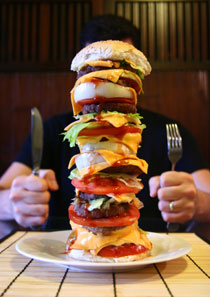
After downing 70 chicken wings in about an hour, Andrew Walen realized he had a problem.

Oh, he had known something was wrong over the years. Normal people don’t consume 4,500 calories worth of food in one sitting, or order takeout for four when dining alone. But it took a maniacal feeding frenzy for him to finally accept the reality: He was a binge eater, and he had absolutely no control around food.

“Ultimately, it was about numbing out and self-loathing,” said Mr. Walen, now 39 and a therapist in Columbia, Md. “There was this voice in my head that said, ‘You’re no good, worthless,’ and I turned to food.”

Mr. Walen is one of an estimated eight million men and women in the United States who struggle with binge eating, defined as consuming large amounts of food within a two-hour period at least twice a week without purging, accompanied by a sense of being out of control.

While about 10 percent of patients with anorexia and bulimia are men, binge eating is a problem shared almost equally by both sexes. A study published online in October and then in the March issue of The International Journal of Eating Disorders found that among 46,351 men and women ages 18 to 65, about 11 percent of women and 7.5 percent of men acknowledged some degree of binge eating.

“Binge eating among men is associated with significant levels of emotional distress, obesity, depression and work productivity impairment,” said Richard Bedrosian, a study author and director of behavioral health and solution development at Wellness and Prevention Inc., which works with employers and health plans.

But while binge eating is challenging for women who suffer from it, the perils are perhaps greater for men, who rarely seek treatment for what many believe is a “women’s disease.” Unlike bulimia and anorexia, binge eating does not even have a distinct listing in the current D.S.M., as the diagnostic guide for mental health professionals is known.

“Guys generally don’t come forward for any reason,” said Ron Saxen, 49, author of “The Good Eater,” a memoir of his struggle with binge eating, which began when he was about 11. At his worst, Mr. Saxen was consuming 10,000 to 15,000 calories’ worth of Big Macs, French fries, chocolate milkshakes, candy bars, ice cream and M & Ms, often within an hour-and-a-half window.

Those men who do seek treatment often have difficulty finding a facility or therapist to work with them — even the literature is predominantly female-centric. Before Vic Avon was given a diagnosis of anorexia in 2006, for example, he scoured the Web for information relating to men and eating disorders. “Everything I saw was written for and by women,” said Mr. Avon, 29, a building contractor in Brick Township, N.J.

Mr. Avon seesawed between anorexia and binge eating (not uncommon), at one point weighing 300 pounds. “I was so ashamed because it was a girl’s illness, I thought. I didn’t have any guys to look to.”

Many binge-eating men do not even recognize that anything is wrong. About 70 percent of people with binge eating disorder are overweight or obese, but a higher weight is generally more culturally acceptable for men than for women.

“There’s nothing wrong with a college guy eating a whole pizza by himself, but with women they would be horrified,” said Roberto Olivardia, a clinical psychologist who specializes in the treatment of body image disorders and eating disorders in men and is an author of “The Adonis Complex.”

Even if they are disturbed by their food intake, few men make the connection between gorging and emotional distress. “With men it’s usually a disconnect,” said Mr. Walen, the former binge eater turned therapist. “It’s about ‘I want to eat,’ not ‘I’m coping with an emotional trauma.’ ”

Adam Lamparello’s binge eating was both physical and psychological, the result of the starvation that ensued during his six-year bout with anorexia, and his attempt to fill the “emptiness, loneliness and emotional void” that he felt in his life.

“Those with binge eating disorder often do not have meaningful relationships with other people, are isolated, believe that life has no purpose or have suffered prior traumatic events and turn to food for emotional comfort,” said Mr. Lamparello, 36, a lawyer in Hasbrouck Heights, N.J., who recently published “Ten-Mile Morning: My Journey Through Anorexia Nervosa.”

Men like Mr. Avon and Mr. Walen often struggle to find help. But the tide may be slowly turning as awareness about men and binge eating grows. Chevese Turner, founder and chief executive of the Binge Eating Disorder Association, said about 20 percent of the calls she receives are from men, up from 5 percent when she started the organization in 2008.

In general, cognitive behavioral therapy is the most successful treatment for binge eaters, said Sarah J. Parker, the director and a founder of the Reeds Center, an outpatient mental health center in New York that treats men and women who have anxiety and eating disorders. Treatment often begins with efforts to recognize distorted, all-or-nothing thinking and to begin monitoring one’s eating, sleeping and exercise patterns. Since many binge eaters restrict food intake during the day and binge at night, the goal is to get them to eat three meals a day and a snack.

Whether or not one can be fully cured of binge eating depends on one’s definition of “cured.” An October 2011 study in The Journal of Consulting and Clinical Psychology reported a 51 percent remission rate for patients a year after using cognitive behavioral therapy. Therapy did not lead to weight loss, however.

“Do people stop binge eating and basically not binge eat again? Yeah,” Ms. Parker said. “Is it O.K. to have an episode once a month? For some people that might be a cure.”

Mr. Saxen finally went to a therapist at age 40. While he no longer binges, “I’m in the camp of A.A. — you’re always recovering,” he said. “There are times when bad things are happening, and I have my moments.”

After the chicken wing incident, Mr. Walen also sought treatment. He has not had a full-on, out-of-control “big B” binge since 2006 — but he has had “little B” moments. “I would say that most people have ‘little B’ binges where they go, ‘I know I overate, but it didn’t come with a lot of guilt shame stuff.’ I think almost everyone goes through that a few times a year,” he said.

Perhaps the greatest challenge, experts say, is to persuade more men to come forward and seek treatment. “You have to have alternative means of getting men to acknowledge the problem,” Dr. Bedrosian said. “We need to find alternative ways for men to get screened, we have to encourage the screening for all eating disorders in primary care,” with an emphasis on making sure men as well as women receive attention.

He added, “If I were training medical students today I would say, ‘When you’re discussing weight loss programs with an obese patient, make sure you ask them about binge eating behavior.’ ”

Wednesday, September 19, 2012

Why Do We Hate Athletes Who Cheat?

Armstrong gives Jan Ullrich "The Look" as he passed him on the final climb of L'Alpe d'Huez after feigning fatigue (2001 Tour de France)

Lance Armstrong may be one of the few "guilty as sin" athletes not to be totally rejected by his fan base. In baseball, people like Mark McGuire, Sammy Sosa, Barry Bonds, Alex Rodriguez, and Roger Clemons, to name only a few, lost a lot of their fans and likely any chance at being elected to the Hall of Fame because of performance enhancing drugs (PED).

Interestingly, this is less true in the NFL, where I have little doubt that the athletes are at least using testosterone injections. The "random" test is on the day of or day after the game, so you piss in a cup and go get your shot. Testosterone levels will be back to normal by the next week's game, and you will have healed quicker and better than you could have without the drug.

We seem to get - consciously or not - that modern professional football might be a sport that demands drug use. On the other hand, it's a sport set up to facilitate PEDs, and when someone does get caught, it is generally not a top-tier player.

So why do we get bent out of shape about athletes using PEDs? Why does it warrant hearings in Congress (which is a complete and total farce and waste of tax dollars)? Why will Barry Bonds, who was probably the best hitter the game has seen and holder of the career home run record, never make it into the hall of fame?

Here is one possibility:
Athletes must work "near the edges of endurance and the outer fringes of metabolic stability. Conditioning and diet allow the athlete to engage at the highest levels of human body performance, incredibly close to the breakdown points of cardiovascular, respiratory, and digestive systems. With the body close to its limits, the pressures, and the years of effort and expense for training all on the line, it is no wonder that some of our heroes suppress these intense feelings by succumbing to performance-enhancing and pain-relieving drugs. The surprise is that we are disappointed in them when they are found out, not because we are doing any better in holding it all together without prescribed or recreational pharmaceutical support, but because the weakness of the hero exposes our own insufficiencies and guilty sedations."  

~ Alan Fogel, The Psychophysiology of Self-Awareness: Rediscovering the Lost Art of Body Sense
Maybe Fogel is correct, maybe if we see our heroes falter, see them as human beings like ourselves, it reminds us that we too are flawed. It seems most people in this country would do anything to avoid those feelings.

I think part of the reason I support drug use in sports, however, is because I can identify with them. I have been an athlete. I know how hard it can be to stay in peak condition for months at a time, fighting off injuries, fatigue, and other stress. I've played four or five full 90-minute, tournament-level soccer games in a single 3-day weekend, and if there was drug I could have taken back then to perform better, I might have done it.

When I watch the three major cycling races (Giro d'Italia, Tour de France, Vuelta a Espana), I have no idea how they could ride for three weeks at the speeds they do without PEDs. It's no wonder there are more cyclists suspended for PEDs than in any other sport on the planet.

We held up Lance Armstrong as an almost super human hero - until we found out that he too is mortal. Then we judge him and take away his victories, in itself a silly decision since all the other contenders in those races were also using PEDs.

We, as a nation, cannot understand the pain he endured to win those races because we cannot bear the pain of our daily lives.


We are a nation drugged on sugar, tobacco, alcohol, marijuana, methamphetamine, antidepressants, tranquilizers, sedatives, narcotics, and on and on, what right do we have judge athletes who use PEDs to be the best in their particular sport?

The athletes at least have a goal - we are just numbing ourselves to avoid life.

Friday, July 13, 2012

Ending the Cycle - Perspective and Personal Story

These two posts feel connected in my mind - whether or not they are is up to you, I suppose. The first one is a Daily Om from a while ago, which I may have posted by itself. The second is a personal story by Dan Dianda at The Mindful Word.

Ending the Cycle: Start Today


by Madisyn Taylor

Each day offers us an opportunity to renew our resolve to the universe that we are ready for change.


One of the hardest things in life is feeling stuck in a situation that we don’t like and want to change. We may have exhausted ourselves trying to figure out how to make change, and we may even have given up. However, each day offers us an opportunity to renew our resolve and to declare to the universe that we are ready for change. We may even say out loud that we have tried and struggled and have not found a way, but that we are open to help, and that we intend to keep working to create change for ourselves. Making this declaration to the universe, and to ourselves, may be just the remedy for the stagnation we are experiencing. And, it can be done today, right now.

It is difficult to understand, even with hindsight, how the choices we have made have added up to our current situation, but it is a good idea to examine the story we tell ourselves. If we tend to regard ourselves as having failed, this will block our ability to allow ourselves to succeed. We have the power to change the story we tell ourselves by acknowledging that in the past, we did our best, and we exhibited many positive qualities, and had many fine moments on our path to the present moment. We can also recognize that we have learned from our experiences, and that this will help us with our current choices.

When we do this kind of work on how we view our past self, we make it possible for the future to be based on a positive self-assessment. This inner shift may allow us to get out of the cycle we’ve been in that’s been keeping us stuck. Now we can declare our intentions to the universe, knowing that we have done the inner work necessary to allow our lives to change. Allow today to be the day to end cycles and enter into a new way of being.
I'm not sure about declaring things to the universe, but there are often times in our lives where we wonder how we ended up in this moment and place and situation. All of our choices in the past have led us to this moment, and this moment, and this moment.

If we do like where we find ourselves, it's up to us to change things. Only I can create a new future from this moment forward by making new choices. Each morning that I wake up is a new day in which I can make new choices to create the future I desire - it's never easy, and in fact, change is one of the hardest things for most us to accomplish.

In a post related to this topic, Dan Dianda at The Mindful Word wrote about his own experience with how he "began to question what was going on around me and why I went along without checking in with myself—without questioning the narrative spinning in my head."
Don Dianda is the author of See for your Self: Zen Mindfulness for the Next Generation. Through meditation, daily mindfulness practice, and individual koan work, Dianda seeks to shed light on the inherently deep connection one can have with the experience of this life as well as the world one moves through. Stepping into the now and recognizing the movements within the mind is where the path begins.

Here is his article.

REAL MEANING: A personal essay on questioning the fabricated reality of one’s life 

WE CREATE OUR OWN REALITY: I had it all, or so I thought
“Every day is a journey, and the journey itself is home.”—Matsuo Basho

Growing up in a well-to-do American family is materially comfortable. Family troubles aside—and they can be considerable—life is full of pleasure: desires are satisfied, drinks guzzled and fanciful whims gained. There are high school football games, school days, workdays, sex, travelling, television, Fourth of July celebrations, drama, weekend all-nighters, jokes, cliques, victories, and defeats. Like a giant cliché, life unfolds, and it unfolds around a focal point: me-I-a separate ego. From here good and bad, love and hate, sad, mad, happy, despair, upbeat, low, subject, object, outside, come together to form one’s life experience. To keep some form of sanity, we follow our mind and attempt to gratify its wants and needs as a way to find fulfillment and success. We create stories and follow them. We listen to our thoughts intently—to the point where we eventually become them. We go for more and more. But is that it? I found out. Coming home at three in the morning tired, intoxicated, full of shallow thoughts and loaded with cheap laughs, my life was passing before my eyes.

Throughout my first two years in college, I often had the urge to “black out,” literally. Though I wasn’t conscious enough to be aware of it at the time, I wanted to be able to float through life, running from painful experiences that had rooted themselves into my psyche. The path at the time was simply to ignore any stirrings within and to keep going, to press on, to focus on money and being accepted within the constructs of the society I found myself in. These were the values, but I wasn’t buying them anymore.

Something was shifting inside me. I wasn’t aware of what it was or how it was working. I just began to question what was going on around me and why I went along without checking in with myself—without questioning the narrative spinning in my head.

I changed my life and woke up during my junior year of college: I’d had enough. The drinking didn’t do it for me. The partying didn’t do it for me. Vegas, Miami, L.A., didn’t do it for me. I felt completely strange and insubstantial in my own body. Everything I had created, my ego, my friendships, my internal wiring, my identity—aspects of my external being I had spent years cultivating, shaping and reshaping—were just the bones of a paper tiger in the face of the stirrings of what lay buried beneath. I’d been living in a dream and I was finally beginning to realize it.

The slow change within my heart had been an ongoing process. There had been an upswelling of feeling and emotion when I had been alone hiking in the hills or swimming in the ocean. Also, brief moments of disconnect from my social life allowed questions, concerning what I was doing, to bubble up. But fear and doubt coincided with these thoughts. So, naturally I did what I was good at, I dove back into my life with added vigor. I denied. I suppressed all my inner yearnings with more alcohol, more drugs, and more meaningless relationships. I searched for more of the same to fill the growing inner void and outer disconnection—feeding my ego, only to have it come back to me over and over again. There was something deep inside that persisted in repelling my unconscious overtures. Though I did not realize it at the time, my Self was saving me from myself.

If time passes in the blink of an eye, how could insubstantial things be more valuable than the present moment?

One early morning after going out and drinking, I came home feeling slightly ill. I crawled into bed and passed out, something many of us can relate to. In the night, I dreamed that a powerful, jet-black snake had been sucking vital energy from the back of my neck. Its muscles pulsated with each drink. All I could do was grab it and pull, but to no avail.
Read the whole article.

Monday, March 26, 2012

Michael Taylor - What Are The Benefits Of Meditation For Men?


Last Friday's conversation on A New Conversation with Men, hosted by Coach Michael Taylor, featured Peter Vroom talking about his "The Resolute Mind" meditation technique and "how it can support men in dealing with the multiplicity of challenges men deal with on a daily basis."


Listen to internet radio with Coach Michael Taylor on Blog Talk Radio


What Are The Benefits Of Meditation For Men?

by Coach Michael Taylor


Men are faced with unprecedented stresses and challenges today. Unfortunately, too many men turn to alcohol, drugs and sex to try to deal with this stress.

Join Coach Michael Taylor as he speaks with Peter Vroom about The Resolute Mind meditation technique and how it can support men in dealing with the multiplicity of challenges men deal with on a daily basis.

Peter Vroom has been studying Vedic Meditation since 2002 and was an assistant teacher with Limor Babai for many years. He ran many advanced knowledge courses and assisted many students to a greater understanding of the technique. After finishing his training with Thom Knoles in India and the US, Peter now runs his own centres in LA, Sydney and New York. 

Find him here: www.theresolutemind.com
Meditation is good - no matter what it's called or what lineage it's from. At the very least, just sit with good posture, breathe naturally with your belly, notice the breath move in and out, and repeat. Do this until you have been sitting for 5, 10, or 15 minutes. Evey time your mind wanders from the breath, notice "thinking" or "drifting," and gently bring attention back to the breath.


For a more in-depth instruction, see this article by Thanissaro Bhikkhu on Basic Breath Meditation Instructions.