Showing posts with label perspective. Show all posts

Monday, July 14, 2014

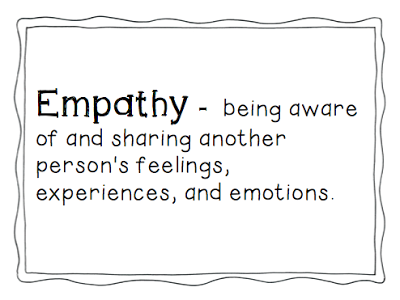
Denise Cummins - Why Some People Seem to Lack Empathy

https://blogger.googleusercontent.com/img/b/R29vZ2xl/AVvXsEj6q0ntngPzy2AAcGTGIg8TPvJ613e9BbatSBtHZPrbwBlH-YNVgTMAjmXBfCVuIYfnr96fgcWz9G3w2t44UUPtMe3bjbpiy1RpXZx-F0Aj_-5XlPQqoEo_dsC-Daua2vs5HLA3WOqygaVY/s400/Empathy.png

Between men and women, men usually get the bad rap for not being very good about expressing empathy, unfairly I would suggest.

This post from Psychology Today's Good Thinking blog, by Denise Cummins, Ph.D., offers some insight into people (not just men) seem to lack empathy - and it's a study of women only (no men).


Why friends sometimes shun each other when they should be there instead.

Published on June 23, 2014 by Denise Cummins, Ph.D. in Good Thinking

"You OK? You seem distracted", asks Alice's coworker.


"Yes, I'm OK", Alice responds. "It's just that my mother is in the hospital again, and I'm not sure she's going to make it this time." Alice's voice cracks, and she reaches for a tissue to wipe her tears. When she looks up, she is surprised to find her coworker has vanished.

To make matters worse, her coworker avoids her for the rest of the day. He is even hostile when Alice asks for information she needs to complete a report.

Later that evening, her coworker sends her an email that simply says, "Sorry. Couldn't take it."

Most of us have had interactions like this that leave us scratching our heads. We can reverse the sexes in the above scenario, or have both parties be the same sex. It doesn't matter. It still surprises and chagrins us when people we consider friends—decent, kind people—seem to abandon us when we most need emotional support. They are clearly not sadists who delight in the suffering of others or psychopaths who are indifferent to it. So their behavior is perplexing.

This kind of interaction can lead to anger, judgment, and recriminations—the "you don't care about me" outrage response. But here is the problem: Both parties feel their feelings have been trampled.


The Empathy Response Can Lead to Emotional Overwhelm

Consider what happens inside us when we view the suffering of others. When we experience physical pain or emotional distress ourselves, a neural circuit becomes activated (anterior cingulate cortex—or ACC--and insula).  Neuroscientific research shows this same circuit gets activated when we see others suffer pain or emotional distress. So seeing the suffering of others causes us to suffer as well.
Although this response is crucial for social interaction, it is indeed unpleasant. If that circuit is hit too frequently (excessive sharing of others' negative experiences), it can lead to emotional burnout.

And so people develop strategies for protecting themselves. Some do what Alice's coworker did—put physical and emotional distance between themselves and the suffering person. Some stay present but emotionally dissociate, which the sufferer usually experiences as emotional abandonment.

Coping with the Emotional Overwhelm of Empathy

A crucial part of socialization is learning how to protect oneself from being overwhelmed by the suffering of others while still giving them the support they need and deserve.

Research suggests that the answer to this dilemma may be compassion training. Compassion is defined as a feeling of concern for the suffering of others (rather than experiencing distress in the face of the suffering of others.) Programs aimed at training compassion have been found to foster prosocial (helping) behavior while evoking a feeling of emotional well-being.

Recent research led by Max Planck scientist Olga Klimicki showed that compassion training actually affects which neural circuits are activated when viewing the suffering of others. 

This was the basic design of the experiment:


Compassion study design
The design of an fMRI study on compassion training

The affect group viewed three blocks of video clips that consisted of a high-emotion and a low-emotion video clip (10-18 seconds long). The clips were taken from newscasts or documentaries. The high-emotion video showed people suffering physical or emotional distress. The low-emotion vides showed everyday scenes that did not include suffering. fMRI brain scans were taken while the women viewed the videos. After each video, the women rated how much empathy, positive feelings and negative feeling they had experienced while seeing the video. They were told that "empathy" meant how much they shared the emotion of the persons in the video clips.

The first session was the baseline—the women simply viewed the videos and their natural responses were recorded. Following this pre-training viewing session, the women received "empathy training" to enhance their empathetic responses. This training consisted of instructing them to focus on resonating with the suffering they were viewing. The second viewing session followed this training. Following this, they received "compassion training" which consisted of a meditation for directing love and compassion toward themselves and others. They then viewed the third and final set of videos. (A control group completed a memory task that consisted of learning lists of neutral words.)

The results were quite striking: As expected, the women showed more distress to the high-emotion clips than the low-emotion ones, both in their fMRI scans and their own ratings. The scans showed activation of the "empathy circuit" (ACC and insula). Their distress was enhanced following empathy training—greater activation in their empathy circuitry, higher negative emotion ratings, and lower positive emotion ratings.

But importantly, compassion training reversed these effects: Negative emotion ratings returned to baseline levels, positive emotion ratings surpassed baseline levels, and a brain circuit associated with reward and affiliation became activated (medial orbitofrontal cortex and striatum).

The researchers concluded that compassion can be trained as a coping strategy to overcome empathic distress and strengthen resilience. Rather than feeling overwhelmed by the suffering of others, those trained in compassion can offer help while simultaneously deriving peace and satisfaction from reducing the suffering of others.

Final note: You may be wondering why only women served as participants in the study. The answer can be found here.

Copyright June 23, 2014 Denise Cummins, PhD

Dr. Cummins is a research psychologist, a Fellow of the Association for Psychological Science, and the author of Good Thinking: Seven Powerful Ideas That Influence the Way We Think.

More information about me can be found on my homepage
And my author page.
Follow me on Twitter.
And on Google+.

Monday, March 3, 2014

Pamela Druckerman - What You Learn in Your 40s (and What I Learned)

This piece from The New York Times is pretty accurate, for men as well as for women. As I approach 47, I tend to think of my 40s as the decade when I finally figured who the hell I am and what my own unique purpose is in this lifetime. I also learned it is okay to fail - most people are too self-obsessed to notice, and those who aren't are my likely to lend a hand than to laugh. I wish I had known that in my teens and 20s.

There are a few things important in my life that are not in Druckerman's list, and these may be issues more important to men than to women (or not).
  • Aging does not require that we become overweight and sedentary and, in fact, staying fit makes the numbers we associate with age mean nothing. I was the most fit I have ever been when I turned 40 - and even now I am only a 2-week carb restriction from being that lean again, and now with more muscle. Oh yeah, aging does not mean we still cannot increase muscle mass - it's harder, but it is still possible.
  • As libido decreases with age, the quality of sex increases in many profound ways (if you are conscious). Quality is way better than quantity.
  • Grey hair and gradual hair loss do not make me old or less masculine. I will never color my hair again . . . unless I go goth again for some strange reason.
  • Clothes should comfortable and functional. I could not care less if I am stylish but am not at all comfortable. Utility beats fashion every time for me.
  • It's okay for man to have 10 or more pairs of shoes. I have 6 or 7 different pairs of athletic shoes, each with its own functional quality that I like. I have some casual shoes, some dress shoes, and hiking boots. Okay, so maybe I have 15 or more pairs of shoes (not including soccer cleats [2] and cycling shoes [3]).
What have you learned in your 40s?

What You Learn in Your 40s


SundayReview | Contributing Op-Ed Writer
FEB. 28, 2014

Pamela Druckerman 
PARIS — IF all goes according to plan, I’ll turn 44 soon after this column appears. So far in my adult life, I’ve never managed to grasp a decade’s main point until long after it was over. It turns out that I wasn’t supposed to spend my 20s frantically looking for a husband; I should have been building my career and enjoying my last gasp of freedom. I then spent my 30s ruminating on grievances accumulated in my 20s.

This time around, I’d like to save time by figuring out the decade while I’m still in it. Entering middle age in Paris — the world’s epicenter of existentialism — isn’t terribly helpful. With their signature blend of subtlety and pessimism, the French carve up midlife into the “crisis of the 40s,” the “crisis of the 50s” and the “noonday demon” (described by one French writer as “when a man in his 50s falls in love with the babysitter”).

The modern 40s are so busy it’s hard to assess them. Researchers describe the new “rush hour of life,” when career and child-rearing peaks collide. Today’s 40ish professionals are the DITT generation: double income, toddler twins.


The existing literature treats the 40s as transitional. Victor Hugo supposedly called 40 “the old age of youth.” In Paris, it’s when waiters start calling you “Madame” without an ironic wink. The conventional wisdom is that you’re still reasonably young, but that everything is declining: health, fertility, the certainty that you will one day read “Hamlet” and know how to cook leeks. Among my peers there’s a now-or-never mood: We still have time for a second act, but we’d better get moving on it.

I think the biggest transition of the 40s is realizing that we’ve actually, improbably, managed to learn and grow a bit. In another 10 years, our 40-something revelations will no doubt seem naïve (“Ants can see molecules!” a man told me in college).

But for now, to cement our small gains, here are some things we know today that we didn’t know a decade ago:

If you worry less about what people think of you, you can pick up an astonishing amount of information about them. You no longer leave conversations wondering what just happened. Other people’s minds and motives are finally revealed.

•People are constantly trying to shape how you view them. In certain extreme cases, they seem to be transmitting a personal motto, such as “I have a relaxed parenting style!”; “I earn in the low six figures!”; “I’m authentic and don’t try to project an image!”

•Eight hours of continuous, unmedicated sleep is one of life’s great pleasures. Actually, scratch “unmedicated.”

•There are no grown-ups. We suspect this when we are younger, but can confirm it only once we are the ones writing books and attending parent-teacher conferences. Everyone is winging it, some just do it more confidently.

•There are no soul mates. Not in the traditional sense, at least. In my 20s someone told me that each person has not one but 30 soul mates walking the earth. (“Yes,” said a colleague, when I informed him of this, “and I’m trying to sleep with all of them.”) In fact, “soul mate” isn’t a pre-existing condition. It’s an earned title. They’re made over time.

•You will miss out on some near soul mates. This goes for friendships, too. There will be unforgettable people with whom you have shared an excellent evening or a few days. Now they live in Hong Kong, and you will never see them again. That’s just how life is.

•Emotional scenes are tiring and pointless. At a wedding many years ago, an older British gentleman who found me sulking in a corner helpfully explained that I was having a G.E.S. — a Ghastly Emotional Scene. In your 40s, these no longer seem necessary. For starters, you’re not invited to weddings anymore. And you and your partner know your ritual arguments so well, you can have them in a tenth of the time.

•Forgive your exes, even the awful ones. They were just winging it, too.

•When you meet someone extremely charming, be cautious instead of dazzled. By your 40s, you’ve gotten better at spotting narcissists before they ruin your life. You know that “nice” isn’t a sufficient quality for friendship, but it’s a necessary one.

•People’s youthful quirks can harden into adult pathologies. What’s adorable at 20 can be worrisome at 30 and dangerous at 40. Also, at 40, you see the outlines of what your peers will look like when they’re 70.

•More about you is universal than not universal. My unscientific assessment is that we are 95 percent cohort, 5 percent unique. Knowing this is a bit of a disappointment, and a bit of a relief.

•But you find your tribe. Jerry Seinfeld said in an interview last year that his favorite part of the Emmy Awards was when the comedy writers went onstage to collect their prize. “You see these gnome-like cretins, just kind of all misshapen. And I go, ‘This is me. This is who I am. That’s my group.’ ” By your 40s, you don’t want to be with the cool people; you want to be with your people.


Just say “no.” Never suggest lunch with people you don’t want to have lunch with. They will be much less disappointed than you think.

•You don’t have to decide whether God exists. Maybe he does and maybe he doesn’t. But when you’re already worrying that the National Security Agency is reading your emails (and as a foreigner in France, that you’re constantly breaking unspoken cultural rules), it’s better not to know whether yet another entity is watching you.

Finally, a few more tips gleaned from four decades of experience:

•Do not buy those too-small jeans, on the expectation that you will soon lose weight.

•If you are invited to lunch with someone who works in the fashion industry, do not wear your most “fashionable” outfit. Wear black.

•If you like the outfit on the mannequin, buy exactly what’s on the mannequin. Do not try to recreate the same look by yourself.

•It’s O.K. if you don’t like jazz.

•When you’re wondering whether she’s his daughter or his girlfriend, she’s his girlfriend.

•When you’re unsure if it’s a woman or a man, it’s a woman. 


~ Pamela Druckerman is the author of “Bringing Up Bébé: One American Mother Discovers the Wisdom of French Parenting,” and a contributing opinion writer.