Showing posts with label resolutions. Show all posts

Wednesday, January 1, 2014

A Healthy New Year, Part One: Creating a Weight Training Workout


Here is a little offering for the new year on how to create your own weight training workouts.

Most people don't plan to fail in their New Year's resolutions to get in shape or lose some weight, the problem is that they often fail to plan. That means having a strategy for workouts and a specific and measurable goal. This is the first part of a series designed to help you understand how to construct basic training programs.

Part Two will discuss ways to use weight training as cardio and to burn fat.


Creating a Weight Training Workout

From the following menu of exercises (not exhaustive - see Bobybuilder.com for an exhaustive list), pick one exercise from each bodypart/body region using either free weights or machines (or some of each). Ideally, there is a leg exercise, a back movement, a chest movement, a shoulder exercise, and an ab exercise or two.

If you are pressed for time, go down to three exercises: a leg movement, a press, and a pull. Ideally, you will use one of the "Big" lifts for each exercise, for example, front squat, DB bench press, and pull ups.

You can also use full-body exercises and “odd equipment” movements to add intensity.

You’ll notice that there are no direct arm exercises - they are a waste of time if fat loss and muscle are the goals. All pulling exercises work your biceps and all pushing exercises work your triceps. If you want to add arm work, please feel free to do so, but add it in as a finisher (see Part Two, when it's posted).


Free Weights

Legs
  • Static Lunges or Walking Lunges
  • Barbell Squats, DB squats, Goblet Squats, Bodyweight Squats
  • Jump Squats, or Lunge Jumps (change feet in air), with or without dumbbells
  • Barbell Deadlift, DB deadlift, Romanian deadlift, Uni-lateral Romanian deadlift, KB Deadlift (sumo style, wide stance)
  • Overhead Squat (hold barbell or DBs overhead and squat), One-Arm Overhead Squat (DB or KB)
  • Sprints, Standing Broad Jump, and Lateral Jumps (if space allows)0
  • Drag or Pull a Sled (if available) or a wheelbarrow loaded with rocks
  • Core Ball Hamstring Curls (Lying on back, place feet on the core ball, legs straight, lift butt off the floor until body is in a straight line, then roll the ball toward your butt by pulling with heals, then roll back out - that’s one rep - can also be done one leg at a time to make it harder)

Back
  • Pull-ups (bodyweight or assisted), Chin Ups (palms toward face, bodyweight, or assisted)
  • One Arm DB or KB Row, Body Row (use TRX, rings, or smith machine bar set low), Barbell Row, Double KB Row
  • DB Pullover (hold dumbbell with both hands over chest and lower behind the head as far as possible w/out pain, them using the lats pull the DB back to start position)
  • Bent laterals, Barbell/DB bent shrugs (pull shoulder blades together)
  • Shrugs, High pulls, Hang clean, Squat clean, Snatch (from floor or from hang) - Do not try Olympic lifts without some coaching on form.

Chest
  • Bench Press, DB Bench Press, Push-Ups, TRX Push-Ups, Spiderman Push-Ups, Resistance Band Standing Press (press straight out the front of the body, hands coming together slightly), Dips (weighted, bodyweight, or assisted)
  • Incline Variations of Bench Press, DB Press
  • DB Flies, Incline DB flies, TRX or Ring Flies, Resistance Band Flies
  • Pullover (works lats and pecs)

Shoulders
  • DB Overhead Press, KB Press, DB Push-Press (or one-arm variations of these)
  • Seated Barbell Press, Standing Barbell Press, Push Press
  • DB Side Laterals, DB Bent Laterals, DB Front Laterals, Combinations (of first three)
  • Upright barbell row, or Upright DB row

Abs
  • Planks, TRX or Ring Fall Outs, Side Planks, Bodysaw
  • Hand Step-Ups (step down and back up one hand at a time on a 6” riser), Plank to Push-Up Position (from push-up position, place one elbow on floor, then the other, then back up to push-up position), Push-Up Reach Under (from top of push-up position, reach one arm under and touch the opposite hip, alternate arms)
  • Reverse Crunch (lying on back, feet in the air, raise hips off the floor)
  • Inch Worm (from standing, touch the floor then walk hands out to slightly past shoulders and walk them back to feet, then stand up)
  • Back Bridges (lying on back, feet on floor w/ knees bent, lift hips off the floor and squeeze the butt muscles, then slowly lower back to floor) - Can be done one-legged, with feet on BOSU ball or with feet on Core Ball
  • Ab Wheel Roll-Outs (knees on floor, on BOSU Ball, or on stability disc) - Can also be done with a loaded barbell

Full-Body Exercises
  • Kettlebell Swing (or DB) One or Two-hand, Full-Body Extensions, Burpees (add push-up and/or jump), DB Clean and Press, DB Snatch, Battling Ropes, Medicine Ball Slams, DB Squat-Press, Spiderman Push-ups, Renegade Push-ups with Row, Snatch into uni-lateral overhead squat (DB or KB)


Machine Exercises

Legs
  • Horizontal Leg Press or Seated Leg Press (NOT 45 degree angle machines)
  • Seated, Standing, or Lying Leg Curl
  • Leg Extension (do lower weights for higher reps)

Back
  • Lat Pull-Down (wide handles or narrow v-grip), One-Arm Lat Pull (use cable handles), Straight-Arm Lat Pull (Standing, arms straight but elbows not locked, bar slightly higher than head, use upper back pull to bar to the hips while heeping arms straight, then reverse under control)
  • Seated Row, Seated Cable Row, Seated One-Arm Cable Row (use cable handles)
  • Standing Cable Row (knees soft), Standing One-Arm Cable Row (knees soft)
  • Seated pullover

Chest
  • Seated Chest Press, Incline Chest Press
  • Seated Chest Flies, Cable Chest Flies
  • Seated pullover

Shoulders
  • Seated Overhead Press, Seated Laterals


SAMPLE Work Outs:

General guidelines:
  • Use a rep range of 3 to 20 (lower reps = heavier weights; higher reps = lower weights)
  • Aim for 24-60 reps per exercise total (so 10 sets of 3 reps, 5 sets of 5 reps, or 6 sets of 6 reps, or 3 sets of 12 reps, and so on)
  • Heavier weights, lower reps (3-6) = strength; Lighter weights, medium reps (6-10) = muscle and strength; Light weights, high reps (10 or more) = muscular endurance - All are good for fat loss if rest periods are minimal
  • These suggestions apply to machine exercises, too
  • For best metabolic effect, use supersets (2 exercises) or giant sets (3 or more exercises)
  • On average, do 2 back exercises for every chest exercise
  • When supersetting, pair a push and a pull, or an upper body and lower body
  • Total workout time should be 30-45 minutes
  • If you have access, add sprints, sled pulls/pushes, sledge hammer swings, tire flipping, etc.
  • ALWAYS use good form, and if form is failing, put the weight down
Workout A:
  • DB Jump Squats
  • Unilateral Kettlebell Row
  • Spiderman Push-Ups
  • DB Squat-Press
  • Bodysaw
  • Battling Ropes
For the above workout, it might look like this if we use supersets:

A1: DB Jump Squats, 8 reps
A2: Unilateral KB row, 8 reps
> 4 sets

B1: Spiderman Push-ups, 12 reps
B2: DB Squat-Press, 12 reps
> 3 sets

C1: Bodysaw, 30 seconds
C2: Battling Ropes, 30 seconds
> 30 seconds rest, then repeat for 6 total sets

Workout B:
  • Seated Leg Press
  • Lat Pulldowns (vertical pull)
  • Incline Chest Machine
  • Seated Overhead Press
  • Seated Cable Rows (horizontal pull)
  • DB Swing
  • Ab Wheel Roll-outs
I might do this in the following way (assuming easy access to all machines, which is tough in a commercial gym):

A1: Seated Leg Press, 20 reps
A2: Lat Pulldowns, 8 reps
A3: Incline Chest Machine, 8 reps
> 3 sets - on lats and chest aim for a quick pull or push, then let the lat bar go up on a 3-5 seconds count, and the chest machine handle come down on 3-5 seconds count

B1: Seated Overhead Press, 6 reps
B2: Seated Cable Rows, 6 reps
> 5 sets

C1: DB Swing, 15 reps
C2: Ab Wheel, 12 reps
> 3 sets, minimal rest


In Part Two, I will discuss ways to make weight training into the best fat burning exercise you can do - and still build cardiovascular capacity and maintain or even build muscle.

Saturday, January 1, 2011

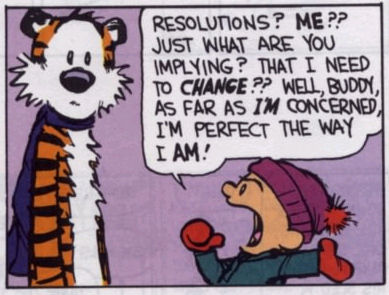
Do You Make New Year Resolutions? What Are Your Yours for 2011?

http://www.askdavetaylor.com/4-blog-pics/calvin-hobbes-new-years-resolutions.jpg

I resolved many, many years ago to never again to make a New Year resolution - it's the only resolution that has ever stuck for me. Before that, I would make my yearly promise to quit smoking, stop swearing, or whatever I thought I needed to do for that year. Within a week or two I was back to my old habits.

When I quit smoking it was the end of April, when I began eating well, it was in September, and so on - for me, I know when it's time and I do it, whenever that awareness arises. I could never make a serious choice just because it is a new year, or a new week, or a new whatever.

But I know for others resolutions can work - some of my clients came in on a resolution and are still training. I know people who are very successful with resolutions - apparently, around 40-60% of people are still successful at 6 months (if this were true for people who join gyms, they would be packed in like sardines).

I hope all of us will be the best men we can be in 2011 - whether that takes a resolution or simply setting the intention each morning as we begin the day, every day, for the rest of our lives.

But if you are one of those people who does well with resolutions, here are two articles to help you out - one on health and one on spirituality - and at the end there are a few more links to articles to help you out, or give you ideas.

Resolute About Resolutions

Mehmet Oz, M.D. -Vice-Chair and Professor of Surgery at Columbia University, author, radio and TV show host

This is going to be a good year for you. Why am I so positive? I recently came across some evidence to back up my sunny forecast. My friend John C. Norcross, PhD, professor of psychology at the University of Scranton and coauthor of the book Changing for Good, recently shared some research with me. According to his research published in the Journal of Clinical Psychology between 40% and 50% of adults in the United States will make New Year's resolutions and 2/3 will concern life threatening behaviors (smoking, alcohol consumption, obesity). In fact, 40 to 46% of New Year's resolvers will be successful at six months. Contrary to conventional opinion, a considerable proportion of New Year resolvers do succeed. This gives me enormous hope and strengthens my resolve to help you with a very important resolution: helping you lose weight.

New Year's resolutions are a teachable moments, and Dr. Norcross shared with me that you are 10 times more likely to change by making a New Year's resolution than someone with identical goals and motivation who does not make a resolution. For the 2/3's of all Americans who are overweight or obese, this could be life saving information. The stark reality is that carrying excess body fat puts you at greater risk heart disease, cancer, diabetes and stroke. This is a resolution you must take very seriously. I want you to look at this year's resolution a little differently - not as a promise to lose a certain amount of pounds but rather an investment in yourself because you are worth it.

If I start this year with the belief that this year you will reach your goal weight then so must you. I have been teaching about weight loss for decades and with the help of some of my colleagues, co-authors, producers and advisors came up with an 11 week plan that takes the most important principles and combines them into a single plan that will yield the best results and be the easiest to follow. Like all meaningful change, this is a marathon, not a wind sprint. It's an 11 week program called "11 Weeks to Move it and Lose It" and its designed to instill lifestyle, exercise and eating habits that extend long into 2011 and beyond and is easy to find at www.doctoroz.com. Best of all, the program is free so you have run out of excuses.

A New Year's Resolution can be a dramatic or cathartic moment for many people, but I would rather just see it as a new way to do things from now on rather than with the burden and drama of drastic change. Forget about how hard weight loss has been in prior years. Forget that you may have not succeeded in the past. Expect to slip a few times. Dr. Norcross corroborated what I have long taught on the show which is that failing along the way is normal and should be embraced. Like a GPS, simply recalibrate after a wrong turn and make an authorized U turn so you are back on the right path. Allow yourself to be one of the 71% of people we know are strengthened by a slip or minor failure. Refuse to judge yourself.

The first step is to make realistic, attainable goals. Be as specific as possible. Vague goals beget vague resolutions and grandiose goals beget resignation. Body Mass Index (BMI) is a standard tool for helping you judge body weight and amount of body fat you have. An ideal BMI is 25. It's easier to aspire to an ideal BMI than constantly think about how many pounds you have to lose. There is a BMI calculator in this program which will calculate yours if you know your height and weight.

The next step is to choose who is going to be your partner in crime. Social support has been show as critical to success in numerous research studies. I am confident you have at least one friend or family member that needs to lose weight along with you. That person will be a terrific ally in your weight loss journey and you in theirs. If you can include more than one person in your support network, do so. Motivate and support one another. My plan offers a social network for you to talk with other people who are on the same journey. Exercise is central to any weight loss program. You need at least 20 minutes a day and I refuse to believe that is impossible for anybody. I do understand that many people need to be taught how to work out and which techniques yield results. Exercise is not one size fits all. If you have a program customized for you, it will be easier, appropriate, and more likely to bring you to your goal weight. As part of the New Year's "11 Weeks to Move it and Lose It" plan, the Nike SPARQ Training Network (NSTN) have tutorials on the site that will be customized to your individual circumstances. You have the absolute cream of the crop teaching you. You can also plan daily menus and log your meals so you can evaluate eating that is right for you and see where you are failing.

This is going to be a good year. Is there any other way to look at it? It's not about the weight; it's never been about the weight. It's about how much you care about yourself and believing that you can do it. I know this is easier said than done, so as we start our journey know that I care about you and I believe in you. I just want you to care about yourself as much as I care for you. Go start your resolution revolution at www.doctoroz.com and watch the January 3 show!

* * * * *

New Year's Spiritual Renewal: Making Resolutions vs. Transforming Our Identity

Thomas Amelio - Managing Director, New York Open Center

Posted: January 1, 2011

Every year, beginning a day or so after Christmas, and ending New Year's morning, I lead a retreat at Kripalu Center in Stockbridge, MA, called the "New Years Spiritual Renewal Retreat." It's wonderful to be able to get away and do a retreat like this in a yoga resort and educational center like Kripalu, but how can we initiate spiritual renewal wherever we are, and sustain it throughout the year? What are the "spiritual" approaches to change that go deeper -- and are far more successful -- than the mere making of resolutions? In a five-day retreat I cover a number of approaches, and would take a book to share them, but most important is the practice of meditation. I call meditation the "laboratory of life," that indispensable period we take out of our day, not to "self improve," but rather to uncover our underlying divinity. During times of transition, such as the approach of the New Year, many people especially focus on their identity, how to become a new and improved version themselves, and in this retreat I try to show how meditation can deliver a deeper transformation than what we normally think of as self-improvement.

Most of us live in a piece of territory called "me" -- a personality who seems to live inside the boundaries of its skin, separate from all that surrounds it. The Brihadaranyaka Upanishad says that when the sense of an "other" arises, fear (of suffering) arises. This separate personality thus involves itself in a constant strategy of minimizing any potential discomfort or pain, and maximizing its pleasure. It hopes for a happier future filled with good things and experiences.

The spiritual path of yoga, of which meditation (dhyana) is central, seeks to purify us of the five kleshas (obstacles). These are abhivinesh (fearful clinging to life); raga and dvesha; (attraction and repulsion.); asmita (false placement of our sense of identity); and avidya (ignorance of our real nature.)

The beginning of meditation is to relax our minds and bodies to open up a space between our chronically fused patterns of stimulus and reaction. There are many ways to meditate, but we can begin with a simple technique of noting the rising and falling of the diaphragm as we breathe, and allowing all other thoughts to pass without engaging them in any way, returning to our point of focus again and again. Ten to fifteen minutes every day is a great start.

In this newly opened space of consciousness, we increase our capacity to observe without prejudice, and free our mind from being a ping pong ball bouncing between the paddles of conflicting thoughts and emotions. We will soon begin to notice that most of our thoughts are occupied in some way with attraction to the pleasant (raga), and the repelling of the non-pleasant (dvesha): the mind is found to be dwelling on past pleasures or planning new ones, or remembering past pains and strategizing how to avoid them the future . These forces fuel our urge to create an identity whose happiness is optimized, and whose pain is minimized. The problem is that we are stuck in a stressful, swinging pendulum of duality when we try to become someone who can stabilize the one, and prevent the other. (And, unfortunately, the making of resolutions usually arises from this very dynamic.)

Meditation is aimed not at becoming a person with masterful control over attraction and repulsion, likes and dislikes, but rather to soften the hold of such obstacles so that we may regularly experience our underlying divine nature now, while allowing the conditioning of the obstacles (kleshas) to hold less and less sway. And what is our real nature? According to yoga it is Sat Chid Ananda -- existence, consciousness, and joy. This is not an achieved state. It is simply who we truly are, the light which illuminates the film character with whom we currently identify.

A primary klesha we work with in meditation is asmita. Though often translated as "egoism;" this tells us little. The Sanskrit root of "asmita" is "asmi," meaning "I am." Asmita is the process of placing our sense of "I am-ness" in that which we are not. (At the New York Open Center I often share with my students the story of walking behind a man whom I overhear saying "there's me over there." Was he pointing to his divine nature -- or even his own body? No. The "me" to which he was referring was his Mercedes! ) Asmita is placing our identification in objects of perception, including material things, memories, beliefs and concepts -- the ultimate concept being the thought of a being separate "I." Placing our sense of self in that which we are not, prevents us from being anchored in our true ground of being.

Simply having insights into our real nature from time to time is not enough to weaken the hold of asmita. It needs the constant meditative exposure to the light of awareness, where we get to notice the mistake of placing our "I am-ness" in that which we are not, and observe that constant tendency to "become" someone.

And what is the focus of this becoming? It is driven, once again, by the force of raga and dvesha -- attraction and repulsion. We seek to maximize satisfaction and minimize discomfort by becoming someone "better" -- a thinner, richer, healthier person; a more respected, together, successful, lovable, and -- yes -- "spiritual" person.

If we don't engage in this identification process, what we may begin to notice is that there is a radiance and energy increasingly present. It is of the nature of joy -- not a "happy positive" feeling -- but something deeper and more abiding. Then something wonderful happens; the force of asmita (identification) begins to actually work for us. We begin to identify with joy itself -- at least for small moments -- and it starts to inform our bodies, minds, creative impulses and our relationships; we find ourselves making healthier, more creative and loving choices, naturally. It also illuminates our calling in life -- our dharma, and our service to the world, and alleviates the quandary of struggling to choose the "right" path. The pull to self-improve that drives us to make New Year's resolutions is fulfilled on a grander scope, and in a deeper way, through the conscious transformation of our identity made possible through regular meditation practice.
Related On Huffington Post:

New Year's Resolutions: 10 Easy Ways To Recharge, Restore And Renew In 2011

This year, don't think of New Year's resolutions as a punishment or a task; see them as a way to introduce (or reintroduce) positive behaviors...

New Year 2011: Books About Starting Over (PHOTOS)

As we begin to ring in the New Year, we reflect on the past and think about making changes for the future. Some New Year's...

Read more from Huffington Post bloggers:

Sam Harris
Sam Harris: A New Year's Resolution for the Rich
American opposition to the "redistribution of wealth" has achieved the luster of a religious creed. And, as with all religions, one finds the faithful witlessly espousing doctrines that harm almost everyone.

Dr. Andrew Weil
Dr. Andrew Weil: Turmeric Health Benefits: Have a Happy New Year With Turmeric
The National Institutes of Health lists 24 current studies on the effects of turmeric and its chief active component, curcumin.

David Katz, M.D.
David Katz, M.D.: New Year's Eve 2011: The Average Lifespan of a Resolution, and How to Make Yours Stick
We all make New Year's resolutions at the same time, but there is no reason to think we are all comparably ready to make lasting behavior change at the same time.

Wray Herbert
Wray Herbert: New Year's Resolution: Why Fuzzy, Ambiguous Resolutions Work Best
Common thinking is that people prefer precise information -- If we can measure it, we can manage it. But is this true?

Tags: , , , , , , , , , , , , , , , ,