Showing posts with label crime. Show all posts

Thursday, October 25, 2012

Romeo Vitelli, Ph.D. - When Men Are Raped


Contrary to what the author of this study reports, I am proud to say that SACASA (Southern Arizona Center Against Sexual Assault), where I work as a trauma therapist, has been seeing male survivors or rape, assault, molestation, and incest for most of its existence, beginning with the Tucson Rape Crisis Center in the late 1970s.

The numbers reported here a bit low, from what I have seen - around 11-15% of all rapes are of males, with 85-89% female victims. [If male rapes in prison and/or the military were accurately reported, I suspect these numbers would be much different.] From what I have seen personally, there is definitely a higher percentage of gay and bisexual (and possibly MTF transgender) survivors, with most being under 25 when they first seek services with our agency.

We work hard to include information on male victims, especially young boys and teens, in our community outreach and education, but I suspect there are still a lot of myths about men and rape, as this article suggests and tries to remedy.

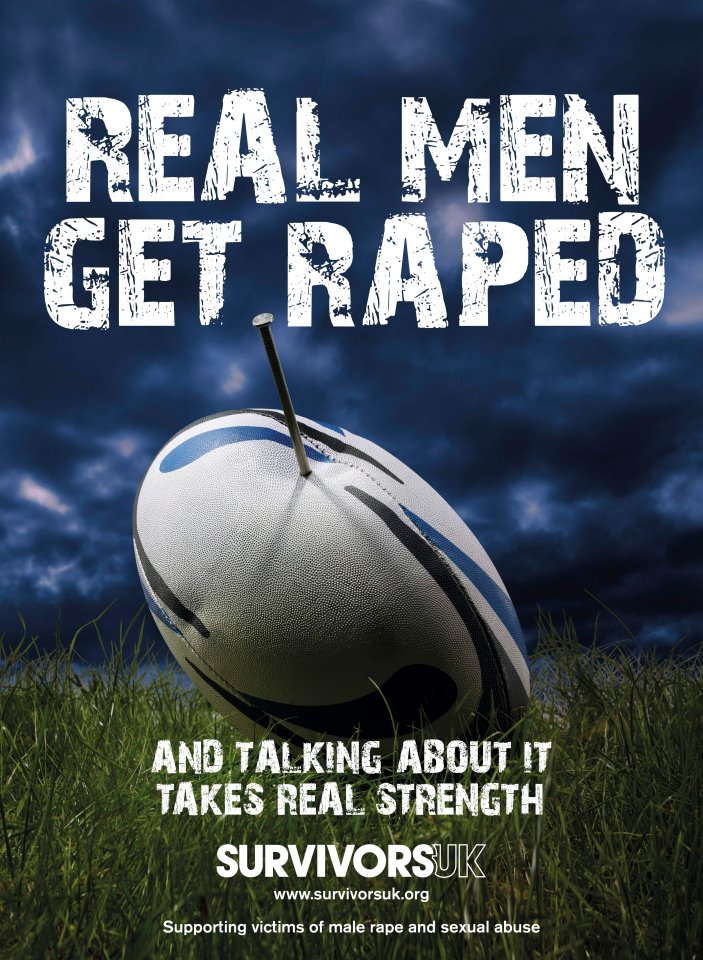
Being sexually assaulted is not something that only happens to women

The trauma that women who have been sexually victimized is well-known, both in terms of the emotional consequences of the assault itself as well as the pain associated with trying to obtain justice afterward. While men are usually the perpetrators of sexual violence and women are usually the victims, that is not always the case however.  

Actual incidence of sexual assault involving adult male victims has always been difficult to estimate. Victim surveys of British and American males have shown that 3 to 8 per cent of males reported at least one adulthood incidence of sexual assault in their lifetimes with at least 5 to 10 per cent of all rape victims being male (Pino & Meier, 1990;   Coxell & King, 1999). These numbers can be substantially higher for non-heterosexual males though.  One 2005 study reported that 13.2 per cent of bisexual males and 11.2 per cent of gay men reported at least one instance of sexual assault as adults. Still, those numbers are almost certainly underestimate the reality considering most male victims are reluctant to report their sexual assault to the police. While the majority of these crimes are committed by male offenders, an estimated 6 to 15 per cent of these sexual assaults can involve female perpetrators (either working independently or in association with male co-offenders). 

But why has male sexual assault been so often marginalized in many societies?   According to a provocative new literature review recently published in Psychology of Men and Masculinity,  the problem may stem from various “myths” surrounding male rape. The review authors, Jessica A. Turchik of Stanford Medical School and Katie M. Edwards of Ohio University,  focus on a series of common rape myths that often prevent male victim from reporting their assault and can even make police officers refuse to take their complaint seriously. The myths include:
  • Men cannot be raped
  • “Real” men can defend themselves against rape
  • Only gay men are victims and/or perpetrators of rape
  • Men are not affected by rape (or not as much as women)
  • A woman cannot sexually assault a man
  • Male rape only happens in prisons
  • Sexual assault by someone of the same sex causes homosexuality
  • Homosexual and bisexual men deserve to be sexually assaulted because they are immoral and deviant
  • If a victim physically responds to a sexual assault, he must have wanted it.
Many of these myths are frequently reported in social psychological reviews of male and female rape. Found across different cultures, they often reflect common attitudes about male sexuality. Since most media coverage on rape focuses on female victims with any reporting of male rape tending to be lurid (and often sarcastic), it is probably not surprising that male rape myths persist over time.   

Media representations of male rape (such as in movies like “Deliverance” and graphic scenes of rape in prison) certainly reinforce these attitudes. Even laws relating to sexual assault have shown a clear gender bias at times with rape being defined as female-only in many jurisdictions (such as in Canada before the Criminal Code was revised during the 1980s).    

Considering how common male rape myths are, it is probably not surprising that studies of law enforcement officers, medical students, and even rape crisis workers have shown these same attitudes towards sexual assault involving male victims. While homophobia can often account for gay rape victims being more likely to be blamed than heterosexual victims of sexual assault,  there is also a strong correlation between believing rape myths involving both male and female victims. In other words, people who believe common myths about male rape are likely to believe myths about female rape as well.

Whatever the cause, persistent attitudes about male rape are found in large segments of the general population and can have devastating consequences for men who have been victimized. Not only are victims far less likely to report the crime but those victims courageous enough to come forward can face a horrendous lack of support from the criminal justice system and even from those agencies that provide assistance for female victims of sexual assault.   

Although crisis center and hospital records have consistently shown that 3 to 12 per cent of reported sexual assault involve male victims,  one study from the 1990s indicate that as many as 37 per cent of rape crisis centres restrict services to females only. I am not aware of any more recent studies to suggest that this has changed substantially over time.

As Turchik and Edwards point out in their review, the negative attitudes spurred on by myths surrounding male rape are well-established among medical professionals, the courts, police officers, the military, and even the prison system and spring from the same patriarchal systems that reinforce negative attitudes about female rape. While more sensitive reporting has helped change attitudes towards female rape, whether these same changes will encourage male victims to come forward is another question.

Though prison rape and sexual assault of underage males have been forced into the open as more high-profile cases are reported, the prevalence of male rape myths in our society and the attitudes about male sexuality that they reflect are much slower to change. That these changes need to happen and resources need to be put in place to help both men and women who experience sexual assault is something that we must face, both as a society and as individuals.

For simple justice, if nothing else.

Sunday, August 12, 2012

Henry Rollins: Education Will Restore A Vigorous Democracy


Henry Rollins has become a regular voice at Big Think, for which we can all be grateful. It's hard to name another man who has self-created his own life in the same manner as Rollins. Best known as the lead singer of the seminal punk band Blag Flag, he has recreated himself several times since that band's demise.

Black Flag continually challenged their audience's expectations for the band and, as the lead singer, Rollins took the brunt of their rage, which was often physical violence. Rollins typically responded in kind, pulling audience members on stage and beating them. As he matured, however, and became more educated and more politically active, he channeled that anger into activism. In a 2010 interview, he said, "This is where my anger takes me, to places like this [Bhopal, India] not into abuse but into proactive, clean movement".[68]

First with the Rollins Band, then with his own record label and publishing company, with prolific spoken word performances and as the host a various radio shows, he also began acting in films and TV shows, was named Details Magazine's Man of the Year in 1994, and political activism, promoting LGBT rights, World Hunger Relief, an end to war, and touring with the United Service Organizations to entertain American troops (beginning in 2003 with the Iraq War).

All the while, he was becoming incredibly self-educated.

It's not at all surprising then to hear Rollins say the education is the key to having a real and vigorous democracy . . . and to reducing prison populations, which are mostly men.

Henry Rollins: Education Will Restore A Vigorous Democracy


Daniel Honan on August 12, 2012

According to Henry Rollins, education is the great leveler of the playing field, which is why the punk rocker says that elites are fearful of it. What would happen if our educational system did succeed in leveling the playing field? According to Rollins, for one thing, the prison population will plummet.

The temptation to rob a liquor store, for instance, would be greatly reduced, Rollins says, if our schools succeeded in teaching all students aptitude -- the ability to learn. That means "someone can open any book and have the ability to obtain knowledge."
What other benefits would reinventing education have?

Rollins says that democracy would be a much more vigorous thing. "We would expect much more of our politicians," he says, "and Thomas Jefferson would finally stop rolling in his grave."
Watch the video here:


Image courtesy of Shutterstock

Monday, May 21, 2012

TEDxXavierUniversity - Sherman Bradley - Relational Justice

Sherman Bradley brings his own family experience to introduce the topic of relational justice - a shift of perspective around crime and poverty as relational (between people) and not institutional (between the person and the state). Here is a definition of relational justice from Nicola Baker and Jonathan Burnside:
Relational justice is a fresh vision of what doing justice means in a society where relationships are being undermined and undervalued. It turns the spotlight on one of the goals of justice which is to restore and repair human relationships damaged by crime.
 Bradley brings these ideas to healing poverty and helping men without hope through his organization, Consider the Poor, a project of the City Gospel Mission. Consider the Poor educates the public about the dynamics of poverty and homelessness and encourages dialogue about these critical issues. By bringing people together for training and discussion, Consider the Poor inspires men and women to advocate for the poor and create grassroots change in their communities.

Sherman Bradley's Understanding Poverty Workshop 

Take Action


TEDxXavierUniversity - Sherman Bradley - Relational Justice
This former US air force sargent, has made it is his life's mission to empower formerly incarcerated, addicted, disenfranchised and homeless men. What he discovered is a new way of looking at... one another.

Sherman Bradley is innovating the way we serve with an entirely new approach.

Sunday, February 26, 2012

In Waiting - A New Short Film Made by Boys in Westchester Jail


This story ran in the local paper for Eastchester, NY. It's great to see boys (young men) who have been in trouble make something creative from the experience. Sending blessings for these young men to create lives that their backgrounds would never have predicted.

Film Made by Boys in Westchester Jail to Premiere

Rick Pezzullo (email)


VALHALLA, N.Y. – A film created by students in a youth program at the Westchester County Jail in Valhalla will premiere at the Jacobs Burns Film Center (JBFC) in Pleasantville Monday night.

The nine-minute feature film that chronicles masculinity in prison today was filmed entirely within the confines of the prison by a handful of now former inmates from the Southern Westchester BOCES Incarcerated Youth Program.

"It's been an incredible experience for the JBFC to work with the Incarcerated Youth Program and we are proud to be screening the courageous story the students chose to tell this year," said Emily Keating, director of education programs at the film center. "This transformational experience provides the youth with essential 21st century digital literacy skills and gives them a powerful means of expression."

The film entitled “In Waiting” is an adaptation of Israel Horovitz's seminal play “The Indian Wants the Bronx,” which tells the story of an Indian native who comes to New York knowing very little English and is subsequently taunted and attacked by some young punks.

JBCF staff spent six months teaching the students how to film and edit digital video and helped them produce, write and direct a film amid the dark, barren walls of the jail.

The film project initiative first began at the jail in the fall of 2008. “In Waiting” is the third film made by youths and JBCF. The first was called “Judgement,” which explored the idea of being judged and judging others, while the second, called “Look Inside,” looked at the daily life experiences of being in jail and reflections from students.

The Southern Westchester BOCES Incarcerated Youth Program serves approximately 900 students annually and 140 students a day. There are 18 classrooms available to students, who are in class five hours a day. Credits for the courses are given by the home school districts of the students.

Donnie Simmons, supervisor of the program, said the goal is to "provide the best quality educational services we possibly can to this entire constituent population."

None of the students who worked on “In Waiting” were available for comment.

Thursday, February 24, 2011

Short Film - I Am Sean Bell

http://www.bam.org/viewdocument.aspx?did=5284

Interesting short film made about the aftermath of the Sean Bell killing, in which 3 young men, including Sean Bell on the morning after his bachelor party, were shot more than 50 times by a team of both plainclothes and undercover NYPD officers, killing Bell.

The whole situation is confused and it seems that we will never know what really happened and why. This short film examines the impact on young black men in New York city following the event.

I think this is just a preview of the film - you might have to follow the title link below back to Snag Films to see the whole 10 minute film.

Media that Matters

I Am Sean Bell (2010) 10 min

Director/Producer: Stacey Muhammad

Young boys reflect on the Sean Bell tragedy, speaking out about their fears and hopes as they approach manhood

I’ve loved film for as long as I can remember. Initially, screenwriting was my interest; however, I wanted to see my ideas come to life beyond the writing. This led to a desire to acquire the skills needed to actually produce my own projects. So, I embarked upon the journey of studying and learning as much about the filmmaking process as I possibly could by attending film school, workshops, and anything else I could find.

First and foremost, I consider myself an activist, so I’m drawn to human issues and subjects that enlighten and uplift humanity while challenging us to examine our ideals and issues on this planet. I’ve always been drawn to documentary filmmaking, particularly as an activist. It’s a powerful way to communicate with an audience.

When I chose to do the Sean Bell film, I was extremely disturbed by the verdict and wanted to hear from the children, particularly young black boys, about their thoughts, fears and concerns regarding violence against black men. Most of the topics that interest me are those that give a voice to those often unheard populations of people, who indeed have stories to tell and victories to celebrate.

One thing that I’ve learned is that life is what it is—meaning, everything we do and experience is connected. Often, we try to compartmentalize our lives and deal with different aspects of our experience (be it our personal lives, our career, etc.). Filmmaking, for me, is a spiritual process and journey. I’ve been prepared through life experiences, for each and every topic I choose to explore.

So, my advice to any aspiring filmmaker would be to live your life with integrity, take care of yourself, learn as much about your craft as possible, commit to creating the life you desire and expect the universe to grant you everything you ask.


Wednesday, November 10, 2010

Secret Lives of Men - "Hidden Truth: Young Men Navigating Lives In and Out of Juvenile Prison" Adam Reich


Interesting topic - especially since I was a teen who was in and out of the legal system, including a few days in Oregon's maximum security facility for teen boys. Fortunately for me, a judge changed his mind and gave me probation instead of the several months I was to spend in lock-up.

Here it the book to be discussed:


"Hidden Truth: Young Men Navigating Lives In and Out of Juvenile Prison" Adam Reich
Hidden Truth takes the reader inside a Rhode Island juvenile prison to explore broader questions of how poor, disenfranchised young men come to terms with masculinity and identity. Adam D. Reich, who worked with inmates to produce a newspaper, writes vividly and memorably about the young men he came to know, and in the process extends theories of masculinity, crime, and social reproduction into a provocative new paradigm. Reich suggests that young men's participation in crime constitutes a game through which they achieve "outsider masculinity." Once in prison these same youths are forced to reconcile their criminal practices with a new game and new "insider masculinity" enforced by guards and administrators.

Listen to internet radio with Secret Lives of Men on Blog Talk Radio