Showing posts with label therapy. Show all posts

Saturday, September 28, 2013

Aaron Anderson - Five Signs a Man Needs to See a Counselor

From the Good Men Project, Aaron Anderson offers five signs that we might need to seek out therapy. I agree for the most part - and none of the reasons given here are indicative of serious psychological symptoms (like suicidality, audio hallucinations, panic attacks, or dissociation).

When I began therapy, it was because I was unhappy with my life, my relationships, and my future. Therapy helped me know who I am, understand how I had come to that point in my life, and how to change the things I was not happy with in my life.

Counseling can save your life, but it can also help you find the life you have always wanted to live.

Five Signs a Man Needs to See a Counselor

September 22, 2013
by Aaron Anderson

Men aren’t supposed to go to counseling, they’re supposed to be tougher than that, right?


For a lot of men, the thought of going to a counselor for therapy is silly. It’s just not part of the man code to go and see a counselor. Seeing a counselor means talking about feelings and your childhood and there’s always the potential of the counselor telling you that your problems are occurring because you’re still in love with your mother. It’s no wonder then, why a lot of men don’t seek out counseling. And then there’s always the question of ‘do I need therapy anyway’? Everyone goes through rough spots. But how do you know when you need therapy? Let’s take a look.

Five signs a man needs to see a counselor.

1) The ‘rough patch’ stays rough for a while. Everybody goes through rough patches now and again. Whether it’s a rough time at work, a rough time in your marriage or a rough patch in life. But if these rough patches stay rough for a while you probably ought to see a counselor. You could wait it out, but what’s the point? Seeing a counselor sooner than later ensures that you get back on track sooner and start enjoying life sooner, too.

2) Your wife/mother/significant other suggests counseling. As a counselor who specializes in marriage counseling, I dread phone calls from men. I dread them because they usually go something like this: Me: Hello? Him: Hi, I need to set up an appointment for my wife and I to come to counseling. She’s been threatening to divorce me for three years and she finally left this morning. Do you have any appointments later today? Me: I have an appointment for later this week if that will help. Him: Okay. Great. Let me call my wife and see if she’ll come.

They normally don’t call back. The ones who do call back are just being courteous to tell me that their wife has gone to the courthouse for the divorce papers and won’t be needing my services after all. Men, do yourselves a favor and go to counseling the FIRST time your wife/mother/significant other suggests it.

3) You want more out of life. In his book Real Boys by William Pollack, PhD, Dr. Pollack talks about the ‘boy code’ that we hear as young men. As young men we often hear to sit down, shut up, and don’t complain. We’re also told to suck it up, don’t cry and move on. So as grown men we often feel like we can’t want more out of life because we just have to suck it up and accept our life as it is. But counseling is a great way to get exactly what you want out of life and get the tools you need to get there. You may have to talk about your feelings but you shed those unwanted burdens that are keeping you down. And you get exactly what you want out of your life in the mean time, too.

4) You’re easily irritated. Men display mental health difficulties differently than women do. Women internalize their difficulties by feeling sad, quiet and guilty. Men are much more external in their displays of mental difficulty. This means they get irritated at others more, become more aggressive and even become physical at times. If this isn’t how you normally react to stress and you’re reacting this way more and more it’s time to see a counselor. If you do normally react this way to stress, you still need to see a counselor.

5) You just want to be left alone for extended periods of time. Everybody goes through spells where they just want to be left alone for a few hours, night a day or a weekend. But if you find yourself day after day just wanting to be left alone by your wife, kids and colleagues at work it’s time to see a counselor. Being left alone is a temporary solution. Sometimes being left alone temporarily is all you need to get your mind back in the game and get a fresh perspective on how to fix things. But if you find yourself wanting to be left alone day after day after day, that’s a big red flag that something more serious is going on.

Unfortunately, there’s still a stigma about seeing a counselor. And for some reason, many men wait until the last minute or just don’t go at all. But a real man does whatever a man has to do in order to be a man; including going to counseling.

About Aaron Anderson
Aaron Anderson is a Licensed Marriage and Family Therapist and owner of The Marriage and Family Clinic in Denver, CO. He also writes for several publications online and in print all on the topic of marriages, families and men. In his spare time (whatever that is) he is secretly preparing to be the next great chef. You can find him on Twitter @MarriageDr and on Facebook giving great info without the psychobabble.

Saturday, September 15, 2012

Survey Request - Males' Expectations of Counseling


I found this survey through Boysen Hodgson on Facebook, I am assuming they won't mind the added exposure in generating responses, so if you also have blog that reaches men, please consider re-posting this.

Here is the consent form, the link will take you to the page where you can begin the survey.

Adult Consent Form

 
Western Michigan University
Department of: Counselor Education Counseling Psychology
Principal Investigator: Lonnie E. Duncan, Ph.D.
Student Investigator: Sheryl Kelly, M.A.


You have been invited to participate in a research project entitled "Males’ Expectations of Counseling." This research is intended to study what men expect to encounter when in a counseling session. This project is Sheryl Kelly’s dissertation project. This consent document will explain the purpose of this research project and will go over all of the time commitments, the procedures used in the study, and the risks and benefits of participating in this research project. Please read this consent form carefully and completely and please ask any questions if you need more clarification.
What are we trying to find out in this study?

Research has consistently shown that men are less likely to seek counseling, harbor negative attitudes toward counseling, and are less willing than women to seek therapy for psychological problems regardless of culture, race, or ethnicity (Addis & Mahalik, 2003; McCarthy & Holliday, 2004; Smith, Tran, & Thompson, 2008). To address this, the present study will expand the current knowledge base on men and their counseling expectations.

Who can participant in this study?

Individuals that identify as a male, being at least 18 years of age, have at least a high school diploma or GED, and have access to the internet will be included in this study. You will be asked to provide general information about yourself, such as age, race, level of education received, education status, socioeconomic status, type of area raised in, and previous counseling experience. If the results of the questionnaires indicate that you are less than 18 years of age, or have less than a high school diploma/GED you will be excluded from the study.
 
Where will this study take place?
Participants will be invited to complete a questionnaire, and provided with a link to the secure online website where the survey will be housed.

What is the time commitment for participating in this study?
Each participant will be asked to contribute approximately 45-50 minutes of time to complete the surveys.

What will you be asked to do if you choose to participate in this study?
Participants will be asked to provide informed consent and complete questionnaires. No specific identifying information (e.g., email, phone number, name) will be collected in this process. Questionnaire is to be anonymous.

What information is being measured during the study?
This research will seek to measure and better understand the counseling expectations of males. The information obtained from this study will be interpreted for clinical application and program training.

What are the risks of participating in this study and how will these risks be minimized?
Minimal risk should be present, as the subject will be completing an anonymous online survey. As in all research, there may be unforeseen risks to the participant. No compensation or treatment will be made available to the subject.

What are the benefits of participating in this study?
This research would be beneficial to the field of counseling psychology as well as the population being studied. The data obtained from this study will provide counseling psychologists with insight into the expectations of males, and possibly provide the participants with insight into their thoughts about counseling.

Are there any costs associated with participating in this study?
There are no monetary costs associated with participating cost. Participation in this study will cost each of the participants approximately 45-50 minutes of their time.

Is there any compensation for participating in this study?
No compensation or treatment will be made available to the subject.

Who will have access to the information collected during this study?
Only the student and principal investigator will have access to the information collected. To participate in this anonymous survey, participants will not be required to provide any identifying information such as name or date of birth. Potential participants will complete the anonymous survey on a secure web page that can be accessed via invitation only. Upon gathering all necessary data to conduct study all surveys and subsequently web site will be removed from the internet. Subject identification will be made with a number. Data will be retained for no more than 3 years. Data will remain on a password protected flash drive/personal computer during statistical analysis period Following proper statistical analysis results of data will be presented a part of student investigator’s dissertation defense.
What if you want to stop participating in this study?
You can choose to stop participating in the study at anytime for any reason. You will not suffer any prejudice or penalty by your decision to stop your participation. You will experience NO consequences either academically or personally if you choose to withdraw from this study.

If you have any questions or concerns about this study, you may contact either Sheryl Kelly, M.A. or Lonnie E. Duncan, Ph.D. at 269-387-5152. You may also contact the chair of Human Subjects Institutional Review Board at 269-387-8293 or the vice president for research at 269-387-8298 with any concerns that you have.


This consent has been approved by the Western Michigan University Human Subjects Institutional Review Board (HSIRB) on July 31, 2012. Do not participate after July 31, 2013.
Go to the survey.

Saturday, January 28, 2012

Why Men from Rural Communities Avoid Seeking Mental HealthCounseling

 
New research identified self-stigma as the primary reason that men from rural areas do not reach out for help. This research essentially confirms prior knowledge - that men in more traditional communities are "trained" to see asking for help, or even needing help, as a weakness. These beliefs prevent men in these communities (or men who hold these values) from asking for help.

This was posted at GoodTherapy.org.

Why Men From Rural Communities Avoid Seeking Mental Health Counseling

January 27th, 2012


Men, in general, are far less likely than women to seek professional help for mental health problems. But a new study, led by Joseph H. Hammer and David L. Vogel of the Department of Psychology at Iowa State University, suggests that men from rural communities are even more resistant than urban-dwelling men when it comes to getting psychological counseling. The study expands upon previous research by the team and explores the factors that create barriers to treatment. For example, in the study, Hammer and colleagues identified self-stigma as the primary reason that men from rural areas do not reach out for help.

Masculine norms of success, power, emotional control, and self-reliance are evident throughout Western cultures. In America, men are taught early on the significance of these norms. Asking for help and showing emotional vulnerability is perceived as a sign of weakness and often makes young boys the target of ridicule by family members or peers. To avoid this victimization, young boys and teens will resort to internalizing and will transfer external stigmas regarding counseling to themselves as self-stigmas.

For this most recent study, the researchers interviewed 4,748 men from both urban and rural communities. They discovered that the men from rural areas were twice as likely to conform to traditional masculine norms as their urban peers, which led to concerns about treatment. In particular, there are fewer clinicians in rural communities, so confidentiality was of major concern to the men. Also, the targeted treatment designed to address specific mental health problems could require travel to another town, resulting in time away from family or work, threatening self-reliance and role fulfillment.

Although income did not influence men’s motivation to seek help, education did. In all communities, men with the least amount of education resisted treatment because of self-stigma more than any other group. The researchers believe nonconventional treatments, such as adventure therapy or internet treatment programs, could provide resources that would appeal to men with strong masculine norms, particularly those in rural communities. Literature aimed at dispelling the stigma of treatment, available in doctors’ offices or through community clinics, could also help these men overcome their resistance. The researchers added, “Working to build greater trust in the therapeutic relationship may also reduce the perceived threat of seeking help to clients’ self-esteem and confidence.”

Reference:
Hammer, J. H., Vogel, D. L., & Heimerdinger-Edwards, S. R. (2012, January 23). Men’s Help Seeking: Examination of Differences Across Community Size, Education, and Income. Psychology of Men & Masculinity. Advance online publication. doi: 10.1037/a0026813

Saturday, October 1, 2011

Bedi & Richards - What Men Want From Psychotherapy

http://amog.com/wp-content/uploads/2011/08/Adults-with-ADHD-550x373.jpg

GoodTherapy.orghttp://www.goodtherapy.org/ posted this brief research review of a new study that looks at what men want and seek from psychotherapy. The study found that the most important qualities in creating the therapeutic alliance with male clients are "Formal Respect, Client Responsibility, Practical Help, and Bringing out the Issues."

These are all very external qualities, about the relationship and solution-oriented approaches and not about healing original wounding as is part of the psychodynamic approach. Yet this is not my experience of all the men I work with - some are certainly in line with this, but others are willing and wanting to do the deeper work.

What Men Want From Psychotherapy

September 30th, 2011 

A GoodTherapy.org News Headline:

Men are much less likely to seek clinical help for their psychological issues than women. Because they hold to traditional male gender roles, most men do not respond to psychotherapy delivered in a generic approach, most often welcomed and received positively by women. “Practitioners who are accustomed to working in androgynous environments may fail to fully grasp the foreign nature of psychotherapy to men who hold “traditional” North American masculine gender role beliefs,” said Robinder P. Bedi and Mica Richards of Western Washington University, authors of a new study exploring what approaches provide the best outcome for men in psychotherapy. “Understanding the perspective of men and further appreciating the impact of gender role socialization on alliance formation will enable psychotherapists to provide improved mental health services to men, a group that appears to be less well served than women by conventional psychotherapy practices.”

The researchers evaluated 37 male clients who were entering therapy for stress, anxiety, substance use, trauma and depression. They found the factors that were most important for the development of a healthy client-therapist alliance for the men were Formal Respect, Client Responsibility, Practical Help and Bringing out the Issues. “Bringing out the Issues (labeled using the language of the men in the study) emerged as a key category in understanding the perspective of men on the therapeutic alliance,” said the researchers. “It was the largest category, found to be statistically significantly more helpful and understood than all other categories except Client Responsibility and Formal Respect.” The team emphasized that clinicians who wish to achieve a positive outcome with their male clients should understand this fundamental difference between men and women in treatment. They added, “In developing a therapeutic alliance with a typical man, it seems important to balance conventional relationship-building techniques, such as empathy, paraphrases, normalization, and validation, with asking questions and providing suggestions.”
Reference:
Bedi, R. P., & Richards, M. (2011, May 23). What a Man Wants: The Male Perspective on Therapeutic Alliance Formation. Psychotherapy: Theory, Research, Practice, Training. Advance online publication. doi: 10.1037/a0022424
Abstract:

What a man wants: The male perspective on therapeutic alliance formation.
 
Although the link between client ratings of therapeutic alliance quality and psychotherapy outcome has been well established by previous research, there is still much to be done to clarify what variables are important to clients, particularly men, in the formation of an alliance. Thirty-seven male clients currently undergoing psychotherapy categorized 74 critical incidents for alliance formation in an open-ended manner on the basis of self-perceived relatedness. Multivariate concept-mapping statistical techniques were used to identify the typical way in which the participants conceptualized variables that are important to alliance formation. Nine categories of variables were identified (Bringing out the Issues, Nonverbal Psychotherapist Actions, Emotional Support, Formal Respect, Practical Help, Office Environment, Information, Client Responsibility, and Choice of Professional). Bringing out the Issues emerged as the highest rated and most consistently understood category across the men in this study. The results of this study add to a small but growing body of research on the client's perspective of alliance formation and provide an initial conceptual model of how men understand the variables of common alliance formation. The developed model also provides several hypotheses, which are presented for verification in future research and clinical practice.

Tuesday, September 13, 2011

Men Underrepresented in Psychological Research Studies

This was posted at GoodTherapy.com - and it's good that this gets some exposure. For a long time it was assumed that modern psychology was based almost exclusively on studies of men. While that may have been true in the very beginning (although I doubt it), recent studies have been relying very heavily on female subjects such that much of modern theory is based on studies of women (this is even more true in nutrition and exercise research, for some reason).

Men Underrepresented in Psychological Research Studies

September 9th, 2011

A GoodTherapy.org News Headline:

Research shows that men are far less likely to seek therapy than women when confronted with anxiety, depression, anger or other psychological problems. Although this clearly suggests that many men are being undertreated for significant mental health issues, this dynamic also affects the field of research. C. Edward Watkins, Jr. Ph.D., of the University of North Texas, recently asked an essential question, “How many men have actually been involved in short-term and long-term psychodynamic treatment research?” Watkins looked at 86 separate studies from six reviews over the last ten years to find an answer. “Those six reviews/meta-analyses were selected for scrutiny because they covered a broad spectrum of disorders (mental and physical), have received considerable attention in the medical, psychiatric, and psychological literature, and have appeared in what are well-respected, peer-reviewed medical, psychiatric, or psychoanalytic journals,” said Watkins.

Watkins realized that overall women were represented more than men in clinical studies, 60% versus 40%. Additionally, Watkins noticed that a large portion of the studies that did have male subjects tended to focus on addiction issues, leaving many other psychological treatment studies void of male data. Overall, he found that 11% of the studies had no male participants at all, and 23% of the studies only contained data from six males or less. “We clearly see here both positives and negatives to our picture,” said Watkins. “Male research participants tend to be more difficult to secure than females in psychological research generally; that appears to be no less so for both short-term and long-term psychodynamic treatment research. In our efforts to amass the most complete, fully informed, and ever-informative female and male psychodynamic treatment database upon which to draw, that may well be an enduring problem with which we as researchers will have to continue to struggle and work to creatively address in the decades ahead.”

Reference:
Watkins, C. E., Jr. (2011, August 29). THE STUDY OF MEN IN SHORT-TERM AND LONG-TERM PSYCHODYNAMIC PSYCHOTHERAPY: A Brief Research Note. Psychoanalytic Psychology. Advance online publication. doi: 10.1037/a0025183

Saturday, August 27, 2011

Phil Tyson - Emotion Phobia in Men


I've been working with men in various ways for the past several years, but never as intensely as I have in the last three months as an intern counselor. My experience in coaching was very different than it has been in counseling - perhaps that was as much about me and my perspective as it was about my clients.

What I have found - and what Tyson (Men's Well-Being) is speaking to here - is that men are every bit as emotional as women. Likewise, women as equally as fearful of entering into challenging emotions as are men. Women believe they are more comfortable with their emotional lives, and maybe some are, but I have actually had more men willing to get in touch with their deeper feelings than I have women.

We need to end the old stereotypes, and I need to keep learning to enter into therapy with beginner's mind. I used to have some expectations of the differences between men and women, mostly in their socialization, but so far, most of those expectations have been shown to be wrong (or partial at best).

Emotion Phobia in Men

Phobias manchesterWorking with a wide range of men, I am struck that the stereotype of men being unemotional is simply not true. Men, like women, fall on the spectrum from those who are extremely comfortable and aware of their emotional worlds, to those who, simply, aren't.
Of course we are all emotional creatures. Everything we experience we do so with an emotional tone. We see a beautiful woman, and we feel attraction. We see the England football team, and we feel disappointment.
Some men, however, have become scared of their emotional lives. They choose to see themselves as "rational", and become distrustful of emotions in themselves and others. They have become emotion phobic.
This is a short post, so feel free to go read the rest of it.

Monday, May 23, 2011

Psych Central - Hard to Find a Male Therapist?

http://i.cdn.turner.com/cnn/2010/LIVING/06/21/tf.dragged.husban.counseling/story.husband.therapy.ts.jpg

Yesterday I posted an article from the New York Times on the challenges of finding a male therapist - and the likelihood that it will get tougher in the future as current therapists retire and the current 5:1 ratio of women to men becomes more felt in the marketplace.

Dr. John Grohol, the CEO and founder of Psych Central, basically says, "So what?"

I think he is seeing the issue only from a mental health perspective - there seems to be no recognition of the gender issues some men may have in choosing a therapist. As the NYT article suggests, many men (not all, but a significant number) would prefer to have a male therapist.

Likewise, there are many instances when a male therapist is desirable for women, too. Several women who read the last post felt that a male therapist was their preference and was necessary for their growth. I am about to begin my practicum and internship at a facility that works with sexual assault victims - I will be the only male intern, and they are glad to have me.

I was told that they sometimes prefer a male therapist for some clients to allow a powerful transference (my supervisor is classical psychoanalytic) and to act as a model of a male who is not violent and who does not treat them badly.

Considering these factors and others, there is a need for more male therapists, in my opinion.

Hard to Find a Male Therapist?

By John M Grohol PsyD
Founder & Editor-in-Chief

Hard to Find a Male Therapist

Well, yes. Fewer men are choosing clinical psychology as a profession.

We’ve known this for many years, as graduate programs in psychology — both Master’s level and doctoral — have increasingly become female-dominated. In my graduate class of 1990, over 75% of the class was female. That percentage has only increased in the past two decades.

So Benedict Carey’s new article in the New York Times is a bit of a puzzler. The angle is that because of this gender discrepancy, a good male therapist is increasingly becoming difficult to find:

Researchers began tracking the “feminization” of mental health care more than a generation ago, when women started to outnumber men in fields like psychology and counseling. Today the takeover is almost complete.

And I say, “So what?”

I say that only because while I think everyone should have their choice of therapist gender, there’s virtually no research demonstrating that there’s any relationship between therapist gender, client gender and treatment outcomes. Since there’s no data, it’s hard to get too worked up about a trend that started over 30 years ago.

So instead of data, Carey trots out a few — mostly male — therapists to sound the warning bells:

“There’s a way in which a guy grows up that he knows some things that women don’t know, and vice versa,” said David Moultrup, a psychotherapist in Belmont, Mass. “But that male viewpoint has been so devalued in the course of empowering little girls for the past 40 or 50 years that it is now all but lost in talk therapy. Society needs to have the choice, and the choice is being taken away.”

Actually, without data, we don’t know that “the choice is being taken away.” We know that there are less male therapists than there were 30 years ago. But we don’t know whether that makes any difference. Are fewer men seeking therapy because of it? Are men who do seek therapy from a woman when they wanted to see a male worse off because of it?

These are good questions to ask. But without research, we don’t know the answers.

Despite these complaints - and more, so read the whole article - Grohol still recommends the NYT article.


Sunday, May 22, 2011

Need Therapy? A Good Man Is Hard to Find


In my counseling program, the average male to female ratio is about 4:1 or 3:1 at best (my cohort). In recent years, there have been several cohorts with only one or two males. The article reports a 5:1 ratio.

In yesterday's New York Times, Benedict Carey posted an article - Need Therapy? A Good Man Is Hard to Find - about the dearth of male therapists and the resulting inability of men who want therapy to find a male therapist with whom to work.

I've seen only one male therapist in my life, for a men's group, and I would have to say my experience with female therapists was mostly good - and it had nothing to do with their sex. But, on the other hand, I was dealing with some issues that are not gender specific, so there was not the absence of experience that Dr. Levant mentions later in this article.

Researchers began tracking the “feminization” of mental health care more than a generation ago, when women started to outnumber men in fields like psychology and counseling. Today the takeover is almost complete.

Men earn only one in five of all master’s degrees awarded in psychology, down from half in the 1970s. They account for less than 10 percent of social workers under the age of 34, according to a recent survey. And their numbers have dwindled among professional counselors — to 10 percent of the American Counseling Association’s membership today from 30 percent in 1982 — and appear to be declining among marriage and family therapists.

Some college psychology programs cannot even attract male applicants, much less students. And at many therapists’ conferences, attendees with salt-and-pepper beards wander the hallways as lonely as peaceniks at a gun fair.

The result, many therapists argue, is that the profession is at risk of losing its appeal for a large group of sufferers — most of them men — who would like to receive therapy but prefer to start with a male therapist.

“There’s a way in which a guy grows up that he knows some things that women don’t know, and vice versa,” said David Moultrup, a psychotherapist in Belmont, Mass. “But that male viewpoint has been so devalued in the course of empowering little girls for the past 40 or 50 years that it is now all but lost in talk therapy. Society needs to have the choice, and the choice is being taken away.”

The reasons for the shift are economic as well as cultural, most people in these professions agree. Managed care took a bite out of therapists’ incomes in the 1990s. Psychiatry, the most male-dominated corner of therapy, increasingly turned to drug treatments. And as women entered the work force in greater numbers, they proved to be more drawn to the talking cure than men — in giving the treatment as well as in receiving it.

“Usually women get blamed when a profession loses status, but in this case the trend started first, and men just evacuated,” said Dorothy Cantor, a former president of American Psychological Association who conducted a landmark study of gender and psychology in 1995. “Women moved up into the field and took their place.”

The impact of this gender switch on the value of therapy is negligible, studies suggest. A good therapist is a good therapist, male or female, and a mediocre one is a mediocre one. Shared experience may even be a impediment, in some cases: therapists often caution students against assuming that they have special insight into person’s problems just because they have something in common.

Still, perception is all important when it comes to seeking help for the very first time. In a recent study among 266 college men, Ronald F. Levant, a psychologist at the University of Akron, found that a man’s willingness to seek therapy was directly related to how strongly he agreed with traditionally male assumptions, like “I can usually handle whatever comes my way.” Such a man on the fence about seeking treatment could be discouraged by the prospect of talking to a woman.

“Many men like this believe that only another man can help them, and it doesn’t matter whether that’s true or not,” Dr. Levant said. “What’s important is what the client believes.”

Both male therapists and men who have been in treatment agree that there are certain topics that — at least initially, all things being equal — are best discussed within gender. Sex is one, they say. And some men are far less ashamed about affairs when speaking to another man.

Aggression is another. Many men grow up in a world of hostile body language and real physical violence that is almost entirely invisible to women. A bar fight that sounds traumatic to a female therapist may be no more than a good night out for a man. Likewise, a stare-down in the sandbox that looks vanishingly trivial from a distance may lie like a poisoned well in the stream of the unconscious.

In some men’s groups he used to run, Dr. Levant passed out index cards and had each participant write down the one thing he was most ashamed of, that he was reluctant to admit to himself, much less to anyone else. “I would get things like, ‘I backed down from a fight in junior high school,’ ” he said, “and these were mostly middle-aged, married guys.”

In just the past few years, psychologists have identified a number of issues that are, in effect, male versions of the gender-identity issues that so many mothers face in the work force: the self-doubt of being a stay-at-home father, the tension between being a provider and being a father, even male post-partum depression.

“In the same way that there is something very personal about being a mother, something very important to female identity, the experience of fathering is also very powerful,” said Aaron Rochlen, a psychologist at the University of Texas, Austin. “And some men, I think, prefer to talk about that — the joy of being a father, the stress, how it’s impacting them — with a therapist who’s had the same experience,” from the same point of view.

If they can find one, that is. “I remember when I started training, I looked around and realized that for the first time in my life, I was an endangered minority,” said Ryan McKelley, a psychologist at the University of Wisconsin, La Crosse. “Now I tell my male students, if you’re interested in clinical care, you can write your own ticket. You’ll be hired immediately.”

I think that as men become more aware of their entrapment within traditional masculinity models and roles, there will be an increase in men seeking therapy - and there will be a need for more male therapists.

For a lot of men still living in the traditional roles, there is likely a suspicion that a female therapist could not possibly understand them. If they get to the point of seeking therapy, they may only feel comfortable talking to another man.

They should have that option available to them.


Friday, May 20, 2011

"The Men's Project" on Secret Lives of Men


The Men's Project (TMP) was founded in Ottawa on July 1, 1997. The creation of TMP was initiated by its two founders: Larry Gauthier, MSW, and Rick Goodwin, MSW RSW, and the National Capital Region YMCA-YWCA. TMP was created to fill existing gaps in community-based counselling resources for men.

This is a phenomenal idea. Listening to the podcast, in which Chris Blazina interviews one of the founders, Rick Goodwin makes me want to find some way to do that here in Tucson. This is a community that really needs community counseling that addresses men, and only men - from police and fire departments, from Davis-Monthan Air Force Base, from Fort Huachuca, from the various reservations, and perhaps most importantly, from the multitude of gangs that make Tucson their battleground.

The Center for Life Skills Development offers men's counseling, but I would never seek counseling at a place whose web page reads like it was written by a third grader.

Anyway, maybe this is what I want to do as a counselor . . . . .

"The Men's Project" on Secret Lives of Men

Broadcasting live from Canada this week, we visit with Rick Goodwin Director of "The Men's Project." The Men's Project is a non-profit charitable men's counselling agency that has been providing services to men and their families since 1997.The men's Project provides individual and couple counseling, as well as a specialized healing program for men who have experienced sexual or physical abuse as children, anger management, emotional intelligence and fathering.The services are specifically designed for men and professionally facilitated by accredited psychotherapists.

Listen to internet radio with Secret Lives of Men on Blog Talk Radio


Friday, December 31, 2010

Dr Miles Groth - Working with Young Males in Psychotherapy: Implications of the Findings of Boyhood Studies

This is an useful (for some of us) from Contemporary Psychotherapy - a free online magazine. Understanding young men has become increasingly challenging - my guess is that working with them therapeutically is even more challenging.

As a note of clarification: Dr. Groth is one of the founders of the "male studies" movement - they tend to believe that men's studies are feminized due to their origin in women's studies and gender studies departments. And they tend to be harshly anti-feminism, as if all feminists are the same and hold the same values. I disagree with that part of their agenda.


Working with Young Males in Psychotherapy:

Working with Young Males in Psychotherapy: Implications of the Findings of Boyhood Studies

Dr Miles Groth discusses his approach to, and experience of, working psychotherapeutically with young men aged 4 to 24.

The New Boyhood

Boys are now among the most challenging groups with whom we work as psychotherapists. During the past two decades, boyhood has received special attention, and with good reason: boyhood is being radically redefined. As a result, the number of vulnerable boys who require our attention and care has increased significantly. Some of them are just entering kindergarten; others are graduating from high school or college and manoeuvering their way in a world of work that has increasingly fewer places for them; a decreasing number are in graduate school. Ever more are disconnected, disaffiliated and adrift. We witness a group who often make the astonishing claim that they do not feel welcome among us. Some do not articulate it this way, but they indicate it in their actions. Especially disturbing, we see more and more boys who by age fifteen have lost the kinetic playfulness and saying-by-doing typical of boys and young males. Many wander on in an odd, constricting, dimmed-down atmosphere that engulfs them for another decade. We often find that, no matter how long our reach, we cannot touch them.

The features of traditional boyish behavior still make their appearance at about age four when the differences between the sexes register with males but the boy as pre-gender trickster has often been tamed. Given the earlier average onset of puberty at about age twelve, one might suppose that boyhood ends sooner, yet for want of significant and decisive rites of passage, male adolescence has effectively disappeared, replaced by an extended period of boyhood. No longer children, males in the second decade of life are not busy consolidating their identity, the mark of the adolescent passage, as they once did. Very apparent to casual observation and evident in the media, boyhood now extends into the early twenties, when a ragged tear finds young males suddenly dropped off at the curb of a world where they are expected to assume the “elusive status” of manhood.

The behavioral manifestations of the new, two-decade-long boyhood are by now well known and have been documented by clinicians, educators and journalists: lack of commitment to projects and pastimes that once were satisfying to boys; aimless movement from one distraction to another; sullenness, withdrawal and isolation—the Western version of hikikimori which finds an alarming number of Japanese boys staying in their rooms for weeks or months at a time; an alarming increase in the number of suicides at ever earlier ages (4-6 times greater than that of their female age-mates); outbursts of aggressive behavior directed at individuals, especially those representing our major social institutions, the family and school; if attending an educational institution, lack of engagement in learning and a resulting failure to attain literacy; and numbing bouts of abuse of alcohol and both licit and illicit drugs. Such retreat into chemical solipsism is now often iatrogenic; Ritalin, as often as marijuana, is a boy’s introduction to drugs. In the college years, he grinds up the tablets he has been prescribed for more than a decade to dampen his behavior and inhales their contents. This he washes down with beer and tops off with a joint. We hear accounts of experiences of depression, hostility, feelings of rage that cannot be articulated, confusion, lack of motivation, and an almost schizoid retreat into worlds of fantasy mediated by video games and online diversions.

Young males2

Boys no longer “will be boys.” More and more, the cliché does not at all apply. In fact, we are relieved if a young boy’s dearest possession is his skateboard, yet he is now often closest to the cyclops of his computer. He may lift weights alone in his parents’ basement or strum his guitar. His emotional outlets are often limited to anger. With decreasing numbers playing organized sports, a boy’s generous physical energy may find an outlet exploding in a rave, playing in a rock band, or enacting backyard wrestling scenarios. Boyhood ends not by being transcended in initiations or symbolical rituals but by being forced underground still very much alive. Typically, this occurs when a boy leaves school, whether early or late. The creature we see then – sometimes inaccurately called a boy-man – is in fact no part man, however. This status has been made even more problematic by the fact that in the past thirty years definitions of manhood have changed in ways that even fully grown men of the past two generations have not been able to understand and accommodate. We cannot expect our boys to fathom what no one can say they are to become.

Read the whole article.


Saturday, November 27, 2010

Article Review: Obstacles to the dynamic understanding of therapist-patient sexual relations

I reviewed this article for my sexuality and sex therapy class. Gutheil & Gabbard (1992) look at the complexity of the therapist-client sexual relationship from a psychodynamic perspective - while the therapist is always violating ethical codes in having such a relationship, it's not nearly so cut and dried as people tend to view it.

When I was an undergrad way back in the day, my Psych 101 professor (who also had a private practice) was well-known in the community for sleeping with his attractive female clients. This was 1987 - there probably was not a law against it, although I'm sure even then it was an ethics violation. But no one ever reported him that I knew about. He was the guy most people think about when they hear of a therapist sleeping with a client - and while that is the majority of cases, it is certainly not ALL of them.
Full citation:
Gutheil, T., & Gabbard, G. (1992). Obstacles to the dynamic understanding of therapist-patient sexual relations. American Journal of Psychotherapy, 46(4), 515-525. Retrieved from MEDLINE with Full Text database.
Here is the introduction to the paper, just so it is clear that I nor the authors are condoning sexual misconduct and sexual relationships between therapist and client. [Interestingly, I did not feel the need to do this for class, but I do here in this public space.]
Introduction
Therapist-patient sexual misconduct represents a serious problem in clinical, legal, and ethical terms. Sexual relations of this nature are harmful to patients, destructive to the work of therapy, and damaging to the profession itself. Such behavior has become one of the chief sources of malpractice litigation against psychiatrists in recent years, and several states have now criminalized therapist-patient sexual misconduct.

Given the gravity of the issue and the need for a more comprehensive understanding of the dynamics that lead to such tragic distortions of the therapeutic relationship, it is alarming that the topic has become—in some quarters under some circumstances—undiscussable in rational and temperate discourse for reasons that include political and policy concerns. This difficulty in discussion, which constitutes the main topic of this communication, appears to relate to a number of factors, including a widespread longing for simplicity of world view, a longing that prompts resistance to a more complex (and hence, a more realistic) analysis. The unfortunate effect of this undiscussability, however, is the creation of an empirical and conceptual blind spot in the precise area where we desperately need to increase and expand our understanding.

The problems we are identifying were nicely captured in a recent Newsweek cover story entitled "Thought Police" (12/24/90). The essence of this article was that a number of current problems cannot be addressed in public discourse because they are seen as "politically incorrect" and thus unwelcome to their respective audiences. Strikingly, this form of oppression was highlighted in the story as occurring on academic campuses, traditionally arenas of freedom for unfettered discourse.

In the case of therapist-patient sexual misconduct, the "politically correct" version of the phenomenon is that a psychopathic male therapist preys on a victimized female patient, who herself plays no role in eliciting such behavior, and who is always severely traumatized by the experience. To attempt to examine the psychodynamics of the therapist, the patient, or the interaction between them may be viewed as either "blaming the victim" or overly sympathizing with the offender. In other words, it is not politically correct in some venues to approach cases of sexual misconduct as complex interactions deserving detailed and systematic psychodynamic understanding.

As an example of the kind of interference with empirical scientific inquiry with which we are concerned, one of us was recently presenting a paper to a large workshop audience on the subject of borderline personality disorder. In passing it was noted that a study of sexual transgressions by mental health professionals in an inpatient setting revealed that the patients involved were predominantly borderline. The presentation was immediately interrupted by a woman in the audience who said that therapist-patient sexual relations were caused by predatory male therapists and that it was therefore inappropriate to focus on the patients involved. The presenter explained that he was in no way "blaming" the patients but simply reporting the results of a study.

Another audience member rose to her feet and said that therapist-patient sex was always the fault of the therapist. The presenter agreed that only the therapist could be held responsible for the boundary violations under discussion. He went on to say, however, that studying the transference-countertransference dynamics of such interactions was extremely useful in that it provided a basis for educating professionals about warning signals and the need to seek consultation when such signals arise. A third audience member suggested that education was of no value and instead proposed that criminal penalties analogous to those for rape were the only answer.

In a recent article published by one of us,' the common countertransference responses evoked by borderline patients were discussed in some detail. Included among these countertransference responses was the tendency of some therapists to step outside their usual professional role in an effort to accommodate the intense demands and longings of patients with borderline psychopathology. In response to this article, a series of letters accused the author of "blaming the victim" even by examining these dynamics. One such letter stated:
Although Dr. Gutheil asserts [in the article] that he is not "blaming the victim," it is difficult to read his article without a strong sense that the patient's, not the therapist's problems give rise to sexual exploitation by the therapist . . . [Other comments] certainly suggest it is the patient's rather than the therapist's behavior and dynamics that bear scrutiny [in such cases] . [emphasis added]
Note the simplistic "zero-sum game" conceptualization, as though either member of the dyad must be the sole source of the problem. The possibility that both could be contributing to the situation was not even considered. Note also the implication that even scrutiny of dynamics itself may be "aimed" at one or the other party, but not both, in fine disregard of the inherently dyadic nature of therapy; indeed, one might infer, perhaps, that the letter writers believe that only the therapist's dynamics are suitable for scrutiny.
Hopefully, that establishes a sense of what these authors sought to do in this article. My brief summary follows:

Sexual relationships between therapist and clients have become the primary source of malpractice litigation against therapists in recent years. Many states have criminalized sexual misconduct on the part of mental health professionals.

The way the situation is generally viewed - the “politically correct” version - is that a psychopathic male therapist victimizes a wounded and vulnerable female patient who plays no role in creating the seduction. The challenge becomes finding a way into the situation that is honest and that does not look like “blaming the victim” or sympathizing with the offender. There must be a way to deal with the situation as the complex psychodynamic relationship that it is.

Several studies have found that the female patient in these relationships is often suffering from "borderline personality disorder" - I diagnosis that I personally do not support. Reports of these studies elicited accusations of “blaming the victim.”

The authors propose three axioms:
  1. Only the therapist has a professional code to violate, so only the therapist is liable or criminal – is blameworthy. The patient has no ethical code and therefore cannot be blameworthy.
  2. Both the therapist and the client are (in general) competent adults and are accountable for their behaviors, as are all adults. By Axiom 1, the victim is not being blamed. This is only intended to state that a complex interaction of transference-countertransference is at work.
  3. Only a careful and candid examination (without political correctness issues) of the psychodynamic issues can fairly explain a sexual relationship on this type. None of which means it will be easy, comfortable, or reassuring – only that doing so is in the best interests of the practice, the patients, and the public.
The usual obstacles to a careful examination of the situation:
  • All or nothing thinking (black and white morality) - people have a tendency to see these relationships as purely wrong on the part of the therapist, which is only a partial truth. The situation is often, though not always, more complex than it seems on the surface.
  • Gender bias (against males) – a lot of time is spent on this, demonstrating that yes, men are most likely to abuse, but that female-female “boundary violations” happen quite often and are not reported. Further, to even talk about female therapists as violators is often seen to be deflecting the issue away from men, not as presenting a whole picture.
Three primary truths (from the research, one of these is generally true):
  • The therapist was predatory.
  • The therapist felt pursued and coerced into a sexual relationship.
  • The therapist felt the sexual relationship was “true love.”
Three conclusions the authors reach based on the available research:
  1. Objective examinations of sensitive issues such as this do not always yield the results people most want to hear or feel comfortable with – outcomes may not fit “our favorite worldview.”
  2. The “politically correct” model therapist-patient misconduct is often true, but it is not accurate in all cases. Failing to objectively analyze each case because of ideological biases is wrong.
  3. The transference-countertransference developments (of which sexual misconduct is one type) in a therapeutic relationship are, by definition, repetitions of past relationships – they must be viewed in terms of the complexity inherent in all human relationships.
Finally, the authors offer this summary of their research on this topic:
SUMMARY
Several dynamic resistances appear to interfere with rational and empirically based discourse about therapist-patient sexual misconduct. These resistances include the lure of reductionism and a longing for simplicity; wishes for "political correctness"; gender bias; and confusion about the nature of the trauma in sexual misconduct.

We conclude that (1) empirical study may produce unpleasant results; (2) "politically incorrect" models of misconduct merit study with care equal to "politically correct" ones; and (3) those reenactments we call transference-countertransference should be viewed in all their human complexity. Only then will our increased understanding of misconduct offer hope of prevention.

Sunday, October 10, 2010

Call for Articles: Special Issue of Counselling & Psychotherapy Research on Men & Psychotherapy

From the American Men's Studies Association.

Call for Articles: Special Issue of Counseling & Psychotherapy Research on Men & Psychotherapy

October 9, 2010 by Editor


Dr. Werner Kierski is seeking articles for a special issue of Counseling & Psychotherapy Research, a quarterly international journal of the British Association of Counselling and Psychotherapy, which will be dedicated to the topic of men and psychotherapy. CPR has been published for 10 years with a quarterly readership of approx 32,000. The deadline will need to be finalized by the editorial board, but it is likely to be April 1, 2011.

He is looking for the following:

  • Original research into counselling, psychotherapy and the use of counselling with men.
  • Case studies, where systematic and ethical methods of data collection have been applied.
  • Critical discussions and reviews of the relevance for practice of existing research studies.

The request is for articles of 3000-5000 words which will be peer reviewed, and need to comply with Taylor & Francis style. Articles will present research on men and therapy but some reflective articles may be included as well.

For more information, contact Dr. Werner Kierski.


Wednesday, September 22, 2010

Richard J. Loebl - Who’s in Charge – Understanding Men Today

This is the first in a series of posts by Richard J. Loebl at the GoodTherapy.org blog on men and where we are today in terms of our emotions, our relationships, and our behavior.

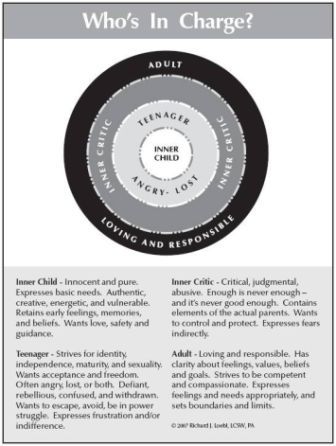
He's using a modified parts model here, focusing on just the inner child, inner teen, the critic, and the adult - this is fairly common in briefer forms of parts work. I don't like his diagram because it misrepresents the complexity of the relationships between parts, but it'll do.

What he calls the inner teenager here is more likely a manager part, or several manager parts, each with its own ways of protecting the inner child. The adult part is more likely the Self, or some variation on a mature, compassionate, non-reactive core identity. But I am picking nits - it's just that this is my area, and I prefer to see the model used correctly.

Who’s in Charge – Understanding Men Today

September 20th, 2010

By Richard J. Loebl, LSCW, PA, Men’s Issues Topic Expert Contributor

Click here to contact Richard and/or see his GoodTherapy.org Profile

**This is the first in a series of articles about men today – how we function emotionally, behaviorally, and in relationships**

Like most men today, I learned how to be a man from the fathers, grandfathers, brothers and uncles in my life. Like other baby boomers, I also learned about “ideal” manhood from the heroes of my time – John Wayne, James Bond, and others. In my early teens my values and beliefs were influenced by leaders who were larger than life, such as President Kennedy and Martin Luther King. In my late teens it was Bob Dylan, John Lennon, and others who shaped my beliefs and image. Then it took years of psychotherapy and personal development to find the real me – the real man inside.

I’ve worked with hundreds of men in various types of counseling, men’s groups, and personal growth workshops for over 30 years now. These men have taught me what I know about men today. They taught me how a man feels emotion, how they communicate, and how they deal with the demands of life. They also taught me how a man thinks about love, relationships, work, and play. These men have shared their struggles, their fears and frustrations, their self-doubt, and their victories, large and small.

As a result of these experiences, I developed a self-help model that helps men, and the women in their life, understand their feelings and patterns of behavior. It helps to answer questions such as: Why do men get so angry at times? Why do they procrastinate and avoid responsibility? Why do they refuse to ask for directions?

The Who’s In Charge? model describes our internal parts. For example, when I buy a large container of ice cream and bring it home, part of me wants to eat all of it the first night. Sometimes I do eat too much, and a different part is critical. Another part takes over when I plan smaller portions to enjoy the next few nights.

The internal parts in this model include an Inner Child, innocent, vulnerable, often dependent. My work with men helped me identify a unique part of this model, the Teenager, who wants independence and empowerment, but is often lost, angry or both. The Inner Critic is judgmental, blaming, and demanding. Fortunately, all of us have an Adult part – loving, responsible, and competent.

These parts often reveal themselves in relationships. In my men’s group, the guys often talk about their marital problems. Bob, age 43, says his marriage is like a roller coaster. He loves his wife and enjoys her company. Then she makes “demands” he finds unfair, or she complains about something (money, the chores he didn’t do). Bob says he reacts very quickly with intense anger. First he defends himself in an angry, defiant manner, and then he distances by avoiding her, shutting down, and not talking. The group members tell Bob that he sounds like a victim when he tells his story. They are understanding about his feelings of hurt and anger, and suggest that he take a less reactive position with her. They want him to stand up to her, but in a loving and responsible manner, and to take responsibility for his part in the relationship dance.

During this group session, Bob could see how his anger and avoidance covered up his feelings of shame and fear – that he’s not good enough for her, and she could leave. I asked him one of my Who’s In Charge? questions. I said “Bob, when you’re feeling this way – so hurt and full of shame – and you quickly resort to anger and blame, how old are you?” He thought for a moment and said “Mid-teens. Like 13 or 14”. I asked him what was going on when he was that age, and he told the group about how the kids at school picked on him, and he was afraid to tell his parents. His mother was critical, and his father, who was an alcoholic, but very successful in business, was verbally and physically abusive. Bob, at 14, acted out by avoiding the kids at school, by watching TV instead of doing homework, and he either kicked holes in the walls or sulked in his bedroom.

Bob was able to recognize the lost, angry Teen who reacts today when he feels blamed or attacked by his wife. He could connect with the Child inside who feels so hurt and ashamed – and how the Teen protects the Child by getting angry and defensive. Then his Critic takes over, either blaming his wife, or blaming himself for his immature behavior. The men in the group helped him to enable the Adult by being compassionate with himself, with his wife and her feelings and needs, and encouraging him to talk to her about his fears and what he needs from her emotionally.

In the past, we learned how to be men from our fathers and from idealized heroes, past and present. Today we have another choice – to learn from other men who have walked the path of personal growth and discovery. In future blog entries, I will share more stories about these courageous men of integrity.

©Copyright 2010 by By Richard J. Loebl, LSCW, PA. All Rights Reserved. Permission to publish granted to GoodTherapy.org. The following article was solely written and edited by the author named above. The views and opinions expressed are not necessarily shared by GoodTherapy.org. Questions or concerns about the following article can be directed to the author or posted as a comment to this blog entry. Click here to contact Richard and/or see his GoodTherapy.org Profile


Tuesday, August 24, 2010

Secret Lives of Men - Gilles Tremblay: Therapeutic Work with More Traditional Men


Interesting episode - most men in therapy are going to be traditional men, so it's important to know what they need and how best to work with them.

Secret Lives of Men - Gilles Tremblay: Therapeutic Work with More Traditional Men

August programs are dedicated to the exploration of men and masculinity on the worldwide level; this approach is in conjunction with the release of the new book, “An International Psychology of Men: Theoretical Advances, Case Studies, and Clinical Innovations" (The Routledge Series on Counseling and Psychotherapy with Boys and Men. This month’s guests, each a contributor to the book, discusses their research and clinical work with men. Today’s guest is Gilles Tremblay (École de service social Université Laval, Canada. Our topic is Therapeutic Work with More Traditional Men.

Listen to internet radio with Secret Lives of Men on Blog Talk Radio


Friday, August 6, 2010

Chris Blazina's Secret Lives of Men - Travis A. Ryan on Body Image


Interesting . . . . Another book on my wish list.


Host Name:
Secret Lives of Men
Name: Travis A. Ryan

August programs are dedicated to the exploration of men and masculinity on the worldwide level; this approach is in conjunction with the release of the new book, “An International Psychology of Men: Theoretical Advances, Case Studies and Clinical Innovations" (The Routledge Series on Counseling and Psychotherapy with Boys and Men). This month’s guests, each a contributor to the book, discusses their research and clinical work with men. Today’s guest is Travis A. Ryan a graduate of the National University of Ireland-Galway. Our topic is men’s body image. Contact Travis Ryan at: travisryan13@gmail.com

Listen to internet radio with Secret Lives of Men on Blog Talk Radio