Showing posts with label fathers. Show all posts

Thursday, September 25, 2014

Selfless Cop Changes Lives of Two Boys . . . FOREVER

http://cdn.inquisitr.com/wp-content/uploads/2014/09/Jack-Mook-and-Sons-665x385.jpg

When a Pittsburgh police detective noticed that two boys he was training in a boxing gym stopped showing up, he went looking for them. What happens next is why I still have faith in human beings.

These Kids Had No Idea a Cop Would React This Way When He Heard about Their Living Situation


Police officer Jack Mook was enjoying his bachelor life, only having himself to take care of. He was boxing in his spare time and noticed that a couple of foster kids he helped train stopped showing up.

He tracked them down and found that they were living under terrible circumstances with abusive foster parents. Jack took matters into his own hands and had them placed in a new foster home…HIS home. Jack traded in his single life for the life of a parent and even legally adopted the two boys. Jack and the boys wouldn’t have it any other way and are restoring a lot of people’s faith in humanity!

Wednesday, August 27, 2014

'You're Not Alone': Dads Who Blog Redefine Modern Fatherhood

This article comes from NPR's Men in America series, which has been running throughout the summer.

'You're Not Alone': Dads Who Blog Redefine Modern Fatherhood

Brent Almond with his 4-year-old son, Jon. Almond began blogging several years ago to review kids' products, but soon found that he got more satisfaction from chronicling daily life as a father.
Brent Almond with his 4-year-old son, Jon. Almond began blogging several years ago to review kids' products, but soon found that he got more satisfaction from chronicling daily life as a father.Jennifer Ludden/NPR 
 
When graphic designer Brent Almond adopted a son a few years ago, he was struck — like so many new parents — by the steep learning curve, the sheer hard work of parenting and the overwhelming array of kiddie stuff he found himself having to buy.

So he launched a blog, Designer Daddy, to review products for their aesthetic value. But he soon found he got far more out of chronicling daily life as a father.

"It causes me to pause and think about things happening in my son's life and our life as parents and as a family," he says.


Almond is among hundreds of daddy bloggers who've taken to the Web in recent years — a logical outgrowth, perhaps, of the record number of stay-at-home and single fathers.

According to the Pew Research Center, there were 2 million stay-at-home dads in 2012, nearly double the number from 1989. And overall, the time fathers spend with their children has nearly tripled from a generation ago.

Many bloggers see their role as helping to define the modern dad. For Almond, that means challenging stereotypes not just of men, but also of gay men. He and his husband were the first same-sex couple to become parents in their social circle in Kensington, Md., but he's found a community of others online.

One of the first things he wrote about was the baby wipes he bought at Target, called Mom to Mom. "I'm like, 'Are we not allowed to use these?' " he says, laughing. "Did dads not ever use wipes?"

The social media conglomerate BlogHer recently honored Almond as a "Voice of the Year" for one of his posts. He wrote about being at the mall — disheveled, exhausted, chasing his toddler — when he ran into a young gay couple he knew. They were the guys his gay men's chorus had voted "cutest couple," well-dressed and heading to a play. Almond wondered, "Is Being a Dad Turning Me Straight?"
"Exhibit A: I no longer go to my gossipy, orgasmic shampoo-giving stylist. I now get my hair cut by an old, Greek barber within walking distance of my house."
He also wears the same gray T-shirts every day, lets his house get messy and, he writes, "Oh, the horror. Sometimes I leave the house wearing a black belt with brown shoes."

Any sleep-deprived mom with spit-up on her shirt can relate.

Beyond blogs, dads are also finding each other through a slew of daddy podcasts. Ryan E. Hamilton co-hosts the After Show podcast on Life of Dad. It brings on dad bloggers to talk about everything from sports to work-life balance to what is the appropriate age to let your child play the crazy popular video game Minecraft.

Oddly enough, Hamilton says half those who come to Life of Dad's podcasts and blogs are women.
"I get the sense that it's women kind of peeking through the peephole," he says. "You know, 'What's my husband going through that he's not quite opening up to me about?' "

Hamilton's opened up a lot, blogging about his struggles with divorce and depression and discovering he's not alone.

"And you're not alone in bigger and more grandiose ways than you ever thought," he says. "There've been complete strangers that have become probably some of my best friends, just by virtue of the fact that I've opened up and shared the good, bad and ugliest parts of my life."

"One thing I'm very proud of in the dad blogger community is that we really are supportive of each other," says Scott Behson, a professor of management at Fairleigh Dickinson University who has his own blog, Fathers, Work, and Family.

Behson says the dad blogging community is diverse — across age, race, income — and fathers have largely avoided the stay-at-home vs. working parent drama of the mommy wars.

"Society puts so much pressure on women to be this 'ideal mother,' " he says, "that they feel really torn no matter what they do, that they're not doing it right. And I think society hasn't placed that on fathers, so maybe we have it easier in that regard."

Even so, Behson says fathers do face entrenched, negative stereotypes: deadbeat dad, part-time dad, bumbling dad. Two years ago, daddy bloggers took on a number of big-brand TV commercials that fostered such perceptions. Huggies diapers took the most heat for portraying dads as inept, and the company quickly pulled the ad and remade it.

This year, blogger Zach Rosenberg at 8BitDad screened 140 commercials, spoiling for a fight. "And then my results actually surprised me," he writes.

By and large, Rosenberg found this year's crop of commercial dads loving, respected and competent — just like dad bloggers have been saying they are.

Wednesday, August 20, 2014

The Science of Fatherhood (NPR)

This is an excellent NPR show on the science of becoming a father, and how current science has ignored or overlooked the important role of fathers.

This originally on The Daily Circuit from Minnesota Public Radio.

The science of fatherhood

The Daily Circuit · Aug 4, 2014


A picture taken April 21, 2006 shows Berlin, Germany resident Nicolas W. changing his 8-month-old daughter at home. JOHN MACDOUGALL/AFP/Getty Images

Listen: Story audio

39min 13sec

Guests
  • Dr Eli J Finkel: Professor of psychology and of management and organizations at Northwestern University
  • Paul Raeburn: Author of "Do Fathers Matter?" chief media critic at the Knight Science Journalism Tracker and blogger at About Fathers for Psychology Today
Parenting is hard work - we've always known that. There are major biological and life changes that occur when you welcome a baby into your home.

Social scientists, however, have been taking a new look at the experience of parenthood. In an article Dr Eli J Finkel in The New York Times, he said the biological changes that a man faces when he becomes a father have long been overlooked:
Although many parents happily take to their new role, millions every year respond with despair. According to a 2010 article in the Journal of the American Medical Association, among new parents -- three to six months postpartum -- 42 percent of mothers and 26 percent of fathers exhibit signs of clinical depression. In a longitudinal study reported earlier this year in the journal Pediatrics, men on average experienced significant increases in depressive symptomatology across the first five years of fatherhood (if and only if they lived with their child). Indeed, in the years after becoming a parent, both men and women experience significant reductions in their overall level of satisfaction with their lives, according to a 2008 paper in The Economic Journal.
Author Paul Raeburn says that beyond the initial transition of becoming a father, science frequently omits the role a father plays in a child's life - be it the role of a sperm donor, a bread winner, a primary caretaker or a relationship that doesn't fit into one category.

Finkel and Raeburn join The Daily Circuit to discuss how becoming a father impacts a man, and what role a father plays in a child's life.

Sunday, August 17, 2014

Michael Brooks - Men Can Be Just as "Maternal" As Women, According to Neuroscience

http://www.newrepublic.com/sites/default/files/u187208/fathersnewstatesman.jpg

"Sometimes science needs to state the bleeding obvious." Indeed, that about sums it up. But the "bleeding obvious" around this topic is not widely believed in the U.S. Women are still considered better care-givers, more emotionally attuned, and more nurturing. Those of us who know single fathers know this is not true.

By the way, this comes from The New Republic, via The New Statesman.

The researchers scanned the brains of parents while they watched videos of their own interactions with their children. What they found is that brain activity increases in two areas (the article did not name the areas and the study is pay-walled):
One is an emotional network that deals with social bonding, ensures vigilance and coordinates responses to distress, providing chemical rewards for behaviors that maintain the child’s well-being. The other network is concerned with mental processing. It monitors the child’s likely state of mind, emotional condition, and future needs, allowing for planning.
In the secondary care-giver, the activity is stronger in the 2nd area, the one focused on planning and monitoring the child's state of mind. In the primary care-giver, the social bonding and distress response area is most active.

Here's the aha! moment: the above was true no matter who was the primary caregiver, the mother or the father (if the father does not have a female partner). In fathers with female partners, whether they are primary or secondary caregivers, "the relative size of the of emotional and thinking responses varied according to how much time they spend looking after the child."

Take home message: "Neuroscience tells us that children who are raised by two fathers experience the same care-giving environment as those raised by a mother and a father."

Support the Anti-Bulling Campaign
Dan Savage (right), his husband Terry (left) and their son, DJ (middle).

Well, damn, this IS bleeding obvious.

Men Can Be Just as "Maternal" As Women, According to Neuroscience

By Michael Brooks
July 25, 2014

Occasionally, scientific research comes up with banal findings that should nonetheless stop us in our tracks. For example, researchers recently published a study showing that a father’s brain will change its hormonal outputs and neural activity depending on his parenting duties. The conclusion of the research is, in essence, that men make good parents, too. Surely this is not news.

Yet it does provide evidence that is sadly still useful. Those involved with issues of adoption, fathers’ rights, gay rights, child custody, and religion-fueled bigotry will all benefit from understanding what we now know about what makes a good parent.

The biggest enemy of progress has been the natural world, or at least our view of it. Females are the primary caregivers in 95 percent of mammal species. That is mainly because of lactation. Infants are nourished by their mothers’ milk, so it makes sense for most early caring to be done by females.

Human beings, however, have developed more sophisticated means of nourishing and raising our offspring. Should the circumstances require a different set-up, we have ways to cope. It turns out that this is not just in terms of formula milk, nannies or day care: We also have a flexible brain.

The new study, published in Proceedings of the National Academy of Sciences, scanned the brains of parents while they watched videos of their interactions with their children. The researchers found that this stimulated activity in two systems of the brain. One is an emotional network that deals with social bonding, ensures vigilance and coordinates responses to distress, providing chemical rewards for behaviors that maintain the child’s well-being. The other network is concerned with mental processing. It monitors the child’s likely state of mind, emotional condition, and future needs, allowing for planning.

In mothers who are the primary caregivers, the emotional system was most active. Fathers who are secondary to a female caregiver were more engaged as thinkers and planners. But men raising a child without a female partner were found to have the same level of emotional response as a mother and the same thinking and planning response as the secondary father. In other words, they are able to perform both roles.

What’s more, for men in both primary and secondary roles, the relative size of the of emotional and thinking responses varied according to how much time they spend looking after the child. To give the child the best care, the brain changes its output depending on circumstances.

Neuroscience tells us that children who are raised by two fathers experience the same care-giving environment as those raised by a mother and a father. Similar studies still need to be conducted on single mothers, non-parents raising children and dual-mother parents but the likelihood is that they, too, will display similar plasticity.

Oregon State University’s Sarina Saturn writes that this will one day be regarded as a landmark study. That is a little depressing—we shouldn’t need scientific research to tell us this. Yet she is right. It will help dispel prejudice, just as the discovery of homosexual activity among animals helped to dispel the myth that this is somehow unnatural. We now know that the brain “is flexible enough to keep up with the times”, as Saturn puts it. Hurrah. Sometimes science needs to state the bleeding obvious.

~ This piece first appeared on newstatesman.com.

Saturday, August 2, 2014

'Masters of Sex' Artfully Exposes a Myth of Masculinity

A recent episode (July 27) of Masters of Sex (Showtime) has received a lot of attention for its depiction of main character William Masters' revelation of childhood physical abuse by his father. This revelation was quickly buried again.

The impetus for the revelation was Masters' experience delivering a baby with ambiguous genitalia, and then feeling outraged by the harsh reaction from the newborn's father. Because of this series of events, Masters found himself reflecting on his own struggles with masculinity to research partner Virginia Johnson (Lizzy Caplan) during a secret hotel rendezvous.

This is a show I have not gotten into yet, but I plan to do so. It is currently one of the most highly praised shows on television.

'Masters of Sex' artfully exposes a myth of masculinity

By Yvonne Villarreal


Michael Sheen has wowed critics by playing one of TV’s most unlikable characters in Showtime’s highly praised “Masters of Sex.” (Jay L. Clendenin / Los Angeles Times)

Highlights:
  • Michael Sheen propels 'Masters of Sex' by exposing a troubled childhood and then quickly shutting it away
  • 'Masters of Sex' has delivered a masterful episode that artfully exposes a myth of masculinity
It turns out that the pioneering sex researcher William Masters in "Masters of Sex" is most exposed when cloaked in a plush white bathrobe.

The July 27 episode of the highly praised Showtime drama had viewers more on edge than the moments before a physician delivers test results. The episode pivoted on Michael Sheen's stellar performance as the famous sex researcher who slowly peeled back the Band-Aid on a very troubled childhood and then quickly re-applied it.

After delivering a baby with ambiguous genitalia, and later becoming incensed by the harsh reaction from the newborn's father, Masters found himself reflecting on his own struggles with masculinity to research partner Virginia Johnson (Lizzy Caplan) during a secret hotel rendezvous. With nothing but a bathrobe as his armor, Masters became the patient.

"He did me a favor," Sheen said in the scene where he tells of suffering a broken nose at the hands of his father at age 14. "He made me the man I am today."

It was a commanding point in the slow-burn of the icy character as the modest-performing show settles into its second season. For the man who has thrived in Hollywood's world of historical fiction — playing real-life characters in film such as David Frost in "Frost/Nixon" and former British Prime Minister Tony Blair in "The Queen" — the Welsh native has established himself as one of television's premiere actors. His depiction of the sex researcher as one of TV's least sympathetic anti-heroes has been revered by critics — many took issue with his omission from this year's Emmy race.

Over a recent breakfast, Sheen reviewed the intricacies of the confounding character whose work help set the stage for the sexual revolution. As he cut into two poached eggs, the 45-year-old actor motioned to the oozing yolk with his eyes.

"That will never be Bill," he said. "You won't see his feelings spill out, but he gave us a little something in that episode."

After a pause, he elaborated.


Lizzy Caplan and Michael Sheen star in "Masters of Sex." (Craig Blankenhorn / Showtime)

"The road to happiness can often be a road of awfulness in getting there," he added. "Bill has become the person he's become and he's adapted to life and dealt with things the ways he's dealt with them because of stuff that happened to him when he was younger, but it's not really working for him. What it's created is kind of a prison. And, yeah, he'd like to be free from that prison, but there's a part of him that made that prison for a reason, and he doesn't want to leave it. It's too scary. And I find that so damn interesting, I have to say. It's like he's the Walter White journey in reverse."

When viewers met Masters, he was a prominent but uptight OB-GYN physician at Washington University School of Medicine who was also a detached husband to a doting wife (Caitlin FitzGerald). He soon became fixated on the study of sex, a taboo subject particularly for an academic in the 1950s. Eventually, to pursue his passion, he enlisted Johnson to help conduct research — the two eventually began a sexual relationship.

The near constant in Masters' character is that he's a jerk much of the time. It's a boldly honest approach to a character that dares to buck TV's hang-ups with likability, Sheen said. And like Masters, Sheen isn't here to play nice and make friends.

Michelle Ashford, who developed the series from Thomas Maier's biography of the same name, initially gave consideration to making Masters slightly warmer and more palatable for viewers. The decision was being weighed during a time when audiences were actually rooting for "Breaking Bad's" meth-dealing Walter White.

But Sheen fought against softening his character to please viewers.

"There's a scene in Oliver Stone's film 'Nixon' where [Richard] Nixon points to a painting of JFK, and he says, 'When they look at you, they see what they want to be. When they look at me, they see what they are,'" he said in his best Anthony Hopkins-as-Nixon impersonation. "Most TV characters are who people want to be, even if it's Walter White.

"Sure, Don Draper isn't a pleasant character, but he looks gorgeous, and everyone wants to sleep with him. I don't look like that! And I want to make that a strength. At the same time, I have an absolute responsibility to be totally rigorous in making sure that he's a real person. Why shouldn't the audience have a character that's about all their worst qualities?"

The role was presented to Sheen during his run as Hamlet in a controversial production in London in late 2011. The call was Ashford's first glimpse of Sheen's intensity.

"He was really listening more than he was asking a ton of questions," Ashford said. "Since then, the back and forth between the two of us as to who Bill is and what makes him tick and what makes him weak is a true collaboration. You can't even say he's been invaluable to the process. He just is the process. We talk on the phone, by email, in his trailer — we talk all the time about this character. The way we're able to follow this character for a long time really stirs something in Michael."

Over breakfast, Sheen displays an equal curiosity over the medium's state of metamorphosis — the way it's consumed; its multi-platformness. The fascination has spurred him to begin developing his own projects for television. In doing research, he's read over some TV outlines — among them was the original series overview of HBO's "True Detective."

"In the very opening line, it's described as a 'literary,'" Sheen said. "It hit me like a bullet because I've been thinking about that. I feel like that is what this new version of TV is kind of becoming. It's a cross between a novel and a film. The way you can layer and reveal characters in this space is just so fascinating to me.

"It's why I'm OK with being the [jerk] in your living room. At least I'm not a [jerk] trying to cover it up."

Twitter: @villarrealy

'Masters of Sex'
Where: Showtime
When: 10 p.m. Sunday
Rating: TV-MA-LSV (may be unsuitable for children under the age of 17 with advisories for coarse language, sex and violence)

Tuesday, July 22, 2014

The 3 Scariest Words A Boy Can Hear

So what are those three scariest words? "Be a man."

This wisdom comes from Joe Ehrmann, a former NFL defensive lineman and now a pastor. He was interviewed recently for NPR's Utah Public Radio, and the transcript is below. This story is part of All Things Considered's "Men in America" series.

Interesting quote:
CORNISH: For you, what is masculinity? What does it mean to be a man?
EHRMANN: I think it could be only defined by two things. One, it's your capacity to love and to be loved. Masculinity ought to be defined in terms of relationships. Second thing, it ought to be defined by commitment to a cause - that all of us have a responsibility to give back - to make the world more fair, more just, more hospitable for every human being. So I think it's about relationships and commitment to a cause. That's the underlying of all humanity - men and women.
Cool interview.

The 3 Scariest Words A Boy Can Hear

By NPR Staff
Originally published on Mon July 14, 2014 

Listen  - 7:25


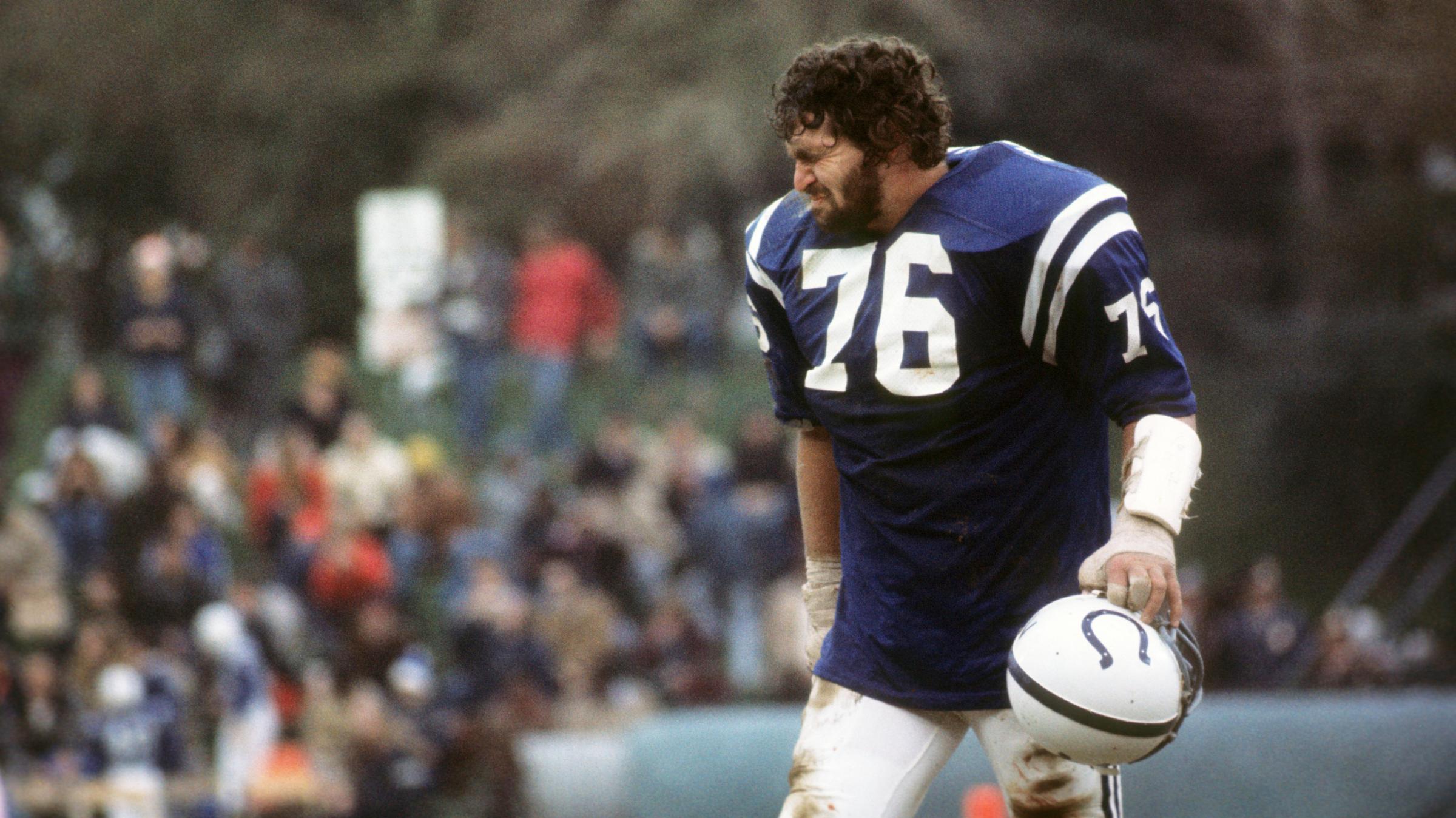
Joe Ehrmann, shown in 1975, was a defensive lineman with the Baltimore Colts for much of the '70s. He says that as a child, he was taught that being a man meant dominating people and circumstances — a lesson that served him well on the football field, but less so in real life.   Neil Leifer Sports Illustrated/Getty Images
This story is part of All Things Considered's "Men in America" series.

It's rare that a man makes it through life without being told, at least once, "Be a man." To Joe Ehrmann, a former NFL defensive lineman and now a pastor, those are the three scariest words that a boy can hear.

Ehrmann — who played with the Baltimore Colts for much of the 1970s and was a lineman at Syracuse University before that — confronted many models of masculinity in his life. But, as with many boys, his first instructor on manhood was his father, who was an amateur boxer.

Ehrmann says of his father: "I think his definition, which was very old in this country, was: Men don't need. Men don't want. Men don't touch. Men don't feel. If you're going to be a man in this world, you better learn how to dominate and control people and circumstances."

On the football field, those lessons served Ehrmann well. But, as he tells NPR's Audie Cornish, it was not the same case in the pediatric oncology ward. In 1978, Ehrmann's teenage brother was diagnosed with cancer. However tough Joe was on the field, he did not feel equipped to help his brother or himself.

Interview Highlights


On how his brother's death affected him

When he died, that was devastating to me. And I started to ask all the questions about what is the role, the meaning, the purpose of life. I was 29 years old, I was six years into my NFL career, and I had no concept — no concept what life was about, and no concept what I was about. And on this journey, I ended up asking the question: What does it mean to be a man? ...

I recognized that everything I had invested my life in — all my accomplishments, my achievements, the stuff I had accumulated — I recognized at that moment they offered no hope or help to my 19-year-old brother — 18-year-old brother — lying on his deathbed. ...

All I had was these old "man up" kind of things — "suck it up, we'll get through this together" — when he really needed the emotional, the nurturing, the love. And I had to really struggle to pull that out of my heart.

On the roles a coach can play in his players' lives

There's two kinds of coaches in America: You're either transactional or you're transformational. Transactional coaches basically use young people for their own identity, their own validation, their own ends. It's always about them — the team first, players' needs down the road.

And then you have transformational coaches. They understand the power, the platform, the position they have in the lives of young people, and they're going to use that to change the arc of every young person's life. I think football is an ideal place — sports in general — team sports are an ideal place to help boys become men. And the great myth in America today is that sports builds character. That's not true in a win-at-all-costs culture. Sports doesn't build character unless the coach models it, nurtures it and teaches it.

On what those philosophies look like on the field

I think there's a lot of screamers, there's a lot of shouters, there's a lot of shamers. My approach is this: Boy, you're in the middle of the game, and some kid's having a tough time. They get beat. ... I tell all my players, "Come on over to me during the game and I'll give you a hug." And you think about the power of a hug versus swearing, shouting, shaming at some kid.

When I played football, I hated [when] some kid would get a knee injury, your teammate would go down and that coach would say move the practice down 20 yards and leave that kid laying there. ... As coaches, we can kneel down next to that kid, you affirm the tears, the pain, the emotions, and you bring all the team around to say, "How can we help Bobby? He's one of us; he's done so much. He had so many dreams." So, you teach them how to build authentic community as men caring for and loving each other.

On the changes he's seen in ideas of masculinity

I think those three lies of masculinity — athletic ability, sexual conquest, economic success — in many ways, those things have been heightened. You have this increase in social media. You have young boys coming into this world, and they are hit 24/7. They're given all kinds of negative messages about their masculinity. They've been conditioned, and they have way more messaging out of this culture than I ever had as a young boy. I think in many respects, it's more difficult. There's more negative messaging out there and less positive.

On what it means to be a man

It think it can only be defined by two things: One, it's your capacity to love and to be loved. Masculinity ought to be defined in terms of relationships. Second thing, it ought to be defined by commitment to a cause. All of us have a responsibility to give back, to make the world more fair, more just, more hospitable for every human being. So I think it's about relationships and commitments to a cause. That's the underline of all humanity — men and women.

Copyright 2014 NPR. To see more, visit http://www.npr.org/.

Transcript


ROBERT SIEGEL, HOST:

This is ALL THINGS CONSIDERED from NPR News. I'm Robert Siegel.

AUDIE CORNISH, HOST:

And I'm Audie Cornish. We've been hearing about men this summer - how their roles have changed, what their lives are like. And one thing most men are told at some point in their early lives is this - be a man.

JOE EHRMANN: Yeah, I think every boy at a very early age is given this mandate to be a man. They're actually the three scariest words every boy receives.

CORNISH: That's former NFL defenseman Joe Ehrmann. He played in the 1970s, mostly for the Baltimore Colts. As with many boys, his first instructor on manhood was his father.

EHRMANN: I think in many ways my father gave me all the wrong concepts about being a man. I think his definition, which was very old-school in this country, was men don't need. Men don't want. Men don't touch. Men don't feel. If you're going to be a man in this world, you better learn how to dominate and control people and circumstances.

CORNISH: And, of course, men don't cry. On the football field, those lessons served Joe Ehrmann well, but not in the pediatric oncology ward. In 1978 Ehrmann's teenage brother was diagnosed with cancer, and however tough Joe Ehrmann was on the field, he did not feel equipped to help his dying brother or himself.

EHRMANN: When he died, that was devastating to me. And I started to ask all the questions about what is the role, the meaning, the purpose of life. I was 29 years old. I was six years in my NFL career, and I had no concept - no concept what life was about and no concept what I was about. And on this journey I ended up asking the question what does it mean to be a man?

CORNISH: Why that question for this particular really very emotionally wrenching part of life?

EHRMANN: Well, 'cause I think I recognized that when my brother was diagnosed and began his dying process - I recognized that everything I had invested my life in - all my accomplishments, my achievements, stuff I had accumulated - I recognized at that moment they offered no hope or help to my 19-year-old brother - 18-year-old brother lying on his deathbed. I was a socialized male that had separated my heart from my head, trying to live life from the neck up.

CORNISH: You were saying all you had were the locker room speeches basically.

EHRMANN: Yeah. All I had was these old man up kind of things. Suck it up. We'll get through this thing together. When he really needed the emotional - the nurturing, the love. Boy, and I had to really struggle to pull that of my heart.

CORNISH: You went on to seminary and to become a pastor. And you also went on to coach high school football. Now, can you talk about what it is in particular you think coaches can do to shift this ideology and whether you really have encountered coaches who are interested in doing that?

EHRMANN: Well, there's two kinds of coaches in America. You're either transactional or you're transformational. Transactional coaches basically use young people for their own identity, their own validation, their own ends. It's always about them - the team first, players' needs down the road. And then you have transformational coaches. They understand the power, the platform, the position they have in the lives of young people, and they're going to use that to change the arc of every young person's life. I think football is an ideal place - sports in general - team sports are an ideal place to help boys become men. And the great myth in America today is that sports builds character. That's not true in a win-at-all-costs culture. Sports doesn't build character unless a coach models it, nurtures it and teaches it.

CORNISH: You mentioned that coaches are either transactional - what can you do for me - or transformational. On the field, how does that play out? Are you basically talking about the screamers here?

EHRMANN: The screamers, yeah. I think there's a lot of screamers. There's a lot of shouters. There's a lot of shamers. My approach is this - boy, you're in the middle of the game and some kid's having a tough time. They get beat. I tell all my players, come on over to me during the game and I'll give you a hug. And you think about the power of a hug versus swearing, shouting, shaming at some kid. Boy, you know, when I played ball I hated - some kid would get a knee injury. Your teammate would go down and that coach would say move the practice down 20 yards and leave that kid laying there. Boy, as coaches, we get kneeled down next to the kid. You affirm the tears, the pain, the emotions, and then you bring all the team around to say how can we help Bobby? He's one of us. He's done so much. He had so many dreams. So you teach them how to build authentic community as men caring and loving for each other.

CORNISH: I'm speaking with Joe Ehrmann. He's founder of Coach for America. And so you've actually been doing this work for decades. And has the average boy changed in some way or are there changes you've seen in how they approach masculinity than when you were growing up?

EHRMANN: Not too much. Boy, I think there's different nuances and stuff, but we have a real crisis when it comes to what it means to be a man.

CORNISH: Not too much, really?

EHRMANN: I don't think so. I think those three lies of masculinity - athletic ability, sexual conquest, economic success. In many ways those things have been heightened. You have this increase in social media. You have young boys coming into this world and they are - 24/7 they're given all kinds of negative messages about their masculinity. They've been conditioned, and they have way more messaging out of this culture than I ever had as a young boy. So I think in many respects it's more difficult. There's more negative messaging out there and less positive.

CORNISH: Can you talk about a particular incident that really drives that home for you?

EHRMANN: Well, I think the Steubenville, Ohio, rape case - two high school boys - 16-year-old girl - drunk, passed out - hundreds of pictures taken - tweets. And that one person had the moral clarity or moral courage to intervene in the midst of that. Two boys sentenced to prison - had no idea about consent. They weren't taught this stuff. A community tried to cover it up. Boy, I think that thing is played out and could play out at any high school. Boys have to be taught about - they have to have the moral clarity and the moral courage to speak up. That's not going to end. Women can't end it. It's not going to end until we raise up a generation of men that have the courage to call out other men on behalf of women in this country.

CORNISH: For you, what is masculinity? What does it mean to be a man?

EHRMANN: I think it could be only defined by two things. One, it's your capacity to love and to be loved. Masculinity ought to be defined in terms of relationships. Second thing, it ought to be defined by commitment to a cause - that all of us have a responsibility to give back - to make the world more fair, more just, more hospitable for every human being. So I think it's about relationships and commitment to a cause. That's the underlying of all humanity - men and women.

CORNISH: Joe Ehrmann - he's founder of Coach for America. Thank you so much for speaking with us. EHRMANN: Great to be with you, Audie. Thank you.
Transcript provided by NPR, Copyright NPR.

Wednesday, June 25, 2014

Roughhousing Lessons From Dad

Dad\\\

It's nice to see researchers looking at the role of fathers in their children's lives. This review of recent research comes from the Wall Street Journal.

Roughhousing Lessons From Dad

Fathers Teach Risk-Taking, Boundary-Setting; Learning From 'Sock Wrestling'


By Sue Shellenbarger
Updated June 11, 2014


http://m.wsj.net/video/20140613/061014lunchworkfam2/061014lunchworkfam2_640x360.jpg
Fathers who spend time with their kids help instill self-control and social skills, numerous studies show, but exactly how fathers do that is a mystery. WSJ columnist Sue Shellenbarger and father of two Greg Kessler join Tanya Rivero on Lunch Break to decode the father factor. Photo: Greg Kessler

There is no question among researchers that fathers who spend time with their children instill self-control and social skills in their offspring.

Exactly how dads do that, however, is largely a mystery.

Thousands of studies have sliced and diced the benefits for children of a close, nurturing bond with Mom. Researchers have a harder time analyzing the ways fathers interact with children, such as rough-and-tumble play.

Some scientists are inventing new scales and laboratory procedures to try to measure the father factor. One researcher watched fathers and children playing games like "Get Up," in which fathers try to get up from the floor while the children try to hold them down, and "Sock Wrestle," in which father and child try to snatch each other's socks. Other researchers had toddlers climb down stairs in fathers' presence, in a process dubbed "Risky Situation."

"Most people have a pretty well-defined sense of what it means to be a good mom, but for dads, that role is much less scripted," says University of Georgia researcher Geoffrey Brown, lead author of a 2012 study in the Journal of Family Psychology on fundamental questions about how fathers bond with children.


Theo Stroomer for the Wall Street Journal

Greg Kessler likes to roughhouse with his 7-year-old son Ezra or his 4-year-old daughter Zoe. He loves wrestling, pillow-fighting and a game they call "Big Chair, Little Chair," when he lies down, balances a child on the soles of his feet and raises and lowers the child in midair, says Mr. Kessler, a New York City photographer.

His wife, Paula Trotto, believes her husband's play style will help Ezra learn to stand up for himself, but "it does baffle me" that her husband enjoys getting the children so excited, she says. At times, she adds, "I have to leave the room. It's such an intuitive thing, to not want to tolerate the sounds of your kids screaming."

The primary test of attachment—a key concept in child-development research—was developed to analyze babies' bonds with mothers. This procedure, known as the "Strange Situation," has mothers briefly separate from their infants twice. Babies who are upset but readily comforted by the mother when she returns are seen as having a secure bond.

Positive scores tend to sync with other measures of mothers' sensitivity and to predict better cognitive and emotional skills in children later. But when researchers put dads through the Strange Situation, the scores don't consistently predict much, and often fail to match other measures' results.

Many researchers believe dad's bond is expressed a little later, when the father serves as a secure base allowing the child to explore and take risks. This is hard to study in a lab. Animal studies, however, show that baby rats deprived of rough-and-tumble are more aggressive and lack social skills as adults.

The Father Factor

Researchers studying fathers' role often look at how they act during rough-and-tumble play. Here are some positive signs:
  • Father is immersed in the game emotionally, smiling and laughing
  • Father shows spontaneity, creativity or silliness
  • Father is good-natured about losing, with no signs of ego
  • Father helps the child control his or her emotions and calms him or her when overexcited
  • Father adjusts his effort and his technique based on the child's cues
  • Father motivates the child to stay engaged and keep going, or rejoin the game
  • Father is dominant but shares the upper hand, allowing the child to win sometimes
--Richard Fletcher, University of Newcastle in Australia
In an early study at the University of Regensburg in Germany, researchers created a scale to evaluate parents' play, based on whether they challenged kids to stretch themselves, were sensitive to their emotions and encouraged them to solve problems. Mothers and fathers were observed playing with blocks or play dough with their 2-year-olds. Fathers' scores were a unique predictor of children's healthy attitudes toward relationships with others at age 16, according to the 2002 study of 49 subjects led by Karin Grossmann, a senior scientist at the university.

Christopher VanDijk tunes in closely to signals from his 4-year-old son Liam that he wants to play. "He gets this mischievous look on his face, and you just kind of know," says Mr. VanDijk of Denver, an at-home dad. "We have pillow fights. And I pretend like I'm going to eat his ears. There's lots of squealing."

Liam sometimes takes the lead, saying, 'I'm going to scare you, and when I say, "Boo!" you have to say, "Ahhh!" ' Mr. VanDijk also watches for signals that Liam is out-of-control or frightened. "There are times when you put on the brakes," he says.

Rough-and-tumble play isn't confined to fathers. "If a mom does it, the child will learn the same thing," says Catherine Tamis-LeMonda, a professor of developmental psychology at New York University.

Mr. VanDijk's wife Angie, a college administrator, often plays active superhero games with Liam. "Sometimes he needs quiet time, sometimes he needs scuffle time," she says.

Fathers engage in more scuffle time on average, however. Using an adjustable carpeted ramp, researchers at New York University asked 34 parents to show how steep a slope they'd allow their babies to attempt. Some 62% of fathers said they would let their babies try a slope beyond their ability, compared with 56% of mothers, says the 2007 study co-authored by Dr. Tamis-LeMonda.

Many fathers walk a fine line during play between safety and risk, allowing children to get minor injuries without endangering them, says a 2011 study of 32 subjects in the Journal of Developmental and Behavioral Pediatrics. Researchers say this can instill emotional intelligence under fire, and an ability to take prudent risks and set limits with peers.

Navdeep Singh Dhillon likes play-fighting with his 4-year-old daughter Kavya, pretending to throw a kick, teaching her how to block it, then saying, "OK, it's your turn to kick me," he says. He sometimes traps Kavya and his 4-month-old son Shaiyar in a leg lock and has Kavya "tap out," tapping him three times as a signal to release them. Mr. Dhillon of Jersey City, N.J., a college professor, says such play teaches children to set boundaries. "When they have relationships of their own, or with other kids, they'll know what is OK and what's not OK."

Richard Fletcher, an Australian researcher who has studied fathers in free-form games with preschoolers, says fathers need to follow children's lead sometimes, while encouraging them to stretch themselves, and to let them win often enough to have fun—but not so often that they lose interest. Dr. Fletcher, a senior lecturer on the health and medicine faculty at the University of Newcastle, invented a scale to measure quality of play. In a study published last year in Early Child Development and Care, researchers video-recorded 26 fathers in their homes playing the games "Get Up" and "Sock Wrestle" with their 3- and 4-year-olds. Children of fathers who scored high on play quality had fewer social and behavior problems.

The "Risky Situation" is a 20-minute test that assesses children's confidence to explore. Toddlers are placed in a room with their father and a stranger and allowed to play with the stranger, then to climb down a set of stairs. Toddlers who explored with confidence, while heeding limits set by their fathers, had better social and emotional skills 12 to 18 months later, according to a 2013 study co-authored by the test's creator, Daniel Paquette, an associate professor of psychoeducation at the University of Montreal in Canada.

Dr. Tamis-LeMonda is video-recording daily routines of 100 New York City families. In a past study, she discovered "hall ball"— a game where "Dad throws the ball down the hallway," and the toddler brings it back, she says. "That's a natural, everyday routine we wouldn't have known about if we just brought families into the lab and said, 'Here are some toys.' " Such insights, she says, "might guide future research."

Write to Sue Shellenbarger at sue.shellenbarger@wsj.com

Sunday, June 15, 2014

Dads Reflect on the Unexpected Moments that Defined Them as Parents

Happy Father's Day to the dad's out there. Here is an article from The Atlantic on the joyful moments of being a father. Judith Ohikuare interviews Brian Gresko, author of When I First Held You: 22 Critically Acclaimed Writers Talk About the Triumphs, Challenges, and Transformative Experience of Fatherhood.

What Makes Men Fathers

Dads reflect on the unexpected moments that defined them as parents.


Michaela Rehle/Reuters

As writer and stay-at-home dad Brian Gresko sees it, narratives about fatherhood are slowly but surely becoming more present in overall conversations about parenthood. He notes that programs like NBC’s Today have honed in on dads by rebranding long-running segments like Today Moms into Today Parents (with an extra nod to Modern Dads). And online, Gresko says, “There’s definitely a growing trajectory of men writing honestly and openly about parenting” as a counterbalance to the well-established mommy-blogosphere.

Still, Gresko notes that while “there are also the so-called momoirs,” that genre doesn’t quite exist yet for dads. His new anthology, When I First Held You, compiles 22 essays on fatherhood from a host of distinguished contemporary attempts to showcase the wide range of experiences that men have as they grapple with being called “Dad.” I spoke with Gresko about the changing nature of fatherhood and visibility inside and outside of the home.


When did you become a stay-at-home dad and why was that the best decision for your family at the time?

My decision to be a writer and to be a dad all came kind of at the same time for me, or out of the same catalyst. At the time, my then-girlfriend was nearing 30 and wanted to have a family. That was a stumbling block in our relationship, and I took a year to get some space, and teach, and write in China. While I was there, I not only fell into a more regular practice of writing, but I also decided that I did, indeed, want to get married and start a family. When I came back home, I enrolled in an MFA program at The New School, my wife and I got married, and she became pregnant.
My son was born a week after I got out of school, so my wife wanted to go back to work. I had taken myself out of a career path at that point already, and it appealed to me to stay at home and have time to write in the evenings and while my son napped. But it also really appealed to me emotionally because even though I had not wanted to be a father for most of my life, I had decided to embrace it as fully as I could.

What was the environment like for stay-at-home dads at the time?

This was in Brooklyn in 2009, so it wasn’t foreign, but even today it’s much more normal to see guys walking around with their babies strapped to them or with strollers. A few guys would give me looks like, You’re walking around with a baby? What’s up with that?—but it was mostly women.
I would get unsolicited advice, as if I didn’t know what I was doing and nannies looking for work would kind of assume that I would rather be working, and that I must be looking for someone to take care of my child. To take yourself out of the workforce was seen as very strange. I was met with, “Well, this must be a nice little vacation for you,” or “You must be taking a sabbatical to try and reboot yourself. I wish I could do that,” instead of recognizing what I was doing as another kind of work. So, those first couple of years when I was at home with my son were very lonely.

How did you feel about fatherhood when you became a dad, especially since as you say, you didn’t actually want to be one for most of your life?

When I was a child, my parents revealed to me that the guy I grew up thinking was my biological father was actually my adopted father. It was a really tense conversation and an uncomfortable thing for them to talk about, so we never discussed it again after that. During the process of my dad legally adopting me, my parents had been asked, “How would you address this with the child?” They were advised to talk about it with me at an early age, but not bring it up again unless I wanted to, and that’s what they did. Partly because of my natural temperament, which was to avoid making waves, and partly because I felt that my parents were still upset about it, I felt somewhat shameful and kind of guilty that I had caused this upset for them, so I kind of swallowed it.

But I always felt very different. When I was a teenager, I was more academic and a natural reader, and my parents are a little more sporty and great at fixing things around the house—things that I just didn’t have an inclination for. I started thinking that maybe I was different because my biological father had given me something other than what I was getting at home, and being such a reader, I started to imagine that he was someone like Henry Miller. I really fell in love with Henry Miller and it made sense to me that if [my father] was this really bright, creative guy, then he couldn’t be tied down to a kid since he was pursuing his own artistic path.

All of that synched into this identity for me, where I was going to be a writer and an artist, but I would not be a family person—and that felt right because of what I was interested in, and also because of the pain that I had around the idea of fatherhood and around the idea of family.

So what led you to making this book?

I wanted to hear from guys that are really amazing artists and writers, that you could be a great writer and also be a loving, engaged, active father. That, from the start, is something that has surprised me about fatherhood. I had always completely accepted the idea that a writer or artist had to choose between their work and having a family, but that is not the case.

In fact, the experience of having a kid opens you up emotionally in a way that [causes] you to see the world totally differently. You feel things more deeply; you feel love in a different way. You might have only experienced romantic love and now you’re experiencing this really warm sense of protection for another human being. You feel vulnerable; you want to protect them but you know you can’t. You want to be the best dad you possibly can, but it’s impossible to always have as much patience as kids require, or to be your best self all the time. Those feelings can really feed your creative work, and that’s something I never anticipated.
That’s interesting, especially given the idea that corporate careers are the ones that limit family time, while “creative” ones are seen as more flexible or accommodating—even though writing can be a very solitary thing.

I think of the old Modernist image of the male writer as being unattached and kind of hardheaded; someone hard-drinking with big opinions. Norman Mailer comes to mind, or Kerouac, or Henry Miller, or even Hemingway, who has this macho air about him. He had kids and writes about them a little bit, but mostly writes about going out to bullfights, and on fishing trips, and drinking at bars. That stereotype still looms large.

Writing is a very solitary act and it requires that you have time to think into your imagination and be alone, but it’s also a communicative art. You’re writing about people and that requires not just knowing yourself but [also] paying attention to what goes around you. Most people on this planet become parents at some point, so these are really universal relationships. The men in this book have written books that are just as hard and heavy-hitting as any of the books Modernist authors would have put out—but they’re also really engaged with their families and they don’t hide that.

How does the title of the book relate to the idea of fatherhood? For many women who give birth, experiencing the physical changes that accompany pregnancy might help them feel a connection to their children sooner, whereas men might continue to grapple with the reality of being a parent until there’s actually a baby in front of them.

Women experience those changes in many different ways. I know friends who have said that they loved being pregnant, and there are other people like my wife who just did not enjoy it. But men are completely outside of that. The experience of their partner’s pregnancy is very abstract. We don’t really ever have the experience of our bodies being out of control unless we’re sick—and when that happens, it’s weird. With pregnancy, you’re taking care of this creature that’s growing inside of you, and it’s changing you and making you feel all sorts of things. A guy can hear about that and know the baby is coming, but it’s not a physical reality in the same way that it is for a woman.

That’s something that came up in several of the essays without me asking anybody to put that in. Stephen O’Connor—who was a guy that knew he wanted to be a dad from an early age—writes about how even after his son was born, those early days of infancy were so demanding that he didn’t actually feel like he fully loved his son until there was a health crisis. Then, after hearing that his son is going to be okay, he realizes how terribly, life-alteringly upset he would have been if something tragic had happened, and how inexorably connected they are. That every day, from now on, his son’s happiness will affect his happiness.

In my own [life] story, that was something that my dad said to me. He and my mom had been high school sweethearts, and when she got pregnant and my biological father said that he didn’t want to be a part of it, my adopted dad rekindled their friendship, and then eventually they got married.
He said that in those early days, he wasn’t sure what was going to happen with him, but when he first held me, he knew that he wanted to stick around for not only the love that he and my mom were developing, but also to just be there for me. I think that’s really powerful—that you can hold a little baby that isn’t your child, and it can be a profoundly moving experience.

Did any of the stories in the book resonate with you in particular?

Garth Stein writes in his essay about sharing a bed with his wife and his toddler son, and how this child is lying in between him and his wife like the sword lay between Tristan and Isolde, keeping them separate. Having a little boy, you hear this thing about sons and how much they love their moms, and that image in Stein’s essay really struck a chord with me, because my son has always had a very strong, Oedipal love for his mom. “When I grow up, I’m going to get married to you, mom!” he’ll say, and I never anticipated that.

My wife basically comes home every day to these two guys who are so happy to see her: me, because I’ve spent the whole afternoon with just my son, so I’m happy to see another grown-up, and he gets so excited because now she’s home and can play with him a little bit before dinner. We’re both kind of going, “Pay attention to me! Pay attention to me!” It does sometimes feel like we’re competing for her attentions and affections, and in that sense, Garth’s story really resonated with me.

Was there any commonality in terms of what men and women were saying was hard about being a parent?

I think everyone worries about how good a job they’re doing, and that’s kind of a big secret among parents. You worry that you’re messing your kids up in some way—and you know that you kind of are, which is anxious-making. You have these tiny, little conversations with your kids sometimes—“How was school?”—and then they reveal these big things. All of a sudden you’re in the midst of this really intense conversation wondering, what I should say? What’s the right thing to do? Both men and women have that same sense of, gosh I don’t know; I just hope I’m doing the right thing and that that’s good enough—but nobody knows any better than you do.

Saturday, June 14, 2014

Shawn Phillips - The 10 Best Things About Being A Dad

This is an old post from Shawn, dated 2009, but it's still relevant. Since tomorrow is Father's Day, it seemed like a good time to share this with those who may not see Shawn's Start Strong Monday blog.

It's kind of an interesting "holiday" for me - it's been 34 years since I have had a father, and if he were still alive (he'd be nearly 88 years old), I doubt we would be on speaking terms. The experience of growing up with him (and my equally dysfunctional mother) are why I knew by my teens I would never have kids.

All of this combines to make Father's Day a bit of a mystery. I don't know the feeling of actually being grateful for a father's love and guidance; nor do I have the experience of being a father and feeling that affection from my kids.

So I observe, vicariously and share those things that seem insightful.

The 10 Best Things About Being A Dad

Tue, Jun 23, 2009

sp_bp_mtn_2 

Yesterday was father’s day—a holiday I used to resist. I thought it a bit unnecessary. “Why dedicate one day to showing our father’s we care when we can do it 365 days a year?,” I reasoned.

Well, now that I am a father my view on this has made a 180. I still remember my first father’s day (now 10, geeze) 5 years ago, surprised I was by how great it felt to belong to the category of fathers. It was also special because my dad, BP, was alive and we both got to share the day.

Yesterday may well have been my best father’s day since. 

Sure, it’s great to get gifts and just be recognized but what struck me is how much better I am with self-care, with putting myself near the top of the list on this one day. In my experience this is a place where most father’s struggle—finding time for me.

To all those father’s out there: I hope that you too enjoyed a day where you were the featured attraction. And perhaps were able to anchor the feeling and recognize that while the family will always be first in mind and heart—taking care of self enables us to be more and give more to our children and spouses.
 Riding my bike through the stunning Colorado mountains yesterday I was contemplating the best things about being a dad. What follows are the highlights.

If you’re a dad, you need only skim these as I am sure you’ll connect with them instantly. At the end there’s a space for your story. I’d love to hear your favorite thing about being a dad. Whether it’s already on my list or not, share yours and I’ll make it worth your time, promise.

The 10 Best Things About Being A Dad


1. You finally know how your dad feels about you.


Regardless of the circumstances of your childhood, the moment you go from being “a guy” to being a father you “get it.” That is the feeling of what it is to love something more than life itself. I recall how my view of my father transformed in an instant. For I knew, no matter what he ever did or said, he too had felt “this” for me, my brother and sister. It’s not an optional feeling.


2. You know what it means to love something more than yourself.


Let’s face it, for all guys call sacrifice and profess to “give it up for,” not until we have a child do we really truly get what it is to hold something or someone else more important than self. And I believe this is a vital, transformational experience in life.


3. Whatever your age, kids make you young again.


If you’re a father you get this—if you’re not there yet, trust me on this. It’s so true. Your kids energy doesn’t wait on you. You get moving whether you want to or not. And they keep you playing more and seeing the world through the eyes of innocence that we’ve all worn once.

4. Being a dad makes you a better man.


I think we all like having the opportunity to be a mentor—to help someone learn and grow. It’s inherent in our DNA. And being a father is the ultimate mentoring opportunity—you get to truly shape a life(s). When it becomes obvious that it’s not just what you want them to pick up that they learn, you start thinking about choices you’d not given a second thought to before. Things like where you go, how you get there, who you hang around, etc. It all matters but what matters most is the man you are.


5. It’s a license to be silly and play


Once out of college it seems like the world gets pretty darn serious real quick. Having children brings play back into your life. Whether it’s wrestling around, dancing, making faces, telling jokes or playing tag—you’ve got a license to be your silliest. It’s hard not to go to a playground and play—just as I imagine it’s hard to go to a playground and play if you don’t have kids. It can look bad–so if you must at least stay off the monkey bars if you’re over 30.


6. It awakens you to your global responsibility.


Being a father makes you instantly more accountable and responsible to the world around us. Even if you’re one who’s been outspoken about your concern for the environment, politics or social issues of the day—with children suddenly you become more aware of everything that will impact the next generation and the next.


7. Someone is truly intrigued by your life wisdom stories.


Face it, guys like to tell stories from our formative years. As a father you finally have someone who is truly interested in all those stories that have bored others to tears for years. Enjoy the sharing and be a careful edit so as not to plant any unnecessary seeds—which I can tell you my dad did! They may take many years to materialize but trust me, really “good” stories can percolate for a long time.


8. You actually want someone to best you—to show you up!


While we all pull for friends and people we like, a child of your own is different story. It’s not just hoping they do well you truly want them to exceed any and every best you’ve ever enjoyed. It’s free from even the slightest jealousy of competitiveness and this is a refreshing, empowering feeling.


9. Being a father softens your heart and opens you to life.


No matter how focused you’ve been on getting ahead on your career and success—or how hardened your resolve from your own life circumstances, being a father will melt your heart. I won’t even try to explain it beyond that. At this point you either get it our you don’t. It’s that simple.


10. You’ve got Full Strength to help you be the world’s best dad!


For the other 364 days a year, when it’s not your day, you’ve got the life performance advantage of Full Strength nutrition, the world’s first and only true premium nutrition shake built for the modern day warrior dad. The delicious tasting, convenient, clinically proven nutrition shake with the exclusive Performance Balance is intentionally created to elevate your every day performance in work, play and LIFE. It’s the once a day antidote to dieting that will give you more energy, more time and more vitality to be the Full Strength father you really truly want to be for your children.


Full Strength for SuperHero Fathers


Share ONE of YOUR favorite things being a father—a memorable moment or touching story—and then click here for Dad’s only FREE Shipping on a 2-week or 1-month packages… Full Strength is the only nutrition shake clinically proven to swap fat for lean muscle without any dieting whatsoever!


Until Next Week…

Stay Strong,


Shawn

Follow Me: Twitter.com/shawn_phillips

Wednesday, June 11, 2014

Ray Williams - The Male Identity Crisis and the Decline of Fatherhood


This article appeared in Psychology Today's blog section a few days ago, presumably timed for Father's Day on this coming Sunday. In it, author Ray Williams laments the crisis in male identity and the decline of the nuclear family.

Williams identifies a real and serious problem - family research tends to focus on mothers and children, healthcare agencies tend to exclude fathers (unwittingly), child welfare agencies tend to exclude fathers from case planning, and the list could go on.

For their part, men are less engaged in the family because so many children are now born to single mothers. We do not have fathers, we have "baby daddies."

Perhaps this is a return to our primal background - males deposit sperm in as many women as possible to ensure their gene line continues. Meanwhile, the females are left to tend to the children. When there was a strong tribal community to raise children collectively, this may have worked. Now, however, we lack that support system (unless there is a strong family support) and women are left to raise children on their own, often in economically disadvantaged circumstance.

Clearly, there is a problem. Our society has changed exponentially since the industrial revolution.

The solution to change, however, is seldom to "return to basics," or to reclaim the "golden age." Going backward does not move us forward through change. 

If we want to deal with this problem, we need to create new structures that can include the father in the raising of the child, whether their is a nuclear family or not. And we need to move agencies toward a more inclusive model of the family, in which the father is included in health care planning, education, and child welfare.

But that isn't where Williams goes with this article. He seems to favor a return to the traditional family, which is all well and good, except that is not where we are heading as a society.

The Male Identity Crisis and the Decline of Fatherhood

Is America becoming a fatherless society?

Published on June 8, 2014 by Ray Williams in Wired for Success

America is rapidly becoming a fatherless society, or perhaps more accurately, an absentee father society. The importance and influence of fathers in families has been in significant decline since the Industrial Revolution and is now reaching critical proportions.

As Alexander Mitscherlich argues in Society Without A Father, there has been a "progressive loss of the father's authority and diminution of his power in the family and over the family."

"If present trends continue, writes David Popenoe, a professor of sociology at Rutgers University, "the percentage of American children living apart from their biological fathers will reach 50% by the next century." He argues "this massive erosion of fatherhood contributes mightily to many of the major social problems of our time...Fatherless children have a risk factor of two to three times that of fathered children for a wide range of negative outcomes, including dropping out of high school, giving birth as a teenager and becoming a juvenile delinquent."

According to David Blankenhorn, author of Fatherless America, chair of the National Fatherhood Initiative and founder/president of the Institute for American Values, organization, and research conducted by Popenoe and scores of other researchers:
  • Approximately 30% of all American children are born into single-parent homes, and for the black community, that figure is 68%;
  • Fatherless children are at a dramatically greater risk of drug and alcohol abuse, mental illness, suicide, poor educational performance, teen pregnancy, and criminality, according to the U.S. Department of Health and Human Services, National Center for Health Statistics.
  • Over half of all children living with a single mother are living in poverty, a rate 5 to 6 times that of kids living with both parents;
  • Child abuse is significantly more likely to occur in single parent homes than in intact families;
  • 63% of youth suicides are from fatherless homes according to the U.S. Bureau of the Census;
  • 72% of adolescent murderers grew up without fathers. 60% of America's rapists grew up the same way according to a study by D. Cornell (et al.), in Behavioral Sciences and the Law;
  • 63% of 1500 CEOs and human resource directors said it was not reasonable for a father to take a leave after the birth of a child;
  • 71% of all high school dropouts come from fatherless homes according to the National Principals Association Report on the State of High Schools;
  • 80% of rapists motivated with displaced anger come from fatherless homes according to a report in Criminal Justice & Behavior;
  • In single-mother families in the U.S. about 66% of young children live in poverty;
  • 90% of all homeless and runaway children are from fatherless homes;
  • Children from low-income, two-parent families outperform students from high-income, single-parent homes. Almost twice as many high achievers come from two-parent homes as one-parent homes according to a study by the Charles F. Kettering Foundation.
  • 85% of all children that exhibit behavioral disorders come from fatherless homes according to a study by the Center for Disease Control;
  • Of all violent crimes against women committed by intimates about 65% were committed by either boy-friends or ex-husbands, compared with 9 % by husbands;
  • Girls living with non-natal fathers (boyfriends and stepfathers) are at higher risk for sexual abuse than girls living with natal fathers;
  • Daughters of single mothers are 53% more likely to marry as teenagers, 111% more likely to have children as teenagers, 164% more likely to have a premarital birth and 92% more likely to dissolve their own marriages.
  • A large survey conducted in the late 1980s found that about 20% of divorced fathers had not seen his children in the past year, and that fewer than 50% saw their children more than a few times a year.
  • Juvenile crime, the majority of which is committed by males, has increased six-fold since 1992;
  • In a longitudinal study of 1,197 fourth-grade students, researchers observed "greater levels of aggression in boys from mother-only households than from boys in mother-father households," according to a study published in the Journal of Abnormal Child Psychology.
  • The Scholastic Aptitude Test scores have declined more than 70 points in the past two decades; children in single-parent families tend to score lower on standardized tests and to receive lower grades in school according to a Congressional Research Service Report.
Blankenhorn argues that America is facing not just the loss of fathers, but also the erosion of the ideal of fatherhood. Few people doubt the fundamental importance of mothers, Popenoe comments, but increasingly the question of whether fathers are really necessary is being raised and said by many to be a merely a social role that others - mothers, partners, stepfathers, uncles and aunts, and grandparents - can play.

"The scale of marital breakdowns in the West since 1960 has no historical precedent that I know of," says Lawrence Tone, a noted Princeton University family historian, "There has been nothing like it for the last 2,000 years, and probably longer." Consider what has happened to children. Most estimates are that only about 50% of the children born during the 1970-84 "baby bust" period will still live with their natural parents by age 17-a staggering drop from nearly 80%.

Despite current interest in father involvement in families, an extremely large proportion of family research focuses on mothers and children. Health care agencies and other organizations exclude fathers, often unwittingly. Starting with pregnancy and labor and delivery most appointments are set up for mothers and held at times when fathers work. The same is true for most pediatric visits. School records and files in family service organizations often have the child's and mother's name on the label, and not the father's. In most family agency buildings, the walls are typically pastel colors, the pictures on the wall are of mothers, flowers and babies, the magazines in the waiting room are for women and the staff is predominantly female. In most welfare offices, fathers are not invited to case planning meetings, and when a home visitor is greeted at the door by a man, she often asks to speak with the mother. Given these scenarios, fathers are likely to get the message that they are invisible or irrelevant to their children's welfare, unless it involves financial support.

Popenoe and others have examined the role of fathers in raising children and found there are significant differences than that for mothers. For example, an often-overlooked dimension of fathering is play. From their children's birth through adolescence, fathers tend to emphasize play more than caretaking. The play is both physically stimulating and exciting. It frequently resembles an apprenticeship or teaching relationships, and emphasizes often teamwork and competitive testing of abilities. The way fathers play affects everything from the management of emotions to intelligence and academic achievement. It is particularly important in promoting the essential virtue of self-control.

A committee assembled by the Board of Children and Families of the National Research Council, concluded "children learn critical lessons about how to recognize and deal with highly charged emotions in the content of playing with their fathers. Fathers, in effect, give children practice in regulating their own emotions and recognizing others' emotional clues."

At play and in other realms, fathers tend to stress competition, challenge, initiative, risk taking and independence. Mothers, as caretakers, stress emotional security and personal safety. Father's involvement seems to be linked to improved quantitative and verbal skills, improved problem-solving ability and higher academic achievement for children. Men also have a vital role to play in promoting cooperation and other "soft" virtues. Involved fathers, it turns out according to one 26 year longitudinal research study may be of special importance for the development of empathy in children.

Family life-marriage and child rearing-is a civilizing force for men. It encourages them to develop prudence, cooperativeness, honesty, trust, self-sacrifice and other habits that can lead to success as an economic provider by setting a good example.

Mark Finn and Karen Henwood, writing about the issue of masculinity and fatherhood, in the British Journal of Social Psychology, argue that the traditional view of masculinity, with its focus on power, aggression, economic security, and "maleness", and the emerging new view of fatherhood, which incorporates many aspects of motherhood is a source of struggle for many men who become fathers.

In a study of fatherhood in popular TV sitcoms, Timothy Allen Pehlke and his colleagues concluded that fathers are generally shown to be relatively immature, unhelpful and incapable of taking care of themselves in comparison with other family members. In addition, the researchers found that fathers often served as the butt of family members' jokes. All of these characterizations, while the intention may be humor, depicted fathers as being socially incompetent and objects of derision.

In a study of depictions of fathers in the best selling children's picture books, researcher Suzanne M. Flannery Quinn concluded that of the 200 books analyzed, there were only 24 books where the father appears alone, and only 35 books where mother and father appear together. The author concludes, "because fathers are not present or prominent in a large number of these books, readers are given only a narrow set of images and ideas from which they can construct an understanding of the cultural expectations of fatherhood and what I means to be a father."

It seems to me that the issue of the decline of fatherhood and the problem of the male identity crisis are inextricably intertwined.

In my Psychology Today article, Our male identity crisis: What will happen to men?, I said, "In a post-modern world lacking clear-cut borders and distinctions, it has been difficult to know what it means to be a man and even harder to feel good about being one. The many boundaries of a gendered world built around the opposition of work and family-production versus reproduction, competition versus cooperation, hard vs. soft-have been blurred, and men are groping in the dark for their identity."

Overwhelmingly, the portrayal of men and the male identity in contemporary western societies is mostly negative. Men today are extensively demonized, marginalized and objectified, in a way reminiscent of what happened to women. The issue of the male identity is of crucial importance because males are falling behind in school, committing more suicides and crimes, dying younger and being treated for conditions such as ADHD more than females. There has also been a loss of fatherhood in society as artificial insemination by anonymous donors is on the rise. Further, medical experiments have shown that male sperm can now be grown artificially in a laboratory. There has been a rise in divorce rates where in most cases, child custody is granted to mothers. Continuous negative portrayal of men in the media, along with the feminization of men and loss of fatherhood in society, has caused confusion and frustration in younger generation males, as they do not have a specific role model and are less able to define their role in society.

From once being seen as successful breadwinners, heads of families and being respected leaders, men today are the butt of jokes in the popular media. A Canadian research group, Nathanson and Young, conducted research on the changing role of men and media and concluded that widely popular TV programs such as The Simpsons present the father character, Homer, as lazy, chauvinistic, irresponsible, and stupid and his son, Bart, as mischievous, rude and cruel to his sister. By comparison, the mother and daughter are presented as thoughtful, considerate and mild-natured. The majority of TV shows and advertisements present men as stupid buffoons, or aggressive evil tyrants or insensitive and shallow "studs" for women's pleasure.

According to J.R. Macnamara, in the book, Media and the Male Identity: The Making and Remaking of Men, less than 20% of media profiles reflected positive themes for men. Violent crimes, including murder, assault, and armed robberies accounted for over 55% of all media reporting of male activities. Macnamara says that over 30% of all discussion in the media of male sexuality was in relation to pedophilia, and males' heterosexuality associated with masculinity is seen as violent, aggressive and dominating. Men are frequently shown in TV shows and movies as lacking in commitment in relationships and are shown as frequently cheating on women. And with increasing frequency, women are shown on TV shows and movies as being independent single mothers, not needing a man.

Guy Garcia, author of The Decline of Men: How The American Male is Tuning Out, Giving Up and Flipping Off His Future, argues that many men bemoan a "fragmentation of male identity," in which husbands are asked to take on unaccustomed familial roles such as child care and housework, while wives bring in the bigger paychecks. "Women really have become the dominant gender," says Garcia, "what concerns me is that guys are rapidly falling behind. Women are becoming better educated than men, earning more than men, and, generally speaking, not needing men at all. Meanwhile, as a group, men are losing their way."

"The crisis of fatherhood, then is ultimately a cultural crisis, a sharp decline in the traditional sense of communal responsibly, " contends Popenoe; "It therefore follows that to rescue the rescue the endangered institution of fatherhood, we must regain our sense of community."

So as we annually celebrate Father's Day, and reflect on it's importance to social stability, more men in our culture need to find their male identity and commit to the central importance of fatherhood.

You can follow me at Ray Williams Associates or on Twitter.