Showing posts with label guilt. Show all posts

Thursday, April 11, 2013

Know Your Shadow (Robert Augustus Masters) and Master the Neuroscience of Change (Kelly McGonigal)

I don't generally endorse products on any of my blogs, other than books in review, but this is a little different. One of the things I promote and try to embody in this blog is the receptiveness to change and personal growth that can open and make tender the masculine heart.

Each of the Sounds True offerings below are excellent tools for that kind of transformation. If you are a professional, CEUs are also available.

First, integral psychotherapist and teacher Robert Augustus Masters offers a course on Knowing Your Shadow, designed to help each of us "discover and cultivate intimacy with the endarkened aspects of yourself including core wounds and difficult emotions." I've been reading Masters' work for many years now and I can recommend his teachings without reservation - he offers essential tools for transforming ourselves into better men, better human beings.

The other recommendation is for Kelly McGonigal's The Neuroscience of Change, a course in personal transformation based in mindfulness and self-compassion. She explains how to "nourish the seeds of change and transformation by working with inner experiences as the key to making outward change through willingness, self-awareness, and surrender." This feels like a very useful melding of the work of Kristin Neff (mindfulness and self-compassion) and Dan Siegel (mindfulness and neuroplasticity).

If you would like to support this blog, and these courses feel useful to you, please order them through the links below, If you do so, I will make a little coin to buy more of these programs (and books) so that I can recommend for you the ones I feel are most relevant and useful to readers of this blog.

Knowing Your Shadow
Becoming Intimate with All That You Are
 

Robert Augustus Masters

from Sounds True


Description


“Why are the people around me so difficult?” “Why do I keep getting in situations like this?” Our shadow side, teaches Robert Augustus Masters, contains the emotions and desires we've disowned, neglected, or hidden from ourselves. If not skillfully worked with, it can easily direct our lives on every level. With Knowing Your Shadow, this acclaimed psychotherapist and author shows us how to illuminate and wisely engage with the endarkened aspects of who we are. Join him to explore in depth the areas where shadow work can most benefit us, including:
  • Discovering and cultivating intimacy with the endarkened aspects of yourself
  • Identifying and healing your core wounds
  • Working effectively with anger, fear, shame, guilt, and other difficult emotions
  • Understanding how your shadow influences those around you, often beyond conscious awareness
  • Guided practices, meditations, and exercises for developing more authenticity and wholeness in your personal and workplace relationships, your sexuality, and your spiritual path
Our moods and relationships often seem to have a life of their own. Knowing Your Shadow offers exceptional support for taking charge of your life at a deep level, providing expert guidance and instruction to discover and make wise use of what lies hidden or otherwise neglected within us.

Learn More About:

  • Becoming intimate with your shadow
  • Relating wisely to shame and guilt
  • Ending your suffering by entering your pain
  • Exploring the presence of your past
  • Freeing yourself from your inner critic
  • Working with fear, anger, and other darker emotions
  • Bringing sex out of the shadows—how we eroticize our unmet needs
  • The signs of spiritual bypassing
  • Healthy spirituality
  • Becoming intimate with all that you are


Music by Diane Bardwell


Knowing Your Shadow - Session Titles
Session 1: Becoming Intimate with Your Shadow
Session 2: Becoming Intimate with Your Reactivity and Pain
Session 3: Relating Wisely to Your Inner Critic, Shame, and Guilt
Session 4: Becoming Intimate with Your Darker Emotions
Session 5: Bringing Sex Out of the Shadows
Session 6: Spirituality's Shadow

6 CE credits available!
» Learn more
» Calculate how many home study hours are allowed per renewal period

Want to buy the CE credits only? If you already purchased this title, you can purchase the CE credits separately.

NOTE: CE credits are available for US customers only.

Course objectives:
  • Discuss how to discover and cultivate intimacy with the endarkened aspects of yourself including core wounds and difficult emotions
  • Explain how your shadow influences those around you, often beyond conscious awareness
  • Define the signs of spiritual bypassing versus healthy spirituality
  • Discuss how to free yourself from your inner critic
  • Summarize how to become intimate with all that you are
  • Utilize guided practices, meditations, and exercises for developing more authenticity and wholeness in your personal and workplace relationships, your sexuality, and your spiritual path

* * * * *

The Neuroscience of Change
A Compassion-Based Program for Personal Transformation
 

Kelly McGonigal

from Sounds True


Description 

Personal Transformation Based on Mindfulness and Self-Compassion

What's your most important goal? Why does it matter so deeply? How will you overcome the obstacles? Answer these questions with sincerity, proceed with mindfulness and compassion, and you have just set in motion a revolutionary method for personal change that is supported by both the latest science and traditional wisdom. On The Neuroscience of Change, psychologist and award-winning Stanford lecturer Kelly McGonigal presents six sessions of breakthrough ideas, guided practices, and real-world exercises for making self-awareness and kindness the basis for meaningful transformation.

Practical Methods to Retrain Your Brain to Support Your Goals

Our understanding of the incredible power of the human brain is at an all-time high, with the emerging fields of neuroscience, evolutionary psychology, and psychophysiology opening new possibilities for greater health, happiness, and freedom from suffering. Drawing on her training as a research scientist and longtime practitioner of meditation and yoga, Dr. McGonigal reveals these startling findings—including the clinically supported methods for training the mind away from default states and negativity that no longer serve us and establishing behaviors and attitudes aligned with our highest values and aspirations.

The First Rule of Change: It's Already Happening

As the world's wisdom traditions teach and science is now verifying, our lives are in fact defined by constant change. Whether you're looking to change a behavior, improve your health or other circumstances, or simply for a way to bring hope and resilience into your life as it is, The Neuroscience of Change will help you trust yourself and unfold your true capacities for personal transformation.

Highlights
  • Willingness, self-awareness, and surrender—how to nourish the seeds of change
  • Focusing on the process, not the outcome
  • How to overcome the “trigger-to-instinct” reaction
  • The proven benefits of meditation—and how to start practicing yourself
  • How to transform self-criticism into self-compassion
  • Why your mind creates habits—and how to consciously create new ones
  • Making values-driven commitments
  • Visualization and the principle of “encoding prospective memories”
  • The power of the vow
  • “Deep activation” and the danger of rejecting what is
  • Working with inner experiences as the key to making outward change
  • Six hours of breakthrough science, practical wisdom, guided exercises, and mindfulness meditations for making positive change that lasts

6.5 CE credits available!

» Learn more
» Calculate how many home study hours are allowed per renewal period

Want to buy the CE credits only? If you already purchased this title, you can purchase the CE credits separately.

NOTE: CE credits are available for US customers only.

Course objectives:
  • Discuss how to nourish the seeds of change and transformation by working with inner experiences as the key to making outward change through willingness, self-awareness, and surrender.
  • Explain how to transform self-criticism into self-compassion
  • Discuss the value of vows, "encoding prospective memories," making values-driven commitments and how to overcome the "trigger-to-instinct" in the process of transformation and change.
  • Practice guided reflections based on breakthrough science, practical sensibility, and wisdom traditions, including exercises and mindfulness meditations that for making positive change that lasts.

Saturday, February 23, 2013

Marty Klein - Challenging the Myth of Sex Addiction (and My Reply)

Dr. Marty Klein is a licensed marriage and family therapist and certified sex therapist in Palo Alto, California - and he seems to think that the notion (diagnosis) of sex addiction is a load of crap. While there is a lot I agree with in this post (especially the repugnant cop-out of "sex addiction" for celebrities and politicians who get caught in affairs), there is even more that my experience tells me is simply wrong.

My girlfriend is a Certified Sex Addiction Therapist and we both have worked with men (and in her case some women, I believe) who are, beyond a doubt, sex addicts. These people have lost homes, spouses, jobs, and all of their assets because of their addiction. This is a little different than being a womanizer or surfing too much internet porn.

The key factor for sex as an addiction, in my opinion, is that it is a compulsive form of self-medication. Sex addiction is a process addiction (a behavior rather than a substance), and its cycle looks like this:


Patrick Carnes, who Klein rightly acknowledges as the pioneer in sex addiction diagnosis and treatment, identifies four core beliefs held by most sex addicts in one form or another (and if you substitute something else for sex in the fourth one, like cocaine, heroin, or food, these may apply to all addicts).
  1. I am basically a bad, unworthy person
  2. No one would love me as I am
  3. My needs are never going to be met if I have to depend upon others
  4. Sex is my most important need
Let's unpack these a little more (all of this material comes from Patrick Carnes, Out of the Shadows: Understanding Sexual Addiction):
The first core belief of the addict is “I am basically a bad, unworthy person.” Abandonment means being unwanted. The child can only conclude that being unwanted means being unworthy and bad.
___

A second core belief comes from the first core belief about the child being a bad person. Because of personal unworthiness, the child believes, “No one would love me as I am.” Relationships with others become more tenuous the deeper this belief is. Children grow up believing that no one will accept them unconditionally. People will not be there; they cannot be trusted or depended on. If they do want a relationship, it is because they want something—not because they care. There will always be a price to pay. Minimally, there will be something that must be overlooked, ignored, or denied. To be close will mean to lose reality or integrity somehow. So intimacy is avoided.
___

[I]n the lonely search for something or someone to depend on—which has already excluded parents—a child can start to find those things which always comfort, which always feel good, which always are there, and which always do what they promise. For some, alcohol and drugs are the answer. For others it is food. And there is always sex, which usually costs nothing and nobody else can regulate.

This choice stems from the addict’s third core belief that is about needs: “My needs are never going to be met if I have to depend upon others.” In healthy families, children have a deep sense that their parents care for them as opposed to abandoning them.

Healthy parenting includes touching, loving, affirming, and guiding. The child feels cared for even when struggling with rules and limits. Trust in one’s self, as well as trust of others, emerges in that relationship.

When a child’s exploration of sexuality goes beyond discovery to routine self-comforting because of the lack of human care, there is potential for addiction [emphasis added]. Sex becomes confused with comforting and nurturing. Moreover, the assumption is made that everyone else feels and acts the same. Therefore, to feel secure means to be sexual.

Consequently, the child’s relationships with people have the potential for being replaced with an addictive relationship with sexuality. Addiction is a relationship—a pathological relationship in which sexual obsession replaces people. And it can start very early. The final core belief of the addict emerges clearly: “Sex is my most important need.”

The kinds of childhood situations described here are further complicated when the children are surrounded by negative rules, messages, and judgments about sex. When addicts and their spouses study their families of origin, they are flooded with memories of events where they were told that being sexual was bad or, worse, that they were bad for being sexual.

When children’s primary source of comfort is sex and yet they are told by those whose judgments count the most that to be sexual is perverse, the conclusions they make about themselves are clear. They are unlikable. They need to hide that central part of themselves, which others will despise. Rather than repressing the sexual behaviors, they hide them or keep them secret. Needing to keep that central part of themselves secret adds to the pain and loneliness—which, in turn, creates a need for comfort, making the sexual fix that much more necessary.
In my experience, the self-medicating aspect is a reply to the inner sense of worthlessness and feeling unlovable. Some kids who have this sense of shame discover alcohol or drugs (for me it was alcohol and marijuana), other kids discover sex or food - either way, what is a normal healthy behavior becomes pathological because it is used to numb, to dissociate, to medicate away the pain of living with shame.

The worst part of it is that the addict feels more shame when s/he tries to control or stop the behavior and can't - then they act out to numb that shame, and the cycle spirals downward until the person's life is out of control.

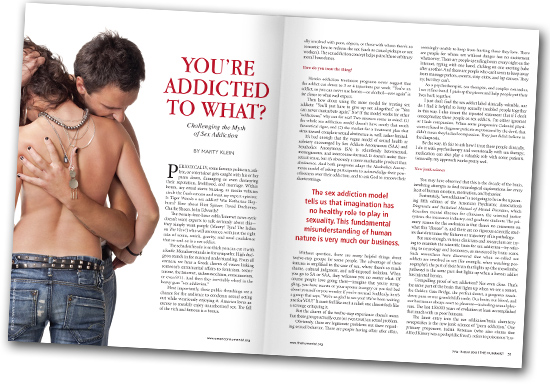
You’re Addicted to What?
Challenging the Myth of Sex Addiction


by: Marty Klein
Published in the July/August 2012 Humanist


Periodically, some famous politician, athlete, or entertainer gets caught with his or her pants down, damaging or even destroying their reputation, livelihood, and marriage. Within hours, my email starts buzzing, as media vultures circle the fresh carcass and want my expert opinion: Is Tiger Woods a sex addict? Was Katharine Hepburn? How about Eliot Spitzer, David Duchovny, Charlie Sheen, John Edwards?

The twenty-four-hour cable/Internet news cycle doesn’t want experts to talk seriously about this—they simply want people (Maury! Tyra! The ladies on The View!) who will announce, with just the right mix of scorn, smirk, gravity, and total confidence that so-and-so is a sex addict.

The schadenfreude is so thick you can cut it with a knife. Moralism stands in for sympathy. High dudgeon stands in for nuanced understanding. From all corners, we hear a Greek chorus of voices linking someone’s extramarital affairs to feminism, testosterone, the Internet, sadomasochism, consumerism, or even 9/11. And then they inevitably wheel in the heavy gun: “sex addiction.”

Most importantly, these public thrashings are a chance for the audience to condemn sexual acting out while vicariously enjoying it. America loves an excuse to sneakily enjoy unauthorized sex. The fall of the rich and famous is a bonus.

So when USA Today calls about Eliot Spitzer’s high-end escorts, or CNN emails about Anthony Weiner’s sexting, I’m usually pretty slow to respond to the ghoulish invitation.

I don’t diagnose people I haven’t met. More importantly, I don’t use the diagnosis of sex addiction. In thirty-one years as a sex therapist, marriage counselor, and psychotherapist, I’ve never seen sex addiction. I’ve heard about virtually every sexual variation, obsession, fantasy, trauma, and involvement with sex workers, but I’ve never seen sex addiction.

New patients tell me all the time how they can’t keep from doing self-destructive sexual things; still, I see no sex addiction. Instead, I see people regretting the sexual choices they make, often denying that these are decisions. I see people wanting to change, but not wanting to give up what makes them feel alive or young or loved or adequate; wanting the advantages of changing, but not wanting to give up what makes them feel they’re better or sexier or naughtier than other people. Most importantly, I see people wanting to stop doing what makes them feel powerful, attractive, or loved, but since they don’t want to stop feeling powerful, attractive or loved, they can’t seem to stop the repetitive sex clumsily designed to create those feelings.

The conflict over sex addiction is important to humanists for several reasons. “Sex addiction” is a special weapon now used by the religious right to combat perceived liberalism, to ignore science, and to ignite fear. It also helps legitimize anti-sex moralism and bigotry. And psychologists, judges, legislators, and the media are buying it.
When people refer to themselves or others as “sex addicts,” what are they actually talking about? More than anything, simple narcissistic character structure: the familiar “I guess I thought I could get away with it,” “Deep down, I don’t really believe the rules apply to me,” or “When I hurt, I want relief, and I don’t care so much about breaking promises or hurting others.”

If that sounds like normal people—if that sounds like you—it’s not surprising. Narcissism is a common human condition. So here’s my evaluation of almost everyone who is diagnosed as a sex addict—by themselves, their loved ones, or an addictionologist: it’s someone who is unhappy with the consequences of their sexual choices, but who finds it too emotionally painful to make different choices. You know, the way some of us are with cookies, new sweaters, or watching the Kardashians on TV.

Which is to say, it’s not about the sex. It’s about the immature decision-making.

The rest of the people who are in pain about their sexual decision-making are generally struggling with one or more of the following: compulsivity, impulsivity, obsessive-compulsive disorder, bipolar disorder, borderline personality disorder, or post-traumatic stress disorder. An idiosyncratic response to medication can even be a factor.

So when people talk about sex addiction, they’re really talking about all of these, and more. When someone says, “sexually, I’m out of control,” that doesn’t tell us very much. When we know someone has affair after affair; or that someone regularly masturbates to the point of pain; or that someone constantly pressures his wife for sex regardless of how unrealistic it is (she’s post-partum, she has the flu, his parents are in the next room, they had a big fight just a few hours ago); or that someone is pursuing anonymous sex in public parks in a way that’s begging for jail time and loss of career; or that someone watches three hours of porn per night, we simply don’t know very much about the person.

On the other hand, anyone who says “sexually, I’m out of control” is automatically welcomed into the fellowship of sex addicts—without any attempt to evaluate that person’s mental state. Sex therapists generally don’t get distracted by the sexual part of patients’ stories. Those without training in sexuality—like so-called sex addiction counselors—often do.

Let’s examine this cultural phenomenon in more detail.
Read the whole article. 

Saturday, January 26, 2013

Graham Phoenix - Vulnerability And Shame For Men – This Is Not About Weakness

Over at his Male eXperience blog, Graham Phoenix recently posted an excellent article on vulnerability, guilt, and shame, all of which are serious issues for men. One of the key quotes he includes in this post is from BrenĂ© Brown about a man's experience of being vulnerable and open - he says that it's not men who are hard on other men who show vulnerability or emotion, it's the women with whom they are in relationship.

Here is the key passage:
But you see those books you just signed for my wife and my three daughters? They’d rather me die on top of my white horse than watch me fall down. When we reach out and be vulnerable we get the shit beat out of us. 
This is unfortunately true for a lot of women and men. There is an unspoken double bind for many men when their female partners tell them to be more sensitive and open - when they do, the woman often loses interest in them or begins to resent their vulnerability as not masculine.

As much as men need to work on their own ability to be vulnerable, to dare greatly, women need to examine their unconscious biases and expectations about masculinity and begin to understand that many women still see sensitivity and vulnerability in men as weakness.

Vulnerability And Shame For Men – This Is Not About Weakness 
by Graham Phoenix (read about Graham Phoenix here)

Men see vulnerability as weakness, men see shame as weakness. They hide vulnerability and shame under a mask of emotional control, work, status and violence. How can they throw off the mask and start living in the power of vulnerability?


BrenĂ© Brown is a research professor at the University of Houston, Graduate College of Social Work. She has spent the past decade studying vulnerability, courage, worthiness, and shame.

Her 2010 TEDx Houston talk on the power of vulnerability is one of the most watched talks on TED.com with over 7 million views. She gave the closing talk, Listening to Shame, at the 2012 TED Conference in Long Beach.

These talks have rebounded around the world and changed the landscape in thinking about vulnerability, shame and guilt. She has made people realise that this is an area we are all involved in.

Her 2012 TED talk went deep into this issue. In this article I will use quotations from her talk to look at how this issue affects men, in particular.

♦◊♦

She used a famous quote from Theodore Roosevelt that is particularly relevant to men. It’s about ‘the arena’ where men fight their battles, daily, and where men establish their idea of masculinity.
“It is not the critic who counts. It is not the man who sits and points out how the doer of deeds could have done things better and how he falls and stumbles. The credit goes to the man in the arena whose face is marred with dust and blood and sweat. But when he’s in the arena, at best he wins, and at worst he loses, but when he fails, when he loses, he does so daring greatly.” (Theodore Roosevelt)


The idea of ‘daring greatly’ is appealing to many men, but the question is how to achieve it without appearing weak. The problem is when men equate failure with weakness, or they think that others, those they love and respect, equate failure with weakness.
Graham also included one other quote from Brown that I think is especially relevant.
“For men, shame is not a bunch of competing, conflicting expectations. Shame is one, “Do not be perceived as what — weak?” […] A man looked at me one day after a book signing and said, “… you say to reach out, tell our story, be vulnerable. But you see those books you just signed for my wife and my three daughters? They’d rather me die on top of my white horse than watch me fall down. When we reach out and be vulnerable we get the shit beat out of us. And don’t tell me it’s from the guys and the coaches and the dads, because the women in my life are harder on me than anyone else.” 
“You show me a woman who can actually sit with a man in real vulnerability and fear, I’ll show you a woman who’s done incredible work. You show me a man who can sit with a woman who’s just had it, she can’t do it all anymore, and his first response is not, “I unloaded the dishwasher,” but he really listens — because that’s all we need — I’ll show you a guy who’s done a lot of work.”
Go read the whole post.

Tuesday, January 15, 2013

Lance Armstrong [sort of] Comes Clean - May Testify Against UCI and WADA Officials


Leaks from last night's Oprah interview with Lance Armstrong are all over the Internet (the interview is scheduled to air on Thursday). It seems Armstrong offered a limited admission to using to performance enhancing drugs (PEDs) during his career.

However, the bigger news is that he plans to testify against officials of the International Cycling Union, the governing body of professional cycling, about their involvement with doping in cycling, but he apparently will not testify against other riders.

Part of his motivation in testifying is that he is named in a whistle-blower lawsuit filed by Floyd Landis, a former teammate, who filed the case in 2010 against Armstrong and other principals of the Postal Service team (where he and Armstrong were teammates). Landis's lawsuit claims US Postal and Armstrong "defrauded the government because its riders used performance-enhancing drugs in violation of its sponsorship contract." Armstrong could be liable for millions of dollars in damages if the Justice Department decides to join the case (they are close to making a decision).

According to CBS News, Armstrong and possibly his longtime agent, Bill Stapleton, has offered to repay several millions of dollars of the more than $30 million the Postal Service spent sponsoring the team, as part of their cooperation as witnesses in the case, which would seem to be his way to avoid being named as a co-defendant in the lawsuit.

It seems Armstrong has met with the U.S. Anti-Doping Agency (USADA) including its chief executive, Travis Tygart, to discuss what he needs to do to lessen the punishment against him so that he can compete in running and triathlon events from which he is banned under the ruling that stripped him of his racing titles.

Armstrong Admits Doping, and Says He Will Testify

By JULIET MACUR
Published: January 14, 2013

In an interview with Oprah Winfrey that is scheduled for broadcast on her network on Thursday, Lance Armstrong confessed that he used performance-enhancing drugs during his cycling career, according to two people briefed on the interview, which was recorded Monday in Austin, Tex.

It is unclear, though, how forthcoming Armstrong was about his doping program, which the United States Anti-Doping Agency has said was part of the most sophisticated, organized and professional doping scheme in the history of sports. Armstrong, when reached by e-mail Monday, said he could not discuss the interview.

Acknowledging his doping past has cleared the way for Armstrong to take the next step in trying to mitigate his lifetime ban from Olympic sports. He is planning to testify against several powerful people in the sport of cycling who knew about his doping and possibly facilitated it, said several people with knowledge of the situation.

Armstrong, 41, is planning to testify against officials from the International Cycling Union, the worldwide governing body of cycling, about their involvement with doping in cycling, but he will not testify against other riders, according to the people familiar with his plans.

He is also in discussions with the United States Department of Justice to possibly testify in a federal whistle-blower case. That case involves the cycling team sponsored by the United States Postal Service, and Armstrong would testify against several of the team’s owners, including the investment banker Thom Weisel, and other officials, one person close to the situation said. That person did not want his name published because the case is still open.

Floyd Landis, one of Armstrong’s former teammates, filed the whistle-blower case in 2010 against Armstrong and other principals of the Postal Service team on which he and Armstrong competed together for several years. Landis claimed the team defrauded the government because its riders used performance-enhancing drugs in violation of its sponsorship contract.

Now Armstrong and possibly his longtime agent, Bill Stapleton, are seeking to repay several millions of dollars of the more than $30 million the Postal Service spent sponsoring the team, as part of their cooperation as witnesses in the case, said the person with knowledge of the matter. (CBS News first reported Armstrong was in talks to return money to the Postal Service.) The Department of Justice is considering whether to join the case as a plaintiff and is close to making that decision, the person said.

Armstrong, who for more than a decade vehemently denied doping, would be willing to testify against the cycling union officials and his former team’s officials because he badly wants to compete in triathlons and running events again. Last fall, he was barred from many of those events because they are sanctioned by organizations that follow the World Anti-Doping Code, the rules under which he is serving his lifetime ban. Armstrong said that lifetime ban was unfair.

He met with United States Anti-Doping Agency officials, including Travis Tygart, the agency’s chief executive, last month to discuss what he needed to do to mitigate his ban. Several people with knowledge of the discussions said Tygart would be willing to reduce Armstrong’s punishment if Armstrong would testify against the people who helped him dope. That would possibly include Pat McQuaid, the president of the cycling union, and Hein Verbruggen, who was the cycling union’s president from 1991 to 2005, a time when doping in the sport was rampant. Verbruggen, who is close with the International Olympic Committee president, Jacques Rogge, is also the cycling union’s honorary president and an honorary member of the I.O.C.

David Howman, director general of the World Anti-Doping Agency, said in a telephone interview Monday that he would not believe that Armstrong would testify in other cases to help clean up the sport until it happens.

“This guy is an enigma and nobody really knows what he is going to do, no matter what he says,” Howman said. “I think he’s got his own demons to deal with, but nothing can be done about his lifetime ban when he hasn’t done anything to help us yet.”

Last fall the United States Anti-Doping Agency called Armstrong the kingpin of the doping program on his Tour de France winning teams when it made public evidence that he had doped and had encouraged his teammates to dope. During his interview with Winfrey, Armstrong rebutted the claim that he was a leader of the doping program, saying he just did what his teammates were doing, according to the two people who did not want their names published because they are not authorized to speak about the interview.

Before heading to the Winfrey interview in downtown Austin, Armstrong stopped at the headquarters of his cancer charity, Livestrong, and apologized to the staff. He told them he was sorry for letting everyone down and for putting so much stress on the organization because of his doping scandal.

He did not confess to using performance-enhancing drugs, but spoke for about 20 minutes in the organization’s boardroom, eliciting tears from some of the employees, said Rae Bazzarre, a spokeswoman for Livestrong.

“It was emotional and he choked up for a moment,” she said. “But we were all glad to see him.”

Armstrong had not been at the headquarters since Oct. 21, Bazzarre said, about two weeks before he resigned from Livestrong’s board of directors.


A version of this article appeared in print on January 15, 2013, on page B11 of the New York edition with the headline: Armstrong Will Implicate Officials.

Wednesday, June 27, 2012

Daily Om - Releasing Guilt: Permission to Forgive Ourselves


This was the Daily Om from a while back. I wanted to share this because I see so much of myself in what this brief message conveys. It's easy for me to forgive others, but it can seem like turning lead into gold to forgive myself - a nice idea in theory, but unrealistic in practice.

And yet, holding myself accountable is essential to growing and learning. And guilt can be a part of that - but when it is held over time it can transform into shame - the sense that I am bad.

It's important to distinguish between guilt (I did something that was wrong or that feels bad) and shame (I am wrong, I am a worthless person). Guilt can be useful in inspiring a change in behavior, but shame is destructive.

As I said above, my experience is that guilt not released when the necessary changes have been made can transform into shame. Learning to forgive our own mistakes is essential to avoiding the toxicity of shame. I have been working at this for years and I am finally getting it.

Releasing Guilt: Permission to Forgive Ourselves


by Madisyn Taylor

Dwelling in guilt is like living your life with an anchor tied to your ankles dragging you down.

Learning to accept the things that we perceive as wrong can be a difficult task for many of us. Often we have been brought up to accept that it is normal to feel guilty about our actions and that by doing so we will make everything seem alright within ourselves. Even though we might feel that we have a reason to make up for the choices we have made, it is much more important for us to learn how to deal with them in a healthy and positive way, such as through forgiveness and understanding.

When we can look back at our past and really assess what has happened, we begin to realize that there are many dimensions to our actions. While feeling guilty might assuage our feelings at first, it is really only a short-term solution. It is all too ironic that being hard on ourselves is the easy way out. If we truly are able to gaze upon our lives through the lens of compassion, however, we will be able to see that there is much more to what we do and have done than we realize. Perhaps we were simply trying to protect ourselves or others and did the best we could at the time, or maybe we thought we had no other recourse and chose a solution in the heat of the moment. Once we can understand that dwelling in our negative feelings will only make us feel worse, we will come to recognize that it is really only through forgiving ourselves that we can transform our feelings and truly heal any resentment we have about our past.

Giving ourselves permission to feel at peace with our past actions is one of the most positive steps we can take toward living a life free from regrets, disappointments, and guilt. The more we are able to remind ourselves that the true path to a peaceful mind and heart is through acceptance of every part of our lives and actions, the more harmony and inner joy we will experience in all aspects of our lives.


What do you think? Discuss this article and share your opinion

Wednesday, December 22, 2010

Permission to Forgive Ourselves - Releasing Guilt

http://www.thehealthage.com/site/wp-content/uploads/2010/05/male-depression-1.jpg

One of the things that often happens as men come to awareness of their lives - the social structures in which men have oppressed women(1), and even the subtle ways they may have objectified or sexualized women, for both good an bad - is a sense of guilt for the ways women have sometimes been denied their full humanity. Even men who have generally treated the women in their lives quite well (and maybe especially these men) tend to feel guilt and/or shame for the legacy of dehumanization so many women have suffered (and still suffer in mnay parts of the world).

In some ways, and for a short time, guilt can be healthy. It can motivate us to change behaviors, to change perspectives. Guilt is the sense that I have done something wrong (or that we as men have done something wrong) and that I feel bad for having done it.

Shame, on the other hand, is not at all useful because shame tends to be the sense that there is something inherently wrong with me, something that makes me (or men) bad, evil, or flawed in essence.

Radical feminism has tended to shame men, to argue that history makes all men evil, irredeemable, and inherently flawed. This is not only mean-spirited and wrong, but it attempts to do unto men what some men have done unto women - it's equivalent to the kid who gets bullied and then bullies someone else, passing along the torment.

Guilt, however, can be healthy - unless we get caught up in that feeling as an identity. Many male feminists have become so attached to guilt that they cannot see the value in working toward a healthy model of masculinity - it seems better to adopt a feminist view of men as flawed.

John Stoltenberg, one of the "leaders" in men's studies (more appropriately "feminist studies of men"), wrote a book called The End of Manhood in which he equates masculinity with toxicity and sees feminism as the answer (he was married to Andrea Dworkin, although he now considers himself gay). He is also author of Refusing to Be a Man, and this article (Why I Stopped Trying to Be a Real Man - published in Feminista!) plays some of the same chords:
If everyone trying to be a "real man" thinks there's someone else out there who has more manhood, then either some guy has more manhood than anybody--and he's got so much manhood he never has to prove it and it's never ever in doubt--or else manhood doesn't exist. It's just a sham and a delusion.

As I watched guys trying to prove their fantasy of manhood--by doing dirt to women, making fun of queers, putting down people of other religions and races--I realized they were doing something really negative to me too, because their fear and hatred of everything "nonmanly" was killing off something in me that I valued.

That's why I feel a connection to feminism. I want a humanity that is not measured against the cult of masculinity. I want a selfhood that does not reject fine parts of myself just because they are not "manly." I want courage to confront the things men have done in the world that are damaging to women and that are also leaving no safe space for the self I hope to be.

This is, in my opinion, a shame-based perspective. "Refusing to be a man" is not a viable response - Why not be a mature man, why not model and teach a healthy masculinity that honors all non-harming forms of masculine identity, that honors women, that does not seek dominance but rather community?

Yet even guilt is not productive - it's a way out. We feel guilty rather than act to change things. This Daily Om offers a perspective on this that I think can be helpful for men who are experiencing the guilt that often comes with waking up to our power and responsibility as men:
Permission to Forgive Ourselves
Releasing Guilt

Guilt is temporary and unproductive, it is all too ironic that being hard on ourselves is the easy way out.

Learning to accept the things that we perceive as wrong can be a difficult task for many of us. Often we have been brought up to accept that it is normal to feel guilty about our actions and that by doing so we will make everything seem alright within ourselves. Even though we might feel that we have a reason to make up for the choices we have made, it is much more important for us to learn how to deal with them in a healthy and positive way, such as through forgiveness and understanding.

When we can look back at our past and really assess what has happened, we begin to realize that there are many dimensions to our actions. While feeling guilty might assuage our feelings at first, it is really only a short-term solution. It is all too ironic that being hard on ourselves is the easy way out. If we truly are able to gaze upon our lives through the lens of compassion, however, we will be able to see that there is much more to what we do and have done than we realize. Perhaps we were simply trying to protect ourselves or others and did the best we could at the time, or maybe we thought we had no other recourse and chose a solution in the heat of the moment. Once we can understand that dwelling in our negative feelings will only make us feel worse, we will come to recognize that it is really only through forgiving ourselves that we can transform our feelings and truly heal any resentment we have about our past.

Giving ourselves permission to feel at peace with our past actions is one of the most positive steps we can take toward living a life free from regrets, disappointments, and guilt. The more we are able to remind ourselves that the true path to a peaceful mind and heart is through acceptance of every part of our lives and actions, the more harmony and inner joy we will experience in all aspects of our lives.

[Emphasis added.]

Compassion is the nearly always the missing ingredient - compassion for others, compassion for ourselves. Through compassion we can learn to practice forgiveness - for the past, for ourselves, and for others.


(1) This is a huge generalization and I am NOT saying that men are evil and women are victims, but historically it is undeniable that male social structures have at various times regarded women as possessions and/or denied them full status as members of society.