Showing posts with label homosexuality. Show all posts

Tuesday, August 12, 2014

Being Gay in Iran - Coming Out in a Country Where That Can Get You Killed

From The Stranger, Seattle's real alternative weekly, this is a tender and harrowing first-person account of coming out and being outed in Iran, a country where being gay can get you killed.

Being Gay in Iran

Coming Out in a Country Where That Can Get You Killed, and the TV Documentary That Outed Me to the World

by Farhad Dolatizadeh
May 28, 2014
Photos by Ethan Folk


I RAN FROM IRAN - And found myself in this town in Turkey, where I didn’t know a soul. I was one of the lucky ones.

I'm 16.


"May I ask you something personal?"

I know what's coming.

I look at my aunt as she takes her time to assemble the correct words. She is a tiny, sweet woman wearing a loosely draped head scarf, staring at me with shining dark-brown eyes. I love her more dearly than anything in the world. Of course I will tell her the truth. I can't think of a reason to hide from her. It isn't as if she might murder me or run around spreading my secret. She's not one of those closed-minded, brainwashed people who would automatically judge me. She spent most of her life outside of Iran, living and working as an architect in Norway and Germany. If there is anyone out there who would understand me, it's her.

"Are you gay, Feri Kitty?" she asks.

My name is Farhad, but since I was little, my aunt has affectionately called me Feri Kitty, referring to my soft spot for kittens.

"You call me Feri Kitty and expect me to be who? Robocop?" I snap. The bitch inside me has been growing day by day.

She just gazes at me. Eventually she smiles and wraps me in her arms. "It's okay. There's no need to be aggressive... everything is going to be okay."

I weep into her shoulder and can't respond.

This is my first coming out.


I'm 17.


I'm lying on my bed, waiting for sleep to take me, when my brother stirs. He and I are sharing a room, and his bed is only a few meters away. He is four years older than I am, but I have always regarded myself as the more mature one.

It's been six months since the conversation with my aunt.

I can't make out my brother's features, but I hear his voice, husky from sleep: "Farhad, who is this new guy you are hanging out with so much? He seems older than you! Is he from your school?"

I am silent for a beat. "You mean Darius?"

"Yes."

"Yep. He's my friend. Nope. Not from school," I say, trying my best to indicate that I am on the verge of sleep and the conversation is over.

But he barges on: "Where do you know him from, then?"

"Why do you care, you dumbass? Go bug your girlfriend and leave my life to me," I say in my mind. But to my brother, I say: "I met him at a cafe."

Another pause, and then, without a trace of emotion, my brother says: "He is handsome. Is he your boyfriend?"

I am shocked. Is this really my brother? Has he been possessed by some kind of demon? I quickly assess that, although he is not the smartest or even the most open-minded person in the world, he is a good brother, and he has always been there when I've needed him. I can trust him with the truth.

I still can't see his face in the dark, so I'm unable to catch his reaction when I reply, "Yes. He is."

Another heavy pause.

"So, does that mean that you are gay?"

Whoa. "Gay"? Really? I am shocked that he has used the English term. I thought that my brother, like most Iranians, would know only the slang term "sissy." Maybe he's not as stupid as I thought.

"Yes?" I blurt, stunned.

I wait for him to respond, but nothing comes. I can't believe it—he just rolls over and goes back to sleep. For fuck's sake, you just found out that your younger brother is gay! You can't just nod off and leave it like that! You should say something, you need to say something!

What a dumbass.

Five minutes later, I hear another rustle and see his silhouette shift as he turns back to me.

"Farhad, does that mean that I'm not going to be an uncle?"

Is he trying to act cool? Is that really his primary concern? "I... really don't know. Maybe someday?"

"Okay," he says, and goes quiet again, leaving me with a head full of racing thoughts.


I'm 18.


I'm sitting in the car with my dad. We are driving to his factory, when he suddenly asks, "Have you decided what you are going to do about your military service?"

"I'm not going," I say, trying to avoid his searching look.

"But every single man must go into the military, unless they can prove some handicap..."

My father is in his 40s and has worked hard all his life. I see the deep lines of experience on his face. Maybe this evidence of wisdom is why I feel so ready to expose myself to him. I don't know. But I have a feeling that he will accept me.

"I know the rules, Father. I'm not going. I can't go because of the rule prohibiting homosexuals from serving in the military," I say. Despite my determination, I am unable to keep my voice completely stable.

"But... are you gay?" he says, eyes fixed straight ahead—on the road.

"Yes," I reply. This time, with confidence.

The car fills with silence. After listening to my heart pound and the sounds of the road, I find the courage to say, "Well... aren't you going to say anything?"

Still staring at the road, my father begins to speak. "We are not stupid, Farhad. We are your parents. I knew the moment I laid eyes on you. I didn't want to believe it, but I knew."

Perhaps I have misjudged my father. I feel my mouth go dry and I begin to choke up.

"Farhad, I didn't want to believe it, not because I'm ashamed, but because I know how hard it is for homosexuals in this country. I don't want my baby boy to be killed by the government just because of his sexual preference. I want the best life for you. I want to send you away. To a safer country. To somewhere no one can hurt you because of the kind of person you love."

As afraid as I am, I understand him completely. I am overwhelmed by feelings of relief and love. I am so fortunate to have such a father, but feel so cursed to know that I will eventually be banished from my homeland. I'll have to leave Iran eventually. No gay is safe in this country. I heard this from my aunt, years ago, and now I've heard it from my father. I know his intentions are good.

I don't want to break down in front of my father, so I simply smile and try to keep it lighthearted. "Let's just deal with the military duty first."

He returns my smile, and it lingers as he turns his attention back to the road.

"Thank you for loving me, Dad."

"Always, Son. Always."


I'm 20.


Of course, my father is the one to open the discussion with my mother. He knows exactly how to reason with her, and after three days of tears and talking, she manages to calm down.

In many ways, my mom is my best friend now. I can tell her anything. She loves my boyfriend, Darius, and she is constantly urging me to bring him home for dinner with the family. She is still squeamish about the topic of sex, but I think this is normal for mothers regardless of their son's orientation.

I'm sitting in the living room with Darius, and the house is empty. I'm kissing him, as I do whenever we have the luxury of being alone together. We are in love, and in these moments, I feel absolute bliss and comfort.

I am thinking about the flavor of his mouth, when the ringing of the telephone pulls me out of the moment.

I reluctantly break away and answer. I recognize my cousin's familiar voice, but I can tell immediately that something is very, very wrong.

"Farhad. I saw you on the TV," he declares. Coldly.

What? TV? My mind races, but I cannot imagine what he could be referring to. Before I can respond or even question him, he says, "I know what you are. I know what you are and I don't want to see you anymore."

The line clicks dead.

I'm frozen. I am unable to speak, and Darius grows worried as my face turns pale. I fumble for the remote control, and the TV comes to life. I flip through the channels until I find something unusual. They are showing a documentary about gay people in Iran and letting people around the world know how hard and dangerous it is for gays in this country. The film was made by a Canadian television channel, and it sure seems like they care a lot about the well-being of gays in Iran.

Darius and I are shocked that a documentary on such a subject is being aired. Now some people are talking about their problems in front of the camera, but their faces are blurred. It is interesting, I suppose, but what does it have to do with me? In less than a minute, I have my answer. I begin to feel dread when the camera pans across a restaurant I know well. It is the spot where gay people in Tehran gather every Tuesday. Where I go most Tuesdays. Now the camera is inside the restaurant, and they are showing us. They are showing our faces. They are showing my face. It is obviously shot with a concealed camera. A long lens, zoomed in—my face filling the screen for several seconds. Casually chatting, completely unaware. They are even sure to identify the restaurant by name. And we don't know we are being filmed. How nice of them: They want to let the world know how miserable gay people are in Iran and how the government kills them because of their orientation, and they come to our community and expose us to everyone? To the hateful government? To our neighbors, friends, and families?

I watch the film until the end. My face was clearly shown, yet I had no clue of the film's existence until a few minutes ago. I'm shocked. I'm scared. I don't know what to do. Darius and I sit speechless. According to the documentary, the producers got "group consent," but I never consented to this.

I pick the phone up and call my aunt in Norway. She answers, and I blurt out, "Auntie, I just came out to the world..."


A window display IN ANKARA Where I lived as a refugee after a TV documentary aired undercover footage of my face.


I'm 24.


I've been in Ankara, Turkey, for three months now, and I sit in a small, nearly empty concrete room. Across from me sits a blue-eyed man with slicked-back ginger hair and a bright beard. The table in front of me is bare except for a computer and some loose notes. I can't shake the impression that the man is some sort of church official—a pastor, perhaps. In reality, he is a representative of the United Nations High Commissioner for Refugees (UNHCR), who handles amnesty requests. I prefer not to go into detail so that other refugees who are going to leave Iran won't face any extra problems, but I have escaped from Iran.

"How do you feel when you see yourself in that documentary?" he asks.

Angry. Upset. Desperate.

Angry at all of the people who mocked me and looked down on me. Angry at the president, who went on national television and stated that there were no homosexuals in Iran. Angry at the TV channel that wasted an opportunity to put the spotlight on a reprehensible government, and instead put the spotlight on people like me. Angry at the idiocy that allowed them to describe how Iranian gays are facing execution, and in the next moment broadcast images of dozens of closeted homosexuals. Angry at the hurry, the oversight, the ignorance—whatever allowed such an obvious and dangerous mistake to happen. I was angry at God, to create me as I was—a gay man in a country that did not accept me.

And yes, upset. Upset about the blind submission of millions to an intolerant brand of religion that states that homosexuality is an unforgivable sin. Upset about the hypocrisy and inconsistent interpretations of Islam. Upset about the Iranian parents who have murdered their children just for being gay. Upset and confused by a society in which murdering your own child is less of a crime than loving someone.

And yes, desperate. Desperate to be loved again by the ones who decided I was inhuman once they discovered that I was gay. Desperate to get far away from the situation that had developed since the airing of the documentary. Desperate to get back the four years of my life spent defending myself from hatred and mockery, perpetually in fear of the government. Desperate to find shelter. To find a safe place. A place where I needn't fear for my life. I lived for four years in Iran after that documentary aired, four years of living in protective mode: I didn't go to that restaurant anymore, I lost friends, I was forced to leave university, and I had to begin a new life with people who didn't know me. Finally, I had an opportunity to flee to Turkey, and I took it.

So yes, I am angry and upset and desperate. I look at the guy in front of me. He seems to be a nice guy. He is working for UNHCR. I can trust him. He is smiling at me and waiting for my answer. I try my best to give him an answer, but I burst into tears instead.

He doesn't reply. He nods and taps a few notes into his keyboard. I try to stifle my tears and give him an answer. Then I think about all of the other refugees in Turkey. About their miserable lives. How they are relegated to small villages, which they cannot leave. How they aren't allowed to work and have no legal means to support themselves. They have no identity and no nationality. They are just beings—walking around, waiting for their time to come, waiting to know their destiny. Just like me.

Then I think about the others in the documentary who weren't even able to escape as far as Turkey.

And I burst into tears again.


NOT SO WELCOME - The UN pondered my application for amnesty for two years, and Canada took another year to decide after that.


I'm 27.


I'm in my room. My last roommate moved out five months ago, so the house is silent. His asylum request to the US was granted, but I remain here in our small house. I sit on my bed, staring at my computer screen and trying to pass the time.

It's been almost three years since I filed for asylum, and I'm still here in the Turkish village. I'm terribly depressed. I feel lonely and unspeakably weary from constant harassment. The villagers look at me like some sort of strange, alien object. The police have accused me of being HIV-positive and demanded that I submit to blood tests. I knew this was an illegal request, and when I refused, they told me to stay away from people, and that I was a threat to the community. At our weekly "check-in" today, the police officer wouldn't even let me in his room. He told me that he wouldn't shake my hand because he is scared of contracting AIDS.

I miss so many of the friends that I've made in these three years. I've met many other refugees from Iran and seen them all come and go—off to their new, safe homes. But I remain. Alone. Does anyone think of me? Does the UNHCR or the Canadian embassy know what my life is like in here? How can they expect me to survive in a place where I'm not even allowed to work for three years? Don't they feel some sort of responsibility for me, since it was a Canadian television company that made the documentary? Once the UN finally completed the two-year processing of my application, why has it taken the Canadian embassy an additional year to decide if I deserve to live in their country? Why, when every other case has been decided in a matter of months? I wonder what I have done wrong to deserve this.

I have thought of suicide. I have thought of different ways to end this miserable waiting. But there is a hope in the name "Canada"—it conjures imagery in my mind that is both vivid and uncertain. A better life. Freedom. Safety in a distant northern land.

But I am tired. I'm so tired of waiting for their call. I am sick of the endless, numbing disappointment. It's simply not fair.

Then my cell phone rings.

"Hello. Am I speaking to Farhad?" asks the voice from the other end.

"Yes, I am Farhad!" I rush to spit out the words. No matter how many times the phone has rung, or the mail has arrived, or I have felt hope—I still can't suppress the thrill when I think something is about to happen. No matter how many times that hope has been crushed or I have been disappointed, I still can't completely eliminate the excitement. I am aware of all of this as I state my name. My hope begins to fade as the line is briefly silent. I prepare myself for the letdown—I've gotten good at this.

Then the voice says, "Hi, Farhad. This is Mr. [redacted] from the Canadian embassy. Are you available tomorrow to come to the embassy? We will need your passport to issue you the visa."

~ Farhad Dolatizadeh's name has been changed to protect his identity. He is now living safely in Canada.

Wednesday, June 4, 2014

The Missing Myth: A New Vision of Same-Sex Love - An Interview with Gilles Herrada


In this interview from last summer, Vanessa Fisher (co-editor of Integral Voices on Sex, Gender, and Spirituality, scheduled for release in July, 2014) interviews one of the contributors, Gilles Herrada, about his book, The Missing Myth: A New Vision of Same-Sex Love. Here is the publisher's ad copy for the book:
If homosexual behavior is an aberration from the standpoint of reproduction, why is it widespread among humans, primates, and a myriad of other animal species, and why has it been favored by evolution? And if homosexuality is considered a moral problem based on religious beliefs, why were more homosexuals exterminated under the brief reigns of such secular regimes as the Communists and the Nazis than during the entire Christian Inquisition. Why is everything about homosexuality always a paradox? In The Missing Myth, Gilles Herrada tackles the many questions about the role and meaning of homosexuality in the evolution of our species and the development of civilization: what evolutionary edge same-sex relationships have provided to the human species; what biological mechanisms generate the sexual diversity that we observe; why homosexual behavior ended up being prohibited worldwide; why homophobia has persisted throughout history; why the homosexual community resurfaced after World War II; and others.
I've had the good fortune of reading Gilles book and I highly recommend it for anyone who wants to understand the depth and complexities of same-sex love - including its rejection and the still persistent homophobia many people express.

The interview is excellent - enjoy.

The Missing Myth: A New Vision of Same-Sex Love

An Interview with Gilles Herrada by Vanessa D. Fisher


Download this Dialogue as an MP3


Gilles Herrada, Ph.D., is a research scientist, a writer, and life coach at LifeAsACreation. He has worked at the universities of Nice, Paris, Columbia, and Harvard, and is published internationally.

In this Dialogue, I interview Gilles about his recently published book, The Missing Myth: A New Vision of Same-Sex Love.

Below is a short quote from the book, which offers a taste of the new and expansive context Gilles opens in his book for re-visioning same-sex love...
After having been stigmatized as a sin or a perversion by two millenniums of homophobic culture, a mere half-century of well-intentioned pro-homosexual discourse has left homosexuality impoverished, truncated, disjointed, and ripped apart. Why is this? Modern homosexual identity only started to emerge in the nineteenth century and really grounded itself no earlier than the second half of the twentieth century. In this respect, this identity is extremely young, and because of the historical cultural context in which it was born, modern homosexuality has essentially been conceived and theorized within a biological, psychoanalytic, and sociological, and hence profoundly materialistic context.

As a result, modern homosexuality exists in body and mind, but has no soul.

Modern homosexuality has been analyzed and rationalized by modernists, contextualized and even deconstructed by postmodernists, but not many have dared to give it meaning…. As a consequence, the sacred dimension of modern homosexuality—symbolic and spiritual, inevitably—has remained largely ignored by the homosexual discourse, leaving its brutal rejection by traditional religions still unanswered.
In this sense, the original and somewhat humble premise of The Missing Myth is that homosexuality has yet to discover itself..."

While at Harvard, Gilles discovered a large family of genes involved in the detection of pheromones, those “secret” odors that trigger animal sexual and social behaviors. Gilles also attended and facilitated programs in what is commonly labeled as “personal development.” These workshops gave him the rare opportunity to discuss with homophobic men in an open and intimate setup. This offered him a unique chance to inquire into the mechanisms of homophobia empathically, that is from a homophobic standpoint.

Part of his research work regarding homosexuality’s history was presented at the First Integral Theory Conference in 2008 and will soon be published in the anthology titled Integral Voices on Sex, Gender, and Spirituality, co-edited by Sarah Nicholson and Vanessa D. Fisher, to be published by SUNY Press.

Gilles currently lives in New York City.
This Dialogue was recorded July 11, 2013

Thursday, April 10, 2014

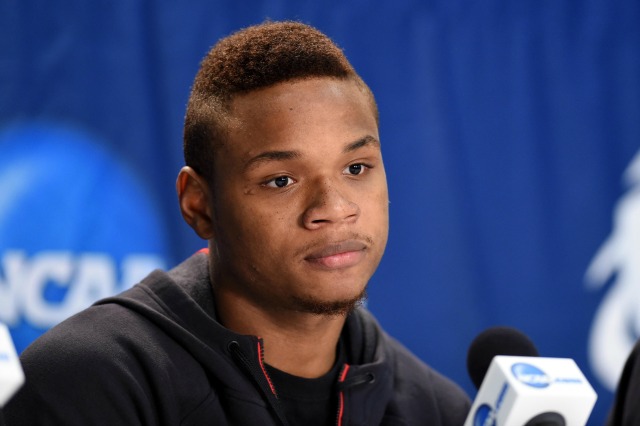
Why Derrick Gordon Coming Out is Important, and a Story


Jason Collins was the first active NBA player to come out; Michael Sam was the first Division I NCAA football player to come out; and now Derrick Gordon is the first Division I NCAA men's basketball player to come up.

Some people seem to think it's no big deal, and it shouldn't be - no one should give a rat's ass about anyone else's sexuality if the other person is not being evangelical. But that's not the world we live in, and that is certainly not the world of male sports. So, kudos to Mr. Gordon for showing other young men it is okay to be yourself - gay, straight, or somewhere in between.

Why Derrick Gordon Coming Out is Important, and a Story

April 9, 2014


Derrick Gordon first realized he was gay in middle school but never told anybody until earlier this month. He's now 22 years old. So the UMass guard has been hiding things from his family and friends for nearly a decade, and, by Gordon's own admission, he didn't figure he'd publicly disclose his sexual orientation for at least another three or four years.

But then NBA veteran Jason Collins came out last year.

And ...

"When he came out I wanted to come out the next day," Gordon said in an interview conducted by Kate Fagan that was broadcast nationally on Wednesday. "It was a relief."

And that, quite simply, is why Gordon's story is a huge and important story.

Because his story might help somebody else the way Collins' story helped him.

"[Collins] was getting subbed into [an NBA] game [as an openly gay man], and everybody stood up and started clapping," Gordon said. "And I was visualizing ... that being me. ... I just kept replaying it over and over again. ... And that definitely put a huge smile on my face."

Over the past year we've now had three examples of prominent male athletes publicly acknowledging that they're gay, and each time somebody on Twitter or a message board has been compelled to ask why this is a story. It happened when Collins came out. It happened again when Missouri football player Michael Sam came out. It happened again early Wednesday, when Gordon, a starter on the UMass team that made this season's NCAA Tournament, came out, and I get so frustrated every time somebody asks this question.

Are you one of those people?

Are you somebody who asks why this is a story?

 
UMass guard Derrick Gordon's decision to come out is important beyond college basketball. (USATSI)

If so, take eight minutes, watch this interview, and then, presumably, you'll never ask that question again because what you'll realize is that Gordon wouldn't be able to live honestly if not for Collins' story first being a story. There had never been an openly gay man in the NBA until Collins just like there had never been an openly gay man in Division I football until Sam just like there had never been an openly gay man in Division I basketball until Gordon, and it's naive to think one very public announcement didn't help trigger the next. In fact, Gordon was quite clear in stating that without Collins' story he'd almost certainly still be in the closet, and he was quite clear in stating that being in the closet was an awful way to live.

"I want to be myself," Gordon said. "I don't want to be somebody that I'm not."

Now, Gordon can be himself.

He doesn't have to hide anything anymore.

And the only reason Gordon ever felt comfortable enough to take this step is because he saw the way Collins and Sam have been treated by teammates and fans in recent months, and the only reason he saw that is because their stories were stories. This is still all so new, you know? So it doesn't matter whether you care or do not care if a player is gay. What matters is that there's another young gay athlete somewhere who will feel empowered to come out because of Gordon's story the same way Gordon was empowered by Collins' story.

And I'll take it a step farther.

Is it foolish to think that Gordon's teammates at UMass are more accepting of the news than they might've otherwise been because of the way they saw the Brooklyn Nets accept Collins? Is it farfetched to suggest that the way future Hall of Famers Kevin Garnett and Paul Pierce publicly handled that situation helped the UMass players better handle this situation?

I don't think it is.

I think all of these stories are connected.

And that's why anybody suggesting these stories aren't stories is wildly missing the point. Again, Collins' story helped pave the way for Sam's story, and those stories helped pave the way for Gordon's story. Across the board, those three men now say they're happier than they've ever been, and watching them be accepted will undoubtedly help somebody else, which is why these important stories deserve every headline they can possibly get.


~ Gary Parrish is a senior college basketball columnist for CBSSports.com and frequent contributor to the CBS Sports Network. The Mississippi native also hosts the highest-rated sports talk radio show -- The Gary Parrish Show -- in the history of Memphis. He lives in that area with his wife, two children and a dog.

Wednesday, September 18, 2013

Brent Girouex, Confesses to Having Sex with Four Teenage Boys and Gets NO Days in Jail

This is effed up in more ways than I count. Our system is so screwed up - even the original 17 years this pedophile received was not sufficient, especially considering he is clearly delusional based on his comments.

‘Rape Away The Gay’ Pastor Brent Girouex Gets Sentence Reduced 


Rape Away The Gay Pastor Will Not Serve Time

“Rape away the gay” pastor Brent Girouex, a 31-year-old Iowa man, will not serve jail time for confessing to police that he had sex with at least four youths, according to a recent report from KRMG.

Since that confession, eight additional young men have admitted to being violated by the now-former pastor of Victory Fellowship Church in Council Bluffs, Iowa.

If you don’t want to be appalled, fair warning: you may want to skip over this next section.

Apparently, Girouex thought he could rape away the gay by “praying while he had sexual contact” with his victims in an effort to keep them “sexually pure” for God.

 He then allegedly told police that “when they would ejaculate, they would be getting rid of the evil thoughts in their mind.”

Girouex is a married father of four. Since the disturbing revelations have hit the Internet, his wife Erin has spoken out against him and the reduced sentence that he received after initially getting 17 years in prison.

Instead of upholding to that initial ruling, a judge decided to sentence Girouex to five years probation and mandatory sexual offender treatment.

Provided he doesn’t violate the terms of his probation — in other words, victimize someone else — he will not serve a day in jail.

In comments to KCCI, Erin Girouex had this to say about the idea of sending her husband to prison: “If that’s what it takes to get him away from people, then yes … I don’t want (my children) anywhere near him.”

She added that what she wants is for other victims of sexual misconduct to speak out before it’s too late.

Erin plans to file for divorce, but according to KCCI “the hang-up is that her husband wants to see their children.”

Currently, Brent Girouex has a court-ordered, twice-per-month visitation schedule, where he must be supervised by his own mother.

Here’s a mugshot: 

Rape Away The Gay Pastor Mugshot Brent Girouex


The sentence in this case has many Americans understandably perplexed at the lax attitudes toward sexual violence.

Following on the heels of a Montana judge, who only sentenced a convicted rapist to 30 days in jail after his 14-year-old victim committed suicide, it definitely establishes a horrible precedent.

Do you think the case of the “rape away the gay” pastor is proof the US does not take sexual crimes against minors seriously?


‘Rape Away The Gay’ Pastor Brent Girouex Gets Sentence Reduced Rape Away The Gay Pastor Will Not Serve Time “Rape away the gay” pastor Brent Girouex, a 31-year-old Iowa man, will not serve jail time for confessing to police that he had sex with at least four youths, according to a recent report from KRMG. Since that confession, eight additional young men have admitted to being violated by the now-former pastor of Victory Fellowship Church in Council Bluffs, Iowa. If you don’t want to be appalled, fair warning: you may want to skip over this next section. Apparently, Girouex thought he could rape away the gay by “praying while he had sexual contact” with his victims in an effort to keep them “sexually pure” for God. He then allegedly told police that “when they would ejaculate, they would be getting rid of the evil thoughts in their mind.” Girouex is a married father of four. Since the disturbing revelations have hit the Internet, his wife Erin has spoken out against him and the reduced sentence that he received after initially getting 17 years in prison. Instead of upholding to that initial ruling, a judge decided to sentence Girouex to five years probation and mandatory sexual offender treatment. Provided he doesn’t violate the terms of his probation — in other words, victimize someone else — he will not serve a day in jail. In comments to KCCI, Erin Girouex had this to say about the idea of sending her husband to prison: “If that’s what it takes to get him away from people, then yes … I don’t want (my children) anywhere near him.” She added that what she wants is for other victims of sexual misconduct to speak out before it’s too late. Erin plans to file for divorce, but according to KCCI “the hang-up is that her husband wants to see their children.” Currently, Brent Girouex has a court-ordered, twice-per-month visitation schedule, where he must be supervised by his own mother. Here’s a mugshot: Rape Away The Gay Pastor Mugshot Brent Girouex The sentence in this case has many Americans understandably perplexed at the lax attitudes toward sexual violence. Following on the heels of a Montana judge, who only sentenced a convicted rapist to 30 days in jail after his 14-year-old victim committed suicide, it definitely establishes a horrible precedent. Do you think the case of the “rape away the gay” pastor is proof the US does not take sexual crimes against minors seriously?
Read more at http://www.inquisitr.com/946459/rape-away-the-gay-pastor-brent-girouex-gets-sentence-reduced/#21F3izuySEzIyQTK.99

Wednesday, August 28, 2013

British Neo-Pro Soccer Players Much More Accepting of Gay Teammates


In Britain, researchers spoke to 22 young men (age 16-18) on the verge of becoming professional soccer players (footballers). What they found was that all the participants would openly accept one of their colleagues coming out. All of the participants in the study identified as heterosexual and come from the lower to upper working class families.

In the last study to look at this issue (2002), Professor Eric Anderson, of the University of Winchester (who is one of the three co-authors of the new research) found that gay male athletes were tolerated by teammates, "as long as they played the sport well." However, there were no findings of active "support."

This is good to see - British football has traditionally been pretty homophobic, although not quite as much so as U.S. football (not soccer).

This shift seems to speak to the more open and accepting perspectives of the millennial generation, young people who have grown up with gay men and lesbian women in their daily lives. Exposure to people who are "other" reduces the sense of otherness and they become "like me," which is the key to acceptance.

Full Citation:
R. Magrath, E. Anderson, S. Roberts. (2013, Jul 30). On the door-step of equality: Attitudes toward gay athletes among academy-level footballers. International Review for the Sociology of Sport, 48(4), 1-18. DOI: 10.1177/1012690213495747

You can read the whole paper at Academia.edu or at the Sage Publications site. For now, here is the abstract followed by a summary of the press release from Science Daily.
Abstract
In this semi-structured interview research, we investigate the attitudes of 22 academy level association football (soccer) players who are potentially on the verge of becoming professional athletes. We find that, as a result of these men belonging to a generation holding inclusive attitudes towards homosexuality, independent of whether they maintain contact with gay men, they are unanimously supportive of gay men coming out on their team. Thus, this research supports a growing body of literature suggesting that team sport culture is no longer a bastion of homophobia in the UK. Their support includes athletes being unconcerned with sharing rooms with gay players, changing with them in the locker rooms, or relating to them on a social and emotional level. The only apprehension they maintain is that having a gay teammate might somewhat alter homosocial banter, as they would not want to offend that individual.
* * * * *

Generational Shift in Attitudes Among Young Soccer Players Towards Gay Teammates


Aug. 27, 2013 — Young soccer players (footballers) on the verge of becoming professionals are now much more likely to be supportive of gay teammates than a decade ago, according to new research from sociologists at the universities of Kent and Winchester.

Conducted via interviews with 22 Premier League academy footballers aged 16-18, the research found that all the participants would openly accept one of their colleagues coming out.

The research, led by Dr Steven Roberts, of the University of Kent's School of Social Policy, Sociology and Social Research, and Professor Eric Anderson, of the University of Winchester's Faculty of Business, Law and Sport, made use of intermittent interviews over a four-month period between November 2012 and February 2013.

All the participants identified themselves as heterosexual in their interview and all said they were from a lower to upper working class background. The study results showed a marked difference in acceptance of gay teammates compared to the findings of the last such study, carried out a decade ago.

Dr Roberts said: 'The interview results were broadly consistent with other recent research on young British men of their age in that these men showed no overt animosity towards gay men.

'In fact, they were more than tolerant and showed an inclusive attitude toward the hypothetical situation of having a gay teammate, best friend or roommate reveal their sexuality. The results are clear: among the 22 future footballers we interviewed, all were unbothered by the issue of gays in sport.

'This indicated a marked shift in perception from the last study. Although there was some evidence then that attitudes were changing, there has been a generational shift over the last decade. Lads now are saying "we would openly support and accept one of our colleagues coming out." '

The last similar research into the attitudes of young sportsmen was carried out in 2002 by Professor Eric Anderson, of the University of Winchester, one of the three co-authors of the new research. His study found that gay male athletes were tolerated by teammates, 'as long as they played the sport well'. However, there were no findings of active 'support'.

Professor Anderson said: 'Recent comments by Robbie Rogers, the former Leeds United footballer who came out but then left the English game to return to play in the US, suggested he didn't know how easy it would have been to make the transition.

'However, our research does suggest that attitudes in the locker room among young British players would lay the foundation for a player to be able to come out.'

Friday, May 31, 2013

After Careful Deliberation, Baby Goes With Homosexuality

Nice parody of what some people still believe - from The Onion, of course.

After Careful Deliberation, Baby Goes With Homosexuality

ISSUE 49•22 • May 30, 2013


EDMOND, OK—Following weeks of deliberation during which he carefully considered what sort of life he wanted for himself, 4-month-old baby Nathan Reynolds announced Wednesday that he had decided to be homosexual.

“I thought about it for a long time,” said Reynolds, who took into account both how his peers would view him and how he would be treated by society at large before determining his sexual orientation. “I weighed the pros and cons of homosexuality, and ultimately I decided that it was the right thing for me.”

The 16-week-old infant, who admitted that he was fully aware of the negative consequences associated with choosing to be attracted to members of the same sex, claimed that he was now prepared to go through life struggling with rejection, intolerance, and unprovoked hostility.

In addition, Reynolds confirmed that he opted for homosexuality despite very serious concerns about sustaining permanent psychological damage from a lack of acceptance from family members and fearing the stigma of publicly displaying affection for another man.

“Of course, I wasn’t certain of anything at first, but when I finally made up my mind to be gay, I was conscious of the fact that loved ones would repeatedly tell me that I’m not normal,” said the 4-month-old baby who made the decision before reaching the developmental milestone of head control. “Even though I’ll be subjected to ignorant homophobic attitudes and countless anti-gay slurs, the choice of homosexuality really works for me.”

Reynolds, like all infants when they reach the ages between 2 and 10 months old, was intent on determining his sexual orientation, emphasizing that his decision was “just a lifestyle choice and nothing more.” While every baby reportedly makes a commitment to being heterosexual, homosexual, or transgender, Reynolds revealed that each infant has different reasons for their decision, explaining that gay felt like a good fit for his personality and disposition.

“My selection of a sexual preference was the product of a great deal of self-reflection,” said the newly homosexual infant, who added that he reached his decision completely on his own and was not influenced by his genetic makeup or any circumstances beyond his control. “If my sexuality means I get bullied at school, or that I end up feeling unloved and shunned for my entire life, or that I don’t receive equal protection under the law, then obviously that will be my own fault.”

Reynolds reportedly acknowledged that heterosexuality would have had some benefits, such as the universal right to marriage, the ability to adopt children without fear of scrutiny, and the feeling of being validated by his religion. However, the 16-week-old infant said that, in the end, he had decided to identify with a small minority that lacks many basic rights.

“Who knows? Maybe I’ll even change my mind at some point,” said Reynolds, explaining that he can, at any time, freely choose whom he is attracted to. “If I wake up one day and don’t want to be gay anymore, then I can just switch to being heterosexual, easy as that.”

“After all, it’s not like I’m stuck with this decision for the rest of my life,” Reynolds added.

Saturday, May 11, 2013

Straight People Answering A Question Gay People Have Been Asked For Years


Most everyone has seen this video already, but I wanted to make sure it's archived here for posterity - I found it through Upworthy, they found it at Wipe Out Homophobia.

If more straight folk thought about this question and their answer, there might be a whole lot more understanding that being gay (or bi, or straight, or poly) is not a choice or a decision - it's who a person is, at birth, as nature intended.

Watch These Straight People Answer A Question Gay People Have Been Asked For Years


Watching these straight people react to being asked a question that gay people have been asked forever is pretty delightful. If only more people were this empathetic and understanding...

Posted by Rebecca Eisenberg


ORIGINAL: By Travis Nuckolls and Chris Baker (follow Chris on Twitter). Found on Wipe Out Homophobia.

Thursday, January 24, 2013

Battling Homophobia in Professional Sports

In recent years (mostly the last two or three years) there has been an increasingly vocal movement within professional male sports to eradicate, or at the least confront, the pervasive homophobia that has long been a part of that world. We know things are beginning to change when hyper-masculine men such as Brendon Ayanbadejo of the Baltimore Ravens, Scott Fujita of the Cleveland Browns, and Chris Kluwe of the Minnesota Vikings (all are straight) become vocal and even "impassioned" spokesmen for same-sex marriage.

Even boxing has an openly gay fighter, featherweight Orlando Cruz.


But there has never, ever been a professional male athlete who has come out while still playing his (team) sport in the U.S. David Kopay (Redskins running back), Billy Bean (Dodgers and Padres outfielder), John Amaechi (NBA center-forward), and Wade Davis (Titans, Seahawks, and Redskins cornerback) are gay athletes who waited until they were well out of their sport to reveal their sexual identity.

The NHL (You Can Play), MLS, and MLB have taken some leadership in trying to create a more welcoming atmosphere for gay players to feel safe and not feel compelled to be closeted. The San Francisco Giants were followed by a handful of other baseball teams, as well as teams and players from other professional sports, in participating in Dan Savage's It Gets Better Project.

35 N.H.L. players, including Henrik Lundqvist of the Rangers, Corey Perry of the Anaheim Ducks, and Daniel Alfredsson of the Ottawa Senators have supported You Can Play, a campaign created and promoted by hockey’s Burke family to open doors for gay athletes to participate in sports. Brenden Burke died in a car accident in 2010 - he came out while serving as manager of his college hockey team - his brother Patrick Burke is a scout with the Philadelphia Flyers. Their father, Maple Leafs General Manager Brian Burke, marched in Toronto’s gay pride parade with Brendan, and again after Brendan died.

The You Can Play campaign . . .
. . . is intended to “make locker rooms safe for all athletes, rather than places of fear, slurs and bullying,” said Patrick Burke, a scout with the Philadelphia Flyers and a founder of the project. 
The message will be shown for the first time during the first intermission of NBC’s Sunday afternoon telecast of the Bruins-Rangers game [note: this is from 2012]. Thirty-five N.H.L. players, including award winners and All-Stars, have committed to take part in the project, Burke said. The You Can Play Web site is scheduled to go online Sunday. 
Several Major League Baseball teams made similar announcements last season, as did N.B.A. players after a series of incidents in which fellow N.B.A. players used antigay slurs. (LA Times)
Unfortunately, there is still a rainbow ceiling for gay male athletes. 
Just ask soccer player David Testo. When Testo, a decorated midfielder with the Montreal Impact of the second-tier North American Soccer League, came out on a Canadian TV show 13 months ago he said the initial reception was positive. But his contract had expired two weeks earlier and after his announcement the phone stopped ringing. 
Testo, 31, hasn't played a game since. 
"It seems like there is a lot more support these days. But for someone to come out to the public or just to their teammates, it takes a lot of just coming to terms with it yourself," Testo says. "Most of these athletes are younger and they haven't had their time to kind of explore and just come to that kind of self-awareness. 
"I would love for someone to be able to do that in their prime and really be a role model, an inspiration for others. When that one special [player] does it, it's just going to open the floodgates. But it's hard. When there's a lot of money on the line, when there's endorsements on the line, it's different. Why would anyone want to risk that?" (LA Times)
While change is happening, men like David Testo still suffer from the homophobia infecting professional sports. He was a high quality player - nothing about his performance before coming out would have led team to ignore his availability when his contract ended.

In England, Manchester United's heterosexual goalkeeper Anders Lindegaard (of the Premier League - English football's version of the NHL or MLB, sports with lower tier professional leagues) joined the campaign to kick homophobia out of football (that's soccer to my American readers).

IT WAS bold and unequivocal. ''Gay people need a hero. They need someone who dares to step forward and stand for their sexuality.''
He's not the only one. West Ham winger Matt Jarvis became the third heterosexual Premier League star to appear on the cover of Attitude (a gay magazine). Former English rugby union international Ben Cohen launched a foundation with the goal of bringing an end to homophobic bullying. In Australia, Wallabies flanker (rugby) David Pocock has vowed he won't marry his girlfriend until gay couples are afforded the same right.

Still, according to Caroline Fusco (University of Toronto), homophobic attitudes are still embedded in professional sports.
“Sport as a space has been one that has really been there for the production of a certain kind of hyper-masculinity. Particularly when you think of pro sports, the big ones: hockey, football, baseball. These all tie in to the rugged notion of masculinity, and these attitudes remain — that gay men aren’t masculine,” she says.
*****
“Homophobia is also tied in to social class, to race as well,” says Fusco. “Who gets this hyper proving ground for masculinity?”
According to Fusco, these anti-homophobia campaigns are important, but she feels they need to take "a more holistic approach."
“These campaigns are really important, [but] there’s something about the implementation of the plan. It starts very early for boys and girls, at school, and schools need to be involved. Municipal, provincial and federal governments need to get on board.
The same is true here in the U.S. If we want to change the nature of the culture, it starts with teaching our children that every human being has the right to love the person of their choice, whether that person is the opposite sex or the same sex is not relevant.

And this needs to be a part of our sports programs - with a zero tolerance policy for bullying or harassment of gay teammates, or even of other students in the school. Then the programs being created for athletes at the professional level need to be re-tooled for middle school, high school, and college athletes.

I played soccer in Seattle for a couple of seasons on a gay (well, GBT) men's team. There is nothing girlie or weak or contagious about those men. They were ferocious athletes and nice guys. As the token bi guy (most of the team was gay, with a couple of straight guys, as well), I was accepted without hesitation - all they cared was that I was a good passer and an efficient scorer.

Even though this was a "recreational" league, most of these guys had been stars of their high school teams and many of us had played college ball. The level of competition was at least equal to that of my NAIA-Division III school.

I don't know what it will take for the first man at the professional level to feel safe coming out while still playing. But I know that the efforts of You Can Play and the It Gets Better Project (among others) will be instrumental in creating that safe space.

Friday, December 7, 2012

Congratulations to Dan Savage and Terry Miller, Finally Legally Married


I would like to extend a heart-felt congratulations to author, advice columnist, and co-founder of the It Gets Better Project, Dan Savage and his fellow co-founder and long-time partner Terry Miller on their marriage, which is finally recognized by law. Now their son DJ can proudly say, "My daddies are married!"

I've been reading Savage Love for more than 15 years, and have not always agreed with Savage, especially on open relationships (although he always points out the incredible difficulty of doing those well and on-goingly), but I have always admired his honesty and bluntness - as evidenced in "Dump the motherfucker already," better known to his readers as DMFA.

I have enjoyed his political consciousness and advocacy for basic human freedoms around harm-free sexuality with which government often seems to have a problem. More importantly, to me,he is open to new information and perspectives; for example, he initially supported Bush's invasion of Iraq, but eventually felt that Bush had not made a legitimate case for invasion (nor has convinced the UN and our allies). Eventually (2005) he felt the whole thing had been a disaster.

Anyway - offering blessings to Dan and Terry for a long and happy life together.

By the way, the Good Men Project also posted a nice note of congratulations:

Dan Savage and Terry Miller Legally Married At Last

The famed sex columnist and his husband were among the first to take advantage of Washington state’s new law recognizing their union.

We at the Good Men Project congratulate Dan Savage and Terry Miller on the legal recognition of their marriage in Washington state, as reported by the San Francisco Chronicle, which also has a slideshow of images of the happy couple receiving their official marriage license. Mr. Savage has been a longtime advocate for greater sexual and gender freedom for all people, and has worked to break down stereotypes and end oppression and bullying based on sexuality or gender. These are goals we at the Good Men Project share, and we hope that these ideals will continue to spread until they’re considered self-evident, painfully obvious, and frankly a little old-fashioned. We wish Mr. Savage and Mr. Miller continued happiness in their union.

Saturday, June 23, 2012

Alan Turing: Church, State, and the Tragedy of Gender-Defiant Genius


Today is the 100th birthday of Alan Turing, the brilliant mathematician who died far too young just shy of his 42nd birthday in 1954. Blogs and magazines across the internets are singing Turing's praises today - and rightfully so. It is not hyperbole to suggest that Turing reshaped the world we live it with his innovations in computational intelligence.

Here is a little bit from Daniel Dennett (at The Atlantic Monthly) on Turing's impact:
The Pre-Turing world was one in which computers were people, who had to understand mathematics in order to do their jobs. Turing realized that this was just not necessary: you could take the tasks they performed and squeeze out the last tiny smidgens of understanding, leaving nothing but brute, mechanical actions. In order to be a perfect and beautiful computing machine, it is not requisite to know what arithmetic is. 
 
What Darwin and Turing had both discovered, in their different ways, was the existence of competence without comprehension. This inverted the deeply plausible assumption that comprehension is in fact the source of all advanced competence. Why, after all, do we insist on sending our children to school, and why do we frown on the old-fashioned methods of rote learning? We expect our children's growing competence to flow from their growing comprehension. The motto of modern education might be: "Comprehend in order to be competent." For us members of H. sapiens, this is almost always the right way to look at, and strive for, competence. I suspect that this much-loved principle of education is one of the primary motivators of skepticism about both evolution and its cousin in Turing's world, artificial intelligence. The very idea that mindless mechanicity can generate human-level -- or divine level! -- competence strikes many as philistine, repugnant, an insult to our minds, and the mind of God.

A celebration of the life and work of the pioneering computer scientist
See full coverage

Consider how Turing went about his proof. He took human computers as his model. There they sat at their desks, doing one simple and highly reliable step after another, checking their work, writing down the intermediate results instead of relying on their memories, consulting their recipes as often as they needed, turning what at first might appear a daunting task into a routine they could almost do in their sleep. Turing systematically broke down the simple steps into even simpler steps, removing all vestiges of discernment or comprehension. Did a human computer have difficulty telling the number 99999999999 from the number 9999999999? Then break down the perceptual problem of recognizing the number into simpler problems, distributing easier, stupider acts of discrimination over multiple steps. He thus prepared an inventory of basic building blocks from which to construct the universal algorithm that could execute any other algorithm. He showed how that algorithm would enable a (human) computer to compute any function, and noted that:
The behavior of the computer at any moment is determined by the symbols which he is observing and his "state of mind" at that moment. We may suppose that there is a bound B to the number of symbols or squares which the computer can observe at one moment. If he wishes to observe more, he must use successive observations. ... The operation actually performed is determined ... by the state of mind of the computer and the observed symbols. In particular, they determine the state of mind of the computer after the operation is carried out.
He then noted, calmly:
We may now construct a machine to do the work of this computer.
Right there we see the reduction of all possible computation to a mindless process. We can start with the simple building blocks Turing had isolated, and construct layer upon layer of more sophisticated computation, restoring, gradually, the intelligence Turing had so deftly laundered out of the practices of human computers. 
For all his brilliance, he was a man living in the wrong era, and the system punished him for how nature had created him - a gay man at a time when it was illegal to be gay.

Of all the tributes to Turing the mathematical and computational genius, the column from Maria Popova at Brain Pickings, posted yesterday, is the most moving to me.

She examines the life of the man, the human being struggling to find his place in a world that could not accept him as nature had made him. A man who is described as seeming often out of place, uncomfortable in his clothes, or living in the wrong century (belonging either three centuries back or two forward).

Here is some of Popova's article, much of it quoted from David Leavitt's biography of Turing, The Man Who Knew Too Much: Alan Turing and the Invention of the Computer:
In 1952, Turing was criminally prosecuted by the U.K. government for his homosexuality, illegal at the time, and forced to take female hormones to “cure” his unlawful “disorder” — a process known as chemical castration — as an alternative to a prison sentence. Less than two years later, shortly before his forty-second birthday, Turing committed suicide. In The Man Who Knew Too Much: Alan Turing and the Invention of the Computer (public library), David Leavitt offers a poignant lens on how Turing’s homosexuality factored into his intellectual and creative triumphs and tribulations:
In a letter written to his friend Norman Routeledge near the end of his life, Turing linked his arrest with his accomplishments in an extraordinary syllogism:
Turing believes machines think
Turing lies with men
Therefore machines cannot think
His fear seems to have been that his homosexuality would be used not just against him but against his ideas. Nor was his notion of the rather antiquated biblical locution ‘to lie with’ accidental: Turing was fully aware of the degree to which both his homosexuality and his belief in computer intelligence posed a threat to organized religion. After all, his insistence on questioning humankind’s exclusive claim to the faculty of thought had brought on him a barrage of criticism in the 1940s, perhaps because his call to ‘fair play’ to machines encoded a subtle critique of social norms that denied to another population — that of homosexual men and women — the right to a legitimate existence. For Turing — remarkably, given the era in which he came of age — seems to have taken it as a given that there was nothing wrong with being homosexual; more remarkably, this conviction came to inform even some of his most arcane mathematical writings. To some extent his ability to make unexpected connections reflected the startlingly original — and at the same time startlingly literal — nature of his imagination.
To further illustrate this odd duality of the disenfranchised and the prodigious that defined Turing’s existence, Leavitt cites the writings of novelist Lyn Irvine, whose husband was the mathematician Max Newman, and her brief recollection of Turing published in the late 1950s — an insightful portrait of him as a man unable to fit into the standard social molds, torn between the past and the future:
Alan certainly had less of the eighteenth and nineteenth centuries in him than most of his contemporaries. One must go back three centuries (or on [forward] two perhaps) to place him…
This tension of belonging, elusively just beyond reach, comes up a few paragraphs later, where Irvine writes:
He never looked right in his clothes, neither in his Burberry, well-worn, dirty, and a size too small, nor when he took pains and wore a clean white shirt or his best tweed suit. An Alchemist’s robe, or chain mail would have suited him, the first one fitting in with his abstracted manner, the second with that dark and powerful head, with its chin like a ship’s prow and its nose short and curved like the nose of an enquiring animal. The chain mail would have gone with his eyes too, blue to the brightness and richness of stained glass.
Leavitt laments:
The alchemist took logical principles, wire, and electronic circuits, and made a machine. The knight defended the right of that machine to a future.
If only he had been able to save himself.
The most tragic irony — or, perhaps, greatest frontier for redemption — is that today, we’re still debating the very civil liberty and basic human right the violation of which precipitated Turing’s suicide, but we’re waging our wars, fueling and following that debate, largely via the machine he invented. More than half a century later, how many Turings are we forcing to be smaller than they are, and how many are we losing completely?
This is a sad and tragic tribute to a man who was punished for his innate and natural desires for physical affection. Popova's point at the end here is spot on - we are still fighting over the rights of LGBT folks to live as full and free citizens in this country.

Never again should someone choose death as a more pleasant option than life simply because s/he is denied the freedom to live as s/he was born to live, and to love as s/he was born to love. 

Thursday, April 12, 2012

Psychiatrist Robert Spitzer Retracts Controversial 2001 Paper Claiming "Ex-Gay Therapy" Works

One of the most often cited "research" articles in defense of "reparative therapy" or "ex-gay therapy" has been retracted by its author. It's about freaking time - it was one of the worst studies published and gave cover to a lot of anti-gay groups, many of whom are convinced men can "pray the gay away." As any gay man who has tried to pray away his natural feelings can attest, it doesn't work.

Psychiatrist retracts infamous study claiming gay people can turn straight through therapy 

Robert Spitzer admits critiques of 2011 research are 'largely correct'

Wednesday, April 11, 2012

 Dr. Robert Spitzer of Columbia University, who at one time said that gay people could be converted, has retracted his claims.

Spitzer's study declared that 'motivated individuals' could turn from gay to straight with the help of so-called ex-gay therapy. 

The psychiatrist behind a prominent 2001 study declaring people can go from gay to straight has retracted his original claims.

Although the research is still cited by anti-gay organizations as proof that so-called ex-gay therapy works to change someone's sexual orientation, the study has endured scientific criticism for years.

Now, Robert Spitzer, who led the research, told American Prospect that he wants to publish a retraction.

"In retrospect, I have to admit I think the critiques are largely correct," Spitzer said. "The findings can be considered evidence for what those who have undergone ex-gay therapy say about it, but nothing more."

Spitzer's confession was part of writer Gabriel Arana's account of growing up gay, and struggling to change his sexual orientation by undergoing therapy.

Arana interviewed Spitzer, 79, who is now retired and suffering from Parkinson's disease, at his home. He asked Arana to print the retraction of his study "so I don't have to worry about it."

The original study was based on interviews with 200 patients who were being treated with ex-gay therapy, which claimed to reverse sexual orientation in gay patients.

The paper Spitzer published concluded that the therapy worked "for a highly select group of motivated individuals" without providing any definitive success rate.

Still, the research was highly lauded, especially by anti-gay groups, and labeled "explosive" by The Associated Press.

One of Spitzer's colleagues said it was like "throwing a grenade into the gay community," according to American Prospect.

While the prestige the study gained infuriated gay rights organizations and psychiatrists who questioned the research, Spitzer had never commented on its credibility until now.

Wayne Besen, author of "Anything But Straight: Unmasking the Scandals and Lies Behind the Ex-Gay Myth," commended Spitzer's retraction in an interview with the Huffington Post.

"Dr. Spitzer's repudiation of his 2001 study is an earthquake that severely undermines the validity of 'ex-gay' programs," he said.

"Spitzer just kicked out the final leg from the stool on which the proponents of 'ex-gay' therapy based their already shaky claims of success."


Saturday, February 11, 2012

Jill Dolan - Do We Need a More Nuanced View of Sexuality?


Writing for Alternet, Jill Dolan responds to the latest LGBT controversy that arose when Sex in the City actress Cynthia Nixon said in an New York Times Magazine interview that she chose to be a lesbian. Here is a brief summary of the issue:
LGBT, feminist and queer theorists such as UC-Berkeley’s Judith Butler and University of Michigan’s Gayle Rubin propose that gender and sexuality in fact aren’t innate, but are chimeras constructed as indisputable fact by ideology and long-established cultural norms. Nixon’s announcement follows their logic. She had a long-term relationship with a man; now she’s in a committed relationship with a woman. She says jokingly that “gay is better,” but that she chose among sexual practices and relationships is most important. 
Here is what she actually said in the interview and, for the record, I agree with her 100%.
“I gave a speech recently, an empowerment speech to a gay audience, and it included the line ‘I’ve been straight and I’ve been gay, and gay is better.’ And they tried to get me to change it, because they said it implies that homosexuality can be a choice. And for me, it is a choice. I understand that for many people it’s not, but for me it’s a choice, and you don’t get to define my gayness for me. A certain section of our community is very concerned that it not be seen as a choice, because if it’s a choice, then we could opt out. I say it doesn’t matter if we flew here or we swam here, it matters that we are here and we are one group and let us stop trying to make a litmus test for who is considered gay and who is not.” Her face was red and her arms were waving. “As you can tell,” she said, “I am very annoyed about this issue. Why can’t it be a choice? Why is that any less legitimate? It seems we’re just ceding this point to bigots who are demanding it, and I don’t think that they should define the terms of the debate. I also feel like people think I was walking around in a cloud and didn’t realize I was gay, which I find really offensive. I find it offensive to me, but I also find it offensive to all the men I’ve been out with.”
The LGBT community is afraid - and rightfully so - that for Nixon to declare that her sexual relationship is a choice is to allow the conservatives to say, "See, it is a choice, and it's an immoral choice that deserves no recognition under law.

The gay community holds to the biology argument as strongly as the conservatives hold to the immorality argument - both are essentially fundamentalist arguments that hold to the belief that sexual identity is a binary, you're either gay or you're straight, and it's not a choice.

But it's not a binary - as noted in the article from Dilon, there is a large part of our gender identity and sexual preference that is socially constructed. When identity is socially constructed, there is a uniqueness to each person's relational experience, environmental influence, and biology. There are no either/or constructs in this wider perspective.

Dilon's article includes the following passage in support of Nixon:
Nixon’s insistence that she’s making a choice about her sexuality is doubly radical. She’s refusing to submit to conservative constructions of sexuality that make heterosexuality the only appropriate expression of desire and she’s advocating for a rights-based argument that isn’t rooted in biology but in practice and experience. The old models of lifelong, unwavering sexual orientation no longer adequately describe the multiplicity and fluidity of sexual practices and choices.
Exactly. Sexual preference and expression is much more fluid than most people know or - in the case of conservatives - are willing to accept about themselves.