Now, Brand has published an article in the Guardian (UK) explaining/defending his comments. One of the reasons I like Brand is that he is very intelligent and he is well-educated (mostly). In this piece he really offers us the context in which he made his comments, and the context is absurd on every level.
The archetypal role of the comedian has always been to speak truth the power (the court jester), and this often requires pointing out absurdity and hypocrisy. Russell Brand is getting quite good in this role.
Russell Brand and the GQ awards: 'It's amazing how absurd it seems'
The comedian on his evening at the GQ awards, from which he was ejected after cracking a joke about sponsor Hugo Boss

Russell Brand
The Guardian, Friday 13 September 2013
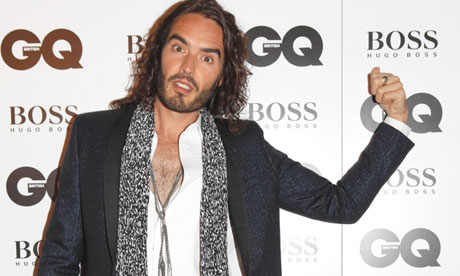
Russell Brand at the GQ Men of the Year awards at the Royal Opera House.Photograph: Richard Young/Rex Features
Last week, Russell Brand was in hot water again after cracking a Nazi joke at the expense of GQ award sponsors, Hugo Boss. Here, he gives his side of the story:
I have had the privilege of scuba diving. I did it once on holiday, and I'm aware that it's one of those subjects that people can get pretty boring and sincere about, and sincerity, for we British, is no state in which to dwell, so I'll be brief. The scuba dive itself was numenistic enough, a drenched heaven; coastal shelves and their staggering, sub-aquatic architecture, like spilt cathedrals, gormless, ghostly fish gliding by like Jackson Pollock's pets. Silent miracles. What got me, though, was when I came up for air, at the end. As my head came above water after even a paltry 15 minutes in Davy Jones's Locker, there was something absurd about the surface. How we, the creatures of the land, live our lives, obliviously trundling, flat feet slapping against the dust.
It must have been a while since I've attended a fancy, glitzy event, because as soon as I got to the GQ awards I felt like something was up. The usual visual grammar was in place – a carpet in the street, people in paddocks awaiting a brush with something glamorous, blokes with earpieces, birds in frocks of colliding colours that if sighted in nature would indicate the presence of poison. I'm not trying to pass myself off as some kind of Francis of Assisi, Yusuf Islam, man of the people, but I just wasn't feeling it. I ambled into the Opera House across yet more outdoor carpets, boards bearing branding, in this case Hugo Boss, past paparazzi, and began to queue up at the line of journalists and presenters, in a slightly nicer paddock who offer up mics and say stuff like:
"Who are you wearing?"
"I'm not wearing anyone. I went with clobber, I'm not Buffalo Bill."
Noel Gallagher was immediately ahead of me in the press line and he's actually a mate. I mean, I love him: sometimes I forget he wrote Supersonic and played to 400,000 people at Knebworth because he's such a laugh. He laid right into me, the usual gear: "What the fook you wearing? Does Rod Stewart know you're going through his jumble?" I try to remain composed and give as good as I get, even though the paddock-side banter is accompanied by looming foam-tipped eavesdroppers, hanging like insidious mistletoe.
In case you don't know, these parties aren't like real parties. It's fabricated fun, imposed from the outside. A vision of what squares imagine cool people might do set on a spaceship. Or in Moloko. As we come out of the lift there's a bloody great long corridor flanked by gorgeous birds in black dresses, paid to be there, motionless, left hand on hip, teeth tacked to lips with scarlet glue. The intention, I suppose, is to contrive some Ian Fleming super-uterus of well fit mannequins to midwife you into the shindig, but me and my mate Matt just felt self-conscious, jigging through Robert Palmer's oestrogen passage like aspirational Morris dancers. Matt stared at their necks and I made small talk as I hot stepped towards the pre-show drinks. Now, I'm not typically immune to the allure of objectified women, but I am presently beleaguered by a nerdish, whirling dervish, and am eschewing all others. Perhaps the clarity of this elation has awakened me. A friend of mine said: "Being in love is like discovering a concealed ballroom in a house you've long inhabited." I also don't drink, so these affairs where most people rinse away their Britishness and twitishness with booze are for me a face-first log flume of backslaps, chitchat, eyewash and gak.
After a load of photos and what-not, we descend the world's longest escalator, which are called that even as they de-escalate, and in we go to the main forum, a high ceilinged hall, full of circular cloth-draped, numbered tables, a stage at the front, the letters GQ, 12-foot high in neon at the back; this aside, though, neon forever the moniker of trash, this is a posh do, in an opera house full of folk in tuxes.
Everywhere you look there's someone off the telly; Stephen Fry, Pharrell, Sir Bobby Charlton, Samuel L Jackson, Rio Ferdinand, Justin Timberlake, foreign secretary William Hague and mayor of London Boris Johnson. My table is a sanctuary of sorts; Noel and his missus Sara, John Bishop and his wife Mel, my mates Matt Morgan, Mick and Gee. Noel and I are both there to get awards and decide to use our speeches to dig each other out. This makes me feel a little grounded in the unreal glare, normal.
Noel's award is for being an "icon" and mine for being an "oracle". My knowledge of the classics is limited, but includes awareness that an oracle is a spiritual medium through whom prophecies from the gods were sought in ancient Greece. Thankfully, I have a sense of humour that prevents me from taking accolades of that nature on face value, or I'd've been in the tricky position of receiving the GQ award for being "best portal to a mystical dimension", which is a lot of pressure. Me, Matt and Noel conclude it's probably best to treat the whole event as a bit of a laugh and, as if to confirm this as the correct attitude, Boris Johnson – a man perpetually in pajamas regardless of what he's wearing – bounds to the stage to accept the award for "best politician". Yes, we agree: this is definitely a joke.
Boris, it seems, is taking it in this spirit, joshing beneath his ever-redeeming barnet that Labour's opposition to military action in Syria is a fey stance that he, as GQ politician of the year, would never be guilty of.
Matt is momentarily focused. "He's making light of gassed Syrian children," he says. We watch, slightly aghast, then return to goading Noel.
Before long, John Bishop is on stage giving me a lovely introduction, so I get up as Noel hurls down a few gauntlets, daring me to "do my worst".
I thanked John, said the "oracle award" sounds like a made-up prize you'd give a fat kid on sports day – I should know, I used to get them – then that it's barmy that Hugo Boss can trade under the same name they flogged uniforms to the Nazis under and the ludicrous necessity for an event such as this one to banish such a lurid piece of information from our collective consciousness.
I could see the room dividing as I spoke. I could hear the laughter of some and louder still silence of others. I realised that for some people this was regarded as an event with import. The magazine, the sponsors and some of those in attendance saw it as a kind of ceremony that warranted respect. In effect, it is a corporate ritual, an alliance between a media organisation, GQ, and a commercial entity, Hugo Boss. What dawned on me as the night went on is that even in apparently frivolous conditions the establishment asserts control, and won't tolerate having that assertion challenged, even flippantly, by that most beautifully adept tool: comedy.
The jokes about Hugo Boss were not intended to herald a campaign to destroy them. They're not Monsanto or Halliburton, the contemporary corporate allies of modern-day fascism; they are, I thought, an irrelevant menswear supplier with a double-dodgy history. The evening, though, provided an interesting opportunity to see how power structures preserve their agenda, even in a chintzy microcosm.
Subsequent to my jokes, the evening took a peculiar turn. Like the illusion of sophistication had been inadvertently disrupted by the exposure. It had the vibe of a wedding dinner where the best man's speech had revealed the groom's infidelity. With Hitler.
Foreign secretary William Hague gave an award to former Telegraph editor Charles Moore, for writing a hagiography of Margaret Thatcher, who used his acceptance speech to build a precarious connection between my comments about the sponsors, my foolish answerphone scandal at the BBC and the Sachs family's flight, 70 years earlier, from Nazi-occupied Europe. It was a confusing tapestry that Moore spun but he seemed to be saying that a) the calls were as bad as the Holocaust and b) the Sachs family may not've sought refuge in Britain had they known what awaited them. Even for a man whose former job was editing the Telegraph this is an extraordinary way to manipulate information.
Noel, who is not one to sit quietly on his feelings, literally booed while Charles Moore was talking, and others joined in. Booing! When do you hear booing in this day and age other than pantomimes and parliament? Hague and Johnson are equally at home in either (Widow Twanky and Buttons, obviously) so were not unduly ruffled, but I thought it was nuts. The room by now had a distinct feel of "us and them" and if there is a line drawn in the sand I don't ever want to find myself on the same side as Hague and Johnson. Up went Noel to garner his gong and he did not disappoint: "Always nice to be invited to the Tory party conference," he began, "Good to see the foreign secretary present when there's shit kicking off in Syria."
Noel once expressed his disgust at seeing a politician at Glastonbury. "What are you doing here? This ain't for you," he'd said. He explained to me: "You used to know where you were with politicians in the 70s and 80s cos they all looked like nutters: Thatcher, Heseltine, Cyril Smith. Now they look normal, they're more dangerous." Then, with dreadful foreboding: "They move among us." I agree with Noel. What are politicians doing at Glastonbury and the GQ awards? I feel guilty going, and I'm a comedian. Why are public officials, paid by us, turning up at events for fashion magazines? Well, the reason I was there was because I have a tour on and I was advised it would be good publicity. What are the politicians selling? How are they managing our perception of them with their attendance of these sequin-encrusted corporate balls?
We witness that there is a relationship between government, media and industry that is evident even at this most spurious and superficial level. These three institutions support one another. We know that however cool a media outlet may purport to be, their primary loyalty is to their corporate backers. We know also that you cannot criticise the corporate backers openly without censorship and subsequent manipulation of this information.
Now I'm aware that this was really no big deal; I'm not saying I'm an estuary Che Guevara. It was a daft joke by a daft comic at a daft event. It makes me wonder, though, how the relationships and power dynamics I witnessed on this relatively inconsequential context are replicated on a more significant scale.
For example, if you can't criticise Hugo Boss at the GQ awards because they own the event, do you think it is significant that energy companies donate to the Tory party? Will that affect government policy? Will the relationships that "politician of the year" Boris Johnson has with City bankers – he took many more meetings with them than public servants in his first term as mayor – influence the way he runs our capital?
Is it any wonder that Amazon, Vodafone and Starbucks avoid paying tax when they enjoy such cosy relationships with members of our government?
Ought we be concerned that our rights to protest are being continually eroded under the guise of enhancing our safety? Is there a relationship between proposed fracking in the UK, new laws that prohibit protest and the relationships between energy companies and our government?
I don't know. I do have some good principles picked up that night that are generally applicable: the glamour and the glitz isn't real, the party isn't real, you have a much better time mucking around trying to make your mates laugh. I suppose that's obvious. We all know it, we already know all the important stuff, like: don't trust politicians, don't trust big business and don't trust the media. Trust your own heart and each another. When you take a breath and look away from the spectacle it's amazing how absurd it seems when you look back.