Showing posts with label sex addiction. Show all posts

Saturday, September 7, 2013

Charlie Glickman on The Crash and Burn of Hugo Schwyzer


Over the years I have posted a lot of articles by male feminist author and (soon to be former) gender studies professor at Pasadena City College, Hugo Schwyzer, who had written (at various times) for Jezebel, Good Men Project, Role/ReBoot, and The Atlantic, among others.

In light of his recent admission of sleeping with students, not once, but on-goingly, while claiming to be an upstanding man in a happy marriage, I have taken down all of the material on this blog of which he was author.

If you have been following the story around the interwebs, you know the situation. If not here are a few articles to bring you up to speed (if you care).
Since his announcement that he was quitting the internet, he has been posting updates on his blog of a new autobiography he is writing about his life, his drug/alcohol addictions, and (if he has figured out yet) his sexual addiction. Yes, he is a sex addict.

That he is continuing to post material after "quitting" the internet rings of hypocrisy and narcissism. I eagerly await his termination by Pasadena City College and I hope that no substantive publisher picks up his new story (can we trust that any of this is true and not more marketing schtick?).

For those who want to read a more balanced and insightful take on this situation, in which many of us were taken in by a con-man, this article from Charlie Glickman feels about right to me.

Some Thoughts About Hugo Schwyzer

If you haven’t been tracking Hugo Schwyzer’s crash and burn, this post probably isn’t relevant for you. But for those of you who have been following it…

I’ve been thinking a lot about how everything went down for Schwyzer ever since his meltdown. It’s taken me a bit to sit with what I’ve read and what I’ve heard because there’s just so much of it. And every time I think things have gone as far as they’ll go, they keep getting worse.

I feel a lot of anger about what Schwyzer has done. Like many others, I hoped that his contrition for his past actions was genuine and that his behavior had changed. Like all of those other folks, I was wrong.

The last direct contact I had with him was when I spoke at his class this past April. To be honest, I had mixed feelings about associating myself with him. By that point, I knew that he wasn’t everything he presented himself as, but I decided to go ahead with my talk because I thought that I had something valuable to offer the students in his Navigating Pornography class. Given my background discussing gender and masculinity, I wanted to open up a discussion with them about how porn both reflects and shapes masculinity, and to offer alternative ideas of how we can define what it means to be a man. I volunteered my time for the sake of the students and while I had a fine experience a guest speaker and bringing some different perspectives to the class, I still felt unsure about being connected with Schwyzer. I should have listened to my gut on that one. I didn’t realize just how big a chasm there was between how he presented and how he acted.

I recently read a good definition of “trustworthiness.” We decide that someone is worthy of our trust when we believe that they will take our best interests into account. That doesn’t mean that they’ll do what we want. It means that they’ll consider our best interests and will take them seriously. 

Unfortunately, some people are good at putting up a front and convincing others that they deserve that trust. When we get conned, it’s hard to let go of that, even in the face of direct evidence. I wish I could say that I hadn’t been taken in, but I was. And as a result, I didn’t see the damage Schwyzer was doing, despite having been told about some of it. The inability to let go of the illusion that we want to see, and the tendency to throw good money after bad because we can’t admit our error both got in my way, and I deeply regret that.

I’ve been sitting with the question of why part of me wanted his stories to be true. Some of it is that I do genuinely want to live in a world in which we can trust people when they do their best to change. I don’t buy into the confession-and-redemption model that so many others do, but I do think that people can make amends and change. That made it easy for me to focus on the parts of Schwyzer’s story that I wanted to.

Some of it is that he was very charismatic. We spoke on the phone a few times when he interviewed me for pieces he was writing and he really seemed to get it. I didn’t agree with everything he wrote, but in conversation, he seemed more clued in. I’ve seen enough people write to generate controversy to have assumed that was what he was doing. On the two occasions when we met in person (one of which was when we chatted before I spoke to his class), his charisma was even more compelling. I don’t know how to describe it, but if you’ve ever met someone with charisma, you know how it can draw you in. I’m willing to bet that he could turn it up when it was directed at someone who had something he wanted, like say, a student he wanted to have sex with.

Some of it is that I have less direct experience with the kind of manipulation that he was doing. I was talking with a friend who faced a lot of that growing up and they recognized his bullshit early on. That’s a difficult thing to see when you don’t have those particular filters.

I’m sure that there are other elements to it, but those are the three big ones that I’ve come up with so far. The thing about a con artist is that they get you to want to believe them. They can get you to overlook the most glaring inconsistencies, which is what makes the con so successful. I don’t know if Schwyzer was buying into his act himself, how much of it was the result of his mental illness, or what else might have been going on. It doesn’t really matter to me because whatever the root causes, he conned me and he conned a lot of other people. I wish I’d been able to see it sooner.

Unfortunately, his lies and his actions have made it that much harder for all of the men out there who want to be allies to women, whether we call ourselves feminists or not. By convincing folks to trust him and then betraying that trust, by lying about what he was doing for years and pretending to be acting from integrity when he wasn’t, and by using the language of feminism and social justice as a smokescreen, Schwyzer has made it even more difficult for us to demonstrate our desire to be worthy of the trust of the women in our lives and our communities.

Far worse, Schwyzer’s betrayal of the women in his classes, as well as in online and in-person communities, adds insult to injury. There are women he hurt directly and indirectly, and I don’t think we have a complete tally, yet. While I feel some anger over how Schwyzer conned me and others, that pales in comparison to my anger about the ways in which he has injured and betrayed women while lying to our faces.

I’m glad that Pasadena City College is taking steps that I expect will result in his losing his position as a professor. Wherever he ends up, I can only hope that he is no longer in a position of authority over anyone.  And I hope that he is no longer able to influence or contribute to the ongoing discussion about gender equality and sexual politics. Fool me once, shame on you. Fool me twice, shame on me.

Saturday, February 23, 2013

Marty Klein - Challenging the Myth of Sex Addiction (and My Reply)

Dr. Marty Klein is a licensed marriage and family therapist and certified sex therapist in Palo Alto, California - and he seems to think that the notion (diagnosis) of sex addiction is a load of crap. While there is a lot I agree with in this post (especially the repugnant cop-out of "sex addiction" for celebrities and politicians who get caught in affairs), there is even more that my experience tells me is simply wrong.

My girlfriend is a Certified Sex Addiction Therapist and we both have worked with men (and in her case some women, I believe) who are, beyond a doubt, sex addicts. These people have lost homes, spouses, jobs, and all of their assets because of their addiction. This is a little different than being a womanizer or surfing too much internet porn.

The key factor for sex as an addiction, in my opinion, is that it is a compulsive form of self-medication. Sex addiction is a process addiction (a behavior rather than a substance), and its cycle looks like this:


Patrick Carnes, who Klein rightly acknowledges as the pioneer in sex addiction diagnosis and treatment, identifies four core beliefs held by most sex addicts in one form or another (and if you substitute something else for sex in the fourth one, like cocaine, heroin, or food, these may apply to all addicts).
  1. I am basically a bad, unworthy person
  2. No one would love me as I am
  3. My needs are never going to be met if I have to depend upon others
  4. Sex is my most important need
Let's unpack these a little more (all of this material comes from Patrick Carnes, Out of the Shadows: Understanding Sexual Addiction):
The first core belief of the addict is “I am basically a bad, unworthy person.” Abandonment means being unwanted. The child can only conclude that being unwanted means being unworthy and bad.
___

A second core belief comes from the first core belief about the child being a bad person. Because of personal unworthiness, the child believes, “No one would love me as I am.” Relationships with others become more tenuous the deeper this belief is. Children grow up believing that no one will accept them unconditionally. People will not be there; they cannot be trusted or depended on. If they do want a relationship, it is because they want something—not because they care. There will always be a price to pay. Minimally, there will be something that must be overlooked, ignored, or denied. To be close will mean to lose reality or integrity somehow. So intimacy is avoided.
___

[I]n the lonely search for something or someone to depend on—which has already excluded parents—a child can start to find those things which always comfort, which always feel good, which always are there, and which always do what they promise. For some, alcohol and drugs are the answer. For others it is food. And there is always sex, which usually costs nothing and nobody else can regulate.

This choice stems from the addict’s third core belief that is about needs: “My needs are never going to be met if I have to depend upon others.” In healthy families, children have a deep sense that their parents care for them as opposed to abandoning them.

Healthy parenting includes touching, loving, affirming, and guiding. The child feels cared for even when struggling with rules and limits. Trust in one’s self, as well as trust of others, emerges in that relationship.

When a child’s exploration of sexuality goes beyond discovery to routine self-comforting because of the lack of human care, there is potential for addiction [emphasis added]. Sex becomes confused with comforting and nurturing. Moreover, the assumption is made that everyone else feels and acts the same. Therefore, to feel secure means to be sexual.

Consequently, the child’s relationships with people have the potential for being replaced with an addictive relationship with sexuality. Addiction is a relationship—a pathological relationship in which sexual obsession replaces people. And it can start very early. The final core belief of the addict emerges clearly: “Sex is my most important need.

The kinds of childhood situations described here are further complicated when the children are surrounded by negative rules, messages, and judgments about sex. When addicts and their spouses study their families of origin, they are flooded with memories of events where they were told that being sexual was bad or, worse, that they were bad for being sexual.

When children’s primary source of comfort is sex and yet they are told by those whose judgments count the most that to be sexual is perverse, the conclusions they make about themselves are clear. They are unlikable. They need to hide that central part of themselves, which others will despise. Rather than repressing the sexual behaviors, they hide them or keep them secret. Needing to keep that central part of themselves secret adds to the pain and loneliness—which, in turn, creates a need for comfort, making the sexual fix that much more necessary.
In my experience, the self-medicating aspect is a reply to the inner sense of worthlessness and feeling unlovable. Some kids who have this sense of shame discover alcohol or drugs (for me it was alcohol and marijuana), other kids discover sex or food - either way, what is a normal healthy behavior becomes pathological because it is used to numb, to dissociate, to medicate away the pain of living with shame.

The worst part of it is that the addict feels more shame when s/he tries to control or stop the behavior and can't - then they act out to numb that shame, and the cycle spirals downward until the person's life is out of control.

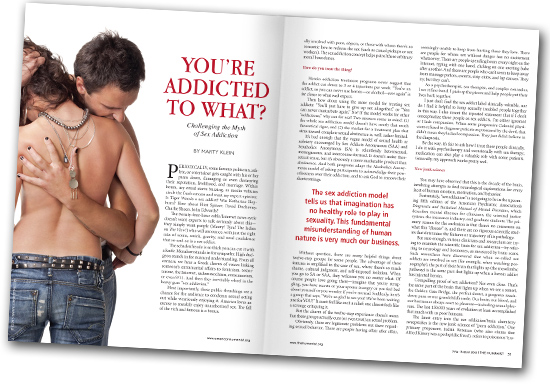
You’re Addicted to What?
Challenging the Myth of Sex Addiction


by: Marty Klein
Published in the July/August 2012 Humanist


Periodically, some famous politician, athlete, or entertainer gets caught with his or her pants down, damaging or even destroying their reputation, livelihood, and marriage. Within hours, my email starts buzzing, as media vultures circle the fresh carcass and want my expert opinion: Is Tiger Woods a sex addict? Was Katharine Hepburn? How about Eliot Spitzer, David Duchovny, Charlie Sheen, John Edwards?

The twenty-four-hour cable/Internet news cycle doesn’t want experts to talk seriously about this—they simply want people (Maury! Tyra! The ladies on The View!) who will announce, with just the right mix of scorn, smirk, gravity, and total confidence that so-and-so is a sex addict.

The schadenfreude is so thick you can cut it with a knife. Moralism stands in for sympathy. High dudgeon stands in for nuanced understanding. From all corners, we hear a Greek chorus of voices linking someone’s extramarital affairs to feminism, testosterone, the Internet, sadomasochism, consumerism, or even 9/11. And then they inevitably wheel in the heavy gun: “sex addiction.”

Most importantly, these public thrashings are a chance for the audience to condemn sexual acting out while vicariously enjoying it. America loves an excuse to sneakily enjoy unauthorized sex. The fall of the rich and famous is a bonus.

So when USA Today calls about Eliot Spitzer’s high-end escorts, or CNN emails about Anthony Weiner’s sexting, I’m usually pretty slow to respond to the ghoulish invitation.

I don’t diagnose people I haven’t met. More importantly, I don’t use the diagnosis of sex addiction. In thirty-one years as a sex therapist, marriage counselor, and psychotherapist, I’ve never seen sex addiction. I’ve heard about virtually every sexual variation, obsession, fantasy, trauma, and involvement with sex workers, but I’ve never seen sex addiction.

New patients tell me all the time how they can’t keep from doing self-destructive sexual things; still, I see no sex addiction. Instead, I see people regretting the sexual choices they make, often denying that these are decisions. I see people wanting to change, but not wanting to give up what makes them feel alive or young or loved or adequate; wanting the advantages of changing, but not wanting to give up what makes them feel they’re better or sexier or naughtier than other people. Most importantly, I see people wanting to stop doing what makes them feel powerful, attractive, or loved, but since they don’t want to stop feeling powerful, attractive or loved, they can’t seem to stop the repetitive sex clumsily designed to create those feelings.

The conflict over sex addiction is important to humanists for several reasons. “Sex addiction” is a special weapon now used by the religious right to combat perceived liberalism, to ignore science, and to ignite fear. It also helps legitimize anti-sex moralism and bigotry. And psychologists, judges, legislators, and the media are buying it.
When people refer to themselves or others as “sex addicts,” what are they actually talking about? More than anything, simple narcissistic character structure: the familiar “I guess I thought I could get away with it,” “Deep down, I don’t really believe the rules apply to me,” or “When I hurt, I want relief, and I don’t care so much about breaking promises or hurting others.”

If that sounds like normal people—if that sounds like you—it’s not surprising. Narcissism is a common human condition. So here’s my evaluation of almost everyone who is diagnosed as a sex addict—by themselves, their loved ones, or an addictionologist: it’s someone who is unhappy with the consequences of their sexual choices, but who finds it too emotionally painful to make different choices. You know, the way some of us are with cookies, new sweaters, or watching the Kardashians on TV.

Which is to say, it’s not about the sex. It’s about the immature decision-making.

The rest of the people who are in pain about their sexual decision-making are generally struggling with one or more of the following: compulsivity, impulsivity, obsessive-compulsive disorder, bipolar disorder, borderline personality disorder, or post-traumatic stress disorder. An idiosyncratic response to medication can even be a factor.

So when people talk about sex addiction, they’re really talking about all of these, and more. When someone says, “sexually, I’m out of control,” that doesn’t tell us very much. When we know someone has affair after affair; or that someone regularly masturbates to the point of pain; or that someone constantly pressures his wife for sex regardless of how unrealistic it is (she’s post-partum, she has the flu, his parents are in the next room, they had a big fight just a few hours ago); or that someone is pursuing anonymous sex in public parks in a way that’s begging for jail time and loss of career; or that someone watches three hours of porn per night, we simply don’t know very much about the person.

On the other hand, anyone who says “sexually, I’m out of control” is automatically welcomed into the fellowship of sex addicts—without any attempt to evaluate that person’s mental state. Sex therapists generally don’t get distracted by the sexual part of patients’ stories. Those without training in sexuality—like so-called sex addiction counselors—often do.

Let’s examine this cultural phenomenon in more detail.
Read the whole article

Sunday, February 10, 2013

Linda Hatch, PhD - Good Porn, Bad Porn


I am sure that there can be good porn, or at the very least that porn can be educational as well as titillating, but among the several sex addicts I have seen as a coach or therapist, porn is more addictive than most chemicals, and it's free. And if you have ever seen much porn, it's hard to believe any of it can be good.

My greater concern, however, is for the young men who are growing up watching online porn and learning porn-style sex as "normal sex." Porn-style sex is all about the orgasm, especially the man's, but none of it is about emotional intimacy and caring.

It's hard enough to learn about healthy, intimate sexuality as a young man, throwing porn into the mix is a recipe for disaster. Not only will these young men be ignorant of how female sexuality actually works, but they will have been conditioned to quick and easy pay-off of masturbating to porn, which might make the whole process of seduction, foreplay, and mutually pleasurable sexual sharing seem like too much work (I have heard this from sex addicts).

This article was posted in November of 2012 at the Psych Central blog, The Impact of Sex Addiction by Dr. Linda Hatch.


Is there good porn?

Take a look at this statement from an article called The Impact of Internet Pornography on Adolescents: A Review of the Research. 

“Increased access to the Internet by adolescents has created unprecedented opportunities for sexual education, learning and growth.”

(Owens, E. W., Behun, R. J., Manning, J.D. and Reid, R.C. (2012). Journal of Sexual Addiction and Compulsiviy, 19, 99-122)
Writers and researchers seem to feel obligated to acknowledge the potential benefits of pornography when in fact their own research as well as the vast majority of everyone else’s shows no such thing.

The above authors go on to document the damaging effects of internet pornography on adolescents.  For example that youth who view porn develop unrealistic sexual values and beliefs, and that viewing violent porn is related to higher levels of sexually aggressive behavior. Also that viewing porn leads to body image problems with girls and performance fears in boys and so on.

Certainly research on the negative effects of porn is important. But there is always an opposing view out there that porn serves the useful functions of freeing men and women, reducing shame around sex, aiding couples, and educating the young.

The reporting of scientific evidence often seems to be an attempt to escape the good vs. bad debate about porn so as to avoid being seen as moralistic. Just the facts. And indeed that is what science does.

But proving that porn can be a harmful, addictive drug fails to address a larger issue that I think is given less attention.


The two sides of the porn debate

The conservative/religious anti-porn movement is pitted against pro-porn ideology. Supporters of porn can range from freedom of speech advocates to those who argue that porn is liberating and any opposition to porn is a moralistic attempt to impose rigid, outdated norms on everyone.

The pro-porn folks (or at least the porn industry) appear to be winning.  The amount of porn consumed is increasing and the imagery is becoming more extreme in terms of erotic depictions of dominance/submission, degradation and violence against women.

Although women are starting to watch internet porn in increasing numbers, the majority of viewers are men (about 70%) and porn videos are typically depictions of male dominance.

The porn narrative

Professor Robert Jensen of the Austin School of Journalism says that porn typically tells a story.  That story, he says, is that “all women are there for the sexual pleasure of men.

Further, Jensen argues that porn conveys the message that there are no “good” girls, that all women are “whores,” and that women like pain.  And he believes that part of the porn ideology is that when women play out these roles they will “become fully realized as sexual beings.”

Other writers have tabulated the frequency of the various sex acts  in porn depicting a couple, the relative frequency of receiving oral sex, of male vs. female orgasm etc. and has found that it favors men.

Professor Jensen maintains that this pattern in the stories and the increasing extremity of porn, particularly so-called “gonzo” porn infiltrates the mainstream of visual media. This is referred to as the “pornifying of pop culture.”

The human values question

When the two sides face off in the porn debate it often comes down to values.  So the scientists can prove that porn has any number of bad effects like addiction, erectile dysfunction, and divorce, but that will not convince someone whose sexuality has become fused with sexual objectification.  They will feel attacked at a deep level.

The larger question that I feel is neglected is not whether your porn viewing is consistent with my values, but whether your porn viewing is consistent with your own values.

As Professor Jensen points out, porn as a whole is built around ideas like gender inequality and the comodification of a class of people (women).  Subordinating and dominating any segment of humanity is inconsistent with most people’s value systems.

Along with the scientific data we need to remind ourselves as clinicians and researchers to bring the discussion back around to the values that we and our clients share, like the capacity for empathy and a sense of our common humanity.

~ Linda Hatch is a psychologist and certified sex addiction therapist specializing in the treatment of sex addicts and the partners and families of sex addicts. Linda also blogs on her own website at Sexaddictionscounseling.com

Monday, February 27, 2012

Understanding Porn Addiction - A Reply to The Good Men Project


Over at The Good Man Project there is a recent article called, no joke, "Theoretically a man could worry that he’s addicted to porn and it turns out he’s really not. Is there room in the diagnostic system for that possibility?”  Apparently this was a comment someone left on the post "Why Does Porn Seem Hotter Than My Partner?"

Please be aware, there is no diagnostic category for porn addiction - it's not a recognized mental illness, nor is sex addiction. Which is not to say that porn addiction does not exist - it most certainly does, and most porn addicts are not aware that they are addicts, and most of them certainly would not self-refer. 

The Editors, in their article based on this comment, offered their own definition of porn addiction:
Here’s where [the authors of the original post] are on solid ground: there are men who are aware that they have a problem with porn. These men know they have a problem because they feel like their porn habits are out of control. Their sense of being out of control gives them a lot of stress, and a part of each of them wants to change but is not sure how. I have no doubt the testimonials are genuine.

This is often how addiction or other psychological disorders are spotted and treated. Treatment often begins when the subject asks for help or when the subject identifies to himself that he has a problem. A diagnosis of porn addiction is literally “subjective” – based in large part on whether or not the subject thinks he has a problem. If he thinks he has a problem, then he probably does. This is a common threshold for a lot of conditions in the DSM-IV: the difference between a personal quirk and a disorder is how much it bothers the subject. If I have a problem with reliance on the subject’s own viewpoint, then I have a problem with psychiatry as a science in the first place.

So, if a man prefers to masturbate to porn instead of his partner and this bothers him, or if he can only get an erection to porn and this bothers him, then he has a problem.

My question is: if it doesn’t bother him very much, then can we still say that he has a porn problem? Maybe in some cases, maybe not. Maybe he’s addicted and he’s in denial, or maybe he doesn’t have a problem. That’s the tricky part.
Again, porn addiction is not in the DSM-IV, nor will it be in the DSM-5.

This brings me to my next point - porn addiction exists, for sure, but there are no standardized, agreed upon measures for diagnosing addicts. Patrick Carnes teaches counselors how to assess for this problem, but he is still an outsider in the mental health industry (this does not make him wrong, only a trailblazer).

There are differences in the brain scans of sex addicts than those of "normal" people. However, the scans of a sex addict are nearly identical to those of a cocaine addict - pretty much all addiction, with the technology we have today, looks alike in the brain. So a brain scan will not clearly identify a porn addict or a sex addict, largely because sexual addictions are very frequently comorbid with other chemical addictions.

So how do we identify a porn addict?

Obviously, if it is getting in the way of daily activities, or it is destroying an intimate relationship, or if you are acting out (viewing porn and/or masturbating) at work, you have a problem.

In my opinion, all addictions share one common element - the chemical or the activity serves to "self-medicate" our painful or disturbing feelings out of awareness. When we feel the need to engage in our addiction of choice, more than likely there is an uncomfortable feeling just beneath that urge, so we engage in our addiction, the feeling goes away (for now), and then if our addiction is sexual or otherwise troublesome (crack, heroin, meth, alcohol, etc.), then we feel shameful.

Here is how Patrick Carnes conceives of the addiction cycle - it would be the same for porn as it is for sex or drugs:
THE ADDICTION CYCLE 
For sexual addicts an addictive experience progresses through a four-step cycle that intensifies with each repetition: 
1. Preoccupation—the trance or mood wherein the addicts’ minds are completely engrossed with thoughts of sex. This mental state creates an obsessive search for sexual stimulation. 
2. Ritualization—the addicts’ own special routines that lead up to the sexual behavior. The ritual intensifies the preoccupation, adding arousal and excitement.
3. Compulsive sexual behavior—the actual sexual act, which is the end goal of the preoccupation and ritualization. Sexual addicts are unable to control or stop this behavior. 
4. Despair—the feeling of utter hopelessness addicts have about their behavior and their powerlessness. 
The pain the addicts feel at the end of the cycle can be numbed or obscured by sexual preoccupation that reengages the addiction cycle.

[Carnes, Out of the Shadows: Understanding Sex Addiction, 3rd Edition, 2001, Kindle Location 462-470]
From an earlier post I did on this topic, here is more from Carnes on the core beliefs of the sex addict (likely true as well for the porn addict).

Sex addiction, like all other addictions (sex, like gambling, is often considered a process addiction rather than a substance addiction), is generally a response to developmental damage in the child, who is neglected, abused, molested, raped, or otherwise exposed to violence and/or sexuality at a young age. The result is a brain that is wired differently, a brain prone to seeking ways to escape, to numb the psychological pain.

Carnes identifies four primary areas in development that get hijacked and become unhealthy core beliefs, leading to addictive behavior.

There are four factors in a child’s development that ultimately become part of the sexual addiction:
1. self-image—how children perceive themselves
2. relationships—how children perceive their relationships with others

3. needs—how children perceive their own needs

4. sexuality—how children perceive their own sexual feelings and needs

These perceptions ultimately become “core beliefs” central to the addictive system. They are conclusions that can govern choices and behaviors during the child’s adult life.

[Carnes, 2009, Out of the Shadows, Kindle Locations 1432-1437]
In the addict, each of these areas develops into an unhealthy core belief. In examining how these beliefs comes about, Carnes offers a series of examples, including a man named Morris. Here is a brief summary of this man's childhood:
First, there is alcoholism in the family. Second, physical and emotional abuse accompany sexual abuse. Third, sexual experience is both humiliating and comforting. And fourth, the reality of the child is denied when the child’s accounts of abuse are not taken seriously. All of these are potent contributors to the addiction, as we shall see. 
By far the most important factor, however, is a sense of having been abandoned. From a child’s point of view, “you can abuse me, humiliate me, exploit me, and even not believe me, but by far the worst is if you don’t even want me.” Fear of abandonment is a constant theme in all addictions, including alcoholism. Within the sexual addiction, it is especially powerful.

[Carnes, 1454-1459]
Abandonment, in some form or another, whether literal, emotional, physical, or otherwise, is a foundational wound for addicts, but especially for sex addicts.
The sexual addiction receives its power from a fundamental concern for survival.

The first core belief of the addict is “I am basically a bad, unworthy person.” Abandonment means being unwanted. The child can only conclude that being unwanted means being unworthy and bad.

[Carnes, 1467-1469]
Abandonment does take many forms, and aside from the versions mentioned above, attachment psychology recognizes poor attachment as a form of abandonment, especially the absence of "mirroring" for the infant as a way to develop affect regulation (see Allan Schore). Schore refers to this as relational trauma, and the results includes inability to regulate affect (thus the 4th core belief in some form another as shown below), a sense of worthlessness, feeling fundamentally flawed, and a variety of other issues, mostly stemming from the right brain's emotional centers.

Here are the other three core beliefs and how they play out:
A second core belief comes from the first core belief about the child being a bad person. Because of personal unworthiness, the child believes, “No one would love me as I am.” Relationships with others become more tenuous the deeper this belief is. Children grow up believing that no one will accept them unconditionally. People will not be there; they cannot be trusted or depended on. If they do want a relationship, it is because they want something—not because they care. There will always be a price to pay. Minimally, there will be something that must be overlooked, ignored, or denied. To be close will mean to lose reality or integrity somehow. So intimacy is avoided.

[Carnes, 1483-1488]
***
[I]n the lonely search for something or someone to depend on—which has already excluded parents—a child can start to find those things which always comfort, which always feel good, which always are there, and which always do what they promise. For some, alcohol and drugs are the answer. For others it is food. And there is always sex, which usually costs nothing and nobody else can regulate.

This choice stems from the addict’s third core belief that is about needs: “My needs are never going to be met if I have to depend upon others.” In healthy families, children have a deep sense that their parents care for them as opposed to abandoning them.

Healthy parenting includes touching, loving, affirming, and guiding. The child feels cared for even when struggling with rules and limits. Trust in one’s self, as well as trust of others, emerges in that relationship.

When a child’s exploration of sexuality goes beyond discovery to routine self-comforting because of the lack of human care, there is potential for addiction. Sex becomes confused with comforting and nurturing. Moreover, the assumption is made that everyone else feels and acts the same. Therefore, to feel secure means to be sexual.

Consequently, the child’s relationships with people have the potential for being replaced with an addictive relationship with sexuality. Addiction is a relationship—a pathological relationship in which sexual obsession replaces people. And it can start very early. The final core belief of the addict emerges clearly: “Sex is my most important need.”

The kinds of childhood situations described here are further complicated when the children are surrounded by negative rules, messages, and judgments about sex. When addicts and their spouses study their families of origin, they are flooded with memories of events where they were told that being sexual was bad or, worse, that they were bad for being sexual.

When children’s primary source of comfort is sex and yet they are told by those whose judgments count the most that to be sexual is perverse, the conclusions they make about themselves are clear. They are unlikable. They need to hide that central part of themselves, which others will despise. Rather than repressing the sexual behaviors, they hide them or keep them secret. Needing to keep that central part of themselves secret adds to the pain and loneliness—which, in turn, creates a need for comfort, making the sexual fix that much more necessary.

[Carnes, 1494-1512]
In summary, here are the four core beliefs held by most sex addicts in one form or another (and if you substitute something else for sex in the fourth one, like cocaine, heroin, or food, these may apply to all addicts).
  1. I am basically a bad, unworthy person
  2. No one would love me as I am
  3. My needs are never going to be met if I have to depend upon others
  4. Sex is my most important need
These core beliefs were the foundation of the child's life as s/he grew up (can also be a she) become the axis of the addict's adult life - with each belief adding to the disconnect between the addict's interiority (the "world the addict experiences, with its pain and shame") and the addict's exterior persona or image that is projected to protect his secret and keep his inner life hidden. 

To cope with this disconnect, to cope with the belief that "I am a bad, unworthy person," some addicts feel that any degradation or humiliation that comes their way is justified - it reinforces their sense of failure and inadequacy.

Other addicts develop a grandiose or detached  persona (mask) that they show to the world hide their foundational guilt and shame.
Addicts create a front of “normalcy” to hide their sense of inadequacy. They may even appear grandiose and full of exaggerated self-importance. The front contrasts with actions that appear degrading or self-defeating or both. Others see decisions or behaviors as irrational, unfathomable, or even self-destructive, but not “normal.” 
Close friends and family members become angry and frustrated with the addict’s egocentric quality, especially when there is insensitivity to others. They are troubled at what looks like destructive or curious behavior that does not fit the image the addict projects. 
The belief “No one would love me as I am” also sustains the secret world. Addicts continue to believe that everyone would abandon them if the truth were known. Consequently, they have a constant fear of being vulnerable or dependent on others.

[Carnes, 1568-1574]
A lot of sexual addicts proclaim extreme sexual propriety, or in some circles, "postconventional moral development" - the results of this can be moral self-righteousness around sexual activity, with those who call them on their behavior being dismissed as morally underdeveloped or morally rigid.
Cover-ups, lies, and deceptions are made to conceal personal sexual behavior. The addict’s protestations of high sexual morality are like a smoke screen, obscuring the impact of sexual obsession. Friends and family tend to reject suspicions of sexual compulsivity because of the addict’s “values.” However, as evidence of powerless behavior and unmanageability mounts, these persons are confused because they do not know what to believe. In addition, they do not wish to intervene in something so personal.

[Carnes, 1604-1607]
As this quote shows, people around the addict often dismiss accusations around the addict because they do not match their experience of the addict's professed morality in the sexual realm. Those who are closest to the addict risk becoming co-addicts, according to Carnes:
By definition, the addict replaces normal human relationships with sexual compulsiveness. Loved ones feel the loss, try to deny it, and become angry, feeling despair and sometimes hope. The coaddicts’ efforts to restore the relationship are not only ineffective, they can intensify and deepen the addictive system for the addict. To compound the tragedy, coaddicts will take actions which are self-destructive, degrading, or even profound violations of their own values. Family members, as coaddicts, become part of the problem. Hence, the prefix co-.

[Carnes, 1640-1644]
 I highly recommend Carnes' books as a good foundation for understanding this addiction - he is a recovering sex addict so he knows the terrain. More importantly, however, we can learn a LOT by talking with porn addicts and sex addicts who are will to share their stories so that others might understand their experience.

Wednesday, November 30, 2011

Chris Lee - The Sex Addiction Epidemic


In recent years, sex addiction has become the default claim when men get caught sleeping with someone other than the person they are married to. This is unfortunate - sex addiction is a real disorder and a lot of men and women suffer with it. Chris Lee, for the The Daily Beast/Newsweek, looks into the sex addiction epidemic.

The Sex Addiction Epidemic


It wrecks ­marriages, ­destroys ­careers, and saps self-worth. Yet ­Americans are being ­diagnosed as sex ­addicts in ­record numbers. Inside an epidemic. 


Valerie realized that sex was wrecking her life right around the time her second marriage disintegrated. At 30, and employed as a human-resources administrator in Phoenix, she had serially cheated on both her husbands—often with their subordinates and co-workers—logging anonymous hookups in fast-food-restaurant bathrooms, affairs with married men, and one-night stands too numerous to count. But Valerie couldn’t stop. Not even after one man’s wife aimed a shotgun at her head while catching them in flagrante delicto. Valerie called phone-sex chat lines and pored over online pornography, masturbating so compulsively that it wasn’t uncommon for her to choose her vibrator over going to work. She craved public exhibitionism, too, particularly at strip clubs, and even accepted money in exchange for sex—not out of financial necessity but for the illicit rush such acts gave her.

For Valerie, sex was a form of self-medication: to obliterate the anxiety, despair, and crippling fear of emotional intimacy that had haunted her since being abandoned as a child. “In order to soothe the loneliness and the fear of being unwanted, I was looking for love in all the wrong places,” she recalls.

After a decade of carrying on this way, Valerie hit rock bottom. Facing her second divorce as well as the end of an affair, she grew despondent and attempted to take her life by overdosing on prescription medication. Awakening in the ICU, she at last understood what she had become: a sex addict. “Through sexually acting out, I lost two marriages and a job. I ended up homeless and on food stamps,” says Valerie, who, like most sex addicts interviewed for this story, declined to provide her real name. “I was totally out of control.”

“Sex addiction” remains a controversial designation—often dismissed as a myth or providing talk-show punchlines thanks to high-profile lotharios such as Dominique Strauss-Kahn and Tiger Woods. But compulsive sexual behavior, also called hypersexual disorder, can systematically destroy a person’s life much as addictions to alcohol or drugs can. And it’s affecting an increasing number of Americans, say psychiatrists and addiction experts. “It’s a national epidemic,” says Steven Luff, coauthor of Pure Eyes: A Man’s Guide to Sexual Integrity and leader of the X3LA sexual-addiction recovery groups in Hollywood.


Chris Lee discusses sex addiction on MSNBC.

 
Reliable figures for the number of diagnosed sex addicts are difficult to come by, but the Society for the Advancement of Sexual Health, an education and sex-addiction treatment organization, estimates that between 3 and 5 percent of the U.S. population—or more than 9 million people—could meet the criteria for addiction. Some 1,500 sex therapists treating compulsive behavior are practicing today, up from fewer than 100 a decade ago, say several researchers and clinicians, while dozens of rehabilitation centers now advertise treatment programs, up from just five or six in the same period. The demographics are changing, too. “Where it used to be 40- to 50-year-old men seeking treatment, now there are more females, adolescents, and senior citizens,” says Tami VerHelst, vice president of the International Institute for Trauma and Addiction Professionals. “Grandfathers getting caught with porn on their computers by grandkids, and grandkids sexting at 12.”
Read the rest of the article.

Sunday, September 4, 2011

Sex Addicts Are True Addicts, and Addiction Is Often a Trauma Response

http://tv.popcrunch.com/wp-content/uploads/2008/08/david_duchovny_gillian_anderson_bed.jpg

Sex addiction has been a hot topic in the last year or two - it seems to be the go-to answer when a man gets caught sleeping around. Tiger Woods was said to be diagnosed with sex addiction, as was David Duchovny, as well as Governor Mark Sanford (SC), former-president Bill Clinton (according to former-president Gerald Ford), former Mets GM and now-fired ESPN baseball analyst Steve Phillips, and nearly anyone else who gets caught having affairs (or in other "unseemly" predicaments).

But sex addiction is not about having affairs or a lot of sex - it's about compulsive sex that often loses its excitement and pleasure. It's about masturbating so much that the penis gets raw, or having unsafe anonymous sex in adult arcades, or risking arrest to expose oneself to passers by, waiting for hours outside a house for brief glimpse of a woman undressing.

And it's about lying to oneself about how out of control one's life has become, about all the money wasted, the jobs lost, the family that left - it's about a huge pile of lies told to others and told to oneself.

Sex addicts - like most other addicts - believe their lies and rationalizations, a trait referred to as sincere delusion. Part of the delusion is often blaming others for his actions:
The addict’s blame of others for all problems is another way to protect his secret life. Fault lies with spouse, children, parents, work associates, or boss. The addict is self-righteous, critical, and judgmental. There is no acceptance of personal responsibility for mistakes, failures, or actions. This appearance of integrity further insulates the addict’s world from reality. The blame dynamic provides further justification for the addict’s behavior.

[Carnes, P., Out of the Shadows, 2009, Kindle Locations 453-456]
As pioneer sex addiction researcher Patrick Carnes has made clear in his many books (Out of the Shadows: Understanding Sex Addiction, 3rd Edition, 2001, is probably the best introduction), sex addiction, like all other addictions (sex, like gambling, is often considered a process addiction rather than a substance addiction), is generally a response to developmental damage in the child, who is neglected, abused, molested, raped, or otherwise exposed to violence and/or sexuality at a young age. The result is a brain that is wired differently, a brain prone to seeking ways to escape, to numb the psychological pain.

Carnes identifies four primary areas in development that get hijacked and become unhealthy core beliefs, leading to addictive behavior.
There are four factors in a child’s development that ultimately become part of the sexual addiction:

1. self-image—how children perceive themselves

2. relationships—how children perceive their relationships with others

3. needs—how children perceive their own needs

4. sexuality—how children perceive their own sexual feelings and needs

These perceptions ultimately become “core beliefs” central to the addictive system. They are conclusions that can govern choices and behaviors during the child’s adult life.

[Carnes, 2009, Out of the Shadows, Kindle Locations 1432-1437]
In the addict, each of these areas develops into an unhealthy core belief. In examining how these beliefs comes about, Carnes offers a series of examples, including a man named Morris. Here is a brief summary of this man's childhood:
First, there is alcoholism in the family. Second, physical and emotional abuse accompany sexual abuse. Third, sexual experience is both humiliating and comforting. And fourth, the reality of the child is denied when the child’s accounts of abuse are not taken seriously. All of these are potent contributors to the addiction, as we shall see. 

By far the most important factor, however, is a sense of having been abandoned. From a child’s point of view, “you can abuse me, humiliate me, exploit me, and even not believe me, but by far the worst is if you don’t even want me.” Fear of abandonment is a constant theme in all addictions, including alcoholism. Within the sexual addiction, it is especially powerful.

[Carnes, 1454-1459]
Abandonment, in some form or another, whether literal, emotional, physical, or otherwise, is a foundational wound for addicts, but especially for sex addicts.
The sexual addiction receives its power from a fundamental concern for survival.

The first core belief of the addict is “I am basically a bad, unworthy person.” Abandonment means being unwanted. The child can only conclude that being unwanted means being unworthy and bad.

[Carnes, Kindle Locations 1467-1469]
Abandonment does take many forms, and aside from the versions mentioned above, attachment psychology recognizes poor attachment as a form of abandonment, especially the absence of "mirroring" for the infant as a way to develop affect regulation (see Allan Schore). Schore refers to this as relational trauma, and the results includes inability to regulate affect (thus the 4th core belief in some form another as shown below), a sense of worthlessness, feeling fundamentally flawed, and a variety of other issues, mostly stemming from the right brain's emotional centers.

Here are the other three core beliefs and how they play out:
A second core belief comes from the first core belief about the child being a bad person. Because of personal unworthiness, the child believes, “No one would love me as I am.” Relationships with others become more tenuous the deeper this belief is. Children grow up believing that no one will accept them unconditionally. People will not be there; they cannot be trusted or depended on. If they do want a relationship, it is because they want something—not because they care. There will always be a price to pay. Minimally, there will be something that must be overlooked, ignored, or denied. To be close will mean to lose reality or integrity somehow. So intimacy is avoided.

[Carnes, 1483-1488]

***
[I]n the lonely search for something or someone to depend on—which has already excluded parents—a child can start to find those things which always comfort, which always feel good, which always are there, and which always do what they promise. For some, alcohol and drugs are the answer. For others it is food. And there is always sex, which usually costs nothing and nobody else can regulate.

This choice stems from the addict’s third core belief that is about needs: “My needs are never going to be met if I have to depend upon others.” In healthy families, children have a deep sense that their parents care for them as opposed to abandoning them.

Healthy parenting includes touching, loving, affirming, and guiding. The child feels cared for even when struggling with rules and limits. Trust in one’s self, as well as trust of others, emerges in that relationship.

When a child’s exploration of sexuality goes beyond discovery to routine self-comforting because of the lack of human care, there is potential for addiction. Sex becomes confused with comforting and nurturing. Moreover, the assumption is made that everyone else feels and acts the same. Therefore, to feel secure means to be sexual.

Consequently, the child’s relationships with people have the potential for being replaced with an addictive relationship with sexuality. Addiction is a relationship—a pathological relationship in which sexual obsession replaces people. And it can start very early. The final core belief of the addict emerges clearly: “Sex is my most important need.”

The kinds of childhood situations described here are further complicated when the children are surrounded by negative rules, messages, and judgments about sex. When addicts and their spouses study their families of origin, they are flooded with memories of events where they were told that being sexual was bad or, worse, that they were bad for being sexual.

When children’s primary source of comfort is sex and yet they are told by those whose judgments count the most that to be sexual is perverse, the conclusions they make about themselves are clear. They are unlikable. They need to hide that central part of themselves, which others will despise. Rather than repressing the sexual behaviors, they hide them or keep them secret. Needing to keep that central part of themselves secret adds to the pain and loneliness—which, in turn, creates a need for comfort, making the sexual fix that much more necessary.

[Carnes, 1494-1512]
In summary, here are the four core beliefs held by most sex addicts in one form or another (and if you substitute something else for sex in the fourth one, like cocaine, heroin, or food, these may apply to all addicts).
  1. I am basically a bad, unworthy person
  2. No one would love me as I am
  3. My needs are never going to be met if I have to depend upon others
  4. Sex is my most important need
These core beliefs were the foundation of the child's life as he grew up (can also be a she) become the axis of the addict's adult life - with each belief adding to the disconnect between the addict's interiority (the "world the addict experiences, with its pain and shame") and the addict's exterior persona or image that is projected to protect his secret and keep his inner life hidden. 

To cope with this disconnect, to cope with the belief that "I am a bad, unworthy person," some addicts feel that any degradation or humiliation that comes their way is justified - it reinforces their sense of failure and inadequacy.

Other addicts develop a grandiose or detached  persona (mask) that they show to the world hide their foundational guilt and shame.
Addicts create a front of “normalcy” to hide their sense of inadequacy. They may even appear grandiose and full of exaggerated self-importance. The front contrasts with actions that appear degrading or self-defeating or both. Others see decisions or behaviors as irrational, unfathomable, or even self-destructive, but not “normal.” 
Close friends and family members become angry and frustrated with the addict’s egocentric quality, especially when there is insensitivity to others. They are troubled at what looks like destructive or curious behavior that does not fit the image the addict projects. 
The belief “No one would love me as I am” also sustains the secret world. Addicts continue to believe that everyone would abandon them if the truth were known. Consequently, they have a constant fear of being vulnerable or dependent on others.

[Carnes, 1568-1574]
A lot of sexual addicts proclaim extreme sexual propriety, or in some circles, "postconventional moral development" - the results of this can be moral self-righteousness around sexual activity, with those who call them on their behavior being dismissed as morally underdeveloped or morally rigid.
Cover-ups, lies, and deceptions are made to conceal personal sexual behavior. The addict’s protestations of high sexual morality are like a smoke screen, obscuring the impact of sexual obsession. Friends and family tend to reject suspicions of sexual compulsivity because of the addict’s “values.” However, as evidence of powerless behavior and unmanageability mounts, these persons are confused because they do not know what to believe. In addition, they do not wish to intervene in something so personal.

[Carnes, 1604-1607]
As this quote shows, people around the addict often dismiss accusations around the addict because they do not match their experience of the addict's professed morality in the sexual realm. Those who are closest to the addict risk becoming co-addicts, according to Carnes:
By definition, the addict replaces normal human relationships with sexual compulsiveness. Loved ones feel the loss, try to deny it, and become angry, feeling despair and sometimes hope. The coaddicts’ efforts to restore the relationship are not only ineffective, they can intensify and deepen the addictive system for the addict. To compound the tragedy, coaddicts will take actions which are self-destructive, degrading, or even profound violations of their own values. Family members, as coaddicts, become part of the problem. Hence, the prefix co-.

[Carnes, 1640-1644]
Finally, I want to conclude with the basic addiction cycle as experienced by sex addicts and defined by Carnes:
THE ADDICTION CYCLE 

For sexual addicts an addictive experience progresses through a four-step cycle that intensifies with each repetition: 

1. Preoccupation—the trance or mood wherein the addicts’ minds are completely engrossed with thoughts of sex. This mental state creates an obsessive search for sexual stimulation. 

2. Ritualization—the addicts’ own special routines that lead up to the sexual behavior. The ritual intensifies the preoccupation, adding arousal and excitement.

3. Compulsive sexual behavior—the actual sexual act, which is the end goal of the preoccupation and ritualization. Sexual addicts are unable to control or stop this behavior. 

4. Despair—the feeling of utter hopelessness addicts have about their behavior and their powerlessness. 

The pain the addicts feel at the end of the cycle can be numbed or obscured by sexual preoccupation that reengages the addiction cycle.

[Carnes, 462-470]
There's also a process called sexual anorexia that can occur after the despair stage, where the shame is so strong that the addict is able to deny himself sex for an extended period of time. This can also backfire in that the addict will say, "I can quit whenever I want." Shame-based deprivation is not the same as being able to quit.

Please keep all of this mind in the coming days as I post some news over at Integral Options Cafe.

Saturday, September 3, 2011

Porn May Deter Sexual Violence and Increase Porn-Induced Sexual Dysfunction


A new study (July, 2011) reviewed in Scientific American and Scientific American Mind - as well as a host of other sites, including Huffington Post - suggests the viewing porn may decrease sexual violence. The distinction must made between "normal" porn and violent or humiliating porn - this is from the SA post in the Stream of Consciousness blog by :
in a 2007 survey of 650 young men, scientists found that users of mainstream, nonviolent pornography were neither more nor less sexually satisfied than nonusers. Both groups felt the same degree of intimacy in their relationships and had similar sexual experiences. 

The men with a penchant for violent or fetishist porn did have a few quirks: they masturbated more frequently, had more sexual partners in their lives, and were not as close to their partners as the average, non-porn-watching male (whoever that is). 
I think what all of these studies are leaving out, and which I see in a couple of men I am working with, is that porn - especially the ease of access to internet porn - can become a very powerful addiction. Patrick Carnes (the first person to talk openly about sex addiction, because he suffered with it himself) offers stories of seemingly normal men who lose their jobs, their homes, their families, and sometimes their freedom because of their sexual addictions. Internet porn may be the most common sexual addiction in America.

A recent article at Psychology Today looked at a less visible problem with the frequent use of porn - sexual dysfunction.
Internet porn appears to be "sex-negative" for many users.


Dismay
A growing number of young, healthy Internet pornography users are complaining of delayed ejaculation, inability to be turned on by real partners, and sluggish erections.

Lots of guys, 20s or so, can't get it up anymore with a real girl, and they all relate having a serious porn/masturbation habit. Guys will never openly discuss this with friends or co-workers, for fear of getting laughed out of town. But when someone tells their story on a health forum, and there are 50-100 replies from other guys who struggle with the same thing, this is for real.
Read the whole article.

As so often is the case, it's not either/or. For most consumers of porn, there does not seem to be any problems, and despite years of feminist claims otherwise, porn does not lead to the devaluing of women - on the contrary, it seems to lead to a "benevolent sexism," the belief that women need to be protected.

On the other hand, trying to repress one's desire to watch more only seems to increase the desire, as research by Michael P. Twohig, a psychologist at Utah State University, when he asked 299 undergraduate students about their use of porn:
It turns out that among porn viewers, the amount of porn each subject consumed had nothing to do with his or her mental state. What mattered most, Twohig found, was whether the subjects tried to control their sexual thoughts and desires. The more they tried to clamp down on their urge for sex or porn, the more likely they were to consider their own pornography use a problem. The findings suggest that suppressing the desire to view pornography, for example, for moral or religious reasons, might actually strengthen the urge for it and exacerbate sexual problems. 
I wonder how this plays into the addiction treatment protocols that often require a complete abstinence from porn?

Finally, as several authors have pointed out, the use of porn likely reflects the users personality, and does not, as commonly asserted, shape the personality. If a young man prefers violent porn, he is already someone who has violent tendencies, so it's not the porn that makes him violent.

Two final quotes:
My take (Ingrid Wickelgren): a lot of things happen to males during their development to shape their brains one way or the other, to be nice guys or jerks. By the time they start watching porn, their habits are more likely to reflect who they are than to shape their personalities in any significant way.
And:
It’s all about “personal views and personal values,” Twohig says. In other words, the effects of pornography—positive or negative—have little to do with the medium itself and everything to do with the person viewing it.

Saturday, April 9, 2011

Pornography: Its History in Civilisation & How iIt Changes Your Brain [NSFW]

http://www.toonpool.com/user/997/files/dog_cops_sniff_out_pornography_389315.jpg

Back in 1999, Channel 4 (England) ran a 6-part series on the "secret history" of pornography in Western Civilization. If you have ever looked at some of the classic art in various cultures, it really was not so secret. But this is still a quite interesting series.

Below the video there is an article on how pornography in its current form rewires the brain of those who consume it regularly.

Pornography: The Secret History of Civilisation

(TV mini-series 1999) (6 episodes- 50min/episode)

Pornography: The Secret History of CivilisationAfter taking in the fast-paced anthropology lesson of this engaging six-part series produced for British television in 1999, it would seem that for most of civilization, pornography hasn’t been such a secret after all.

The six lively episodes take playful account of that which is on more people’s minds than will easily admit, and which has been an important, if often vilified part of world culture since humans could think about such things. This documentary is a stylish and tidy chronological account of erotic imagery that the episodes categorize from earliest recorded history to the latest (as of the end of the 20th century) prospects afforded by the Internet and virtual technology.

An array of interview subjects from scholars to porn stars talk about everything from the graphic images discovered amongst the ruins of Pompeii and the one-of-a-kind erotica traded among high-class Europeans, to what it’s like for individuals to make and distribute their own adult encounters through the facility of their own bedroom camcorders.

Before it was demonized and censored when the printing press brought porn to the masses, it seems erotic drawings were a lot of jolly good fun that was not at all stigmatized. (One of the most amusing sequences is an interview with a prestigious, septuagenarian and erotic art historian who is interviewed about his specialty while reclining nude under the gaze of a woman sketching his portrait.)

Once the church became involved, deeming the depictions of man, woman, and beast doing what came naturally as obscene–a relatively modern classification – it moved into the shadows of sociological study. The episodes on photography, including still and moving pictures and the impact modern technology had in creating a porn industry are interesting, but not entirely enlightening for most people who have even a passing knowledge of the development of erotica from French postcards to adult home video.

Watch the full documentary now (playlist – 4 hours)


This article was posted by Donald Hilton at the Arts & Opinion blog - Dr. Hilton is a noted neurosurgeon at the University of Texas - and he is also a noted anti-pornography crusader who argues (quite well) that pornography is as addictive as any drug. He is the author of He Restoreth My Soul, a Christian approach to porn addiction.

He is not alone in this argument - there is ample research to support his position. In fact, more and more in-patient treatment facilities are recognizing porn addiction as one of the addictions with which patients present (notably, porn and sex addiction tend to also have chemical addiction partnerships in the patient).

He's on a lot more solid ground with me arguing from a neuroscience perspective than from a reproductive perspective or a Christian spiritual perspective.

This is a long article, so I am only presenting some relevant parts of it.

Porn Addiction: HOW PORNOGRAPHY DRUGS AND CHANGES YOUR BRAIN

by Donald Hilton (2010)
_________________

While some have avoided using the term “addiction” in the context of natural compulsions such as uncontrolled sexuality, overeating, or gambling, let us consider current scientific evidence regarding the brain and addiction.

* * * * * *

DISRUPTION OF DOPAMINE

Let’s review some of the important components of the reward system of the brain. On the outside is the cerebral cortex, a layer of nerve cells that carry conscious, volitional thought. In the front, over the eyes, are the frontal lobes. These areas are important in judgment, and, if the brain were a car, the frontal lobes would be the brakes. These lobes have important connections to the pleasure pathways, so pleasure can be controlled.

In the center of the brain is the nucleus accumbens. This almond-sized area is a key pleasure reward center, and when activated by dopamine and other neurotransmitters, it causes us to value and desire pleasure rewards. Dopamine is essential for humans to desire and value appropriate pleasure in life. Without it, we would not be as incentivized to eat, procreate, or even to try to win a game.

It’s the overuse of the dopamine reward system that causes addiction. When the pathways are used compulsively, a downgrading occurs that actually decreases the amount of dopamine in the pleasure areas available for use, and the dopamine cells themselves start to atrophy, or shrink. The reward cells in the nucleus accumbens are now starved for dopamine and exist in a state of dopamine craving, as a downgrading of dopamine receptors on the pleasure cells occurs as well. This resetting of the “pleasure thermostat” produces a “new normal.” In this addictive state, the person must act out in addiction to boost the dopamine to levels sufficient just to feel normal.

As the desensitization of the reward circuits continues, stronger and stronger stimuli are required to boost the dopamine. In the case of narcotic addiction, the addicted person must increase the amount of the drug to get the same high. In pornography addiction, progressively more shocking images are required to stimulate the person.

FRONTAL LOBE DAMAGE

As a feedback of sorts, the frontal lobes also atrophy, or shrink. Think of it as a “wearing out of the brake pads.” This physical and functional decline in the judgment center of the brain causes the person to become impaired in his ability to process the consequences of acting out in addiction. Addiction scientists have called this condition hypofrontality, and have noted a similarity in the behavior of addicted persons to the behavior of patients with frontal brain damage.

Neurosurgeons frequently treat people with frontal lobe damage. In a car crash, for instance, the driver’s brain will often decelerate into the back of his forehead inside his skull, bruising the frontal lobes. Patients with frontal lobe damage exhibit a constellation of behaviors we call frontal lobe syndrome. First, these patients are impulsive, in that they thoughtlessly engage in activities with little regard to the consequences. Second, they are compulsive; they become fixated or focused on certain objects or behaviors, and have to have them, no matter what. Third, they become emotionally labile, and have sudden and unpredictable mood swings. Fourth, they exhibit impaired judgment.

So cortical hypofrontality, or shrinkage of the frontal lobes, causes these four behaviors, and they can result from a car wreck or from addiction.

A study on cocaine addiction published in 2002 shows volume loss, or shrinkage, in several areas of the brain, particularly the frontal control areas. A study from 2004 shows very similar results for methamphetamine. But we expect drugs to damage the brain, so these studies don’t really surprise us.

Consider, though, a natural addiction, such as overeating leading to obesity. You might be surprised to learn that a study published in 2006 showed shrinkage in the frontal lobes in obesity very similar to that found in the cocaine and methamphetamine studies. And a study published in 2007 of persons exhibiting severe sexual addiction produced almost identical results to the cocaine, methamphetamine, and obesity studies. (Encouragingly, two studies, one on drug addiction [methamphetamine] and one on natural addiction [obesity] also show a return to more normal frontal lobe volumes with time in recovery.)

So we have four studies, two drug and two natural addiction studies, all done in different academic institutions by different research teams, and published over a five-year period in four different peer-reviewed scientific journals. And all four studies show that addictions physically affect the frontal lobes of the brain.

ADDICTION IS ADDICTION

I mentioned that the dopamine systems don’t work well in addiction, that they become damaged. This damage, as well as frontal lobe damage, can be shown with brain scans, such as functional MRI, PET, and SPECT scans. Recent brain scan studies have not only shown abnormalities in cases of cocaine addiction, but also in cases of pathologic gambling and overeating leading to obesity.

So non-biased science is telling us that addiction is present when there is continued destructive behavior in spite of adverse consequences. As stated in the journal Science, “as far as the brain is concerned, a reward’s a reward, regardless of whether it comes from a chemical or an experience.”

What about pornography and sexual addiction? Dr. Eric Nestler, head of neuroscience research at Mount Cedar Sinai in New York and one of the most respected addiction scientists in the world, published a paper in the journal Nature Neuroscience in 2005 titled “Is there a common pathway for addiction?” In this paper he said that the dopamine reward systems mediate not only drug addiction, but also “natural addictions (that is, compulsive consumption of natural rewards) such as pathological overeating, pathological gambling, and sexual addictions.”

The prestigious Royal Society of London, founded in the 1660s, publishes the longest-running scientific journal in the world, Philosophical Transactions of the Royal Society. A recent issue devoted 17 articles to the current understanding of addiction. Interestingly, two of the articles were specifically concerned with natural addiction, pathologic gambling and overeating.

FRANTIC LEARNING

Drs. Robert Malenka and Julie Kauer, in a landmark paper in Nature in 2007 on mechanisms of the physical and chemical changes that occur in the brain cells of addicted individuals, said, “Addiction represents a pathological, yet powerful form of learning and memory.” We now call these changes in brain cells “long term potentiation” and “long term depression,” and speak of the brain as being plastic, or subject to change and re-wiring.

Dr. Norman Doidge, a neurologist at Columbia, in his book The Brain That Changes Itself, describes how pornography causes re-wiring of the neural circuits. He notes that in a study of men viewing internet pornography, the men looked “uncannily” like rats pushing the lever to receive cocaine in the experimental Skinner boxes. Like the addicted rats, the men were desperately seeking the next fix, clicking the mouse just as the rats pushed the lever.

Pornography addiction is frantic learning, and perhaps this is why many who have struggled with multiple addictions report that it was the hardest for them to overcome. Drug addictions, while powerful, are more passive in a “thinking” kind of way, whereas pornography viewing, especially on the internet, is a much more active process neurologically. The constant searching for and evaluating of each image or video clip for its potency and effect is an exercise in neuronal learning, limited only by the progressively rewired brain. Curiosities are thus fused into compulsions, and the need for a larger dopamine fix can drive the person from soft-core to hard-core to child pornography—and worse. A paper published in the Journal of Family Violence in 2009 revealed that 85 percent of men arrested for child pornography had also physically abused children.

DEHUMANIZED SEXUALITY

In addition to cortical hypofrontality and downgrading of the mesolimbic dopaminergic systems, a third element appears to be important in pornography and sexual addiction. Oxytocin and vasopressin are important hormones in the brain with regard to physically performing sexually. Studies show that oxytocin is also important in increasing trust in humans, in emotional bonding between sexual mates, and in parental bonding. We are wired to bond to the object of our sexuality.

It is a good thing when this bonding occurs in a committed marriage relationship, but there is a dark side. When sexual gratification occurs in the context of pornography use, it can result in the formation of a virtual mistress of sorts. Dr. Victor Cline, in his essay, “Pornography’s Effects on Adult and Child,” describes this process as follows:
In my experience as a sexual therapist, any individual who regularly masturbates to pornography is at risk of becoming, in time, a sexual addict, as well as conditioning himself into having a sexual deviancy and/or disturbing a bonded relationship with a spouse or girlfriend.

A frequent side effect is that it also dramatically reduces their capacity to love (e.g., it results in a marked dissociation of sex from friendship, affection, caring, and other normal healthy emotions and traits which help marital relationships). Their sexual side becomes in a sense dehumanized. Many of them develop an “alien ego state” (or dark side), whose core is antisocial lust devoid of most values.

In time, the “high” obtained from masturbating to pornography becomes more important than real life relationships. . . .
The process of masturbatory conditioning is inexorable and does not spontaneously remiss. The course of this illness may be slow and is nearly always hidden from view. It is usually a secret part of the man’s life, and like a cancer, it keeps growing and spreading. It rarely ever reverses itself, and it is also very difficult to treat and heal. Denial on the part of the male addict and refusal to confront the problem are typical and predictable, and this almost always leads to marital or couple disharmony, sometimes divorce and sometimes the breaking up of other intimate relationships.

Dr. Doidge notes,"Pornographers promise healthy pleasure and a release from sexual tension, but what they often deliver is addiction, and an eventual decrease in pleasure. Paradoxically, the male patients I worked with often craved pornography but didn’t like it." In the book Pornified, Pamela Paul gives numerous examples of this, and describes one person who decided to limit his pornography use, not from a moralist or guilt-based perspective, but out of a desire to again experience pleasure in actual physical relationships with women.

“Porn impotence,” where the man experiences sexuality preferentially with porn instead of a woman, is a real and growing phenomenon. When a man’s sex drive has been diverted away from his spouse in this way, writes Dr. Cline, the wife can “easily sense this, and often [feels] very lonely and rejected.”

An article in the Journal of Sex and Marital Therapy described a study showing that many women view the pornographic activities of their partners “as a form of infidelity”:
The theme that runs through their letters is that the man has taken the most intimate aspect of the relationship, sexuality, which is supposed to express the bond of love between the couple and be confined exclusively to the relationship, and shared it with countless fantasy women. The vast majority of women in this study used words such as “betrayal,” “cheating,” and “affair “ to describe the significance that their partner’s involvement in pornography had for them.
A TRIPLE HOOK

Let me use a fishing analogy to illustrate some of these concepts. Every August, if possible, I try to be on the Unalakleet River in Alaska fishing for silver salmon. We use a particular lure, a triple hook called the Blue Fox pixie. As fisherman know, it is important to keep the drag loose just after hooking the fish, when it still has a lot of fight. As the fish tires, though, we tighten the drag and increase the resistance. In this way the fish is reeled into the boat and netted.

Similarly, pornography is a triple hook, consisting of cortical hypofrontality, dopaminergic downgrading, and oxytocin/vasopressin bonding. Each of these hooks is powerful, and they are synergistic. Pornography sets its hooks very quickly and deeply, and as the addiction progresses, it progressively tightens the dopamine drag until there is no more play in the line. The person is drawn ever closer to the boat, and the waiting net.

DEMOGRAPHIC DISASTER

Why is it essential to understand the addictive nature of pornography? Because if we view it as merely a bad habit, and do not afford those seeking healing the full support needed to overcome any true addiction, we will continue to be disappointed, as individuals and as a society. Pornography is the fabric used to weave a tapestry of sexual permissiveness that undermines the very foundation of society. Biologically, it destroys the ability of a population to sustain itself. It is a demographic disaster.

The author Tom Wolfe said, “The bigger pornography gets, the lower the birthrate becomes.” Does he have a point? In the 1950s every country now in the European Union had a fertility rate above the 2.1 needed to sustain a population. Now none of them do, and several are at or near the 1.3 rate called the “lowest low fertility,” from which it is virtually impossible to recover. It was in the late 1960s and early 1970s that this decline began, which corresponds precisely with the dawning of the sexual revolution. There is a direct correlation between the growing cultural dominance of the sexual revolution and the diminishing birthrate, and while causation may not be proven, it is strongly supported by the pheromone effect of pornography.

Demographic decline is, of course, multi-factorial. Urbanization, women in the workplace, gender role adaptation, and even increased life expectancy are important factors in the inverted population pyramids. But the primordial, or biological factors of human sexuality and family stability are primary and, in my opinion, haven’t been appropriately weighted.

In 1934 Cambridge anthropologist Dr. J. D. Unwin published Sex and Culture. In it he examined 86 cultures spanning 5,000 years with regard to the effects of both sexual restraint and sexual abandon. His perspective was strictly secular, and his findings were not based in moralistic dogma. He found, without exception, that cultures that practiced strict monogamy in marital bonds exhibited what he called creative social energy, and reached the zenith of production. Cultures that had no restraint on sexuality, without exception, deteriorated into mediocrity and chaos. In Houposia, The Sexual and Economic Foundations of a New Society, published posthumously, he summarized:
In human records, there is no instance of a society retaining its energy after a complete new generation has inherited a tradition which does not insist on pre-nuptial and post-nuptial continence. . . . The evidence is that in the past a class has risen to a position of political dominance because of its great energy and that at the period of its rising, its sexual regulations have always been strict. It has retained its energy and dominated the society so long as its sexual regulations have demanded both pre-nuptial and post-nuptial continence. . . .
I know of no exceptions to these rules.

Read more.

He may know of no exceptions to those rules, but there are many. In many pre-industrial societies there are no strictures against pre-marital sex - in fact, some cultures require as admission into adulthood (an older woman with a boy or an older man with a girl). In other cultures, promiscuity is not frowned upon at all.