Showing posts with label violence. Show all posts

Saturday, September 27, 2014

Dorian Furtuna - Male Aggression: Why are men more violent?

http://i.telegraph.co.uk/multimedia/archive/02116/braveheart_2116469b.jpg

If I had to summarize this article's stance on male aggression, it would be: "Evolution and my hormones made me do it." I would guess that this is still the majority view in biology, anthropology, and even some areas of psychology.

What's missing from this rather simplistic model is the social construction aspect - that gender behaviors are socially constructed and socially enforced. Men may have an obvious evolutionary design that allowed us to be more violent and aggressive - generally in the same way as the males of any species are aggressive as a means of protecting the group (from family to tribe to religion to nation).

BUT, we are no longer a species that operates in a kill-or-be-killed world. We have evolved. In general, the greater the level of psychosocial development, the lesser the incidence of violent behavior. It is no longer feasible to claim a biological imperative toward violence - our biology is only one aspect of who we are.

Male Aggression

Why are men more violent?

Published on September 22, 2014 by Dorian Furtuna, Ph.D. in Homo Aggressivus
In almost every society men are the ones who are overwhelmingly involved in wars, in all kinds of intergroup aggressions and intragroup homicide; they mobilize themselves in armies of violent fans, in criminal gangs, in bands of thugs, etc. These observations are as old as the world and have allowed us to create a clear distinction between male and female sexes regarding their predisposition to violence. Wars are a biosocial product of men and a field for male’s manifestation [Goldstein, 2001]. The same thing is true of crime and cruelty, which are closely linked to masculinity.

Canadian evolutionary psychologists Martin Daly and Margo Wilson, who specialize in studying the homicide phenomenon, have analyzed 35 homicide data sets from 14 countries, including some from primitive societies and some from different eras. Among these societies men committed homicide, on average, 26 times more frequently than women [Daly, Wilson, 1994]. Also, familicides (the killing of family members) are committed mostly by men. Some data have shown that men were involved in more than 90 percent of cases [Wilson, Daly, 1997, p. 160].

Men are also, in 70 percent of cases, the victims of homicides. In some societies, this percentage jumps to over 90 percent [Daly, Wilson, 1988; Berkowitz, 1993, p. 274, apud Buss, Duntley, 2002].
In the Russian Federation, in 1996, 86.6 percent of all serious crimes were committed by men. In the U.S., in 2004, 85 percent of total serious crimes were committed by men. Ninety-two percent of serial killers from the U.S. are men [1]. This statistical report is valid for most countries, regardless of their geographical location or size. In Republic of Moldova, for example, about 90 percent of crimes are committed by men [2].

Let us analyze another dimension of violence – cruelty and animal abuse. One of the studies that approached this issue found the following male-to-female ratio, regarding violence to animals: beatings – 38 to 1, shooting – 16 to 1, torture – 20 to 1, burning – 17 to 1 [Gerbasi, 2004].

Why are men more aggressive than women? Several theories have been proposed, trying to explain this phenomenon, most of them being from social psychological theories. One of the most popular theories belongs to American social psychologist Leonard Berkowitz. According to him, men and women are educated, traditionally, to carry out different social roles. Berkowitz uses the following reasoning for his theory: Think of all the ways in which modern Western society teaches children that fighting is more suitable for men than to women. Folk literature and the media constantly present men, and not women, fighting. Parents buy toy guns for boys and dolls for girls. Parents are more willing to endorse and encourage the aggressive behavior of boys, and not of girls. Again and again, directly and indirectly, minors learn that men are aggressive, and women not [Berkowitz, 1993, p. 395].

The theory of “social roles” has created a new paradigm in gender policies and marks, even today, the ways in which many civic and preschool education strategies are developed. It is presumed that girls and boys shall be educated and treated alike, non-discriminatory, and even the behavioral differences between them will disappear. However, although it contains in itself a good dose of truth (boys and girls were, traditionally, part of a different education), Berkowitz’s theory about learned social roles was subject to several critics, who have shown its vulnerabilities.

First of all, it’s not the parents that impose behavioral styles on their children, but their reaction at the latter’s requests; toy guns are bought for boys and dolls for girls because these are usually the children’s preferences (in part genetically predetermined). And as parents respond to children’s preformed wishes, so do media, offering a content which corresponds to behavioral patterns already existing on a social level [Hoyenga, Hoyenga, 1993]. Then, Berkowitz’s theory mirrored the Western culture, but didn’t take into account the realities from other cultures (without cinema, literature, media, toy stores), where the behavioral patterns of boys still greatly differ from that of girls. It was noted, among other things, that homicides in North America (where it seems that the media fosters intense social roles) are marked by sex differences to a lesser degree than in many other societies [Daly, Wilson, 1989, p. 101-102, apud Buss, Duntley, 2002]. So it is not the imprinting of social roles that sits at the origin of men’s increased aggressiveness, but inner causes, determined by the nature of men.

Also important in this regard are the findings of social psychologists who have noted that the social emancipation of women in recent decades has barely influenced or enhanced the expressiveness of aggressive behavior in women, which is additional proof that the higher degree of masculine aggressiveness is, first of all, due to genetic factors. Sex differences predetermine, on a genetic level, the differences in aggressive behavior [Wilson, Herrnstein, 1985]. It’s specific for women to use verbal aggression in intrasexual competition between women and rarely are there cases of physical assault. Women use only language in competitive strategies [Buss, Dedden, 1990, apud Fitzgerald, Whitaker, 2009, p. 469].

Most relevant in explaining the genesis of male aggressive behavior proved to be the approaches from an evolutionary perspective. Thus, the fact that men are more aggressive and stronger than women can be explained through intrasexual competition (between males). Men have inherited these skills from our evolutionary ancestors, because, in general, in the living world, gaining a higher hierarchical status, resources, protecting the family and obtaining competitive advantages in conquering women involves increased physical contest and increased aggressiveness [Buss, Duntley, 2006; Gat, 2010]. Similarly, in many animal species, including primates, males have the biological role of being guardians of the territory and of banishing the intruders or of protecting the group from predators, and these functions imply that males exhibit a higher level of aggression than females [Wilson, 1975].

The fact that males are more aggressive and more violent is reflected by their anatomy itself; in many animals species they are heavier, more muscular, better armed with means of attack and defense. In humans, for example, the arms of men are, on average, 75 percent more muscular than those of women; and the top of a male body is 90 percent stronger that the top of a female body [Bohannon, 1997; Abe et al., 2003, apud Goetz, 2010, p. 16]. Also, men are taller, they have denser and heavier bones, their jaw is more massive, their reaction time is shorter, their visual acuity is better, their muscle/fat ratio is greater, their heart is bulkier, their percentage of hemoglobin is higher, their skin is thicker, their lungs bigger, their resistance to dehydration is higher etc. In other words, from all points of view, men are more suited for battle than women, and these skills are native; they were selected and evolutionary polished [Sell et al., 2012, p. 33].

Men also have a specific hormonal status. Testosterone, for example, is directly responsible for inducing competitive and even criminal behavior. According to Evolutionary Neuroandrogetic Theory, male sex hormones (androgens) are correlated with the increased ability of males to acquire resources, hierarchical position and sexual partners [Ellis, 2003, 2004].

All of these anatomical, hormonal, behavioral and evolutionary factors demonstrate the biological, instinctual inclination of men to be more combative. Therefore, on an individual and social level, men are involved in acts of violence and crime. The social environment only cultivates and points out these predispositions towards fighting and aggression.

Sources:

1. ...И смертельная ненависть к мужчинам // Ракитин А.И.”Загадочные преступления прошлого”. 2008 / http://murders.ru/Florida_2.html
2. Statistica gender // Biroul Naţional de Statistică al Republicii Moldova / http://www.statistica.md/category.php?l=ro&idc=264
• Abe T., Kearns C.F., Fukunaga, T. Sex differences in whole body skeletal muscle mass measured by magnetic resonance imaging and its distribution in young Japanese adults // British Journal of Sports Medicine. Vol. 37. 2003. P. 436-440.
• Berkowitz L. Aggression: Its causes, consequences, and control. New York. McGraw-Hill. 1993. 485 p.
• Bohannon R.W. Reference values for extremity muscle strength obtained by hand-held dynamometry from adults aged 20 to 79 years // Archives of Physical Medicine and Rehabilitation. Vol. 78. 1997. P. 26-32.
• Buss D.M., Dedden L.A. Derogation of competitors // Journal of Social and Personal Relationships. Vol. 7. 1990. P. 395-422.
• Buss D.M., Duntley J.D. Murder by Design: The Evolution of Homicide // Behavioral and Brain Sciences. 2002 / http://www.philosophy.dept.shef.ac.uk/AHRB-Project/Papers/Non-pdf...
• Buss D.M., Duntley J.D. The Evolution of Aggression // In M. Schaller, J.A. Simpson, D.T. Kenrick (Eds.), “Evolution and Social Psychology”. New York, NY: Psychology Press. 2006. P. 263-285.
• Daly M., Wilson M. Homicide and cultural evolution // Ethology and Sociobiology. Vol. 10. 1989. P. 99-110.
• Daly M., Wilson M.I. Evolutionary psychology of male violence // In: Male Violence (Ed. by J. Archer). London: Routledge. 1994. P. 253–288.
• Daly M., Wilson M.I. Homicide. Hawthorn: Aldine de Gruyter. 1988.
• Ellis L. Genes, criminality, and the evolutionaryneuroandrogenic theory // In: A. Walsh and L. Ellis (Eds.), “Biosocialcriminology: Challenging environmentalism's supremacy Hauppauge”. NY: Nova Science. 2003. P. 13-34.
• Ellis L. Sex, status, and criminality: A theoretical nexus // Social Biology. Vol. 51. 2004. P. 144-160.
• Fitzgerald C.J., Whitaker M.B. Sex differences in violent versus non-violent life-threatening altruism // Evolutionary Psychology. Vol. 7(3). 2009. P. 467-476.
• Gat A. Why War? Motivations for Fighting in the Human State of Nature // in P. Kappeler and J. Silk (eds), “Mind the Gap: Tracing the Origins of Human Universals”. Springer Berlin. 2010. P. 197-220.
• Gerbasi K. Gender and nonhuman animal cruelty convictions: Data from Pet-Abuse.com // Society and Animals. Vol. 12. 2004. P.359-365.
• Goetz A.T. The evolutionary psychology of violence // Psicothema. Vol. 22(1). 2010 Feb. P. 15-21.
• Goldstein J. War and gender: How Gender Shapes the War System and Vice Versa. Cambridge: Cambridge University Press. 2001.
• Hoyenga K.B., Hoyenga K.T. Gender-related differences: Origins and outcomes. Boston: Allyn & Bacon. 1993.
• Sell A., Hone L.S., Pound N. The importance of physical strength to human males // Human Nature. Vol. 23(1). 2012 Mar. P. 30-44. doi: 10.1007/s12110-012-9131-2.
• Wilson E.O. “Sociobiology: A New Synthesis”. Harvard University Press. 1975.
• Wilson J.Q., Herrnstein R.J. Crime and Human Nature. New York. Simon & Shuster. 1985.
• Wilson M.I., Daly M. Familicide: uxoricide plus filicide? // In M Riedel & J Boulahanis, eds., Lethal violence: Proceedings of the 1995 meeting of the Homicide Research Working Group. Washington DC: National Institute of Justice. 1997. P. 159-169.

Wednesday, September 24, 2014

Rightbloggers - Rice, Peterson NFL Scandals Really About Liberals' Plan to Pussify America

What do we expect from the knuckle draggers in the rightwing blogosphere when confronted with men hurting women? Yeah, that's right, more knuckle dragging hypermasculinity.

Roy Edroso at The Village Voice did a round up of the nonsense spewing from the right.

Rice, Peterson NFL Scandals Really About Liberals' Plan to Pussify America, Say Rightbloggers

By Roy Edroso
Sun., Sept. 21 2014


[Roy Edroso dissects the right-wing blogosphere in this weekly feature]

The NFL hasn't been having a great time of it lately, PR-wise (though its TV viewership numbers seem not to have suffered): Now even non-fans know that Baltimore Raven Ray Rice was seen cold-cocking his fiancee and Minnesota Viking Adrian Peterson allegedly beat his kid hard enough with a switch to raise welts.

As often happens when celebrities get negative publicity, we have heard opinions from several parties not intimate with these cases. Rightbloggers used the controversies to promote their pet cultural theories: For example, that it's really liberals, not football players, who beat up women, and that the NFL, which is liberal like all corporations, is being Rice-baited into paying off feminists and sissies who, like liberal sportswriters, just want to ruin America's Game for conservatives.

The most prominent conservative commentary on these cases has come from Rush Limbaugh, who you may remember attacked the NFL as liberal-biased when they wouldn't let him buy a share of the St. Louis Rams in 2009. Limbaugh has so much yak on the subject (e.g., "The NFL Collides With the PC Media Culture") that we could fill this column with it, but let's not: The lesser rightbloggers are much more fun.

Many of the brethren were outraged that popular sportswriters did not immediately ask what the big deal was, but actually acted appalled. What ever happened to the shirtsleeved drunks of yore who would have shitcanned these stories but pronto?

When CBS sportscaster James Brown blamed childhood taunts like "You throw the ball like a girl" or "You're a little sissy" for the hypermasculinity that sometimes leads to domestic violence, Ben Shapiro of FrontPageMag claimed this was ridiculous, and what would really stop such violence was two-parents-but-not-gay families.


The liberal media is using guerrilla tactics to spread negative ideas about violent jocks. (Huffington Post.)

"No man has ever hit a woman because she 'throws like a girl,' " point-missed Shapiro. "But plenty of young men have hit women because they had no moral compass and did not believe in basic concepts of virtue -- and plenty of young men lack such a moral compass and belief in virtue thanks to lack of male role models." So Shapiro pleaded fatherhood, a cause he affected to believe is "unpopular."

As for sissy-shaming, Shapiro found concern over that as absurd as concern over the Washington Redskins' team name -- or, as he was careful to put it, "that the name of the Washington Redskins matters far more to Native-Americans than the nearly half of Native-American youths who drop out of high school," perhaps hoping this would defuse the issue the way "what about black-on-black crime?" defused the Michael Brown shooting, at least among a certain demographic.

Well, at least Brown didn't get the treatment Michael Signorile got from NewsBusters, which headlined, "Breaking: Gay Liberal Radio Host Doesn't Like NFL." (Swish, and we don't mean basketball!)

At National Review, Andrew C. McCarthy criticized "tendentious 'sports journalists,' the majority of whom are decidedly left of center, [who] are much less guarded about their hostility to conservatives than their fellow progressives on the political beat." He gave exactly one example of this: ESPN allowed its own correspondent, Kate Fagan, to speak on the issue. (Fagan also writes for espnW, which McCarthy told us is "where the network focuses on women in sports and, seamlessly, on political and social matters that the Left has successfully branded 'women's issues.' ")

Fagan, as the taped interview shows, said that the issue was bigger than Ray Rice, and that she wanted the NFL to "throw the kitchen sink at domestic violence," which meant, in her opinion, going into schools and "talking to young men about dealing with anger about how they treat women: I think that's where you're going to see change...going into the school systems and the younger spaces and really reprogramming how we raise men."

This McCarthy took to mean that "boys would be instructed that differentiating men from women breeds domestic violence," and that was "how radical ideas -- like the Left's war on boys -- get mainstreamed." He proposed instead that we focus on "the breakdown of the family, the scorn heaped on chivalry, the disappearance of manners, and the general coarsening of our society that result from relentless progressive attacks on traditional values and institutions." If only boys opened doors for girls again, there'd be no need for this reprogramming! (Other key phrases in McCarthy's column: "the Obama Left's agenda," "ACORN," "Al Sharpton's National Action Network," and "Alinsky-style community organizing.")

Fagan wasn't the only woman rightbloggers were mad at. When NOW President Terry O'Neill complained about the Rice incident, Larry Elder roared, "What about NOW's indifference toward, if not acceptance of, the late Sen. Ted Kennedy's sordid record of disgusting behavior toward women?" Also, what about Bill Clinton, Juanita Broaddrick, Kathleen Wiley, Paula Jones, and Gennifer Flowers? How come their video footage didn't make NOW mad? (For more of the same, see radio shouter Mark Levin.)

Disdaining Brown's "wild attempt to connect the Ray Rice incident to a sexist culture in the NFL," George Neumayr of the American Spectator said oh yeah what about Islam critic Ayaan Hirsi Ali, who had recently spoken without incident at Yale University? "When someone like Hirsi Ali makes a far more serious case for violence against women grounded in Islamic tradition, the Left throws a fit," said Neumayr. Why, those Muslims are almost as bad as Ted Kennedy.

"If women are the same as men, then how can they argue that a woman beaten by her boyfriend deserves special protection?" oh-shit-not-this-again'd Gina Loudon at WorldNetDaily. Loudon then argued that feminist doctrine -- specifically that "there is no difference between men and women," which we believe comes from Our Bodies, Ourselves -- meant that "you can't say that male abusers are more at fault than female abusers." But "despite old feminists' fantasies," she added, "women and men are not the same. American women are waking up to that fact, and as the co-author of a new book, 'What Women Really Want,' " etc., link to purchase provided.

At the New American, Selwyn Duke said oh yeah, what about Bill Clinton, Bob Filner, and Bob Packwood? Then, having run out of prominent Democrats to talk about, Duke posited that "it is liberal men -- feminist-oriented men -- who are most likely to abuse women." See, churchgoing people tend to be Republicans, and in one study churchgoers self-reported less domestic abuse than non-churchgoers. Libs hate God, so case closed!

If you need more, Duke said, "just consider feminist dogma. Liberals assert that men will treat women better if we scrap antiquated ideas such as chivalry, thought to be condescending, and passionately embrace notions of equality, which, liberals insist, means teaching boys to treat the sexes the same. Let's translate this: so we're telling little boys to treat girls the way they would other boys. And how might that be?" Translation: Equality means you get to smack a bitch up.

"This should a true 'duh' moment," added Duke. Indeed.

Some of the brethren saw in critics of off-the-field NFL violence evidence of what might be called Rice-baiting -- that is, Rice-pimping the unfortunate incidents to generate cash for their Rice-related causes.

"THE LEFT PREPARES TO CASH IN ON RAY RICE," cried Paul Mirengoff at Power Line.

"Whenever an institution becomes as massive as the NFL, the ideologically driven will attempt to enlist the institution for their own purposes," Mirengoff went on. Along with the more obvious ideologues, "some corporate sponsors -- Marriott Hotels, FedEx, PepsiCo and maybe others -- have also gotten into the act," not because they are, as recent history shows, PR-obsessed weasels, but because they "want to stay on the good side of liberal pressure groups like NOW....Corporate America is prone to roll over (up to a point) for liberal pressure groups. They do so in part because corporate America is, itself, liberal..." That explains all those diversity programs -- and now they're going to teach married people not to beat each other up! What is this, Russia?

At End of the American Dream, Michael Snyder went further: "the NFL has become a circus of political correctness," he claimed. For example, "the NFL recently banned advertisements from 'Slap Ya Mama Cajun Products.' " Why would they do that during a domestic violence controversy? Must be political! Worse, Snyder reported, NFL players wear pink accoutrements during Breast Cancer Awareness Month. Soon they'll be wearing bras and panties, like Billy Martin predicted!

The Rice issue had not cooled when the world discovered the welts on Peterson's son, and suddenly we were hearing about the pros and cons of corporal punishment from amateur child-rearing experts across the country, including Sean Hannity, who said his old man beat him pretty good and he came out all right, which self-activating joke we're sure you've already gotten.

The brethren seemed a little tired by the time the Peterson case came up, but some put in solid effort to extract conservative points from it, with predictable results.


Aw, so cute, with little stars like when Nancy and Sluggo got beaten till they bled! (The Cagle Post.)

"NFL Star Adrian Peterson Is Facing Serious Jail Time For Something Our Parents Did Every Day," headlined Western Journalism (over photographs of the welts on the kid's legs).

Douglas V. Gibbs talked at the Canada Free Press about how he got beat with a switch as a kid, and though he retroactively approved of that, his wife wouldn't let him spank their own kids. Gibbs said the kids came out OK, though "I do believe their transition into adulthood would have been smoother had they been disciplined in a stronger manner as they were growing up." (We wonder what his wife thinks of this, assuming she's still around.)

However, Gibbs went on, "some people believe that any physical discipline, especially if an instrument is used, is abusive, and they have decided to force their view upon parents that do not agree with them...'If only,' they must've been thinking, 'if only we had a poster child, a high profile person to fry for his abusive disciplinary techniques, so that we can drive home the idea that whoopin's are child abuse.'"

And then the Devil delivered unto them Adrian Peterson! "Remember, people like Hillary Clinton says [sic] that parents can't be trusted with the raising of their children, and that it 'takes a village to raise a child,' " claimed Gibbs. "They are foaming at the mouth with the good fortune of the Peterson story falling in their laps...They did it with Sandy Hook when it came to Gun Control, and they are doing it with Adrian Peterson..." Try and keep this stuff quiet, guys -- admittedly, that's tough to do with mass murder, but there are ways to hit kids that don't leave marks.

At Hot Air, Jazz Shaw said the "dog pile on the NFL in general and Commissioner Roger Goodell in particular" was "not dissimilar to the general gang mentality which has so many broadcasters ready to pile on the police in every nook and cranny of the country in the wake of the Ferguson case."

Jack Cashill at American Thinker also had a Ferguson angle: "For all its controlled violence, football provides young men, many of them from troubled homes, with all the discipline they will ever know," he wrote. "Had Ferguson's Michael Brown -- all 6'4", 295 pounds of him -- grown up in a halfway functional household he would likely be alive and playing offensive tackle for some college today." Probably would have gotten out of some traffic tickets as well, unless liberals have ruined that for us, too!

"This is all so wildly disproportionate," sputtered National Review's Rich Lowry -- he was talking about the negative reactions, we should make clear, not the writings of his fellow rightbloggers -- "that perhaps something more than the usual ax-grinding, ratings chase, and group think is at work. It may be that these cases are ways to express a deeper discomfort with the NFL, which sacrifices men's bodies and minds for our viewing pleasure every week." And who might be expressing that discomfort? Maybe sissies -- if we're still allowed to use that noble word!

"The problem with this particular cultural conversation," said Lowry's colleague Nancy French, is "it's hard to conduct it rationally while looking at the photos of a little boy's legs. Peterson said he went overboard in his spanking that day. He didn't do it right." (Pro tip: Next time, try the rubber hose.) "Yet the Left demands that the Peterson case simply be the end of the question, the end of the spanking era."

French supported this last assertion with a quote from an anti-spanking advocate whose authority to speak for the Left must have been voted when we were out of the room. ("The Left, of course, knows the art of spinning a tale," she added; you have to admire her chutzpah.) But in rightblogger-world, nothing's either good or bad, but its propaganda potential makes it so.

Let us close with Eric Golub of Communities Digital News, one of the rare defenders of NFL commissioner Goodell, whose job is jeopardized by these scandals. "Goodell is not being attacked for anything he has done or failed to do," said Golub. "He is being attacked for his mere being."

What Golub meant was that Goodell's father was a Republican senator, and "Goodell is married to Jane Skinner, who used to be a widely respected on-air personality at Fox News. That sounds like a pretty Republican household." By contrast, sportswriters are a bunch of commies ("NBC's Bob Costas has also aggressively pushed gun control").

Golub's nut graf (in one sense, anyway) was this:
"The NFL makes plenty of money, just like Walmart and those oil companies liberals hate so much. The NFL is violent, which bothers the leftist peaceniks as much as they are bothered by gun manufacturers. It is male-dominated, which offends the radical feminists. It is pro-military and overtly pro-American, which the left derides as jingoistic. Commissioner Goodell is tall, handsome, white, male and married to a beautiful blonde wife. He also has perfect hair. He is everything the liberal media loathes."
We tend to think of conspiracy theorists as nuts raving about chemtrails, but really -- when you're that deeply immersed in partisan politics, anything that happens can be part of one.

Sunday, September 21, 2014

Domestic Violence Appears More Likely for Same-Sex Couples

http://www.washingtonblade.com/content/files/2014/03/domestic_violence_insert_by_Bigstock.jpg

I've seen research suggesting that this is true in the past - but this adds to the evidence. It would be useful, too, to get a more comprehensive assessment of male same-sex domestic violence. As the article below notes, most of the research has been conducted on lesbians, not gay men or bisexuals.

We need to increase prevention eduction to the LGBT community, not just professional athletes and other high profile people.

Domestic Violence More Likely for Same-Sex Couples

By Janice Wood Associate News Editor
Reviewed by John M. Grohol, Psy.D. on September 21, 2014


Domestic violence occurs at least as frequently — and likely more so — between same-sex couples, according to a review of literature conducted by researchers at Northwestern Medicine.

“Evidence suggests that the minority stress model may explain these high prevalence rates,” said senior author Richard Carroll, associate professor in psychiatry and behavioral sciences at Northwestern University Feinberg School of Medicine and a psychologist at Northwestern Memorial Hospital.

“Domestic violence is exacerbated because same-sex couples are dealing with the additional stress of being a sexual minority. This leads to reluctance to address domestic violence issues.”

Previous studies have shown that domestic violence affects 25 percent to 75 percent of lesbian, gay, and bisexual individuals. However, researchers believe that a lack of representative data and underreporting of abuse suggests even higher rates.

An estimated 25 percent of heterosexual women experience domestic abuse, according to researchers, who note that that percentage is “significantly lower” for heterosexual men.

“There has been a lot of research on domestic violence, but it hasn’t looked as carefully at the subgroup of same-sex couples,” Carroll said. “Another obstacle is getting the appropriate samples because of the stigma that has been attached to sexual orientation. In the past, individuals were reluctant to talk about it.”

The research that has examined same-sex domestic violence has concentrated on lesbians rather than gay men and bisexuals, according to the Northwestern scientists.

“Men may not want to see themselves as the victim, to present themselves as un-masculine and unable to defend themselves,” Carroll said.

He suggests that homosexual men and women may not report domestic violence for fear of discrimination and being blamed for abuse from a partner. They also may worry about their sexual orientation being revealed before they are comfortable with it.

“We need to educate health care providers about the presence of this problem and remind them to assess for it in homosexual relationships, just as they would for heterosexual patients,” Carroll said.

“The hope is that with increasingly deeper acceptance, the stress and stigma will disappear for these individuals so they can get the help they need.”

The review was published in the Journal of Sex & Marital Therapy.

Source: Northwestern University

Saturday, August 23, 2014

Neglected Boys May Turn into Violent Adolescents


Among all of the ways children can suffer in childhood, neglect is turning out to be equally as traumatic as physical and/or sexual abuse. To better understand how destructive neglect can be (and we are not talking only about lack of food, clothing, or shelter), here is some material from Bruce Perry, one of leaders in the study of how adversity challenges the developing brain in children.
The Neurodevelopmental Impact of Neglect in Childhood

Neglect is the absence of critical organizing experiences at key times during development. Despite its obvious importance in understanding child maltreatment, neglect has been understudied. Indeed, deprivation of critical experiences during development may be the most destructive yet the least understood area of child maltreatment. There are several reasons for this. The most obvious is that neglect is difficult to “see.” Unlike a broken bone, maldevelopment of neural systems mediating empathy, for example, resulting from emotional neglect during infancy is not readily observable.

***

[W]hat we do know about neglect during early childhood supports a neuroarcheological view of adverse childhood experience. The earlier and more pervasive the neglect is, the more devastating the developmental problems for the child. Indeed, chaotic, inattentive and ignorant caregiving can produce pervasive developmental delay (PDD; DSM IV-R) in a young child (Rutter et al., 1999). Yet the very same inattention for the same duration if the child is ten will have very different and less severe impact than inattention during the first years of life. (Perry, 2002, p. 88-89)
This new research suggests that neglected boys are more likely to display violence as adolescents, which makes perfect in that neglect can severely compromise affect regulation, allowing anger to escalate to violence very easily.

Here is a brief definition of affect regulation:
AFFECT is the behavioral expression of emotion and affect regulation is a set of processes individuals use to manage emotions and their expression to accomplish goals. However, structures involved in affect regulation are among the last to mature in the developing brain; therefore, many adolescents may not be adequately equipped to regulate their affect. Consequently, adolescents are at increased risk of adverse health outcomes associated with poor affect regulation. (Bell & McBride, 2010)
That should be enough foundation to contextualize this article (press release, actually).

Neglected boys may turn into violent adolescents


August 18, 2014
Written by Matt Swayne
Source: Penn State
Summary:
Parents who physically neglect their boys may increase the risk that they will raise violent adolescents, according to sociologists. Examples of physical neglect include not taking a sick or injured child to the doctor, improperly clothing a child and not feeding a child, according to the researchers. While physical abuse is a significant contributor to violent behavior, physical neglect alone is an even stronger predictor of male adolescent violence than physical abuse, they noted.
__________

Parents who physically neglect their boys may increase the risk that they will raise violent adolescents, according to Penn State sociologists.

In a study of currently incarcerated male adolescents, physical neglect during childhood arose as the strongest predictor of violent behavior, said William McGuigan, associate professor of human development and family studies at Penn State Shenango. Researchers are just beginning to acknowledge the powerful role of neglect in influencing adolescent violence, he added.

"One of the problems with studying neglect is that it is an act of omission, rather than one of commission. In other words, it is characterized as the absence of an act, rather than an actual act of mistreatment," said McGuigan. "However, now we have better measures and larger databases to document neglect."

Examples of physical neglect include not taking a sick or injured child to the doctor, improperly clothing a child and not feeding a child, according to the researchers who will present their findings today (Aug. 18) at the annual meeting of the American Sociological Association in San Francisco.

The study indicated that while physical abuse is a significant contributor to violent behavior, physical neglect alone is an even stronger predictor of male adolescent violence than physical abuse, or even physical abuse and neglect combined.

"It sounds somewhat contrarian, but the physical abuse might at least show that parents are paying some type of attention to the child," said McGuigan, who worked with Roxanne Atterholt, instructor, and Jack A. Luchette, an undergraduate student, both in in human development and family studies at Penn State Shenango.

McGuigan said that understanding how neglect can influence violent behavior in adolescent males may lead to better education for caregivers and better care for at-risk youths.

"We have to look more into neglect and become more aware of how it may cause some of these violent behaviors," said McGuigan. "From that, we can build early preventative care programs than can help avoid these negative outcomes."

The research could also create assessments that, for example, might help protect people who care for adolescents by identifying youths who are more prone to violence.

The researchers analyzed data taken from a survey of 85 subjects, who are residents of a Pennsylvania detention center for delinquent males. In the survey, 25 of the participants, or 29.4 percent of the group, said that they experienced at least one incidence of childhood neglect. Acts of violence included fighting with students or parents, hitting teachers or instructors and using a weapon to scare, rob or injure another person.

Sexual abuse was not included in the survey. Only two subjects responded that they were sexually abused in the survey, which was not enough to provide conclusive findings, McGuigan said.


Story Source:
The above story is based on materials provided by Penn State. The original article was written by Matt Swayne. Note: Materials may be edited for content and length.

Wednesday, August 13, 2014

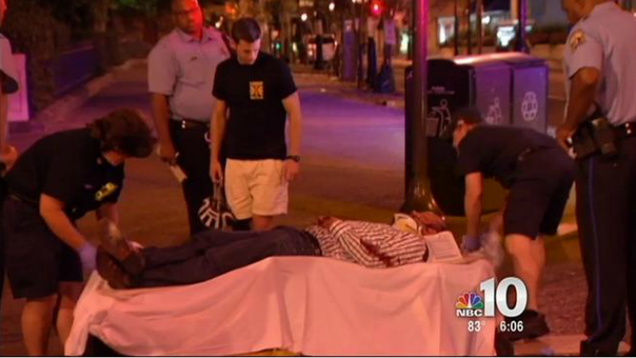
Man Violently Attacked for Standing Up for Women Being Catcalled (via Jezebel)

It's great that this guy stood up to the a-holes, and it sucks that he got so badly hurt.

Man Violently Attacked for Standing Up for Women Being Catcalled

Rebecca Rose  | August 12, 2014


A man is in the hospital after he was attacked for defending a group of women who were being harassed on the street, according to police.

The 39-year-old Texas man (whose name has not been released) was visiting Philadelphia's Rittenhouse Square on Saturday night. Police said the man observed a car of men pull up to a group of women. Via NBC Philadelphia:

The men inside the Nissan began taunting and catcalling the women, according to investigators, prompting the victim to get involved.

"The male victim took offense to something that the guys were saying to the girls and said 'hey, watch what you're saying,'" said Philadelphia Police Captain George Fuchs.

Police say one of the men inside the Nissan then got out of the car and punched the victim once in the head. The man was knocked unconscious after he fell and struck his head on the concrete.

[...]

Police say the suspect's Nissan had Delaware tags. They are currently looking through surveillance video to see if they can find the license plate number.
The man is in stable condition at a local hospital. "This is a tragic, tragic story," Captain Fuchs said. "Here's a guy trying to stick up for these girls and he gets victimized."

Good to know that their are men who are so irrationally fixated on their need to publicly demean and shame women they are willing to beat the shit out of anyone who gets in their way or dares call it into question. Great. Add another layer of fear to all the reasons why I hate catcalling.

Screencap via NBC Philadelphia.

Monday, August 11, 2014

PBS Nova - Mind of a Rampage Killer

This is an excellent documentary focused on some of the rampage killers (almost all teenagers) over the last decade or so. PBS assembles quite a group of psychologists and neuroscientists to help us understand (as best we can at this point) why and how they young men become killers.

Mind of a Rampage Killer

Can science help us understand why some people commit horrific acts of mass murder?

Aired February 20, 2013 on PBS


Program Description


What makes a person walk into a theater or a church or a classroom full of students and open fire? What combination of circumstances compels a human being to commit the most inhuman of crimes? Can science in any way help us understand these horrific events and provide any clues as to how to prevent them in the future? As the nation tries to understand the tragic events at Newtown, NOVA correspondent Miles O’Brien separates fact from fiction, investigating new theories that the most destructive rampage killers are driven most of all, not by the urge to kill, but the wish to die. Could suicide–and the desire to go out in a media-fueled blaze of glory–be the main motivation? How much can science tell us about the violent brain?  Most importantly, can we recognize dangerous minds in time—and stop the next Newtown?


Transcript (scroll down)


Participants

  • Paul Appelbaum, Columbia University
  • Joshua W. Buckholtz, Harvard University
  • Cynthia Ebsen, Mendota Mental Health Institute
  • Paul Frick, University of New Orleans
  • John Keilp, Columbia University
  • Liza Long, Mother of "Michael"
  • Karlen Lyons-Ruth, Harvard Medical School
  • Michael Meaney, McGill University
  • Katherine Newman, Johns Hopkins University
  • Miles O'Brien, NOVA Correspondent
  • Steven Pinker, Harvard University
  • Andrew Solomon, Author, Far from the Tree
  • Moshe Szyf, McGill University
  • Martin Teicher, Harvard Medical School
  • Gregory Van Rybroek, Mendota Mental Health Institute
  • Jeff Williams, Andy Williams' Father

Sunday, July 27, 2014

Omnivore - Men's Issues

From Bookforum's Omnivore blog, this collection of links on men's issues should give you plenty to read for a Sunday afternoon.

Men's Issues

Jul 24 2014
3:00PM

Wednesday, May 28, 2014

Masculinity, Misogyny And Murder: Unpacking A Killing In California (On Point w/ Tom Ashbrook)

I have already commented on this tragedy in two different posts (here and here), as well as sharing a collection of links devoted to this topic (here). I don't really have too much to add, other than to reiterate that these killings cannot be simplified into a single cause or target of blame.

In Elliott Rodger's actions there are a whole collection of factors, most prominent (as if often true and overlooked) is the delusional and grandiose thinking that justified these actions in his broken mind. It's easy to blame guns (he owned all of his weapons legally), or misogynistic, toxic masculinity (he followed men's rights activists [MRAs] and pick up artists [PUAs] on You Tube), but they are only part of the story - they are shadow elements of our culture that rarely get examined in the light of day unless we are forced to do so by some atrocity like this one.

Masculinity, Misogyny And Murder: Unpacking A Killing In California

A vicious, deadly rampage spurs a new look at misogyny and why it matters.

May 28, 2014 | Tom Ashbrook

People gather at a park for a candlelight vigil to honor the victims of Friday night’s mass shooting on Saturday, May 24, 2014, in Isla Vista, Calif. Sheriff’s officials said Elliot Rodger, 22, went on a rampage near the University of California, Santa Barbara, stabbing three people to death at his apartment before shooting and killing three more in a crime spree through a nearby neighborhood. (AP)
What’s in a killer’s heart? We know in the case of last Friday’s Santa Barbara massacre. Because the killer wrote about it at length. He despised women. His unrequited desire turned into a furious hatred. And a plan to kill. A plan he carried out. An overwhelming response followed. A Twitter flood – the #yesallwomen hashtag – women sharing their own stories. Concerns that hatred, entitlement, towards women is woven widely into our culture. Not creating killers necessarily, but haters. Is this true? Where’s the line? And what’s to be done? This hour, On Point: Misogyny. Assessing the damage.
– John Donvan

Guests

Soraya Chemaly, activist and writer. Her work has appeared in the Huffington Post, Salon, the Guardian, CNN and in other publications. (@schemaly)

David Futrelle, freelance writer who blogs at “We Hunted the Mammoth,” a site that tracks the “Men’s Rights” movement online. (@DavidFutrelle)

Dr. Robert Heasley, professor of sociology at the Indiana University of Pennsylvania. Former president of the American Men’s Studies Association.

From The Reading List

Slate: The Pick-Up Artist Community’s Predictable, Horrible Response to a Mass Murder – “I do not blame the Pick-Up Artist community (or its somehow even more deeply tortured counterpart, the Anti-Pick-Up-Artist community) for the deaths of seven people. The man who committed this horrific crime is responsible for this heinous act. But I was interested to see how these groups are reacting to the news. It is disturbing, if not surprising, that they are using these murders to reinforce their hatred of women and “Beta” men, and to cement their own status at the top of the pyramid.”

The Guardian: Elliot Rodger’s California shooting spree: further proof that misogyny kills — “Rodger was reportedly involved with the online men’s rights movement: allegedly active on one forum and said to have been following several men’s rights channels on YouTube. The language Rodger used in his videos against women – like referring to himself as an “alpha male” – is common rhetoric in such circles. These communities are so virulently misogynist that the Southern Poverty Law Center, an organization that tracks hate groups, has been watching their movements for years.”

Washington Post: In covering Elliot Rodger, writers aren’t shy about blaming misogyny and the groups that perpetuate it — “people have embraced the term ‘misogyny’ to describe Rodger’s online screeds against women, and they've been more receptive to treating Friday’s killings as a hate crime, the way McDevitt suggests. Sunday night, Gawker’s Jordan Sargeantnoticed that Rap Genius co-founder Mahbod Moghadam posted incendiary annotations to Rodger’s 141-page manifesto. The manifesto had been uploaded to News Genius, Rap Genius’s sister site which aims to annotate and explain the news. Moghadam said Rodger’s manifesto was ‘beautifully written.’”

Sunday, May 25, 2014

Elliot Rodger - "Toxic Male Entitlement" or Mental Illness?

Elliot Rodger as a child
It did not take long for some "journalists" to take the easy path and blame "toxic male entitlement" for the shooting rampage of Elliot Rodger. Katie McDonough, a "lifestyle" editor at Salon has made the first move (of which I am aware). I have no doubt that "toxic male entitlement devalues women's and men's lives," the subtitle of her article. But, one must wonder, Did you WATCH the video this kid left behind?

Did anyone notice the delusional grandiosity in his video and manifesto, or the impotent rage, both expressed through ideas of omnipotence and entitlement? Did you notice how calmly, even calculatedly, he spoke in his final video statement, all the way down to the attempted "villain" laugh? Do you understand what it takes for a person to write 137 pages explaining his pain and his plan to kill those he blamed for his suffering?

This is not merely "toxic male entitlement," this is severe mental illness.

The record of events that is emerging suggests that people in his life have been concerned about him for some time. According to ABC News:
Brown said cops have had three previous contacts with Rodger before Friday's shooting, including when a member of Rodger's family asked police to check on him because of alarm over his behavior and videos. Brown said the cops found no reason to take further action on Rodger.
One of the other incidents occurred in January when he made a citizen's arrest of his roommate for allegedly stealing three candles, and again in July 2013 when he claimed he had been assaulted. Police determined that Rodger may have been the aggressor, Brown said. 

* * *

Schifman said in recent weeks that Rodger’s parents were concerned for their son's well being and reported his disturbing YouTube videos to police, which lead to an investigation. According to Schifman, police interviewed Rodger and found him to be “polite and kind.” He did not specify which law enforcement division conducted the interview. 

A social worker also contacted police about Rodger last week, said Schifman.
If you pay attention to his language, both in the video and in his manifesto, you will notice that his issues are all externalized, it is women who do not like him and there is no awareness of his own part in this issue. We call that an external locus of control, he is at the mercy of "powerful others," in this case attractive women.

Julian Rotter is the architect of the locus of control theory - this is from the Wikipedia entry on this topic:
Externals attribute outcomes of events to external circumstances. People that have external locus of control believe that many things that happen in their lives are out of their control.[9] They believe that their own actions are a result of external factors that are beyond their control. Rotter in his study suggested that people that have external locus of control have four types of beliefs which include the following: powerful others such as doctors, nurses, fate, luck and a belief that the world is too complex to predict its outcomes. People that have external locus of control tend to blame others for the outcomes rather than themselves. ... Due to their locating control outside themselves, externals tend to feel they have less control over their fate. People with an external locus of control tend to be more stressed and prone to clinical depression.[10]
What follows may be disturbing for some readers - these quotes are from the manifesto he left behind, 137 pages of rage and delusions, of blaming others for his suffering.

This first quote is about his plan to kill the men who have had successful sex lives, to even the score in his warped perspective:
All of that pleasure they had in life, I will punish by bringing them pain and suffering. I have lived a life of pain and suffering, and it was time to bring that pain to people who actually deserve it. I will cut them, flay them, strip all the skin off their flesh, and pour boiling water all over them while they are still alive, as well as any other form of torture I could possibly think of.

When they are dead, I will behead them and keep their heads in a bag, for their heads will play a major role in the final phase. This First Phase will represent my vengeance against all of the men who have had pleasurable sex lives while I’ve had to suffer. Things will be fair once I make them suffer as I did. I will finally even the score.
That is "phase one" of his plan. In "phase two," he goes after the women to punish them for denying him sex.
I will punish all females for the crime of depriving me of sex. They have starved me of sex for my entire youth, and gave that pleasure to other men. In doing so, they took many years of my life away.

I cannot kill every single female on earth, but I can deliver a devastating blow that will shake all of them to the core of their wicked hearts. I will attack the very girls who represent everything I hate in the female gender: The hottest sorority of UCSB.
Again, notice that he is blaming all of his pain, all of his loneliness, all of his frustration on the men who are successful with women and on the women who have denied him sex and love. I could go on quoting passage after passage, but this is already sufficient.

For the final phase of his plan, he believes he must, "kill my little brother, denying him of the chance to grow up to surpass me." This is indicative of someone who has split, whose ego no longer experiences dissonance between his beliefs about the world and the world itself.

He goes so far as to suggest that after he has murdered all of these people, "everyone will fear me as the powerful god I am," clearly a grandiose delusion of power and control, the things he has never felt himself to possess in his own life.

And there is the crux of this kid's mental illness. His reality, and his understanding of his reality, became so intolerable, so painful, that his psyche split into two separate parts: (1) the lonely, depressed, and socially impotent young man who once believed he could change his situation, and (2) the angry, rageful, and delusional rampage killer. This second persona became his sense of self, to the point that he acted on all of the fantasies he had been experiencing of making other people suffer as he has suffered.

All of this points to a paranoid psychosis. The DSM-IV recognizes paranoia as a personality disorder (possible here), as a subtype of schizophrenia (it seems that he has been in this space for less than 6 months, so it would be schizophreniform disorder), and "the persecutory type of delusional disorder (coded: 297.0), which is also called "querulous paranoia" when the focus is to remedy some injustice by legal action" (quite likely here, except that his delusions include himself as judge, jury, and executioner). He certainly experiences himself as persecuted.

It's far too easy to blame the PUA and MRA groups Rodger was interested in for spreading hateful misogyny, although they are loathsome in doing so.

The tougher, more relevant question is to understand how this young man who comes from a family of wealth and privilege became so alienated, wounded, and violent. For sure there is mental illness here, but mental illness does not grow without some fertilizer. What were the events and experiences that sent him into an alternate world where he can become a god through the murder of those he blames for his suffering and isolation?

In looking at this honestly and with a wider lens, we are confronted with the possibility that he could be anyone's son, or brother, or friend. But for different early life circumstances, different brain wiring, and different maturational experiences, I could be Elliot Rodger.

This is a reality too troubling to look at, so the media will take the easy way out and blame "toxic male entitlement."

Below is the article from Salon mentioned above. Is this the way we want to view this tragedy as a nation, or would we rather struggle to fathom the events as indicative of a young man whose soul became infected with pain, isolation, and rage?

Elliot Rodger’s fatal menace: How toxic male entitlement devalues women’s and men’s lives

In moments after unspeakable tragedy we must not rush to conclusions. But here's one thing we already know too well

Katie Mcdonough
Sunday, May 25, 2014


Elliot Rodger (Credit: YouTube)

We don’t yet know much about the six innocent women and men who were killed in Isla Vista, California late Friday night, but we have come to know a few things about the man who is alleged to have murdered them. Hours before he is believed to have fatally stabbed and shot six people and wounded 13 others in that coastal college town, Elliot Rodger filmed a video of himself — palm trees behind him, the glow of an orange sun highlighting his young face — and vowed to get “revenge against humanity.”

There’s a lot more in the video, and the 140-page “manifesto” he left in his apartment. Rodger felt victimized by women, whom he appeared to desire and loathe simultaneously. He expressed anger and resentment toward other men, often because of their relationships with women. He seemed to be a profoundly troubled, profoundly lonely young man. According to a statement from the Rodger family’s attorney, he was receiving care from mental health professionals after his parents were alarmed by his Internet footprint — a series of YouTube videos and men’s rights chat groups where he expressed his violent views about women, men and himself.

It’s hard to say what any of this actually tells us. Maybe nothing. I won’t pretend to know. What role did Rodger’s misogyny play in this tragedy? And what about his apparent struggle with mental illness — that big, blanket term we never talk about except to throw it around as if it explains why someone would murder six people? And what about guns? What of our cowardice — the cowardice of our elected officials — when it comes to regulating deadly weapons so that we stand a better chance of keeping them out of the hands of men like Elliot Rodger? What about these things? As a friend and I discussed earlier while trying to grapple with the tragedy as we learned each new chilling detail, all of these things matter, but none seem sufficient to explain what happened. They couldn’t possibly, and yet they’re all we have.

It would be irresponsible to lay this violence at the feet of the men’s rights activists with whom Rodger seemed to find support for his rage. Rodger is alleged to have murdered six women and men. No amount of Internet vitriol — no unfulfilled threats of violence — can equal that. But it also denies reality to pretend that Rodger’s sense of masculine entitlement and views about women didn’t matter or somehow existed in a vacuum. These things matter because the horror of Rodger’s alleged crimes is unique, but the distorted way he understood himself as a man and the violence with which discussed women — the bleak and dehumanizing lens through which he judged them — is not. Just as we examine our culture of guns once again in the wake of yet another mass shooting, we must also examine our culture of misogyny and toxic masculinity, which devalues both women’s and men’s lives and worth, and inflicts real and daily harm. We must examine the dangerous normative values that treat women as less than human, and that make them — according to Elliot Rodger — deserving of death.

There is an angry part of me — a frightened part of me — that wants to tear Rodger’s video manifesto apart in the pettiest terms imaginable. Point to how cliched it all is — the tired self-importance, the god comparisons, his lazy use of “sluts” and “brutes” to describe the women and men he would allegedly target and murder only hours later. I have seen these videos before. Women have heard these threats before, and been forced to consider how seriously they should take a man who tells them on Twitter that he knows where they live and that, “You are going to die and I am the one who is going to kill you.” If Rodger had posted his angry monologue to YouTube or fired it off in an email to a woman online and then gone about his day — seething privately and without violence about his wounded sense of entitlement and the sting of having his resentful and warped desires unfulfilled — the country wouldn’t be talking about him. Because until the moment that he is alleged to have killed six women and men, Elliot Rodger was every bit the same as the other men who are defined by their resentment toward women and their sense of bitter victimization in the world. Men who threaten women in person and online in an attempt to control their lives. Men who feel that girls and women owe them adoration, sexual gratification, subservience. Men whose sense of rage and entitlement has rotted their brains and ruined them.

And this anger — this toxic male entitlement — isn’t contained to random comment boards or the YouTube videos of disturbed young men. It’s on full view elsewhere in our culture. Earlier this week, a writer for the New York Post quoted a member of a men’s rights group as the sole source in a report on Jill Abramson’s ouster at the New York Times. Mel Feit of the National Center for Men told columnist Richard Johnson that Abramson was systematically firing men and replacing them with women. He said that our society gives women preferential treatment. On his website, Feit bemoans a culture in which men are subject to the powerful whims of vindictive women who exist on “sexual pedestals.” He argues that men can’t be blamed for rape after a certain point of arousal. These views about women and violence are replicated in our criminal justice system. They filter into our media. This is what makes Rodger’s misogynistic vitriol so terrifying — the fact that in many ways it’s utterly banal.

The news out of Isla Vista is still painfully fresh, and in the coming days we will continue to struggle to understand this pattern of violence. And while we do that — the work of considering what laws, support systems and cultural shifts must be put in place to prevent these tragedies from destroying more lives, families and communities — I can’t help but be reminded of all of the women who have been victimized by a culture and a system that denies their humanity.

I’m reminded of Marissa Alexander, whom the state of Florida is trying to imprison for 60 years because she fired a warning shot to ward off a man who had a history of violently abusing her and had told her that he was going to kill her. I’m reminded of CeCe McDonald, a trans woman of color who was incarcerated for defending herself during a brutal assault. “Her gift for survival was a prison sentence,” trans actress and activist Laverne Cox recently observed. I’m reminded of the 276 Nigerian schoolgirls who were abducted more than a month ago and remain missing because they had the audacity to go to school.

I think of the millions of other women and girls whose names the public does not know, but who have been forced all the same — by institutional forces larger than themselves, by systemic and enduring misogyny and racism, by the sheer bad luck of being at a given place at a given moment — to become statistics or symbols of our culture’s profound disregard for the humanity of women and girls. I am reminded of all of them and I don’t know where to put the pain and anger that comes with that. There is no possible vessel large enough to hold it all.

Katie McDonough is an assistant editor for Salon, focusing on lifestyle. Follow her on Twitter @kmcdonovgh or email her at kmcdonough@salon.com.

Saturday, May 24, 2014

What We Know About Elliot Rodger, The UC Santa Barbara Gunman [UPDATED]

ElliotRodger.jpg

Another young, disaffected male goes on murderous shooting rampage, killing seven people, including himself (it's currently unclear if he shot himself or was shot in one of the two shootouts with police following his shooting spree), and left an additional seven injured.

Pundits are going to have their say, and some are likely going to target Rodger's affiliation with pick-up artist (PUA) and men's rights advocates (MRA) sites.

[UPDATE: Slate now has an article up looking at the PUA responses, and the anti-PUA responses (these are guys who feel they got scammed by PUA marketing, but still think, "women are scum") to the shooting, and more interestingly, the shooter: “Nobody gives a shit about some socially deprived, narrow-clavicle twink with a delusional sense of self. He's a poser.”]

OllieGarkey at the Daily Kos has been looking into some of the You Tube accounts Rodger was subscribed to:
"The Player Supreme Show" which rails against the feminization of men and talks about how to pick up women.

"RSDfreetour" which is a series of self-help seminars run by RSD Nation, a "pick up artist" site.

There's also a user called McHenry Cruiser who in addition to being a pickup artist is a comedian who has some kind of beef with Louis CK, and another called "Squatting Cassanova," who seems to be your average PUA.

I'm still digging through some of the folks he's subscribed to.

He is what the Men's Rights movement calls an "Incel" which is short for involuntary celibacy. It's a hot topic in various parts of the manosphere.

Rather than seeking mental help for some obvious issues, he sought out the Men's Rights Movement. He watched their propaganda. He internalized their hatred of women. (There's no shortage of anti-woman rhetoric and nonsense. For some of the worst of it, check out The Red Pill's "Pussy Pass" forum, where they take isolated incidents, remove them from any rational context, and blow them way out of proportion.)
As much as I dislike the PUAs and MRAs, I suspect they will painted as the villains here (other than the kid), as the writer at the Daily Kos is already doing. Difficult as it is, I am afraid that blaming these hate-mongering groups for the actions of a disturbed kid is about as unfair as is blaming hard rock/heavy metal for teen drug abuse or violence.
So this kid who needed some serious mental help sought out the destructive, BS views coming from the men's rights movement. He felt entitled to sex with women. He blamed women for not providing him with sex. He exposed himself to hateful rhetoric about women.

And then he acted on that hatred, and targeted college girls for a drive-by shooting, killed six, wounded seven, and then shot himself.

I don't think we should be at all surprised that when hateful rhetoric is trained on any group, lone wolves like this guy get triggered.
The author is correct about the mental illness aspect - and his family has revealed that he was receiving psychiatric care (they say he has high functioning Asperger's, but that alone cannot explain this episode of murderous rage). The real failure here is with the parents and possibly with a mental health system that did not catch this kid's rage and social isolation, or take it seriously enough. In some ways, the situation is very similar to Jared Loughner, minus the schizophrenia with which Loughner clearly suffered. 

I am not going to post the video manifesto Rodger's left behind, or its transcript - if you are interested you can view them for yourself: video | transcript.

To wrap this up, here is some information from Journalist's Resource, by John Wihbey (April 3, 2014) - the article includes links to a lot of relevant research.
What some researchers call “rampage violence” — such as the shootings in Newtown, Conn., at Columbine High and Virginia Tech, and at Rep. Gabrielle Giffords’s political event in Tucson — plays a prominent role in the national consciousness, often touching off political debates over gun control laws, shifts in the culture and the role of violent media, particularly video games.

Though each act of violence has a distinct context, over the past decade the social science research community has continued to search for more general frameworks of understanding. But some researchers believe that establishing more precise psychological/criminal profiles in the hope of preventing such events through interventions may ultimately prove elusive. Though much speculation is offered in the media immediately afterward, scholars often note the limits of existing knowledge. (For a review of the research literature on such profiling, see the first article below.) It should be said that the connection between violence and severe mental illness is often over-simplified in the news media, and claims should be framed and informed by the existing empirical research. A 2013 survey and report published in The New England Journal of Medicine has data on the public’s views on mental illness issues and violence, in the wake of the Newtown, Conn., school shooting incident.

In terms of violent acts in a school context, the FBI compiles useful background materials and data, as does the Centers for Disease Control.

Below are studies that provide a window into the state of knowledge in this area:
______

“The Nature of Mass Murder and Autogenic Massacre”
Bowers, Thomas G.; Holmes, Eric S.; Rhom, Ashley. Journal of Police and Criminal Psychology, 2010, 25:59-66. doi: 10.1007/s11896-009-9059-6


Abstract: “Incidents of mass murder have gained considerable media attention, but are not well understood in behavioral sciences. Current definitions are weak, and may include politically or ideologically motivated phenomenon. Our current understanding of the phenomenon indicates these incidents are not peculiar to only western cultures, and appear to be increasing. Methods most prominently used include firearms by males who have experienced challenging setbacks in important social, familial and vocational domains. There often appears to be important autogenic components … including dysthymic reactions and similar antecedents. There have been observations of possible seasonal variations in mass murders, but research to date is inadequate to establish this relationship. It is recommended behavioral sciences and mental health researchers increase research efforts on understanding mass killings, as the current socioeconomic climate may increase vulnerability to this phenomenon, and the incidents are not well understood despite their notoriety.”

“Rampage Violence Requires a New Type of Research”
Harris Jr., John M.; Harris, Robin B. American Journal of Public Health, June 2012, Vol. 102, No. 6, pp. 1054-1057. doi: 10.2105/AJPH.2011.300545


Abstract: “Tragedies such as school shootings and the assault on Congresswoman Gabrielle Giffords share features that define them as acts of “rampage violence.” These types of events can lead to despair about their inevitability and unpredictability. To understand and prevent rampage violence, we need to acknowledge that current discipline-based violence research is not well suited to this specific challenge. There are numerous important, unanswered research questions that can inform policies designed to prevent rampage violence. It is time to develop alternative research approaches to reduce the risk of rampage violence. Such approaches should incorporate transdisciplinary research models; flexible, outcomes-focused organizational structures similar to those used to investigate other catastrophic events; and an expanded inventory of analytic tools.”

“The ‘Pseudocommando’ Mass Murderer: Part I, The Psychology of Revenge and Obliteration”
Knoll, James L. Journal of American Academy of Psychiatry and the Law, March 2010,  38:1:87-94


Abstract: “The pseudocommando is a type of mass murderer who kills in public during the daytime, plans his offense well in advance, and comes prepared with a powerful arsenal of weapons. He has no escape planned and expects to be killed during the incident. Research suggests that the pseudocommando is driven by strong feelings of anger and resentment, flowing from beliefs about being persecuted or grossly mistreated. He views himself as carrying out a highly personal agenda of payback. Some mass murderers take special steps to send a final communication to the public or news media; these communications, to date, have received little detailed analysis. An offender’s use of language may reveal important data about his state of mind, motivation, and psychopathology. Part I of this article reviews the research on the pseudocommando, as well as the psychology of revenge, with special attention to revenge fantasies. It is argued that revenge fantasies become the last refuge for the pseudocommando’s mortally wounded self-esteem and ultimately enable him to commit mass murder-suicide.” (Also see Part II of the article.)

“Attributing Blame in Tragedy: Understanding Attitudes About the Causes of Three Mass Shootings”
Haider-Markel, Donald P.; Joslyn, Mark R. American Political Science Association, 2011 annual meeting paper. Accessed through Social Science Research Network.


Abstract: “Individuals develop causal stories about the world around them that explain events, behaviors, and conditions. These stories may attribute causes to controllable components, such as individual choice, or uncontrollable components, such as systematic forces in the environment. Here we employ motivated reasoning and attribution theory to understand causal attributions to the 2007 Virginia Tech shootings, the 2009 Fort Hood shootings, and the 2011 Tucson, Arizona shootings. We argue that causal attributions stem from individual reasoning that is primarily motivated by existing dispositions and accuracy motives. Both motivations are present for attributions about these mass shootings and we seek to understand their significance and whether dispositional motives condition accuracy drives. We are able to test several hypotheses using individual level survey data from several national surveys to explain attributions about the shootings. Our findings suggest a substantial partisan divide on the causes of the tragedies and considerable differences between the least and most educated respondents. However, our analyses also reveal that while education has virtually no influence on the attributions made by Republicans, it heightens the differences among Democrats. We discuss these findings for the public’s understanding of these tragedies and more broadly for attribution research.”

“Psychological Profiles of School Shooters: Positive Directions and One Big Wrong Turn”
Ferguson, Christopher J.; Coulson, Mark; Barnett, Jane. Journal of Police Crisis Negotiations, 2011, Vol. 11, Issue 2. doi: 10.1080/15332586.2011.581523


Abstract: “A wave of school shootings in the mid- to late 1990s led to great interest in attempts to ‘profile’ school shooters with an eye both on identifying imminent perpetrators and preventing further incidents. Given that school shootings are generally rare, and many perpetrators are killed during their crimes, the availability of school shooters for research is obviously limited. Not surprisingly, initial profiles of school shooters were arguably of limited value. Although school shooting incidents, particularly by minors, have declined, some evidence has emerged to elucidate the psychological elements of school shooting incidents. School shooting incidents may follow extreme versions of etiological pathways seen for less extreme youth violence, and youthful school shooters appear more similar than different to adult perpetrators of mass shootings. The quest to understanding school shootings has led to several wrong turns, most notably the quixotic desire by politicians, advocates, and some scholars to link both school shootings and less extreme youth violence to playing violent video games, despite considerable and increasing evidence to the contrary.”

“The Autogenic (Self-Generated) Massacre”
Mullen, P.E. Behavioral Sciences and the Law, 2004, 22(3):311-23.


Abstract: “Mass killings can be of a variety of types including family slayings, cult killings, and the by-product of other criminal activities. This article focuses on massacres where the perpetrators indiscriminately kill people in pursuit of a highly personal agenda arising from their own specific social situation and psychopathology. Five cases are presented of this type of autogenic (self-generated) massacre, all of whom survived and were assessed by the author. Not only do these massacres follow an almost stereotypical course, but the perpetrators tend to share common social and psychological disabilities. They are isolates, often bullied in childhood, who have rarely established themselves in effective work roles as adults. They have personalities marked by suspiciousness, obsessional traits, and grandiosity. They often harbor persecutory beliefs, which may occasionally verge on the delusional. The autogenic massacre is essentially murder suicide, in which the perpetrators intend first to kill as many people as they can and then kill themselves. The script for this particular form of suicide has established itself in western society and is continuing to spread, and to diversify.”

“Mass Murder: An Analysis of Extreme Violence”
Fox, James Alan; Levin, Jack. Journal of Applied Psychoanalytic Studies. Vol. 5, No. 1 (2003), 47-64, doi: 10.1023/A:1021051002020.


Findings: “Mass murder involves the slaughter of four or more victims by one or a few assailants within a single event, lasting but a few minutes or as long as several hours. More than just arbitrary, using this minimum body count — as opposed to a two- or three-victim threshold suggested by others (e.g., Ressler et al., 1988, Holmes and Holmes, 2001) — helps to distinguish multiple killing from homicide generally. Moreover, by restricting our attention to acts committed by one or a few offenders, our working definition of multiple homicide also excludes highly organized or institutionalized killings (e.g., war crimes and large-scale acts of political terrorism as well as certain acts of highly organized crime rings). Although state-sponsored killings are important in their own right, they may be better explained through the theories and methods of political science than criminology. Thus, for example, the definition of multiple homicide would include the crimes committed by Charles Manson and his followers, but not those of Hitler’s Third Reich, or the 9/11 terrorists, despite some similarities in the operations of authority.”

“Predicting the Risk of Future Dangerousness”
Phillipps, Robert T.M. Virtual Mentor. June 2012, Volume 14, Number 6: 472-476.


Abstract: “A consequence if not a driving force of the pendulum swing away from benevolence and toward the protection of others has been increased attention to an individual’s dangerousness, with the operative presumption that dangerousness is often the result of a mental illness. But dangerousness is not always the result of mental illness. Individuals who commit violent or aggressive acts often do so for reasons unrelated to mental illness…. Research, in fact, confirms the error in associating dangerousness with mental illness, showing that ‘the vast majority of people who are violent do not suffer from mental illnesses. The absolute risk of violence among the mentally ill as a group is still very small and … only a small proportion of the violence in our society can be attributed to persons who are mentally ill.’ Violence is not a diagnosis nor is it a disease. Potential to do harm is not a symptom or a sign of mental illness, rather it must be the central consideration when assessing future dangerousness.”

“Predicting Dangerousness With Two Million Adolescent Clinical Inventory Psychopathy Scales: The Importance of Egocentric and Callous Traits
Salekin, Randall, T.; Ziegler, Tracey A.; Larrea, Maria A.; Anthony, Virginia Lee; Bennett, Allyson D. Journal of Personality Assessment, 2003, Vol. 80, Issue 2. doi: 10.1207/S15327752JPA8002_04.

Abstract: “Psychopathy in youth has received increased recognition as a critical clinical construct for the evaluation and management of adolescents who have come into contact with the law (e.g., Forth, Hare, & Hart, 1990; Frick, 1998; Lynam, 1996, 1998). Although considerable attention has been devoted to the adult construct of psychopathy and its relation to recidivism, psychopathy in adolescents has been less thoroughly researched. Recently, a psychopathy scale (Murrie and Cornell Psychopathy Scale; Murrie & Cornell, 2000) was developed from items of the Million Adolescent Clinical Inventory (MACI; Millon, 1993). This scale was found to be highly related to the Psychopathy Checklist-Revised (Hare, 1991) and was judged to have demonstrated good criterion validity. A necessary step in the validation process of any psychopathy scale is establishing its predictive validity. With this in mind, we investigated the ability of the MACI Psychopathy Scale to predict recidivism with 55 adolescent offenders 2 years after they had been evaluated at a juvenile court evaluation unit. In addition, we devised a psychopathy scale from MACI items that aligned more closely with Cooke and Michie (2001) and Frick, Bodin, and Barry’s (2001) recommendations for the refinement of psychopathy and tested its predictive validity. Results indicate that both scales had predictive utility. Interpersonal and affective components of the revised scale were particularly important in the prediction of both general and violent reoffending.”

“Violent Video Game Effects on Aggression, Empathy and Prosocial Behavior in Eastern and Western Countries: A Meta-Analytic Review”
Anderson, Craig A.; Shibuya, Akiko; Ihori, Nobuko; Swing, Edward L.; Bushman, Brad J.; Sakamoto, Akira; Rothstein, Hannah R.; Saleem, Muniba. Psychological Bulletin, March 2010, Vol. 136(2), 151-173


Abstract: “Meta-analytic procedures were used to test the effects of violent video games on aggressive behavior, aggressive cognition, aggressive affect, physiological arousal, empathy/desensitization, and prosocial behavior. Unique features of this meta-analytic review include (a) more restrictive methodological quality inclusion criteria than in past meta-analyses; (b) cross-cultural comparisons; (c) longitudinal studies for all outcomes except physiological arousal; (d) conservative statistical controls; (e) multiple moderator analyses; and (f) sensitivity analyses. Social-cognitive models and cultural differences between Japan and Western countries were used to generate theory-based predictions. Meta-analyses yielded significant effects for all 6 outcome variables. The pattern of results for different outcomes and research designs (experimental, cross-sectional, longitudinal) fit theoretical predictions well. The evidence strongly suggests that exposure to violent video games is a causal risk factor for increased aggressive behavior, aggressive cognition, and aggressive affect and for decreased empathy and prosocial behavior. Moderator analyses revealed significant research design effects, weak evidence of cultural differences in susceptibility and type of measurement effects, and no evidence of sex differences in susceptibility. Results of various sensitivity analyses revealed these effects to be robust, with little evidence of selection (publication) bias.”

“Posttraumatic Stress Among Students after the Shootings at Virginia Tech”
Hughes, Michael; Brymer, Melissa; Chiu, Wai Tat; Fairbank, John A.; Jones, Russell T.; Pynoos, Robert S.; Rothwell, Virginia; Steinberg, Alan M.; Kessler, Ronald C. Psychological Trauma: Theory, Research, Practice, and Policy, December 2011, Vol. 3(4), 403-411. doi: 10.1037/a0024565


Abstract: “On April 16, 2007, in the worst campus shooting incident in U.S. history, 49 students and faculty at Virginia Polytechnic Institute and State University (Virginia Tech) were shot, of whom 32 were killed. A cross-sectional survey of 4,639 Virginia Tech students was carried out the following summer/fall to assess PTSD symptoms using the Trauma Screening Questionnaire (TSQ). High levels of posttraumatic stress symptoms (probable PTSD) were experienced by 15.4% of respondents 3 to 4 months following the shooting. Exposure to trauma-related stressors varied greatly, from 64.5% unable to confirm the safety of friends to 9.1% who had a close friend killed. Odds ratios for stressors predicting high levels of posttraumatic stress symptoms were highest for losses (2.6-3.6; injury/death of someone close) and inability to confirm the safety of friends (2.5). Stressor effects were unrelated to age, gender, and race/ethnicity. The exposures that explained most of the cases of high posttraumatic stress symptoms were inability to confirm the safety of friends (30.7%); death of a (not close) friend (20.3%); and death of a close friend (10.1%). The importance of high-prevalence low-impact stressors resulted in a low concentration of probable cases of PTSD, making it difficult to target a small, highly exposed segment of students for mental health treatment outreach. The high density of student social networks will likely make this low concentration of probable PTSD a common feature of future college mass trauma incidents, requiring broad-based outreach to find students needing mental health treatment interventions.”

“Adjustment Following the Mass Shooting at Virginia Tech: The Roles of Resource Loss and Gain”
Littleton, Heather L.; Axsom, Danny; Grills-Taquechel, Amie E. Psychological Trauma: Theory, Research, Practice and Policy, September 2009, Vol. 1(3), 206-219. doi: 10.1037/a0017468


Abstract: “Unfortunately, many individuals will be exposed to traumatic events during their lifetime. The experience of loss and gain of valued resources may represent important predictors of psychological distress following these experiences. The current study examined the extent to which loss and gain of interpersonal and intrapersonal resources (e.g., hope, intimacy) predicted psychological distress among college women following the mass shooting at Virginia Tech (VT). Participants were 193 college women from whom pre-event psychological distress and social support data had been obtained. These women completed surveys regarding their psychological distress, coping, and resource loss and gain 2- and 6-months after the VT shooting. Structural equation modeling supported that resource loss predicted greater psychological distress 6 months after the shooting whereas resource gain was weakly related to lower levels of psychological distress. The study also revealed that social support and psychological distress prior to the shooting predicted resource loss, and social support and active coping with the shooting predicted resource gain. Implications of the results for research examining the roles of resource loss and gain in posttrauma adjustment and the development of interventions following mass trauma are discussed.”

“Murder by Numbers: Monetary Costs Imposed by a Sample of Homicide Offenders”
DeLisi, Matt; Kosloski, Anna; Sween, Molly; Hachmeister, Emily; Moore, Matt; Drury, Alan. Journal of Forensic Psychiatry & Psychology, 2010, Vol. 21, Issue 4. doi: 10.1080/ 14789940903564388.


Abstract: “Prior research on the monetary costs of criminal careers has neglected to focus on homicide offenders and tended to minimize the public costs associated with crime. Drawing on expanded monetization estimates produced by Cohen and Piquero, this study assessed the monetary costs for five crimes (murder, rape, armed robbery, aggravated assault, and burglary) imposed by a sample of (n = 654) convicted and incarcerated murderers. The average cost per murder exceeded $17.25 million and the average murderer in the current sample posed costs approaching $24 million. The most violent and prolific offenders singly produced costs greater than $150-160 million in terms of victim costs, criminal justice costs, lost offender productivity, and public willingness-to-pay costs.”

“More Support for Gun Rights, Gay Marriage than in 2008, 2004″
Pew Research Center, April 2012


Findings: Opinions on gun rights have shifted significantly over time. In 2000, 66% of Americans said controlling gun ownership was more important than protecting gun rights, while just 29% said rights were more important. By 2012, 49% supported gun rights versus 45% favoring gun control. Support for gun ownership among both men and women has increased from 2008, with a 14 percentage point increase in support for gun rights for men and a 9 percentage point increase for women. Partisan division over gun control has also grown in recent years. Republican support for gun rights increased from 65% in 2009 to 72% in 2012, while Independent support for gun rights increased from 48% in 2009 to 55% in 2012.

“Firearms and Violence: A Critical Review”
Wellford C.F.; Pepper J.V.; Petrie C.V. National Research Council of the National Academies, 2004. Washington, DC: National Academies Press.


Findings: “Empirical research on firearms and violence has resulted in important findings that can inform policy decisions. In particular, a wealth of descriptive information exists about the prevalence of firearm-related injuries and deaths, about firearms markets, and about the relationships between rates of gun ownership and violence. Research has found, for example, that higher rates of household firearms ownership are associated with higher rates of gun suicide, that illegal diversions from legitimate commerce are important sources of crime guns and guns used in suicide, that firearms are used defensively many times per day, and that some types of targeted police interventions may effectively lower gun crime and violence. This information is a vital starting point for any constructive dialogue about how to address the problem of firearms and violence. While much has been learned, much remains to be done, and this report necessarily focuses on the important unknowns in this field of study. The committee found that answers to some of the most pressing questions cannot be addressed with existing data and research methods, however well designed. For example, despite a large body of research, the committee found no credible evidence that the passage of right-to-carry laws decreases or increases violent crime, and there is almost no empirical evidence that the more than 80 prevention programs focused on gun-related violence have had any effect on children’s behavior, knowledge, attitudes or beliefs about firearms. The committee found that the data available on these questions are too weak to support unambiguous conclusions or strong policy statements.”