From the Institute of Arts and Letters:
With rapid economic and social change leaving Britain’s men behind, Labour politician Diane Abbott imagines brave solutions to an impending social disaster.
With rapid economic and social change leaving Britain’s men behind, Labour politician Diane Abbott imagines brave solutions to an impending social disaster.
Generation Stupid
September 30, 2014
Bad Words | Written by umair haque

We need to talk.
You’re not going to like it.
Here’s the deal.
Jobs. Careers. Homes. Stability. Healthcare. Money. Stability. Democracy. Civil rights. A planet. Freedom. Meaning. Purpose. Happiness.
FaceTinder. UberDrones. Watching people play videogames. Selfies. LOLcats. Friending. Tube videos. Free porn. Pawnshop reality TV. The Latest and Most Kardashian Kardashian. Butt implants. Scandal. Outrage. Titillation. Cosmeceuticals. Made-by-the-lowest-bidder-slave-labor-sweatshop-shit. #OMG. #WTF? #IDK.
What do you spend most of yourself on? Where do most of your passions life? What do you invest most of your attention, energy, and ideas in?
The stuff on the second list.
You are trading the stuff in the first list for the stuff in the second list.
#LOL.
What the fuck is wrong with you?
Maybe you can’t change the world. It’s true. Not of all us can — and not all of us should try. But you can…be a functioning human. Am I suggesting you call your congressman, your MP, revolt in the streets, become a dreadlocked hippie and organize town halls no one comes to because you smell like the 1960s? Nope. But I am suggesting that wasting your life on bullshit is…the greatest of all bullshit.
If all your life amounts to is the pursuit of the Perfect Selfie, the Greatest High Score, the Largest Number of Mega Awesome Totally Fake Friends — congratulations! You’re a proud member of Generation Stupid.
The world is literally falling apart. We will be lucky if this decade doesn’t end in great catastrophe. Because the last time the world got stuck on the express train to nowhere, the passengers started fighting each other…to the death.
Let’s face it. We do the stuff on the second list because we’re afraid, anxious, worried. Deep down, we know things are going deeply, badly wrong. Socially, economically, culturally…spiritually.
Who wouldn’t want to escape the world? Who wouldn’t want to run away, into the immaculate digital arms of the most beautiful lover who ever was? The one that never challenges you, frightens you, hurts you? The one that tells you ”love” is whatever you want to be — as long as it’s a “profile”, an “avatar”, a “choice” from a dropdown menu.
Are you serious? Is that all you are? A being made of…bullshit?
You’re in pursuit of a deity that looks like Venus. A goddess of pure love. But she is an illusion made of bits and digits. And you must look back, not up. For then you will remember. No one ever won their freedom by looking to the contemptuous gods for salvation, instead of in their spirits for liberation.
That is precisely what courage is. Not the absence of fear. But the overcoming of fear, despite the surety of pain. Damn me if you must, the courageous say. I am damned anyway. If I cannot.
Generation Stupid. I love you. But you have to learn to love yourselves. Not in the naive, foolish, hopeless, cynical way you have been taught. That love is merely the “freedom” to take whiz through in a theme park chugging shots of designer digital esctasy while the world smashes itself into oblivion. So that all traces of the real you are obliterated. To love yourselves in a truer sense. To learn that there is not just more to life than all that — there is no life in all that.
You must learn to love yourselves as people who share the same obligations all human beings do. To make the most of yourselves, and live extraordinary lives.
Here. Now. At this very moment. In the place you stand. Not inside the screen, as a machine, a programs, an instruction, a profile, a counterfeit, an image. A helpless, less than human thing…that is…merely executed, stored, performed…processed.
All that…shit…? It’s just noise in the signal. Of what? Of life.
Imagine if I took a picture of myself, smiling coyly — while the world burned right down to an ember behind me. It would be the Perfect Selfie. For I would surely be lord and master of all. Everyone would know how cool I was. Look! Umair doesn’t give a shit! The fucking world’s burning down…and he took a selfie!! Damn…that dude!! He’s so cool!! What cojones!
But what would it be worth? Even the most Perfect Selfie in the world would just be noise. In the signal. Of life.
It would get me no closer to an extraordinary life. Just as extraordinarily wasted one.
That is every person’s challenge. To have the courage to be the signal. The lighthouse. The fire. The spark. The true north. Not merely to reduce one’s self to noise. To futility, oblivion, nothingness…meaninglessness...emptiness…a glitch at the end of the world…fizzling out into…bzzzt.
Courage, Generation Stupid. Courage. That is the truest miracle of all, for it is the only one there is.
Man is the weakest, the most laughable, of all the great beasts. He is hairless and small, clawless and slow. And yet, man may face a lion, in his very den. And conquer him. By, first, conquering himself.
Running away will never bring you a step closer to the life you were meant to live. Not a single aching step. Only courage can. That is what it has always taken to live. For life is not merely given, or taken. It is earned. With tears and sweat, suffering and grief, wonder and beauty, perseverance and grace. And so it can also be wasted.
Don’t waste your life. Live an extraordinary one. Say it with me.
Damn me if you must. I am damned anyway.

Will 'Cisgender' Survive?
The linguistic complement to "transgender" has achieved some popularity, but faces social and political obstacles to dictionary coronation.
Paula Blank | Sept. 24, 2014
The situation is more complicated for "cisgender," coined in the 1990s to mean the opposite of "transgender." The "trans" in "transgender" comes from a Latin word meaning "on the other side of," and the "cis" in "cisgender" comes from a Latin word meaning "on this side of." "Cisgender" refers to people who feel there is a match between their assigned sex and the gender they feel themselves to be. You are cisgender if your birth certificate says you're male and you identify yourself as a man or if your birth certificate says you're female and you identify as a woman. Presumably you are also cisgender if you were born intersex (that is, with some combination of male and female reproductive parts) and identify as an intersex or androgynous person.
For a while, "cisgender" only appeared in academic journals. But now it's all over the Internet, and not just on blogs and sites of, by, and for transgender people. It's made it into online reference works like the Oxford Dictionaries. And since "cisgender" is one of the 56 options for gender identification on Facebook (along with "cis female," "cis male," "cis woman, "cis man," "cisgender woman," "cisgender man," and just plain "cis"), it has already achieved a kind of pop officialdom.
Still, "truthiness" never made into standard dictionaries of contemporary English. Neither have any of the "cis" words—at least not yet. Will "cisgender" go all the way into the English language, become mainstream, right alongside "transgender"?
Despite Facebook, even despite Colbert, "cisgender" may not last, let alone become a household word. And it's not because it started life as academic jargon. After all, "transsexual," the basis for "transgender," was first introduced in the American Journal of Psychotherapy. "Heterosexual" and "homosexual" were invented by neurologists in the late 19th century, to name what they considered to be opposing perversions ("heterosexuals" were deviants who enjoyed relations with the opposite sex for pleasure and not just for procreation). Since "transgender," "heterosexual," and "homosexual" have stuck despite their provenance, "cisgender" just might, too.
That said, "cisgender" sounds more improbable as a word than "transgender" ever did. While the prefix "trans" is familiar from hundreds of English words ("translate," "transport," "transcend"), "cis" occurs in only a handful, the least obscure of which is probably "cisalpine" ("on this side of the Alps"). Compared to "transgender," the meaning of "cisgender" isn't very transparent (so to speak). Research by Harvard linguist Steven Pinker has shown that neologisms with staying power can often be identified by their initial "unobstrusiveness" (see his 2007 bestseller, The Stuff of Thought: Language as a Window into Human Nature). Lexicographer Kerry Maxwell has since used a simpler (and more recent) word, "user-friendliness" to predict longevity. She says it helps if new words are easy to pronounce, easy to read, and easy to spell.
"Cisgender"? Not so much.
Of course, there's more at stake in the viability of "cisgender" than mere words. "Cisgender" suggests a commonality among transgender and non-transgender people, at a time when transgender people are struggling for recognition. It tells us that we all experience some kind of relationship between our bodies and our selves, whatever that relationship may be. And it reminds us that those who experience a "match" between their body and their selves have it a lot easier in our society than those who do not. To the extent that "cisgender" helps raise awareness of intolerance and injustice towards transgender people, it serves a crucial political purpose right now. Potentially, "cisgender" could help build consensus on transgender rights.
However, the politics of "cisgender" have already proven divisive. Perhaps the most surprising protests are coming from the left—from people, that is, who might otherwise be counted on to support the transgender movement. There are feminists who balk at the idea that cisgender women are privileged in relation to transgender women, who were born male. Among other potential benefits, such as "passing" as men in a patriarchal culture, transgender women don't have to worry about reproductive rights. The Huffington Post recently collected a grab-bag of very mixed reactions to "cisgender" from the gay community. It's clear that some gay men and lesbians see "cisgender" as a slur, a way of labeling them as elitists or conformists after all (i.e., as not "queer" enough). Some think "cisgender" validates the notion that there are two (and only two) genders, correlating with two (and only two) sexes, just as many are exploring non-binary gender identities, such as "genderqueer."
All of which brings us back to the problem of the word "cisgender" itself. Linguists agree that the survival of a neologism relies, above all, on whether it names a stable and coherent concept, an idea that will last. It's the uncertainty of the concept behind the word "cisgender," for now, that really hints at trouble.
As the social and medical sciences tell us more and more about ourselves and one another, we may eventually settle on the right words, the true words or, at least, the ones that reflect the data. "Cisgender" may or may not end up being one of them. But maybe, in the long run, it doesn't matter. Maybe the impact of Facebook's 56 genders will one day prove to have had nothing to do with naming all the possibilities for gender identity, but rather with helping to make the idea of possibility, itself, official. Our vocabulary of gender and sex is in flux right now because our ideas about gender and sex are in flux, too.
So will "cisgender" be an upcoming "Word of the Year," the linguistic sign of our times? Or will we just forget about it?
Quite possibly, both.
Paula Blank is a professor of English at the College of William and Mary.
We are all sexters now: America’s favorite amateur porn
Sexting nation, 78 million strong! How the scolds and moralists lost, and sexting became an all-American pastime
David Rosen
Saturday, Aug 16, 2014
(Credit: Ammentorp Photography via Shutterstock)
It was only a few years ago when scolds and the media made “sexting” a national concern. Congressmen were being outed for exposing themselves in revealing sexts; states across the country were passing laws making it a crime; hundreds of kids were being busted for doing it; and talk-show talking heads, along with religious leaders and other social worthies, were bemoaning the fate of American youth. Sexting was scary.
Today, sexting has all but disappeared from public discourse. Sure, occasional teen busts are reported, but they capture far less media attention. Why? What’s happened to make the hottest media story of a couple of years ago pretty much disappear from the public stage?
With rare exception, the popular media are driven by the crisis du jour: the latest body count report, natural disaster or political sex scandal. So, yesterday’s news is so yesterday.
But sexting is more than a media story; it is the first original form of pornography to emerge in the 21st century. Sexting may have disappeared from the public spotlight, but it has not disappeared from public life.
Sexting is an original form of do-it-yourself (DIY) or user-generated-content (UGC) media, amateur porn. It began as a subversive art, with young people taking, sending and receiving explicit nude, semi-nude and provocative still images, video clips and/or text messages of themselves and others via a smartphone or another mobile communication device.
Sexting is not child porn, or sexual bullying; for the most part, sexting is not a form of sexual exploitation, of violation. Rather, it is a postmodern aesthetic with roots reaching back to pre-modern forms of female representation, from the original 17th century “posture girl.” Between 10 and 20 percent of teens engage in sexting, but they are only the tip of an increasingly popular social phenomenon.
The outings of Congressmen Anthony Weiner, D-N.Y., and Chris Lee, R-N.Y., in 2011 shifted the sexting storyline. It went from a tabloid tale of out-of-control teens, a 21st-century version of 1950s kids into obscene comic books or Marlon Brando’s “The Wild One,” to pathetic tales of male exhibitionists. Perhaps most alarming: recent disclosures about the UK spy program, “Optic Nerve,” which scooped up an untold number of sexually explicit images, proves again that sexting is widespread among American adults.
Sexting is going suburban and vanilla. Like “adult” pornography, it is being accepted as just one more of the “50 shades” of sexual titillation. Sexting scandals involving adults are regular occurrences and there’s even a website featuring the latest celebrity sexting scandal. Retina-X Studios, a company that sells online tracking tools, recently conducted a study of 4,800 respondents and found that the most sexting takes place on Tuesday morning, between 10 a.m. and noon – time when most teens are in school. It also found that iPhone users engaged in sexting almost twice as frequently as Android users.
The most revealing testimony to the mainstreaming of sexting was a recent Washington Post piece, “A guide to safe sexting: How to send nude photos without ruining your life, career and reputation.” Its warning to readers was simple: “Repeat after me: If you can’t prevent people from spreading your nudes, the next-best thing you can do is prevent them from ever knowing said nudes belong to you.”
The Post instructed readers to follow two essential rules for online posts. First: “Never include your face in the photo. Make the background nondescript. Cover or omit distinguishing features, like birthmarks and tattoos.” Second: “Anonymize the photo file itself. All photos, even ones taken on a smartphone or tablet, are embedded with information about how, when and where the photo was taken. This is called EXIF data, and you want to strip it from any photos you may need to deny ownership of in the future.” One can only wonder how many inside-the-Beltway players saved the article. Sexting has become an all-American form of self-expression.
*
No one knows how many Americans engage in sexting. However, recent surveys by McAfee and Pew suggest how sexting is going mainstream.
McAfee, the cyber security firm, released a study earlier this year of “more than 1,500 consumers” and found that more than half (54%) “send or receive intimate content including video, photos, emails and messages.” It found that one in three American adults have filmed sexual content on their mobile devices.
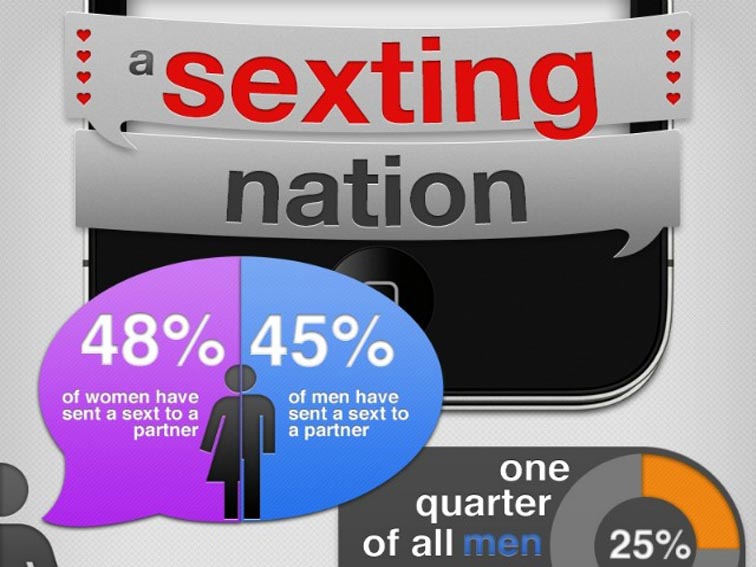
Digging deeper, McAfee reported that 70 percent of 18- to 24-year-olds receive sexually suggestive content and that (among those using mobile devices) more males than females do so (61% vs. 48%). It also found that 45 percent of adults stored the sexts they received while 40 percent stored the ones they sent. Among those who sent “intimate or racy content,” three-fourths (77%) sent it to their significant other, while only 1 in 10 sent such content to a total stranger.
Pew Research reported that “sexting … is practiced by couples and singles alike” and has nearly doubled since its last survey in 2012. The most active adults engaged in sexting were between 25 and 34 years of age. “Married and partnered adults are just as likely as those not in a relationship to say they have sent sexts,” the report noted, adding, “single adults are more likely to report receiving and forwarding such images or videos.” Pew’s research also found the following among adults: 20 percent of “cellphone” owners have received a sext of someone they know; 9 percent have sent a message of themselves to someone else; and 3 percent have forwarded a sext to someone else.
Approximately 145 million Americans own a “smartphone,” a 3G or 4G mobile device capable of image-based sexting. Extrapolating from this estimate, the McAfee report suggests that upwards of 78 million users have engaged in sexting. The Pew report suggests that some 30 million Americans have received a sext and about 13 million have sent one. The scope of sexting among Americans likely resides somewhere between the two estimates. Clearly, sexting is no longer simply a teen titillation.
*
Sexting emerged as a form of DIY or amateur pornography about a decade ago and originally subverted the dominant porn conventions in (for the most part) three ways. First, it involved teen makers and viewers, not adults (e.g., sex predators); second, it involved erotic display and not explicit sex acts (e.g., fellatio, intercourse); and third, it was a non-commercial form of enticements (i.e., not a product for sale). Sexting continues as a form of teen flirting, something essentially by and for young people and freely exchanged, a gift.
However, sexting seems to be increasingly adopted as part of the postmodern adult sex scene, and as it goes mainstream it is losing its critical edge. In the U.S., “noncommercial” sexual relations between consenting adults are not illegal. One can easily imagine sexts becoming the next intimate Valentine’s card or seductive private message, the latest personal turn-on. Who needs chocolates when one can send a sext?
Will sexting be integrated into the commercial sex industry? Sex is big business in the U.S., estimated at $50 billion in annual revenue. Prostitution, illegal in all but a handful of Nevada counties, pulls in an estimated $18 billion; the sex toy or “sexual wellness” sector is pegged at $15 billion; the 3,000 or so gentlemen’s clubs are reported to serve some 1.2 million (mostly male) customers a day and generate an estimated $3.1 billion to $7.5 billion in revenues. And this does not include the private “safe sex” clubs for gays and straights as well as specialized fetish clubs (e.g., BDSM) often hosted by a professional dominatrix, the gay bathhouses or other illicit “noncommercial” hookups easily arranged via voice calls, Internet sites and wireless app services.
The U.S. porn business is estimated at $10 billion-plus annually. According to one source, there are nearly 25 million porn sites worldwide, making up 12 percent of all websites. Sebastian Anthony, writing for ExtremeTech, reports that Xvideos is the biggest porn site on the Web, receiving 4.4 billion page views and 350 million unique visits per month. He claims porn accounts for 30 percent of all Web traffic. (In comparison, Wikipedia gets about 8 billion page views.) Anthony estimates the average length of time spent on Xvideo at 15 minutes. From an aesthetic perspective, he notes that, alas, most people receive their digital video feeds using low-resolution streaming.
Sex saturates the marketplace, whether promoting personal satisfaction or glamorizing a product, be it a new car or a mouthwash. Sexting illustrates the power of technological innovation and, sadly, of how a once-radical, DIY form of self-expression is being recuperated, integrated into the commercial economy. The marketplace has perfected the art of turning the most intimate human exchange into a commodity. The only unanswered question is what intimacy remains to be plundered?
More David Rosen.
Being Gay in Iran
Coming Out in a Country Where That Can Get You Killed, and the TV Documentary That Outed Me to the World
by Farhad Dolatizadeh
May 28, 2014
Photos by Ethan Folk
 I RAN FROM IRAN - And found myself in this town in Turkey, where I didn’t know a soul. I was one of the lucky ones.
I'm 16.
"May I ask you something personal?"
I know what's coming.
I look at my aunt as she takes her time to assemble the correct words. She is a tiny, sweet woman wearing a loosely draped head scarf, staring at me with shining dark-brown eyes. I love her more dearly than anything in the world. Of course I will tell her the truth. I can't think of a reason to hide from her. It isn't as if she might murder me or run around spreading my secret. She's not one of those closed-minded, brainwashed people who would automatically judge me. She spent most of her life outside of Iran, living and working as an architect in Norway and Germany. If there is anyone out there who would understand me, it's her.
"Are you gay, Feri Kitty?" she asks.
My name is Farhad, but since I was little, my aunt has affectionately called me Feri Kitty, referring to my soft spot for kittens.
"You call me Feri Kitty and expect me to be who? Robocop?" I snap. The bitch inside me has been growing day by day.
She just gazes at me. Eventually she smiles and wraps me in her arms. "It's okay. There's no need to be aggressive... everything is going to be okay."
I weep into her shoulder and can't respond.
This is my first coming out.
I'm 17.
I'm lying on my bed, waiting for sleep to take me, when my brother stirs. He and I are sharing a room, and his bed is only a few meters away. He is four years older than I am, but I have always regarded myself as the more mature one.
It's been six months since the conversation with my aunt.
I can't make out my brother's features, but I hear his voice, husky from sleep: "Farhad, who is this new guy you are hanging out with so much? He seems older than you! Is he from your school?"
I am silent for a beat. "You mean Darius?"
"Yes."
"Yep. He's my friend. Nope. Not from school," I say, trying my best to indicate that I am on the verge of sleep and the conversation is over.
But he barges on: "Where do you know him from, then?"
"Why do you care, you dumbass? Go bug your girlfriend and leave my life to me," I say in my mind. But to my brother, I say: "I met him at a cafe."
Another pause, and then, without a trace of emotion, my brother says: "He is handsome. Is he your boyfriend?"
I am shocked. Is this really my brother? Has he been possessed by some kind of demon? I quickly assess that, although he is not the smartest or even the most open-minded person in the world, he is a good brother, and he has always been there when I've needed him. I can trust him with the truth.
I still can't see his face in the dark, so I'm unable to catch his reaction when I reply, "Yes. He is."
Another heavy pause.
"So, does that mean that you are gay?"
Whoa. "Gay"? Really? I am shocked that he has used the English term. I thought that my brother, like most Iranians, would know only the slang term "sissy." Maybe he's not as stupid as I thought.
"Yes?" I blurt, stunned.
I wait for him to respond, but nothing comes. I can't believe it—he just rolls over and goes back to sleep. For fuck's sake, you just found out that your younger brother is gay! You can't just nod off and leave it like that! You should say something, you need to say something!
What a dumbass.
Five minutes later, I hear another rustle and see his silhouette shift as he turns back to me.
"Farhad, does that mean that I'm not going to be an uncle?"
Is he trying to act cool? Is that really his primary concern? "I... really don't know. Maybe someday?"
"Okay," he says, and goes quiet again, leaving me with a head full of racing thoughts.
I'm 18.
I'm sitting in the car with my dad. We are driving to his factory, when he suddenly asks, "Have you decided what you are going to do about your military service?"
"I'm not going," I say, trying to avoid his searching look.
"But every single man must go into the military, unless they can prove some handicap..."
My father is in his 40s and has worked hard all his life. I see the deep lines of experience on his face. Maybe this evidence of wisdom is why I feel so ready to expose myself to him. I don't know. But I have a feeling that he will accept me.
"I know the rules, Father. I'm not going. I can't go because of the rule prohibiting homosexuals from serving in the military," I say. Despite my determination, I am unable to keep my voice completely stable.
"But... are you gay?" he says, eyes fixed straight ahead—on the road.
"Yes," I reply. This time, with confidence.
The car fills with silence. After listening to my heart pound and the sounds of the road, I find the courage to say, "Well... aren't you going to say anything?"
Still staring at the road, my father begins to speak. "We are not stupid, Farhad. We are your parents. I knew the moment I laid eyes on you. I didn't want to believe it, but I knew."
Perhaps I have misjudged my father. I feel my mouth go dry and I begin to choke up.
"Farhad, I didn't want to believe it, not because I'm ashamed, but because I know how hard it is for homosexuals in this country. I don't want my baby boy to be killed by the government just because of his sexual preference. I want the best life for you. I want to send you away. To a safer country. To somewhere no one can hurt you because of the kind of person you love."
As afraid as I am, I understand him completely. I am overwhelmed by feelings of relief and love. I am so fortunate to have such a father, but feel so cursed to know that I will eventually be banished from my homeland. I'll have to leave Iran eventually. No gay is safe in this country. I heard this from my aunt, years ago, and now I've heard it from my father. I know his intentions are good.
I don't want to break down in front of my father, so I simply smile and try to keep it lighthearted. "Let's just deal with the military duty first."
He returns my smile, and it lingers as he turns his attention back to the road.
"Thank you for loving me, Dad."
"Always, Son. Always."
I'm 20.
Of course, my father is the one to open the discussion with my mother. He knows exactly how to reason with her, and after three days of tears and talking, she manages to calm down.
In many ways, my mom is my best friend now. I can tell her anything. She loves my boyfriend, Darius, and she is constantly urging me to bring him home for dinner with the family. She is still squeamish about the topic of sex, but I think this is normal for mothers regardless of their son's orientation.
I'm sitting in the living room with Darius, and the house is empty. I'm kissing him, as I do whenever we have the luxury of being alone together. We are in love, and in these moments, I feel absolute bliss and comfort.
I am thinking about the flavor of his mouth, when the ringing of the telephone pulls me out of the moment.
I reluctantly break away and answer. I recognize my cousin's familiar voice, but I can tell immediately that something is very, very wrong.
"Farhad. I saw you on the TV," he declares. Coldly.
What? TV? My mind races, but I cannot imagine what he could be referring to. Before I can respond or even question him, he says, "I know what you are. I know what you are and I don't want to see you anymore."
The line clicks dead.
I'm frozen. I am unable to speak, and Darius grows worried as my face turns pale. I fumble for the remote control, and the TV comes to life. I flip through the channels until I find something unusual. They are showing a documentary about gay people in Iran and letting people around the world know how hard and dangerous it is for gays in this country. The film was made by a Canadian television channel, and it sure seems like they care a lot about the well-being of gays in Iran.
Darius and I are shocked that a documentary on such a subject is being aired. Now some people are talking about their problems in front of the camera, but their faces are blurred. It is interesting, I suppose, but what does it have to do with me? In less than a minute, I have my answer. I begin to feel dread when the camera pans across a restaurant I know well. It is the spot where gay people in Tehran gather every Tuesday. Where I go most Tuesdays. Now the camera is inside the restaurant, and they are showing us. They are showing our faces. They are showing my face. It is obviously shot with a concealed camera. A long lens, zoomed in—my face filling the screen for several seconds. Casually chatting, completely unaware. They are even sure to identify the restaurant by name. And we don't know we are being filmed. How nice of them: They want to let the world know how miserable gay people are in Iran and how the government kills them because of their orientation, and they come to our community and expose us to everyone? To the hateful government? To our neighbors, friends, and families?
I watch the film until the end. My face was clearly shown, yet I had no clue of the film's existence until a few minutes ago. I'm shocked. I'm scared. I don't know what to do. Darius and I sit speechless. According to the documentary, the producers got "group consent," but I never consented to this.
I pick the phone up and call my aunt in Norway. She answers, and I blurt out, "Auntie, I just came out to the world..."
 A window display IN ANKARA Where I lived as a refugee after a TV documentary aired undercover footage of my face.
I'm 24.
I've been in Ankara, Turkey, for three months now, and I sit in a small, nearly empty concrete room. Across from me sits a blue-eyed man with slicked-back ginger hair and a bright beard. The table in front of me is bare except for a computer and some loose notes. I can't shake the impression that the man is some sort of church official—a pastor, perhaps. In reality, he is a representative of the United Nations High Commissioner for Refugees (UNHCR), who handles amnesty requests. I prefer not to go into detail so that other refugees who are going to leave Iran won't face any extra problems, but I have escaped from Iran.
"How do you feel when you see yourself in that documentary?" he asks.
Angry. Upset. Desperate.
Angry at all of the people who mocked me and looked down on me. Angry at the president, who went on national television and stated that there were no homosexuals in Iran. Angry at the TV channel that wasted an opportunity to put the spotlight on a reprehensible government, and instead put the spotlight on people like me. Angry at the idiocy that allowed them to describe how Iranian gays are facing execution, and in the next moment broadcast images of dozens of closeted homosexuals. Angry at the hurry, the oversight, the ignorance—whatever allowed such an obvious and dangerous mistake to happen. I was angry at God, to create me as I was—a gay man in a country that did not accept me.
And yes, upset. Upset about the blind submission of millions to an intolerant brand of religion that states that homosexuality is an unforgivable sin. Upset about the hypocrisy and inconsistent interpretations of Islam. Upset about the Iranian parents who have murdered their children just for being gay. Upset and confused by a society in which murdering your own child is less of a crime than loving someone.
And yes, desperate. Desperate to be loved again by the ones who decided I was inhuman once they discovered that I was gay. Desperate to get far away from the situation that had developed since the airing of the documentary. Desperate to get back the four years of my life spent defending myself from hatred and mockery, perpetually in fear of the government. Desperate to find shelter. To find a safe place. A place where I needn't fear for my life. I lived for four years in Iran after that documentary aired, four years of living in protective mode: I didn't go to that restaurant anymore, I lost friends, I was forced to leave university, and I had to begin a new life with people who didn't know me. Finally, I had an opportunity to flee to Turkey, and I took it.
So yes, I am angry and upset and desperate. I look at the guy in front of me. He seems to be a nice guy. He is working for UNHCR. I can trust him. He is smiling at me and waiting for my answer. I try my best to give him an answer, but I burst into tears instead.
He doesn't reply. He nods and taps a few notes into his keyboard. I try to stifle my tears and give him an answer. Then I think about all of the other refugees in Turkey. About their miserable lives. How they are relegated to small villages, which they cannot leave. How they aren't allowed to work and have no legal means to support themselves. They have no identity and no nationality. They are just beings—walking around, waiting for their time to come, waiting to know their destiny. Just like me.
Then I think about the others in the documentary who weren't even able to escape as far as Turkey.
And I burst into tears again.
 NOT SO WELCOME - The UN pondered my application for amnesty for two years, and Canada took another year to decide after that.
I'm 27.
I'm in my room. My last roommate moved out five months ago, so the house is silent. His asylum request to the US was granted, but I remain here in our small house. I sit on my bed, staring at my computer screen and trying to pass the time.
It's been almost three years since I filed for asylum, and I'm still here in the Turkish village. I'm terribly depressed. I feel lonely and unspeakably weary from constant harassment. The villagers look at me like some sort of strange, alien object. The police have accused me of being HIV-positive and demanded that I submit to blood tests. I knew this was an illegal request, and when I refused, they told me to stay away from people, and that I was a threat to the community. At our weekly "check-in" today, the police officer wouldn't even let me in his room. He told me that he wouldn't shake my hand because he is scared of contracting AIDS.
I miss so many of the friends that I've made in these three years. I've met many other refugees from Iran and seen them all come and go—off to their new, safe homes. But I remain. Alone. Does anyone think of me? Does the UNHCR or the Canadian embassy know what my life is like in here? How can they expect me to survive in a place where I'm not even allowed to work for three years? Don't they feel some sort of responsibility for me, since it was a Canadian television company that made the documentary? Once the UN finally completed the two-year processing of my application, why has it taken the Canadian embassy an additional year to decide if I deserve to live in their country? Why, when every other case has been decided in a matter of months? I wonder what I have done wrong to deserve this.
I have thought of suicide. I have thought of different ways to end this miserable waiting. But there is a hope in the name "Canada"—it conjures imagery in my mind that is both vivid and uncertain. A better life. Freedom. Safety in a distant northern land.
But I am tired. I'm so tired of waiting for their call. I am sick of the endless, numbing disappointment. It's simply not fair.
Then my cell phone rings.
"Hello. Am I speaking to Farhad?" asks the voice from the other end.
"Yes, I am Farhad!" I rush to spit out the words. No matter how many times the phone has rung, or the mail has arrived, or I have felt hope—I still can't suppress the thrill when I think something is about to happen. No matter how many times that hope has been crushed or I have been disappointed, I still can't completely eliminate the excitement. I am aware of all of this as I state my name. My hope begins to fade as the line is briefly silent. I prepare myself for the letdown—I've gotten good at this.
Then the voice says, "Hi, Farhad. This is Mr. [redacted] from the Canadian embassy. Are you available tomorrow to come to the embassy? We will need your passport to issue you the visa."
~ Farhad Dolatizadeh's name has been changed to protect his identity. He is now living safely in Canada.
Mind of a Rampage Killer
Can science help us understand why some people commit horrific acts of mass murder?
Aired February 20, 2013 on PBS

Program Description

The book-length "No Escape: Male Rape in U.S. Prisons" was released on April 19, 2001.[6] The report documented that prison rape was commonplace during a time when half of U.S. states compiled no statistics on the subject.[2] Brent Staples described the report, which was based partly on the testimony of over 200 inmate victims, as "grisly".[7]The reality is that reporting prison rape is likely to get you hurt even worse - the "no snitch" code is incredibly powerful. Like so many other forms of rape, this is an issue of toxic masculinity.
"No Escape" surveyed 34 states' prison systems.[8][9] The report documented lurid accounts of prison rape, wherein inmates were being sold to other inmates as sex slaves. Men, instead of being beaten into submission, were coerced into sexual activity, sometimes while prison officials stood by.[7] In the report a group of six Texas inmates told HRW that sexual slavery "is commonplace in the system's most dangerous prison units."[10] "No Escape" identified prisons run by the Texas Department of Criminal Justice as the worst for incidents of prison rape;[11] this assertion was confirmed by later reports.[12][13] The report also collated similar testimony from inmates in Arkansas, Illinois, Michigan, and California.[10]
John Oliver Shames Americans for Public Apathy Toward Prison Rape
No one deserves to be the victim of a sexual crime.
August 1, 2014 | By Jelani Hayes
Photo Credit: Ljupco Smokovski / Shutterstock.com
Recently on Last Week Tonight, John Oliver delivered a great segment on the American prison system. One of the issues he addressed was the public’s apathy toward and alarming amusement by the occurrence of rape in prisons. “It’s so easy not to care about prisoners,” he said. “They are, by definition, convicted criminals. In fact, it’s so easy not to care that we are really comfortable making jokes about one of the most horrifying things that can potentially happen to them.” Rape.
Sexual assault is prevalent in our prisons and jails—a fact most Americans have probably gathered from popular media wherein prison rape jokes are common. According to the 2011-2012 National Inmate Survey, 4.0 percent of federal and state incarcerated persons and 3.2 percent of those in jails reported being sexually assaulted—from unwanted touching to rape—in the last twelve months. A prison or jail staff member was said to be responsible for more than half of these incidents. These numbers are open to question, of course. Other studies have suggested higher percentages, and sexual assaults are traditionally under reported.
Sexual violence should not occur in any space, yet its appearance in correctional facilities is especially troubling—prisons and jails are, in theory, controlled environments. Realistically, they cannot be completely controlled, but the rape of an inmate is a far greater oversight than the entry of contraband. Because the majority of these incidences occur at the hands of staff members, the crime is an even worse insult to our criminal justice system and our humanity.
The United States incarcerates more people than any other nation—largely a result of its militant and racist drug war—and thus its criminal justice system is subjecting a highly unusual number of people to violence in a confined space where they are unable to adequately protect themselves. The sexual victimization of imprisoned persons defeats one of the theoretical purposes of incarceration: rehabilitation. Upon their release, formerly incarcerated persons not only have to try to obtain housing, jobs, and educational opportunities with a criminal record attached to their names but they must also aim to cope with the emotional scars of being subjected or witness to sexual violence. The average incarcerated woman, for instance, has been a victim of physical or sexual abuse prior to being imprisoned. Incarceration may only continue the violence she is forced to confront.
Despite common knowledge of prison rape culture, the victims’ stories have largely gone untold and their pain has been cheapened into humor. Recently, select incidents of rape have received substantial media attention with the help of social networking and student activism. From college campuses to high school parties, the public is taking part in an ongoing conversation about rape culture—outside of prison walls. The victims whose lives are disrupted and thrown into the media spotlight are generally young, educated women who themselves pose no real or imagined threat to society. Justifiably, sympathy and support pours in from feminists and, quite frankly, anyone who is appalled by their cases and how the media, educational institutions, and the criminal justice system handle them. These stories are important. They remind us that rape culture deeply permeates American culture, and as a society, we have an obligation to combat and protect one another from its consequences. That obligation—as it is expressed in our mainstream conscience—currently does not extend in a meaningful way to our most vulnerable population: incarcerated children, men, and woman.
Incarcerated persons are forced to relinquish their bodies to the power of the state and render their humanity to public opinion. The government and the private prison industry have done very little to prevent sexual violence in jails and prisons. The media has presented sexual assault as a normal component of the punishment dealt to lawbreakers. Prison rape has been the subject of jokes (don’t drop the soap), used jokingly as a deterrent to crime (if you get caught, you know what will happen to someone like you in jail), and as an interrogation method (Law and Order: Special Victims Unit detectives have, on a number of occasions, threatened suspected sex offenders with the prospect of eye-for-an-eye justice at the hands of other inmates). Taken together, society has stripped incarcerated children, men, and women of their humanity. Their dehumanization is possible in part because of the uneducated popular notion that criminals stem from a culture not our own and that the conditions of their punishment are generally well deserved. With nearly one out of every 100 adults in the United States in jail or prison, the message society is currently sending is that sexual assault is tragic—99 percent of the time.
No one deserves to be the victim of a sexual crime—not even those society values so little that we store them away from public sight and sympathy. In the name of universal human dignity, the outrage surrounding rape culture must extend to the 2.2 million people behind American bars.
This piece first appeared on the Drug Policy Alliance Blog.
~ Jelani Hayes is an intern in the media department at the Drug Policy Alliance and a senior at the University of Pennsylvania.
Bathrobes And Baby Carriers: The Stuff Of Manliness?
by Shereen Marisol Meraji
June 27, 2014
Listen to the Story
All Things Considered
4 min 43 sec
This summer, All Things Considered is looking at the lives of Men in America and how things have changed — or haven't. Part of that is redefining masculinity, so the show asked me to ask guys about the stuff they equate with manliness today. (Submit your own stories in the form below.)
I started my very unscientific investigation on a Friday night at a Washington, D.C., barbershop. Fresh Cut owner Bernard Fernandez chose his Buick. He fixed it up himself and says that first car meant freedom and independence; a way to get to and from work and a paycheck. "That's manly!" Fernandez says.
"It didn't have nothing but one seat in it, that was the driver's seat — anybody else rode in it, they just rode on milk crates. I had a lot of fun in that car."
When I asked on Twitter, one of you picked a BabyBjorn as your object because you tweeted that you didn't feel like a man until you had a kid. Others mentioned motorcycles, chainsaws and even a "man pan" (that's a heavy cast iron pan for those who are curious; I know I was).
When I posed the question to writer and rapper David Lee, he immediately thought of what he should say.
"I should pick something like a watch or a boot, perhaps a battle-ax," he says.
Lee is a New Yorker who writes Gumship, an online men's guide to Asian lifestyle and entertainment. He ultimately voted against the battle-ax and went with a bathrobe as his masculine object. But his is no Hugh Heffner-esque robe. The blue terry cloth Adventure Time cartoon robe hits around midthigh, and Lee says it represents the luxury of being a man today.
"I think we're at a space in time where men are openly loving My Little Ponies, embracing cartoons, still playing video games, and we're really dictating what it means to be a man," he says. "Everyone's confused whether or not they're being ironic or not, and that's so luxurious, you know?"
Join The Conversation
Use #menpr to join in the conversation about men in America on Twitter, Facebook and Instagram.
NPR ASKS: What Object Makes You Feel Manly?
As part of All Things Considered's summer series on men in America, we want to hear about the object, thing, toy, tool or stuff that makes you feel manly.Scroll down to the bottom of the story at the NPR page linked to above to share your response.
Women are also welcome! No judgment or imposition of tightly defined gender roles here – this is meant to be FUN.
If you're sharing on social media, use the hashtag #menpr. Follow all the stories here: http://n.pr/1pL5tIe
We may use your response on the radio and NPR.org.
* Required
What physical object makes you feel manly? Why? *
Example: A baby carrier – because you didn't feel like a man until you became a father.
Men can be feminists but it’s actually really hard work
Feminism is for everybody because sexism hurts everybody, but lots of men are comfortable with the status quo
Katie McDonough
Monday, Jun 9, 2014
Joseph Gordon-Levitt recently called himself a feminist (Credit: AP/Victoria Will)
The Betteridge law of headlines states that “any headline which ends in a question mark can be answered by the word no,” but a Monday piece in the New York Times may be the rare exception. “Is it possible to be a male feminist?” asks writer (and self-described male feminist) Jake Flanagin. The answer to this question is yes. Possibly even, “Yes of course come on seriously?”
It’s a fine enough question for a journalist to ask (think piece glass houses, etc.), but Flanagin’s decision to focus on Hugo Schwyzer — who was given several platforms to write about men and feminism while he spent his spare time attacking the personal, academic and professional lives of black feminists and other feminists of color – is an odd one. As Jamil Smith noted on Twitter, if you want to have a conversation about men and feminism, why not talk to male feminists? Smith’s point, I think, is to raise the issue of why we seem to have a lot of pieces questioning whether men can be feminists and very few that explore what happens after you answer that question in the affirmative. Aren’t we even a little bit curious?
The most compelling part of the Times piece comes in the very last paragraph, when writer Noah Berlatsky discusses the work that being a male feminist actually requires. “It’s true that sometimes male feminists, myself not excluded, imagine we’re brave allies, altruistically saving women by standing up for them,” Berlatsky observes. “But dreams about men saving women are just another version of misogyny — and, in this case in particular, totally backwards. Misogyny is a cage for everyone. When I call myself a male feminist, I’m not doing it because I think I’m going to save women. I’m doing it because I think it’s important for men to acknowledge that as long as women aren’t free, men won’t be either.”
Berlatsky gets to something important about the nature of justice — that it’s a radically intertwined project. Contrary to the tired trope about “mothers, wives and daughters” that generally gets thrown around in arguments about why men should care about women’s rights, men should be feminists because the lives of the women and girls they have never met and will never meet matter. Particularly in a culture that does not encourage men to cultivate or express empathy, this thing of giving a basic shit about people you don’t know is itself a kind of radical act. But Berlatsky’s point that “misogyny is a cage for everyone” also captures another reason that I think men can and should identify as feminists. Because of course men should be outraged at the violence experienced by women and girls and the systems that dehumanize them, but framing men’s relationship to feminism exclusively as men’s relationship to women’s status in the world erases the fact that men are also harmed by patriarchy, toxic masculinity and entrenched cultural and institutional sexism.
The scale is aways going to be different, of course. I’d never try to argue otherwise. Cultural norms that hold women as mothers and caregivers above all else mean that women get paid less than their male colleagues for the same work, and that women disproportionately put their personal and career ambitions on hold in order to care for children and others. But these same norms also leave men questioning their masculinity or doubting their self-worth if they want to stay home with their children. These things aren’t the same, but they both matter.
The same could be said about dominant narratives around sexual assault. Women and girls make up the majority of victims of sexual violence, but a culture that straight up says that teenage boys can’t be raped makes it almost impossible for male survivors to come forward. Destructive ideas about sexual male entitlement are at the heart of rape culture and the reason that so many women and girls are victimized in their lifetimes, but they also feed into this idea that men always want sex, which makes men who have been victims of rape question whether or not what happened to them even counts as a crime. It took a really, really long time for this to even become a crime. These same norms also encourage men to have really warped relationships to desire and sexual satisfaction. This stuff hurts women the most because of the violence it engenders, but it hurts men, too.
There are plenty of important questions to ask about how men can be feminists without making themselves the center of the movement. About the work of listening and boosting versus erasing and derailing. About how men get lots of applause and accolades for doing very basic things — like not violently abusing women. About how many men don’t identify as feminists because they are deeply invested in upholding the systems — like patriarchy and white supremacy — that benefit them. And Berlatsky’s point about the line between the male savior complex and being a legitimate force for positive social change is well made. But we can have all of these conversations while acknowledging that men who identify as feminists aren’t just cheerleading for women — they’re fighting systems that tell them that being a good listener makes them a pussy, or that they shouldn’t share their emotions, or that straight men can’t have intimate friendships with other men, or that rape in prison is hilarious.
Feminism’s relevance to everyone has been articulated and re-articulated throughout the history of the movement, and I was reminded of this again over the weekend when I read an interview with actress Mackenzie Davis, who said she couldn’t understand why “feminism” feels like such a scary word to some people.
“Feminism is rooted in racial rights and gender rights, and all of those things intersect, and to say that that’s not something you can stand behind — it confuses me,” she told the Times. “I think it’s a really great word.”
So do plenty of men.
Katie McDonough is an assistant editor for Salon, focusing on politics, culture and feminism. Follow her on Twitter @kmcdonovgh or email her at kmcdonough@salon.com.

The Male Identity Crisis and the Decline of Fatherhood
Is America becoming a fatherless society?
Published on June 8, 2014 by Ray Williams in Wired for Success
America is rapidly becoming a fatherless society, or perhaps more accurately, an absentee father society. The importance and influence of fathers in families has been in significant decline since the Industrial Revolution and is now reaching critical proportions.
As Alexander Mitscherlich argues in Society Without A Father, there has been a "progressive loss of the father's authority and diminution of his power in the family and over the family."
"If present trends continue, writes David Popenoe, a professor of sociology at Rutgers University, "the percentage of American children living apart from their biological fathers will reach 50% by the next century." He argues "this massive erosion of fatherhood contributes mightily to many of the major social problems of our time...Fatherless children have a risk factor of two to three times that of fathered children for a wide range of negative outcomes, including dropping out of high school, giving birth as a teenager and becoming a juvenile delinquent."
According to David Blankenhorn, author of Fatherless America, chair of the National Fatherhood Initiative and founder/president of the Institute for American Values, organization, and research conducted by Popenoe and scores of other researchers:
Blankenhorn argues that America is facing not just the loss of fathers, but also the erosion of the ideal of fatherhood. Few people doubt the fundamental importance of mothers, Popenoe comments, but increasingly the question of whether fathers are really necessary is being raised and said by many to be a merely a social role that others - mothers, partners, stepfathers, uncles and aunts, and grandparents - can play.
- Approximately 30% of all American children are born into single-parent homes, and for the black community, that figure is 68%;
- Fatherless children are at a dramatically greater risk of drug and alcohol abuse, mental illness, suicide, poor educational performance, teen pregnancy, and criminality, according to the U.S. Department of Health and Human Services, National Center for Health Statistics.
- Over half of all children living with a single mother are living in poverty, a rate 5 to 6 times that of kids living with both parents;
- Child abuse is significantly more likely to occur in single parent homes than in intact families;
- 63% of youth suicides are from fatherless homes according to the U.S. Bureau of the Census;
- 72% of adolescent murderers grew up without fathers. 60% of America's rapists grew up the same way according to a study by D. Cornell (et al.), in Behavioral Sciences and the Law;
- 63% of 1500 CEOs and human resource directors said it was not reasonable for a father to take a leave after the birth of a child;
- 71% of all high school dropouts come from fatherless homes according to the National Principals Association Report on the State of High Schools;
- 80% of rapists motivated with displaced anger come from fatherless homes according to a report in Criminal Justice & Behavior;
- In single-mother families in the U.S. about 66% of young children live in poverty;
- 90% of all homeless and runaway children are from fatherless homes;
- Children from low-income, two-parent families outperform students from high-income, single-parent homes. Almost twice as many high achievers come from two-parent homes as one-parent homes according to a study by the Charles F. Kettering Foundation.
- 85% of all children that exhibit behavioral disorders come from fatherless homes according to a study by the Center for Disease Control;
- Of all violent crimes against women committed by intimates about 65% were committed by either boy-friends or ex-husbands, compared with 9 % by husbands;
- Girls living with non-natal fathers (boyfriends and stepfathers) are at higher risk for sexual abuse than girls living with natal fathers;
- Daughters of single mothers are 53% more likely to marry as teenagers, 111% more likely to have children as teenagers, 164% more likely to have a premarital birth and 92% more likely to dissolve their own marriages.
- A large survey conducted in the late 1980s found that about 20% of divorced fathers had not seen his children in the past year, and that fewer than 50% saw their children more than a few times a year.
- Juvenile crime, the majority of which is committed by males, has increased six-fold since 1992;
- In a longitudinal study of 1,197 fourth-grade students, researchers observed "greater levels of aggression in boys from mother-only households than from boys in mother-father households," according to a study published in the Journal of Abnormal Child Psychology.
- The Scholastic Aptitude Test scores have declined more than 70 points in the past two decades; children in single-parent families tend to score lower on standardized tests and to receive lower grades in school according to a Congressional Research Service Report.
"The scale of marital breakdowns in the West since 1960 has no historical precedent that I know of," says Lawrence Tone, a noted Princeton University family historian, "There has been nothing like it for the last 2,000 years, and probably longer." Consider what has happened to children. Most estimates are that only about 50% of the children born during the 1970-84 "baby bust" period will still live with their natural parents by age 17-a staggering drop from nearly 80%.
Despite current interest in father involvement in families, an extremely large proportion of family research focuses on mothers and children. Health care agencies and other organizations exclude fathers, often unwittingly. Starting with pregnancy and labor and delivery most appointments are set up for mothers and held at times when fathers work. The same is true for most pediatric visits. School records and files in family service organizations often have the child's and mother's name on the label, and not the father's. In most family agency buildings, the walls are typically pastel colors, the pictures on the wall are of mothers, flowers and babies, the magazines in the waiting room are for women and the staff is predominantly female. In most welfare offices, fathers are not invited to case planning meetings, and when a home visitor is greeted at the door by a man, she often asks to speak with the mother. Given these scenarios, fathers are likely to get the message that they are invisible or irrelevant to their children's welfare, unless it involves financial support.
Popenoe and others have examined the role of fathers in raising children and found there are significant differences than that for mothers. For example, an often-overlooked dimension of fathering is play. From their children's birth through adolescence, fathers tend to emphasize play more than caretaking. The play is both physically stimulating and exciting. It frequently resembles an apprenticeship or teaching relationships, and emphasizes often teamwork and competitive testing of abilities. The way fathers play affects everything from the management of emotions to intelligence and academic achievement. It is particularly important in promoting the essential virtue of self-control.
A committee assembled by the Board of Children and Families of the National Research Council, concluded "children learn critical lessons about how to recognize and deal with highly charged emotions in the content of playing with their fathers. Fathers, in effect, give children practice in regulating their own emotions and recognizing others' emotional clues."
At play and in other realms, fathers tend to stress competition, challenge, initiative, risk taking and independence. Mothers, as caretakers, stress emotional security and personal safety. Father's involvement seems to be linked to improved quantitative and verbal skills, improved problem-solving ability and higher academic achievement for children. Men also have a vital role to play in promoting cooperation and other "soft" virtues. Involved fathers, it turns out according to one 26 year longitudinal research study may be of special importance for the development of empathy in children.
Family life-marriage and child rearing-is a civilizing force for men. It encourages them to develop prudence, cooperativeness, honesty, trust, self-sacrifice and other habits that can lead to success as an economic provider by setting a good example.
Mark Finn and Karen Henwood, writing about the issue of masculinity and fatherhood, in the British Journal of Social Psychology, argue that the traditional view of masculinity, with its focus on power, aggression, economic security, and "maleness", and the emerging new view of fatherhood, which incorporates many aspects of motherhood is a source of struggle for many men who become fathers.
In a study of fatherhood in popular TV sitcoms, Timothy Allen Pehlke and his colleagues concluded that fathers are generally shown to be relatively immature, unhelpful and incapable of taking care of themselves in comparison with other family members. In addition, the researchers found that fathers often served as the butt of family members' jokes. All of these characterizations, while the intention may be humor, depicted fathers as being socially incompetent and objects of derision.
In a study of depictions of fathers in the best selling children's picture books, researcher Suzanne M. Flannery Quinn concluded that of the 200 books analyzed, there were only 24 books where the father appears alone, and only 35 books where mother and father appear together. The author concludes, "because fathers are not present or prominent in a large number of these books, readers are given only a narrow set of images and ideas from which they can construct an understanding of the cultural expectations of fatherhood and what I means to be a father."
It seems to me that the issue of the decline of fatherhood and the problem of the male identity crisis are inextricably intertwined.
In my Psychology Today article, Our male identity crisis: What will happen to men?, I said, "In a post-modern world lacking clear-cut borders and distinctions, it has been difficult to know what it means to be a man and even harder to feel good about being one. The many boundaries of a gendered world built around the opposition of work and family-production versus reproduction, competition versus cooperation, hard vs. soft-have been blurred, and men are groping in the dark for their identity."
Overwhelmingly, the portrayal of men and the male identity in contemporary western societies is mostly negative. Men today are extensively demonized, marginalized and objectified, in a way reminiscent of what happened to women. The issue of the male identity is of crucial importance because males are falling behind in school, committing more suicides and crimes, dying younger and being treated for conditions such as ADHD more than females. There has also been a loss of fatherhood in society as artificial insemination by anonymous donors is on the rise. Further, medical experiments have shown that male sperm can now be grown artificially in a laboratory. There has been a rise in divorce rates where in most cases, child custody is granted to mothers. Continuous negative portrayal of men in the media, along with the feminization of men and loss of fatherhood in society, has caused confusion and frustration in younger generation males, as they do not have a specific role model and are less able to define their role in society.
From once being seen as successful breadwinners, heads of families and being respected leaders, men today are the butt of jokes in the popular media. A Canadian research group, Nathanson and Young, conducted research on the changing role of men and media and concluded that widely popular TV programs such as The Simpsons present the father character, Homer, as lazy, chauvinistic, irresponsible, and stupid and his son, Bart, as mischievous, rude and cruel to his sister. By comparison, the mother and daughter are presented as thoughtful, considerate and mild-natured. The majority of TV shows and advertisements present men as stupid buffoons, or aggressive evil tyrants or insensitive and shallow "studs" for women's pleasure.
According to J.R. Macnamara, in the book, Media and the Male Identity: The Making and Remaking of Men, less than 20% of media profiles reflected positive themes for men. Violent crimes, including murder, assault, and armed robberies accounted for over 55% of all media reporting of male activities. Macnamara says that over 30% of all discussion in the media of male sexuality was in relation to pedophilia, and males' heterosexuality associated with masculinity is seen as violent, aggressive and dominating. Men are frequently shown in TV shows and movies as lacking in commitment in relationships and are shown as frequently cheating on women. And with increasing frequency, women are shown on TV shows and movies as being independent single mothers, not needing a man.
Guy Garcia, author of The Decline of Men: How The American Male is Tuning Out, Giving Up and Flipping Off His Future, argues that many men bemoan a "fragmentation of male identity," in which husbands are asked to take on unaccustomed familial roles such as child care and housework, while wives bring in the bigger paychecks. "Women really have become the dominant gender," says Garcia, "what concerns me is that guys are rapidly falling behind. Women are becoming better educated than men, earning more than men, and, generally speaking, not needing men at all. Meanwhile, as a group, men are losing their way."
"The crisis of fatherhood, then is ultimately a cultural crisis, a sharp decline in the traditional sense of communal responsibly, " contends Popenoe; "It therefore follows that to rescue the rescue the endangered institution of fatherhood, we must regain our sense of community."
So as we annually celebrate Father's Day, and reflect on it's importance to social stability, more men in our culture need to find their male identity and commit to the central importance of fatherhood.
You can follow me at Ray Williams Associates or on Twitter.