Showing posts with label language. Show all posts

Thursday, November 6, 2014

Gender-Neutral Pronouns: When ‘They’ Doesn’t Identify as Either Male or Female

http://api.ning.com/files/vuUh0rgUyT5x36zjYRuNTCzeCmVYXt5tjbfep1fxznLcys3YAq6seS01fP3QHEdQMxeMllNNO0prEGgze2bvC7Xi*Jh8Phhs/binary.jpg

Interestingly, this is from the Washington Post. I didn't even know this column existed.

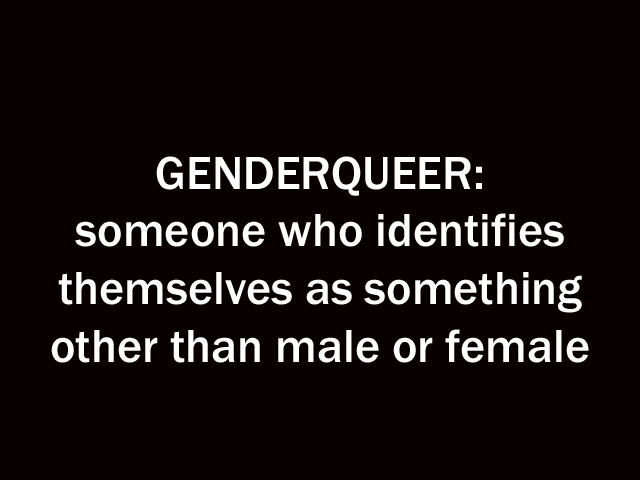
http://broadsideonline.com/files/2013/04/genderqueer.jpg

Gender-neutral pronouns: When ‘they’ doesn’t identify as either male or female


By Steven Petrow, Columnist, Civilities
October 27, 2014

Dear Civilities: Recently, a young woman I know explained to me that she now considers herself to be “genderqueer,” which is a new phrase for me. My first question is: What does she mean by that? I also understand that she no longer uses female pronouns to refer to herself (i.e., “her” and “she”) but prefers “they,” “them” and “their” because, as she told me, they identify her as a person, not as either a man or a woman. She has asked her friends to adopt that language, too, but maybe I’m old school, because I find it odd and grammatically incorrect to say something like, “Oh, they went to the movies this afternoon,” in reference to one singular person. What is the right thing to do, and say, in this circumstance?” — Name withheld, Washington, D.C.

A: My first reaction is: Wow, this is complicated. But really, it’s not. Language is about respect, and we should all do our best to recognize how people wish to be identified, whether it is using their preferred name or a pronoun spelled any which way. In other words, do your best to adjust to changing times and terms, and address people the way they ask you. Or more bluntly, use a person’s preferred gender pronouns even if they are unfamiliar to you and not in the general lexicon. (This would only apply to those who make such a request; our own pronouns remain the same.)

But this latest evolution of the English language has felt awkward to me as well, as I have witnessed my inner Strunk and White struggle with what I first saw as “political correctness.” My first step was to learn more about “genderqueer,” which the National Center for Transgender Equality explains as a “term used by some individuals who identify as neither entirely male nor entirely female.” Jacob Tobia, a recent college grad who identifies as genderqueer, also helped me:
“Genderqueer people see gender not as binary with men or women, but as a spectrum that ranges from masculinity to femininity. Most genderqueer people identify somewhere between or outside of conventional masculinity or femininity.”
Jacob Tobia is a recent college grad who identifies as genderqueer.

Jacob (whom I’ve known for years) prefers the pronouns “they” and “them,” and so here’s how I would write about Jacob: They have a gender identity that encompasses both male and female, and their attire ranges from pencil skirts, high heels and lipstick to blazers, bow ties and facial hair on any given day.

This past week I attended a presentation at Duke University’s Center for Sexual and Gender Diversity, whose name was the LGBT Center but was changed to reflect a more fluid understanding of gender. At the outset, the speaker asked the audience to introduce ourselves and declare our preferred gender pronouns. Most of us stated an adherence to the traditional — “he/him/his” and “she/her/hers” — but several individuals chose gender-neutral pronouns, “they/them/their.” One person preferred to use “ze” (“ze smiled”) and “hir” (“I work with hir”).

Clearly, there’s change afoot in the language to refer to gender identity, and this clashes for some people with strong feelings about established rules of English. On my Facebook page, when asked for input about this question, many expressed views along these lines: “The letter writer needs to follow the rules of grammar and pick a singular. You can’t just toss the rules on a whim.”

I think it’s wiser to take a longer view on matters of language evolution. It’s not as if this is the first time the language we use to describe gender has prompted debate. Think back to the early 1970s when the term “Ms.” was introduced as an alternative to “Miss” and “Mrs.”

There was vociferous opposition to that change by linguists and etiquette experts. But it made good sense because it obviated the need to guess a woman’s marital status. To this day, the Economist magazine’s style guide states: “The overriding principle is to treat people with respect. That usually means giving them the title they themselves adopt.” And then it calls out “Ms.” as being “ugly.”

Linguist Dennis Baron at the University of Illinois points to the evolution of the word “you” as another example: “Purists object that a plural pronoun like ‘they’ can’t be used as a singular. But they are wrong: ‘You’ began its life as plural (the singular second person was ‘thou’). Then ‘you’ began serving as singular as well. . . . Today we use ‘you’ to refer to one person — ‘Are you talkin’ to me?’ — without worrying about number. And for most people, ‘they’ works the same way.”

Even the “they” and “them” debate itself has been going on for some time. Baron referred to an 1878 issue of the Atlantic magazine arguing that tired old “he” and “she” needed replacing: “We need a new pronoun. The need of a personal pronoun of the singular number and common gender is so desperate, urgent, imperative, that according to the established theories it should long have grown in our speech, as the tails grew off monkeys.”

There you go, folks — the history. Now without my Strunk and White sword to fall on, I’d add only that grammar evolution should be bolstered with respect. My friend Jacob is not a pronoun, but a person. And if they want me to refer to them with a gender-neutral pronoun, I will do my best. You should, too. (As for “ze” and “hir,” I’ll try, but I’m still going to need a little more time to learn how to pronounce them.)

~ Steven Petrow, the author of “Steven Petrow’s Complete Gay & Lesbian Manners,” addresses questions about LGBT and straight etiquette in his column, Civilities. View Archive

E-mail questions to Civilities at stevenpetrow@earthlink.net (unfortunately not all questions can be answered). You can reach him on Facebook at facebook.com/stevenpetrow and on Twitter @stevenpetrow.

Wednesday, October 22, 2014

Will 'Cisgender' Survive?

https://blogger.googleusercontent.com/img/b/R29vZ2xl/AVvXsEgm2wOlA0ywowCYd7vHWkphZpSOUOd3Psl92BFXr49YtvhYDJnGgYw8Os_jXwT54HwJhVEh8DDxStSkJGFPQBNDXian22OgVu8UFNSq2HFUjH_FwAb6D0inEXIGnbYtfeb7EWH-vt7K51c/s1600/trans+cis.jpg

Not the people, the word.

I think this is actually a very useful word - it removes the normativity of the male/female binary. I also like genderqueer as a way to subvert the binary.

Will 'Cisgender' Survive?

The linguistic complement to "transgender" has achieved some popularity, but faces social and political obstacles to dictionary coronation.


The new Amazon Original Series, Transparent, about a middle-aged father who's transitioning into a woman, is just the latest cultural sign that the word "transgender" has gone mainstream. No doubt there have been transgender people—that is, those with a gender identity or gender expression that doesn't conform to their assigned birth sex—since there have been people at all, but the term itself wasn't coined until the 1970s. Popular confusion about its usage notwithstanding (for example, questions about the difference between "transgender" and "transsexual"), "transgender" is here, it's queer, and a lot of people have gotten used to it.

The situation is more complicated for "cisgender," coined in the 1990s to mean the opposite of "transgender." The "trans" in "transgender" comes from a Latin word meaning "on the other side of," and the "cis" in "cisgender" comes from a Latin word meaning "on this side of." "Cisgender" refers to people who feel there is a match between their assigned sex and the gender they feel themselves to be. You are cisgender if your birth certificate says you're male and you identify yourself as a man or if your birth certificate says you're female and you identify as a woman. Presumably you are also cisgender if you were born intersex (that is, with some combination of male and female reproductive parts) and identify as an intersex or androgynous person.

For a while, "cisgender" only appeared in academic journals. But now it's all over the Internet, and not just on blogs and sites of, by, and for transgender people. It's made it into online reference works like the Oxford Dictionaries. And since "cisgender" is one of the 56 options for gender identification on Facebook (along with "cis female," "cis male," "cis woman, "cis man," "cisgender woman," "cisgender man," and just plain "cis"), it has already achieved a kind of pop officialdom. 
Even more auspiciously, Stephen Colbert referred to "cis-language" in a recent episode of The Colbert Report. On June 17, in a segment of the show called "The Word," the comedian announced that his racial identity is "ciswhite" because, as he put it, "I've always been comfortable with my birth-race." Colbert's announcement should be a big deal as far as disseminating "cis" goes. His 2005 coinage, "truthiness," became so popular that the American Dialect Society named it "The Word of the Year"—the term that best represented the times. In 2006 it was still going strong, as the Merriam-Webster Dictionary named it its "Word of the Year," too.

Still, "truthiness" never made into standard dictionaries of contemporary English. Neither have any of the "cis" words—at least not yet. Will "cisgender" go all the way into the English language, become mainstream, right alongside "transgender"?

Despite Facebook, even despite Colbert, "cisgender" may not last, let alone become a household word. And it's not because it started life as academic jargon. After all, "transsexual," the basis for "transgender," was first introduced in the American Journal of Psychotherapy. "Heterosexual" and "homosexual" were invented by neurologists in the late 19th century, to name what they considered to be opposing perversions ("heterosexuals" were deviants who enjoyed relations with the opposite sex for pleasure and not just for procreation). Since "transgender," "heterosexual," and "homosexual" have stuck despite their provenance, "cisgender" just might, too.

That said, "cisgender" sounds more improbable as a word than "transgender" ever did. While the prefix "trans" is familiar from hundreds of English words ("translate," "transport," "transcend"), "cis" occurs in only a handful, the least obscure of which is probably "cisalpine" ("on this side of the Alps"). Compared to "transgender," the meaning of "cisgender" isn't very transparent (so to speak). Research by Harvard linguist Steven Pinker has shown that neologisms with staying power can often be identified by their initial "unobstrusiveness" (see his 2007 bestseller, The Stuff of Thought: Language as a Window into Human Nature). Lexicographer Kerry Maxwell has since used a simpler (and more recent) word, "user-friendliness" to predict longevity. She says it helps if new words are easy to pronounce, easy to read, and easy to spell.

"Cisgender"? Not so much.

Of course, there's more at stake in the viability of "cisgender" than mere words. "Cisgender" suggests a commonality among transgender and non-transgender people, at a time when transgender people are struggling for recognition. It tells us that we all experience some kind of relationship between our bodies and our selves, whatever that relationship may be. And it reminds us that those who experience a "match" between their body and their selves have it a lot easier in our society than those who do not. To the extent that "cisgender" helps raise awareness of intolerance and injustice towards transgender people, it serves a crucial political purpose right now. Potentially, "cisgender" could help build consensus on transgender rights.


However, the politics of "cisgender" have already proven divisive. Perhaps the most surprising protests are coming from the left—from people, that is, who might otherwise be counted on to support the transgender movement. There are feminists who balk at the idea that cisgender women are privileged in relation to transgender women, who were born male. Among other potential benefits, such as "passing" as men in a patriarchal culture, transgender women don't have to worry about reproductive rights. The Huffington Post recently collected a grab-bag of very mixed reactions to "cisgender" from the gay community. It's clear that some gay men and lesbians see "cisgender" as a slur, a way of labeling them as elitists or conformists after all (i.e., as not "queer" enough). Some think "cisgender" validates the notion that there are two (and only two) genders, correlating with two (and only two) sexes, just as many are exploring non-binary gender identities, such as "genderqueer."
All of which brings us back to the problem of the word "cisgender" itself. Linguists agree that the survival of a neologism relies, above all, on whether it names a stable and coherent concept, an idea that will last. It's the uncertainty of the concept behind the word "cisgender," for now, that really hints at trouble.  

As the social and medical sciences tell us more and more about ourselves and one another, we may eventually settle on the right words, the true words or, at least, the ones that reflect the data. "Cisgender" may or may not end up being one of them. But maybe, in the long run, it doesn't matter. Maybe the impact of Facebook's 56 genders will one day prove to have had nothing to do with naming all the possibilities for gender identity, but rather with helping to make the idea of possibility, itself, official. Our vocabulary of gender and sex is in flux right now because our ideas about gender and sex are in flux, too.

So will "cisgender" be an upcoming "Word of the Year," the linguistic sign of our times? Or will we just forget about it?

Quite possibly, both.
Paula Blank is a professor of English at the College of William and Mary.

Thursday, August 14, 2014

The End of Bro Culture?


Slate has posted an interesting article of the history of the word, bro, and the reasons why it may be on its way out of common usage. One of the best arguments is from the Russian linguist Bakhtin, who once pointed out that every genre ends in parody of itself in literary form. This was before films became the cultural standard and literature became a fringe medium. If Bakhtin is right, the recent trend of bro movies (I Love You, Man, The Expendables, Harold And Kumar Go To White Castle, The Hangover, and so on) might be the best indicator the word is doomed.

Here is the video referenced in the first paragraph of the article from Slate.


Funny. It's only fitting that men should know what it feels like to be seen as little more than decoration. The only difference is that here it is done as satire, when male rocker videos do it there is no self-awareness that they are dehumanizing the women.

Here is the more serious full article from Slate on the potential demise of Bro culture. Couldn't happen too soon for me.

The End of Bro

The term’s ubiquity may signal its demise.

By Matthew J.X. Malady

Bro in the news. Image by Slate.

A few weeks ago, the country music duo Maddie & Tae released their debut single “Girl in a Country Song” to impressive airplay numbers and broad media coverage. Why all the attention? The song is catchy, but it also appealed to people as the latest in a series of highly public junk punches that have been pounding away at bro culture as we’ve come to know it. “Girl in a Country Song” takes aim at a musical genre known as Bro Country, a term coined by former Slate music critic Jody Rosen. In the video, which has been viewed more than 4 million times on YouTube, three bros are made to parade around in cutoff jeans and too-tight tank tops before eating strawberries in slo-mo.

As nearly everyone has noticed, since at least the early aughts, men—especially straight, white men between the ages of 15 and 35 who happen to wear their baseball caps backward and enjoy the occasional brewski or bro-hug with other similarly situated men—have been referring to one another as bro with increasing regularity. As a result, we’ve all suffered through far too many bro-related SNL sketches and that ridiculous Bros Icing Bros thing, our ears accosted by annoying portmanbros like “bromance” and “Broseph Stalin.” “U Mad Bro?” became an Internet and T-shirt sensation. “Don’t tase me, bro!” went viral within hours of being uttered. And bro on, and bro on.

During the past 12 months there has been a marked uptick in news stories and magazine articles portraying the bro lifestyle as one based on privilege, self-centeredness, and sexism. (Among the more prominent examples: a widely read New York Times piece that examined “a sexist, alpha-male culture” in the tech industry.) But when it comes to how we talk to one another, a similar level of backlash isn’t immediately evident. The proliferation of “Don’t Bro Me If You Don’t Know Me!” T-shirts may seem to signal the early stages of a rebellion against the bro-ification of our language—but they also appear to claim a truer, more intimate meaning of the term that should not be sullied. (Once we do know the T-shirt wearer, we can, it seems, bro them at will.) And spend 10 minutes at almost any sporting event, concert, gym, or mall, and you’ll quickly realize that bro’s place in casual conversation remains rock solid.

Still, amid this very ubiquity, there are signs that suggest the word may not last. To understand why, it helps to know where the word comes from, and why it’s taken off over the past decade or so.

University of Pittsburgh linguistics professor Scott Kiesling argues that bro has thrived during the recent past at least partly because it offers up a few things that other seemingly similar words like dude, man, and buddy do not. “One difference that bro presents is that it is used much more than the others as a referring term to refer to a particular type of person,” he says. Kiesling notes that dude was at one point associated with a laidback, counterculture vibe, but even then it wasn’t limited to such a precise subset of men. “Dude and the other terms never really picked out a specific type of man [the way] bro does. Dudes are just dudes, men are just men, and even buddies are simply close friends. They do have slightly different connotations, but not to the specificity that bro does.”

In that way, Kiesling adds, bro has become more productive than words such as man or buddy. And when most people use it, they are doing so with specific intent. “In general, I suspect that anyone using bro knows what they are doing and why, and, moreover, taking a stance toward the terms and the culture,” he says. “They may be borrowing some aspect of ‘bro culture’ momentarily, embracing it, criticizing it, etc. But there is no ‘dude culture’ or ‘buddy culture’ to align with or against, so that’s very different.”

Even with this relatively specific set of connotations, though, the word has gradually become more widely applicable. The bro label is no longer being used solely in reference to fratty white men. It has expanded beyond the hetero universe. And, as Ann Friedman noted on the Cut last September—by paraphrasing Jay Z—the term is not even always reserved for men. In some instances, “ladies is bros, too.” (Just in case there are any doubters, Amanda Hess has developed a running list of ladybros.)

So bro is, at least for the moment, a fairly handy word with quite a bit of range. That may not seem like great news for those hoping that it goes the way of yuppie. Are we stuck with bro forever?

This is where a longer view of the word’s history is worth examining. Though usage of bro as an abbreviation of “brother” can be traced back to at least 1660, conversational uses more similar to what we hear today begin cropping up in the mid- to late 18th century, according to lexicographer and Indiana University English professor Michael Adams. He points to the text of a 1762 burlesque play titled Homer Travestie, which includes the word bro several times. “That suggests maybe it’s low or underworld speech—a type of slang of the period,” Adams says. “Brother would often be shortened to bro in this period, in the same way that many names were radically shortened, so that William would be shortened to Wm. You just skip all the letters you didn’t really need to identify the person. So in casual correspondence, that was the way people referred to each other, and it may have migrated into speech.”

Bro’s use as a simple abbreviation appears to have remained fairly consistent during subsequent centuries. But its slang usage really took off during the past 100 years or so as it gained popularity in the black community as a replacement for brother in conversation. (Use of the term brother in the black church, Adams says, can be definitively dated back to at least the early 20th century, though “that’s partly just the emergence of African-American culture into print, so it’s quite likely that brother associated with the church has a longer history. It just ends up not being recorded anywhere.”)

While the heavy use of brother by those participating in social movements during the 1960s helped propel bro into the realm of casual conversation among activists, its more broad ascendance into the pop cultural pantheon after that was mostly due to lots of white kids trying to seem cool by emulating black slang. As the 20th century advanced, first brother and then bro became progressively more common in back speech says Geoffrey Nunberg, a linguistics expert who teaches at Berkeley’s School of Information. “Then,” he adds, “like everything else in black English, it’s appropriated and reinterpreted both deliberately and unwittingly by other speakers.”

This is an old, familiar story with respect to slang progression, Adams notes. “In so many ways, from the jazz age, right up through hip-hop,” he says, “African-Americans have been doing hip things, and white people have been trading on that cultural production, if you want to call it that, in order to prove that they are also hip.”

Of course, that sort of appropriation by no means guarantees that the resulting use, or any contemporary reinterpretation of the word, is destined to live on forever. And, according to both Nunberg and Adams, bro haters may have some reason to be encouraged by how the word has veered off in different directions as usage increased.

Adams contends that the mocking and parodying that has begun to attach to bro’s usage may not bode well for the term’s longevity. “The great Russian formalist critic Bakhtin once pointed out that every genre ends in parody of itself in literary form, and there are ways in which slang also moves toward that parody status,” he says. “So that when something is about ready to explode or die out, when it will be finally used up, is when people have gotten it to the stage of parody.”

Adams also believes the future of bro may to a large extent depend on the persistence of what are considered to be the foremost breeding grounds for bros: fraternities and other all-male organizations. “How residential are our universities going to be 30 years from now?” Adams asks. “Or how many people will be at home taking courses via computer and having other social associations that don’t have to do with getting together only with men.” While admitting that gaming bros and other online bro groupings could still thrive in such a scenario, he says a future wherein people—foremost young people—congregate in person less often could help speed the decline of bro. “The future of the term is going to depend on whether there are social phenomena that require use of the term, or make use of the term somehow evidently useful to some people.”

But even if nothing changes on that front, and men still convene in person with regularity down the line, bro still may not be safe.

“My first instinct would be to say that this word is going [away],” Nunberg says. “It’s too self-conscious. It’s too marked. It’s too easily ridiculed to be around for long. And because bro is associated with all these portmanteaus and derivatives, that’s a good sign it’s not going to be around. Those things never are. Every once in a while something like infotainment sticks around. But these sorts of words tend to climb up on the beach, and then get pulled down with the next tide.”

Both Adams and Nunberg declined to speculate as to whether such a tide might arrive next year, in a few decades, or even centuries from now. And rightly so. Asking for a precise prediction about something as fluid and unpredictable as language progression is a silly endeavor. It is, as one might say, for now at least, a clown question, bro.

~ Matthew J.X. Malady is Slate’s Good Word columnist. Follow him on Twitter @matthewjxmalady.

Monday, March 17, 2014

Robert Sapolsky - Metaphors Are Us (from Nautilus)

This is an old article (from April 2013) by Stanford professor of biology and neurology Robert Sapolsky, the author of many books, including Why Zebras Don't Get Ulcers (Third Edition) (1994/2004), Monkeyluv: And Other Essays on Our Lives as Animals (2005), and A Primate's Memoir: A Neuroscientist's Unconventional Life Among the Baboons (2001).

In this excellent article from Nautilus, Sapolsky examines the use of metaphor in humans, perhaps the last vestige of human exceptionalism not yet demonstrated in other animals.

The topic of metaphors is rich territory for digging deep and going down the rabbit hole. Two excellent books, both by George Lakoff and Mark Johnson, are Metaphors We Live By (1980/2003) and Philosophy in the Flesh: the Embodied Mind & its Challenge to Western Thought (1999). The latter book deals with how body-based metaphors permeate our language and our understanding of the world around us. After all, the first tool of measurement we had was a foot, and taking a leap of faith is not dissimilar to jumping off a cliff (physically).

Metaphors Are Us

War, murder, music, art. We would have none without metaphor.

By Robert Sapolsky
Illustration by John Hendrix April 29, 2013

THE OTHER DAY I fixed something—a rarity for me. The flotation device in the toilet water tank was rubbing against the side, getting stuck halfway up so that the tank didn’t fill completely. I own a hammer and know how to operate it. But I couldn’t fit it into the tank to whack the device back into place. Ditto for owning and using a wrench. It wouldn’t fit either. But fortunately I also own a plunger and I used its handle to push the floating thing back the other way, using the side of the tank as a fulcrum. It worked, although the device got bent so that the top of the tank didn’t quite fit. That overwhelmed me, so I called it a good day’s work.

I was proud of myself. “There,” I thought smugly. “It’s not just chimps who can use tools.”

Humans used to be unique in lots of ways. We were the only species who made tools, murdered each other, passed on culture. And each of those supposed defining features has now been demonstrated in other species. We’re not so special after all. But there are still ways that humans appear to stand alone. One of those is hugely important: the human capacity to think symbolically. Metaphors, similes, parables, figures of speech—they exert enormous power over us. We kill for symbols, die for them. Yet symbols generate one of the most magnificent human inventions: art.

In recent years scientists from leading universities, including UCLA, University College London, and Yale, have made remarkable insights into the neurobiology of symbols. A major finding from their work is that the brain is not very good at distinguishing between the metaphorical and literal. In fact, as scientists have shown us, symbols and metaphors, and the morality they engender, are the product of clunky processes in our brains.

Symbols serve as a simplifying stand-in for something complex. (A rectangle of cloth with stars and stripes represents all of American history and values.) And this is very useful. To see why, start by considering basic language—communication without a lot of symbolic content. Suppose you are being menaced by something terrifying and so scream your head off. Someone listening can’t tell if the blood-curdling “Aiiiii!” means an approaching comet, right-wing death squad, or Komodo dragon. It just means that things are majorly not right, a generic scream where the message is the meaning. This present-tense emotionality is what communication by animals is mostly about.

Symbolic language brought huge evolutionary advantages. This can be seen even in the baby steps of symbolism of other species. When vervet monkeys, for instance, spot a predator, they don’t just generically scream. They use distinct vocalizations, different “proto-words,” where one means, “Aiiiiii!, predator on the ground, run up the tree,” and the other means, “Aiiiiii!, predator in the air, run down the tree.” It’s mighty useful to have evolved the cognitive capacity to make that distinction. Who would want to guess wrong and dash up to the top of a tree when the problem is a raptor swooping down?

Language pries apart a message from its meaning, and as our hominid ancestors kept getting better at this separation, great individual and social advantages accrued. We became capable of representing emotions in the past and possible emotions in the future, as well as things that have nothing to do with emotion. We evolved a uniquely dramatic means of separating message from meaning and intent: lying. And we invented asthetic symbolism; after all, those 30,000-year-old paintings of horses in Chauvet cave are not really horses.

Our early use of symbols helped forge powerful bonds and rules of cooperation, as human societies grew increasingly complex and competitive. A recent study by Ara Norenzayan of the University of British Columbia and Azim Shariff of the University of Oregon revealed that, across 186 societies, the larger the typical social group, the more likely it was the culture created a god who monitored and judged human morality—perhaps the ultimate symbol of rule enforcement.


HOW DID OUR BRAINS evolve to mediate this complexity? In an awkward way. As has been said, evolution is not an inventor, it’s a tinkerer, making do with the pieces at hand. While a squid can’t swim as fast as many fish, it swims pretty fast for something that evolved from mollusks. Similarly, while the human brain turns out to handle symbols and metaphors in an inelegant way, it still does a pretty good job for something that evolved from brains that only processed the literal. The best way to shine a light on this unwieldy process is through metaphors for two feelings critical to survival: pain and disgust.

Consider the following: you stub your toe. Pain receptors there send messages to the spine and on up to the brain, where various regions kick into action. Some of these areas tell you about location, intensity, and quality. Is it your left toe or right ear that hurts? Was your toe stubbed or crushed by a tractor-trailer? This is the meat-and-potatoes of pain processing, found in every mammal.

But there are fancier, more recently evolved parts of the brain in the frontal cortex that assess the meaning of the pain. Maybe it’s bad news: your stubbed toe signals the start of some unlikely disease. Or maybe it’s good news: you’re going to get your firewalker diploma because the hot coals made your toes throb. Much of this assessing occurs in a frontal cortical region called the anterior cingulate. This structure is heavily involved in “error detection,” noting discrepancies between what is anticipated and what occurs. And pain from out of nowhere surely represents a discrepancy between the pain-free setting that you anticipate versus the painful reality.

Now let’s go a little deeper, based on work by Naomi Eisenberger at UCLA. While lying in a brain scanner, you play a game of virtual catch, where you and two people in another room toss a cyberball around on a computer screen. (In reality, there aren’t two other people, only a computer program.) In the control condition, you’re informed mid-play that there’s a computer glitch and you’re temporarily off-line. You watch the virtual ball get tossed between those two people. Now in the experimental setting, you’re playing with the other two and suddenly they start ignoring you and only toss the ball between them. Hey, how come they don’t want to play with me anymore? Junior high all over again. And the brain scanner shows that the neurons in your anterior cingulate activate.

In other words, rejection hurts. “Well, yeah,” you might say. “But that’s not like stubbing your toe.” It is to your anterior cingulate. Both abstract social and literal pain impact the same cingulate neurons.

We take things a step further with work by Tania Singer and Chris Frith at University College London. While in a brain scanner, you’re administered a mild shock, delivered through electrodes on your fingers. All the usual brain regions activate, including the anterior cingulate. Now you watch your beloved get shocked in the same way. The brain regions that ask, “Is it my finger or toe that hurts?” remain silent. It’s not their problem. But your anterior cingulate activates, and as far as it’s concerned, “feeling someone’s pain” isn’t just a figure of speech. You seem to feel the pain too. As evolution continued to tinker, it did something remarkable with humans. It duct-taped (metaphorically, of course) the anterior cingulate’s role in giving context to pain into a profound capacity for empathy.

We’re not the only empathic species. Chimps show empathy when, for example, they become more likely to groom someone who has been unfairly thrashed by an aggressive jerk of a chimp. And we’re not the only species with an anterior cingulate. But studies show the human anterior cingulate is more complex than in other species, with more connections to abstract, associational parts of the cortex, regions that can call your attention to the pains of the world, rather than the pain in your big toe.

And we feel someone else’s pain like no other species. We extend it over distance to help a refugee child on another continent. We extend it over time, feeling the terror of what are now mere human remains at Pompeii. We feel it embodied in words, as we contemplate George’s sadness that Lennie is never going to get his rabbits. (That part of Of Mice and Men never failed to leave me a sopping, tearful mess when I’d reread it obsessively as a kid.) We even feel empathic pain prompted by symbols encompassed in pixels. “Oh no, the poor Na’vi!” we cry, when Home Tree is destroyed in Avatar. Because the anterior cingulate has trouble remembering “it’s only a figure of speech,” it functions as if your heart is literally being torn out.


LET'S CONSIDER another domain where our brains’ shaky management of symbols adds tremendous power to a unique human quality: morality.

You’re in a brain scanner and because of the scientist’s weirdly persuasive request, you bite into some rotten food. Something rancid and fetid and skanky. This activates another part of the frontal cortex, the insula, which, among other functions, processes gustatory and olfactory disgust. It sends neuronal signals to face muscles that reflexively spit out that bite, and to your stomach muscles that make you puke. All mammals have an insula that processes gustatory disgust. After all, no animal wants to consume poison.

But we are the only animal where that process serves something more abstract. Think about eating something disgusting. Think about a mouthful of centipedes, chewing and swallowing them as they struggle, wiping off the little legs that you’ve drooled onto your lips. Whammo goes the insula, leaping into action, sending out its usual messages of disgust. Now think about something awful you once did, something deeply shameful. The insula activates. It has been co-opted into processing that human invention: moral disgust.

Is it a surprise that the human insula is involved in processing moral disgust along with gustatory disgust? Not when human behaviors can make us feel sick to our stomachs, can leave bad tastes in our mouths, can stink. When I heard about the massacre at Newtown, “feeling sick to my stomach” wasn’t just some symbolic figure-of-speech way of saying that I felt distressed. I felt nauseous. The insula not only prompts the stomach to purge itself of toxic food; it prompts our stomach to purge the reality of that nightmarish event. The distance between the symbolic message and the meaning shrinks.

As shown by Chen-Bo Zhong of the University of Toronto and Katie Liljenquist of Brigham Young University, if you’re forced to ruminate on a moral transgression of yours, you’re more likely to clean your hands afterward. And the scientists showed something even more provocative. They ask you to ruminate on your moral failings; afterward, you’re put in a position where you can respond to someone’s request for help. Wallow in your moral turpitude and you’re more likely to help. Unless you had a chance to wash post-wallowing. Then that urge to compensate for your transgression is gone; you’ve washed away your sins and gotten that damn spot out. Pontius Pilate and Lady Macbeth could lecture at scientific conferences about this one.

Remarkably, the way our brains use symbols to discern disgust and morality also contributes to political ideology. Work by scientists such as Kevin Smith of the University of Nebraska reveals that on the average conservatives have a lower threshold for visceral disgust than do liberals. Look at pictures of excrement or open sores undulating with maggots, and if your insula goes atypically berserk, chances are that you’re a conservative—but only about social issues, say, gay marriage, if you’re heterosexual. And if your insula just takes those maggots in stride, chances are you’re a liberal. In a study by Yoel Inbar of Tilburg University, David Pizarro of Cornell and Paul Bloom of Yale, participants, placed in a room with a wastebasket marinated in a stink spray (note to self: never do research in that lab) “showed less warmth toward gay men relative to heterosexual men.” In a control room, without the stink, participants evaluated gay and heterosexual men equally. In a nutty, smart, real world example, Tea Party candidate Carl Paladino mailed out campaign flyers impregnated with the smell of garbage during his GOP primary campaign for New York governor in 2010. His campaign trumpeted, “Something really stinks in Albany.” Paladino won his primary. (He stunk, however, in the general election, losing by a large margin to Andrew Cuomo.)

Our wobbly, symbol-dependent brains are molded by personal ideology and culture, shaping our perceptions, emotions, and convictions. We use symbols to demonize our enemies and wage war. The Hutu of Rwanda portrayed the enemy Tutsi as cockroaches. In Nazi propaganda posters, Jews were rats who carried dangerous microbes. Many cultures inculcate their members into acquiring symbols that repel, doing so by strengthening specific neural pathways from the cortex to the insula, pathways that you’d never find in another species. Depending on who you are, those pathways could be activated by the sight of a swastika or of two men kissing. Or perhaps by the thoughts of an abortion, or of a 10-year-old Yemeni girl forced to marry an old man. Our stomachs lurch, and we feel the visceral certainty of what is wrong. And we belong.

The same brain apparatus is behind symbols that move us to our most empathic, inclusive, and embracing. It is often art that does this most powerfully. We see the artistry of a skillful photojournalist—a photo of a child whose home was devastated by a natural disaster— and we reach for our wallets. If it is 1937, we don’t look at Picasso’s “Guernica” and see a menagerie of anatomically deformed mammals. Instead we see the devastation and feel the pain of a defenseless Basque village immolated during the Spanish Civil War. We feel moved to act against the Fascists and Nazis who conducted the aerial attack. Today we can feel moved to care about the fate of animals when we look at the simple artistic symbol, like a panda logo, of an environmental group.

Our metaphor-making brains are unique in the animal kingdom. But clearly we are dealing with a double-edged sword. We can dull the edge that demonizes, and sharpen the one that urges us to good acts.


Tuesday, August 6, 2013

Slam Poet Marshall Davis Jones on Our Socially Networked World

Marshall Soulful Jones

If you like slam poetry at all, or, hell, if you like language and rhythm, this guy is good, and he riffs on the very medium through we are being exposed to his poetry. Good find, from the Good Men Project.

Click: Slam Poet Marshall Davis Jones Performs ‘Touchscreen’


AUGUST 4, 2013 BY THE EDITORS


Marshall Soulful Jones performs this live at the Bowery Poetry Club in NY. And yes, we’re aware of the irony of sharing this on Facebook and You Tube and Twitter—when the poem speaks so eloquently about the lack of humanity in those networks.

Marshall is worth watching not just for the idea behind his poem, but for the wonderful wordplay throughout. “It used to be difficult to connect when friends formed cliques but it’s even more difficult when clicks form friends.” And Twitter doesn’t escape his rage against the i-machines: “I can’t hear the sound of mother nature speaking over all this tweeting.”

Listen to the rest, if you are like us you’ll watch it two or three times–especially the last line, which is killer. And then you’ll be sure to tweet it out, won’t you?

Thursday, August 1, 2013

Al Vernacchio - Our Metaphors Shape Our Sexual Experiences (Video) - Baseball vs. Pizza


From the Good Men Project, this is a TED Talk I had missed, but is worth the 20 minutes or so to watch or listen. Al Vernacchio looks at how the language we use to talk about sex - our metaphors - shape our experience of sex. Language has power.

[Note: I edited this a little bit for clarity - there were typos and such that made it a rough read.]

How Our Metaphors For Sex Shape Our Sexual Experiences (Video)

JULY 31, 2013 BY ROSS STEINBORN


How the baseball metaphor for sex is toxic to our understanding of sexuality and why pizza might be a better metaphor.

“I only got to second base,” is a common lament from young men but they aren’t always referring to America’s past time, baseball, often they are referring to a sexual experience. Yes, baseball has become the dominate American metaphor to talk about sex but this metaphor, as Al Vernacchio points out, is toxic to our understanding of sexuality. Its competitive, there are winners and losers, two “teams” (genders) pitted against each other. There are set times when its expected—you can’t tell the coach you just don’t feel like playing today. There are set roles—you're a catcher, not a pitcher—which means there is little discussion.

Vernacchio suggests we change our metaphor to pizza. Wanting pizza is an urge for which there is no set time, no season. Ordering pizza with another requires communication. Even if you’ve been ordering pizza with that person for a long time you ask, “do we want the usual.” Finally, pizza is a common experience, where everyone gains some pleasure, and if someone didn’t like the pizza, you take that into consideration the next time you order out.

Thursday, July 25, 2013

Julian Baggini - The Death of My Father (via Aeon Magazine)

At 13, I was young when my father died. I didn't have the resources or skills an adult might possess to process the pain, the confusion, the anger, the almost (but not quite) invisible sense of abandonment. As an adult, when my mother died, I had the skills and I was able to think and write and process the experience through language, as Baggini describes below.

Fatherloss is an interesting topic in masculinity studies - how we are when we lose our fathers has a real impact on it affects us as men (or boys).

This excellent article by one of my favorite living philosophers, Julian Baggini, author of The Ego Trick and many other fine books, comes from the always interesting Aeon Magazine.

The Death of My Father

When someone close to you dies, the very fabric of your life is ripped to shreds. Is philosophy any consolation?


by Julian Baggini
Published on 5 July 2013

A funeral in Italy, 1951. Photo by Henri Cartier-Bresson/Magnum Photos


Julian Baggini is a writer and founding editor of The Philosophers’ Magazine. His latest book is The Shrink and the Sage: A Guide to Modern Dilemmas, co-authored with Antonia Macaro. His previous book, a "Best Books of 2012" selection on many lists, was The Ego Trick.

I’m dealing with the death of my father the way I deal with most things: by thinking, and processing those thoughts through writing, fingers to keyboard. Given my philosophical bent, these thoughts wander from his particular death to mortality in general. That might strike you as cold, excessively rational, analytic. But the only rule about grief is that there are no rules. Reactions to death cannot be neatly divided between the normal or abnormal, appropriate and inappropriate, right and wrong. We muddle through death as we muddle through life, each scrambling in the dark for a way through.

At times like these, philosophers are of limited use because when they have talked about dying they have tended to focus on what it means for the one who dies. Plato, for instance, called philosophy a preparation for death, while Epicurus told us we had nothing to fear from dying. But such thoughts are not much use to those who die suddenly. My father had seemed fit as a fiddle, but he was struck by a heart attack and died on the spot. The same happened to his brother and his brother-in-law, while his own father was killed instantly by a stroke. It is as though the Grim Reaper enjoys playing a cruel joke on those who look intently ahead. Those who prepare to meet him face-to-face are just as likely to find he sneaks up behind them and takes them unawares.

A much more useful philosophy would help us to prepare for the deaths of others. I have never been sure that philosophy does a good job of that. But perhaps a philosophical outlook can help us make sense of death when it comes close to us. It seems to me there are three dimensions to this: what the death means for the one who has died; what it means for those who survive; and, perhaps most of all, the sheer shock and surprise to find death not knocking at the door but crashing through it, uninvited.

If death comes at the end of a long illness, most would say it is easier to face, even if nothing can fully prepare you for the day when it finally comes. However, when the death is sudden, almost everyone talks the language of incredulity. ‘It doesn’t seem possible.’ ‘It doesn’t seem real.’ ‘I still can’t believe it.’ I’ve heard phrases such as these again and again over recent days. My father had not lived in his native Italy for years but he was back for one of his periodic visits, and on this trip he seems to have been exceptionally sociable. The number of people who had chatted to him for the first time in years in the days before his death is extraordinary. And they all said that he seemed fit, well, healthy. Those who knew him longer talked about how they assumed this slim cyclist and vegetarian, who was a strictly social drinker and smoker, would outlive his generally stouter, less careful, more sedentary peers.

I cannot share their feelings of impossibility. Yes, there are elements of unreality about it all but, for as long as I can remember, I have been more or less constantly aware that death can come to anyone at any time. So I’m genuinely not surprised when occasionally it does, even when it’s to a member of my family. Of course, some people will have a longer life than others, but I know that the rule of chance defeats the law of averages for any given person.

So what surprises me is not that people die or get sick, but that other people continue to be so surprised when it happens. Am I unusual in this because I have devoted so much of my life to philosophy? I suspect the causal arrow is the other way round: I have devoted so much of my life to philosophy because I am unusual in this. After all, it is not as though the basic insight depends on a close reading of the Stoics, Socrates or Schopenhauer. I am talking about the facts about death that everyone knows, but cannot necessarily accept. All that it takes to ingrain them is the philosophical habit of turning easily understood ideas into the more difficult practice of how you perceive the world day by day.

Cultural norms have their part to play, too. In the village where my father died and was interred, there is no hiding from death when it comes, no disguising what has happened. Every passing is marked by posters announcing the time and place of the funeral, so wherever you go there is always some reminder of death’s omnipresence. Nor are they coy about corpses. My father was laid out in a coffin in his brothers’ house, a glass lid allowing him to be seen, and his body kept cool by a refrigeration unit. People popped in and out all day to see him, often talking over his body.

The ceremonial niceties, such as the huge free-standing electric candle sticks that were placed either side of his coffin, contrasted with the utilitarian brutalities of the thing. The undertakers, for instance, sealed up the metal lining of his coffin by putting on the lid, getting out a fiery soldering iron and welding him in. At the graveyard, he was interred into a wall, and after the priest had given a last splash of his holy water, two men in grubby clothes set to work bricking him up.

It’s very different in Britain, where bodies are whisked away to mortuaries and seeing them is something you can avoid altogether without censure. The Italian way — at least the one I saw — has to be better. Everything here seemed designed to make you as aware as possible of the reality of death and its natural place in the life cycle. But such is the human desire to avoid facing mortality that even in Italy people seem genuinely shocked to see another one bite the dust. If anyone does look at the empty cubicles in the cemetery wall and thinks ‘One of these has my name on it,’ that thought seems to be swiftly buried with the body.

These strange facts persuade me that the shock of death can be diminished by how we think about it, if we think about it as a reality and not just an abstract idea. If we really do take on board the fickle nature of fate, the inevitability of death and the randomness of its timing, then although there might be other things about a death that leave us devastated, the mere surprise and shock of it need not be one of them.

There are, of course, plenty of other things about a death to get upset about, most obviously our sadness for the person who has died. However, philosophers have struggled to make sense of this and, as a result, have often concluded that there is simply nothing to be concerned about. The person has died. He cannot suffer in any way. There is no point in feeling sorry about what he might have missed out on because there is no longer anyone there to feel sorry for. The only people who can feel any pain are those who survive.

I think there’s something deeply wrong about this. The sadness that one feels for the deceased is not that he is, in a strange way, still around but unable to appreciate life, but rather that he is no longer around at all. He is not suffering but nor is he enjoying, savouring, loving, laughing, or appreciating either. That is the cause of our sadness, for him or, perhaps more accurately, for what the deceased could still have been.

Many philosophers have been baffled by this, protesting that it is no more rational to feel sad for the unexperienced joys of the deceased than it is for those of the never born. But there is a huge difference between the time two people could have spent together in the real world were it not for an accident, say, and the time two people who had never been born could have spent together in a parallel, imaginary universe. The former did not come to pass when it very nearly could have, while the latter is just one of an infinite number of counterfactual possibilities. It takes a curiously impersonal perspective to assign the same value to both the unrealised experiences of purely hypothetical beings and those of people who lived and breathed. If we can delight in someone’s company, or even just derive enjoyment from a glass of good wine, then there is nothing irrational about feeling sad, perhaps painfully so, that someone we know who would have taken equal pleasure did not have the chance to do so.

Philosophers flounder when trying to analyse grief because the phenomenon they are trying to capture is indeed complex and paradoxical. To see a corpse in a coffin, as dozens of people did at my uncles’ house, is to be confronted by something that is, and is not, someone you loved, and love. People often say of a corpse that it looks like the person is sleeping. I can’t agree. In every living thing, asleep or awake, there are small movements, subtle signs of vitality. The face of my father was completely lifeless, not a single muscle was flexed, his chest neither rose nor fell with his breathing. He was gone. And yet in a sense this was also clearly him, what remained of him. His still being there in that state was the clearest evidence that he was no longer there. You feel for him knowing that he feels nothing, he is now nothing. And that is precisely the source of your sadness for him.

To a strict logician, this might seem incoherent. But even logicians must accept that there are times when an inconsistent description comes closer to the truth than our best attempt at consistency. The language and logic of philosophy are sometimes inadequate to capture some of the most important and real phenomena of life. At such times, the poetry of paradox comes closer than the deracinated prose of consistency. In a conflict between our best rational account and the profoundest felt experience, we should be careful of awarding victory to the rational unless we are sure it has delivered a knockout blow.

Sadness for the days not lived is appropriate even when a person is old and has had a long, good life. Life is never long enough. We almost all decline before we have exhausted our capacity to suck the marrow out of life. I accept that mortality is necessary for life to have meaning, and that eternal life would be a sentence, not a reward. But I cannot accept that 80 years (if you’re lucky) of diminishing potency is enough, and that we should not feel sad that we – and the people we love – don’t have longer.

Despite their failings, it might still seem that the philosophers who preached placid acceptance of death were not too far wrong. The existential shock can be countered and, although sadness for the dead might be deep, it need not feel like the punch in the gut that typically characterises bereavement. But there is a third aspect of grieving that is not so easily ameliorated. When you lose someone very close to you, the very fabric of your life is ripped to shreds.

The most common, and accurate, way of describing this is as a loss of a part of yourself. This is more than just a metaphor. When someone is close to you, his way of thinking, his thoughts and his biography become inextricably linked with yours. Where you end and he begins is not clear. No one would think it controversial to say that when you lose such a companion, then a part of your life is lost too. If, as I and many wiser minds have concluded, you are the sum of your experiences, thoughts, projects, plans and so on, then to lose someone who is such a big part of these things is indeed to lose a part of yourself.

Perhaps this is a better way to understand sayings such as ‘It doesn’t seem real’ or ‘I can’t believe it.’ Experiencing the death of someone close to us, we have a sense that the world has been so transformed, so disfigured, that it is no longer familiar: we don’t know how to be in it. We clumsily say we can’t believe it. What we really mean is that we cannot conceive what it even means to be ourselves any more. This can be the case even when the person is no longer a regular part of one’s daily life, but has been a constant background presence for as long as you can remember.

And yet, if the hardest thing is not that the other person’s life has ended but that our own has been ripped to shreds, then has grief become a deeply selfish thing? I don’t think so. The phenomenology of grief means that we cannot draw any simple division between self and other. We feel confused — are we crying for ourselves or for the deceased? — because our feelings for ourselves and the person we love can’t be neatly taken apart, just as we cannot neatly take ourselves apart from those to whom we are closest. Rather than being a purely selfish thought, the idea that someone was so loved that he became a part of you is the most profound form of appreciation possible. It’s perhaps also why death is so often marked by regret, which is not about just you or the one you mourn, but for the shared opportunities lost to you both.

In a subtler way, the interpenetration of self and other extends to everyone whose lives we have touched. For me, the most affecting part of my father’s funeral was when I entered the church to find it packed, standing-room only. It was not that he had dozens and dozens of very close friends. It was that, over the course of his life, he had become part of the lives of many people in his village, usually in small ways that were nonetheless significant enough to motivate them to come out to remember him. This community had lost a part of itself, and they were grieving for that. As we live more and more atomised lives, perhaps this aspect of grief will diminish in importance. There will be plenty of free seats at my funeral, for sure. When the fabric of our selves is torn apart, we will increasingly find it made of a smaller and smaller cloth. Grief will become more limited but also more private, and perhaps therefore harder to bear.

There is one more way in which philosophy can change the way we react to death. Aristotle said that you could not describe a life as good until it was over. What has gone well so far could still end in a catastrophe that would negate all that has gone before, while a hitherto awful life could yet be redeemed.

I have seen the full stop of death, closing the final chapter of a life, making it possible to stand back, look at the whole, and say that it was good. Of course, any life story is littered with mistakes, bad times and failures, as well as successes. But in the case of my father, and of some others I have known who have died in recent years, there has been some comfort in the knowledge that the overall story was a good one. Maybe there were some decent chapters that still might have been written, but there could equally have been a cruel twist or two in the tale that would have led to a less happy ending. For the protagonist, better a good short novel than a tragic epic.

There is nothing automatically soothing about this, of course. The reaper can, and often does, choose to type ‘The End’ after pages of misery, without bothering to bring any resolution. The last full stop that allows the ‘life well lived’ to be appreciated can also expose the life gone badly for all the horror that it was. That is just one reason why secular humanists should not overstate the extent to which a good, happy, moral life is possible without God. Of course it is. But bad and unhappy lives are also possible, and all too common. Philosophy provides little consolation for these, other than the knowledge that the pain is over.

I am presupposing here that death is indeed the end, as I have throughout this essay. But much of what I have described will also resonate with those who believe in a life to come. People often say there are no atheists in foxholes: that in the face of death everyone clings on to some transcendental hope. In my experience that is simply not true, and even if it were, I always reply that there do not seem to be too many theists at funerals, either. The way that the bereaved behave suggests to me that they do not feel any confidence that their loss is a mere temporary inconvenience.

My father believed that there was something more to come after this life and so, as he often did, he would have disagreed with much of what I have written here, while approving of the sincere attempt to work out the truth for myself, as he had done for himself. At the same time, his passing is a reminder that no one gets it all straight, and that even the best philosophy in the world can’t save us from ultimate extinction, likely in a state far from enlightenment. It has to be enough to have lived well and to have played a part in the lives of others too, and the only philosophy worth its salt is the kind that helps us to do just that.

However we grieve, after the tomb is sealed, the ashes scattered, or the coffin buried, all we can do is get on with trying to make sure we write the best chapters of our own lives that we can, while contributing some good lines and passages to those of others. We can’t guarantee that the great editor of fate won’t ruin it by inserting an ugly ending. But we can give the bastard as little help as possible.

Sunday, August 5, 2012

Brian D. Earp on the Decline of the Masculine Generic Pronoun


This recent article from the Journal of Communication and Culture looks at the decline of the masculine generic pronoun in English. Earp examines the arguments against the masculine generic (largely as detrimental to women in that it privileges the masculine over the feminine) and efforts to change its use. He then presents some support for the declining use of the masculine generic in academic, popular, and personal discourse.


BRIAN D. EARP
Yale University, Department of Cognitive Science 
Email: brian.earp@gmail.com

Abstract: 

In English, as in many other languages, male-gendered pronouns are sometimes used to refer not only to men, but to individuals whose gender is unknown or unspecified, to human beings in general (as in ―mankind‖) and sometimes even to females (as when the casual ―Hey guys‖ is spoken to a group of women). These so-called he/man or masculine generics have come under fire in recent decades for being sexist, even archaic, and positively harmful to women and girls; and advocates of gender-neutral (or nonsexist) language have put forward serious efforts to discourage their use. Have they been successful, and to what extent? In this paper, I review some of the main arguments in favor of abolishing sexist male generics. I then present three studies tracking the use of he/man terminology in academic, popular, and personal discourse over the past several decades. I show that the use of these terms has fallen dramatically in recent years, while nonsexist alternatives have gradually taken their place. We may be paying witness to the early stages of the ultimate extinction of masculine generics.

Full Citation:
Earp, BD. (2012, Spr). The extinction of masculine generic. Journal for Communication and Culture, 2:1; 4-19.

Here is Earp's overview of the argument against the masculine generic pronoun - the whole article is available at the link above.

Part 1: The Case against He/Man Language—A Very Brief Review 

The use of masculine terms to refer to persons of unknown gender, generic or hypothetical persons, people in general, or as a synonym for humankind is more than just a grammatical curiosity. As a number of commentators8 have forcefully argued, it may be legitimately harmful to women and girls. 

One way to understand this harm is to consider how masculine generics (such as mankind) seem to count being a man as the default or prototypical human status, creating what Wendy Martyna calls an "implicit equation of maleness with humanness."(9) This equation has the effect of devaluing, excluding, or making invisible female human beings – a matter of particular concern since, as Michael Newman points out, females "not only constitute half of humanity, but are also victims of other forms of marginalization."(10) Non-sexist terms such as humankind, that is, terms which embrace – both denotatively and connotatively – all genders, nimbly avoid this problem and are thus preferable to their sexist counterparts. 

What does it mean for masculine terms to make women "invisible" – and how could mere word-choice have such a dramatic-sounding effect? Simply put, there is ample psycholinguistic evidence(11) that people encountering he/man generics are more likely to think of male human beings as the referents of those terms. Thus, when a person reads or hears the word "mankind," for example, he or she is likely to reflexively conjure up mental images of men (doing such-and-so) as opposed to either women or abstract visions "the human race." This has the effect of minimizing women‘s importance and diverting attention away from their very existence.(12) The result is a sort of invisibility – in the language itself, in the individual‘s mind‘s eye, and in the broader social consciousness. 

Someone could object that metaphorical ―invisibility‖ is too gauzy a notion to merit serious concern. But sexist language has consequences in the real world as well. For example, Sandra Bem and Daryl Bem found evidence that "sex-biased wording in job advertisements ... discourage[d] ... women from applying for 'opposite-sex' jobs for which they might well be qualified."(13) And more recently, John Briere and Cheryl Lanktree found that subjects who had been exposed to various levels of sexist noun and pronoun usage rated the attractiveness of a career in psychology in "sex-role stereotypic directions as a function of degree of exposure to sexist language."(14) Far from being "gauzy" issues, job prospects and career-choice are of practical concern and paramount importance. Sexist language which may have the effect of limiting a woman's options in these domains, then, is clearly harmful.

In this very brief review, I have shown how he/man generics may be considered detrimental from the perspective of several different modes of thought: philosophical, sociological, psychological, and practical. On this view, any evidence that such language use is on the decline would be most welcome. I turn now to the second part of my paper, in which I present three studies offering an empirical evaluation of just such a decline.

Friday, August 3, 2012

Two Myths and Three Facts About the Differences in Men and Women's Brains

There are a handful of myths in the world (well, mostly on the internet so people think they are true) about supposed differences between men and women, especially concerning our brains. This brief article from Christian Jarrett, Ph.D (editor of the British Psychological Society's Research Digest blog and staff writer on their magazine The Psychologist) at his Psychology Today blog, Brain Myths, tries to clear up some misunderstandings.

There is a related series of myths about language use in men and women, many of them created and/or perpetuated by John Gray, the &%$@# behind the whole men are Martians and women are Venusians stupidity. Dr. Yvonne K. Fulbright debunked this nonsense in a column at Huffington Post last year - I have included it below.


One of the really stupid myths that won't go away (I've seen it in academic gender studies articles) is that women use way more words per day than men. Louann Brizendine, author of  The Female Brain, is often quoted on her assertion that women speak an average of 20,000 words per day, while men speak a paltry 7,000 words per day (but it's only sloppy research on her part, the myth goes back 15 or more years). An article from Scientific American dispels the myth emphatically.

As you may notice, this is one topic that infuriates me - Gray and others generate fortunes making this stuff up and people are so uneducated in science and psychology that they believe it. But what the hell, they also believe that John Gray is an actual PhD, when he doesn't even hold a master's degree from an accredited school.

Gender brain differences are real, but we should interpret them with caution

MYTH 1: Women’s brains are more balanced

"It is true that men use one side of their brain to listen while women use both sides," says the Suite 101 website with misplaced confidence. 

This is a variation of the popular idea found in many books and websites that men depend more than women on one hemisphere or the other for particular functions (especially language), and related to this, that women have a chunkier corpus callosum—the bridge of neurons that connects the two brain hemispheres.

One source of the myth is a theory proposed by the late US neurologist Norman Geschwind and his collaborators in the 1980s, that higher testosterone levels in the womb mean the left hemisphere of male babies develops more slowly than females, and that it ends up more cramped. But the Geschwind claim is not true: John Gilmore and his team scanned the brains of 74 newborns and found no evidence for smaller left hemispheres in male babies compared with females. Also debunking the idea of greater lateralisation in male brains, a meta-analysis by Iris Sommer and her colleagues of 14 studies, involving 377 men and 442 women, found no evidence of differences in language lateralisation between the sexes. On the thickness of the corpus callosum, Mikkel Wallentin reviewed the evidence in a 2009 paper, including post-mortem and brain imaging studies. “The alleged sex-related corpus callosum size difference is a myth,” he wrote. 

FACT 1: Men’s brains are bigger

Men do have bigger brains than women, even taking into account their larger bodies. This has been documented time and again. To take just one example, Sandra Witelson and her colleagues weighed the brains of 58 women and 42 men post-mortem and found the women’s were 1248 grams on average, compared with 1378 grams for the men. Note, there’s an overlap between the sexes, so some women will have larger brains than some men. A Danish study of 94 brains published in 1998 estimated that the larger male brain volume translated into an average 16 per cent greater amount of neurons in the neocortex of men versus women.

FACT 2: There are sex differences in the size of individual brain structures

The hippocampus, a structure involved in memory, is usually larger in women; the amygdala, a structure involved in emotional processing, is larger in men. It’s also true that the cortical mantle (made up of grey matter) is thicker in women, and that women tend to have a higher ratio of grey to white matter (white matter being the kind of brain cells that are insulated). However, it’s important to note that these differences may have more to do with brain size than with sex—in other words it could be that smaller brains tend to have a higher ratio of grey matter, and it just happens that women tend to have smaller brains.

MYTH 2: Sex-related brain differences explain behavioural differences between the sexes
According to John Gray, author of Why Mars and Venus Collide, men are prone to forgetting to buy the milk because of their more localised brain activity (as quoted by Cordelia Fine). 

It’s tempting to see the brain differences between the sexes, mythical or otherwise, and think that they explain behavioural differences; such as men’s milk amnesia, their superiority on mental rotation tasks or women’s advantage with emotional processing. In fact, in many cases we simply don’t know the implications of the sex-related brain differences. It’s even possible that brain differences are responsible for behavioural similarities between the sexes. This is known as the “compensation theory” and it could explain why men and women’s performance on various tasks is similar even whilst they show different patterns of brain activity. Bearing this in mind, readers should treat with extreme scepticism those evangelists who draw on supposed sex-related brain differences to support their claims about the need for gendered educational practices.

It’s also important to remember that behavioural differences between the sexes are rarely as fixed as is often made out in the media. Cultural expectations and pressures play a big part. For instance, telling women that their sex is inferior at mental rotation tends to provoke poor performance; giving them empowering information, by contrast, tends to nullify any sex differences. Related to this, in countries that subscribe less strongly to gender-stereotyped beliefs about ability, women tend to perform better at science. These kind of findings remind us that over-simplifying and over-generalising findings about gender differences risks setting up vicious self-fulfilling prophesies, so that men and women come to resemble unfounded stereotypes

FACT 3: Sex-related brain differences matter

Whilst we should be cautious about how we interpret sex-related brain differences (Cordelia Fine reminds us that “the male brain is like nothing in the world so much as a female brain”), it’s important not to take political correctness too far and deny that differences do exist. The neuroscientist Larry Cahill makes this point in his 2006 paper “Why sex matters for neuroscience”, in which he reviews many of the sex-related brain differences. Furthering our understanding of sex-related brain differences could help shed much needed light on conditions like autism and depression that tend to be found much more often in men and women, respectively.


Further reading—do read Delusions of Gender, The Real Science Behind Sex Differences by Cordelia Fine; Pink Brain, Blue Brain by Lise Eliot; and Brain Gender, by Melissa Hines (and Deborah Cameron's The Myth of Mars and Venus). Avoid Why Men Don't Listen and Women Can't Read Maps by Barbara and Allan Pease; Why Mars and Venus Collide, by John Gray; and The Female Brain by Louann Brizendine (also avoid The Male Brain).

* * * * * * *

Male-Female Communication: Debunking the Mars-Venus Myth

Dr. Yvonne K. Fulbright - Sexologist, Sexuality Educator, Author
Posted: 02/13/11
Go to a popular news site like The Huffington Post and plug the term "mars venus" into the search field. At least a dozen blogs come up, making reference to men and women speaking "different languages." The dogma of John Gray's "Men Are from Mars, Women Are from Venus" is everywhere, and it appears positioned to get even bigger with Summit Entertainment reportedly acquiring the film and TV rights to Gray's franchise.

Why should we care? According to scientific research and Deborah Cameron's "The Myth of Mars and Venus," Gray has "he" versus "she" communication all wrong.

Turn to any Mars/Venus-based resource, and you'll hear that men and women are fundamentally different in the way they use language to communicate. The supposed differences between the sexes, they say, are due to nature, not nurture; humans are hard-wired so that females excel in verbal tasks -- explaining why she wants to talk his ears off about feelings, needs and "where we're at," and why he is so turned off by such attempts.

Yet, as Cameron's book points out, the data on gender communication differences indicates otherwise:

Myth: Females talk more than males.
Fact: A review of 56 research studies by Deborah James and Janice Drakich found 34 that reported that men talk more than women, with females talking more than males in only two studies. A more recent University of Arizona study in the journal Science reported that both genders speak almost the exact same number of words daily (16,000).

Myth: Females are more verbally skilled than males.
Fact: While a 2005 meta-analysis of studies on gender differences in verbal/communicative behavior by Janet Shibley Hyde found a moderate effect size favoring women, it also revealed that there was a close to zero effect for reading comprehension, vocabulary and verbal reasoning.

Myth: Females seek to connect with others, while males use language with the intention of accomplishing things.
Fact: Studies by researchers Kathy O'Leary and Pamela Fishman indicate that the genders may differ in patterns because they're engaged in different activities or are playing different conversational roles. These differences don't necessarily appear when males and females are doing the same things or playing same roles.

Myth: Females use language cooperatively, because they prefer harmony and equality.
Fact: Hyde's meta-analysis indicated that there was a moderate effect size for women when it came to smiling during conversations. There was also a small effect size for them when it came to speech production, talkativeness, affiliative speech and self-disclosure. Still, who's to say that this isn't due to nurture and not nature, especially when there's no data to support the former?

Myth: Males are more direct and not as polite in communicating.
Fact: Hyde's meta-analysis showed that there was only a small effect size favoring males when it came to conversational interruption and assertive speech. There's actually more variation in communication within each gender than there is when you compare any differences between men and women.

As the research shows, the language skills of men and women are nearly identical. Yet the myths they debunk are still used to support the premise that the genders are regularly misunderstanding each other due to mere genetics. With the media fully on-board the Mars/Venus bandwagon, "failure to communicate" across genders has been used to explain everything from why men don't take out the garbage upon request to why a rapist didn't understand his victim's attempts to resist. Ultimately, both genders suffer.

Men are sized up as inarticulate, aggressive Neanderthals, incapable of feeling emotions and being sensitive. Women are criticized for being overly cooperative and caring doormats. Such discrimination shapes beliefs and influences actions, both personally and professionally.

When it comes to mating, he is supposed to be allowed to "go into his cave" when times get tough or when there's something that needs to be done or discussed. Maintaining the relationship becomes her responsibility, requiring that she accommodate his communication style.

When it comes to the job market, females are supposedly better at jobs involving communication and empathy, while men are supposed to be better suited for analyzing complex systems. She is favored when it comes to jobs involving teaching, nursing and counseling. He is considered better suited to occupy positions of power and authority, as in engineering, banking and politics.

Anybody who is truly enlightened and who knows anything about males, females and relationships knows that that is all wrong. Still, the Mars/Venus phenomenon continues to make millions. When will we let science command the "he versus she" communication conversation?

Follow Dr. Yvonne K. Fulbright on Twitter: www.twitter.com/YvonneFulbright