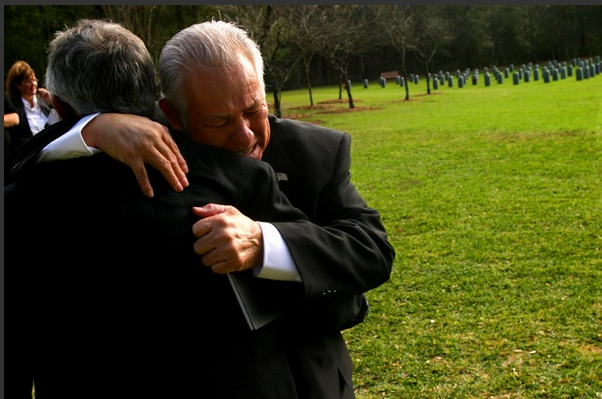
Showing posts with label grief. Show all posts

Sunday, May 11, 2014

It Took Losing My Mother to Finally Know Her

I wrote this several years ago and posted it on Integral Options Cafe in 2005. I thought it might be a good time to reshare this post, in honor of sons and mothers who struggle to know each other as people, and maybe as encouragement to change that, if at all possible.

When I posted this piece, my mother's uterine cancer had just returned and metastasized into her whole abdomen and into her brain. A few days later, on August 24 of 2005, I sat beside her in a hospice as her breathing slowed and then stopped. A quiet end to a painful life. 

Here is a picture of me from back in 2003, give or take, about 36 years old. Unfortunately, I have no pictures of my mother scanned into this computer.

Getting to Know Ruth

Three years ago, my mother was diagnosed with uterine cancer. The doctors thought it was terminal. Somehow, she recovered from the surgery, the chemo, and the radiation and lived for two+ years in remission. But uterine cancer nearly always returns, and so it has. My mother is in a morphine-induced coma to ease her pain. She will likely never awaken.

When she was first diagnosed, I wrote the following entry in my journal – a confession of sorts, as well as a tribute to the woman who raised me as best she could. She lasted three years longer than anyone thought possible, long enough to lose her daughter and to see her son find himself as a man.


Getting to Know Ruth
5.25.02


For thirty-five years, my life until this very moment, my mother has been a non-person to me. Obviously, I knew she was human, had a history before my birth, and possessed her own hopes and fears. But I never really saw or experienced her as a real person, a complete human being. She was my mother, a collection of feelings and memories that I had accumulated over these thirty-five years.

A few nights ago, however, I found out she has cancer, very serious cancer. She has been sick for almost a month, but now it is official: uterine cancer, maybe more that will be discovered in surgery. But the surgery will have to wait until they can control some blood clotting that might kill her during a surgical procedure.

She told me she is tired, that after seventy-two years -- very difficult, challenging, painful years -- she is ready to die.

For the first time in my life, my experience of her shifted. It wasn’t the first time that I was in a care-taking role with her (for several years after my father died, when I was 13, I was the adult in the house), so the shift has to be something else. After a lot of tears, a few hours of writing in my journal, and listening to Lou Reed’s Magic and Loss, I began to clearly see my mother for the first time -- to see her life, her struggles, her loves, all from a place outside my own needs and fears.

My mother has become a person, a person whom I love very much, a person whom I hardly know, a person who is dying.

*****

My mother was born in February, 1930, along with a fraternal twin brother. When she was conceived, the world seemed to offer unlimited potential. There were jobs, and it was easy to support a family of five, even for the children of German immigrants at a time when Germans were not trusted after the First World War.

Then the stock market crashed and the Great Depression began. Big cities like Chicago – where my mother's family settled – were hit hard. Jobs of any kind became scarce. Suddenly it was next to impossible to support a family of five. My grandfather took any work he could get, but still, there was often only enough food for one meager meal each day. Sugar cubes were given to satisfy the hunger of crying children. The struggle to feed the family went on for several years. My mother and her brother developed rickets, a deficiency illness caused by a lack of calcium and vitamin D. My mother and her brother were severely malnourished at an age when proper nutrition determines normal physical and intellectual development.

As a result of this malnutrition, my mother, like her brother, did not experience normal intellectual growth. Her IQ scores would likely test in the range of 70 to 80. By most standards, she is developmentally disabled. She has had difficulty living independently during those years when she was not living with her mother or married.

*****

I was thirteen when my father died. By that time I had been identified as “talented and gifted” and placed in advanced classes in school. It was difficult for a strong-willed and precocious child to grow up with a challenged parent as primary caregiver.

When my father died, I was the one who took care of the funeral arrangements, the insurance policy, the government pension my mother would receive, and all the other financial decisions. I continued to perform most of the money-related tasks for two or three years. However, within six months of my father’s death, I was smoking pot regularly, drinking whenever possible, and beginning to show a lot of unconscious anger. 


Emotionally, I was completely shut down, using chemicals to stay numb. My straight A grades began to decline. I was in pain and needed a strong mother to comfort me, but she was in too much pain of her own, too lost to be able to help my sister or me. She was diagnosed with depression and put on medications that made her sleep a lot, although the sleeping is also part of the depression.

Over the next several years, I became a daily drug user and was arrested for alcohol possession, vandalism, and growing my own marijuana. Grace alone kept me out of jail or the morgue for the better part of my teen years. The times I was locked up only made me angrier and more determined to feel nothing.

During those years, my relationship with my mother was terrible. I was incapable of seeing how much pain she was in, how lost she felt, how much she needed my love and support. However, as I became increasingly lost in a haze of smoke, drink, and pills, she learned to pay the bills on her own, got a driver’s license for the first time in her life, and found the strength to call the police when she found my little pot-growing operation. I was sixteen and completely out of control.

Although I knew my mother was different from other mothers, even when I was young, it wasn’t until I was a teenager that I truly became aware of the reality. I wasn’t understanding or compassionate. I was angry. I made fun of her in front of my friends. I told her she was stupid. I hurt her in more ways than I can count. And she just kept on loving me and doing her best to keep me alive and healthy.

As I write this, I still feel so much shame for those actions and words. I’ve spent the last 15 years trying to make up for the pain I caused her during those five years when I was acting out every shadow element in my psyche. If I had 100 more years to make amends, it would not be enough.

When I was 19, after hitting my personal bottom, I cleaned up my life and went to college. I studied psychology, literature, and religions. I began to learn a little about why I was so unconscious and confused during my teen years, and pieces of why my mother has had to struggle in her life. Most importantly, I began to learn about powers greater than me in this amazing Universe.

*****

My mother is not like other mothers. She was never able to help me with my homework. She seldom read to me. She was incapable of advising me on whom to go to parties with when I was in middle school and dating was new and awkward. When I began to publish poems after high school, she never asked to read them or showed any interest in my writing. When I was in college, she didn’t ask about my studies, had no awareness of national or international events, and only wanted to know if I was employed.

She isn’t like other mothers. I saw the mothers of my friends turn their backs and walk away from troubled sons and daughters, unable to face their failures as a parent and their children's pain. But my mother never stopped loving me, supporting me, or trying to help me, no matter how awful I became, and I became very awful. Where other mothers might or did give up, she loved me even more.

After 35 years, I am finally able to see that she was gifted in ways I could not understand earlier in my life. She has an amazing heart, a capacity to love that my mind can barely grasp. I didn’t have the mother I wanted, but I had the mother I needed. To get to where I am now in my life, I had to go through the pain and confusion of my youth, and I didn’t need someone to guide me through it, I just needed someone to love me no matter how lost I found myself. If I had been guided through those difficult experiences, without the pain, there would have been no learning, no understanding, and no wisdom gained from the experience of finding my own way through the dark places within me.

I would not wish my teen years on anyone, but those experiences are what allow me to sit here now and write these words. If I hadn't been so out of control, my mother may have never found the strength to take control of her own life and learn to be as independent as she became. Again, we get what we need, not what we want.

So, now she is dying. This comes at a time when my life is in a liminal space between who I was and who I will become, a self-chosen disruption of the course my life was following. In the middle of all this, my mother is diagnosed with cancer.

Odd as it may sound, the timing for this to happen in my life could not be better. I am in a unique position in my life to change the way I see the world, to change the meta-narrative of my life, to re-open my heart in ways I have been too frightened to do in the past. For the first time in my life I am on the path of self-discovery and healing. It makes all the difference.

From this place in my life, I have learned to step back from myself, to see through the eyes of my observer self, or Witness. Through those eyes I see my mother as a person. I can see her struggles, her fears, her joys, her successes. I see her weaknesses and her strengths. I see her not as my mother, but as wonderful human being who has survived 72 painful, challenging years while holding onto the love in her heart. I see a woman who is not capable of knowing how extraordinary she is. I see a woman who inspires me to open my heart and learn to love in the same selfless way she has loved others for her entire life.

I am blessed to come to see my mother as the human being she is, not just as my mother. I have been given a chance to know her in ways I could never imagine before. I want to learn how she was able to love others so easily, despite being told she was not like everyone else and being treated as deficient.

My mother is not like other mothers. For however much time she has left, I want to learn about her fears, her joys, her life. I want to know the person who is named Ruth. 


R.I.P., Ruth Sophie Harryman, born Ruth Sophie Koenig.

Friday, November 29, 2013

A Son Learns About Life Through His Father's Death


Over at his Psychology Today blog, Going Out Not Knowing, David B. Seaburn, Ph.D., L.M.F.T. discusses being with his father the day he died, and the lessons he learned on life from being with father as he died.
I was forty-eight when he died. I am sixty-three now. I carry his pocket knife with me every day. At one time I lost his knife for two years so my brother bought me another one exactly like it. Now I can carry two. I have his watch on the night stand beside my bed.
Fatherloss is one of the most difficult experiences in many men's lives. One of the better books on this topic is Fatherloss: How Sons of All Ages Come to Terms with the Deaths of Their Dads by Neil Chethik - you can read the introduction here.

The Day My Father Died

Being with my father when he died taught me more about life than death.

Published on November 9, 2013 by David B. Seaburn, Ph.D., L.M.F.T. in Going Out Not Knowing


November 11, 1998 dawned grey and cold. I had been staying with my brother and mother in Ellwood City, Pa. off and on for six weeks since my father had been diagnosed with acute leukemia. The doctor had given him six to eight weeks to live. It had been a long twenty-two years since my father had had a heart attack, years littered with health problems, years of caregiving for my mother. My father was eighty years old and proud of it. His brothers had all died before him, mostly of heart disease, one at the age of thirty-six. The day before he died was my parents’ fifty-sixth wedding anniversary, something that he was unaware of. We crossed our fingers that day, hoping he would live through it.

A few days before his death, my mother and I received a call in the middle of the night from my father’s nurse. She said he was restless and afraid and that we should come to the hospital. When we arrived, he was not afraid at all. In fact, he was smiling and more alert than he had been in many days. My mother and I stood by the bed talking with him. He joked that a beer would taste good about now. At one point he asked my mother to kiss him, which she did. Then he asked me to say a prayer, so the three of us held hands while I prayed.

That was his last lucid moment. He was unconscious most of the time after that.

I knew he was dying, but I did not recognize this as his goodbye. We had been making daily trips to the hospital for weeks and had fallen into the dying routine with its waiting, and watching, and remembering, and lunches at the hospital café, and stories, and laughter, and sadness, and silence. I realized later that I had assumed that my father would just go on dying, but never actually die.


On the morning of November 11 I took my dog, Abby, for a walk in the school yard near my parents’ house. We stopped and talked to a neighbor who asked all about my father. When I got back to the house, it was a little after 9am, a later start than usual. My mother wasn’t quite ready. My brother was on the road, his trucking job not allowing him time to be with us that morning, although he was with us emotionally throughout. I told my mother that I would go to the hospital, see how things were, and then come back to pick her up.

When I got to hospital, I checked in with the nursing staff at the desk to see how my father’s night had been. Then I went to his room where he lay on his back, his mouth open, his breathing slowed. I spoke to him as I always did, reporting on the weather, talking a little about how the Steelers were doing. I put some water on a tiny sponge and dabbed his lips. I cleaned his nose. Then I sat on the naugahyde lounger beside him. His breathing was labored. I listened to him exhale and waited anxiously for his inhale. I counted the seconds between each breath. One, two, three, four, more anxious now, five, six, seven, finally another inhale and I felt relieved. Again, and again, and again. This went on for several minutes. Around 9.20am----one, two, three, four, five, six, seven, eight, nine--- I stood up and looked at Dad. I listened and watched. I placed my hand on his chest. By then I knew he had died. I held his hand, his fingers still soft and warm.

Quietness.

I had the strangest sensation (perhaps my last moment of denial) that my dad would wake up and tell me all about dying, what it was like, how it had gone, as if having triumphed over the last of life’s challenges, he could give me some wisdom about what to expect.

I was forty-eight when he died. I am sixty-three now. I carry his pocket knife with me every day. At one time I lost his knife for two years so my brother bought me another one exactly like it. Now I can carry two. I have his watch on the night stand beside my bed. When my wife and I watch our two little granddaughters (ages four and two), they love to play in our bedroom. The two-year old, Makayla, always stands on the bench beside my nightstand and puts my father’s watch on. It slides up to her armpit as she holds her arm up high. When she is done, she puts it back exactly where she found it.

When I was forty-eight, I hoped my father’s death would teach me about dying. At sixty-three, I think it has taught me mostly about living; that life is short but beautiful; that even though time is measured, there is enough, if you pay attention; and that everything that matters in life is here, now.

David B. Seaburn, Ph.D., L.M.F.T.


David B. Seaburn, Ph.D., L.M.F.T., served a rural country parish, worked in community mental health, was an assistant professor of psychiatry and family medicine at the University of Rochester Medical Center for twenty years, and directed a public school-based free family counseling center. He co-authored two professional books, Family-Oriented Primary Care (1990) and Models of Collaboration (1996), over sixty articles, and four novels: Chimney Bluffs (2012), Charlie No Face (2011—Finalist in General Fiction, National Indie Excellence Awards), Pumpkin Hill (2007), and Darkness is as Light (2005). He and his wife live near Rochester, NY. They have two adult daughters and two wonderful granddaughters.

Thursday, July 25, 2013

Julian Baggini - The Death of My Father (via Aeon Magazine)

At 13, I was young when my father died. I didn't have the resources or skills an adult might possess to process the pain, the confusion, the anger, the almost (but not quite) invisible sense of abandonment. As an adult, when my mother died, I had the skills and I was able to think and write and process the experience through language, as Baggini describes below.

Fatherloss is an interesting topic in masculinity studies - how we are when we lose our fathers has a real impact on it affects us as men (or boys).

This excellent article by one of my favorite living philosophers, Julian Baggini, author of The Ego Trick and many other fine books, comes from the always interesting Aeon Magazine.

The Death of My Father

When someone close to you dies, the very fabric of your life is ripped to shreds. Is philosophy any consolation?


by Julian Baggini
Published on 5 July 2013

A funeral in Italy, 1951. Photo by Henri Cartier-Bresson/Magnum Photos


Julian Baggini is a writer and founding editor of The Philosophers’ Magazine. His latest book is The Shrink and the Sage: A Guide to Modern Dilemmas, co-authored with Antonia Macaro. His previous book, a "Best Books of 2012" selection on many lists, was The Ego Trick.

I’m dealing with the death of my father the way I deal with most things: by thinking, and processing those thoughts through writing, fingers to keyboard. Given my philosophical bent, these thoughts wander from his particular death to mortality in general. That might strike you as cold, excessively rational, analytic. But the only rule about grief is that there are no rules. Reactions to death cannot be neatly divided between the normal or abnormal, appropriate and inappropriate, right and wrong. We muddle through death as we muddle through life, each scrambling in the dark for a way through.

At times like these, philosophers are of limited use because when they have talked about dying they have tended to focus on what it means for the one who dies. Plato, for instance, called philosophy a preparation for death, while Epicurus told us we had nothing to fear from dying. But such thoughts are not much use to those who die suddenly. My father had seemed fit as a fiddle, but he was struck by a heart attack and died on the spot. The same happened to his brother and his brother-in-law, while his own father was killed instantly by a stroke. It is as though the Grim Reaper enjoys playing a cruel joke on those who look intently ahead. Those who prepare to meet him face-to-face are just as likely to find he sneaks up behind them and takes them unawares.

A much more useful philosophy would help us to prepare for the deaths of others. I have never been sure that philosophy does a good job of that. But perhaps a philosophical outlook can help us make sense of death when it comes close to us. It seems to me there are three dimensions to this: what the death means for the one who has died; what it means for those who survive; and, perhaps most of all, the sheer shock and surprise to find death not knocking at the door but crashing through it, uninvited.

If death comes at the end of a long illness, most would say it is easier to face, even if nothing can fully prepare you for the day when it finally comes. However, when the death is sudden, almost everyone talks the language of incredulity. ‘It doesn’t seem possible.’ ‘It doesn’t seem real.’ ‘I still can’t believe it.’ I’ve heard phrases such as these again and again over recent days. My father had not lived in his native Italy for years but he was back for one of his periodic visits, and on this trip he seems to have been exceptionally sociable. The number of people who had chatted to him for the first time in years in the days before his death is extraordinary. And they all said that he seemed fit, well, healthy. Those who knew him longer talked about how they assumed this slim cyclist and vegetarian, who was a strictly social drinker and smoker, would outlive his generally stouter, less careful, more sedentary peers.

I cannot share their feelings of impossibility. Yes, there are elements of unreality about it all but, for as long as I can remember, I have been more or less constantly aware that death can come to anyone at any time. So I’m genuinely not surprised when occasionally it does, even when it’s to a member of my family. Of course, some people will have a longer life than others, but I know that the rule of chance defeats the law of averages for any given person.

So what surprises me is not that people die or get sick, but that other people continue to be so surprised when it happens. Am I unusual in this because I have devoted so much of my life to philosophy? I suspect the causal arrow is the other way round: I have devoted so much of my life to philosophy because I am unusual in this. After all, it is not as though the basic insight depends on a close reading of the Stoics, Socrates or Schopenhauer. I am talking about the facts about death that everyone knows, but cannot necessarily accept. All that it takes to ingrain them is the philosophical habit of turning easily understood ideas into the more difficult practice of how you perceive the world day by day.

Cultural norms have their part to play, too. In the village where my father died and was interred, there is no hiding from death when it comes, no disguising what has happened. Every passing is marked by posters announcing the time and place of the funeral, so wherever you go there is always some reminder of death’s omnipresence. Nor are they coy about corpses. My father was laid out in a coffin in his brothers’ house, a glass lid allowing him to be seen, and his body kept cool by a refrigeration unit. People popped in and out all day to see him, often talking over his body.

The ceremonial niceties, such as the huge free-standing electric candle sticks that were placed either side of his coffin, contrasted with the utilitarian brutalities of the thing. The undertakers, for instance, sealed up the metal lining of his coffin by putting on the lid, getting out a fiery soldering iron and welding him in. At the graveyard, he was interred into a wall, and after the priest had given a last splash of his holy water, two men in grubby clothes set to work bricking him up.

It’s very different in Britain, where bodies are whisked away to mortuaries and seeing them is something you can avoid altogether without censure. The Italian way — at least the one I saw — has to be better. Everything here seemed designed to make you as aware as possible of the reality of death and its natural place in the life cycle. But such is the human desire to avoid facing mortality that even in Italy people seem genuinely shocked to see another one bite the dust. If anyone does look at the empty cubicles in the cemetery wall and thinks ‘One of these has my name on it,’ that thought seems to be swiftly buried with the body.

These strange facts persuade me that the shock of death can be diminished by how we think about it, if we think about it as a reality and not just an abstract idea. If we really do take on board the fickle nature of fate, the inevitability of death and the randomness of its timing, then although there might be other things about a death that leave us devastated, the mere surprise and shock of it need not be one of them.

There are, of course, plenty of other things about a death to get upset about, most obviously our sadness for the person who has died. However, philosophers have struggled to make sense of this and, as a result, have often concluded that there is simply nothing to be concerned about. The person has died. He cannot suffer in any way. There is no point in feeling sorry about what he might have missed out on because there is no longer anyone there to feel sorry for. The only people who can feel any pain are those who survive.

I think there’s something deeply wrong about this. The sadness that one feels for the deceased is not that he is, in a strange way, still around but unable to appreciate life, but rather that he is no longer around at all. He is not suffering but nor is he enjoying, savouring, loving, laughing, or appreciating either. That is the cause of our sadness, for him or, perhaps more accurately, for what the deceased could still have been.

Many philosophers have been baffled by this, protesting that it is no more rational to feel sad for the unexperienced joys of the deceased than it is for those of the never born. But there is a huge difference between the time two people could have spent together in the real world were it not for an accident, say, and the time two people who had never been born could have spent together in a parallel, imaginary universe. The former did not come to pass when it very nearly could have, while the latter is just one of an infinite number of counterfactual possibilities. It takes a curiously impersonal perspective to assign the same value to both the unrealised experiences of purely hypothetical beings and those of people who lived and breathed. If we can delight in someone’s company, or even just derive enjoyment from a glass of good wine, then there is nothing irrational about feeling sad, perhaps painfully so, that someone we know who would have taken equal pleasure did not have the chance to do so.

Philosophers flounder when trying to analyse grief because the phenomenon they are trying to capture is indeed complex and paradoxical. To see a corpse in a coffin, as dozens of people did at my uncles’ house, is to be confronted by something that is, and is not, someone you loved, and love. People often say of a corpse that it looks like the person is sleeping. I can’t agree. In every living thing, asleep or awake, there are small movements, subtle signs of vitality. The face of my father was completely lifeless, not a single muscle was flexed, his chest neither rose nor fell with his breathing. He was gone. And yet in a sense this was also clearly him, what remained of him. His still being there in that state was the clearest evidence that he was no longer there. You feel for him knowing that he feels nothing, he is now nothing. And that is precisely the source of your sadness for him.

To a strict logician, this might seem incoherent. But even logicians must accept that there are times when an inconsistent description comes closer to the truth than our best attempt at consistency. The language and logic of philosophy are sometimes inadequate to capture some of the most important and real phenomena of life. At such times, the poetry of paradox comes closer than the deracinated prose of consistency. In a conflict between our best rational account and the profoundest felt experience, we should be careful of awarding victory to the rational unless we are sure it has delivered a knockout blow.

Sadness for the days not lived is appropriate even when a person is old and has had a long, good life. Life is never long enough. We almost all decline before we have exhausted our capacity to suck the marrow out of life. I accept that mortality is necessary for life to have meaning, and that eternal life would be a sentence, not a reward. But I cannot accept that 80 years (if you’re lucky) of diminishing potency is enough, and that we should not feel sad that we – and the people we love – don’t have longer.

Despite their failings, it might still seem that the philosophers who preached placid acceptance of death were not too far wrong. The existential shock can be countered and, although sadness for the dead might be deep, it need not feel like the punch in the gut that typically characterises bereavement. But there is a third aspect of grieving that is not so easily ameliorated. When you lose someone very close to you, the very fabric of your life is ripped to shreds.

The most common, and accurate, way of describing this is as a loss of a part of yourself. This is more than just a metaphor. When someone is close to you, his way of thinking, his thoughts and his biography become inextricably linked with yours. Where you end and he begins is not clear. No one would think it controversial to say that when you lose such a companion, then a part of your life is lost too. If, as I and many wiser minds have concluded, you are the sum of your experiences, thoughts, projects, plans and so on, then to lose someone who is such a big part of these things is indeed to lose a part of yourself.

Perhaps this is a better way to understand sayings such as ‘It doesn’t seem real’ or ‘I can’t believe it.’ Experiencing the death of someone close to us, we have a sense that the world has been so transformed, so disfigured, that it is no longer familiar: we don’t know how to be in it. We clumsily say we can’t believe it. What we really mean is that we cannot conceive what it even means to be ourselves any more. This can be the case even when the person is no longer a regular part of one’s daily life, but has been a constant background presence for as long as you can remember.

And yet, if the hardest thing is not that the other person’s life has ended but that our own has been ripped to shreds, then has grief become a deeply selfish thing? I don’t think so. The phenomenology of grief means that we cannot draw any simple division between self and other. We feel confused — are we crying for ourselves or for the deceased? — because our feelings for ourselves and the person we love can’t be neatly taken apart, just as we cannot neatly take ourselves apart from those to whom we are closest. Rather than being a purely selfish thought, the idea that someone was so loved that he became a part of you is the most profound form of appreciation possible. It’s perhaps also why death is so often marked by regret, which is not about just you or the one you mourn, but for the shared opportunities lost to you both.

In a subtler way, the interpenetration of self and other extends to everyone whose lives we have touched. For me, the most affecting part of my father’s funeral was when I entered the church to find it packed, standing-room only. It was not that he had dozens and dozens of very close friends. It was that, over the course of his life, he had become part of the lives of many people in his village, usually in small ways that were nonetheless significant enough to motivate them to come out to remember him. This community had lost a part of itself, and they were grieving for that. As we live more and more atomised lives, perhaps this aspect of grief will diminish in importance. There will be plenty of free seats at my funeral, for sure. When the fabric of our selves is torn apart, we will increasingly find it made of a smaller and smaller cloth. Grief will become more limited but also more private, and perhaps therefore harder to bear.

There is one more way in which philosophy can change the way we react to death. Aristotle said that you could not describe a life as good until it was over. What has gone well so far could still end in a catastrophe that would negate all that has gone before, while a hitherto awful life could yet be redeemed.

I have seen the full stop of death, closing the final chapter of a life, making it possible to stand back, look at the whole, and say that it was good. Of course, any life story is littered with mistakes, bad times and failures, as well as successes. But in the case of my father, and of some others I have known who have died in recent years, there has been some comfort in the knowledge that the overall story was a good one. Maybe there were some decent chapters that still might have been written, but there could equally have been a cruel twist or two in the tale that would have led to a less happy ending. For the protagonist, better a good short novel than a tragic epic.

There is nothing automatically soothing about this, of course. The reaper can, and often does, choose to type ‘The End’ after pages of misery, without bothering to bring any resolution. The last full stop that allows the ‘life well lived’ to be appreciated can also expose the life gone badly for all the horror that it was. That is just one reason why secular humanists should not overstate the extent to which a good, happy, moral life is possible without God. Of course it is. But bad and unhappy lives are also possible, and all too common. Philosophy provides little consolation for these, other than the knowledge that the pain is over.

I am presupposing here that death is indeed the end, as I have throughout this essay. But much of what I have described will also resonate with those who believe in a life to come. People often say there are no atheists in foxholes: that in the face of death everyone clings on to some transcendental hope. In my experience that is simply not true, and even if it were, I always reply that there do not seem to be too many theists at funerals, either. The way that the bereaved behave suggests to me that they do not feel any confidence that their loss is a mere temporary inconvenience.

My father believed that there was something more to come after this life and so, as he often did, he would have disagreed with much of what I have written here, while approving of the sincere attempt to work out the truth for myself, as he had done for himself. At the same time, his passing is a reminder that no one gets it all straight, and that even the best philosophy in the world can’t save us from ultimate extinction, likely in a state far from enlightenment. It has to be enough to have lived well and to have played a part in the lives of others too, and the only philosophy worth its salt is the kind that helps us to do just that.

However we grieve, after the tomb is sealed, the ashes scattered, or the coffin buried, all we can do is get on with trying to make sure we write the best chapters of our own lives that we can, while contributing some good lines and passages to those of others. We can’t guarantee that the great editor of fate won’t ruin it by inserting an ugly ending. But we can give the bastard as little help as possible.

Saturday, August 27, 2011

A Man and His Dog - Grieving


This short video made me cry . . . hard - deep sobbing sensations of loss released from my body. We so deeply underestimate the love and awareness of the animals we live with in our lives. I could feel Hawkeye's pain through my whole body - never experienced anything like that before.
Heartbreaking Video: Dog Mourns at His Navy SEAL Owner's Funeral

Earlier this week the funeral for Navy SEAL Jon Tumilson, who was killed in Afghanistan, was held in his hometown of Rockford, Iowa. And there among the 1,500 people mourning Tumilson at the service was his Labrador retriever, Hawkeye.


(PHOTOS: Dogs at War)


The photo above was snapped by Tumilson's cousin, Lisa Pembleton, who captured Hawkeye lying near his master one last time. The dog walked over to the casket at the beginning of the service and "dropped down with a heaving sigh," reports MSNBC.


Thursday, August 4, 2011

Perry Garfinkel - Men in Grief Seek Others Who Mourn as They Do

http://beinglatino.files.wordpress.com/2011/04/grieving-man.png

Good article - everyone grieves differently, so it only makes sense that men seek out someone who grieves as they do when they want or need support. Often enough, no matter how much we love our wives, mothers, sisters, or female friends, men need other men in their grief.

Men in Grief Seek Others Who Mourn as They Do

- Veteran journalist
Posted 7/28/11

In 1990, Sam and Gretchen Feldman cashed out on their share of a national chain of men's apparel stores and retired to Martha's Vineyard, Mass. There, they devoted their time to volunteer work and an active social calendar. The following years were golden ones for the Feldmans, but in 2007 Mrs. Feldman learned she had cancer. She died a year later.

The Feldmans had been married 53 years, and Mr. Feldman's grief was palpable to friends who knew him as a buoyant, resilient personality.

"There was a huge hole in my life that no amount of activity could replace," said Mr. Feldman, now 82. "And except for my two daughters, there was no one I could turn to for solace."

There was a local bereavement group for spouses, but Mr. Feldman opted out when he learned it consisted only of women.

"I just didn't think women would relate to my pain," he said. "And, frankly, I come from a generation that feels uncomfortable exposing our sadness and vulnerability to the opposite sex."

The loss of a loved one is a profoundly heartbreaking experience, but it is not the same for everyone. Research increasingly suggests that men and women experience grief in different ways, and the realization has bolstered a nascent movement of bereavement groups geared to men throughout the country. Many of them are affiliated with hospitals and hospice centers.

Concern about reaching men in grief has gained new urgency with shifting demographics. The number of men age 65 and older increased by 21 percent from 2000 to 2010, nearly double the 11.2 percent growth rate for women in that age group, according to census figures. As the gender gap in life span narrows, experts suggest that more men will be facing the loss of loved ones, particularly spouses.

Many will be not be prepared for the experience. The loss of a spouse often is crushing for men physically as well as psychologically. In a 2001 paper published in The Review of General Psychology, psychologists at the University of Utrecht in the Netherlands confirmed earlier data showing widowers have a higher incidence of mental and physical illness, disabilities, death and suicide than widows do. While women who lose their husbands often speak of feeling abandoned or deserted, widowers tend to experience the loss "as one of dismemberment, as if they had lost something that kept them organized and whole," Michael Caserta, chairman of the Center for Healthy Aging at the University of Utah, said by e-mail.

The Harvard Bereavement Study, a landmark late 1960s investigation of spousal loss, found that widowers experienced the death of a wife as a multifaceted tragedy, a loss of protection, support and comfort that left many at sea. The men in the study relied heavily on their wives to manage their domestic lives, from household chores to raising their children, the researchers noted.

The grief of men is compounded, Dr. Caserta added, by the fact that so many have been reluctant to directly address real feelings of deep sadness; until recently, men were expected to be emotionally controlled and inexpressive. Simply persuading grief-stricken men to attend a bereavement group is still no small challenge.

"While there's strong indication that grief therapy helps men, historically men generally don't join groups," Phyllis Silverman, a grief researcher and an author of Widower: When Men Are Left Alone, said in a telephone interview.

There are also differences in the length of time men grieve, compared with women, and how long it takes to move on. An old axiom that "women mourn, men replace" turns out to be untrue.

"It used to be thought that men grieve acutely and heal more quickly, and that women grieve chronically over a longer time period," said George A. Bonanno, a clinical psychology professor at Columbia University in New York.

But now, Dr. Bonanno said, many researchers believe that grief follows a more complex pattern in both men and women.

"No matter what sex, we oscillate between positive and negative emotions, between waves of sadness about the loss and hope for the future," he said in a telephone interview. "This can be frustrating for men, who often seek the 'quick-fix' approach."

Sherry Schachter, director of bereavement services at Calvary Hospital in the Bronx and a grief specialist for 25 years, said in a telephone interview: "While women grieve intuitively, open to expressing their feelings, men are 'instrumental' grievers. They're not comfortable with talking about their feelings, and they prefer to do things to cope."

In a men's group she has run for the last few years, she said, "I never ask, 'How do you feel?' Rather, I ask, 'What did you do?' "

In some cases, what men are doing is taking grief counseling into their own hands. Mr. Feldman started a biweekly bereavement group for widowers on Martha's Vineyard, and two years ago spearheaded the Men's Bereavement Network, a nonprofit organization seeking to establish and support grief groups for men nationwide. The network is helping to establish bereavement groups for men in places as diverse as DePere, Wis.; Clearwater, Fla.; and Danvers, Mass.

At a recent peer-led gathering of the Martha's Vineyard group begun by Mr. Feldman, eight men in their late 40s to late 80s sat around the dining room table at the home of the session leader, Foster Greene. Dr. George Cohn, a local psychiatrist, sat alongside, for the most part a silent observer.

A retired fisherman, at 85 one of the older members of the group, spoke in a low voice, looking mostly into his coffee cup. His wife of 54 years died in 2010.

"I don't know about you guys," he said, quickly glancing around the table of men, "but for me it gets harder, not easier." The other men nodded.

Later Dr. Cohn said, "Sometimes that's all a man wants or needs -- a sympathetic ear."

Originally published in The New York Times


Tuesday, April 19, 2011

Sage Mahosadha: The Grieving Man and the Teacher-Student Relationship

http://imagebase.davidniblack.com/main.php?g2_view=core.DownloadItem&g2_itemId=2875&g2_serialNumber=3

This is a cool post from my online friend and fellow Tucsonan, Sage Mahosadha. Sage blogs at The Whole World is a Single Flower - we have connected over the past several months around issues we are both passionate about - mature masculinity, men's evolution, spirituality, and so on.

From time to time on his blog, Sage answers questions from readers - this is one of those posts. I wanted to share this with all of you because I think he is one to a big issue, one that many books have been written about, but most of which circle the truth without ever quite landing on it.

More from me below.

Questions for Sage: The Grieving Man and the Teacher - Student Relationship


I was participating in a web-based discussion forum for men who also have some sort of concrete spiritual practice, when someone participating in the discussion asked me this very specific question:

"Sage, I understand you have written quite a bit about what you call "The Grieving Man" archetype. Do you think this comes into play in any way in the teacher-student relationship when both the teacher and the student are both male? I was recently reading about a male student who broke with his male teacher in a very public and acrimonious way and got the sense that something else that was not spoken of was going on there."

Sage responds: I am glad you asked me that question. I have a lot to say there. First, here are my most basic ideas about what I term, "The Grieving Man" and part of what I see as being at the root of it:

I believe most mens primary and in many cases lifelong grief experience is deeply connected to their relationship (or lack thereof) with their fathers. I believe this can also be true even if the man believes he has/had a wonderful relationship with the father (or father figure). I suspect however, the vast majority of men, at least in western cultures, have not had a good relationship with their fathers. My intuition tells me that this is also more or less the case for men in other parts of the world as well. I simply do not have enough personal or research experience there to say this with as much authority as I do for men who live in The West.

Men are essentially grieving because we do not know how to love other men, half the world's human population. And we need to know how to love men to lead fully productive lives. This is all directly related to the experience of not feeling loved by the father or feeling abandoned or not understood or not accepted by the father, etc. Most men realize this on some level, mostly subconsciously.

So the grieving man is grieving in my view, largely because of a disconnect from at least a perceived loving and supportive relationship with the father or the primary male father figure in the young boy's life. And so a primary result of this particular disconnect is a propensity for men to then look to women to teach us how to love, regardless of the man's sexual orientation.

So that is the most basic background stance I have.

Now lets superimpose the teacher-student relationship onto that.
Go read the whole post.

I am one of those men who spent years searching for my father's love in my relationships with women (and men). My father died when I was young (as I have mentioned here many times), and even while he was alive he was not the most affectionate man on the planet, at least not with me (my sister received much more of that than I did).

I'm not sure when I came to the realization that Sage describes above. At some point during my last round of psychotherapy I came to grips with the reality of my relationship to my father - that it sucked, and that I had been trying to rationalize and justify his actions so that I could maintain some semblance of what the Object-Relations psychologists would call the "Good Father," which meant repressing the "Bad Father."

As I worked through that stuff, I also realized that I was often uncomfortable around other men, especially men who seemed very masculine to me. It became clear at some point that I felt as though I had never learned how to be a man or what it means to be or feel masculine - so being around those men I identified as masculine intimidated me.

It was about that time that I started this blog.

My father taught me some rules of old school masculinity - the chivalry code: hold doors for women, respect women (especially my mother - failed that one when I was young), open car doors, ladies first, if some guy is mistreating a women then kick his ass, never show fear or doubt (fail that one frequently), and so on.

Some of those have served me well, some not so much.

But I feel like I never learned to be comfortable being a man - which is why I have been reading, researching, and writing about it for 5 or 6 years now. During that time I have figured out a few things.

Because I never felt comfortable showing affection with my father - mostly because he did not model how to do that with me - I never learned how to be affectionate with other men. Add to that growing up in a rural conservative part of Oregon where showing affection for another man means you're gay, and fearing that label (even though I found men attractive back then, I repressed it). Being called gay or, more likely, a faggot, was a curse for a teen boy who thought of himself as a jock and wanted to be the All-American Stud (aside from the broken home, run-ins with the police, the drug and alcohol problem, and so on). Yes, I was well-socialized as a teen, thank the universe (or genetics) that it did not stick.

So, getting back on topic, I was (sometimes still am) that grieving man Sage is describing above.

I'm still working on all of this, but I can show care and affection for my male friends - and I have no fear that they will think I am anything other than me - because they know I am not gay, straight, or any other label . . . I'm me.

And I guess it helps that most of my male friends identify as gay or bisexual - so they are more comfortable with emotions and expressing them (it's not fair to generalize this to all gay men, but the guys I know are).


Friday, February 4, 2011

Poetry - "Grief Calls Us to the Things of This World" by Sherman Alexie


A beautiful poem from Sherman Alexie, one of America's finest living poets - from his recent collection, Face.


Grief Calls Us to the Things of This World
by Sherman Alexie

The morning air is all awash with angels . . .
- Richard Wilbur


The eyes open to a blue telephone
In the bathroom of this five-star hotel.

I wonder whom I should call? A plumber,
Proctologist, urologist, or priest?

Who is most among us and most deserves
The first call? I choose my father because

He's astounded by bathroom telephones.
I dial home. My mother answers. "Hey, Ma,

I say, "Can I talk to Poppa?" She gasps,
And then I remember that my father

Has been dead for nearly a year. "Shit, Mom,"
I say. "I forgot he’s dead. I’m sorry—

How did I forget?" "It’s okay," she says.
"I made him a cup of instant coffee

This morning and left it on the table—
Like I have for, what, twenty-seven years—

And I didn't realize my mistake
Until this afternoon." My mother laughs

At the angels who wait for us to pause
During the most ordinary of days

And sing our praise to forgetfulness
Before they slap our souls with their cold wings.

Those angels burden and unbalance us.
Those fucking angels ride us piggyback.

Those angels, forever falling, snare us
And haul us, prey and praying, into dust.


~ From Face by Sherman Alexie. Copyright © 2009 by Sherman Alexie.


Saturday, October 16, 2010

We Had to Euthanize Maggie This Morning

Maggie was our family, our child - she was seven years old (give or take, she was a rescue).

We had to end her suffering this morning - she had rapidly gone downhill in the last ten days. Her eyes were so sad, she could not eat, she could barely drink, and movement looked agonizing. She had lost 8 lbs in that short period. We had ruled out valley fever and several other things. It was probably cancer.

We couldn't bear to keep her alive for our benefit - she was suffering, and it broke our hearts. Euthanasia was the only humane choice - all things are impermanent, and fighting that would not have been fair to her.

I keep using present tense verbs and having to change them - it doesn't feel real yet.

I've been with death my whole life - pets, people, friends, farm animals, my immediate family. In 2005 my sister and mother died in the same summer. I watched my mother's quick decline with ovarian cancer that came out of remission (after my sister died) and filled her whole body. I wasn't there when my father died of his 5th heart attack when I was 13.

This hurts worse than any of the other ones.

I'm not sure why - maybe because Maggie loved us without conditions, no matter what kind of mood we were in or whatever - she loved me/us, always, faithfully.

Or maybe because I am more present to my feelings than I have ever been before. I couldn't stop the tears and sobs as we held her and the shot was administered. Yet even while experiencing my own pain and loss I could comfort Jami and hold her . . . . Is this what it means to be a man with access to his heart?

And I can't stop the tears as I write this.

Yes, she was a dog, a pet -- but she was our family. The house feels so empty without her getting into things, demanding we pet her . . . .

I know that being able to feel this loss so deeply is a sign of all the work I have done, especially around death and loss - work to have access to my feelings, to not suppress suffering and pain . . . . and it sucks to hurt so much.


Friday, August 20, 2010

Embracing Grief - Grief is Important

http://syaple.mlblogs.com/grief.jpg

When my father died, I had no idea how to grieve such a huge loss for a 13 year old kid. No one around me did either, so I didn't. I buried it, then proceeded to act out and self-numb for several years.

The hardest part is that this experience left me unable to properly process other losses - girlfriends, friends, whatever. If we cannot honor and process our losses, they remain like anchors in our psyches, keeping us connected to that sadness and grief. Even though we are not aware of it, those feelings will shape our responses to life.

But it doesn't have to be this way - this Daily Om speaks to being able to sit with out feelings, including grief and loss, rather the numbing them or burying them.
Embracing Grief
Grief is Important

Giving ourselves permission to be with sadness actually creates space for us to begin the healing process.

Change is something that happens each and every moment in our lives. Since nothing is constant, it may sometimes seem as if we are losing something whenever things do change. Understanding that this is part of our daily existence and that there will not only be gains but also losses in our lives can help us more readily accept and deal with whatever happens.

Whenever we lose something or somebody we love, it is important for us to take time out for ourselves and truly feel the weight of what we are experiencing. Although it may seem that doing so will push us into a deeper state of sadness, truly giving ourselves permission to be with whatever arises actually creates space for us to begin the healing process. This is because the act of grieving is a natural process, allowing us to sort through the range of emotions that are present in our everyday existence. Even though it may sometimes seem easier to involve ourselves in activities that take our minds off of our sadness, this will only make the route to healing more difficult. Unless we listen to where we are in the moment, the emotions we experience will only grow in intensity, and our feelings will manifest themselves in more powerful and less comfortable ways. Once we consciously acknowledge that these emotions are present, however, we are more able to soothe the sorrow of the moment. In so doing, we become more open to our natural ability to heal ourselves.

Grieving doesn’t have to be a process that keeps us rooted in our thoughts of fear and sadness. For the moment we might feel despondent, but by expressing and coping with our true feelings, we face the sadness head-on. When we allow ourselves to accept and deal with our loss fully, we will then be able to continue our life’s journey with a much more positive and accepting outlook. This will make it easier for us to see that our grief is ephemeral and, just like our moments of happiness, it will also come to pass.

What do you think?
Discuss this article and share your opinion


Tuesday, August 3, 2010

Tom Matlock - Love Survives

Another interesting Huffington Post column from Tom Matlock in his series on parenting (growing up with a single mom or being a single dad).

Tom is the force behind the Good Men Project.
Tom Matlock - Love Survives

Tom Matlack talks to photographer Ron Cowie about enduring love, unspeakable loss and staying present when life falls apart.

Listen to the interview here: RonTomInterview


I had never met Ron Cowie before sitting down with him--and his 5-year-old daughter, Kiki--at a picnic table at Coffee Roasters in Tiverton, Rhode Island. I knew only of his series of haunting photographs, "Leaving Babylon," done shortly before his wife's death.

What drew me to these images, and the good man who made them, was his willingness to embrace loss fully rather than run from it. I think we can all learn from that.

TOM: We've been talking a lot at The Good Men Project about fatherless boys being raised by single moms. Can you talk to me a little bit about being a single dad? What's it like?

RON: I was put into it so quickly. You just wake up and suddenly you've got to read stories and you've got to make breakfast and you've got to ... and the decisions get taken out of it. Under my circumstances, I think more help was offered without a lot of strings attached because people just knew that I was in a whole new situation. It wasn't like a marriage breaking up, where there are people taking sides. It was just, "This is a tragedy."

TOM: Tell me in a few words what your wife was like.

RON: Oh, boy. A few words?

TOM: (Laughs.) Maybe how you met her.

RON: I met her at the photo school, New England School of Photography, where I teach now. But I was a student. I was a first-year student, and my tendency was to always kind of fish off the company pier with relationships.

TOM: (Laughs.)

RON: And she was one of these people where there was a slight interest back and forth.

And I'll never forget the thing that really hooked me. I was saying something to her in a gallery that she was running. And without even turning around, she said, "Ron, some of the things you say I just get embarrassed for you." I'm like, "Ouch." (Laughs.) I'm just embarrassed for you. I was like, Wow! OK.

And I don't know what it was, but I knew that she was the one. I didn't want to screw up. I knew I was in a new chapter of my life, and I also knew I had no emotional preparation for what I needed to be in this relationship; I hadn't been in a relationship like it. But she was patient. She was loving. She taught me how to love.

Really, she was generous enough to teach me how to let me be loved. I think that was the bottom line. It's not like she was a saint and never did anything wrong, or that we didn't have arguments. But she was a very loving, gentle person. That's the best way to describe it and everything kind of came from that. And I think part of her shortcomings was--

KIKI: Daddy?

RON: Yes, Kiki?

KIKI: When am I going to have my bagel and cream cheese?

RON: Oh, when are you going to have your bagel and cream cheese? In a little bit.

KIKI: Okay.

RON: That's being a single parent.

TOM: (Laughs.)

RON: That's what it is.

TOM: When did you get married?

RON: September 9th, 2000. I was 30. And it was great. She did a lot of the planning and everything, and it was a good marriage. But I was also learning how to be married. I didn't know how to do that. Kiki, do you want to go up and make an order for a bagel and cream cheese?

KIKI: Daddy.

RON: Twenty dollars makes you less shy. Go. Bring change back.

(Ron, Tom laugh.)

RON: So, we had to learn how to be ... it's just like anything.

TOM: I've done it twice, so I know.

RON: Yeah.

TOM: (Laughs.)

RON: Well, then, I don't need to tell you anything. I'm going to be doing it twice, too. She died in 2008. In 2007, after we had moved in and Kiki was kind of up and mobile, I realized that a lot of my defenses started coming down.

I was taking pictures that were more personal, and I was able to better appreciate the little things. She would say, "We (Kiki and her) are going for a walk. You want to come?" And my first answer would always be, "You know I have work to do." And then I realized, you know what? This isn't going to last forever. Go.

And I'm really glad I did, because I was able to sort of see, and I took my camera, so it gave me an excuse. And really seeing just what love is, and her interacting with Kiki and sort of realizing that yeah, this is my life, and it's good. It's beautiful. And it's nothing major, nothing grandiose. It was just watching two people interact with each other.

TOM: Do you have pictures from those walks?

RON: Oh, yeah. Those are the most important things. It's just real simple. And because I always feel like I don't belong anywhere, and when you get to--


KIKI: Here's money. No, it's not mine.


TOM: (Laughs.)

RON: Put it right under the--here. Good. Good. (Laughs.) And yeah, that was--that's precious stuff. I never thought that that would be the most important stuff in my life, but that is. At that time I knew it was important, but...

TOM: So, tell me a little bit about what happened.

RON: Well, she had the flu. She had allergies, the flu and a temperature, and she was in bed for a week. And this is an important thing to pass on--she also had a cough. So it was kind of pneumonia, too, a cough that kept her up. But then all of a sudden, her temperature started going down and she got better. That was on a Saturday. She was feeling a bit better.

And then on Easter Sunday she came downstairs and laid out eggs with Kiki, and then she said, "I'm just going to go back up in bed and rest." I said, "Oh, okay. That's fine." And Sunday night, I slept on the sofa downstairs because she didn't want to keep me up with her coughing. Monday morning, she came down and said, "I really don't feel well at all. I think I want to go to the doctor." She didn't want to go to the doctor before, because she said she didn't want to be a bother.

So Monday we went and got a prescription for Mucilex and Robitussin, and then she had a chest x-ray. When we got back, the doctor had left a message on the machine: "You've got pneumonia. I think we're going to check you in." By the time we got to the emergency room, she was really, really weak. She was in septic shock from bacterial pneumonia. It's where your body can no longer fight off the bacteria, and your organs start to shut down.

She was lucid until she wasn't. She became un-lucid just as the doctors were walking in with the results of the blood test. They said, "Your wife is having a really hard time breathing, so we're going to incubate her right now and help her do that. We have to put her out."

She was really scared. And it was tough, because the last thing she saw me say while she was conscious was, "Everything's going to be all right, and I love you." I can still see her scared face. They did a tracheotomy and she went into cardiac arrest because they couldn't get the tube down her throat--it had swollen shut.

That's when I got up from the room and went outside, and that's when I heard "We don't have a pulse," and CPR was done and they got that back. But then she just--she never woke up. She was in a coma. She went into ICU, and when I was up there, she was just like a rag doll. I think they knew--they said, "Your wife is very, very sick. There's a chance she's not going to make it, and you need to know that."

Finally they told me that there wasn't more I could do there, and that I should go home. They gave me the direct line to the ICU. I woke up at 1:00 a.m., called, no difference. Then I woke up later again. And it was really hitting me, and I just started calling out, "Lisa, you got to fight. Come on." Just begging her, just talking to the ceiling in the bedroom. Fight. Fight, fight, fight, fight. Please. And then I had this vision of her in this blue turtleneck that she wore. (Crying).

I thought she looked beautiful in it all the time. And this vision--it wasn't like I actually saw her. I'm not saying she was there. But I can see it plain as day. Right now I see it. And she was smiling, and now I know it was her telling me it was okay. It was okay. And I said, "I can call now. I can call the ICU." And I did, and when I did, the phone rang and rang and rang. And I knew then that it wasn't good.

When they picked up, the doctor came on. He said, "She's been in cardiac arrest for the past 40 minutes, and we've done everything in this hospital that we can do to keep her alive, but the person you know isn't here anymore and the most helpful thing for everyone would be to stop the code." (Crying.)

And I just said, "Okay." I just--it's like you're on autopilot. I didn't even think twice. And so that's what I did. And my sister and her partner were down, and I went into the guest bedroom and told them. She went into the hospital Monday, and she died Tuesday morning.

TOM: And this was in 2008?

RON: March 25th, because it was on one of her best friends' birthdays, too.

TOM: How old was she?

RON: She was--oh, she won't mind that I forget how old she was.

TOM: (Laughs.)

RON: I think she may have been 44, something like that. She will always be 29 to me.

Read the rest or listen to interview.


Wednesday, July 7, 2010

Opening to Receive Comfort - Sharing Grief

http://americasvoiceonline.org/page/-/americasvoice/images/grief2.jpg

I was reading Warren Farrell's The Myth of Male Power last night in preparation for a panel discussion at the Integral Theory Conference at the end of the month - one of the things I agree with him on is the need to provide ALL returning soldiers (who are mostly men, at least as far as combat experience is concerned) with individual and family therapy.

We strip men of their individuality (as much as that is possible) when we train them to be soldiers, then we send them into battle situations where they see and experience horrible things, which they have to bury in order to function. When they come home, we want them to talk about their feelings, but that runs counter to everything they were taught about being men as they grew up and everything they were taught about being soldiers in wartime.

One of the deepest struggles all men face, and soldiers in particular, is profound, crippling grief. Keeping that pain inside is what men have been taught to do, and yet allowing ourselves to be vulnerable, allowing ourselves to receive comfort is exactly how to heal that pain. Sharing the pain eases our own suffering, but it also allows those close to us to feel even closer, to feel apart of our lives.

Allowing ourselves to process and release the grief, in whatever way we can do that, does not make us weak or girly. It takes incredible strength to face emotions that we secretly fear might overwhelm us or even annihilate us.

Today's Daily Om looks at this idea in a more general way - it seemed fitting that it came after reading that section of the book last night.
Opening to Receive Comfort
Sharing Grief

Grief is part of the human experience. Sharing our grief allows us to ease our burden by letting someone else help carry it.

When we experience something that causes us to feel shock and sadness, we may feel the urge to withdraw from life. It may seem like remaining withdrawn will keep us protected from the world, but during these times it is important to reach out to those trusted and precious people who care about us the most. Even with our best information and reasoning, we never know when someone else’s experience or perspective can give us additional information that we need. The universe speaks to us through many channels, and when we open ourselves up to receive its messages, we also receive nurturing care from a loving partner in life’s journey.

Grief is part of the human experience, and sharing our vulnerability is what creates truly close bonds in our relationships. Opening ourselves up in this way gets to the core of our being, past all of our defenses and prejudices. When life seems to crack the outer shell of our world, we are both raw and fresh at the same time. It is then that we discover who is truly willing to walk with us through life. We also see that some of those sent to us may not be the ones we expected to see. Regardless, we learn to trust in the universe, in others, in our own strength and resilience, and in the wisdom of life itself.

Sharing grief allows us to ease our burden by letting someone else help carry it. This helps us process our own inner thoughts and feelings through the filter of a trusted and beloved someone. We may feel guilty or selfish, as if we are unloading on someone who has their own challenges. Although, if we think about it, we know we would do the same for them, and their protests would seem pointless. Remember that not sharing feelings with others denies them the opportunity to feel. We may be the messenger sent by the universe for their benefit, and it is on this mission that we have been sent. By sharing our hopes and fears, joys and pains with another person, we accept the universe’s gifts of wisdom and loving care.