Showing posts with label sons. Show all posts

Saturday, August 2, 2014

'Masters of Sex' Artfully Exposes a Myth of Masculinity

A recent episode (July 27) of Masters of Sex (Showtime) has received a lot of attention for its depiction of main character William Masters' revelation of childhood physical abuse by his father. This revelation was quickly buried again.

The impetus for the revelation was Masters' experience delivering a baby with ambiguous genitalia, and then feeling outraged by the harsh reaction from the newborn's father. Because of this series of events, Masters found himself reflecting on his own struggles with masculinity to research partner Virginia Johnson (Lizzy Caplan) during a secret hotel rendezvous.

This is a show I have not gotten into yet, but I plan to do so. It is currently one of the most highly praised shows on television.

'Masters of Sex' artfully exposes a myth of masculinity

By Yvonne Villarreal


Michael Sheen has wowed critics by playing one of TV’s most unlikable characters in Showtime’s highly praised “Masters of Sex.” (Jay L. Clendenin / Los Angeles Times)

Highlights:
  • Michael Sheen propels 'Masters of Sex' by exposing a troubled childhood and then quickly shutting it away
  • 'Masters of Sex' has delivered a masterful episode that artfully exposes a myth of masculinity
It turns out that the pioneering sex researcher William Masters in "Masters of Sex" is most exposed when cloaked in a plush white bathrobe.

The July 27 episode of the highly praised Showtime drama had viewers more on edge than the moments before a physician delivers test results. The episode pivoted on Michael Sheen's stellar performance as the famous sex researcher who slowly peeled back the Band-Aid on a very troubled childhood and then quickly re-applied it.

After delivering a baby with ambiguous genitalia, and later becoming incensed by the harsh reaction from the newborn's father, Masters found himself reflecting on his own struggles with masculinity to research partner Virginia Johnson (Lizzy Caplan) during a secret hotel rendezvous. With nothing but a bathrobe as his armor, Masters became the patient.

"He did me a favor," Sheen said in the scene where he tells of suffering a broken nose at the hands of his father at age 14. "He made me the man I am today."

It was a commanding point in the slow-burn of the icy character as the modest-performing show settles into its second season. For the man who has thrived in Hollywood's world of historical fiction — playing real-life characters in film such as David Frost in "Frost/Nixon" and former British Prime Minister Tony Blair in "The Queen" — the Welsh native has established himself as one of television's premiere actors. His depiction of the sex researcher as one of TV's least sympathetic anti-heroes has been revered by critics — many took issue with his omission from this year's Emmy race.

Over a recent breakfast, Sheen reviewed the intricacies of the confounding character whose work help set the stage for the sexual revolution. As he cut into two poached eggs, the 45-year-old actor motioned to the oozing yolk with his eyes.

"That will never be Bill," he said. "You won't see his feelings spill out, but he gave us a little something in that episode."

After a pause, he elaborated.
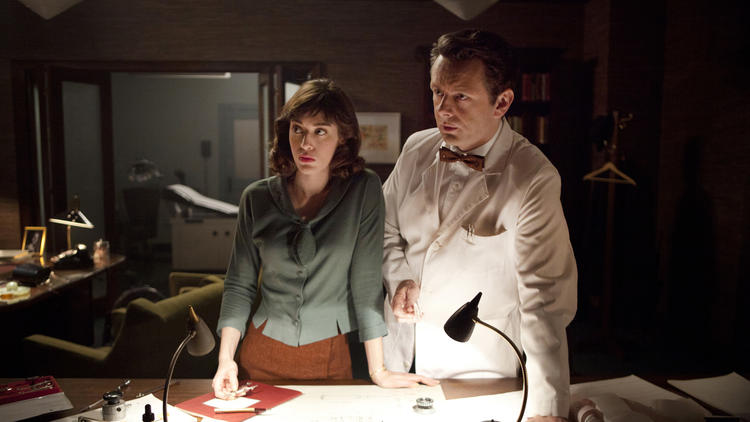

Lizzy Caplan and Michael Sheen star in "Masters of Sex." (Craig Blankenhorn / Showtime)

"The road to happiness can often be a road of awfulness in getting there," he added. "Bill has become the person he's become and he's adapted to life and dealt with things the ways he's dealt with them because of stuff that happened to him when he was younger, but it's not really working for him. What it's created is kind of a prison. And, yeah, he'd like to be free from that prison, but there's a part of him that made that prison for a reason, and he doesn't want to leave it. It's too scary. And I find that so damn interesting, I have to say. It's like he's the Walter White journey in reverse."

When viewers met Masters, he was a prominent but uptight OB-GYN physician at Washington University School of Medicine who was also a detached husband to a doting wife (Caitlin FitzGerald). He soon became fixated on the study of sex, a taboo subject particularly for an academic in the 1950s. Eventually, to pursue his passion, he enlisted Johnson to help conduct research — the two eventually began a sexual relationship.

The near constant in Masters' character is that he's a jerk much of the time. It's a boldly honest approach to a character that dares to buck TV's hang-ups with likability, Sheen said. And like Masters, Sheen isn't here to play nice and make friends.

Michelle Ashford, who developed the series from Thomas Maier's biography of the same name, initially gave consideration to making Masters slightly warmer and more palatable for viewers. The decision was being weighed during a time when audiences were actually rooting for "Breaking Bad's" meth-dealing Walter White.

But Sheen fought against softening his character to please viewers.

"There's a scene in Oliver Stone's film 'Nixon' where [Richard] Nixon points to a painting of JFK, and he says, 'When they look at you, they see what they want to be. When they look at me, they see what they are,'" he said in his best Anthony Hopkins-as-Nixon impersonation. "Most TV characters are who people want to be, even if it's Walter White.

"Sure, Don Draper isn't a pleasant character, but he looks gorgeous, and everyone wants to sleep with him. I don't look like that! And I want to make that a strength. At the same time, I have an absolute responsibility to be totally rigorous in making sure that he's a real person. Why shouldn't the audience have a character that's about all their worst qualities?"

The role was presented to Sheen during his run as Hamlet in a controversial production in London in late 2011. The call was Ashford's first glimpse of Sheen's intensity.

"He was really listening more than he was asking a ton of questions," Ashford said. "Since then, the back and forth between the two of us as to who Bill is and what makes him tick and what makes him weak is a true collaboration. You can't even say he's been invaluable to the process. He just is the process. We talk on the phone, by email, in his trailer — we talk all the time about this character. The way we're able to follow this character for a long time really stirs something in Michael."

Over breakfast, Sheen displays an equal curiosity over the medium's state of metamorphosis — the way it's consumed; its multi-platformness. The fascination has spurred him to begin developing his own projects for television. In doing research, he's read over some TV outlines — among them was the original series overview of HBO's "True Detective."

"In the very opening line, it's described as a 'literary,'" Sheen said. "It hit me like a bullet because I've been thinking about that. I feel like that is what this new version of TV is kind of becoming. It's a cross between a novel and a film. The way you can layer and reveal characters in this space is just so fascinating to me.

"It's why I'm OK with being the [jerk] in your living room. At least I'm not a [jerk] trying to cover it up."

Twitter: @villarrealy

'Masters of Sex'
Where: Showtime
When: 10 p.m. Sunday
Rating: TV-MA-LSV (may be unsuitable for children under the age of 17 with advisories for coarse language, sex and violence)

Tuesday, July 22, 2014

The 3 Scariest Words A Boy Can Hear

So what are those three scariest words? "Be a man."

This wisdom comes from Joe Ehrmann, a former NFL defensive lineman and now a pastor. He was interviewed recently for NPR's Utah Public Radio, and the transcript is below. This story is part of All Things Considered's "Men in America" series.

Interesting quote:
CORNISH: For you, what is masculinity? What does it mean to be a man?
EHRMANN: I think it could be only defined by two things. One, it's your capacity to love and to be loved. Masculinity ought to be defined in terms of relationships. Second thing, it ought to be defined by commitment to a cause - that all of us have a responsibility to give back - to make the world more fair, more just, more hospitable for every human being. So I think it's about relationships and commitment to a cause. That's the underlying of all humanity - men and women.
Cool interview.

The 3 Scariest Words A Boy Can Hear

By NPR Staff
Originally published on Mon July 14, 2014 

Listen  - 7:25


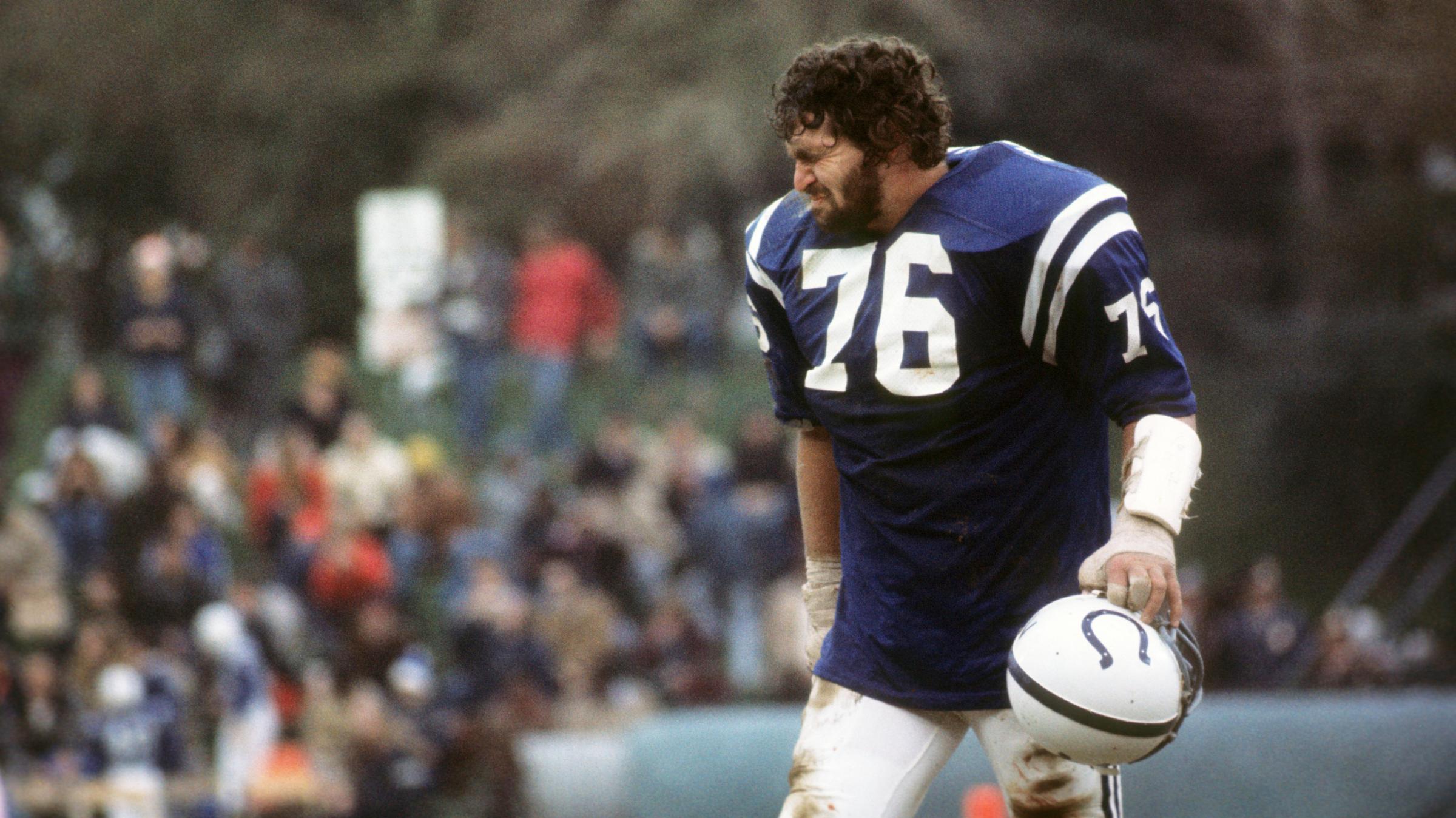
Joe Ehrmann, shown in 1975, was a defensive lineman with the Baltimore Colts for much of the '70s. He says that as a child, he was taught that being a man meant dominating people and circumstances — a lesson that served him well on the football field, but less so in real life.   Neil Leifer Sports Illustrated/Getty Images
This story is part of All Things Considered's "Men in America" series.

It's rare that a man makes it through life without being told, at least once, "Be a man." To Joe Ehrmann, a former NFL defensive lineman and now a pastor, those are the three scariest words that a boy can hear.

Ehrmann — who played with the Baltimore Colts for much of the 1970s and was a lineman at Syracuse University before that — confronted many models of masculinity in his life. But, as with many boys, his first instructor on manhood was his father, who was an amateur boxer.

Ehrmann says of his father: "I think his definition, which was very old in this country, was: Men don't need. Men don't want. Men don't touch. Men don't feel. If you're going to be a man in this world, you better learn how to dominate and control people and circumstances."

On the football field, those lessons served Ehrmann well. But, as he tells NPR's Audie Cornish, it was not the same case in the pediatric oncology ward. In 1978, Ehrmann's teenage brother was diagnosed with cancer. However tough Joe was on the field, he did not feel equipped to help his brother or himself.

Interview Highlights


On how his brother's death affected him

When he died, that was devastating to me. And I started to ask all the questions about what is the role, the meaning, the purpose of life. I was 29 years old, I was six years into my NFL career, and I had no concept — no concept what life was about, and no concept what I was about. And on this journey, I ended up asking the question: What does it mean to be a man? ...

I recognized that everything I had invested my life in — all my accomplishments, my achievements, the stuff I had accumulated — I recognized at that moment they offered no hope or help to my 19-year-old brother — 18-year-old brother — lying on his deathbed. ...

All I had was these old "man up" kind of things — "suck it up, we'll get through this together" — when he really needed the emotional, the nurturing, the love. And I had to really struggle to pull that out of my heart.

On the roles a coach can play in his players' lives

There's two kinds of coaches in America: You're either transactional or you're transformational. Transactional coaches basically use young people for their own identity, their own validation, their own ends. It's always about them — the team first, players' needs down the road.

And then you have transformational coaches. They understand the power, the platform, the position they have in the lives of young people, and they're going to use that to change the arc of every young person's life. I think football is an ideal place — sports in general — team sports are an ideal place to help boys become men. And the great myth in America today is that sports builds character. That's not true in a win-at-all-costs culture. Sports doesn't build character unless the coach models it, nurtures it and teaches it.

On what those philosophies look like on the field

I think there's a lot of screamers, there's a lot of shouters, there's a lot of shamers. My approach is this: Boy, you're in the middle of the game, and some kid's having a tough time. They get beat. ... I tell all my players, "Come on over to me during the game and I'll give you a hug." And you think about the power of a hug versus swearing, shouting, shaming at some kid.

When I played football, I hated [when] some kid would get a knee injury, your teammate would go down and that coach would say move the practice down 20 yards and leave that kid laying there. ... As coaches, we can kneel down next to that kid, you affirm the tears, the pain, the emotions, and you bring all the team around to say, "How can we help Bobby? He's one of us; he's done so much. He had so many dreams." So, you teach them how to build authentic community as men caring for and loving each other.

On the changes he's seen in ideas of masculinity

I think those three lies of masculinity — athletic ability, sexual conquest, economic success — in many ways, those things have been heightened. You have this increase in social media. You have young boys coming into this world, and they are hit 24/7. They're given all kinds of negative messages about their masculinity. They've been conditioned, and they have way more messaging out of this culture than I ever had as a young boy. I think in many respects, it's more difficult. There's more negative messaging out there and less positive.

On what it means to be a man

It think it can only be defined by two things: One, it's your capacity to love and to be loved. Masculinity ought to be defined in terms of relationships. Second thing, it ought to be defined by commitment to a cause. All of us have a responsibility to give back, to make the world more fair, more just, more hospitable for every human being. So I think it's about relationships and commitments to a cause. That's the underline of all humanity — men and women.

Copyright 2014 NPR. To see more, visit http://www.npr.org/.

Transcript


ROBERT SIEGEL, HOST:

This is ALL THINGS CONSIDERED from NPR News. I'm Robert Siegel.

AUDIE CORNISH, HOST:

And I'm Audie Cornish. We've been hearing about men this summer - how their roles have changed, what their lives are like. And one thing most men are told at some point in their early lives is this - be a man.

JOE EHRMANN: Yeah, I think every boy at a very early age is given this mandate to be a man. They're actually the three scariest words every boy receives.

CORNISH: That's former NFL defenseman Joe Ehrmann. He played in the 1970s, mostly for the Baltimore Colts. As with many boys, his first instructor on manhood was his father.

EHRMANN: I think in many ways my father gave me all the wrong concepts about being a man. I think his definition, which was very old-school in this country, was men don't need. Men don't want. Men don't touch. Men don't feel. If you're going to be a man in this world, you better learn how to dominate and control people and circumstances.

CORNISH: And, of course, men don't cry. On the football field, those lessons served Joe Ehrmann well, but not in the pediatric oncology ward. In 1978 Ehrmann's teenage brother was diagnosed with cancer, and however tough Joe Ehrmann was on the field, he did not feel equipped to help his dying brother or himself.

EHRMANN: When he died, that was devastating to me. And I started to ask all the questions about what is the role, the meaning, the purpose of life. I was 29 years old. I was six years in my NFL career, and I had no concept - no concept what life was about and no concept what I was about. And on this journey I ended up asking the question what does it mean to be a man?

CORNISH: Why that question for this particular really very emotionally wrenching part of life?

EHRMANN: Well, 'cause I think I recognized that when my brother was diagnosed and began his dying process - I recognized that everything I had invested my life in - all my accomplishments, my achievements, stuff I had accumulated - I recognized at that moment they offered no hope or help to my 19-year-old brother - 18-year-old brother lying on his deathbed. I was a socialized male that had separated my heart from my head, trying to live life from the neck up.

CORNISH: You were saying all you had were the locker room speeches basically.

EHRMANN: Yeah. All I had was these old man up kind of things. Suck it up. We'll get through this thing together. When he really needed the emotional - the nurturing, the love. Boy, and I had to really struggle to pull that of my heart.

CORNISH: You went on to seminary and to become a pastor. And you also went on to coach high school football. Now, can you talk about what it is in particular you think coaches can do to shift this ideology and whether you really have encountered coaches who are interested in doing that?

EHRMANN: Well, there's two kinds of coaches in America. You're either transactional or you're transformational. Transactional coaches basically use young people for their own identity, their own validation, their own ends. It's always about them - the team first, players' needs down the road. And then you have transformational coaches. They understand the power, the platform, the position they have in the lives of young people, and they're going to use that to change the arc of every young person's life. I think football is an ideal place - sports in general - team sports are an ideal place to help boys become men. And the great myth in America today is that sports builds character. That's not true in a win-at-all-costs culture. Sports doesn't build character unless a coach models it, nurtures it and teaches it.

CORNISH: You mentioned that coaches are either transactional - what can you do for me - or transformational. On the field, how does that play out? Are you basically talking about the screamers here?

EHRMANN: The screamers, yeah. I think there's a lot of screamers. There's a lot of shouters. There's a lot of shamers. My approach is this - boy, you're in the middle of the game and some kid's having a tough time. They get beat. I tell all my players, come on over to me during the game and I'll give you a hug. And you think about the power of a hug versus swearing, shouting, shaming at some kid. Boy, you know, when I played ball I hated - some kid would get a knee injury. Your teammate would go down and that coach would say move the practice down 20 yards and leave that kid laying there. Boy, as coaches, we get kneeled down next to the kid. You affirm the tears, the pain, the emotions, and then you bring all the team around to say how can we help Bobby? He's one of us. He's done so much. He had so many dreams. So you teach them how to build authentic community as men caring and loving for each other.

CORNISH: I'm speaking with Joe Ehrmann. He's founder of Coach for America. And so you've actually been doing this work for decades. And has the average boy changed in some way or are there changes you've seen in how they approach masculinity than when you were growing up?

EHRMANN: Not too much. Boy, I think there's different nuances and stuff, but we have a real crisis when it comes to what it means to be a man.

CORNISH: Not too much, really?

EHRMANN: I don't think so. I think those three lies of masculinity - athletic ability, sexual conquest, economic success. In many ways those things have been heightened. You have this increase in social media. You have young boys coming into this world and they are - 24/7 they're given all kinds of negative messages about their masculinity. They've been conditioned, and they have way more messaging out of this culture than I ever had as a young boy. So I think in many respects it's more difficult. There's more negative messaging out there and less positive.

CORNISH: Can you talk about a particular incident that really drives that home for you?

EHRMANN: Well, I think the Steubenville, Ohio, rape case - two high school boys - 16-year-old girl - drunk, passed out - hundreds of pictures taken - tweets. And that one person had the moral clarity or moral courage to intervene in the midst of that. Two boys sentenced to prison - had no idea about consent. They weren't taught this stuff. A community tried to cover it up. Boy, I think that thing is played out and could play out at any high school. Boys have to be taught about - they have to have the moral clarity and the moral courage to speak up. That's not going to end. Women can't end it. It's not going to end until we raise up a generation of men that have the courage to call out other men on behalf of women in this country.

CORNISH: For you, what is masculinity? What does it mean to be a man?

EHRMANN: I think it could be only defined by two things. One, it's your capacity to love and to be loved. Masculinity ought to be defined in terms of relationships. Second thing, it ought to be defined by commitment to a cause - that all of us have a responsibility to give back - to make the world more fair, more just, more hospitable for every human being. So I think it's about relationships and commitment to a cause. That's the underlying of all humanity - men and women.

CORNISH: Joe Ehrmann - he's founder of Coach for America. Thank you so much for speaking with us. EHRMANN: Great to be with you, Audie. Thank you.
Transcript provided by NPR, Copyright NPR.

Monday, June 2, 2014

Rite of Passage - A Father and Son Explore a Changing Landscape


Here is a nice article from Orion magazine on the journey of a father to imbue in his teen son the beauty and appreciation of nature that inspired the father to give up a journalism career to become a environmental activist.

Rite of Passage

A father and son explore a changing landscape

Mike Tidwell

Published in the May/June and July/August 2014 issue of Orion magazine


Sometimes travel is mandated, sometimes it is endured, but often it is undertaken for the sheer pleasure of seeing new places or visiting old friends. Sometimes we travel on foot, sometimes by plane, sometimes all it takes is a book or a good imagination to carry us away. What does travel mean, and how does it shape the course of a day or a lifetime? This spring’s double issue of Orion includes a special section exploring the idea of the journey, and we’re pleased to share one of the features with you here. To read the full special section, six features in all, subscribe to Orion and let the journey begin.


ABOVE THE ROCK canyon wall, the sun winks into morning view, drowsy and golden. The light pours onto the mute Rio Grande, soon finding our tent just yards from the bank. The slanting rays gradually find the sleeping face of my son, Sasha.

He’s fifteen years old. Not quite a man, but almost. We’ll be visiting colleges this time next year. He’s not a boy, either, although he looks consummately boyish in the innocence of slumber. I see the Little Leaguer in his face, and the kindergartener. In sleep we catch the last youthful poses of our children.

And at this moment, I wonder yet again why I brought Sasha to this wilderness place. Part of the answer is simple. I’ve traveled the world—the Amazon, the Serengeti, the Alps—and for me this is the most haunting and beautiful landscape on earth. We are in absolute backcountry: the Chihuahuan Desert canyons of “Big Bend Country,” literally that giant bend of the Rio Grande that separates west Texas from northern Mexico. The same sun washing over Sasha’s closed eyes is rousing the cliff swallows into song two hundred feet away. Around us, a million desert flowers go all electric in late-March bloom—red ocotillo, purple verbena, the magenta blossoms of cholla cacti. In the riverbank shallows, a longnose gar sloshes though the willow grass, hunting frogs.

Quietly, I slip out of the tent and catch a glimpse of a desert hawk winging hundreds of feet overhead, above the canyon. From up there, that hawk can see the nearby Chisos Mountains to the northwest, towering to nearly eight thousand feet with the deep-green cover of alpine woodlands. Below the peaks, that hawk can see the vast expanse of desert floor, all cactus and scrub, spreading north, south, east, west. And arching through it all is the pale green ribbon of the Rio Grande. But what that hawk doesn’t see are very many human beings.

I discovered the place fourteen years ago by accident. A newspaper editor asked me to visit Big Bend National Park, the twelve-hundred-square-mile jewel on the Texas side. The editor’s question: Why do so few Americans visit this most lovely of places? The reporter’s answer: It’s at the end of the earth, not on the way to anywhere, and surrounded on three sides by harsh and hostile Mexican desert.

But it’s beautiful. Shockingly so. And therein lies the problem in bringing my son—still-sleeping Sasha—to this place. It seems almost cruel. So many of the living things we’re here to celebrate, all across this landscape, are stressed out, dying, or migrating away from here. Like politics, all global warming is local. By roasting our common atmosphere with greenhouse gases, we bring chaotic change to regional ecosystems like the Big Bend region. Here scientists and fifth-generation ranchers and native people all tell the same story: unimaginable recent heat waves, freakish cold snaps and, above all, drought.

Just since I was last here—when Sasha was in diapers back home in Maryland—the place has changed. The pinyon pines in the Chisos range had not yet experienced “mass mortality” due to chronic lack of water. And the lechuguilla, a signature species of the desert, had not yet been flash frozen in huge numbers during the unheard-of cold spell of 2012. When Sasha is my age, fifty-one, this ecosystem will almost certainly be a distant memory, barring some global clean-energy miracle in the next few years, a rescue that seems less likely with each passing month of international inaction and domestic denial. So I struggle: Is this healthy? Is it right what I’m doing here, bringing Sasha to this place?

That morning in the canyon light, I’m bird-watching from the riverbank when the brightening day finally wakes up Sasha. “Hey, what’s for breakfast?” he asks. I hear his sleeping bag unzipping, his teenage voice turning to his favorite teenage subject: food. “Eggs and tortillas,” I say. “Outstanding,” comes the reply.

Within an hour we’ll be in a canoe, paddling through this still-rich land where the lechuguilla and pinyon pines are trying their best to recover and the roadrunners and tarantulas and mountain lions are all still here in good numbers, despite recent climate shocks. The Big Bend region, like the Amazon rainforest and the Great Barrier Reef, is an incomprehensively vast ecosystem still teeming with the life of the Holocene and our nearly twelve-thousand-year run of stable climate. Over 450 species of birds—more than in any other U.S. park—still live or pass through Big Bend National Park.

But we’re not voyeurs here, drawn to that shortsighted product of the global travel industry, see-it-while-you-can tourism. We’re here to see it, yes. While we still can, yes. And to bond in the delights of desert camping. But for me there are deeper, more elusive motivations. I have come to the place I love most in the world, with the person I love most, in order to . . . what? Apologize? Ask for forgiveness? Find some new hope in an unexpected fresh insight? All of the above? What, basically, do we say to our kids in the face of astonishing loss in the natural world? How much of that loss do we even want them to know about, to discover and love, as it changes and exits? What do we owe our kids? What do we owe these places? How do we even talk about all this?


WHEN SASHA WAS four years old, in 2001, I walked away from a twenty-year journalism career to become a full-time activist on global warming. The transition was not easy for him or me. I launched a nonprofit organization, raised money, hired staff, and worked nearly nonstop. Frequently reporters would call me at night or on weekends to discuss the latest terrifying scientific study on Arctic ice melt or rising storms. More than once I hung up the phone only to finally notice my little boy, fire truck in hand, looking up at me from somewhere in the room. “Are we all going to die, Daddy?” he’d ask.

“No way,” I’d say, swooping down for a hug. “No way. We’re going to fix this thing, I promise.” And off he’d go, building another Lego house, with windows and chimneys and always—always—lots of solar panels on the roof, just like our house. He assumed all homes had solar power. He assumed all dads talked on the phone about the end of the world, and then said not to worry.

It was a schizophrenic time, those early days of parenting and climate activism. I tried to manage Sasha’s relationship with nature, discouraging him from watching in-depth nature programs on TV, not wanting him to fall too much in love with all that. But we also hiked and camped and fished, a lot. I took him to the woods whenever I could. It’s my passion. And all his life Sasha heard me talk about Big Bend country. About this desert ideal in faraway Texas, and how I was going to take him there one day.

And then that day came. Sophomore year of high school. Spring break. Better go now before girls and college and career intervene. So we loaded up the backpacks, bought carbon offsets for the long trip, and boarded a flight at Reagan National. New sunglasses dangled from straps around our necks. High above the plains of central Texas, however, with nary a cloud below our plane, I realize something: I don’t have a plan for unspooling the big messages I had assumed—and hoped—would come from this trip. Thankfully, they began unspooling themselves.

“Look at that,” Sasha says, pointing to hundreds of pumpjack oil wells spread thousands of feet below us.

“Nineteenth-century energy,” I tell him.

“And what’s that?” he asks, pointing to an apparent matrix of rocket launchers.

“Fracking for gas,” I say. “Twentieth-century energy.”

And then, further west, I spot the series of awesome white lines, full of spinning giant blades. “Your century, Sasha,” I say, as the wind farms pass below our plane, working with haughty gracefulness in the Texas breeze. “Yours.”

We finally land in El Paso, along the northern edge of the Chihuahuan Desert, and head southeast by car. Tiny ranch towns soon give way to nothing but creosote bush and towering yucca, dust devils and lost burros. When the two-lane state roads finally run out five hours later, we enter Big Bend National Park. And it’s everything I remember.

“Did I exaggerate? Did I exaggerate?” I ask my son. He’s too busy shooting photos to talk much. The camera spoke softly, click after click, as giant agave plants float into view in golden, brittle poses. Then come the arroyos, violently beautiful in the distance, carved by a million flash floods. Then the Chisos Mountains, phantomlike, forested, painted in shadows. Click. Click. Click. And then swaths of red-blooming Indian paintbrush, punctuated with javelina tracks and the den doors of a strange desert rat that miraculously never, ever, drinks water. “You did not exaggerate,” Sasha says.

The camera’s clicking is a memory cue for me, reminding me of a speech Bill McKibben gave in 2005, addressing a group of climate activists gathered at Middlebury College. “Fight like hell,” Bill told us. “But be a witness, too. Go see the whales, the rainforests. There’s no guarantee we’ll save them all. Memorize this great world, the one we were born into. Tell others in the future. Their mistakes might be fewer if they know the greatness we once saw.” This had always been a central if unspoken part of this trip to Texas, of course. And it explained most of the trips to the woods during Sasha’s childhood. Be a witness, my child. Don’t forget these things.

And so on our first full day at Big Bend National Park, we race to the top of the highest mountain, Emory Peak, and toss off our backpacks. There, from nearly eight thousand feet, we look down on an absolute kingdom. It tumbles and flows below us, down from a crown of pinyon pines to a robe of scrub oaks and desert flowers to a labyrinthine floor of cactuses stretching to the Rio Grande and off into Mexico. We are at the summit, Sasha and I, at last, where mountain lions roam amid rare Carmen Mountain white-tailed deer.

And if only it had ended right there—if only the story had been exclusively about life that day, and not also death. But the path back down the mountain does not lie. It meanders past bright-orange metal signs put there by rangers: FIRE DANGER EXTREME and HIGH RISK OF WILDFIRE. Sasha photographs these too. Click. Click.

The first decade of the twenty-first century was one of the driest in Texas since record-keeping began. And 2011 was the driest single year of all for many parts of west Texas. Like a vise, the trend of severe drought, intensifying over the last half century, is clamping down here. Scientists say rising temperatures are to blame. The hotter it gets, the greater the evaporation, sucking moisture and life right out of the land.

I hear the sound of cracking twigs and crumbling pine bark under our boots as we walk through our first long stretch of dead woodlands that day. It is worse than a graveyard. The bodies are unburied: bleached pinyon torsos countless and eerie all around us. They fill narrow valleys and cover the tops of foothills in vast patches amid the still-green survivors. The dieback of these pines is happening all across the American West, affecting everything from black-chinned hummingbirds to black bears. At the edge of one maze of dead trees, we break for water. I had worked up a little speech for years. “Remember when you were little,” I say to Sasha, “and how I always told you we were going to solve global warming?”

“Yeah,” he says. I pause and then tell him, for the first time, about McKibben’s speech. Sasha is ready, I figure. Fifteen years old. “The wind farms just aren’t coming fast enough,” I say. “We’re going to lose a lot on this earth.”

But like Santa Claus and sex, we both know he’s understood the truth long before. It’s good to have it out of the way, nonetheless. “Yeah, I know,” he says, packing up his camera, ready for the final hike down to camp. “And I’ll remember,” he says. “I’ll remember.”


SASHA IS A WONDERFUL son: honor student, junior varsity baseball pitcher, Eagle Scout. Best of all, right now, he’s totally into this intense and adventurous trip west with his dad. But he’s still a teenager. Ten months earlier, right before turning fifteen, he told his mom and me not to bother getting him a birthday present if it wasn’t an iPhone. If we loved him, he said, we’d get him one. So we got him an iPhone.

After sunset, lying on our backs below a brilliant desert night sky, billions of stars above, the hallelujahs fill my ears as if from a choir. Sasha and I are side by side, stunned into silence by the celestial display. And his phone has no signal. None. Blessedly. For the entire week. Same with mine.

So we are able to float, undisturbed, into the infinity of outer space. That’s what it feels like on a moonless night in west Texas. It’s not stargazing here. A dense curtain of brilliant dots is pulled from horizon to horizon, each dot saying, “Touch me. Touch me.” At night, lying here on your back, you are in outer space. We spy a blinking satellite. We find Saturn, Orion’s belt, and Cancer. Ursa Major leads us to Polaris, the North Star. “Whoa!” I say, pointing to another impossibly long shooting star.

It’s midway through our journey, and this has always been part of the plan: to show Sasha the best star display in America and perhaps the world. It’s a counterweight—timeless, cosmic—to the earthbound challenges and intermittent sadness of this one desert expanse on a tiny planet in a lonely solar system. I can feel the cool sand against my back. “Is it bad,” Sasha asks, “that I wish I were watching March Madness basketball right now?” He pulls out his phone. “Don’t you wish we could know the scores?”


IF YOU WANT to take the long view of matters here and yonder, then Ten Bits Ranch is one of those word-of-mouth places worth wandering into. A self-styled eco-refuge just outside the western border of Big Bend, it’s run by two geologists who are also amateur paleontologists and off-the-grid enthusiasts. Solar panels power the whole ranch, including the lamps in the cantina that light up an amazing collection of dinosaur bones under glass. There are vertebrae from duck-billed hadrosaurs and tail bones from mammoth Jurassic crocodiles, all found on the five hundred acres here. We’ve come to Ten Bits to wash up between camping trips and to learn about low-carbon life in the desert. But mostly we’ve come to explore a mysterious cliff dwelling on the property, used by Apache, Comanche, and older Archaic tribes for millennia.

It’s another cool, blue-sky morning in the desert when we leave our cabin, walking past bleached cattle skulls nailed to fence posts. The ancient Indian settlement is a quarter mile away, up a gentle slope along the southern side of a low mountain. Our hearts are pounding as we scramble past the final few boulders and red-blooming ocotillo to arrive at this unmarked and little-visited place. The shelter is simple and primitive, consisting of a long, deep rock overhang. But evidence of habitation is everywhere, including cylindrical mortars in the rock floor, worn in from centuries of pounding grain with hand-held pestles.

We stand on the ledge, facing the distant Rio Grande, and imagine the people who once lived here. The south-facing overhang was for winter shelter, anthropologists believe, offering protection from the cold north wind. In summer, it would have been too hot here, too exposed to sun. I think of all those people. All those winters. They slept, daydreamed, argued, laughed, made love, belched, snored, and cried right here—for thousands of years, with only a crude shelter from wind, a bad shelter from rain, and no shelter from cold.

Reflexively, I begin looking for an arrowhead. I always do whenever I think I have any chance. I scatter small rocks with my toe. I peek under boulders. I talk while I hunt, trying to stay on message. “The thing is,” I say to Sasha, “this climate change we’re seeing worldwide is going to affect more than just plants and animals pretty soon.” His teenager impatience starts coming through. “You’re about to tell me life is going to get hard for all people soon, aren’t you?”

“Well, yes.”

“But that civilization will carry on somehow, even if it’s hard. These cliff dwellers endured under hard conditions.”

“Yes,” I say.

“Well here’s what I don’t understand,” he grumbles, standing on the ledge and pointing to Ten Bits Ranch in the distance. “See all those solar panels?” There were eighteen of them, polycrystalline, big, providing three kilowatts of power, enough to run a kitchen, lamps, a water well, iPods, all in the middle of nowhere. “Why,” Sasha asked, “can’t ExxonMobil just become the Exxon of solar? Can’t these companies make a profit building solar farms?”

“Yes.”

“So why don’t they do it and just get off of oil?”

“Because Exxon can make more money with oil right now. Bigger profits.”

“So this whole thing—Katrina, Sandy, drought—is about Exxon making slightly higher profits for a few more years until god knows what happens to the climate?”

“Yes.”

“Dad, how are you losing this debate?”

“We’re not losing it,” I say. “We’re just not winning it fast enough.”

“What’s it going to take?” he asks. “Just what in the world is it going to take?”

“I don’t know,” I tell him. “I don’t know.” I keep saying it. Until I stop saying it.

“Holy cow!” I shout. The stone in my hand is not an imposter this time. It’s not a mere triangle-shaped rock with coincidental sharp edges. It’s an arrowhead. Carefully worked. Chipped, flaked, pointed. I found an arrowhead.


THE WEEK, too soon, roams to a close as we head back toward El Paso, our dusty tent and backpacks stuffed in the trunk. I feel a restlessness lift from me. I’ve finally done it. I’ve taken my son to this place. And now I’ll never come back here again. I know it. Not me. I have my memories. I love those memories. Why risk them with another return?

“What?!” Sasha exclaims when I tell him this. He’s appalled. “You’re crazy not to come back. I’m coming back. And I’m staying longer. As soon as I can.” From the passenger seat, he’s shooting some final desert photos.

And then I see it in his face. He has the same bug I’ve had for a decade and a half, but in a different way. He just finished touring a beautifully imperfect place. A place in transition. But he’s not sad. He’s not bummed out, perhaps despite my best efforts. He has a different starting point than I do. Born in 1997, all he’s known is a fast-changing, impermanent earth. So the world seems less fragile to him, I think. More elemental. Rock, sky, sand, life. It will all be here whenever he returns. And, if pressed, I think he would call that hope.
~ Mike Tidwell is the author of several books, including Bayou Farewell: The Rich Life and Tragic Death of Louisiana’s Cajun Coast. His journeys to Africa, as a Peace Corps volunteer, and to Asia, as a journalist, allowed him to encounter firsthand evidence of global warming—experiences which led him to found the Chesapeake Climate Action Network, where he is executive director.

Sunday, May 11, 2014

It Took Losing My Mother to Finally Know Her

I wrote this several years ago and posted it on Integral Options Cafe in 2005. I thought it might be a good time to reshare this post, in honor of sons and mothers who struggle to know each other as people, and maybe as encouragement to change that, if at all possible.

When I posted this piece, my mother's uterine cancer had just returned and metastasized into her whole abdomen and into her brain. A few days later, on August 24 of 2005, I sat beside her in a hospice as her breathing slowed and then stopped. A quiet end to a painful life. 

Here is a picture of me from back in 2003, give or take, about 36 years old. Unfortunately, I have no pictures of my mother scanned into this computer.

Getting to Know Ruth

Three years ago, my mother was diagnosed with uterine cancer. The doctors thought it was terminal. Somehow, she recovered from the surgery, the chemo, and the radiation and lived for two+ years in remission. But uterine cancer nearly always returns, and so it has. My mother is in a morphine-induced coma to ease her pain. She will likely never awaken.

When she was first diagnosed, I wrote the following entry in my journal – a confession of sorts, as well as a tribute to the woman who raised me as best she could. She lasted three years longer than anyone thought possible, long enough to lose her daughter and to see her son find himself as a man.


Getting to Know Ruth
5.25.02


For thirty-five years, my life until this very moment, my mother has been a non-person to me. Obviously, I knew she was human, had a history before my birth, and possessed her own hopes and fears. But I never really saw or experienced her as a real person, a complete human being. She was my mother, a collection of feelings and memories that I had accumulated over these thirty-five years.

A few nights ago, however, I found out she has cancer, very serious cancer. She has been sick for almost a month, but now it is official: uterine cancer, maybe more that will be discovered in surgery. But the surgery will have to wait until they can control some blood clotting that might kill her during a surgical procedure.

She told me she is tired, that after seventy-two years -- very difficult, challenging, painful years -- she is ready to die.

For the first time in my life, my experience of her shifted. It wasn’t the first time that I was in a care-taking role with her (for several years after my father died, when I was 13, I was the adult in the house), so the shift has to be something else. After a lot of tears, a few hours of writing in my journal, and listening to Lou Reed’s Magic and Loss, I began to clearly see my mother for the first time -- to see her life, her struggles, her loves, all from a place outside my own needs and fears.

My mother has become a person, a person whom I love very much, a person whom I hardly know, a person who is dying.

*****

My mother was born in February, 1930, along with a fraternal twin brother. When she was conceived, the world seemed to offer unlimited potential. There were jobs, and it was easy to support a family of five, even for the children of German immigrants at a time when Germans were not trusted after the First World War.

Then the stock market crashed and the Great Depression began. Big cities like Chicago – where my mother's family settled – were hit hard. Jobs of any kind became scarce. Suddenly it was next to impossible to support a family of five. My grandfather took any work he could get, but still, there was often only enough food for one meager meal each day. Sugar cubes were given to satisfy the hunger of crying children. The struggle to feed the family went on for several years. My mother and her brother developed rickets, a deficiency illness caused by a lack of calcium and vitamin D. My mother and her brother were severely malnourished at an age when proper nutrition determines normal physical and intellectual development.

As a result of this malnutrition, my mother, like her brother, did not experience normal intellectual growth. Her IQ scores would likely test in the range of 70 to 80. By most standards, she is developmentally disabled. She has had difficulty living independently during those years when she was not living with her mother or married.

*****

I was thirteen when my father died. By that time I had been identified as “talented and gifted” and placed in advanced classes in school. It was difficult for a strong-willed and precocious child to grow up with a challenged parent as primary caregiver.

When my father died, I was the one who took care of the funeral arrangements, the insurance policy, the government pension my mother would receive, and all the other financial decisions. I continued to perform most of the money-related tasks for two or three years. However, within six months of my father’s death, I was smoking pot regularly, drinking whenever possible, and beginning to show a lot of unconscious anger. 


Emotionally, I was completely shut down, using chemicals to stay numb. My straight A grades began to decline. I was in pain and needed a strong mother to comfort me, but she was in too much pain of her own, too lost to be able to help my sister or me. She was diagnosed with depression and put on medications that made her sleep a lot, although the sleeping is also part of the depression.

Over the next several years, I became a daily drug user and was arrested for alcohol possession, vandalism, and growing my own marijuana. Grace alone kept me out of jail or the morgue for the better part of my teen years. The times I was locked up only made me angrier and more determined to feel nothing.

During those years, my relationship with my mother was terrible. I was incapable of seeing how much pain she was in, how lost she felt, how much she needed my love and support. However, as I became increasingly lost in a haze of smoke, drink, and pills, she learned to pay the bills on her own, got a driver’s license for the first time in her life, and found the strength to call the police when she found my little pot-growing operation. I was sixteen and completely out of control.

Although I knew my mother was different from other mothers, even when I was young, it wasn’t until I was a teenager that I truly became aware of the reality. I wasn’t understanding or compassionate. I was angry. I made fun of her in front of my friends. I told her she was stupid. I hurt her in more ways than I can count. And she just kept on loving me and doing her best to keep me alive and healthy.

As I write this, I still feel so much shame for those actions and words. I’ve spent the last 15 years trying to make up for the pain I caused her during those five years when I was acting out every shadow element in my psyche. If I had 100 more years to make amends, it would not be enough.

When I was 19, after hitting my personal bottom, I cleaned up my life and went to college. I studied psychology, literature, and religions. I began to learn a little about why I was so unconscious and confused during my teen years, and pieces of why my mother has had to struggle in her life. Most importantly, I began to learn about powers greater than me in this amazing Universe.

*****

My mother is not like other mothers. She was never able to help me with my homework. She seldom read to me. She was incapable of advising me on whom to go to parties with when I was in middle school and dating was new and awkward. When I began to publish poems after high school, she never asked to read them or showed any interest in my writing. When I was in college, she didn’t ask about my studies, had no awareness of national or international events, and only wanted to know if I was employed.

She isn’t like other mothers. I saw the mothers of my friends turn their backs and walk away from troubled sons and daughters, unable to face their failures as a parent and their children's pain. But my mother never stopped loving me, supporting me, or trying to help me, no matter how awful I became, and I became very awful. Where other mothers might or did give up, she loved me even more.

After 35 years, I am finally able to see that she was gifted in ways I could not understand earlier in my life. She has an amazing heart, a capacity to love that my mind can barely grasp. I didn’t have the mother I wanted, but I had the mother I needed. To get to where I am now in my life, I had to go through the pain and confusion of my youth, and I didn’t need someone to guide me through it, I just needed someone to love me no matter how lost I found myself. If I had been guided through those difficult experiences, without the pain, there would have been no learning, no understanding, and no wisdom gained from the experience of finding my own way through the dark places within me.

I would not wish my teen years on anyone, but those experiences are what allow me to sit here now and write these words. If I hadn't been so out of control, my mother may have never found the strength to take control of her own life and learn to be as independent as she became. Again, we get what we need, not what we want.

So, now she is dying. This comes at a time when my life is in a liminal space between who I was and who I will become, a self-chosen disruption of the course my life was following. In the middle of all this, my mother is diagnosed with cancer.

Odd as it may sound, the timing for this to happen in my life could not be better. I am in a unique position in my life to change the way I see the world, to change the meta-narrative of my life, to re-open my heart in ways I have been too frightened to do in the past. For the first time in my life I am on the path of self-discovery and healing. It makes all the difference.

From this place in my life, I have learned to step back from myself, to see through the eyes of my observer self, or Witness. Through those eyes I see my mother as a person. I can see her struggles, her fears, her joys, her successes. I see her weaknesses and her strengths. I see her not as my mother, but as wonderful human being who has survived 72 painful, challenging years while holding onto the love in her heart. I see a woman who is not capable of knowing how extraordinary she is. I see a woman who inspires me to open my heart and learn to love in the same selfless way she has loved others for her entire life.

I am blessed to come to see my mother as the human being she is, not just as my mother. I have been given a chance to know her in ways I could never imagine before. I want to learn how she was able to love others so easily, despite being told she was not like everyone else and being treated as deficient.

My mother is not like other mothers. For however much time she has left, I want to learn about her fears, her joys, her life. I want to know the person who is named Ruth. 


R.I.P., Ruth Sophie Harryman, born Ruth Sophie Koenig.

Thursday, December 19, 2013

The Meaning of Masculinity - How Three 2013 Films Depict Masculinity in a Time of Societal Flux

Via The Washington Free Beacon (a seriously right wing paper - sorry about that), this article reviews three films from 2013 in terms of what they reveal about masculinity in a time when it's in flux, both for individual men and for the society as a whole. I haven't seen any of these, but they all sound interesting.

The Meaning of Masculinity

The Place Beyond the Pines, The Spectacular Now, and Dallas Buyers Club on what it means to be a man


December 6, 2013


As awards season kicks into high gear, critics are inundated with screeners for films they may have missed the first time around. Here are three prestige pictures—The Place Beyond the Pines, The Spectacular Now, and The Dallas Buyers Club—that are interesting for the competing ways in which they present masculinity in a time of societal flux.

###

Luke: He can get his own kid. That’s every man’s right.

The Place Beyond the Pines

Derek Cianfrance’s The Place Beyond the Pines is a story of fathers and sons, and the way sons become their fathers. But it is more than that, a look at masculinity in America and what it means to be a man in a changing world where opportunities are scarce.

Luke (Ryan Gosling) is a carnival daredevil who discovers that during his last turn through upstate New York he fathered a child. He is forced to choose: quit his act and get involved with his kid’s life or push on, same as always. Sticking around, of course, isn’t enough. He needs to earn the respect of Romina (Eva Mendes), his son’s mother. To do that, he needs to earn money. And to do that … well, how does a carny with no work experience, no skills, and a tendency to get violent do that?

In post-industrial America—an America in which there’s minimum-wage work and not much else for the unskilled—Luke doesn’t have many options. He is desperate to live up to his ideal of manhood—a father to his son, a provider to his lover—and that desperation eventually boils over. So he takes to robbing banks, upping the stakes until, eventually, he gets crushed.

###

Dan: If I were your father, I guess this would be the part where I give you a lecture.

Sutter: If you were my father, you wouldn’t have to give me a lecture.

The Spectacular Now

For much of The Spectacular Now, there is a noticeable lack of male role models in the life of the hard-drinking Sutter (Miles Teller). Sutter lives with his mother, a nurse doing her best to get by while raising a kind but troubled kid.

But then we see what has become of Sutter’s father and we understand that no influence can be better than a bad influence. His dad Tommy (Kyle Chandler) is a drunken lout, more interested in hooking up with the local slattern than having a beer or three with his long-neglected son. Indeed, he sticks Sutter with the tab as he scoots off to catch a case of the clap.

The closest things to positive male role models in Sutter’s life are Dan (Bob Odenkirk), his boss at a men’s clothing boutique, and Mr. Aster (Andre Royo), Sutter’s long-suffering math teacher. Each takes a different approach to straightening Sutter out: Mr. Aster offers the stick (do better in math or I’ll fail you and you won’t graduate) while Dan offers the carrot (you can avoid being downsized by promising not to come into work hammered). But neither has enough influence over the boy to set him on the right path.

Sutter needs a father, not a father figure. But the dissolution of the nuclear family and the lack of stability that results have destroyed whatever chances Sutter might have had at success. And it’s not long before his pathologies threaten the stability of Aimee (Shailene Woodley), another fatherless child floating through modern America, trying to find something on which to grab hold.

###

Ron: I got a newsflash for y’all: ain’t nothin’ out there that can kill Ron Woodruff in 30 days.

Dallas Buyers Club

Dallas Buyers Club isn’t terribly interested in fathers. But it is fascinated by the way traditional conceptions of masculinity initially may have facilitated the spread of AIDS—and then helped get the disease under control.

Ron Woodruff (Matthew McConaughey) is a man’s man in mid-1980s Dallas, running scams at the rodeo when he isn’t fixing the electrical systems on oil rigs or bedding trailer trash skanks two at a time, coke-rings around his nose and Jack Daniels in his gut. That excess comes back to haunt him, however, as he catches HIV from one of his conquests.

When the doctor who diagnoses him asks if he has engaged in homosexual relations recently, Ron snarls that he’s no “faggot.” HIV? That’s for queers and junkies. He loves the ladies and takes his drugs nasally, thank you very much.

But Ron definitely has HIV. And as he comes to grips with that fact, he must also come to grips with the fact that his friends have abandoned him. He’s no longer welcome in his local watering hole or at his place of business. He even gets evicted from the trailer park in which he lives. After overdosing on the retroviral AZT—at the time going through FDA testing—he heads to Mexico to concoct a cocktail of unapproved drugs.

Discovering a better way to keep his disease under control, Ron also stumbles into a business opportunity: He can sell his blend of drugs to similarly desperate men. This brings him into contact with the “faggots” he once so despised—and with them comes a modicum of compassion. His fight to live (and to save the lives of others) gives him new purpose, and helps him redefine what it means to be a man.

###

All three of these examinations of masculinity are interesting in spurts and all three have their problems. The Place Beyond the Pines is the most ambitious, in part due to its disregard for narrative conventions surrounding time lapsed on screen. Cianfrance discards the flow of the story in order to rather pedantically drive home the point he wants to make: The sins of the father are revisited upon the son.

The Spectacular Now, meanwhile, is the most heartfelt of these pictures. There’s a real pain in Sutter’s eyes; you can feel him struggling to make sense of his life in a world that doesn’t quite know what to do with him. Unfortunately, it feels a bit slight.

Dallas Buyer’s Club is probably the best of the three, and McConaughey deserves the buzz he’s receiving for his starring turn. But the film feels something like a Hallmark-special-by-way-of-HBO. We are in the theater to learn a lesson about tolerance and compassion and acceptance, and we’re rarely allowed to forget that fact.

Friday, November 29, 2013

A Son Learns About Life Through His Father's Death


Over at his Psychology Today blog, Going Out Not Knowing, David B. Seaburn, Ph.D., L.M.F.T. discusses being with his father the day he died, and the lessons he learned on life from being with father as he died.
I was forty-eight when he died. I am sixty-three now. I carry his pocket knife with me every day. At one time I lost his knife for two years so my brother bought me another one exactly like it. Now I can carry two. I have his watch on the night stand beside my bed.
Fatherloss is one of the most difficult experiences in many men's lives. One of the better books on this topic is Fatherloss: How Sons of All Ages Come to Terms with the Deaths of Their Dads by Neil Chethik - you can read the introduction here.

The Day My Father Died

Being with my father when he died taught me more about life than death.

Published on November 9, 2013 by David B. Seaburn, Ph.D., L.M.F.T. in Going Out Not Knowing


November 11, 1998 dawned grey and cold. I had been staying with my brother and mother in Ellwood City, Pa. off and on for six weeks since my father had been diagnosed with acute leukemia. The doctor had given him six to eight weeks to live. It had been a long twenty-two years since my father had had a heart attack, years littered with health problems, years of caregiving for my mother. My father was eighty years old and proud of it. His brothers had all died before him, mostly of heart disease, one at the age of thirty-six. The day before he died was my parents’ fifty-sixth wedding anniversary, something that he was unaware of. We crossed our fingers that day, hoping he would live through it.

A few days before his death, my mother and I received a call in the middle of the night from my father’s nurse. She said he was restless and afraid and that we should come to the hospital. When we arrived, he was not afraid at all. In fact, he was smiling and more alert than he had been in many days. My mother and I stood by the bed talking with him. He joked that a beer would taste good about now. At one point he asked my mother to kiss him, which she did. Then he asked me to say a prayer, so the three of us held hands while I prayed.

That was his last lucid moment. He was unconscious most of the time after that.

I knew he was dying, but I did not recognize this as his goodbye. We had been making daily trips to the hospital for weeks and had fallen into the dying routine with its waiting, and watching, and remembering, and lunches at the hospital café, and stories, and laughter, and sadness, and silence. I realized later that I had assumed that my father would just go on dying, but never actually die.


On the morning of November 11 I took my dog, Abby, for a walk in the school yard near my parents’ house. We stopped and talked to a neighbor who asked all about my father. When I got back to the house, it was a little after 9am, a later start than usual. My mother wasn’t quite ready. My brother was on the road, his trucking job not allowing him time to be with us that morning, although he was with us emotionally throughout. I told my mother that I would go to the hospital, see how things were, and then come back to pick her up.

When I got to hospital, I checked in with the nursing staff at the desk to see how my father’s night had been. Then I went to his room where he lay on his back, his mouth open, his breathing slowed. I spoke to him as I always did, reporting on the weather, talking a little about how the Steelers were doing. I put some water on a tiny sponge and dabbed his lips. I cleaned his nose. Then I sat on the naugahyde lounger beside him. His breathing was labored. I listened to him exhale and waited anxiously for his inhale. I counted the seconds between each breath. One, two, three, four, more anxious now, five, six, seven, finally another inhale and I felt relieved. Again, and again, and again. This went on for several minutes. Around 9.20am----one, two, three, four, five, six, seven, eight, nine--- I stood up and looked at Dad. I listened and watched. I placed my hand on his chest. By then I knew he had died. I held his hand, his fingers still soft and warm.

Quietness.

I had the strangest sensation (perhaps my last moment of denial) that my dad would wake up and tell me all about dying, what it was like, how it had gone, as if having triumphed over the last of life’s challenges, he could give me some wisdom about what to expect.

I was forty-eight when he died. I am sixty-three now. I carry his pocket knife with me every day. At one time I lost his knife for two years so my brother bought me another one exactly like it. Now I can carry two. I have his watch on the night stand beside my bed. When my wife and I watch our two little granddaughters (ages four and two), they love to play in our bedroom. The two-year old, Makayla, always stands on the bench beside my nightstand and puts my father’s watch on. It slides up to her armpit as she holds her arm up high. When she is done, she puts it back exactly where she found it.

When I was forty-eight, I hoped my father’s death would teach me about dying. At sixty-three, I think it has taught me mostly about living; that life is short but beautiful; that even though time is measured, there is enough, if you pay attention; and that everything that matters in life is here, now.

David B. Seaburn, Ph.D., L.M.F.T.


David B. Seaburn, Ph.D., L.M.F.T., served a rural country parish, worked in community mental health, was an assistant professor of psychiatry and family medicine at the University of Rochester Medical Center for twenty years, and directed a public school-based free family counseling center. He co-authored two professional books, Family-Oriented Primary Care (1990) and Models of Collaboration (1996), over sixty articles, and four novels: Chimney Bluffs (2012), Charlie No Face (2011—Finalist in General Fiction, National Indie Excellence Awards), Pumpkin Hill (2007), and Darkness is as Light (2005). He and his wife live near Rochester, NY. They have two adult daughters and two wonderful granddaughters.

Tuesday, October 15, 2013

Jackson Bliss - A Scarcity of Affection Among Men

This is one of the unfortunate truisms for men in this culture - we are raised to see affection as foreplay, as sexual, and not as a vital human need. Over at the Good Men Project, Jackson Bliss shares his experience of waking up to this reality and his process of understanding it.

A Scarcity of Affection Among Men

October 7, 2013 by Jackson Bliss
Jackson Bliss sees how men have grown up seeing affection as sexual behavior, not social behavior. And that is one of the tragedies of our times.
Once, just as I was about to step inside Union Station in New Haven, an old black guy with fuzzy grey hair and glasses stopped me on the sidewalk and asked me if I had a light. Though technically I’d stopped smoking when I’d started grad school, my bad habit resurfaced at the end of every semester because of the stress. It was reading period, so I pulled out my lighter with a little guilt and tried lighting his cigarette. The wind was strong and erratic though, extinguishing the flame every time I rolled the flint. As I became impatient, I finally grabbed his soft, wilted old hand and cupped it with mine, lighting his cigarette undisturbed. He took a big puff and exhaled. Then he nodded his head, smiled at me and said: Thank you, son. By the time I was inside the train station, I was bawling.
At first, I didn’t understand where the tears were coming from. Maybe, I wondered, it was the anxiety of having to write three thirty-page essays in the next ten days or my secret dread of seeing my on-again-off-again girlfriend in New York who I fought with every weekend like a professional scrapper trying to dodge the first inevitable blow. Maybe it was the dreary Connecticut weather finally getting to me, weather that reminded me of Dante’s description of purgatory. Maybe I was sad because I was a poor grad student from Chicago who sometimes felt lost and out of place in New England. And maybe I was just really vulnerable that day. Whatever the ultimate reason, the tears poured out of me inside the station, on the escalator and even on the train where I looked out the window to avoid the sharp looks of commuters. The real issue buried underneath my grief was the fact that I rarely got the male affection I’d wanted as a kid. And the sad thing is, I’m not the exception either. 
♦◊♦

My pops is a good guy, but he’s old school (which means he’s not very good at expressing himself). While he’s slowly learned to respect me as a man, we’ve never been very close. When we hang out in Chicago, for example, I’m almost always the one to initiate things. Because we’re different politically and professionally, we’ve had to strain to understand each other for most of our lives. When I was a kid, we never played in the backyard together (I played catch or soccer with my spunky obāsan). Because I was a latchkey kid, I only saw my parents for four hours a day max, most of our time spent in the kitchen and the TV room.

To be honest, I can’t remember my dad hugging me as boy nor do I remember him being proud of me growing up (except when I graduated from high school, which was really important to him). Even when I gave my MFA reading six years ago in nearby South Bend, I remember not being surprised that my dad didn’t show up. Now, I don’t point these things out an indictment because my dad is a good and hard-working person (and god knows I could be a rambunctious, argumentative, and exasperating little punk). My dad helped me a little bit with my college tuition, paid for my final year of high school at my Jesuit prep school and remained emotionally devoted to my obāsan his entire life, even after my parents split up. He was a dad in the only way he knew how to be with me, slowly evolving once he remarried his second wife and had a third son (who he has a much more proactive and affectionate relationship with). It’s only recently that I’ve truly felt he’s proud of me for the man I’ve become, and maybe this is related to my stubborn professional aspirations as a fiction writer, to finishing my PhD, and to marrying the love of my life. Maybe his recent respect for me has nothing to do with any of those things. As I’ve grown up and become comfortable with my self, I’ve learned to overcome the big issues I had with him, but I point out the scarcity of affection in my relationship with him because I think it partially explains why male approval was always so important to me growing up, why I still have a soft spot for male affection, why I still find myself seeking the respect of older men. 
♦◊♦

One of the pernicious consequences of living in a country still struggling with homophobia, social verticality, and patriarchy, is not just the rigid gender roles this system imposes on men (and obviously women), but also the way it prevents grown men from expressing love, gratitude and affection to each other (and often to their sons). Because of this, many boys grow up seeing affection as inherently unmasculine because their fathers never modeled affection and unconditional love as a constituent part of their own masculinity.


Just as tragic, our system still punishes boys for expressing love and affection to each other (except in the case of sports) by subjecting them to social and sexual taboo, which means boys will grow up seeing affection as (hetero)sexual behavior and not social behavior, which is troubling. For many straight boys, affection will become gendered, the unique behavior of girlfriends, moms and female friends. While girls are victims of the system just as much as boys are, the system victimizes them in different ways at different stages (through slut-shaming, income inequality, domestic relegation, sexual objectification and ownership, for example). But one of the major systemic tragedies for boys is the ongoing poverty of male affection in their lives. As psychoanalytically unsatisfying as it is, for many grown men, there is a void inside us that was earmarked for our fathers’ attention and approval (which can often feel like signifiers of love). It’s a void we carry with us into adulthood, a void that only disappears (if it disappears at all) with friendships that are deeply communicative, supportive and unconditional. This void only disappears (if it disappears at all) with a lifetime of self-forgiveness for the emptiness we feel inside. This emptiness is not our fault, but if we deny its existence or pretend we’ve moved beyond the scene of our childhood trauma, we become victims of our own pathology, innocent bystanders in the crossfire of denial, unlovability and self-reproach.

Men only heal when we surround ourselves with others who are engines of deep and uncontrollable love, people who are compassionate, affectionate, forgiving and open with their emotions. For me, the most recent source of affection, kindness and love has been my wife, who I love more deeply than any person I’ve ever known. In high school, it was my religion and English teachers. In college, it was my brother and my friends. Someday, it will be my own fatherhood, which will give me new emotional space for repairing the tiny broken parts of me and for expressing my endless devotion, explicit love and continuous affection for my baby. Even though he doesn’t exist yet, even though she hasn’t even been conceived, my love for him is already enormous, already bigger than myself.


Photo: lenny montana / flickr