Showing posts with label children. Show all posts

Wednesday, August 20, 2014

The Science of Fatherhood (NPR)

This is an excellent NPR show on the science of becoming a father, and how current science has ignored or overlooked the important role of fathers.

This originally on The Daily Circuit from Minnesota Public Radio.

The science of fatherhood

The Daily Circuit · Aug 4, 2014


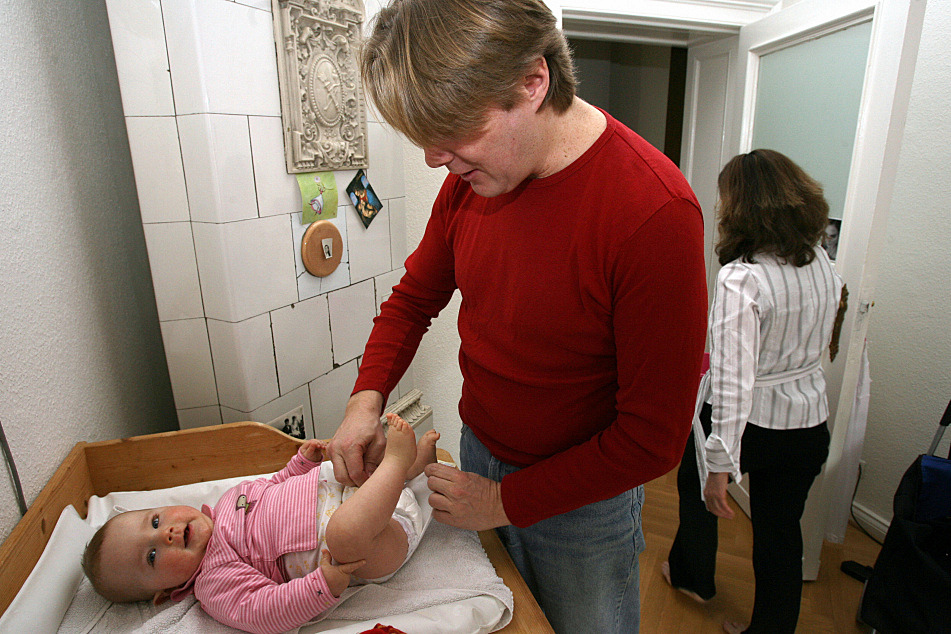
A picture taken April 21, 2006 shows Berlin, Germany resident Nicolas W. changing his 8-month-old daughter at home. JOHN MACDOUGALL/AFP/Getty Images

Listen: Story audio

39min 13sec

Guests
  • Dr Eli J Finkel: Professor of psychology and of management and organizations at Northwestern University
  • Paul Raeburn: Author of "Do Fathers Matter?" chief media critic at the Knight Science Journalism Tracker and blogger at About Fathers for Psychology Today
Parenting is hard work - we've always known that. There are major biological and life changes that occur when you welcome a baby into your home.

Social scientists, however, have been taking a new look at the experience of parenthood. In an article Dr Eli J Finkel in The New York Times, he said the biological changes that a man faces when he becomes a father have long been overlooked:
Although many parents happily take to their new role, millions every year respond with despair. According to a 2010 article in the Journal of the American Medical Association, among new parents -- three to six months postpartum -- 42 percent of mothers and 26 percent of fathers exhibit signs of clinical depression. In a longitudinal study reported earlier this year in the journal Pediatrics, men on average experienced significant increases in depressive symptomatology across the first five years of fatherhood (if and only if they lived with their child). Indeed, in the years after becoming a parent, both men and women experience significant reductions in their overall level of satisfaction with their lives, according to a 2008 paper in The Economic Journal.
Author Paul Raeburn says that beyond the initial transition of becoming a father, science frequently omits the role a father plays in a child's life - be it the role of a sperm donor, a bread winner, a primary caretaker or a relationship that doesn't fit into one category.

Finkel and Raeburn join The Daily Circuit to discuss how becoming a father impacts a man, and what role a father plays in a child's life.

Sunday, August 17, 2014

Michael Brooks - Men Can Be Just as "Maternal" As Women, According to Neuroscience

http://www.newrepublic.com/sites/default/files/u187208/fathersnewstatesman.jpg

"Sometimes science needs to state the bleeding obvious." Indeed, that about sums it up. But the "bleeding obvious" around this topic is not widely believed in the U.S. Women are still considered better care-givers, more emotionally attuned, and more nurturing. Those of us who know single fathers know this is not true.

By the way, this comes from The New Republic, via The New Statesman.

The researchers scanned the brains of parents while they watched videos of their own interactions with their children. What they found is that brain activity increases in two areas (the article did not name the areas and the study is pay-walled):
One is an emotional network that deals with social bonding, ensures vigilance and coordinates responses to distress, providing chemical rewards for behaviors that maintain the child’s well-being. The other network is concerned with mental processing. It monitors the child’s likely state of mind, emotional condition, and future needs, allowing for planning.
In the secondary care-giver, the activity is stronger in the 2nd area, the one focused on planning and monitoring the child's state of mind. In the primary care-giver, the social bonding and distress response area is most active.

Here's the aha! moment: the above was true no matter who was the primary caregiver, the mother or the father (if the father does not have a female partner). In fathers with female partners, whether they are primary or secondary caregivers, "the relative size of the of emotional and thinking responses varied according to how much time they spend looking after the child."

Take home message: "Neuroscience tells us that children who are raised by two fathers experience the same care-giving environment as those raised by a mother and a father."

Support the Anti-Bulling Campaign
Dan Savage (right), his husband Terry (left) and their son, DJ (middle).

Well, damn, this IS bleeding obvious.

Men Can Be Just as "Maternal" As Women, According to Neuroscience

By Michael Brooks
July 25, 2014

Occasionally, scientific research comes up with banal findings that should nonetheless stop us in our tracks. For example, researchers recently published a study showing that a father’s brain will change its hormonal outputs and neural activity depending on his parenting duties. The conclusion of the research is, in essence, that men make good parents, too. Surely this is not news.

Yet it does provide evidence that is sadly still useful. Those involved with issues of adoption, fathers’ rights, gay rights, child custody, and religion-fueled bigotry will all benefit from understanding what we now know about what makes a good parent.

The biggest enemy of progress has been the natural world, or at least our view of it. Females are the primary caregivers in 95 percent of mammal species. That is mainly because of lactation. Infants are nourished by their mothers’ milk, so it makes sense for most early caring to be done by females.

Human beings, however, have developed more sophisticated means of nourishing and raising our offspring. Should the circumstances require a different set-up, we have ways to cope. It turns out that this is not just in terms of formula milk, nannies or day care: We also have a flexible brain.

The new study, published in Proceedings of the National Academy of Sciences, scanned the brains of parents while they watched videos of their interactions with their children. The researchers found that this stimulated activity in two systems of the brain. One is an emotional network that deals with social bonding, ensures vigilance and coordinates responses to distress, providing chemical rewards for behaviors that maintain the child’s well-being. The other network is concerned with mental processing. It monitors the child’s likely state of mind, emotional condition, and future needs, allowing for planning.

In mothers who are the primary caregivers, the emotional system was most active. Fathers who are secondary to a female caregiver were more engaged as thinkers and planners. But men raising a child without a female partner were found to have the same level of emotional response as a mother and the same thinking and planning response as the secondary father. In other words, they are able to perform both roles.

What’s more, for men in both primary and secondary roles, the relative size of the of emotional and thinking responses varied according to how much time they spend looking after the child. To give the child the best care, the brain changes its output depending on circumstances.

Neuroscience tells us that children who are raised by two fathers experience the same care-giving environment as those raised by a mother and a father. Similar studies still need to be conducted on single mothers, non-parents raising children and dual-mother parents but the likelihood is that they, too, will display similar plasticity.

Oregon State University’s Sarina Saturn writes that this will one day be regarded as a landmark study. That is a little depressing—we shouldn’t need scientific research to tell us this. Yet she is right. It will help dispel prejudice, just as the discovery of homosexual activity among animals helped to dispel the myth that this is somehow unnatural. We now know that the brain “is flexible enough to keep up with the times”, as Saturn puts it. Hurrah. Sometimes science needs to state the bleeding obvious.

~ This piece first appeared on newstatesman.com.

Wednesday, June 25, 2014

Roughhousing Lessons From Dad

Dad\\\

It's nice to see researchers looking at the role of fathers in their children's lives. This review of recent research comes from the Wall Street Journal.

Roughhousing Lessons From Dad

Fathers Teach Risk-Taking, Boundary-Setting; Learning From 'Sock Wrestling'


By Sue Shellenbarger
Updated June 11, 2014


http://m.wsj.net/video/20140613/061014lunchworkfam2/061014lunchworkfam2_640x360.jpg
Fathers who spend time with their kids help instill self-control and social skills, numerous studies show, but exactly how fathers do that is a mystery. WSJ columnist Sue Shellenbarger and father of two Greg Kessler join Tanya Rivero on Lunch Break to decode the father factor. Photo: Greg Kessler

There is no question among researchers that fathers who spend time with their children instill self-control and social skills in their offspring.

Exactly how dads do that, however, is largely a mystery.

Thousands of studies have sliced and diced the benefits for children of a close, nurturing bond with Mom. Researchers have a harder time analyzing the ways fathers interact with children, such as rough-and-tumble play.

Some scientists are inventing new scales and laboratory procedures to try to measure the father factor. One researcher watched fathers and children playing games like "Get Up," in which fathers try to get up from the floor while the children try to hold them down, and "Sock Wrestle," in which father and child try to snatch each other's socks. Other researchers had toddlers climb down stairs in fathers' presence, in a process dubbed "Risky Situation."

"Most people have a pretty well-defined sense of what it means to be a good mom, but for dads, that role is much less scripted," says University of Georgia researcher Geoffrey Brown, lead author of a 2012 study in the Journal of Family Psychology on fundamental questions about how fathers bond with children.


Theo Stroomer for the Wall Street Journal

Greg Kessler likes to roughhouse with his 7-year-old son Ezra or his 4-year-old daughter Zoe. He loves wrestling, pillow-fighting and a game they call "Big Chair, Little Chair," when he lies down, balances a child on the soles of his feet and raises and lowers the child in midair, says Mr. Kessler, a New York City photographer.

His wife, Paula Trotto, believes her husband's play style will help Ezra learn to stand up for himself, but "it does baffle me" that her husband enjoys getting the children so excited, she says. At times, she adds, "I have to leave the room. It's such an intuitive thing, to not want to tolerate the sounds of your kids screaming."

The primary test of attachment—a key concept in child-development research—was developed to analyze babies' bonds with mothers. This procedure, known as the "Strange Situation," has mothers briefly separate from their infants twice. Babies who are upset but readily comforted by the mother when she returns are seen as having a secure bond.

Positive scores tend to sync with other measures of mothers' sensitivity and to predict better cognitive and emotional skills in children later. But when researchers put dads through the Strange Situation, the scores don't consistently predict much, and often fail to match other measures' results.

Many researchers believe dad's bond is expressed a little later, when the father serves as a secure base allowing the child to explore and take risks. This is hard to study in a lab. Animal studies, however, show that baby rats deprived of rough-and-tumble are more aggressive and lack social skills as adults.

The Father Factor

Researchers studying fathers' role often look at how they act during rough-and-tumble play. Here are some positive signs:
  • Father is immersed in the game emotionally, smiling and laughing
  • Father shows spontaneity, creativity or silliness
  • Father is good-natured about losing, with no signs of ego
  • Father helps the child control his or her emotions and calms him or her when overexcited
  • Father adjusts his effort and his technique based on the child's cues
  • Father motivates the child to stay engaged and keep going, or rejoin the game
  • Father is dominant but shares the upper hand, allowing the child to win sometimes
--Richard Fletcher, University of Newcastle in Australia
In an early study at the University of Regensburg in Germany, researchers created a scale to evaluate parents' play, based on whether they challenged kids to stretch themselves, were sensitive to their emotions and encouraged them to solve problems. Mothers and fathers were observed playing with blocks or play dough with their 2-year-olds. Fathers' scores were a unique predictor of children's healthy attitudes toward relationships with others at age 16, according to the 2002 study of 49 subjects led by Karin Grossmann, a senior scientist at the university.

Christopher VanDijk tunes in closely to signals from his 4-year-old son Liam that he wants to play. "He gets this mischievous look on his face, and you just kind of know," says Mr. VanDijk of Denver, an at-home dad. "We have pillow fights. And I pretend like I'm going to eat his ears. There's lots of squealing."

Liam sometimes takes the lead, saying, 'I'm going to scare you, and when I say, "Boo!" you have to say, "Ahhh!" ' Mr. VanDijk also watches for signals that Liam is out-of-control or frightened. "There are times when you put on the brakes," he says.

Rough-and-tumble play isn't confined to fathers. "If a mom does it, the child will learn the same thing," says Catherine Tamis-LeMonda, a professor of developmental psychology at New York University.

Mr. VanDijk's wife Angie, a college administrator, often plays active superhero games with Liam. "Sometimes he needs quiet time, sometimes he needs scuffle time," she says.

Fathers engage in more scuffle time on average, however. Using an adjustable carpeted ramp, researchers at New York University asked 34 parents to show how steep a slope they'd allow their babies to attempt. Some 62% of fathers said they would let their babies try a slope beyond their ability, compared with 56% of mothers, says the 2007 study co-authored by Dr. Tamis-LeMonda.

Many fathers walk a fine line during play between safety and risk, allowing children to get minor injuries without endangering them, says a 2011 study of 32 subjects in the Journal of Developmental and Behavioral Pediatrics. Researchers say this can instill emotional intelligence under fire, and an ability to take prudent risks and set limits with peers.

Navdeep Singh Dhillon likes play-fighting with his 4-year-old daughter Kavya, pretending to throw a kick, teaching her how to block it, then saying, "OK, it's your turn to kick me," he says. He sometimes traps Kavya and his 4-month-old son Shaiyar in a leg lock and has Kavya "tap out," tapping him three times as a signal to release them. Mr. Dhillon of Jersey City, N.J., a college professor, says such play teaches children to set boundaries. "When they have relationships of their own, or with other kids, they'll know what is OK and what's not OK."

Richard Fletcher, an Australian researcher who has studied fathers in free-form games with preschoolers, says fathers need to follow children's lead sometimes, while encouraging them to stretch themselves, and to let them win often enough to have fun—but not so often that they lose interest. Dr. Fletcher, a senior lecturer on the health and medicine faculty at the University of Newcastle, invented a scale to measure quality of play. In a study published last year in Early Child Development and Care, researchers video-recorded 26 fathers in their homes playing the games "Get Up" and "Sock Wrestle" with their 3- and 4-year-olds. Children of fathers who scored high on play quality had fewer social and behavior problems.

The "Risky Situation" is a 20-minute test that assesses children's confidence to explore. Toddlers are placed in a room with their father and a stranger and allowed to play with the stranger, then to climb down a set of stairs. Toddlers who explored with confidence, while heeding limits set by their fathers, had better social and emotional skills 12 to 18 months later, according to a 2013 study co-authored by the test's creator, Daniel Paquette, an associate professor of psychoeducation at the University of Montreal in Canada.

Dr. Tamis-LeMonda is video-recording daily routines of 100 New York City families. In a past study, she discovered "hall ball"— a game where "Dad throws the ball down the hallway," and the toddler brings it back, she says. "That's a natural, everyday routine we wouldn't have known about if we just brought families into the lab and said, 'Here are some toys.' " Such insights, she says, "might guide future research."

Write to Sue Shellenbarger at sue.shellenbarger@wsj.com

Saturday, June 14, 2014

Shawn Phillips - The 10 Best Things About Being A Dad

This is an old post from Shawn, dated 2009, but it's still relevant. Since tomorrow is Father's Day, it seemed like a good time to share this with those who may not see Shawn's Start Strong Monday blog.

It's kind of an interesting "holiday" for me - it's been 34 years since I have had a father, and if he were still alive (he'd be nearly 88 years old), I doubt we would be on speaking terms. The experience of growing up with him (and my equally dysfunctional mother) are why I knew by my teens I would never have kids.

All of this combines to make Father's Day a bit of a mystery. I don't know the feeling of actually being grateful for a father's love and guidance; nor do I have the experience of being a father and feeling that affection from my kids.

So I observe, vicariously and share those things that seem insightful.

The 10 Best Things About Being A Dad

Tue, Jun 23, 2009

sp_bp_mtn_2 

Yesterday was father’s day—a holiday I used to resist. I thought it a bit unnecessary. “Why dedicate one day to showing our father’s we care when we can do it 365 days a year?,” I reasoned.

Well, now that I am a father my view on this has made a 180. I still remember my first father’s day (now 10, geeze) 5 years ago, surprised I was by how great it felt to belong to the category of fathers. It was also special because my dad, BP, was alive and we both got to share the day.

Yesterday may well have been my best father’s day since. 

Sure, it’s great to get gifts and just be recognized but what struck me is how much better I am with self-care, with putting myself near the top of the list on this one day. In my experience this is a place where most father’s struggle—finding time for me.

To all those father’s out there: I hope that you too enjoyed a day where you were the featured attraction. And perhaps were able to anchor the feeling and recognize that while the family will always be first in mind and heart—taking care of self enables us to be more and give more to our children and spouses.
 Riding my bike through the stunning Colorado mountains yesterday I was contemplating the best things about being a dad. What follows are the highlights.

If you’re a dad, you need only skim these as I am sure you’ll connect with them instantly. At the end there’s a space for your story. I’d love to hear your favorite thing about being a dad. Whether it’s already on my list or not, share yours and I’ll make it worth your time, promise.

The 10 Best Things About Being A Dad


1. You finally know how your dad feels about you.


Regardless of the circumstances of your childhood, the moment you go from being “a guy” to being a father you “get it.” That is the feeling of what it is to love something more than life itself. I recall how my view of my father transformed in an instant. For I knew, no matter what he ever did or said, he too had felt “this” for me, my brother and sister. It’s not an optional feeling.


2. You know what it means to love something more than yourself.


Let’s face it, for all guys call sacrifice and profess to “give it up for,” not until we have a child do we really truly get what it is to hold something or someone else more important than self. And I believe this is a vital, transformational experience in life.


3. Whatever your age, kids make you young again.


If you’re a father you get this—if you’re not there yet, trust me on this. It’s so true. Your kids energy doesn’t wait on you. You get moving whether you want to or not. And they keep you playing more and seeing the world through the eyes of innocence that we’ve all worn once.

4. Being a dad makes you a better man.


I think we all like having the opportunity to be a mentor—to help someone learn and grow. It’s inherent in our DNA. And being a father is the ultimate mentoring opportunity—you get to truly shape a life(s). When it becomes obvious that it’s not just what you want them to pick up that they learn, you start thinking about choices you’d not given a second thought to before. Things like where you go, how you get there, who you hang around, etc. It all matters but what matters most is the man you are.


5. It’s a license to be silly and play


Once out of college it seems like the world gets pretty darn serious real quick. Having children brings play back into your life. Whether it’s wrestling around, dancing, making faces, telling jokes or playing tag—you’ve got a license to be your silliest. It’s hard not to go to a playground and play—just as I imagine it’s hard to go to a playground and play if you don’t have kids. It can look bad–so if you must at least stay off the monkey bars if you’re over 30.


6. It awakens you to your global responsibility.


Being a father makes you instantly more accountable and responsible to the world around us. Even if you’re one who’s been outspoken about your concern for the environment, politics or social issues of the day—with children suddenly you become more aware of everything that will impact the next generation and the next.


7. Someone is truly intrigued by your life wisdom stories.


Face it, guys like to tell stories from our formative years. As a father you finally have someone who is truly interested in all those stories that have bored others to tears for years. Enjoy the sharing and be a careful edit so as not to plant any unnecessary seeds—which I can tell you my dad did! They may take many years to materialize but trust me, really “good” stories can percolate for a long time.


8. You actually want someone to best you—to show you up!


While we all pull for friends and people we like, a child of your own is different story. It’s not just hoping they do well you truly want them to exceed any and every best you’ve ever enjoyed. It’s free from even the slightest jealousy of competitiveness and this is a refreshing, empowering feeling.


9. Being a father softens your heart and opens you to life.


No matter how focused you’ve been on getting ahead on your career and success—or how hardened your resolve from your own life circumstances, being a father will melt your heart. I won’t even try to explain it beyond that. At this point you either get it our you don’t. It’s that simple.


10. You’ve got Full Strength to help you be the world’s best dad!


For the other 364 days a year, when it’s not your day, you’ve got the life performance advantage of Full Strength nutrition, the world’s first and only true premium nutrition shake built for the modern day warrior dad. The delicious tasting, convenient, clinically proven nutrition shake with the exclusive Performance Balance is intentionally created to elevate your every day performance in work, play and LIFE. It’s the once a day antidote to dieting that will give you more energy, more time and more vitality to be the Full Strength father you really truly want to be for your children.


Full Strength for SuperHero Fathers


Share ONE of YOUR favorite things being a father—a memorable moment or touching story—and then click here for Dad’s only FREE Shipping on a 2-week or 1-month packages… Full Strength is the only nutrition shake clinically proven to swap fat for lean muscle without any dieting whatsoever!


Until Next Week…

Stay Strong,


Shawn

Follow Me: Twitter.com/shawn_phillips

Saturday, March 15, 2014

Elizabeth Meyer, Ph.D. - The Danger with “Boys Will Be Boys”


Why don't we ever say, "girls will be girls," when a girl does something that makes uncomfortable because it suggests a shadow side of their "girlishness"? Yet when a boy, let's a nine-year-old boy staring at a girl in a bikini at the beach, does something that makes us uncomfortable (because we know it is sexist or objectification), we simply write it off as "boys will be boys."

In this article from her Gender and Schooling blog at Psychology Today, offers four points about how this "boys will be boys" model is bad for boys, and bad for the rest of us as well.
  1. It prompts students to construct gender stereotypes.
  2. Gender stereotypes allow unconscious biases to form and proliferate.
  3. It is misinformed thinking and oversimplifies the problem.
  4. It limits the full expression of children.
She makes some good points.

Image at the top is from NothingIsReal.

The Danger with “Boys Will Be Boys”

Why this phrase should be banned from our vocabulary

Published on March 14, 2014 by Elizabeth J. Meyer, Ph.D. in Gender and Schooling
This post is a response to The Way We Talk About Gender Can Make a Big Difference by Christia S. Brown, Ph.D.

I’ve had a couple different conversations with the teachers at my child’s preschool about some of the aggressive behaviors a few of the children have been exhibiting. It has been most alarming to wake up in the morning and have my three-year-old say to me, “I am a robot, I’m going to eat your brain and peel off your skin.” I was also concerned to learn that when a child brought in a Ninjago book, the teachers read the book to the children even though Common Sense media reports that this series is best for children 7 and over and has 0/5 educational value, 2/5 for violence and 5/5 for consumerism. When I have expressed my concerns about some of these issues, every conversation has ended the same, with the teacher saying, “Oh you know, boys will be boys.”

That statement effectively has ended the conversation because it has left me too stunned and flabbergasted to respond. I bite my tongue each time because I don’t want to be THAT parent who is viewed as oversensitive and disengaged from reality. I also want to have a productive dialogue that will allow the preschool to hear my concerns in a way that may allow them to shift their thinking about how they address these issues. This blog is my attempt to organize my thoughts and gather some relevant research in order to help other parents and teachers who may find themselves perplexed by the same situation. So why is “boys will be boys” dangerous?
  1. It prompts students to construct gender stereotypes. A recent Psychology Today blog post discussed the impacts of gendered language in elementary schools and how teachers who simply said things like “good morning boys and girls” vs. teachers who said “good morning children” led students to engage in more gender stereotypical thinking such as “only women can be kind, gentle and take care of children” or “only men should be a doctor or construction worker.” These gender stereotypes are limiting for everyone. One of the most damaging impacts is a phenomenon called “stereotype threat.” This is the impact of internalizing stereotypes about your group and having that impact your academic performance that has been documented in the research of Steele & Aronson (1995) and Aronson & Williams (2004). Aronson explains “when social conditions threaten basic motives—our sense of competence, our feelings of belonging, our feelings of control—this can dramatically influence our intellectual capacities.” He goes on to say, “These studies shed considerable light on how stereotypes suppress the performance, motivation and learning of students who have to contend with them and they suggest what educators can do to help.” For example, students of color underperformed in similar measures when students were asked to mark their gender or their race on their test paper, and in cases where students were not "reminded" of this group membership and as a result, the associated stereotypes, students performed much better. Another study confirmed that girls performed better in math assessments where stereotype threat was reduced (Quinn & Spencer 2001). Another Psychology Today blogger wrote eloquently about research showing how this impacted children as early as 1st grade and their attitudes toward math and language arts.
  2. Gender stereotypes allow unconscious biases to form and proliferate. Unconscious bias is a term that describes internalized attitudes about a particular group of people that then can shape our interactions with that group. In Jean Moule’s 2009 article, Understanding unconscious bias and unintentional racism, she calls this "blink of the eye racism," which in this case would be "blink of the eye sexism." These sorts of unexamined and deeply embedded beliefs are powerful in shaping how we make decisions in hundreds of everyday interactions, which can impact students’ educational opportunities. David Sadker outlines many examples of how this impacts students in his 2002 article, An Educator’s Primer to the Gender War. He explains that teachers give more attention to the "more active" boys and less academic contact to the "quieter" girls, and although more girls are identified for gifted programs in elementary schools, by high school fewer girls remain in gifted programs—particularly African American and Latina girls. These stereotypes also reinforce the myth of the gender binary and "sex differences" which I discuss more in point four below.
  3. It is misinformed thinking and oversimplifies the problem. This expression attempts to explain away aggressive behaviors that a small number of children exhibit by linking it with "natural" or "biological" impulses without examining other reasons for the aggression. By linking aggressive behaviors with a child’s sex assigned at birth it ignores all the other environmental (family, media influences, messages at school, etc.) and individual factors (personality, nutrition, body chemistry, etc.) that might be influencing behaviors. It creates an easy excuse to fall back on so adults don’t have to examine other reasons for such aggressive behaviors. It is also often used to justify schoolyard bullying—often very extreme cases that are violent and homophobic in nature—and causes many adults to accept negative behaviors as "natural." The principal in the famous Nabozny v. Podlesny case where a student was hospitalized after being beaten up for being gay justified the assault using such terms. This phrase allows harmful behaviors to persist unchecked and possibly worsen over time. It also reduces the likelihood of adults intervening in interactions that can be really harmful.
  4. It limits the full expression of children. By saying “boys will be boys” it teaches children that certain behaviors are endemic to masculinity and exclusive to boys only. This form of thinking reinforces rigid binaries that cause us to develop more engrained “either/or” attitudes that allow our culture to ignore the true spectrum and variety of behaviors that individuals can exhibit. Janet Hyde from the University of Wisconsin, Madison has carefully critiqued the “science of sex differences” research by doing an extensive analysis of studies of sex differences. This meta-analysis of hundreds of studies showed that most reported differences between sexes are quite small. As a result she has developed the gender similarities hypothesis that humans are more alike on most factors than "common sense" would have you believe. The Psychology Today editors wrote about this study in a blog post in 2008 that summarizes the study quite concisely. Other books have been published that try to perpetuate this belief that males and females are very different, and the media are ready to repeat these stories because they are comforting and familiar to their audience. However, they are not supported by the majority of research and we need to be able to talk about children’s behavior in more complex and nuanced ways that don’t confine them to socially constructed pink and blue scripts.


I want my child to grow up in a world that allows him to explore his strengths and express his personality in ways that are true to him, not ways that society believes boys are supposed to behave. I hope by sharing some of this research here, other parents and teachers may be able to work more actively to combat this misinformed approach to working with children and allow our kids to explore and express themselves in ways that are authentic and healthy for them. This will hopefully minimize some of the academic gaps reported on here, as well as reduce some of the violence that many young men engage in, and allow gender-creative and transgender youth to be affirmed and supported in their home and school environments.

Tuesday, March 4, 2014

Higher Risk of Mental Illness for Those With Older Fathers

Hmmmm . . . my father was 40 when I was born. I certainly got the ADHD thing. In my 20s, I was suicidal more than once. And according to my girlfriend, I am on the autistic spectrum a wee bit. Thanks dad!

This comes via Dr. Jeremy Dean at PsychBlog.

Higher Risk of Mental Illness for Those With Older Fathers


Massive study finds children with older dads much more likely to have autism, ADHD and bipolar disorder.

A new study has found that the children of older fathers have a much greater risk of serious mental illness.

The findings come from a huge number of people: everyone born in Sweden between 1973 and 2001 (D’Onofrio et al., 2014).

The researchers included over 2.5 million people, representing almost 90% of the population.

They found associations between older fathers and psychiatric conditions such as bipolar disorder, schizophrenia, autism and ADHD.

When they compared fathers who were 24-years-old with those who were 45-years old, they found that children of the older fathers were:
  • 25 times more likely to have bipolar disorder,
  • 13 times more likely to have ADHD,
  • 3.5 times more likely to have autism,
  • 2.5 times more likely to have suicidal behaviour.
The findings remained after they controlled for birth order, education and a host of other variables.

Brian D’Onofrio, the study’s lead author, expressed surprise at these numbers:
“We were shocked by the findings. The specific associations with paternal age were much, much larger than in previous studies.”
Faulty sperm

The authors suggest that the explanation for the association is that, while women are born with all their eggs, men continue to produce sperm, which degrades in quality over their lifetime.

People are exposed to all kinds of environmental toxins which could cause this kind of genetic mutation.

Molecular genetic studies have indeed found just this degradation in the quality of men’s sperm with age.

D’Onofrio concludes:
“While the findings do not indicate that every child born to an older father will have these problems, they add to a growing body of research indicating that advancing paternal age is associated with increased risk for serious problems. As such, the entire body of research can help to inform individuals in their personal and medical decision-making.”
With the average age at which men have children increasing in many countries, these findings could have important implications for both public policy and for individual decisions about when to procreate.

Image credit: Nisha A
Dr Jeremy Dean is a psychologist and the author of PsyBlog. His latest book is "Making Habits, Breaking Habits: How to Make Changes That Stick". You can follow PsyBlog on Facebook, Twitter and Google+.

Saturday, March 1, 2014

A Third of American Children Are Growing Up in Homes Without Their Biological Fathers

Dads DO matter, a lot. There is ever increasing piles of evidence showing that children who grow up without their biological father (or any good father figure) do worse in school, have more social and behavioral problems, and are at increased risk of mental illness. Those are the facts.

But we also know that children who grow in homes with "family problems" are also more prone to many of the same issues.

This is a no-win situation for the kids. The only solution is for fathers to have more access to their children in the event of divorce or having fathered a child out of wedlock (the family court system is still blatantly anti-fathers in many areas of the country). Of course, that requires the fathers to WANT to be involved, which is more often the case now than ever before.

This article comes from The Atlantic.

Why Dads Matter

A third of American children are growing up in homes without their biological fathers.

Lois M. Collins & Marjorie Cortez Feb 23 2014


MIDVALE, Utah — Jordan Ott was the third of his mother’s six children, born over the course of four marriages.

By age 8, he’d had two step-dads; his brothers and sisters had more or fewer based on birth order. Each child also had different numbers of siblings, depending on whether their own dads fathered other children. Ott has one full sister, four half-siblings and at one point had three step-siblings “that I know of,” he said. His own father has mostly lived far away.

His story is not uncommon today. More than half of babies of mothers under 30 are born to unmarried parents. The divorce rate among those who do marry exceeds 40 percent, according to the 2012 State of Our Unions report.

These statistics play out most often in the form of absent fathers—or the arrival and departure of serial father figures involved in romantic relationships with a child’s mother. (Moms still usually retain custody in a breakup or divorce.) Twenty-four million American children—one in three—are growing up in homes without their biological fathers, the 2011 Census says. Children in father-absent homes, it notes, are almost four times more likely to be poor.


Like Ott, now 25, children may grow up with lots of father figures, but no real dad. Or they can be like Arvie Burgos, 17 and in foster care in Utah, who grew up in a virtually man-free zone.

Ott said he learned not to pay attention to stepfathers, even one he had for years. “If I did something wrong and needed discipline, he was all over it. Otherwise, we didn’t have too much to do with each other.”

Meanwhile, Burgos’ sole significant male role model was a young man he saw a few hours each month courtesy of a Big Brothers program. His father had never been part of his life and his mother was a drug addict. He could count on his grandmother, but she died when he was 15, about the time his mentor moved away.

“I think there’s consensus that cultural and family factors are causing children’s family lives to be more unstable than in the past,” said Andrew J. Cherlin, author of The Marriage-Go-Round and director of the Hopkins Population Center at Johns Hopkins University. Experts debate whether recent cultural shifts or economic changes most undermine family stability, but, said Cherlin, “most who I respect believe both are at play.” “None of this implies men are better as dads than women are as moms.”

Most children weather family turmoil and wind up OK, said Cherlin, who coined the term “family churn” to describe what happens to families as couples split, often moving dad out of the home and a new man in. A study in the Journal of Marriage and Family said children in such homes experience an average of more than 5.25 partnership transitions. That’s tough for kids who are used to having their own fathers within reach.

“Dad also helps with impulse control and memory and enhances a child’s ability to respond effectively to new or ambiguous situations, for boys and girls,” said Warren Farrell, author of Father and Child Reunion. Children who are close to their fathers tend to achieve more academically, while kids with absent fathers are more likely to drop out. Fathers are the biggest factor in preventing drug use, Farrell said.

The time a dad spends with his children is a particularly strong predictor of how empathetic a child will become, according to commission of experts who wrote a proposal asking President Obama to create a White House Council on Boys and Men. The group, which Farrell helped assemble, compiled research showing infants with dads living at home were months ahead in personal and social development. Children who lack contact with fathers are more likely to be treated for emotional or behavioral problems. Girls with absent or indifferent fathers are more prone to hyperactivity. If dad is around, girls are less likely to become pregnant as teens.

As early as 1993, studies showed that dads also influenced whether their sons became teenage fathers. A Temple University study found no boys born to teen mothers became teen fathers if they had close relationships with their biological fathers, compared to 15 percent of those who didn’t have that closeness.

“None of this implies men are better as dads than women are as moms,” Farrell and the commission emphasized. Children need both.

But dad’s place is not always secure. The commission report said, “The U.S. has done a better job of integrating women into the workplace than in integrating men into the family—especially into the lives of children in the non-intact family. We have valued men as wallets more than as dads.” The result is “moms feeling deprived of resources and dads feeling deprived of purpose and children feeling deprived of the full range of parenting input.”

Few have studied the relationship between children and sequential parent figures, said Paula Fomby, associate research scientist at University of Michigan. She said research suggests someone not biologically related is less likely to invest in a child for various hypothetical reasons, including unclear parental roles. Sometimes, father figures compete or are stretched thin by obligations to children fathered with other women.

The more transitions a child endures, the worse off he or she typically is, Cherlin said.

In Ott’s case, not all the siblings growing up with him experienced the family’s transitions the same way. Some of his younger half-siblings were actually living with both biological parents while he was dealing with a step-father. It was unequal and complicated as step-fathers treated him and his siblings each differently. He saw friends in intact families enjoy greater consistency, something he wants for his own future children.

“There is a great deal of evidence that children from single-parent homes have worse outcomes on both academic and economic measures than children from two-parent families,” wrote scholar Elaine C. Kamarck and Third Way president Jonathan Cowan in the introduction to Wayward Sons, a report produced for Washington think tank Third Way. “There is a vast inequality of both financial resources and parental time and attention between one- and two-parent families.”

The report also said absent fathers particularly impact the psychosocial and academic development of boys.

University of California-Berkeley’s Philip A. Cowan and his wife, Carolyn Pape Cowan, study parent couples. Their research shows a couple’s relationship is vital to their children, even if they are no longer intimate partners—whether they’re divorced, separated or never married.

“The relationship between two biological parents determines a lot about how fathers are going to be involved, and that determines a lot how kids are going to be,” he said. Simply improving the job market for young adults, especially men, would do wonders to stabilize families.

If parents get along, their children tend to be more psychologically and emotionally healthy. Moms who feel their child’s father backs them up are better mothers through all stages of the child’s development, reports the U.S. Department of Health and Human Services—“more responsive, affectionate, and confident with their infants; more self-controlled in dealing with defiant toddlers; and better confidants for teenagers seeking advice and emotional support.”

Ott’s father lived too far away to be available physically or emotionally. Burgos “knew” his father through a single letter and a phone call. Neither of them gained the benefits the studies attribute to an involved, interactive dad.

The federal government is beginning to recognize how important fathers are to children after years of focusing almost exclusively on mothers. Government-funded programs to promote marriage for at-risk families now include money for paternal involvement, too, Cowan said. Social welfare programs have been told to include fathers in case management. The Obama, Bush and Clinton administrations all funded healthy-marriage initiatives. Cowan called attempts to include fathers “islands of hope,” but concedes they’re “fighting decades of prejudice.”

The odds are still stacked against fathers in many government and nonprofit agencies designed to assist families, he said. Often, men’s names are not included on case files, even when parents are married.

Simply improving the job market for young adults, especially men, would do wonders to stabilize families—particularly those just starting out, Cherlin said. Experts have been surprised by the real drop in divorce among the college-educated, who still can get good jobs. He said young people need more job training opportunities and apprenticeships, especially if they’re not college-bound. Making sure tax policy doesn’t discourage marriage and providing a modest earned income tax credit for disadvantaged childless young adults would also encourage formation of stable relationships, he added.

Stable relationships are something both Ott and Burgos long for, and each can picture one in his mind. But both admit to feeling somewhat unsure about how to make it happen in real life.

Burgos said he had some good teachers and a foster dad he liked a lot, but no confidants after his “big brother” Jacob moved away. “I don’t really have deep emotional conversations with anybody,” he admits.

Ott recently married and hopes to have children and a stable family life. Burned more than once by the choices adults made when he was young, he keeps one eye on the past. It’s a path he doesn’t intend to travel.

“I’ve never had a family,” Ott said. “I know what I’m not going to do.”

This story is part of The Father Factor, a series, produced in collaboration with the Deseret News, on the role of dads in American society today.

Lois M. Collins and Marjorie Cortez

Lois M. Collins covers family issues for the Deseret News and is a recent National Health Journalism fellow. Marjorie Cortez is a reporter for the Deseret News, where she covers local government and human services issues including poverty, substance abuse, mental illness, homelessness, and refugee resettlement.

See also

Sunday, January 12, 2014

Findings from a Large and Recent Study of U.S. Paternal Involvement


Peter B Gray is co-author, with Kermyt Anderson, of Fatherhood: Evolution and Human Paternal Behavior (2012). In this post from their Psychology Today blog, The Evolving Father, Gray takes a quick look at new findings on the involvement of fathers with their children.

Some Father-Friendly Data

Findings from a large and recent study of U.S. paternal involvement

Published on January 8, 2014 by Peter B. Gray, Ph.D. in The Evolving Father


Data on Dads--Oh Boy

If you are a father of a 3 year old, how frequently have you read to your child the past four weeks? If you are the father of a 10 year old, how often have you taken your child to activities the past four weeks? If you delve into the results of a recent report issued by the Centers for Disease Control (CDC), you can find answers to eight of these kinds of questions from a nationally representative probability sample of over 10,00 men aged 15-44, about 4000 of whom were fathers. What are some highlights of the study? And what are some qualifiers and interpretations?

One of the themes highlighted during the late-December 2013 media rush on this study was the high involvement of fathers. Most residential fathers who fell into the study engaged in most of the activities they were asked about. As an example, 93% of coresidential fathers with a child aged 5-18 years of age reported eating a meal at least several times a week or every day with their child during the past four weeks. As another example, some 84% of fathers reported reading at least once a week with a child less than five years of age. So much for slacker dads, these figures suggest.

Another theme of the findings is that father involvement differed greatly depending on whether a father lived with a child or not. For the eight behaviors asked about (e.g., playing with a child), fathers who lived with a child reported engaging in these more often than fathers who don’t live with a child. Just over half of non-residential fathers reported not eating any meals with their child aged 5-18 or reading to their child under age five during the past five weeks. Dads are obviously much less involved if they don’t live with their children, even if that is hardly surprising. Coresidential fathers also perceive they are doing a better job at fathering (44% reporting very good) than their nonresidential counterparts (21% very good). Yet from another angle, it’s astonishing that non-residential dads do anything for their kids. As Kermyt Anderson noted in our Fatherhood: Evolution and Human Paternal Behavior book, one definition of our species’ uniqueness could boil down to the claim that, “humans are the species in which males continue to invest in offspring after the parents cease to be in a sexual relationship.” (p. 130)

Besides residential status, study findings were presented with respect to fathers’ age, cultural background, relationship status (marriage vs. cohabitation) and education. These factors were also associated with variation in paternal involvement. Older fathers reported playing less and reading more than did younger fathers, for example. Nonresidential Hispanic or Latino fathers were less likely to have eaten meals with their child aged 5-18 the past four weeks than were African American or White fathers.

With this bonanza of quantitative data on U.S. paternal involvement, what are some spins suitable to an “evolving father” blog? As some reports have noted, the data suggest some incremental increases in paternal involvement in the U.S. since the last comparable report in 2002. Other sources of data (e.g., time diaries) have shown increases in the time men spend with their kids, including some specific activities like cleaning or diapering them, in the past few decades. So by such measures it appears that U.S. dads are engaging in more direct care and interaction with their children.

Some other key elements are not included in the data. Most importantly, there is no information on fathers’ economic contributions. In the U.S. and elsewhere, fathers continue to be scrutinized carefully for their ability to contribute to the financial and material support of a partner and children, making the lack of such data here a notable gap. While it can be refreshing to see the spotlight on fathers shift from a focus on breadwinning to lots of direct behavioral involvement, more complicated discussions about contemporary male work/family tradeoffs, female work/family tradeoffs, and a sexual division of labor within families need both pieces. The report also ignored any potential differences between step- and genetic fathers, combining both groups within the category of coresidential fathers. Given potential motivational and material differences between step- and genetic fathers, that also warranted a distinction, even if to show previously-documented findings such that coresidential stepfathers may me more involved in their stepkids’ lives than those same children’s nonresidential fathers.

In summary, the data on American dads and their direct care are richer with this study, even if we can push those data into all kinds of other conversations (even a panel discussion at a local NPR affiliate).

Monday, December 23, 2013

How Childhood Neglect Stunts the Brain


According to a Psychology Today "Diagnosis Dictionary" entry, more children suffer from neglect in the U.S. than from physical and sexual abuse combined.
During 2005, 62.8 percent of victims experienced neglect, 16.6 percent were physically abused, 9.3 percent were sexually abused, 7.1 percent were emotionally or psychologically maltreated, and 2.0 percent were medically neglected.
Unlike child sexual abuse, where girls are more likely to be victims (based on reporting - there might be more "equality" here than statistics indicate), neglect is equal opportunity, with only a slight difference (2003) between girls (50.7%) and boys (47.3%) - it's unclear where the other 2% fall. Another study (2001) found boys accounting for 48.6 percent and girls accounting for 51.1 percent.

We have known for quite some time that neglect has serious impacts on brain development. Rene Spitz showed the effects of neglect on infant attachment in his foundling home studies. Spitz (1945) compared 61 infants living in a foundling home to 69 infants living in a nursery. The foundling home contained children given up by un-wed mothers whereas the nursery contained children of delinquent girls.

In the foundling homes there was very little to no interaction with adults, few things with which to play, and most of the infants' time is spent in cribs with extremely limited visual stimulation. In the nursery, however, infants were cared for by mothers or foster mothers, they were given toys, and the cribs allowed for visual stimulation. Spitz found that the Developmental Quotient for foundling home babies was averaged at 72, while for the nursery babies the Developmental Quotient was averaged at 105.

More recent research, with the aid of brain imaging, reveals that - among other issues - the mass of the corpus callosum was reduced by 15%–18% (Teicher, et al, 2004) in neglected children. I am particularly interested, however, in how neglect (or the corresponding inflammation from the stress response) impacts myelination.


This article is from Wired Science in 2012, but it remains relevant and informative. The original article is here:

Full Citation:  
Makinodan, M, Rosen, KM, Ito, S, and Corfas, G. (2012, Sep 14). A Critical Period for Social Experience–Dependent Oligodendrocyte Maturation and Myelination. Science, Vol. 337 No. 6090.

How Childhood Neglect Stunts the Brain


By Brandon Keim
09.13.12 | Wired Science


Photo: D. Sharon Pruitt/Flickr

Science is painting a dramatic picture of how childhood neglect damages developing brains, so stunting them that neglect might be likened to physically violent abuse.

The latest addition to this research narrative comes from a study of mice placed in isolation early in their lives, an experiment that, on its surface, might seem redundant: After all, we already know that neglect is bad for humans, much less mice.

But they key to the study is in the details. The researchers found striking abnormalities in tissues that transmit electrical messages across the brain, suggesting a specific mechanism for some of the dysfunctions seen in neglected human children.

“This is very strong evidence that changes in myelin cause some of the behavioral problems caused by isolation,” said neurologist Gabriel Corfas of Harvard Medical School, a co-author of the new study, released Sept. 13 in Science.

Corfas and his team, led by fellow Harvard Med neuroscientist Manabu Makinodan, put 21-day-old mice in isolation for two weeks, then returned them to their colonies. When the mice reached adolescence, the researchers compared their brains and behavior to mice who hadn’t been isolated.

The isolated mice were antisocial, with striking deficits in memory. Their myelin, a cell layer that forms around neuronal networks like insulation around wires, was unusually thin, especially in the prefrontal cortex, a brain region central to cognition and personality.

'The first years of life are crucially important for brain architecture.'Similar patterns of behavior have been seen, again and again, in children raised in orphanages or neglected by parents, as have changes to a variety of brain regions, including the prefrontal cortex. The myelin deficiencies identified by Corfas and Makinodan may underlie these defects.

“This is incredibly important data, because it gives us the neural mechanisms associated with the deleterious changes in the brain” that arise from neglect, said Nathan Fox, a cognitive neuroscientist at the University of Maryland.

Fox was not involved in the new study, but is part of a research group working on a long-term study of childhood neglect that is scientifically striking and poignantly tragic. Led by Harvard Medical School pediatricians Charles Nelson and Margaret Sheridan, the project has tracked for the last 12 years children who started their lives in an orphanage in Bucharest, Romania, a country infamous for the spartan, impersonal conditions of its orphanages.

Among children who spent their first two years in the orphanage, the researchers observed high levels developmental problems, cognitive deficits, mental illness, and significant reductions in brain size. When the researchers measured the sheer amount of electrical activity generated by the brains of children who’d been isolated as toddlers, “it was like you’d had a rheostat, a dimmer, and dimmed down the amount of energy in these institutionalized children,” said Fox.

These problems persisted even when toddlers were later adopted, suggesting a crucial importance for those early years in setting a life’s neurological trajectory. “There’s a sensitive period for which, if a child is taken out of an institution, the effects appear to be remediated, and after which remediation is very, very difficult,” Fox said. The same pattern was observed in Corfas and Makinodan’s mice.

One phenomenon not studied in the mice, but regularly found in people neglected as children, are problems with stress: mood disorders, anxiety, and general dysfunction in a body’s stress responses.

Controlled for gender and age, average white matter volumes in the brains of children who grew up in a Romanian orphanage (left), started in an orphange but were placed in foster care (center), or never lived in an orphanage at all (right). Image: Sheridan et al./PNAS

Those mechanisms have been studied in another animal, the rhesus monkey. While deprivation studies on non-human primates — and in particular chimpanzees — are controversial, the results from the monkey studies have been instructive.

Early-life isolation sets off a flood of hormones that permanently warp their responses to stress, leaving them anxious and prone to violent swings in mood.

Isolation is so damaging because humans, especially as infants, literally depend on social stimulation to shape their minds, said psychologist John Cacioppo of the University of Chicago.

“Human social processes were once thought to have been incidental to learning and cognition,” Cacioppo wrote in an e-mail. “However, we now think that the complexities and demands of social species have contributed to the evolution of the brain and nervous system and to various aspects of cognition.”

Corfas and Makinodan’s team linked specific genetic changes to the abnormalities in their mice, and hope they might someday inform the development of drugs that can help reverse isolation’s effects.

A more immediate implication of the research is social. As evidence of neglect’s severe, long-term consequences accumulates, it could shape the way people think not just of orphanages, but policy matters like maternity and paternity leave, or the work requirements of single parents on welfare.

“What this work certainly says is that the first years of life are crucially important for brain architecture,” Fox said. “Infants and young children have to grow up in an environment of social relationships, and experiencing those is critical for healthy cognitive, social and psychological development. As a society, we should be figuring out how to encourage all that to happen.”
Monday, October 7, 2013

This is What Real Fatherhood Looks Like (Good Men Project)

Nice collection of photos on the multiplicity of expressions of masculine fatherhood. The collection comes from the Good Men Project and it seems like a positive way to begin the week.

This is What Real Fatherhood Looks Like

September 6, 2012 by the Editors

Juan C. Gonzalez takes a photo of himself and his son flying through the air every single year. See more at Lime Fly Photography.
Tender, surprising, and brimming with love: these are images of real* fatherhood.

We asked Good Men Project readers what Real Fatherhood meant to them, and how it looked in their day-to-day lives. Here are some of the amazing photos, stories and tweets you shared with us during our #RealFatherhood campaign.
*”real” in this case = “real-life”, as in, not actors or media-created images.

♦◊♦

Dave is very at ease with the fact that he has twins.

♦◊♦


Gabe and Pierce – even their toes match.

♦◊♦


Mark Greene and son. More fun at MegaSAHD

Yes, sir, I do believe in the power of Post-Its.


♦◊♦


Marcus Williams and twin daughters

Are you both listening?


♦◊♦


Charlie Capen and son Finn. More fun from Charlie at How To Be A Dad.

One of us has put on his happy face.


♦◊♦


Chris and Sammie

There’s no party like a tea party…


♦◊♦


…except maybe a princess dress-up party.

“Is my tiara on straight?”


♦◊♦


Alberto and Quentin

There’s gotta be a better system for this.


♦◊♦


Single image (not photoshopped!) courtesy of Lime Fly Photography

They didn’t know about my broom!


♦◊♦


Ryan and Marc

For Ryan, being a good dad is about being a part of what his kids love.


♦◊♦


John, Hailey and Heather with friends
When John said he wanted to be chased by a mob of females, this wasn’t exactly what he had in mind…

No, this is way better.


♦◊♦


See more: The Happy Aspie/Flickr
Bek Caruso’s husband, Jeff, and their son, Alex. Bek and Alex both live with autism, and Bek and Jeff also live with ADHD.

♦◊♦


Matt and Alex. See more at Randy Schroeder photography

1-2-3 Jump!


♦◊♦

Baker Wright coaching his son in his first round of T-ball.


♦◊♦


Christopher and Derek

Some of the best moments in fatherhood are the quietest ones.


♦◊♦


Photo by Maria Allebring

The comfort of Daddy’s arms.


♦◊♦


Emily Heist Moss and her dad. Read more from Emily at Rosie Says Blog.

Mr. 90s Dad


♦◊♦

Lamont holds baby Mya in the NICU. His wife Amie explains the type of father Lamont has been to their children:


“I’m married to a guy who used to sing Elton John’s “Your Song”, and read the classic version of Peter Pan to our dying daughter. He made a great Tink… Here he is holding Mya about 2 months before she died. He was going on probably less than 3 hours of sleep over 2 or 3 days, which actually was pretty common because he worked and then spent every waking hour in the NICU.“

Read more here
♦◊♦


Ivan and Izz

Baby in blue at the center of the universe.


♦◊♦


Dr. Adam Sheck and his daughter winning first prize in a pie eating contest at a father-daughter picnic.

♦◊♦


Antonio, Gina and Stella

Silly Daddy!


♦◊♦


Jon D. writes: “She made me understand the absolute power of real unconditional love. I can not think of anything she could ever do that will make me not love her.”

♦◊♦


Nathan, dad of Owen and Aria. “They are my world.”

The perfect smell of a sleeping baby’s head.


♦◊♦


Josh and the girls. Photo by Erin Gant

Daddy Tickle Monster


♦◊♦


Lamont with Javen, Max and Ty. See more photos by Amie Lee

Peeing lesson


♦◊♦


Matt and Alex, by Mathias Johnson Photo

And into the future, Daddy forever more.


♦◊♦ 

Read all of the #RealFatherhood stories