Showing posts with label cinema. Show all posts

Monday, October 27, 2014

"Force Majeure" - A Movie That Will Change How You Think About Manhood (via Esquire)

This review of the new Swedish film Force Majeure (96% Fresh at Rotten Tomatoes), from Esquire, makes it sound equally important for most men to see and painful to have to sit through. Likely, both are true.

Here is the official trailer:


This seems to be a can't miss film, especially for those of us who care about creating a healthier more authentic masculinity.

A Movie That Will Change How You Think About Manhood

The bleak, funny Force Majeure


By Nick Schager on October 23, 2014


Tired of all those superheroes outmatching you in toughness, confidence, and manliness? If so, then the cinematic antidote has arrived in the form of Force Majeure, a Swedish film (and the country's Oscar entry) that tears masculinity a new one.

Opening in limited release tomorrow and then expanding in the coming weeks, director Robert Ostlund's film is ostensibly a drama. But its dissection of macho attitudes and guises is so unsparing that it achieves a pitch-perfect balance between scathing censure and black humor. Rarely has a film taken men to the woodshed for their failings with such a mix of disgust, pity, and wit, the last of which is the key ingredient that helps make Force Majeure such a unique high-wire balancing act. It puts the awkwardness of a Ben Stiller farce to shame, and investigates the man-child phenomenon more deeply than a timid Hollywood bro-comedy ever could.

The film, exquisitely shot to emphasize the dynamics between characters, concerns a middle-class Swedish family on a ski-resort vacation. They're an average clan, led by the average Tomas (Johannes Bah Kuhnke), whose defining characteristic is his milquetoast personality and habit of constantly checking his iPhone for work messages. Their perfectly pleasant, unremarkable getaway is demolished, however, when during breakfast on the resort terrace one morning, a "controlled" avalanche is detonated by mountain officials, and the cascade of snow approaches the vacationers. At first, Tomas tells his panicking children to be calm. Yet as the snow builds to a roaring wall facing them, the possibility of death becomes frighteningly real. In that moment, as wife Ebba (Lisa Loven Kongsli) grabs the children to shield them from the avalanche, Tomas grabs his gloves and phone—and flees.

Yes, he flees.


It's a moment of undeniable cowardice, and one that doesn't go unnoticed by Ebba and the kids, who, once the false alarm is over, sit in stunned silence as their father rejoins them at the table. Tomas's spinelessness and selfishness hang in the air for what seems like an eternity, even as they resume their vacation, with the kids miserable and Ebba barely able to contain her revulsion around Tomas. Her horror at her husband soon builds to an uncontrollable point, and it's then, during two separate conversations with other couples, that Force Majeure truly becomes a film that's watched while squirming restlessly and half-covering one's eyes.

During the first of those two chats, with a man and woman they've just met, Tomas denies that he fled the scene, thus digging himself an even deeper hole. Of course, Tomas is wracked with shame over his failure to act as protector, and Force Majeure depicts him as a man who's outwardly possessed and yet so internally weak and pathetic that he lacks even the courage to retroactively admit to (and atone for) his sins. Tomas hits rock bottom during a later evening spent with big-bearded friend Mats (Game of Thrones' Kristofer Hivju) and his 20-year-old girlfriend, who are put in the amusingly uncomfortable position of having to hear about Tomas's gutlessness, and then, in Mats's case, try to put a positive spin on indefensible behavior. During this tense centerpiece, director Ostlund refuses to turn away from his characters as they grapple with Tomas's shortcomings and the misery he's wrought, casting such an intense eye on Tomas and Ebba (and, in heartbreaking cutaways, their kids) that the film takes on the air of an inescapable nightmare at which you can only laugh.

Tomas's and Mats's ladies-man self-images are destroyed while they have a post-skiing drink, and Mats's girlfriend slams him for, hypothetically speaking, having the same cowardly instincts as Tomas (because, in part, he's left his kids with his ex-wife). No matter where you turn in Force Majeure, masculinity is under attack, and with good reason. And yet despite its scornful critique of traditional ideas about men's strength, bravery, virility, and altruism fostered by Marvel comics adaptations, Ostlund's film is no reprimanding lecture or slog. Instead, by rigorously fixating on his characters' faces as they refuse to look at each other or blubber uncontrollably over their own crappiness, he's created a sharply funny satire about the distance between what men project and what they really are. It's a joke for the ages, but it's also designed as a wake-up call to the real modern man-children of the world who haven't owned up to their true, flawed selves.

Wednesday, September 10, 2014

The 10 Best Movies About Becoming a Man (via Esquire)

Esquire has assembled their list of the 10 best male coming of age movies, beginning with this year's instant classic, Boyhood.

The original version of Lord of the Flies is a classic bit of weirdness and a deep look at the savage still lurking within all of us.

The 10 Best Movies About Becoming a Man

By Nick Schager on July 11, 2014


Richard Linklater's Boyhood.

Shot over twelve years in order to capture its headlining newcomer Ellar Coltrane's literal aging from a precocious 6-year-old kid to a lanky 18-year-old teen, the exceptional Boyhood, in theaters today, takes a unique approach to the coming-of-age saga. But despite the clever gimmick, it follows in a long line of films concerned with male maturation, a process that can be at once funny and awkward, tumultuous and traumatic, depressing and euphoric. Whether somber or comic (or both), these stories plumb adolescent and young-adult experiences in order to locate the ways in which we confront early challenges, encounters, and triumphs, and then use those incidents as stepping stones on the path to adulthood. In honor of Boyhood, we present ten great movies about becoming a man.


Stand by Me (1986)


A truly great American coming-of-age film, this gem directed by Rob Reiner (based on Stephen King's short story "The Body") tracks four friends as they embark on an odyssey to find the corpse of a missing friend. It's an alternately joyous and haunting tale, and one marked by its mature, unsettling snapshot of kids coming face-to-face, for the first time, with their own mortality.


The 400 Blows (1959)


François Truffaut's debut remains the genre's standard-bearer, depicting the adolescent bumps and bruises suffered by young schoolboy Antoine Doinel (Jean-Pierre Léaud) with piercing empathy and acute attention to detail. Though Truffaut and Léaud would revisit the character four subsequent times, The 400 Blows' legendary final close-up speaks silent volumes about Doinel's transition from naïve boy to young man.


Say Anything... (1989) 


The definitive '80s romantic comedy as well as a sly coming-of-age tale, Cameron Crowe's Say Anything... is rooted in the amorous quest — and concurrent, hard-won maturation — of John Cusack's Lloyd Dobler, the endearingly funny, sensitive high-school guy no one could resist.


Empire of the Sun (1987)


Steven Spielberg's period drama focuses on the ordeal of a young British boy (Christian Bale) living in Shanghai who, during WWII, finds himself a prisoner of war after the city is occupied by the Japanese, and is separated from his parents and forced to contend with the horrors of war. It's one of Spielberg's most quietly evocative depictions of childhood's end.


Lord of the Flies (1963)


Peter Brook's adaptation of William Golding's famous 1954 novel concerns the harsh lessons learned by a group of British schoolchildren stranded on a remote island. Left to fend for themselves, their efforts to survive — and establish some sort of law and order in the process — result in an unforgettable allegory about the alternately kind and cruel nature of both boys and men.


Hope and Glory (1987)


Like Spielberg's Empire of the Sun (released the same year), John Boorman's Hope and Glory charts the difficult childhood of a young boy during wartime — in this case, a ten-year-old named Bill (Sebastian Rice-Edwards), whose turbulent attempts to make sense of the world while London is wracked by the Blitz during WWII is based on director Boorman's own harrowing experiences.


Walkabout (1971)


Stranded in the Australian outback after their father loses his mind and kills himself, a young brother and sister are compelled to survive off the land with the help of an Aboriginal boy in Nicolas Roeg's Walkabout. It's a film of tremendous beauty and terror about the clash between civilization and untamed nature, and how that conflict shapes — in ways both predictable and unexpected — these siblings' transformation into adults.


Big Wednesday


John Milius's unsung surfing movie follows three friends (Jan-Michael Vincent, William Katt, and Gary Busey) as they grow up during the late 1960s, as the Vietnam War escalates. A rowdy saga of riding waves and enduring tragedies, it's a surprisingly poignant film about seemingly invulnerable men coping with the inevitable loss of youthful innocence.


Swingers (1996)


Unemployed actors enjoy the L.A. and Vegas nightlife — and ladies — in Jon Favreau's Swingers, an amusing ode to getting busy and moving on with your life. Via the fumbling and bumbling of Favreau's mopey Mike Peters, it captures how a broken heart can be the unlikely catalyst for finding your true, grown-up self.


Straw Dogs (1971)


Sam Peckinpah's controversial character study/home-invasion thriller revolves around a wimpy mathematician (Dustin Hoffman) whose very masculinity is challenged when a group of roughneck locals begins terrorizing him and his beautiful wife at a rural English cottage. Noted for its incendiary rape scene, it's fundamentally the story of a coward learning, through violence, to embrace his powerful, ultimately destructive manhood.

Wednesday, August 6, 2014

Who's The Man? Hollywood Heroes Defined Masculinity For Millions

This brief story from NPR details the shift in Hollywood from leading men who embody traditional forms of masculinity (tough, sure, quiet) to men who are more real and more reflective of the varied masculinities men can embody. Even our superheroes are flawed men (Iron Man, The Dark Knight [Batman], Superman) who have doubts about themselves and who many not always act like heroes.

Who's The Man? Hollywood Heroes Defined Masculinity For Millions

by Bob Mondello
All Things Considered
July 30, 2014
John Wayne — seen here in 1956's The Searchers — was an icon of traditional Hollywood manliness.
John Wayne — seen here in 1956's The Searchers — was an icon of traditional Hollywood manliness. AP/Warner Bros.
Tony Curtis used to say that he'd learned how to kiss a girl by watching Cary Grant at the movies. Let's give him the benefit of the doubt and assume he wasn't just sitting behind Grant at the theater — while also noting that he's hardly alone in taking instruction from films.

Movies have always offered a window through which audiences, sitting in the dark, can observe human nature without being observed. A movie theater is where many a boy learned how to make things right, the way John Wayne did in so many pictures, with fists or a gun. Movies taught about sacrificing for the greater good, as Humphrey Bogart did when he sent Ingrid Bergman off with a "here's lookin' at you, kid" in Casablanca. They're a place to learn about standing firm against injustice (with Spencer Tracy in Inherit the Wind), and about standing up for yourself (with Sidney Poitier in A Raisin in the Sun).

All of which was useful for a nation that thought of itself as a melting pot. For generations, newly arrived immigrants had emerged slowly from their ethnic enclaves in big cities, where things were comfortingly just like the old country. Assimilating was hard.

But film — even back when it was silent — was like an instruction manual for the American experience. For a nickel at the nickelodeon, a foreign fellow fresh off the boat could see exactly how American men dressed, how they greeted each other (with a handshake, not with European kisses on each cheek), and, more generally, how people in his newly adopted country behaved. Admittedly, silent films used a kind of shorthand for American behavior — stereotypes, to allow directors to brush in characters quickly without dialogue: women were almost always domestic, delicate and passive, while men were outgoing, strong and active.

Film's power of suggestion quickly became so influential — so overwhelming in fact — that some argued it should be curbed. In the 1930s, the film industry created a production code that laid out a set of strict rules for filmmakers, banning drunkenness, sex, revenge plots, all forms of immorality and stating explicitly that no movie should throw audience sympathy to the side of wrongdoing.

You couldn't do most of Shakespeare under those rules, but you could have strong, manly, family-friendly heroes. Which meant, as the bluenoses intended, that Hollywood, having been told what it could show, was in effect telling audiences what they should be — portraying human behavior (especially male behavior) in idealized, heroic terms that mere mortals might have trouble living up to.

After World War II, the code started fraying around the edges as competition from television cut into Hollywood's bottom line. What could film offer that TV couldn't? Well, foreign films had nudity; indie films offered rebellion. The studios wanted a piece of that action, so they stopped restricting filmmakers with the Production Code and started alerting audiences through the ratings we know today.

And as soon as the restrictions were gone, leading men in movies became more like men in real life — not always strong or good or forceful. Dustin Hoffman became a huge star, playing a total slacker in The Graduate. Peter Fonda easy-rode his way across America; Paul Newman and Steve McQueen played antiheroes and got labeled the "Kings of Cool." John Travolta was that era's Fred Astaire — all of them recognizable as people, not icons.

All were nuanced, and vulnerable and incapable of being like the men of old Hollywood, because the world had changed too much. Woody Allen demonstrated the change in comically literal terms by conjuring up Bogie to help him man up in Play It Again, Sam.

In a world of modern, nuanced, flawed screen men, superheroes like Robert Downey Jr.'s Iron Man have taken up the mantle of traditional movie masculinity, says critic Bob Mondello. Industrial Light & Magic
Testosterone was in full retreat by the 1980s. Movies made for teenagers had teen heroes, not adult males. James Bond started poking fun at the kind of "suave" his predecessors had played straight, and romance devolved from Cary Grant to Hugh Grant — stammering, hesitant, charming in a manner that was utterly without eloquence or confidence.

This led over time to the adult male as overgrown child in Judd Apatow comedies, to dads who turned themselves into Mrs. Doubtfires to rule the roost, to sensitive bad guys, earnest good guys, gay guys who wished they could quit each other, and action heroes like Jason Bourne who literally don't know who they are. Men, in short, became varied, and human, and unambiguously authentic on-screen.

But audiences still want heroes — and more important, audiences are eager to pay to see heroes. Which means Hollywood needed to find a way for males to be heroic again.

The solution, which turned out to be a multibillion-dollar solution: Make them superheroic. Men of Steel, Men of Iron, men with the webslinging power of spiders and with the claws of wolverines — but more important, each and every one a man who cares.

From John Wayne to Iron Man ... not such a stretch, really. They're icons both, standing tall, fighting for the greater good. And yes, they're manly in a way that may not be entirely human, or even something most people would want to live up to. But it sure looks great in Cinemascope.

Thursday, December 19, 2013

The Meaning of Masculinity - How Three 2013 Films Depict Masculinity in a Time of Societal Flux

Via The Washington Free Beacon (a seriously right wing paper - sorry about that), this article reviews three films from 2013 in terms of what they reveal about masculinity in a time when it's in flux, both for individual men and for the society as a whole. I haven't seen any of these, but they all sound interesting.

The Meaning of Masculinity

The Place Beyond the Pines, The Spectacular Now, and Dallas Buyers Club on what it means to be a man


December 6, 2013


As awards season kicks into high gear, critics are inundated with screeners for films they may have missed the first time around. Here are three prestige pictures—The Place Beyond the Pines, The Spectacular Now, and The Dallas Buyers Club—that are interesting for the competing ways in which they present masculinity in a time of societal flux.

###

Luke: He can get his own kid. That’s every man’s right.

The Place Beyond the Pines

Derek Cianfrance’s The Place Beyond the Pines is a story of fathers and sons, and the way sons become their fathers. But it is more than that, a look at masculinity in America and what it means to be a man in a changing world where opportunities are scarce.

Luke (Ryan Gosling) is a carnival daredevil who discovers that during his last turn through upstate New York he fathered a child. He is forced to choose: quit his act and get involved with his kid’s life or push on, same as always. Sticking around, of course, isn’t enough. He needs to earn the respect of Romina (Eva Mendes), his son’s mother. To do that, he needs to earn money. And to do that … well, how does a carny with no work experience, no skills, and a tendency to get violent do that?

In post-industrial America—an America in which there’s minimum-wage work and not much else for the unskilled—Luke doesn’t have many options. He is desperate to live up to his ideal of manhood—a father to his son, a provider to his lover—and that desperation eventually boils over. So he takes to robbing banks, upping the stakes until, eventually, he gets crushed.

###

Dan: If I were your father, I guess this would be the part where I give you a lecture.

Sutter: If you were my father, you wouldn’t have to give me a lecture.

The Spectacular Now

For much of The Spectacular Now, there is a noticeable lack of male role models in the life of the hard-drinking Sutter (Miles Teller). Sutter lives with his mother, a nurse doing her best to get by while raising a kind but troubled kid.

But then we see what has become of Sutter’s father and we understand that no influence can be better than a bad influence. His dad Tommy (Kyle Chandler) is a drunken lout, more interested in hooking up with the local slattern than having a beer or three with his long-neglected son. Indeed, he sticks Sutter with the tab as he scoots off to catch a case of the clap.

The closest things to positive male role models in Sutter’s life are Dan (Bob Odenkirk), his boss at a men’s clothing boutique, and Mr. Aster (Andre Royo), Sutter’s long-suffering math teacher. Each takes a different approach to straightening Sutter out: Mr. Aster offers the stick (do better in math or I’ll fail you and you won’t graduate) while Dan offers the carrot (you can avoid being downsized by promising not to come into work hammered). But neither has enough influence over the boy to set him on the right path.

Sutter needs a father, not a father figure. But the dissolution of the nuclear family and the lack of stability that results have destroyed whatever chances Sutter might have had at success. And it’s not long before his pathologies threaten the stability of Aimee (Shailene Woodley), another fatherless child floating through modern America, trying to find something on which to grab hold.

###

Ron: I got a newsflash for y’all: ain’t nothin’ out there that can kill Ron Woodruff in 30 days.

Dallas Buyers Club

Dallas Buyers Club isn’t terribly interested in fathers. But it is fascinated by the way traditional conceptions of masculinity initially may have facilitated the spread of AIDS—and then helped get the disease under control.

Ron Woodruff (Matthew McConaughey) is a man’s man in mid-1980s Dallas, running scams at the rodeo when he isn’t fixing the electrical systems on oil rigs or bedding trailer trash skanks two at a time, coke-rings around his nose and Jack Daniels in his gut. That excess comes back to haunt him, however, as he catches HIV from one of his conquests.

When the doctor who diagnoses him asks if he has engaged in homosexual relations recently, Ron snarls that he’s no “faggot.” HIV? That’s for queers and junkies. He loves the ladies and takes his drugs nasally, thank you very much.

But Ron definitely has HIV. And as he comes to grips with that fact, he must also come to grips with the fact that his friends have abandoned him. He’s no longer welcome in his local watering hole or at his place of business. He even gets evicted from the trailer park in which he lives. After overdosing on the retroviral AZT—at the time going through FDA testing—he heads to Mexico to concoct a cocktail of unapproved drugs.

Discovering a better way to keep his disease under control, Ron also stumbles into a business opportunity: He can sell his blend of drugs to similarly desperate men. This brings him into contact with the “faggots” he once so despised—and with them comes a modicum of compassion. His fight to live (and to save the lives of others) gives him new purpose, and helps him redefine what it means to be a man.

###

All three of these examinations of masculinity are interesting in spurts and all three have their problems. The Place Beyond the Pines is the most ambitious, in part due to its disregard for narrative conventions surrounding time lapsed on screen. Cianfrance discards the flow of the story in order to rather pedantically drive home the point he wants to make: The sins of the father are revisited upon the son.

The Spectacular Now, meanwhile, is the most heartfelt of these pictures. There’s a real pain in Sutter’s eyes; you can feel him struggling to make sense of his life in a world that doesn’t quite know what to do with him. Unfortunately, it feels a bit slight.

Dallas Buyer’s Club is probably the best of the three, and McConaughey deserves the buzz he’s receiving for his starring turn. But the film feels something like a Hallmark-special-by-way-of-HBO. We are in the theater to learn a lesson about tolerance and compassion and acceptance, and we’re rarely allowed to forget that fact.

Tuesday, October 22, 2013

"12 Years a Slave" Reminds Us that Slaves Didn't Win Freedom by Being Manly


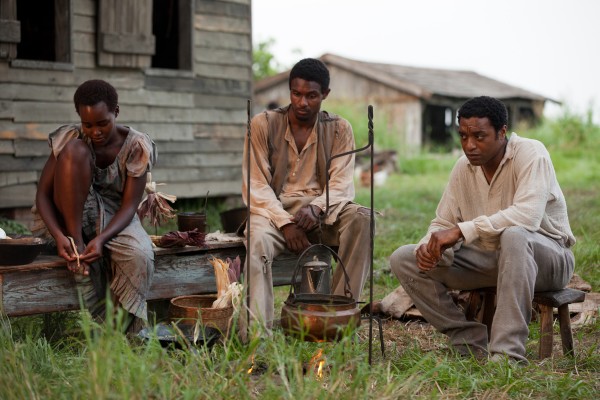
A friend at Facebook (thanks Jean!) turned me on to this article from The Atlantic, a review of the new film (based on a true story), 12 Years a Slave. The reason this film - and this review of the film - appeals to me is that Director Steve McQueen offers a different take on the movie hero - traditionally a role that requires that a man "man-up," or become a "real man," which generally means to physically defeat one's tormentor or enemy.

Not so in this film, which is a fictionalized adaptation of the 1853 autobiography Twelve Years a Slave by Solomon Northup, a free black man who was kidnapped in Washington, D.C. in 1841 and sold into slavery.

In Django Unchained, as is also true in Glory, manly strength leads to freedom and vengeance. In 12 Years a Slave, it serves only to harm those you care about.
When Northup escapes, it's not through violence, but because a white Canadian working on the plantation agreed to get word to the north. Northup's ordeal ends as abruptly as it began when an old white friend pulls up at the plantation with the sheriff. There's no hail of gunfire, only a hail of legalese. Nor is this a happy ending. No one can give him back his lost years with his wife, or missing his children grow up. Patsey, and many others, are still enslaved. The men who kidnapped him are never brought to justice. Northup has no manly triumph. '12 Years a Slave' doesn't see slavery as a trial that men must overcome on their way to being men, but as a systemic evil that leaves those in its grasp with no good choices.
I'm excited to see this film - it's rare that life on film is presented with the fully incomprehensible abruptness that we experience in real life. One day Northup is a happily married man making a living as a musician - the next he has been sold into slavery. And just as suddenly, 12 years later, through no heroic action on his part, he is once again a free man . . . but his life and his sense of the world is forever altered by his experience.

NPR did a short but interesting review of the film, and it has been reviewed by nearly every major newspaper and culture blog. It has a 7.9/10 rating at IMdB and a 95% positive rating at Rotten Tomatoes (94% among views who are not critics).

12 Years a Slave's Reminder: Slaves Didn't Win Freedom by Being Manly

Unlike Glory or Django Unchained, Steve McQueen's film resists the notion that a slave could overcome the institution just by fully asserting his masculinity.

Noah Berlatsky | Oct 21 2013


Fox Searchlight

Hollywood is in general uncomfortable with race, but it likes heroic masculinity. It's no surprise, then, that films about slavery often end up being about men becoming men. Django Unchained is a basic revenge story, with Django taking up the phallic gun to blast the evil forces that have held him down and captured his wife. Glory is a standard military parable, with the weak and undisciplined black troops learning to be a deadly fighting force even as their boyish white commanding officer proves himself. "We're men," Denzel Washington declares before the final battle, for all the world as if, before they joined the regiment, they were something else.

Remarkably and honorably, 12 Years a Slave, based on Solomon Northup's 1841 autobiographical narrative, has a different story to tell. When the film opens, Northup (Chiwetel Ejiofor) is a free musician, living in Saratoga, New York with his wife, son and daughter. He's a success and a grown-up; he doesn't need to learn to become a man. The narrative arc of the film isn't from powerlessness to power. It's the reverse.

Northup is courted by two men who promise him a touring gig, and then, after they've lured him to Washington, slip him a drug, knocking him unconscious. He wakes up in a cell, where he is viciously beaten on all fours while the slaver hits him with a stick from behind. Northup loses his former life, his dignity, even his self, as he is forced to take the name of a runaway slave, Platt. The entire sequence is a violation and unmanning—it's presented as a symbolic rape.

If we were working with the logic of Glory or Django, Northup would have to regain his manhood by standing up to his attackers and besting them in combat. That's not what happens here, though. Instead, Northup tries various ways to deal with the system. At first, he uses his education and skills to help his (very) relatively humane owner, William Ford (Benedict Cumberbatch), with various engineering projects. Then, when he is harassed and attacked by Ford's overseer, he fights back, in a scene reminiscent of Frederick Douglass's autobiography, whipping the man who had intended to whip him. Where Douglass triumphed, though, Northup just ends up sold to a true sadist. As another slave, Eliza (Adepero Oduye), tells Northup, you can compromise yourself as you will, give the slave-owners your skills or your body. It doesn't matter. You're still a slave.

Eliza's speech has no parallels in Glory or Django, because when masculinity is the story, women are pushed to the sidelines. In Django, the main romance of the film is between Django and his white buddy; the second is between Django and the evil slave Stephen—and lagging far behind in third is the relationship between Django and his wife, who functions more as a prize than as a person. For its part, Glory barely has a female speaking role; like Django, all its energy goes into inter- and intra-racial male bonding.

12 Years a Slave though, doesn't present masculinity as a solution to slavery, and as a result it's able to think about and care about women as people rather than as accessories or MacGuffins. Other than Northup, in fact, the most vivid slave characters are female. There's Eliza, who is utterly devastated by the loss of her children. And there's Patsey (Lupita Nyong'o), a phenomenal worker in the cotton fields who Northup's second sadistic owner, Edwin Epps (Michael Fassbender), takes as his mistress. Patsey is raped by Epps, loathed by his jealous wife, and systematically abused, beaten, and tortured by both. In a terrifying scene, she wakes Northup up and begs him to take her to the marsh and drown her. "Do what I ain't got the strength to do myself," she pleads. "God is merciful and forgives merciful acts."

Northup, with a desperate callousness, refuses, asking her "How can you fall into such despair?"—though there's no question that he knows exactly how. Later, he is forced at gunpoint to lash her back bloody. In Django, manly strength leads to freedom and vengeance; here, it serves only to harm those you care about.

When Northup escapes, it's not through violence, but because a white Canadian working on the plantation agreed to get word to the north. Northup's ordeal ends as abruptly as it began when an old white friend pulls up at the plantation with the sheriff. There's no hail of gunfire, only a hail of legalese. Nor is this a happy ending. No one can give him back his lost years with his wife, or missing his children grow up. Patsey, and many others, are still enslaved. The men who kidnapped him are never brought to justice. Northup has no manly triumph. '12 Years a Slave' doesn't see slavery as a trial that men must overcome on their way to being men, but as a systemic evil that leaves those in its grasp with no good choices.

Manly triumph isn't to be sneered at in every case. The 54th Massachusetts of Glory really did fight with honor and transform Northern opinion about blacks—their courage really did matter. But seeing slavery solely as a test of masculinity not only erases women's experience; it ends up making men who don't overcome it responsible for their own oppression. If you were a man, such narratives say, you would fight back and kill them all with the music swelling, as Django does in Django Unchained. Django even explicitly refers to its title character as "exceptional"—he is better than all those others sunk in slavery. If you don't defeat your enemies like a man, the film seems to say, then you're not a man, you're a moral failure. Which is not that far from saying that victims are responsible for their victimhood.

At the end of the film, when Northup returns to his family, he starts stammering apologies—for his appearance, for crying, and, though he doesn't say it, for being captured and being unable to return to his family for so long. To which his wife, Anne (Kelsey Scott) replies, "You have absolutely nothing to apologize for." 12 Years a Slave doesn't see slavery as a trial that men must overcome on their way to being men, but as a systemic evil that leaves those in its grasp with no good choices. As a result, 12 Years a Slave is that rare film about slavery in which slaves don't have to become Hollywood "men" for their stories to matter.

Related Story: 


The Searing, Visceral 12 Years a Slave

Friday, November 2, 2012

Watch Kurosawa’s Rashomon Free Online


Akira Kurosawa made his masterpiece, Rashomon, in 1950, and despite the lack of support from the studio that produced the film, it went on to win the Golden Lion at the Venice Film Festival, the Academy Award as best foreign film, and to set box office records for a subtitled film.

A lot of the current assessments of the film look at how it influenced films made later (Courage Under Fire and The Usual Suspects), but I suspect that Kurosawa had read William Faulkner's The Sound and the Fury. In that book, the events are told from four different perspectives (three siblings and a housekeeper), and includes the infamous Benjy chapter, told from the perspective of a developmentally disabled adult.

It is this same use of the unreliable first-person account that Kurosawa uses in Rashomon.

Watch Kurosawa’s Rashomon Free Online, the Film That Introduced Japanese Cinema to the West

November 2nd, 2012


“Come on, Homer,” Marge Simpson once said to her husband before one of the cartoon family’s trips abroad, “Japan will be fun! You liked Rashomon.” Homer’s sullen reply: “That’s not how I remember it.” There you have all you need to know about that film’s permanent and immediate place in the zeitgeist. Akira Kurosawa’s 1950 tale of crime, punishment, and the nature of memory has become a byword for the way that single events produce bewildering varieties of recollections and interpretations. We make this reference in the same offhand way when we make a reference to, say, Rosebud, the tortured magnate’s childhood sled incinerated at the end of Citizen Kane. It comes in handy when we need to describe those seemingly vast revelations that actually reveal nothing. But just as far fewer people throw around the word “Rosebud” than have actually seen and appreciated Citizen Kane, far fewer people display familiarity with “Rashomon” than with Rashomon. Yet both pictures hold up immaculately today, and you can watch the latter free on Archive.org (or pick up a finer print on DVD/Blu-ray here).

In addition to signifying both a classic film and an inescapable element of the human experience (not to mention the Ryunosuke Akutagawa short story that provided the movie’s basis), “Rashomon” also signifies a place. The Rashomon gate isn’t just a film set; should you find yourself in Kyoto, you can visit it. I may well do that myself soon, since I’m coming to you for the next couple of weeks from western Japan. While here, I’ll take the opportunity to showcase a few particularly intriguing pieces of Japanese film, television, art, and media on Open Culture. If you, like me, live under the spell of Japanophilia, Japanese film may well have first cast it upon you. After taking the Italian Critics Award and the Golden Lion at the 1951 Venice Film Festival, Rashomon cast it on a generation or two of westerners. While the cinema of Japan has much more to offer than Kurosawa, you could hardly find a place of higher craft or accessibility to begin exploring it.

Related content:
Colin Marshall hosts and produces Notebook on Cities and Culture. Follow him on Twitter at @colinmarshall.