Showing posts with label reviews. Show all posts

Monday, October 27, 2014

"Force Majeure" - A Movie That Will Change How You Think About Manhood (via Esquire)

This review of the new Swedish film Force Majeure (96% Fresh at Rotten Tomatoes), from Esquire, makes it sound equally important for most men to see and painful to have to sit through. Likely, both are true.

Here is the official trailer:


This seems to be a can't miss film, especially for those of us who care about creating a healthier more authentic masculinity.

A Movie That Will Change How You Think About Manhood

The bleak, funny Force Majeure


By Nick Schager on October 23, 2014


Tired of all those superheroes outmatching you in toughness, confidence, and manliness? If so, then the cinematic antidote has arrived in the form of Force Majeure, a Swedish film (and the country's Oscar entry) that tears masculinity a new one.

Opening in limited release tomorrow and then expanding in the coming weeks, director Robert Ostlund's film is ostensibly a drama. But its dissection of macho attitudes and guises is so unsparing that it achieves a pitch-perfect balance between scathing censure and black humor. Rarely has a film taken men to the woodshed for their failings with such a mix of disgust, pity, and wit, the last of which is the key ingredient that helps make Force Majeure such a unique high-wire balancing act. It puts the awkwardness of a Ben Stiller farce to shame, and investigates the man-child phenomenon more deeply than a timid Hollywood bro-comedy ever could.

The film, exquisitely shot to emphasize the dynamics between characters, concerns a middle-class Swedish family on a ski-resort vacation. They're an average clan, led by the average Tomas (Johannes Bah Kuhnke), whose defining characteristic is his milquetoast personality and habit of constantly checking his iPhone for work messages. Their perfectly pleasant, unremarkable getaway is demolished, however, when during breakfast on the resort terrace one morning, a "controlled" avalanche is detonated by mountain officials, and the cascade of snow approaches the vacationers. At first, Tomas tells his panicking children to be calm. Yet as the snow builds to a roaring wall facing them, the possibility of death becomes frighteningly real. In that moment, as wife Ebba (Lisa Loven Kongsli) grabs the children to shield them from the avalanche, Tomas grabs his gloves and phone—and flees.

Yes, he flees.


It's a moment of undeniable cowardice, and one that doesn't go unnoticed by Ebba and the kids, who, once the false alarm is over, sit in stunned silence as their father rejoins them at the table. Tomas's spinelessness and selfishness hang in the air for what seems like an eternity, even as they resume their vacation, with the kids miserable and Ebba barely able to contain her revulsion around Tomas. Her horror at her husband soon builds to an uncontrollable point, and it's then, during two separate conversations with other couples, that Force Majeure truly becomes a film that's watched while squirming restlessly and half-covering one's eyes.

During the first of those two chats, with a man and woman they've just met, Tomas denies that he fled the scene, thus digging himself an even deeper hole. Of course, Tomas is wracked with shame over his failure to act as protector, and Force Majeure depicts him as a man who's outwardly possessed and yet so internally weak and pathetic that he lacks even the courage to retroactively admit to (and atone for) his sins. Tomas hits rock bottom during a later evening spent with big-bearded friend Mats (Game of Thrones' Kristofer Hivju) and his 20-year-old girlfriend, who are put in the amusingly uncomfortable position of having to hear about Tomas's gutlessness, and then, in Mats's case, try to put a positive spin on indefensible behavior. During this tense centerpiece, director Ostlund refuses to turn away from his characters as they grapple with Tomas's shortcomings and the misery he's wrought, casting such an intense eye on Tomas and Ebba (and, in heartbreaking cutaways, their kids) that the film takes on the air of an inescapable nightmare at which you can only laugh.

Tomas's and Mats's ladies-man self-images are destroyed while they have a post-skiing drink, and Mats's girlfriend slams him for, hypothetically speaking, having the same cowardly instincts as Tomas (because, in part, he's left his kids with his ex-wife). No matter where you turn in Force Majeure, masculinity is under attack, and with good reason. And yet despite its scornful critique of traditional ideas about men's strength, bravery, virility, and altruism fostered by Marvel comics adaptations, Ostlund's film is no reprimanding lecture or slog. Instead, by rigorously fixating on his characters' faces as they refuse to look at each other or blubber uncontrollably over their own crappiness, he's created a sharply funny satire about the distance between what men project and what they really are. It's a joke for the ages, but it's also designed as a wake-up call to the real modern man-children of the world who haven't owned up to their true, flawed selves.

Friday, May 23, 2014

Fitness Friday - Fitness News and Information You Can Use

In this week's Fitness Friday, we get the truth on testosterone replacement for men, a review of Dan John's new book, a look at powerlifting squats vs. Olympic squats, the pros and cons of counting calories, and the good, the bad, and the ugly in powerlifting.

Testosterone Doesn't Up MI or Stroke: May Be Protective?

Miriam E. Tucker
May 18, 2014

LAS VEGAS — Contrary to recent findings, a new retrospective study of data from 40 specialized clinics around the United States has found that testosterone therapy in men is not associated with an increased risk for myocardial infarction (MI) or stroke and may even be cardioprotective.

The late-breaking results were presented here at the American Association of Clinical Endocrinologists (AACE) 23rd Annual Scientific and Clinical Congress by Robert Tan, MD, director of the Opal Medical Clinic, Houston, research director of the Low T Institute, and clinical professor of family and community medicine at the University of Texas.

Among 19,968 hypogonadal men who received testosterone therapy during a 5-year period (2009–2014) at Low T Centers nationwide (www.lowtcenter.com), the risk for MI was 7-fold lower and the risk for stroke 9 times lower compared with samples from the general population. Further, there was no evidence of worsening of preexisting MI or stroke in patients treated with testosterone.

"There has been a lot of hype and concern....I want to try to explain the other side of the story," Dr. Tan said in introducing his presentation.

He told Medscape Medical News, "When compared with other databases looking at rates of MI and strokes, it appears testosterone is cardioprotective."

* * * * *

From Built Lean, a review of Dan John's new book, Intervention: Course Corrections for the Athlete and Trainer.

Intervention By Dan John Book Review

by Marc Perry, CSCS, CPT | May 20, 2014


I first came across Dan John at a Perform Better Summit a few years ago. Since then, I’ve heard his name pop up over and over again.

More recently, BuiltLean contributor Steve Bergeron reviewed the 8-Week BuiltLean Transformation Program I developed. Steve suggested I incorporate more hip-dominant movements and recommended I check out Intervention: Course Corrections for the Athlete and Trainer by Dan John. I bought the book and excitedly starting digging into it.

Dan John is an accomplished strength coach, discus thrower, and Olympic lifter. He has developed a large following of trainers and coaches who enjoy his no frills, strength-based approach to getting very strong and very athletic.

* * * * *

From Breaking Muscle (be sure to check out the video of Donnie Thompson working his way up to a world record 1305lb squat):

Powerlifting Versus Olympic Squats: Which Is Better?

Robert Camacho
Contributor - Strength and Conditioning, Injury Prevention and Rehab
More Articles from this Author

Olympic Squat

Generally speaking there are two ways to squat: powerlifting or Olympic style. Even though they are both a squat and legitimate techniques in their own right, there is a bit of a difference when considering the utility and risks of each method.

Both squat styles involve tossing some weight on a barbell, placing it on top of your shoulders, and then dropping your butt down. But within that, there are some significant biomechanical differences between the two. These differences are mostly related to two factors: bar and foot position. Olympic squats are typically performed high bar with a narrow stance, while powerlifting are done low bar with a wide stance. Let’s take a look at some examples.
By the way, there is also the bodybuilder squat, with narrower foot position and the bar higher on top of the traps.

* * * * *

From T-Nation, Dani Shugart on counting calories, who should and who should not.

Calories: Should You Be Counting?

by Dani Shugart   
05/20/14


Here's what you need to know...

  • Because their instincts are bad and their appetite is low, skinny guys seeking gains should spend some time counting calories.
  • Physique competitors are at risk of undereating more than overeating. Counting calories and macros keeps them on task when their contest-crazy minds get out of hand.
  • Average overweight people are better off focusing their efforts on other areas, like food quality, than counting every little morsel.
  • For most people, calorie counting is a useful but temporary strategy. If it makes you neurotic, you've been doing it too long or it's just not for you.
It takes a special kind of person to actually want to keep track of every last thing he consumes. He measures it, analyzes it, then determines whether or not he should adjust it. He plays accountant with his body. Some calorie accountants are very successful. They build more muscle, lose more fat, and become aware of deficiencies. Some of them even develop the skills to masterfully manipulate calories from different sources and achieve a specific look for a specific event. Anal retentive tendencies pay off for them.

But others play accountant and get nothing back for their efforts. They plug their weight into a formula or online calculator and track every morsel, then make either temporary progress or none at all. Why does it work for some people but not for others? While working with clients it's become clear to me who benefits from counting and who would get better results by placing their focus elsewhere.
* * * * *

Finally, also from T-Nation, here is Charles Staley on powerlifting.

Powerlifting: The Good, Bad and Ugly

by Charles Staley   
05/19/14


Here's what you need to know...
  • Powerlifting is awesome, except for some of the fat physiques, the gaggle of federations, the rampant drug use and the supportive garb that allows you to artificially bench more than you can deadlift.
  • The rise of raw powerlifting has been positive. It's more relatable to the average lifter and appeals to those who'd rather see a more honest display of strength.
  • Despite its flaws, powerlifting is a primal rush, and signing up for a meet is one of the best things you can do to ramp up your training progress.
Back in the days when I was involved in Olympic-style weightlifting, I tended to view powerlifting with some disdain, which, by the way, is common in weightlifting circles. Weightlifters love to bag on their iron brothers for being fat simpletons who over-rely on high-tech supportive garb and who don't have the technical skills necessary for "advanced" skills like the Olympic lifts.

Powerlifting deserves some of this reputation. A quick search on YouTube will pull up video after video of bloated 350-pound dudes quarter-squatting about 40% more than they could actually squat to parallel without all the multi-ply supersuits and wraps. However, judging the sport by these unfortunate examples is about as fair as judging the sport of weightlifting by looking at some of its obese super-heavyweight competitors. The truth is, powerlifting is going through some very positive changes lately, which I'll discuss in a bit. For now though, I'd like to briefly share my personal experiences with the sport so that you have a bit of insight into my perspective.

I participated in my first raw competition in June of 2010 at the age of 50. Like many new competitors opt to do, I did a partial meet – in this case, I only competed in the deadlift event. One thing that's really nice about powerlifting, especially for newbies, is that you can just do one or two events if you'd like. This way, you can get started with a minimum of stress and anxiety. I lifted well and met lots of nice folks. I was hooked. Since then, I've gone on to win the World Championships for my age/weight category in the 100% Raw Federation. As I write this, I'm gearing up for my next meet.

I confess that I'm not exactly cut out to be a powerlifter. In fact, during a recent discussion with my insurance agent where I mentioned that I was training for a competition, he blurted, "Oh, you do triathlons?" At 198 pounds, powerlifting would reward me dearly for being 5'7" as opposed to 6'1", but so be it. I'd also be better off being 24 rather than 54, but guess what? I've decided to compete on my own terms.

Sure, my lifts would skyrocket if I brought my bodyweight up to 250 or so, but so would my waistline, and I'm not down with that. I'm using competitive powerlifting to test myself at my current height and weight, not to do whatever it takes to add a few pounds to my total. Keep this in mind as I transition to the less-appealing aspects of powerlifting.

Tuesday, October 22, 2013

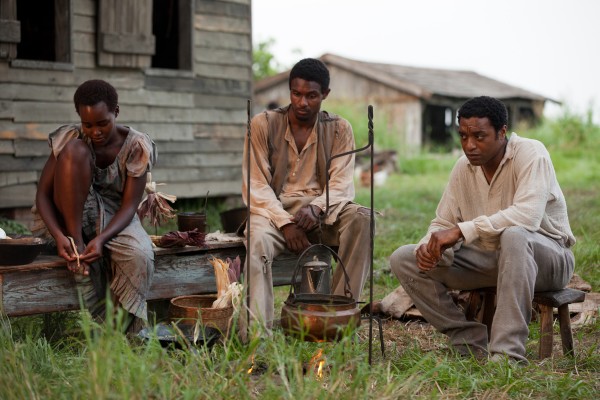
"12 Years a Slave" Reminds Us that Slaves Didn't Win Freedom by Being Manly


A friend at Facebook (thanks Jean!) turned me on to this article from The Atlantic, a review of the new film (based on a true story), 12 Years a Slave. The reason this film - and this review of the film - appeals to me is that Director Steve McQueen offers a different take on the movie hero - traditionally a role that requires that a man "man-up," or become a "real man," which generally means to physically defeat one's tormentor or enemy.

Not so in this film, which is a fictionalized adaptation of the 1853 autobiography Twelve Years a Slave by Solomon Northup, a free black man who was kidnapped in Washington, D.C. in 1841 and sold into slavery.

In Django Unchained, as is also true in Glory, manly strength leads to freedom and vengeance. In 12 Years a Slave, it serves only to harm those you care about.
When Northup escapes, it's not through violence, but because a white Canadian working on the plantation agreed to get word to the north. Northup's ordeal ends as abruptly as it began when an old white friend pulls up at the plantation with the sheriff. There's no hail of gunfire, only a hail of legalese. Nor is this a happy ending. No one can give him back his lost years with his wife, or missing his children grow up. Patsey, and many others, are still enslaved. The men who kidnapped him are never brought to justice. Northup has no manly triumph. '12 Years a Slave' doesn't see slavery as a trial that men must overcome on their way to being men, but as a systemic evil that leaves those in its grasp with no good choices.
I'm excited to see this film - it's rare that life on film is presented with the fully incomprehensible abruptness that we experience in real life. One day Northup is a happily married man making a living as a musician - the next he has been sold into slavery. And just as suddenly, 12 years later, through no heroic action on his part, he is once again a free man . . . but his life and his sense of the world is forever altered by his experience.

NPR did a short but interesting review of the film, and it has been reviewed by nearly every major newspaper and culture blog. It has a 7.9/10 rating at IMdB and a 95% positive rating at Rotten Tomatoes (94% among views who are not critics).

12 Years a Slave's Reminder: Slaves Didn't Win Freedom by Being Manly

Unlike Glory or Django Unchained, Steve McQueen's film resists the notion that a slave could overcome the institution just by fully asserting his masculinity.

Noah Berlatsky | Oct 21 2013


Fox Searchlight

Hollywood is in general uncomfortable with race, but it likes heroic masculinity. It's no surprise, then, that films about slavery often end up being about men becoming men. Django Unchained is a basic revenge story, with Django taking up the phallic gun to blast the evil forces that have held him down and captured his wife. Glory is a standard military parable, with the weak and undisciplined black troops learning to be a deadly fighting force even as their boyish white commanding officer proves himself. "We're men," Denzel Washington declares before the final battle, for all the world as if, before they joined the regiment, they were something else.

Remarkably and honorably, 12 Years a Slave, based on Solomon Northup's 1841 autobiographical narrative, has a different story to tell. When the film opens, Northup (Chiwetel Ejiofor) is a free musician, living in Saratoga, New York with his wife, son and daughter. He's a success and a grown-up; he doesn't need to learn to become a man. The narrative arc of the film isn't from powerlessness to power. It's the reverse.

Northup is courted by two men who promise him a touring gig, and then, after they've lured him to Washington, slip him a drug, knocking him unconscious. He wakes up in a cell, where he is viciously beaten on all fours while the slaver hits him with a stick from behind. Northup loses his former life, his dignity, even his self, as he is forced to take the name of a runaway slave, Platt. The entire sequence is a violation and unmanning—it's presented as a symbolic rape.

If we were working with the logic of Glory or Django, Northup would have to regain his manhood by standing up to his attackers and besting them in combat. That's not what happens here, though. Instead, Northup tries various ways to deal with the system. At first, he uses his education and skills to help his (very) relatively humane owner, William Ford (Benedict Cumberbatch), with various engineering projects. Then, when he is harassed and attacked by Ford's overseer, he fights back, in a scene reminiscent of Frederick Douglass's autobiography, whipping the man who had intended to whip him. Where Douglass triumphed, though, Northup just ends up sold to a true sadist. As another slave, Eliza (Adepero Oduye), tells Northup, you can compromise yourself as you will, give the slave-owners your skills or your body. It doesn't matter. You're still a slave.

Eliza's speech has no parallels in Glory or Django, because when masculinity is the story, women are pushed to the sidelines. In Django, the main romance of the film is between Django and his white buddy; the second is between Django and the evil slave Stephen—and lagging far behind in third is the relationship between Django and his wife, who functions more as a prize than as a person. For its part, Glory barely has a female speaking role; like Django, all its energy goes into inter- and intra-racial male bonding.

12 Years a Slave though, doesn't present masculinity as a solution to slavery, and as a result it's able to think about and care about women as people rather than as accessories or MacGuffins. Other than Northup, in fact, the most vivid slave characters are female. There's Eliza, who is utterly devastated by the loss of her children. And there's Patsey (Lupita Nyong'o), a phenomenal worker in the cotton fields who Northup's second sadistic owner, Edwin Epps (Michael Fassbender), takes as his mistress. Patsey is raped by Epps, loathed by his jealous wife, and systematically abused, beaten, and tortured by both. In a terrifying scene, she wakes Northup up and begs him to take her to the marsh and drown her. "Do what I ain't got the strength to do myself," she pleads. "God is merciful and forgives merciful acts."

Northup, with a desperate callousness, refuses, asking her "How can you fall into such despair?"—though there's no question that he knows exactly how. Later, he is forced at gunpoint to lash her back bloody. In Django, manly strength leads to freedom and vengeance; here, it serves only to harm those you care about.

When Northup escapes, it's not through violence, but because a white Canadian working on the plantation agreed to get word to the north. Northup's ordeal ends as abruptly as it began when an old white friend pulls up at the plantation with the sheriff. There's no hail of gunfire, only a hail of legalese. Nor is this a happy ending. No one can give him back his lost years with his wife, or missing his children grow up. Patsey, and many others, are still enslaved. The men who kidnapped him are never brought to justice. Northup has no manly triumph. '12 Years a Slave' doesn't see slavery as a trial that men must overcome on their way to being men, but as a systemic evil that leaves those in its grasp with no good choices.

Manly triumph isn't to be sneered at in every case. The 54th Massachusetts of Glory really did fight with honor and transform Northern opinion about blacks—their courage really did matter. But seeing slavery solely as a test of masculinity not only erases women's experience; it ends up making men who don't overcome it responsible for their own oppression. If you were a man, such narratives say, you would fight back and kill them all with the music swelling, as Django does in Django Unchained. Django even explicitly refers to its title character as "exceptional"—he is better than all those others sunk in slavery. If you don't defeat your enemies like a man, the film seems to say, then you're not a man, you're a moral failure. Which is not that far from saying that victims are responsible for their victimhood.

At the end of the film, when Northup returns to his family, he starts stammering apologies—for his appearance, for crying, and, though he doesn't say it, for being captured and being unable to return to his family for so long. To which his wife, Anne (Kelsey Scott) replies, "You have absolutely nothing to apologize for." 12 Years a Slave doesn't see slavery as a trial that men must overcome on their way to being men, but as a systemic evil that leaves those in its grasp with no good choices. As a result, 12 Years a Slave is that rare film about slavery in which slaves don't have to become Hollywood "men" for their stories to matter.

Related Story: 


The Searing, Visceral 12 Years a Slave

Monday, April 8, 2013

Journal of Men, Masculinities and Spirituality - Volume 2, Number 1: The Intimate Connection

A new issue of the Journal of Men, Masculinities, and Spirituality is available online.


Volume 2, Number 1: Table of Contents

The Intimate Connection


Editorial: 
Editor's Note (pp. 1-2)
Joseph Gelfer

Articles:
Sexually Explicit? Re-reading Revelation’s 144,000 Virgins as a Response to Roman Discourses (pp. 3-28)
Lynn Huber

Men, Buddhism and the Discontents of Western Modernity (pp. 29-46)
Chris Barker

Book Reviews:
Review of Dale B. Martin, Sex and the Single Savior: Gender and Sexuality in Biblical Interpretation (pp. 47-51)
Ken Stone

Review of Stefan Horlacher, Masculinities. Konzeptionen von Männlichkeit im Werk von Thomas Hardy und D. H. Lawrenc [Masculinities: Conceptions of Masculinity in the Works of Thomas Hardy and D. H. Lawrence] (pp. 52-53)
Silvia Mergenthal

Review of Stephen Arterburn and Fred Stoeker with Mike Yorkey, Every Man’s Battle: Every Man’s Guide to Winning the War on Sexual Temptation One Victory at a Timeand Every Young Man’s Battle: Strategies for Victory in the Real World of Sexual Temptation (pp. 54-55)
Mark J. Justad

Review of Marc Epprecht, Hungochani: The History of a Dissident Sexuality in Southern Africa (pp. 56-57)
Phillip A. Cantrell, II

Review of Charles H. Lippy, Do Real Men Pray? Images of the Christian Man and Male Spirituality in White Protestant America (pp. 58-59)
Bradford McCall

Download Vol. 2 No. 1 (784 KB PDF)
Kindle edition

Wednesday, May 23, 2012

Jack Kerouac's "On the Road" Hits the Big Screen at Cannes

Director Salles and cast members pose during a photocall at the 65th Cannes Film Festival


Finally, more than 30 years after Francis Ford Coppola bought the rights to the book, and more than five decades since Jack Kerouac spent three benzedrine-fueled weeks furiously typing the manscript, On the Road - "a frenetic tale of liberation, masculinity and post-War America" - has been made into a film. 

The film debuts at Cannes, and it seems that so far, the reviews have been quite negative. That's too bad, it has the material to be a great film if were done honestly and faithfully to the book, with no pretense and no overly pretty faces (aside from the Dean Moriarty character, who I always pictured a young Marlon Brando or James Dean).

Kerouac's "On the Road" hits screen in Cannes debut


CANNES (Reuters) - The Bible of the Beat Generation, "On the Road" premiered at Cannes on Wednesday, taking more than five decades for the frenetic tale of liberation, masculinity and post-War America to play out its journey from novel to the big screen.

Furiously written on a typewriter over a three-week long creative binge in 1951, Jack Kerouac's On the Road is the seminal portrayal of "Beat" culture and its spiritual quest for expression.

The film version from Brazilian director Walter Salles ("Motorcycle Diaries") strives to capture the energy and drug-fuelled stream of consciousness of the original book.

Salles is helped by the casting of British actor Sam Riley as protagonist Sal Paradise, a stand-in for Kerouac himself, and U.S. actor Garrett Hedlund as Dean Moriarty, a symbol of American virility and poster child for living in the moment.

"The only people who interest me are the mad ones," Paradise writes, and Moriarty fits the bill. The charming, adventurous con man becomes Paradise's alter ego, and their closely bonded friendship plays out across a series of road trips.

"It's about the loss of innocence, it's about the search for that last frontier they'll never find," Salles told reporters in Cannes. "It's about also discovering that this is the end of the road and the end of the American dream."

Kristen Stewart of "Twilight" fame plays Moriarty's young wife Marylou, Kirsten Dunst plays second wife Camille and Viggo Mortensen takes a turn as Old Bull Lee, who is based on William Burroughs.

Salles said he and the team had "enormous respect for Kerouac" which helped drive the process from the time Francis Ford Coppola bought the film rights to the book in 1979.

The idea of making On the Road into a movie languished "until Walter raised his hand and said I think I can make this movie," said Coppola's son, Roman, who is a co-producer. "It took 30 years but it was such a natural fit with Walter."

Most early reviews were negative.

"It feels long and tedious, as if we've dropped in on someone else's party without knowing or caring who these folks are, knocking back the whisky and barbiturates as regularly as they're knocking off each other," wrote London magazine Time Out's Dave Calhoun.

British newspaper The Telegraph called the film a "tedious loop of beatnik debauchery" while the Evening Standard said it "seems to lack the mad passion of Jack Kerouac's ferocious and extraordinary writing."

ROAD MOVIE

Drugs, sex and jazz are central to On the Road, as the lead characters' quest for freedom of body and mind take them to black jazz clubs, flop houses, migrant camps and rail depots.

"A road movie I think is what made me into a film maker and I'm very loyal to it," Salles told the press.

He said he found parallels between Kerouac's search for inspiration through jazz and bebop as he wrote his novel in an improvisational style and the job of the director.

"You always have to be on the lookout for what you find along the way, it's a way of creating fantastic images."

Salles' camera captures America's vastness - and the promise of something new around the corner - from the lights of New York to the hills of San Francisco and the long expanse of flat road and endless sky in between.

But as the sun fades on the brief and bright explosion of the characters' lives, age and responsibility intrude.

"This high we're on is a mirage," character Carlo Marx tells Paradise and Moriarty.

For a look at Cannes' 2012 lineup, click here: http://link.reuters.com/vav28s

(Reporting By Alexandria Sage, editing by Paul Casciato)

Friday, May 4, 2012

Chris Dierkes - Integral Relationships: A Book Review

A while back, Chris Dierkes at Beams and Struts reviewed Integral Relationships: A Manual for Men by Martin Ucik. I have not read the book, partly because of the price tag and partly because it is so closely aligned with Ken Wilber's AQAL model of masculine/feminine (which I find to be highly problematic, as does Chris) and Wilber's "kosmic address" stuff, which Chris also critiques in much the same way I might, but he does so more eloquently and with more erudition.

It's an excellent review - I'm offering a little from the beginning, but it's very detailed and comprehensive.

Integral Relationships: A Book Review

Written by  Chris Dierkes 

Editor's Introduction (Chris): Based on the positive recommendations of some colleagues of mine, I contacted Martin and asked him if he would like me to review a copy of his book for Beams & Struts. He very graciously agreed.
--
Integral Relationships: A Manual for Men by Martin Ucik is a very intriguing text. Ken Wilber describes something he calls The Kosmic Address. The Kosmic Address is the location of any reference in existence, be they thoughts, emotions, systems, or places, and so on. We might even say each person has a distinct Kosmic Address (or perspective) within existence. The metaphor of a Kosmic Address takes something from the physical world and applies it to our inner worlds. This locational metaphor allows Wilber to describe integral theory as a kind of navigational or guidance system. So while integral theory can get quite complex at times--with its states, stages, lines, types, etc.--deep down its purpose is always about finding or locating the reality of beings and tuning into their worlds.

integral relationshipsIn Integral Relationships, Martin Ucik has taken the navigational dimension of integral theory--this desire to locate the experience and inner world of another--and sets its parameters to the experience of a man seeking to find a beloved woman. Ucik is very upfront that this book is for straight men and that his work is not geared towards gay men nor does he feel that he is in a position to speak to their experience. (For those interested in the subject of same sex relationships from an integral perspective, see The Missing Myth by Gilles Herrada).
The book follows a deeply logical and consistent pattern. It is also very heavy on the theory, a combination not uncommon in German writers, I suppose. It's a very deep study of the topic of heterosexual relationships from the vantage point of men. Ucik makes what I think is a persuasive case for the need to have a text on relationships focused for men. He gives what I found to be wise advice that men are better advised to simply read the book, absorb its perspective (as they find it helpful) and then go about being more compassionate, present, centered beings with women. They should follow that pattern rather than necessarily sharing the book and trying to talk about quadrants and levels and lines and how this is helping them understand love. To put it mildly, that latter approach might not work so well.

There's great value in a book written especially for (straight) men that takes seriously their inner lives. Issues like pain and shame and vulnerability are not ones men typically address in our society.

Full disclosure: As a reviewer I'm not in a position to make any determinations relative to Ucik's dating advice (Chapter 13 in particular). All of the men I've talked to who have read this book are, like me, in long term relationships. As someone in a long term committed relationship, I did find the book to be very helpful in coming to terms with both the past and the present of my marriage.
Read the whole review.

Wednesday, March 21, 2012

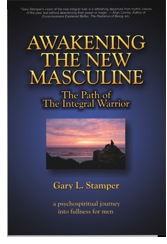
Book Review: Gary Stamper, Awakening the New Masculine: The Path of the Integral Warrior

My review of Awakening the New Masculine: The Path of the Integral Warrior, by Gary Stamper, Ph.D. (Berrett-Koehler Publishers, 2012) has just been published today at the Integral Leadership Review. Here is a little section from the beginning of the review:

Book Review: Gary Stamper, Awakening the New Masculine: The Path of the Integral Warrior

Is the Mythopoetic Men’s Movement Ready for the Leap to Integral? A Review of Awakening the New Masculine: The Path of the Integral Warrior, by Gary Stamper, Ph.D. San Francisco: Berrett-Koehler Publishers, 2012.

Reviewed by William Harryman


When I see a new book coming out from someone involved with the integral movement (Stamper co-founded and led the Seattle Integral salon), and especially the Ken Wilber version of integral theory, I steel myself for the seemingly obligatory two to three chapters that attempt to explain the integral model for those who are not familiar with it. Much to his credit, Gary Stamper, in his new book, Awakening the New Masculine: The Path of the Integral Warrior, has not done that. He has written a book about the work he does with men in his Integral Warrior trainings, work that happens to be deeply influenced by Wilberian integral theory and Spiral Dynamics, both of which require some explication. There is, to be clear, a lot of integralese in this book, but it doesn’t have the heavy-handed feel with which other books based in integral theory are often burdened.

Essentially, Stamper has written a how-to spirituality book for men. There have been a few of these in recent years, coming mostly from the Jungian world or from a previously scattered group that has coalesced into “muscular Christianity,” a masculinist spiritual Christian movement. The only other books that include integral theory are Martin Ucik’s Integral Relationships: A Manual for Men (2010), David Deida’s The Way of the Superior Man: A Spiritual Guide to Mastering the Challenges of Women, Work, and Sexual Desire (1997), Joseph Gelfer’s The Masculinity Conspiracy (2011, online e-book) and Numen, Old Men: Contemporary Masculine Spiritualties and the Problem of Patriarchy (2009). Both of Gelfer’s books are in-depth academic treatises rather than spiritual how-to books.

Before continuing, a brief overview of the last 40 or so years of the men’s movement might help to contextualize what Stamper’s Awakening the New Masculine is attempting.

Saturday, September 10, 2011

NPR - At Home With Warriors, And The Burdens They Carry

Nice segment from NPR - a review of a new documentary on the men (and women) who serve their country and are trying to find their place in a world that will never look or feel the same for them.

At Home With Warriors, And The Burdens They Carry

Art's Sake: Dominic "Dom" Fredianelli is the linchpin of a group of young Michigan men who go off to war — and return home bearing its scars — in Where Soldiers Come From. An art student at Finlandia University, Fredianelli channeled his experiences into a massive mural in his hometown.
Justin Hennard/Quincy Hill Films
Art's Sake: Dominic "Dom" Fredianelli is the linchpin of a group of young Michigan men who go off to war — and return home bearing its scars — in Where Soldiers Come From. An art student at Finlandia University, Fredianelli channeled his experiences into a massive mural in his hometown.
Where Soldiers
Come From
  • Director: Heather Courtney
  • Genre: Documentary
  • Running Time: 93 minutes
Not rated.
With: Dominic Fredianelli, Cole Smith, Matt "Bodi" Beaudoin
September 8, 2011
Where Soldiers Come From, the latest in a slew of documentaries about American military recruits muddling through a tour of duty in Afghanistan, pointedly enters theaters as we observe another anniversary of the Sept. 11 attacks. But the film's true historical referent is the end of the Vietnam War, when U.S. soldiers returned home to a thundering silence — or, from certain quarters, to outright hostility. Today, to judge by the swelling torrent of nonfiction films bearing witness to the plight of the American grunt in and after Iraq and Afghanistan, we can't apologize enough for blaming the messengers.
Helped along by advances in digital technology, just about anyone with airfare and a camera can tag along with an Army unit these days and follow it home. But though it's essential to keep asking what we're fighting for — as most of these documentaries do —there's an inevitable risk of mediocrity in numbers. There's also the risk of blunting our sympathies: No matter how urgent the narrative of comradeship under fire — nor how frustrating the return home to five minutes of glory and a lifetime of struggle with post-traumatic stress disorder and inadequate support services — its endless repetition courts indifference.
Up to a point, Where Soldiers Come From covers that familiar ground in a familiar way. Heather Courtney, who wrote, co-edited, shot and produced the film, rode a bomb-sweeper with a small band of National Guardsmen from the small town of Hancock, in Michigan's beautiful Upper Peninsula. With them she endured the tedium of waiting, the terror of undetected roadside bombs blowing up in their faces, the creeping disillusion when they saw no progress in a war whose purpose they had understood only imperfectly, if at all.
What's different, as the film's title suggests, is Courtney's focus on the modest community that raised these young men, whose families defy stereotype about the demographics of non-officer Army recruitment. Neither Dom, a sensitive lad studying graphic art in college, nor Cole, an easygoing everyman with a penchant for stand-up comedy, joined up to escape troubled childhoods. Their reasons were practical and banal — a recruiter's promise of a fat signing bonus and college tuition, the absence of any other career plans — and their decisions taken with what seems a hair-raising lightness.
Dom's tour of duty takes him to rural Afghanistan, where he works to clear IEDs.
EnlargeHeather Courtney/Quincy Hill Films
Dom's tour of duty takes him to rural Afghanistan, where he works to clear IEDs.
Both were raised in solid, loving, working-class families — one military, one not — in a stable environment. (As stable, anyway, as a town can be when it's had to remake itself from mining town to tourist hub, and when cycles of recession have left the lucky ones working two jobs.) Parents and girlfriends — patriots all, yet disgusted with the Bush administration and hopeful, on the eve of the 2008 elections, about a promised Obama troop drawdown — are far from thrilled about the boys' decision. But they throw their collective weight behind them.
No doubt the fact that Courtney herself grew up in northern Michigan helped open up these self-effacing citizens, so clearly unaccustomed to explaining themselves. The director has a storyteller's grasp of the telling detail: the carefree dive into Lake Superior; a farewell cake iced with thanks for the boys' upcoming service; the Army educator who, shepherding recruits through a month's perfunctory training, can't pronounce the name of Afghanistan's president. She draws sharp contrasts between snowy rural Michigan and the parched mountainous terrain where the boys serve, charts their eventual return home to run-ins with G.I. Bill bureaucrats, details their struggles with traumatic brain injury — the legacy of repeated concussions even in soldiers who don't suffer a direct hit.
More than most documentaries on the subject, Where Soldiers Come From builds a world for these young men and watches it turn upside down, reframing itself slowly and painfully around the unforeseen consequences of snap decisions. Offering no commentary, Courtney positions herself as an observer, yet her choice of moments to capture leaves us in no doubt where she stands.
"Hearts and minds," Dom murmurs with heavy irony as he hands out candy to Afghan children, and Courtney keeps the camera running when his friend Bodi erupts into a bitter tirade. Openly admitting that he hates Afghanistan and its people, he insists that the Army has turned him into an all-American racist.
For Dom, stricken with TBI, there will be relief through his art and a neatly redemptive ending to the movie. But it's Bodi's desperate, abandoned rant that will echo in our minds, the unofficial voice behind the official remembrances of Sept. 11.