Showing posts with label real man. Show all posts

Friday, February 21, 2014

Do You Have to Pee Standing Up to Be a Real Man?

Why would you pee sitting down (if you are a cis male)? But that is not the issue of this story - some men are not able to pee standing up, and some men are gender- or genital-variant. If you are a trans man who wishes to pass, standing at a urinal might be the only to fully pass.

From Pacific Standard.

Do You Have to Pee Standing Up to Be a Real Man?

• February 13, 2014 

urinals
This simple idea, encouraged by medical texts of the past that taught deviation from the norm would lead to confused sexuality and gender identity issues, has put a surprising number of babies under the knife.


In contemporary American culture, much is still demanded of “real men”: To be commanding and composed. To be courageous and chivalrous. To be rugged, strong, and low-voiced. And to be able to pee standing up.

Males are sometimes born with a urinary meatus (what kids might call “the pee hole”) somewhere other than the tip of the penis, which can make it difficult to meet this last demand. The opening might be farther down the head, on the shaft, or even on the scrotum. When this happens, and a doctor notices it, a newborn lad gets hit with a diagnosis of hypospadias. Often, he will be referred to a surgeon for “correction.”

How many boys are born with hypospadias is a matter of some dispute. Environmental hormone disruptors—including those found in some medications for hair loss and prostate cancer—increase chances of a male fetus developing hypospadias, and so the rate of hypospadias in America is probably increasing every year. Right now, American medical textbooks put the frequency at around one in 150 to 250 live male births, which would make it pretty common. That frequency would mean that, when you’re shopping in Costco, chances are so is a man born with hypospadias. When you’re in a major sports stadium, chances are you’re surrounded by a few hundred such men.

In fact, hypospadias might be much more common than even that, and may have always been. In 1995, the Journal of Urology published a stunning—and generally ignored—study out of Germany that showed that urologists have unreasonably strict expectations for penises. These physicians looked at a group of 500 men and found that only 55 percent could be labeled “normal,” according to medical standards. Of the 500, fully 225 counted as having hypospadias.

The team observed that “it remains unclear whether the tip of the glans [penis] is truly the normal site” for the urethral opening. The physicians also questioned whether surgical “correction” of hypospadias was necessary, given what they admitted was the “significant complication rate” of “reparative” surgeries—and given these men seemed to have figured out how to use their penises to their own satisfaction.

Yet every day in America, baby boys are put under anesthesia and under the knife to “fix” hypospadias. This involves moving the meatus to where surgeons believe it’s “supposed” to be (regardless of the German study’s findings). In mild cases of hypospadias, this is often a relatively simple surgery, and most of the time comes with no complications. In more significant cases, moving the meatus involves having to surgically build more urethra (the tube that carries urine and, in males, semen). That’s when things can get especially tricky.

The risks of “hypospadias repair” surgeries include wounds opening up on the penis (fistulas), scar tissue building up inside the urethra (stenosis), chronic pain at the surgical site, and chronic infections. For some boys, surgical “repairs” to their penises turn out to be downright destructive—even devastating. Jim Lake, a 54-year-old counselor who works in the Chicago area, has had 17 major urological surgeries to try and undo the damage that followed the surgical “correction” performed on his penis when he was just a baby. The medical literature has a special name for boys and men like Jim: hypospadias cripples.

Make no mistake: this “crippling” isn’t caused by the hypospadias; it’s caused by the complications of surgeries to “fix” hypospadias. In the vast majority of cases, initial “repair” of hypospadias is not done because a boy’s health is being actively compromised by this anatomical quirk; his health is not. In fact, in most cases, the surgery increases the odds a boy is going to suffer from urological problems. If what you care about is improving physical health, in most cases you would not go through with “hypospadias repair.”

And consider one of the most shocking findings of the German study: “all but 6 [of the 225 men diagnosed with hypospadias] were not aware of any penile anomaly, all but 1 homosexual patient have fathered children…. [A]ll patients participated in sexual intercourse without problems and were able to void in a standing position with a single stream.” So why label them as anything but normal?

Most hypospadias “repairs” performed by surgeons occur because of an untested, Freudian belief that you can’t grow up a “real man” if you urinate and ejaculate from somewhere other than the very tip of your penis. Urology texts of the past made it pretty plain: if you don’t “fix” hypospadias, a boy might be so messed up in his gender identity that he’ll grow up gay. Few urologists today seem to believe that sexual orientation is caused by how one pees, but many still think boys’ psychological health absolutely depends on being able to pee standing up. There’s no evidence for this. Why insurance covers it, even when there is no good evidence it is necessary or beneficial, remains a mystery.

I have heard some contemporary surgeons insist that hypospadias repair is done for a “medical” reason—to ensure a boy can eventually successfully impregnate a woman though intercourse. But there are simpler, non-surgical solutions to the problem of ejaculating somewhere other than the penis’s tip, including one reported in a late-19th-century British medical journal. In that case, a man with hypospadias was reported to have impregnated his wife by ejaculating onto a long-handled spoon and inserting it into her vagina.

Of course, we have better tools today. Through my work on this subject, a few years ago I met a man with “uncorrected” hypospadias who had opted for a high-quality turkey baster. He observed to me that, so far as he and his wife were concerned, they had the best of all possible worlds: he had no trouble with erections, orgasms, and intercourse—he was healthy—and yet he couldn’t accidentally get his wife pregnant. When they wanted to conceive, they just engaged in a private thanksgiving.

Nevertheless, parents of boys with hypospadias are often led to believe “corrective” surgery is necessary and worth the risks. Urologists don’t typically suggest that, before consenting to surgery, parents talk to the men in the Hypospadias and Epispadias Association (HEA) support group, of which Jim Lake is the incoming president.

Tiger Devore, a clinical psychologist now completing his service as HEA’s president, told me in a recent phone interview that he sees signs of pediatric urologists backing off of “hypospadias repair,” and that those changes in attitude break down along generational lines. Devore attended the International Pediatric Urology Task Force on Hypospadias in Las Vegas last September, and there he observed younger urologists being much more hesitant to push “corrective” surgery, especially in relatively minor cases, because of the risks.

Devore’s observation reminded me of a set of conversations I had with one pediatric urologist. About 15 years ago, this urological surgeon told me he wished I’d stop saying that hypospadias repair was motivated by a latent homophobia—it was a necessary surgery, he said. When I ran into him a couple of years ago, he admitted to me that my activist colleagues and I had been winning in our attempts to get his colleagues to move away from so many “repair” surgeries for hypospadias. I asked him to what he attributed the change. Without pause, he replied, “American culture has really come around on the gay thing.”

Could it be that surgeons and parents have really worried that a child left to grow up with atypical genitals will be at greater risk of gender identity and sexual orientation “problems”? Well, when I was editing a handbook for parents of these children in 2005, and I asked specialist clinicians what questions parents typically had when faced with a newborn with atypical genitals, the number one question was: Will my child be gay?

After working in this field for almost 20 years, I do not believe that most parents (or physicians) are trying to eliminate the possibility of a gay child through “corrective” surgery. I don’t see this as a eugenicist agenda. I think when parents ask Will my child be gay?, most of the time they are asking something more complicated, something genuinely compassionate: Will my child be able to know love, as I have known love?

But I do think it is the case that we still have a very tangled and too often unexamined confusion over genital variation and its meanings. We need an approach that is much calmer, more organized, and less anatomically naïve. Less surgical in its “corrective” fantasies.

So what are the options, at least for hypospadias?

A pediatric psychologist asked me something like this a couple of years ago, specifically in reference to a three-year-old boy on his service. The boy was born with hypospadias and his parents had decided early on against surgery. The mother was now feeling some anxiety because the boy, whose hypospadias made it so he had to sit to pee, was noticing how boys usually stand to pee while girls sit. The psychologist was calling to ask me if I knew of a simple prosthetic option so that this boy could try standing to pee.

Yes, I replied. And I know about the prosthetic solution because I like to camp. There’s a product called Go Girl, and it’s basically a reusable little plastic funnel. You hold it under yourself when you urinate, and the pee goes shooting out in front. Transgender men (who used to be female) sometimes also use these. I suggested the psychologist buy some of these devices, perhaps in the “camo” color, take them out of the Go Girl package, and show the kid how to use them, in case he wanted to pee standing up. A few bucks spent now and then on this handy product will buy this boy time so he can decide later, when he’s mature enough, if he wants to take on genital surgery risk. By then, too, the surgeries will hopefully be better.

An even better solution than Go Girl came from another family I ran across, a family including a boy born with a small penis and hypospadias. The first set of doctors had suggested sex changing the boy, something that used to be pretty common in such cases. (If you can’t make him into a “real man,” you make him into a girl, right?) Another set of doctors had offered “hypospadias repair.” But the parents, conservative Christians, had decided to let the boy grow up without elective, risky, invasive medical procedures.

In this case, the father took an innovative approach. Hearing about the alleged importance of a boy being able to urinate the way the men around him do, the father decided to sit to pee. Following the father’s lead, so did (and do) all the other men in the family when they are around this little boy: they all sit to pee.

Rather than getting that little boy to come to their norm, they decided to go to his.

What lesson is that little American boy learning about what makes a “real man”: compassion, acceptance, joy, and love. And sitting down to pee. What would be wrong with more men like that?

To watch videos of people born with hypospadias and other relatively uncommon variations on sex anatomy talking about their lives, visit The Interface Project.

Alice Dreger
Alice Dreger is a professor of clinical medical humanities and bioethics at Northwestern University's Feinberg School of Medicine. She has written for The New York Times, The Wall Street Journal, and The Washington Post

Tuesday, October 22, 2013

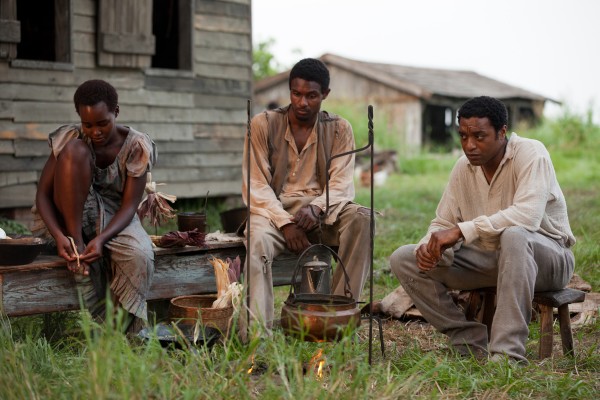
"12 Years a Slave" Reminds Us that Slaves Didn't Win Freedom by Being Manly


A friend at Facebook (thanks Jean!) turned me on to this article from The Atlantic, a review of the new film (based on a true story), 12 Years a Slave. The reason this film - and this review of the film - appeals to me is that Director Steve McQueen offers a different take on the movie hero - traditionally a role that requires that a man "man-up," or become a "real man," which generally means to physically defeat one's tormentor or enemy.

Not so in this film, which is a fictionalized adaptation of the 1853 autobiography Twelve Years a Slave by Solomon Northup, a free black man who was kidnapped in Washington, D.C. in 1841 and sold into slavery.

In Django Unchained, as is also true in Glory, manly strength leads to freedom and vengeance. In 12 Years a Slave, it serves only to harm those you care about.
When Northup escapes, it's not through violence, but because a white Canadian working on the plantation agreed to get word to the north. Northup's ordeal ends as abruptly as it began when an old white friend pulls up at the plantation with the sheriff. There's no hail of gunfire, only a hail of legalese. Nor is this a happy ending. No one can give him back his lost years with his wife, or missing his children grow up. Patsey, and many others, are still enslaved. The men who kidnapped him are never brought to justice. Northup has no manly triumph. '12 Years a Slave' doesn't see slavery as a trial that men must overcome on their way to being men, but as a systemic evil that leaves those in its grasp with no good choices.
I'm excited to see this film - it's rare that life on film is presented with the fully incomprehensible abruptness that we experience in real life. One day Northup is a happily married man making a living as a musician - the next he has been sold into slavery. And just as suddenly, 12 years later, through no heroic action on his part, he is once again a free man . . . but his life and his sense of the world is forever altered by his experience.

NPR did a short but interesting review of the film, and it has been reviewed by nearly every major newspaper and culture blog. It has a 7.9/10 rating at IMdB and a 95% positive rating at Rotten Tomatoes (94% among views who are not critics).

12 Years a Slave's Reminder: Slaves Didn't Win Freedom by Being Manly

Unlike Glory or Django Unchained, Steve McQueen's film resists the notion that a slave could overcome the institution just by fully asserting his masculinity.

Noah Berlatsky | Oct 21 2013


Fox Searchlight

Hollywood is in general uncomfortable with race, but it likes heroic masculinity. It's no surprise, then, that films about slavery often end up being about men becoming men. Django Unchained is a basic revenge story, with Django taking up the phallic gun to blast the evil forces that have held him down and captured his wife. Glory is a standard military parable, with the weak and undisciplined black troops learning to be a deadly fighting force even as their boyish white commanding officer proves himself. "We're men," Denzel Washington declares before the final battle, for all the world as if, before they joined the regiment, they were something else.

Remarkably and honorably, 12 Years a Slave, based on Solomon Northup's 1841 autobiographical narrative, has a different story to tell. When the film opens, Northup (Chiwetel Ejiofor) is a free musician, living in Saratoga, New York with his wife, son and daughter. He's a success and a grown-up; he doesn't need to learn to become a man. The narrative arc of the film isn't from powerlessness to power. It's the reverse.

Northup is courted by two men who promise him a touring gig, and then, after they've lured him to Washington, slip him a drug, knocking him unconscious. He wakes up in a cell, where he is viciously beaten on all fours while the slaver hits him with a stick from behind. Northup loses his former life, his dignity, even his self, as he is forced to take the name of a runaway slave, Platt. The entire sequence is a violation and unmanning—it's presented as a symbolic rape.

If we were working with the logic of Glory or Django, Northup would have to regain his manhood by standing up to his attackers and besting them in combat. That's not what happens here, though. Instead, Northup tries various ways to deal with the system. At first, he uses his education and skills to help his (very) relatively humane owner, William Ford (Benedict Cumberbatch), with various engineering projects. Then, when he is harassed and attacked by Ford's overseer, he fights back, in a scene reminiscent of Frederick Douglass's autobiography, whipping the man who had intended to whip him. Where Douglass triumphed, though, Northup just ends up sold to a true sadist. As another slave, Eliza (Adepero Oduye), tells Northup, you can compromise yourself as you will, give the slave-owners your skills or your body. It doesn't matter. You're still a slave.

Eliza's speech has no parallels in Glory or Django, because when masculinity is the story, women are pushed to the sidelines. In Django, the main romance of the film is between Django and his white buddy; the second is between Django and the evil slave Stephen—and lagging far behind in third is the relationship between Django and his wife, who functions more as a prize than as a person. For its part, Glory barely has a female speaking role; like Django, all its energy goes into inter- and intra-racial male bonding.

12 Years a Slave though, doesn't present masculinity as a solution to slavery, and as a result it's able to think about and care about women as people rather than as accessories or MacGuffins. Other than Northup, in fact, the most vivid slave characters are female. There's Eliza, who is utterly devastated by the loss of her children. And there's Patsey (Lupita Nyong'o), a phenomenal worker in the cotton fields who Northup's second sadistic owner, Edwin Epps (Michael Fassbender), takes as his mistress. Patsey is raped by Epps, loathed by his jealous wife, and systematically abused, beaten, and tortured by both. In a terrifying scene, she wakes Northup up and begs him to take her to the marsh and drown her. "Do what I ain't got the strength to do myself," she pleads. "God is merciful and forgives merciful acts."

Northup, with a desperate callousness, refuses, asking her "How can you fall into such despair?"—though there's no question that he knows exactly how. Later, he is forced at gunpoint to lash her back bloody. In Django, manly strength leads to freedom and vengeance; here, it serves only to harm those you care about.

When Northup escapes, it's not through violence, but because a white Canadian working on the plantation agreed to get word to the north. Northup's ordeal ends as abruptly as it began when an old white friend pulls up at the plantation with the sheriff. There's no hail of gunfire, only a hail of legalese. Nor is this a happy ending. No one can give him back his lost years with his wife, or missing his children grow up. Patsey, and many others, are still enslaved. The men who kidnapped him are never brought to justice. Northup has no manly triumph. '12 Years a Slave' doesn't see slavery as a trial that men must overcome on their way to being men, but as a systemic evil that leaves those in its grasp with no good choices.

Manly triumph isn't to be sneered at in every case. The 54th Massachusetts of Glory really did fight with honor and transform Northern opinion about blacks—their courage really did matter. But seeing slavery solely as a test of masculinity not only erases women's experience; it ends up making men who don't overcome it responsible for their own oppression. If you were a man, such narratives say, you would fight back and kill them all with the music swelling, as Django does in Django Unchained. Django even explicitly refers to its title character as "exceptional"—he is better than all those others sunk in slavery. If you don't defeat your enemies like a man, the film seems to say, then you're not a man, you're a moral failure. Which is not that far from saying that victims are responsible for their victimhood.

At the end of the film, when Northup returns to his family, he starts stammering apologies—for his appearance, for crying, and, though he doesn't say it, for being captured and being unable to return to his family for so long. To which his wife, Anne (Kelsey Scott) replies, "You have absolutely nothing to apologize for." 12 Years a Slave doesn't see slavery as a trial that men must overcome on their way to being men, but as a systemic evil that leaves those in its grasp with no good choices. As a result, 12 Years a Slave is that rare film about slavery in which slaves don't have to become Hollywood "men" for their stories to matter.

Related Story: 


The Searing, Visceral 12 Years a Slave

Thursday, October 3, 2013

Alex Bove - The Mangina Monologues: The Battle Over “Real” Masculinity

One of the worst things I have seen men do to other men in recent years (other than sending them to die in battle or mines and so on) is to label them women for expressing feelings (such as wanting equality for women) with which the hypermasculine traditional males disagree. The term they like to use is mangina. I have had that label tossed in my direction many times, unfortunately for them I could not care in the least what those MRAs think about me.

At the Good Men Project, Alex Bove has written an interesting overview of the "mangina monologues."

The Mangina Monologues: The Battle Over “Real” Masculinity

October 3, 2013 by Alex Bove


Will the real “real men” please stand up? Alex Bove would like to examine this unhealthy conception of gender.

—–


A recent photo shoot for the U.K.’s Sun newspaper presented side-by-side images of “real” men and athletes/models dressed only in underwear.

While we might be inclined applaud the “positive” message that “real” men don’t look like soccer stars and models, I think we ought to question whether any group of men ought to claim the mantle of the real. I endorse a maximally-inclusive version of masculinity that embraces cisgender men, transmen, men of color, gay, straight, and omnisexual men (and asexual men too), vegans and hunters, atheists and Baptists, young and old men, men of all physical and mental abilities, and yes (gasp!), even masculine-identified women. I will not accept an unexamined conception of gender.

Conversations about “real” men abound in the men’s rights blogosphere and are usually couched as battles between authentic men and limp-wristed, so-called “beta” males. A term has been coined for these men: “manginas.” Some bloggers have even attempted to parody this web site’s name, and to malign its authors. I’d like to take a moment to examine what I think that means.

On one level, ridiculing men by calling them women is classic misogyny. The insult only works if observers believe that being a woman is a bad thing, or that displaying womanly traits is unmanly. Likewise, calling a man limp-wristed is not only homophobic but also misogynistic. After all, gay men are men. The insult is not necessarily intended for all gay men but only for effeminate ones (those whose body language approximates traditionally feminine mannerisms). Thus, what is truly unacceptable is not men who desire men but rather men who act like women.

But I don’t think the primary purpose of the “mangina” epithet is to place non-gender-conforming men in the same category as women: rather, the goal is to circumscribe the category of “real” men. This strategy still reinforces a binary, but the binary is not so much man/woman as it is man/not-man. What I find most troubling about this world view is that it almost always seeks to define the (usually privileged) category of “man” extremely narrowly. While women certainly fall outside of the realm of “real” men, so do a large number (perhaps a majority) of men.

The worst thing about being a mangina, according to men’s rights advocates, is that it requires a man to mask his true identity, all because of feminism’s nefarious influence. As MRA Jack Donovan says in his critique of the Good Men Project:
if you let women dictate what kinds of male feelings are acceptable, you’re going to get a site that’s about what men think women want to hear — not a site about who men really are.
The proposition that “who men really are” is unacceptable to women is only true if we assume an essential (real) masculinity, from which all other masculinities (along with the entirety of female experience, of course) must be excluded. It requires us to accept that all men are one specific thing. Since feminism embraces the theory that gender is constructed, and therefore provisional, it allows for the existence of more than one masculinity. A flexible notion of gender can be threatening, especially to those who believe that authenticity is the sine qua non of masculinity.

Anti-feminists sometimes frame this threat as an existential one, but challenges to traditional masculinity only threaten masculine privilege. No one is suggesting that “manly” men ought not to be allowed in the club. What we are saying, however, is that we want to diversify the membership (to torture the metaphor). One way to view the “threat” of diversity is to see it as an incursion, and to imagine that the small, exclusive club of masculinity will become overcrowded (and we all know how much men like to stretch their legs and relax). But another way to see it is as an opportunity for expansion, allowing everyone to have the same amount of space in a much bigger building.

I’m not suggesting that we take away hypermasculine men’s right to call themselves masculine. I also don’t think, as Jack Donovan does, that openly criticizing traditional masculinity is a form of “explaining to men what they are doing wrong, and what feminists think those men should be doing instead, so that women can be happier or feel safer in some way.” We must criticize elements of masculinity that may be harmful to both women and men, but doing so should not dehumanize men who identify with those traits. It’s possible (preferable, even) to discuss what has historically been “wrong” with masculinity without throwing out the baby with the proverbial bathwater.

Ultimately, it would be wonderful to remove the gender binary altogether and to see gender expression as falling somewhere along a continuum (and as fluid, open to change throughout a person’s lifetime). Why should my vulnerability, compassion, and empathy be in conflict with my self-sufficiency, stoicism, and toughness? These things don’t feel contradictory to me. They are a set of skills I use at different times for different purposes. Doesn’t everyone?

Perhaps not. Not everyone has a mangina, after all.

Photo: [main] renaissancechambara / flickr, Mark Hillary / flickr, jbcurio / flickr [inset] queerity

Tuesday, September 17, 2013

Tomorrow (9/18/2013) at Google Hangouts - “What is a Real Man?”

Okay, define real, then define man. If we are going to have this discussion, we will need to agree upon the meanings of the terms. However, I suspect that will not happen to my satisfaction. Besides, I'll be at work during that time, so my two cents are what I just wrote above.

If you would like to hang out and listen or participate, it's the What Kind of Man Do You Want to Be Google Hangout, supported by the Good Men Project - go HERE to get an invitation (required).

Upcoming Google Hangout Asks: “What is a Real Man?”

September 17, 2013 by Marie Roker-Jones


This month on the What Kind of Man Do You Want to Be Google Hangout, the conversation is about the image of a real man and how societal and media masculine standards perpetuates male stereotyping.

Marie Roker-Jones from Raising Great Men will be joined by radio personality and writer Dr. Vibe to discuss how hyper-masculinity and media stereotypes of men influence young men’s thoughts on manhood.

Panelists for the first half of the discussion at 8:00pm EST on September 18th are Enrique Pascal, author of What Does A Real MAN Look Like? and host of Transformation Radio and Alan Bishop, founder of The 365 Effect, producer and creator several television shows .

At 9:00pm EST, also on September 18th, Marie and Dr Vibe will be joined by three young men: Edmund Adjapong, Rey Saint-Vil and Alex Hanse to discuss how media messages have shaped their views on men.

To learn more about the hangout or to join in, see the invitation page on Google+.

Follow Dr. Vibe and Marie Roker-Jones on Twitter for more information.