Showing posts with label trans men. Show all posts

Sunday, April 26, 2015

Bruce Jenner, Aydian Dowling, and America's Transgender Awakening

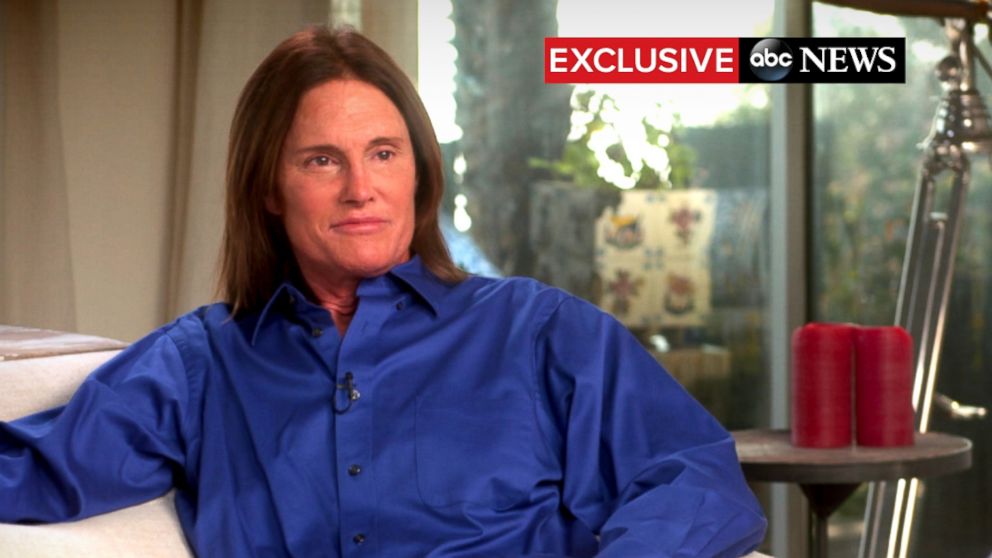
PHOTO: Bruce Jenner sat down for a far-ranging exclusive interview with ABC’s Diane Sawyer in a special edition of “20/20.”

There are two big stories involving transgender people in the news this week. The first one is Bruce Jenner's television interview with Diane Sawyer in which he comes out as a woman. Unless you have been living under a rock, you have at least heard about the interview if not seen it.

Here is just a snip of his comments:
“For all intents and purposes, I’m a woman,” Jenner told ABC’s Diane Sawyer in an exclusive interview that aired Friday in a special two-hour edition of ABC News’ “20/20.” 

“People look at me differently. They see you as this macho male, but my heart and my soul and everything that I do in life -- it is part of me,” Jenner, 65, said. “That female side is part of me. That’s who I am.”
CNN has proposed that "2015 may be remembered as the year the term "transgender" fully entered mainstream consciousness." Here is more evidence they site (correctly) that suggests America is having a transgender awakening:
In January, President Obama condemned the persecution of "people who are lesbian, gay, bisexual or transgender," becoming the first president to utter the word in a State of the Union address.

"Transparent," about an aging father who begins living as a woman, won two top awards at the Golden Globes, while transgender actress Laverne Cox of "Orange is the New Black" -- who made the cover of Time magazine last year -- was just cast in a new CBS drama

The May issue of Vogue has a photo spread with transgender model Andreja Pejic, who said on Instagram this week that she "was told by various people many times over that the chances of me ending up on these pages were slim to none." A transgender character had a recurring storyline on the just-wrapped final season of "Glee," while transgender activist and YouTube star Jazz Jennings will star in a reality show debuting on TLC this summer.

transgender model Andreja Pejic

The second big news story, which is a far second to the Bruce Jenner story, a (wo)man once considered the best athlete on the planet after he won the 1976 Olympic gold medal in the Decathlon, is that a trans man, Aydian Dowling, is the leading vote-getter to appear on the cover of Men's Health Magazine.


As USA Today notes, he is not assured of being on the cover simply by winning the reader's vote:
While Dowling is clearly in the lead with reader votes (he's ahead by more than 30,000) it doesn't necessarily mean his image will grace the cover.

Judges for the annual contest, now in its second year, select a winner from entries based on a number of criteria including fitness, professional success, healthy lifestyle and how much they give back to their community. The public votes make up 10% of the final ranking, according to the contest rules.
Still, it would be a huge step for transgender acceptance and equality if he were given the cover, and no matter what less welcoming readers of Men's Health might think, this would likely be one of the best selling issues of all time. That may be all it takes to get Aydian Dowling on the cover.

These two stories, plus the trans model in Vogue (even if her image reinforces the dominant image of female beauty, and does not represent the majority of trans women), the success of Transparent on Amazon Prime, and the success of transgender actress Laverne Cox of Orange is the New Black, all signify a transgender awakening in America.

It's time. 

For more, see CNN's America's Transgender Moment.

Sunday, September 7, 2014

Doing The Hard Work Of Becoming A 'Real Man'

From NPR's All Things Considered, Saeed Jones reviews the intriguing book from TC Cooper, Real Man Adventures (2012). The reason this book is interesting to me, and likely anyone who is interested in how masculinity is socially constructed, is that the author is a trans man, a man born with a female biological body but a male sense of self.

Here is the publisher's ad copy for the book:
A few years ago, the novelist T Cooper wrote his parents a letter telling them he “wasn’t their daughter anymore.” And that was the “good news.”

Real Man Adventures is Cooper’s brash, wildly inventive, and often comic exploration of the paradoxes and pleasures of masculinity. He takes us through his transition into identifying as male, and how he went on to marry his wife and become an adoring stepfather of two children. Alternately bemused and exasperated when he feels compelled to explain all this, Cooper never loses his sense of humor. “Ten Things People Assume I Understand About Women But Actually Don’t,” reads one chapter title, while another proffers: “Sometimes I Think the Whole of Modern History Can Be Explained by Testosterone.”

A brilliant collage of letters, essays, interviews (with his brother, with his wife, with the parents of other transgender children), artwork, and sharp evocations of difficult conversations with old friends and puzzled bureaucrats, Real Man Adventures will forever change what you think about what it means to be a man.
I look forward to reading this, and sharing it with my trans men clients who are still working to develop a comfortable sense of a being man without the socialization cis males get simply by being born male. The way that trans men construct their masculine identity is informative for all of us.

Doing The Hard Work Of Becoming A 'Real Man'


by Saeed Jones
September 01, 2014

All Things Considered

3 min 10 sec

Real Man Adventures
by T Cooper
Paperback, 275 pages

Here is something I wish I'd been taught when I was still a limp-wristed little boy: Any man who says that the performance of red-blooded masculinity comes naturally and is easy to pull off is either lying to you, or worse, himself. Being a man, or, constructing manhood is damn hard work.

Some of us just give up and eventually settle into an easier, more breathable version of ourselves. Others resort to all sorts of desperate shows of sexism, violence and general havoc in an attempt to convince ourselves and our culture that we are up to measure.

T Cooper's recent book, Real Man Adventures, examines manhood's precariousness through the lens of his own experiences. The memoir opens, after an epigraph from Ralph Ellison's novel Invisible Man, with these three sentences: "I am a visible man. By all appearances white, middle-class, heterosexual. Male."

Cooper, a happy married man with two young step daughters, is also transgender. His identity as a transgender man is not and should not be regarded as a paradox. And through the book, via essays both humorous and heartbreaking, lists, illustrated diagrams and interviews with family members and friends, Cooper strives and ultimately succeeds in illuminating what he has learned about manhood on the way to becoming himself.

One chapter is a list of changes he and his wife have noticed since he first started taking testosterone, among them: "I am angry more frequently. Or: it takes way less to make me blazing mad." And, "People defer to me more." And, "I say less to strangers." Later, there's a chapter in which Cooper interviews a trans friend's mother. He begins the interview by admitting: "I'm asking you these questions because I'm too much of a wimp to ask my own parents. Or maybe I'm not ready to hear their answers."

Cooper writes with intelligence and vulnerability as he grapples with the idea of being or becoming a "real man." And in doing so, he gets to an essential truth that we'd all do well to heed: Manhood itself is a work of art, you might say. The stoicism, the toughness, the strength are like a painter's brushstrokes on a self-portrait: "This is who I am. This is who I want you to see." If we are real men, Cooper seems to say, it is because we are real to and with ourselves.

What he has accomplished with Real Man Adventures was not achieved without risk or sacrifice. He weighs the possible consequences of writing about his personal life and thus exposing himself and his family. For all the progress America has made regarding acceptance of transgender people, there is still a great deal of work to be done. But the necessary change, the breakthrough we seek and need begins here in this book, with the honest questions answered and the self laid bare.

I would have loved to read Cooper's book when I was still a boy, but I suppose — since being a man is an ever ongoing process — his brilliant writing has arrived right on time all the same.

  • Saeed Jones' next book of poetry, Prelude to Bruise, comes out next month.

Friday, February 21, 2014

Do You Have to Pee Standing Up to Be a Real Man?

Why would you pee sitting down (if you are a cis male)? But that is not the issue of this story - some men are not able to pee standing up, and some men are gender- or genital-variant. If you are a trans man who wishes to pass, standing at a urinal might be the only to fully pass.

From Pacific Standard.

Do You Have to Pee Standing Up to Be a Real Man?

• February 13, 2014 

urinals
This simple idea, encouraged by medical texts of the past that taught deviation from the norm would lead to confused sexuality and gender identity issues, has put a surprising number of babies under the knife.


In contemporary American culture, much is still demanded of “real men”: To be commanding and composed. To be courageous and chivalrous. To be rugged, strong, and low-voiced. And to be able to pee standing up.

Males are sometimes born with a urinary meatus (what kids might call “the pee hole”) somewhere other than the tip of the penis, which can make it difficult to meet this last demand. The opening might be farther down the head, on the shaft, or even on the scrotum. When this happens, and a doctor notices it, a newborn lad gets hit with a diagnosis of hypospadias. Often, he will be referred to a surgeon for “correction.”

How many boys are born with hypospadias is a matter of some dispute. Environmental hormone disruptors—including those found in some medications for hair loss and prostate cancer—increase chances of a male fetus developing hypospadias, and so the rate of hypospadias in America is probably increasing every year. Right now, American medical textbooks put the frequency at around one in 150 to 250 live male births, which would make it pretty common. That frequency would mean that, when you’re shopping in Costco, chances are so is a man born with hypospadias. When you’re in a major sports stadium, chances are you’re surrounded by a few hundred such men.

In fact, hypospadias might be much more common than even that, and may have always been. In 1995, the Journal of Urology published a stunning—and generally ignored—study out of Germany that showed that urologists have unreasonably strict expectations for penises. These physicians looked at a group of 500 men and found that only 55 percent could be labeled “normal,” according to medical standards. Of the 500, fully 225 counted as having hypospadias.

The team observed that “it remains unclear whether the tip of the glans [penis] is truly the normal site” for the urethral opening. The physicians also questioned whether surgical “correction” of hypospadias was necessary, given what they admitted was the “significant complication rate” of “reparative” surgeries—and given these men seemed to have figured out how to use their penises to their own satisfaction.

Yet every day in America, baby boys are put under anesthesia and under the knife to “fix” hypospadias. This involves moving the meatus to where surgeons believe it’s “supposed” to be (regardless of the German study’s findings). In mild cases of hypospadias, this is often a relatively simple surgery, and most of the time comes with no complications. In more significant cases, moving the meatus involves having to surgically build more urethra (the tube that carries urine and, in males, semen). That’s when things can get especially tricky.

The risks of “hypospadias repair” surgeries include wounds opening up on the penis (fistulas), scar tissue building up inside the urethra (stenosis), chronic pain at the surgical site, and chronic infections. For some boys, surgical “repairs” to their penises turn out to be downright destructive—even devastating. Jim Lake, a 54-year-old counselor who works in the Chicago area, has had 17 major urological surgeries to try and undo the damage that followed the surgical “correction” performed on his penis when he was just a baby. The medical literature has a special name for boys and men like Jim: hypospadias cripples.

Make no mistake: this “crippling” isn’t caused by the hypospadias; it’s caused by the complications of surgeries to “fix” hypospadias. In the vast majority of cases, initial “repair” of hypospadias is not done because a boy’s health is being actively compromised by this anatomical quirk; his health is not. In fact, in most cases, the surgery increases the odds a boy is going to suffer from urological problems. If what you care about is improving physical health, in most cases you would not go through with “hypospadias repair.”

And consider one of the most shocking findings of the German study: “all but 6 [of the 225 men diagnosed with hypospadias] were not aware of any penile anomaly, all but 1 homosexual patient have fathered children…. [A]ll patients participated in sexual intercourse without problems and were able to void in a standing position with a single stream.” So why label them as anything but normal?

Most hypospadias “repairs” performed by surgeons occur because of an untested, Freudian belief that you can’t grow up a “real man” if you urinate and ejaculate from somewhere other than the very tip of your penis. Urology texts of the past made it pretty plain: if you don’t “fix” hypospadias, a boy might be so messed up in his gender identity that he’ll grow up gay. Few urologists today seem to believe that sexual orientation is caused by how one pees, but many still think boys’ psychological health absolutely depends on being able to pee standing up. There’s no evidence for this. Why insurance covers it, even when there is no good evidence it is necessary or beneficial, remains a mystery.

I have heard some contemporary surgeons insist that hypospadias repair is done for a “medical” reason—to ensure a boy can eventually successfully impregnate a woman though intercourse. But there are simpler, non-surgical solutions to the problem of ejaculating somewhere other than the penis’s tip, including one reported in a late-19th-century British medical journal. In that case, a man with hypospadias was reported to have impregnated his wife by ejaculating onto a long-handled spoon and inserting it into her vagina.

Of course, we have better tools today. Through my work on this subject, a few years ago I met a man with “uncorrected” hypospadias who had opted for a high-quality turkey baster. He observed to me that, so far as he and his wife were concerned, they had the best of all possible worlds: he had no trouble with erections, orgasms, and intercourse—he was healthy—and yet he couldn’t accidentally get his wife pregnant. When they wanted to conceive, they just engaged in a private thanksgiving.

Nevertheless, parents of boys with hypospadias are often led to believe “corrective” surgery is necessary and worth the risks. Urologists don’t typically suggest that, before consenting to surgery, parents talk to the men in the Hypospadias and Epispadias Association (HEA) support group, of which Jim Lake is the incoming president.

Tiger Devore, a clinical psychologist now completing his service as HEA’s president, told me in a recent phone interview that he sees signs of pediatric urologists backing off of “hypospadias repair,” and that those changes in attitude break down along generational lines. Devore attended the International Pediatric Urology Task Force on Hypospadias in Las Vegas last September, and there he observed younger urologists being much more hesitant to push “corrective” surgery, especially in relatively minor cases, because of the risks.

Devore’s observation reminded me of a set of conversations I had with one pediatric urologist. About 15 years ago, this urological surgeon told me he wished I’d stop saying that hypospadias repair was motivated by a latent homophobia—it was a necessary surgery, he said. When I ran into him a couple of years ago, he admitted to me that my activist colleagues and I had been winning in our attempts to get his colleagues to move away from so many “repair” surgeries for hypospadias. I asked him to what he attributed the change. Without pause, he replied, “American culture has really come around on the gay thing.”

Could it be that surgeons and parents have really worried that a child left to grow up with atypical genitals will be at greater risk of gender identity and sexual orientation “problems”? Well, when I was editing a handbook for parents of these children in 2005, and I asked specialist clinicians what questions parents typically had when faced with a newborn with atypical genitals, the number one question was: Will my child be gay?

After working in this field for almost 20 years, I do not believe that most parents (or physicians) are trying to eliminate the possibility of a gay child through “corrective” surgery. I don’t see this as a eugenicist agenda. I think when parents ask Will my child be gay?, most of the time they are asking something more complicated, something genuinely compassionate: Will my child be able to know love, as I have known love?

But I do think it is the case that we still have a very tangled and too often unexamined confusion over genital variation and its meanings. We need an approach that is much calmer, more organized, and less anatomically naïve. Less surgical in its “corrective” fantasies.

So what are the options, at least for hypospadias?

A pediatric psychologist asked me something like this a couple of years ago, specifically in reference to a three-year-old boy on his service. The boy was born with hypospadias and his parents had decided early on against surgery. The mother was now feeling some anxiety because the boy, whose hypospadias made it so he had to sit to pee, was noticing how boys usually stand to pee while girls sit. The psychologist was calling to ask me if I knew of a simple prosthetic option so that this boy could try standing to pee.

Yes, I replied. And I know about the prosthetic solution because I like to camp. There’s a product called Go Girl, and it’s basically a reusable little plastic funnel. You hold it under yourself when you urinate, and the pee goes shooting out in front. Transgender men (who used to be female) sometimes also use these. I suggested the psychologist buy some of these devices, perhaps in the “camo” color, take them out of the Go Girl package, and show the kid how to use them, in case he wanted to pee standing up. A few bucks spent now and then on this handy product will buy this boy time so he can decide later, when he’s mature enough, if he wants to take on genital surgery risk. By then, too, the surgeries will hopefully be better.

An even better solution than Go Girl came from another family I ran across, a family including a boy born with a small penis and hypospadias. The first set of doctors had suggested sex changing the boy, something that used to be pretty common in such cases. (If you can’t make him into a “real man,” you make him into a girl, right?) Another set of doctors had offered “hypospadias repair.” But the parents, conservative Christians, had decided to let the boy grow up without elective, risky, invasive medical procedures.

In this case, the father took an innovative approach. Hearing about the alleged importance of a boy being able to urinate the way the men around him do, the father decided to sit to pee. Following the father’s lead, so did (and do) all the other men in the family when they are around this little boy: they all sit to pee.

Rather than getting that little boy to come to their norm, they decided to go to his.

What lesson is that little American boy learning about what makes a “real man”: compassion, acceptance, joy, and love. And sitting down to pee. What would be wrong with more men like that?

To watch videos of people born with hypospadias and other relatively uncommon variations on sex anatomy talking about their lives, visit The Interface Project.

Alice Dreger
Alice Dreger is a professor of clinical medical humanities and bioethics at Northwestern University's Feinberg School of Medicine. She has written for The New York Times, The Wall Street Journal, and The Washington Post

Monday, February 3, 2014

JJ Vincent - Manning Up: Transsexual Men on Finding Family, Brotherhood, and Themselves

From the Good Men Project, this is a "review" (more like a preview) of a book due out later this year,
Manning Up: Transsexual Men on Finding Brotherhood, Family & Themselves (pre-order now from Transgress Press for $20.00, $3.00 off of the anticipated cover price).


This seems to be an interesting book - it's a topic that I have researched and studied myself, so I have an interest in this material beyond the work I have done with trans men.

Manning Up: Transsexual Men on Finding Family, Brotherhood, and Themselves

February 2, 2014 by JJ Vincent

Manning Up: Transexual Men Talk

A new book brings together a diverse range of trans*male voices to share their stories of how they became the men that they are.


Manning Up is not the first anthology of trans*men’s stories, but it may be the most diverse and wide-ranging.

Let’s start with the title, Manning Up. It’s usually a phrase that makes us cringe, associated with someone telling us that we are not living up to some masculine ideal. The editors, Zander Keig and Mitch Kellaway, have given “manning up” a new definition, using it as a phrase to describe the process of someone becoming the man they know themselves to be. In his foreword, transman, activist, and author Jamison Green writes:

As the men included in this collection attest, being a man involves knowing who you are and how you fit into the world of men. No man gains this knowledge automatically. It is a process for each of us, regardless of race, class, or age. The men who share pieces of their stories in these pages are in varying stages of this process. Their diverse backgrounds, ages, and racial heritage illuminate their journeys, and their histories of physical and socio-cultural obstacles enrich their appreciation of the nuances involved in taking their places among the men in their spheres, as well as redefining their relationships with women.
Each of the writers approaches masculinity from a different perspective. Some grew up doing “boy” activism others were pushed along traditionally female paths. Some are open and out, others choose to live with minimal disclosure of the lives they formerly led. Some transitioned early in life, with the full support of their families. One man was 54. These men are Christian, Jewish, Muslim, none of the above, gay, straight, poly, single, married. They are as varied as men anywhere.

One unifying theme in all of these stories, what makes them so compelling, is that each of them always knew, on some level, that they were not women, regardless of they physical characteristics they were born with or the social labels placed on them. Another is love-love of self, love of others-and how their transitions allowed them to experience this in new ways. What makes each one distinct, though, is what they believed a man was, how that view was shaped over time, and how they embraced or rejected that in their own lives.
 

One reviewer writes:
What is most subversive about the book, is that the stories present a poignant image of familial acceptance — something that many trans narratives still tend to shy away from. We hear from men whose masculinity is shaped by intimate interactions with fathers, brothers, colleagues, and even lovers.

Manning Up shows the complexity and beauty of transition that is not only unique to the trans male experience but with its underlying theme of love, it is a book that is relatable to all genders.

~ Kortney Ryan Ziegler, Oakland-based award-winning artist and writer
It is the distinct tone of each story that gives this book its strength, separates it from “coming out” books, and makes it accessible and compelling to anyone, not just people in the GLBT community. There is no one type of man; there is no one type of masculinity, or one transition narrative. Another reviewer says:
The genius of Manning Up is its ability to include, indeed its insistence on, multiple narratives and experiences and, thus, the creation of many new histories. These essays are a necessary antidote to today’s pervasive and crushing limited scope of “acceptable” (hyper) masculinities. These first person, deeply reflective and wondrously diverse narratives broaden the range of what is possible for trans and cis men alike. An important addition to masculinity studies by men with vitally human perspectives.

~ tc tolbert, co-editor of Troubling the Line: Trans and Genderqueer Poetry and Poetics
Manning Up contains a total of 29 stories divided into four sections: Manning Up, Family Man, Men Like Me, and New Territories.

I’m not going to lie to you and say this is a book of quick and easy reads, of short essays about being a man in modern society. There are pieces in here that will challenge you. There are pieces that are poetic and lyrical and others that are forceful and in-your-face. They are not all uplifting, with pat endings, starring the characters that popular media has taught us to expect in the stories of trans*people.

But they are worth your time. One writer writes about the most honest performance he has ever given, a true autobiography on stage-and how it is rewarded with praise for his acting ability. Another speaks of his comfort and discomfort of being unquestioningly accepted into the crude sexual joking/male bonding of his much-younger coworkers. In one deeply thought-provoking piece, the writer speaks about being a “new black man”, now subject to the presumption and racism that go with that.

Being a man, becoming a man, regardless of the path you take to get there, does not automatically confer privilege or erase your past experiences. But these stories, by established writers and new voices, will give you a new perspective on what it means to be one.

Photo by Wolfgang

Saturday, August 17, 2013

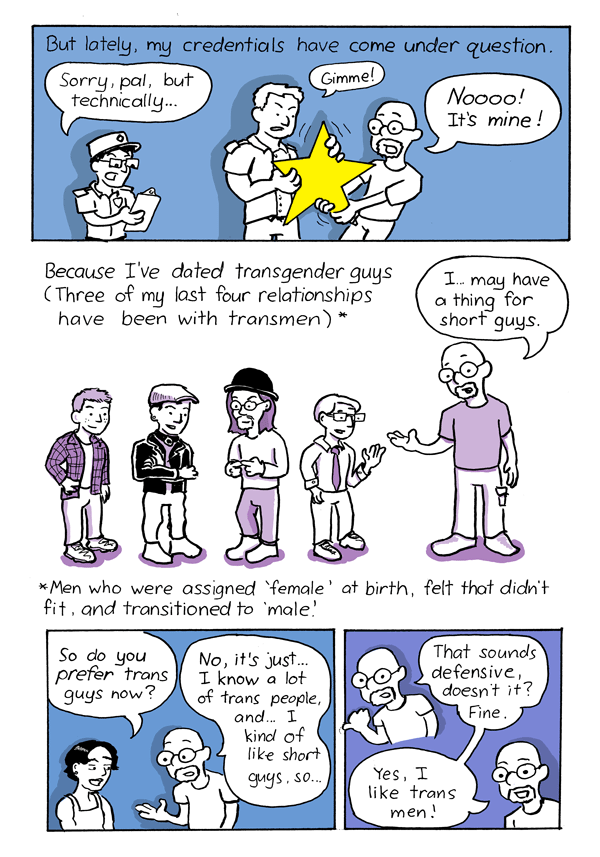
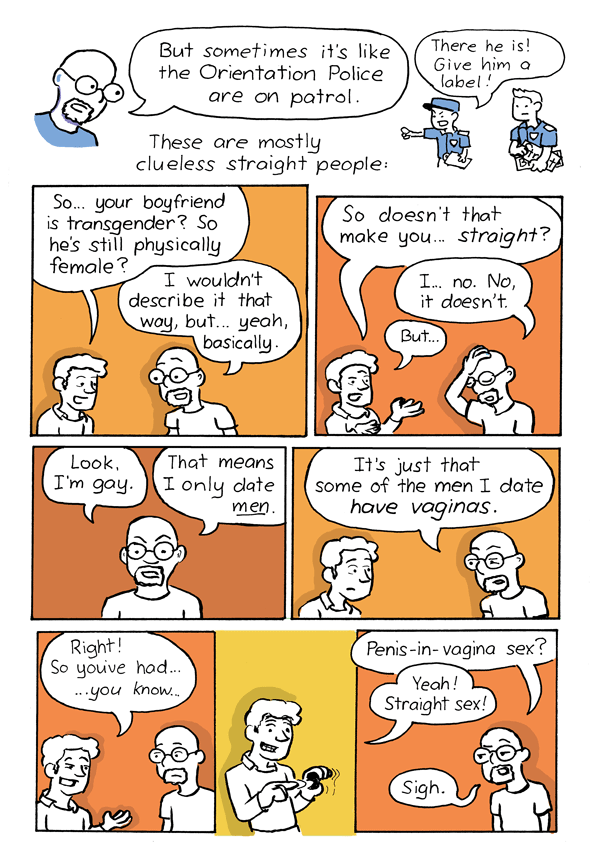
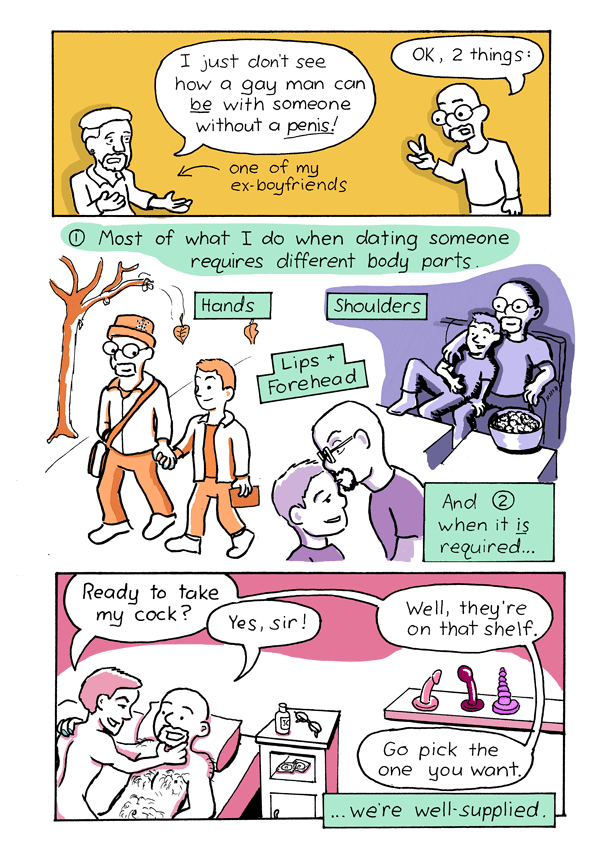
Bill Roundy - Orientation Police (a Comic)

From The Amazing Adventures of Bill, drawn by Bill Roundy. [This comic was drawn for the Anything That Loves anthology from Northwest Press.]

This comic, Orientation Police, is an excellent look at the issues we get into when we insist of labeling ourselves or each other.