Showing posts with label Pacific Standard. Show all posts

Thursday, October 16, 2014

Michael White - How the Sexes Evolved (via Pacific Standard)

Each Friday, Pacific Standard has been looking at how and why the social becomes biological. This week Michale White flipped the question: How does biology become social? One of the best ways to see how biology drives social behavior is to look at one of the oldest social relationships in the living world: sex.

How the Sexes Evolved

• August 15, 2014 

sex-gene
(Photo: Crystal Eye Studio/Shutterstock)
The distinction between males and females is one of the oldest facts of biology—but how did it come to affect our social identity?
Every Friday this month we’re taking a look at the relationship between the social and the biological—specifically, how and why the former becomes the latter. Check back next week for another installment.

One way to understand how and why the social becomes biological is to flip the question: How does biology become social? One of the best ways to see how biology drives social behavior is to look at one of the oldest social relationships in the living world: sex.

Sex and its central role is biology is the main reason why men and women are different, but it’s hard to tease apart biology from culture. Anatomical differences are obviously biological, while a quick survey of various human societies is enough to see that many differences between men and women are cultural and liable to change. The distinction between males and females, however, is one of the oldest facts of biology. Except for bacteria, nearly all life reproduces sexually at least some of the time, and two distinct sexes are generally necessary to do this.

Just why sex is such a popular method for transferring genes to the next generation is still a bit of an enigma, but it’s clear that distinct male and female sexes emerged multiple times throughout evolutionary history. It happened in the ancestors of plants and animals more than a billion years ago. That’s too far back for us to recover even sketchy details about how the original distinction between males and females evolved. Fortunately for us, we have an “evolutionary time machine” of sorts: the volvocine green algae. It’s a family of present-day species that nicely illustrates the evolutionary transition from a single-celled organism without very distinct sexes, to a multi-cellular one with genuine males and females.

Volvocine algae are like a time machine because, in the relatively brief period of 200 million years, this group evolved from a free-living, single-cell ancestor into a variety of multi-cellular life forms. To study this evolutionary process, biologists can compare a present-day single-cell species, Chlamydomonas reinhardtii, with its much larger, multi-cellular relative, Volvox carteri. Volvox has males and females, while Chlamydomonas doesn’t; by comparing the two, we can learn about how sexes evolve.

Chlamydomonas sex is typical for a single-cell sexual organism: primitive. These algae come in two different “mating types,” called “plus” and “minus.” Instead of issuing specialized male and female reproductive cells, this organism transforms its entire one-celled self into a gamete and seeks out a partner of the opposite mating type. Like two poles of a magnet, “plus” and “minus” organisms aren’t that different from each other. The differences that do exist serve mainly to allow one mating type to recognize and fuse with the other.

Volvox sex, on the other hand, is surprisingly familiar. These algae, made up of about 2,000 cells, exist as distinct males and females. The males produce sperm that fertilize the eggs of the females, producing a zygote that develops into an embryo. Sound familiar? But here’s the stunning fact about it: This whole reproductive process evolved from scratch in algae within the last 200 million years, during a time when reptiles, amphibians, mammals—descended from a long line of sexually reproducing ancestors—were roaming the Earth. The two sexes of Volvox are an evolutionary rerun.

SO HOW DO YOU get from mating types to males and females? That’s the question asked by a trio of researchers, at the Danforth Plant Science Center in St. Louis and the Salk Institute in La Jolla, in a study published this summer. The scientists began from the observation that distinct sexes have evolved repeatedly in life’s history, and the result is nearly always the same: females who produce relatively few large, immobile eggs, and males who produce many small, mobile sperm. To understand the genetic basis of Volvox males and females, the researchers tried swapping genes between the sexes.

They were interested in one gene in particular, called MID. Male Volvox have this gene, while the females don’t. This gene exists in single-celled algae as well, where it acts as a master mating type switch that prevents “minus” from turning into “plus.” The scientists reasoned that MID might do something similar in Volvox. They transferred a copy of this male-specific gene into females, which became pseudo-males and started making sperm. And when they deleted MID from the males, the algae became pseudo-females and started making eggs. Their results show that this master switch gene “control[s] two very different manifestations of sexual reproduction.” This gene was reprogrammed from a simple regulator of primitive mating types into one that controls the major differences between females and males.

The oldest and most fundamental way that males and females differ is in their reproductive cells. Once you have sex-specific reproductive cells, new sex-specific evolutionary strategies come into play. These drive the development of even more physical and behavioral differences between males and females. New genes fall under the control of the master switch to become sex-specific genes. In Volvox, about a dozen genes are found only in males or females. In humans, there are about 80 protein-coding genes on the Y chromosome that are specific to men. The human master switch is called SRY, and like MID in Volvox, its primary job is to switch on the genetic program to produce sperm.

There is no doubt that the trend in human societies is to exaggerate the differences between men and women—typically by emphasizing the supposedly lesser capabilities of women. Then society changes, and sex differences that many people took for granted as biological turn out to be social after all. Certainly compared to many species, the differences between human males and females are small. But those biological differences drive so much of our social behavior, for better and for worse, and the case of Volvox algae show how the differences between men and women probably began.

Michael White
Michael White is a systems biologist at the Department of Genetics and the Center for Genome Sciences and Systems Biology at the Washington University School of Medicine in St. Louis, where he studies how DNA encodes information for gene regulation. He co-founded the online science pub The Finch and Pea. Follow him on Twitter @genologos.

More From Michael White
Related Stories


Monday, June 30, 2014

The American Man: A Late Night at Magic Cobra Tattoo


The is the first installment of a new series from Pacific Standard called The American Man, written by Thomas Page McBee, author of the forthcoming title, Man Alive: A True Story of Violence, Forgiveness and Becoming a Man (City Lights/Sister Spit, September 9, 2014).


This article looks at tattooing as a male bonding ritual. His perspective in these articles (and likely his book as well) is sure to be more interesting than some other male writers on gender - McBee is a transman, and therefore has had to manufacture a sense of masculinity in ways many cis-males have never even considered.

The American Man: A Late Night at Magic Cobra Tattoo

By Thomas Page McBee • June 19, 2014

tattoo-machine
(Photo: Susan Law Caiz/Shutterstock)

Our constant exploration for a sense of belonging is just about the only thing that could bring Brooklyn hipsters, queers, and a Christian couple from California all together for tattoos in the middle of a full-moon night. That and the $13 price tag.


The plan was for the scruffy lot of us to line up at midnight on the 12th outside Magic Cobra Tattoo in Brooklyn to get Friday the 13th tattoos—an underground tradition in shops across the country where $13, tenacity, and whiskey (recommended, not required) gets you a date with a piece of flash chosen last-minute off the shop’s board: a skull with “13” for eyes, a dagger, a toilet on fire.

My two buddies and I have dozens of tattoos between us, and there was talk of all three of us getting the same one. A crown, I figured, though I’d go for the owl or a dagger maybe, too. I love my friends, I love reclaiming masculine ritual, and I love tattoos.

What could go wrong?

Male bonding traditions are strikingly consistent and problematic in many cultures: often simultaneously homophobic and homosexual, pervasive, historic, and even animal—from skin cutting in Papua New Guinea to foreskin suturing by the Romans to bullet ant-sting initiation in Brazil—they’re also stunning in their commitment to pain and power as a way to mark a masculine coming-of-age.

One dark, modern side of such rituals is hazing—of particular concern in the military and college fraternities. The Army, which defines hazing as “an activity typically steeped in tradition, bound by silence, and ritualistic in nature” that “is thought to mark a transition, celebrate an achievement, or bring someone into a social or professional circle” has a zero tolerance policy for such activities, and the “deadliest fraternity” has eliminated pledging altogether.

I think that’s wise, and the fact is, ever since I began injecting testosterone three years ago, I’ve been drawn to ritual. I didn’t have a boyhood, never stayed up all night at summer camp engaging in harmless pranks like writing “butts” on some poor sap’s forehead, and—like a lot of modern men—I walk a knife’s edge between nostalgia for a true straight razor shave and a gratitude that I can be my tight-jean, literary self without much worry. I’m turned off by the endemic sexism, violence, and homophobia peppering locker room and barbershop talk, and—since I never felt an affiliation with my birth gender—I’m 33 and, for the first time in my life, I experience gender affinity with every toll booth ticket taker who calls me “brother” or “boss.”

Men are taught that power is the key to relationships, which is where a lot of troubling behavior starts. But an instinct to ritualize bonding may come from a need for healthy belonging. Contrary to popular belief, studies show that under stress that results in vulnerability groups of men (like women) demonstrate cooperative behavior that leads to less aggression and more trust and compassion. So Friday the 13th tattoos with my buddies felt more goodtime portside sailor than, you know, frat nightmare kidnapping and death. That was the idea, anyway.

It was only right that the night started off with my good buddy’s first trip to Shake Shack. We ate burgers and talked about this horrible dude we both want to punch in the face and the women we love, tenderness and red meat and elaborate fantasies regarding this guy getting his comeuppance. Then he bailed on the idea of tattoos so he could get up early enough to meet his fiancée in Philly (“I get it,” I said, because I did), and I took the G to hold a spot in line for my other friend.

The parlor line was a culture all its own. Hardcore old tattoo dudes; Brooklyn hipsters; and a mishmash of twentysomething hip-hop heads, and wide-eyed first-timers drank beer out of coffee cups and smoked joint after joint. A kid I knew from queer dance parties showed up, read my astrological chart, and hit on the straight girl in front of us who planned to get a UFO inked on her neck. She was with two doofuses, one of whom announced that he was “just here to meet bitches,” which drew a look from pretty much everyone around him. “Sorry,” he said, but he wasn’t. Later, I felt a twinge of victory when the straight girl ordered him to buy her cigarettes and he was gone, hitting three stores and returning to her with his hands outstretched, like an offering.

My friend showed up late and got in line with someone else, leaving me with no plan and a ragtag group—the straight Queens guys up-talking peyote with blustery bravado while holding an umbrella over my head, the queer kid smoking endless kush out of a vaporizer, and the Christian California couple behind me who went and bought me beer and snacks at 3 a.m. but stared at me, wide-eyed, when the queer kid announced that we were “all gay”—which wasn’t really true, I sleep with women, but whatever, close enough.

“You people might not like this,” the Queens guy just here to hit it with the ladies mumbled to us drunkenly around 4, “but there’s this reggae dance night in the Rockaways you should check out.” Kush Queer smiled politely, while I tried to understand whose people he thought I was exactly—gay ones, I guessed. It occurred to me that, as usual, I straddled the world in which I passed and the one in which I didn’t.

I can always bond, but never commit, to one way of being a man: I belong everywhere and nowhere at once.

Maybe that’s the reality of a lot of my brethren. Younger men aren’t as hampered by social constructions of masculinity, and though we may hunger to reclaim some aspects of it with our boxing clubs and barber shops, we have less of a need to codify what being a man means in primal, no-pain-no-gain terms. Generation Y men do more housework and are more engaged fathers than any generation before. Despite the need to be better feminists, many of us—contrary to what Pharrell thinks—use the term to define ourselves.

I caught sight of my friend after he got a knot tattoo on his arm, and we hugged and then he took off. I’d decided to go my own way with the log cabin, but by 4 I’d lost steam. It had been five hours, someone said the tattooists were drunk, and I felt a little hungover. When the rain kicked up, I told my new friends I was out, collected pounds from all of them, and hopped in a trolling cab.

It was the ride home that, surprisingly, offered me the fraternity I’d spent all night seeking. The driver, a Nigerian man with bad hearing and alarmingly erratic steering, couldn’t find the bridge to get me back to Manhattan. After a few minutes circling the same three blocks, I asked if we were lost. “Yes,” he said, pulling over, actually holding his head in his hands. It was 5 in the morning on a Friday, the salmon sunrise making everything a little sparkly. “I’m so ashamed,” he said.

“It’s all right,” I told him, because it was. He’d turned off the meter, I had nowhere to be, and the rain made the light look magic.

After getting back on the road and asking another cabbie for directions, my man turned around and faced me. “Have you ever been lost?” he asked, his eyes pleading, and I knew that what I wanted was this: a kindness to sand the edge off days filled with tiresome bravado, electric moments of near-violence, shit talk and flexing and avoiding a mysterious fight on Canal with a guy who accused me (wrongly) of “taking pictures of his car.” This moment wasn’t a ritual or a test, but when I answered the cabbie, I felt fraternal.

“I’m always lost,” I said, and we both laughed, two strangers in fragile bodies, connected in our liminal crossing of the bridge, under the sun that just kept on rising over our journey home.

EDITOR’S NOTE: The American Man is a new semi-regular series from Thomas Page McBee that features gonzo reporting from barbers shops, boxing gyms, frat houses, and other bastions of masculinity in an effort to define what makes a modern man.


Thomas Page McBee is the author of the forthcoming book Man Alive: A True Story of Violence, Forgiveness and Becoming a Man. He has written about gender for the New York Times, the Atlantic, Vice, Salon, and the Rumpus, where he pens the column “Self-Made Man.” Follow him on Twitter @thomapagemcbee.

Thursday, May 22, 2014

Jared Keller - The Tortured Rise of the All-American Bro (Pacific Standard)

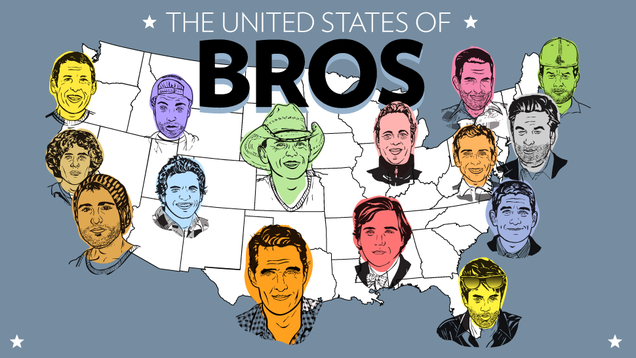
The United States of Bros: A Map and Field Guide

This article by Jared Keller comes from Pacific Standard - it offers a first-person account of a man who identifies himself as a "bro."
For all intents and purposes, I am a bro. I identify as a bro in the sense that, as Jezebel so aptly put it, I am “an adult male whose social life revolves around collegiate homosocial bonding and who also presents himself in a way that assimilates to the prevailing aesthetic of men with similar socialization patterns.”
From a much more critical, dismissive perspective, John Saward says of "bros," writing in Vice, “This is his dream. This is his life. He is the worst person alive, and he has no idea.
 He is a walking scorched-earth policy. He takes what he wants to satisfy some hedonistic impulse, and then he leaves her sobbing in a hallway with her friend on the other line. He wrings every moment of every drop of novelty. He is doing shots and never with a chaser, because moderation and restraint are for women and faggots and children. The only way to be a real man is to be a real man as ferociously as humanly possible. He goes all-in; he gets shredded and ripped and defines his life by aggression and competitions. He buys the hamburger that comes with two other hamburgers and a chicken cutlet on top of it. Why? Because it’s three hamburgers with a chicken cutlet on top of it.
Keller asks, and tried to answer in this article, some very challenging questions:
Where did this strange American Bro come from, this alien, fist-pumping, Jager-bombing avatar of modern sexism, racism, and nihilism? And why does he loom over every male friendship, every moment “with the boys”? Am I doomed, by our culture, to live as a jerk, a social parasite made fat on the sweet lard of privilege, with my male friends and colleagues? At what point did all strong homosocial relationships between men become conflated with the most vile and socially abhorrent behavior and egregious sartorial choices?
I'm fortunate, I guess, to have long, long ago left the "bro" stage of my life, sometime in 20s. When I get together with male friends, it's usually over coffee or lunch, not Jager-bombs. Our conversations do involve our work, but also our hobbies, or home repairs (do bros own homes?), or interesting books or articles we have read.

This is longish, but it is certainly deserving of a good read.

The Tortured Rise of the All-American Bro

Pacific Standard
By Jared Keller • May 06, 2014


cornell-fraternity
A fraternity building at Cornell University (Photo: Pete Spiro/Shutterstock)


The misogynist portrait of modern American masculinity may be a historical accident. Here’s how to fix it.

In April, my college buddies and I drove up to Maine to spend the weekend getting drunk and bouncing around downtown Portland for a former roommate’s bachelor party. Of all the people I’ve met and friends I’ve made—through high school and internships and college and jobs—these random goofballs are my closest friends. We headed north to celebrate impending nuptials, but at its core this weekend was about, as my girlfriend says, “just hanging out with the bros.”

For all intents and purposes, I am a bro. I identify as a bro in the sense that, as Jezebel so aptly put it, I am “an adult male whose social life revolves around collegiate homosocial bonding and who also presents himself in a way that assimilates to the prevailing aesthetic of men with similar socialization patterns.”

But according to Vice, my friends and I are the worst thing to happen to Portland since the great 1866 fire that leveled churches, destroyed the city’s commercial center, and left nearly 10,000 homeless. On an off day, I should be on Boston’s Orange Line, stinking of bourbon and slurring, and “cackling at the ceiling, electrified by the degree to which he does not give a fuck,” John Saward writes. “This is his dream. This is his life. He is the worst person alive, and he has no idea.”
He is a walking scorched-earth policy. He takes what he wants to satisfy some hedonistic impulse, and then he leaves her sobbing in a hallway with her friend on the other line. He wrings every moment of every drop of novelty. He is doing shots and never with a chaser, because moderation and restraint are for women and faggots and children. The only way to be a real man is to be a real man as ferociously as humanly possible. He goes all-in; he gets shredded and ripped and defines his life by aggression and competitions. He buys the hamburger that comes with two other hamburgers and a chicken cutlet on top of it. Why? Because it’s three hamburgers with a chicken cutlet on top of it.
I’ve been a member of male-centric institutions my entire life—sports teams, a summer camp staff, a fraternity—and still, somehow, my friends and I don’t seem to quite match this portrait of the American Bro. My weekend habits, though boisterous and uncouth, don’t sync with the totally terrifying acid trip of masculinity captured by Vice. Though I have spent time in the presence (or wake) of the horrific men described by Saward, I have never done 75 push-ups because NO REGRETS. I don’t know anyone named Rachael who wants it, she so wants it, bro. None of my fashion choices match Jezebel’s amazing geographical exhibition of the Great North American Bro. Even BuzzFeed’s “How ‘Bro’ Are You?” quiz considers me vaguely well-adjusted, despite the fact that I make duckface in way too many photos and have been known to say “duuude.” “Congratulations on having exquisite taste,” the BuzzFeed results page says, “and feel free to procreate as much as you like!”

Where did this strange American Bro come from, this alien, fist-pumping, Jager-bombing avatar of modern sexism, racism, and nihilism? And why does he loom over every male friendship, every moment “with the boys”? Am I doomed, by our culture, to live as a jerk, a social parasite made fat on the sweet lard of privilege, with my male friends and colleagues? At what point did all strong homosocial relationships between men become conflated with the most vile and socially abhorrent behavior and egregious sartorial choices?

The repressive, hypermasculine bro that stalks your local watering hole and pisses in the street is a modern, anxious manifestation of homosexual panic, an allergic reaction to the mainstreaming of gay culture.

Ironically, the history of homosexuality in America may hold the secret to the modern hyper-masculine bro. Prior to the 1970s, the majority of psychological literature on homosexuality was based on the presumption that the practice was a mental disorder, a view that coincided with advances in medicine at the end of the 18th century and the rise of psychoanalysis in the U.S. and Continental Europe. Homosexuality was eventually declassified as a mental illness in 1973, and all references to homosexuality as a psychiatric disorder were removed from the American Psychiatric Association’s Diagnostic and Statistical Manual of Mental Disorders (DSM). Despite this, gays and lesbians were still met with apprehension and hostility by the American public: In 1988, only 11 percent approved of same-sex marriage, and while that number increased to 46 percent by 2010, 40 percent of Americans remain opposed to it.

But decades of classifying homosexuality as a “dysfunction” in America left a lasting mark on all homosocial relationships. In modern Anglo-American society, writes gender theorist Eve Kosofsky (who coined the term “homosocial”) in her classic study “Between Men,” there’s a significantly greater disconnect between male homosexual and homosocial bonds, whereas there’s a much more psychosocially continuous relationship between female homosexual and homosocial bonds. The discontinuity between male homosociality and homosexuality results in male homosocial relationships taking on the form of “male bonding,” which is characterized by homosocial desire and intimacy (say it with me now: “broing out”) but marked, most notably, by homosexual panic, the fear of this attention gliding over into something a little more taboo, a little more risqué. In an attempt to emphasize heterosexuality, fear or hatred of homosexuals and misogynist language developed. The bro, in short, is a culture-wide defense mechanism against the gay.

This social split between male homosexual and homosocial relationships is why the sort of homosocial bonding on display in black-and-white photographs of men throughout American history all but went extinct by the middle of the 20th century: homosexuality had become a pathologized identity, one that carried connotations of psychological dysfunction and perversion. “The shift meant sitting for a portrait in your best bro’s lap was verboten; more important, though, some have argued that it has led to a wide-scale deprivation in boys and men of intimate touch that is important to their development and mental health,” Kat Stoeffel explains at The Cut, discussing the rise of touch isolation. “Men who hold hands, sling an arm around each other, and say ‘I love you’ risk being labeled gay at best and violent homophobic backlash (either from observers or their beloved bro) at worst.”
Male physical affection may be making a comeback: According to a recent study in British journal Men and Masculinities, 98 percent of the heterosexual men interviewed had shared a bed with another man, while 93 percent had cuddled or spooned with one, evidence of, as the authors write, “expansion of changing conceptions of masculinity in contemporary culture.”

The repressive, hypermasculine bro that stalks your local watering hole and pisses in the street is a modern, anxious manifestation of homosexual panic, an allergic reaction to the mainstreaming of gay culture (and, by extension, a loss of cultural power and sexual stability). The modern definition of manhood came about in strict domination over the feminine, both sexually and behaviorally. “Male-male relations organize and give meaning to the social and sexual involvements of young heterosexual men in a powerful way,” writes researcher Michael Flood in a 2008 issue of Men and Masculinities, an exploration of how male homosocial bonding affects men’s relationships with women. “Homosocial bonds are policed against the feminizing and homosexualizing influences of excessive heterosociality, achieving sex with women is a means to status among men, sex with women is a direct medium of male bonding, and men’s narratives of their sexual and gender relations are offered to male audiences in storytelling cultures generated in part by homosociality.”

If modern misogyny is a virus, a symptom of psychosexual anxiety and irrational fear of homosexuality, then institutions like fraternities make for an excellent petri dish. Alcohol consumption is the primary way in which men “negotiate masculinities in leisure activities,” writes Lois West in the Journal of Men’s Studies in a 2001 examination of two American drinking cultures, fraternities and the U.S. Navy. Collective boozing—at frat houses, on shore leave, at sporting events—can facilitate the creation of masculine homosociality by “developing a sense of community and trust” around perpetuating certain kinds of American masculine traditions, West writes. But alcohol-driven social interactions are also used to inhibit negotiations over other hierarchies of identity and social boundaries relating to class, religion, race, ethnicity, and sexuality. “Status hierarchies get negotiated through competitive drinking games, humor, and heterosexual significations.”

One of the more troubling features of the modern bro isn’t the sad, relatively recent dose of anxiety that fuels his behavior, but the cultural power he maintains. Male-heavy organizations like the armed forces and college fraternities have the institutional power to safeguard the more violent, despicable, and misogynistic behaviors of young men. The prevalence of sexual assault on college campuses, the site of social and professional development for America’s workforce, is especially troubling. Nearly 20 to 25 percent of female college students will experience rape or attempted rape during their time on campus, according to the Department of Justice; and according to research by the Center for Public Integrity, abusive students rarely receive more than a slap on the wrist. Some universities even rebrand rape as “non-consensual sex.” College sexual assault has become such a frightening epidemic in America that the White House has pressured universities to do more to combat it.

Fraternities, once social organizations focused on personal development and scholastic achievement, have devolved into engines for misogyny and assault. And they can breed future horrors. “Future fraternity brothers are often coddled by yes-men athletic coaches and administrators in high school, where they learn that they can argue their way out of class and — as nationally publicized cases like Steubenville and Maryville show us — rape accusations,” Katie Baker writes. “‘[A]n astonishing number of CEOs of Fortune 500 companies, congressmen and male senators, and American presidents have belonged to fraternities.’ Once they’re entrenched in the high-paying jobs they expected to easily obtain, these former fraternity brothers … continue to act the same way behind barely closed doors. If you feel so secure about your past, present and future that you feel invincible, why stop the fun?”

One of the more troubling features of the modern bro isn’t the sad, relatively recent dose of anxiety that fuels his behavior, but the cultural power he maintains.

And in that permanent aura of cultural invincibility, born from the anxiety of homosocial bonding, is where we find the American bro, freed from the ivied walls and storied halls of his fraternity house and let loose on the sidewalks near you. A visceral portrait of the dark strains of brodom can be found in Cord Jefferson’s demand that the white community take responsibility for a “culture of lawlessness” after a group of surfers rioted in Huntington Beach, California—a satirical inversion of the “culture of black violence” segments favored by cable’s talking heads. “Whites in America have been out from under their European ancestors’ boot heels for centuries; California specifically outlawed preferences for nonwhites in state hiring and education nearly two decades ago, so being ‘oppressed’ is no longer an excuse for behavior like this,” Jefferson writes. “How long must we wait for the white community to get its act together?”

Racism, sexism, and misogyny are alive and well in the minds of some men with too much time, money, and anger on their hands. In this respect, the chest-thumping, booze-guzzling mess of a man you encounter clad in stunner shades and blasting EDM in the early hours of the morning isn’t the norm, but some accidental avatar of the worst impulses of modern man. The bro is a historical accident, a hostile social virus—incubated in the safety of homosocial bonding and bred in communal organizations—that has infected the bloodstream of the United States.

Changing demographics and attitudes may be a vaccine against the social and political dominance of bros: Millennials, fast transitioning into adulthood, are the most racially diverse generation in American history, a trend driven by the large wave of Hispanic and Asian immigrants who have been coming to the U.S. for the past half century, and whose U.S.-born children are now aging. Millennials are essentially a transitional generation: Some 43 percent of Millennial adults are non-white, the highest share of any generation, and the Census Bureau projects that the full U.S. population will be majority non-white sometime around 2043. With the changing racial make-up of today’s young adults comes a burst of political liberalism, an acceptance of homosexuality, and an emphasis on social and political justice along gender and racial lines.

But the bro is a persistent creature, and some male-centric organizations can remain safe spaces for misogyny, frustration, anxiety, and cultural narcissism despite shifts in American society. The emphasis on terrible style choices—the cheapest, most juvenile form of identity politics—only distracts attention from other forms of sexism that permeate American culture beneath the veneer of irony and sophistication (hello, hipster sexism). And casting homosocial relationships between men into something cartoonish and clownish, either as insufferably haphazard and childish (like the bromances that dot Judd Apatow’s filmography) or mortifyingly aggressive and secretly homosexual (Jersey Shore), can end up conflating positive friendships with the caricature of a man that is the American Bro.

Male friendships are camouflage to the worst impulses of the bro, at the cost of a relatively decent, courteous, and moral class of American men. For them—us—being good isn’t enough. We can’t just point to this scourge of American social life and say “not all men.” I was lucky enough to belong to male-centric institutions—like my childhood summer camp—that emphasized understanding, empathy, and loyalty. But as a straight, white man, I benefit from brodom in American culture, and I’ve been socialized to navigate it. This is what it means to actually “check your privilege”: If the American Bro is “the worst person alive, and he has no idea,” as Vice’s Saward writes, then a real man lives keenly aware of the historical and institutional powers which he has inherited, regardless of good, humble, and sensitive he thinks he is.

This, really, is my challenge: To recast “bro”—now, rightfully, a slur—as the rallying cry of honest, thoughtful, and productive male friendship.
Jared Keller
~ Jared Keller is a journalist and social media specialist living in New York. His writing has appeared in The Atlantic, Bloomberg Businessweek, National Journal, Outside, Al Jazeera America, and The Verge.

More From Jared Keller

Wednesday, April 2, 2014

Alice Dreger - The Social Construction of Sex (via Pacific Standard)

There are two basic camps in the study of sex and gender - social constructionists on one side, who believe that most or all of our conceptions of sex and gender are based in our shared definitions of said realms - often with the intent to eliminate any differences between male and female; and biological determinism on the other side, who tend to believe biology is the only real factor in sexual and gender identity - often with the intention to rigidify biological differences into essential differences. Obviously, these are extremes and most people fall somewhere between these two poles.

This article from Pacific Standard offers a both/and model rather than the usual either/or approach.

The Social Construction of Sex

By Alice Dreger • March 21, 2014

sex-social-construction
(Photo: bonumopus/Shutterstock)

Many of us probably get our core gender identities as much from our biological origins as we do from our gender educations.
I keep running into smart people who seem to think I believe that sex “isn’t real” because it is all “socially constructed.” Allow me to correct this erroneous social construction of me by summarizing here what I think about sex and gender. I’m tempted to say “what I know about sex and gender” because there are few things I feel as sure about as this.

Testes are real. Ovaries are equally real. They sometimes make real gametes. (I don’t mean to imply they sometimes make fantasy gametes—just that they sometimes don’t make gametes.) Chromosomes and genes are also real. As anyone who’s every forgotten to wear a pad on the right day knows, menstrual blood is real. To the delight of this straight woman, penile erections are real. So are clitoral erections. I’m equally delighted about those. When I say these are “real,” what I mean is that these things have a material existence independent of our ability as humans to notice, study, deny, politicize, or categorize them. I can’t believe I even have to assert this claim, but some academics have gone over the deep end and disagree. (I don’t hang out with such people unless there I have some form of pain killer at the ready.)

So why would I write a book with the phrase medical invention of sex in the title?

Because the way we choose to categorize and delineate males and females (and others) is basically a social decision … a decision some would call a social construction. I might even call it that, if it didn’t lead people to believe I am looped. (That’s why I used “invention” in the book’s title and not “construction,” but I guess the subtlety didn’t work.)

Yes, most men have recognizable penises, scrotums, testes, etc. Most women have recognizable clitorises, labia, vaginas, etc. But some people are born with versions of these organs that are in-between. Most people have either XX or XY chromosomes, though (because of genetic variations) some people have the opposite of what you’d guess from the way their bodies look and/or function, and some people have combinations like XXY or XO or XX/XY. Nature doesn’t care that we humans tend to like discrete categories. The real world is messy. To quote a guy who knew a lot about the fictions of sex, “There are more things in Heaven and Earth, Horatio, than are dreamt of in your philosophy.”

Can you decide what ultimately makes someone male, female, or other? Practically speaking, sure. That is to say, you can go ahead and make a decision. You won’t be the first. Over time, various scientists, doctors, midwives, grandmothers, judges, etc. have in practice decided who will count as male, female, or other. They’ve decided things like how small a penis has to be before the person attached to it counts as “other” (what we might call intersex). Some Texas judges have decided which chromosome (Y) you have to have to count as male and have to lack to count as female.

But such decisions are based on social need. They lack scientific and intellectual vigor—there are always reasonable objections and exceptions to each attempt. In fact, these decisions keep getting revised, over and over and over again, and I suspect they always will. People want their anatomical categories neat, but nature is (in this metaphor) a slob. We’re an odd couple that way.

In short, while lots of aspects of what we call “sex” are real—so real we can truly say they have been discovered and not constructed—the borders human draw on sex categories are … invented. They are invented like other tools, to do a special job. Sometimes that job is to assign a sex to a kid, sometimes that job is to try to prohibit “same-sex” marriage, sometimes that job is to try to keep Japan’s emperor from becoming an empress.

What, then, about gender?

And what is gender? For those of you who haven’t had Sex/Gender-101, “sex” is a term usually used to talk about biological aspects of males and females, and social scientists sensibly break down “gender” into two basic ideas, “gender roles” and “gender identities.”

“Gender roles” are the parts males and females are expected to play in social settings. Are these “socially constructed”? Sure. The expectation that women will perform more housework and childcare and be paid less at work than men is a social construction in the sense that we find constant social reiterations of these gender-based expectations. The expectation that men will be strong, insensitive, and hornier than women could also be described as a social construction.

But—and here’s a big but—social gender roles may very well be fuzzy manifestations of our ontogeny (individual development, from conception onward) and phylogeny (the evolution of our species). In other words, the plasticized gender role expectations we find in the toy aisles of Target may be like the end of a telephone game where the start is our evolutionary history and our genes.

I think there’s good reason to think this is the case. First off, there’s some pretty good evidence that across almost every (if not every) culture, there is some consistency in gender role expectations. Boys across cultures are expected to—and do—play with toys meant to represent weapons. Girls across cultures are expected to—and do—play with toys that represent cooking and parenting. This doesn’t mean all children meet these expectations (we know they don’t), it just means all cultures seem to share some basic gender expectations.

OK, so maybe we could say “weapon” toys are also toys that represent a form of cooking and parenting—after all, weapons can be used to hunt for food and protect the young—but here we’re getting into the reality versus representation problem. And I think the reality is that there are some consistent patterns in male and female behaviors across cultures. Any feminist mother who has ever seen her carefully-raised three-year-old son pick up a stick and pretend to shoot or sword-play with it, or her carefully-raised three-year-old daughter go into full princess mode, will tell you this. Is it possible these kids learned these things from their culture? Sure, but it’s tough not to notice the persistence of the gender/behavior correlations anecdotally and in good studies.

Let me be clear: I’m not advocating we give up on trying to end oppressive gender norms. Just because something may be natural doesn’t mean we shouldn’t try to figure out what might be better.

This, then, brings us to the issue of gender identity. Gender identity can be described as the internal feeling of being a boy, girl, man, woman, or something else. Is gender identity socially constructed—that is, are people taught to feel like one or the other?

When I started doing intersex work, I thought so. I thought we were taught to feel, act, and behave like girls and boys. But I don’t think that anymore. That is to say, sure we’re taught these things, but many of us probably get our core gender identities as much from our biological origins as we do from our gender educations. I’ve met too many people who, in spite of careful gender educations—sometimes even intensive gender educations—just clearly felt the gender assigned to them was the wrong one. I’ve also seen a lot of evidence from intersex that prenatal hormone levels correlate with gender-type behaviors, gender identities, and even sexual orientation. (Correlate, not cause! But correlations can be useful clues to causal factors.) I am not one of the people that flips out when the scientist Mike Bailey points out that, statistically speaking, gay men enter feminine-identified professions more than straight men, any more than I flip out when the scientist Bruce Bagemihl points out the tremendous sexual (and gender!) diversity found in the natural world. I’m fascinated, not infuriated, that the scientist Marc Breedlove has found some evidence that prenatal androgen levels seem to correlate with sexual orientation. Species show patterns in sex and gender diversity; we humans are no different.

It makes me crazy that some of my feminist friends try so hard to stop their kids from being gender-typical. I have one such friend who has a fairy-princess daughter, and my friend keeps trying to keep her daughter butch, as if she owes this to Susan B. Anthony. I asked my friend, “If your son wanted to wear a pretty pink dress, would you let him?” She turned red and said, “Yes.” I answered, “Then why isn’t it gender-based oppression to deny your daughter a pretty pink dress?”

Oy! Is this what we’ve come to?

While on the road a few years back, I met a stridently-feminist soon-to-be mom who pulled me aside to worry aloud about how she was going to raise her child. How was she going to keep this child free from gender expectations? Here’s what I told her: Gender isn’t just about oppression. It’s also about pleasure. We get pleasure from our genders. You will get pleasure from your child’s gender, and will sometimes delight in it the same way you will delight in your child growing and learning how to count. Your child will get pleasure from his or her gender. When we have sex, it is often in gendered ways—we enjoy sex as a woman with a man, or as a woman with a woman. How much more evidence do you need that gender can be joyfully delicious? Why oppress yourself and your child with your expectation that gender is always about oppression?

On this note, let me just say this: People who think gender identities, gender roles, and sexual orientations are all socially constructed are the most naive biological determinists I’ve ever seen. They think all human brains are completely without structure when it comes to these things; we all have empty slates in our skulls at birth. No, we don’t! Really!

In fact, I think we can’t know that much about any individual person’s biology without a huge amount of study on that person—and even then, it’s hard to know much. (I think the same is true about an individual person’s social history.) In this sense, I’m much less of a strict biological determinist than the social constructivists people incorrectly lump me with. I happen to think that, for any given child, we can’t predict with certainty what gender identity or sexual orientation she or he will grow up to have, even if the child is raised in a very sex-role-strict culture. Some will go against our best guesses and educational attempts—we know that again from cross-cultural studies, where transgender, lesbian, bi, and gay children and adults show up again and again.

Should we work to end economic and resource disparities between men and women? Absolutely. Should we press for LBGT rights? I got a big ol’ rainbow flag waving outside my house. But as we do all that good political work, I don’t think we should deny the findings of science. And I also don’t think we should deny pretty pink dresses and dolls to the significant numbers of little girls who want them just because some people wrongly think it profoundly unnatural that a few little boys want pretty pink dresses and dolls, too.

So, please, please don’t say Alice Dreger thinks sex is socially constructed (if what you mean by that is that gonads, gametes, and genes aren’t real) and please don’t say that Alice Dreger thinks we should get rid of gender. That’s not the real me.


This post originally appeared on the author’s personal site.

 
Alice Dreger is a professor of clinical medical humanities and bioethics at Northwestern University's Feinberg School of Medicine. She has written for The New York Times, The Wall Street Journal, and The Washington Post.

More From Alice Dreger

Friday, February 21, 2014

Do You Have to Pee Standing Up to Be a Real Man?

Why would you pee sitting down (if you are a cis male)? But that is not the issue of this story - some men are not able to pee standing up, and some men are gender- or genital-variant. If you are a trans man who wishes to pass, standing at a urinal might be the only to fully pass.

From Pacific Standard.

Do You Have to Pee Standing Up to Be a Real Man?

• February 13, 2014 

urinals
This simple idea, encouraged by medical texts of the past that taught deviation from the norm would lead to confused sexuality and gender identity issues, has put a surprising number of babies under the knife.


In contemporary American culture, much is still demanded of “real men”: To be commanding and composed. To be courageous and chivalrous. To be rugged, strong, and low-voiced. And to be able to pee standing up.

Males are sometimes born with a urinary meatus (what kids might call “the pee hole”) somewhere other than the tip of the penis, which can make it difficult to meet this last demand. The opening might be farther down the head, on the shaft, or even on the scrotum. When this happens, and a doctor notices it, a newborn lad gets hit with a diagnosis of hypospadias. Often, he will be referred to a surgeon for “correction.”

How many boys are born with hypospadias is a matter of some dispute. Environmental hormone disruptors—including those found in some medications for hair loss and prostate cancer—increase chances of a male fetus developing hypospadias, and so the rate of hypospadias in America is probably increasing every year. Right now, American medical textbooks put the frequency at around one in 150 to 250 live male births, which would make it pretty common. That frequency would mean that, when you’re shopping in Costco, chances are so is a man born with hypospadias. When you’re in a major sports stadium, chances are you’re surrounded by a few hundred such men.

In fact, hypospadias might be much more common than even that, and may have always been. In 1995, the Journal of Urology published a stunning—and generally ignored—study out of Germany that showed that urologists have unreasonably strict expectations for penises. These physicians looked at a group of 500 men and found that only 55 percent could be labeled “normal,” according to medical standards. Of the 500, fully 225 counted as having hypospadias.

The team observed that “it remains unclear whether the tip of the glans [penis] is truly the normal site” for the urethral opening. The physicians also questioned whether surgical “correction” of hypospadias was necessary, given what they admitted was the “significant complication rate” of “reparative” surgeries—and given these men seemed to have figured out how to use their penises to their own satisfaction.

Yet every day in America, baby boys are put under anesthesia and under the knife to “fix” hypospadias. This involves moving the meatus to where surgeons believe it’s “supposed” to be (regardless of the German study’s findings). In mild cases of hypospadias, this is often a relatively simple surgery, and most of the time comes with no complications. In more significant cases, moving the meatus involves having to surgically build more urethra (the tube that carries urine and, in males, semen). That’s when things can get especially tricky.

The risks of “hypospadias repair” surgeries include wounds opening up on the penis (fistulas), scar tissue building up inside the urethra (stenosis), chronic pain at the surgical site, and chronic infections. For some boys, surgical “repairs” to their penises turn out to be downright destructive—even devastating. Jim Lake, a 54-year-old counselor who works in the Chicago area, has had 17 major urological surgeries to try and undo the damage that followed the surgical “correction” performed on his penis when he was just a baby. The medical literature has a special name for boys and men like Jim: hypospadias cripples.

Make no mistake: this “crippling” isn’t caused by the hypospadias; it’s caused by the complications of surgeries to “fix” hypospadias. In the vast majority of cases, initial “repair” of hypospadias is not done because a boy’s health is being actively compromised by this anatomical quirk; his health is not. In fact, in most cases, the surgery increases the odds a boy is going to suffer from urological problems. If what you care about is improving physical health, in most cases you would not go through with “hypospadias repair.”

And consider one of the most shocking findings of the German study: “all but 6 [of the 225 men diagnosed with hypospadias] were not aware of any penile anomaly, all but 1 homosexual patient have fathered children…. [A]ll patients participated in sexual intercourse without problems and were able to void in a standing position with a single stream.” So why label them as anything but normal?

Most hypospadias “repairs” performed by surgeons occur because of an untested, Freudian belief that you can’t grow up a “real man” if you urinate and ejaculate from somewhere other than the very tip of your penis. Urology texts of the past made it pretty plain: if you don’t “fix” hypospadias, a boy might be so messed up in his gender identity that he’ll grow up gay. Few urologists today seem to believe that sexual orientation is caused by how one pees, but many still think boys’ psychological health absolutely depends on being able to pee standing up. There’s no evidence for this. Why insurance covers it, even when there is no good evidence it is necessary or beneficial, remains a mystery.

I have heard some contemporary surgeons insist that hypospadias repair is done for a “medical” reason—to ensure a boy can eventually successfully impregnate a woman though intercourse. But there are simpler, non-surgical solutions to the problem of ejaculating somewhere other than the penis’s tip, including one reported in a late-19th-century British medical journal. In that case, a man with hypospadias was reported to have impregnated his wife by ejaculating onto a long-handled spoon and inserting it into her vagina.

Of course, we have better tools today. Through my work on this subject, a few years ago I met a man with “uncorrected” hypospadias who had opted for a high-quality turkey baster. He observed to me that, so far as he and his wife were concerned, they had the best of all possible worlds: he had no trouble with erections, orgasms, and intercourse—he was healthy—and yet he couldn’t accidentally get his wife pregnant. When they wanted to conceive, they just engaged in a private thanksgiving.

Nevertheless, parents of boys with hypospadias are often led to believe “corrective” surgery is necessary and worth the risks. Urologists don’t typically suggest that, before consenting to surgery, parents talk to the men in the Hypospadias and Epispadias Association (HEA) support group, of which Jim Lake is the incoming president.

Tiger Devore, a clinical psychologist now completing his service as HEA’s president, told me in a recent phone interview that he sees signs of pediatric urologists backing off of “hypospadias repair,” and that those changes in attitude break down along generational lines. Devore attended the International Pediatric Urology Task Force on Hypospadias in Las Vegas last September, and there he observed younger urologists being much more hesitant to push “corrective” surgery, especially in relatively minor cases, because of the risks.

Devore’s observation reminded me of a set of conversations I had with one pediatric urologist. About 15 years ago, this urological surgeon told me he wished I’d stop saying that hypospadias repair was motivated by a latent homophobia—it was a necessary surgery, he said. When I ran into him a couple of years ago, he admitted to me that my activist colleagues and I had been winning in our attempts to get his colleagues to move away from so many “repair” surgeries for hypospadias. I asked him to what he attributed the change. Without pause, he replied, “American culture has really come around on the gay thing.”

Could it be that surgeons and parents have really worried that a child left to grow up with atypical genitals will be at greater risk of gender identity and sexual orientation “problems”? Well, when I was editing a handbook for parents of these children in 2005, and I asked specialist clinicians what questions parents typically had when faced with a newborn with atypical genitals, the number one question was: Will my child be gay?

After working in this field for almost 20 years, I do not believe that most parents (or physicians) are trying to eliminate the possibility of a gay child through “corrective” surgery. I don’t see this as a eugenicist agenda. I think when parents ask Will my child be gay?, most of the time they are asking something more complicated, something genuinely compassionate: Will my child be able to know love, as I have known love?

But I do think it is the case that we still have a very tangled and too often unexamined confusion over genital variation and its meanings. We need an approach that is much calmer, more organized, and less anatomically naïve. Less surgical in its “corrective” fantasies.

So what are the options, at least for hypospadias?

A pediatric psychologist asked me something like this a couple of years ago, specifically in reference to a three-year-old boy on his service. The boy was born with hypospadias and his parents had decided early on against surgery. The mother was now feeling some anxiety because the boy, whose hypospadias made it so he had to sit to pee, was noticing how boys usually stand to pee while girls sit. The psychologist was calling to ask me if I knew of a simple prosthetic option so that this boy could try standing to pee.

Yes, I replied. And I know about the prosthetic solution because I like to camp. There’s a product called Go Girl, and it’s basically a reusable little plastic funnel. You hold it under yourself when you urinate, and the pee goes shooting out in front. Transgender men (who used to be female) sometimes also use these. I suggested the psychologist buy some of these devices, perhaps in the “camo” color, take them out of the Go Girl package, and show the kid how to use them, in case he wanted to pee standing up. A few bucks spent now and then on this handy product will buy this boy time so he can decide later, when he’s mature enough, if he wants to take on genital surgery risk. By then, too, the surgeries will hopefully be better.

An even better solution than Go Girl came from another family I ran across, a family including a boy born with a small penis and hypospadias. The first set of doctors had suggested sex changing the boy, something that used to be pretty common in such cases. (If you can’t make him into a “real man,” you make him into a girl, right?) Another set of doctors had offered “hypospadias repair.” But the parents, conservative Christians, had decided to let the boy grow up without elective, risky, invasive medical procedures.

In this case, the father took an innovative approach. Hearing about the alleged importance of a boy being able to urinate the way the men around him do, the father decided to sit to pee. Following the father’s lead, so did (and do) all the other men in the family when they are around this little boy: they all sit to pee.

Rather than getting that little boy to come to their norm, they decided to go to his.

What lesson is that little American boy learning about what makes a “real man”: compassion, acceptance, joy, and love. And sitting down to pee. What would be wrong with more men like that?

To watch videos of people born with hypospadias and other relatively uncommon variations on sex anatomy talking about their lives, visit The Interface Project.

Alice Dreger
Alice Dreger is a professor of clinical medical humanities and bioethics at Northwestern University's Feinberg School of Medicine. She has written for The New York Times, The Wall Street Journal, and The Washington Post