Showing posts with label young men. Show all posts

Wednesday, November 5, 2014

MIT and CalArts are the Latest Colleges to Expose the Rape Crisis

Apparently, it's not only jocks and frat boys who contribute to America's rape culture - geeks and nerds do, too. This sad article is from Jezebel.

One addendum to this story, and others like it, needs to be made clear - we need to start asking college men about their unwanted sexual experiences. While most guys would be too ashamed to call it rape (stereotypes still dominate), a LOT of young men have sex against their will, either through intoxication of coercion. In one study (conducted at a University in Chile), 1 in 5 young men reported unwanted sexual experiences (USE) since the age of 14, another 9.4% reported USE prior to age 14 (Lehrer, Lehrer, and Koss, 2013).

In another study:
In a sample drawn from 12 U.S. colleges, 22.2 % of male participants reported some form of USE over their lifetime, with 8.3 % reporting severe USE (involving threats and/or force) (Tewksbury & Mustaine, 2001).
The 1 in 5 number seems to be accurate across nationalities. It's time we begin looking at this more closely in the U.S. media - the numbers of male victims are too similar to those of females to keep on ignoring this problem.

MIT and CalArts are the Latest Colleges to Expose the Rape Crisis


Anna Merlan
10/28/14 4:15pm


The Massachusetts Institute of Technology has released a new survey about sexual assault at the university, and it makes us feel all sorts of things: the now-familiar depression and rage, of course, but also, somewhere deep down, a tiny, unfamiliar tendril of tentative optimism.

The depressing and rage-inducing part is that about 17 percent of women and 5 percent of men said they had been sexually assaulted during their time at MIT. (The full survey can be found here. The school polled nearly 4,000 undergraduate and graduate students. The survey was sent to nearly 11,000, but only about 35 percent responded). And, like the other studies, this one also found that most of them didn't report those incidents to an authority figure. The study's authors write, "Close to two-thirds (63%) of respondents who indicated they had an unwanted sexual experience at MIT told someone else about the incident(s), but fewer than 5% reported the experience(s) to someone in an official capacity."

These numbers correspond pretty closely with a similar survey released by the University of Oregon earlier this month, as well as a Department of Justice study released in 2007. Despite how fervently rape apologists like George Will stick their fingers in their ears and try to yell it away, all the available evidence suggests that about one in five women are raped or sexually assaulted during their college years, and few of them want to report it. A full 72 percent of the people at MIT reporting they'd been sexually assaulted said they didn't report because they "did not think the incident(s) was serious enough."

The survey also pointed out some pretty encouraging campus attitudes about rape. A solid 83 percent of students understood that an incident can be rape or sexual assault even if the victim didn't verbally say "no." The majority also understood that rape doesn't happen "because people put themselves in bad situations," and nine out of 10 students agreed "most MIT students would respect someone who did something to prevent a sexual assault." Things seem to be progressing nicely in terms of generational awareness of how rape works: recall, if you will, that Bill Frezza is an MIT alum. He wrote that obnoxious, quickly-deleted Forbes piece stating that "drunk female guests" and their bewildering rape allegations could destroy the fraternity system. But there's still some confusion about consent: more than half of the respondents agreed with the statement, "Rape and sexual assault can happen unintentionally, especially if alcohol is involved."

"Sure, the data tells us things that we maybe didn't want to hear," Cynthia Barnhart, MIT's chancellor, told the New York Times. One of the most disturbing, she added, is that "there is confusion among some of our students about what constitutes sexual assault."

The MIT survey indicates how seriously the school is taking the problem, and the fact that they're willing to publicize the results says a lot about their commitment to transparency.

But it's also becoming increasingly clear that when schools won't address their sexual assault problem, students will do it for them: last week, around 150 students at CalArts, a small liberal arts school near Los Angeles, staged a mass-walkout to protest how the school had handled a rape allegation last year. According to Al Jazeera, who first reported the story, the student, a freshman, was raped in a bathroom by someone she'd briefly dated. The school, she alleges, asked a number of bizarre and insulting questions during a two-month investigation of the incident. From Al Jazeera:
[S]he said school administrators asked her questions about her drinking habits, how often she partied, the length of her dress, how oral rape was even possible, whether she climaxed and whether climaxing was an issue when she'd been with her alleged rapist before.
The perpetrator was ultimately suspended from school for one year. The victim has filed a federal title IX complaint against the school with the U.S. Department of Education's Office of Civil Rights, alleging they mishandled her complaint.

Anna Knecht Schawrzer, a CalArts student who helped organize the walkout, says the student protesters are pushing for a new campus policy, one she hopes could become a model for other schools nationwide.

"I want CalArts to be known for a culture that promotes sexual respect," she says. "To make this possible, we as a community need to construct an architecture that facilitates accountability and health." They're recommending, among other things, a better and clearer campus sexual assault policy, a staff member solely devoted to addressing these issues, and better training for all staff and faculty on how to handle sexual assault reports.

MIT, meanwhile, has a lot of data, but seemingly hasn't quite figured out what to do with it. For now, they've set up an email account to take suggestions. The survey's authors write, at the very end of their report: "If you have ideas now about how MIT can reduce the incidence of unwanted sexual behavior on campus and improve the support the Institute offers when it does occur, please contact stop-assault@mit.edu."

MIT's Simmons Hall; Image via Graysky/Flickr

Thursday, October 30, 2014
Proposal - Relational Education Through Dance

http://www.theprospect.net/wp-content/uploads/2013/12/061010-MiddleSchool-Dance-001-L.jpg

One of the biggest issues I see in how young men relate to young women is the lack of empathy and compassion for their experience (and vice versa). There is, to me, a critical age for learning these skills, generally between the ages of 11-14, puberty.

Proposal

What if, say beginning in sixth grade, we divided up the boys and the girls and talked about how we relate to the opposite sex? Not just the usual "how babies are made" talk, but real, honest, ongoing talk about feeling nervous asking a girl to dance, about flirting, about appropriate language, about inappropriate language and behaviors, and so on.

What if then, after a semester of these ongoing conversations, we then taught kids to dance, formal dance, like the kind we learn for weddings? I suggest this because there is a formality and respect that this type of dance (waltz, rumba, foxtrot, salsa, etc.) entails that can help boys and girls to enact some of what they learn in the conversations that precede it and continue alongside it.

Imagine how much easier our lives might have been had we learned to dance as young people. But more importantly, imagine how much dating and relationships might have been had we learned some basic rules for conduct with the opposite sex (all of which is applicable to same-sex relationships, as well).

I'm sure that as an 11-year-old I would have been mortified at having to dance. I also know that kids get over this awkwardness pretty quickly once they begin to develop a sense of mastery.

http://www.uptowncollective.com/wp-content/uploads/2014/06/Washington-Heights-Kids-Ballroom-Dancing.jpg

I don't know. Maybe this would not work to change the patterns of how young adults interact, but it's worth a try.

Saturday, October 25, 2014

This Is What Developing Acute Schizophrenia Feels Like (via Vice)

This is an amazing first person account of one young man's descent into psychosis and his slow and hopeful recovery. I have to append a warning to this story however - his outcome is great, but your outcome may vary.

A lot of people do NOT respond well to the atypical antipsychotic medications now in wide use, and a lot of those people suffer with serious weight gain (and diabetes, eventually), lethargy, brain fog, loss of sexual function, and a whole list of other problems. This young man was among the fortunate few who respond to the medications.

This comes from Vice.

This Is What Developing Acute Schizophrenia Feels Like


By Daniel Smith* | Oct 15 2014
*This and other names have been changed.

The brain, showing the cerebral cortex. Photo via Wellcome Images

A year ago this winter, I began to not recognize myself.

Sleep was the first thing to change. Progressively, over the course of about two weeks, I began struggling to drift off. As a 24-year-old man with a good supply of hash, this had never been a problem before. It was so odd. Seemingly out of the blue, I’d get into bed at night and not be able to shut off my brain. Thoughts would grow tendrils and loop onto other thoughts, tangling together like a big wall of ivy. Some nights, I’d pull the covers over my head, grab my face hard in my hands, and whisper, “Shut. The. Fuck. Up.”

Eventually I would be able to get to sleep, but I’d wake up feeling peculiar, like I had forgotten to do or tell someone something. Hunger wasn’t as aggressive as it usually was during this time, either. Normally I bolt downstairs to pour a heaping bowl of Frosted Flakes the second my eyes open. Instead, I woke each morning with a sick, creeping feeling in my gut. Still, I carried on as normal, thinking I’d just lay off the hash for a bit. That was probably it. I wasn’t panicked.

I carried on my work at a local wine shop and tried to push what was happening during the night to the back of my mind. I got through the days OK, if slightly bleary-eyed—but looking back now I can see that I had started to struggle with simple conversations.

If my boss told me to check a delivery, it’d take me a few seconds to process what he was saying, like two or three people had said it at the same time and I couldn’t make out the clear instruction. Looking at morning delivery slips and trying to make sense of them in my head was like trying to make out a tree in the fog—possible, but hard.

Everything felt misty. I started to think that stuff was about to fall all the time—I’d look at a shelf of bottles and see one or two about to topple over, then look again and they’d be fine. I also kept thinking I could hear phones ringing, at all different pitches, even though there were no phones in the warehouse. Again, I wasn’t panicking yet—I just told everyone who asked if I was OK that I wasn’t sleeping well and thought it was all down to that. Sleep deprivation does weird things to people. A friend at work gave me some sleeping pills to try out, and they seemed to help for a bit, even though I’d wake up and feel like my head was full of wool. I stopped caring about going to bars or playing soccer on the weekends. All I wanted to do was sleep. Conversations were too much work.

I’d say it probably took two months from that initial sleeplessness for me to actually think there was something seriously wrong with me. The thought octopuses, as I ended up calling them, got weirder and weirder at night. I’d have the TV on and start being unable to identify what was noise coming from the screen and what was my own noise. It was frightening. One night, while watching Homeland (of all the shows), I had what I thought at the time was a panic attack. I knew what a panic attack was because one of the girls I used to go out with had them—she once had to lie down in the movie theater and do deep breathing to stop herself from retching. It was horrible to watch. That night in bed, though, I started trembling like it was freezing cold—only my skin was boiling. My legs shook against the bed sheets and there was this cacophony in my head, like a crowd of people were chatting beside my pillow. Nothing dramatic, just a steady, confusing noise. By the flickering light of the TV, I began to lose my mind.

I didn’t sleep at all that night. I felt paralyzed. My bedroom door had become the very end of my world, like the paper set Jim Carrey rows into in the final scene of The Truman Show. The noise came and went in waves, but it felt like someone, or something, had replaced my body and mind. It wasn’t me who was too scared to go to the bathroom to piss, so I decided to do it into an empty glass, spilling it all over the floor. It wasn’t me who threw all my bed sheets off, only feeling comfortable completely naked against the bare mattress. It wasn’t me who pressed the tip of a boxcutter into my heel to try and snap myself out of the despair. In that room, as the sun came up and my alarm went off for work, I thought, I need my mom.

Luckily, she was only a staircase away. I hadn’t gotten myself together to move out of home yet—couldn’t afford to, really. I called her from my phone because I thought that if I left my bedroom my insides were going to fall out. I genuinely believed crossing the threshold of my bedroom doorframe into the hallway would make my skull come apart and my bowels fall out of me like a bucket of pig swill. She answered the phone and said, “Oh for goodness sake, Daniel,* stop messing around,” or something similar. I started crying, apparently in big, whooping sobs like a little boy, and heard her throwing her phone on the floor through the ceiling.

When she opened my door, she gasped. I don’t remember doing it, but apparently I’d pulled apart my TV remotes (I had, like, four of them) and my bare mattress was covered in little circuit boards, piss, and blood (from my heel). I sat there in my underwear, crying, and told her that I'd been “taken over.” She called an ambulance.

Again, I don’t really remember this properly, but apparently when the paramedics arrived I thought they were both taking pictures of me. I got really angry and tried to punch them. I screamed at one of them, telling him it was against the law to take my photo and that I had rights, all while seated in a pair of soaking wet boxer shorts with blood all over my leg.

All I remember from the drive to the hospital is my mom holding my legs down against the bed, but she says I was screaming that I didn’t want to be driven on the highway because there were people crouched inside the speed cameras. My memories of the hospital that night are colorless flashes of needles, soft voices, and arm restraints.

An image showing brain areas more active in controls than in schizophrenia patients during a working memory task. Photo via

All the above is what’s called a psychotic episode, and it's emblematic of acute schizophrenia—the illness I was diagnosed with. Psychosis is defined as someone having a loss of contact with reality. It can happen quickly, or—most commonly in those who develop schizophrenia—can be a slow burner and then suddenly snap. That’s what happened to me. I was hospitalized for about a week and a half and started on a course of antipsychotic medication immediately. I don’t remember much of this time, either, only that I felt sick a lot and found it hard to talk to anyone. Oh, and that the guy in the room next to me constantly shat himself on purpose. The smell was like the death I felt in my brain.

I remember the day I started to feel like I’d clicked back into reality, when the new chemicals I was taking found their footing in my body and didn’t just make me want to cover my head in blankets and sleep. My brother came in to see me with my mom (they’d been coming in every day but mostly just talked to the doctors and nurses—I was incapable of conversation), and we watched three episodes of Breaking Bad in a row on the iPad in the visitor’s lounge. My mom held it against her knees with one hand, while occasionally stroking the back of my neck with the other. I laughed at something Saul said and felt like I might be getting somewhere, like the curtains that had been drawn on who I once was were starting to flicker. I even ate a full meal that evening, and I'll now never take mashed potatoes for granted again.

The road to recovery was filled with potholes. Namely, debilitating panic attacks when I had flashes of what had happened weeks previous. But the mental health team at my local NHS hospital were amazing—save a couple of nurses who treated me like a baby. I hated that. Once I was allowed home I had a social worker come and see me every week to check on the medication, ask about what I was doing each day, and encourage me to go for walks with my mom and start talking to my friends again. I'd been too embarrassed to, and thought they wouldn’t understand. Or, worse, just write me off as a nutjob. I couldn’t have been more wrong.

My best friend, Sam, said he’d been so worried about me that he actually hadn’t been sleeping at night. Stupid bastard. One by one they all started texting me again—I think they'd been frightened of saying the wrong thing, mostly—and said they couldn’t wait to start playing soccer again, that I’d be back on my skinny legs in no time. It was amazing how mature they all seemed.

The mental health unit arranged a course of outpatient therapy with a straight-talking man called Gregg. The antipsychotics were really sedating for a while, and I often felt like I was wading through molasses, but there was a strange calm in my brain that I’d not felt for months and months. Gregg helped make sense of what had happened to me, teaching me techniques for when panicked thoughts came into my brain about that night when I snapped (he says it’s unhelpful to talk about “losing” your mind—the mind is still there, it just got ill) and how to not live in fear of it happening again. He encouraged me to start seeing my friends again and told me about how the mind doesn’t stay the same, how it’s possible for it to recover, and that the medication had worked so would continue to work, but that I had to be realistic with myself and accept that I had become ill. All I needed was time.

Accepting it was the biggest thing, actually. Frustration is, as I’ve learned, too close to anxiety. On the days when I’d go out for a walk (my mom made me go every afternoon for at least an hour, leaving me on my own halfway through and giving me a task, like buying a pint of milk or some butter) and start thinking about everything, thoughts would flash into my brain: For fuck’s sake, why can’t you just be normal? I had to stop, inhale a few times and say to myself out loud, "I am normal. I just got sick and am having a break."

Within about six weeks of leaving the hospital, I started going to my friends’ houses again. I always felt a little twinge of discomfort when the TV was too loud, or when everyone talked at once, but I just told them when I felt strange. No one laughed at me. No one pitied me, either, which was amazing. I feel like if one of them had gotten sick like I had, I’d be like an overbearing mother, constantly asking if they were all right.

Within ten weeks I was back at work part-time. My boss couldn’t have been more sympathetic. Apparently, when I went into the hospital he called my mom to let me know that the job was waiting for me as soon as I felt well enough, and that I could take it at my own pace. Initially this made me angry—I didn’t want to go back as some sort of invalid. I was 25 (I celebrated my birthday in a medicated fog watching Friends reruns), not 60, and wanted to be thought of as the same guy when I returned. It took me a while to accept people’s sympathy and care for what it was, not a slight on me as a person.

Going back to work was the best thing for me. Having a routine, people to talk to, and tangible tasks to complete was very medicinal. I had days when I’d wake up and feel frightened, when it would take me a couple of hours to shower and leave the house, but nobody questioned me. I called Gregg a few times from the warehouse—being in the place where my reality had started to slip was, on occasions, pretty odd—and he wasn’t always available, but sometimes just leaving him a message was enough. Eventually, he said I didn’t need to come and see him anymore—that he trusted me to work through the thoughts and techniques on my own.

It’s a year on now, and I’ve not relapsed. I'll have to take this medication for a long time, I think, but I’m OK with that. I have precious little sex drive (even though I can still get it up) and have put on a bit of weight, but those are small prices to pay for clarity of mind.

I wanted to tell this story because, until I became schizophrenic, the word represented a death sentence in my mind. When you hear of people being schizophrenic, you imagine them locked in rooms with padded walls, rocking backwards and forwards into a two-dimensional future of heavily-medicated conversations and drool-covered pillows. You imagine a future of hearing voices and seeing phantoms. This is far from the case if it's treated well. With the right treatment, and especially if it’s caught early, you can recover incredibly well from acute schizophrenia, as you can from other mental illnesses.

I'm realistic about my prognosis: I might have a relapse at some point in the future, and do sometimes feel depressed about that. But now I know that I can recover well, it’s less scary. I'm back at work, socializing, keeping fit, and playing soccer like I was a year ago. I’ve even been on vacation. I’m not quite ready to move out of home yet, but that might be due to laziness more than anything.

My biggest piece of advice to anyone who starts to experience any psychological symptoms they’re not used to is to tell someone. Anyone. Make it a conversation rather than something you carry around yourself. Mental illness is no different from physical illness—it just involves a different organ: the brain. Don’t worry about asking for time off work, or about telling your boss that you’re feeling unwell, like I did. Looking back, hallucinating that invisible phones were ringing when I still had some grip on reality should have made me reach out to someone. Shame can play no part when it comes to looking after your mental well-being, and we should be as finely tuned to our mental symptoms as we are to our physical ones. Being a master of disguise, like I was to even my own mom, is nothing to be proud of.

If you're feeling out of sorts, talk to your doctor. Demand emergency appointments if you have to. Even if you think it sounds silly, or like something that will blow over, telling someone about how you’re feeling is the best thing you can do. I was dealt with as a psychiatric emergency, and as we all know, the hospital is astounding in an emergency. I don’t know what it’s like for others that don’t present like I did (I’ve read all sorts of horror stories about shoddy, delayed treatment online), but I do know that staying silent about feeling unwell is the worst thing you can do. People are always far more sympathetic than you think they’ll be.

It’s 2014. We need to stop treating mental illness as something taboo, something that will stain us forever. And that can only start with ourselves.

Saturday, October 11, 2014

Seven Sayreville, N.J., High School Football Players Charged in Sexual Assault of Teammates


If the numbers mentioned in the report from Christian Science Monitor are accurate, 1 in 4 boys experiences sexual violence from peers during the high school years. This is identical to the number of females experiencing sexual violence in high school or college. Clearly, rape is not about sex - it's about power, control, and humiliation.

This crap needs to stop.

Hazing cancels Sayreville, N.J., football season: Does culture contribute to abuse?

As more details of the nature of the alleged sexual abuse in the New Jersey football program become known, a debate widens about the damage that can come from behavior often dismissed as 'initiation.'


By Stacy Teicher Khadaroo, Staff writer | October 10, 2014


In a football town, Sayreville residents shaken by hazing scandal; WPIX - New York

Amid a criminal investigation into possible hazing and sexual violence among high school football players, the town of Sayreville, N.J., is facing a season with no more football.

The decision by Sayreville Superintendent of Schools Richard Labbe to cancel the season Monday night brought an uproar from some parents, worried that innocent students who may depend on football for college scholarships would be unfairly punished.

[Update: On Friday night, seven students were charged with sex crimes in connection with a series of assaults. Six of the seven students, ranging in age from 15 to 17, were arrested Friday night, and the seventh was being sought, police and prosecutors said.]

But as details of the allegations at War Memorial High School spread in the news media this week, the town has become the stage for a broader public conversation about the detrimental nature of behaviors that experts say are too often dismissed as “tradition” or “initiation.”

About 47 percent of high school students experience some form of hazing, but only 8 percent apply that label to it, a landmark national study found in 2008. Among high school boys, 26 percent experience sexual violence from their male peers, the Journal of Youth and Adolescence reported in 2009.

A parent of one of the players in Sayreville told NJ Advance Media Wednesday that this fall, freshmen players were repeatedly attacked in the locker room by upperclassmen, who would physically restrain their target and assault him anally.

The school district has directed questions to the Middlesex County Prosecutor’s office, and a spokesman there told the Monitor he cannot comment beyond confirming there is an “active investigation.”

The initial negative reaction by many in the town when the season was cancelled may stem from confusion over the language in New Jersey’s statutes such as intimidation, harassment, and bullying, says Parry Aftab, an attorney and anti-bullying expert based in Fort Lee, N.J. Some people may not have realized how serious the allegations were.

But some who hear the allegations in such cases are still inclined to excuse the behavior and, instead, blame the victims for coming forward, says Kiersten Stewart, director of public policy and advocacy in the Washington office of Futures Without Violence. “This in no way can be tolerated. This is not hazing, this is child sexual abuse and we need to call it what it is,” she says.

The case highlights that education about respect, decency, and standing up against violence needs to start at a young age, Ms. Stewart and others say. But there also needs to be tough scrutiny of what any adults may have known about the case – whether current or former coaches, parents, or former players.

Superintendent Labbe told football players’ parents that school officials were not aware of any bullying or hazing before players came forward late last week, NJ Advance Media reports.

It’s important that students have access to anonymous reporting methods for more of them to come forward about bullying, hazing, and sexual assault, Ms. Aftab says.

The society “can’t just look at it as some anomalous thing that happens in some aberrant group,” but instead “we have to look at aspects of our culture that can create a climate where something like this is able to occur,” says Elizabeth Allan, president of Stop Hazing and a professor at the University of Maine in Orono.

One such factor is “the social construction of masculinity,” Professor Allan says, in which there are “lots of rewards for being seen as strong, tough, heterosexual…. One way to reinforce power and status and hierarchy in a group is to engage [male peers] in behaviors that would call into question their masculinity.”

In this case, if the allegations are true, she says, it will be more obvious to people that the behavior was physically forced, but in many instances of hazing, people think victims are going along with it because they don’t understand the coercion at play. “The kids know that if they don’t [go along with hazing] they are likely going to be seen in a different light.”

Education about how to speak up or intervene as a bystander in such situations is spreading into more high schools and middle schools around the country.

Sayreville community members are organizing a Sunday evening vigil to show support for the victims of the alleged hazing and raise awareness.

Tuesday, September 30, 2014

16 Lies We Need to Stop Teaching Boys about Sex (via Nerve)

This article from Nerve is excellent - it's honest, it's direct, and it's probably not safe for work. BUT it is worthy of sharing with your son (and possibly your husband or boyfriend). Nerve is one of the best, if not the best, adult site (that is not porn) out there, so check them out sometime.

16 Lies We Need to Stop Teaching Boys about Sex


Kate Hakala@explikateme • Apr. 29, 2014

• • • • •
Give me a break, sex doesn’t last for hours.


Recently, Policy Mic put together a completely dead-on list of myths about sex that we need to stop teaching young impressionable girls. But girls aren’t the only ones whose formative sexual education can make or break the way one interacts with their sexuality for the rest of their life. According to a study done by the CDC, only 81 percent of men are taught how to say “no” to sex by the time they graduate high school and a sad 62 percent are taught about different methods of birth control.

Outdated ideas of gender roles impact men just as much as they influence women. Everything from Robin Thicke’s “Blurred Lines” to the Steubenville football players to Old Spice’s Man Your Man Could Smell Like shapes the way young men see themselves and the way they’re sexualized. Before we can all start having better sex, here are some lies we need to stop feeding boys about how “real men” have sex.

1. A big penis is the only way to ever please a lover.


Source

The prevalence of size queens and people who say, “But it really does matter,” are only hurting everybody’s sex lives. Studies have pegged the average penis size somewhere between 5.1 to 5.6 inches. But that’s certainly not the images men are hit with in porn or the rare times dicks are flashed in mainstream movies. All this talk about dick size gives men anxiety about their girth and their ability to please their partners, but studies have pegged up to 77 percent of women don’t care at all about dick size. As the saying goes, it’s not the size of the tools, but how you use them.

2. Sex lasts for at least an hour.


Source

A lot of emphasis is put on men lasting longer in bed, with many products out there attempting to get men to go on for hours and hours. But the average inter-vaginal sex lasts only 7.3 minutes. Shorter sex isn’t exactly “short” — it’s the norm. It’s up to both partners to be respectful enough of each other’s pleasure to make sure that both are satisfied, whatever the duration of intercourse itself.

3. Men always want sex.


Source

Just as the myth that women don’t want as much sex as men exists, society also assumes that men are indefatigable, relentless sex zombies. It’s okay to not want sex, and sometimes, men don’t.

4. Sex ends with a man’s orgasm.


Source

Just as a lot of women can’t orgasm though intercourse alone, sex can still be sex without a male orgasm. It takes the average man about seven to 14 minutes to reach orgasm during sex whereas it takes women anywhere from 10 to 20 minutes — which means, sex doesn’t need to end just because a man has ejaculated. Thinking that way puts a lot of pressure on the male orgasm and leaves the partner’s pleasure by the wayside.

5. What you see in porn is what happens during sex.

Source

Porn is full of huge dongs, ever-moaning women, money shots, fetishes, and extreme sex acts. But, as men come to realize after having sex for a while, solely jackhammering away is generally not the way to go. Not realizing that there are distinct differences between porn and sex — entertainment and reality — is damaging to both partners and puts too much pressure on everyday sex.

6. Men should always initiate sex.


Source

This is simply not true. Men are always cornered to make the first move — first to call, first to ask out, first to head to the bedroom — but initiative doesn’t make someone “manly,” and deciding when is right should be up to both parties.

7. Circumcised penises are the right kind.


Source

There are many camps when it comes to circumcising men, but it really doesn’t matter. Just as with all aesthetic or religious choices, there is no one right way to be. In fact, studies have shown that despite urban legend, circumcised penises don’t influence sexual pleasure. While only 33 percent of women in one survey said they prefer an uncircumcised penis, a large part of that turtleneck fear is that women just aren’t as exposed to them. (But ask anyone who has played with an uncircumcised penis, and they probably don’t care either way.)

8. Men are in charge of buying condoms.


Source

As Policy Mic points out, it’s expected that men buy all the condoms and women just sit back and ignore protection. While it makes sense that men might want to be their own condoms to get the right size, brand, and flavor of their choice, they shouldn’t be the only ones stocking up on rubbers.

9. All men are born with penises.


Source

That’s not say having sex with a man relies solely on the individual’s ability to get an erection. Transgender men and gender queer individuals have sex, too. Being a real man is about knowing oneself as a man.

10. Everyone around you is having sex.


Source

A study from 2013 revealed that while it’s expected that most high school boys are already having sex, in fact only 35 percent of 16-year-old boys have had sex. Meaning: not everyone around you is actually getting it on. While movies like The 40-Year-Old Virgin depict not having sex as an emblem of shame, the truth is, there are often lulls in people’s sex drive and sex frequency throughout a lifetime.

11. Liking butt play makes you gay.


Source

Here’s a little lesson: men, gay or straight, have a prostate gland. It’s a walnut-sized gland that’s part of a dude’s reproductive system. Men can achieve an orgasm from anal sex or a prostate massage alone. Which mean when a guy is requesting “butt stuff,” like a finger in the ass or a rim job, it doesn’t mean anything about his sexual orientation.

12. Going down on someone isn’t masculine.


Source

Going down on someone doesn’t make you a pussy, it makes you good in bed. Besides, studies have shown that the main evolutionary drive behind men giving oral sex isn’t about reciprocation, it’s about sustaining a relationship. Amen.

13. Men can’t get some kinds of STIs.


Source

While there are some wild rumors out there about some men, especially straight men, being exempt from certain STIs, the fact is, that’s simply not true. While it’s harder or impossible to test for some STIs, like HPV, in men, guys are still very capable of catching and spreading STIs, including HIV. Just because boys don’t always have the same symptoms as girls doesn’t mean they’re superhuman.

14. If you buy someone dinner, you’re getting laid.


Source

Sex — unless one of the parties is being paid — is not commerce or an exchange. Picking up the tab on your date’s meal doesn’t mean you should be rewarded with sex. It doesn’t mean anything except that you paid for chicken parm.

15. When men can’t get erections, it means they don’t want sex.


Source

Sometimes, men don’t have a boner. This could be because they’re not in the mood, because they drank too much, they’re on medication, or depressed. There are literally a million reasons why a man sometimes can’t get it up. While some studies have pegged up to 52 percent of men as experiencing some sort of erectile dysfunction in their lives, it’s important to note the presence or absence of an erection in the bedroom doesn’t always have to do with sexual desire. And it has nothing to do with masculinity.

16. Men think about sex every seven seconds.


Source

C’mon. Just stop.

Image via HBO.

Sunday, August 31, 2014

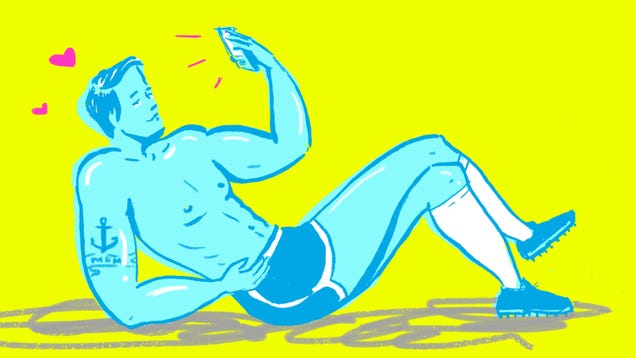
Tracy Moore - Meet the Spornosexuals: Muscled Men Who Embrace Equal Opportunity Objectification

http://www.soyhomosensual.com/wp-content/uploads/2014/06/485618_10151613117724857_68070654_n-279x300.jpg

About 20 years ago, a new word entered the cultural lexicon, and quickly became both pervasive and pointless - Mark Simpson's metrosexual. [Even now, the spell-checker in Blogger thinks its not a word.]

So Simpson thinks he has identified a new subculture in varied world of masculinities, the spornosexual, a second generation metrosexual where obsession with clothes is replaced by obsession with sports and fitness, and the added, seemingly ubiquitous porn addiction (or desire to be a porn star).

Oh, and they love to post selfies of their buffness on social media sites. Honestly, this makes them little different than all of the females who post pictures of themselves in their underwear or showing off their ass-sets. It all feels a bit homoerotic to me, which is also interesting. While certainly a lot of these guys identify as straight, there is also the element in this trend of wanting to be desired by both sexes, whether it's to be sexually desired (by women) or to instill jealousy (in other men) for their physiques (who will desire their buffness).

Besides, this type of selfie has long been an element in the gay male community - a kind of marketing tactic.

So, do we really need this word? Tracy Moore, writing for Jezebel, thinks not.


Meet the Muscled Men Who Embrace Equal Opportunity Objectification

by Tracy Moore | 6/23/14

What's with dudes getting buffer, y'all? Should we call it something? Other than, you know, buff dudes? What ever happened to beefcake? How about we ask that guy who came up with metrosexual. Oh, he already came up with something. Spornosexual. [dies]

Let's all say it once and then never say it again because this bullshit is never going to happen. Sporno-barf-ual. Sporno-vomitron. Sporno-dude-icus. Spornoshitcicle. In fairness, if I coined a term like metrosexual that actually caught on so thoroughly that it was used even by terribly unhip people in near-forgotten states where trends hit two years late even with the Internet, I'd probably enter the ring with lady luck again and try to coin another thing every six months.

Mark Simpson, term coiner, waited 20 years. That is something. But this spornosexual business just won't do. It is a new thing out this month already added to Urban Dick that's supposed to be a term describing a second-generation metrosexual, only + sports + porn, a portmanteau of sportsman and porn star. It's all thanks to the rise of selfies, social media, and a pornified culture, what Simpson describes as "the major vectors of the male desire to be desired."

One, it sounds too much like spore or spawn and therefore it is gross and dumb, the double-whammy of bad things you can do to concepts. At least metrosexual gave you a better sense of the intersections: Urban + sexuality. It was dumb, too, but had a kind of clarity we could all dread together while also comprehending.

Two, it's way too general and all encompassing of all dudes who are beefy and nice to look at on some level without really isolating any particular distinction. According to Simpson, the tools of these eye-burning bathing suits would qualify BUT ALSO this totally acceptable beefiness found in Daniel Osborne from The Only Way Its Essex. And, we can only presume, beefcakes such as Gosling, and Efron, and Tatum, etc.

I'm spornoconfused. Wait, what is a spornosexual supposed to be, again?

Says Simpson:

With their painstakingly pumped and chiselled bodies, muscle-enhancing tattoos, piercings, adorable beards and plunging necklines it's eye-catchingly clear that second-generation metrosexuality is less about clothes than it was for the first. Eagerly self-objectifying, second generation metrosexuality is totally tarty. Their own bodies (more than clobber and product) have become the ultimate accessories, fashioning them at the gym into a hot commodity – one that they share and compare in an online marketplace.

This new wave puts the "sexual" into metrosexuality. In fact, a new term is needed to describe them, these pumped-up offspring of those Ronaldo and Beckham lunch-box ads, where sport got into bed with porn while Mr Armani took pictures.

Let's call them "spornosexuals".
Second thought: Let's not. While it's worth looking at the way selfies and porn have intersected to give rise to the indulgence of our vainer tendencies, we've no doubt all moved a little closer to the light. The term spornosexual goes beyond that to generalize beyond comprehension and make extreme assumptions about the intelligence and sleaze of anyone who looks the part (whatever that part is/still don't get it).

Says Simpson: They want to be wanted for their bodies, not their wardrobe. And certainly not their minds.

Look, if you re-read his paragraphs and pretend they're about women it sounds like every dumb thing ever said about a woman who cares a lot about her appearance. Additionally, in the various coverage of the term, you get a good sense of the unease of writers (male and female) about men who boldly seek attention for their physique or have bodies that are considered sexually appealing.

Here's one:

The term encapsulates the new breed of male who thinks nothing of using (and abusing) products, practises and pleasures previously only the domain of women and gay men. Practises including wearing half-thongs to the beach.
Ugh, men showing their bodies? And thinking nothing of it?!

Another, which calls spornosexuality an "evolutionary step backward":

Spornosexual. It sounds like something Japanese businessmen might watch (featuring naked girls and fish), but actually it's the latest fad in male beauty.
Is it really a fad? Is men caring about their bodies and appearance and clothes — even to what we might think of as "extreme" by virtue of the cultural pressure on them not to care — a fad, or simply inevitable and quite human?

And

Women have had to endure this commercialisation for years, but for men the "fun" started in the 1990s with the rise of the metrosexuals – fellas who seemed to imagine that wearing a necklace made them feminists or even a little bit gay. But, in defence of metrosexuality, at least that trend was all about remaking yourself to be attractive to others. It was innately social. By contrast, the spornosexual is really only interested in how they look to themselves – it is narcissistic. By toning and perfuming and recording every ripple with Facebook selfies, they've converted their bodies into their own masturbatory aids.
He's right that women have had to endure this for years: Narcissism is usually aimed as a pejorative at women who spend a bajillion hours getting ready as a result of an insidious blend of liking to do it and being told since birth it's their first duty to mankind. But the answer to men increasingly getting on this vain train is not to mock men who give in to the pleasures of being desired, it's to eventually regard the desire to look good — whatever your definition of that is — as acceptable for the people who are into it, not spend another round of centuries now aiming the tired criticism of shallow frivolity at men.

He goes onto say there's nothing wrong with wanting to look good, but that prioritizing looking good above having brains (for men) is not a sign of gender equality or social progress. Again, the larger point is missed: Looking good without being viewed as intelligent is hardly considered problematic in women, much less viewed as a tragic development. But men being all brawn and no brain? A step back.

But back to those men: Certainly, the increasing focus on everyone feeling the pressure to look camera ready is a phenomenon well worth documenting, but not everyone feels that pressure, and it's certainly not summed up by spornosexual. Certainly it'd be nice if everyone could feel less pressure to look perfect, but this is capitalism, and equal opportunity objectification is probably the best we can hope for.

Simpson writes that spornosexuals have "photoshopped themselves in real life" which we know is a lot like a line out of Crazy, Stupid Love uttered by Emma Stone describing the body of none other than ultimate beefcake Ryan Gosling. This. But this is a long time coming and true of women too. In a piece about the rise of Hollywood hotties, Dodai tracked the trend that for men in the industry, it's no longer about acting; it's about abs.

The fact is, it's possible to discuss and critique the fact that men's bodies can be sexualized too, for better or for worse, and celebrate that choice when it is in fact a choice. Men's bodies are no less appealing or lust-inspiring than women's, and such determinations are a matter of opinion anyway. Still, it's hard to imagine a time when, no matter how much men "eagerly objectify" themselves, that such pressures will ever be a mandate. The decision to be extra-maniacal about your bod as a dude on earth is probably only going to help you, and even if it makes a lot of people invested in more rigid gender roles uncomfortable, for the time being, it's still optional.

Illustration by Tara Jacoby.

Tuesday, August 19, 2014

Virginity Pledges for Men Can Lead to Sexual Confusion, Even After the Wedding Day


In a study of a group of 15 young evangelical Christian men, Sarah Diefendorf found that support groups and open discussions about sex with trusted companions were key in helping the men during their pre-marital years.

Once these young men were married, however, the men were confronted with challenges. The church taught the guys to "keep problems in the dark" after marriage, which left the men feeling that they couldn't talk about sex with their friends and that they didn't know how to comfortably broach the subject with their wives.

Just another example of how abstinence training fails young people.

Virginity pledges for men can lead to sexual confusion, even after the wedding day


Date: August 17, 2014
Source: American Sociological Association (ASA)

Summary:
Bragging of sexual conquests, suggestive jokes and innuendo, and sexual one-upmanship can all be a part of demonstrating one’s manhood, especially for young men eager to exert their masculinity. But how does masculinity manifest itself among young men who have pledged sexual abstinence before marriage? How do they handle sexual temptation, and what sorts of challenges crop up once they're married?
____________________

"Sexual purity and pledging abstinence are most commonly thought of as feminine, something girls and young women promise before marriage," said Sarah Diefendorf, a doctoral candidate in sociology at the University of Washington. "But I wanted to look at this from the men's point of view."

Studying a group of 15 young evangelical Christian men, Diefendorf found that support groups and open discussions about sex with trusted companions were key in helping the men during their pre-marital years. But once married, she found these men encountered trouble. Instructed by the church to keep problems "in the dark" after marriage, the men reported feeling like they couldn't discuss sex with their friends and that they didn't know how to comfortably broach the subject with their wives. The newly wedded men also expressed surprise that sexual temptations continued to taunt them.

Diefendorf will present her findings at the 109th Annual Meeting of the American Sociological Association.

At the start of her study, in 2008, the men were in their late teens and early 20s and part of a support group for young men who had pledged to remain virgins until marriage. The group was affiliated with a nondenominational evangelical megachurch in the southwest United States that had about 14,000 attendees at Sunday services. Over the course of a year, Diefendorf attended their meetings, and conducted one-on-one interviews and focus-group meetings with the men.

The men talked about sex as both "sacred" -- a gift from God meant for the marriage bed -- and "beastly" if it occurs outside of marriage.

"To maintain this gift from God, they believe they must refrain from sex before marriage," Diefendorf said.

The support group is one way for the young men to explore their sexual urges, she said. Many of them opened up to struggles with pornography and masturbation, which some considered "destructive" and a threat to their commitment to abstinence.

"People think that evangelical support groups are just about suppressing men's natural urges, but really they are caring, supportive, and safe spaces that allow men to have a remarkably open and frank discussion about sexual desire," Diefendorf said.

Besides the support group, the men sought out accountability partners to help control their behavior. One of them, for instance, had an accountability partner who would text message him each night, "Are you behaving?" Some of them used software to track which websites they visited, and shared the results with the partner.

A few years later, in 2011 and 2012, Diefendorf followed up with the men. Fourteen of them were married and she wanted to find out how the men's views of sex and masculinity had changed since marriage.

During a focus-group meeting in one of their homes, it soon became clear that as taboo as sexual activity was before marriage, it was now taboo to talk about sex as it was seen as disrespecting their wives.

"After marriage, the church culture assumes that couples become each other's support, regardless of the issue at hand," Diefendorf said. "There's little support in figuring out sexuality in married life, and these men don't know how to talk to their wives about it."

As one of the men put it: "For me to come home from work and say, 'Hey, did you like it last time?' I mean that would be -- that would be such a weird question for me to ask."

The newlyweds also revealed that they continue to think of sex in terms of control, and how the so-called beastly elements of sex -- temptations by pornography and extramarital affairs -- do not disappear with the transition to married life.

"Before you get married the biggest thing you struggle with, usually, is premarital sex," one of the men told Diefendorf. "But once you are married, you can't be tempted by that anymore, so you get attacked by completely different things. Essentially Satan has to find a new angle to attack on."

They wished for more guidance from the church, and someone in the group said he'd cheer if his pastor decided to talk more about sex.

"While the whole point of these support groups is to honor sex in marriage, these men have gotten so used to thinking about sex as something negative that they bring those concerns with them to the marriage bed," Diefendorf said. "Once they're married, these men struggle to manage those concerns in the absence of the supportive community they once benefited from."

She hopes that her study leads to more positive discussions of sex and how it is healthy, especially within the context of abstinence-only sex education. "There's an obsession with virginity in this country," Diefendorf said. "And we forget to have informative, successful conversations on sex."

Story Source:
The above story is based on materials provided by American Sociological Association (ASA). Note: Materials may be edited for content and length.

Monday, August 18, 2014

You’re 16. You’re a Pedophile. You Don’t Want to Hurt Anyone. What Do You Do Now?


This is a long but highly interesting article on the efforts of young men who have identified in themselves a desire for sex with children but who do not want to become perpetrators. There are very few resources around the country for these guys, which is sad because without help they are likely to become offenders.

This article comes from Medium, and I found as a selection on last week's Longreads.

You’re 16. You’re a Pedophile. You Don’t Want to Hurt Anyone. What Do You Do Now?

There’s no helpline for pedophiles who want treatment before they act. So a teen with a terrible secret had to find his own way to save himself and others like him.

By Luke Malone | Illustrations by Simon Prades

Adam was at his desk in the second-story bedroom of his family’s suburban home when he came across it. He had recently switched file-sharing programs to one that offered more content and faster browsing, and his downloading habit had increased in kind. There was now a constant stream of files whose names included acronyms such as PTHC, or pre-teen hardcore.

The boy in this video was fair-haired and looked to be about one and a half, his small, naked body tied up to restrict movement. A man’s torso entered the frame and the child began to scream. As he watched the scene unfold, Adam was transfixed, and then quickly revolted; he reached over and stopped the video. It wasn’t like anything he’d witnessed in the two years he’d been viewing child pornography. Until now everything he’d seen seemed to suggest that the kids liked it, but this toddler was clearly in pain.

He moved over to his bed, a twin with a sturdy, wooden frame, and lay down on the crumpled blue and white cloud-print sheet. Band posters clung to the surrounding walls. Directly across from the foot of the bed was a bookshelf housing an impressive collection of horror novels. Atop the shelf sat several chess and baseball trophies whose silver sheen had been dulled by dust, and he stared up at them as he tried to process what he had just seen. He felt, he told me later, a combination of anger, sadness, and confusion.

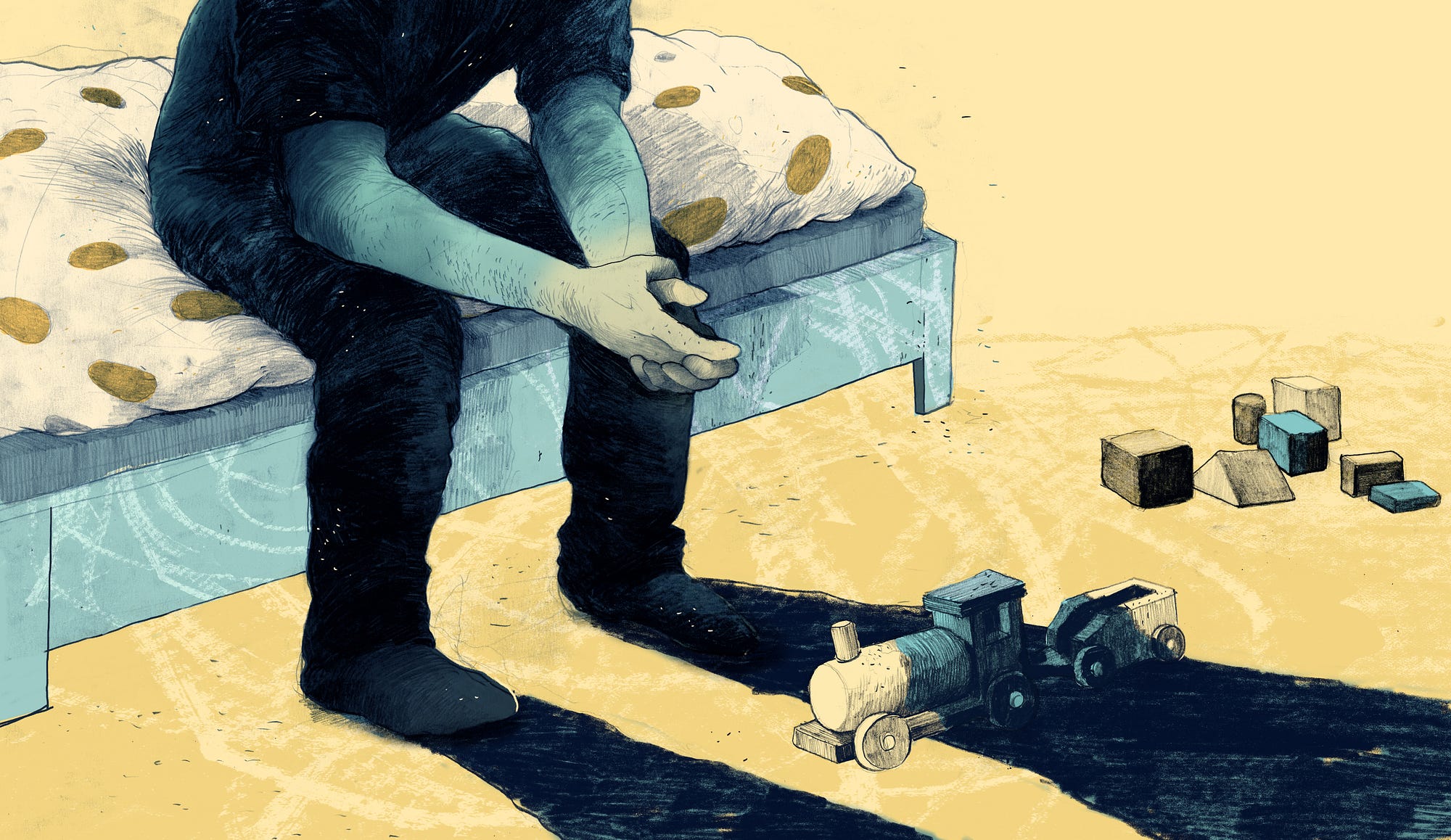
Seeing that toddler trussed up and in pain confirmed something he’d long suspected but now had to acknowledge. The man in the video was one of those guys they sometimes talked about on the news. Though Adam didn’t want to hurt anyone, he knew that, on some level, he was just like him. He was 16 years old, he was a pedophile, and he had to do something about it.


WE HAVE A FEW go-to archetypes when it comes to pedophilia: There is the playground lurker, the chat-room predator, and the monstrous (often religious) authority figure. These men are usually middle-aged, unrepentant serial abusers who are caught only after remaining undetected for years. But what about the preceding decades? When do these urges first begin to manifest?


The Diagnostic and Statistical Manual of Mental Disorders defines a pedophile as an individual who “over a period of at least six months” has “recurrent, intense sexually arousing fantasies, sexual urges, or behaviors involving sexual activity with a prepubescent child or children.” This person also has to have “acted on these sexual urges, or the sexual urges or fantasies cause marked distress or interpersonal difficulty,” and be “at least age 16 years and at least five years older than the child or children” involved.


Anecdotal evidence suggests that most pedophiles first notice an attraction toward children when they themselves are between 11 and 16, mirroring that of any other sexual awakening. It can be a confusing time for any of us, but imagine realizing that you’re attracted to little kids. How do these young men and women negotiate that with no viable role models or support network? There is no It Gets Better for pedophiles. Are they all fated to end up as child molesters? Or is it possible for them to live a life without hurting children at all?

I spoke with experts and asked around online. I came across a site for self-described pedophiles who acknowledged their attraction and wanted help dealing with it. But the men I met were in their 50s and 60s, and I’d hoped to speak with someone younger, someone still coming to terms with what he was learning about himself. I asked them if they knew anyone like that, and a few weeks later I received an email.

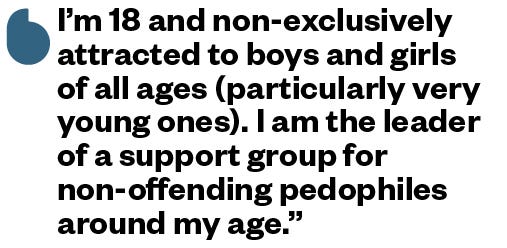
“My name is Adam,” it read. “I’m 18 and non-exclusively attracted to boys and girls of all ages (particularly very young ones). I am the leader of a support group for non-offending pedophiles around my age… I would be very happy to talk with you.”


ADAM IS NOW 20 (his name, like those of other young men in this article, has been changed). He has a slightly chubby build and messy, medium-brown hair. The first time we spoke at length about his attractions, we were sitting in his old, beat-up car, in the lot of a park near the house he shares with his parents and two older brothers. It had become our regular meeting place. Outside the car, locals chatted among themselves while herding frisky Labradors and Weimaraners into the backs of jeeps; two kids roughhoused in the dirt next to us until their father asked them to stop.

Talking about his pedophilic urges, Adam refused to look me in the eye, though he often stole glances when he thought I wasn’t looking. He first noticed his attraction toward young children when he was 11. He’d developed a crush on a kindergartener at school, a boy, his desire fueled by brief, furtive glimpses of him in the halls. By the time he reached 16, his sexual interest in kids had become more defined. He found himself attracted primarily to boys between three and seven and girls aged five to eight.

When I pressed him about what he finds most attractive in a child, he shifted in the car seat from side to side, and eventually managed to say: “Small body, hairless legs, you know, things like that… like small genitalia.” But there is a strong emotional pull, a potent idea of innocence that, he explained, is far more intoxicating than anatomy. “A lot of us tend to have, I think, unrealistic views of kids,” he said. “To the point that they’re kind of angelic.” This purity, he told me, is what keeps in check his urge to act on his desires. “I see an innocence in children that would be violated,” he said.


It is why the video of the toddler, out of everything he’d seen, rattled him. There was no denying that the boy was being debased. The bound child was wailing as the man defecated on him, though his cries were soon replaced with choking splutters as his abuser began urinating in his mouth. “I wanted to reach through the computer screen and kill the person,” Adam said. “I was just so horrified at what I saw.”

I asked him what happened in the days and weeks after he’d watched the video, and he admitted he didn’t stop downloading child porn straight away. He tried his best to abstain, often going weeks, but would end up back in front of the computer. He scoured the internet looking for a way to help him break his porn “addiction” and deal with his attraction to children, and ended up at a general mental health forum. This site stated that new visitors must offer an introductory message. “I know that pedophiles don’t choose to be pedophiles,” he wrote. “I didn’t want my attraction. I don’t want my attraction. But the attraction is there, and all I can do is try to curb it.”

Instead of posting it right away, he went to bed and masturbated to child porn. “I actually felt okay about that because I reasoned that I was taking the first step toward getting help,” he said. “I guess like a drug addict enlisting in rehab and then using one last time before it starts.” He published it the following morning.

The response to his post was mixed. Some commentators were working through their own abuse history, and couldn’t stomach the idea of helping a self-confessed pedophile. But two female sexual-abuse survivors eventually came forward, convinced that he was of an age where a change could still be made. One of them, Adam believes, had suffered particularly brutal abuse, abuse that was filmed, and their conversations about the evils of child pornography would often trigger her past traumas. “She cared about me,” he said. “But she made it known that she felt I deserved whatever the law decided to do with me if I were caught for the CP [child porn].”

More than once she kept him distracted from watching porn until the early hours of the morning, when he was tired enough to go to sleep.


HIS PORNOGRAPHY habit, of course, was merely symptomatic of a larger issue. It took him a long time, he told me, to accept that his desire for young boys wasn’t simply going to evaporate just because he’d stopped downloading and watching videos, and he grew increasingly despondent trying to suppress these feelings. “I was passively suicidal for a long time. I went six months without seeking actual help aside from online,” he said.

One night, while his father was out, Adam walked into his parents’ room and handed a note to his mother as she was lying in bed. “Read this,” he said. Paula (whose name has also been changed) looked up at him and opened her mouth to speak but changed her mind when she saw the expression on his face. He slipped back out of the room and she considered the letter for a moment, turning it over in her hands. She got up and walked down the hall to Adam’s bedroom, and found him curled up in bed with his back to the door. She called out to him, but he pretended he was already asleep.

Not knowing what else to do, she walked back to her room and unfolded the note. When Adam sent me a copy of it years later, he told me he couldn’t read past the first few lines, the memory of this time still so raw for him.

Dear Mommy, I am writing this letter to you as I cannot bring myself to say what I need to say to you to your face. It would simply be too painful for me, and I don’t want you to see me cry and struggle, nor do I want you to be pained by seeing me do so… I find that I am seldom happy, and very rarely go through days when I am entirely happy… I am always overshadowed with feelings of depression, guilt and shame. I’m really sick and tired of covering these feelings up… I want you to let me see a psychologist, and for both your and my own privacy, I don’t want you to be in any way acquainted with him/her… I understand that you probably have a lot to ask me, but I need some time to get my head wrapped around things. I thank you in advance for my privacy. Love, Adam.
He didn’t explain the source of his depression and his mother decided not to ask. The next morning, she pulled him aside and told him she would find him a local therapist who took their insurance.


It was a Friday morning when Adam went to see her. As he sat with his mother in the waiting room, the reality of what was about to happen washed over him. He was overwhelmed. He was about to vocalize a secret he’d only ever previously admitted to strangers on the internet.

He was called into her office, his heart racing as he stepped toward the door. She closed it behind them, offered him a seat, and began the session with questions familiar to anyone who has been in therapy, “family history, how many siblings I have,” that kind of thing. She scribbled his answers down in a notepad, and then asked why he had come to see her. Adam had never in his life felt such dread. His body began to shake as he explained that he suffered from anxiety. She asked what was making him anxious, and he just blurted it out: “I’m a pedophile and I’m addicted to child pornography.”

She blinked at him for a moment and then asked him to repeat himself. When he did, her mood changed. “She just became extremely cold and harsh,” he said. “She even, a few times, almost got to the level of shouting.” She suggested that he was simply nervous around kids his own age — a reaction I’ve learned is common among therapists with limited experience in this area. She told him she wasn’t trained to deal with the situation, but she would ask around for information on how to help him and scheduled a second session for a couple of weeks later.

I asked Adam why he agreed to see her again, and he said he felt he had no choice: “I didn’t have anything else, you know?” He soon found himself back in the waiting room with his mother. “I walk in, she asks how I’m doing, and she seems a little bit more sympathetic,” he said. “But she told me pretty much right away, ‘I can’t do this. I have to tell your mom.’”


THERE IS CURRENTLY no mechanism for treating someone who has pedophilic urges and hasn’t acted on them. A major roadblock is the existence of mandatory reporting laws, which dictate that people in certain professions must report suspicion of child abuse and neglect to Child Protective Services. (The individuals required to make a report varies from state to state; it can include all citizens but is usually restricted to those whose work puts them in regular contact with children, such as teachers, police, and psychologists.)

Mandated reporting revolutionized the way child abuse is handled in the U.S. and has brought many incidents to light, but it can be problematic for young men like Adam who haven’t abused children. The civil and criminal liabilities facing those who fail to report someone who goes on to molest a kid, combined with the fact that it need only be based on suspicion and not probable cause, means a report could be triggered when well-intentioned individuals reach out for help. The overwhelming number of minor-attracted men I spoke with said this was too much of a deterrent. Which also makes it harder to learn more about them.

There is a lot we still don’t know about pedophilia—one researcher described our scientific understanding of it as a series of “pretty big black holes.” We don’t know, for example, how someone comes by an attraction for prepubescent children in the first place. The research we do have, and this is derived from very small sample sizes, suggests that those attracted to kids tend to be shorter, left-handed, and have a lower IQ than the broader population. Another study found that being knocked unconscious before the age of 13 might be a factor. This may sound like quackery, but it points toward biological causation. In other words, it’s likely that pedophiles are born this way.


Things are a little clearer when it comes to the numbers. Studies suggest that up to 9 percent of men have fantasized about having sex with a prepubescent child, and 3 percent of all men have gone on to sexually offend. (Not all of them would meet the diagnostic criteria for pedophilia. The latter figure includes situational offenders, men who abuse children if the opportunity arises but who otherwise have no pre-existing attraction to kids.) Michael Seto, director of the University of Ottawa’s Forensic Research Unit and associate editor of Sexual Abuse: A Journal of Research and Treatment, believes that the prevalence of male pedophiles sits closer to 1 percent of the population, which would equate to at least 1.2 million in the U.S. alone. (Female pedophiles exist, but in smaller numbers.)

The distinction between fantasies and behavior is an important one to make. Our failure to acknowledge the existence of pedophiles who choose not to act on their desires not only prevents them from coming forward to seek help but is also an obstacle when it comes to gaining support for therapeutic intervention. Seto told me there is evidence to suggest that there are a significant number of men who are sexually attracted to children and struggling, often alone, to keep their urges in check. “If you did a survey of the general public,” Seto said, “I think a large majority would assume that anyone who is sexually attracted to prepubescent children has acted on it.”


THE FIRST THING that I recall the therapist saying is ‘We’ve got a problem,’” said Adam’s mom, Paula. She knew something was up when she first entered the room. She saw her son staring at the floor, “not speaking… practically not breathing, he wasn’t moving a muscle, other than he was shaking.” And then the therapist told her why she was there.

“I was really, really shocked. I thought we were going to be talking about depression. That wasn’t even on my radar of what I thought could even come up as part of the problem,” she said. “It immediately entered my mind that perhaps somebody had abused him. How else could this have happened? How else could he have even thought to do that if he wasn’t abused?”

But while victimization is a risk factor for perpetration, it’s not a given, and the majority of abused children do not go on to offend. Paula believes her son when he says it’s not the case. “If it had already come out that he was engaged in looking at child pornography, why would he then hold back on the other component?” she said. “It would have been easier, I think, from his position to say that something had happened to him and then he is considered a victim.”

Paula hasn’t told anyone about what she learned about her son — not a friend, not a therapist of her own, not her husband. Our conversations were the first she’s had about it since finding out. “Nobody,” she said, with a melancholic laugh, when I asked who she turns to for support. “I can be certain that his dad would not have, I don’t think could have, handled it in a similar way as myself. He’s just much more emotionally reactive.”


But it doesn’t mean she hasn’t been thinking about it. I was surprised by how eager she was to talk about Adam, and so directly. In fact, discussing her son’s attraction to children seemed to come as a relief. “It is something I’m aware of when I lay down to sleep and I’m aware of it when I get up,” she said. “It’s always on my mind.”

Paula copes by being pragmatic. She helped her son find a new therapist, one better equipped to help him deal with his attractions. And when that new therapist suggested he remove all information on the two computers he used to access child porn, so as to reduce temptation and possible legal ramifications, she led the charge. “Adam told me that the only way to do that would be to actually replace the hard drives, because writing over them or just deleting information does not actually get rid of it—it’s still embedded, it’s still there,” she said, adding that they destroyed the originals. “I didn’t want him to be at any risk whatsoever, and I felt the thing to do was to immediately get rid of it.”

Her concern was hardly disproportionate to the potential repercussions. Possession of child pornography carries statutory penalties under federal and state law. These penalties can be so severe that those caught with child porn can receive longer sentences than those convicted of child abuse. Because the videos he downloaded included children under 12 years old, a first-time offender like Adam might have been fined $100,000 and sentenced up to 20 years in prison; the maximum term can be increased to 40 years for those with prior convictions.

Paula said her greatest fear is that he might one day go back to viewing child porn, but, after a little pressing, she acknowledged a larger concern. “I know that he has had thoughts, I know that he’s had urges… I know that when people have urges and thoughts that they can progress to actions, and of course I worry that could happen,” she said. “I don’t want there to be any victims. I mean, every child is very important. My son is important to me, and I would feel horrible if he was abused and I would feel horrible if he abused, so there’s no winners there.”

She and her son hadn’t spoken directly about that day at the therapist’s office, much less the underlying issue, in the intervening three years. They only recently resumed the discussion when I persuaded Adam to ask if she’d be willing to speak with me. This has forced Paula to come to terms with things she was able to avoid before. He told her he identifies as a pedophile and “it is his expectation that this is going to be a very long, lifetime struggle.” It was painful to hear, though, important. But she remains hopeful for his future.

“Best-case scenario is that this never happened and this never could happen to my son or anybody’s son, but that bubble has already popped because bad things do happen to good people and good sons and good mothers,” she said. “The next best-case scenario would be to be able to live with this burden and live a normal and happy and productive life… I want him to be happy, to not feel depressed about this, and to be able to fulfill all of his dreams that were there before and that should continue to be available to him even living with this.”


ADAM’S NEW THERAPIST put him on Zoloft and taught him to resist the urge to identify with the child molesters he encountered in the media. “A lot of it was, ‘I’m a monster’ for having viewed that stuff but also just for having these attractions,” he said. “What you hear in the media and online and how people talk, it sinks in, you know? You don’t even question it. It’s just kind of a fact.”

But his sense of social isolation wasn’t so easily remedied, and his thoughts about young children were as strong as ever. He had maintained an active presence on the mental health message boards, but said most of the members he knew were abuse survivors, depressives, or alcoholics — no one who could truly understand what he was struggling with on a daily basis.

One day he typed the words “young pedophile” into Google, and his original thread on the mental health board was the first entry to come up. But when he started to scroll down he saw similar entries on other boards, ones with headlines like “I’m a young pedophile and I need some help” and “How can I get free counseling? I’m a teenage pedophile.” Desperate for someone to relate to, he started reaching out. “I’d say, ‘I’m a pedophile. I used to have a child porn addiction. I know what you’re going through,’” he said. “‘You obviously need help, and I know someone else around our age who’s like that. I think we could be a good support for you and vice versa.’”


This is how he began communicating with other young pedophiles around the world. In turn, they introduced him to those they had managed to find. Distinct from the idea of a malevolent pedophile ring, these young men — and occasionally young women — said they didn’t want to hurt children and were trying find a way to make sure they never would. Some messaged back and forth before dropping off (“They probably got scared that it was a sting operation,” said Adam), but one by one a cluster of regulars formed. Before long Adam had inadvertently established an informal online support group for pedophiles in their teens and early 20s who want help battling their attraction toward children.

Speaking with members of the group, it’s apparent their concern about detection sits close to the surface — each citing a fear of rejection by family and friends, and the unwanted attention of law enforcement. Yet, Adam explained that many are willing to risk it rather than continue to battle their demons alone. “For a pedophile, there is almost no place to go and get information or any sort of help,” he said. “I’m sure that there are pedophiles who kill themselves who never come out as that. Who never admit to it, even in a suicide letter. I think there’s probably a lot more than people would realize.”


There are currently nine members, ranging in age from 16 to 22, eight men and one woman, though Adam said others have come and gone over the years. Some members hail from as far abroad as the Philippines, but language barriers confine most participants to the U.S. and the U.K. His group has two rules. The first is that you can’t have offended or harbor any intention to do so; those who question the concept are banished if they can’t be convinced otherwise. The second is a commitment to stopping the use of child pornography. Adam told me it’s okay if you come into the group as a user, but you must be devoted to quitting.

Adam’s mom recently found out about the group. Realizing that support is elusive to those in his situation, she accepts it. But she also harbors reservations about them operating without the oversight of professionals. “We need to understand the problem so that we can find appropriate ways to fix it. The way to help is to identify anyone that wants help,” Paula said. “We have to make connections. Just as they have things like hotlines for people to come forward and get help with problems they’re having, there has to be something available and advertised for young people that may be having these thoughts and these urges.”


ANYONE THAT'S DONE treatment with people who have sexually offended know that many of them are horrified by their behaviors,” Elizabeth Letourneau, founding director of the Moore Center for the Prevention of Child Sexual Abuse at Johns Hopkins University, told me. “A lot of these guys don’t want to be sexually abusing children.”

We first met at her office one dreary afternoon last February. Out the window, whose sill was flanked by framed photos of her two sons, you could see rain gently blanketing downtown Baltimore. The center’s core mission is “to try to change the way the nation views child sexual abuse, as something that is preventable.” From a desk piled high with books and manila folders full of journal articles, she continued: “We say we’re really concerned about sex offending and we really don’t want children to be sexually offended and we don’t want adults to be raped, but we don’t do anything to prevent it. We put most of our energy into criminal justice, which means that the offense has already happened and often many offenses have already happened.”

Letourneau is the only U.S. researcher developing science and policy in the field of primary prevention. She wants to implement a program, separate to her work at the center, that provides preventive therapy for non-offenders and offenders alike. Her focus will be on adolescents, at least initially. She believes that early intervention is more effective and that teenagers pose less of a threat to potential funders and review boards. She would also like to get parents involved, though this would present its own challenges. “The risk that you face when you have to pull in a parent and a kid is that you’re going to lose some kids who are not able to talk about this to their parent, out of fear or shame or embarrassment,” she said. “We will miss some important subgroups.”

Adam told me that, when it comes to pedophilia, there are other distinctions beyond age and gender preference — most notably, primary and exclusive attraction. A primary interest means a person is sexually focused on children but can also be aroused by those who are more age-appropriate. Exclusive attraction is when someone feels no sexual desire for anyone but prepubescent kids. Letourneau is curious if young pedophiles who show even a slight interest in their peers might respond to treatment that attempts to redirect their attention into that corner. For most people, our age of attraction increases as we mature, suggesting that it is variable. She wonders if pedophilic adolescents can be encouraged to develop acceptable sexual desires, but acknowledges that it wouldn’t be effective for those with exclusive attraction.


Historically, attempts to change sexual impulses have included arousal reconditioning, which involves, essentially, getting men to masturbate to fantasies of their preferred target and then switching to something more socially acceptable right before climax. But there is also the opposite, like satiation training, where patients masturbate to fantasies over and over again until they are drained of desire.

I suggested to Letourneau that talk of sexual reconditioning strongly echoes the tactics of gay conversion therapy, a harmful and wholly unsuccessful pseudoscience, and she was quick to distance herself. “It’s a horrible legacy of psychology and psychiatry,” she agreed. “It seems kind of archaic, actually. And, frankly, ethically challenging to do with kids. So coming up with a viable way that is respectful of the person, the child and the parent, but also effective… I don’t know what that’s going to look like. I have no idea. I don’t want it to look like arousal reconditioning, I can tell you that.”

Dr. Klaus Beier doesn’t believe in sexual reconditioning. He leads the team behind Prevention Project Dunkelfeld, a therapeutic program based in Germany that targets potential offenders. He believes that minor attraction is a fixed part of someone’s makeup, that it’s “fate and not choice.” His program is considered the global gold standard of preventive treatment, and its practitioners help adults manage their attraction to children rather than try to change it. “In my view, it’s not the inclination that’s a problem,” he said. “And I wouldn’t condemn the inclination, I’d condemn the behavior.” The program consists of weekly therapy sessions for up to 12 months. They favor cognitive behavioral therapy, but also offer libido-reducing medication, otherwise known as chemical castration, if a patient needs to reduce his sexual drive in order to benefit from treatment.


The cornerstone of the program, according to Beier, is confidentiality. Germany doesn’t have mandated reporting, and that, he said, makes it easier for men to seek treatment. The project’s aim is to bring as many undetected men forward as possible, which is more easily achieved when you remove the threat of punitive action. This includes men who have already molested a child in addition to non-offending pedophiles. In English, Dunkelfeld translates to “dark field.” Beier said most cases of child sexual abuse go unreported, and though it can be ethically challenging to suggest that sex offenders evade immediate prosecution, he and his colleagues believe that it’s better to bring them into the light for the sake of preventing further instances of abuse.

“Telling the police would not be the first step we would choose,” said Dunkelfeld’s research coordinator, Gerold Scherner. “If we know about this, we will talk about it frankly and openly: What happened? What can you do? How safe is the child?”

In the United States, researchers can apply for a Certificate of Confidentiality. These federal certificates, if granted, protect the privacy of research study participants and can offer temporary exemptions from mandatory reporting laws. But there has been only one certificate granted in the area of pedophilia research. Between 1977 and 1985, Dr. Gene Abel interviewed 561 unidentified sex offenders in order to better understand this under-researched population. No one has been given one since.

It’s a hard ask, but Letourneau is considering applying for a certificate when she launches her new program. She doesn’t know if she’ll have much luck. “I’d like to be able to include youth who have offended but who are undetected, and the reason for that is that if they’re undetected they’re gonna stay undetected,” she said. “Do you want them to get help or not? For my money, you really want to be working with the kids who have already started offending, because those are the ones most likely to offend again.”


IT'S NOT THAT I don’t want to see a therapist,” said Mike, a 21-year-old on the West Coast. “It’s just that I don’t feel that I can see a therapist.”

I had been speaking with Mike online for two months before he agreed to let me fly out and meet in person. We met in the parking lot of a local supermarket and wound up talking in front of a Starbucks. He is pale and slight, and has a long face dominated by high cheekbones, wide brown eyes and dark, curly hair. Unlike Adam, he is outwardly confident and unguarded; he talks fast, casually jumping from one topic to the next, and has no reservations about discussing his attraction to children. He explained that he maintains a clear distinction between those he feels sexually attracted to and those with whom he feels a close paternal bond. He told me he only feels an erotic pull to girls aged seven to 12, and that for two-to-six-year-olds it’s more of a protective, almost brotherly instinct. He said this is what makes him such a good preschool teacher.

He is currently studying child development, and substitute teaches part-time for a pre-kindergarten program. He plans to continue working with kids up to six when he graduates from college, and said his connection to children helps him relate to them better. “I’ve had people say, ‘If you don’t go into teaching you’re doing the world a disservice. Like, you’re brilliant, why would you not?’” he said. “I never felt like I shouldn’t be here, this is dangerous… Long-term maybe this is a bad idea, but in the moment, right now where I’m at, I’m fine.”

Mike first noticed his sexual interest in children at 13, when he developed a crush on a girl he used to babysit. She was around three at the time and would strip naked and run around the house. “I was aware of it but it was like, well, it will go away,” he said. “I’m 13, so I’m transitioning from girls without boobs to girls with boobs.” He said he never acted on it, but that doesn’t mean he wasn’t tempted, admitting that he would find himself overcome with curiosity when he changed her diaper. “I’d want to touch her and that’s kind of as far as anything went,” he said.


When he started his teaching placement, he created a strict set of rules: staying away from the bathroom area where possible and avoiding any physical contact with the children. He said he would tense up when the more playful kids approached him for a hug. This wasn’t so much to keep the children safe, he told me, as to ensure people wouldn’t become wary of him. Which was something his dad warned him about when he first started. “He’s like, ‘People are going to be suspicious of you simply because you’re a guy. Don’t do anything stupid,’” he said. “And, honestly, I wonder if that had anything to do with it, because that kind of freaked me out.”

Adam asked Mike to be the first one to join the group in mid-2011, and they’ve communicated almost daily since. He said he’s not worried that Mike will abuse the children in his care, but he does wonder why he would leave himself open to temptation. “As much as I support Mike, and I’m definitely very close with him, his becoming a teacher is never something I’ve supported,” he said. “And not because I think he’d slip up, because I honestly believe very firmly that he wouldn’t, but I think he’s going to torture himself a lot in that position. I think that’s not going to make him very happy.”

Like Adam, Mike grew increasingly depressed while grappling with his desires. He never made active plans to commit suicide, but told me that he thought about it and knew what to do if the time came. “If I had a sawn-off shotgun, that would be it,” he said. “I don’t want to take pills because I could come back from that.” Ultimately, he felt he couldn’t kill himself and leave his family with no context for what he had done, and instead hoped that God would take care of matters for him. “But at the same time, I was still… It would be nice if I got hit by a car or I got really sick,” he said.

More than anyone else I spoke with, Mike seems like he could benefit from having a professional to talk to, and not just because of his proximity to children. I was taken by his urgent need to disclose information others might have a hard time expressing. Late one afternoon we were sitting in his car in the parking lot of a different shopping mall. After hours of conversation, I suggested that we wrap for the day and he flat-out refused, telling me in an uncharacteristically abrupt tone that he had to get it out. We continued speaking until the encroaching shadows finally met and turned to darkness, stopping only when the center’s cleaning staff began arriving for their night’s work.


IN PLACE of therapy, Mike leans on Adam and the group. They talk via email, text, telephone, and Skype, but their primary tool of communication is Gchat, where they can speak in groups or have multiple conversations at the same time. If arguments break out among members they look to Adam, their default leader, for advice.

In the beginning they were all pretty fragile, wrestling with this dark secret and what it meant for their futures. But once they’d exhausted talk of their attraction to children and the unique set of issues that come with it, they turned to far more routine topics: chatting about computer games or The Walking Dead, or sharing random YouTube clips.

Adam told me that sometimes they’d tease each other about peer-aged crushes, offering relationship advice and egging each other on to ask people out. “I talked to Mike a fair bit about dating. Partly about the guy I dated for a little while and partly about this girl in his class who he wanted to ask out. He’d find every excuse in the world not to do so, and I’d be supportive by trying to push him to take the leap,” he said. “We did talk about everyday things that most everyone else in the world has to deal with.”


James, 22, is another member of the group, and the only registered sex offender. In May 2011 he was convicted of indecent liberty with a minor and sent to prison. Adam was reluctant to break the group’s most fundamental rule by letting him join, but eventually became convinced of his commitment not to reoffend. Since then, they’ve grown close. “We talk about the obvious subject of being a pedophile, you can’t get around that,” James said, adding that it’s lost some of its urgency over the years. “We just think about it as if we’re both fans of this sports team. We sit there and talk about it in that same direction, but we can immediately turn around and talk about something else. To other people it’s a huge deal, but to us it’s just life. Life as it is. We’ve been living with it our whole lives.”

When I asked Adam to show me examples of their chats, he said they no longer keep records for security reasons. But, after some digging, he eventually found a handful of logs from the early days. The conversations in the documents he sent me veered from mundane to earnest, among them a discussion of whether shotacon or lolicon — manga and anime depictions of intergenerational sex — are morally acceptable alternatives to child porn. On several occasions it seemed like they were testing the waters with each other, admitting suspect behavior and then waiting for the other one to respond.
1:46 PM Mike: so you’re right
i do have a problem
i’ve started googling pictures of girls in their underwear and such on a regular basis
so fucking awful

1:47 PM Adam: …you need to stop this before it’s too late
if I can, so can you

Mike: yeah
ive even seen some CP show up in the results

Adam: :o

Mike: that was really disturbing
it wasn’t serious

Adam: did you look at it?

Mike: no
admittedly I kinda wanted to though
1:48 PM Adam: you need to stop
Adam’s group of young pedophiles isn’t the only such self-help resource on the internet. There is B4U-ACT, a Maryland-based outfit with around 100 subscribers, which offers peer support services to pedophiles and guidelines for accessing mental health providers who might be willing to help. However, the moderators of B4U-ACT claim that because they’re not a research organization they can’t say whether all instances of adult-child sex are intrinsically harmful. “But we do support and would advocate for minor-attracted people to live law-abiding lives,” said Matthew Hutton, the group’s spokesperson, who uses a pseudonym to protect his identity. “Even though we acknowledge the existence of research in the past that might say that some sort of contact between teenagers and older people might not be so harmful.”

This ambiguity made Adam and some others uncomfortable, and it’s why he didn’t stick around for long after signing up. A splinter group was formed, named Virtuous Pedophiles. Now the largest pedophile support group in the U.S., its 318 active members are clear in their belief that sex with children is wrong. The founders, Ethan Edwards and Nick Devin (also pseudonyms), both family men with children, enact this policy with tight moderation. If someone is seen to be voicing the opinion that minor sex is acceptable, he gets a warning. Repeat offenders are ousted from the group. The membership list is also restricted to those aged 18 and over, lest they be accused of wrongdoing.

While Adam contributes to discussions there from time to time, his focus remains on the young men who come to his own group for help. James, for one, speaks with a clear reverence for Adam. Though his status as a sex offender means he must attend court-mandated therapy, it is Adam and the others that he credits with helping keep him on the right path. It’s also not lost on him that, for everyone else, it is the only lifeline they have. “If they want help, if they want to be better, to try and fix their behavior and be a better person, he’s never given up on them,” he said. “He didn’t give up on me, he didn’t give up on Mike, he never gave up on any of us.


WHEN I TOLD Professor Letourneau that I was in contact with a group of young, non-offending pedophiles, she seemed taken aback. In her 25 years in the field she’s had plenty of experience with juveniles who have abused children, but she had never met a pedophile who hasn’t. It seemed strange to me considering her line of work, but she explained that, because such pedophiles rarely come forward, researchers have no way of accessing this particular segment of the population. “I don’t know anyone else who has made it a goal to talk to young people who have an attraction to younger people,” she said.

I asked her if she’d like to be put in touch with the group, and she jumped at the chance. After speaking with four of them over the phone, which she described as “kind of a life-altering experience,” she flew out and met Adam face-to-face, and has been speaking with him regularly ever since. She said they have taught her things about pedophilia that she didn’t know before, and it’s giving her a clearer understanding of how these attractions develop. She’s now using this information to modify her proposed treatment plan and has brought Adam on as an official advisor.


“I’m not a teenage boy attracted to children, and so I don’t know what that experience is like,” she said. “They all describe years of just agonizing self-hatred, agonizing fear of being detected as having sexual interest in children, viewing themselves as monsters, being afraid to look for help… If they could have just turned to someone to talk about this, a professional who’s going to treat this subjectively and see them as a person of worth, who’s going to know that they’re not bad kids, that they’re good kids but they have this aspect of them that they really need help controlling. That’s what they’re looking for and that’s what I hope we can provide.”

Adam’s input has helped expedite the pilot program she’s putting together, aimed at pedophiles aged 17 and under. If successful, it will provide the foundation for a comprehensive preventive model, which she hopes to eventually expand to include pedophiles of all ages, that will be rolled out online and to therapists across the country. Though it’s in the early planning stages, Letourneau imagines it will involve disabusing them of the notion that sex with children is ever appropriate, improving self-esteem in light of a situation that might not change, and strengthening social interaction with their peers. In many ways, it’s an extension of what Adam has been doing with his group for the past three years.

The last time I saw Adam in person we found ourselves sitting, once again, in his car. We had been talking for a few hours and were about to finish up when I asked him what it feels like to be not only a pedophile, but something of a pioneer. He paused for a moment before answering. “It’s one part of what defines me. You know, a small part of the puzzle,” he said. “Part of me is a pedophile but that’s not all I am. I’m also, I think, a very decent person in a lot of other ways. I’m definitely a very caring person… I have hobbies, I have interests, I have studies, and things like that all put together define who I am.”


This story was written by Luke Malone. It was edited by Mark Lotto, fact-checked by Hilary Elkins, and copy-edited by Lawrence Levi. Illustrations by Simon Prades. A version of this story first appeared on This American Life.

Read more: Editor Mark Lotto discusses the graphic nature of this story, and art director Erich Nagler talks about how to illustrate the most horrifying piece in the world.