Showing posts with label social media. Show all posts

Sunday, August 31, 2014

Tracy Moore - Meet the Spornosexuals: Muscled Men Who Embrace Equal Opportunity Objectification

http://www.soyhomosensual.com/wp-content/uploads/2014/06/485618_10151613117724857_68070654_n-279x300.jpg

About 20 years ago, a new word entered the cultural lexicon, and quickly became both pervasive and pointless - Mark Simpson's metrosexual. [Even now, the spell-checker in Blogger thinks its not a word.]

So Simpson thinks he has identified a new subculture in varied world of masculinities, the spornosexual, a second generation metrosexual where obsession with clothes is replaced by obsession with sports and fitness, and the added, seemingly ubiquitous porn addiction (or desire to be a porn star).

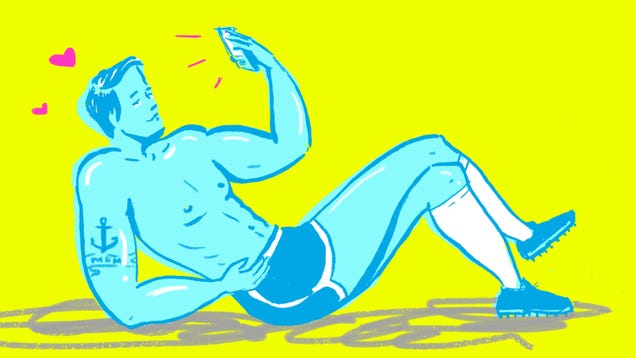
Oh, and they love to post selfies of their buffness on social media sites. Honestly, this makes them little different than all of the females who post pictures of themselves in their underwear or showing off their ass-sets. It all feels a bit homoerotic to me, which is also interesting. While certainly a lot of these guys identify as straight, there is also the element in this trend of wanting to be desired by both sexes, whether it's to be sexually desired (by women) or to instill jealousy (in other men) for their physiques (who will desire their buffness).

Besides, this type of selfie has long been an element in the gay male community - a kind of marketing tactic.

So, do we really need this word? Tracy Moore, writing for Jezebel, thinks not.


Meet the Muscled Men Who Embrace Equal Opportunity Objectification

by Tracy Moore | 6/23/14

What's with dudes getting buffer, y'all? Should we call it something? Other than, you know, buff dudes? What ever happened to beefcake? How about we ask that guy who came up with metrosexual. Oh, he already came up with something. Spornosexual. [dies]

Let's all say it once and then never say it again because this bullshit is never going to happen. Sporno-barf-ual. Sporno-vomitron. Sporno-dude-icus. Spornoshitcicle. In fairness, if I coined a term like metrosexual that actually caught on so thoroughly that it was used even by terribly unhip people in near-forgotten states where trends hit two years late even with the Internet, I'd probably enter the ring with lady luck again and try to coin another thing every six months.

Mark Simpson, term coiner, waited 20 years. That is something. But this spornosexual business just won't do. It is a new thing out this month already added to Urban Dick that's supposed to be a term describing a second-generation metrosexual, only + sports + porn, a portmanteau of sportsman and porn star. It's all thanks to the rise of selfies, social media, and a pornified culture, what Simpson describes as "the major vectors of the male desire to be desired."

One, it sounds too much like spore or spawn and therefore it is gross and dumb, the double-whammy of bad things you can do to concepts. At least metrosexual gave you a better sense of the intersections: Urban + sexuality. It was dumb, too, but had a kind of clarity we could all dread together while also comprehending.

Two, it's way too general and all encompassing of all dudes who are beefy and nice to look at on some level without really isolating any particular distinction. According to Simpson, the tools of these eye-burning bathing suits would qualify BUT ALSO this totally acceptable beefiness found in Daniel Osborne from The Only Way Its Essex. And, we can only presume, beefcakes such as Gosling, and Efron, and Tatum, etc.

I'm spornoconfused. Wait, what is a spornosexual supposed to be, again?

Says Simpson:

With their painstakingly pumped and chiselled bodies, muscle-enhancing tattoos, piercings, adorable beards and plunging necklines it's eye-catchingly clear that second-generation metrosexuality is less about clothes than it was for the first. Eagerly self-objectifying, second generation metrosexuality is totally tarty. Their own bodies (more than clobber and product) have become the ultimate accessories, fashioning them at the gym into a hot commodity – one that they share and compare in an online marketplace.

This new wave puts the "sexual" into metrosexuality. In fact, a new term is needed to describe them, these pumped-up offspring of those Ronaldo and Beckham lunch-box ads, where sport got into bed with porn while Mr Armani took pictures.

Let's call them "spornosexuals".
Second thought: Let's not. While it's worth looking at the way selfies and porn have intersected to give rise to the indulgence of our vainer tendencies, we've no doubt all moved a little closer to the light. The term spornosexual goes beyond that to generalize beyond comprehension and make extreme assumptions about the intelligence and sleaze of anyone who looks the part (whatever that part is/still don't get it).

Says Simpson: They want to be wanted for their bodies, not their wardrobe. And certainly not their minds.

Look, if you re-read his paragraphs and pretend they're about women it sounds like every dumb thing ever said about a woman who cares a lot about her appearance. Additionally, in the various coverage of the term, you get a good sense of the unease of writers (male and female) about men who boldly seek attention for their physique or have bodies that are considered sexually appealing.

Here's one:

The term encapsulates the new breed of male who thinks nothing of using (and abusing) products, practises and pleasures previously only the domain of women and gay men. Practises including wearing half-thongs to the beach.
Ugh, men showing their bodies? And thinking nothing of it?!

Another, which calls spornosexuality an "evolutionary step backward":

Spornosexual. It sounds like something Japanese businessmen might watch (featuring naked girls and fish), but actually it's the latest fad in male beauty.
Is it really a fad? Is men caring about their bodies and appearance and clothes — even to what we might think of as "extreme" by virtue of the cultural pressure on them not to care — a fad, or simply inevitable and quite human?

And

Women have had to endure this commercialisation for years, but for men the "fun" started in the 1990s with the rise of the metrosexuals – fellas who seemed to imagine that wearing a necklace made them feminists or even a little bit gay. But, in defence of metrosexuality, at least that trend was all about remaking yourself to be attractive to others. It was innately social. By contrast, the spornosexual is really only interested in how they look to themselves – it is narcissistic. By toning and perfuming and recording every ripple with Facebook selfies, they've converted their bodies into their own masturbatory aids.
He's right that women have had to endure this for years: Narcissism is usually aimed as a pejorative at women who spend a bajillion hours getting ready as a result of an insidious blend of liking to do it and being told since birth it's their first duty to mankind. But the answer to men increasingly getting on this vain train is not to mock men who give in to the pleasures of being desired, it's to eventually regard the desire to look good — whatever your definition of that is — as acceptable for the people who are into it, not spend another round of centuries now aiming the tired criticism of shallow frivolity at men.

He goes onto say there's nothing wrong with wanting to look good, but that prioritizing looking good above having brains (for men) is not a sign of gender equality or social progress. Again, the larger point is missed: Looking good without being viewed as intelligent is hardly considered problematic in women, much less viewed as a tragic development. But men being all brawn and no brain? A step back.

But back to those men: Certainly, the increasing focus on everyone feeling the pressure to look camera ready is a phenomenon well worth documenting, but not everyone feels that pressure, and it's certainly not summed up by spornosexual. Certainly it'd be nice if everyone could feel less pressure to look perfect, but this is capitalism, and equal opportunity objectification is probably the best we can hope for.

Simpson writes that spornosexuals have "photoshopped themselves in real life" which we know is a lot like a line out of Crazy, Stupid Love uttered by Emma Stone describing the body of none other than ultimate beefcake Ryan Gosling. This. But this is a long time coming and true of women too. In a piece about the rise of Hollywood hotties, Dodai tracked the trend that for men in the industry, it's no longer about acting; it's about abs.

The fact is, it's possible to discuss and critique the fact that men's bodies can be sexualized too, for better or for worse, and celebrate that choice when it is in fact a choice. Men's bodies are no less appealing or lust-inspiring than women's, and such determinations are a matter of opinion anyway. Still, it's hard to imagine a time when, no matter how much men "eagerly objectify" themselves, that such pressures will ever be a mandate. The decision to be extra-maniacal about your bod as a dude on earth is probably only going to help you, and even if it makes a lot of people invested in more rigid gender roles uncomfortable, for the time being, it's still optional.

Illustration by Tara Jacoby.
Wednesday, August 27, 2014

'You're Not Alone': Dads Who Blog Redefine Modern Fatherhood

This article comes from NPR's Men in America series, which has been running throughout the summer.

'You're Not Alone': Dads Who Blog Redefine Modern Fatherhood

Brent Almond with his 4-year-old son, Jon. Almond began blogging several years ago to review kids' products, but soon found that he got more satisfaction from chronicling daily life as a father.
Brent Almond with his 4-year-old son, Jon. Almond began blogging several years ago to review kids' products, but soon found that he got more satisfaction from chronicling daily life as a father.Jennifer Ludden/NPR 
 
When graphic designer Brent Almond adopted a son a few years ago, he was struck — like so many new parents — by the steep learning curve, the sheer hard work of parenting and the overwhelming array of kiddie stuff he found himself having to buy.

So he launched a blog, Designer Daddy, to review products for their aesthetic value. But he soon found he got far more out of chronicling daily life as a father.

"It causes me to pause and think about things happening in my son's life and our life as parents and as a family," he says.


Almond is among hundreds of daddy bloggers who've taken to the Web in recent years — a logical outgrowth, perhaps, of the record number of stay-at-home and single fathers.

According to the Pew Research Center, there were 2 million stay-at-home dads in 2012, nearly double the number from 1989. And overall, the time fathers spend with their children has nearly tripled from a generation ago.

Many bloggers see their role as helping to define the modern dad. For Almond, that means challenging stereotypes not just of men, but also of gay men. He and his husband were the first same-sex couple to become parents in their social circle in Kensington, Md., but he's found a community of others online.

One of the first things he wrote about was the baby wipes he bought at Target, called Mom to Mom. "I'm like, 'Are we not allowed to use these?' " he says, laughing. "Did dads not ever use wipes?"

The social media conglomerate BlogHer recently honored Almond as a "Voice of the Year" for one of his posts. He wrote about being at the mall — disheveled, exhausted, chasing his toddler — when he ran into a young gay couple he knew. They were the guys his gay men's chorus had voted "cutest couple," well-dressed and heading to a play. Almond wondered, "Is Being a Dad Turning Me Straight?"
"Exhibit A: I no longer go to my gossipy, orgasmic shampoo-giving stylist. I now get my hair cut by an old, Greek barber within walking distance of my house."
He also wears the same gray T-shirts every day, lets his house get messy and, he writes, "Oh, the horror. Sometimes I leave the house wearing a black belt with brown shoes."

Any sleep-deprived mom with spit-up on her shirt can relate.

Beyond blogs, dads are also finding each other through a slew of daddy podcasts. Ryan E. Hamilton co-hosts the After Show podcast on Life of Dad. It brings on dad bloggers to talk about everything from sports to work-life balance to what is the appropriate age to let your child play the crazy popular video game Minecraft.

Oddly enough, Hamilton says half those who come to Life of Dad's podcasts and blogs are women.
"I get the sense that it's women kind of peeking through the peephole," he says. "You know, 'What's my husband going through that he's not quite opening up to me about?' "

Hamilton's opened up a lot, blogging about his struggles with divorce and depression and discovering he's not alone.

"And you're not alone in bigger and more grandiose ways than you ever thought," he says. "There've been complete strangers that have become probably some of my best friends, just by virtue of the fact that I've opened up and shared the good, bad and ugliest parts of my life."

"One thing I'm very proud of in the dad blogger community is that we really are supportive of each other," says Scott Behson, a professor of management at Fairleigh Dickinson University who has his own blog, Fathers, Work, and Family.

Behson says the dad blogging community is diverse — across age, race, income — and fathers have largely avoided the stay-at-home vs. working parent drama of the mommy wars.

"Society puts so much pressure on women to be this 'ideal mother,' " he says, "that they feel really torn no matter what they do, that they're not doing it right. And I think society hasn't placed that on fathers, so maybe we have it easier in that regard."

Even so, Behson says fathers do face entrenched, negative stereotypes: deadbeat dad, part-time dad, bumbling dad. Two years ago, daddy bloggers took on a number of big-brand TV commercials that fostered such perceptions. Huggies diapers took the most heat for portraying dads as inept, and the company quickly pulled the ad and remade it.

This year, blogger Zach Rosenberg at 8BitDad screened 140 commercials, spoiling for a fight. "And then my results actually surprised me," he writes.

By and large, Rosenberg found this year's crop of commercial dads loving, respected and competent — just like dad bloggers have been saying they are.

Saturday, July 26, 2014

What Do You Call a “Male Feminist” Who Only Wants to Pick Up Women? Meet the “Macktivists”

It seems that the exploits of the sociopathic, ex "male feminist" wonder-boy, Hugo Schwyzer, has spawned a new word - the macktivist: a male who poses as a sensitive, even feminist man in order to attract impressionable and naive young women for the purpose of sex. There is nothing really new in this, only that these cretins are now using social media as the terrain in which they stalk their prey. 

Oh, wait, did I just imply that these guys are sexual predators? Damn straight. Hugo Schwyzer was the worst type of predator, the one wearing sheep's clothing. Or a the Oakland Sister Circle suggests:
First, check if he has both a beard and an astigmatism. Then, make sure he’s wearing a political T-shirt with culturally relevant tattoos creeping out of the sleeves. He may request that you let him recite a poem.
 This is a good article - give it a read.

What do you call a “male feminist” who only wants to pick up women? Meet the “macktivists”

The Internet has made it easy for a crop of men who call themselves feminists to creep on unsuspecting ladies

By Alex-Quan Pham
Thursday, Jul 24, 2014


(Credit: tommaso79 via iStock/Salon)

The outrage machine’s latest buzzword is “macktivist,” which refers to men who claim to be feminists in order to meet women. It is as gross as it sounds. The Oakland Sister Circle has helpfully broken down the anatomy of the macktivist so we can better identify him when needed. First, check if he has both a beard and an astigmatism. Then, make sure he’s wearing a political T-shirt with culturally relevant tattoos creeping out of the sleeves. He may request that you let him recite a poem.

The term “macktivist” is fairly new to the mainstream activist community. But these guys have always lurked within activist circles. Perhaps the most scandalous case of macktivism was Hugo Schwyzer in 2013, who rose through the ranks of feminism to become a professor of gender studies at Pasadena City College. After gaining a considerable amount of clout in the women’s movement, Schwyzer ultimately made two confessions that ended his reign as America’s token male feminist: He had consensual sex with several of his students, and he tried killing himself and his ex-girlfriend in 1998. He later also tweeted apologies to feminists of color whom he abused and dismissed because they were “in his way” along that shiny yellow brick road to male feminist glory.

But today, on just about every prominent social media platform and feminism message board, macktivists have sneakily staked out a vantage point from which they can seduce and manipulate women. Last year, YouTube musician Edd Blann admitted to abusing a fan with whom he had also initiated a sexual relationship. “Over the course of those eight months, I treated her appallingly, manipulated her, and behaved in an extremely misogynistic way towards her,” Blann wrote on his Tumblr page. A year before that, another YouTube musician named Mike Lombardo was charged with soliciting explicit photos from a minor, which ultimately led to a five-year prison term that he is currently serving. Tumblr celebrity Joshua Macedo faced a similar scandal, but in his case, he was the one allegedly sending sexually explicit messages and photos to a 15-year-old girl. One common thread among these cases is that these men were propelled to minor celebrity status via social media, at first projecting personas that seemed by all accounts to be gentlemanly — singing sensitive lyrics about loving, romancing and pining for women.

Then there was Charles Clymer, who was once the administrator of a now-defunct Facebook group called “Equality for Women.” Clymer previously wrote a chain of articles about feminism for the Huffington Post and PolicyMic. But eventually he was accused, whether rightfully or not, of abusing the Facebook group’s members.

What Schwyzer was trying to achieve from his public meltdown is debatable; what’s clear is that he was trying to reap some kind of personal reward from his macktivism. And he was successful until the online feminist community held him accountable.

“Macktivists” collectively evoke that ceaseless riddle of the feminist movement: Can men really be feminists? The answer, thus far, has been a definitive yes, with some parameters. The general consensus is that men can and should call themselves feminists. It’s good for everyone. But claiming an ideology is not the same as putting that ideology into practice.

Feminism and macktivism are not always antithetical; they can exist in the same person. And they can exist in varying degrees. While Hugo Schwyzer is an extreme example, his macktivism was not an isolated incident.

Sometimes, male feminists — whether knowingly or not — do damage in a less visible, immediate way. Often, male feminists don’t grasp the impact of their sexism on women’s lives. There is something crucial to learn, though unexpected, from macktivism: We might not all be as slimy as Hugo Schwyzer, but we don’t have to be straight-up macktivists to accidentally engage in macktivist behavior online.

The best example of this was the reactionary #notallmen, a reaction to the globally trended #yesallwomen. The hashtag defended the last shreds of male honor, rather than forcing men to hold themselves accountable for the ways they reinforce a flawed system. The word “feminist” can be used by men to falsely excuse themselves from that accountability. And that’s the reason why too many women in my life are more vigilant around men who call themselves “feminists” than men who don’t.

I think the first lesson in Better Male Feminism 101 is recognizing that feminism is a space for women. It’s true that men need feminism too, but men clearly possess more latitude in the social landscape. Male feminism is often about men advocating for a seemingly remote ideology that will eventually circle back to them, granting them even more privileges than before. Women, by contrast, often claim feminism not just as an ideology, but as a way of pushing back against episodes of sexism and abuse. But take it from this male feminist: The prize will never come. There is no reward for being male and not being a macktivist — it’s just something #yesallmen should aim for.

Alex-Quan Pham tweets at @alexquanpham.

Wednesday, June 20, 2012

The Secret Lives of Men - iDisorder: Larry D. Rosen


From Dr. Chris Blazina, this episode of The Secret Life of Men - this episode from back in May (2012) looks at the impact of technology on our brains: increased stress, sleeplessness, and compulsivity.


Listen to internet radio with Secret Lives of Men on Blog Talk Radio


The Secret Lives of Men - iDisorder: Understanding Our Obsession with Technology with Larry D. Rosen
IDisorder: changes to your brain’s ability to process information and your ability to relate to the world due to your daily use of media and technology resulting in signs and symptoms of psychological disorders - such as stress, sleeplessness, and a compulsive need to check in with all of your technology. Based on decades of research and expertise in the "psychology of technology," Dr. Larry Rosen offers clear, down-to-earth explanations for why many of us are suffering from an "iDisorder."  Our world is not going to change, and technology will continue to penetrate society even deeper leaving us little chance to react to the seemingly daily additions to our lives. Rosen teaches us how to stay human in an increasingly technological world.

Sunday, December 19, 2010

Nicholas Jackson - Social Media and the End of Age, Race, and Gender

Jackson argues, following the lead of Johanna Blakley (based on her recent TED Talk) that social media is taking the "old-school demographics," as Blakley calls them -- race, gender, age -- out of the advertising/marketing equation and taking your interests into consideration.

And this is supposed to be a GOOD thing? Google's targeted ads freak me out sometimes - and my only consolation with Facebook is that their ads have no bloody idea who I am.

I guess it's the price we are paying for online access and (for now) freedom.

Part of the point in Blakley's TED Talk (which I have not been able to find yet, but you can view of PDF of it) is that women dominate the social media world online, so marketers are going to trend toward addressing their interests and needs, not those of men. Maybe THIS is the good news?

Social Media and the End of Age, Race, and Gender

Dec 14 2010

Nicholas Jackson

Nicholas Jackson - Nicholas Jackson is an associate editor at The Atlantic. A former media aggregator for Slate, his writing has also appeared in Encyclopaedia Britannica and Texas Monthly. Follow him on Twitter @nbj914.

Blakley-Post.jpg

During the 2007-2008 television season, Grey's Anatomy, the emotional hospital procedural on ABC in which characters have nicknames like McDreamy and McSteamy, charged advertisers $419,000 for a thirty-second commercial spot. CSI, that tired crime scene drama with spin-offs centered on cities from coast to coast, was only able to pull in $248,000. And it had about five million more viewers every week. Why? Because everybody who watches CSI is old. And old people don't buy anything.

Old people are worthless. At least they are to big media companies with similarly big advertising budgets. The 18-49 demographic is the one that is most important. These are the people with disposable income. Consider Glee, the runaway FOX hit in which actors (some closer to thirty than to twenty) portray high school characters that like to sing and dance in between classes -- and sometimes during, too. An annual survey from Advertising Age found that the show charges $272,694 for a commercial spot. NCIS: LA, which has the same number of viewers? $154,670.

Depending on which box you fit into, which show you watch, advertisers think they know something about you and your habits. They think they know which products you're going to go buy and when you're going to go buy them. They think they know just about everything.

They do know some things, it's true. They're not spending their money frivolously, throwing it at random shows and hoping it will stick. Current spending habits are based on decades of careful research, much of it led by Nielsen, the audience measurement system developed by Nielsen Media Research, a market analysis firm founded in the 1920s, long before there was a television in every home. Thanks to Facebook, Twitter and other social media networks, though, that model is in the process of being turned on its head. Social media is taking the "old-school demographics," as Johanna Blakley calls them -- race, gender, age -- out of the equation and taking your interests into consideration.

Blakley, the deputy director at the Norman Lear Center, a nonpartisan research and public policy center that studies the political, social, cultural and economic impact of entertainment on the world, gave a speech last week at the TEDWomen conference in Washington, D.C., entitled "Social Media and the End of Gender." Blakley's talk was greeted with less skepticism than it seems she was anticipating. And that's because those of us who use the social media tools she talked about know intuitively that things are changing even if nobody has spelled it out for us yet. But what are the consequences of that change?

"Social media will help us to move past the stereotypes we associate with gender," Blakley opened. "It allows us to escape our demographics." When companies monitor your clickstream -- where and when you click on a Web browser or while using another software application; believe me, they're doing it -- it's hard for them to predict your age, race or gender. "When you look online at the way people aggregate and organize, it's not around age," Blakley said. "It's around interests."

Give this a quick test. Visit your Facebook page. Click on your age. First you'll have to look around to find where it's been moved. With the new design that rolled out last week, it's harder to find this bit of information than ever before. Then you'll realize that you've been tricked: You can't click on it. But there's plenty on your profile that you can click on: your place of work; your favorite sports teams, movies, television shows; the people that inspire you. And when you do click on these things you'll be taken to a page where you can find the 23,920 other people on Facebook that list Dickey's Deliverance as one of their favorite books of all time.

I went to the first fan page that pops up when you search for NCIS: LA and, while Facebook, which is growing in every area, but is still dominated by younger users, can't yet provide the perfect sample, the first person associated with the page a young girl named Nikki. She likes NCIS: LA and anime. She likes Harry Potter books and James Van Allen, the American space scientist named Time magazine's Man of the Year in 1960.

Nikki has a diverse set of interests. Most of us do. And as advertisers learn that and develop new ways to measure it, it will mean a radical shift in how television shows -- and newspapers and websites and other products that rely for their revenue largely on advertising dollars -- are funded. How will these media change?

Women dominate social networking technologies, Blakley stated while showing a slide of how, across the board, more women use these services more than men. "Does this mean that women will dominate the media?" she asked. Are we going to start seeing television shows with all female characters and more movies that center around female protagonists? Will every showing at the local movie theater be a chick flick? No, Blakley insisted. Women will be the ones "who are responsible for driving a stake through the heart of cheesy genre movies," she said. Because they're the ones that are using Twitter, where it's easy to view all messages by subject using hashtags and impossible to view only tweets from middle-aged white guys in Palm Springs. They're the ones, right now, that get it.

Image: Johanna Blakley speaks during Session 6: Crescendo, Wednesday, Dec. 8, 2010, at TEDWomen, Washington, DC. Photo: James Duncan Davidson/TED.