Showing posts with label technology. Show all posts

Tuesday, August 26, 2014

We Are All Sexters Now: America’s Favorite Amateur Porn


"All" is such an inclusive word. I suspect many of us are not part of this "all." But the numbers of people now sexting, and not just teens and young adults, has sky-rocketed.

To me, as an apparent middle aged man, this phenomenon feels like a sad commentary on our increasing isolation from each other as a result of technology. Although, to be fair, I am sure some people do this in responsible and safe ways.

We are all sexters now: America’s favorite amateur porn

Sexting nation, 78 million strong! How the scolds and moralists lost, and sexting became an all-American pastime


David Rosen
Saturday, Aug 16, 2014


(Credit: Ammentorp Photography via Shutterstock)

It was only a few years ago when scolds and the media made “sexting” a national concern. Congressmen were being outed for exposing themselves in revealing sexts; states across the country were passing laws making it a crime; hundreds of kids were being busted for doing it; and talk-show talking heads, along with religious leaders and other social worthies, were bemoaning the fate of American youth. Sexting was scary.

Today, sexting has all but disappeared from public discourse. Sure, occasional teen busts are reported, but they capture far less media attention. Why? What’s happened to make the hottest media story of a couple of years ago pretty much disappear from the public stage?

With rare exception, the popular media are driven by the crisis du jour: the latest body count report, natural disaster or political sex scandal. So, yesterday’s news is so yesterday.

But sexting is more than a media story; it is the first original form of pornography to emerge in the 21st century. Sexting may have disappeared from the public spotlight, but it has not disappeared from public life.

Sexting is an original form of do-it-yourself (DIY) or user-generated-content (UGC) media, amateur porn. It began as a subversive art, with young people taking, sending and receiving explicit nude, semi-nude and provocative still images, video clips and/or text messages of themselves and others via a smartphone or another mobile communication device.

Sexting is not child porn, or sexual bullying; for the most part, sexting is not a form of sexual exploitation, of violation. Rather, it is a postmodern aesthetic with roots reaching back to pre-modern forms of female representation, from the original 17th century “posture girl.” Between 10 and 20 percent of teens engage in sexting, but they are only the tip of an increasingly popular social phenomenon.

The outings of Congressmen Anthony Weiner, D-N.Y., and Chris Lee, R-N.Y., in 2011 shifted the sexting storyline. It went from a tabloid tale of out-of-control teens, a 21st-century version of 1950s kids into obscene comic books or Marlon Brando’s “The Wild One,” to pathetic tales of male exhibitionists. Perhaps most alarming: recent disclosures about the UK spy program, “Optic Nerve,” which scooped up an untold number of sexually explicit images, proves again that sexting is widespread among American adults.

Sexting is going suburban and vanilla. Like “adult” pornography, it is being accepted as just one more of the “50 shades” of sexual titillation. Sexting scandals involving adults are regular occurrences and there’s even a website featuring the latest celebrity sexting scandal. Retina-X Studios, a company that sells online tracking tools, recently conducted a study of 4,800 respondents and found that the most sexting takes place on Tuesday morning, between 10 a.m. and noon – time when most teens are in school. It also found that iPhone users engaged in sexting almost twice as frequently as Android users.

The most revealing testimony to the mainstreaming of sexting was a recent Washington Post piece, “A guide to safe sexting: How to send nude photos without ruining your life, career and reputation.” Its warning to readers was simple: “Repeat after me: If you can’t prevent people from spreading your nudes, the next-best thing you can do is prevent them from ever knowing said nudes belong to you.”

The Post instructed readers to follow two essential rules for online posts. First: “Never include your face in the photo. Make the background nondescript. Cover or omit distinguishing features, like birthmarks and tattoos.” Second: “Anonymize the photo file itself. All photos, even ones taken on a smartphone or tablet, are embedded with information about how, when and where the photo was taken. This is called EXIF data, and you want to strip it from any photos you may need to deny ownership of in the future.” One can only wonder how many inside-the-Beltway players saved the article. Sexting has become an all-American form of self-expression.


*

No one knows how many Americans engage in sexting. However, recent surveys by McAfee and Pew suggest how sexting is going mainstream.

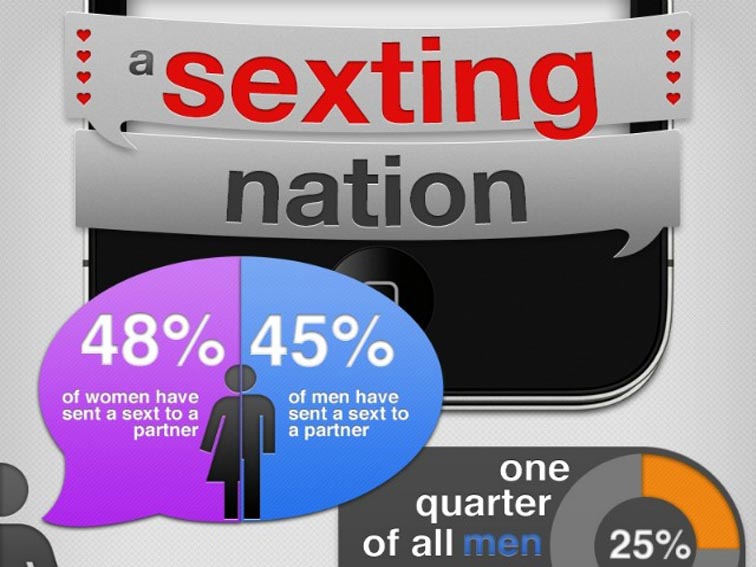
McAfee, the cyber security firm, released a study earlier this year of “more than 1,500 consumers” and found that more than half (54%) “send or receive intimate content including video, photos, emails and messages.” It found that one in three American adults have filmed sexual content on their mobile devices.

Digging deeper, McAfee reported that 70 percent of 18- to 24-year-olds receive sexually suggestive content and that (among those using mobile devices) more males than females do so (61% vs. 48%). It also found that 45 percent of adults stored the sexts they received while 40 percent stored the ones they sent. Among those who sent “intimate or racy content,” three-fourths (77%) sent it to their significant other, while only 1 in 10 sent such content to a total stranger.

Pew Research reported that “sexting … is practiced by couples and singles alike” and has nearly doubled since its last survey in 2012. The most active adults engaged in sexting were between 25 and 34 years of age. “Married and partnered adults are just as likely as those not in a relationship to say they have sent sexts,” the report noted, adding, “single adults are more likely to report receiving and forwarding such images or videos.” Pew’s research also found the following among adults: 20 percent of “cellphone” owners have received a sext of someone they know; 9 percent have sent a message of themselves to someone else; and 3 percent have forwarded a sext to someone else.

Approximately 145 million Americans own a “smartphone,” a 3G or 4G mobile device capable of image-based sexting. Extrapolating from this estimate, the McAfee report suggests that upwards of 78 million users have engaged in sexting. The Pew report suggests that some 30 million Americans have received a sext and about 13 million have sent one. The scope of sexting among Americans likely resides somewhere between the two estimates. Clearly, sexting is no longer simply a teen titillation.


*

Sexting emerged as a form of DIY or amateur pornography about a decade ago and originally subverted the dominant porn conventions in (for the most part) three ways. First, it involved teen makers and viewers, not adults (e.g., sex predators); second, it involved erotic display and not explicit sex acts (e.g., fellatio, intercourse); and third, it was a non-commercial form of enticements (i.e., not a product for sale). Sexting continues as a form of teen flirting, something essentially by and for young people and freely exchanged, a gift.

However, sexting seems to be increasingly adopted as part of the postmodern adult sex scene, and as it goes mainstream it is losing its critical edge. In the U.S., “noncommercial” sexual relations between consenting adults are not illegal. One can easily imagine sexts becoming the next intimate Valentine’s card or seductive private message, the latest personal turn-on. Who needs chocolates when one can send a sext?

Will sexting be integrated into the commercial sex industry? Sex is big business in the U.S., estimated at $50 billion in annual revenue. Prostitution, illegal in all but a handful of Nevada counties, pulls in an estimated $18 billion; the sex toy or “sexual wellness” sector is pegged at $15 billion; the 3,000 or so gentlemen’s clubs are reported to serve some 1.2 million (mostly male) customers a day and generate an estimated $3.1 billion to $7.5 billion in revenues. And this does not include the private “safe sex” clubs for gays and straights as well as specialized fetish clubs (e.g., BDSM) often hosted by a professional dominatrix, the gay bathhouses or other illicit “noncommercial” hookups easily arranged via voice calls, Internet sites and wireless app services.

The U.S. porn business is estimated at $10 billion-plus annually. According to one source, there are nearly 25 million porn sites worldwide, making up 12 percent of all websites. Sebastian Anthony, writing for ExtremeTech, reports that Xvideos is the biggest porn site on the Web, receiving 4.4 billion page views and 350 million unique visits per month. He claims porn accounts for 30 percent of all Web traffic. (In comparison, Wikipedia gets about 8 billion page views.) Anthony estimates the average length of time spent on Xvideo at 15 minutes. From an aesthetic perspective, he notes that, alas, most people receive their digital video feeds using low-resolution streaming.

Sex saturates the marketplace, whether promoting personal satisfaction or glamorizing a product, be it a new car or a mouthwash. Sexting illustrates the power of technological innovation and, sadly, of how a once-radical, DIY form of self-expression is being recuperated, integrated into the commercial economy. The marketplace has perfected the art of turning the most intimate human exchange into a commodity. The only unanswered question is what intimacy remains to be plundered?

More David Rosen.

Tuesday, March 25, 2014

The 2015 Chevy Corvette Z06

I'm not totally obsessed with cars by any stretch of the imagination. But I do like a beautiful and powerful car when I see one. The 2015 Chevy Corvette Z06 is one of those cars.

The 2015 Chevy Corvette Z06 Is an All-American Supercar

2015 Chevrolet Corvette Z06

The Corvette Z06 has always offered an insane amount of performance for the money, but its Ferrari-caliber hardware was cloaked in bodywork that could be mistaken for that of lesser, base-model 'Vettes. The new Z06 not only gets, as GM puts it, "at least" 625 horsepower – more than a McLaren 12C – but it finally looks like a world-class supercar. (Either that or the landing craft for an alien race.) The old Z06's low-key styling almost begged you not to notice. The new one nakedly proclaims its bad intentions and ambitions for world domination.


The Z06's fenders are lasciviously flared, two inches in front and three inches in back, to cover tires that look like they were stolen from a race car. With the optional aero package, the Z06 makes more downforce than any car GM has ever built. This thing's got more carbon fiber than the Dreamliner factory. The Z06 isn't exactly GM's cash cow and isn't important to the company the way the F-150 is to Ford or the 200 is to Chrysler. What it is, however, is a 200-mph middle finger to everyone who danced on GM's grave five years ago and said it wasn't worth saving. It's a kickass bedroom-poster car with the goods to convince a new generation that American vehicles can command the same respect as anything with a prancing horse on the fender.

Ezra Dyer for Men's Journal

Tuesday, August 7, 2012

Damon Horowitz Says “Quit Your Tech Job and Get a Ph.D. in the Humanities”


Damon Horowitz, once a serial entrepreneur, having co-founded Aardvark, Perspecta, and a number of other tech companies, is now a PhD philosopher who recently took the job of In-House Philosopher/Director of Engineering at Google. In this talk at Stanford, he advocates for techies to quit their jobs and go back to school for a PhD in humanities. As someone with a master's in humanities, I would suggest becoming independently wealthy before making such a move.

In my experience the world might be a little better of a place if lawyers, doctors, politicians, psychotherapists, scientists, and just about everyone else had a better and deeper grounding in literature, philosophy, comparative religion, and the arts - all those humanities subjects that won't pay a mortgage but give us a wider perspective and more compassion for our fellow human beings.

This is from Open Culture.

Serial Entrepreneur Damon Horowitz Says “Quit Your Tech Job and Get a Ph.D. in the Humanities”

August 7th, 2012

Damon Horowitz, a philosophy professor and “serial entrepreneur,” recently joined Google as an In-House Philosopher/Director of Engineering. Prior to his work at Google, Horowitz co-founded Aardvark, Perspecta, and a number of other tech companies. In this talk at Stanford University’s 2011 BiblioTech conference on “Human Experience,”  Horowitz explains why he left a highly-paid tech career, in which he sought the keys to artificial intelligence, to pursue a Ph.D. in Philosophy at Stanford (the text of the talk is available here).

Horowitz offers fellow techies a formidable challenge, but a worthwhile one. In saying so, I must confess a bias: As a student and teacher of the humanities, I have watched with some dismay as the culture becomes increasingly dominated by technicians who often ignore or dismiss pressing philosophical and ethical problems in their quest to build a better world. It is gratifying to hear from someone who recognized this issue by (temporarily) giving up what he admits was a great deal of power and societal privilege and headed back to the classroom.

Horowitz describes his intellectual journey from “technologist” to philosopher with passion and candor, and concludes that as a result of his academic inquiry, he “no longer looks for machines to solve all of our problems for us,” and no longer assumes that he knows what’s best for his users. This kind of humility and intellectual flexibility is, ideally, the outcome of a higher degree in the humanities, and Horowitz uses his own trials to make a case for better critical thinking, for a “humanistic perspective,” in the tech sector and elsewhere. For examples, see Horowitz’s TED talks on a “moral operating system” and “philosophy in prison.” Complicating Google’s well-known, unofficial slogan “don’t be evil,” Horowitz, drawing on Hannah Arendt, believes that most of the evil in the world comes not from bad intentions but from “not thinking.”


In a related Stanford talk (above) from the same seminar, Marissa Mayer, former Vice President of Consumer Products at Google, discusses how she incorporated the humanities into product innovation at Google. The first female engineer at Google (and its youngest executive at the time of this talk), she has made headlines recently, becoming the new CEO of Yahoo.

Related Content:
Josh Jones is a doctoral candidate in English at Fordham University and a co-founder and former managing editor of Guernica / A Magazine of Arts and Politics.

Wednesday, June 20, 2012

The Secret Lives of Men - iDisorder: Larry D. Rosen


From Dr. Chris Blazina, this episode of The Secret Life of Men - this episode from back in May (2012) looks at the impact of technology on our brains: increased stress, sleeplessness, and compulsivity.


Listen to internet radio with Secret Lives of Men on Blog Talk Radio


The Secret Lives of Men - iDisorder: Understanding Our Obsession with Technology with Larry D. Rosen
IDisorder: changes to your brain’s ability to process information and your ability to relate to the world due to your daily use of media and technology resulting in signs and symptoms of psychological disorders - such as stress, sleeplessness, and a compulsive need to check in with all of your technology. Based on decades of research and expertise in the "psychology of technology," Dr. Larry Rosen offers clear, down-to-earth explanations for why many of us are suffering from an "iDisorder."  Our world is not going to change, and technology will continue to penetrate society even deeper leaving us little chance to react to the seemingly daily additions to our lives. Rosen teaches us how to stay human in an increasingly technological world.

Wednesday, April 13, 2011

Roxxxy is the world’s first sex robot

So this is what men have been reduced to in their quest for sexual satisfaction - rather than finding a girlfriend or even a one night stand, and rather than taking matters into your own hands, you now can own a sex robot. Her name is Roxxxy, and apparently she is pretty high tech.

If it weren't so absurd, it would be sad . . . . very, very sad.

How to Feel

She can moan orgasmically when the time is ripe.
Roxxxy Sex Robot

Roxxxy is the world’s first sex robot. Her hair style, skin color and personality are customizable. She has tactical and aural sensors that allow “her” to respond appropriately to conversation and stimulation. She can talk about football or moan orgasmically when the time is right. With her embedded wireless modem, she can access the internet and download personality updates and new knowledge. She weighs 27 kilograms making her easy to store. She can grip your hand, move her head up and down and her hips back and forth. Roxxxy costs $7,000. And yes, she has an off switch.

Buy a relationship online now!


Friday, January 14, 2011

TEDxPSU - Ali Carr-Chellman - Gaming to re-engage boys in learning

Boys are falling behind so much in school, especially in reading. We have given so much attention to making sure the needs of girls are being met that classrooms are no longer boy friendly. Even under the best circumstances, the boys of brains develop slower than girls - so when we do not educate them in a way that suits their learning styles, they fall even further behind. Ali Carr-Chellman looks at why this happening and offers a boy-friendly solution - video games.
Ali Carr-Chellman pinpoints three reasons boys are tuning out of school in droves, and lays out her bold plan to re-engage them: bringing their culture into the classroom, with new rules that let boys be boys, and video games that teach as well as entertain. (Recorded atTEDxPSU, October 2010 at Penn State University, PA. Duration: 12:30)


Sunday, May 23, 2010

Cristina Masters - Cyborg Soldiers and Militarised Masculinities

http://www.pinktentacle.com/images/terminator_2_large.jpg

This is an excellent article on the interface of masculinity and militarism. The article comes from Eurozine and is part of their current series on the future of war.

The talk about cyborg soldiers in disturbing in some ways, in that these things (when they exist, and they will) will lack subjectivity in the sense we know it. There will be no inner sense of guilt, shame, empathy, or compassion.

On the other hand, this will address Warren Farrell's issues with only men serving in high-risk combat positions, what he has called the "disposability of men" (I'll have more to say about Farrell in a future post). Replacing men with cyborg soldiers would remove men from that high-risk role.

But the author here is a feminist, so her concern is about the continued representation, through these hyper-masculine "cyborg" soldiers, of the "desire for total masculinist control and domination." Maybe, maybe not.

Maybe that is a valid concern to feminists, but as a male, who believes war is at best the LAST possible action, I wonder about the perpetuation of men as soldiers, as killing machines.

Here is the first paragraphs and then only one excerpt from the article, which is quite long and worth the read - even if you do not agree with her position.

Cyborg soldiers and militarised masculinities

Increasing military interest in the body cancels the transgressive potential of the cyborg. Where humans become the weakest link in contemporary warfare, the cyborg represents a desire for total masculinist control and domination. Machines, not human bodies, are now the subjects of the text.

Feminisms, technology and the military

The absence of bodies in the discourse of a discipline that was born of a concern with war and hence violence against bodies, itself raises curiosity as to the conditions of possibility that enabled this absence.
~ Vivienne Jabri (2006: 825)

In "Fact and Fantasy: The Body of Desire in the Age of Posthumanism", Renée C. Hoogland (2002: 214) argues that "in the increasingly technologized age of posthumanism, bodily matters are, quite simply, too substantial to be left to the 'empirically' inclined minds of natural scientists", and therefore calls on cultural theorists to take up the weighty issue of bodily matters. Recent developments indicate, however, that bodily matters are more and more coming under the ambit of the "strategic" and "security" inclined minds populating military institutions and government administrative offices, in ways perhaps far more troubling and disturbing in all of its potential and real implications. In the post-9/11 context of the war on/of terror, one can scarcely overemphasize the dangerous possibilities signalled in this shift. Dangerous, in that bodily matters are being taken up by institutions primarily concerned with the defence and security of the nation-state in an increasingly biopolitical architecture of power.

For many, it is right that such matters should be taken up by the entity with which we have authorised to act in our name and in our defence – the state. Others, in particular critical theorists of international politics, have expressed grave concern over the deadly security practices at work in the US-led war on/of terror, including not only the wars on Afghanistan and Iraq, but also and significantly, the new security measures around immigration and asylum, individual freedoms and liberties, search and seizure, and the power to detain indefinitely, to name but a few.

Feminists, as much as militarists, have pointed to the virtues of advanced technology in addressing some of the pressing issues of our day, whether explicitly those of identity politics or that of war. With regard to the latter, nowhere is this more apparent than in the US military, where technology has been lauded as the answer to the question of security and terrorism. With regard to the former, feminists such as Jean Bethke Elshtain (2003) have linked advanced military technology to just war practices, and a number of feminists have advanced arguments in favour of technology's transgressive potential both in terms of challenging the strictures of gendered regimes of power, and in support of women's participation in institutions such as the military.

Donna Haraway, the well-known feminist advocate of the transgressive potential of technology, has critically engaged the possibilities of technology in enabling the subversion of binary structures of gendered knowledge. She contends that the human/machine interface, captured in the figure of the cyborg, can fundamentally challenge traditional dualistic western discourses by making apparent the social construction of unitary and exclusionary identity. The cyborg, she argues, can reveal the multiplicity, contextuality, and contingency of gendered subjectivity by blurring distinctions between, for instance, mind/body, self/other and man/woman. At the same time, Haraway (1991: 151) recognises that "the main trouble with cyborgs, of course, is that they are the illegitimate offspring of militarism and patriarchal capitalism [...] But illegitimate offspring are often exceedingly unfaithful to their origins. Their fathers, after all, are inessential."

It appears, however, that the problem persists: in contrast to Haraway's hopeful observation, the figure of the cyborg remains rather faithful to its origins. Thus, while the cyborg may provide new grounds upon which to reveal gender representations as contingent and historically grounded social constructs, we need also to attend to the ways in which the figure of the cyborg may continue to represent a desire for total masculinist control and domination.

* * *

The distinctions between simulation and reality, training and battle, have been breached to the point that there is virtually no distinction, where the critical distinction should be that people are killed in the real world of war (see Der Derian 2003, 2009; Harris 2003; Kundnani 2004). A telling example is the description of the Combat and Maneuver Training Center in Hohenfels, Germany, by an American Colonel: "Once a unit goes into the Box, with the exception that they're shooting laser bullets, and that a guy, instead of falling down with a gunshot wound, will read from a card he's carrying in his pocket how badly hurt he is, virtually everything we do is real. There's nothing simulated in the Box." (Der Derian 1997: 121) The discursive collapsing of reality and simulation has deadly ramifications for the bodies violently inscribed by cyborg soldiers in real wars. The disciplining of soldiers to believe that simulations are reality, and conversely, that reality is a simulation, "produces 'a kind of isolation' from the violence of war that allows for its unrestrained prosecution [...] removed from the bloody results of their decisions" (Gray 1997: 200). Simultaneously, it rationalises and mystifies the disappearance of the body from war, and the denial of the "sentient physicality of human embodiment" (Gusterson 1998: 124).

The denial and suppression of embodiment is indicative of the inscription of military technology as the subject of techno-scientific masculinity and of human bodies, both soldier and civilian, as objects of power and knowledge. The discursive positioning of military technologies as superior to the human soldier has constituted machines as the subject of the text. Technology has become the surface upon which power has been inscribed – inscribed with the power to "write the world" through violent inscriptions and domination (Haraway 1991: 175). The transference of subjectivity onto technology has fundamentally grafted military technology with agency and power through the discursive reinscription of hegemonic techno-militarised masculinity as representative of machine. The language of the cyborg is the language of violence, a language that has the power to generate meaning and knowledge about the bodies upon which it acts. The other – gendered, racialised, and sexualised – is constituted as less human, as object, as different, as a "code problem" in need of techno-scientific solutions, as bodies-of-danger. The language of the cyborg necessitates the denial of the body of the self so that it can act upon the body of the other. Necessarily, this has required the naturalisation of the machine-man interface through techno-scientific discursive practices in order to legitimate practices of dominance, and thus the ethicality of the interface.

At the same time the constitution and production of the cyborg soldier is rearticulating the ever-present relationship between techno-scientific discourses and masculinist discourses. The characteristics traditionally inscribed on male bodies have been rearticulated by military techno-scientific discourses and remapped onto military technologies. So while the cyborg soldier has blurred particular distinctions between machine and man, where technology embodies masculinity, the distinctions between the cyborg soldier and the traditional soldier have become discursively formalised along the lines of masculinity and femininity. The effect is that military technologies have been techno-masculinised, while human soldiers apart from technology have been feminised and reconstituted within the realm of those needing protection.

As such, techno-militarised masculinity has come to symbolise the model American soldier represented in the machine-man interface where technology constitutes soldiers and militarised masculinity constitutes technology. In so many ways, the machine-man interface is literal in the American military where everyday experience is characterised by constant interaction with advanced technology from weapons to computers, surveillance, reconnaissance, delivery systems, and from training simulations to real battle. However it is also significantly metaphorical, in that clearly it is not only male soldiers that interface with technology. Rather, the interface represents the discursive unhinging of male subjectivity from the physical male body and the reinscription of male subjectivity on/into military technologies. Put differently, masculinity does not necessarily coincide with the bio-male body. "It is not that the soldier is influenced by the weapons used; now he or she is (re)constructed and (re)programmed to fit integrally into the weapon systems." (Gray 1997: 195) The significant effect is that advanced technologies are now the subjects of discursive constructions, and thus one of the key signifiers that perform and represent American identity.

In many ways, the inscription of technology with masculine subjectivity is easily recognised in military techno-scientific discourses: phallic shaped missiles, precision-guided missiles that easily find the target, and aerial bombings that leave one with the impression of an "orgasmic ejaculation" impregnating targets with death and destruction rather than life. These are only a few of the more obvious representations of the discursive inscription of masculine subjectivity on/into military technology. What is less obvious, but fundamentally crucial, is the transference of masculine intelligence (knowledge) on/into military technologies, particularly military technologies that are not overtly gendered in shape, size, and overall appearance, but gendered in capabilities, for instance computer and information technologies. "At the heart of most dreams for absolute information there is the ideal of pure intelligence. It is a peculiar version of rationality that is masculine, mathematical, emotionless and instrumentalist." (Gray 1997: 195) While masculine subjectivity has historically represented the mastery of mind over body, rationality over irrationality, and intellect over emotion inscribed on the white, heterosexual male body, the human male body has proven to be a serious liability to achieving if not absolute, at least superior intelligence.

Considering this, the cyborg can be read as fundamentally post-human, and significantly represents a profound rearticulation of the political; in other words, the constitution of the cyborg soldier can be read as a radical rearticulation of human subjectivity (see Springer 1998; Hoogland 2002; Shabot 2006). This post-human subjectivity is represented through the cyborg in the very processes of transferring human reasoning and thinking from human subjects onto technology. The infusion of technology with the ability to reason and think, without being interrupted by emotions such as guilt or bodily limitations such as fatigue, is indicative of the constitution of the fleshy body as no longer capable of producing and projecting desired representations of the American self.

Significantly, the constitution of the soldier as cyborg has also altered who is constituted as a soldier. Traditionally, the signifier soldier was confined to combatants, in other words, men who actually engaged in physical battle. The fusion of technology and masculinity has significantly blurred this traditional distinction, where now civilians can be considered soldiers, and more specifically, cyborg soldiers (Armitage 2003). Military personnel who will likely never be in physical battle, who literally sit in front of computer screens, have now been constituted as soldiers through the interface, effectively enlarging and reconfiguring the representations of soldiers. In the words of US military Colonel Ehrhard: "It is the software engineer who kills now." (Beal 2000) Cyborg soldiers, almost by definition, may never have to lay human eyes on their enemy again – the gaze will be that of the gun sight, the computer screen, and global positioning satellite targeting systems. On the continuum of traditional discursive depersonalisation and dehumanisation, the cyborg soldier represents the extreme of abstract disembodiment, in that the discipline traditionally required to remove oneself from the reality of war (if even possible) is no longer necessary. A mental image of an air fighter's "bomb's eye view" during NATO's humanitarian intervention in Kosovo, frighteningly captures this: "Killing people does not go through your mind [...] From the air, the human factor doesn't mean what it would in an army guy. When you're a fighter pilot, you don't see eyes. You see things – a building, a truck, a bridge, a dam. It's all so technological. I had no Serbian in mind [...] I was shooting at a radar pulse." (Wallace 2000)

Saturday, October 24, 2009

Mike Treder - Women, Men, Logic, and Emotion

Here is an article that builds on (sort of) my recent post about women outperforming men at identifying emotions. This article examines the predominance of males in the transhumanist and technology/scientific communities.

This article comes from the Institute for Ethics and Emerging Technologies site - a great if slightly biased resource on transhumanist and singularity thinking.

Women, Men, Logic, and Emotion


Mike Treder

Mike Treder

Ethical Technology

Posted: Oct 22, 2009

How different are men from women? And how much could those differences affect your future?

It’s been noted before that there is a significant gender imbalance among those who subscribe to transhumanist and/or technoprogressive ideas. The most recent Singularity Summit came in for quite a bit of criticism when their initial speaker list included no women at all. As it turned out, only one of the 25 speakers was female.

But it’s not only the singularity crowd that is dominated by men. Among the IEET’s nearly one thousand Facebook fans, for example, 71% are male and 27% female (as for the remaining 2%, well, who knows). The IEET has 12 interns, and four are female. Of our 15 IEET Fellows, four are women. And this is, unfortunately, a typical pattern. Attend nearly any gathering of futurists or science fiction enthusiasts and you’ll see a lot more male faces than female.

So, is this disparity mainly a result of societal conditioning? Or is there an evolutionary explanation for the differences between how men and women perceive the world and in what areas they take the most interest?

It’s been conclusively shown, of course, that girls are every bit as capable as boys in learning science and math. Some people are even starting to worry now about a reverse disadvantage, as it’s discovered that girls today are outperforming boys at every level in education.

For some reason, though, in the field of engineering the disparity remains especially prominent:

Among U.S. engineers there is an indisputable gender gap—fewer than 20% of engineering graduates are women, according to the National Science Foundation. . . Women have succeeded in larger numbers in fields such as physiology, biology, and social sciences, and they are having increasing success in starting small businesses. Increasingly, engineers and technologists have an advantage in reaching the top, yet in these fields women constitute the smallest minority.

And the difference is also acute when it comes to computer science:

If the attitudes of high school students are a good predictor of eventual career choices, the future will continue to see computer science fields dominated by males. According to new research released by ACM and the WGBH Educational Foundation, compared with girls, more than twice as many boys see computer science as a “good” or “very good” choice as a college major. What’s more, four times as many boys cited computer science as a “very good” career choice.

Perhaps part of the explanation can be found in the results of a recent study done in Canada:

Next time your wife or girlfriend accuses you of not being attuned to her feelings or those of the people around you, just smile and nod.

A study by researchers from the Université de Montréal Centre de recherche en neuropsychologie et cognition (CERNEC), published in the journal Neuropsychologia, says that women are better than men at picking up emotional clues in people’s facial expressions.

The team, headed by Olivier Collignon, set out to examine the long-held belief that women generally do a better job than men in understanding what a person’s expressions, statements and body language says about how they feel.

Collignon, who also works as a researcher at the Université catholique de Louvain’s Institute of Neuroscience in Belgium, says “the aim of such a study isn’t to prove the superiority of men or women. . . These gender studies are necessary for researchers to better understand mental diseases which have a strong gender component. That means they affect men and women differently. Autism is a good example, because it affects more men than women and one of its features is the difficulty in recognizing emotions.”

Could the different levels of interest between men and women in engineering and computer science be related to this? And could this difference also manifest itself in the futurist gender gap? Perhaps so. Consider this description of Asperger syndrome, an autism spectrum disorder fairly common among high achievers in certain areas:

In the social world there is no great benefit to a precise eye for detail, but in the worlds of math, computing, cataloguing, music, linguistics, engineering, and science, such an eye for detail can lead to success rather than failure.

It’s all well for these people, predominantly males, to succeed and become accomplished in their areas of focus. But maybe we should be concerned about a possible deficiency among some transhumanist leaders in understanding and appreciating emotional states. I, for one, would certainly not relish living in a post-Singularity world designed by such men.


Mike Treder is the Managing Director of the IEET, and former Executive Director of the non-profit Center for Responsible Nanotechnology.