Showing posts with label ethics. Show all posts

Monday, December 10, 2012

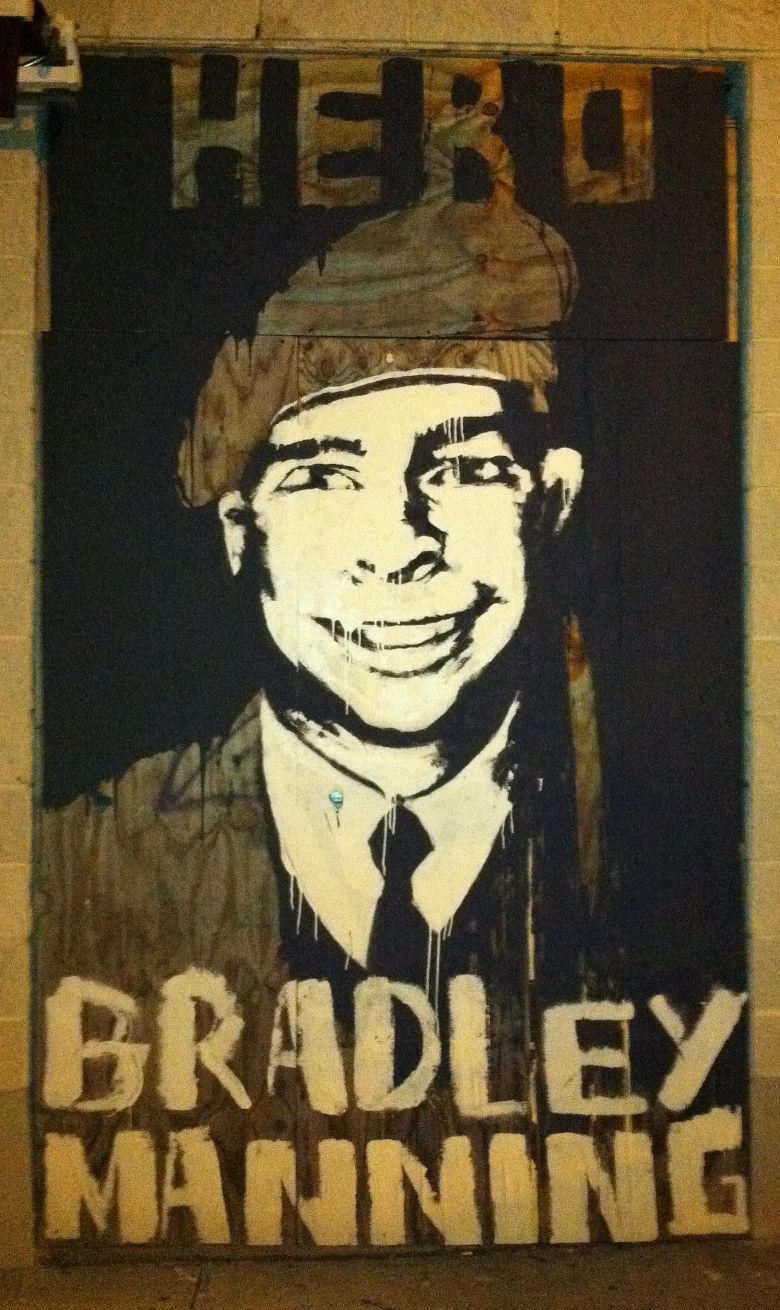
Bradley Manning Is The Guardian's 'Person of the Year 2012'

 Is Bradley Manning a Hero?

PFC Bradley Manning, who is accused of espionage, aiding the enemy, and many, many other offenses, all of which stem from his decision to copy and share tens of thousands of files with Wikileaks, including the now infamous Collateral Murder video (which showed a United States Apache helicopter firing on civilians in New Baghdad in 2007), has been named The Guardian's "Person of the Year" for 2012, with 70% of the vote by readers of The Guardian.
WikiLeaks releases attributed to Bradley Manning have provided unparalleled access to important facts.

Revealing covert crimes in Iraq and Afghanistan and corporations' pervasive influence in governance, this window into the realities of modern international relations has changed the world for the better. While some of these documents may demonstrate how much work lies ahead in terms of securing international peace and justice, they also highlight the potential of the internet as a forum for citizens to participate more directly in civic discussion and creative government accountability projects.
Last week, PFC Bradley Manning offered to accept responsibility for releasing classified documents as an act of conscience – not as charged by the US military (espionage, aiding the enemy, etc.).

I think he is a good choice, not that there aren't dozens of good choices each year. It takes an incredible amount of courage to risk one's life in the interests of  disclosing military and government corruption.

In an effort to break him, he was subjected to nearly a year in solitary confinement against the recommendations of mental health professionals. The argument that he was a suicide risk was refuted in the testimony of three psychiatrists at Quantico, while his personal counselor (Gunnery Sergeant (GYSGT) Blenis) recommended that he be kept on suicide watch (POI), which requires isolation and removal of personal items (at the same time his counselor told Manning that his behavior was exemplary).
While the government has argued this week that PFC Manning’s harsh holding conditions met brig regulations, the defense continued arguing the unnecessarily severe nature of PFC Manning’s Quantico treatment with testimony from the garrison commander at PFC Manning’s current prison in Ft. Leavenworth, KS, Lt. Col. Dawn Hilton.  At Ft. Leavenworth, Lt. Col. Hilton testified, Bradley Manning was found through psychological interviews and observation to be a medium security prisoner, meaning he was allowed much greater freedom of movement, interaction with other prisoners, as well as an array of personal items.  She continued that at Ft. Leavenworth, Suicide Watch was the status most comparable to POI, and her goal was always to downgrade prisoners from this status as soon as possible, by working with psychological staff.  She testified that if a detainee’s condition was so severe that prison staff was unable to successfully downgrade their status within a few days, she would next work to have them transferred to a psychiatric ward, rather than remain in prison.  Additionally, she testified that all prisoners were allowed at least 1 hour of outside recreation per day, in accordance with American Corrections Association (ACA) standards; for the first 6 months of PFC Manning’s imprisonment at Quantico, he was allowed a mere 20 minutes of sunlight per day.  Unlike the Quantico military brig, the Ft. Leavenworth garrison is accredited as meeting 100 percent of ACA standards.
If you are interested in what was actually released in the Wikileaks documents, there is a document that outlines that major items that the government claims are national security issues, but seem actually to be crimes that they do not want exposed. For example:
  • There is an official policy to ignore torture in Iraq.
  • U.S. officials were told to cover up evidence of child abuse by contractors in Afghanistan.
  • Guantanamo prison has held mostly innocent people and low-level operatives.
  • There is an official tally of civilian deaths in Iraq and Afghanistan.
  • U.S. Military officials withheld information about the indiscriminate killing of Reuters journalists and innocent Iraqi civilians.
  • The State Department backed corporate opposition to a Haitian minimum wage law.
  • The U.S. Government had long been faking its public support for Tunisian President Ben Ali.
  • Known Egyptian torturers received training from the FBI in Quantico, Virginia.
  • The Obama Administration allowed Yemen’s President to cover up a secret U.S. drone bombing campaign.
If you would like to contribute to his defense fund, you can do so here.

Monday, December 3, 2012

Steven Ross Pomeroy - The Key to Science (and Life) Is Being Wrong

When do you learn the most about life, who you are, relationships? I'm guessing it's not when you are right about something, or sure of yourself. Most of can only learn through making mistakes or being wrong. Yet we avoid being wrong like the plague. When we can acknowledge that we are wrong about something and be open to other ideas or perspectives, that is when we grow as men, as human beings.

The Key to Science (and Life) Is Being Wrong

November 13, 2012


In 1964, the occasionally enigmatic but always energetic physicist, Dr. Richard Feynman gave a lecture at Cornell University to a packed hall of eager, young scholars. Feynman’s demeanor was crisp and purposeful that day, a style reinforced by his sharp appearance. The professor’s hair was neat and tidy, and he was keenly attired in a trim, tailored suit.

His right hand grasping a piece of chalk, his left had nestled in his coat pocket, Feynman started to speak. “I’m going to discuss how we would look for a new law,” he said in his unvarnished Queens accent, referring to his work as a theoretical physicist.

Feynman walked over to the chalkboard and began to write. His oration continued, almost in a manner synced with his scribbling. “First we guess it… Then we compute the consequences of the guess to see what it would imply. And then we compare those computation results… directly to observation to see if it works.”

Feynman paused, removed his left hand from his coat pocket, and strode back over to the lectern to briefly peruse some notes. He then launched right back into his sermon.

“If it disagrees with experiment, it’s wrong,” he asserted, craning his neck forward and adroitly pointing his left hand at the chalkboard to accentuate the point. “In that simple statement, is the key to science.”

“It doesn’t make any difference how beautiful your guess is,” Feynman proclaimed, gesticulating in wide, circular, somewhat flamboyant motions. “It doesn’t make any difference how smart you are, who made the guess, or what his name is. If it disagrees with experiment, it’s wrong. That’s all there is to it.”

Feynman was absolutely right.

A good scientist must be willing to be wrong. Such an inclination is liberating, for it allows him or her to investigate potential answers — however unlikely they may be — to the difficult questions inspired by this vast, wondrous universe. Not only that, a willingness to be wrong frees a scientist to pursue any avenue opened by evidence, even if that evidence doesn’t support his or her original hunch.

“The hard but just rule is that if the ideas don’t work, you must throw them away,” The great science communicator Carl Sagan wrote. “Don’t waste neurons on what doesn’t work. Devote those neurons to new ideas that better explain the data.”


Sagan’s candid advice was perfectly followed in 1998, when two highly competitive groups of scientists from Harvard and Berkeley were racing to find the rate at which the universe’s expansion was decelerating. It was a high stakes contest, for a Nobel Prize was thought to be on the line.

But to both groups’ astonishment, the data ended up pointing in precisely the opposite direction. The scientists found that the universe’s expansion was not slowing down; it was speeding up! “I was, quite frankly, denying [it] was happening,” Harvard’s Brian Schmidt reportedly said. But because Schmidt and his colleagues overcame their disappointment and were willing to be wrong, the world learned something entirely new about the cosmos.

For the Berkeley and Harvard astrophysicists, recognizing their wrongness was easy, as the data irrefutably pointed in a completely different direction. But it’s not always that simple. Sometimes data can be inconclusive, leaving wiggle room for the researcher to draw a range of conclusions. Unfortunately, this occasionally leads to misconduct, especially for the scientists who are more interested in dogmatically pursuing pet theories instead of proof. They might tweak little bits of data in order to achieve statistical significance in the ubiquitous P-value test or they might ignore certain details that conflict with their hypothesis.

This is, of course, ethically wrong, but human nature often compels us to err in order to guard our ingrained beliefs. While scientists are oft considered to be marble men and women, the truth is, they never stop being human.

In order to recognize wrongness, scientists must maintain some level of detachment from their cherished theories and be open to the ideas of others in their respective fields. Richard Dawkins described a terrific example of this in his book, The God Delusion:
“I have previously told the story of a respected elder statesman of the Zoology Department at Oxford when I was an undergraduate. For years he had passionately believed, and taught, that the Golgi Apparatus (a microscopic feature of the interior of cells) was not real… Every Monday afternoon it was the custom for the whole department to listen to a research talk by a visiting lecturer. One Monday, the visitor was an American cell biologist who presented completely convincing evidence that the Golgi Apparatus was real. At the end of the lecture, the old man strode to the front of the hall, shook the American by the hand and said – with passion – ‘My dear fellow, I wish to thank you. I have been wrong these fifteen years.’”
In the past year, we’ve been treated to two uplifting examples of that sort of modesty. Last year, University of California physics professor Richard Muller changed his skeptical stance on climate change when his own “BEST” study produced data that conflicted with his preconceived notions. He now admits that climate change is caused by human activity. In another noteworthy example, Dr. Robert Spitzer, the psychiatrist who, in a 2001 paper, touted that gays could be “cured,” reversed his position and apologized for his “fatally flawed, study.”

“I believe I owe the gay community an apology,” Spitzer wrote in a letter.

Wrongness is something we all secretly or openly dread. According to self-described “Wrongologist” Kathryn Schulz, in the abstract, we all understand that we’re fallible, but on the personal level, we leave little to no room for being wrong.

But Schulz believes that we should view this situation in a slightly different light. Realizing you’re wrong is what’s devastating, but being wrong often feels pretty good. As a matter of fact, it often feels identical to being right.

Like Wile E. Coyote chasing Road Runner off a cliff in those old Warner Brothers cartoons, we only start to fall when we come to the realization that we, along with our incorrect notions, have no solid ground to stand on. But the simple fact of the matter is that we had already run off the end of the precipice a long time ago! Thus, it’s best to admit that we’re wrong and get the fall over with so we can land (hopefully not too harshly), dust ourselves off, and get back on our feet.

——
Images: Richard Feynman: Wikimedia Commons/Public Domain, Universe Ladder: NASA/JPL-Caltech


Steven Ross Pomeroy 
About the Author: Steven Ross Pomeroy is the assistant editor for Real Clear Science, a science news aggregator. He regularly contributes to RCS’ Newton Blog. As a writer, Steven believes that his greatest assets are his insatiable curiosity and his ceaseless love for learning. Follow on Twitter @SteRoPo.
The views expressed are those of the author and are not necessarily those of Scientific American.

Sunday, September 30, 2012

Andy Hinds on His Experience in Hanna Rosin's The End of Men

In an interview with in The Guardian (UK), Hanna Rosin says she feels miscast in the gender wars, despite the incendiary title of her book, The End of Men. O'Kelly asks her about the stereotyping she employs in the book (men as lazy, women as achievers), and Rosin confesses that it's a fair criticism, but she also defends it:

How do you respond to critics who accuse you of 21st-century stereotyping in your portrayal of women as organised go-getters and men as lazy, unambitious couch potatoes?

I actually think that is a fair criticism. I was trying to capture a certain little slice of society, so I was intentionally looking for couples who exemplified the changing dynamic and it was only when I put the whole thing together that I realised there was an echo in couple after couple. At the very end of the book, I do talk about men's capacity for flexibility, especially at key moments in history, such as the end of both world wars. But it's true that as a series of portraits it does emit certain stereotypes and I don't know what to say about that. I'll have to fix that in my next book.
Someone who no doubt agrees that he was stereotyped - and even caricatured - is Andy Hines, one of the subjects for her research who feels he was misrepresented in the book. He writes about it in a recent column at The Daily Beast. Hines writes at his personal blog, Beta Dad, as well as DadCentric, Aiming Low.

Hanna Rosin’s The End of Men Turned Me Into a Caricature


I’m a happy and satisfied stay-at-home dad. So why did Hannah Rosin turn my story upside down for her bestselling polemic? Andy Hinds calls the author and asks her.


Last year, I responded to a survey on Slate that asked readers in marriages where the wife earned more money about their relationships with their spouses. The survey was conducted by Hannah Rosin, in connection with an article she was writing about “breadwinning wives.” The survey results were eventually incorporated into her bestselling book, The End of Men: And the Rise of Women.

If you haven’t read it already, The End of Men essentially argues that men in the United States (and pretty much everywhere else) are falling behind women in all facets of life. In school and in the workplace, women have made huge strides over the past few decades, while men have failed to adapt to the new economic and social realities that have obliterated “a power arrangement that’s prevailed for most of history.” Furthermore, according to Rosin, even as we men quickly ebb into marketplace obsolescence, those of us with families continue to be slacker manchildren in the home, unable to overcome sloppy parenting, haphazard home economics, and fealty to bro culture.

After I took her survey last year, Rosin contacted me directly, which led to an email exchange and then a long telephone interview in which I spilled my guts about my experience as a stay-at-home dad to toddler twins.

We spoke for over an hour about the joys and challenges of parenting, about perceptions of masculinity, about my relationship with my wife, and about my and my wife’s backgrounds. Among other topics, we discussed the fact that, despite growing up in a military family, I have parents who enthusiastically support the decisions my wife and I have made regarding our parenting roles. Likewise, my very traditional Vietnamese immigrant in-laws have no qualms with our domestic arrangements.

Rosin seemed surprised and impressed at this, yet she continued to press me for evidence to support her theory: marital tensions, awkward encounters with moms on the playground, feelings of shame at my own gender betrayal, and so on.

The reality: As I told Rosin, I’ve never been happier or more comfortable in my own skin than I have during my three-year stint staying home with my kids. I said there are moments of frustration and fatigue, of course, but when I consider how I feel about my place in the “new gender landscape,” I feel my life is a tremendous success.

Then I saw the book. Here’s how Rosin characterized our talk (as well as in a more recent Slate piece, “I Ain’t Sayin’ He’s a Gold Digger”): 
... It was clear from my dozens of interviews that there are tensions under the surface. A power arrangement that’s prevailed for most of history does not fade without a ripple. In many cases I heard the same old marriage anxieties, only they showed up in the reverse gender. Andy, a stay-at-home dad in San Jose, Calif., had to cancel several appointments with me because he couldn’t get his twins to sleep. Before he stayed home with his kids, he was a carpenter. His wife is a physician, and because she makes so much more money it made sense for him to take the parenting lead. Andy likes watching the toddlers, but he is wistful about his old life, and somewhat defensive about his new one.

The feelings flood over him when he passes construction crews while taking the twins on a walk: What would it be like to work with a group of guys up on a roof again? What adventures is his wife having while he’s wiping off bibs? When his wife and her doctor friends rib him about staying home, he over-aggressively pulls the manual labor card: “How about I come over and help you put that Ikea furniture together, Mr. Doctor?” It’s the old Betty Friedan identity crisis, only in masculine form. These days when his wife suggests that he should go back to work, Andy feels “terrified.” It’s been a long time, and he’s lost the stomach for the outside world.
I laughed out loud when I read this description of me. Despite our wide-ranging conversation about the richness of my life since I became a father and a fulltime caregiver, Rosin had rendered me as a hapless stock character in her tableau of post-masculine despair.

Let me make a few clarifications.
Read the whole article, including his conversation with Rosin about her portrayal of him in the book.

Tuesday, August 7, 2012

Damon Horowitz Says “Quit Your Tech Job and Get a Ph.D. in the Humanities”


Damon Horowitz, once a serial entrepreneur, having co-founded Aardvark, Perspecta, and a number of other tech companies, is now a PhD philosopher who recently took the job of In-House Philosopher/Director of Engineering at Google. In this talk at Stanford, he advocates for techies to quit their jobs and go back to school for a PhD in humanities. As someone with a master's in humanities, I would suggest becoming independently wealthy before making such a move.

In my experience the world might be a little better of a place if lawyers, doctors, politicians, psychotherapists, scientists, and just about everyone else had a better and deeper grounding in literature, philosophy, comparative religion, and the arts - all those humanities subjects that won't pay a mortgage but give us a wider perspective and more compassion for our fellow human beings.

This is from Open Culture.

Serial Entrepreneur Damon Horowitz Says “Quit Your Tech Job and Get a Ph.D. in the Humanities”

August 7th, 2012

Damon Horowitz, a philosophy professor and “serial entrepreneur,” recently joined Google as an In-House Philosopher/Director of Engineering. Prior to his work at Google, Horowitz co-founded Aardvark, Perspecta, and a number of other tech companies. In this talk at Stanford University’s 2011 BiblioTech conference on “Human Experience,”  Horowitz explains why he left a highly-paid tech career, in which he sought the keys to artificial intelligence, to pursue a Ph.D. in Philosophy at Stanford (the text of the talk is available here).

Horowitz offers fellow techies a formidable challenge, but a worthwhile one. In saying so, I must confess a bias: As a student and teacher of the humanities, I have watched with some dismay as the culture becomes increasingly dominated by technicians who often ignore or dismiss pressing philosophical and ethical problems in their quest to build a better world. It is gratifying to hear from someone who recognized this issue by (temporarily) giving up what he admits was a great deal of power and societal privilege and headed back to the classroom.

Horowitz describes his intellectual journey from “technologist” to philosopher with passion and candor, and concludes that as a result of his academic inquiry, he “no longer looks for machines to solve all of our problems for us,” and no longer assumes that he knows what’s best for his users. This kind of humility and intellectual flexibility is, ideally, the outcome of a higher degree in the humanities, and Horowitz uses his own trials to make a case for better critical thinking, for a “humanistic perspective,” in the tech sector and elsewhere. For examples, see Horowitz’s TED talks on a “moral operating system” and “philosophy in prison.” Complicating Google’s well-known, unofficial slogan “don’t be evil,” Horowitz, drawing on Hannah Arendt, believes that most of the evil in the world comes not from bad intentions but from “not thinking.”


In a related Stanford talk (above) from the same seminar, Marissa Mayer, former Vice President of Consumer Products at Google, discusses how she incorporated the humanities into product innovation at Google. The first female engineer at Google (and its youngest executive at the time of this talk), she has made headlines recently, becoming the new CEO of Yahoo.

Related Content:
Josh Jones is a doctoral candidate in English at Fordham University and a co-founder and former managing editor of Guernica / A Magazine of Arts and Politics.

Monday, July 2, 2012

Sexual Misconduct: The Third Zen Precept by Nancy Baker


This is member-supported content from Tricycle - A useful discussion on Zen's Third Precept: Sexual Misconduct, by Nancy Baker (supporting membership required for access). You don't have to be Zen or even Buddhist to appreciate this precept - all of us should be more aware of our sexual conduct and our embodiment of sexual ethics.

The Third Zen precept - Kamesu micchacara veramani sikkhapadam samadiyami, "I undertake the course of training in refraining from wrong-doing in respect of sensuality." - began in the monastic world, where celibacy was required. The rules were fairly strict (from Access to Insight, Buddhism and Sex):
Complete sexual continence is considered an essential feature of the monastic life. Intercourse of a heterosexual or homosexual character is automatically a Parajika offense. A monk who performs such an act is considered to have expelled himself from the Order, and is no longer in communion with the other monks. Any acts of a sexually unbecoming nature falling short of intercourse result in suspension and require expiation. Samaneras, or novice monks, who break their training in this respect are disrobed.
Laypeople who do not participate in sexual violence (rape, molestation, incest) or psychologically coercive sexual misconduct (incest, power imbalances such teacher/student, quid pro quo situations), or morally inappropriate sexual conduct (marital affairs, lying to seduce) may feel that this precept has no relevance in their lives. Nancy Baker counters that belief:
In fact, if we look more closely, it is a subtle and interesting precept; there is more to it than first meets the eye. There are several different translations of its subject matter: “adultery,” “impure sexuality,” “sexual misconduct,” “unchaste conduct,” and “misuse of sex.” What causes the misconduct and the impurity has been translated as “attachment,” “greed,” “grasping,” and “desire.” A consideration of some of the differences among these translations actually allows us to see the richness of the precept. Here, I will examine two ways of understanding this precept: sexual misconduct and misuse of sex.
The sexual misconduct point is easiest to grasp - "our conscious and unconscious impulses to take advantage of the susceptibility of others for our own emotional or physical gratification" - i.e., sex that harms others in any way.

Misuse of sex, however, relates to the impact of our sexual behavior on ourselves. In the end, it comes down the the Buddhist idea of kamma (karma). Here is more from Access to Insight's article (by M. O'C. Walshe):
We may recall that a few years ago there was a song "Money is the Root of all Evil" Some people pointed out that not money, but the love for money is the root of all evil (well, of a lot of evil, anyway). And here is the snag. Sexual pleasure (like money) is not "evil" (or unskilled), but attachment to sexual pleasure (like the love of money) is. If we can experience the pleasure without attachment we are all right; if we become attached to it, we are not "hitting the mark." Now of course it is rather difficult (to put it mildly) to experience pleasure of any sort without feeling attached to it. But attachment is kamma, and unskilled kamma at that. And the results of that will inevitably, according to Buddhism, be something unpleasant in the future.

Many people will find this explanation novel. Some will find it puzzling. Some will undoubtedly reject it — with or without investigation — with the excuse that it is overly subtle, or arbitrary, or something of the sort. What they mean is, of course, that they find it inconvenient. But it will repay a lot of consideration and mindful investigation. Careful study, in fact, should show that it is the key to the whole problem. The matter can also be considered in terms of the law of Dependent Origination: "Contact is the basis for the arising of feeling; feeling... of craving; craving... of clinging;" etc., the ultimate outcome being of course the continued process of becoming, with all the sufferings entailed.
It seems to me there is, in the Theravada tradition of Buddhism, an emphasis on control of desire - exercising restraint in all areas of our lives, but especially sexuality, to prevent attachment. I find that when we try to control anything that is natural in our lives - sexuality, hunger, desire, emotions - that we end up in a negative relationship with that energy - it ends up controlling us either overtly or covertly.

I propose we do not try to control our cravings, desires, and feelings (I can no more repress anger than I can sexual desire), but rather, befriend them, get to know them, and understand the role they play in our lives (positive and negative, since it will never be all one or the other). This is a different approach, but I suspect it is more likely to allow us to come into "right relationship" with our sexuality, desires, and feelings.

Sexual Misconduct

The Third Zen Precept 

Nancy Baker

Author Nancy Baker is currently leading a Tricycle community discussion about sexual misconduct and the third Zen precept. You can join the discussion here.

Monday, June 25, 2012

Men Willing to Betray Morals to Maintain Masculinity

A recent article in Scientific American suggests men are willing to compromise - "cut corners" is the phrase they use - on their moral beliefs if they feel their masculinity is at stake.

Although this collection of studies makes men seem like weasels, we should keep in mind (as the authors point out, although not until the last paragraph, by which time most readers have already clicked on to something else) that each of these studies used competitive negotiation scenarios, a domain inhabited by men seen as strong, even cutthroat, are those who are successful. For a man to fail in this "historically male-dominated situation" results in lower income (money = power), loss of professional respect, and - at the bottom line - loss means being seen as weak.

We all know that for many men, at least traditional men, one must be seen as strong in order to hold the respect of other men. If your masculinity is threatened, and your sense of value is based on being viewed as masculine and powerful, it's likely you will cut moral corners here and there (unless your fear of "losing face" is less than your fear of eternal damnation - religious can be a powerful deterrent).


When Men Are Less Moral Than Women

If males feel their masculinity may be at stake, they are more likely to cut ethical corners

 | June 19, 2012

What do Barry Bonds, Bernie Madoff, and James Murdoch have in common? They were all, in their respective areas, in it to win it – whatever the cost. Their appetite for success apparently disabled the moral compass that would have otherwise kept their dishonesty, greed, and hubris in check.

The magnitude of these highly publicized ethical infractions may lead one to wonder whether folks like Barry, Bernie, and Jimmy were absent the day their kindergarten teachers talked about lying, cheating, and stealing. Recent research, however, suggests that ethical violations are somewhat predictable, that in fact there are specific circumstances, contexts, and individual characteristics that beckon us away from the moral high road.

One of the most notable risk factors for ethical laxity is one that all of the above offenders share: Being a man. A number of studies demonstrate that men have lower moral standards than women, at least in competitive contexts. For example, men are more likely than women to minimize the consequences of moral misconduct, to adopt ethically questionable tactics in strategic endeavors, and to engage in greater deceit. This pattern is particularly pronounced in arenas in which success has (at least historically) been viewed as a sign of male vigor and competence, and where loss signifies weakness, impotence, or cowardice (e.g., a business negotiation or a chess match). When men must use strategy or cunning to prove or defend their masculinity, they are willing to compromise moral standards to assert dominance.

Shall we blame it on testosterone, the Y chromosome, or other genetic differences? The current evidence doesn't point in that direction. Instead, a recent series of studies by Laura Kray and Michael Haselhuhn suggests that the root of this pattern may be more socio-cultural in nature, as men - at least in American culture - seem motivated to protect and defend their masculinity. These scientists suggest that losing a "battle," particularly in contexts that are highly competitive and historically male oriented, presents a threat to masculine competency. Apparently manhood is relatively fragile and precarious, and when it is challenged, men tend to become more aggressive and defensive. So a man's gotta do what a man's gotta do. To ensure victory, men will sacrifice moral standards if doing so means winning.

To test this theory, Kray and Haselhuhn conducted several experiments in which they examined not only the kinds of moral decisions made by men and women, but also the personal and situational factors that influenced those decisions. In one study, participants evaluated an ethical scenario in which an elderly couple was selling their home of 40 years with the expectation that the buyer would maintain their cherished abode. The buyer, however, intended to raze the structure and build a new home on the property. Participants had to indicate whether the buyer was morally obligated to reveal the conflicting intentions. Participants also completed a separate questionnaire that assessed the extent to which they perceived negotiating as a masculine endeavor.

Consistent with other findings, men in this investigation were more tolerant of withholding information from the seller. Moreover, this leniency was more prevalent for men who perceived negotiating as a masculine endeavor. Thus men found it more acceptable to deceive if they believed that successful negotiating was an indicator of male prowess.

In two follow up studies, participants considered different viewpoints as they made moral decisions. In one scenario, participants were to consider the moral necessity of revealing a buyer's intentions (which were in conflict with the seller's) in a real estate deal. The twist is that they were asked to do so from the perspective of either the buyer's agent or the seller's agent. In another scenario, participants were to judge whether it was ethical to deceive a potential buyer by fabricating other offers. Here, participants were to imagine that they themselves had lied or that another person had lied, and they were to evaluate the moral appropriateness of the lie.

In both studies, men generally set lower ethical standards than women, as they were significantly less likely to recommend disclosure of conflicting intentions in the first scenario, and to condemn a lie in the second. Notably, across both studies men altered their ethical evaluations depending upon their perspective. In the first scenario, men in the seller role were far more likely to recommend that the buyer's true intentions be revealed than men in the buyer role. In the second scenario, men were far more willing to justify a lie when making judgments about their own actions than those of another.

Thus, men's moral judgments varied in such a way as to maximize their own advantage in each negotiation process; when necessary for personal gain, ethical missteps were acceptable. By contrast, women made similar ethical judgments across all perspectives. Even when the ethical choice was clearly detrimental to personal success, women maintained their ethical standards.

A final study used the aptly-named SINS scale (self-reported inappropriate negotiation strategies), which assesses individuals' willingness to violate ethical principles in a variety of negotiation settings. Once again, men were more willing than women to engage in shady tactics: they were more accepting of techniques like making false promises, misrepresenting information, and sabotaging their opponents. This was especially true for men who believed that negotiation prowess was an innate and integral part of their masculine nature – that good negotiators are born, not cultivated. Men who believed that their negotiation skills were a fundamental, fixed part of their identity had higher SINS scores than those who believe that negotiation tactics could be learned or developed.

Before we uniformly cast men as self-serving, cut-throat schemers devoid of moral backbones, it is important to consider the fact that these investigations all used competitive negotiation scenarios, where strong men have, stereotypically, been successful. Failure in these historically male-dominated situations is associated with diminished financial status, threat to professional rank, and - at least to some - weakness. It is possible that women may demonstrate similar vulnerabilities to their moral standards when faced with dilemmas that challenge their feminine competency or identity, or in arenas were women are (stereotypically) expected to be successful (e.g., skill as a mother, navigating social interactions, effectiveness as a writer). Nonetheless, these findings suggest that if ethical standards are a significant factor in your choice of financial advisors or real estate agents, it may be safer to go with Bernadette than with Bernie.

Are you a scientist who specializes in neuroscience, cognitive science, or psychology? And have you read a recent peer-reviewed paper that you would like to write about? Please send suggestions to Mind Matters editor Gareth Cook, a Pulitzer prize-winning journalist at the Boston Globe. He can be reached at garethideas AT gmail.com or Twitter @garethideas.

ABOUT THE AUTHOR(S)

Cindi May is a Professor of Psychology at the College of Charleston. She studies ways to optimize cognitive functioning in college students, older adults, and individuals with intellectual disabilities.


Monday, August 22, 2011

Lisa Hickey - Forgiveness Is Macho

Lisa Hickey offers up a first-person account of her own feelings toward Germany - her inability to forgive the nation for its Nazi past - and then visits a country that does not reflect her beliefs. From The Good Men Project.

I might add that "macho" is the wrong word, but I get her intention - I'd prefer "mature," or "compassionate," but she's trying to sell forgiveness to men who often want to be seen as macho, so, yeah, okay.
Forgiveness Is Macho
AUGUST 17, 2011 BY LISA HICKEY


Lisa Hickey travels from Germany to the comments on a blog post to discover that forgiveness is an action word.


♦◊♦


I didn’t expect to like Germany. It wasn’t on my itinerary, just an accidental stop on my way to better places. But I love that I can rent a bicycle right there at the train station; and even though the words on the signs are long and look unpronounceable, at least they have letters I recognize. I am immediately at home among the clatter of cycles on the city street. Everyone bikes. The buildings are sweeping expanses of stone, large archways, and red roofs.


I pedal out of Munich, over rolling hills, and past clock towers. I’m looking for a lake 20 miles south, and when I arrive I’m surprised to note everyone is topless.


The only reason I am in Stamberg, the German city-by-the-lake, is that I was in Italy the night before. I had a rail pass and no place to sleep, and a train with a sleeper car was Munich-bound. The lake water is delightful. The people are cheerful and talkative. I feel like I’ve stepped inside an 18th century European painting and I don’t want to leave.


I thought I’d hate Germany. I didn’t want to go because it was a country I couldn’t forgive. I couldn’t forgive the fact that much of the Holocaust happened in Germany. I couldn’t forgive all the nightmares that caused me. The sick feeling in my stomach every time I thought about it. I couldn’t forgive the fact that I would pray in school that teachers wouldn’t make me learn about what happened in concentration camps. Please don’t let that really have happened. I would crinkle my eyes shut in an effort to block out the images formed in my head from the stories I read.


♦◊♦


Clouds roll in; there is the smell of thunder. The lake people and I disperse to a shanty that sells waffles and ice cream. People are laughing and running. A couple kisses, their wet t-shirts wrinkling around their skin. A few hailstones fall.


The logical part of my brain knows that I can’t hate an entire country because of some unspeakable acts by a small faction of people some 60 years ago. I am a logical person. Most days I am open-minded and non-judgmental. But when I try to think my way into forgiveness, I can never do it.


Yet, of course forgiveness is possible. And the key for me came from a mantra that makes its way around recovery rooms: “Act first, feelings will follow.”
Read the whole post.

Friday, May 20, 2011

Big Think - We're Not As Moral As We Think (And How That Gets Us in Trouble)

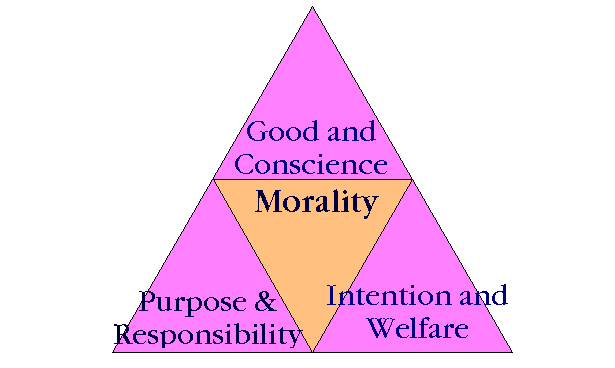
http://www.marxists.org/reference/archive/hegel/triads/morality.gif

Studies have often shown that we overestimate the degree of our moral positions - we tend to think we are more morally aligned than our desires and actions would seem to indicate. This brief article from Big Think looks at how this misalignment gets us into trouble.

In this interview, Nitin Nohria, Dean of Harvard Business School, argues that "since we are so often convinced that we will "never be led astray," when we actually face a complex moral choice we lack the critical skills necessary to do the right thing." Furthermore, he feels that we err when we assume that someone who has made a mistake is a "bad seed," or is flawed in character - we all make mistakes.

We need to bring more compassion to these situations.

We're Not As Moral As We Think (And How That Gets Us in Trouble)

Daniel Honan on May 20, 2011

Fallenangel

What's the Big Idea?

Nearly any man can stand adversity, said Lincoln, but "if you want to test a man's character, give him power." America's 16th president certainly knew a lot about that. Consider Lincoln's frustrations with the egomaniacal commander George B. McClellan, who was just one in a long succession of incompetent generals Lincoln ended up firing.

Numerous bankers, politicians, athletes and celebrities have proven Lincoln true, time and again. And yet, that does not necessarily make all of these people bad, per se, argues Nitin Nohria in his interview with Big Think.

Nohria, the dean of Harvard Business School, is not looking to create excuses for mistakes or immoral actions. Instead, Nohria is trying to get us to think beyond the "knee-jerk reaction" of simply labeling a person good or evil, as if a character flaw is the only thing that motivates us to do bad things, or that the only kind of person capable of moral failure is simply a "bad seed."

Nohria argues that overconfidence in our own moral capacity is what really gets us into trouble. In other words, since we are so often convinced that we will "never be led astray," when we actually face a complex moral choice we lack the critical skills necessary to do the right thing.

What's the significance?

As dean of Harvard Business School, the idea of teaching these skills is of great importance for Nohria. In fact, Nohria has promoted an MBA oath that pledges socially responsible leadership. Like the Hippocratic Oath in medicine, the MBA oath is a "professional credo for MBA graduates." The oath has been embraced globally and has been signed by over 5,000 students.

If we are to expect the next generation of business leaders--not to mention the future leaders in all fields--to truly honor such a commitment, students must be given the tools to properly evaluate the situations that challenge their moral judgment. Then, in Lincoln's words, the better angels of our nature might prevail.


Wednesday, April 6, 2011

Emily Ann Baratta - Integral Sexual Ethics

http://www.nypost.com/rw/nypost/2010/05/18/entertainment/photos_stories/cropped/hot_teacher--300x300.jpg

This article made the rounds among integral theorists a while back, in part as an antidote to the 3-part series of article at Integral Life by Jun Po Kelly, a Buddhist teacher who (after the sexual impropriety admissions by Genpo Merzel on Big Mind fame) wrote in defense of promiscuity among integral folks - because, you know, being integral and all they can handle it in an ethical way (cough, cough, BULLSHIT, cough).

Merzel is not the first integral teacher to sleep with students, just the latest - Marc Gafni has done it many times (and may still be doing it from what I have heard) and Don Beck has also gone this route. Seems to be an issue among the male leadership (who knows how many others, although I have heard rumors there are more).

Emily Ann Baratta is a recent graduate of JFK University with an MA in Integral Psychology. She is also a Roman Catholic, a perspective that no doubt influences the position she takes in her masters thesis.

Integral Sexual Ethics is posted at Scribd as a free download. Read it.

Wednesday, March 2, 2011

The Secret Lives of men - The Psychology of Superheroes: An Unauthorized Exploration

This is a cool topic - and it sounds like an interesting book. The Psychology of Superheroes: An Unauthorized Exploration (Psychology of Popular Culture series), Robin Rosenberg PhD (Editor) - 18 essays on the psychology of idealized men and masculinity (mostly - there is Wonder Woman and female mutants in X-Men), or conversely, the dark masculinity of villains.


The Secret Lives of Men
Unmasking superhuman abilities and double lives, this analysis showcases nearly two dozen psychologists as their essays explore the minds of pop culture’s most intriguing and daring superheroes, including Spider-Man, Batman, Superman, and the X-Men. Exposing the inner thoughts that these reclusive heroes would only dare share with trained professionals, heady experts give detailed psychoanalyses of what makes specific superheroes tick while answering such questions as Why do superheroes choose to be superheroes? Why is there so much prejudice against the X-Men mutants? What makes Spider-Man so altruistic? and Why are supervillains so aggressive? Additionally, the essays tackle why superheroes have such an enduring effect on American culture.
Listen or download:

Listen to internet radio with Secret Lives of Men on Blog Talk Radio

This is a very useful review of the book by Malvin, a reviewer on the Amazon page - he offers some insight into what we get with this book.
"The Psychology of Superheroes" by Robin S. Rosenberg (editor) is an outstanding collection of eighteen essays about the insights we can gain in human psychology by studying the behavior of comic book superheroes. Almost all of the authors are college professors or doctoral candidates in psychology who expertly blend their professional knowledge with their love of comics. The result is a clever, witty and intriguing book that should appeal to anyone interested in psychology or pop culture.

Several authors dedicate their essays to studying how individual superheroes fit or deviate from standard psychological models and practices. For example, Christopher Patrick and Sarah Patrick contend that the Incredible Hulk suffers from a textbook example of reactive aggression triggered by the extreme physical and emotional maltreatment he suffered as a youth. Robert Biswas-Diener finds that the Spider-Man alter ego allows Peter Parker to gain encouragement through performance and an increase in personal happiness in general accordance with positive psychology theory. On the other hand, Bradley Daniels informs us that the insanity plea seems to be used far more frequently in the comics than in real life; and thankfully, no real world mental institution exists that is as easily escapable as Gotham's notorious Arkham Asylum.

The moral behavior of superheroes is discussed in several pieces. Peter DeScioli and Robert Kurzban compare and contrast the absolutist ethics of Superman with the more complex utilitarian ethics of Batman, who nonetheless retains a consistent sense of purpose to ensure socially just outcomes. Andrew Getzfeld suggests that The Punisher's moral outrage over the murder of his family compels him to engage in an extreme form of vigilantism that, unfortunately, would probably remain intractable even if he was afforded the benefit of intensive clinical treatment.

Other articles shed light on the psychology of groups, institutions and society. Mikhail Lyubansky shows how the X-Men embody the ideology of tolerance and diversity within the walls of the Xavier Institute but are unfairly scapegoated for their enviable talents by human society. Chuck Tate studies the history of Wonder Woman to discuss how changing societal attitudes towards women has made the struggle to depict a strong, independent woman to remain a highly problematic task.

These are just a few of the many remarkable essays contained in this fun, intelligent book. It is highly recommended to everyone.

Thursday, August 12, 2010

Guest Post: Cherie Beck - A Call to Integral Males

This guest post from Cherie Beck was actually a comment left on a post over at Integral Options Cafe that dealt with Marc Gafni, his childhood, and the behaviors that have left so many of us in the integral community feeling that he has not healed his own wounding sufficiently to be teaching in public.

Cherie is a long-time member of the integral community - and a Spiral Dynamics Trainer/Coach. I first met her back in 2005 when I took an SDi training with Don Beck - she was his assistant teacher. At that time, I was unaware that Beck also had sexual boundary issues with students (and he too is a married man).

I felt that her three-part comment, while deeply personal, was also a call to the integral community, especially the men, to become the leaders who we would want to follow.

Tough role, that one. To be a teacher and a leader requires us to know our own shit inside and out, and to know those areas that can trigger us into behaviors and expressions that are not healthy for ourselves or the community. There is a consensus among many of us that our current (primarily male) leaders are not setting a good example in that regard.

Besides her blog, you can connect with Cherie at these social networks:
And now, her post.
Cherie Beck - A Call to Integral Males

I came back from the ITC yearning for the juice. In a jam packed weekend of presentations, where is it? Where were you? One of the only people I had wanted to connect with and didn’t. Here you are - And you’ve got the juice!

I hear the cry, once again, for some kind of accounting through at least a conversation, by exposing of more points of view of this subject, to at least reflect on the process of how this community is monitoring it’s ethical standards.

I answer this time - for the same reason I came forth when the light shined upon Don Beck - the lack of a suitable container to workout these critically important issues. My yearning for the creation of an appropriate environment to meet the complexity of human sexuality, change, and leadership grows within me. I can see that I have some role to play here, so I am called forth once again.

In this situation, the conditions are different, as is my relationship with the person at the center of the conflict, although both hold positions of perceived leadership in this infant web of connections that I hear referred to as the Integral community.

In the prior instance, I choose to create a boundary so that a toxic situation could be isolated and dealt with, at least in the short term, in a manner and by people more suited to the leader involved.

In this instance, I find that your positioning of the circumstances involving Marc Gafni to be a seed through which a more public participation might help support the growth, development, and emergence of the NEXT spiritual leaders, leaders more competent to handle the demands of this community as it struggles to form into something viable and valuable to the world, as it arises from that same world. My intent is to strengthen your container in which the seeds you are planting might thrive.

As humanity pushes out beyond the structures of a postmodern worldview into overwhelming challenges posed by global problems, the solutions, at this stage, are falling squarely on the the personal development challenges of the individuals on a trajectory toward such heights. And sexuality and leadership will be the hotbed of obstacles, insights, breakdowns, and breakthroughs as the movement of transcending and including unfolds beneath our feet.

First, I want to make clear that I stand for sexuality, and sexual practice, as a compulsory catalyst for human transformation and social evolutionary change.

Compulsory.

From this stand, I continue to look for 2nd tier approaches, lenses, and thinking to support the change that is wanting to happen. There is a huge load to unpack here. More than can be accomplished in this one, lengthy comment.

Second, fresh from the ITC (as a presenter) where I began to weave in the dynamics of generations as social holons - and cycles of times as important change patterns that are vitally relevant - and up to this point, a missing component in comprehensive integral framing, I understand that the leaders, spiritual or otherwise, that have taken us to the point we are at, are not the ones to lead us forward. Those leaders still have a role play, even if it is continuing to create the conditions within which the next leaders will emerge. Therein, I see a very appealing opening in this situation.

So as I relate to Marc Gafni, my first real exposure to him came from his participation as an panelist in the ITC session entitled "Integral as a Mass Movement or Elitist Pursuit." In the audience, I sat in front of a pregnant woman to whom Marc pointed during his introduction as (paraphrased), Mariana, the person to whom he is partnered and whom is with child.

Really? The impact of the introduction resonated in my being as, "Oh, so that is his solution. Interesting."

I walked away very uninspired from that panel session. Marc was only one of five men who voiced a perspective on the topic - and I sat listening, attentive, as a perspective arose in me to a degree I couldn’t sit still. Yet, I found myself in a conversation where there was no space in which to move.

My perspective is that in order for integral to be a movement instead of an elitist pursuit (which is what the the session projected, not from it’s words, but from it’s actions) the understanding of “movement” needs to be reframed. But that’s another story.

I offer in the forum you have created about Marc Gafni’s participation in this talked about “movement,” where my perspective does have space in which to move, a reframe:

I think the ethical question has been answered. Whatever indiscretions Marc Gafni indulged, he was evaluated as psychologically sound and competent by his peers. Personally, from where the ITC is operating today, that assessment makes sense to me. I think you’ll have a hard time changing it.

The question relevant now is: What is his impact, intended and unintended? Inside of this question I see a tight framing around the issue of integrity rather than ethics, a way of seeing which presents a path forward.

I find myself, very turned on looking into the frame of integrity. For I sense at this time, what is important for you as men, and what I yearn for as a woman in your sphere of influence, is for you to support and hold each other to a level of integrity we’ve not yet seen because the cognitive capacity of the men in this community is far beyond their practical skill set as messengers.

As a woman I can tell you my impression is that Marc is not in integrity and that the impact of such a gap is worth paying attention to. Yet pay attention to it not as a character flaw - but as a developmental challenge for him personally, and for the leadership roles within and without the community. Spiritual teachings are not easy to live into. And Integral Spiritual teachings, while they help us find our way in the territory, have also significantly upped the game.

So this is a challenge by choice, not by peer pressure, nor by collective ethical/moral obligation.

Whomever steps forward to lead the Integral Community into and out the other side of integrity - I guarantee that we will be in the company of the NEXT spiritual leaders of our time. That lights me up and has me care about what is happening here and even ignites my own sexual desire in a way I’ve not experienced before.

Well, guess what. When you bring the juice, Bill, you bring it! I didn’t have to look far to see who the first candidate would be.

I got to Alex Rollin’s comments where he says he is looking for who’s voice isn’t being heard and asks what else can be done, in a stream of information that included a public disclosure of his promiscuity. Yikes, I was left with yet another knife plunged deep into the center of my heart. But this time, though, I am well practiced, for it’s not the first knife, nor even the worst heartbreak to come from the hands of this man. For I am the one he married, and I am the one he divorced, and I am the one on the receiving end of his “just what I am doing now” behavior justifications. I am the one who continues to dwell in the crucible that is our relationship. I stayed still and centered throughout the night opening to the burning pain in my heart and letting this publicized truth integrate through my being.

Shit this stuff hurts even though it is not as debilitating as it once was.

It lasted into the next day tearing away old thought patterns and sinking deep into my core where I was able to slowly release an energy bubble, which in earlier days would have a been a primal scream likely to have brought the house down.

In the midst of this clearing I awoke to a startling clarity. In this polarized spiraling spin of yin/yang connection Alex and I have been caught in for the last 5 years, it was the dearth of love in our relationship that triggered, not caused, but triggered his “promiscuity.”

Holy shit . . . literally. He has not acted alone in what I often found to be absolutely egregious actions.

All this energy in the system that is WE, has to go somewhere, and when it can’t go up, it goes down. Sometimes it has to go down before it can go up. As a Spiral Dynamics integralist, I understand that.

Yet in that same moment, I realized that while I may not have been able to love enough before, that is no longer true. In the depths of my own heart I have a felt sense and need in my own experience of how important love is for the integral and evolutionary development of the human being, and any container for such development must be filled with it. This is a love that demands we open to all of the things we abhor, fear, and reject - to open to a “being withness” that Gail Taylor named in this community and was promptly told didn’t fit. And yes, evolution is wanting us to face the past and clear away all the old programming no matter where it came from - childhood trauma and human karma be damned. Toward this end my friends, we will need a depth of being that has yet to emerge here.

So Alex, it’s is my voice that continues to want to be heard, if by no one else but you.

In answering your second question, Alex, of what else can be done, I turn to Bill and request him to direct his energy not toward Marc Gafni, but to you as one who carries the potential to be a next spiritual leader in this community and for him to hold you accountable to your own heart, and to the truth and teachings you so readily access for others. Here in the forum of your choosing, of your stated life purpose of an open and free internet and of peer to peer engagement, through the declaration I see coming through in your comments- you have chosen to show up.

I make this request from a place of more than enough love, as the woman who carries the 3rd entity of the “WE” in my heart, mind, and soul as though it was a baby developing inside me, that I am not satisfied with nor will I settle for anything less than who you were born to be.

If you accept this challenge, I will stand by you as the woman who now loves, the woman who knows who she is, who recognizes who you are, who has learned who you are not, and who is partnered with you in who you are becoming; and as the woman who moves through her world in the experience of deep connection to how out of integrity you are living today.

Why? Because I care and it matters.
Cherie named Alex Rollin, her ex-husband, as a potential spiritual leader in the integral community, as well as expressing her impression that he is not living in integrity with himself. So I think it's fair to also include his response to her comments - this is all available on the blog post linked to above.
Cherie, thanks for writing in and showing yourself in such a beautiful and spectacular way in public. Really amazing!

I'm doing a little bit. I found another "leader" who was saying to everyone that he was inviting people to "put all their chickens in the shared community" basket but it turns out he doesn't want to share the eggs back or acknowledge anyone who put in a chicken.

There's about 16 nasty threads, and lots of obfuscation and nastiness. In the end I was inspired by the dialogue here so I hopped in with a full personal critique of use of power. Now the leader wants to "divorce" me. His words.

When I put up the comment, the first one above, and asked about "what else could be listened to," I did not mean that any of us privileged folk should make more noise about how cool we are or why we are all alright and back ourselves up in that the truly good are that, whether we label them that or not.

I was talking about little girls in Israel who got(?) tricked, for example, and perhaps want to share their side of the story. How about we start our own witch hunt office?

Some standing operation that is a way anyone can make accusations of anyone else, or question them. It would be like a standardized format for doing so, and an explanation of the format.

And it better not be called "integral witch hunt" either because that's bull. How about "permaculture witch hunt: for culture that lasts longer than man." Anthropocentrism is so 20th century, anyways.

Wait . . . crap, this might make witches feel bad. Hmm...How about "permaculture energy hunt: culture that lasts longer than man." The process itself would give folks who feel like they are abused a forum and format and method for speaking truth to power.

As a drunken quasi-self-authoring fool, I don't have a lot of problem with this, and I regularly lose my shirt speaking truth to power, but others are not so drunken or lucky to afford this extravagance. Those are the people we ought to be listening to.

I could give a crap about whether any current "integral" toady thinks Marc is this OR that because it is not part of a process that includes the non-hyper-enabled people's of the world.

Terrified? Good. And that, too, shall pass.
Hmmmm . . . I don't know Alex very well, although I DO know he has a wicked sense of humor. This comment seems half serious, half full of shit. Maybe I am misreading him.

Anyway, I know I am not the next spiritual leader in the integral community, but I do have some things to say, and I plan to begin saying them more publicly in the future. I also am not a teacher, so I don't know what to call my rantings . . .

I simply want to understand what it means to live with fierce compassion, to embody wise love, and find a way to share that with those who want to listen. And if I can't do it, I hope someone else can - that is the male energy we need in the leaders who will come next.


Friday, July 9, 2010

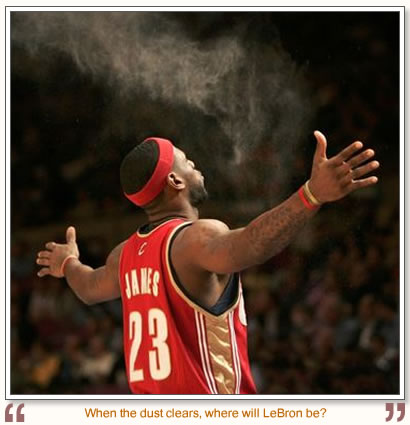
Comparing the LeBron James Spectacle With How a Real Man (Kevin Durant) Handles His Business

2010-07-09-lebron_james16.jpg

Is this what happens when you have been worshipped since adolescence for your physical skills? Does this spectacle resemble any of the young pop music/starlets who seek publicity at any cost?

Should I ask for a one hour show on a cable network the next time I decide which job to take?

I see very few people, if any, questioning LeBron's decision to "take [his] talents to South Beach, and, uh, join the Miami Heat," but almost everyone is questioning how and why he decided that he needed to do it in prime time, in a one hour show devoted to his 2 second statement.

When I heard about the one hour special, I thought, what the fuck? Seriously? Even satirist Andy Borowitz made fun his ode to narcissism:
Millions of Americans huddled around their televisions Thursday night, transfixed by the spectacle of an incredibly wealthy man getting a new job.

In living rooms, bars, and restaurants across the country, a record audience gathered to watch the rich guy announce who would be signing his massive new paychecks.

In New York's Times Square, Tracy Klugian, 27, was one of thousands who braved the blistering temperature to watch the multimillionaire reveal the location of his new employer.

"I wouldn't have missed this for anything," said Mr. Klugian. "For anyone who considers himself a fan of the rich getting richer, this was must-see TV."

Jack McCallum at Sports Illustrated, prior to "The Decision," had some thoughts:
I have not been immune from the protracted free-agent pornfest. I've made a few phone calls and dropped a few hints to sources that I would love to be the one to announce LeBron's destination, get my name on that endlessly spooling crawl across the bottom of the TV. But all the while I've been a little heartsick, half-angry and half-sad at the devolution of this process, what it says about the NBA, the cult of celebrity that has overtaken our country and the whole out-of-whack state of sports journalism.
And this . . .
But the big story, of course, was LeBron, who, drunk on the magnificence of his own LeBron-ness, is utterly clueless of how ridiculous this whole process has been, the monumental amount of self-importance attached to scheduling a one-hour show when you have zero championship rings and, at last glance, were seen folding like a beach chair against the Celtics in the Eastern Conference semifinals. Magic coach Stan Van Gundy termed the whole LeBron tease "almost like a parody of itself," which would be accurate if he removed the word "almost." I'm sure Team LeBron is claiming that "The Decision" is mostly about raising money for charity, but here's a simpler way he could do that -- take a million or two of the 100 he's going to get and write a check to the Boys and Girls Clubs of America. And if he's already done it, do it again.
Saying this whole spectacle was a parody of itself is an understatement. The decision had been made probably weeks ago, if not longer (like when they played on The Dream Team together). Yet he visited several teams, each of which thought they had a shot at King James. Silly them. LeBron was playing all of us - and he succeeded.

ESPN had the best ratings they have had for anything that is not the NFL (7.3 share overall, and 9.6 from 9:15 to 9:30, the period when James actually said he was Miami-bound).

As far as money is concerned, everyone comes out of this pretty well - ok, except Cleveland, who will go back to being a third-rate basketball city - and all the businesses that thrived due to LeBron's presence will also suffer. OK, that's business.

But I continue to be amazed that James thought he needed a prime time show to announce his decision - this is the kind of thing a president does when the nation goes to war, not the kind of thing an athlete does when he changes teams.

By comparison, on the same day James had his ESPN spectacle, another major NBA star sent out Twitter note to his followers announcing he had signed a contract extension for five years and $86 million - and he wasn't even a free agent, yet he signed for an additional five years with no early termination option, a common clause for long contracts.

He's 21-year-old Kevin Durant of the Oklahoma City Thunder (who used to be my Seattle Sonics).


Durant at his summer camp for kids.

This comes from Jonathan Abrams in the New York Times:

At the age of 21, Durant became the youngest player to win a scoring title, averaging 30.1 points last season to edge out James. He finished second to James in the most valuable player balloting after helping the Thunder to a major one-year improvement. Oklahoma City arguably provided the eventual champion Los Angeles Lakers with their greatest playoff challenge in the Western Conference, with a tough six-game series.

“It means that they’re really committed to what I believe in — and that’s the team first,” Durant said. “And I’m excited about it and honored that they gave an extension.”

The commitment extends both ways. Offering Durant a maximum extension was a no-brainer, but Durant was not a free agent this summer. With an uncertain economy and a small market, Oklahoma City could have tried to save money by waiting for a new collective bargaining agreement after next season.

LeBron James made it to the N.B.A. Finals by his fourth season - but he has not found his way back to the promised land. Kevin Durant begins his fourth season this year - and he no doubts wants a shot at the title, as well. His young team pushed the Champion Lakers to 6 tough games this past season, and it may be only the Lakers who stand between him and his shot at the Trophy.

My guess is that Durant gets his ring before James does in terms on years in the league - and he'll do it through loyalty, quality play as a part of a team (rather than as The Chosen One, of The King), and he will do it quietly, without an hour-long prime-time show devoted to his Decision.

While LeBron has been acting like an entitle little child in a man's body (which may be how he earned the Man-Child moniker in his high school days).

Meanwhile, Durant is building a Hall of Fame career, happy to be in a small market seeking to build a team with him and several other young guys as the foundation.

This is how a real man does it.

http://i2.cdn.turner.com/si/2009/writers/chris_mannix/07/27/us.team/kevin-durant.jpg
Durant Playing for Team USA

Benjamin C. Klein at the Bleacher Report thinks that Durant is the new King, the one player who be the next Michael Jordon, or at least let us forget him for a few minutes now and then.
I believe that he can make us forget Mike, and be a true King. Unlike a young LeBron, Durant has several things going for him that LeBron didn’t with the Cavs. Durant already has his Pippen, a young point guard named Russell Westbrook. Heck, Durant already has his Horace Grant in Jeff Green. LeBron had Darius Miles early on. Durant also has a good coach, a fantastic general manager, and an owner that only meddles in marketing. LeBron had none of that early on in Cleveland.

However, it’s not just the external factors that make me believe Durant will succeed where LeBron has failed. Durant, unlike LeBron, seems less interested in marketing appeal and more interested in the game. Durant was on the bench during summer league play this last week cheering so loud you would swear he was a cheerleader. Durant breathes basketball; LeBron only seems to breath the things that basketball gives him.

So mark it down ladies and gentleman, July 8th 2010 will go down as the day The King of the NBA abdicated his throne, too weary from the pressure. And if we are lucky, July 9th 2010 will go down as the day the new King, King Kevin Durant, took the crown and never looked back.

Just how clear is it that LeBron has (1) abdicated his position as King James, and (2) didn't really anticipate what his decision would bring?

Point #1: Andy Ostroy, Huffington Post:

The second-coming of Michael Jordan has curiously chosen instead to be the second fiddle of Dwayne Wade, the Heat's one-man offensive machine who'll now also be joined by former Toronto all-star forward Chris Bosh (Gotta hand it to Miami president Pat Riley for bagging the top three free agents of all time). But as anyone with an ounce of basketball knowledge will tell you, Wade is not going to change his style of play for Lebron. It's his team, his town ("Wade County") and his game. Which begs the question, why on Earth would James take a back seat to Wade? The truth is, James, who was feeling the pressure to live up to the "the greatest of all time" label, does not see himself the way fans or the media does. He does not believe he's the caliber of player of Jordan and Kobe Bryant, who've won six and five NBA championships respectively. His decision to cede top-dog status to Wade is a de facto admission that he cannot carry a team and win it all on his back; that he's not "the man" like Jordan and Kobe, and now clearly, Wade.

I tend to agree - this agreement suggests that none of the three are The Man - they each have realized they cannot carry a team to a title on their own, something Phil Jackson has gotten Jordon and Bryant to buy into on his way to 11 NBA titles.

Miami is not even the best basketball choice according to many sports bobbleheads, including me - Chicago has a more balanced team that is ready to give him the title he wants so badly - and he would still be King James, rather than the Prince of Wade County.

By the way, I don't think Durant is The Man either - the difference is that Durant knows he needs a quality team around him to win a title - for a long time, James seemed convinced he could do it alone.

Point #2: Mark Kriegel at Fox Sports:
“The Decision’s” first authentic moment ... came as Michael Wilbon asked James for reaction to the sight of his erstwhile fans in Cleveland now burning his jersey.

He wore an unmistakable expression of shock. You could see it finally dawn on him, this new reality. A media event born of the power struggle between CAA and Endeavor/William Morris had quickly devolved into one of those old-school wrestling interviews. Apparently, the possibility of jersey-burning hadn’t been addressed in any of the memos. In their zeal to hatch the perfect plan, the King’s minions had underestimated the backlash. Without even having to dye his hair, LeBron James had suddenly become the biggest heel in American sports.

“I can’t get involved in that,” he said. “This is a business.”

You could almost see James’ thoughts, as if they’d been superimposed in neatly lettered in cartoon bubbles over his head: BUT I DID EVERYTHING RIGHT! THEY’RE CHANGING THE RULES ON ME!

I wonder what he thought might happen in Cleveland? Did he think they would support his decision and thank him for the memories?

The way he staged this whole spectacle was arrogant, egocentric, and insensitive to the people who have loved and supported him in Cleveland and the rest of Ohio. An hour-long "fuck-off" to his fans? Of course they are burning his jersey - his home might be next.

In the end, the younger Kevin Durant comes off looking the like the more mature man, or at least the one who knows how to handle his business in the right way.