Showing posts with label leadership. Show all posts

Monday, December 2, 2013

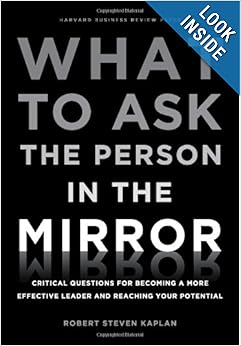
Leading@Google: Robert Steven Kaplan - What to Ask the Person in the Mirror


Robert S. Kaplan is the Marvin Bower Professor of Leadership Development at Harvard University. He is the author of What to Ask the Person in the Mirror: Critical Questions for Becoming a More Effective Leader and Reaching Your Potential (2011), which is the topic of his talk at Google that same year.

About the book:
Successful leaders know that leadership is less often about having all the answers—and more often about asking the right questions. The challenge lies in being able to step back, reflect, and ask the key questions that are critical to your performance and your organization’s effectiveness.

In What to Ask the Person in the Mirror, HBS professor and business leader Robert Kaplan presents a process for asking the big questions that will enable you to diagnose problems, change course if necessary, and advance your career. He lays out areas of inquiry, including questions such as:
•Do I clearly articulate my vision and top priorities to my employees and key constituencies?
•Does the way I spend my time enable me to achieve my top priorities?
•Do I give subordinates timely and direct feedback they can act on? Do I actively seek feedback myself?
•Have I developed a succession roadmap?
•Is my organization’s design aligned with the achievement of its objectives?
•Is my leadership style still effective, and does it reflect who I truly am?
Packed with real-life situations, this highly readable and practical guide helps you learn to ask the right questions—and work through the answers in ways that are right for you. By asking these questions, you can tackle the inevitable challenges of leadership as you craft new strategies for staying on top of your game.
 All of us who act as leaders in any capacity can learn from this approach to leadership.

Leading@Google: Robert Steven Kaplan


Uploaded on Oct 20, 2011

Robert Steven Kaplan | What to Ask the Person in the Mirror: Critical Questions for Becoming a More Effective Leader and Reaching Your Potential


In What to Ask the Person in the Mirror, Kaplan offers a concise and engaging guide to help executives improve their effectiveness as leaders. At the core of the book is a series of critical questions to help you lead your organization more successfully and take ownership of your career. Based on his extensive experience as a senior business executive, professor at Harvard Business School, and an advisor to leaders worldwide, Kaplan provides a simple, powerful framework that includes seven key areas for inquiry that will resonate with business leaders in both the commercial and the nonprofit sectors.

Friday, December 14, 2012

"Our Hearts Are Broken Today" - President Obama on Connecticut School Shooting


By now, most everyone knows that a young man went into an elementary school in Newton, CT, and opened fire with a pair of semi-automatic pistols, after first shooting his mother at their home. At the school, 26 people were killed it total - 20 of them were children, as well as the principal and a school psychologist.

Preliminary reports suggest the young man had a personality disorder - he also died in the massacre.

Christian Science Monitor offered the video of President Obama's statement - in which he cried. This is without question the most real and human presidential statement I have EVER seen in my 45 years. Fuck the political issues, this is a man who cares deeply and passionately about the nation he serves.

In a very real way, Obama's tears offered some Americans (if not many) a validation and a mirror of their own horrific feelings, as well as their fears. Some days, as he mentions, he is a father first, and a human being, and then he is President of the United States. This is what leadership looks like on the worst possible day in the lives of those who survive their murdered family members.


Video - Obama on Conn. shooting: 'Our hearts are broken today'

Obama on Conn. shooting, speaking at the White House, called for 'meaningful action to prevent more tragedies like this, regardless of the politics.' At this point, he didn't offer specifics.


By Linda Feldmann, Staff writer / December 14, 2012


His full statement:
This afternoon, I spoke with Governor Malloy and FBI Director Mueller. I offered Governor Malloy my condolences on behalf of the nation and made it clear he will have every single resource he needs to investigate this heinous crime, care for the victims, counsel their families.

We've endured too many of these tragedies in the past few years and each time I hear the news, I react not as a president but as anybody else would as a parent. And that was especially true today. I know there's not a parent in America who doesn't feel the same overwhelming grief that I do.

The majority of those who died today were children. Beautiful little kids between the ages of five and 10 years old. They had their entire lives ahead of them: birthdays, graduations, weddings [wipes away tears], kids of their own.

Among the fallen were also teachers, men and women who devoted their lives to helping our children fulfill their dreams. So our hearts are broken today. For the parents, grandparents, sisters and brothers of these little children. And for the families of the adults who were lost.

Our hearts are broken for the parents of the survivors as well. For as blessed as they are to have their children home tonight, they know that their children's innocence has been torn away from them too early, and there are no words that will ease their pain.

As a country, we have been through this too many times. Whether it's an elementary school in Newtown or a shopping mall in Oregon or a temple in Wisconsin or a movie theater in Aurora, or a street corner in Chicago, these neighborhoods are our neighborhoods, and these children are our children. And we're going to have to come together and take meaningful action to prevent more tragedies like this, regardless of the politics.

This evening, Michelle and I will do what I know every parent in America will do, which is hug our children a little tighter, and we'll tell them that we love them, and we'll remind each other how deeply we love one another. But there are families in Connecticut who cannot do that tonight, and they need all of us, right now. In the hard days to come, that community needs us to be at our best as Americans, and I will do everything in my power as President to help.

Because while nothing can fill the space of a lost child or loved one, all of us can extend a hand to those in need, to remind them that we are there for them, that we are praying for them, that the love they felt for those they lost endures not just in their memories, but also in ours.

May God bless the memory of the victims. And in the words of scripture, "Heal the broken hearted and bind up their wounds."

Thursday, May 3, 2012

Man Finally Put In Charge Of Struggling Feminist Movement

This is a classic 2007 column from The Onion: America's Finest News Source. The genius is in how they simultaneously satirize the feminist movement and the patriarchal system that makes feminism necessary. Good humor and satire plays no favorites.

Man Finally Put In Charge Of Struggling Feminist Movement

December 3, 2007 | ISSUE 48•15 ISSUE 43•49
 
 
Head feminist "Buck" McGowan leads a march on Washington for women's rights.

WASHINGTON—After decades spent battling gender discrimination and inequality in the workplace, the feminist movement underwent a high-level shake-up last month, when 53-year-old management consultant Peter "Buck" McGowan took over as new chief of the worldwide initiative for women's rights.

McGowan, who now oversees the group's day-to-day operations, said he "couldn't be happier" to bring his ambition, experience, and no-nonsense attitude to his new role as the nation's top feminist.

"All the feminist movement needed to do was bring on someone who had the balls to do something about this glass ceiling business," said McGowan, who quickly closed the 23.5 percent gender wage gap by "making a few calls to the big boys upstairs." "In the world of gender identity and empowered female sexuality, it's all about who you know."

McGowan, who was selected from a pool of roughly 150 million candidates, made eliminating sexual harassment his first priority before working on securing reproductive rights for women in all 50 states, and promoting healthy body images through an influx of strong, independent female characters in TV, magazines, and film.

"It's about time," McGowan said upon returning from a golf game with several "network honchos" in which he brokered a deal to bring a variety of women's sports to prime-time television. "These ladies should have brought me on years ago."

McGowan claimed that one of the main reasons the movement enjoyed so little success in the past was that the previous management was often too timid and passive and should have been much more results-focused.

"You can't waste time pussyfooting around with protests and getting all emotional about a bunch of irrelevant details," McGowan said. "If you want to enjoy equal rights, you have to have a real man-to-man chat with the people in charge until you can hammer out some more equitable custody laws."

"And don't get me started on how disorganized and scatterbrained their old fundraising methods were," McGowan added. "Let's just say the movement never really had a head for numbers."

After McGowan successfully appointed three of his best men to lead Smith College's women's studies department and called in some favors to a number of powerful board chairmen to triple the number of female CEOs in Fortune 500 companies, analysts predicted that the feminist movement could achieve all of McGowan's goals by as early as 2009.

"With a charismatic, self-assured guy like Pete pulling the strings, we might even see a female elected president one of these days," said Nathan Roth, an analyst at the Cato Institute. "Finally, the feminist movement has a face that commands respect."

McGowan, however, said he didn't get into the business of women's rights for the praise.

"What these women were able to accomplish with the little manpower they had is very impressive," McGowan said. "I just bring a certain something to the table—I'm not sure what—that gave us that extra little push into complete female independence. I guess it just comes naturally."

But despite his modesty, McGowan continues to garner praise from those closest to the cause.

"The whole movement just seems more legitimate with Buck in charge," leading feminist Gloria Steinem said at a gala dinner Friday. "His drive, focus, and determination are truly remarkable. Mr. McGowan is a man with a plan."

Although he has not hinted at any future projects after all forms of gender discrimination are a thing of the past, McGowan has vehemently denied rumors that he will leave the feminist movement to head up the struggle for gay rights.

"The wife would kill me if I took on any more hours," McGowan said. "I'm sure those fellows know how that goes."

Saturday, March 10, 2012

Michael Cox - A “New Man” Manifesto

Michael Cox runs the Tao of Bachelorhood site, a kind of online handbook for how to be a better guy. Cox has been a bachelor all of his life, which he admits is not really a selling point, but he's happy, and along the way he has learned quite a bit "from the usual men’s books and ‘zines to Queer Eye to personal discussions with world-famous pickup artists." Okay, the pickup artists part is a bit sketchy.

Here is a bit of his "mission statement":
The Tao of Bachelorhood features down-to-earth lifestyle information for regular guys. No bikini photos, drinking games or videos of hockey fights, unless it’s to make a point. Instead we’ll explore both the big picture (keeping your integrity, behaving consistently and acting boldly) and the details of dating, grooming, fitness, relationships, clothes and nutrition.
I present this because the material I am about to share is his "New Man" Manifesto, so it seems useful to know a little about what he values in being a man.

My sense is that he is offering a down-to-earth model for being a man.

A “New Man” Manifesto

by Michael on February 17, 2012

Steve McQueen - He cleaned up well, too.

(Caution: frank talk ahead, with naughty words. Proceed only if you can handle it.)

What makes you a man?

I mean besides your penis.

I get kind of tired of seeing “expert” after “expert” (anyone can be an expert these days) try and lecture us on becoming a “modern” or “new” man. The fact is, the essence of manhood hasn’t changed, isn’t changing and will not change anytime soon, no matter how many pop psychologists want it to.

Don’t misinterpret that as suggesting that a man can’t be a teacher or a nurse, can’t raise a child, or can’t express feelings. These things are neither manly nor un-manly, and anyone who tells you a man has to somehow change to do them is full of shit.

Then there’s the other side: the (usually) guys whose only advice is to “man up.” If you were to break your leg, those same guys would tell you to “walk it off, you pansy.” It’s shotgun advice that in and of itself means nothing. Usually it’s code for doing things the laziest way possible. Well, you’re not an ape or a lion, you make choices based on some amount of self-aware, conscious thought. We’re socialized creatures who have evolved out of using genetic instinct to solve problems and decide courses of action. Thinking is not only allowed, it’s necessary.

So just what does it mean to be a man in the modern world? Get comfy…

You Are Your Habits

Life is a series of small habits that add up to who we are. What we do and how we do it. The way we eat. The way we shake hands. The way we behave when we meet a beautiful woman. How we choose to spend our free time. The way we act in public, and the way we act when no one’s watching.

All of these habits, put together, are you. They’re me. They make us leaders or lovers or loners.

Habits make the man.
Read the whole post.

Here is part two - this seems to be an ongoing series, so subscribe to his RSS feed to see future posts.

The Three Elements of Manhood (The New Man Manifesto, Part 2)

by Michael on March 7, 2012

Success!
Not a fortune; a statement of fact.

In the first part of The New Man Manifesto, we discussed the most basic building block of manliness: habits. Your habits define who you are, and if you don’t like who you are or the life you’re living, changing it is best done one habit at a time.

But what are the habits that set you apart as a great man, or at least a good man?

Most men’s magazines define manhood in materialistic terms: money, sex, power. However, chasing any of those as a “solution” is a fool’s game, and the news headlines are full of men who based their lives on the pursuit of one or more to the point where it cost them more than they gained. Money, sex and power do make for very easy articles to write, and a lot of guys are easily distracted by fancy cars or women in bikinis, so I understand why the “lad mags” promote them.

I tend to side with the philosophers, from Socrates to Richard Layard, who agree that beyond the necessities, owning things isn’t what makes people happy. Manhood, as much as we’d like it to be a goal-oriented achievement we can sketch out like a business plan, derives from within, much like happiness.

And success, as much as we’d like to define it as adulation and wealth, is probably more tied up in what we can do for others—how we use our gift. What we leave behind, not just after we’re dead, but after we’ve left the room. Success is how you feel about what you’ve just done, whether it’s an account-winning business presentation or saying “good morning” to your neighbor.

The other piece of the puzzle is the fact that we’ve got to deal with the customs and expectations of our society, as well as the realities of basic life. You’re expected to pull your weight in some way. You’re not awarded a woman as a birthright; you’re expected to attract one. Ideally you have a circle of male friends—of course, you can have female friends as well, but if you can’t make friends with other men, something’s out of whack.

The Three Elements

A “classic” successful man—one admired by other men and valued by women—can be deconstructed into three loosely defined elements:
  • Leadership
  • Relationships
  • Life Maintenance
Each of these elements overlaps the others, and if you excel in one you’re more likely to excel in the others as well. Each element encompasses a series of habits that you can adopt, change or drop. You don’t have to be an “alpha male” in any element to be happy or successful; you merely have to demonstrate that you have these elements within you.
Read the whole post.

Tuesday, September 27, 2011

Lisa Earle McLeod - Empathy and Innovation: An Unexpected Pairing That Will Solve any Problem


According to Jeremy Rifkin (The Empathic Civilization), empathy is the future of our human enterprise, or we will have no future at all. In this article, Lisa McLeod suggests that empathy and innovation can solve a lot of our problems. I think she has a point.

Men have tended to lead with power and authority (yes, huge generalization), not with empathy - but McLeod suggests that empathy allows us to understand problems better and, therefore, to find better solutions.

I would also argue that this approach allows us to function better in relationships. Despite claims to the contrary (mostly in popular culture), men are equally as good at empathy as women, we just have not be encouraged as much to develop that skill.

Empathy and Innovation: An Unexpected Pairing That Will Solve any Problem

Lisa Earle McLeod - Keynote speaker and author, 'The Triangle of Truth'

Q: What do world hunger and bad customer service have in common?
A: The secret to solving them both is empathy and innovation.
Empathy and innovation seem like an unlikely pairing, but together, they're the secret to solving just about everything.
Here's why. You have to care about a problem before you're motivated to solve it. Alexander Graham Bell invented the telephone because his wife was deaf and he wanted to help those who couldn't hear.
Empathy for his wife ignited the innovation.
The challenge is, everyone wants to be innovative; it's powerful. But empathy sounds like some wimpy thing your mother would lecture you about.
Innovation is sexy. Empathy isn't.
Can you imagine a company ad campaign with the slogan "We're the industry leader in empathy?"
Unless they ran a chain of funeral homes, very few would embrace the mantra. But that's a real shame because empathy is a huge competitive advantage.
Read the whole article.

Visit her Blog -- How Smart People Can Get Better At Everything
Web site -- www.TriangleofTruth.com 

Friday, May 20, 2011

Big Think - We're Not As Moral As We Think (And How That Gets Us in Trouble)

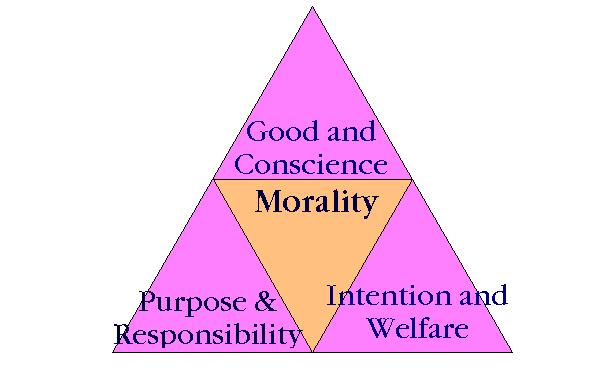
http://www.marxists.org/reference/archive/hegel/triads/morality.gif

Studies have often shown that we overestimate the degree of our moral positions - we tend to think we are more morally aligned than our desires and actions would seem to indicate. This brief article from Big Think looks at how this misalignment gets us into trouble.

In this interview, Nitin Nohria, Dean of Harvard Business School, argues that "since we are so often convinced that we will "never be led astray," when we actually face a complex moral choice we lack the critical skills necessary to do the right thing." Furthermore, he feels that we err when we assume that someone who has made a mistake is a "bad seed," or is flawed in character - we all make mistakes.

We need to bring more compassion to these situations.

We're Not As Moral As We Think (And How That Gets Us in Trouble)

Daniel Honan on May 20, 2011

Fallenangel

What's the Big Idea?

Nearly any man can stand adversity, said Lincoln, but "if you want to test a man's character, give him power." America's 16th president certainly knew a lot about that. Consider Lincoln's frustrations with the egomaniacal commander George B. McClellan, who was just one in a long succession of incompetent generals Lincoln ended up firing.

Numerous bankers, politicians, athletes and celebrities have proven Lincoln true, time and again. And yet, that does not necessarily make all of these people bad, per se, argues Nitin Nohria in his interview with Big Think.

Nohria, the dean of Harvard Business School, is not looking to create excuses for mistakes or immoral actions. Instead, Nohria is trying to get us to think beyond the "knee-jerk reaction" of simply labeling a person good or evil, as if a character flaw is the only thing that motivates us to do bad things, or that the only kind of person capable of moral failure is simply a "bad seed."

Nohria argues that overconfidence in our own moral capacity is what really gets us into trouble. In other words, since we are so often convinced that we will "never be led astray," when we actually face a complex moral choice we lack the critical skills necessary to do the right thing.

What's the significance?

As dean of Harvard Business School, the idea of teaching these skills is of great importance for Nohria. In fact, Nohria has promoted an MBA oath that pledges socially responsible leadership. Like the Hippocratic Oath in medicine, the MBA oath is a "professional credo for MBA graduates." The oath has been embraced globally and has been signed by over 5,000 students.

If we are to expect the next generation of business leaders--not to mention the future leaders in all fields--to truly honor such a commitment, students must be given the tools to properly evaluate the situations that challenge their moral judgment. Then, in Lincoln's words, the better angels of our nature might prevail.


Friday, December 17, 2010

The Good Men Project - The Top 10 Good Men of 2010

Nice list - I'm especially glad to see Dan Savage on the list. His work this year with the It Gets Better Project was nothing less than inspirational for a lot of people, especially the young people whose lives may be saved.

I didn't know their number one choice, but he is awesome - very happy to see someone devoted to educated get some recognition.

#1: Geoffrey Canada

“Our entire public education system needs radical and immediate improvement. We must tackle the challenge of improving traditional public schools, where the overwhelming majority of children are.”

Great list. These are all good men. And I am also glad to see Gates and Buffett on the list.

The Top 10 Good Men of 2010

In 2010, we saw challenges that required a fool’s readiness to undertake Sisyphean tasks. We faced the biggest oil spill in our country’s history, the grim prospect that our jobs weren’t coming back (at least not for a while), and a cantankerous political climate that stifled progress.

Which is why for this, our inaugural Good Men of the Year list, we’re not celebrating memorable personalities, newly minted pop-culture icons, or 15-minute men. This was a year of unprecedented challenges, and it cried out for good men.

Men who inspired us to do better.

Men who wouldn’t settle for incremental improvements—and who were willing to make sacrifices for bona fide progress.

Men who embraced failure as a necessary ingredient in their success.

Men who would rather be called an asshole than ineffectual.

This year, it wasn’t just our ideas that mattered, but how we shared them. Our networks—from an online community of innovators, to educators on neglected blocks in Harlem, to a civilization 2,000 feet underground—became catalysts for change.

We learned that the smallest germ of an idea could grow contagious and develop into a viral phenomenon. So we rolled up our sleeves, opened our computers, and started to think.

What follows are just 10 of the many men who made their world a better place in 2010. So tell us: who would be on your top 10 list?

♦◊♦

The Top 10 Good Men of 2010

10) Josh Hamilton

9) Chris Christie

8 ) The Chilean Miners

7) Mick Foley

6) David Beckmann

5) Barack Obama

4) The Billionaires Who Pledged Their Fortunes

3) Dan Savage

2) Chris Anderson

1) Geoffrey Canada

♦◊♦


Tuesday, October 19, 2010

Tony Schwartz - The Four Capacities Every Great Leader Needs (And Very Few Have)

This article was posted at the Harvard Business Review, and I thought it might be useful to take a look at the four traits he mentions. Schwartz looks at (1) leaders see others' hidden talents, (2) meeting the needs of their team, including meaningful purpose, (3) offer clear vision of success and empower team to achieve success, and (4) the best leaders are both strong and vulnerable, able to embrace their shadows as well as their light.

Two of these are clearly leadership goals (#2 & #3), but the other two (and potentially all four) are traits of mature human beings - those we want in a friend, a relationship partner, or especially in our team as we work on a project.

In my experience, the best leaders are those with the widest and deepest perspectives and with the best emotional intelligence and interpersonal skills. In a sense, I think that's what Schwartz is getting at too.

~ Tony Schwartz is the president and CEO of The Energy Project and the author of The Way We're Working Isn't Working. Become a fan of The Energy Project on Facebook and connect with Tony at Twitter.com/TonySchwartz and Twitter.com/Energy_Project.

When I was a very young journalist, full of bravado and barely concealed insecurity, Ed Kosner, editor of Newsweek, hired me to do a job I wasn't sure I was capable of doing. Thrown into deep water, I had no choice but to swim. But I also knew he wouldn't let me drown. His confidence buoyed me.

Some years later, I was hired away by Arthur Gelb, the managing editor of the New York Times. This time, I was seduced by Gelb's contagious exuberance about being part of a noble fraternity committed to putting out the world's greatest newspaper.

Over the last dozen years, I've worked with scores of CEOs and senior executives to help them build more engaged, high performance cultures by energizing their employees. Along the way, I've landed on four key capacities that show up, to one degree or another, in the most inspiring leaders I've met.

1. Great leaders recognize strengths in us that we don't always yet fully see in ourselves.

This is precisely what Kosner did with me. He provided belief where I didn't yet have it, and I trusted his judgment more than my own. It's the Pygmalion effect: expectations become self-fulfilling.

Both positive and negative emotions feed on themselves. In the absence of Kosner's confidence, I simply wouldn't have assumed I was ready to write at that level.

Because he seemed so sure I could — he saw better than I did how my ambition and relentlessness would eventually help me prevail — I wasted little energy in corrosive worry and doubt.

Instead, I simply invested myself in getting better, day by day, step by step. Because we can achieve excellence in almost anything we practice with sufficient focus and intention, I did get better, which fed my own confidence and satisfaction, and my willingness to keep pushing myself.

2. Rather than simply trying to get more out of us, great leaders seek to understand and meet our needs, above all a compelling mission beyond our immediate self-interest, or theirs.

Great leaders understand that how they make people feel, day in and day out, has a profound influence on how they perform.

We each have a range of core needs — physical, emotional, mental and spiritual. Great leaders focus on helping their employees meet each of these needs, recognizing that it helps them to perform better and more sustainably.

Arthur Gelb helped me meet not just my emotional need to be valued, but also my spiritual need to be engaged in a mission bigger than my own success. Far too few leaders take the time to figure out what they truly stand for, beyond the bottom line, and why we should feel excited to work for them.

3. Great leaders take the time to clearly define what success looks like, and then empower and trust us to figure out the best way to achieve it.

One of our core needs is for self-expression. One of the most demoralizing and infantilizing experiences at work is to feel micromanaged.

The job of leaders is not to do the work of those they lead, but to serve as Chief Energy Officer — to free and fuel us to bring the best of ourselves to work every day.

Part of that responsibility is defining, in the clearest possible way, what's expected of us — our concrete deliverables. This is a time-consuming and challenging process, and most leaders I've met do very little of it. When they do it effectively, the next step for leaders is to get out of the way.

That requires trusting that employees will figure out for themselves the best way to get their work done, and that even though they'll take wrong turns and make mistakes, they learn and grow stronger along the way.

4. The best of all leaders — a tiny fraction — have the capacity to embrace their own opposites, most notably vulnerability alongside strength, and confidence balanced by humility.

This capacity is uniquely powerful because all of us struggle, whether we're aware of it or not, with our self worth. We're each vulnerable to believing, at any given moment, that we're not good enough.

Great leaders don't feel the need to be right, or to be perfect, because they've learned to value themselves in spite of shortcomings they freely acknowledge. In turn, they bring this generous spirit to those they lead.

The more leaders make us feel valued, in spite of our imperfections, the less energy we will spend asserting, defending and restoring our value, and the more energy we have available to create value.

All four capacities are grounded in one overarching insight. Great leaders recognize that the best way to get the highest value is to give the highest value.

Thursday, August 12, 2010

Guest Post: Cherie Beck - A Call to Integral Males

This guest post from Cherie Beck was actually a comment left on a post over at Integral Options Cafe that dealt with Marc Gafni, his childhood, and the behaviors that have left so many of us in the integral community feeling that he has not healed his own wounding sufficiently to be teaching in public.

Cherie is a long-time member of the integral community - and a Spiral Dynamics Trainer/Coach. I first met her back in 2005 when I took an SDi training with Don Beck - she was his assistant teacher. At that time, I was unaware that Beck also had sexual boundary issues with students (and he too is a married man).

I felt that her three-part comment, while deeply personal, was also a call to the integral community, especially the men, to become the leaders who we would want to follow.

Tough role, that one. To be a teacher and a leader requires us to know our own shit inside and out, and to know those areas that can trigger us into behaviors and expressions that are not healthy for ourselves or the community. There is a consensus among many of us that our current (primarily male) leaders are not setting a good example in that regard.

Besides her blog, you can connect with Cherie at these social networks:
And now, her post.
Cherie Beck - A Call to Integral Males

I came back from the ITC yearning for the juice. In a jam packed weekend of presentations, where is it? Where were you? One of the only people I had wanted to connect with and didn’t. Here you are - And you’ve got the juice!

I hear the cry, once again, for some kind of accounting through at least a conversation, by exposing of more points of view of this subject, to at least reflect on the process of how this community is monitoring it’s ethical standards.

I answer this time - for the same reason I came forth when the light shined upon Don Beck - the lack of a suitable container to workout these critically important issues. My yearning for the creation of an appropriate environment to meet the complexity of human sexuality, change, and leadership grows within me. I can see that I have some role to play here, so I am called forth once again.

In this situation, the conditions are different, as is my relationship with the person at the center of the conflict, although both hold positions of perceived leadership in this infant web of connections that I hear referred to as the Integral community.

In the prior instance, I choose to create a boundary so that a toxic situation could be isolated and dealt with, at least in the short term, in a manner and by people more suited to the leader involved.

In this instance, I find that your positioning of the circumstances involving Marc Gafni to be a seed through which a more public participation might help support the growth, development, and emergence of the NEXT spiritual leaders, leaders more competent to handle the demands of this community as it struggles to form into something viable and valuable to the world, as it arises from that same world. My intent is to strengthen your container in which the seeds you are planting might thrive.

As humanity pushes out beyond the structures of a postmodern worldview into overwhelming challenges posed by global problems, the solutions, at this stage, are falling squarely on the the personal development challenges of the individuals on a trajectory toward such heights. And sexuality and leadership will be the hotbed of obstacles, insights, breakdowns, and breakthroughs as the movement of transcending and including unfolds beneath our feet.

First, I want to make clear that I stand for sexuality, and sexual practice, as a compulsory catalyst for human transformation and social evolutionary change.

Compulsory.

From this stand, I continue to look for 2nd tier approaches, lenses, and thinking to support the change that is wanting to happen. There is a huge load to unpack here. More than can be accomplished in this one, lengthy comment.

Second, fresh from the ITC (as a presenter) where I began to weave in the dynamics of generations as social holons - and cycles of times as important change patterns that are vitally relevant - and up to this point, a missing component in comprehensive integral framing, I understand that the leaders, spiritual or otherwise, that have taken us to the point we are at, are not the ones to lead us forward. Those leaders still have a role play, even if it is continuing to create the conditions within which the next leaders will emerge. Therein, I see a very appealing opening in this situation.

So as I relate to Marc Gafni, my first real exposure to him came from his participation as an panelist in the ITC session entitled "Integral as a Mass Movement or Elitist Pursuit." In the audience, I sat in front of a pregnant woman to whom Marc pointed during his introduction as (paraphrased), Mariana, the person to whom he is partnered and whom is with child.

Really? The impact of the introduction resonated in my being as, "Oh, so that is his solution. Interesting."

I walked away very uninspired from that panel session. Marc was only one of five men who voiced a perspective on the topic - and I sat listening, attentive, as a perspective arose in me to a degree I couldn’t sit still. Yet, I found myself in a conversation where there was no space in which to move.

My perspective is that in order for integral to be a movement instead of an elitist pursuit (which is what the the session projected, not from it’s words, but from it’s actions) the understanding of “movement” needs to be reframed. But that’s another story.

I offer in the forum you have created about Marc Gafni’s participation in this talked about “movement,” where my perspective does have space in which to move, a reframe:

I think the ethical question has been answered. Whatever indiscretions Marc Gafni indulged, he was evaluated as psychologically sound and competent by his peers. Personally, from where the ITC is operating today, that assessment makes sense to me. I think you’ll have a hard time changing it.

The question relevant now is: What is his impact, intended and unintended? Inside of this question I see a tight framing around the issue of integrity rather than ethics, a way of seeing which presents a path forward.

I find myself, very turned on looking into the frame of integrity. For I sense at this time, what is important for you as men, and what I yearn for as a woman in your sphere of influence, is for you to support and hold each other to a level of integrity we’ve not yet seen because the cognitive capacity of the men in this community is far beyond their practical skill set as messengers.

As a woman I can tell you my impression is that Marc is not in integrity and that the impact of such a gap is worth paying attention to. Yet pay attention to it not as a character flaw - but as a developmental challenge for him personally, and for the leadership roles within and without the community. Spiritual teachings are not easy to live into. And Integral Spiritual teachings, while they help us find our way in the territory, have also significantly upped the game.

So this is a challenge by choice, not by peer pressure, nor by collective ethical/moral obligation.

Whomever steps forward to lead the Integral Community into and out the other side of integrity - I guarantee that we will be in the company of the NEXT spiritual leaders of our time. That lights me up and has me care about what is happening here and even ignites my own sexual desire in a way I’ve not experienced before.

Well, guess what. When you bring the juice, Bill, you bring it! I didn’t have to look far to see who the first candidate would be.

I got to Alex Rollin’s comments where he says he is looking for who’s voice isn’t being heard and asks what else can be done, in a stream of information that included a public disclosure of his promiscuity. Yikes, I was left with yet another knife plunged deep into the center of my heart. But this time, though, I am well practiced, for it’s not the first knife, nor even the worst heartbreak to come from the hands of this man. For I am the one he married, and I am the one he divorced, and I am the one on the receiving end of his “just what I am doing now” behavior justifications. I am the one who continues to dwell in the crucible that is our relationship. I stayed still and centered throughout the night opening to the burning pain in my heart and letting this publicized truth integrate through my being.

Shit this stuff hurts even though it is not as debilitating as it once was.

It lasted into the next day tearing away old thought patterns and sinking deep into my core where I was able to slowly release an energy bubble, which in earlier days would have a been a primal scream likely to have brought the house down.

In the midst of this clearing I awoke to a startling clarity. In this polarized spiraling spin of yin/yang connection Alex and I have been caught in for the last 5 years, it was the dearth of love in our relationship that triggered, not caused, but triggered his “promiscuity.”

Holy shit . . . literally. He has not acted alone in what I often found to be absolutely egregious actions.

All this energy in the system that is WE, has to go somewhere, and when it can’t go up, it goes down. Sometimes it has to go down before it can go up. As a Spiral Dynamics integralist, I understand that.

Yet in that same moment, I realized that while I may not have been able to love enough before, that is no longer true. In the depths of my own heart I have a felt sense and need in my own experience of how important love is for the integral and evolutionary development of the human being, and any container for such development must be filled with it. This is a love that demands we open to all of the things we abhor, fear, and reject - to open to a “being withness” that Gail Taylor named in this community and was promptly told didn’t fit. And yes, evolution is wanting us to face the past and clear away all the old programming no matter where it came from - childhood trauma and human karma be damned. Toward this end my friends, we will need a depth of being that has yet to emerge here.

So Alex, it’s is my voice that continues to want to be heard, if by no one else but you.

In answering your second question, Alex, of what else can be done, I turn to Bill and request him to direct his energy not toward Marc Gafni, but to you as one who carries the potential to be a next spiritual leader in this community and for him to hold you accountable to your own heart, and to the truth and teachings you so readily access for others. Here in the forum of your choosing, of your stated life purpose of an open and free internet and of peer to peer engagement, through the declaration I see coming through in your comments- you have chosen to show up.

I make this request from a place of more than enough love, as the woman who carries the 3rd entity of the “WE” in my heart, mind, and soul as though it was a baby developing inside me, that I am not satisfied with nor will I settle for anything less than who you were born to be.

If you accept this challenge, I will stand by you as the woman who now loves, the woman who knows who she is, who recognizes who you are, who has learned who you are not, and who is partnered with you in who you are becoming; and as the woman who moves through her world in the experience of deep connection to how out of integrity you are living today.

Why? Because I care and it matters.
Cherie named Alex Rollin, her ex-husband, as a potential spiritual leader in the integral community, as well as expressing her impression that he is not living in integrity with himself. So I think it's fair to also include his response to her comments - this is all available on the blog post linked to above.
Cherie, thanks for writing in and showing yourself in such a beautiful and spectacular way in public. Really amazing!

I'm doing a little bit. I found another "leader" who was saying to everyone that he was inviting people to "put all their chickens in the shared community" basket but it turns out he doesn't want to share the eggs back or acknowledge anyone who put in a chicken.

There's about 16 nasty threads, and lots of obfuscation and nastiness. In the end I was inspired by the dialogue here so I hopped in with a full personal critique of use of power. Now the leader wants to "divorce" me. His words.

When I put up the comment, the first one above, and asked about "what else could be listened to," I did not mean that any of us privileged folk should make more noise about how cool we are or why we are all alright and back ourselves up in that the truly good are that, whether we label them that or not.

I was talking about little girls in Israel who got(?) tricked, for example, and perhaps want to share their side of the story. How about we start our own witch hunt office?

Some standing operation that is a way anyone can make accusations of anyone else, or question them. It would be like a standardized format for doing so, and an explanation of the format.

And it better not be called "integral witch hunt" either because that's bull. How about "permaculture witch hunt: for culture that lasts longer than man." Anthropocentrism is so 20th century, anyways.

Wait . . . crap, this might make witches feel bad. Hmm...How about "permaculture energy hunt: culture that lasts longer than man." The process itself would give folks who feel like they are abused a forum and format and method for speaking truth to power.

As a drunken quasi-self-authoring fool, I don't have a lot of problem with this, and I regularly lose my shirt speaking truth to power, but others are not so drunken or lucky to afford this extravagance. Those are the people we ought to be listening to.

I could give a crap about whether any current "integral" toady thinks Marc is this OR that because it is not part of a process that includes the non-hyper-enabled people's of the world.

Terrified? Good. And that, too, shall pass.
Hmmmm . . . I don't know Alex very well, although I DO know he has a wicked sense of humor. This comment seems half serious, half full of shit. Maybe I am misreading him.

Anyway, I know I am not the next spiritual leader in the integral community, but I do have some things to say, and I plan to begin saying them more publicly in the future. I also am not a teacher, so I don't know what to call my rantings . . .

I simply want to understand what it means to live with fierce compassion, to embody wise love, and find a way to share that with those who want to listen. And if I can't do it, I hope someone else can - that is the male energy we need in the leaders who will come next.


Monday, July 26, 2010

Guest Post: Mark Walsh - Leadership and Communication Skills

https://mail.google.com/mail/?ui=2&ik=0711a8657c&view=att&th=12a096c4fdc125dc&attid=0.3&disp=inline&zw

[Cross-posted at Integral Options Cafe.]

Mark Walsh heads leadership training providers Integration Training: based in Brighton, London and Birmingham UK. Specializing in "embodied" ways of working, they help organizations get more done without going insane (stress and time management), coordinate action more effectively (team building and communication training), and help leaders build impact, influence and presence.

Leadership and Communication Skills

I run a leadership training company helping people around the world develop their personal impact, influence, and presence. We take an integral approach looking at embodied aspects of leadership, interpersonal communication skills, psychological development, and cultural factors. Much of what we do in the business training and non-profit sector world applies equally to men and women . . . but I suspect not all. I’ve been looking forward to writing this article unashamedly with only men in mind . . . though of course if you’re a woman feel free to snoop and get some insight.

Men are from Snickers

Making far-reaching generalisations about men’s and women’s communication in the style of trite magazines and populist psychology is dangerous and unfair...but that’s what I’m going to do, because I trust you not to hold it too tightly or start a PC warlock-hunt. The following is based on my limited personal experience, a less than thorough review of the scientific literature and frankly, a big set of nuts.

Heartfelt Leadership

If you don’t have direction you’re useless. Typologically and developmentally of course, some men are more inclined towards going with the flow and that’s fine - if it it really makes you happy, go back to the hot-tub. The vast majority of men I’ve gotten to know well, however, are far happier, sexier, and richer if they are leading their lives with passionate focused intent. This to me, rather than having followers or being on a grand crusade, is the essence of personal leadership. To take action on a sea of troubles based on what breaks your heart and demands you set sail. I would encourage men out there to lead from your passion and your pain . . . and if you’re not regularly, privately fearful and publicly first mocked then attacked, you’re not yet leading.

Leadership Training

After an education based on encouraging conformity, preparation for a mechanised soulless workplace, and de-individualisation, some from of leadership training is often beneficial (and if you avoided that and were raised by nice soft hippy parents instead, it is definitely necessary). My own leadership training was in the form of an extended period of residential martial arts study, apprenticing with a number of aikido teachers in the UK and abroad, followed by peace-work in conflicted countries using what I’d learned. I now see that I actively sought this difficult, painful, and poverty-stricken initiation in order to find a form of leadership training that wasn’t available from my schooling or family. Before I crossed this bridge, there was a lot of wasted time, alcohol, and womanising under it, and I was utterly miserable. Until a man has made some type of hero’s journey (and it may look VERY different from mine if you have the soul of an artist, farmer, or monk for example) he has no claim to leadership and is merely a dangerous boy.

The Embodied Leadership Challenge

Leadership isn’t a theoretical affair that you can learn from a book but rather a lived and continual sharpening of experience and in whatever you make your dojo. Peak events and weekend workshops won’t cut it...regular dedicated practice is essential to build the embodied leadership presence that is both necessary to lead and obvious to others.

I would recommend the courses of Integral College and Newfield Network in Europe and the Strozzi Institute in the states for those looking for open public programmes with an embodied component and genuine transformational element.

Communication Training

Let’s face it, most men are shit at communication (take that utterance for example) - the cliche is based in truth. By the standards of expressing ourselves, building relationships, and coordinating action (the I, we and it of communication) we are often tested and found wanting. I would therefore highly recommend some kind of communication training for all men. I have made a journey in this regard from “a 1 out of 10 to at least a 5,” as some old female friends joke, and this has been very valuable to me personally and professionally.

Unfortunately much of the communication training that exists seems like it is designed as a form of slow painful penis removal by people stuck in a touchy-feely relativist swamp. Challenge and accountability are two aspects of communication found in a number of forms of men’s work that I enjoy, and I think add to the equally important aspects of emotional self-awareness, empathy, and support that are encouraged in more feminine communication training. I, we, and it aspects of communication are all vital.

I would also like to say that communication, like leadership, is poetry not prose, and you won’t find yours here. No man is an island, or an undifferentiated ocean either. Leadership training turns up from flotsam to navigators . . . and communication means we will not sail alone. For me this is worth the trouble, and if you’re a man not in this kind of trouble yet . . . I challenge you to dive in.


* * *

Mark Walsh heads leadership training providers Integration Training: based in Brighton, London and Birmingham UK. Specialising in "embodied" ways of working they help organisations get more done without going insane (stress and time management), coordinate action more effectively (team building and communication training) and help leaders build impact, influence and presence. His background includes work with blue-chip companies, non-profit sector work in war zones, an academic degree in psychology and an aikido black-belt. In his spare time he dances, meditates and enjoys being exploited by two cats and one baby niece. His life ambition is to make it normal to be a human being at work.

Wednesday, October 28, 2009

Revolutionary Man Leadership Training

Here's your chance to work with Jayson and other dedicated men in defining and achieving your highest purpose.

The Revolutionary Man Leadership training is a program that will put you on your “edge,” where all true learning takes place out of your comfort zone. You’ll be challenged, confronted, celebrated and seen. Prepare to live: really live. Without risk – the guts, there is no reward – the glory. Jayson helps you get there. ----Jeffrey Wolfe, 45, College professor/Oriental medical doctor

Attention: Smart, motivated, evolving guys who are ready to truly explore what is possible…

Revolutionary Man Leadership
Training

Get On It & Apply!! 16 Spots Now Open
Price Goes Up November 1, 2009

“Are You Ready To Man Up
And Take Your Life To The Next Level
By Going Through An Intense Rite of Passage
That Will Push You, Wake You Up, And Inspire You
To Live Into Your Full Potential As a Man?”


More details and sign up at the Revolutionary Man site.


Tuesday, October 21, 2008

The New Man Episode 34: Authentic Man Program: The Power of Integrity

The New Man this week talks with Bryan Bayer and Garrison Cohen of the Authentic Man Program, about their latest tools to help men achieve their true potential.

Episode 34: Authentic Man Program: The Power of Integrity

Listen Now
RSS: Subscribe
RSS: iTunes

What the hell is integrity really? Why would it play an important role in our lives and our interactions with other men...and women?

This week we're talking again with our friends Bryan Bayer and Garrison Cohen of the Authentic Man Program, about their latest tools to help men achieve their true potential.

Listen as the fellas from AMP cover:

  • How our being nice can be the barrier to our own greatness;
  • How it is really our duty to express how we really feel, regardless of the outcome;
  • The importance of owning our attraction;
  • What we have to put on the line to evolve to the next level;
  • Where to find the arena to play our highest game;
  • Calling ourselves on our own bullshit;
  • The latest multimedia products from AMP;
  • How to put all of this theory in to real action.

Click Here to start discovering your potential with the Authentic Man Program.

Related Links:

Thursday, August 21, 2008

Art of Manliness - Five Traits of True Leadership

A cool post from the Art of Manliness blog on Five Traits of True Leadership.

These are all good, positive traits, but they are essentially forms of agency, and cool as that might be in this culture, it's not the only form of leadership that exists.

Five Traits of True Leadership
officers Five Traits of True Leadership

We all lead at some point in our life. We serve as leaders in our jobs, in our communities, and in our families. For many, being a leader means having the power to control others. Those who take this view eventually find that the more they try to control people, the less influence they have over them. For others, leadership means being in a position of authority. Yet, a man can be a leader even if he’s on the bottom of the totem pole. When a man sees that something must be done, he won’t let his lack of position limit him from taking charge; he steps into the gap and assumes responsibility. True leadership is not about superiority, position, or prestige. It’s about revealing and releasing the potential of those around you. Leadership is not about the power of one, but facilitating the greatness of many.

Unfortunately, many men today are sloughing off leadership responsibilities either because of laziness or apathy. They would rather live a life of ignoble ease and have others shoulder the responsibility for them. But the world needs the leadership of virtuous men more than ever. When you’re called to serve as a leader, will you be ready to take on the challenge?

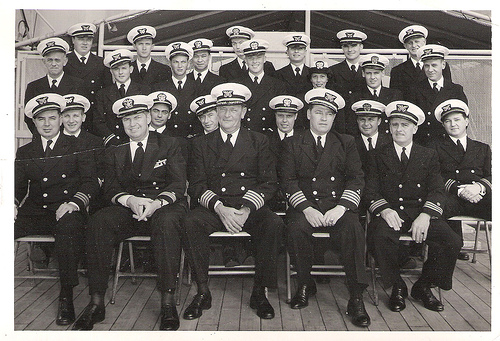
In 1950, the United States Military printed a small book for all armed forces officers on how to become better leaders and men. In it, five traits are set forth on what makes an effective leader. We’ve taken these traits and explored their meaning and application for every man whether an officer or a civilian.

1. Quiet resolution. An effective leader has the resolve to see every task through to the end. Resolve is easy to have in the quiet before the storm comes. Resolve is a breeze when one’s commitment has never been tested. It is when the fear, chaos, and stress of a crisis hits that true resolve is revealed. In any situation, there will be an opportunity for retreat, an escape hatch, the chance to shirk responsibility and choose safety and defeat over risk and greater reward. At that moment, the man with quiet resolve does not waffle, he does not doubt the choice that he knows is right. Without the terrible grip of indecision seizing him, he is cool and levelheaded, unflappable in the face of challenge. He is not loud, yelling and frenetically scurrying about in an attempt to cover his lack of grit with useless action. The man with quiet resolution is a man others can feel supremely confident in. While the world around him goes to pot, he knows what his mission is and he calmly fulfills it. He is the anchor in the storm.

How to become a leader with quiet resolution:

Do not wait for a crisis to emerge to make a decision. Inventory your values and goals, and set a plan for how you will react when certain crises arise and important decisions need to be made. DO NOT wait to make you choice until the heat of the moment, when you will be most tempted to surrender your values. Set a course for yourself, and when trials come, and you are sorely tested, you will not panic, you will not waver, you will simply remember your plan and follow it through.

2. The hardihood to take risks. Nothing ventured, nothing gained. Great achievements come to those who are willing to take risks. A leader who continually plays it safe will never put themselves or the people they lead in a position to experience success. A life without risks is surely alluring; its sweet lullaby of safety and comfort has lulled many a man into the trap of mediocrity and apathy. The weak man stands at the crossroads of decision, tempted by the possible reward and yet paralyzed by the fear of defeat. He is blinded to the fact that even failure brings its own rewards. Without failure a man never comes to know himself, his limits, his potential, and what he is truly capable of. A man who never dares greatly fails to see that he has taken the greatest risk of all: the risk that he will never progress, never refine his soul, never amount to anything worthwhile.

How to become a leader that takes risks:

The fear of taking risks can be very real. You cannot expect to have the courage to take a large risk when you have had no experience taking small ones. So find opportunities in your daily life to take little risks. It could be as small as approaching a stranger and striking up a conversation. Find an activity that frightens you, like public speaking and go for it. As you venture more risks, you develop the capacity to overcome your fear and gain the wisdom to know when a risk is worth taking. You will achieve the mettle to take the big risk when your leadership abilities are truly called upon.

3. The readiness to share in rewards with subordinates. A great leader, although supremely confident, humbly acknowledges that no success, no matter how large of a role he personally played in bringing it to fruition, is a wholly solo effort. He is deeply grateful for all those, even those with small roles, who played a part in the achievement. And he understands human nature. He understands that people love to be recognized for their contributions. When a group or organization succeeds, a true leader makes it a priority to recognize both in public and private the contributions of those he led. When a person sees that a leader is humble and will share in success, they’ll be more willing to follow that person.

How to become a leader that shares rewards with subordinates:

Sharing success with the people who follow you can be as easy as offering public recognition or increasing their compensation. A simple thank you card expressing your gratitude for an employee’s effort in completing a project can go a long ways in building loyalty to you and your organization. When offering thanks or giving praise, try to be as specific as possible. It shows the person you lead that you are keenly aware of what they do and makes the thanks or praise more personal and sincere.

4. An equal readiness to take the blame when things go adversely. It is when things go wrong that true leaders are separated from the pretenders. The weasel leader will gladly accept the accolades when he and his team succeeds, but will find another individual to take the fall when things get tough. When followers see this, it completely demolishes any confidence and allegiance to that leader. True leaders will take responsibility for all consequences of their decisions, even the bad ones. Even when the results were the fault of a subordinate, a true leader will still take all the blame. Perhaps the leader failed to communicate clearly what the subordinate’s duty was, or maybe the leader failed to match the right man with the right job. After taking responsibility for the results, an effective leader will immediately take action to correct the situation.

How to be a leader by taking the blame when things go adversely:

When taking the blame, you must do so sincerely. Your confession must spring from a genuine belief that you were at fault. To accept blame, but to do so grudgingly, makes you a boy, not a man. Never play the part of the martyr and seek glory for taking the fall. Likewise, don’t take the blame publically, but then tell your subordinates that the only reason you took responsibility was to save their asses. You’ll look like a phony and deteriorate their trust in you.

5. The nerve to survive storm and disappointment and to face each new day with the score sheet wiped clean; neither dwelling on one’s successes, nor accepting discouragement from one’s failures. All of history’s great leaders had moments of supreme success and moments of devastating defeat. Great leaders focus on the things they can change and influence, and the past is not one of those things. If you fail, learn from it and then immediately cease to dwell on it. Rehashing the past will not do anything for you. Moreover, the people a man leads will lose confidence in their leader if they continually brood over their failures.

When you succeed, celebrate with your followers, and move on. A leader who continually dwells on past success shows that he has not set his eye on greater things. Additionally, as we learn from the Greeks, a leader’s hubris can quickly become their downfall. Always stay humble and hungry.

How to become a leader by not living in the past:

Read biographies of great leaders from history. By reading about the lives of these great men, you’ll learn that even the best leaders faced enormous setbacks. You’ll gain perspective and come to see that one failure does not mean the death of a man’s capacity to lead. And the amazing feats of the great men of history will inspire you to believe in the powerful influence on history a true leader can wield.

All in all, good advice.