Showing posts with label patriarchy. Show all posts

Tuesday, May 27, 2014

The Tantrum of Masculinity - Omnivore

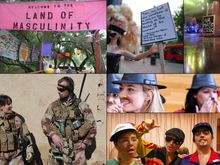
From Bookforum's Omnivore blog, here is a new collection of links themed on masculinity.The topics include patriarchy, male competition, academic masculinities, education, military masculinities, and pick up artists (PUAs).

And speaking of PUAs, there are also the mandatory links to articles blaming men, masculinity, patriarchy, and guns for the shooting rampage in Isla Vista. If only it were that simple.

The tantrum of masculinity

May 26 2014
9:00AM

Here are the requisite articles on the Isla Vista killings last Friday.

 from the 12:00 pm entry:
  • Rightbloggers say Santa Barbara killer Elliot Rodger's sexist rants have nothing to do with sexism (or guns). 
  • In the deadly aftermath of Elliot Rodger’s psychotic and suicidal shooting spree that left six others dead, the muted echoes of David Attias — who killed four people in Isla Vista 12 years ago — will be bouncing off Isla Vista’s blood-stained streets for some time to come. 

Friday, January 3, 2014

The Production of Patriarchy - Bookforum Omnivore

From Bookforum's Omnivore blog, here is yet another fascinating collection of links on masculinity, patriarchy, and feminism, among other things.

Among the interesting reads is Constructing Our Own Definition of Masculinity: An Intersectionality Approach by Cristobal Salinas Jr. and Cameron C. Beatty (Iowa State), a talk given at the 2013 ACPA Annual Convention  (Las Vegas, NV), entitled "Looking Forward: A Dialogue on College Men and Masculinities."

Enjoy.

The Production of Patriarchy


Dec 20 2013
9:00AM

Thursday, November 14, 2013

Omnivore Linkage - Gender, Patriarchy, and MRAs

Here is a new collection of links from Bookforum's Omnivore blog, this one dealing with gender issues, patriarchy, men's rights activists, feminism, and other interesting topics.

Gender-specific

Nov 14 2013
9:00AM

Saturday, July 13, 2013

Omnivore - Differences Between Men and Women

From Friday's issue of Bookforum's Omnivore blog, this is an interesting assortment of links for articles dealing with the various differences between men and women.

Between Men and Women

Monday, April 29, 2013

America's Military-Masculinity Complex and Other Issues of Masculinity

From Bookforum's Omnivore blog, an interesting collection of links about masculinity - most of them dealing with the more toxic and violent (i.e., archaic) forms of masculinity. Looking at these, you might think men were little more than sexually coercive and violent criminals/terrorists.

Of these, the first one is perhaps the most interesting - here is the abstract:

Feminism, Masculinities, and Multiple Identities
Martha Albertson Fineman


Abstract:
Masculinities scholarship could be seen as distinct from and complementary to feminist theory — an independent and parallel companion theory, developed by men. In this regard, from a feminist’s perspective masculinities scholarship might be thought of as ethnography, helpfully providing insights into the operations and assumptions of a distinct masculine culture. This approach would seem to validate the notion that there are significant differences between men’s and women’s experiences and perspectives, and consideration of both is necessary to form a complete legal theory picture. Feminist legal theory and masculinities theory are thus seen as both contrasting and complementary in nature.

On the other hand, masculinities scholarship can be understood as providing the basis for a critique of feminist legal theory. This approach begins with the allegation that feminist legal theory generally and incorrectly treats men as a monolithic group when there is in fact a multiplicity of male identities. Masculinities scholarship, in this framing, could be categorized as the male-focused companion to critiques that have been made over the past thirty years that feminist legal theory is excluding and essentializing. It is this understanding of the significance of masculinities to feminist legal theory that prompted this Essay.

Toxic masculinity

APR 29 2013
9:00AM


Sunday, February 17, 2013

Dan Mahle - One Conversation: A Call to Men

This was posted by Jamie Utt at his Change from Within blog. It's a guest post from a friend of his, Dan Mahle, a program coordinator, facilitator, and community builder living in Seattle, WA.

We all should be asking this one simple question, which is from the article below: “So what can we, as men, do to begin to transform this culture of violence against women?” And then we should take it a step further: "What can we do, as men, to begin to end this culture of violence?"

While I fully support this particular cause, I also recognize that patriarchy is not about men - it is about power over others. We all want to end violence against women, but we also want to end violence against men, against children, against any human being. Rather than power over, we can begin to create a culture of empowered with - we become empowered individually and collectively with each other.

I don't know exactly what a new interdependent culture would look like in practice, but I know that violence would become, over time, obsolete.

Patriarchy vs Love: Time for Men to RISE


This week’s post comes from a dear friend.

Dan Mahle at the 1 Billion Rising event in Seattle, WA

Dan Mahle is a program coordinator, facilitator, and community builder living in Seattle, WA. He received his B.A. in Peace and Global Studies from Earlham College in 2008. He has been involved in a variety of non-profit organizations since then, including several youth programs that he helped to launch. His personal mission is to support people in uniting across lines of difference to identify common values & goals, build culture & community resilience, and share powerful stories through creative expression. When he’s not working, he can be found running, hiking, writing music, and eating tasty bowls of cereal late at night.

——————
One Conversation: A Call to Men


I had an incredible conversation with a complete stranger today. He was an older guy who happened to stop by the 1 Billion Rising local event that took place in downtown Seattle. As I was walking toward the small crowd of mostly women who were holding signs and dancing, he stopped me with a loud, “Hey, what is this ‘1 Billion Rising’ thing?”

When I told him that it was a global movement to end violence against women, launched by Vagina Monologues playwright, Eve Ensler, his voice softened and his eyes darted away.

He started telling me about how violence had affected so many of the women in his life. He began tearing up as he shared that most of the women he loves have been victims of sexual assault and/or abuse. He recalled spending 15 years with his ex-wife who, despite endless medications, could not overcome the depression she felt ever since the day she was sexually assaulted. I could see the hurt and sadness in his face as he told me that he couldn’t find any way to help her. His mother, he said, had also been a survivor.

Suddenly staring firmly at me, he said, “Women shouldn’t be treated this way. They are the life-givers; we owe everything to them.” He was visibly shaken.

I looked back at him and asked, “So what can we, as men, do to begin to transform this culture of violence against women?”

We talked about how important it would be for more men to have honest conversations about patriarchy and its countless negative impacts on us and on the women in our lives. Both of us acknowledged, though, that these kinds of safe spaces for male emotional expression are few and far between.

I gave him a hug and he said, “I love you, man.” We had met just 5 minutes before, but the moment of solidarity and healing that we shared in that short space was profound.

It got me thinking: Why don’t we, as men, seek out more spaces for truthful sharing about our feelings and our experiences with patriarchy? Why don’t we talk about violence against women, about sexism, and about rape culture? The ‘1 Billion Rising’ movement is based on a single, chilling statistic: One in three women on the planet will be raped or beaten in her lifetime.

That’s 1 billion women worldwide. How can we say that we love the women in our lives, even as we are perpetuating (consciously or unconsciously) a culture of violence against them?” Every day that we are silent, the cycle of violence continues.

The Cost of Patriarchy

This is where shame often comes in. I’ve known it by many names: frustration, defensiveness, anger, aggression, rage, a need for control, etc. But it all comes back to shame. It all comes back to some deep-seated feeling of unworthiness that keeps us from meeting our most fundamental human need: the need to feel loved.

While women in our society are taught that their worth depends on their physical beauty, men are taught that our worth depends upon our performance, our control, our accomplishments. At some point, like so many women, many of us realize that we will never be able to fulfil the expectations placed on us. But instead of questioning the patriarchal culture that has burdened us with these perverse and insatiable demands, we come to believe that who we are is not good enough.

In an effort to avoid feelings of vulnerability, we methodically replace emotional expression with emotional numbness. And so, in our disconnection from self and others, we unlearn what it means to truly love.

As bell hooks puts it in her book, The Will To Change: Men, Masculinity, and Love, “The reality is that men are hurting and that the whole culture responds to them by saying, ‘Please do not tell us what you feel.’”

When we forget what it means to love, we often desperately search for cheap replacements: we work long hours at work in an attempt to receive praise and recognition; we watch porn or buy prostitutes in a distorted attempt to feel loved and sexually fulfilled; we buy an endless number of things in an attempt to fill the painful void of loneliness within. Until we, as men, face our fear of vulnerability and begin telling each other what we feel, nothing will change.


Right now, there is a powerful, growing movement of women who are rising up all around the world to demand an end to violence. This movement is a struggle for equality, but it is also a call back to love. It is an invitation to all people to transform the dominant culture from a culture of violence to a culture of love, starting from within our own hearts. We owe it to all women to stand beside them as they say “enough is enough!” We owe it to ourselves to finally invite love, in all of its fullness, back into our lives.

Learn more about 1 Billion Rising here.

Thursday, May 3, 2012

Man Finally Put In Charge Of Struggling Feminist Movement

This is a classic 2007 column from The Onion: America's Finest News Source. The genius is in how they simultaneously satirize the feminist movement and the patriarchal system that makes feminism necessary. Good humor and satire plays no favorites.

Man Finally Put In Charge Of Struggling Feminist Movement

December 3, 2007 | ISSUE 48•15 ISSUE 43•49
 
 
Head feminist "Buck" McGowan leads a march on Washington for women's rights.

WASHINGTON—After decades spent battling gender discrimination and inequality in the workplace, the feminist movement underwent a high-level shake-up last month, when 53-year-old management consultant Peter "Buck" McGowan took over as new chief of the worldwide initiative for women's rights.

McGowan, who now oversees the group's day-to-day operations, said he "couldn't be happier" to bring his ambition, experience, and no-nonsense attitude to his new role as the nation's top feminist.

"All the feminist movement needed to do was bring on someone who had the balls to do something about this glass ceiling business," said McGowan, who quickly closed the 23.5 percent gender wage gap by "making a few calls to the big boys upstairs." "In the world of gender identity and empowered female sexuality, it's all about who you know."

McGowan, who was selected from a pool of roughly 150 million candidates, made eliminating sexual harassment his first priority before working on securing reproductive rights for women in all 50 states, and promoting healthy body images through an influx of strong, independent female characters in TV, magazines, and film.

"It's about time," McGowan said upon returning from a golf game with several "network honchos" in which he brokered a deal to bring a variety of women's sports to prime-time television. "These ladies should have brought me on years ago."

McGowan claimed that one of the main reasons the movement enjoyed so little success in the past was that the previous management was often too timid and passive and should have been much more results-focused.

"You can't waste time pussyfooting around with protests and getting all emotional about a bunch of irrelevant details," McGowan said. "If you want to enjoy equal rights, you have to have a real man-to-man chat with the people in charge until you can hammer out some more equitable custody laws."

"And don't get me started on how disorganized and scatterbrained their old fundraising methods were," McGowan added. "Let's just say the movement never really had a head for numbers."

After McGowan successfully appointed three of his best men to lead Smith College's women's studies department and called in some favors to a number of powerful board chairmen to triple the number of female CEOs in Fortune 500 companies, analysts predicted that the feminist movement could achieve all of McGowan's goals by as early as 2009.

"With a charismatic, self-assured guy like Pete pulling the strings, we might even see a female elected president one of these days," said Nathan Roth, an analyst at the Cato Institute. "Finally, the feminist movement has a face that commands respect."

McGowan, however, said he didn't get into the business of women's rights for the praise.

"What these women were able to accomplish with the little manpower they had is very impressive," McGowan said. "I just bring a certain something to the table—I'm not sure what—that gave us that extra little push into complete female independence. I guess it just comes naturally."

But despite his modesty, McGowan continues to garner praise from those closest to the cause.

"The whole movement just seems more legitimate with Buck in charge," leading feminist Gloria Steinem said at a gala dinner Friday. "His drive, focus, and determination are truly remarkable. Mr. McGowan is a man with a plan."

Although he has not hinted at any future projects after all forms of gender discrimination are a thing of the past, McGowan has vehemently denied rumors that he will leave the feminist movement to head up the struggle for gay rights.

"The wife would kill me if I took on any more hours," McGowan said. "I'm sure those fellows know how that goes."

Tuesday, January 17, 2012

Bookforum - Positionings of Gender

Yesterday's Bookforum offered up a collection of links on issues related to gender - it's a pretty eclectic mixture of material, sure to please and/or piss off most anyone. Contrary to my usual practice, I've broken these links down into discrete entries for your browsing pleasure.

Positionings of gender

Sunday, September 25, 2011

Slate Debate - Apparently, Men Are Finished

Slate held a debate with Dan Abrams (ABC News chief legal analyst) and Hanna Rosin (author for Slate and The Atlantic) arguing for the proposition, "Men Are Finished" and Christina Hoff Sommers (American Enterprise Institute scholar ) and Dave Zinczenko (Men's Health Editor in Chief) who opposed the motion. ABC News Nightline Correspondent John Donvan moderated.

Really? That was the best they could do on the opposition side? Why not someone like Warren Farrell (who I dislike but who really knows his stuff) or Lise Eliot (Pink Brain, Blue Brain) or Cordelia Fine (Delusions of Gender)? Why not include an expert in men's studies such as Ron Levant, or Michael Kimmel, or William Pollack?

Perhaps, too, the proposition might better have read, Patriarchy Is Finished, which is really what the debate revolved around. But the chosen statement garners a lot more attention by being outlandish and inflammatory.

Anyway, the video is included below.

Apparently the Abrams and Rosin side seriously out-argued the Sommers and Zinczenko side. The audience came in with 20% agreeing that men are finished, 54% against, and 26% undecided. A little over an hour later, 66% agreed with the motion, 29% opposed and only 5% were still undecided.

Apparently, Men Are Finished

The fairer sex won big at Tuesday's Slate/Intelligence Squared U.S. debate.


In the middle of Tuesday night's Slate/Intelligence Squared U.S. debate, ABC News chief legal analyst Dan Abrams presented this damning piece of evidence: "Between 1995 and 2008, 82 percent of lightning strikes were on men," Even God, Abrams told the packed house at NYU's Skirball Center, has decided that men are finished.


Abrams teamed with journalist Hanna Rosin of Slate and the Atlantic to argue for the proposition, "Men Are Finished." They squared off against American Enterprise Institute scholar Christina Hoff Sommers and Men's Health Editor in Chief Dave Zinczenko, who opposed the motion. ABC News Nightline Correspondent John Donvan moderated.


The debate—lively, a little bit mean, and extremely funny—ended with a big victory for Rosin and Abrams. Before the debate started, 20 percent of the audience voted for the motion, 54 against, and 26 were undecided. By the end of the debate—in a result that Intelligence Squared deemed the biggest swing in its history—the numbers had more than reversed, with 66 percent voting for the motion, 29 against it, and 5 percent undecided.


Watch the video from the debate:
Debate: MEN ARE FINISHED (iq2us.org) from Intelligence Squared U.S. on Vimeo.


"Men are finished," is a bold claim—"preposterous," as Zinczenko scoffed repeatedly. Rosin and Abrams helped their cause early by defining victory down: They argued that "men are finished" did not mean complete and utter humiliation of the sex, but rather an end to male dominance. Rosin, the author of last summer's Atlantic cover story "The End of Men," used her opening statement to argue that men are through dominating because they've failed to adapt to a postmodern economy that places a higher premium on traditionally feminine attributes (consensus-building, social intuition, empathy, and communication skills). Men have narrow, inflexible ideas of what it means to be a man, and thus have pigeonholed themselves into dying industries. Women, on the other hand, are more flexible and malleable than ever before. There's "some special formula required for succeeding" today that women seem to have in greater abundance," Rosin said, while reeling off favorable statistics. In 2010, women became the majority of the workforce for the first time in American history. They now hold 54 percent of managerial jobs, and are set to dominate 13 of the 15 industries projected to grow the most in the next decade. They're more likely than men to receive a college degree. Meanwhile, one-fifth of men are out of work. And images of the "omega" male (imagine the slothlike, video-game entranced, drugged-up, potbellied guys you see in Judd Apatow movies) dominate movies and television shows. "We'd like you to think of this as the writing on the wall, the sign that points to an inevitable future," she asserted. "The world where men dominate the public sphere, and where male traits lead to public success is the world we're saying goodbye to."

Sommers, author of The War Against Boys, countered that the short-term trends we're seeing are signs of equalization, not dominance: Women are joining men, or even catching up to them, as partners in running the world. They are not surpassing them. She and Zinczenko both cited Mark Zuckerberg, Steve Jobs, and Bill Gates as proof that we need men to drive innovation in fields like technology and science. And our civilization depends on the brawn and bravery of the men—"and some women"—who fight and die to protect us. "Toughness and assertiveness are obsolete—that's absurd!" she declared, referring to the idea that male traits aren't as crucial to the postindustrial economy.
Go read the whole article.

Monday, March 28, 2011

Christina Hoff Sommers Applauds Tina Brown's Post-Feminist Summit

http://www.marieclaire.com/cm/marieclaire/images/Hasina.jpg

An intern for Christina Hoff Sommers sent me this article she wrote for The American (the magazine of the conservative American Enterprise Institute). I'm not sure why they sent it to me - I've been highly critical of Sommers conservative, retro-cultural agenda - in fact, I represent most of what she despises.

That said, this is a good rebuttal to the MRA's who think all feminists are evil and ignorant.

I support the efforts of these women - financially when I can, and in spirit always. They are victims of patriarchy - men entrenched in archaic egocentric power-structures. I do not blame men in general, I blame the systems that keep these structures active.

And yet each man who stones his wife to death for speaking to another man who is not her family, each man who rapes the females in a village as a form of terrorism, each man who sells his daughter into marriage while she is still a child - each of these men carries a weight, the burden of their guilt. Each of those men is responsible for his actions.

This is not about hating men - it's about reforming violent and shameful systems that are not congruent with the 21st century.

Tina Brown's Post-Feminist Summit

By Christina Hoff Sommers
Thursday, March 24, 2011

Tina Brown has given Western feminism something it has lacked since the 1970s: a contemporary purpose worthy of its illustrious past.

Tina Brown, editor of Newsweek and The Daily Beast, held her second annual “Women in the World” conference earlier this month at the Millennial Hotel in New York City. When I told a writer friend I was attending and urged her to come along, she e-mailed back, “zzzzzzz.”

I knew what she was thinking. Women’s conferences are usually tedious affairs, organized by women’s studies professors and Title IX lobbyists and filled with complaint, victim-talk, and “anger issues.” But this one was different. Its subject was not the travails of middle-class American women, but rather the genuine hardships and dangers faced by women in Muslim and other cultures in the developing world. Not a single representative from the National Organization for Women or the American Association of University Women was in evidence. The panels were moderated by well-known journalists—Christiane Amanpour, Charlie Rose, Leslie Stahl, and Barbara Walters. Several prominent American women served on panels, including Kirsten Gillibrand, Melinda Gates, Cheryl Mills, Amy Chua, and Diane Von Furstenberg. But the stars of the summit were activists from the poorest regions of the world. And the spirit was not self-pitying and anti-male but self-confident and serious.

One after another, women from Bangladesh, Cambodia, the Congo, and Egypt spoke about how they were organizing against honor killings, mass rapes, genital mutilation, child marriage, and gender apartheid—and getting results.

In a session called “Stealing Beauty,” panelists discussed acid attacks. A Cambodian woman named Yem Chhuon described an incident six years ago when her husband’s mistress threw acid in her face, also hitting her infant daughter cradled in her arms. Her face is badly disfigured, but instead of retreating from the world she is campaigning against the “culture of impunity” that surrounds acid assaults in her country (both Cambodian men and women wield this horrific weapon). A philanthropic group called Virtue Foundation (whose guiding principle is that “true global change must begin within each of us—one person at a time, one act at a time”) has helped her and her daughter find expert medical attention. Today Chhuon is advancing a series of reforms: regulating the sale of acid, improving police awareness, and sensitizing judges. Her daughter, Sophorn—charming, scarred, and nearly blind—came on stage to greet the crowd. Suddenly, “acid attacks” were no longer a distant abstraction; they were as real as the disfigured six-year-old girl standing onstage in her velvet dress and patent leather shoes.

One after another, women from Bangladesh, Cambodia, the Congo, and Egypt spoke about how they were organizing against honor killings, mass rapes, genital mutilation, child marriage, and gender apartheid—and getting results. We met the “Rosa Parks of Saudi Arabia,” Wajeha Al-Huwaider. As co-founder of the Association for the Protection and Defense of Women's Rights in Saudi Arabia, this divorced mother of two is waging a brave and relentless campaign against sexist injustice. A social networker, she has posted a provocative video of herself on YouTube—with more than 200,000 hits so far. What makes it provocative? She is driving a car and encouraging other Saudi women to do the same. In another video she revealed details about an upcoming marriage between an eight-year-old girl and a 50-year-old man. Local journalists as well as CNN picked up on the story. An unusual public discussion of the horrors of child marriage ensued—and the little girl was set free.

Read the whole article.


Thursday, August 5, 2010

Masculinity and the Cultural Complex of Patripsych

http://godlesspaladin.files.wordpress.com/2009/05/manly-men.jpg

The cultural complex is an idea introduced by Thomas Singer and Samuel L. Kimbles in the book they edited: The Cultural Complex: Contemporary Jungian Perspectives on Psyche and Society (Published by Brunner-Routledge, 2004). The CG Jung Page posted the introduction when the book came out. Here is the article (introduction), then I have some lengthy thoughts on this topic - specifically as it relates to men.

The Cultural Complex

Edited by Thomas Singer M.D, and Samuel L. Kimbles, Ph.D.
Published by Brunner-Routledge, 2004.

Introduction
Thomas Singer and Samuel L. Kimbles

Since the fall of the Berlin wall and the collapse of the binary world view of conflicting superpowers that it symbolized, an endless parade of ethnic, racial, religious, gender, national and regional factions have emerged on the world stage with their long simmering feuds bubbling over. Everywhere, disadvantaged and! or disenfranchised groups - whether representing a minority or a majority - have been crying out for justice, healing or vengeance - or all three simultaneously. It seems as if peoples from every continent have been caught in an endless round of conflicts that run the gamut from familial and tribal skirmishes to international hatreds. As these group conflicts flood relationships with highly charged emotions at every level of human exchange - from local to global - we seek explanations, understanding and remedies. More often than not, such seeking leaves us feeling powerless in the face of the intractable nature of these feuds. Political theories, economic theories, sociological theories, religious theories and psychological theories - all provide a partial glimpse of the truth as to what underlies and fuels these conflicts. This book offers a new perspective on the psychological nature of conflicts between groups and cultures. This new perspective is based on an old theory - Jung's theory of complexes which he developed at the beginning of the twentieth century. Our modern version and new application of Jung's old idea make no special claim to having the answer to what causes - or might heal - group and cultural conflict, but they offer a point of view that may be useful to some as they ponder the forces that invariably seem to thwart most human attempts to bring a peaceful, collaborative spirit to the unending strife between groups of people. In our ripe time or kairos, when understanding both the uniqueness and commonality of cultures from around the world has become essential for the well-being of the global community itself, shedding more light on what tears us apart is an essential first step. Much of what tears us apart can be understood as the manifestation of autonomous processes in the collective and individual psyche that organize themselves as cultural complexes.

This book sets out to explore a single notion - what we have called "the cultural complex." The very name of the notion is a synthesis of two very potent words - "cultural" and "complex" - each carrying a long and important history of research, speculation, and multileveled meaning. The notion of a "cultural complex" is a synthetic idea, i.e., it springs from a particular tradition - analytical psychology - and draws on different strands of that tradition to build a new idea for the purpose of understanding the psychology of group conflict. Over and over again in this book, we will underline the premise that the psychology of cultural complexes operates both in the collective psychology of the group and in the individual members of the group. Each chapter in the book should be read as part of a collaborative effort to give flesh and bones to the theory of the "cultural complex." By exploring the notion of a cultural complex in a variety of contexts and crosscultural settings, the reader will be exposed to the concept as it applies to both groups and individuals. In a very real sense, the separate contributions in this book can be thought of as a group effort to define the notion of the cultural complex.

Jungian theory at its best is open and evolving, with a long and meaningful history of modification and adaptation. Jung himself was never static in the development of his ideas and as a result, there are several different "theories" in his life's work that exist side by side: complex theory, the theory of psychological types, the theory of the archetypes and the collective unconscious and ultimately, Jung's theory of the Self. These theories taken together form a whole, but were never intended to be a tight, carefully constructed architectural gem. One can think of the loose collection of separate theories that have grown up to become known as "analytical psychology" as being a bit ramshackle like an old New England farmhouse. Many additions to the original structure have been made over time as different needs emerged. Our theory of cultural complexes is just such a new addition and we like to think of it as being built in the style of a farmhouse addition - we hope as a "great room," although some may see it as a "mud room." Whatever scale and value is given to it, it is clear that we need a new room.

Jung's complex theory was his first original contribution to the young science of psychoanalysis. It is still a vital part of how Jungians understand and formulate the inner and outer experience of individuals. Although Jung included the cultural level in his schema of the psyche, his theory of complexes has never been systematically applied to the life of groups and to what Jung and his followers have been fond of calling the "collective." Applying Jung's theory of complexes to the cultural level of the psyche and the life of the group (and how the life of the group exists in the psyche of the individual) is the new addition that we propose to build and it is hoped that this book will be part of the design and construction of the new room. Those knowledgeable about Jungian psychology will already be protesting that Jung and Jungians have always had a keen interest in the collective and have actively explored diverse cultures, making enormous contributions to understanding the role of the collective in the psyche. Of course, this is true. But when it came to understanding the psychopathology and emotional entanglements of groups, tribes, and nations, Jung did not take advantage of his original theory of complexes and this has left a major gap in analytical psychology.

E-mail: Tom Singer tsinger@batnet.com

Let's start off with a little more information. Here is a brief overview of the idea of complexes - one of the enduring contributions of Freud and especially of Jung, who refined the term and made it more usable (from Wikipedia):

In psychology a complex is a group of mental factors that are unconsciously associated by the individual with a particular subject or connected by a recognizable theme[1] and influence the individual's attitude and behavior. Their existence is widely agreed upon in the area of depth psychology at least, being instrumental in the systems of both Freud and Jung. They are generally a way of mapping the psyche, and are crucial theoretical items of common reference to be found in therapy.

The term "complex," or "feeling-toned complex of ideas," was adopted by Carl Jung when he was still a close associate of Sigmund Freud. (Theodor Ziehen is credited with coining the term in 1898.) Jung described a "complex" as a 'node' in the unconscious; it may be imagined as a knot of unconscious feelings and beliefs, detectable indirectly, through behavior that is puzzling or hard to account for.

Jung found evidence for complexes very early in his career, in the word association tests conducted at the Burghƶlzli, the psychiatric clinic of Zurich University, where Jung worked from 1900–1908. In the word association tests, a researcher read a list of words to each subject, who was asked to say, as quickly as possible, the first thing that came to mind in response to each word. Researchers timed subjects' responses, and noted any unusual reactions—hesitations, slips of the tongue, signs of emotion. Jung was interested in patterns he detected in subjects' responses, hinting at unconscious feelings and beliefs.

In Jung's theory, complexes may be conscious, partly conscious, or unconscious.[2] They may be related to traumatic experiences, or not. There are many kinds of complex, but at the core of any complex is a universal pattern of experience, or archetype. Some of the key complexes Jung wrote about were the anima (a node of unconscious beliefs and feelings in a man's psyche relating to the opposite gender) and animus (the corresponding complex in a woman's psyche); and the shadow (Jung's term embracing any aspect of psyche which has been excluded from conscious awareness). Many Jungian complexes appear in complementary pairs: for example, the puer, or eternal youth, often appears in relationship to the senex, or archetypal old man. A puer complex might manifest as an individual's unconscious dread of growing up, of losing one's romantic ideals or freedom; a senex complex, by contrast, might be seen in a person who, without seeming to understand why, is driven to act out an "old man" role, in creative or destructive ways. Only when a complex results in destructive behavior would it be seen as pathological; otherwise, a Jungian view of psyche accepts the presence of diverse complexes in ordinary health.

We can look at Jung's idea of the complex (as expanded by his translator, Jolande Jacobi) as a kind of unconscious subpersonality (for more on this idea, see my post at Integral Options Cafe) - a way of being in the world that we are generally unable to hold as an object of awareness until we disidentify from it. Doing so, we begin to get a sense of the power a complex can have in our lives.
[E]very complex consists primarily of a "nuclear element," a vehicle of meaning, which is beyond the realm of the conscious will, unconscious and uncontrollable; and secondarily, of a number of associations connected with the nuclear element, stemming in part from innate personal disposition and in part from individual experiences conditioned by the environment.
Further:
Once constellated and actualized, the complex can openly resist the intentions of the ego consciousness, shatter its unity, split off from it, and act as an "animated foreign body in the sphere of consciousness."(1)

~ Jolande Jacobi, Complex, Archetype, Symbol in the Psychology of C.G. Jung
This is essentially the definition of a subpersonality, though we will have to replace the archetype as the "nuclear element" with some form of trauma, dissociation, or some other event that can create the need for self-protection in the psyche.(2) And just as complexes gather associations around the initial kernel, so too do subpersonalities.

The approach taken by Singer & Kimbles argues that the same thing can happen at the cultural level - an idea that has been a part of the psychodynamic tradition for decades (or more).

One source of subpersonalities/complexes is the cultural unconscious. This is where the patripsych (the internal constellation of patriarchal patterns) comes from, a term made popular by the feminist movement. John Rowan works with this idea quite a bit, but it is not the only form of culturally determined complexes. Others might include the dutiful student, the patriot, the soldier, the mensch, and so on. Every culture will have different values that are internalized as roles or behaviors or ways of thinking.

But for this post, our focus is the patripsych:
The patripsych is a shorthand term for what we have called the internal constellation of patriarchal patterns. By this we mean all the attitudes, ideas and feelings, usually compulsive and unconscious, that develop in relation to authority and control. This development is closely related to learning about sex roles - learning about whether you are a little bot or a little girl. (3)
John Rowan explains it in a little more detail in his book, Subpersonalities: The People Inside Us (1990):
It is the patripsych we have to contend with when we are touching on compulsive feelings of dependence on authority figures, so that I assume they know best. I want to get near them. I want to be like them, and so forth. It is also the patripsych I have to contend with when I have a compulsive need to fight authority figures, opposing them regardless of what they do, dedicating my life to their destruction and seeing them as symbols of evil. And it is the patripsych I have to contend with when I am withdrawing into myself, refusing to compete, being uncommunicative, not engaging in any way and in this way avoiding all the issues of control. (p. 139-140)
Does any of this sound familiar? To be honest, when I first came across this idea maybe 10-12 years ago, I dismissed as irrelevant to my life. In my own mind, then, I had evolved beyond such limitations. Damn, was I naive. The more work I have done on masculinity issues, the more I realize how pervasive and subtle it is.

In many ways, the patripsych is a cultural complex/subpersonality that combines the agentic aspect of the masculine psyche in its pathological form (the pusher, always pushing us to do more, be more) with the inner critic in its most pathological form (always telling us we are not good enough, not worthy of being loved or respected for ourselves).

In Rowan's opinion, this is one of the most difficult parts/complexes to work with in therapy, although group work seems to be better suited to uprooting it. In individual work, no matter how much it seems we have gotten to it, the minute the client goes back out into the world, the culture is striving to re-embed the complex in his psyche through television commercials, movies, songs, peers, family, and nearly anything else you can imagine.

More to the point, men who reject this cultural complex suffer backlash from other men, and even from women (who are also impacted by the patripsych), who tend to reject men not seen as masculine by other men (this is a huge generalization, but true in the abstract).

Until recently, there had not been much research on this experience, but a very recent article by Moss-Racusin, Phelan & Rudman (2010) sheds new light on it:
Despite the high costs of adhering to masculine stereotypes, stereotype violation is associated with its own set of risks (Rudman & Phelan, 2008). For men, backlash effects have been underinvestigated, but some evidence suggests that, relative to comparable women, they are penalized for passiveness (Costrich, Feinstein, Kidder, Maracek, & Pascale, 1975), emotional self-disclosure (Derlega & Chaiken, 1976), and achieving success in feminine domains (Cherry & Deaux, 1978; Rudman & Fairchild, 2004). Given that modesty is associated with women (Heatherington et al., 1998), it should incur penalties for men because acting “macho” is a key component of men's professional power (Collinson & Hearn, 1996). Indeed, men who act modestly may be viewed as weak, and in turn experience ostracism in the workplace for not behaving like “one of the boys” (Berdahl, 2007). It therefore seems likely that men tend to behave immodestly because to do otherwise risks social and economic penalties. (4)
As men, we need to make it permissible, if not desirable, to shed these unconscious controls on our sense of self - and on our roles and expressions of our innate masculine hearts. The only way men will evolve out of the traditional, stereotypical roles is to create a safe space for our buddies and brothers - and ourselves - to do so.

For more on this particular topic, see John Rowan's Healing the Male Psyche: Therapy as Initiation (1997).

References and notes:
1. Jung: "A Review of the Complex Theory," The Structure and Dynamics of the Psyche (Collected Works of C.G. Jung, Volume 8) .
2. Not all subpersonalities arise from trauma, obviously -- we can actually create our own subpersonalities, especially as teenagers, by "trying on" different roles. Other subs develop as our roles develop, for example as a parent, or as an employee, and so on. But the subs I am interested in here are the ones that can "hi-jack" the psyche and make us wonder why do what we do.
3. Southgate, J. & Randall, R. (1978). The Barefoot Psychoanalyst. London: Association of Karen Horney Psychoanalytic Counselors.
4. Moss-Racusin, C.A., Phelan, J.E. & Rudman, L.A. (2010). When men break the gender rules: Status incongruity and backlash against modest men. Psychology of Men & Masculinity; Apr, Vol 11(2); pp. 140-151.


Wednesday, September 3, 2008

The Point - Rescuing Masculinity from Patriarchy


A good article over at The Point on Rescuing Masculinity from Patriarchy. I don't have time to comment on this, but I would love to hear what all of you think -- please leave your thoughts in the comments after you go read the whole post.

Here is a taste to whet your appetite:

But back to reclaiming the definition of masculinity:

There a few ways to go about this, and the following list refers to brainstorming sessions with a few bottles of wine over a few nights with varied company. To be balanced, I include a list on femininity.

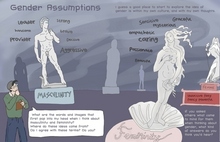
Masculinity

Integrity, accountability, supportive, courage, protective, strength, assertiveness, determination, will, high regard for love, power, energy/active, physical, sexual, present, trustworthy, fierce, raw

Femininity

intuitive, flexible, tolerant, compassionate, creative, emotional, nurturing, capable, practical, graceful, gentle, sensual, receptive

To be clear, this is not a list of how people should act. Women need to be assertive and men need to be compassionate. Some men behave in feminine ways, some women in masculine ways, and there is nothing wrong with this, as long as one does not judge these individual qualities as better/worse. Every person carries a unique balance of these energies, and the key is to not restrict them or judge them. In the traditional eastern Yin/Yang symbol, it is shown how in each dual pair there is always the aspect of its opposite, or even, that trying to identify each idea/concept without its ‘opposite’ is only possible philosophically, as they are inextricably linked in this world.

The negative reaction I have elicited from some people using archetypes and dualism as semiotic base references come from what I believe to be cultural connotations that incorrectly reflect the true meanings of these concepts, and how they relate to the subconscious and the psyche. In America, dualism seems to popularly have taken on a zero-sum nature. It is exactly the interactions of dualities that I refer to, the description of reality in a manner that relates reality to itself. Though it could even be seen in greater american culture, the desire for zero sum duality; that there is only love, no fear. Only light, no dark. At least marketing seems obsessed with the idea. That if only we could escape that darned dualistic nature to life, and achieve a purity of experience, we could be happy. All happy, no unhappy, that is. This is, of course, impossible.

So how do we extricate the masculine from the patriarchal?

Here is a little more:

So how do we extricate the masculine from the patriarchal?

By understanding that patriarchy is the weakest form of masculinity, and represents its extreme misuse.

  • The weakest expression of power is tyranny
  • The weakest expression of assertiveness is aggression
  • The weakest expression of protectiveness is war
  • The weakest expression of accountability is control
  • The weakest expression of determination is stubbornness
  • The weakest expression of strength is violence
  • The weakest expression of will is domination
  • The weakest expression of sexuality is rape
  • and so on.
I think the author makes a good point -- masculinity and patriarchy are NOT the same thing, and we need to extricate healthy masculinity from the oppressive tradition of patriarchal contexts.