Showing posts with label power. Show all posts

Tuesday, October 14, 2014

Dr. Jean Kim - Why He Hits: The Psychology of an Abuser

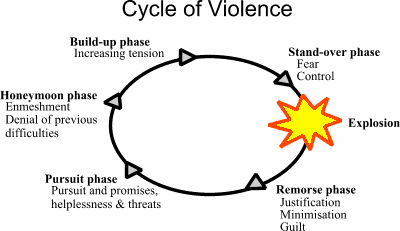
http://dlib.info/home/sla/images/Cyc.gif

From Psychology Today's blog section, Dr. Jean Kim (Culture Shrink) attempts to explain the psychology of a (male) abuser. This is an excellent post in that it does not offer easy answers (she lists a large number of conditions that can lead to violence) and she writes from the personal experience of growing up with a father who was violent to her mother.

http://ionevoxxi.files.wordpress.com/2013/07/470_5096928251355262391.gif?w=550&h=650

All of these same conditions can apply to women who abuse their male partners - and this is more common than most people are willing to admit. The rates of DV are nearly equal between the genders. But men are much less likely to report, and when men abuse, they tend to create more damage.

Why He Hits: The Psychology of an Abuser

Exploring the biological and psychological drive of abusers


Published on October 8, 2014 by Jean Kim, M.D. in Culture Shrink

The act is simple. But everything around it is not. Fist meets flesh; force makes contact. Nerve endings fire away in pain; capillaries burst; tissues swell.

The physical mutates the moment. Violence creates as it destroys. As we know from the recent 9/11 anniversary, the axis of someone’s psyche shifts after something traumatic happens. Tomorrow is never the same. In violence’s wake, a savage creation is born. A monstrous mélange of anguish, sorrow, confusion, shame, anger—and to look upon it is to look at oneself in a shattered mirror, a grotesquerie of what you thought was love, family, intimacy.

To have that moment and its afterbirth displayed for all the world to see, the monster that thrives in the shadows and corners of personal respectability and civility, is what has finally happened with the Ray Rice incident. Thanks to the era of cell phone cameras and instant media and Youtube, the personal can no longer remain private. And while there may be something to be said for the victim’s agency in choosing when to reveal private horror to others, Janay Rice has become the unwitting, unwilling poster child for an important conversation.

Aside from the myriad discussions of an abuse victim’s behavior and the crucial #WhyIStayed Twitter feed, here I have decided to focus on the perpetrator. Because as someone who grew up with a father who committed domestic violence, it is a question that has plagued me my entire life. Why does someone you love, someone who should cherish you unconditionally, treat you or your loved one cruelly? What has gone awry in that person to become an instrument of violence, both physical, and inevitably emotional?

On some level, that question has defined my entire identity and my choice of career. Not unlike the obsessions of a driven detective searching for a murderer, or of John Wayne in the classic movie The Searchers looking for years for his kidnapped missing niece, I too have obsessed over that question. I studied literature, looking for the answers in human behavior and motivations, the nature of good and evil. I became a psychiatrist, devoted to helping people who have suffered the mental fall-out from trauma, which leaves devastation in many forms, be it nightmares, isolation, depression, anxiety, self-hatred, self-destructive behaviors, and more. But I also wondered about the psyche of the aggressor, the criminal, the sociopath, who would also sometimes come under my purview.

Abusers often suffer from their own mental illnesses; a mood disorder may make them more prone to irritability and anger. Both depression and mania can manifest in heightened snappiness and quickness to attack, especially when associated with insomnia. (And in rarer severe cases, psychotic paranoia can also contribute.) Post-traumatic stress disorder (as sometimes seen in people in high-stress, high-threat careers like the military) can cause people to remain in fight-or-flight mode, leading to a chronic edginess and aggressive will to survive. An impulse control disorder may mean the person has trouble keeping wayward behaviors in check, has repetitive compulsions exacerbating stress. A traumatic brain injury or other organic brain damage (as associated often now with sports like football and boxing) may affect parts of the brain like the frontal lobe, causing disinhibition or mood changes. Addictions to substances like alcohol can also strongly exacerbate these behaviors. Some research has conjectured that testosterone can also sometimes worsen violent, antisocial, and aggressive behaviors, and adversely affect empathy.

Environment and learned behavior also contribute to abuse. Oftentimes abusers have witnessed similar behaviors in their own families, and they inevitably imitate their original role models, male or female. They may harbor severe resentment towards the gender they attack because of unresolved issues with their own parent, who may have been physically or emotionally cruel or unloving. It isn’t uncommon to end up “identifying with the aggressor,” an ego defense mechanism where you internalize the role of the powerful figure in the family, because you see abuse and dominance as power. You see this aggression as the way to behave in your later relationships and jobs, as the best way to survive, else you be the one victimized instead. Kill or be killed is the only relationship language you understand.

There is also the related issue of lack of ego strength; why would someone need to constantly control and belittle someone else to feel better about themselves? Abusers sometimes come from backgrounds where they were often belittled or grew to lack self-esteem. Usually the abuse is directed towards someone who would be considered weaker than them anyway, someone who is vulnerable, like a physically smaller female who is often younger, less educated or less financially independent, more easily manipulated. The abuser is a secret coward, never assured of their own power, even when they stack the deck heavily in their favor. (And certainly there can be male victims of abuse as well, with even more complex forms of shame and manipulation involved.)

Yet even with these biological and psychological insights as to what renders someone vulnerable to becoming violent, I still wonder what goes awry in that key moment, where someone decides to cross that line that most of us still recognize and appropriately flinch at in revulsion. Where someone lets loose with that fist, that belt, that weapon, decides to finally pull that trigger. Sometimes I still think there is a greater moral question to be asked as well of an abuser. What is causing that blind spot, that says hitting someone is okay?

Perhaps there is a rush, a thrill that goes with the transgression. There is a perverse reward going on to the circuits, that the kill has happened. It’s not that different than other trained instincts of violence we encourage in our society: be it in video games or aggressive sports or hunting or never-ending wars. Perhaps there is still a thirst for blood that is gratifying, enjoyable, and it is a thin line to cross when it comes then to a loved one who is easily and readily accessible, easy to hide.

This line-crossing may differentiate a sociopath from the rest of us. And yes, perhaps, a level of sociopathy or psychopathy is ultimately part of the picture for an abuser; a lack of empathy, even an enjoyment of inflicting cruelty or pain, a disregard for the aftermath. Although Dr. Robert Hare Ph.D., the psychologist who created the gold standard for diagnosing psychopathy, the Hare Psychopathy Scale, estimates that only 1% of the general population meets criteria for the official diagnosis, he has noted that higher numbers may have psychopathic traits and can be found in corporate businesses and other mainstream walks of life.

And although many may tend to consider domestic abuse as more of a “crime of passion” or less calculated than your stereotypical cold-blooded murder, that isn’t really the case. Oftentimes there is a longstanding pattern of manipulation and control inflicted by the abuser. Their tactics are not fleeting and isolated; they groom and master their victims quite skillfully; the callous bursts of violence are part of a larger campaign to dominate and emotionally cripple their victims so they lose their independence and will-power to leave. In this sense, given the high rates of domestic violence in our society (up to a third of women have been subjected to it according to a recent CDC study), the rates of sociopathic traits might be much higher than we realize.

Sure, all of us carry some capacity for cruelty or violence. Thanatos fights with eros for our souls—the age-old devil and angel chattering on our shoulders for control. Most of us keep our baser instincts in check. Circumstances and biology may make it easier for the line to be crossed, may bring you closer to the precipice. But it’s still your choice to release the monster. And it is a choice we must continue to acknowledge, to prosecute, and to vehemently condemn.

But that condemnation comes at a price we must acknowledge as well. Abusers come in all walks of life, all levels of society, and varying degrees of behavior. (There are definitely female abusers too, but we shouldn’t minimize the statistical reality that more men are prone to committing domestic violence.) They are human too, they can be loved and loving, they can do good as well as evil. It is not always so easy to “just leave” them or hate them. We should also stand back and view both abuser and victim with some compassion and appreciation of human and circumstantial complexity.

We need to continue to examine and address socioeconomic factors that contribute to abuse, such as war, poverty, stress, mental illness, violent entertainment, and other contributors to violence. We need to encourage mutual respect in society and healthy role-models for relationships. We need to promote love and forgiveness as well, but part of that involves recognition of a crime, recognition of the brutality of a violent act, not denial. Only when the act is acknowledged can the healing begin.

Related Links

Sunday, July 20, 2014

Men, Power, Money, and Sex - An Interview with Warren Farrell, Men's Rights Advocate


Marty Nemko is a life coach, author, and he blogs at his self-named site. He often blogs on topics related to men and boys, so it seems appropriate that he interview men's rights activist Warren Farrel for his Psychology Today blog, How to Do Life. Yes, I wrote activist and not advocate - he is the former, not the later.

First, my disclaimer: I do not like Farrell. His claims on the frequency of false rape accusations are totally ignorant of the reality "on the ground." For example, he claims below that we need to do away with the guilty/not-guilty binary because sexual encounters are far too nuanced for such a binary (this has been Marc Gafni's defense of his sexual predation on students, on whose board of directors Farrell sits). And besides, he adds, sometimes there are false reports, so we should never assume guilt.

WRONG - 92% (at least) to 98% of rape claims or true, and this doesn't even acknowledge the true claims that are not investigated by police.

Farrell has repeated made insanely stupid comments on date rape. Like this one:
We have forgotten that before we began calling this date rape and date fraud, we called it exciting. (Myth of Male Power, p. 314-15)
Or this one:
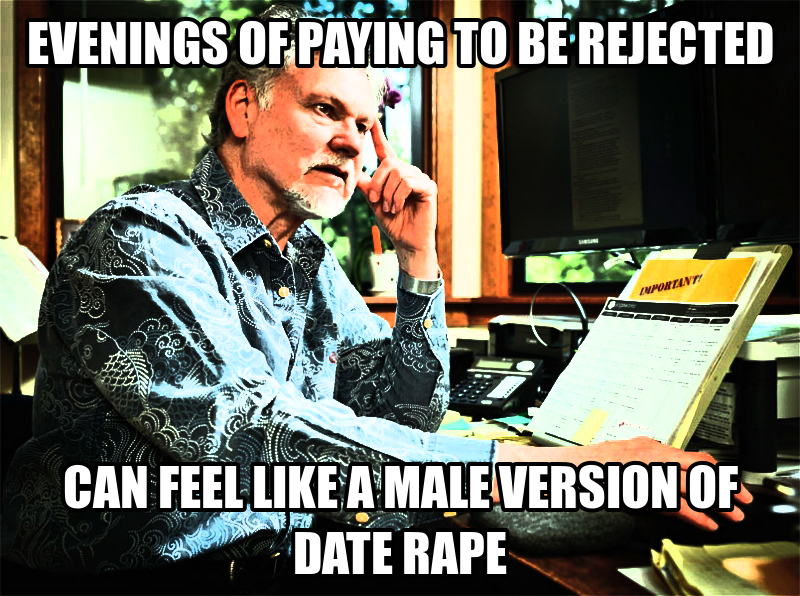
Evenings of paying to be rejected can feel like a male version of date rape. (MoMP, p. 314)
Really? Paying for dinner and not getting laid is the same as date rape? So the price of sex with a woman is dinner? Are we talking a nice restaurant here, or will Taco Bell due? Isn't that prostitution?

Oh, and by the way, have you been raped, Warren? Do you know how it feels to have your autonomy and physical body, not to mention your psychological self, sexually violated by another person? To have your trust in other human beings destroyed? To believe, despite the evidence, that somehow it was your fault? To have the nightmares, the hypervigilance, the self-loathing that comes with rape? Yeah, thought not.

Or this:
Almost all single women acknowledge they have agreed to go back to a guy’s place “just to talk” but were nevertheless responsive to his first kiss. Almost all acknowledge they’ve recently said something like “That’s far enough for now,” even as her lips are still kissing and her tongue is still touching his. (MoMP, p. 314)
Okay, so if you kiss somebody, that is tacit consent to sex? Wrong again, Warren.

And he always goes back to his straw man about false reports. Most studies put the false report rate at 2%. Even the FBI (1996), only put it at 8%:
As with all other Crime Index offenses, complaints of forcible rape made to law enforcement agencies are sometimes found to be false or baseless. In such cases, law enforcement agencies “unfound” the offenses and exclude them from crime counts. The “unfounded” rate, or percentage of complaints determined through investigation to be false, is higher for forcible rape than for any other Index crime. Eight percent of forcible rape complaints in 1996 were “unfounded,” while the average for all Index crimes was 2 percent.
What that section fails to mention, however, and Farrell has never acknowledged, is that local law enforcement will often decide a case is unfounded when drugs or alcohol are involved, or when there is previous sexual activity between the rapist and the victim.

Roughly a third to a full half of the clients I see have reported their rapist and the police/sheriff decided not to file charges or even pursue an investigation. This is seldom acknowledged aside from claims that reported rapes are far less than total rapes.

* * * *

One place Farrell is right is that this needs to be something we talk about with kids long before college or when they become sexual (high school, in general). Education is always the best prevention.

Where Farrell tends to be most relevant is in his discussions of the disposable nature of men in most societies. However, the answer is not to put more women in those jobs to make the risk more equal - it's to remove that safety issues that make those jobs so deadly (mining, oil fields, etc, where the corporations repeatedly avoid, undermine, or lobby against safety regulations). And the exception here is combat - let women be in combat military roles if they can do it.

Anyway, here is the brief interview.

Men, Power, Money, and Sex

An interview with men's advocate, Warren Farrell

Published on July 17, 2014 by Marty Nemko, Ph.D. in How To Do Life


Warren Farrell is a leading expert on men’s issues. He is the author of seven books and chair of the Commission to Create a White House Council on Boys and Men. He served on the board of the National Organization for Women (NOW) in New York City and is an advocate for both sexes having the full range of options, professionally and personally. 

I interviewed him about gender roles, power, why men earn more, and campus rape.

Marty Nemko: You're most well-known for your book The Myth of Male Power, just out in a new e-book edition. Many people think men have the power: Look at the Senate and CEO rosters. How would you respond?

Warren Farrell: A small percentage of men have major institutional power but across the full population, real power is about having choices. The women’s movement has made it socially acceptable for a mom to work full-time, stay home with the child full-time, or work part-time. That’s as it should be. Alas, it’s not as acceptable for a man to work part-time, let alone be a full-time parent. Mr. Mom is still a term of derision.

Marty Nemko: But men earn more. Isn’t that power?

Warren Farrell: Many men still buy into a false definition of power: feeling obligated to earn money that someone else spends while we die sooner—5.2 years sooner. That’s not power. That’s being a prisoner of the need for love and approval.

Marty Nemko: In your book, Why Men Earn More, you report that the statistic that women earn 77 cents for each dollar a man earns for the same work is very misleading. Can you give an example as to why? 

Warren Farrell: Women who have never been married and never had children earn 17% more than never-married men that have never had children, even when education and years worked are equal. Men don’t earn more than women. Dads earn more than moms. Why? When a child is born, a mom is more likely to divide her labor between work and home, earning less at work. A dad is more likely to increase his hours at work—or work two jobs—often taking jobs he likes less that pay more. 

Marty Nemko: In Why Men Earn More, you write, “The road to high pay is a toll road.” Are you suggesting that high pay and power can be inversely correlated?

Warren Farrell: Yes. For many dads, the road to high pay is not about power; it’s about his hope to make his children’s life better than his. It’s about giving his wife a better life. And to get that higher pay, he often has to forgo work he'd rather do. For example, he might prefer to be a teacher or a creative but to better support his family, he accepts a long-hours, high-stress, technical, travel-intensive, often soulless management position.

Marty Nemko: In your recent Reddit Highlighted Conversation, you cite statistics so startling that some would question their veracity. Would you provide the source for:
  • This is the first time in U.S. history that our sons will have less education than their dads.
  • Boys' suicide rate goes from equal to girls at age 9 to five times(!) girls' in their twenties.
  • More U.S. male military were killed by suicide in one year than were killed in the wars in Iraq and Afghanistan in all years combined.
Warren Farrell: Yes. Boys having less education than their dads is from the OECD (Organization for Economic Co-operation and Development), “Education at a Glance,” 2010, Table A1.3a

The boy-girl suicide rate is from the Centers for Disease Control and Prevention, Morbidity and Mortality Weekly Report, 58,1, 2009, and Web-based Injury Statistics Query and Reporting System (WISQARS), 2010.

The U.S. military suicide rate data is from the DOD, uncovered by CBS, in Armen Keteyian, “Suicide Epidemic Among Veterans.” CBS News, November 13, 2007. http://www.cbsnews.com/stories/2007/11/13/cbsnews_investigates/main3496471.shtml.

Marty Nemko: The subtitle of your book The Myth of Male Power is: Why Men are the Disposable Sex. How are men the disposable sex?

Warren Farrell: Virtually all societies that survived did so based on their ability to train their sons to be disposable—disposable in war, disposable at work.

Marty Nemko: That’s a strong statement. What’s your evidence?

Warren Farrell: The evidence is ubiquitous. 92 percent of workplace deaths occur to men, jobs few women would take: oil rig workers, long-haul truckers, roofers, coal miners. Yet there isn't the political will to create regulations that would afford them more protection for these workers. Meanwhile, when women have a less life-threatening deficit, for example, underrepresentation of women in engineering, there's massive expenditure to redress. Although male-only draft registration is a violation of both the 14th Amendment’s equal-protection clause and the 5th Amendment’s due process clause, it is so unconsciously accepted it isn’t even questioned. Only men can serve in direct combat so 98 percent of Iraq and Afghanistan deaths were men.

Marty Nemko: Is the fact that men die 5.2 years younger than women another example of male disposability?

Warren Farrell: It is the combination of facts like men dying 5.2 years younger than women—or men dying sooner from all ten of the ten leading causes of death, plus the fact that we nevertheless have seven federal offices of women’s health and none of men’s health that together reflect the psychology of indifference toward male disposability. Similarly, men over the age of 85 commit suicide 1350 percent as frequently as women over 85. Virtually no one knows this. If women over 85 committed suicide 1350 percent as often than men, it would be used as the quintessential example of our undervaluing of women. We seem to care more about saving whales than saving males.

Marty Nemko: You said men are indirectly disposable as dads. How do you mean?

Warren Farrell: In a divorce, if the mother doesn’t want the father to be equally involved, the apriori assumption is that she's right. Men have to fight in court for that right, and that's expensive.Unless he’s rich, he’s disposable. 

Marty Nemko: What are your thoughts about the current focus on campus rape?

Warren Farrell: The issue first should be addressed before kids get to college. For example, we may need to encourage our daughters to take the initiative when they do want physical intimacy, not just to say when they don’t. Our society strives for equality but few experts are asking women to share the responsibility for taking the initiative in sex, thereby risking rejection. During adolescence, women are the more mature sex. It’s unfair to expect guys to assume 90 percent of the burden of sexual rejection.

Marty Nemko: What should happen at college?

Warren Farrell: First, make the law the last resort. The law is binary: guilty/not guilty. Sex is nuanced and more nonverbal than verbal. Those nuances have evolved over millennia. A slight change in eye contact means everything in a male-female encounter but would be laughed at in court. And if a grievance is filed, we should not presume guilt. Alas, some accusations are false.

Marty Nemko: What about workshops at college?

Warren Farrell: Yes but both sexes should be walking a mile in each other’s moccasins.

Marty Nemko: You’ve done such trainings, right?

Warren Farrell: Yes. I used to tell college audiences, “Every woman is in a beauty contest every day of her life.” I then invited all the guys on stage to experience that. I had those guys wear bathing suits and had the women be the judges. The guys were stunned at being unseen for their integrity, intelligence, or values. They felt objectified.

Marty Nemko: What did you do to help the young women walk a mile in the guys’ moccasins?

Warren Farrell: I had the women “ask-out” the guys they were most attracted to on a 20-minute “date.” Some did what they criticize men for, for example, lying to get an attractive guy to go out with them. Others went after a less attractive guy to reduce the chance of getting rejected. The guys totally identified with that.

Marty Nemko: What was the outcome of those workshops?

Warren Farrell: Greater compassion for the other sex’s vulnerability, and I formed hundreds of men and women’s groups so they would continue to deepen their compassion after I left campus. 

Marty Nemko: Was there any concrete evidence it reduced campus rape?

Warren Farrell: I asked campus sponsors to let me know if any of the workshop participants later were involved in a date rape accusation. Although I had worked with 20,000 students in hundreds of colleges, not one incident was reported.

Marty Nemko: Do you still do those workshops?

Warren Farrell: As political correctness set into the colleges’ psyches, college programs shifted to emphasizing only men understanding women. It would be wiser for programs to help both sexes better understand each other. We don’t need a women’s movement blaming men, nor a men’s movement blaming women. We need a gender liberation movement. We need both sexes walking a mile in each other’s moccasins.

Friday, May 16, 2014

Fitness Friday - Fitness News and Information You Can Use

It's Friday, so it's time for another collection of fitness articles from around the web. This week's topics include "butt wink," how to improve power, 10 health myths debunked, understanding and using training percentages, and last, whether or not time under tension is important.


First up, this is from Girls Gone Strong (don't let the name of the site fool you, these women know their stuff - and this is problem I see more in men than in women, so pay attention):

My Butt Is Doing What? Squats and Butt Wink

(Note from GGS: Hey GGS Community!  We have a real treat for you today with another awesome installment of Ask Ann, our monthly column with Physical Therapist and Athletic Trainer, Ann Wendel.  Enjoy!)

“Hi Ann!  I try to squat to full depth, but I can’t seem to do it comfortably or with good form. I keep hearing the term “butt wink.” What is it and what causes it?”

Hi there!  Thank so much for submitting your question.  It’s a great question, and ties in nicely with last month’s column. Let’s start by defining the term “butt wink.”

Butt wink is a common term for losing proper spinal positioning when squatting to depth (in gym terms, “in the hole” or “ass to grass”). Instead of maintaining a neutral or slightly extended lumbar spine, the lifter experiences posterior pelvic tilt and lumbar flexion at the lowest point of their squat. This makes the butt “wink” or tuck under (the photo below left shows proper form, photo on the right shows butt wink).


Butt Wink Picture 1
Image Source: here 

* * * * *

3 Keys to Improving Power

May 9, 2014 | Mike Robertson


power-jump 
As an athlete, power reigns supreme.

Sure maximal speed is important, and being brutally strong can help, but if you want to be at your best it behooves you to improve power.

Unfortunately, I think most athletes go about this entirely wrong.

First and foremost, they spend all their time focusing on force production vs. force absorption.
 
Second, athletes and coaches alike don’t follow a basic hierarchy when it comes to training power. Just like you shouldn’t train force production before force absorption, you may not need to train power at all initially to see improvements in power production!

Here are three keys you should focus on if your goal is to improve power.

* * * * *

From Lifehacker:

10 Health Myths That Just Won't Die, Debunked by Science

By Adam Dachis


Everything makes you fat! Gluten-free food is the key to eternal youth! You need to poop ten times a day or you’ll die! You’ll find tons of equally ridiculous health claims around the internet, and you’ll actually believe some of them. Today we’re taking a look at 10 common myths and uncovering the truth.

While we’ve learned a lot about health issues here at Lifehacker over the years, we can’t claim expertise on any particular subject. To help us get to the root of these myths, we solicited the help of three experts: Dr. Carly Stewart (medical expert at Money Crashers), Andy Bellatti (Las Vegas-based registered dietitian), and Dr. Spencer Nadolsky (medical editor at Examine.com). They all offer a unique perspective on each myth but mostly came to the same conclusions: we have a lot of silly misinformation out there about our health.

* * * * *
From T-Nation:

From 0 to 100: Know Your Percentages!

by Christian Thibaudeau
05/13/14


Here's what you need to know...

  • Knowing the effects of each training zone will allow you to make the best choices when it comes to designing your own training plans. 
  • Each training percentage, from zero to 100% of your 1RM, has a distinct effect on speed, power, muscle hardness, muscle density, and hypertrophy. 
  • Percentages can't always be followed to the "T". Some days 80% will feel like 90%, but these general guidelines will help you plan your training to get the results you're after.
While training percentages can vary depending on how you're feeling on a given day, they can still be extremely useful. After all, if you know the specific training effect of various levels of loading, you can select the weight that's appropriate to your goals. So here's something I've rarely seen presented: a list of percentages that explains what each type of training load can provide and what kind of body they will give you.
* * * * *

Last up this week is a video talk from Team3DMJ about time under tension (TUT), which was once all the rage in training for size or strength.

Peeling Back a Layer Episode 5: "Is Time Under Tension Important?"

Published on May 14, 2014


Peeling back a layer addresses commonly misunderstood topics that we think we have a solid grasp of, but that we are actually missing a critical understanding of.

This episode asks the question, "Is Time Under Tension Important?"

See the referenced scientific studies here (I recommend reading the full texts):

Monday, April 28, 2014

Michael Taylor - Male Transformation: A Mans Journey To Wholeness


Here is this week's podcast from Coach Michael Taylor on his A New Conversation with Men show (Blog Talk Radio). His guests are Keith Merron and Tim Kelly. They have created a workshop called Sword and Scepter (relating to warrior and king) that is specifically designed to support men in understanding how to embrace new ways of being and relating as men, providing a road map for men to follow that leads them to wholeness.

My sense is that this workshop aims to change a man's relationship to and with power, advocating a more responsible and compassionate use of leadership power (scepter) and assertive power (sword).

Male Transformation - A Mans Journey To Wholeness


Coach Michael Taylor


Find Additional Education Podcasts with Coach Michael Taylor on BlogTalkRadio

Are there solutions to the senseless acts of violence perpetuated by men that are so common in our society? Will new gun laws or additional legislation help eradicate these problems? Is it part of a mans genetic makeup to be violent?

Contrary to negative media generated stereotypes about men, men are not inherently violent and they can learn to be more loving, sensitive and caring. They can be taught to deal appropriately with their anger and they can embrace new ways of being and relating as men.

What has been missing is a resource that deals specifically with the complexity of the changing roles of masculinity. What is needed is a dialog about A Mans Journey To Wholeness.

One such resource is the Sword and Scepter workshop facilitated by Keith Merron and Tim Kelly. This workshop was specifically designed to support men in understanding how to embrace new ways of being and relating as men and it provides a road map for men to follow that leads them to wholeness.

Join Coach Michael Taylor as he interviews the developers of the Sword & Scepter workshop and learn how the workshop can support men in living extraordinary lives.

For more info about the workshop log on to: www.swordandscepter.net

From the website for Sword and Scepter, here is a description of the workshop and what one can expect during the four days. PLEASE NOTE: I am not advocating this process, just sharing the information.

The Sword and Scepter Workshop

A 4-day Exploration of Masculine Power
The Sword and Scepter Workshop operates from the assumption that deepening one’s power is a process. It requires courageous opening to oneself, to others, and to the deepest aspects of what it means to be a conscious man in this world. It is our belief that learning about power has a dual edge: the inner exploration of power and its development, and its outer expression in effective forms. We work both of these edges throughout the workshop, seeking to discover both a deeper sense of self and its viable and authentic expression.

What You Can Expect from the 4-day Sword and Scepter Workshop
  • A better understanding of your own relationship to power
  • An understanding of the motives that drive you to express or repress your power
  • An experience of expressing power with other men
  • A model for healthy expression of male power
  • A sense of when your own power serves and when it harms
  • An enhanced ability to harness and channel your personal power

What You Will Experience
The workshop is structured as a series of exercises, experiences, and conversations, rather than lectures and instruction. Participants will join in an exploration in which each man brings his own wisdom and experiences to the circle. We will explore male power through a variety of means, including:
  • Exercises designed to help participant see how they show up as men
  • Exercises designed to draw out masculine power
  • Opportunities to see the impact of power
  • Journaling and other self-reflective activities
  • Men’s Council
  • Accessing timeless masculine archetypes, such as king and warrior
  • Meditation, visioning, and work with imagery
  • Giving and receiving feedback.
The workshop begins on a Thursday evening and runs through Sunday.

How We Are Different
Compared to other workshops, we're different due to:
  • Our purpose. This is a workshop about masculine power. We are not going to tell you how to be a man. We are not a men's social group. We are not a workshop company. We don't exist primarily to make money. We are here specifically to expand your consciousness in the area of power.
  • Who we work with. We focus on men already interested in their own growth and development. We are not trying to convince men of the value of focusing on their own growth. Most men come through invitation, word of mouth. The men show up ready to work, you get more for the time spent.
  • The team. Several men putting on the event are volunteering their time, and we are primarily covering costs, and proceeds go to the non-profit Tribe of Men. Many of the men are highly successful workshop conductors, coaches, consultants and executives in their own right. You'll get multiple perspectives and examples.
  • Follow-up. We believe growth requires more than a "great weekend". The Sword and Scepter ended up creating the Tribe of Men, a non-profit organization dedicated to expanding the consciousness of men. The Tribe can provide ongoing support for interested men, at a price you set for yourself.
 

Tuesday, December 31, 2013

Die Like a Man: The Toxic Masculinity of "Breaking Bad"

I missed this article when it first appeared in October, but it's still a topic worth discussing now that nearly everyone has seen the Breaking Bad finale. The title of the article tells you what you are going to read, a review of the ways this epic television show portrayed a toxic form of masculinity defined by violence, power, and money.

I have no disagreements with any of that.

However, I want to suggest that there are other depictions of masculinity that are not so toxic. For much of the series, Walt and Jesse perform a strange dance of interdependence - many times Walt could have allowed Jesse to be killed and did not. And in one of the most difficult scenes early in the series, Walt allows Jesse's heroin addict girlfriend to die of asphyxiation in her sleep rather than save her, ostensibly to protect Jesse from his proclivity for addiction.

It's Jesse who represents the best of masculine values, in spite of the chaotic world in which he lives. He loves honestly and consistently. He does his best to take care of the young woman and her son that he loves and had to leave in order to protect them from the dangerous people in his life, including Walt. When he escapes in the final episode after Walt rescues him, we can imagine he will find the young boy (his mother, Jesse's love, is now dead) and raise him as his own.

Throughout the show, Jesse struggles with addiction, goes to rehab, and struggles some more with addiction. He is beaten nearly to death by Hank, Walt's brother-in-law, and then for much of the last season he is beaten and tortured.

Jesse never gives up hope. And he never loses his sense of right and wrong the way Walt does as he seeks more money, more power, and does so with violence - including putting out a hit on Jesse.

It's too simplistic to say that Breaking Bad presents and represents toxic masculinity - it reveals the full spectrum of masculinity, from tenderness to toxicity, often within the space of a single scene. 

Die Like a Man: The Toxic Masculinity of Breaking Bad

By Laura Hudson
10.05.13


Spoilers for the Breaking Bad finale follow.
“It felt right and satisfying and proper to us that he went out on his own terms; he went out like a man,” Breaking Bad creator Vince Gilligan shared in a recent podcast, describing the death of Walter White in the series finale.

If that sounds familiar, it’s because we heard Hank – his prototypically macho brother-in-law – say something very similar during Skyler’s intervention, when he defended Walt’s decision to refuse both financial charity and cancer treatment: “Maybe Walt just wants to die like a man.”

What, exactly, does it mean to be a “man”? It’s a question that sits at the dark, warped heart of the entire series and its anti-hero protagonist. A nerdy chemist whose brains haven’t earned him any power or respect from the world at large, the terminally ill Walt decides that he’s finally going to get that power and respect through whatever means necessary (and whenever possible, using science). The show doesn’t just trace Walt’s arc from Mr. Chips to Scarface, as Gilligan famously described it, or from Walt to Heisenberg; it also maps his journey from being a “pussy” to being a “man.” And while he succeeds in his goals, it’s a transformation that comes at a high price.

If we really want to look at the definition of a man within the world of Breaking Bad, it’s easiest to start by looking at what it says a man is not: the Walter White we meet in the very first episode of the show.

By some measures, Walt has had a successful life: He’s incredibly brilliant (we’re told his research contributed to a project that won a Nobel Prize, not to mention Gray Matter Industries); he’s a teacher; and most importantly, he has a loving relationship with his family, and another child on the way. But Walt still feels like a failure, particularly because he hasn’t achieved the sort of financial success he believes he deserved.

Money and masculinity are deeply linked by the series. Not only does money signify the value of the person who earns it, but also the control and self-sufficiency that comes along with it. This link between manliness, money, and power is a dangerous one for people who accept it. Walt, after all, would literally rather die than accept charity, because taking money from Gretchen and Elliott would somehow make him feel like less of a man.

Later, when Walt says that cooking meth has cost him his family, drug kingpin Gus Fring suggests that perhaps he’s looking at it the wrong way. Perhaps in alienating his family, he was actually fulfilling a more important role: “When you have children, you will always have family. They will always be your priority, your responsibility. And a man, a man provides. And he does it even when he’s not appreciated, or respected, or even loved. He simply bears up and he does it. Because he’s a man.”

This seems particularly prescient, because it’s the exact model of manhood that Walt embraces. By the time the finale rolls around, Walt is so alienated from his family that they neither want to see him nor accept his money, and so he must funnel his drug fortune to them without their knowledge, ensuring he receives no credit — no appreciation, respect or love. In Walt’s mind, the measure of a man isn’t his relationship to his family, but rather his ability to support them financially. Faced with a terminal cancer diagnosis, and the decision about what sort of legacy he truly wants to leave behind, Walt sacrifices the former for the latter. (Of course, as he admits in the final episode, it isn’t simply about the money, and it isn’t really for his family. Leaving them the money isn’t an act of altruism so much as it is an affirmation of his own power and identity: being a man who provides.)

Masculinity in Breaking Bad is a brittle thing, one so terrified of weakness that any display of vulnerability must be punished, and any slight against another man’s power answered with violence – or else perceived as a weakness. We see it in the hyper-masculine culture of both the neo-Nazis and the drug cartel, where the air is always dripping with machismo and vengeance is considered an almost sacred duty.

This model of manhood also requires control not only over your own life, but over the lives of others. Think about all of the most iconic moments of the show, the badass lines that made us want to pump our fists: “Say my name.” “I am the danger.” “I am the one who knocks.” “I won.” Every single time, it’s about dominance – not just about having power, but about taking power away from someone else.


The series begins with what seems like an odd image: a pair of pants, flying through the air. Much of what follows is about who gets to wear them. When Skyler shows up unexpectedly to threaten Jesse for supposedly selling weed to Walt, Jesse is quick to insult Walt’s manhood: “Good job wearing the pants in the family.” As time goes on, however, and Walt slowly dominates Skyler to the point that she would rather try to drown herself in a pool than speak up against him, the new status quo becomes clear: He’s wearing the pants now.

It’s also worth noting that when Hank finally discovers the truth about Walt, it’s while Hank is sitting on the toilet – literally, getting caught with his pants down. And while Walt may not have wanted Hank to die, Walt almost surely thrills a little to getting away with all his crimes under the nose of the man who used to condescend to him, enacting his own twisted version of the movie where the nerd gets one over on the jock. Once the truth is out and Hank assaults him physically, Walt fires back with a chilling warning, letting Hank knows that he is no longer a man to be trifled with: “If you don’t know who I am, then maybe the best course is to tread lightly.”

Their conflict is one of the most interesting in the show, not only because Hank serves as the uber-masculine counterpoint to Walt – the Charles Atlas to Walt’s skinny kid getting sand kicked in his eyes – but because their pissing contest in the garage isn’t just about who has more power. It’s about which brand of power is superior: brains or brawn. Ultimately, Walt doesn’t subordinate Hank by lifting weights, getting buff and beating him in a fistfight. He wins by outsmarting him, like Walt always does.

When we first meet Walt, he’s an object of ridicule to his students, trapped in a low status loop where his intellect isn’t valued and confers no power to him. The first sign that he is transforming into someone different is when he begins to push back, and lash out at the bullies around him – and of course, he does it with science. When slighted by a jerk in an expensive car, Walt manipulates the engine and causes it detonate. When a drug lord beats Jesse and takes their money, Walt shows up with an explosive designed to look like meth and blows up the building. When the feds get hold of the incriminating tapes from the superlab, Walt rigs a truck with a supermagnet, and uses it to erase the evidence from outside the building.

Walt and science, making everyone their bitch since 2008.

Which leads us to perhaps the most interesting and gender-charged word on Breaking Bad: “bitch.” Yes, yes, it’s just a word. But it’s also coded with some very gender-specific ideas about power and dominance – who has it and who takes it – that are fundamental to the conflict at the heart of Walt’s transformation.

The easiest way to deconstruct a word is to think not only about what it means but what it does, and how it does it. When you call a woman a bitch, you’re saying that she’s difficult, unaccommodating. By that standard, Walter White would be possibly the biggest bitch of all. Of course, that’s not the way it works. When we apply a female slur like “bitch” to a man, something strange happens. It stops meaning that someone is difficult or unpleasant – words that for men more easily be seen as signs of strength – and instead becomes an indicator of weakness and cowardice.

In short, calling a man a “bitch” is designed to diminish his power by comparing him to a woman. It implies that women are weaker and less powerful, and also that they are to be used and dominated. “Bitch” is linked to exploitation, to submission; if you make someone your bitch, you force them to submit to your will, in one way or another. (Despite being the most famous and popular insult of Jesse Pinkman, it’s worth noting that Jesse almost never uses the word to describe women.)

Similarly, “pussy” is a word used almost exclusively against men, for the very reason that it reduces them from masculine to feminine, from a higher level of power to a lower one. What these words tell us is that men aren’t just defined by what they are; they’re defined by what they’re not supposed to be. Over and over again, men in Breaking Bad send and receive the message that the last thing they want to be is women.

Jesse: The face of toxic masculinity

Jesse is highly aware of the very narrow cultural script for being a man, and certainly knows how to act it out. This is a guy who feels perfectly comfortable grabbing his crotch and telling Walt to “speak into the mic, bitch!” But despite his flaws and his posturing, he’s always been a good guy: compassionate, caring and even sensitive. Deep down Jesse is more creampuff than criminal, unable to take part in the sociopathy of the people around him and deeply traumatized when forced to commit violence. (Walt, meanwhile, just whistles.) We see Jesse cry on more than one occasion, and he has a particular soft spot for children, both very stereotypically feminine traits.

Needless to say, Jesse is punished for them. Expressing emotion is seen as weakness and liability, and the reason that Jesse ultimately ends up broken, enslaved and exploited by the final episode. Despite his attempts to ward off subordination with masculine posturing — like calling everyone in earshot a “bitch” — that’s exactly what he becomes. Manipulated by a long series of more powerful men, by the end of the series Jesse is shackled in a cell while the men around him watch videos of him weeping during his confession for entertainment. “Does this pussy cry through the whole thing?” asks Jack.

In many ways a boy trying to become a man, Jesse is the male face of the damage that toxic masculinity does – the cost it extracts not only from women but from men. He shatters against the rocks of the masculine ideal, and it’s doubtful he will ever be able to put himself back together. Taken to its furthest extent, this brand of masculinity punishes men for acting like Jesse, and instead produces men like Walt – and even Todd.

The irony of this perspective on masculinity is that for all its insistence on the importance of power — both having it and taking it — it often makes the people who adopt it weaker. Or as Walt Jr. says, when asked to discuss his father’s refusal to accept charity or get treatment for his cancer: “You’re a pussy.” (Of course.)

When Hank refuses to acknowledge his PTSD – or accept his physical weakness after his shooting – he prevents himself from healing both emotionally and physically. When Heisenberg’s crimes are pinned on Gale, Walt tells Hank that the other chemist wasn’t good enough to pull it off because his pride won’t allow him to give up the credit. And in the end, masculine pride is what makes Walt’s final act of revenge possible: By suggesting that Jack might have partnered with a rat — impugning his honor — Walt is able to delay his own death long enough to activate his machine gun.

Many have argued that Breaking Bad is an indictment of Walt, a critique of the male power fantasy rather than a celebration. How we respond to the ending and whether we’re still rooting for Walt in those final moments is indeed a measure of our own complicity – or Matt Zoller Seitz puts it at Vulture, “it’s an ending that leaves us alone with a mirror.”

While we may want to cheer for the character we’ve been identifying with for so long, what are we really cheering? What standards of success are we tacitly endorsing when we feel just a little bit pleased that Walt got to live — and die — “like a man”? The masculinity described in Breaking Bad is something deeply pernicious, a cultural dogma that damages, warps and limits men, isolating them from their emotions and from others. It promotes violence, retribution, and a hierarchy built upon the backs victims both male and female. Sometimes, it kills them. As Silpa Kovvari at The Atlantic observed, the masculinity of Breaking Bad represents “standards to die by, not to live by.”

Regardless of whatever personal triumph it represents to him, Walt’s is a Pyrrhic victory; he has achieved power only by stripping it from others, and perpetuating the same ruthless system that once humiliated him and treated him as worthless.

If we learned anything from the kind, brilliant Gale, it’s that the Walter White who dies at the end of the show would have had no problem shooting the Walter White of the first episode in the head if he got in his way. When the nerd who was bullied becomes the bully, should we really feel a sense of satisfaction? Or should we take a deep, soul-searching look at the sort of system that makes underdogs like Walt feel like the only way they can be men is by destroying and dominating everyone around them?

Breaking Bad was a show about a man with greatness inside him, and who believed that the only way to achieve it was by becoming the sort of man who whose greatness would be acknowledged and respected. While it’s obvious that Walt isn’t a “good” guy by the end, to many people he was still a sympathetic one. It’s far easier to high-five Walt for climbing to the top of the masculine power pyramid than to reexamine whether we should be tearing it down. Not only because of the collateral damage it does to people like Skyler and Andrea, but the damage it does to the men who attempt the climb.

While Gilligan has voiced his criticism and even contempt for the man Walt becomes on numerous occasions, the final installment is nothing if not a victory lap. Yes, Walt pays for his decisions in many ways, but it’s telling that all of those costs get extracted in the episodes preceding the finale. Taken on its own, the last episode of the show reads more like wish fulfillment than condemnation, as Walt dies surrounded not by his failures but by his triumphs, by the chemistry he loves rather than the family he sacrificed, and with a smile on his face. You can (and probably should) step back and view Walt’s final form as a critique, as something that ends in emptiness, but somehow that’s not the feeling the finale imparts. The show ends not by inviting introspection, but rather, as Gilligan said, offering satisfaction:

“As bad a guy as he has been, and as dark a series of misdeeds as he has committed, it felt right and satisfying and proper for us that he went out on his own terms. He went out like a man.”

Indeed he did.

Monday, November 4, 2013

Charles Poliquin - Use a Hex Bar Instead of a Straight Bar for Squat Jumps (Quick Tip)


Squat jumps are an excellent way to build strength and power in the legs, not to mention the cardiovascular benefits. The traditional approach has to been to use dumbbells initially, then go to a bar on the back when the need for heavier weight arises. The downside to this is that having a bar on the back creates a lot of pressure on the spine - not good in the long term.

Hex bar jump squats, or trap bar jump squats (same beast), take a LOT of the pressure off of the spine, and it makes is much easier to ditch the weight if needed. If you have a hex bar/trap bar, give it a shot.

Use a Hex Bar Instead of a Straight Bar for Squat Jumps

Saturday, November 02, 2013
Charles Poliquin
The hex bar is a superior tool for performing squat jumps. A study published in 2012 in the Journal of Strength and Conditioning Research found that the biomechanics of a hex bar jump more closely resemble the jumping that occurs in sports. With a hex bar you can jump higher and produce greater force and power than you can with a straight bar. As a bonus, the hex bar jump will also develop the traps as you shrug during the jump.
Here is the abstract of the article Poliquin cites:

Effect of Load Positioning on the Kinematics and Kinetics of Weighted Vertical Jumps

Swinton, Paul; Stewart, Arthur D.; Lloyd, Ray; Agouris, Ioannis; Keogh, Justin W. L.

Abstract

One of the most popular exercises for developing lower-body muscular power is the weighted vertical jump. The present study sought to examine the effect of altering the position of the external load on the kinematics and kinetics of the movement. Twenty-nine resistance-trained rugby union athletes performed maximal effort jumps with 0, 20, 40, and 60% of their squat 1 repetition maximum (1RM) with the load positioned (a) on the posterior aspect of the shoulder using a straight barbell and (b) at arms' length using a hexagonal barbell. Kinematic and kinetic variables were calculated through integration of the vertical ground reaction force data using a forward dynamics approach. Performance of the hexagonal barbell jump resulted in significantly (p < 0.05) greater values for jump height, peak force, peak power, and peak rate of force development compared with the straight barbell jump. Significantly (p < 0.05) greater peak power was produced during the unloaded jump compared with all trials where the external load was positioned on the shoulder. In contrast, significantly (p < 0.05) greater peak power was produced when using the hexagonal barbell combined with a load of 20% 1RM compared with all other conditions investigated. The results suggest that weighted vertical jumps should be performed with the external load positioned at arms' length rather than on the shoulder when attempting to improve lower-body muscular performance.
Citation:
Swinton, PA, Stewart, AD, Lloyd, R, Agouris, I, and Keogh, JWL. Effect of load positioning on the kinematics and kinetics of weighted vertical jumps. J Strength Cond Res 26(4): 906–913, 2012.

Here is a video of former NFL running back Devon Moore doing trap bar squat jumps.


Read more:

Friday, November 1, 2013

Jennifer Ouellette - What Does Sexual Harassment Look Like?

A couple of weeks ago, the "sexual harassment" scandal at the Scientific American blogs, centered on the ways Bora Zivkovic was inappropriate with female writers, was all the news in the science blogosphere
A very well-known science writer and blogger, the Blogs Editor at Scientific American, and co-founder of ScienceOnline.com - Bora Zivkovic - was accused by first one and then several science writers - all female - of sexual harassment.
The pattern is pretty distinct in each of their stories

[Bora] contacted her, showed interest in her work, met with her, and then proceeded to steer the conversation straight towards sex (such as repeatedly telling her he was a "very sexual person.")
This is all so effing disturbing as a man - I work with women who go through this is much less public ways. Often, as is the case with Kathleen Raven, this kind of harassment devolves into rape.
I am so proud of these women for speaking out and revealing the culture of control and power in which they work. And I applaud Ed Yong for featuring this story on his blog this weekend.
Jennifer Ouellette, another blogger, at Scientific American's Cocktail Party Physics blog, has some thoughts about what happened and how we discuss and define sexual harassment. While she commends the women who came forward and expresses dismay with what her friend has done, she also feels some empathy for Bora and his wife:
I have spent the last week, like many others, grieving for what our small community has lost, and what the three young women who came forward have suffered. Each subsequent revelation was like a hard punch to the gut. Monica, Hannah, Kathleen — I’m so sorry. I truly had no idea.

And yes, I grieve for Bora himself, and his wife, Catherine, although I cannot condone his behavior, or deny the damage this has wrought. I cannot place concern for his well-being above that of the young women he has harmed through his actions.
She makes some excellent points of what this kind of behavior - and the atmosphere it creates - does to women. It's worth the few minutes it takes to read this.

Jeepers, Creepers: What Does Sexual Harassment Look Like?

By Jennifer Ouellette | October 22, 2013 | Cocktail Party Physics (Physics with a twist)


I have been largely silent publicly about the events of the past week that ended with the resignation of our blogs editor, Bora Zivkovic, mostly because (a) I was waiting for all the facts to come in and trying to process those facts in the throes of considerable cognitive dissonance, and (b) others have addressed so clearly and eloquently the many knotty issues I would have raised. Honestly, I’m suffering from metaphorical PTSD (Note: this is not meant to diminish PTSD; it accurately reflects my shellshocked emotional state): Bora is a longstanding friend and colleague. I have spent the last week, like many others, grieving for what our small community has lost, and what the three young women who came forward have suffered. Each subsequent revelation was like a hard punch to the gut. Monica, Hannah, Kathleen — I’m so sorry. I truly had no idea.

And yes, I grieve for Bora himself, and his wife, Catherine, although I cannot condone his behavior, or deny the damage this has wrought. I cannot place concern for his well-being above that of the young women he has harmed through his actions. But human beings are complex, a mass of contradictions, and we are all, at various times, laid flat by our own frailty. His fall was just more precipitous than most, and because of his substantial influence, the fallout and collateral damage were more severe. As Ashutosh Jogalekar phrased it,
We can applaud the substance of Bora’s foundational contributions to the rise of science blogging even as we continue to denounce his actions. This episode is a reminder that human beings are flawed and that the same person can reach both the heights of achievement and the depths of failure.
Ashutosh is a thoughtful man, and he chose his words carefully, with plenty of caveats. But there was one phrase elsewhere in his post that bothered me, because it is one that I’ve heard echoed in comments all over the Web: that “in none of the three cases did Bora’s behavior descend into overt sexual or physical harassment.” It’s the same point Hannah Waters made in her post when she talked about “not-quite-harassment,” and when Monica Byrne confessed that at first, she wasn’t entirely sure what happened to her constituted “real” harassment.

I wish I didn’t feel compelled to talk about this. I just want to explore through my writing all the cool science and culture stuff out there and share my enthusiasm with others, augmented with the occasional funny video. But clearly we need to talk about what sexual harassment looks like, because it’s not always black-and-white, and no two cases are exactly alike. I would argue that the insidiousness of those borderline gray areas can sometimes be more damaging, in the long run, than the blatantly obvious cases — particularly for fields that wish to attract and promote more women within their ranks. An accumulation of incessant little things can gradually create an intolerable environment, and sexual harassment is a often a significant part of that. (Cf. the “chilly climate.”) It’s especially impactful when it happens early in one’s career. As this post noted: “Events at the beginning of your career timeline are, by definition, formative.” So it’s important that we openly acknowledge when these kinds of things happen, and act swiftly to address them.


Like pretty much every woman out there, I am no stranger to harassment. It’s just part of what a friend recently described as the persistent “background noise” of being a Woman in Public: the whistles and catcalls, the random slurping sounds, the public masturbators and the gropers, the chatty men next to you on the subway who keep trying to make “friendly” conversation when you just want to be left alone to read your book, the exhortations to “smile, sweetheart,” and, when you protest, the defensive insistence that they were just “being friendly, geez, what a bitch.” It’s a daily barrage, and frankly, it gets exhausting. (One of the loveliest things about married middle age is that one is increasingly invisible as a sexual target — and I mean that sincerely.)

Matters become more complicated when it’s someone you know in a professional or even a semi-professional setting, especially if there is an imbalance of respective power. I’m going to describe two separate case studies from my own misspent youth to illustrate how fuzzy the lines can be. Which would you consider overt sexual harassment? And which do you think had the greater impact on me and my future professional development?

Case #1:

I was just 22, quiet, painfully shy, and achingly naive, working as a copy editor at a publishing company. One of the male senior staff offered to buy me a friendly drink after work, just to welcome me to the fold. I thought it was a little weird but didn’t want to appear impolite when I was just starting a new job, plus I didn’t know many people yet, so I agreed. More than 20 years later, I still vividly recall the sudden chill when the joke he was telling unexpectedly turned sexually explicit. Very explicit, deliberately so. Leering slightly, he stared intently in my eyes as he savored every naughty detail, oblivious to my attempts to avert his gaze, my crossed arms, my nervous chuckle as I sought escape. It wasn’t remotely sexy or erotic; he sounded like a horny 12-year-old sniggering over Daddy’s old Hustler rags.

I told him that I needed to get home, insisted on paying for my own drink because I didn’t want to feel obligated in any way to this man. He remained oblivious, taking my elbow as we walked down the street, leaning close and murmuring that it was too bad he’d given up his apartment in the city because then we could have gone there for the night. I was stunned. Did he honestly think he had a snowball’s chance in hell of getting me into bed? Had he really not noticed my growing discomfort, my stiff posture, my instinctive pulling away, my incredulous expression at the very idea of sleeping with him?

Yes. He did. And no. He hadn’t. I was just a prop in his personal fetishized sexual fantasy, in which he was the erudite, sophisticated sex god offering to initiate the pretty ingenue into the delights of carnal pleasure. My wishes were irrelevant, my boundaries disregarded; he didn’t see “me” at all.

His self-delusion reached new heights when he stopped by my cubicle a couple of days later and condescendingly informed me that he felt we should really just be friends, that he was actually seeing someone. He hoped he hadn’t led me on and that I could “get over” him and move on with my life. I just stared at him with a “WTF?” expression and finally shrugged and said sure, no problem. He seemed a bit taken aback by my nonchalance; I’m sure he convinced himself I was frigid. Clearly any woman who found him repulsive had to be frigid. It was my first encounter with the manipulative, “If you weren’t such a prude, you wouldn’t find this offensive” line such men routinely feed their targets. It wouldn’t be my last.

This man was senior to me, but he was not my direct superior and he mostly left me alone once he’d determined I wasn’t an easy mark, apart from occasionally brushing against me in the hall (his office was near my cubicle) and giving a knowing smirk. No harm, no foul. Men will be men, right? It’s not like we all have a god-given right to never feel socially uncomfortable. But it poisoned my experience on the job. I was wary of socializing with co-workers after-hours, even in groups, unless my one trusted friend (who remains one of my best friends) was present. I largely kept to myself, and leapt at the first new employment opportunity that came my way. Later, I heard through the grapevine that he’d been cited for sexual harassment; apparently he’d been sending anonymous dirty emails regularly over the company servers to a female colleague, who tracked him down and reported the abuse. I have no idea if he kept his job.

Case #2:

I was working at a different company, a little older, not much wiser. At an official company dinner, I found myself seated next to a 60-ish high-ranking administrator — let’s call him X — who became progressively inebriated. When I felt his hand slip onto my thigh under the table, gently squeeze and start to slide upward, I quickly stood up and said I needed a refill from the bar. And I stayed in the bar for the rest of the evening, enduring the ribbing of several co-workers, who guessed why I had left my seat. The man had a reputation as an incorrigible horndog.

At first I had no intention of reporting him. I’d gotten a bit more jaded by then, intent on playing the role of Post-Feminist Free Spirit. (Spoiler alert: it really didn’t suit me.) A spot of drunken groping paled in comparison to the PR rep who insisted on meeting at his home office to discuss the freelance article I was writing. That guy answered the door wearing nothing but a bathrobe, and promptly laid down on the oversized sofa, suggesting that if I wanted access to his client, perhaps I could “massage” his legs — especially the upper inner thigh region. The sight of those flabby white thighs and barely-visible testicles peeking through the robe’s folds haunted me for days. (You’re welcome for that visual. Share my pain!) And no — I never wrote that article. I guess I just didn’t “want it enough” to pay that high a price.

I figured I just had to avoid X from now on. Except the ribbing from co-workers continued for the next couple of days, with people teasing that I was the “future Mrs. X” — someone even pasted a doctored photo on my computer monitor, with my face and X’s imposed on a stock wedding pose. Finally, embarrassed and fed up with the breezy acceptance of X’s lecherous behavior more than the behavior itself, I marched into Human Resources and said I wanted to lodge a formal complaint. I was lucky: the woman seated on the other side of X that night had witnessed the whole thing — and she just happened to be the head of HR.

X denied it when she first confronted him, but she countered, “I was there. I saw you.” And he caved. With his guilt established, she asked what I wanted to be done about it. Honestly? I just wanted it to go away. I didn’t even want an apology. Ultimately I asked that he get a stern talking-to about how poorly his behavior reflected on the company and how he should probably regulate his drinking at future company events. Despite this uncomfortable incident, I enjoyed my employment there. It was easy to avoid X, given the company’s size and his seniority. Looking back, did I make the right choice? I don’t know. I’d like to think that black mark on his personnel record chastened him somewhat, but it’s just as likely that he continued to cheerfully get drunk and grope young women all the way until retirement.

Case #2 is a fairly straightforward example of mild sexual harassment, and there is comfort in that kind of clarity. It happened in a professional work environment and — crucially — when I spoke up, someone believed me, and appropriate action was taken, which, sadly, is not always the case. (Having a witness didn’t hurt.) So that work environment, to me, was a safe space, and the incident didn’t really prey on my psyche.

Case #1 falls into that nebulous gray area; it happened while socializing outside of the office. I doubt the HR department of that company would have been able to do anything even if I’d reported it. It was really just your standard creeper scenario, apart from the work connection and the close proximity of our work spaces. Had I been a little older, not so wet behind the ears — heck, had his office just been on another floor so I could easily avoid him — I could have shrugged it off more easily. Instead, I quit my job, even though I had been aiming for a career in publishing. And as it turned out, the man was a sexual harasser with a particular fetish for talking dirty to women he worked with; his behavior toward me was insignificant on its own, but was part of a broader pattern.

I don’t share this because I’m psychologically scarred. The incidents were mild and happened so long ago, I wouldn’t even have thought about them had last week’s drama not jogged my memory. Things turned out pretty okay for me. I did end up in publishing, eventually — I just took a more circuitous route and ended up on the authorial end of the spectrum. But that doesn’t excuse the behavior of those men.

Every woman of my acquaintance has multiple stories like this — yes, even in the world of science writing. Over time, you develop a thick skin and learn to take these things in stride. You shrug wearily and figure this is just how things are, comparing harassment war stories with your female colleagues over drinks, ridiculing the pathetic creatures because what can you do except laugh about it ruefully? We watch each other’s backs and run interference when necessary. We’re taught to stay silent, and we don’t fancy the inevitable attacks on our credibility and character that ensue when we violate this unspoken social compact. Just ask Monica, Hannah, and Kathleen Raven, all of whom offered very credible accounts, confirmed by the man in question, and were still sharply criticized for daring to speak up. (“Why didn’t they do X? Why did they do Y? He never harassed me, so clearly those women are lying.”) We get tired of arguing and trying to convince the nitpicking skeptics that yes, what happened to us really did constitute harassment and no, we didn’t “misunderstand” — and we certainly didn’t “ask for it.” So we rarely name names publicly, on the record (but we know who you are!), and we rarely stop to question whether it has to be this way.

But this system we’ve developed also supports the perpetrators and impedes change, as Alice Bell pointed out:
We should be able to give a lecture without a colleague eyeing-up our legs. We should be able to bend down and tie our bloody shoelace on campus without someone making a comment about our bum. The gateways to particular people, jobs, ideas and spaces should not be guarded by questions of whether or not we are willing to entertain the idea of screwing someone in a position of power. We should be able to talk about stuff like this and call it out without being made to feel like some sort of sour killjoy.
This problem is much bigger than Bora Zivkovic, extending far beyond the science blogosphere. It’s everywhere. His voluntary resignation was the right the thing to do: he gets points for (finally) copping to his guilt and sparing the community he helped build further heartbreak and strife – shades of the idealism and generosity that made the “Blogfather” so beloved. But I admit, it kind of chafes that, off the top of my head, I can think of a handful of prominent men in the science-related sphere alone who have behaved just as inappropriately, if not more so, toward women and have paid zero consequences – because the protective herd instinct kicks in, or because they are better liars, or because the women they target just can’t bring themselves to risk naming them publicly.

There has been much denouncing this past week of “trial by Twitter,” and while it’s better to wait to get one’s facts straight before expressing outrage en masse (or defending the indefensible), the reason women resort to public “naming and shaming” in the first place is because the situation has become intolerable and this is the only way they feel they can be heard. Perhaps it would help if there were more than two possible outcomes: remaining silent, or the “nuclear option,” which the science blogging community experienced last week. Kelly Hills weighed in with a couple of thoughtful posts offering a possible way forward, but reiterated that “power and authority must be removed when a harasser is identified.” And the Guardian offered four useful tips to “avoid becoming a leading sex pest.”

It’s a start. Can we have accountability without all this fallout? Can we call someone out for inappropriate behavior and still leave space for redemption and reform? I would like to think so, if only to make it easier for women to speak out. How many women have remained silent, guilt-tripped into doing so by people reminding them to think of the man’s family and his future? “You don’t want to ruin his career over something like this, do you?” we are told. And when you put it that way, no – we don’t. But it’s interesting that nobody asks what this might do to our careers.

It’s time to stop asking women to pick up the tab for some men’s bad behavior. It really doesn’t have to be this way.

(P.S. I promise to get back to science now.)

(P.P.S. I was tempted to turn off comments on this post, but opted to instead moderate carefully. The first comment, which I hesitated to approve, is inflammatory — and kinda Spammy, since the same comment has been left on other people’s post on this issue — but can nonetheless be useful for fostering discussion. See my own comments at #8 and #9. There is still much hurt and anger swirling about, and I ask people commenting to please respond to the substance, not the tone. Don’t make shut down comments!)


~ About the Author: Jennifer Ouellette is a science writer who loves to indulge her inner geek by finding quirky connections between physics, popular culture, and the world at large. Follow on Twitter @JenLucPiquant.

The views expressed are those of the author and are not necessarily those of Scientific American.