Showing posts with label domestic violence. Show all posts

Tuesday, October 14, 2014

Dr. Jean Kim - Why He Hits: The Psychology of an Abuser

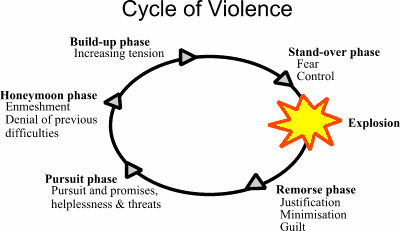
http://dlib.info/home/sla/images/Cyc.gif

From Psychology Today's blog section, Dr. Jean Kim (Culture Shrink) attempts to explain the psychology of a (male) abuser. This is an excellent post in that it does not offer easy answers (she lists a large number of conditions that can lead to violence) and she writes from the personal experience of growing up with a father who was violent to her mother.

http://ionevoxxi.files.wordpress.com/2013/07/470_5096928251355262391.gif?w=550&h=650

All of these same conditions can apply to women who abuse their male partners - and this is more common than most people are willing to admit. The rates of DV are nearly equal between the genders. But men are much less likely to report, and when men abuse, they tend to create more damage.

Why He Hits: The Psychology of an Abuser

Exploring the biological and psychological drive of abusers


Published on October 8, 2014 by Jean Kim, M.D. in Culture Shrink

The act is simple. But everything around it is not. Fist meets flesh; force makes contact. Nerve endings fire away in pain; capillaries burst; tissues swell.

The physical mutates the moment. Violence creates as it destroys. As we know from the recent 9/11 anniversary, the axis of someone’s psyche shifts after something traumatic happens. Tomorrow is never the same. In violence’s wake, a savage creation is born. A monstrous mélange of anguish, sorrow, confusion, shame, anger—and to look upon it is to look at oneself in a shattered mirror, a grotesquerie of what you thought was love, family, intimacy.

To have that moment and its afterbirth displayed for all the world to see, the monster that thrives in the shadows and corners of personal respectability and civility, is what has finally happened with the Ray Rice incident. Thanks to the era of cell phone cameras and instant media and Youtube, the personal can no longer remain private. And while there may be something to be said for the victim’s agency in choosing when to reveal private horror to others, Janay Rice has become the unwitting, unwilling poster child for an important conversation.

Aside from the myriad discussions of an abuse victim’s behavior and the crucial #WhyIStayed Twitter feed, here I have decided to focus on the perpetrator. Because as someone who grew up with a father who committed domestic violence, it is a question that has plagued me my entire life. Why does someone you love, someone who should cherish you unconditionally, treat you or your loved one cruelly? What has gone awry in that person to become an instrument of violence, both physical, and inevitably emotional?

On some level, that question has defined my entire identity and my choice of career. Not unlike the obsessions of a driven detective searching for a murderer, or of John Wayne in the classic movie The Searchers looking for years for his kidnapped missing niece, I too have obsessed over that question. I studied literature, looking for the answers in human behavior and motivations, the nature of good and evil. I became a psychiatrist, devoted to helping people who have suffered the mental fall-out from trauma, which leaves devastation in many forms, be it nightmares, isolation, depression, anxiety, self-hatred, self-destructive behaviors, and more. But I also wondered about the psyche of the aggressor, the criminal, the sociopath, who would also sometimes come under my purview.

Abusers often suffer from their own mental illnesses; a mood disorder may make them more prone to irritability and anger. Both depression and mania can manifest in heightened snappiness and quickness to attack, especially when associated with insomnia. (And in rarer severe cases, psychotic paranoia can also contribute.) Post-traumatic stress disorder (as sometimes seen in people in high-stress, high-threat careers like the military) can cause people to remain in fight-or-flight mode, leading to a chronic edginess and aggressive will to survive. An impulse control disorder may mean the person has trouble keeping wayward behaviors in check, has repetitive compulsions exacerbating stress. A traumatic brain injury or other organic brain damage (as associated often now with sports like football and boxing) may affect parts of the brain like the frontal lobe, causing disinhibition or mood changes. Addictions to substances like alcohol can also strongly exacerbate these behaviors. Some research has conjectured that testosterone can also sometimes worsen violent, antisocial, and aggressive behaviors, and adversely affect empathy.

Environment and learned behavior also contribute to abuse. Oftentimes abusers have witnessed similar behaviors in their own families, and they inevitably imitate their original role models, male or female. They may harbor severe resentment towards the gender they attack because of unresolved issues with their own parent, who may have been physically or emotionally cruel or unloving. It isn’t uncommon to end up “identifying with the aggressor,” an ego defense mechanism where you internalize the role of the powerful figure in the family, because you see abuse and dominance as power. You see this aggression as the way to behave in your later relationships and jobs, as the best way to survive, else you be the one victimized instead. Kill or be killed is the only relationship language you understand.

There is also the related issue of lack of ego strength; why would someone need to constantly control and belittle someone else to feel better about themselves? Abusers sometimes come from backgrounds where they were often belittled or grew to lack self-esteem. Usually the abuse is directed towards someone who would be considered weaker than them anyway, someone who is vulnerable, like a physically smaller female who is often younger, less educated or less financially independent, more easily manipulated. The abuser is a secret coward, never assured of their own power, even when they stack the deck heavily in their favor. (And certainly there can be male victims of abuse as well, with even more complex forms of shame and manipulation involved.)

Yet even with these biological and psychological insights as to what renders someone vulnerable to becoming violent, I still wonder what goes awry in that key moment, where someone decides to cross that line that most of us still recognize and appropriately flinch at in revulsion. Where someone lets loose with that fist, that belt, that weapon, decides to finally pull that trigger. Sometimes I still think there is a greater moral question to be asked as well of an abuser. What is causing that blind spot, that says hitting someone is okay?

Perhaps there is a rush, a thrill that goes with the transgression. There is a perverse reward going on to the circuits, that the kill has happened. It’s not that different than other trained instincts of violence we encourage in our society: be it in video games or aggressive sports or hunting or never-ending wars. Perhaps there is still a thirst for blood that is gratifying, enjoyable, and it is a thin line to cross when it comes then to a loved one who is easily and readily accessible, easy to hide.

This line-crossing may differentiate a sociopath from the rest of us. And yes, perhaps, a level of sociopathy or psychopathy is ultimately part of the picture for an abuser; a lack of empathy, even an enjoyment of inflicting cruelty or pain, a disregard for the aftermath. Although Dr. Robert Hare Ph.D., the psychologist who created the gold standard for diagnosing psychopathy, the Hare Psychopathy Scale, estimates that only 1% of the general population meets criteria for the official diagnosis, he has noted that higher numbers may have psychopathic traits and can be found in corporate businesses and other mainstream walks of life.

And although many may tend to consider domestic abuse as more of a “crime of passion” or less calculated than your stereotypical cold-blooded murder, that isn’t really the case. Oftentimes there is a longstanding pattern of manipulation and control inflicted by the abuser. Their tactics are not fleeting and isolated; they groom and master their victims quite skillfully; the callous bursts of violence are part of a larger campaign to dominate and emotionally cripple their victims so they lose their independence and will-power to leave. In this sense, given the high rates of domestic violence in our society (up to a third of women have been subjected to it according to a recent CDC study), the rates of sociopathic traits might be much higher than we realize.

Sure, all of us carry some capacity for cruelty or violence. Thanatos fights with eros for our souls—the age-old devil and angel chattering on our shoulders for control. Most of us keep our baser instincts in check. Circumstances and biology may make it easier for the line to be crossed, may bring you closer to the precipice. But it’s still your choice to release the monster. And it is a choice we must continue to acknowledge, to prosecute, and to vehemently condemn.

But that condemnation comes at a price we must acknowledge as well. Abusers come in all walks of life, all levels of society, and varying degrees of behavior. (There are definitely female abusers too, but we shouldn’t minimize the statistical reality that more men are prone to committing domestic violence.) They are human too, they can be loved and loving, they can do good as well as evil. It is not always so easy to “just leave” them or hate them. We should also stand back and view both abuser and victim with some compassion and appreciation of human and circumstantial complexity.

We need to continue to examine and address socioeconomic factors that contribute to abuse, such as war, poverty, stress, mental illness, violent entertainment, and other contributors to violence. We need to encourage mutual respect in society and healthy role-models for relationships. We need to promote love and forgiveness as well, but part of that involves recognition of a crime, recognition of the brutality of a violent act, not denial. Only when the act is acknowledged can the healing begin.

Related Links

Wednesday, September 24, 2014

Rightbloggers - Rice, Peterson NFL Scandals Really About Liberals' Plan to Pussify America

What do we expect from the knuckle draggers in the rightwing blogosphere when confronted with men hurting women? Yeah, that's right, more knuckle dragging hypermasculinity.

Roy Edroso at The Village Voice did a round up of the nonsense spewing from the right.

Rice, Peterson NFL Scandals Really About Liberals' Plan to Pussify America, Say Rightbloggers

By Roy Edroso
Sun., Sept. 21 2014


[Roy Edroso dissects the right-wing blogosphere in this weekly feature]

The NFL hasn't been having a great time of it lately, PR-wise (though its TV viewership numbers seem not to have suffered): Now even non-fans know that Baltimore Raven Ray Rice was seen cold-cocking his fiancee and Minnesota Viking Adrian Peterson allegedly beat his kid hard enough with a switch to raise welts.

As often happens when celebrities get negative publicity, we have heard opinions from several parties not intimate with these cases. Rightbloggers used the controversies to promote their pet cultural theories: For example, that it's really liberals, not football players, who beat up women, and that the NFL, which is liberal like all corporations, is being Rice-baited into paying off feminists and sissies who, like liberal sportswriters, just want to ruin America's Game for conservatives.

The most prominent conservative commentary on these cases has come from Rush Limbaugh, who you may remember attacked the NFL as liberal-biased when they wouldn't let him buy a share of the St. Louis Rams in 2009. Limbaugh has so much yak on the subject (e.g., "The NFL Collides With the PC Media Culture") that we could fill this column with it, but let's not: The lesser rightbloggers are much more fun.

Many of the brethren were outraged that popular sportswriters did not immediately ask what the big deal was, but actually acted appalled. What ever happened to the shirtsleeved drunks of yore who would have shitcanned these stories but pronto?

When CBS sportscaster James Brown blamed childhood taunts like "You throw the ball like a girl" or "You're a little sissy" for the hypermasculinity that sometimes leads to domestic violence, Ben Shapiro of FrontPageMag claimed this was ridiculous, and what would really stop such violence was two-parents-but-not-gay families.


The liberal media is using guerrilla tactics to spread negative ideas about violent jocks. (Huffington Post.)

"No man has ever hit a woman because she 'throws like a girl,' " point-missed Shapiro. "But plenty of young men have hit women because they had no moral compass and did not believe in basic concepts of virtue -- and plenty of young men lack such a moral compass and belief in virtue thanks to lack of male role models." So Shapiro pleaded fatherhood, a cause he affected to believe is "unpopular."

As for sissy-shaming, Shapiro found concern over that as absurd as concern over the Washington Redskins' team name -- or, as he was careful to put it, "that the name of the Washington Redskins matters far more to Native-Americans than the nearly half of Native-American youths who drop out of high school," perhaps hoping this would defuse the issue the way "what about black-on-black crime?" defused the Michael Brown shooting, at least among a certain demographic.

Well, at least Brown didn't get the treatment Michael Signorile got from NewsBusters, which headlined, "Breaking: Gay Liberal Radio Host Doesn't Like NFL." (Swish, and we don't mean basketball!)

At National Review, Andrew C. McCarthy criticized "tendentious 'sports journalists,' the majority of whom are decidedly left of center, [who] are much less guarded about their hostility to conservatives than their fellow progressives on the political beat." He gave exactly one example of this: ESPN allowed its own correspondent, Kate Fagan, to speak on the issue. (Fagan also writes for espnW, which McCarthy told us is "where the network focuses on women in sports and, seamlessly, on political and social matters that the Left has successfully branded 'women's issues.' ")

Fagan, as the taped interview shows, said that the issue was bigger than Ray Rice, and that she wanted the NFL to "throw the kitchen sink at domestic violence," which meant, in her opinion, going into schools and "talking to young men about dealing with anger about how they treat women: I think that's where you're going to see change...going into the school systems and the younger spaces and really reprogramming how we raise men."

This McCarthy took to mean that "boys would be instructed that differentiating men from women breeds domestic violence," and that was "how radical ideas -- like the Left's war on boys -- get mainstreamed." He proposed instead that we focus on "the breakdown of the family, the scorn heaped on chivalry, the disappearance of manners, and the general coarsening of our society that result from relentless progressive attacks on traditional values and institutions." If only boys opened doors for girls again, there'd be no need for this reprogramming! (Other key phrases in McCarthy's column: "the Obama Left's agenda," "ACORN," "Al Sharpton's National Action Network," and "Alinsky-style community organizing.")

Fagan wasn't the only woman rightbloggers were mad at. When NOW President Terry O'Neill complained about the Rice incident, Larry Elder roared, "What about NOW's indifference toward, if not acceptance of, the late Sen. Ted Kennedy's sordid record of disgusting behavior toward women?" Also, what about Bill Clinton, Juanita Broaddrick, Kathleen Wiley, Paula Jones, and Gennifer Flowers? How come their video footage didn't make NOW mad? (For more of the same, see radio shouter Mark Levin.)

Disdaining Brown's "wild attempt to connect the Ray Rice incident to a sexist culture in the NFL," George Neumayr of the American Spectator said oh yeah what about Islam critic Ayaan Hirsi Ali, who had recently spoken without incident at Yale University? "When someone like Hirsi Ali makes a far more serious case for violence against women grounded in Islamic tradition, the Left throws a fit," said Neumayr. Why, those Muslims are almost as bad as Ted Kennedy.

"If women are the same as men, then how can they argue that a woman beaten by her boyfriend deserves special protection?" oh-shit-not-this-again'd Gina Loudon at WorldNetDaily. Loudon then argued that feminist doctrine -- specifically that "there is no difference between men and women," which we believe comes from Our Bodies, Ourselves -- meant that "you can't say that male abusers are more at fault than female abusers." But "despite old feminists' fantasies," she added, "women and men are not the same. American women are waking up to that fact, and as the co-author of a new book, 'What Women Really Want,' " etc., link to purchase provided.

At the New American, Selwyn Duke said oh yeah, what about Bill Clinton, Bob Filner, and Bob Packwood? Then, having run out of prominent Democrats to talk about, Duke posited that "it is liberal men -- feminist-oriented men -- who are most likely to abuse women." See, churchgoing people tend to be Republicans, and in one study churchgoers self-reported less domestic abuse than non-churchgoers. Libs hate God, so case closed!

If you need more, Duke said, "just consider feminist dogma. Liberals assert that men will treat women better if we scrap antiquated ideas such as chivalry, thought to be condescending, and passionately embrace notions of equality, which, liberals insist, means teaching boys to treat the sexes the same. Let's translate this: so we're telling little boys to treat girls the way they would other boys. And how might that be?" Translation: Equality means you get to smack a bitch up.

"This should a true 'duh' moment," added Duke. Indeed.

Some of the brethren saw in critics of off-the-field NFL violence evidence of what might be called Rice-baiting -- that is, Rice-pimping the unfortunate incidents to generate cash for their Rice-related causes.

"THE LEFT PREPARES TO CASH IN ON RAY RICE," cried Paul Mirengoff at Power Line.

"Whenever an institution becomes as massive as the NFL, the ideologically driven will attempt to enlist the institution for their own purposes," Mirengoff went on. Along with the more obvious ideologues, "some corporate sponsors -- Marriott Hotels, FedEx, PepsiCo and maybe others -- have also gotten into the act," not because they are, as recent history shows, PR-obsessed weasels, but because they "want to stay on the good side of liberal pressure groups like NOW....Corporate America is prone to roll over (up to a point) for liberal pressure groups. They do so in part because corporate America is, itself, liberal..." That explains all those diversity programs -- and now they're going to teach married people not to beat each other up! What is this, Russia?

At End of the American Dream, Michael Snyder went further: "the NFL has become a circus of political correctness," he claimed. For example, "the NFL recently banned advertisements from 'Slap Ya Mama Cajun Products.' " Why would they do that during a domestic violence controversy? Must be political! Worse, Snyder reported, NFL players wear pink accoutrements during Breast Cancer Awareness Month. Soon they'll be wearing bras and panties, like Billy Martin predicted!

The Rice issue had not cooled when the world discovered the welts on Peterson's son, and suddenly we were hearing about the pros and cons of corporal punishment from amateur child-rearing experts across the country, including Sean Hannity, who said his old man beat him pretty good and he came out all right, which self-activating joke we're sure you've already gotten.

The brethren seemed a little tired by the time the Peterson case came up, but some put in solid effort to extract conservative points from it, with predictable results.


Aw, so cute, with little stars like when Nancy and Sluggo got beaten till they bled! (The Cagle Post.)

"NFL Star Adrian Peterson Is Facing Serious Jail Time For Something Our Parents Did Every Day," headlined Western Journalism (over photographs of the welts on the kid's legs).

Douglas V. Gibbs talked at the Canada Free Press about how he got beat with a switch as a kid, and though he retroactively approved of that, his wife wouldn't let him spank their own kids. Gibbs said the kids came out OK, though "I do believe their transition into adulthood would have been smoother had they been disciplined in a stronger manner as they were growing up." (We wonder what his wife thinks of this, assuming she's still around.)

However, Gibbs went on, "some people believe that any physical discipline, especially if an instrument is used, is abusive, and they have decided to force their view upon parents that do not agree with them...'If only,' they must've been thinking, 'if only we had a poster child, a high profile person to fry for his abusive disciplinary techniques, so that we can drive home the idea that whoopin's are child abuse.'"

And then the Devil delivered unto them Adrian Peterson! "Remember, people like Hillary Clinton says [sic] that parents can't be trusted with the raising of their children, and that it 'takes a village to raise a child,' " claimed Gibbs. "They are foaming at the mouth with the good fortune of the Peterson story falling in their laps...They did it with Sandy Hook when it came to Gun Control, and they are doing it with Adrian Peterson..." Try and keep this stuff quiet, guys -- admittedly, that's tough to do with mass murder, but there are ways to hit kids that don't leave marks.

At Hot Air, Jazz Shaw said the "dog pile on the NFL in general and Commissioner Roger Goodell in particular" was "not dissimilar to the general gang mentality which has so many broadcasters ready to pile on the police in every nook and cranny of the country in the wake of the Ferguson case."

Jack Cashill at American Thinker also had a Ferguson angle: "For all its controlled violence, football provides young men, many of them from troubled homes, with all the discipline they will ever know," he wrote. "Had Ferguson's Michael Brown -- all 6'4", 295 pounds of him -- grown up in a halfway functional household he would likely be alive and playing offensive tackle for some college today." Probably would have gotten out of some traffic tickets as well, unless liberals have ruined that for us, too!

"This is all so wildly disproportionate," sputtered National Review's Rich Lowry -- he was talking about the negative reactions, we should make clear, not the writings of his fellow rightbloggers -- "that perhaps something more than the usual ax-grinding, ratings chase, and group think is at work. It may be that these cases are ways to express a deeper discomfort with the NFL, which sacrifices men's bodies and minds for our viewing pleasure every week." And who might be expressing that discomfort? Maybe sissies -- if we're still allowed to use that noble word!

"The problem with this particular cultural conversation," said Lowry's colleague Nancy French, is "it's hard to conduct it rationally while looking at the photos of a little boy's legs. Peterson said he went overboard in his spanking that day. He didn't do it right." (Pro tip: Next time, try the rubber hose.) "Yet the Left demands that the Peterson case simply be the end of the question, the end of the spanking era."

French supported this last assertion with a quote from an anti-spanking advocate whose authority to speak for the Left must have been voted when we were out of the room. ("The Left, of course, knows the art of spinning a tale," she added; you have to admire her chutzpah.) But in rightblogger-world, nothing's either good or bad, but its propaganda potential makes it so.

Let us close with Eric Golub of Communities Digital News, one of the rare defenders of NFL commissioner Goodell, whose job is jeopardized by these scandals. "Goodell is not being attacked for anything he has done or failed to do," said Golub. "He is being attacked for his mere being."

What Golub meant was that Goodell's father was a Republican senator, and "Goodell is married to Jane Skinner, who used to be a widely respected on-air personality at Fox News. That sounds like a pretty Republican household." By contrast, sportswriters are a bunch of commies ("NBC's Bob Costas has also aggressively pushed gun control").

Golub's nut graf (in one sense, anyway) was this:
"The NFL makes plenty of money, just like Walmart and those oil companies liberals hate so much. The NFL is violent, which bothers the leftist peaceniks as much as they are bothered by gun manufacturers. It is male-dominated, which offends the radical feminists. It is pro-military and overtly pro-American, which the left derides as jingoistic. Commissioner Goodell is tall, handsome, white, male and married to a beautiful blonde wife. He also has perfect hair. He is everything the liberal media loathes."
We tend to think of conspiracy theorists as nuts raving about chemtrails, but really -- when you're that deeply immersed in partisan politics, anything that happens can be part of one.

Sunday, September 21, 2014

Domestic Violence Appears More Likely for Same-Sex Couples

http://www.washingtonblade.com/content/files/2014/03/domestic_violence_insert_by_Bigstock.jpg

I've seen research suggesting that this is true in the past - but this adds to the evidence. It would be useful, too, to get a more comprehensive assessment of male same-sex domestic violence. As the article below notes, most of the research has been conducted on lesbians, not gay men or bisexuals.

We need to increase prevention eduction to the LGBT community, not just professional athletes and other high profile people.

Domestic Violence More Likely for Same-Sex Couples

By Janice Wood Associate News Editor
Reviewed by John M. Grohol, Psy.D. on September 21, 2014


Domestic violence occurs at least as frequently — and likely more so — between same-sex couples, according to a review of literature conducted by researchers at Northwestern Medicine.

“Evidence suggests that the minority stress model may explain these high prevalence rates,” said senior author Richard Carroll, associate professor in psychiatry and behavioral sciences at Northwestern University Feinberg School of Medicine and a psychologist at Northwestern Memorial Hospital.

“Domestic violence is exacerbated because same-sex couples are dealing with the additional stress of being a sexual minority. This leads to reluctance to address domestic violence issues.”

Previous studies have shown that domestic violence affects 25 percent to 75 percent of lesbian, gay, and bisexual individuals. However, researchers believe that a lack of representative data and underreporting of abuse suggests even higher rates.

An estimated 25 percent of heterosexual women experience domestic abuse, according to researchers, who note that that percentage is “significantly lower” for heterosexual men.

“There has been a lot of research on domestic violence, but it hasn’t looked as carefully at the subgroup of same-sex couples,” Carroll said. “Another obstacle is getting the appropriate samples because of the stigma that has been attached to sexual orientation. In the past, individuals were reluctant to talk about it.”

The research that has examined same-sex domestic violence has concentrated on lesbians rather than gay men and bisexuals, according to the Northwestern scientists.

“Men may not want to see themselves as the victim, to present themselves as un-masculine and unable to defend themselves,” Carroll said.

He suggests that homosexual men and women may not report domestic violence for fear of discrimination and being blamed for abuse from a partner. They also may worry about their sexual orientation being revealed before they are comfortable with it.

“We need to educate health care providers about the presence of this problem and remind them to assess for it in homosexual relationships, just as they would for heterosexual patients,” Carroll said.

“The hope is that with increasingly deeper acceptance, the stress and stigma will disappear for these individuals so they can get the help they need.”

The review was published in the Journal of Sex & Marital Therapy.

Source: Northwestern University

Monday, September 15, 2014

One in Five Men Reports Violence Toward Intimate Partners

http://cdn.medicalxpress.com/newman/gfx/news/2014/oneinfivemen.jpg

That is a scary number, but it matches the number of women who report being the victims of intimate partner violence. It's worth noting, however, since it is seldom discussed, that intimate partner violence is almost equally perpetrated by women and men (53% by men, 47% by women, according to the CDC), but men cause more damage.

One in five men reports violence toward intimate partners


September 15, 2014
Source: University of Michigan Health System

Summary:
Intimate partner violence is more prevalent than diabetes, research shows. One in five men in the U.S. reports violence towards their spouse or significant other, says a new nationally-representative study. The analysis also found that male aggression toward a partner is associated with warning signs that could come up during routine health care visits, including irritable bowel syndrome (IBS) and insomnia, in addition to better known risks like substance abuse and a history of either experiencing or witnessing violence as a child.
One in five men in the U.S. reports violence towards their spouse or significant other, says a new nationally-representative study by the University of Michigan.

The analysis also found that male aggression toward a partner is associated with warning signs that could come up during routine health care visits, including irritable bowel syndrome (IBS) and insomnia, in addition to better known risks like substance abuse and a history of either experiencing or witnessing violence as a child.

The findings appear in the Journal of the American Board of Family Medicine and are based on the most recent data available from the National Comorbidity Survey-Replication from 2001-2003. The survey assesses intimate partner violence and characteristics among male perpetrators.

"When people think of men who abuse their partners, they often think of violent people who they have never come across, or people they have only heard about in the news," says lead author Vijay Singh, M.D., MPH, MS, a clinical lecturer in the Departments of Emergency Medicine and Family Medicine at the University of Michigan Medical School.

"However, our study showed one out of every five men in the U.S. reported physical violence toward an intimate partner. It's likely that we've all met these men in our daily environment. This is an issue that cuts across all communities, regardless of race, income, or any other demographics."

Domestic violence has become a growing health concern. In the U.S. each year, roughly 320,000 outpatient health visits and 1,200 deaths among women are due to intimate partner violence, and $8.3 billion is spent in related medical and mental health services alone. The new U-M findings show that the prevalence of partner violence in the country is even greater than that of diabetes.

The subject has also recently been in the headlines, with the case of NFL running back Ray Rice. The Baltimore Ravens released Rice after a video of him hitting his wife in a casino elevator surfaced in the news.

The U-M study found that more than half of the men who reported violence toward a partner had at least one routine health visit over the last year and nearly one third noted at least one emergency room visit over the last year.

"Most of our efforts to prevent intimate partner violence have focused on screening and improving outcomes for women who are victims, because their health and well-being is our priority. Very little work, however, has been done on how to identify male perpetrators," says Singh, who is also a member of the University of Michigan Injury Center and Institute for Healthcare Policy and Innovation.

"Our research shows that male perpetrators of intimate partner violence seek routine medical services, and they have physical symptoms that are common reasons patients seek medical care. This suggests that we may be missing an important opportunity in the primary care setting to identify their aggressive behavior and potentially intervene."

Singh says further work needs to be done on developing identification and intervention programs focused to on male aggression toward a partner.

The nationally-representative sample included 530 men with an average age of 42. Roughly 78 percent were non-Hispanic white, 56 percent were educated beyond high school and 84 percent were employed.

Intimate partner violence was defined as pushing, grabbing, shoving, throwing something, slapping or hitting, kicking, biting, beating up, choking, burning or scalding, or threatening a partner with a knife or gun.

Story Source:
The above story is based on materials provided by University of Michigan Health System. Note: Materials may be edited for content and length.

Journal Reference:
V. Singh, R. Tolman, M. Walton, S. Chermack, R. Cunningham. (2014). Characteristics of Men Who Perpetrate Intimate Partner Violence. The Journal of the American Board of Family Medicine; 27(5): 661 DOI: 10.3122/jabfm.2014.05.130247

The National Intimate Partner and Sexual Violence Survey (NISVS) infographic

Sunday, July 27, 2014

Omnivore - Men's Issues

From Bookforum's Omnivore blog, this collection of links on men's issues should give you plenty to read for a Sunday afternoon.

Men's Issues

Jul 24 2014
3:00PM

Thursday, May 29, 2014

New Insights Into Why Some Men Assault Women


New research reveals what many of us have known for years - men who are insecure in their masculinity are more likely to commit intimate partner violence. This is article is particularly relevant to the killings at UCSB on Friday of last week. That young man was incredibly insecure in his masculinity, not to mention in his sense of self as a whole.

Granted, most men who fit this profile do not progress beyond beating and/or emotionally abusing their partners, but fueled by grandiosity and delusions, with some misogyny from the MRAs and PUAs thrown in to make it even more toxic, Elliott Rodger exemplifies the most extreme end of the violence curve -  it's no longer a woman, it's all women; and it's no longer physical abuse, it's murder (and torture in his fantasies).

The article appears (will appear - this is an "online early" offering, likely due to the killings in Isla Vista) in Personality and Individual Differences (Volume 68, October 2014, Pages 160–164). The abstract is followed by a summary of the research from Pacific Standard (the article is pay-walled).

Full Citation:
Reidy, DE,  Berke, DS, Gentile, B, and Zeichner, A. (2014, Oct). Man enough? Masculine discrepancy stress and intimate partner violence. Personality and Individual Differences; 68, Pages 160–164. doi: 10.1016/j.paid.2014.04.021

Man enough? Masculine discrepancy stress and intimate partner violence

Dennis E. Reidya, Danielle S. Berkeb, Brittany Gentileb, Amos Zeichner

Highlights
  • Masculine socialization has been theorized to predispose men to IPV.
  • However, gender role discrepancy stress has not been investigated.
  • Gender role discrepancy stress and IPV were assessed via the M-Turk website.
  • Discrepancy stress predicted psychological, physical, and sexual IPV.
  • Implications for prevention are discussed.
Abstract

Research on gender roles suggests that men who strongly adhere to traditional masculine gender norms are at increased risk for the perpetration of violent and abusive acts toward their female intimate partners. Yet, gender norms alone fail to provide a comprehensive explanation of the multifaceted construct of intimate partner violence (IPV) and there is theoretical reason to suspect that men who fail to conform to masculine roles may equally be at risk for IPV. In the present study, we assessed effect of masculine discrepancy stress, a form of distress arising from perceived failure to conform to socially-prescribed masculine gender role norms, on IPV. Six-hundred men completed online surveys assessing their experience of discrepancy stress, masculine gender role norms, and history of IPV. Results indicated that masculine discrepancy stress significantly predicted men’s historical perpetration of IPV independent of other masculinity related variables. Findings are discussed in terms of potential distress engendered by masculine socialization as well as putative implications of gender role discrepancy stress for understanding and intervening in partner violence perpetrated by men.

* * * * * * * * *

New Insights Into Why Some Men Assault Women

By Tom Jacobs • May 28, 2014


http://d1435t697bgi2o.cloudfront.net/wp-content/uploads/2014/05/ucsb-lagoon.jpg
A view over the University of California-Santa Barbara's lagoon to one of the Channel Islands. (Photo: Superchilum/Wikimedia Commons)


For some, the sense that they are not sufficiently masculine leads to stress, and ultimately to striking out at the women closest to them.
Last weekend’s tragic events outside the University of California-Santa Barbara, have ignited an impassioned national conversation about misogyny, male anger, and violence against women. Timely new research suggests physical abuse against wives and girlfriends may be triggered by a specific psychological state: The emotional stress that can result when males perceive themselves as less masculine than their peers and cultural role models.

A research team led by Dennis Reidy, a violence-prevention scholar at the Centers for Disease Control and Prevention in Atlanta, refers to this as “discrepancy stress,” and defines it as “a form of distress arising from perceived failure to conform to socially prescribed masculine gender role norms.”

In the journal Personality and Individual Differences, the researchers present evidence of a link between this type of stress and interpersonal violence, even “independent of other masculinity related variables.”

Along with three colleagues from the University of Georgia, Reidy conducted a study of 600 heterosexual American men who were recruited online. Along with basic demographic information, study participants responded to a series of statements revealing how they view their own masculinity.

On a one-to-seven scale, they expressed their level of agreement or disagreement with such statements as “I am less masculine than the average guy,” “I worry that people judge me because I’m not like the typical man,” and “I wish I was more manly.”

In addition, they noted the extent to which they endorse traditional gender roles, and the “degree of conflict” they encounter when such roles are challenged. Finally, they reported the extent to which they have engaged in “psychological, physical, or sexually violent behavior” with their current partner, most recent partner, or past partners.

The key result: Men who felt stress over their perceived inadequate level of masculinity were more likely to have admitted abusing their partners, even after a variety of other factors were taken into consideration.

“Men who experience stress related to perceiving themselves as being less masculine than the typical man—or believing that they are perceived as such by others—may be more likely to interpret ambiguous interactions as challenges to their masculinity,” Reidy and his colleagues write.

“Thus, it would be reasonable to expect that these men would be more likely to respond in a manner intended to demonstrate and, perhaps, bolster their masculine status.”

Acts of physical violence, they chillingly add, are “common methods of demonstrating masculinity.”

The researchers found that men who did not fit into traditional masculine roles but felt comfortable about that were not, on average, more likely to abuse their partners. Rather, violent behavior was specifically linked to the “experience of distress” over one’s perceived lack of masculinity.

The researchers add several cautionary notes to their study. They concede that self-reports of interpersonal violence may not be entirely accurate, as some men surely underreported how often they engage in such activity. In addition, their study does not address women-on-men violence or violence among same-sex couples.

Finally, the correlation they found is not proof of causation. It’s conceivable (although not likely) that committing acts of violence against women led them to doubt their masculinity, rather than the other way around.

These caveats aside, their study provides new insights into the roots of male-on-female violence, and may point toward ways of preventing it. Such efforts “should focus on the role of masculine socialization, acceptance of gender norms, and how they may engender distress in adolescents and adult men,” the researchers write.

“Intervening at an early age to prevent violence in teen dating relationships may avert a series of consequences across the lifespan,” they conclude, “including the perpetration of interpersonal violence in future adult relationships.”


~ Staff writer Tom Jacobs is a veteran journalist with more than 20 years experience at daily newspapers. He has served as a staff writer for The Los Angeles Daily News and the Santa Barbara News-Press. His work has also appeared in The Los Angeles Times, Chicago Tribune, and Ventura County Star.

More From Tom Jacobs

Tuesday, April 29, 2014

The Larger Your Penis, The More Likely Your Wife Will Cheat (in Kenya)

Irony, that. You can read the abstract for the study below this piece from the Huffington Post (the whole study is open access on PLoS ONE). The good news for American men is that this study involved women married to fishermen along Lake Victoria in Kisumu County, Kenya, so there is likely some cultural and values-based issues that Huffington Post chose not to mention in their provocative title.

See what the HP article does not mention until near the bottom is that penis size ranked third on the list of reasons they women had affairs - domestic violence and being denied a preferred sex position were one and two, respectively.

The Larger Your Penis, The More Likely Your Wife Will Cheat Says New Study

The Huffington Post | by Taryn Hillin
Posted: 04/23/2014


Men often view having a large member as a symbol of strength and sexual prowess. But it turns out, when it comes to keeping a woman satisfied, bigger may not be better.

Contrary to popular belief, a new study out of Kenya found that husbands with larger penises were more likely to be cheated on by their wives (shocking, we know).

For the study -- published this month in PLOS One -- researchers interviewed 545 married couples in Kenya in order to better understand their relationship habits and, more specifically, to identify factors which contributed to women having extramarital affairs.

Researchers asked both partners to self-report the male's erect penis size (they had a 15 inch ruler on hand for reference). Then, if there were differences between the estimates (which there were), they either took the average of the two or went with the estimate from the partner who was less likely to fib.

What they found was rather shocking:

"Every one inch longer penis increased the likelihood of women being involved in extra-marital partnership by almost one-and-half times," the researchers wrote. "Women associated large penises with pain and discomfort during sex which precludes the enjoyment and sexual satisfaction that women are supposed to feel."

In fact, one woman interviewed for the study told the researchers the following: "Some penis may be large yet my vagina is small, when he tries to insert it inside, it hurts so much that I will have to look for another man who has a smaller one [penis] and can do it in a way I can enjoy."

According to the study, 6.2 percent of the 545 females had affairs during the six-month study. Other factors that increased the likelihood of women straying outside the marriage included domestic violence, being denied sex or denied preferred sexual position, being under age of 25 and a lack of sexual satisfaction.

Researchers focused on female infidelity specifically because of the prevalence and spread of HIV among women in the region. Researchers felt if they could identify reasons for unprotected sex, they might better prevent it.
* * * * *

Here is the full abstract - follow the title link to see the whole article (open access).

Full Citation: 
Kwena Z, Mwanzo I, Shisanya C, Camlin C, Turan J, et al. (2014, Apr 18). Predictors of Extra-Marital Partnerships among Women Married to Fishermen along Lake Victoria in Kisumu County, Kenya. PLoS ONE; 9(4): e95298. doi: 10.1371/journal.pone.0095298

Predictors of Extra-Marital Partnerships among Women Married to Fishermen along Lake Victoria in Kisumu County, Kenya

Zachary Kwena, Isaac Mwanzo, Chris Shisanya, Carol Camlin, Janet Turan, Lilian Achiro, Elizabeth Bukusi

Abstract

Background

The vulnerability of women to HIV infection makes establishing predictors of women's involvement in extra-marital partnerships critical. We investigated the predictors of extra-marital partnerships among women married to fishermen.
 

Methods

The current analyses are part of a mixed methods cross-sectional survey of 1090 gender-matched interviews with 545 couples and 12 focus group discussions (FGDs) with 59 couples. Using a proportional to size simple random sample of fishermen as our index participants, we asked them to enrol in the study with their spouses. The consenting couples were interviewed simultaneously in separate private rooms. In addition to socio-economic and demographic data, we collected information on sexual behaviour including extra-marital sexual partnerships. We analysed these data using descriptive statistics and multivariate logistic regression. For FGDs, couples willing to participate were invited, consented and separated for simultaneous FGDs by gender-matched moderators. The resultant audiofiles were transcribed verbatim and translated into English for coding and thematic content analysis using NVivo 9.
 

Results

The prevalence of extra-marital partnerships among women was 6.2% within a reference time of six months. Factors that were independently associated with increased likelihood of extra-marital partnerships were domestic violence (aOR, 1.45; 95% CI 1.09–1.92), women reporting being denied a preferred sex position (aOR, 3.34; 95% CI 1.26–8.84) and spouse longer erect penis (aOR, 1.34; 95% CI 1.00–1.78). Conversely, women's age – more than 24years (aOR, 0.33; 95% CI 0.14–0.78) and women's increased sexual satisfaction (aOR, 0.92; 95% CI 0.87–0.96) were associated with reduced likelihood of extra-marital partnerships.
 
Conclusion

Domestic violence, denial of a preferred sex positions, longer erect penis, younger age and increased sexual satisfaction were the main predictors of women's involvement in extra-marital partnerships. Integration of sex education, counselling and life skills training in couple HIV prevention programs might help in risk reduction.

Wednesday, July 31, 2013

Nick Smithers - Why We Have To Talk About Male Victims of Domestic Violence

From the Good Men Project, Nick Smithers tries to raise public awareness about male victims of domestic violence (in Scotland). The numbers in this country are sobering.

According to research by the Domestic Violence Research Group, intimate partner violence (IPV) is essentially bi-directional, and when it's unidirectional (aside from sexual coercion) women are more often the perpetrators (nearly 2:1 on average), yet men are more often arrested or incarcerated.
In conclusion, our results demonstrate the amount of overall IPV differed significantly among samples, but the percent that was categorized as bi-directional did not. This indicates that bi-directional violence is a common IPV pattern and suggests that women play a larger role in the occurrence of IPV than previously thought. Such findings have considerable implications for assessment, legal, intervention, and preventive efforts. It is suggested that if one resolution of the gender symmetry/asymmetry debate is to argue that there are subtypes of male and female intimate partner violence perpetrators, or that there are different patterns of violence amongst relationships characterized by IPV (Johnson, 2005; Johnson, 2006), researchers and clinicians will need to work to together to determine how to reliably and meaningfully make these determinations in ways that will facilitate our ability to effectively prevent and treat all types of IPV.
Here are some very sobering statistics on the rates of IPV and whether it is bi-directional, MFPV (male to female) or FMPV (female to male) among three populations (epidemiological, community, and college):
Among epidemiological/population samples, the average weighted rate of IPV reported was 16.3% (22.1% unweighted). Using weighted averages, among those reporting IPV, 57.9% of the IPV reported was bi-directional. Of the remaining 42.1% that was reported as uni-directional IPV, 13.8% was MFPV, 28.3% was FMPV, and the ratio of uni-directional FMPV to MFPV was 2.05 weighted (2.02 unweighted).
Among community samples, the average weighted rate of IPV reported was 47.0%. Using weighted averages, among those reporting IPV, 59.6% was bidirectional. Of the remaining 40.4% that was reported as uni-directional IPV, 17.5% was MFPV, 22.9% was FMPV, and the ratio of uni-directional FMPV to MFPV was 1.30 weighted (1.98 unweighted).
Among school and college samples, the average weighted rate of IPV reported was 39.2%. Using weighted averages, among those reporting IPV, 51.9% was bi-directional. Of the remaining 48.1% that was reported as uni-directional IPV, 16.2% was MFPV, 31.9% was FMPV, and the ratio of uni-directional FMPV to MFPV was 1.96 weighted (2.18 unweighted).
This information remains relatively unknown among the general population. This silence about gender-based violence is perpetuated by the overwhelming emphasis on male-perpetuated violence, which does tend to be more violent when it occurs.

Why We Have To Talk About Male Victims of Domestic Violence

JULY 27, 2013 BY NICK SMITHERS 


Nick Smithers works for a Scottish charity that wants male victims to be included in the public perception of domestic violence.


I recently started a new job as the National Development Officer for Abused Men in Scotland (AMIS), a charity that’s been working to improve services of male victims of domestic violence since 2010. Part of my role is to raise awareness of male victims which often means taking our message to events where the focus has traditionally been on women. Which is why, earlier this year I ending up co-presenting a workshop with a representative of a prominent organisation which provides essential supports to women who are fleeing abusive partners.

Conversations about male and female victims of domestic violence can often get reduced to arguments about gender politics. AMIS works hard to avoid this type of dialogue. As a frontline service we bring real expertise of working with male victims and we back this up with rigorous and original research such as our recent report on Men’s Experience of Domestic Abuse in Scotland.

One of the key themes that has emerged from our research is the extent to which the “public story” of domestic abuse is extremely pervasive—that being the notion that domestic abuse is perpetrated almost exclusively by men against women. It’s one thing knowing this, the challenge we face is finding ways to create a new public story that accounts for both male and female victims.

♦◊♦

As I sat in the hall awaiting the call to step up to stage and begin my presentation I was approached by the chairperson and informed that we would be joined by the Queen’s daughter the Princess Royal and asked whether I knew royal protocol. Well for those of you who live in more evolved democracies such things as royal protocol are likely to be something of a mystery – well, they are also a mystery to me, Scots born and bred. My innate urge to conform overcame any rebelliousness and I stood when expected, sat when instructed and generally behaved myself – I wanted to make friends and influence people of course.

While I sat on stage and listened to the informative and moving presentation by my co-presenter, my anxiety grew, as the heightened atmosphere in the hall became apparent. As my co-presenter sat down there was much muttering and whispering and I could see that there was some disagreement between Her Royal Highness and her consort. Horror, against her will the Princess was being ushered from the room before having the opportunity to hear about the experience of men in Scotland who are victim to domestic abuse, she turned and offered an apology to me as she was led away and I took to the lectern.

Well I hope I can say confidently that she missed something, as the talk attracted a good deal of interest and the majority of questions afterwards were related to my presentation. Many of the professionals from around Europe recognised the iniquity that I related affecting men. I had described the ingrained, gendered conceptualisation which renders male victimhood counter-intuitive. This can create a service vacuum where repeat victimisation of men can become a common occurrence from an uncomprehending system.

I was asked my view on the introduction of the term “gender based violence” (GBV) to replace ‘domestic abuse’ in many official publications and discourse. I suggested that this could be another barrier to men getting help as the implication was that GBV was male on female—the standard assumption. My co-presenter intervened to make what, to me, was a telling clarification. It was asserted that GBV was not about ‘who does what to whom’ but about why some people were victimised due to their gender.

♦◊♦

My co-presenter then stated that social construction theory explains this phenomenon as it illuminates the fact that men are brought up to control women and that this is the context for domestic abuse. Well I was somewhat taken aback by this statement which I could neither relate to on a personal level as a man nor on a professional level having worked with men in a deprived area of Edinburgh for six years.

This exchange has been reverberating in my mind since then. It seems to encapsulate an ideology which is the hidden, guiding hand of domestic abuse policy here in Scotland and beyond. While it was surprising for me to hear such a political definition of sex roles it was highly instructive as to why abused men in Scotland often suffer in silence.

Men experiencing domestic abuse can feel stigmatised and ashamed. In many cases men will not recognise their experience as domestic abuse such is the prevalence of the public story- they will believe it is something which only happens to women. It is imperative that the narrative around domestic abuse shifts to allow gender inclusive language to become the norm.

The first step is the recognition that significant numbers of men are experiencing domestic abuse but often feel that they have nowhere to turn for help.

I believe that if we keep speaking out for male victims then the public story about domestic violence will change and everyone — including the Princess Royal—will recognize that both male and female victims of domestic violence need our help and support.

♦◊♦

Photo Credit: Flickr/The New Institute

Wednesday, June 5, 2013

The Psych Files Podcast - Ep 196: What Men Need to Do to End Violence Against Others


From The Psyche Files Podcast, Michael A. Britt, Ph.D., former Assistant Professor of Psychology at Marist College, a new podcast on what men need to do to end violence against others.

The Psyche Files: Ep 196: What Men Need to Do to End Violence Against Others

Podcast: Download


Are jail time and new laws the only answers to men’s violence against women, children, and other men? Or is there something every man can do to end these tragedies? In an earlier episode of The Psych Files in which I discussed Blaming the Victim, I talked about why there’s a tendency to blame victims and to overlook the Optimism Bias that we all share (particularly younger folks). But podcast listener and psychotherapist Jackie Henry felt that I didn’t go far enough in that episode, and she was right. We – especially men – need to think carefully about the way we talk about women in our everyday lives. Was that joke really funny? Or was it one of the small ingredients that eventually adds up to – or contributes to – the ongoing violence and lack of empathy that those with power express toward those without it. We take up this important issue in this episode of The Psych files.


We say to ourselves, ‘What can I do? I’m only one person. How can we change the system?’ I think you move through that and you realize that there are small things you can do. Once we work on the individual level eventually that’s how bigger things change – Jackie Henry

Friday, May 31, 2013

This Is What a Good Man Looks Like . . . Patrick Stewart

I have admired Patrick Stewart as an example of a good man for several years. He always has seemed humble and grateful, yet is one of the most talented actors of his generation or any other. When he began to speak out about the domestic violence he lived with as a child (see here and here), my respect for him increased substantially.

A blogger at the Comicpalooza in Texas, held on Memorial Day weekend, thanked him for a speech he gave on domestic violence at an Amnesty International event. She said she had been through a similar event in her life and thanked him for speaking out.

From there, things got personal . . . .

Patrick Stewart hugs domestic-abuse survivor, tells of violence in his childhood


Gael Fashingbauer Cooper
TODAY

Patrick Stewart told the Comicpalooza audience that his mother was blamed for the abuse rained on her by his father.

On television, he was the almost unflappable Captain Jean-Luc Picard on "Star Trek: The Next Generation." But Patrick Stewart was raised in a poor household with an abusive father, and the experience gave him the fire to work for such causes once he had the fame to make himself heard.

Stewart appeared at Comicpalooza in Texas over the Memorial Day weekend, and while there, answered questions from audience members.

Heather Skye, who blogs at Lemon Sweetie, thanked Stewart for a speech he gave at an Amnesty International event about domestic violence, saying that she had come through a similar event and appreciated his speaking out, and asked him about what non-acting work he's the most proud of.

And then things got personal. Stewart, who has spoken about his father's abuse before, referenced his own childhood in 1940s England. "The work that I do in campaigns about violence towards women, particularly domestic violence, grew out of my own childhood experience," he said.


He discussed the specific groups he works with, and went on to say, "I do what I do in my mother's name, because I couldn't help her then. Now I can."

Stewart said his father, a World War II veteran, was then said to suffer from severe shellshock, but would today be diagnosed with post-traumatic stress disorder. He works with both the veterans' mental-health charity Combat Stress as well as the domestic-violence shelter Refuge, saying he does so because of both of his parents.

"As a child, I heard in my home doctors and ambulance men say, 'Mrs. Stewart, you must have done something to provoke him,'" Stewart said to Skye and the crowd. "'Mrs. Stewart, it takes two to make an argument.' Wrong! WRONG! My mother did nothing to provoke that, and even if she had, violence is never ever a choice that a man should make. Ever!"

The crowd gave Stewart a standing ovation, and shortly after, he walked into the crowd and hugged Skye. She wrote on her blog, "He told me 'You never have to go through that again, you’re safe now.' I couldn’t stop thanking him. His embrace was so warm and genuine. It was two people, two strangers, supporting and giving love. And when we pulled away he looked (straight) in my eyes, like he was promising that. He told me to take care. And I will."

Sunday, March 10, 2013

Sir Patrick Stewart Calls on ‘One Million Men’ to Promise an End to Violence Against Women


In the U.S., Congress finally renewed the Violence Against Women Act (VAWA) and President Obama signed the legislation that provides money for domestic violence shelters, financial support for non-profits that offer therapy services to survivors of domestic violence, sexual assault, and other acts of violence, and other acts of violence, and extends to education efforts to end dating violence and stalking as well.

From Wikipedia:
One of the greatest successes of VAWA is its emphasis on a coordinated community response to domestic violence, sex dating violence, sexual assault, and stalking of women; courts, law enforcement, prosecutors, victim services, and the private bar currently work together in a coordinated effort that had not heretofore existed on the state and local levels. VAWA also supports the work of community-based organizations that are engaged in work to end domestic violence, dating violence, sexual assault, and stalking against women, particularly those groups that provide culturally and linguistically specific services. Additionally, VAWA provides specific support for work with tribes and tribal organizations to end domestic violence, dating violence, sexual assault, and stalking against Native American women.
Part of the opposition from the GOP to renewing this law was the new inclusion of same-sex couples in the list of protected groups, an increased ability for tribal courts to rule on cases involving non-tribal defendants, and provisions allowing battered illegal aliens to claim temporary visas.


Meanwhile, on Friday in New York . . .
"Sir Patrick Stewart stood in the center of the Diplomat Ballroom at the UN Hotel here on Friday, pounding his fist methodically against a podium, each thump punctuated with a number ("One ... two ... three ...") until he got to nine.

"Every nine seconds a woman is assaulted or beaten in the United States," Stewart said.
Stewart was serving as host for an event to launch "Ring The Bell," "a global campaign calling on one million men to make one million "concrete, actionable promises" to end violence against women."

Stewart grew up in a violent home, making him an ideal spokesperson for this event and for the new initiative to gather one million to stand against domestic violence.
"I became an expert on when to open the door and throw myself between my father's fist and my mother's body," Stewart said. 
He said his father "was unable to control his emotions—and his hands." 
"My mother did not do anything to provoke my father," Stewart added. "But even if she did, violence is not the answer."
Other speakers at the event included Dallas Mayor Michael Rawlings and former NFL quarterback and college football hall-of-famer Don McPherson.
Dallas Mayor Michael Rawlings, who in January launched an initiative to combat domestic violence in his city, suggested "dialing up the shame" for men who commit violent acts against women. 
"You can call a man who hits a woman a lot of things," Rawlings said, "but you can't call him a man." 
Don McPherson, a former NFL quarterback and college football hall-of-famer turned feminist, agreed. 
"We don't raise boys to be men," McPherson said. "We raise them not to be women, or gay men." 
McPherson compared the fight to end violence against women with the one to end racism.
"White people confronted white people to fight racism," he said. "Men need to confront men."
That last point is crucial is we are to ever reduce the incidence of violence - men need to stand up to other men who are abusers. Shame is not my idea of how to do so (sorry Mayor).

McPherson offers the real solution. We need raise our boys to be men of honor and integrity, men who do not resort to violence when they are angry or hurt, men who will not stand idle while other men are abusive. This starts with our kids, our parenting, our schools. 

It starts with us.

~ Thanks to Yahoo News' "The Lookout" for the details and quotes in this post.