Showing posts with label education. Show all posts

Thursday, October 30, 2014

Proposal - Relational Education Through Dance

http://www.theprospect.net/wp-content/uploads/2013/12/061010-MiddleSchool-Dance-001-L.jpg

One of the biggest issues I see in how young men relate to young women is the lack of empathy and compassion for their experience (and vice versa). There is, to me, a critical age for learning these skills, generally between the ages of 11-14, puberty.

Proposal

What if, say beginning in sixth grade, we divided up the boys and the girls and talked about how we relate to the opposite sex? Not just the usual "how babies are made" talk, but real, honest, ongoing talk about feeling nervous asking a girl to dance, about flirting, about appropriate language, about inappropriate language and behaviors, and so on.

What if then, after a semester of these ongoing conversations, we then taught kids to dance, formal dance, like the kind we learn for weddings? I suggest this because there is a formality and respect that this type of dance (waltz, rumba, foxtrot, salsa, etc.) entails that can help boys and girls to enact some of what they learn in the conversations that precede it and continue alongside it.

Imagine how much easier our lives might have been had we learned to dance as young people. But more importantly, imagine how much dating and relationships might have been had we learned some basic rules for conduct with the opposite sex (all of which is applicable to same-sex relationships, as well).

I'm sure that as an 11-year-old I would have been mortified at having to dance. I also know that kids get over this awkwardness pretty quickly once they begin to develop a sense of mastery.

http://www.uptowncollective.com/wp-content/uploads/2014/06/Washington-Heights-Kids-Ballroom-Dancing.jpg

I don't know. Maybe this would not work to change the patterns of how young adults interact, but it's worth a try.

Tuesday, September 9, 2014

Why Don't More Men Go Into Teaching?

I wonder if there is some kind of schedule that news organizations follow that allows them to know when it is time to rehash an old idea as though it were brand new. Just saying. If so, it's time for the annual hand-wringing about the lack of male teachers.

For what it's worth, this IS an issue, but it's an old issue.

Want to solve this problem?

Pay teachers a wage commensurate with the responsibility they hold in helping shape our children into adults. When being an elementary school teacher pays $75K a year, there will be a LOT of men applying, and there will be so much demand for those jobs that we will be able to get rid of the teachers who are little more than daycare workers.

Why Don't More Men Go Into Teaching?


AS Tommie Leaders, 22, approached college graduation last spring, his professors told him he would have no trouble getting hired. “You’re a guy teaching elementary, ” they said.

Mr. Leaders, who earned his education degree from the University of Nebraska in June, started teaching fifth grade last month in Council Bluffs, Iowa. He is the only male teacher in the building.

Across the country, teaching is an overwhelmingly female profession, and in fact has become more so over time. More than three-quarters of all teachers in kindergarten through high school are women, according to Education Department data, up from about two-thirds three decades ago. The disparity is most pronounced in elementary and middle schools, where more than 80 percent of teachers are women.

Educators, advocates and lawmakers fight bitterly about tenure, academic standards and the prevalence of testing, but one thing most sides tend to agree on is the importance of raising the status of teaching so the profession will attract the best candidates.

A change in the gender imbalance could sway the way teaching is regarded. Jobs dominated by women pay less on average than those with higher proportions of men, and studies have shown that these careers tend to enjoy less prestige as well.

Although teaching was once a career for men, by the time women began entering the work force in large numbers in the 1960s, teaching, along with nursing, was one of very few careers open to them. But despite inroads that women have made entering previously male-dominated fields, there has not been a corresponding flow of men into teaching and nursing.

“We’re not beyond having a cultural devaluation of women’s work,” said Philip N. Cohen, a sociologist at the University of Maryland. “So that if a job is done primarily by women, people tend to believe it has less value.”

Although teachers have more time off and, at least for now, better benefits and job security than many other professions, their pay has remained essentially stagnant since 1970 in inflation-adjusted terms. The median pay for an elementary school teacher is now about $40,000.

According to Maria Fitzpatrick, an economist at Cornell University who analyzed census data, women who work outside of teaching have seen their pay rise by about 25 percent since 1970 while average men’s wages in nonteaching jobs have actually fallen, also in inflation-adjusted terms. Still, men can earn much more, on average, outside of teaching, while women’s teaching salaries more closely match the average pay for women outside of education.

Because they are still the primary caregivers in families, women may be more attracted to the profession than men in part because they can work the same schedules as their children. Teachers can take a few years out of work to stay at home with babies or toddlers and return to the profession easily (although if they do, their salaries may lag behind those who don’t take time off). And although the recession caused many school districts to hand out pink slips, teachers generally have lower levels of unemployment than other college-educated Americans.

With so few men currently in teaching, other men may be less inclined to view it as a desirable option. “It will be less and less in their head that this is an occupation for males,” said Richard M. Ingersoll, a professor of education and sociology at the University of Pennsylvania who has analyzed education department data on the demographics of teaching. “There’s a snowball effect.”

Of course there are other reasons teaching may be devalued beyond the fact that so many women do it. After all, in countries like Finland and Singapore — where students tend to perform better on academic tests than students in the United States — teachers are more highly regarded despite the fact that the gender imbalance looks similar at the front of the classroom. In the United States, where 42 percent of high school teachers are men, high school educators do not enjoy a higher status than those in elementary school.

Teachers unions argue that the swift adoption of new academic standards, the use of standardized tests to evaluate teachers’ job performance and efforts to overhaul tenure all make teaching a less attractive career for anyone.

“The reality of teaching right now is that it’s always been a hard job,” said Randi Weingarten, president of the American Federation of Teachers, the nation’s second largest teachers union. It’s “harder now than ever before, with less and less respect,” she said. 

Deans of education departments lament the lack of men, but are not sure what to do about it. Susan H. Fuhrman, president of Teachers College at Columbia University, said she was puzzled by the persistent absence of men in elementary education programs, where women outnumber them nine to one. “I do think it’s a vicious cycle,” she said. “Women went into it without other options and it was a low-status profession that was associated with women, and the fact that it’s now dominated by women inhibits the status from increasing.”

Simply recruiting more men into the profession is not likely to raise the quality of the teaching force.

And at a time when teachers are nowhere near to representing the racial diversity of America’s students, many educators argue that increasing the number of African-American and Latino teachers is a higher priority than simply bringing more men onto the job.

Both Teach for America, the group that places high-achieving college graduates in low-income schools for two-year stints, and Teach.org, a newly formed partnership between the Department of Education and several companies, teachers unions and other groups, have recently introduced initiatives aimed specifically at recruiting more racial minorities.

Still, some educators say that boys, who tend to struggle in school more than girls, could use more male role models, or simply people who understand them, in the classroom.

Some say the notion that boys need to be taught differently or by men simply underscores gender stereotypes.

Rafe Esquith, a 32-year veteran who teaches fifth grade at Hobart Boulevard Elementary School in Los Angeles and has written two books on teaching, hopes to show his students — a vast majority of whom come from poor families — “a guy who lives a different life than a lot of the male role models that they see.” Other than that, he said, the value of a man in the classroom “depends on the man, I think.”

Then again, some women may not be eager to open the profession to more men. Men who do become teachers tend to be promoted more quickly into senior administrative positions, said Christine L. Williams, a professor of sociology at the University of Texas who has studied the so-called glass escalator. Nearly half of all school principals are men. If educators are determined to get more men into classrooms, Professor Williams said, the best way would simply be to upgrade the conditions and pay of the job. “And that,” she said, “would positively impact the job for women as well.”

~ Motoko Rich is an education reporter for The New York Times.

Sunday, July 20, 2014

Men, Power, Money, and Sex - An Interview with Warren Farrell, Men's Rights Advocate


Marty Nemko is a life coach, author, and he blogs at his self-named site. He often blogs on topics related to men and boys, so it seems appropriate that he interview men's rights activist Warren Farrel for his Psychology Today blog, How to Do Life. Yes, I wrote activist and not advocate - he is the former, not the later.

First, my disclaimer: I do not like Farrell. His claims on the frequency of false rape accusations are totally ignorant of the reality "on the ground." For example, he claims below that we need to do away with the guilty/not-guilty binary because sexual encounters are far too nuanced for such a binary (this has been Marc Gafni's defense of his sexual predation on students, on whose board of directors Farrell sits). And besides, he adds, sometimes there are false reports, so we should never assume guilt.

WRONG - 92% (at least) to 98% of rape claims or true, and this doesn't even acknowledge the true claims that are not investigated by police.

Farrell has repeated made insanely stupid comments on date rape. Like this one:
We have forgotten that before we began calling this date rape and date fraud, we called it exciting. (Myth of Male Power, p. 314-15)
Or this one:
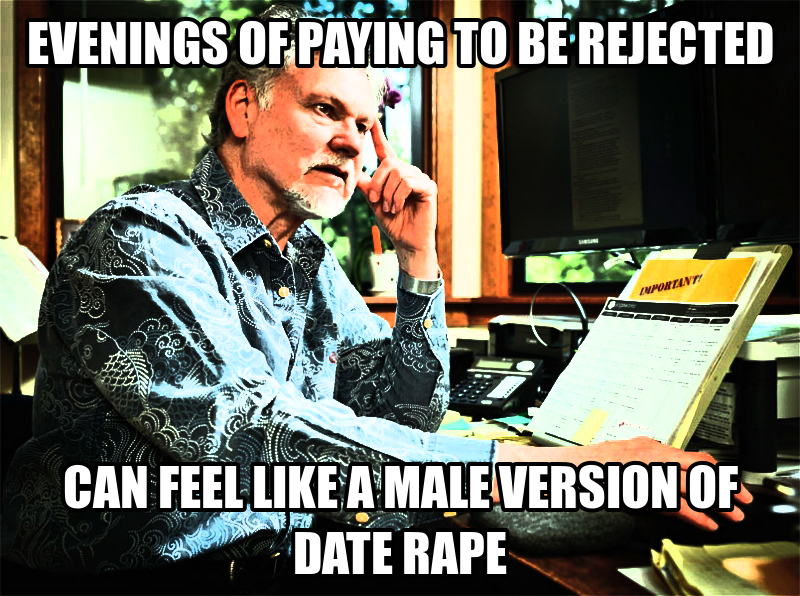
Evenings of paying to be rejected can feel like a male version of date rape. (MoMP, p. 314)
Really? Paying for dinner and not getting laid is the same as date rape? So the price of sex with a woman is dinner? Are we talking a nice restaurant here, or will Taco Bell due? Isn't that prostitution?

Oh, and by the way, have you been raped, Warren? Do you know how it feels to have your autonomy and physical body, not to mention your psychological self, sexually violated by another person? To have your trust in other human beings destroyed? To believe, despite the evidence, that somehow it was your fault? To have the nightmares, the hypervigilance, the self-loathing that comes with rape? Yeah, thought not.

Or this:
Almost all single women acknowledge they have agreed to go back to a guy’s place “just to talk” but were nevertheless responsive to his first kiss. Almost all acknowledge they’ve recently said something like “That’s far enough for now,” even as her lips are still kissing and her tongue is still touching his. (MoMP, p. 314)
Okay, so if you kiss somebody, that is tacit consent to sex? Wrong again, Warren.

And he always goes back to his straw man about false reports. Most studies put the false report rate at 2%. Even the FBI (1996), only put it at 8%:
As with all other Crime Index offenses, complaints of forcible rape made to law enforcement agencies are sometimes found to be false or baseless. In such cases, law enforcement agencies “unfound” the offenses and exclude them from crime counts. The “unfounded” rate, or percentage of complaints determined through investigation to be false, is higher for forcible rape than for any other Index crime. Eight percent of forcible rape complaints in 1996 were “unfounded,” while the average for all Index crimes was 2 percent.
What that section fails to mention, however, and Farrell has never acknowledged, is that local law enforcement will often decide a case is unfounded when drugs or alcohol are involved, or when there is previous sexual activity between the rapist and the victim.

Roughly a third to a full half of the clients I see have reported their rapist and the police/sheriff decided not to file charges or even pursue an investigation. This is seldom acknowledged aside from claims that reported rapes are far less than total rapes.

* * * *

One place Farrell is right is that this needs to be something we talk about with kids long before college or when they become sexual (high school, in general). Education is always the best prevention.

Where Farrell tends to be most relevant is in his discussions of the disposable nature of men in most societies. However, the answer is not to put more women in those jobs to make the risk more equal - it's to remove that safety issues that make those jobs so deadly (mining, oil fields, etc, where the corporations repeatedly avoid, undermine, or lobby against safety regulations). And the exception here is combat - let women be in combat military roles if they can do it.

Anyway, here is the brief interview.

Men, Power, Money, and Sex

An interview with men's advocate, Warren Farrell

Published on July 17, 2014 by Marty Nemko, Ph.D. in How To Do Life


Warren Farrell is a leading expert on men’s issues. He is the author of seven books and chair of the Commission to Create a White House Council on Boys and Men. He served on the board of the National Organization for Women (NOW) in New York City and is an advocate for both sexes having the full range of options, professionally and personally. 

I interviewed him about gender roles, power, why men earn more, and campus rape.

Marty Nemko: You're most well-known for your book The Myth of Male Power, just out in a new e-book edition. Many people think men have the power: Look at the Senate and CEO rosters. How would you respond?

Warren Farrell: A small percentage of men have major institutional power but across the full population, real power is about having choices. The women’s movement has made it socially acceptable for a mom to work full-time, stay home with the child full-time, or work part-time. That’s as it should be. Alas, it’s not as acceptable for a man to work part-time, let alone be a full-time parent. Mr. Mom is still a term of derision.

Marty Nemko: But men earn more. Isn’t that power?

Warren Farrell: Many men still buy into a false definition of power: feeling obligated to earn money that someone else spends while we die sooner—5.2 years sooner. That’s not power. That’s being a prisoner of the need for love and approval.

Marty Nemko: In your book, Why Men Earn More, you report that the statistic that women earn 77 cents for each dollar a man earns for the same work is very misleading. Can you give an example as to why? 

Warren Farrell: Women who have never been married and never had children earn 17% more than never-married men that have never had children, even when education and years worked are equal. Men don’t earn more than women. Dads earn more than moms. Why? When a child is born, a mom is more likely to divide her labor between work and home, earning less at work. A dad is more likely to increase his hours at work—or work two jobs—often taking jobs he likes less that pay more. 

Marty Nemko: In Why Men Earn More, you write, “The road to high pay is a toll road.” Are you suggesting that high pay and power can be inversely correlated?

Warren Farrell: Yes. For many dads, the road to high pay is not about power; it’s about his hope to make his children’s life better than his. It’s about giving his wife a better life. And to get that higher pay, he often has to forgo work he'd rather do. For example, he might prefer to be a teacher or a creative but to better support his family, he accepts a long-hours, high-stress, technical, travel-intensive, often soulless management position.

Marty Nemko: In your recent Reddit Highlighted Conversation, you cite statistics so startling that some would question their veracity. Would you provide the source for:
  • This is the first time in U.S. history that our sons will have less education than their dads.
  • Boys' suicide rate goes from equal to girls at age 9 to five times(!) girls' in their twenties.
  • More U.S. male military were killed by suicide in one year than were killed in the wars in Iraq and Afghanistan in all years combined.
Warren Farrell: Yes. Boys having less education than their dads is from the OECD (Organization for Economic Co-operation and Development), “Education at a Glance,” 2010, Table A1.3a

The boy-girl suicide rate is from the Centers for Disease Control and Prevention, Morbidity and Mortality Weekly Report, 58,1, 2009, and Web-based Injury Statistics Query and Reporting System (WISQARS), 2010.

The U.S. military suicide rate data is from the DOD, uncovered by CBS, in Armen Keteyian, “Suicide Epidemic Among Veterans.” CBS News, November 13, 2007. http://www.cbsnews.com/stories/2007/11/13/cbsnews_investigates/main3496471.shtml.

Marty Nemko: The subtitle of your book The Myth of Male Power is: Why Men are the Disposable Sex. How are men the disposable sex?

Warren Farrell: Virtually all societies that survived did so based on their ability to train their sons to be disposable—disposable in war, disposable at work.

Marty Nemko: That’s a strong statement. What’s your evidence?

Warren Farrell: The evidence is ubiquitous. 92 percent of workplace deaths occur to men, jobs few women would take: oil rig workers, long-haul truckers, roofers, coal miners. Yet there isn't the political will to create regulations that would afford them more protection for these workers. Meanwhile, when women have a less life-threatening deficit, for example, underrepresentation of women in engineering, there's massive expenditure to redress. Although male-only draft registration is a violation of both the 14th Amendment’s equal-protection clause and the 5th Amendment’s due process clause, it is so unconsciously accepted it isn’t even questioned. Only men can serve in direct combat so 98 percent of Iraq and Afghanistan deaths were men.

Marty Nemko: Is the fact that men die 5.2 years younger than women another example of male disposability?

Warren Farrell: It is the combination of facts like men dying 5.2 years younger than women—or men dying sooner from all ten of the ten leading causes of death, plus the fact that we nevertheless have seven federal offices of women’s health and none of men’s health that together reflect the psychology of indifference toward male disposability. Similarly, men over the age of 85 commit suicide 1350 percent as frequently as women over 85. Virtually no one knows this. If women over 85 committed suicide 1350 percent as often than men, it would be used as the quintessential example of our undervaluing of women. We seem to care more about saving whales than saving males.

Marty Nemko: You said men are indirectly disposable as dads. How do you mean?

Warren Farrell: In a divorce, if the mother doesn’t want the father to be equally involved, the apriori assumption is that she's right. Men have to fight in court for that right, and that's expensive.Unless he’s rich, he’s disposable. 

Marty Nemko: What are your thoughts about the current focus on campus rape?

Warren Farrell: The issue first should be addressed before kids get to college. For example, we may need to encourage our daughters to take the initiative when they do want physical intimacy, not just to say when they don’t. Our society strives for equality but few experts are asking women to share the responsibility for taking the initiative in sex, thereby risking rejection. During adolescence, women are the more mature sex. It’s unfair to expect guys to assume 90 percent of the burden of sexual rejection.

Marty Nemko: What should happen at college?

Warren Farrell: First, make the law the last resort. The law is binary: guilty/not guilty. Sex is nuanced and more nonverbal than verbal. Those nuances have evolved over millennia. A slight change in eye contact means everything in a male-female encounter but would be laughed at in court. And if a grievance is filed, we should not presume guilt. Alas, some accusations are false.

Marty Nemko: What about workshops at college?

Warren Farrell: Yes but both sexes should be walking a mile in each other’s moccasins.

Marty Nemko: You’ve done such trainings, right?

Warren Farrell: Yes. I used to tell college audiences, “Every woman is in a beauty contest every day of her life.” I then invited all the guys on stage to experience that. I had those guys wear bathing suits and had the women be the judges. The guys were stunned at being unseen for their integrity, intelligence, or values. They felt objectified.

Marty Nemko: What did you do to help the young women walk a mile in the guys’ moccasins?

Warren Farrell: I had the women “ask-out” the guys they were most attracted to on a 20-minute “date.” Some did what they criticize men for, for example, lying to get an attractive guy to go out with them. Others went after a less attractive guy to reduce the chance of getting rejected. The guys totally identified with that.

Marty Nemko: What was the outcome of those workshops?

Warren Farrell: Greater compassion for the other sex’s vulnerability, and I formed hundreds of men and women’s groups so they would continue to deepen their compassion after I left campus. 

Marty Nemko: Was there any concrete evidence it reduced campus rape?

Warren Farrell: I asked campus sponsors to let me know if any of the workshop participants later were involved in a date rape accusation. Although I had worked with 20,000 students in hundreds of colleges, not one incident was reported.

Marty Nemko: Do you still do those workshops?

Warren Farrell: As political correctness set into the colleges’ psyches, college programs shifted to emphasizing only men understanding women. It would be wiser for programs to help both sexes better understand each other. We don’t need a women’s movement blaming men, nor a men’s movement blaming women. We need a gender liberation movement. We need both sexes walking a mile in each other’s moccasins.

Tuesday, July 15, 2014

The Body Learns - How We've Gotten Education Wrong

I was wondering how long it would take for education science to catch up with cognitive science, particularly with embodied cognition. The use of embodied cognition in education theory is changing everything we thought we knew about how learning occurs.

Most importantly, especially for boys, we are learning that the body is an integral part of the learning process. Better late than never, I guess.

The Body Learns

For years we’ve been telling kids to sit still and pay attention. That’s all wrong.

By Annie Murphy Paul | July 10, 2014

Sam Herman, 7, draws on the SMART Board 885, an interactive whiteboard system that uses multitouch technology, at the Macworld 2011 showroom in San Francisco on Jan. 29, 2011. Incorporating bodily movements—even subtle ones—can improve learning. | Photo by Ryan Anson/AFP/Getty Images
Today’s educational technology often presents itself as a radical departure from the tired practices of traditional instruction. But in one way, at least, it faithfully follows the conventions of the chalk-and-blackboard era: EdTech addresses only the student’s head, leaving the rest of the body out.

Treating mind and body as separate is an old and powerful idea in Western culture. But this venerable trope is facing down a challenge from a generation of researchers—in cognitive science, psychology, neuroscience, even philosophy—who claim that we think with and through our bodies. Even the most abstract mathematical or literary concepts, these researchers maintain, are understood in terms of the experience of our senses and of moving ourselves through space.

This perspective, known as “embodied cognition,” is now becoming a lens through which to look at educational technology. Work in the field shows promising signs that incorporating bodily movements—even subtle ones—can improve the learning that’s done on computers.

For example, Margaret Chan and John Black of Teachers College of Columbia University have shown that physically manipulating an animation of a roller coaster—by sliding the cars up and down the tracks and watching the resulting changes in kinetic and potential energy, as shown in a bar graph—helps students understand the workings of gravity and energy better than static on-screen images and text. This embodied approach to instruction, the authors found, is especially helpful to younger students and to those working on more difficult problems. In counterintuitive domains like physics, bodily rooted learning allows the learner to develop a “feel” for the concept being described, a physical sense that is more comprehensible and compelling than a concept that remains an abstract mental entity.

In similar experiments, led by Insook Han of Hanyang Cyber University in South Korea, students learn about the concept of force by using a joystick to move two gears shown on a computer screen. Han’s studies show that allowing users to physically manipulate the gears in this way improves their memory and problem-solving performance on force-related questions. The richer the perceptual experience provided by the computer program, the greater the students’ understanding and retention of the material.

One reason involving the body improves learning is that bodily movements provide the memory with additional cues with which to represent and retrieve the knowledge learned. Taking action in response to information, in addition to simply seeing or hearing it, creates a richer memory trace and supplies alternative avenues for recalling the memory later on. Movement may also allow users to shed some of their “cognitive load”—the burden imposed by the need to keep track of information. Instead of trying to imagine what the gears would do if moved, a mentally taxing activity, learners can allow their hands to do it and see what happens, freeing up mental resources to think more deeply about what’s happening. This is pretty much how we all learned to drive.

From an evolutionary perspective, our brains developed to help us solve problems in the real world, moving through space and manipulating actual objects. More abstract forms of thought, such as mathematics and written language, came later, and they repurposed older regions of the brain originally dedicated to processing input from the senses and from the motor system.

This repurposing is apparent in the frequency with which we use physically grounded metaphors to express abstract ideas: counting is like moving through space (“the countdown is approaching zero”); accommodating two different principles is like “balancing” them on a scale. Bringing the body back into the equation can provide learners with a useful way station between concrete referents and all-out abstraction. Physically acting out knowledge to be learned or problems to be solved makes the conceptual metaphors employed by our brains a literal reality.

We can see this principle at work in the research of Arthur Glenberg of Arizona State University. In a series of experiments carried out more than a decade ago, Glenberg found that children’s reading comprehension improved when they acted out a written text, using a set of representational toys (a miniature barn and horse, for example, accompanied a story about a farm). Glenberg then demonstrated that the same procedure could work on a digital platform: In a 2011 experiment, he showed that having first- and second-grade students manipulate images of toys on a computer screen after reading a story benefits their comprehension as much as physical manipulation of the toys.

Mina Johnson Glenberg (who is married to Arthur Glenberg and also works at Arizona State, as director of the university’s Embodied Games for Learning lab) is taking the embodied approach even further, designing educational games that engage learners’ entire bodies.

A program called the Alien Health Game, for example, presents students with this scenario: “You have just woken up to find an alien under your bed. It is hungry and it is your job to figure out what makes it healthy.” From an array of foods, users learn to choose the ones that are most nutritious, and then must dance, jump, and exercise to help the alien digest his meal. (A bonus: The game is so physically active that it measurably elevates users’ heart rates.)

In other work, Johnson Glenberg employs Xbox Kinect–like technology to capture students’ movements as they interact with images projected onto a whiteboard. The interface can be used to teach subjects like physics, chemistry, and geology; in the geology module, for example, students use the movements of their bodies to deposit sediment layers, insert a fossil layer, and generate earthquakes in a virtual environment. The technology is being used in a half dozen American schools, including Quest to Learn in New York City and ChicagoQuest.

It’s early days for these real-world applications. But the research behind them can help teachers, parents and students better evaluate and use educational technology products that are already widely available. An awareness of embodied cognition, for example, might lead users to prefer touch-sensitive devices like the iPad, which respond directly to the movement of users’ fingers on the screen, over computers that interpose a keyboard between screen and user. According to John Black of Teachers College, technology that evokes movements that complement the concepts to be learned is also likely to be effective from an embodied point of view: For example, an application in which counting is expressed by tapping on a mouse (discrete movements that complement the discrete nature of counting) will better promote learning than a program that asks users to make a sliding movement as they count (a continuous action at odds with the discrete nature of counting).

Parents and educators can also treat the virtual “movements” involved in many educational programs and games as preparation for more traditional learning. For example, John Black and Jessica Hammer, also of Teachers College, showed that moving through the virtual spaces of the history game Civilization made players much better at learning history from a conventional textbook than players of the game The Sims. Even though Civilization players possessed no greater knowledge of history when they opened the textbook, their virtually embodied experience of grappling with the issues raised by historical simulations made them better prepared to absorb the lessons of the text.

Educators and parents can also help students incorporate bodily movements of their own into the use of educational technology, an approach that Black has applied to the teaching the programming language Scratch. Asking students to act out the motions they intend for the program’s virtual “agent” using their own bodies, and then programming the agents to make the same moves, has shown itself to be “a particularly effective learning approach,” Black writes. Even when they’re learning on computers, it’s wise to remember that students are more than mental machines.


* This story was produced by The Hechinger Report, a nonprofit, nonpartisan education-news outlet affiliated with Teachers College, Columbia University.
* Annie Murphy Paul is a fellow at the New America Foundation and the author of the forthcoming book Brilliant: The Science of How We Get Smarter.

Wednesday, July 2, 2014

The New American Man Doesn't Look Like His Father (NPR)

This is the first installment in a new series from NPR's All Things Considered on the state of masculinity in America right now.

Key quote:
"Survey after survey shows that 60 to 70 percent of men still agree with the notion that masculinity depends on emotional stoicism — never showing fear, never showing pain," Kimmel says. "So, the world has changed dramatically, and yet most men still cling tenaciously to an ideology of masculinity that comes off the set of Mad Men."
I will try to post these as they come up from time to time.

The New American Man Doesn't Look Like His Father

by NPR STAFF | All Things Considered
June 23, 2014 5:55 PM ET

Listen to the Story - 7 min 44 sec

Download
Transcript

   
While life has changed significantly for American men in the past half-century, notions of masculinity remain tied to those that may have been passed down from this father to the son on his shoulders. Evans/Three Lions/Getty Images

This summer, All Things Considered is exploring what it means to be a man in America today. In some ways, the picture for men has changed dramatically over the past 50 years. More women than men are going to college, and the economy is moving away from jobs that traditionally favored men, like manufacturing and mining. Attitudes have also changed on the social front, with young men having more egalitarian attitudes toward women and expectations of being involved fathers.

Pedro Noguera, a professor at New York University and head of the Metropolitan Center for Research on Equity and the Transformation of Schools, says the biggest shakeup has been in education. In 1962, men made up about 65 percent of college enrollees; today they make up about 43 percent.

The other side of that figure is the dropout rate for men. Noguera tells NPR's Audie Cornish that in some states, it's twice as high as the female dropout rate.

"These patterns speak to a larger problem, because we know now that the jobs of the future require college degrees," Noguera says.

The education imbalance between men and women is also having an impact on the dating scene, Noguera adds, something that's been already true in the African-American community: "A growing number of well-educated, professional women ... are unable to find men of similar education."

But sociologist Michael Kimmel, a professor at Stony Brook University and director of the Center for the Study of Men and Masculinities, says the changing landscape hasn't come with changed attitudes about masculinity.

"Survey after survey shows that 60 to 70 percent of men still agree with the notion that masculinity depends on emotional stoicism — never showing fear, never showing pain," Kimmel says. "So, the world has changed dramatically, and yet most men still cling tenaciously to an ideology of masculinity that comes off the set of Mad Men."

But Kimmel says today's boys and young men have a much better sense of gender equality than many of their fathers did. He sees a clear example in cross-sex friendship. For 25 years, Kimmel has asked his students if they had a good friend of the opposite sex. When he first started asking, about 10 percent would answer yes. Today, almost everyone does.

"Think about that. You make friends with your peers, right? You make friends with people you consider your equals, not your boss or your servants. I mean, my students today are more experienced with gender equality in their interpersonal relationships than any generation in our history," he says.

Noguera also has seen men become much more involved with raising their children and general housework.

"But what hasn't come with that is a new definition of what it means to be a man as a nurturer in the family," Noguera says. "Can you be strong and be a nurturer? Well, many women have figured out, yes, they have to be, in fact. Because they have to raise the kids on their own, and they can't afford to just expect some man to save the day."

He says today's men are searching for a way to reconcile old ideas related to strength with the need to be better listeners, more cooperative and more open to others.

Sunday, April 20, 2014

Date and Acquaintance Rape - Presentation Version and Full Version


Here is the presentation (shorter version as presented and a longer version) I gave at the Tucson YWCA yesterday as part of Sexual Assault Awareness Month. These are hosted by SlideShare.

I posted this at Integral Options Cafe but, as I discuss in the presentation, we need to spend more time educating boys and men on treating women with respect, not on teaching women how not to get raped. Teaching women to be afraid of men is not the answer - and it's clearly not working.


Full presentation:


Presentation as given at the YWCA:

Tuesday, April 1, 2014

The Drugging of the American Boy (Esquire) - ADHD and the End of Boys

From Esquire, this is an excellent article on the ways in which our society is using drugs to make little boys docile and more easily managed.

The Drugging of the American Boy

By the time they reach high school, nearly 20 percent of all American boys will be diagnosed with ADHD. Millions of those boys will be prescribed a powerful stimulant to "normalize" them. A great many of those boys will suffer serious side effects from those drugs. The shocking truth is that many of those diagnoses are wrong, and that most of those boys are being drugged for no good reason—simply for being boys. It's time we recognize this as a crisis.

By Ryan D'Agostino on March 27, 2014
Published in the April 2014 issue


Photos by Sarah Wilmer

If you have a son, you have a one-in-seven chance that he has been diagnosed with ADHD. If you have a son who has been diagnosed, it's more than likely that he has been prescribed a stimulant—the most famous brand names are Ritalin and Adderall; newer ones include Vyvanse and Concerta—to deal with the symptoms of that psychiatric condition.

The Drug Enforcement Administration classifies stimulants as Schedule II drugs, defined as having a "high potential for abuse" and "with use potentially leading to severe psychological or physical dependence." (According to a University of Michigan study, Adderall is the most abused brand-name drug among high school seniors.) In addition to stimulants like Ritalin, Adderall, Vyvanse, and Concerta, Schedule II drugs include cocaine, methamphetamine, Demerol, and OxyContin.


ASK HOWARD GLASSER, an expert featured in our story, about his work with ADHD.
AND IF YOU'D LIKE: SHARE YOUR OWN STORY

According to manufacturers of ADHD stimulants, they are associated with sudden death in children who have heart problems, whether those heart problems have been previously detected or not. They can bring on a bipolar condition in a child who didn't exhibit any symptoms of such a disorder before taking stimulants. They are associated with "new or worse aggressive behavior or hostility." They can cause "new psychotic symptoms (such as hearing voices and believing things that are not true) or new manic symptoms." They commonly cause noticeable weight loss and trouble sleeping. In some children, some stimulants can cause the paranoid feeling that bugs are crawling on them. Facial tics. They can cause children's eyes to glaze over, their spirits to dampen. One study reported fears of being harmed by other children and thoughts of suicide.

Imagine you have a six-year-old son. A little boy for whom you are responsible. A little boy you would take a bullet for, a little boy in whom you search for glimpses of yourself, and hope every day that he will turn out just like you, only better. A little boy who would do anything to make you happy. Now imagine that little boy—your little boy—alone in his bed in the night, eyes wide with fear, afraid to move, a frightening and unfamiliar voice echoing in his head, afraid to call for you. Imagine him shivering because he hasn't eaten all day because he isn't hungry. His head is pounding. He doesn't know why any of this is happening.

Now imagine that he is suffering like this because of a mistake. Because a doctor examined him for twelve minutes, looked at a questionnaire on which you had checked some boxes, listened to your brief and vague report that he seemed to have trouble sitting still in kindergarten, made a diagnosis for a disorder the boy doesn't have, and wrote a prescription for a powerful drug he doesn't need.

If you have a son in America, there is an alarming probability that this has happened or will happen to you.


6.4 MILLION CHILDREN BETWEEN THE AGES OF FOUR AND SEVENTEEN HAVE BEEN DIAGNOSED WITH ADHD. BY HIGH SCHOOL, NEARLY 20% OF ALL BOYS WILL HAVE BEEN DIAGNOSED WITH ADHD—A 37% INCREASE SINCE 2003.

On this everyone agrees: The numbers are big. The number of children who have been diagnosed with attention-deficit/hyperactivity disorder—overwhelmingly boys—in the United States has climbed at an astonishing rate over a relatively short period of time. The Centers for Disease Control first attempted to tally ADHD cases in 1997 and found that about 3 percent of American schoolchildren had received the diagnosis, a number that seemed roughly in line with past estimates. But after that year, the number of diagnosed cases began to increase by at least 3 percent every year. Then, between 2003 and 2007, cases increased at a rate of 5.5 percent each year. In 2013, the CDC released data revealing that 11 percent of American schoolchildren had been diagnosed with ADHD, which amounts to 6.4 million children between the ages of four and seventeen—a 16 percent increase since 2007 and a 42 percent increase since 2003. Boys are more than twice as likely to be diagnosed as girls—15.1 percent to 6.7 percent. By high school, even more boys are diagnosed—nearly one in five.

Almost 20 percent.

And overall, of the children in this country who are told they suffer from attention deficit/hyperactivity disorder, two thirds are on prescription drugs.

And on this, too, everyone agrees: That among those millions of diagnoses, there are false ones. That there are high-energy kids—normal boys, most likely—who had the misfortune of seeing a doctor who had scant (if any) training in psychiatric disorders during his long-ago residency but had heard about all these new cases and determined that a hyper kid whose teacher said he has trouble sitting still in class must have ADHD. That among the 6.4 million are a significant percentage of boys who are swallowing pills every day for a disorder they don't have.

On this, too, everyone with standing in this fight seems to agree.


But on the subject of attention-deficit/hyperactivity disorder, that is where the agreement ends.

For example: Doctors, parents, and therapists give a lot of different explanations for the sharp rise. Increased awareness—that's a big one. We know more now. Other possibilities put forth: Too many video games. Too much refined sugar. Pharmaceutical companies pushing ADHD drugs. Lack of gym classes at schools. All of these factors are cited. And people have a lot of different ideas about what to do for the children who receive these diagnoses. Many believe that medicine should be the first treatment, either combined with behavioral therapy or not. Others feel that drugs should be a last resort after making every other alleviative effort you can find or think of, from hypnosis to herbal treatments to neurofeedback.

Given today's prevailing pharmaceutical culture, clinicians who believe that drugs should never be used to treat ADHD in children are very much in the minority. Marketing is powerful, and blockbuster drugs like Ritalin are big business. Business booms, market share grows when scripts are written, and countercultural doctors and therapists who advocate caution and who believe that diagnoses are made too easily—doctors and therapists who preach alternatives to drugs—are finding themselves the butt of jokes.

But more about them shortly.


The United States government first collected information on mental disorders in 1840, when the national census listed two generally accepted conditions: idiocy and insanity. A century later, psychiatrists knew more. They had options when making diagnoses, and by the 1940s difficult kids were classified as "hyperkinetic." Other terms would follow, like minimal brain dysfunction. In 1955, there came a pill doctors could prescribe for these children to temper their hyperactivity and make them behave more like "normal" children. It was a stimulant, so called because it heightened the brain's utilization of dopamine, which can improve attention and concentration. The active ingredient was a highly addictive compound called methylphenidate. The drug was called Ritalin.

By 1987, the American Psychiatric Association (APA) had settled on a more refined name for a disorder among children who exhibited the same set of symptoms, including trouble concentrating and impulsive behavior: attention-deficit/hyperactivity disorder. ADHD. At the time, in American schools, it was still considered unusual for a child to take Ritalin. It was, frankly, considered weird.

Today, it has simply become a default method for dealing with a "difficult" child.

"We are pathologizing boyhood," says Ned Hallo-well, a psychiatrist who has been diagnosed with ADHD himself and has cowritten two books about it, Driven to Distraction and Delivered from Distraction. "God bless the women's movement—we needed it—but what's happened is, particularly in schools where most of the teachers are women, there's been a general girlification of elementary school, where any kind of disruptive behavior is sinful. What I call the 'moral diagnosis' gets made: You're bad. Now go get a doctor and get on medication so you'll be good. And that's a real perversion of what ought to happen. Most boys are naturally more restless than most girls, and I would say that's good. But schools want these little goody-goodies who sit still and do what they're told—these robots—and that's just not who boys are."

Especially when they're young. One of the most shocking studies of the rise in ADHD diagnoses was published in 2012 in the Canadian Medical Association Journal. It was called "Influence of Relative Age on Diagnosis and Treatment of Attention-Deficit/Hyperactivity Disorder in Children." Nearly one million children between the ages of six and twelve took part, making it the largest study of its kind ever. The researchers found that "boys who were born in December"—typically the youngest students in their class—"were 30 percent more likely to receive a diagnosis of ADHD than boys born in January," who were a full year older. And "boys were 41 percent more likely to be given a prescription for a medication to treat ADHD if they were born in December than if they were born in January." These findings suggest, of course, that an errant diagnosis can sometimes result from a developmental period that a boy can grow out of.

And there are other underlying reasons for the recent explosion in diagnoses. Stephen Hinshaw, a professor of psychology at the University of California, Berkeley and the editor of Psychological Bulletin, the research publication of the American Psychological Association, presents evidence in a new book that ADHD diagnoses can vary widely according to demographics and even education policy, which could account for why some states see a rate of 4 percent of schoolchildren with ADHD while others see a rate of almost 15 percent. Most shocking is Hinshaw's examination of the implications of the No Child Left Behind Act of 2001, which gave incentives to states whose students scored well on standardized tests. The result: "Such laws provide real incentive to have children diagnosed and treated." Children with ADHD often get more time to take tests, and in some school districts, tests taken by ADHD kids do not even have to be included in the overall average. "That is, an ADHD diagnosis might exempt a low-achieving youth from lowering the district's overall achievement ranking"—thus ensuring that the district not incur federal sanctions for low scores.

In a study of the years between 2003 and 2007, the years in which the policy was rolled out, the authors looked at children between ages eight and thirteen. They found that among children in many low-income areas (the districts most "targeted" by the bill), ADHD diagnoses increased from 10 percent to 15.3 percent—"a huge rise of 53 percent" in just four years.


48% OF SUBJECTS OF ONE STUDY WHO TOOK ADHD MEDICATIONS EXPERIENCED SIDE EFFECTS LIKE SLEEP PROBLEMS AND "MOOD DISTURBANCES." IN ANOTHER, 6% OF CHILDREN SUFFERED PSYCHOTIC SYMPTOMS, INCLUDING THOUGHTS OF SUICIDE.  Source: Psychiatry, April 2010; The Canadian Journal of Psychiatry, October 1999.

And yet among many of the people interviewed for this story, the most common explanation for the staggering increase in diagnoses is that doctors know more now. Great strides have been made. "I don't think there's an epidemic of new cases," says Mario Saltarelli, a neurologist and the senior vice-president of clinical development at Shire, which manufactures Adderall and Vyvanse. (Since our interview, he has left the company.) "It's always been there. It's now more appropriately understood and recognized." Instead of lumping together all the kids with high energy and bad behavior and calling them hyper, many experts say, doctors can identify the children who exhibit the symptoms specific to ADHD and treat them accordingly. "We were paying attention," says Jeffrey Lieberman, the president of the American Psychiatric Association and chairman of psychiatry at Columbia University Medical Center. "We [now] have reliable descriptions and the means of diagnosing."

Every fifteen years or so, the APA publishes a book called the Diagnostic and Statistical Manual of Mental Disorders, which doctors around the world use as a guide for diagnosing mental disorders in their patients. Known as the DSM, it has been published seven times, first in 1952 and most recently in 2013. For each revision, a new task force of psychiatrists tweaks, refines, and often expands the descriptions, definitions, and symptoms of hundreds of psychiatric disorders. It's not uncommon for definitions to be written more broadly, thus broadening the universe of people who might be diagnosed with a given disorder.

In the DSM-5, the 916-page version that came out last year, there was one important change made to the section on ADHD. The age at which a child can be diagnosed with ADHD was raised from seven to twelve. In the previous edition of the DSM, in order to meet the criteria for diagnosis, several symptoms of ADHD had to be present by age seven. Citing "substantial research published since 1994," the authors increased the window for diagnosis by five years, meaning that twenty million more children are now eligible to be told they have ADHD.

And so if a child is deemed to meet the criteria for ADHD as defined in the DSM, even by a rushed pediatrician after a cursory twelve-minute examination, the clinical-practice guidelines strongly recommend medication as part of the first step in treating kids starting at age six. (Behavior therapy is recommended as a first step for four- and five-year-olds, followed by methylphenidate, or stimulants, if the behavior therapies "do not provide significant improvement and there is moderate-to-severe continuing disturbance in the child's function.")

A cynical person might wonder whether the task forces who write the DSM are influenced by pharmaceutical companies, seeing that with each new disorder they add and each new symptom they deem valid, more people can get expensive prescriptions. ADHD drugs alone were a $10.4 billion business in 2012, a 13 percent increase over the year before.

"I think it happens in an indirect but nonetheless powerful way," says Lisa Cosgrove, a clinical psychologist who is an associate professor at the University of Massachusetts, Boston and a fellow at the Center for Ethics at Harvard. In a study of the DSM-5, she found that 69 percent of the task force acknowledged ties to the pharmaceutical industry. Many of these were likely indirect affiliations, but Cosgrove says that doesn't matter. "It's not that I think there's this quid pro quo kind of corruption going on. But when the individuals who are charged with the responsibility of developing criteria or with changing the symptom criteria—I don't think they are consciously aware of the way in which industry affiliations create pro-industry habits of thought." Cosgrove points to what she calls a "major gap" in the APA's disclosure policy for doctors who worked on the DSM-5: It allows unrestricted research grants from drug companies. "Now, 'unrestricted' means that the pharmaceutical company cannot in-house analyze the data...but there's a wealth of social-psych research that shows that when you are paid even small amounts—and there's the potential for future payment—it affects your behavior. If I get an unrestricted research grant from Pfizer for $500,000, and I'm hoping to get a $2 million grant, at some level I'm going to be aware of how I talk about the results."

The journal Accountability in Research chose Cosgrove's paper "Commentary: The Public Health Consequences of an Industry-Influenced Psychiatric Taxonomy" for publication in 2010, when a first draft of the DSM-5 was made public. In the paper, Cosgrove and her coauthors lambasted the psychiatric community for supporting a manual that largely ignores side effects and promotes diagnosis by constantly adding symptoms and disorders. "A psychiatric taxonomy [i.e., the DSM] which touts indication for medications, but is effectively silent about their associated risks, is evidently unbalanced and raises questions about undue influence," they wrote. "The time has come to seriously reconsider whether the heavily pharmaceutically funded APA should continue to be entrusted with the revision of the DSM."

Dr. Allen Frances, professor emeritus at Duke University School of Medicine, the former chairman of its psychiatry department, and the chairman of the DSM-IV (1994) task force, feels the problem is not corruption but the slow creep of misinformation. "I know the people. They're not doing it for the drug companies—they really believe what they're doing is right. They really believe ADHD is underdiagnosed, and they want to help people who should be getting medication. I just think they're dead wrong."

Frances points to the fact that in August 1997—the same year the CDC first started tallying ADHD cases in the United States—the Food and Drug Administration made it easier for pharmaceutical companies to advertise their drugs to consumers. Spending on direct-to-consumer drug advertising increased from $220 million in 1997 to more than $2.8 billion by 2002.

It's not that Frances believes ADHD is not a real and valid diagnosis; he just believes that these days it's made so frequently it has been rendered meaningless. "It's been watered down so much in the way it's applied that it now includes many kids who are just developmentally different or are immature," he says. "It's a disease called childhood."


Falsely diagnosing a psychiatric disorder in a boy's developing brain is a terrifying prospect. You don't have to be a parent to understand that. And yet it apparently happens all the time. "Kids who don't meet our criteria for our ADHD research studies have the diagnosis—and are being treated for it," says Dr. Steven Cuffe, chairman of the psychiatry department at the University of Florida College of Medicine, Jacksonville and vice-chair of the child and adolescent psychiatry steering committee for the American Board of Psychiatry and Neurology.

The ADHD clinical-practice guidelines published by the American Academy of Pediatrics—the document doctors are supposed to follow when diagnosing a disorder—state only that doctors should determine whether a patient's symptoms are in line with the definition of ADHD in the DSM. To do this accurately requires days or even weeks of work, including multiple interviews with the child and his parents and reports from teachers, plus significant observation. And yet a 2011 study by the American Academy of Pediatrics found that one third of pediatrician visits last less than ten minutes. (Visits for the specific purpose of a psychosocial evaluation are around twenty minutes.) "A proper, well-done assessment cannot be done in ten or fifteen minutes," says Ruth Hughes, a psychologist who is the CEO of Children and Adults with ADHD (CHADD), an advocacy group.

Only one significant study has ever been done to try to determine how many kids have been misdiagnosed with ADHD, and it was done more than twenty years ago. It was led by Peter Jensen, now the vice-chair for psychiatry and psychology research at the Mayo Clinic, but at the time a researcher for the National Institute of Mental Health. After a study of 1,285 children, Jensen estimated that even way back then—before ADHD became a knee-jerk diagnosis in America, before one in seven boys had been given the diagnosis—between 20 and 25 percent were misdiagnosed. They had been told they had the disorder when in fact they did not.

Part of the problem is subjectivity, and the power of a culture that has settled on a drug-based solution. Decades of research have gone into trying to define the disorder in a clinical way, and yet the ultimate diagnosis—Your son has ADHD—is inherently subjective. And insurance companies don't reimburse or reward doctors for time spent doing the diligent work involved in giving a proper opinion. "You have to observe the behavior of the child over different environments. You have to talk to the parents. You have to talk to the teachers. I don't know an insurance company out there that pays for a pediatrician to call and talk to the teachers. They just don't," says Hughes.

Ned Hallowell does not accept insurance in his private psychiatry practice, which he says allows him to spend more time with patients. "But for the average person, it's the luck of the draw," he says. "Do they have a good, savvy pediatrician who can be careful about the diagnosis, or do they have somebody who just hears 'ADD' and writes a prescription?"

Lieberman, the APA president, says most doctors try to get it right. "Are there pressures that are packed on clinicians that make them less than optimally rigorous [in making a diagnosis]? Unfortunately, there are," he says. "But I mean, you have our health-care financing system that's quite dysfunctional, and it's created a situation where doctors have to spend a certain amount of time with bureaucratic, administrative paperwork and regulatory-compliance stuff.... We also have a culture where there's pressure, both from schools as well as from parents, to do something—to alleviate the problem and enhance the performance of the child. That's no excuse, and doctors shouldn't succumb to that. But, you know, doctors are human.... We'd like everybody to be these heroic figures who fulfill the virtues of the Hippocratic oath. I think most doctors aspire to try to do that. But human limitations being what they are...caveat emptor."


One man believes that drugging children's brains is too risky. That until we get a lot closer to achieving a foolproof diagnosis for ADHD, we need to think twice about giving a single pill to a single child. He believes that what is called attention-deficit/hyperactivity disorder might in fact be a boy's greatest gift, the gift of energy. And that the best way to treat it is to first teach the boy to control the energy all by himself, because by learning to control it all by himself, a boy can channel that energy to help him succeed. That the responsible thing to do is first to see if there is some problem with the boy's heart—not with the way it pumps blood, but with its ability to show and accept love. The man's name is Howard Glasser, and he is one of those countercultural clinicians who, as American society has become inured to giving psychotropic drugs to kids, has built a practice predicated on opposing the very idea.

If he were a child today, Glasser would be given a prescription for a stimulant in about five minutes. Little Howie was a wired kid. Obstreperous. But good. A good kid. And when he grew up and became a family therapist—he has applied to earn his doctorate in education from Harvard starting this fall—he created a way of dealing with wired, obstreperous, uncontrollable kids who are, beneath all that, good. And he believes all of them are good.

He calls the method the Nurtured Heart Approach, and it seems simple on the surface: You nurture the child's heart. If a child is hyperactive and defiant and has trouble listening and concentrating, Glasser feels it is our responsibility as a society—as grown-ups—to do everything we can for a child's heart before we start adding chemicals to his brain, because what if his brain is fine? What if the diagnosis isn't right? And even if it is, what if something else works?

Hyperactive, defiant—he was all those things. At home—the apartment his parents rented in Kew Gardens, a leafy, almost suburban corner of Queens—he was sometimes so defiant that his mother would shout into the air, asking what she had done to deserve this, her face brightening with incarnadine helplessness. His father was a salesman of electrical supplies, and he and Howie used to go at it pretty good. Sometimes, when it was his turn to teach Howie a lesson, his father would reach for the rubber machine belt. Howie took that punishment laughing. Heartbreaking laughter.

At school he would sit in the back of the class, cracking jokes until his teachers were overcome with that unique kind of exasperation that results from feeling outrage and disappointment at the same time. Outrage because you wouldn't believe the mouth on this kid. Disappointment because he was so smart. Because he had so much potential.

Man, was Howie Glasser smart. That was the problem nobody saw: He was a funny, clever kid who scored high in both English and math without much studying. School bored him. The teachers, though, had to teach to every student in the class, and Howie felt forgotten. He didn't need to listen, so he sat in the back of the room and goofed off, his gangly frame folded awkwardly into a too-small wooden chair. Kids would laugh, and he'd do it more. And every time the teachers got angry and pointed their fingers toward the principal's office, struggling to keep from screaming at Howie—to keep from smacking him, probably—they were only feeding his recalcitrance. Finally, someone was paying attention to him! Deep down Howie didn't like the negative attention, but it was better than no attention at all.

In junior high school, they wanted to hold him back. He couldn't handle the next grade, they said—he couldn't concentrate, he was hanging around with the wrong kids, he just wasn't ready. But then Howie took a test, and his score surprised even the teachers who knew he was smarter than he let on. He scored high enough to skip ahead and graduated high school at sixteen.

Glasser graduated from City College with a degree in psychology, then got a master's in counseling at New York University. He had started work on a Ph.D., also at NYU, but after a year or so he dropped out to do the thing he loved most, the thing that made all the noise go away, all the trouble, all the teachers who couldn't figure out how to harness and channel his energy, his hollering parents who didn't understand why he couldn't be more like his older brother: He worked with wood.

Howie's Woodworking opened on Third Avenue and East Twelfth Street in New York in 1980. He collected wood around the city—old floorboards from gutted townhouses, planks, pallets, scraps. He made planters and mosaics and odd pieces of furniture. People would see the sign and come in and ask if he could do bigger jobs—cabinetry, fine furniture, storefronts. Glasser would always tell them he could do it, even though he had no idea how. Then he'd hire people who could show him.

After a few years, Glasser moved out west, far from the overdrive of New York, to the Arizona desert. On his way out, in Boulder, Colorado, he got to know a man named Michael Davis, who, with his wife, Anita, was raising four sons, two of whom were adolescents at the time. The first time Glasser visited Davis's house, there was some kind of minor drama unfolding that day, the kind of argument that periodically bubbles up in a house where teenagers live.

And the way the Davises handled it made Glasser weep.

"Michael and Anita were talking to their kids in the most loving way. I had never until that day—ever—encountered anybody who talked to their kids that way. I had tears streaming down my face," he says. "In my world, in my circumscribed world, it was not the culture. It's kind of breathtaking to me now." Even as he tells this story almost thirty years later, Glasser has to pause, swallow hard, and clear his throat.

He eventually moved to Tucson with the woman who would be the mother of his only child, a daughter. Almost as soon as he arrived, he found a job at a family-therapy institute where he could use his psychology training. "It was like the sea parted," he says. He felt as if he was doing what he needed to be doing. He got a second job at a clinic that was known for helping kids with behavior problems. Many of them had been diagnosed with ADHD.

"I had been one of these kids," he says. "And here I am with twelve preadolescent kids who aren't on their meds on the weekends—I would meet with them on Saturday mornings. So you get to see: These are very interesting human beings. I got to experience the truth of these kids off medication."

Glasser would open up group discussions by asking what the rules should be. The children half-raised their hands and called out predictable answers: no hitting, no yelling, no bad words, no this, no that. The first time it happened, Glasser was seized with memories, a darkness moving over his brain like a shadow. "It was PTSD for me. I grew up with rules that start with no, and I hated rules that start with no. They always led to me getting in trouble, and ultimately getting hit," he says. "It got my attention that kids saw rules that way."

The clinic and the therapy institute both employed other bright young therapists, and they all called on their state-of-the-art psychology training to try to help the troubled families in their care. They used positive reinforcement. Instead of rules that started with no, they set rules like "Be respectful" and "Use nice words." This was all fine and hewed closely to the education and therapy trends of the day. Kids behaved better. Families improved. But they didn't change. Positive reinforcement is great, but there was only so far it could go with a difficult child. Glasser knew he hadn't truly scraped away the artifice of defiant behavior to get at whatever pain was festering inside these kids. He wasn't finding whatever it was that stirred them to yell and swear and make the grown-ups think they needed medication.

The problem with the positive rules was that there didn't seem to be a very good way to teach them. The old rules were mostly taught when children broke them. If the rule is "No hitting" and one kid hits another, you'd teach the child the rule in that moment. "What you just did was wrong." You'd tell him to go sit in the corner, or go to his room, or apologize. But in those moments, everyone's upset. The kid who got hit is crying, the hitter is angry and scared, and the grown-up is amping up the authority. The offending child gets all the attention. The rule doesn't stick.

Still, Glasser saw that kids seemed to like "no" rules because they're clear. The line of transgression was definite. He had an idea: What if he told the children how great they were when they didn't break a rule? It would be like a video game. When you do something great while playing a video game—when you simply do what the game expects—you get points and you get to keep going. When you go out of bounds or break one of the game's rules, no one yells at you or reminds you what rule you've broken. You simply miss a turn or lose points. And there is no grudge once you pay the fine. As Glasser wrote in his first book in 1999, Transforming the Difficult Child, "When the consequence is over, it's right back to scoring."

Kids love video games. "They don't need us to figure out a video game for them," he says. "They figure it out in three minutes, and then they become stars. The beauty of those games is the energy of success is so strong, consistent, reliable, available. If they break a rule in the next two seconds, the game unplugs momentarily. Grown-ups look at the consequences in these games and we don't always see the truth of what's going on. It looks to us like, Oh my God, huge consequence—blood spurting, heads rolling. But actually, the kid's out of the game for two seconds but it feels like an eternity to them because they've become such a devotee of being plugged in to success, and they vividly feel the energy of missing out. When the consequence is over, they don't just come back into the game, they come back ever more determined: I'm not gonna break another rule."

And so he thought, What if a child was sitting quietly, not bothering anyone, and you went out of your way to congratulate him on that, very specifically, by telling him how proud you are that he's not hitting anyone, not screaming, not throwing toys, but just sitting quietly? What if you gave a child the equivalent of points—what if you thanked him or hugged him—for not putting his feet on the couch? How would he respond to that?

He'll like it, it turns out.

"I started accusing kids of being successful for not breaking rules. Nobody ever in my professional career had done that," he says. "All of a sudden—and it was as weird as it could be—I knew I was speaking to some level of a kid's soul. I knew it was nourishing them in some way. It was like me weeping at Michael Davis's house. In my professional career, no kid had ever been told they were successful when it came to rules."


Many of the people I interviewed who have had direct experience with ADHD—parents of children who'd been diagnosed, psychiatrists, adult ADHD patients—assured me, within the first minute of our conversation, that ADHD is a real disorder, not some made-up condition.

"It's important to understand that ADHD is a very real, serious, neurobiological disorder," said Saltarelli, the neurologist who was formerly senior vice-president of clinical development at Shire, maker of Adderall and Vyvanse, which is now the most common brand of stimulant prescribed for ADHD. He repeated this point several times during our hour-long conversation.

"I don't think in the medical community or in the research community there is any question that this is a brain disorder. I really don't think that is in question," Ruth Hughes, the CHADD CEO, told me after I asked her about the validity of brain scans that purport to show ADHD, which have been disputed by other scientists.

"There is no doubt in my mind that I really believe this is a disorder, disease, condition, whatever you do—like, it is for real," said Tracie Giles, a parent of four children, two of whom have been diagnosed. She is the coordinator of the local CHADD chapter in Wayne County, Michigan.

The interesting thing is I never asked any of these people whether ADHD is real. But their defensiveness is understandable. ADHD isn't strep throat—there's no culture, no test. To find out if you have it, or if your son has it, or if your daughter has it, you just need a human being to say so—a physician or a psychiatrist—and that makes some people skeptical. Google "Does ADHD exist?" Up pop the detractors who call the very disorder into question.

ADHD has become the most controversial medical topic in America when it comes to children. In 2000, Bob Schaffer, then a Colorado congressman, called a hearing about ADHD medication before the House Committee on Education and the Workforce. "I had been in politics a long time even before I had this hearing," he says. "And you would think that with issues of national missile defense, the space program, the billions we spend on public education, the China trade bill I voted on—that something else would have resulted in more blowback, but I can't think of anything else that did. It inspired more personal hostility and defensiveness than anything else I'd ever been involved in."

The biggest reason: Managing ADHD, for most people who receive the diagnosis, includes taking medication. If the diagnosis is real, a prescription can turn around a child's life in an instant, improving his ability to concentrate and jacking up his self-esteem. Denying a child who needs the medicine is as cruel as forcing it on a kid who doesn't. Even Howard Glasser is not anti-medication—not entirely. He believes that in rare cases it can be effective as a temporary measure. But it's a terrifying choice to make for many parents.

Ned Hallowell once famously said that stimulants were "safer than aspirin," a statement he has since backed off of. ("That's almost a preposterous statement for anyone to say," says Saltarelli.) "I think that was misleading," Hallowell says now. "I was dealing with people who thought these medications were extremely dangerous, and if they're used properly, they are not. But now I don't say that anymore because I'm worried about high school students taking them without any medical evaluation." But Hallowell stands by his assertion—widely corroborated—that it's silly to try to treat ADHD without medicine. "I certainly am not gonna try to persuade you to use medication, but once you learn the facts, chances are you will want to. Because doing a year, say, of non-medication is sort of like saying, Why don't we do a year of squinting before we try eyeglasses."


2003: THE NO CHILD LEFT BEHIND ACT REWARDS SCHOOLS FOR HIGHER TEST SCORES. KIDS WITH ADHD GET MORE TIME TO TAKE TESTS, AND SOMETIMES THEIR SCORES AREN'T COUNTED IN THE OVERALL AVERAGE. AS THE LAW ROLLS OUT, ADHD DIAGNOSES INCREASE 53% IN POOR AREAS.

In 1999 the National Institute of Mental Health published its landmark study "Multimodal Treatment of ADHD," which was led by Peter Jensen; 579 children ages seven to nine took part. The study declared that the best treatment, across the board, is medication combined with behavioral therapy—but that the combination works only marginally better than medication on its own, with no behavioral component. This made a lot of parents feel better about accepting a prescription for their children, and the study is frequently cited by pharmaceutical companies, psychiatrists, and organizations like CHADD.

Research published since the multimodal study, however, suggests that treating kids who have ADHD with cognitive behavioral therapy can have the same positive effect as stimulants. A new study in the Journal of Abnormal Child Psychology shows that behavioral therapy, alone or in combination with stimulants, is far more effective than medication alone. The children in the study—forty-four boys, four girls, all diagnosed with ADHD—were given varying doses of medication and behavioral therapy, and researchers monitored their episodes of "noncompliance" each day. The worst-behaved children were the ones receiving only drugs and no behavioral therapy. Even kids given a placebo while also receiving some behavioral therapy behaved far better than kids being treated with drugs alone. The sweet spot was a low dose of medication plus behavioral therapy.

William Pelham of Florida International University, the lead author of the study and one of the original investigators on the multimodal study, says that these findings show that psychosocial treatments "are the key to long-term success. Medication alone is not the solution to the long term."

I wanted to talk to an actual person at a drug company about the difficult choice. I called Novartis, which manufactures Ritalin and Focalin XR. A media-relations specialist, Julie Masow, declined to make anyone from the company available to me for an interview, citing the fact that it was summer and people were traveling, and instead provided me with a vague written statement. But eventually Masow agreed to provide written answers to any questions I wished to send her via e-mail. It was a fairly fruitless exercise—a lot of anodyne corporatespeak about how "ultimately, the decision to prescribe an ADHD treatment for a child with ADHD is between the physician and the patient's parent/guardian" and "Patients and parents/guardians also receive a copy of the medication guide included in the drug package insert."

Novartis is right, to a point—pharmaceutical companies do not prescribe the drugs they manufacture. So do they care what happens once the drugs leave the factory? When I asked Saltarelli of Shire whether drug companies should do anything to make sure their products are used correctly, he said, "It is our responsibility to make sure that the drugs are being appropriately utilized. It's obviously impossible for us to be in any way involved in diagnosis, let alone in every doctor's office where diagnoses are being made. But we do feel an ethical obligation—and we've actually invested quite a bit to do whatever we possibly can through educational efforts to make sure that these drugs are being used appropriately." When I asked the same question of Novartis, the answer (via e-mail) was "Novartis supports only the appropriate use of ADHD medicines as indicated and prescribed by qualified, licensed health-care providers. Novartis does not participate in the diagnosis of patients with ADHD, as the diagnostic criteria..."

Karen Lowry, a nurse in Medford, New Jersey, helps run a local CHADD chapter. She has four children, the youngest of whom has ADHD. "When he was first diagnosed, we were adamantly against medication. No, it might prevent his brain growth. We'll deal with behavioral programs. It's not happening," she says. "But as first grade progressed and we saw our child with an ADHD diagnosis experiencing hyperactivity, impulsivity, and inattentiveness in a classroom setting with a teacher who was really not very understanding, we saw a kid who was falling through the cracks. We saw a kid who was not developing friendships, peers who were always blaming him for everything that was going on around him. So my husband and I looked at each other again and said, Oh my gosh, we need to rethink this. Are we not being fair to him? What's worse? Not fully understanding the medication and what can happen in a positive way, or just standing our ground saying, We're unsure about this?"

Lowry and her husband ended up putting their youngest son on a stimulant. His behavior improved vastly, and the ADHD seemed to be under control. But toward the end of the school year, he developed severe facial tics, a side effect of some ADHD medications. They took him off the medication for the summer, a decision many parents make at some point. "He's adjusted pretty much," she says. "He's on a very low dose because he does get the headaches. It's sometimes hard to balance, you know, the side effect with the effects of the drug." Overall, Lowry thinks they made the right call. It's a question she gets a lot from other parents of children with ADHD. "I would never tell anyone to put their kid on medication. All I will say is look at the results. And I always commend the parents who come to our classes, even if they're frantic: Your kid will be okay because you're here."

Ruth Hughes, CHADD's CEO, finds herself defending—or justifying—ADHD as a diagnosis regularly. More than twelve thousand people are members of the organization. Its annual budget is about $3.5 million, of which up to 30 percent can come from the pharmaceutical companies that manufacture ADHD drugs, according to Hughes.

During our phone interview, I asked Hughes whether CHADD could be classified as pro-medication. "Well, I'm going to reframe this a little bit," she said. "We are pro-science, pro-research. Our issue is to make parents or adults who potentially have ADHD to be very well informed consumers of medical services."

I told her I was asking because while there are lots of books and articles out there about how to treat ADHD without medication, you hardly ever see anything about that on CHADD's Web site or in its bimonthly magazine, Attention.

"You don't," she said.

If we don't know what we're doing, maybe we shouldn't be doing it. Putting a child on highly addictive psychotropic drugs ought to be very difficult, not shockingly easy. And yet even if Peter Jensen's twenty-year-old estimates about misdiagnosis are still correct, an astonishing 25 percent of today's 6.4 million kids, overwhelmingly boys with developing brains, might be experiencing side effects for no reason. Because he made that assumption long before ADHD became such a popular diagnosis, the number could be far higher now.

Yes, the drugs these children consume may work. They help them focus for longer periods of time. They help them do better in school. But consider this: Stimulants work on just about anyone. "These are powerful drugs," says Bob Schaffer, the former Colorado congressman. "They would work on me. They would make anyone more focused. And everyone's happy because the kid is now under control." The fact that the drugs would help you perform better at work doesn't mean you should take them. And it certainly doesn't mean a seven-year-old boy who doesn't suffer from a psychiatric disorder should be taking them.

Why not, if they help him do better? Because, for one thing, an important study of four thousand children published last year concluded that children who took stimulants didn't do any better in school than kids who didn't. But also, and perhaps more important, because he might not be the same seven-year-old boy once he starts, and he may never be the same boy again.

Another little-examined feature of these drugs is the global changes in personality that they can cause. Jim Forgan is a psychologist in Jupiter, Florida. The first thing you see on his Web site is an ad:
  • "Dr. Jim Forgan's Parent Support System
  • 10 Easy to Use Modules
  • Over 80 Educational Videos
  • Downloadable Resources
  • Online Access 24/7
  • And Much More!"
The video support system is available for a one-time fee of $49.97. Forgan is the coauthor of a book called Raising Boys with ADHD, also available for purchase. He speaks from experience. His son has been diagnosed with ADHD. Forgan knows all the warning signs, and he tells parents about them. He's in favor of drugs when they're administered correctly—starting with low doses, watching vigilantly for side effects, stopping use if the side effects outweigh the benefits.

How do you know if the side effects outweigh the benefits?

"Careful monitoring," says Forgan. "And for me personally, with my son being on the stimulant medications, those are medications you don't have to take every day, so we would give him the holiday breaks on the weekends and spring break and summertime, just so that he didn't have the medication all the time. And yeah, there's a difference, he has more energy. My son doesn't like to take the medications because he feels like it makes him feel flat, and he doesn't like what it does to his personality. And he says he's not the same fun person that he is when he's not on the medication. And some of that fun gets him in trouble at school, because he's funny and knows how to entertain people. But at the same time, he likes that characteristic about himself—that he is fun and knows how to get people laughing and working together and bring energy into a room. Kinda like the life of the party."

I tell Forgan that there is something heartbreaking about the fact that such a lively part of his son's personality disappears when he's on medication, and that his son knows it disappears. "Is it just that he was getting into too much trouble?" I ask.

Forgan pauses and says, "Right. Yup, it gets him in trouble and he hasn't—when he was in elementary school, he didn't have his own ability to have the self-control not to say impulsive things and do impulsive things that other people find funny but the teacher finds very annoying."

"And you see the fun part of him reemerge during breaks from the medicine?"

"Right."

Howard Glasser's biggest fear in life is that a child might grow up not knowing how great a person he is. It keeps Glasser awake at night sometimes, this image of a kid thinking he's no good. It lodges a pit in his throat.

Ned Hallowell, the ADHD expert who has the disorder, writes books about it, has talked about it on Dr. Oz, and thinks medication usually gets good results, feels the same. "The medical model is so slanted toward deficits that it excludes strengths—and it also reinforces stigma, that this is shameful, this is bad, this means you're a loser. And that becomes a self-fulfilling prophecy. It's the old line of whether you think you can or you think you can't, you're right. And what breaks my heart is how these kids, and the parents along with them, get broken in school, and they come out of twelfth grade believing that they're stupid. Believing that they're defective. But this trait, these are the people who colonized this country! Just think of it: Who in the world would get on a boat in 1600 and come over here? You had to be some kind of a nut. You had to be a visionary, a dreamer, an entrepreneur—you know, a risk-taker. That's our gene pool. So this country is absolutely full of ADD."

So there is something great about having ADHD. The question is how to treat the difficult parts in a way that pushes the greatness forward.

"I confront kids with their own greatness," Glasser says. "Because that's what I think allows a kid to go from an ordinary life to a purposeful life. To see who they really are. The worst-case scenario in life is that a boy grows up thinking: Who I really am is a kid who annoys everybody."

In 1994 Glasser opened the Center for the Difficult Child in Tucson, his first effort to teach therapists his Nurtured Heart Approach. In 1999 he published Transforming the Difficult Child, which has quietly sold nearly 250,000 copies. Today he runs an organization he named the Children's Success Foundation, which is an expanded effort to teach educators and therapists around the United States how to use what he has found from twenty years of practicing the Nurtured Heart Approach.

"It's much more about reaction than attention." That sentence appears on page 10 of Transforming the Difficult Child. It's a profound distinction, and there is no deeper nor more simple understanding of a child's needs. Parents of intense boys can shower their children with love and attention, and still the boys might be difficult boys. What's important is how you react to what a child does, good or bad, Glasser says. Mostly, we get animated when our kids do something bad. We get worked up, and we give them energy—negative energy, but energy nonetheless. But when a difficult child is sitting quietly, playing or writing or drawing, not disturbing anyone, not throwing food, not picking on a sibling—we do nothing. We don't acknowledge it at all. The way a difficult child gets a parent's energy, then, is to do something bad.

"Most parenting approaches have you giving a strong punitive consequence that's all energy and that confirms that, as a parent, you're highly available through negativity—you're a toy that works when they push buttons," he says. "And you work if and only if they act out bigger."

Watching Glasser work with a child is a marvel.

He is sitting on the carpeted floor of a family's basement playroom, his lanky frame contorted into what passes for comfort for a sixty-three-year-old man sitting on the floor. He is watching a sandy-haired boy of seven play with his toys. A few minutes before, the boy had been hitting his younger brother, and he had been scolded, hit his brother again, and been banished from the kitchen. Now he plays peacefully.

"I see that you are very calmly building with your Legos," Glasser says to the boy, in a smooth and even voice, as if he were commenting on clouds moving across the sky. "That's really great to see. It shows that you respect your mom and dad, because they love it when you play nicely."

The boy just nods without looking up, like, Sure, thanks mister. So Glasser keeps at it.

"So I assume you heard what I said. And I just want to elaborate a little more. Because here's what's great: You have this wonderful quiet way of thinking things through. I can tell that you're thinking about what it means to be calm. And maybe you don't quite know what calm means. Let me tell you how great calm is. What does it take to be calm?"

The boy looks up now. Words are starting to register with him. His face is blank, but he's thinking. This is unusual for him—getting attention, getting a reaction, for being so good.

"Well, while you're thinking about it, let me tell you. It takes wisdom, for one thing, because you could be yelling. You could be annoying people. Have you ever been annoying? Well, you're not being annoying. You're not running around the lunch table. You're not throwing your food or hitting your brother. All these things that kids your age could do, you're not doing. That's being calm. That shows me you're being thoughtful. That you care about other people, and that you're in control of your body. Being in control takes a lot of concentration and effort. Doesn't it?"

The boy nods, just barely. He is looking right into Glasser's eyes. For years, since he was two, the boy has had trouble controlling his body sometimes. Sometimes the energy inside him is just too much, and it builds like gas trapped in rock until it bursts forth in a violent, painful mess. At times he has driven his parents to a crisis of helplessness. The heartbreaking part is the boy has tried so hard to control his energy, and he's gotten better at it. But sometimes he still just can't. Once, in the middle of the night, when he was four, he wouldn't go to sleep and kept throwing toys at the door until his mother cried and his father yelled, and then through the tears streaming down his tiny cheeks he looked up at his father over the plastic gate that was jammed in his bedroom door and, in a moment of astonishing self-awareness, pleaded, "I need to calm my body down!" When he started school, his parents mentioned to the school psychologist that their son sometimes had an issue with impulsive behavior. The psychologist, who had never met him—who had never met the boy—told the parents that it sounded like he probably had ADHD. The parents had had their son evaluated by child psychologists, pediatricians, teachers, and independent therapists, and not one person had ever suggested ADHD, and in fact, the boy's pediatrician and the rest of the school's counseling, teaching, and professional staff said resolutely the boy showed no signs of it. (When he heard that a school psychologist had said this, Glasser wasn't surprised. "Sure. Your son is intense. If you wanted to go out and get him a prescription for ADHD medication, you could do it tomorrow," he told the parents.)

"That's right," Glasser says to the boy. "It does take a lot of effort. And I want to tell you something: A few minutes ago, you hit your brother. And he started crying, and then you got really upset when your parents told you to stop. You were really mad at him and at them. But look at you now. Look at yourself! You calmed yourself down so beautifully. And that was an amazing, amazing thing to do, because it's hard to calm yourself down when you're so upset. But you figured out how to control your body in a really bad moment. You did that yourself. No one did it for you. And that shows greatness. That shows me and everybody else that you have greatness inside you."

The boy is looking at him still, locked in.

And, slowly at first, the boy begins to smile. And then the smile spreads across his whole, beautiful seven-year-old face. His teeth, missing here and there and sticking out in gaps where he used to suck his thumb, shine across the room, and he lets out a giggle, and the giggle turns into the kind of proud, embarrassed laugh kids do when they haven't learned how to take a compliment. His face is lit up—he is shocked by what he has just heard, and shocked by his own joyful reaction. He's laughing, looking at this man who has just told him that he has greatness within his soul, and the kid slaps the floor, then crosses his skinny arms on top of his head, and smiles with pride. He is euphoric.

It is almost as if he has been drugged.