Showing posts with label money. Show all posts

Sunday, July 20, 2014

Men, Power, Money, and Sex - An Interview with Warren Farrell, Men's Rights Advocate


Marty Nemko is a life coach, author, and he blogs at his self-named site. He often blogs on topics related to men and boys, so it seems appropriate that he interview men's rights activist Warren Farrel for his Psychology Today blog, How to Do Life. Yes, I wrote activist and not advocate - he is the former, not the later.

First, my disclaimer: I do not like Farrell. His claims on the frequency of false rape accusations are totally ignorant of the reality "on the ground." For example, he claims below that we need to do away with the guilty/not-guilty binary because sexual encounters are far too nuanced for such a binary (this has been Marc Gafni's defense of his sexual predation on students, on whose board of directors Farrell sits). And besides, he adds, sometimes there are false reports, so we should never assume guilt.

WRONG - 92% (at least) to 98% of rape claims or true, and this doesn't even acknowledge the true claims that are not investigated by police.

Farrell has repeated made insanely stupid comments on date rape. Like this one:
We have forgotten that before we began calling this date rape and date fraud, we called it exciting. (Myth of Male Power, p. 314-15)
Or this one:
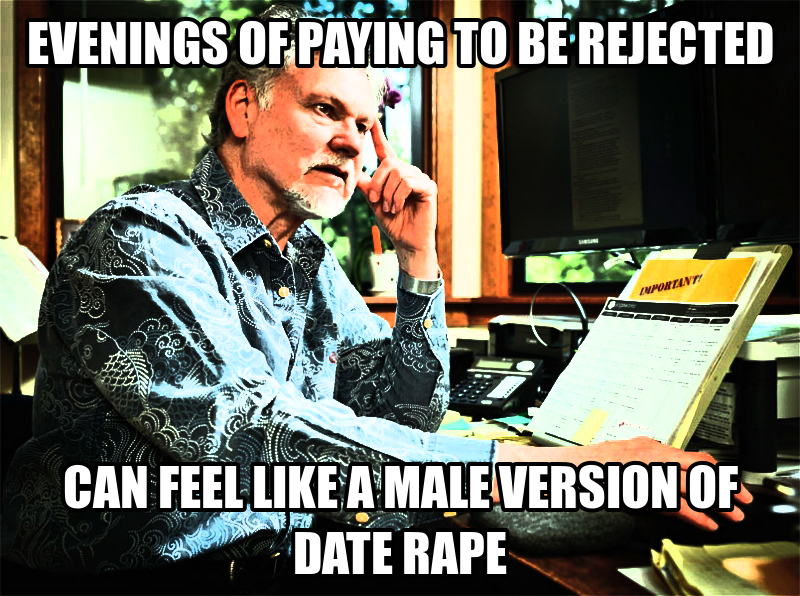
Evenings of paying to be rejected can feel like a male version of date rape. (MoMP, p. 314)
Really? Paying for dinner and not getting laid is the same as date rape? So the price of sex with a woman is dinner? Are we talking a nice restaurant here, or will Taco Bell due? Isn't that prostitution?

Oh, and by the way, have you been raped, Warren? Do you know how it feels to have your autonomy and physical body, not to mention your psychological self, sexually violated by another person? To have your trust in other human beings destroyed? To believe, despite the evidence, that somehow it was your fault? To have the nightmares, the hypervigilance, the self-loathing that comes with rape? Yeah, thought not.

Or this:
Almost all single women acknowledge they have agreed to go back to a guy’s place “just to talk” but were nevertheless responsive to his first kiss. Almost all acknowledge they’ve recently said something like “That’s far enough for now,” even as her lips are still kissing and her tongue is still touching his. (MoMP, p. 314)
Okay, so if you kiss somebody, that is tacit consent to sex? Wrong again, Warren.

And he always goes back to his straw man about false reports. Most studies put the false report rate at 2%. Even the FBI (1996), only put it at 8%:
As with all other Crime Index offenses, complaints of forcible rape made to law enforcement agencies are sometimes found to be false or baseless. In such cases, law enforcement agencies “unfound” the offenses and exclude them from crime counts. The “unfounded” rate, or percentage of complaints determined through investigation to be false, is higher for forcible rape than for any other Index crime. Eight percent of forcible rape complaints in 1996 were “unfounded,” while the average for all Index crimes was 2 percent.
What that section fails to mention, however, and Farrell has never acknowledged, is that local law enforcement will often decide a case is unfounded when drugs or alcohol are involved, or when there is previous sexual activity between the rapist and the victim.

Roughly a third to a full half of the clients I see have reported their rapist and the police/sheriff decided not to file charges or even pursue an investigation. This is seldom acknowledged aside from claims that reported rapes are far less than total rapes.

* * * *

One place Farrell is right is that this needs to be something we talk about with kids long before college or when they become sexual (high school, in general). Education is always the best prevention.

Where Farrell tends to be most relevant is in his discussions of the disposable nature of men in most societies. However, the answer is not to put more women in those jobs to make the risk more equal - it's to remove that safety issues that make those jobs so deadly (mining, oil fields, etc, where the corporations repeatedly avoid, undermine, or lobby against safety regulations). And the exception here is combat - let women be in combat military roles if they can do it.

Anyway, here is the brief interview.

Men, Power, Money, and Sex

An interview with men's advocate, Warren Farrell

Published on July 17, 2014 by Marty Nemko, Ph.D. in How To Do Life


Warren Farrell is a leading expert on men’s issues. He is the author of seven books and chair of the Commission to Create a White House Council on Boys and Men. He served on the board of the National Organization for Women (NOW) in New York City and is an advocate for both sexes having the full range of options, professionally and personally. 

I interviewed him about gender roles, power, why men earn more, and campus rape.

Marty Nemko: You're most well-known for your book The Myth of Male Power, just out in a new e-book edition. Many people think men have the power: Look at the Senate and CEO rosters. How would you respond?

Warren Farrell: A small percentage of men have major institutional power but across the full population, real power is about having choices. The women’s movement has made it socially acceptable for a mom to work full-time, stay home with the child full-time, or work part-time. That’s as it should be. Alas, it’s not as acceptable for a man to work part-time, let alone be a full-time parent. Mr. Mom is still a term of derision.

Marty Nemko: But men earn more. Isn’t that power?

Warren Farrell: Many men still buy into a false definition of power: feeling obligated to earn money that someone else spends while we die sooner—5.2 years sooner. That’s not power. That’s being a prisoner of the need for love and approval.

Marty Nemko: In your book, Why Men Earn More, you report that the statistic that women earn 77 cents for each dollar a man earns for the same work is very misleading. Can you give an example as to why? 

Warren Farrell: Women who have never been married and never had children earn 17% more than never-married men that have never had children, even when education and years worked are equal. Men don’t earn more than women. Dads earn more than moms. Why? When a child is born, a mom is more likely to divide her labor between work and home, earning less at work. A dad is more likely to increase his hours at work—or work two jobs—often taking jobs he likes less that pay more. 

Marty Nemko: In Why Men Earn More, you write, “The road to high pay is a toll road.” Are you suggesting that high pay and power can be inversely correlated?

Warren Farrell: Yes. For many dads, the road to high pay is not about power; it’s about his hope to make his children’s life better than his. It’s about giving his wife a better life. And to get that higher pay, he often has to forgo work he'd rather do. For example, he might prefer to be a teacher or a creative but to better support his family, he accepts a long-hours, high-stress, technical, travel-intensive, often soulless management position.

Marty Nemko: In your recent Reddit Highlighted Conversation, you cite statistics so startling that some would question their veracity. Would you provide the source for:
  • This is the first time in U.S. history that our sons will have less education than their dads.
  • Boys' suicide rate goes from equal to girls at age 9 to five times(!) girls' in their twenties.
  • More U.S. male military were killed by suicide in one year than were killed in the wars in Iraq and Afghanistan in all years combined.
Warren Farrell: Yes. Boys having less education than their dads is from the OECD (Organization for Economic Co-operation and Development), “Education at a Glance,” 2010, Table A1.3a

The boy-girl suicide rate is from the Centers for Disease Control and Prevention, Morbidity and Mortality Weekly Report, 58,1, 2009, and Web-based Injury Statistics Query and Reporting System (WISQARS), 2010.

The U.S. military suicide rate data is from the DOD, uncovered by CBS, in Armen Keteyian, “Suicide Epidemic Among Veterans.” CBS News, November 13, 2007. http://www.cbsnews.com/stories/2007/11/13/cbsnews_investigates/main3496471.shtml.

Marty Nemko: The subtitle of your book The Myth of Male Power is: Why Men are the Disposable Sex. How are men the disposable sex?

Warren Farrell: Virtually all societies that survived did so based on their ability to train their sons to be disposable—disposable in war, disposable at work.

Marty Nemko: That’s a strong statement. What’s your evidence?

Warren Farrell: The evidence is ubiquitous. 92 percent of workplace deaths occur to men, jobs few women would take: oil rig workers, long-haul truckers, roofers, coal miners. Yet there isn't the political will to create regulations that would afford them more protection for these workers. Meanwhile, when women have a less life-threatening deficit, for example, underrepresentation of women in engineering, there's massive expenditure to redress. Although male-only draft registration is a violation of both the 14th Amendment’s equal-protection clause and the 5th Amendment’s due process clause, it is so unconsciously accepted it isn’t even questioned. Only men can serve in direct combat so 98 percent of Iraq and Afghanistan deaths were men.

Marty Nemko: Is the fact that men die 5.2 years younger than women another example of male disposability?

Warren Farrell: It is the combination of facts like men dying 5.2 years younger than women—or men dying sooner from all ten of the ten leading causes of death, plus the fact that we nevertheless have seven federal offices of women’s health and none of men’s health that together reflect the psychology of indifference toward male disposability. Similarly, men over the age of 85 commit suicide 1350 percent as frequently as women over 85. Virtually no one knows this. If women over 85 committed suicide 1350 percent as often than men, it would be used as the quintessential example of our undervaluing of women. We seem to care more about saving whales than saving males.

Marty Nemko: You said men are indirectly disposable as dads. How do you mean?

Warren Farrell: In a divorce, if the mother doesn’t want the father to be equally involved, the apriori assumption is that she's right. Men have to fight in court for that right, and that's expensive.Unless he’s rich, he’s disposable. 

Marty Nemko: What are your thoughts about the current focus on campus rape?

Warren Farrell: The issue first should be addressed before kids get to college. For example, we may need to encourage our daughters to take the initiative when they do want physical intimacy, not just to say when they don’t. Our society strives for equality but few experts are asking women to share the responsibility for taking the initiative in sex, thereby risking rejection. During adolescence, women are the more mature sex. It’s unfair to expect guys to assume 90 percent of the burden of sexual rejection.

Marty Nemko: What should happen at college?

Warren Farrell: First, make the law the last resort. The law is binary: guilty/not guilty. Sex is nuanced and more nonverbal than verbal. Those nuances have evolved over millennia. A slight change in eye contact means everything in a male-female encounter but would be laughed at in court. And if a grievance is filed, we should not presume guilt. Alas, some accusations are false.

Marty Nemko: What about workshops at college?

Warren Farrell: Yes but both sexes should be walking a mile in each other’s moccasins.

Marty Nemko: You’ve done such trainings, right?

Warren Farrell: Yes. I used to tell college audiences, “Every woman is in a beauty contest every day of her life.” I then invited all the guys on stage to experience that. I had those guys wear bathing suits and had the women be the judges. The guys were stunned at being unseen for their integrity, intelligence, or values. They felt objectified.

Marty Nemko: What did you do to help the young women walk a mile in the guys’ moccasins?

Warren Farrell: I had the women “ask-out” the guys they were most attracted to on a 20-minute “date.” Some did what they criticize men for, for example, lying to get an attractive guy to go out with them. Others went after a less attractive guy to reduce the chance of getting rejected. The guys totally identified with that.

Marty Nemko: What was the outcome of those workshops?

Warren Farrell: Greater compassion for the other sex’s vulnerability, and I formed hundreds of men and women’s groups so they would continue to deepen their compassion after I left campus. 

Marty Nemko: Was there any concrete evidence it reduced campus rape?

Warren Farrell: I asked campus sponsors to let me know if any of the workshop participants later were involved in a date rape accusation. Although I had worked with 20,000 students in hundreds of colleges, not one incident was reported.

Marty Nemko: Do you still do those workshops?

Warren Farrell: As political correctness set into the colleges’ psyches, college programs shifted to emphasizing only men understanding women. It would be wiser for programs to help both sexes better understand each other. We don’t need a women’s movement blaming men, nor a men’s movement blaming women. We need a gender liberation movement. We need both sexes walking a mile in each other’s moccasins.

Tuesday, December 31, 2013

Die Like a Man: The Toxic Masculinity of "Breaking Bad"

I missed this article when it first appeared in October, but it's still a topic worth discussing now that nearly everyone has seen the Breaking Bad finale. The title of the article tells you what you are going to read, a review of the ways this epic television show portrayed a toxic form of masculinity defined by violence, power, and money.

I have no disagreements with any of that.

However, I want to suggest that there are other depictions of masculinity that are not so toxic. For much of the series, Walt and Jesse perform a strange dance of interdependence - many times Walt could have allowed Jesse to be killed and did not. And in one of the most difficult scenes early in the series, Walt allows Jesse's heroin addict girlfriend to die of asphyxiation in her sleep rather than save her, ostensibly to protect Jesse from his proclivity for addiction.

It's Jesse who represents the best of masculine values, in spite of the chaotic world in which he lives. He loves honestly and consistently. He does his best to take care of the young woman and her son that he loves and had to leave in order to protect them from the dangerous people in his life, including Walt. When he escapes in the final episode after Walt rescues him, we can imagine he will find the young boy (his mother, Jesse's love, is now dead) and raise him as his own.

Throughout the show, Jesse struggles with addiction, goes to rehab, and struggles some more with addiction. He is beaten nearly to death by Hank, Walt's brother-in-law, and then for much of the last season he is beaten and tortured.

Jesse never gives up hope. And he never loses his sense of right and wrong the way Walt does as he seeks more money, more power, and does so with violence - including putting out a hit on Jesse.

It's too simplistic to say that Breaking Bad presents and represents toxic masculinity - it reveals the full spectrum of masculinity, from tenderness to toxicity, often within the space of a single scene. 

Die Like a Man: The Toxic Masculinity of Breaking Bad

By Laura Hudson
10.05.13


Spoilers for the Breaking Bad finale follow.
“It felt right and satisfying and proper to us that he went out on his own terms; he went out like a man,” Breaking Bad creator Vince Gilligan shared in a recent podcast, describing the death of Walter White in the series finale.

If that sounds familiar, it’s because we heard Hank – his prototypically macho brother-in-law – say something very similar during Skyler’s intervention, when he defended Walt’s decision to refuse both financial charity and cancer treatment: “Maybe Walt just wants to die like a man.”

What, exactly, does it mean to be a “man”? It’s a question that sits at the dark, warped heart of the entire series and its anti-hero protagonist. A nerdy chemist whose brains haven’t earned him any power or respect from the world at large, the terminally ill Walt decides that he’s finally going to get that power and respect through whatever means necessary (and whenever possible, using science). The show doesn’t just trace Walt’s arc from Mr. Chips to Scarface, as Gilligan famously described it, or from Walt to Heisenberg; it also maps his journey from being a “pussy” to being a “man.” And while he succeeds in his goals, it’s a transformation that comes at a high price.

If we really want to look at the definition of a man within the world of Breaking Bad, it’s easiest to start by looking at what it says a man is not: the Walter White we meet in the very first episode of the show.

By some measures, Walt has had a successful life: He’s incredibly brilliant (we’re told his research contributed to a project that won a Nobel Prize, not to mention Gray Matter Industries); he’s a teacher; and most importantly, he has a loving relationship with his family, and another child on the way. But Walt still feels like a failure, particularly because he hasn’t achieved the sort of financial success he believes he deserved.

Money and masculinity are deeply linked by the series. Not only does money signify the value of the person who earns it, but also the control and self-sufficiency that comes along with it. This link between manliness, money, and power is a dangerous one for people who accept it. Walt, after all, would literally rather die than accept charity, because taking money from Gretchen and Elliott would somehow make him feel like less of a man.

Later, when Walt says that cooking meth has cost him his family, drug kingpin Gus Fring suggests that perhaps he’s looking at it the wrong way. Perhaps in alienating his family, he was actually fulfilling a more important role: “When you have children, you will always have family. They will always be your priority, your responsibility. And a man, a man provides. And he does it even when he’s not appreciated, or respected, or even loved. He simply bears up and he does it. Because he’s a man.”

This seems particularly prescient, because it’s the exact model of manhood that Walt embraces. By the time the finale rolls around, Walt is so alienated from his family that they neither want to see him nor accept his money, and so he must funnel his drug fortune to them without their knowledge, ensuring he receives no credit — no appreciation, respect or love. In Walt’s mind, the measure of a man isn’t his relationship to his family, but rather his ability to support them financially. Faced with a terminal cancer diagnosis, and the decision about what sort of legacy he truly wants to leave behind, Walt sacrifices the former for the latter. (Of course, as he admits in the final episode, it isn’t simply about the money, and it isn’t really for his family. Leaving them the money isn’t an act of altruism so much as it is an affirmation of his own power and identity: being a man who provides.)

Masculinity in Breaking Bad is a brittle thing, one so terrified of weakness that any display of vulnerability must be punished, and any slight against another man’s power answered with violence – or else perceived as a weakness. We see it in the hyper-masculine culture of both the neo-Nazis and the drug cartel, where the air is always dripping with machismo and vengeance is considered an almost sacred duty.

This model of manhood also requires control not only over your own life, but over the lives of others. Think about all of the most iconic moments of the show, the badass lines that made us want to pump our fists: “Say my name.” “I am the danger.” “I am the one who knocks.” “I won.” Every single time, it’s about dominance – not just about having power, but about taking power away from someone else.


The series begins with what seems like an odd image: a pair of pants, flying through the air. Much of what follows is about who gets to wear them. When Skyler shows up unexpectedly to threaten Jesse for supposedly selling weed to Walt, Jesse is quick to insult Walt’s manhood: “Good job wearing the pants in the family.” As time goes on, however, and Walt slowly dominates Skyler to the point that she would rather try to drown herself in a pool than speak up against him, the new status quo becomes clear: He’s wearing the pants now.

It’s also worth noting that when Hank finally discovers the truth about Walt, it’s while Hank is sitting on the toilet – literally, getting caught with his pants down. And while Walt may not have wanted Hank to die, Walt almost surely thrills a little to getting away with all his crimes under the nose of the man who used to condescend to him, enacting his own twisted version of the movie where the nerd gets one over on the jock. Once the truth is out and Hank assaults him physically, Walt fires back with a chilling warning, letting Hank knows that he is no longer a man to be trifled with: “If you don’t know who I am, then maybe the best course is to tread lightly.”

Their conflict is one of the most interesting in the show, not only because Hank serves as the uber-masculine counterpoint to Walt – the Charles Atlas to Walt’s skinny kid getting sand kicked in his eyes – but because their pissing contest in the garage isn’t just about who has more power. It’s about which brand of power is superior: brains or brawn. Ultimately, Walt doesn’t subordinate Hank by lifting weights, getting buff and beating him in a fistfight. He wins by outsmarting him, like Walt always does.

When we first meet Walt, he’s an object of ridicule to his students, trapped in a low status loop where his intellect isn’t valued and confers no power to him. The first sign that he is transforming into someone different is when he begins to push back, and lash out at the bullies around him – and of course, he does it with science. When slighted by a jerk in an expensive car, Walt manipulates the engine and causes it detonate. When a drug lord beats Jesse and takes their money, Walt shows up with an explosive designed to look like meth and blows up the building. When the feds get hold of the incriminating tapes from the superlab, Walt rigs a truck with a supermagnet, and uses it to erase the evidence from outside the building.

Walt and science, making everyone their bitch since 2008.

Which leads us to perhaps the most interesting and gender-charged word on Breaking Bad: “bitch.” Yes, yes, it’s just a word. But it’s also coded with some very gender-specific ideas about power and dominance – who has it and who takes it – that are fundamental to the conflict at the heart of Walt’s transformation.

The easiest way to deconstruct a word is to think not only about what it means but what it does, and how it does it. When you call a woman a bitch, you’re saying that she’s difficult, unaccommodating. By that standard, Walter White would be possibly the biggest bitch of all. Of course, that’s not the way it works. When we apply a female slur like “bitch” to a man, something strange happens. It stops meaning that someone is difficult or unpleasant – words that for men more easily be seen as signs of strength – and instead becomes an indicator of weakness and cowardice.

In short, calling a man a “bitch” is designed to diminish his power by comparing him to a woman. It implies that women are weaker and less powerful, and also that they are to be used and dominated. “Bitch” is linked to exploitation, to submission; if you make someone your bitch, you force them to submit to your will, in one way or another. (Despite being the most famous and popular insult of Jesse Pinkman, it’s worth noting that Jesse almost never uses the word to describe women.)

Similarly, “pussy” is a word used almost exclusively against men, for the very reason that it reduces them from masculine to feminine, from a higher level of power to a lower one. What these words tell us is that men aren’t just defined by what they are; they’re defined by what they’re not supposed to be. Over and over again, men in Breaking Bad send and receive the message that the last thing they want to be is women.

Jesse: The face of toxic masculinity

Jesse is highly aware of the very narrow cultural script for being a man, and certainly knows how to act it out. This is a guy who feels perfectly comfortable grabbing his crotch and telling Walt to “speak into the mic, bitch!” But despite his flaws and his posturing, he’s always been a good guy: compassionate, caring and even sensitive. Deep down Jesse is more creampuff than criminal, unable to take part in the sociopathy of the people around him and deeply traumatized when forced to commit violence. (Walt, meanwhile, just whistles.) We see Jesse cry on more than one occasion, and he has a particular soft spot for children, both very stereotypically feminine traits.

Needless to say, Jesse is punished for them. Expressing emotion is seen as weakness and liability, and the reason that Jesse ultimately ends up broken, enslaved and exploited by the final episode. Despite his attempts to ward off subordination with masculine posturing — like calling everyone in earshot a “bitch” — that’s exactly what he becomes. Manipulated by a long series of more powerful men, by the end of the series Jesse is shackled in a cell while the men around him watch videos of him weeping during his confession for entertainment. “Does this pussy cry through the whole thing?” asks Jack.

In many ways a boy trying to become a man, Jesse is the male face of the damage that toxic masculinity does – the cost it extracts not only from women but from men. He shatters against the rocks of the masculine ideal, and it’s doubtful he will ever be able to put himself back together. Taken to its furthest extent, this brand of masculinity punishes men for acting like Jesse, and instead produces men like Walt – and even Todd.

The irony of this perspective on masculinity is that for all its insistence on the importance of power — both having it and taking it — it often makes the people who adopt it weaker. Or as Walt Jr. says, when asked to discuss his father’s refusal to accept charity or get treatment for his cancer: “You’re a pussy.” (Of course.)

When Hank refuses to acknowledge his PTSD – or accept his physical weakness after his shooting – he prevents himself from healing both emotionally and physically. When Heisenberg’s crimes are pinned on Gale, Walt tells Hank that the other chemist wasn’t good enough to pull it off because his pride won’t allow him to give up the credit. And in the end, masculine pride is what makes Walt’s final act of revenge possible: By suggesting that Jack might have partnered with a rat — impugning his honor — Walt is able to delay his own death long enough to activate his machine gun.

Many have argued that Breaking Bad is an indictment of Walt, a critique of the male power fantasy rather than a celebration. How we respond to the ending and whether we’re still rooting for Walt in those final moments is indeed a measure of our own complicity – or Matt Zoller Seitz puts it at Vulture, “it’s an ending that leaves us alone with a mirror.”

While we may want to cheer for the character we’ve been identifying with for so long, what are we really cheering? What standards of success are we tacitly endorsing when we feel just a little bit pleased that Walt got to live — and die — “like a man”? The masculinity described in Breaking Bad is something deeply pernicious, a cultural dogma that damages, warps and limits men, isolating them from their emotions and from others. It promotes violence, retribution, and a hierarchy built upon the backs victims both male and female. Sometimes, it kills them. As Silpa Kovvari at The Atlantic observed, the masculinity of Breaking Bad represents “standards to die by, not to live by.”

Regardless of whatever personal triumph it represents to him, Walt’s is a Pyrrhic victory; he has achieved power only by stripping it from others, and perpetuating the same ruthless system that once humiliated him and treated him as worthless.

If we learned anything from the kind, brilliant Gale, it’s that the Walter White who dies at the end of the show would have had no problem shooting the Walter White of the first episode in the head if he got in his way. When the nerd who was bullied becomes the bully, should we really feel a sense of satisfaction? Or should we take a deep, soul-searching look at the sort of system that makes underdogs like Walt feel like the only way they can be men is by destroying and dominating everyone around them?

Breaking Bad was a show about a man with greatness inside him, and who believed that the only way to achieve it was by becoming the sort of man who whose greatness would be acknowledged and respected. While it’s obvious that Walt isn’t a “good” guy by the end, to many people he was still a sympathetic one. It’s far easier to high-five Walt for climbing to the top of the masculine power pyramid than to reexamine whether we should be tearing it down. Not only because of the collateral damage it does to people like Skyler and Andrea, but the damage it does to the men who attempt the climb.

While Gilligan has voiced his criticism and even contempt for the man Walt becomes on numerous occasions, the final installment is nothing if not a victory lap. Yes, Walt pays for his decisions in many ways, but it’s telling that all of those costs get extracted in the episodes preceding the finale. Taken on its own, the last episode of the show reads more like wish fulfillment than condemnation, as Walt dies surrounded not by his failures but by his triumphs, by the chemistry he loves rather than the family he sacrificed, and with a smile on his face. You can (and probably should) step back and view Walt’s final form as a critique, as something that ends in emptiness, but somehow that’s not the feeling the finale imparts. The show ends not by inviting introspection, but rather, as Gilligan said, offering satisfaction:

“As bad a guy as he has been, and as dark a series of misdeeds as he has committed, it felt right and satisfying and proper for us that he went out on his own terms. He went out like a man.”

Indeed he did.

Tuesday, November 19, 2013

Michael Boyle - Only One Body


From Mike Boyle's Strengthcoach.com blog - a little reminder that this body is our only body. I bet many of you spend more time and money taking care of your car or your house than you do your body.

Only One Body

By Michael Boyle

( the following is reprinted for a third time. Back in 2009 I might get a few hundred views. This time I might get a few thousand. I’m not sure where I posted it first by this is the third time on this site.)

Imagine you are sixteen years old and your parents give you your first car. They also give you simple instructions. There is one small hitch, you only get one car, you can never get another. Never. No trade-ins, no trade-ups. Nothing.

Ask your self how would you maintain that car? My guess is you would be meticulous. Frequent oil changes, proper fuel, etc. Now imagine if your parents also told you that none of the replacement parts for this car would ever work as well as the original parts. Not only that, the replacement parts would be expensive to install and cause you to have decreased use of your car for the rest of the cars useful life? In other words, the car would continue to run but, not at the same speed and with the efficiency you were used to.

Wow, now would we ever put a lot of time and effort into maintenance if that were the case.

After reading the above example ask yourself another question. Why is the human body different? Why do we act as if we don’t care about the one body we were given. Same deal. You only get one body. No returns or trade-ins. Sure, we can replace parts but boy it’s a lot of work and it hurts. Besides, the stuff they put in never works as well as the original “factory” parts. The replacement knee or hip doesn’t give you the same feel and performance as the original part.

Think about it. One body. You determine the mileage? You set the maintenance plan?

No refunds, no warranties, no do-overs?

How about this perspective? One of my clients is a very successful businessman. He often is asked to speak to various groups. One thing he tells every group is that you are going to spend time and money on your health. The truth is the process can be a proactive one or a reactive one. Money spent on your health can take the form of a personal trainer, massage therapist and a gym membership or, it can be money spent on cardiologists, anesthesiologists, and plastic surgeons. Either way, you will spend money.

Same goes for time. You can go to the gym or, to the doctors office. It’s up to you. Either way, you will spend time. Some people say things like “I hate to work out”. Try sitting in the emergency room for a few hours and then get back to me. Working out may not seem so bad. Much like a car, a little preventative maintenance can go a long way. However, in so many ways the body is better than a car. With some good hard work you can turn back the odometer on the body. I wrote an article a while back ( Strength Training- The Fountain of Youth) that discussed a study done by McMaster University which showed that muscle tissue of older subjects actually changed at the cellular level and looked more like the younger control subjects after strength training.

Do me a favor, spend some time on preventative maintenance, it beats the heck out of the alternative. Just remember, you will spend both time and money.

Thursday, May 16, 2013

Peter Lawler & Nina Easton - Perspectives on the Economic Struggles of Men

In his column at Big Think, Peter Lawler breaks down an article from CNN Money on why men are falling behind economically. First the original article and then the response from Lawler.

6 reasons why men are falling behind women

Readers weigh in with their personal observations about why American men are struggling economically


By Nina Easton, senior editor
May 8, 2013


FORTUNE -- There is a growing consensus among scholars on the right, left, and center that the state of median-income men in America is in distress.

They've endured a three-decade drop in earnings. Even before the financial crash, prime-age men were dropping out of the workforce altogether, and the problem has only worsened since. Meanwhile, women are far outstripping their male counterparts in the area that's most important for a 21st century global economy -- education.

The big question remains -- why? On this, the research still falls short. So the outpouring of reader feedback on my column in the April 29 issue of Fortune -- "America's Wayward Sons: Why They Can't Carry On" -- offers some valuable on-the-ground perspective.

The focus of that column was an MIT study showing the sharp rise in single-parent households hurts boys more than girls. Other scholars have blamed a rise in more readily available government assistance, making aid checks more appealing than paychecks. The decline of well-paying manufacturing jobs, combined with fast-paced technological change, also factors in.

Here's what readers, reporting on what they see in their own backyards, had to say:

Flight of fathers. There was broad agreement with the MIT study's conclusion that the rise of single-parenting has set back achievement levels. "My father was a small-time white-collar criminal that fled the country prior to a court date when I was just a few months old," Adam C. Dudly writes. "Even now, in my 30s, I struggle with laziness, sense of identity issues, figuring out who I am or what I want to be, and what kind of man I'm supposed to be ... I would have to assume most young men are not as proactive as I am."

"While this may seem glamorous for those who admire movie stars and athletes, such family arrangements in the real world often doom children to lead lives of emotional and material privation," writes Jason DeSena Trennart. "It is a clear and present danger to the fabric of our republic. Senator Moynihan spoke honestly about this problem in the African American community as long ago as 1965. Sadly, the phenomenon of single-parent households has only grown."

A rise in autism and ADHD. "Unfortunately, the current debate is being waged by social scientists and psychologists who are quick to blame the issue on vague societal trends (globalization, decline in manufacturing) and of course, single mothers and the lack of a male role model," writes Michelle Linn. "I suggest you consider exploring how biological (real) science may be playing a role in this alarming issue. The generation of children born since 1988 are by many accounts the unhealthiest on record. The rates of ADHD, asthma, autism, bipolar disorder, diabetes, and allergies have skyrocketed in the last two decades. In 2012, the Centers for Disease Control published a rate of 1 in 5 children having a behavioral disorder or chronic disease.

"It is well known that neurological disorders affect boys more frequently than girls (for autism, the rate is fivefold)," she continues. "Could it be these illnesses and diseases of the central nervous system are actually affecting our economy? It is very easy to blame the lost potential of up to 20% of our youth on social stereotypes and psychology 101 blithering."

Video games. "As the mother of two boys ages 14 and 15," writes Chris Olofson, "my biggest fear is that it's the video gaming, in addition to the factors you mentioned in your article, that is causing the lack of motivation and initiative to work and thus get a firm hold on the economic ladder.'' She wants to see more research on how video games lead to a decline in reading and thereby college performance.

A K-12 education system biased toward girls. As Rob Ritzenthaler bluntly put it: "Who was the nut that thought that boys should sit at a desk for 6-8 hours a day while they were growing up?" Some readers also criticized the emphasis on obtaining college degrees.

Microbiology professor Pinghui V. Liu cited Japan's system of vocational schools for high school students who can't afford college -- offering engineering and mechanics, commerce and accounting, schools of agriculture and forestry, and even schools of fisheries. With this kind of schooling, teenagers "can start looking for jobs at the age when American students are just beginning to worry about how to pay for their college education," he writes.

Likewise, writes Dave Danson, "the constant message to your our young people that they are going to be a failure in life without a four-year degree is the wrong message to send to parents and young people ... The food in your grocery store was delivered by a trucker who most likely did not have a degree. The store mechanicals are maintained by someone without a degree ... Post-secondary training is vital ... But please try to look at the bigger picture."

Several readers noted that in school, boys and men still outpace women in science and math. And they still dominate in high-paying industrial jobs. Corey Planter, who graduated with a paper-engineering degree, notes that men mostly fill factory jobs as millwrights, pipe fitters, welders, and ironworkers -- paying up to $28 an hour. "You may be thinking that these jobs are rapidly disappearing, however they are not," he writes, noting one machinist shop that was on a nationwide search for enough machinists to keep up with his orders.

The financial gains of women. Gustavo A. Duran makes clear he supports the recent economic gains of women -- his own daughter has a masters from Stanford -- but he sees more and more men taking a backseat. "I am now seeing many women in their 40s being the main breadwinners while their husbands diddle [around] daily in odds and ends," Duran writes. "I think this trend will just get larger as we move on the next two to three decades unless we as a society become more demanding of our male children to be disciplined and accountable ... Men need to be equally responsible for themselves so that they can contribute to taking care of their children and their spouses."

Affirmative action. "I was surprised, however, not to see any mention of affirmative action as a contributor," writes T.J. Wilsson, echoing a number of readers. "With so many major employers obliging 'guidelines' pressuring them to, effectively, discriminate against males ... For example, I read that a major employer in one state had guidelines that some 80% of its newly hired veterinarians be female." Ron Goddard complained that "every step of the way my sons and I were put on notice by corporate America that we were their second choice."

Whatever their perspective, most of the readers who responded wanted more discussion, more research, and more attention to this vital conversation.
* * * * * *

And now the response - and an alternate viewpoint.

Men Fading Badly?

by PETER LAWLER
MAY 10, 2013


Here’s a good article that offers six explanations for why “median-income men in America” are “in distress.” Their incomes are dropping. Lots of “prime-age men” have been “dropping out of the workforce altogether.” Maybe most importantly, men have been disappearing from our institutions of higher education. If our future leaders are to be those who graduate from our colleges in the most serious programs and with the highest levels of achievement, then most of our future leaders will be women.

At my college, which is fairly typical, we've been worried about the “man dearth” for a while now. We can get filled up pretty easily with solid students, but recruiting men is a challenge. We just started up intercollegiate football, which did reduce the “gender gap” for next fall. But everyone knows that that remedy is temporary.

Where are the men who should be in college? The credential of a college degree, of course, is more important than ever, given the “decline of well-paying manufacturing jobs.” Everyone talks about picking up flexible skills and competencies outside the formal academic structure, but it’s not like that’s so easy for the ordinary guy to do. Peter Thiel ain't offering his entreprenurial grants to guys like that.

I’m not talking about my college now: It’s pretty clear that many or most colleges now have a kind a covert affirmative action for men. They’re knocking themselves out looking for them, and (perhaps) they’re compromising standards just a bit on their behalf. But the various schemes just aren’t working that well.

I’m not complaining about having to teach a disproportionate number of women: While I had a good number of really fine male students this spring, there’s no denying that women, in general, are more mature and have better personal discipline at 18 (or 19 or 22). They also have much better social or relational skills, and so they are much better at flattering (someone might say playing) me. Given my self-esteem “issues,” I really appreciate that.

I want to talk about all six causes of the decline of the middle-class man. The somewhat mysterious epidemic of autism is above my pay grade, but I do see it with my own eyes. And then there are video games, which really do cause some young men to exhibit another kind of asocial behavior.

Whatever I might want to do (eventually), I’m just going to put forward for your consideration what might be the most controversial cause.

I call your attention to the “MIT study showing the sharp rise in single-parent households hurts boys more than girls.”

The “flight of fathers,” for one thing, creates “identity issues” for young men. They haven’t been given guidance—or role modeling—about “who I am and what I want to be.” The result is “achievement levels” suffer.

I would add that fewer young men are either being responsible fathers or thinking of themselves as fathers in the near future. Surely one powerful incentive for personal achievement is parenthood. And parenthood isn’t what it should be if the father isn’t present at home and doing his part.

Because most single-parent households are headed up by women, the toll on motherhood just hasn’t been as great. We might even say that moms seem more noble than ever. Maybe one powerful incentive for the personal achievement of women these days is the knowledge that they can’t and shouldn’t rely on men.

So it’s very possible to speculate that the achievement level of our men fades as their participation in genuinely responsible relational life fades. Or at least we can say that the two forms of fading are interdependent.

Tuesday, October 9, 2012

What If Money Was No Object?: Thoughts on the Art of Living from Eastern Philosopher Alan Watts


From Open Culture, this is an excellent reminder that making money is not the same as being happy. Watts encourages us to examine our lives and ask ourselves, Are we putting money ahead of happiness and meaning?

I faced this decision a few years ago and changed my life to fit with my purpose. I stopped working in the production sector (marketing for a giftware company) and shifted my life to the service sector (personal trainer). The world will not be a better place if more people buy coasters, but I can help one person at a time get healthy and, maybe, be happier.

And now I am creating even more alignment as I develop my career as a psychotherapist.

I had to give up income for a while and live more frugally as I realigned my life. But I have never been happier with the way I earn my living - to the point that if I did not need the money, I would still be doing what I am doing right now.

What If Money Was No Object?: Thoughts on the Art of Living from Eastern Philosopher Alan Watts

October 9th, 2012

 
Alan Watts came to San Francisco during the early 1950s, wrote his bestseller Way of Zen, and became one of the foremost popularizers of Zen Buddhism, Hinduism, Taoism and various forms of Eastern philosophy. His TV show, Eastern Wisdom and Modern Life (1960), introduced Americans to the seemingly exotic concept of meditation (watch here). And his radio show and lectures forced listeners to pause and look at their lives from a fresh perspective. Again and again, Watts challenged the Western emphasis on money-making to the exclusion of all else. We’ve heard Watts rail against this soul-crushing value in a lecture animated by the creators of South Park. (I’m not kidding you.) And, in the newly-produced video above, he continues along the same trajectory. So, as you drink your morning coffee and ponder your day, ask yourself: Are you putting money-making before happiness itself? Or are you pursuing the passions that bring happiness, achieving excellence, and then letting the money follow? With that, I’ll let you continue with your day.
H/T @KirstinButler
Related Content:

Friday, July 9, 2010

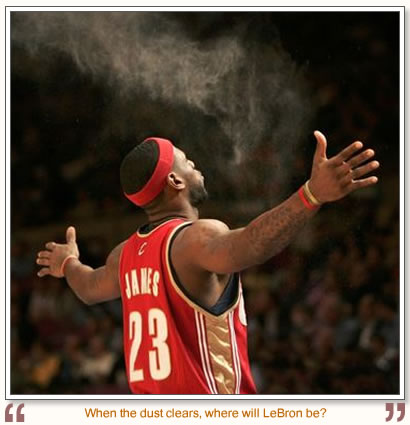
Comparing the LeBron James Spectacle With How a Real Man (Kevin Durant) Handles His Business

2010-07-09-lebron_james16.jpg

Is this what happens when you have been worshipped since adolescence for your physical skills? Does this spectacle resemble any of the young pop music/starlets who seek publicity at any cost?

Should I ask for a one hour show on a cable network the next time I decide which job to take?

I see very few people, if any, questioning LeBron's decision to "take [his] talents to South Beach, and, uh, join the Miami Heat," but almost everyone is questioning how and why he decided that he needed to do it in prime time, in a one hour show devoted to his 2 second statement.

When I heard about the one hour special, I thought, what the fuck? Seriously? Even satirist Andy Borowitz made fun his ode to narcissism:
Millions of Americans huddled around their televisions Thursday night, transfixed by the spectacle of an incredibly wealthy man getting a new job.

In living rooms, bars, and restaurants across the country, a record audience gathered to watch the rich guy announce who would be signing his massive new paychecks.

In New York's Times Square, Tracy Klugian, 27, was one of thousands who braved the blistering temperature to watch the multimillionaire reveal the location of his new employer.

"I wouldn't have missed this for anything," said Mr. Klugian. "For anyone who considers himself a fan of the rich getting richer, this was must-see TV."

Jack McCallum at Sports Illustrated, prior to "The Decision," had some thoughts:
I have not been immune from the protracted free-agent pornfest. I've made a few phone calls and dropped a few hints to sources that I would love to be the one to announce LeBron's destination, get my name on that endlessly spooling crawl across the bottom of the TV. But all the while I've been a little heartsick, half-angry and half-sad at the devolution of this process, what it says about the NBA, the cult of celebrity that has overtaken our country and the whole out-of-whack state of sports journalism.
And this . . .
But the big story, of course, was LeBron, who, drunk on the magnificence of his own LeBron-ness, is utterly clueless of how ridiculous this whole process has been, the monumental amount of self-importance attached to scheduling a one-hour show when you have zero championship rings and, at last glance, were seen folding like a beach chair against the Celtics in the Eastern Conference semifinals. Magic coach Stan Van Gundy termed the whole LeBron tease "almost like a parody of itself," which would be accurate if he removed the word "almost." I'm sure Team LeBron is claiming that "The Decision" is mostly about raising money for charity, but here's a simpler way he could do that -- take a million or two of the 100 he's going to get and write a check to the Boys and Girls Clubs of America. And if he's already done it, do it again.
Saying this whole spectacle was a parody of itself is an understatement. The decision had been made probably weeks ago, if not longer (like when they played on The Dream Team together). Yet he visited several teams, each of which thought they had a shot at King James. Silly them. LeBron was playing all of us - and he succeeded.

ESPN had the best ratings they have had for anything that is not the NFL (7.3 share overall, and 9.6 from 9:15 to 9:30, the period when James actually said he was Miami-bound).

As far as money is concerned, everyone comes out of this pretty well - ok, except Cleveland, who will go back to being a third-rate basketball city - and all the businesses that thrived due to LeBron's presence will also suffer. OK, that's business.

But I continue to be amazed that James thought he needed a prime time show to announce his decision - this is the kind of thing a president does when the nation goes to war, not the kind of thing an athlete does when he changes teams.

By comparison, on the same day James had his ESPN spectacle, another major NBA star sent out Twitter note to his followers announcing he had signed a contract extension for five years and $86 million - and he wasn't even a free agent, yet he signed for an additional five years with no early termination option, a common clause for long contracts.

He's 21-year-old Kevin Durant of the Oklahoma City Thunder (who used to be my Seattle Sonics).


Durant at his summer camp for kids.

This comes from Jonathan Abrams in the New York Times:

At the age of 21, Durant became the youngest player to win a scoring title, averaging 30.1 points last season to edge out James. He finished second to James in the most valuable player balloting after helping the Thunder to a major one-year improvement. Oklahoma City arguably provided the eventual champion Los Angeles Lakers with their greatest playoff challenge in the Western Conference, with a tough six-game series.

“It means that they’re really committed to what I believe in — and that’s the team first,” Durant said. “And I’m excited about it and honored that they gave an extension.”

The commitment extends both ways. Offering Durant a maximum extension was a no-brainer, but Durant was not a free agent this summer. With an uncertain economy and a small market, Oklahoma City could have tried to save money by waiting for a new collective bargaining agreement after next season.

LeBron James made it to the N.B.A. Finals by his fourth season - but he has not found his way back to the promised land. Kevin Durant begins his fourth season this year - and he no doubts wants a shot at the title, as well. His young team pushed the Champion Lakers to 6 tough games this past season, and it may be only the Lakers who stand between him and his shot at the Trophy.

My guess is that Durant gets his ring before James does in terms on years in the league - and he'll do it through loyalty, quality play as a part of a team (rather than as The Chosen One, of The King), and he will do it quietly, without an hour-long prime-time show devoted to his Decision.

While LeBron has been acting like an entitle little child in a man's body (which may be how he earned the Man-Child moniker in his high school days).

Meanwhile, Durant is building a Hall of Fame career, happy to be in a small market seeking to build a team with him and several other young guys as the foundation.

This is how a real man does it.

http://i2.cdn.turner.com/si/2009/writers/chris_mannix/07/27/us.team/kevin-durant.jpg
Durant Playing for Team USA

Benjamin C. Klein at the Bleacher Report thinks that Durant is the new King, the one player who be the next Michael Jordon, or at least let us forget him for a few minutes now and then.
I believe that he can make us forget Mike, and be a true King. Unlike a young LeBron, Durant has several things going for him that LeBron didn’t with the Cavs. Durant already has his Pippen, a young point guard named Russell Westbrook. Heck, Durant already has his Horace Grant in Jeff Green. LeBron had Darius Miles early on. Durant also has a good coach, a fantastic general manager, and an owner that only meddles in marketing. LeBron had none of that early on in Cleveland.

However, it’s not just the external factors that make me believe Durant will succeed where LeBron has failed. Durant, unlike LeBron, seems less interested in marketing appeal and more interested in the game. Durant was on the bench during summer league play this last week cheering so loud you would swear he was a cheerleader. Durant breathes basketball; LeBron only seems to breath the things that basketball gives him.

So mark it down ladies and gentleman, July 8th 2010 will go down as the day The King of the NBA abdicated his throne, too weary from the pressure. And if we are lucky, July 9th 2010 will go down as the day the new King, King Kevin Durant, took the crown and never looked back.

Just how clear is it that LeBron has (1) abdicated his position as King James, and (2) didn't really anticipate what his decision would bring?

Point #1: Andy Ostroy, Huffington Post:

The second-coming of Michael Jordan has curiously chosen instead to be the second fiddle of Dwayne Wade, the Heat's one-man offensive machine who'll now also be joined by former Toronto all-star forward Chris Bosh (Gotta hand it to Miami president Pat Riley for bagging the top three free agents of all time). But as anyone with an ounce of basketball knowledge will tell you, Wade is not going to change his style of play for Lebron. It's his team, his town ("Wade County") and his game. Which begs the question, why on Earth would James take a back seat to Wade? The truth is, James, who was feeling the pressure to live up to the "the greatest of all time" label, does not see himself the way fans or the media does. He does not believe he's the caliber of player of Jordan and Kobe Bryant, who've won six and five NBA championships respectively. His decision to cede top-dog status to Wade is a de facto admission that he cannot carry a team and win it all on his back; that he's not "the man" like Jordan and Kobe, and now clearly, Wade.

I tend to agree - this agreement suggests that none of the three are The Man - they each have realized they cannot carry a team to a title on their own, something Phil Jackson has gotten Jordon and Bryant to buy into on his way to 11 NBA titles.

Miami is not even the best basketball choice according to many sports bobbleheads, including me - Chicago has a more balanced team that is ready to give him the title he wants so badly - and he would still be King James, rather than the Prince of Wade County.

By the way, I don't think Durant is The Man either - the difference is that Durant knows he needs a quality team around him to win a title - for a long time, James seemed convinced he could do it alone.

Point #2: Mark Kriegel at Fox Sports:
“The Decision’s” first authentic moment ... came as Michael Wilbon asked James for reaction to the sight of his erstwhile fans in Cleveland now burning his jersey.

He wore an unmistakable expression of shock. You could see it finally dawn on him, this new reality. A media event born of the power struggle between CAA and Endeavor/William Morris had quickly devolved into one of those old-school wrestling interviews. Apparently, the possibility of jersey-burning hadn’t been addressed in any of the memos. In their zeal to hatch the perfect plan, the King’s minions had underestimated the backlash. Without even having to dye his hair, LeBron James had suddenly become the biggest heel in American sports.

“I can’t get involved in that,” he said. “This is a business.”

You could almost see James’ thoughts, as if they’d been superimposed in neatly lettered in cartoon bubbles over his head: BUT I DID EVERYTHING RIGHT! THEY’RE CHANGING THE RULES ON ME!

I wonder what he thought might happen in Cleveland? Did he think they would support his decision and thank him for the memories?

The way he staged this whole spectacle was arrogant, egocentric, and insensitive to the people who have loved and supported him in Cleveland and the rest of Ohio. An hour-long "fuck-off" to his fans? Of course they are burning his jersey - his home might be next.

In the end, the younger Kevin Durant comes off looking the like the more mature man, or at least the one who knows how to handle his business in the right way.


Thursday, February 11, 2010

Shawn Phillips - When The Soul is Murdered in Search of Profit

Good post from Shawn - go leave him your thoughts about the people/business/whoever sold out quality and service for profits. But I want to use this as a jumping off point.

Men do this same thing in their own lives in many ways - soul murder in exchange for wealth.

A quote from one of my favorite bands: "You sell your soul to feed your ego."

How many men do you know who have sold out their passion (or their families) to make more money, to have a bigger house, to have more toys, to go on better vacations? When these same men are on their deathbed, looking back over their lives, what will they regret?

Will it be not having gotten that third car, or not having bought the 60" plasma television? Or will it be not having spent more time with their families, not having enjoyed the millions of moments that make up a life?

I have hijacked Shawn's post here to make a point about our individual lives (while he is looking at the ways businesses sell out their souls to be bigger and more profitable, but lose their purpose in the process) - but we all do this is various ways.

A few years ago, I was seeing 40+ clients a week. I made a lot of money, and that was great. I was chasing the dollars. But the quality of service for my clients, which is what allowed me to have that many clients, declined as I became overworked with long days, tired from lack of good sleep, and less able to focus my full attention on each client.

One day a husband and wife I was training asked me if I was OK. They felt like I wasn't giving them the attention that had made them want to work with me on their health and fitness goals. I assured them I was fine (but I wasn't really listening to what they said). They ended up quitting the gym and stopped working with me.

That was a hard lesson for me - and I feel bad that I let them down. But it woke me up - I decided that I couldn't chase the money and still be effective as a trainer. That wasn't why I started doing this and it isn't who I am. I made a choice to not work more than 25-30 hours a week so that I could give each client my full attention and my best self.

Anyway, here is Shawn's post.

When The Soul is Murdered in Search of Profit

Invisi_Man You’ve felt it—we’ve all had the experience, more often than we care to admit.

Perhaps it was a favorite local eatery that after a decade of perfection one day become every bit as mediocre as Denny’s. It could have been a favorite line of shoes that you were excited to finally find on sale at Walmart, only to find it wasn’t the same shoe at all.

“It,” invisible to the naked eye, is the soul sucking sound of the move from passion and purpose to profit. And it’s happening right now to shoes, clothing, hair salons, tires, coffee shops, and in all manner of business large and small.

I suspect “it” may even be happening to Facebook as we speak.

In the beginning businesses are less a cunning strategy than an expression of passion by a person on fire and on purpose. Plans are often drawn after to justify the insanity.

On the extremely rare occasions when everything goes according to plan you and I get to touch and feel the products or services, we like them. They are new, fresh (even when they often aren’t really) and authentic.

There’s an energy and aliveness that is exciting.

We rush to wear, ride, drink, consume, and experience them in every way. There’s almost no wrong the people or company can do. And we share them. We rant and rave to friends about the new thing they absolutely must experience.

Enter the Wizards

From the outside looking in—the vantage point of well educated folk—it looks all too much like there’s a great product here, a nice shoe, a terrific new supplement in an amazing round bottle with a lid. That’s to say, they “smells like money.”

But what this well-educated yet partially blind eye doesn’t see is the Mojo—the real magic that is propelling the phenomenon; the wave of energy we’re all surfing.

The “soul wave,” is the 3rd and 4th dimensions of the product or service that doesn’t show up on paper, and can’t be weighed, measured, picked up or packaged and thus escapes the perception of most of the people who wear their ties too tight.

The Soul of a person, product, community or company is the invisible, intangible source of magic, energy, attraction—that thing which made it extraordinary. It’s the 21 grams that makes you and I, you and I.

Tragically, because it’s invisible to most people it’s the first thing to be extracted when the “new regime” comes marching in with their calculators and spreadsheets—or when the current leaders are being “coached to profits.” Profits, profits, profits is the motto of as the once soulful, inspired company is quickly “exercised.” Out comes the new, soulless entity often with a new tag-line or logo in its place.

Fast forward months later…Sales plummeting, consumers no longer excited, the "Exorcists" are puzzled. "What happened to our perfect profit machine?,” they mumble as they stagger in a daze.

They have no clue what happened. All their “indicators” point to success. They can’t see for they see but two-dimensions; the black and red ink of a PL statement.

This sort of “Soul Exorcism” has happened to thousands of products you know and have at one time liked and trusted. It may even have happened at a company you worked—I’ve seen it myself, first-hand.

Where have you felt the “Elvis leave the building” on one of your favorite brands?

Tell me your stories: here.