Showing posts with label rape. Show all posts

Sunday, November 23, 2014

University of Virgina Suspends ALL Fraternities Following Rolling Stone Article

http://assets.rollingstone.com/assets/2014/article/a-rape-on-campus-20141119/174834/large_narrow_rect/1416326631/1035x376-Unknown.jpeg

On November 19th, Rolling Stone published a deeply researched article, called A Rape on Campus: A Brutal Assault and Struggle for Justice at UVA, that related the horrific - and not uncommon - experience of Jackie, a college freshman at UVA who was brutally and violently raped over a period of 3 hours by seven men at the Phi Kappa Psi frat house.
Jackie had taken three hours getting ready, straightening her long, dark, wavy hair. She'd congratulated herself on her choice of a tasteful red dress with a high neckline. Now, climbing the frat-house stairs with Drew, Jackie felt excited. Drew ushered Jackie into a bedroom, shutting the door behind them. The room was pitch-black inside. Jackie blindly turned toward Drew, uttering his name. At that same moment, she says, she detected movement in the room – and felt someone bump into her. Jackie began to scream.

"Shut up," she heard a man's voice say as a body barreled into her, tripping her backward and sending them both crashing through a low glass table. There was a heavy person on top of her, spreading open her thighs, and another person kneeling on her hair, hands pinning down her arms, sharp shards digging into her back, and excited male voices rising all around her. When yet another hand clamped over her mouth, Jackie bit it, and the hand became a fist that punched her in the face. The men surrounding her began to laugh. For a hopeful moment Jackie wondered if this wasn't some collegiate prank. Perhaps at any second someone would flick on the lights and they'd return to the party.
"Grab its motherfucking leg," she heard a voice say. And that's when Jackie knew she was going to be raped.

She remembers every moment of the next three hours of agony, during which, she says, seven men took turns raping her, while two more – her date, Drew, and another man – gave instruction and encouragement. She remembers how the spectators swigged beers, and how they called each other nicknames like Armpit and Blanket. She remembers the men's heft and their sour reek of alcohol mixed with the pungency of marijuana. Most of all, Jackie remembers the pain and the pounding that went on and on.
It only gets worse from there.

Kudos to Rolling Stone for investigating and reporting this story - this is what responsible journalism looks like.

Fortunately, the story went viral. The revelation allowed many more young women to come forward with their stories. Here are two of their stories - see Rape at UVA: Students Say Jackie Was Not Alone for the remainder.
Sadly
I was also raped at UVA in a frat house in 2013. I reported it through the Sexual Misconduct Board at the University and had it tried in 2014. My evidence included texts calling for help, police testimony consistent with mine, and numerous witnesses. But the University still found him innocent. I found Nicole Eramo very unfeeling as well — sociopathic, almost. She later told me she didn't believe the studies that showed rapists, in particular, were repeat offenders of this heinous crime. It was a very negative experience to go through — to be raped and then told that your offender was innocent. I even left clothing as I ran out of the frat house that the University gathered as evidence and it was never returned to me. Not that the clothing was important. It wasn't. The police discouraged me from pursuing it criminally, saying that I didn't have enough evidence to win. They also told me that I should be cautious about pursuing this formally, since court proceedings and news articles related to my case could spread publicly on the Internet. For privacy reasons (I didn't want future employers to Google me and see that I brought forward rape charges), I decided to pursue justice through the University. But the outcome of this process was painful and disappointing. I will never stop wondering why UVA so often expels students for academic lying, cheating, and stealing but has never once expelled a student for rape.

SK
I am so sorry for what happened to you, Jackie, and I wish I had been brave enough my freshman year to report what happened to me. But fearing the very same things – backlash, no consequences – I chose to stay quiet. I support you, I am proud of you and what you did is going to change lives. You are forcing an administration to admit its wrongdoings, and you are getting national attention, which will help to stop this misogyny, violence and pain from affecting more people. I know that feeling like a martyr is never going to feel as good as the girl you were before this happened to you, but your struggle has significance and you are needed in this world.
Then the unexpected happened on Friday (Nov. 21), the UVA administration suspended ALL fraternities and their activities until the beginning of the Spring semester in January, at which time a panel of students, faculty, alumni, and "other concerned parties" will offer recommendations for how to stop these incidents.

Here is the beginning of that article, which includes the full statement by the University's President.

UVA Suspends Fraternities Following Rolling Stone Campus Rape Investigation

"The wrongs described in Rolling Stone are appalling and have caused all of us to reexamine our responsibility to this community," UVA president writes in letter suspending fraternities


Joel Hawksley/For The Washington Post via Getty Images - Graduating students stand to have their pictures taken in front of the Rotunda at University of Virginia in Charlottesville, Va. on May 18, 2013.
By Rolling Stone | November 22, 2014

Following Rolling Stone publishing Sabrina Rubin Erdely's harrowing report "A Rape on Campus," which detailed a pattern of sexual assault among the fraternities at the University of Virginia, many women who attended UVA emailed Rolling Stone sharing their own similar stories. After "A Rape on Campus" went viral, the school itself acknowledged the Rolling Stone article by promising to make changes to their student sexual misconduct policy. Now, the University is taking even more stern action.

President Teresa A. Sullivan announced in a letter to students and alumni that the school's fraternities have been suspended effective immediately. The suspension will last until January 9, 2015, which marks the beginning of the spring semester. In that time, "we will assemble groups of students, faculty, alumni, and other concerned parties to discuss our next steps in preventing sexual assault and sexual violence on Grounds," Sullivan writes.
In my opinion, the only way this is going to change is to take drastic steps - the Fraternities at UVA should remain closed for the rest of the school year, with the students placed in residence halls are allowed to move into off-campus housing.

The administration needs education on rape, date rape, toxic masculinity, and the rape culture that exists on campuses around the country, but especially in some fraternities. The people who turned a blind eye to these events in ignorance or in fear of bad publicity need to be educated on how alcohol and drugs, toxic masculinity, and entitlement and privilege can lead to these type of gang rape situations.

Further, any future rapes that are reported and verified will result in the permanent closure of a given fraternity. Period. 

This needs to be the basic policy on EVERY campus in the country, not just UVA.

Wednesday, November 5, 2014

MIT and CalArts are the Latest Colleges to Expose the Rape Crisis

Apparently, it's not only jocks and frat boys who contribute to America's rape culture - geeks and nerds do, too. This sad article is from Jezebel.

One addendum to this story, and others like it, needs to be made clear - we need to start asking college men about their unwanted sexual experiences. While most guys would be too ashamed to call it rape (stereotypes still dominate), a LOT of young men have sex against their will, either through intoxication of coercion. In one study (conducted at a University in Chile), 1 in 5 young men reported unwanted sexual experiences (USE) since the age of 14, another 9.4% reported USE prior to age 14 (Lehrer, Lehrer, and Koss, 2013).

In another study:
In a sample drawn from 12 U.S. colleges, 22.2 % of male participants reported some form of USE over their lifetime, with 8.3 % reporting severe USE (involving threats and/or force) (Tewksbury & Mustaine, 2001).
The 1 in 5 number seems to be accurate across nationalities. It's time we begin looking at this more closely in the U.S. media - the numbers of male victims are too similar to those of females to keep on ignoring this problem.

MIT and CalArts are the Latest Colleges to Expose the Rape Crisis


Anna Merlan
10/28/14 4:15pm


The Massachusetts Institute of Technology has released a new survey about sexual assault at the university, and it makes us feel all sorts of things: the now-familiar depression and rage, of course, but also, somewhere deep down, a tiny, unfamiliar tendril of tentative optimism.

The depressing and rage-inducing part is that about 17 percent of women and 5 percent of men said they had been sexually assaulted during their time at MIT. (The full survey can be found here. The school polled nearly 4,000 undergraduate and graduate students. The survey was sent to nearly 11,000, but only about 35 percent responded). And, like the other studies, this one also found that most of them didn't report those incidents to an authority figure. The study's authors write, "Close to two-thirds (63%) of respondents who indicated they had an unwanted sexual experience at MIT told someone else about the incident(s), but fewer than 5% reported the experience(s) to someone in an official capacity."

These numbers correspond pretty closely with a similar survey released by the University of Oregon earlier this month, as well as a Department of Justice study released in 2007. Despite how fervently rape apologists like George Will stick their fingers in their ears and try to yell it away, all the available evidence suggests that about one in five women are raped or sexually assaulted during their college years, and few of them want to report it. A full 72 percent of the people at MIT reporting they'd been sexually assaulted said they didn't report because they "did not think the incident(s) was serious enough."

The survey also pointed out some pretty encouraging campus attitudes about rape. A solid 83 percent of students understood that an incident can be rape or sexual assault even if the victim didn't verbally say "no." The majority also understood that rape doesn't happen "because people put themselves in bad situations," and nine out of 10 students agreed "most MIT students would respect someone who did something to prevent a sexual assault." Things seem to be progressing nicely in terms of generational awareness of how rape works: recall, if you will, that Bill Frezza is an MIT alum. He wrote that obnoxious, quickly-deleted Forbes piece stating that "drunk female guests" and their bewildering rape allegations could destroy the fraternity system. But there's still some confusion about consent: more than half of the respondents agreed with the statement, "Rape and sexual assault can happen unintentionally, especially if alcohol is involved."

"Sure, the data tells us things that we maybe didn't want to hear," Cynthia Barnhart, MIT's chancellor, told the New York Times. One of the most disturbing, she added, is that "there is confusion among some of our students about what constitutes sexual assault."

The MIT survey indicates how seriously the school is taking the problem, and the fact that they're willing to publicize the results says a lot about their commitment to transparency.

But it's also becoming increasingly clear that when schools won't address their sexual assault problem, students will do it for them: last week, around 150 students at CalArts, a small liberal arts school near Los Angeles, staged a mass-walkout to protest how the school had handled a rape allegation last year. According to Al Jazeera, who first reported the story, the student, a freshman, was raped in a bathroom by someone she'd briefly dated. The school, she alleges, asked a number of bizarre and insulting questions during a two-month investigation of the incident. From Al Jazeera:
[S]he said school administrators asked her questions about her drinking habits, how often she partied, the length of her dress, how oral rape was even possible, whether she climaxed and whether climaxing was an issue when she'd been with her alleged rapist before.
The perpetrator was ultimately suspended from school for one year. The victim has filed a federal title IX complaint against the school with the U.S. Department of Education's Office of Civil Rights, alleging they mishandled her complaint.

Anna Knecht Schawrzer, a CalArts student who helped organize the walkout, says the student protesters are pushing for a new campus policy, one she hopes could become a model for other schools nationwide.

"I want CalArts to be known for a culture that promotes sexual respect," she says. "To make this possible, we as a community need to construct an architecture that facilitates accountability and health." They're recommending, among other things, a better and clearer campus sexual assault policy, a staff member solely devoted to addressing these issues, and better training for all staff and faculty on how to handle sexual assault reports.

MIT, meanwhile, has a lot of data, but seemingly hasn't quite figured out what to do with it. For now, they've set up an email account to take suggestions. The survey's authors write, at the very end of their report: "If you have ideas now about how MIT can reduce the incidence of unwanted sexual behavior on campus and improve the support the Institute offers when it does occur, please contact stop-assault@mit.edu."

MIT's Simmons Hall; Image via Graysky/Flickr

Saturday, October 11, 2014

Seven Sayreville, N.J., High School Football Players Charged in Sexual Assault of Teammates


If the numbers mentioned in the report from Christian Science Monitor are accurate, 1 in 4 boys experiences sexual violence from peers during the high school years. This is identical to the number of females experiencing sexual violence in high school or college. Clearly, rape is not about sex - it's about power, control, and humiliation.

This crap needs to stop.

Hazing cancels Sayreville, N.J., football season: Does culture contribute to abuse?

As more details of the nature of the alleged sexual abuse in the New Jersey football program become known, a debate widens about the damage that can come from behavior often dismissed as 'initiation.'


By Stacy Teicher Khadaroo, Staff writer | October 10, 2014


In a football town, Sayreville residents shaken by hazing scandal; WPIX - New York

Amid a criminal investigation into possible hazing and sexual violence among high school football players, the town of Sayreville, N.J., is facing a season with no more football.

The decision by Sayreville Superintendent of Schools Richard Labbe to cancel the season Monday night brought an uproar from some parents, worried that innocent students who may depend on football for college scholarships would be unfairly punished.

[Update: On Friday night, seven students were charged with sex crimes in connection with a series of assaults. Six of the seven students, ranging in age from 15 to 17, were arrested Friday night, and the seventh was being sought, police and prosecutors said.]

But as details of the allegations at War Memorial High School spread in the news media this week, the town has become the stage for a broader public conversation about the detrimental nature of behaviors that experts say are too often dismissed as “tradition” or “initiation.”

About 47 percent of high school students experience some form of hazing, but only 8 percent apply that label to it, a landmark national study found in 2008. Among high school boys, 26 percent experience sexual violence from their male peers, the Journal of Youth and Adolescence reported in 2009.

A parent of one of the players in Sayreville told NJ Advance Media Wednesday that this fall, freshmen players were repeatedly attacked in the locker room by upperclassmen, who would physically restrain their target and assault him anally.

The school district has directed questions to the Middlesex County Prosecutor’s office, and a spokesman there told the Monitor he cannot comment beyond confirming there is an “active investigation.”

The initial negative reaction by many in the town when the season was cancelled may stem from confusion over the language in New Jersey’s statutes such as intimidation, harassment, and bullying, says Parry Aftab, an attorney and anti-bullying expert based in Fort Lee, N.J. Some people may not have realized how serious the allegations were.

But some who hear the allegations in such cases are still inclined to excuse the behavior and, instead, blame the victims for coming forward, says Kiersten Stewart, director of public policy and advocacy in the Washington office of Futures Without Violence. “This in no way can be tolerated. This is not hazing, this is child sexual abuse and we need to call it what it is,” she says.

The case highlights that education about respect, decency, and standing up against violence needs to start at a young age, Ms. Stewart and others say. But there also needs to be tough scrutiny of what any adults may have known about the case – whether current or former coaches, parents, or former players.

Superintendent Labbe told football players’ parents that school officials were not aware of any bullying or hazing before players came forward late last week, NJ Advance Media reports.

It’s important that students have access to anonymous reporting methods for more of them to come forward about bullying, hazing, and sexual assault, Ms. Aftab says.

The society “can’t just look at it as some anomalous thing that happens in some aberrant group,” but instead “we have to look at aspects of our culture that can create a climate where something like this is able to occur,” says Elizabeth Allan, president of Stop Hazing and a professor at the University of Maine in Orono.

One such factor is “the social construction of masculinity,” Professor Allan says, in which there are “lots of rewards for being seen as strong, tough, heterosexual…. One way to reinforce power and status and hierarchy in a group is to engage [male peers] in behaviors that would call into question their masculinity.”

In this case, if the allegations are true, she says, it will be more obvious to people that the behavior was physically forced, but in many instances of hazing, people think victims are going along with it because they don’t understand the coercion at play. “The kids know that if they don’t [go along with hazing] they are likely going to be seen in a different light.”

Education about how to speak up or intervene as a bystander in such situations is spreading into more high schools and middle schools around the country.

Sayreville community members are organizing a Sunday evening vigil to show support for the victims of the alleged hazing and raise awareness.

Sunday, September 28, 2014

Frat Brothers Rape 300% More - 1 in 5 Women Is Sexually Assaulted On Campus

http://snowbrains.com/wp-content/uploads/2014/08/frat-bros.jpg
 frat boys

I don't know if we need to ban fraternities, but this is certainly a abysmal statistic - and some people still try to reject the notion of "rape culture."

It is pretty clear, however, that when young, traditional men come together in large groups, their collective IQ drops considerably and their moral compass gets completely derailed.

Frat Brothers Rape 300% More. 1 in 5 Women Is Sexually Assaulted On Campus. Should We Ban Frats?

The stats on campus sexual violence are pretty stark.


Photo Credit: Wallenrock / Shutterstock.com


When I was at Tulane University, girls were warned about the “bad” fraternities: the ones that spiked the punch at parties with Everclear and maybe drugs, the kind of frats where girls got hurt. During my first week of class 18 years ago, rumours circulated about a girl on my floor who had been sexually assaulted by multiple men at a frat party. These issues were always discussed with a certain nonchalance – as if having at least one rapist around was an inevitable part of fraternity life.

Not much has changed.

University of Wisconsin-Milwaukee police are currently investigating a fraternity after several women were found labeled with red and black X’s on their hands after they had to be hospitalized with memory lapses from intoxication at a fraternity party. Last year, three sexual assaults were reported at one Texas fraternity – within just one month. At Georgia Tech, a frat brother sent around an email guide called “Luring your rapebait”. Wesleyan had a frat that was nicknamed the “Rape Factory”. In 2010, fraternity brothers at Yale University marched through campus yelling, “No means yes, yes means anal.”

These are not anomalies or bad apples: numerous studies have found that men who join fraternities are three times more likely to rape, that women in sororities are 74% more likely to experience rape than other college women, and that one in five women will be sexually assaulted in four years away at school. So it seems only natural to ask: With all of the current efforts, from the White House to college towns, to curb campus sexual assault – using “yes means yes” as a standard for consent, holding administrators accountable, touting bystander intervention – why haven’t we addressed perhaps the most obvious solution?

It’s time to talk about banning fraternities.

When sociology professors Elizabeth Armstrong and Laura Hamilton conducted an intensive, landmark five-year study on college students – by living amongst, following around and interviewing students in one dorm at an anonymous Midwestern public university – they reported that two women living on their floor were sexually assaulted at fraternity parties within the first few weeks of the semester.

Armstrong, who turned the results of the study into a well-received bestseller about college inequality and a paper on sexual assault, tells me that while anti-sexual violence programs are doing all the right things, they may not be doing enough.

“I was just at University of Massachusetts and at Wesleyan, and they were talking about bystander intervention programs and that’s great – people should try to engage,” she said. “But what it leaves off the table are the organizations that put people at risk on campus.”

Armstrong reminded me of what I hear on campus visits myself – that fraternities are hotbeds for all sorts of risk beyond sexual assault: there’s also alcoholism, alcohol poisoning, people falling out of windows and dangerous hazing incidents. She insists that frats “vary tremendously” in terms of how sexually dangerous they are – traditionally African American frats, gender-inclusive frats and multicultural frats are not as threatening as those populated by mostly-white, economically-entitled students, for example – but when you look at the overall risk fraternities create for students on campus, “reforming or preserving these organizations doesn’t make a lot of sense,” Armstrong said.

And while probably not all fraternities are hunting grounds for rapists and

not all men who join frats (or varsity sports teams) are predators, when so much sexual violence is centered around one area of campus life, something has to be done.

For Wesleyan – home of the “rape factory” frat – school administrators decided that means mandating that women be admitted to fraternities. The school announced this week that all frats must go co-ed within the next three years. While I applaud what seems a theoretical move towards equality, I don’t much like the idea of women as a “civilizing” force for men’s bad behavior.

Why try to fix something that’s irrevocably broken? Better, instead, that we take an honest look at the statistics and stories coming out of colleges and act accordingly. I realize banning frats is likely a pipe dream – the organizations are deeply embedded in college culture, they generate student programming and are supported by powerful alumni. But if we’re ready to take on college administrators, sue under Title IX, or carry mattresses on our back in protest, why not this? Why not now?


~ Jessica Valenti is a daily columnist for the Guardian US. She is the author of four books on feminism, politics and culture, and founder of Feministing.com.

Thursday, August 7, 2014

John Oliver Shames Americans for Public Apathy Toward Prison Rape


America's prisons are broken. Just ask John Oliver and several puppets. I'm not sure of the actual air date for this, but it was posted to YouTube on July 20, 2014.

With an estimated 2.2 million people in prison in America, 90% of whom are male, it's likely that the reported numbers on prison rape are significantly low compared to the actual occurrence rate.

No Escape: Male Rape in U.S. Prisons
is the title of an influential, book-length, 2001 report by Human Rights Watch on prison rape in the United States. The report is credited with playing a major role in the 2003 passage of the Prison Rape Elimination Act.

From Wikipedia:
The book-length "No Escape: Male Rape in U.S. Prisons" was released on April 19, 2001.[6] The report documented that prison rape was commonplace during a time when half of U.S. states compiled no statistics on the subject.[2] Brent Staples described the report, which was based partly on the testimony of over 200 inmate victims, as "grisly".[7]

"No Escape" surveyed 34 states' prison systems.[8][9] The report documented lurid accounts of prison rape, wherein inmates were being sold to other inmates as sex slaves. Men, instead of being beaten into submission, were coerced into sexual activity, sometimes while prison officials stood by.[7] In the report a group of six Texas inmates told HRW that sexual slavery "is commonplace in the system's most dangerous prison units."[10] "No Escape" identified prisons run by the Texas Department of Criminal Justice as the worst for incidents of prison rape;[11] this assertion was confirmed by later reports.[12][13] The report also collated similar testimony from inmates in Arkansas, Illinois, Michigan, and California.[10]
The reality is that reporting prison rape is likely to get you hurt even worse - the "no snitch" code is incredibly powerful. Like so many other forms of rape, this is an issue of toxic masculinity.


John Oliver Shames Americans for Public Apathy Toward Prison Rape

No one deserves to be the victim of a sexual crime.

August 1, 2014 | By Jelani Hayes


Photo Credit: Ljupco Smokovski / Shutterstock.com

Recently on Last Week Tonight, John Oliver delivered a great segment on the American prison system. One of the issues he addressed was the public’s apathy toward and alarming amusement by the occurrence of rape in prisons. “It’s so easy not to care about prisoners,” he said. “They are, by definition, convicted criminals. In fact, it’s so easy not to care that we are really comfortable making jokes about one of the most horrifying things that can potentially happen to them.” Rape.

Sexual assault is prevalent in our prisons and jails—a fact most Americans have probably gathered from popular media wherein prison rape jokes are common. According to the 2011-2012 National Inmate Survey, 4.0 percent of federal and state incarcerated persons and 3.2 percent of those in jails reported being sexually assaulted—from unwanted touching to rape—in the last twelve months. A prison or jail staff member was said to be responsible for more than half of these incidents. These numbers are open to question, of course. Other studies have suggested higher percentages, and sexual assaults are traditionally under reported.

Sexual violence should not occur in any space, yet its appearance in correctional facilities is especially troubling—prisons and jails are, in theory, controlled environments. Realistically, they cannot be completely controlled, but the rape of an inmate is a far greater oversight than the entry of contraband. Because the majority of these incidences occur at the hands of staff members, the crime is an even worse insult to our criminal justice system and our humanity.

The United States incarcerates more people than any other nation—largely a result of its militant and racist drug war—and thus its criminal justice system is subjecting a highly unusual number of people to violence in a confined space where they are unable to adequately protect themselves. The sexual victimization of imprisoned persons defeats one of the theoretical purposes of incarceration: rehabilitation. Upon their release, formerly incarcerated persons not only have to try to obtain housing, jobs, and educational opportunities with a criminal record attached to their names but they must also aim to cope with the emotional scars of being subjected or witness to sexual violence. The average incarcerated woman, for instance, has been a victim of physical or sexual abuse prior to being imprisoned. Incarceration may only continue the violence she is forced to confront.

Despite common knowledge of prison rape culture, the victims’ stories have largely gone untold and their pain has been cheapened into humor. Recently, select incidents of rape have received substantial media attention with the help of social networking and student activism. From college campuses to high school parties, the public is taking part in an ongoing conversation about rape culture—outside of prison walls. The victims whose lives are disrupted and thrown into the media spotlight are generally young, educated women who themselves pose no real or imagined threat to society. Justifiably, sympathy and support pours in from feminists and, quite frankly, anyone who is appalled by their cases and how the media, educational institutions, and the criminal justice system handle them. These stories are important. They remind us that rape culture deeply permeates American culture, and as a society, we have an obligation to combat and protect one another from its consequences. That obligation—as it is expressed in our mainstream conscience—currently does not extend in a meaningful way to our most vulnerable population: incarcerated children, men, and woman.

Incarcerated persons are forced to relinquish their bodies to the power of the state and render their humanity to public opinion. The government and the private prison industry have done very little to prevent sexual violence in jails and prisons. The media has presented sexual assault as a normal component of the punishment dealt to lawbreakers. Prison rape has been the subject of jokes (don’t drop the soap), used jokingly as a deterrent to crime (if you get caught, you know what will happen to someone like you in jail), and as an interrogation method (Law and Order: Special Victims Unit detectives have, on a number of occasions, threatened suspected sex offenders with the prospect of eye-for-an-eye justice at the hands of other inmates). Taken together, society has stripped incarcerated children, men, and women of their humanity. Their dehumanization is possible in part because of the uneducated popular notion that criminals stem from a culture not our own and that the conditions of their punishment are generally well deserved. With nearly one out of every 100 adults in the United States in jail or prison, the message society is currently sending is that sexual assault is tragic—99 percent of the time.

No one deserves to be the victim of a sexual crime—not even those society values so little that we store them away from public sight and sympathy. In the name of universal human dignity, the outrage surrounding rape culture must extend to the 2.2 million people behind American bars.

This piece first appeared on the Drug Policy Alliance Blog.

~ Jelani Hayes is an intern in the media department at the Drug Policy Alliance and a senior at the University of Pennsylvania.

Sunday, July 20, 2014

Men, Power, Money, and Sex - An Interview with Warren Farrell, Men's Rights Advocate


Marty Nemko is a life coach, author, and he blogs at his self-named site. He often blogs on topics related to men and boys, so it seems appropriate that he interview men's rights activist Warren Farrel for his Psychology Today blog, How to Do Life. Yes, I wrote activist and not advocate - he is the former, not the later.

First, my disclaimer: I do not like Farrell. His claims on the frequency of false rape accusations are totally ignorant of the reality "on the ground." For example, he claims below that we need to do away with the guilty/not-guilty binary because sexual encounters are far too nuanced for such a binary (this has been Marc Gafni's defense of his sexual predation on students, on whose board of directors Farrell sits). And besides, he adds, sometimes there are false reports, so we should never assume guilt.

WRONG - 92% (at least) to 98% of rape claims or true, and this doesn't even acknowledge the true claims that are not investigated by police.

Farrell has repeated made insanely stupid comments on date rape. Like this one:
We have forgotten that before we began calling this date rape and date fraud, we called it exciting. (Myth of Male Power, p. 314-15)
Or this one:
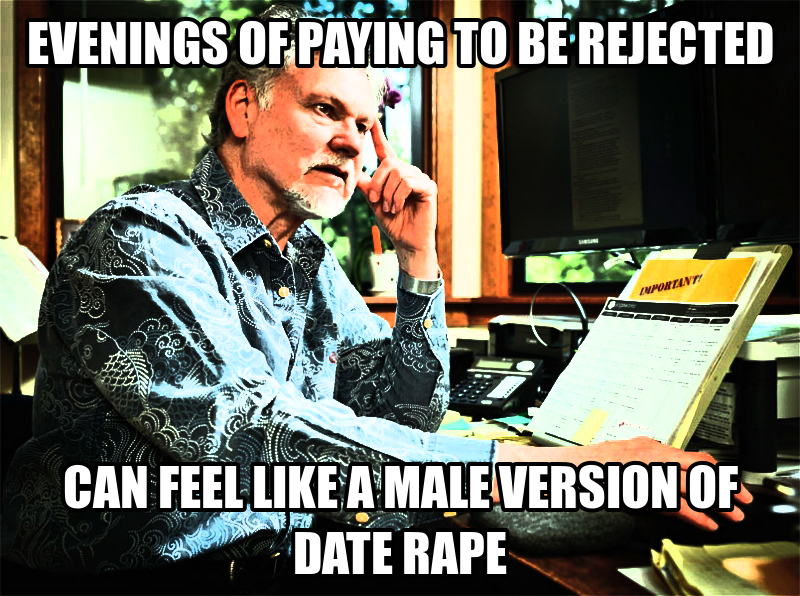
Evenings of paying to be rejected can feel like a male version of date rape. (MoMP, p. 314)
Really? Paying for dinner and not getting laid is the same as date rape? So the price of sex with a woman is dinner? Are we talking a nice restaurant here, or will Taco Bell due? Isn't that prostitution?

Oh, and by the way, have you been raped, Warren? Do you know how it feels to have your autonomy and physical body, not to mention your psychological self, sexually violated by another person? To have your trust in other human beings destroyed? To believe, despite the evidence, that somehow it was your fault? To have the nightmares, the hypervigilance, the self-loathing that comes with rape? Yeah, thought not.

Or this:
Almost all single women acknowledge they have agreed to go back to a guy’s place “just to talk” but were nevertheless responsive to his first kiss. Almost all acknowledge they’ve recently said something like “That’s far enough for now,” even as her lips are still kissing and her tongue is still touching his. (MoMP, p. 314)
Okay, so if you kiss somebody, that is tacit consent to sex? Wrong again, Warren.

And he always goes back to his straw man about false reports. Most studies put the false report rate at 2%. Even the FBI (1996), only put it at 8%:
As with all other Crime Index offenses, complaints of forcible rape made to law enforcement agencies are sometimes found to be false or baseless. In such cases, law enforcement agencies “unfound” the offenses and exclude them from crime counts. The “unfounded” rate, or percentage of complaints determined through investigation to be false, is higher for forcible rape than for any other Index crime. Eight percent of forcible rape complaints in 1996 were “unfounded,” while the average for all Index crimes was 2 percent.
What that section fails to mention, however, and Farrell has never acknowledged, is that local law enforcement will often decide a case is unfounded when drugs or alcohol are involved, or when there is previous sexual activity between the rapist and the victim.

Roughly a third to a full half of the clients I see have reported their rapist and the police/sheriff decided not to file charges or even pursue an investigation. This is seldom acknowledged aside from claims that reported rapes are far less than total rapes.

* * * *

One place Farrell is right is that this needs to be something we talk about with kids long before college or when they become sexual (high school, in general). Education is always the best prevention.

Where Farrell tends to be most relevant is in his discussions of the disposable nature of men in most societies. However, the answer is not to put more women in those jobs to make the risk more equal - it's to remove that safety issues that make those jobs so deadly (mining, oil fields, etc, where the corporations repeatedly avoid, undermine, or lobby against safety regulations). And the exception here is combat - let women be in combat military roles if they can do it.

Anyway, here is the brief interview.

Men, Power, Money, and Sex

An interview with men's advocate, Warren Farrell

Published on July 17, 2014 by Marty Nemko, Ph.D. in How To Do Life


Warren Farrell is a leading expert on men’s issues. He is the author of seven books and chair of the Commission to Create a White House Council on Boys and Men. He served on the board of the National Organization for Women (NOW) in New York City and is an advocate for both sexes having the full range of options, professionally and personally. 

I interviewed him about gender roles, power, why men earn more, and campus rape.

Marty Nemko: You're most well-known for your book The Myth of Male Power, just out in a new e-book edition. Many people think men have the power: Look at the Senate and CEO rosters. How would you respond?

Warren Farrell: A small percentage of men have major institutional power but across the full population, real power is about having choices. The women’s movement has made it socially acceptable for a mom to work full-time, stay home with the child full-time, or work part-time. That’s as it should be. Alas, it’s not as acceptable for a man to work part-time, let alone be a full-time parent. Mr. Mom is still a term of derision.

Marty Nemko: But men earn more. Isn’t that power?

Warren Farrell: Many men still buy into a false definition of power: feeling obligated to earn money that someone else spends while we die sooner—5.2 years sooner. That’s not power. That’s being a prisoner of the need for love and approval.

Marty Nemko: In your book, Why Men Earn More, you report that the statistic that women earn 77 cents for each dollar a man earns for the same work is very misleading. Can you give an example as to why? 

Warren Farrell: Women who have never been married and never had children earn 17% more than never-married men that have never had children, even when education and years worked are equal. Men don’t earn more than women. Dads earn more than moms. Why? When a child is born, a mom is more likely to divide her labor between work and home, earning less at work. A dad is more likely to increase his hours at work—or work two jobs—often taking jobs he likes less that pay more. 

Marty Nemko: In Why Men Earn More, you write, “The road to high pay is a toll road.” Are you suggesting that high pay and power can be inversely correlated?

Warren Farrell: Yes. For many dads, the road to high pay is not about power; it’s about his hope to make his children’s life better than his. It’s about giving his wife a better life. And to get that higher pay, he often has to forgo work he'd rather do. For example, he might prefer to be a teacher or a creative but to better support his family, he accepts a long-hours, high-stress, technical, travel-intensive, often soulless management position.

Marty Nemko: In your recent Reddit Highlighted Conversation, you cite statistics so startling that some would question their veracity. Would you provide the source for:
  • This is the first time in U.S. history that our sons will have less education than their dads.
  • Boys' suicide rate goes from equal to girls at age 9 to five times(!) girls' in their twenties.
  • More U.S. male military were killed by suicide in one year than were killed in the wars in Iraq and Afghanistan in all years combined.
Warren Farrell: Yes. Boys having less education than their dads is from the OECD (Organization for Economic Co-operation and Development), “Education at a Glance,” 2010, Table A1.3a

The boy-girl suicide rate is from the Centers for Disease Control and Prevention, Morbidity and Mortality Weekly Report, 58,1, 2009, and Web-based Injury Statistics Query and Reporting System (WISQARS), 2010.

The U.S. military suicide rate data is from the DOD, uncovered by CBS, in Armen Keteyian, “Suicide Epidemic Among Veterans.” CBS News, November 13, 2007. http://www.cbsnews.com/stories/2007/11/13/cbsnews_investigates/main3496471.shtml.

Marty Nemko: The subtitle of your book The Myth of Male Power is: Why Men are the Disposable Sex. How are men the disposable sex?

Warren Farrell: Virtually all societies that survived did so based on their ability to train their sons to be disposable—disposable in war, disposable at work.

Marty Nemko: That’s a strong statement. What’s your evidence?

Warren Farrell: The evidence is ubiquitous. 92 percent of workplace deaths occur to men, jobs few women would take: oil rig workers, long-haul truckers, roofers, coal miners. Yet there isn't the political will to create regulations that would afford them more protection for these workers. Meanwhile, when women have a less life-threatening deficit, for example, underrepresentation of women in engineering, there's massive expenditure to redress. Although male-only draft registration is a violation of both the 14th Amendment’s equal-protection clause and the 5th Amendment’s due process clause, it is so unconsciously accepted it isn’t even questioned. Only men can serve in direct combat so 98 percent of Iraq and Afghanistan deaths were men.

Marty Nemko: Is the fact that men die 5.2 years younger than women another example of male disposability?

Warren Farrell: It is the combination of facts like men dying 5.2 years younger than women—or men dying sooner from all ten of the ten leading causes of death, plus the fact that we nevertheless have seven federal offices of women’s health and none of men’s health that together reflect the psychology of indifference toward male disposability. Similarly, men over the age of 85 commit suicide 1350 percent as frequently as women over 85. Virtually no one knows this. If women over 85 committed suicide 1350 percent as often than men, it would be used as the quintessential example of our undervaluing of women. We seem to care more about saving whales than saving males.

Marty Nemko: You said men are indirectly disposable as dads. How do you mean?

Warren Farrell: In a divorce, if the mother doesn’t want the father to be equally involved, the apriori assumption is that she's right. Men have to fight in court for that right, and that's expensive.Unless he’s rich, he’s disposable. 

Marty Nemko: What are your thoughts about the current focus on campus rape?

Warren Farrell: The issue first should be addressed before kids get to college. For example, we may need to encourage our daughters to take the initiative when they do want physical intimacy, not just to say when they don’t. Our society strives for equality but few experts are asking women to share the responsibility for taking the initiative in sex, thereby risking rejection. During adolescence, women are the more mature sex. It’s unfair to expect guys to assume 90 percent of the burden of sexual rejection.

Marty Nemko: What should happen at college?

Warren Farrell: First, make the law the last resort. The law is binary: guilty/not guilty. Sex is nuanced and more nonverbal than verbal. Those nuances have evolved over millennia. A slight change in eye contact means everything in a male-female encounter but would be laughed at in court. And if a grievance is filed, we should not presume guilt. Alas, some accusations are false.

Marty Nemko: What about workshops at college?

Warren Farrell: Yes but both sexes should be walking a mile in each other’s moccasins.

Marty Nemko: You’ve done such trainings, right?

Warren Farrell: Yes. I used to tell college audiences, “Every woman is in a beauty contest every day of her life.” I then invited all the guys on stage to experience that. I had those guys wear bathing suits and had the women be the judges. The guys were stunned at being unseen for their integrity, intelligence, or values. They felt objectified.

Marty Nemko: What did you do to help the young women walk a mile in the guys’ moccasins?

Warren Farrell: I had the women “ask-out” the guys they were most attracted to on a 20-minute “date.” Some did what they criticize men for, for example, lying to get an attractive guy to go out with them. Others went after a less attractive guy to reduce the chance of getting rejected. The guys totally identified with that.

Marty Nemko: What was the outcome of those workshops?

Warren Farrell: Greater compassion for the other sex’s vulnerability, and I formed hundreds of men and women’s groups so they would continue to deepen their compassion after I left campus. 

Marty Nemko: Was there any concrete evidence it reduced campus rape?

Warren Farrell: I asked campus sponsors to let me know if any of the workshop participants later were involved in a date rape accusation. Although I had worked with 20,000 students in hundreds of colleges, not one incident was reported.

Marty Nemko: Do you still do those workshops?

Warren Farrell: As political correctness set into the colleges’ psyches, college programs shifted to emphasizing only men understanding women. It would be wiser for programs to help both sexes better understand each other. We don’t need a women’s movement blaming men, nor a men’s movement blaming women. We need a gender liberation movement. We need both sexes walking a mile in each other’s moccasins.

Thursday, June 19, 2014

Male Survivors of Sexual Assault - Ft. Huachuca Presentation


I will be down in Sierra Vista (AZ) later today speaking at Ft. Huachuca (home of U.S. Army Intelligence Center [once known as the School of the Americas]) speaking on the topic of male survivors of sexual abuse (both childhood abuse and adult rape).

Presented below is the Powerpoint slide show that is the foundation for my talk. It contains a LOT of useful statistics on male survivors, so I thought it might be of interest here.