Showing posts with label sexual violence. Show all posts

Sunday, November 23, 2014

University of Virgina Suspends ALL Fraternities Following Rolling Stone Article

http://assets.rollingstone.com/assets/2014/article/a-rape-on-campus-20141119/174834/large_narrow_rect/1416326631/1035x376-Unknown.jpeg

On November 19th, Rolling Stone published a deeply researched article, called A Rape on Campus: A Brutal Assault and Struggle for Justice at UVA, that related the horrific - and not uncommon - experience of Jackie, a college freshman at UVA who was brutally and violently raped over a period of 3 hours by seven men at the Phi Kappa Psi frat house.
Jackie had taken three hours getting ready, straightening her long, dark, wavy hair. She'd congratulated herself on her choice of a tasteful red dress with a high neckline. Now, climbing the frat-house stairs with Drew, Jackie felt excited. Drew ushered Jackie into a bedroom, shutting the door behind them. The room was pitch-black inside. Jackie blindly turned toward Drew, uttering his name. At that same moment, she says, she detected movement in the room – and felt someone bump into her. Jackie began to scream.

"Shut up," she heard a man's voice say as a body barreled into her, tripping her backward and sending them both crashing through a low glass table. There was a heavy person on top of her, spreading open her thighs, and another person kneeling on her hair, hands pinning down her arms, sharp shards digging into her back, and excited male voices rising all around her. When yet another hand clamped over her mouth, Jackie bit it, and the hand became a fist that punched her in the face. The men surrounding her began to laugh. For a hopeful moment Jackie wondered if this wasn't some collegiate prank. Perhaps at any second someone would flick on the lights and they'd return to the party.
"Grab its motherfucking leg," she heard a voice say. And that's when Jackie knew she was going to be raped.

She remembers every moment of the next three hours of agony, during which, she says, seven men took turns raping her, while two more – her date, Drew, and another man – gave instruction and encouragement. She remembers how the spectators swigged beers, and how they called each other nicknames like Armpit and Blanket. She remembers the men's heft and their sour reek of alcohol mixed with the pungency of marijuana. Most of all, Jackie remembers the pain and the pounding that went on and on.
It only gets worse from there.

Kudos to Rolling Stone for investigating and reporting this story - this is what responsible journalism looks like.

Fortunately, the story went viral. The revelation allowed many more young women to come forward with their stories. Here are two of their stories - see Rape at UVA: Students Say Jackie Was Not Alone for the remainder.
Sadly
I was also raped at UVA in a frat house in 2013. I reported it through the Sexual Misconduct Board at the University and had it tried in 2014. My evidence included texts calling for help, police testimony consistent with mine, and numerous witnesses. But the University still found him innocent. I found Nicole Eramo very unfeeling as well — sociopathic, almost. She later told me she didn't believe the studies that showed rapists, in particular, were repeat offenders of this heinous crime. It was a very negative experience to go through — to be raped and then told that your offender was innocent. I even left clothing as I ran out of the frat house that the University gathered as evidence and it was never returned to me. Not that the clothing was important. It wasn't. The police discouraged me from pursuing it criminally, saying that I didn't have enough evidence to win. They also told me that I should be cautious about pursuing this formally, since court proceedings and news articles related to my case could spread publicly on the Internet. For privacy reasons (I didn't want future employers to Google me and see that I brought forward rape charges), I decided to pursue justice through the University. But the outcome of this process was painful and disappointing. I will never stop wondering why UVA so often expels students for academic lying, cheating, and stealing but has never once expelled a student for rape.

SK
I am so sorry for what happened to you, Jackie, and I wish I had been brave enough my freshman year to report what happened to me. But fearing the very same things – backlash, no consequences – I chose to stay quiet. I support you, I am proud of you and what you did is going to change lives. You are forcing an administration to admit its wrongdoings, and you are getting national attention, which will help to stop this misogyny, violence and pain from affecting more people. I know that feeling like a martyr is never going to feel as good as the girl you were before this happened to you, but your struggle has significance and you are needed in this world.
Then the unexpected happened on Friday (Nov. 21), the UVA administration suspended ALL fraternities and their activities until the beginning of the Spring semester in January, at which time a panel of students, faculty, alumni, and "other concerned parties" will offer recommendations for how to stop these incidents.

Here is the beginning of that article, which includes the full statement by the University's President.

UVA Suspends Fraternities Following Rolling Stone Campus Rape Investigation

"The wrongs described in Rolling Stone are appalling and have caused all of us to reexamine our responsibility to this community," UVA president writes in letter suspending fraternities


Joel Hawksley/For The Washington Post via Getty Images - Graduating students stand to have their pictures taken in front of the Rotunda at University of Virginia in Charlottesville, Va. on May 18, 2013.
By Rolling Stone | November 22, 2014

Following Rolling Stone publishing Sabrina Rubin Erdely's harrowing report "A Rape on Campus," which detailed a pattern of sexual assault among the fraternities at the University of Virginia, many women who attended UVA emailed Rolling Stone sharing their own similar stories. After "A Rape on Campus" went viral, the school itself acknowledged the Rolling Stone article by promising to make changes to their student sexual misconduct policy. Now, the University is taking even more stern action.

President Teresa A. Sullivan announced in a letter to students and alumni that the school's fraternities have been suspended effective immediately. The suspension will last until January 9, 2015, which marks the beginning of the spring semester. In that time, "we will assemble groups of students, faculty, alumni, and other concerned parties to discuss our next steps in preventing sexual assault and sexual violence on Grounds," Sullivan writes.
In my opinion, the only way this is going to change is to take drastic steps - the Fraternities at UVA should remain closed for the rest of the school year, with the students placed in residence halls are allowed to move into off-campus housing.

The administration needs education on rape, date rape, toxic masculinity, and the rape culture that exists on campuses around the country, but especially in some fraternities. The people who turned a blind eye to these events in ignorance or in fear of bad publicity need to be educated on how alcohol and drugs, toxic masculinity, and entitlement and privilege can lead to these type of gang rape situations.

Further, any future rapes that are reported and verified will result in the permanent closure of a given fraternity. Period. 

This needs to be the basic policy on EVERY campus in the country, not just UVA.

Saturday, October 11, 2014

Seven Sayreville, N.J., High School Football Players Charged in Sexual Assault of Teammates


If the numbers mentioned in the report from Christian Science Monitor are accurate, 1 in 4 boys experiences sexual violence from peers during the high school years. This is identical to the number of females experiencing sexual violence in high school or college. Clearly, rape is not about sex - it's about power, control, and humiliation.

This crap needs to stop.

Hazing cancels Sayreville, N.J., football season: Does culture contribute to abuse?

As more details of the nature of the alleged sexual abuse in the New Jersey football program become known, a debate widens about the damage that can come from behavior often dismissed as 'initiation.'


By Stacy Teicher Khadaroo, Staff writer | October 10, 2014


In a football town, Sayreville residents shaken by hazing scandal; WPIX - New York

Amid a criminal investigation into possible hazing and sexual violence among high school football players, the town of Sayreville, N.J., is facing a season with no more football.

The decision by Sayreville Superintendent of Schools Richard Labbe to cancel the season Monday night brought an uproar from some parents, worried that innocent students who may depend on football for college scholarships would be unfairly punished.

[Update: On Friday night, seven students were charged with sex crimes in connection with a series of assaults. Six of the seven students, ranging in age from 15 to 17, were arrested Friday night, and the seventh was being sought, police and prosecutors said.]

But as details of the allegations at War Memorial High School spread in the news media this week, the town has become the stage for a broader public conversation about the detrimental nature of behaviors that experts say are too often dismissed as “tradition” or “initiation.”

About 47 percent of high school students experience some form of hazing, but only 8 percent apply that label to it, a landmark national study found in 2008. Among high school boys, 26 percent experience sexual violence from their male peers, the Journal of Youth and Adolescence reported in 2009.

A parent of one of the players in Sayreville told NJ Advance Media Wednesday that this fall, freshmen players were repeatedly attacked in the locker room by upperclassmen, who would physically restrain their target and assault him anally.

The school district has directed questions to the Middlesex County Prosecutor’s office, and a spokesman there told the Monitor he cannot comment beyond confirming there is an “active investigation.”

The initial negative reaction by many in the town when the season was cancelled may stem from confusion over the language in New Jersey’s statutes such as intimidation, harassment, and bullying, says Parry Aftab, an attorney and anti-bullying expert based in Fort Lee, N.J. Some people may not have realized how serious the allegations were.

But some who hear the allegations in such cases are still inclined to excuse the behavior and, instead, blame the victims for coming forward, says Kiersten Stewart, director of public policy and advocacy in the Washington office of Futures Without Violence. “This in no way can be tolerated. This is not hazing, this is child sexual abuse and we need to call it what it is,” she says.

The case highlights that education about respect, decency, and standing up against violence needs to start at a young age, Ms. Stewart and others say. But there also needs to be tough scrutiny of what any adults may have known about the case – whether current or former coaches, parents, or former players.

Superintendent Labbe told football players’ parents that school officials were not aware of any bullying or hazing before players came forward late last week, NJ Advance Media reports.

It’s important that students have access to anonymous reporting methods for more of them to come forward about bullying, hazing, and sexual assault, Ms. Aftab says.

The society “can’t just look at it as some anomalous thing that happens in some aberrant group,” but instead “we have to look at aspects of our culture that can create a climate where something like this is able to occur,” says Elizabeth Allan, president of Stop Hazing and a professor at the University of Maine in Orono.

One such factor is “the social construction of masculinity,” Professor Allan says, in which there are “lots of rewards for being seen as strong, tough, heterosexual…. One way to reinforce power and status and hierarchy in a group is to engage [male peers] in behaviors that would call into question their masculinity.”

In this case, if the allegations are true, she says, it will be more obvious to people that the behavior was physically forced, but in many instances of hazing, people think victims are going along with it because they don’t understand the coercion at play. “The kids know that if they don’t [go along with hazing] they are likely going to be seen in a different light.”

Education about how to speak up or intervene as a bystander in such situations is spreading into more high schools and middle schools around the country.

Sayreville community members are organizing a Sunday evening vigil to show support for the victims of the alleged hazing and raise awareness.

Sunday, September 28, 2014

Frat Brothers Rape 300% More - 1 in 5 Women Is Sexually Assaulted On Campus

http://snowbrains.com/wp-content/uploads/2014/08/frat-bros.jpg
 frat boys

I don't know if we need to ban fraternities, but this is certainly a abysmal statistic - and some people still try to reject the notion of "rape culture."

It is pretty clear, however, that when young, traditional men come together in large groups, their collective IQ drops considerably and their moral compass gets completely derailed.

Frat Brothers Rape 300% More. 1 in 5 Women Is Sexually Assaulted On Campus. Should We Ban Frats?

The stats on campus sexual violence are pretty stark.


Photo Credit: Wallenrock / Shutterstock.com


When I was at Tulane University, girls were warned about the “bad” fraternities: the ones that spiked the punch at parties with Everclear and maybe drugs, the kind of frats where girls got hurt. During my first week of class 18 years ago, rumours circulated about a girl on my floor who had been sexually assaulted by multiple men at a frat party. These issues were always discussed with a certain nonchalance – as if having at least one rapist around was an inevitable part of fraternity life.

Not much has changed.

University of Wisconsin-Milwaukee police are currently investigating a fraternity after several women were found labeled with red and black X’s on their hands after they had to be hospitalized with memory lapses from intoxication at a fraternity party. Last year, three sexual assaults were reported at one Texas fraternity – within just one month. At Georgia Tech, a frat brother sent around an email guide called “Luring your rapebait”. Wesleyan had a frat that was nicknamed the “Rape Factory”. In 2010, fraternity brothers at Yale University marched through campus yelling, “No means yes, yes means anal.”

These are not anomalies or bad apples: numerous studies have found that men who join fraternities are three times more likely to rape, that women in sororities are 74% more likely to experience rape than other college women, and that one in five women will be sexually assaulted in four years away at school. So it seems only natural to ask: With all of the current efforts, from the White House to college towns, to curb campus sexual assault – using “yes means yes” as a standard for consent, holding administrators accountable, touting bystander intervention – why haven’t we addressed perhaps the most obvious solution?

It’s time to talk about banning fraternities.

When sociology professors Elizabeth Armstrong and Laura Hamilton conducted an intensive, landmark five-year study on college students – by living amongst, following around and interviewing students in one dorm at an anonymous Midwestern public university – they reported that two women living on their floor were sexually assaulted at fraternity parties within the first few weeks of the semester.

Armstrong, who turned the results of the study into a well-received bestseller about college inequality and a paper on sexual assault, tells me that while anti-sexual violence programs are doing all the right things, they may not be doing enough.

“I was just at University of Massachusetts and at Wesleyan, and they were talking about bystander intervention programs and that’s great – people should try to engage,” she said. “But what it leaves off the table are the organizations that put people at risk on campus.”

Armstrong reminded me of what I hear on campus visits myself – that fraternities are hotbeds for all sorts of risk beyond sexual assault: there’s also alcoholism, alcohol poisoning, people falling out of windows and dangerous hazing incidents. She insists that frats “vary tremendously” in terms of how sexually dangerous they are – traditionally African American frats, gender-inclusive frats and multicultural frats are not as threatening as those populated by mostly-white, economically-entitled students, for example – but when you look at the overall risk fraternities create for students on campus, “reforming or preserving these organizations doesn’t make a lot of sense,” Armstrong said.

And while probably not all fraternities are hunting grounds for rapists and

not all men who join frats (or varsity sports teams) are predators, when so much sexual violence is centered around one area of campus life, something has to be done.

For Wesleyan – home of the “rape factory” frat – school administrators decided that means mandating that women be admitted to fraternities. The school announced this week that all frats must go co-ed within the next three years. While I applaud what seems a theoretical move towards equality, I don’t much like the idea of women as a “civilizing” force for men’s bad behavior.

Why try to fix something that’s irrevocably broken? Better, instead, that we take an honest look at the statistics and stories coming out of colleges and act accordingly. I realize banning frats is likely a pipe dream – the organizations are deeply embedded in college culture, they generate student programming and are supported by powerful alumni. But if we’re ready to take on college administrators, sue under Title IX, or carry mattresses on our back in protest, why not this? Why not now?


~ Jessica Valenti is a daily columnist for the Guardian US. She is the author of four books on feminism, politics and culture, and founder of Feministing.com.

Wednesday, April 30, 2014

Hollywood's Leading Men Star in Powerful PSA About Sexual Assault


On the other side of the spectrum from the satirical Onion piece posted earlier today, there is this - men who have influence on how young men think about being men taking a stand against sexual violence. Daniel Craig, Benicio del Toro, Steve Carell, Seth Meyers and Dulé Hill, as well as the President and Vice President, took part in the video PSA.

Here is the story, via Jezebel:

Hollywood's Leading Men Star in Powerful PSA About Sexual Assault

Kate Dries | Jezebel
4/29/2014
After a lengthy speech Tuesday by Vice President Joe Biden, the White House introduced their new PSA about sexual assault starring Daniel Craig, Benicio del Toro, Steve Carell, Seth Meyers and Dulé Hill, as well as the President and Vice President.

The PSA is the second from the Obama administration's 1 is 2 Many campaign; the last video featured famous athletes like Eli Manning, Jeremy Lin and David Beckham. It's pegged to their just-released report on college sexual assault. Like the report, the PSA overwhelming focuses on violence against women specifically.

Related


Obama to Create a Task Force on Campus Sexual Assault - This past year was a landmark one for sexual assault activists on campus: the Title IX network helped sexual assault survivors file federal… Read…

White House Announces Guidelines to Combat Campus Sexual Assault - The White House has released recommendations on how to best combat the sexual assault epidemic facing college campuses. And they're not half bad. Read…
During his speech, Biden spoke very forcefully about sexual assault, an issue he's been strongly tied to since the 90s due to his work drafting the Violence Against Women Act. "College and Universities can no longer turn a blind eye and pretend rape and sexual assault doesn't occur on their campuses," Biden said before playing the PSA. "I understand that the good guys in the report, they may feel like they're damaging the reputations of their schools, I get it. But it doesn't matter."

Of the PSA, Biden said he personally made phone calls to get these famous faces involved. As was the case with the original 1 is 2 Many campaign, the Obama administration hopes they will inspire other less famous men to care about sexual assault.

"I'm not used to making calls to big old movie stars," Biden said. "But I called them. And every one of them said immediately, 'What can I do?'"

Saturday, July 13, 2013

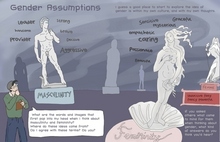
Omnivore - Differences Between Men and Women

From Friday's issue of Bookforum's Omnivore blog, this is an interesting assortment of links for articles dealing with the various differences between men and women.

Between Men and Women

Thursday, May 2, 2013

UA Men's Project Redefines Masculinity, Aims to Raise Awareness of Rape Culture

It's nice to see students at the University of Arizona, here in Tucson, taking steps to redefine masculinity in an effort to reduce sexual violence. I'd really like to see similar programs in the local middle schools and high schools as well - if we can get to them when they are younger, we have a better chance of helping young men grow up to be good adult men.

UA Men's Project redefines masculinity, aims to raise awareness of rape culture


By SHELBY THOMAS 
Published May 1, 2013

Gabriela Diaz/Arizona Daily Wildcat The Men’s Project’s Devon Moule, an anthropology junior and one of the project’s founding interns, volunteers ...

With numerous on-campus programs committed to supporting various factions of the student body, the UA is now welcoming an internship program unique to the male population.

Only one semester old, The Men’s Project was developed through the Women’s Resource Center by Krista Millay, the program director of the WRC. Millay said she has always wanted to offer a space for men to talk about masculinity and about being a guy at the UA.

“If we want college men to engage critically, become their own people and be allies to other identities, then we need to create a space for them to go through that same journey, just like other students get,” Millay said. “Just like all student populations, our college men need some support that is geared toward them. The reality is that they need a space to grapple with issues: The good, the bad and the otherwise. I don’t think that masculinity normally gets that kind of airtime.”

The Men’s Project is run as an internship program that requires ten hours a week from its interns in exchange for three academic credits per semester, Millay said. These hours consist of a team business meeting as well as a critical discussion of current issues within pop culture. The interns also participate in separate projects. In the spring semester, they participated in the planning of Take Back the Night and the development of the curriculum for “The MENS Workshop,” a judicial sanction through the Dean of Student’s Office.

“We hope to develop this program further so that it is also a leadership class that students can take — not just because they have been sanctioned to it, but because they are interested in these topics and want a space to explore them further in a positive and supportive setting,” Millay said.

Michael Webb, a gender and women’s studies senior, is one of the founding interns of the Men’s Project, which he defines as a “program that questions aspects of college male culture and perceptions of masculinity.” Webb said specific questions the organization strives to answer and address include, “What kind of gender stereotypes are in place in our society? What boxes are we putting people in, in terms of the range of expression that we are able to embody in our day-to-day life?”

Webb’s passion for these topics made for a successful first semester for the internship, and now, Millay said she is confident that Alex Karaman, a graduate student working toward his Ph.D. in gender and women’s studies, will continue to improve The Men’s Project as the graduate assistant for the 2013 fall semester.

Karaman was a political science student at Cal State University at Long Beach when he took his first women’s studies course.

He said “the perspective that the course offered on relations between people … was so much more in line with how he had viewed the world,” and he quickly added gender and women’s studies as a second major as a result.

As an undergraduate student, Karaman said he was involved in campus politics and often addressed issues relating to college rape culture and sexual violence. He said when he saw there was an opportunity for this kind of work to take place on the UA campus, he jumped at it.

Although he has new ideas for the fall semester, Karaman said that there have already been great strides made to make The Men’s Project a very “legitimate and central part of the university structure.” He said his goal is to continue these successful services.

For example, Karaman said The Men’s Project will continue to hold “The Men’s Workshop” a few times a semester that will be mandatory for students who are repeat offenders of the Code of Conduct — more specifically, those who have broken rules that seem to indicate the influence of college male culture, such as “issues of violence” or “sexual assault.”

“Our purpose is largely to show that there are men that are actively engaged in trying to change this rape culture,” Karaman said. “I want programming to be made available that is proactive rather than reactive.”

Sunday, April 15, 2012

CNN - Rape Victims in Military Given Personality Disorder Diagnosis and Discharged


It is estimated that nearly 1 in 3 female military veterans were victims of rape or sexual assault by their fellow soldiers (Time, March 8, 2010) while serving on active duty. Now it seems that the military, rather than deal with the issue, is blaming victims by diagnosing them with a personality disorder and discharging them

For those who do not know what this means, it is widely considered (albeit wrongly) that personality disorders are incurable - so giving someone a personality disorder diagnosis (Axis II in the DSM-IV-TR) is labeling them as "crazy." Once this diagnosis is given, it will follow these women for life, impacting their employment options, their insurance costs, and many other areas of their lives, not least of which is their sense of self.

This is fucked up - these women are victimized by their fellow soldiers, then they are further victimized by the patriarchal military system. Adding further insult, dumbass talking heads on networks like Fox News are blaming them as well:
“I think they have actually discovered there is a difference between men and women. And the sexual abuse report says that there has been, since 2006, a 64% increase in violent sexual assaults. Now, what did they expect? These people are in close contact, the whole airing of this issue has never been done by Congress, it’s strictly been a question of pressure from the feminist.”

She then noted that the budget of the Defense Department’s Sexual Assault Prevention and Response Office increased from $5 million in 2005 to more than $23 million in 2010.

“So, you have this whole bureaucracy upon bureaucracy being built up with all kinds of levels of people to support women in the military who are now being raped too much,” Trotta remarked.
Is this how we should make sense of the violence? Military women should expect to be raped because they are serving in close proximity to men? Men cannot control their beastly sexual urges when they are around women?

It must be noted, despite the belief that rape is about sex, that most rape is about anger, power, humiliation, or some other motivation (control, revenge, and so on) and is NOT about sex. Please keep that in my mind throughout this post.

Cultural and literary critic Camille Paglia thinks women need to get beyond the feminist idea that men and women are equal (from PBS - Rape: The most intimate of crimes).
In her book, Sex, Art and American Culture, Camille Paglia calls these "somber truths" women must accept. "Feminism keeps saying the sexes are the same," she writes. "It keeps telling women they can do anything, go anywhere, say anything, wear anything. No, they can't. Women will always be in sexual danger." She may be right, but that doesn't necessarily make rape a woman's responsibility.
Meanwhile, Gloria Steinem believes we need to stop worrying about who gets raped (aside from being focused on the 18-24 age range, there are few other patterns, and even older women are targets) and start looking at who does the raping:
"We have to stop talking about who gets raped and talk about who rapes. Somebody is doing these things. And we have to identify who they are." Who is that somebody? Why do men rape women? And how do you stop them?
When humans lived in a world of physical power, small tribal groups, tenuous survival, and little to no higher cognitive function (such as guilt or empathy), rape may have been a part of life. Or at least that is what the evolutionary psychologists argue, and they contend those same drives are still present in our psychological make-up as a species.

They may be partially correct - rape is more likely when social structures break down in famine, natural disasters, and warfare. To a certain degree, social structure helps reduce violence and enforces norms of behavior.

Further, while we tend to think of primates as more sexually violent, Frans de Waal and other primatologists present very different viewpoints. Barbara Smuts (Discover, Aug. 1995) observes:
Orangutans and chimpanzees are the only nonhuman primates whose males in the wild force females to copulate, while males of several other species, such as vervet monkeys and bonobos (pygmy chimpanzees), rarely if ever try to coerce females sexually. Between the two extremes lie many species, like hamadryas baboons, in which males do not force copulation but nonetheless use threats and intimidation to get sex.

Clearly, this behavior is not common to all primates, and bonobos offer the best example of a culture where male assault never has been recorded - interestingly, we are as closely related to bonobos as we are to chimpanzees.
A unique aspect of bonobo society is that they are a female-dominated species thanks to the network of support that exists between bonobo females. Chimpanzee females are largely isolated from one another, but bonobo females come to one another’s aid. While there may be genetic differences that account for the lack of sexual coercion in bonobos, one important factor is the different environment that promotes these cooperative networks and limits the usefulness of male coercion (see my interview with Frans de Waal for more on this topic). Male bonobos mate more frequently by gaining support from these female networks rather than using sexual coercion as can be found in chimpanzees. Males grow up with this “culture” and observe the older males in their troop emphasize grooming over aggression and then adapt their own behavior in order to maximize their reproductive success.
But even among baboons, where sexual violence is common, where the physically dominant male forces females into sexual relations, there is a clear pattern of learned behavior that can be unlearned in a single generation (as related by Robert Sapolsky in his essay “A Natural History of Peace” for the journal Foreign Affairs [pdf here] and cited in Scientific American, July 20, 2011):
Male baboons have been known to viciously maul a female that has rejected their advances and the level of male aggression is strongly correlated with their mating success. However, in a unique natural experiment Stanford primatologist Robert Sapolsky observed what developed when the largest and most aggressive males died out in a group known as Forest Troop (because they were feeding at the contaminated dump site of a Western safari lodge). In the intervening years Forest Group developed a culture in which kindness was rewarded more than aggression and adolescent males who migrated into the troop adopted this culture themselves.
Clearly, there is a learned component to this form of behavior that is not inherent in baboon culture. So why are human males still prone to sexual violence - millennia after we have outgrown the conditions that may have supported such behavior - and why does male sexual violence seem worse in the military?

Why doesn't military structure offer some of the same protective structure against rape as civilian culture? Maybe there is something about the military culture that also produces or encourages this behavior? According to U.S. Rep. Jackie Speier (CA), the system is completely broken.
The Department of Defense estimates that more than 19,000 service members were raped or sexually assaulted in 2010. Due to a military culture heavy on retaliation and light on prosecution, only 13.5 percent of the victims report the rape.

The system of justice designed to adjudicate cases of rape in the military is in complete shambles. Victims are blamed. Assailants are promoted. Unit commanders - whose promotions are dependent on the conduct and performance of the soldiers they supervise - have an incentive to see that allegations are few and convictions are fewer. As a result, the overwhelming majority of cases get swept under the rug.

This abomination is not new. The Pentagon has largely ignored the recommendations of 18 reports on sexual assault and rape in the military over the past 16 years. As a result, the problem is now worse than ever.
Rep. Speier says there have been many reports outlining the problems and suggesting changes, but the Pentagon has systematically ignored them.
It took four years and the resignation of Defense Secretary Donald Rumsfeld to finally establish a statutorily required commission to investigate reports of sexual misconduct in the military. His successor, Robert Gates, has yet to implement a statutorily required database that would centralize all reports of rapes and sexual assaults in the military.

It is time for the Pentagon to stop treating legal directives as mere suggestions. And it is time for Congress to abandon its role as a bystander.
One might begin to believe that military leaders have a "boys will be boys" mindset that allows them to write off the prevalence of rape and sexual assault as part of the culture. The way they handle the issue - or more accurately, don't handle it - reflects a kind of thinking that allows this behavior to continue.

In the 2010 Time article cited above, the fears of the victims of retaliation and absence of confidentiality prevent them from reporting the rapes and assaults 80-90% of the time.
The Pentagon estimates that 80% to 90% of sexual assaults go unreported, and it's no wonder. Anonymity is all but impossible; a Government Accountability Office report concluded that most victims stay silent because of "the belief that nothing would be done; fear of ostracism, harassment, or ridicule; and concern that peers would gossip." More than half feared they would be labeled troublemakers. A civilian who is raped can get confidential, or "privileged," advice from her doctors, lawyers, victim advocates; the only privilege in the military applies to chaplains. A civilian who knows her assailant has a much better chance of avoiding him than does a soldier at a remote base, where filing charges can be a career killer — not for the assailant but the victim. Women worry that they will be removed from their units for their own "protection" and talk about not wanting to undermine their missions or the cohesion of their units. And then some just do the math: only 8% of cases that are investigated end in prosecution, compared with 40% for civilians arrested for sex crimes. Astonishingly, about 80% of those convicted are honorably discharged nonetheless.
This is horrible - it is a system designed to protect the perpetrators and ostracize the victims. I have some suggestions for reform based not on patriarchal military standards but on civilian criminal law.
  • ANY victim of rape and assault, male or female (and there are many male victims as well), should hold the same rights to confidentiality with doctors and mental health providers as do civilians.
  • ANY allegations of rape or sexual assault should be fully investigated within 48-72 hours and disciplinary actions be taken as quickly as possible. This is much more possible in the military than in the civilian world.
  • ANY soldier or officer found to have committed a rape or sexual assault should be dishonorably discharged immediately and should serve appropriate jail time.
This is not what is happening, however. Rather, military leaders are waging an internal war on women who are, in their view, silly enough to get raped and report the crime. They are not seeking to punish the rapists, they are labeling the women crazy and discharging them from service.

This is shit - but CNN is reporting that this is exactly what is happening - and some of the women are coming forward with their stories.

Rape victims say military labels them 'crazy'

By David S. Martin, CNN
Sat April 14, 2012
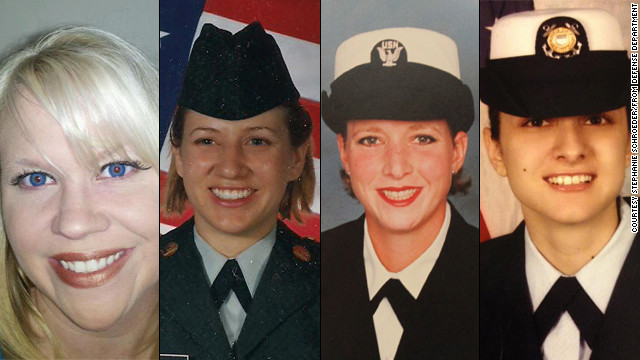
Stephanie Schroeder, Anna Moore, Jenny McClendon and Panayiota Bertzikis say they were raped and then discharged from the military.
Stephanie Schroeder, Anna Moore, Jenny McClendon, and Panayiota Bertzikis 
say they were raped and then discharged from the military.

STORY HIGHLIGHTS
  • Women accuse military of using psychiatric diagnoses to oust sexual assault victims
  • "I couldn't trust my chain of command to ever back me up," says an alleged victim
  • 3,191 military sexual assaults reported in '11: "Unacceptable," says defense secretary
  • Pentagon is assessing its training for sexual assault prevention and response
Editor's note: CNN's Dr. Sanjay Gupta will report further on allegations of sexual assault in the military Saturday and Sunday April 21 and 22 at 7:30 a.m. ET on "Sanjay Gupta MD" on CNN.

(CNN) -- Stephanie Schroeder joined the U.S. Marine Corps not long after 9/11. She was a 21-year-old with an associate's degree when she reported for boot camp at Parris Island, South Carolina.

"I felt like it was the right thing to do," Schroeder recalls.

A year and a half later, the Marines diagnosed her with a personality disorder and deemed her psychologically unfit for the Corps.

Anna Moore enlisted in the Army after 9/11 and planned to make a career of it. Moore was a Patriot missile battery operator in Germany when she was diagnosed with a personality disorder and dismissed from the Army.

Jenny McClendon was serving as a sonar operator on a Navy destroyer when she received her personality disorder diagnosis.

These women joined different branches of the military but they share a common experience:
Each received the psychiatric diagnosis and military discharge after reporting a sexual assault.

"I'm not crazy," says Schroeder, who is married now, with two daughters. "I am actually relatively normal."

McClendon says she had a similar reaction.

"I remember thinking this is absurd; this is ridiculous. How could I be emotionally unstable? I'm very clear of mind, especially considering what had happened." McClendon says. "It was a ludicrous diagnosis."

A similar pattern

CNN has interviewed women in all branches of the armed forces, including the Coast Guard, who tell stories that follow a similar pattern -- a sexual assault, a command dismissive of the allegations and a psychiatric discharge.


Schroeder says a fellow Marine followed her to the bathroom in April 2002. She says he then punched her, ripped off her pants and raped her. When she reported what happened, a non-commissioned officer dismissed the allegation, saying, "'Don't come bitching to me because you had sex and changed your mind,'" Schroeder recalls.

Moore says she was alone in her barracks in October 2002 when a non-commissioned officer from another battery tried to rape her. When she filled out forms to report it, she says, her first sergeant, told her: "Forget about it. It never happened," and tore up the paperwork.

"It felt like a punch in the gut," Moore says. "I couldn't trust my chain of command to ever back me up."

McClendon says she was aboard a Navy destroyer at sea when a superior raped her on the midnight to 2 a.m. watch. After reporting the attack, she was diagnosed with a personality disorder and deemed unfit to serve.

"I was good enough to suit up and show up and serve, but I wasn't good enough after the fact," McClendon says.

Despite the Defense Department's "zero tolerance" policy, there were 3,191 military sexual assaults reported in 2011. Given that most sexual assaults are not reported, the Pentagon estimates the actual number was probably closer to 19,000.

"The number of sexual assaults in the military is unacceptable," Defense Secretary Leon Panetta said at a news conference in January. "Our men and women in uniform put their lives on the line every day to keep America safe. We have a moral duty to keep them safe from those who would attack their dignity and their honor."
Read the whole article.

The military has issued a couple of reports that are freely available online: