Ramin Setoodeh wrote an article for
Newsweek at the end of April that argued gay men (and gay actors/actresses in general) cannot and should not try to play straight characters. He points to Sean Hayes performance opposite Kristin Chenoweth in Broadway's
Promises, Promises as an example of why gay men cannot play straight men convincingly.
Needless to say, this article has raised a lot of issues and a lot of controversy. This post is likely to be long because I want to offer up all of the various views, including the original article.
I generally don't care too much about what people think about actors and the whole entertainment industry. But I think this issue raises some problems with gender identity and sexuality that need to be addressed.
I've seen
a woman play a man becoming a woman, and do it convincingly, and I have seen
a man play a women who is really a man, and do it very well. So why can't a gay man play a straight man? Is it really about the actor's sexual identity, or is it about our inability to watch a gay man play a straight character? We have no issued with a straight actor playing gay, so I think there is a certain degree of ignorance involved, despite the fact that the writer of the original article is openly gay.
In the end, this comes down to our definitions of masculinity (or femininity, although this is much less an issue for lesbian women playing straight characters). We use two bludgeons to keep men in traditional "manliness" roles - naming them gay or naming them feminine, and the first often implies the second.
As a culture, we find it impossible to believe that a gay man is actually masculine - the two ideas cannot exist side by side in the minds of most Americans. They are wrong, too - gay men can be and are masculine, but their masculinity is flavored different than your masculinity. There are many flavors of masculinity (postmodern multiplicity in action) and we need to adjust our definitions to accommodate the various ways men - gay or straight - express their unique masculinity.
This is what we are really dealing with here, beneath all the anger and defensiveness.
Heterosexual actors play gay all the time. Why doesn't it ever work in reverse?
The reviews for the Broadway revival of Promises, Promises were negative enough, even though most of the critics ignored the real problem—the big pink elephant in the room. The leading man of this musical-romantic comedy is supposed to be a single advertising peon named Chuck who is madly in love with a co-worker (Kristin Chenoweth). When the play opened on Broadway in 1968, Jerry Orbach, an actor with enough macho swagger to later fuel years and years of Law and Order, was the star. The revival hands the lead over to Sean Hayes, best known as the queeny Jack on Will & Grace. Hayes is among Hollywood's best verbal slapstickers, but his sexual orientation is part of who he is, and also part of his charm. (The fact that he only came out of the closet just before Promises was another one of those Ricky Martin-duh moments.) But frankly, it's weird seeing Hayes play straight. He comes off as wooden and insincere, like he's trying to hide something, which of course he is. Even the play's most hilarious scene, when Chuck tries to pick up a drunk woman at a bar, devolves into unintentional camp. Is it funny because of all the '60s-era one-liners, or because the woman is so drunk (and clueless) that she agrees to go home with a guy we all know is gay?
This is no laughing matter, however. For decades, Hollywood has kept gay actors—Tab Hunter, Van Johnson, Anthony Perkins, Rock Hudson, etc.—in the closet, to their own personal detriment. The fear was, if people knew your sexual orientation, you could never work again. Thankfully, this seems ridiculous in the era of Portia de Rossi and Neil Patrick Harris. But the truth is, openly gay actors still have reason to be scared. While it's OK for straight actors to play gay (as Jake Gyllenhaal and Heath Ledger did in Brokeback Mountain), it's rare for someone to pull off the trick in reverse. De Rossi and Harris do that on TV, but they also inhabit broad caricatures, not realistic characters likes the ones in Up in the Air or even The Proposal. Last year, Rupert Everett caused a ruckus when he told the Guardian that gay actors should stay in the closet. "The fact is," he said, "that you could not be, and still cannot be, a 25-year-old homosexual trying to make it in the ... film business." Is he just bitter or honest? Maybe both.
Most actors would tell you that the biographical details of their lives are beside the point. Except when they're not. As viewers, we are molded by a society obsessed with dissecting sexuality, starting with the locker-room torture in junior high school. Which is why it's a little hard to know what to make of the latest fabulous player to join Glee: Jonathan Groff, the openly gay Broadway star. In Spring Awakening, he showed us that he was a knockout singer and a heartthrob. But on TV, as the shifty glee captain from another school who steals Rachel's heart, there's something about his performance that feels off. In half his scenes, he scowls—is that a substitute for being straight? When he smiles or giggles, he seems more like your average theater queen, a better romantic match for Kurt than Rachel. It doesn't help that he tried to bed his girlfriend while singing (and writhing to) Madonna's Like a Virgin. He is so distracting, I'm starting to wonder if Groff's character on the show is supposed to be secretly gay.
This is admittedly a complicated issue for the gay community, though it is not, in fact, a uniquely gay problem. In the 1950s, the idea of "color-blind casting" became a reality, and the result is that today there's nothing to stop Denzel Washington from playing the Walter Matthau role in the remake of The Taking of the Pelham 1-2-3. Jack Nicholson, by the force of his charm, makes you forget how he's entirely too old to win Helen Hunt's heart in As Good As It Gets. For gay actors, why should sexual orientation limit a gay actor's choice of roles? The fact is, an actor's background does affect how we see his or her performance—which is why the Tom Hankses and Denzels of the world guard their privacy carefully.
It's not just a problem for someone like Hayes, who even tips off your grandmother's gaydar. For all the beefy bravado that Rock Hudson projects on-screen, Pillow Talk dissolves into a farce when you know the likes of his true bedmates. (Just rewatch the scene where he's wading around in a bubble bath by himself.) Lesbian actresses might have it easier—since straight men think it's OK for them to kiss a girl and like it—but how many of them can you name? Cynthia Nixon was married to a man when she originated Miranda on Sex and the City. Kelly McGillis was straight when she steamed up Top Gun's sheets, and Anne Heche went back to dating men (including her Men in Trees costar). If an actor of the stature of George Clooney came out of the closet tomorrow, would we still accept him as a heterosexual leading man? It's hard to say. Or maybe not. Doesn't it mean something that no openly gay actor like that exists?
Kristen Chenoweth, who co-stars with Hayes in the play, was deeply offended by the article. She wrote a long comment at the Newsweek site, which was reposted by Broadway.com - and then the author of the article responded to her comments.
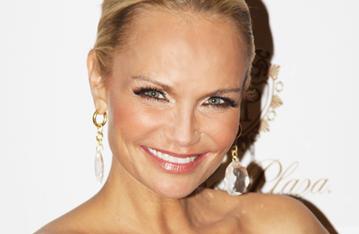 Kristin Chenoweth, the Promises, Promises star who was nominated for three Broadway.com Audience Awards on May 7, has stepped up on her soapbox. The Broadway favorite logged onto Newsweek.com to comment on an article on the website called “Straight Jacket” that suggests that gay actors struggle with playing straight characters. Ramin Setoodah, the openly-gay author of the article, specifically singles out Chenoweth’s leading man, Sean Hayes (calling his casting a problem--”the big pink elephant in the room”), and the recent appearance on TV’s Glee by Tony nominee Jonathan Groff.
"I couldn't stay silent on this one," Chenoweth wrote on Twitter after posting the response. Because she deserves as big as a soapbox as is available, we reprint Chenoweth’s comments below, with thanks to Newsweek.com.
Chenoweth writes:
As a longtime fan of Newsweek and as the actress currently starring opposite the incredibly talented (and sexy!) Sean Hayes in the Broadway revival of Promises, Promises, I was shocked on many levels to see Newsweek publishing Ramin Setoodeh’s horrendously homophobic “Straight Jacket,” which argues that gay actors are simply unfit to play straight. From where I stand, on stage, with Hayes, every night — I’ve observed nothing “wooden” or “weird” in his performance, nor have I noticed the seemingly unwieldy presence of a “pink elephant” in the Broadway Theater. (The Drama League, Outer Critics Circle and Tony members must have also missed that large animal when nominating Hayes’ performance for its highest honors this year.)
I’d normally keep silent on such matters and write such small-minded viewpoints off as perhaps a blip in common sense. But the offense I take to this article, and your decision to publish it, is not really even related to my profession or my work with Hayes or Jonathan Groff (also singled out in the article as too “queeny” to play “straight.”)
This article offends me because I am a human being, a woman and a Christian. For example, there was a time when Jewish actors had to change their names because anti-Semites thought no Jew could convincingly play Gentile. Setoodeh even goes so far as to justify his knee-jerk homophobic reaction to gay actors by accepting and endorsing that “as viewers, we are molded by a society obsessed with dissecting sexuality, starting with the locker room torture in junior high school.” Really? We want to maintain and proliferate the same kind of bullying that makes children cry and in some recent cases have even taken their own lives? That’s so sad, Newsweek! The examples he provides (what scientists call “selection bias”) to prove his “gays can’t play straight” hypothesis are sloppy in my opinion. Come on now!
Openly gay Groff is too “queeny” to play Lea Michele’s boyfriend in Glee, but is a “heartthrob” when he does it in Spring Awakening? Cynthia Nixon only “got away with it” ’cause she peaked before coming out? I don’t know if you’ve missed the giant Sex and the City movie posters, but it seems most of America is “buying it.” I could go on, but I assume these will be taken care of in your “Corrections” this week.
Similarly, thousands of people have traveled from all over the world to enjoy Hayes’ performance and don’t seem to have one single issue with his sexuality! They have no problem buying him as a love-torn heterosexual man. Audiences aren’t giving a darn about who a person is sleeping with or his personal life. Give me a break! We’re actors first, whether we’re playing prostitutes, baseball players, or the Lion King. Audiences come to theater to go on a journey. It’s a character and it’s called acting, and I’d put Hayes and his brilliance up there with some of the greatest actors period.
Lastly, as someone who’s been proudly advocating for equal rights and supporting GLBT causes for as long as I can remember, I know how much it means to young people struggling with their sexuality to see out & proud actors like Sean Hayes, Jonathan Groff, Neil Patrick Harris and Cynthia Nixon succeeding in their work without having to keep their sexuality a secret. No one needs to see a bigoted, factually inaccurate article that tells people who deviate from heterosexual norms that they can’t be open about who they are and still achieve their dreams. I am told on good authority that Mr. Setoodeh is a gay man himself and I would hope, as the author of this article, he would at least understand that. I encourage Newsweek to embrace stories which promote acceptance, love, unity and singing and dancing for all! --Kristin Chenoweth
The author of the original article felt unfairly attacked by this article and other commentaries around the web. Many GLBT sites took serious issue with his stance and have been very critical. So he responded to this comment from Chenoweth.
The Internet is attacking me for my essay on 'Promises, Promises.' But can we steer the debate back to where it belongs?
When Sean Hayes, from Will & Grace, made his Broadway debut in Promises, Promises playing a heterosexual man, the New York Times theater review included these lines: "his emotions often seem pale to the point of colorlessness ... his relationship with [his costar Kristin] Chenoweth feels more like that of a younger brother than a would-be lover and protector." This, to me, is code: it's a way to say that Hayes's sexual orientation is getting in the way of his acting without saying the word gay.
Instead of hiding behind double entendre and leaving the obvious unstated, I wrote an essay in the May 10 issue of NEWSWEEK called "Straight Jacket" examining why, as a society, it's often hard for us to accept an openly gay actor playing a straight character. You can disagree with me if you like, but when was the last time you saw a movie starring a gay actor? The point of my essay was not to disparage my own community, but to examine an issue that is being swept under the rug.
Immediately, a number of gay blogs picked up my essay and ran excerpts from it out of context, under the headline that I was antigay. It went viral. Chenoweth wrote a letter to NEWSWEEK calling the article “horrendously homophobic,", even though she went on to acknowledge that I am openly gay. It went even more viral. In the meantime, commenters on the Internet piled on the attacks. Many of them said they hadn't even read the original article (some of them did) but they all seemed to agree on the same point: that I was an idiot.
Over the weekend, I became the subject of a lot of vicious attacks. I received e-mails that said I will be fired, anonymous phone calls on my cell phone and a creepy letter at my home. Several blogs posted my picture, along with a link to my Twitter feed. People commented about my haircut, and that was only the beginning. I was compared to Ann Coulter and called an Uncle Tom. Someone described me as a "self-hating Arab" that should be writing about terrorism (I'm an American, born in Texas, of Iranian descent).
But what all this scrutiny seemed to miss was my essay's point: if an actor of the stature of George Clooney came out of the closet today, would we still accept him as a heterosexual leading man? It's hard to say, because no actor like that exists. I meant to open a debate—why is that? And what does it say about our notions about sexuality? For all the talk about progress in the gay community in Hollywood, has enough really changed? The answer seems obvious to me: no, it has not.
I realize this is a complicated subject matter, but the Internet sometimes has a way of oversimplfying things. My article became a straw man for homophobia and hurt in the world. If you were pro-gay, you were anti-NEWSWEEK. Chenoweth's argument that gay youth need gay role models is true, but that's not what I was talking about. I was sharing my honest impression about a play that I saw. If you don't agree with me, I'm more than happy to hear opposing viewpoints. But I was hoping to start a dialogue that would be thoughtful—not to become a target for people who twisted my words. I'm not a conservative writer with an antigay agenda. I don't hate gay people or myself. As for my haircut, I don't know what to say. Should I change it?
His argument that he was simply responding to a play he saw - and did not like - is disingenuous. He makes the argument in the original article that gay men - in general, not just Hayes in
Promises, Promises - should not and cannot play straight and do it convincingly.
Yesterday, Newsweek posted another article on this topic, seemingly wanting to keep the story alive. I guess any attention is good attention, especially when you are looking for a buyer to keep you afloat.
In this piece, they ask two gay activists to discuss the controversy.
As people in the blogosphere and beyond hotly debate a NEWSWEEK story on gay actors, two gay activists try to separate fact from friction.

Matt Sayles / AP
Dustin Lance Black won the Oscar for Best Original Screenplay for 'Milk.'At NEWSWEEK, we're used to reporting the news, not being news. But in the last few days, our story
“Straight Jacket” has become something of a sensation, and not, for the most part, in the good sense. The piece examined the difficulty gay actors can have in being cast as straight romantic characters. We'd hoped to stir discussion of why there are still so few openly gay performers in Hollywood, but that message was overwhelmed by readers who thought we were being hurtful and small-minded in our assessment. When a story is so widely misinterpreted, it's obvious we failed at making our point. So in an effort to clear some smoke away from this fire, we spoke to Dustin Lance Black, the Oscar-winning and openly gay screenwriter of
Milk, and Jarrett Barrios, the president of the Gay and Lesbian Alliance Against Defamation (GLAAD), to get their assessment of the larger issues surrounding sexuality in Hollywood. Excerpts:
Marc Peyser, NEWSWEEK Culture Editor: Obviously the piece that we're all hearing about has touched quite a nerve out in the larger world. My hope is more to sort of move beyond that, and talk about what life is really like in Hollywood for gay people—actors, obviously, but also screenwriters, if you will, and directors. It's my sense that one of the reasons people are upset about the piece is that—there's lot of reasons—but one is that we assert that gay people don't get to do the same kinds of things that straight people do. And I think that that's an unpleasant thing to be confronted with. Do you have a sense, Lance, that that's true? Do you think being gay in Hollywood puts no limits on you?
Dustin Lance Black: Just stepping back a second, that wasn't really what I got from the article. I wish that's what the article was about. To me, the article seemed to be attacking gay and lesbian people's ability to—talent to—take on heterosexual roles.
Jarrett Barrios: On a larger level, the veracity—the believability—of a gay character, or the lack of believability, which kind of builds this wall of impossibility for gay actors, lesbian actors, to be successful in their craft.
Peyser: Certainly in regard to the two actors who are talked about most in the piece, I think that yes, he was asserting that those people, for him as an audience member, he [was] not able to believe them as straight characters. But I think that that's built on this larger idea that the reason we can't see past an actor's sexuality is because it's so rarely out there, so to speak. So few actors come out, and the ones that tend to come out probably have less to lose. The ones that have multi-multi-million-dollar careers don't come out of the closet, and therefore it's still a novelty and an aberration in some people's minds. So it's hard to look past that.
Barrios: With all respect, that might have been what he [Setoodeh] implied, but that's not what he said. He said, for example, that Sean Hayes wasn't believable. How could somebody who was "queeny" in Will & Grace be believable in Promises, Promises? As if to say that because in one role he was effeminate, he was no longer a candidate for a noneffeminate role later in his career? That may be what's going on in his [Setoodeh's] head, but it's certainly not what the public thinks.
Black: I'll take it a step further, too— this idea of femininity and sexuality, which I think we also have to confront. I'm from the Mormon church—I'm not active anymore—but [in that church] heterosexual men are encouraged to be not stereotypically masculine. So a lot of Mormon people are often called very, very feminine, and people mistake them as gay. So it also felt like a lot of issues... I'm just saying, I don't know this writer, but it felt like this writer had a lot of issues with femininity and heterosexuality, and the connections between masculinity, femininity, and sexuality. It started getting blurred to me. The heterosexual people in America don't seem to be having that problem with these performances, or seeing that, but this writer did. And to me it felt like it became more about this writer's issues with sexuality and masculinity than it did the success of these performances.
Barrios: What's so odd about this, Marc, to me, is that what he was saying was oddly out of step with what we're all seeing in Hollywood, which is a real spread of the number of gay men and lesbians who are actually playing straight people successfully on television and in movies, and on Broadway, of course. You've got Neil Patrick Harris. You've got—as recently as the last two months—the young man Jonathan [Groff] who's playing the love interest in Glee. You've now got Cheyenne Jackson playing Danny on 30 Rock, in a relationship with Tina Fey, and these are all—the trend seems to be going in exactly the other direction from what this writer has asserted. From the perspective of GLAAD, we want to see a world where there's full equality for all gay, lesbian, bisexual and transgender people. And to think that a child might conclude that they can't be out? When all around them there are gay people coming out and being successful? It's not tenable. It's not believable, what the author is saying. And it's also harmful. Because if they were to believe it, it could really affect the expectations of children and all of us who want to live in a world where we're fully equal.
Peyser: But Lance, you work in Hollywood. Do you think that everybody who is gay is out? Are we going to see that all of the gay actors and actresses and, beyond that, people behind the scenes as well, are out? Is that what Jarrett is implying, that in fact we're very close to?
Black: I feel like this is a separate issue. So I'm happy to move on to talk about it—actually really happy to, I think it's a really interesting subject. But I want to make sure that you're getting what Jarrett's saying and what I'm saying about this article. Because this article said something really different from what the real challenge is, which is making Hollywood a comfortable place for gay and lesbian people to come out and be able to play heterosexual roles. Which, let's be honest: there are a lot more straight roles than gay roles out there. So I think that's our end goal, to finally have those moments where we have openly gay and lesbian actors—and stars—playing straight roles. I think it's already starting to happen, and I disagree with your writer in that I think that some of them are very believable, and very compelling. It only takes looking to Milk to know. In Milk we completely flipped the issue: we had openly gay people playing the straight people and the homophobes, and straight people playing the gay people.
Peyser: It's very nice to say that we would like there to be a world where gay people can feel comfortable enough to be who they are in whatever it is they do, and be accepted for that. My question is, is that anywhere close to true in Hollywood? You mentioned some smaller roles in some smaller things—Cheyenne Jackson, etc. But we're not talking about leading men in big-budget movies that are in fact the role models for so much of what goes on in Hollywood.
Black: Well, listen, first off, I would say that Neil Patrick Harris is starting to break that barrier down in a big way. He's playing a heterosexual role on a big, successful television show. That said, I do understand that we need more than just [Neil] Patrick Harris, and it would be great to have that moment when you have a big A-list celebrity—a big star—who can greenlight a picture by adding his name to it, who is openly gay or lesbian. That is the moment we all want, that we're all looking forward to, and I do believe it will happen. I'll tell you what I see as some of the challenges. My perspective is that Hollywood directors and producers are very open to casting and working with openly gay and lesbian actors. Very open to it. I know that we intentionally sought them out when making Milk. I know that we've sought them out when working on other projects. The problem we're finding is that the filter in Hollywood feels like it's with the agents and managers. And namely with the ones who bring in new talent and start to foster new talent. And I think what they do is they feel like they're taking a bigger risk with someone who's out of the closet.
Peyser: What do you mean by risk?
Read the rest of this long piece.
I'm going to give the final word here to Aaron Sorkin - one of my favorite writers and directors - because he makes more sense in his commentary than anyone else so far. There are many comments around the web, and to their credit, Newsweek has been posting links to the better ones. This one comes from Huffington Post.
Aaron Sorkin, Playwright, screenwriter and television writer
Posted: May 12, 2010 06:19 PM
This is a sentence I never thought I would type: I'm coming to the defense of a theatre critic.
Newsweek's Ramin Setoodeh wrote an article last week titled "Straight Jacket" in which he argues that gay actors can't and shouldn't play straight characters. His "Exhibit A" in the piece is Sean Hayes, the stunningly gifted actor who came to our attention playing Jack MacFarland on the much beloved NBC half-hour comedy Will and Grace. (This was back when NBC broadcast television shows.) Mr. Hayes just opened in the Broadway revival of Promises, Promises, a 1968 musical by Neil Simon, Burt Bacharach and Hal David that was based on The Apartment, the Academy Award-winning film by Billy Wilder and I.A.L. (Izzy) Diamond that starred Jack Lemmon and Shirley MacLaine. Are you following so far?
It doesn't really matter, because all you need to know is that Sean Hayes plays C.C. Baxter in this great show, and that C.C. Baxter is a man who is attracted to women.
Ramin Setoodeh, unlike the overwhelming majority of the people in the audience at the two preview performances I attended, was unhappy with Sean Hayes' performance. This reaction was not due to Mr. Hayes' acting, singing, dancing, comedy, unique charm and exceptional rapport with the audience. Mr. Setoodeh's problem with the star's performance was that in real life, Mr. Hayes is gay. And as if the studio had given the screenwriter a note that the story had to be spicier, Mr. Setoodeh is gay as well.
Much is being made of the Newsweek piece. Much should be. I'm proud to say that my friend, Kristin Chenoweth, who stars opposite Mr. Hayes in the show (and about whose performance I can't possibly be objective -- she's sensational and we'll leave it at that) led the charge -- posting an online rebuttal to Mr. Setoodeh in which she called him homophobic.
For an actress who makes her living and her reputation on Broadway, throwing down with a prominent theatre critic isn't something you do as a career move. In her response to Setoodeh, Ms. Chenoweth made good point after good point after good point...
...and missed the point.
So did Setoodeh.
First things first. An actor, no matter which sex they're attracted to, can't "play" gay or "play" straight. Gay and straight aren't actable things. You can act effeminate and you can act macho (though macho usually ends up reading as gay), but an actor can't play gay or straight anymore than they can play Catholic. The most disturbing thing to me about this episode is that the theater critic for Newsweek didn't know that. Of COURSE gay actors can play straight characters -- it's impossible to believe that Mr. Setoodeh would prefer if Ian McKellen would stop doing King Lear.
But with sincere respect to Ms. Chenoweth and the hundreds and hundreds of Internet posters who've crashed down on Setoodeh in the last few days -- some understandably passionate and some unfortunately hostile -- I don't think Setoodeh was being homophobic. Just wrong.
The problem doesn't have anything to do with sexual preference. The problem has everything to do with the fact that we know too much about each other and we care too much about what we know. In one short decade we have been reconditioned to be entertained by the most private areas of other people's lives. We've become the family dog who's allowed to eat anything that falls on the floor, and the press is the little kid in the family who keeps dropping food. Sandy Bullock's life falls apart? That's for us. A golfer gets caught with strippers? We'll take that, thank you. Lindsay Lohan's an alcoholic? Mmm, mmm good! When Jennifer Aniston plays a movie character who's looking for love, her performance -- always sublime -- doesn't stand a chance against the real story we've been told it's okay to pay attention to, which is that Jennifer Aniston is looking for love. I can't hum a single John Mayer song but I can name five women he's slept with. Sean, for Setoodeh, the show began before you even showed up to the theater that night.
The volcanic eruption of tabloids, Internet insanity and -- you better believe it -- reality TV, has de-creepyized voyeurism. More than that, it's made the private lives of public people -- in the vocabulary of television writers -- the "A" story. And in a not-so-convoluted way, the "A" story has an author -- thousands of authors in an extraordinary collaboration. When I need the audience to know that a piece of information they're about to hear is important, I can use words, a close-up, a push-in, music... when the authors of the no-longer-private-lives "A" story want the audience to know that something's important, it shows up on our Yahoo homepage. (The third story on my homepage yesterday was that Britain, our closest ally, has a new Prime Minister. The first story was about Justin Bieber. Unless the new Prime Minister is Justin Bieber, something's obviously gone wrong.) Is Sean Hayes' sexuality relevant to his performance? It has to be -- the "authors" told us it was important. (Though Setoodeh would have done well to have asked himself if Mr. Hayes' performance would have been any different if C.C. Baxter was in love with a man instead of Ms. Chenoweth's Fran Kubelik. It wouldn't have been.)
I would never presume to -- and those words are almost always followed by whoever said them proceeding to do exactly what they just said they would never presume to do -- but I would never presume to tell someone how they should feel about something. I can only imagine that Setoodeh's piece felt like a solid kidney punch, not to just Mr. Hayes and the other actors tagged in the story, but to teenagers -- kids who live in daily fear of what their parents are going to say, of getting the hell beaten out of them at school, of being an oddity. Gay actors, you'll forgive the expression, are caught between a rock and a hard place. Only criminals and adulterers should have to hide who they are. And in addition to living their own lives in sun and not shadow, these actors want to -- admirably -- be role models for these kids. But they also know the blanker their canvas the better their chance of marginalizing the "A" story. They know that even in 2010, there's still no such thing as an actor who's gay, a movie star and alive all at the same time.
So while I would never presume to tell someone how to feel, if it were me, I would re-direct my energy away from Mr. Setoodeh. (Ryan Murphy-- the very gifted creator of Glee whose cast member, the invaluable Jonathan Groff, was also smacked in the teeth by Setoodeh-- has called for a boycott of Newsweek. I get it completely, but I say please don't boycott Newsweek -- it's still one of the very last places left where we can find news. Boycott the red carpet instead. You're going to win the Emmy, Ryan, and you're going to get the whole publicity bump that comes with it. You and your cast should proudly walk past every microphone that's shoved in your faces. The people holding the microphones are writing the "A" story and you don't have script approval. Boycott In Touch and Us Weekly and Brangelina Daily and every other piece of crap that makes us feel like we're all sitting under hairdryers.)
Gay actors are in absolutely no danger of losing parts in Broadway shows, so if it were me, I'd re-direct my anger to the real problem. The honest-to-God, no kidding around, small-minded, mean-spirited, hysterically frightened, pig-ignorant bigots who don't think homosexuals are fit to get married, adopt children or fight and die for their country. The ones who hold signs saying "God Hates Fags." Those people aren't in the backwoods of Idaho, they're in Congress. Fight THEM. I'll help.
And you know who else will help? Ramin Setoodeh. I promise you he's on the side of the good guys.
Tags:
sexuality, homosexuality, actors, culture, masculinity, Aaron Sorkin, Newsweek, Ramin Setoodeh, Sean Hayes, performance, Kristin Chenoweth, Broadway, Promises Promises, Dustin Lance Black, Jarrett Barrios, Marc Peyser, homophobia, gender roles, sex roles, masculinity styles