Showing posts with label control. Show all posts

Tuesday, October 14, 2014

Dr. Jean Kim - Why He Hits: The Psychology of an Abuser

http://dlib.info/home/sla/images/Cyc.gif

From Psychology Today's blog section, Dr. Jean Kim (Culture Shrink) attempts to explain the psychology of a (male) abuser. This is an excellent post in that it does not offer easy answers (she lists a large number of conditions that can lead to violence) and she writes from the personal experience of growing up with a father who was violent to her mother.

http://ionevoxxi.files.wordpress.com/2013/07/470_5096928251355262391.gif?w=550&h=650

All of these same conditions can apply to women who abuse their male partners - and this is more common than most people are willing to admit. The rates of DV are nearly equal between the genders. But men are much less likely to report, and when men abuse, they tend to create more damage.

Why He Hits: The Psychology of an Abuser

Exploring the biological and psychological drive of abusers


Published on October 8, 2014 by Jean Kim, M.D. in Culture Shrink

The act is simple. But everything around it is not. Fist meets flesh; force makes contact. Nerve endings fire away in pain; capillaries burst; tissues swell.

The physical mutates the moment. Violence creates as it destroys. As we know from the recent 9/11 anniversary, the axis of someone’s psyche shifts after something traumatic happens. Tomorrow is never the same. In violence’s wake, a savage creation is born. A monstrous mélange of anguish, sorrow, confusion, shame, anger—and to look upon it is to look at oneself in a shattered mirror, a grotesquerie of what you thought was love, family, intimacy.

To have that moment and its afterbirth displayed for all the world to see, the monster that thrives in the shadows and corners of personal respectability and civility, is what has finally happened with the Ray Rice incident. Thanks to the era of cell phone cameras and instant media and Youtube, the personal can no longer remain private. And while there may be something to be said for the victim’s agency in choosing when to reveal private horror to others, Janay Rice has become the unwitting, unwilling poster child for an important conversation.

Aside from the myriad discussions of an abuse victim’s behavior and the crucial #WhyIStayed Twitter feed, here I have decided to focus on the perpetrator. Because as someone who grew up with a father who committed domestic violence, it is a question that has plagued me my entire life. Why does someone you love, someone who should cherish you unconditionally, treat you or your loved one cruelly? What has gone awry in that person to become an instrument of violence, both physical, and inevitably emotional?

On some level, that question has defined my entire identity and my choice of career. Not unlike the obsessions of a driven detective searching for a murderer, or of John Wayne in the classic movie The Searchers looking for years for his kidnapped missing niece, I too have obsessed over that question. I studied literature, looking for the answers in human behavior and motivations, the nature of good and evil. I became a psychiatrist, devoted to helping people who have suffered the mental fall-out from trauma, which leaves devastation in many forms, be it nightmares, isolation, depression, anxiety, self-hatred, self-destructive behaviors, and more. But I also wondered about the psyche of the aggressor, the criminal, the sociopath, who would also sometimes come under my purview.

Abusers often suffer from their own mental illnesses; a mood disorder may make them more prone to irritability and anger. Both depression and mania can manifest in heightened snappiness and quickness to attack, especially when associated with insomnia. (And in rarer severe cases, psychotic paranoia can also contribute.) Post-traumatic stress disorder (as sometimes seen in people in high-stress, high-threat careers like the military) can cause people to remain in fight-or-flight mode, leading to a chronic edginess and aggressive will to survive. An impulse control disorder may mean the person has trouble keeping wayward behaviors in check, has repetitive compulsions exacerbating stress. A traumatic brain injury or other organic brain damage (as associated often now with sports like football and boxing) may affect parts of the brain like the frontal lobe, causing disinhibition or mood changes. Addictions to substances like alcohol can also strongly exacerbate these behaviors. Some research has conjectured that testosterone can also sometimes worsen violent, antisocial, and aggressive behaviors, and adversely affect empathy.

Environment and learned behavior also contribute to abuse. Oftentimes abusers have witnessed similar behaviors in their own families, and they inevitably imitate their original role models, male or female. They may harbor severe resentment towards the gender they attack because of unresolved issues with their own parent, who may have been physically or emotionally cruel or unloving. It isn’t uncommon to end up “identifying with the aggressor,” an ego defense mechanism where you internalize the role of the powerful figure in the family, because you see abuse and dominance as power. You see this aggression as the way to behave in your later relationships and jobs, as the best way to survive, else you be the one victimized instead. Kill or be killed is the only relationship language you understand.

There is also the related issue of lack of ego strength; why would someone need to constantly control and belittle someone else to feel better about themselves? Abusers sometimes come from backgrounds where they were often belittled or grew to lack self-esteem. Usually the abuse is directed towards someone who would be considered weaker than them anyway, someone who is vulnerable, like a physically smaller female who is often younger, less educated or less financially independent, more easily manipulated. The abuser is a secret coward, never assured of their own power, even when they stack the deck heavily in their favor. (And certainly there can be male victims of abuse as well, with even more complex forms of shame and manipulation involved.)

Yet even with these biological and psychological insights as to what renders someone vulnerable to becoming violent, I still wonder what goes awry in that key moment, where someone decides to cross that line that most of us still recognize and appropriately flinch at in revulsion. Where someone lets loose with that fist, that belt, that weapon, decides to finally pull that trigger. Sometimes I still think there is a greater moral question to be asked as well of an abuser. What is causing that blind spot, that says hitting someone is okay?

Perhaps there is a rush, a thrill that goes with the transgression. There is a perverse reward going on to the circuits, that the kill has happened. It’s not that different than other trained instincts of violence we encourage in our society: be it in video games or aggressive sports or hunting or never-ending wars. Perhaps there is still a thirst for blood that is gratifying, enjoyable, and it is a thin line to cross when it comes then to a loved one who is easily and readily accessible, easy to hide.

This line-crossing may differentiate a sociopath from the rest of us. And yes, perhaps, a level of sociopathy or psychopathy is ultimately part of the picture for an abuser; a lack of empathy, even an enjoyment of inflicting cruelty or pain, a disregard for the aftermath. Although Dr. Robert Hare Ph.D., the psychologist who created the gold standard for diagnosing psychopathy, the Hare Psychopathy Scale, estimates that only 1% of the general population meets criteria for the official diagnosis, he has noted that higher numbers may have psychopathic traits and can be found in corporate businesses and other mainstream walks of life.

And although many may tend to consider domestic abuse as more of a “crime of passion” or less calculated than your stereotypical cold-blooded murder, that isn’t really the case. Oftentimes there is a longstanding pattern of manipulation and control inflicted by the abuser. Their tactics are not fleeting and isolated; they groom and master their victims quite skillfully; the callous bursts of violence are part of a larger campaign to dominate and emotionally cripple their victims so they lose their independence and will-power to leave. In this sense, given the high rates of domestic violence in our society (up to a third of women have been subjected to it according to a recent CDC study), the rates of sociopathic traits might be much higher than we realize.

Sure, all of us carry some capacity for cruelty or violence. Thanatos fights with eros for our souls—the age-old devil and angel chattering on our shoulders for control. Most of us keep our baser instincts in check. Circumstances and biology may make it easier for the line to be crossed, may bring you closer to the precipice. But it’s still your choice to release the monster. And it is a choice we must continue to acknowledge, to prosecute, and to vehemently condemn.

But that condemnation comes at a price we must acknowledge as well. Abusers come in all walks of life, all levels of society, and varying degrees of behavior. (There are definitely female abusers too, but we shouldn’t minimize the statistical reality that more men are prone to committing domestic violence.) They are human too, they can be loved and loving, they can do good as well as evil. It is not always so easy to “just leave” them or hate them. We should also stand back and view both abuser and victim with some compassion and appreciation of human and circumstantial complexity.

We need to continue to examine and address socioeconomic factors that contribute to abuse, such as war, poverty, stress, mental illness, violent entertainment, and other contributors to violence. We need to encourage mutual respect in society and healthy role-models for relationships. We need to promote love and forgiveness as well, but part of that involves recognition of a crime, recognition of the brutality of a violent act, not denial. Only when the act is acknowledged can the healing begin.

Related Links

Friday, November 1, 2013

Jennifer Ouellette - What Does Sexual Harassment Look Like?

A couple of weeks ago, the "sexual harassment" scandal at the Scientific American blogs, centered on the ways Bora Zivkovic was inappropriate with female writers, was all the news in the science blogosphere
A very well-known science writer and blogger, the Blogs Editor at Scientific American, and co-founder of ScienceOnline.com - Bora Zivkovic - was accused by first one and then several science writers - all female - of sexual harassment.
The pattern is pretty distinct in each of their stories

[Bora] contacted her, showed interest in her work, met with her, and then proceeded to steer the conversation straight towards sex (such as repeatedly telling her he was a "very sexual person.")
This is all so effing disturbing as a man - I work with women who go through this is much less public ways. Often, as is the case with Kathleen Raven, this kind of harassment devolves into rape.
I am so proud of these women for speaking out and revealing the culture of control and power in which they work. And I applaud Ed Yong for featuring this story on his blog this weekend.
Jennifer Ouellette, another blogger, at Scientific American's Cocktail Party Physics blog, has some thoughts about what happened and how we discuss and define sexual harassment. While she commends the women who came forward and expresses dismay with what her friend has done, she also feels some empathy for Bora and his wife:
I have spent the last week, like many others, grieving for what our small community has lost, and what the three young women who came forward have suffered. Each subsequent revelation was like a hard punch to the gut. Monica, Hannah, Kathleen — I’m so sorry. I truly had no idea.

And yes, I grieve for Bora himself, and his wife, Catherine, although I cannot condone his behavior, or deny the damage this has wrought. I cannot place concern for his well-being above that of the young women he has harmed through his actions.
She makes some excellent points of what this kind of behavior - and the atmosphere it creates - does to women. It's worth the few minutes it takes to read this.

Jeepers, Creepers: What Does Sexual Harassment Look Like?

By Jennifer Ouellette | October 22, 2013 | Cocktail Party Physics (Physics with a twist)


I have been largely silent publicly about the events of the past week that ended with the resignation of our blogs editor, Bora Zivkovic, mostly because (a) I was waiting for all the facts to come in and trying to process those facts in the throes of considerable cognitive dissonance, and (b) others have addressed so clearly and eloquently the many knotty issues I would have raised. Honestly, I’m suffering from metaphorical PTSD (Note: this is not meant to diminish PTSD; it accurately reflects my shellshocked emotional state): Bora is a longstanding friend and colleague. I have spent the last week, like many others, grieving for what our small community has lost, and what the three young women who came forward have suffered. Each subsequent revelation was like a hard punch to the gut. Monica, Hannah, Kathleen — I’m so sorry. I truly had no idea.

And yes, I grieve for Bora himself, and his wife, Catherine, although I cannot condone his behavior, or deny the damage this has wrought. I cannot place concern for his well-being above that of the young women he has harmed through his actions. But human beings are complex, a mass of contradictions, and we are all, at various times, laid flat by our own frailty. His fall was just more precipitous than most, and because of his substantial influence, the fallout and collateral damage were more severe. As Ashutosh Jogalekar phrased it,
We can applaud the substance of Bora’s foundational contributions to the rise of science blogging even as we continue to denounce his actions. This episode is a reminder that human beings are flawed and that the same person can reach both the heights of achievement and the depths of failure.
Ashutosh is a thoughtful man, and he chose his words carefully, with plenty of caveats. But there was one phrase elsewhere in his post that bothered me, because it is one that I’ve heard echoed in comments all over the Web: that “in none of the three cases did Bora’s behavior descend into overt sexual or physical harassment.” It’s the same point Hannah Waters made in her post when she talked about “not-quite-harassment,” and when Monica Byrne confessed that at first, she wasn’t entirely sure what happened to her constituted “real” harassment.

I wish I didn’t feel compelled to talk about this. I just want to explore through my writing all the cool science and culture stuff out there and share my enthusiasm with others, augmented with the occasional funny video. But clearly we need to talk about what sexual harassment looks like, because it’s not always black-and-white, and no two cases are exactly alike. I would argue that the insidiousness of those borderline gray areas can sometimes be more damaging, in the long run, than the blatantly obvious cases — particularly for fields that wish to attract and promote more women within their ranks. An accumulation of incessant little things can gradually create an intolerable environment, and sexual harassment is a often a significant part of that. (Cf. the “chilly climate.”) It’s especially impactful when it happens early in one’s career. As this post noted: “Events at the beginning of your career timeline are, by definition, formative.” So it’s important that we openly acknowledge when these kinds of things happen, and act swiftly to address them.


Like pretty much every woman out there, I am no stranger to harassment. It’s just part of what a friend recently described as the persistent “background noise” of being a Woman in Public: the whistles and catcalls, the random slurping sounds, the public masturbators and the gropers, the chatty men next to you on the subway who keep trying to make “friendly” conversation when you just want to be left alone to read your book, the exhortations to “smile, sweetheart,” and, when you protest, the defensive insistence that they were just “being friendly, geez, what a bitch.” It’s a daily barrage, and frankly, it gets exhausting. (One of the loveliest things about married middle age is that one is increasingly invisible as a sexual target — and I mean that sincerely.)

Matters become more complicated when it’s someone you know in a professional or even a semi-professional setting, especially if there is an imbalance of respective power. I’m going to describe two separate case studies from my own misspent youth to illustrate how fuzzy the lines can be. Which would you consider overt sexual harassment? And which do you think had the greater impact on me and my future professional development?

Case #1:

I was just 22, quiet, painfully shy, and achingly naive, working as a copy editor at a publishing company. One of the male senior staff offered to buy me a friendly drink after work, just to welcome me to the fold. I thought it was a little weird but didn’t want to appear impolite when I was just starting a new job, plus I didn’t know many people yet, so I agreed. More than 20 years later, I still vividly recall the sudden chill when the joke he was telling unexpectedly turned sexually explicit. Very explicit, deliberately so. Leering slightly, he stared intently in my eyes as he savored every naughty detail, oblivious to my attempts to avert his gaze, my crossed arms, my nervous chuckle as I sought escape. It wasn’t remotely sexy or erotic; he sounded like a horny 12-year-old sniggering over Daddy’s old Hustler rags.

I told him that I needed to get home, insisted on paying for my own drink because I didn’t want to feel obligated in any way to this man. He remained oblivious, taking my elbow as we walked down the street, leaning close and murmuring that it was too bad he’d given up his apartment in the city because then we could have gone there for the night. I was stunned. Did he honestly think he had a snowball’s chance in hell of getting me into bed? Had he really not noticed my growing discomfort, my stiff posture, my instinctive pulling away, my incredulous expression at the very idea of sleeping with him?

Yes. He did. And no. He hadn’t. I was just a prop in his personal fetishized sexual fantasy, in which he was the erudite, sophisticated sex god offering to initiate the pretty ingenue into the delights of carnal pleasure. My wishes were irrelevant, my boundaries disregarded; he didn’t see “me” at all.

His self-delusion reached new heights when he stopped by my cubicle a couple of days later and condescendingly informed me that he felt we should really just be friends, that he was actually seeing someone. He hoped he hadn’t led me on and that I could “get over” him and move on with my life. I just stared at him with a “WTF?” expression and finally shrugged and said sure, no problem. He seemed a bit taken aback by my nonchalance; I’m sure he convinced himself I was frigid. Clearly any woman who found him repulsive had to be frigid. It was my first encounter with the manipulative, “If you weren’t such a prude, you wouldn’t find this offensive” line such men routinely feed their targets. It wouldn’t be my last.

This man was senior to me, but he was not my direct superior and he mostly left me alone once he’d determined I wasn’t an easy mark, apart from occasionally brushing against me in the hall (his office was near my cubicle) and giving a knowing smirk. No harm, no foul. Men will be men, right? It’s not like we all have a god-given right to never feel socially uncomfortable. But it poisoned my experience on the job. I was wary of socializing with co-workers after-hours, even in groups, unless my one trusted friend (who remains one of my best friends) was present. I largely kept to myself, and leapt at the first new employment opportunity that came my way. Later, I heard through the grapevine that he’d been cited for sexual harassment; apparently he’d been sending anonymous dirty emails regularly over the company servers to a female colleague, who tracked him down and reported the abuse. I have no idea if he kept his job.

Case #2:

I was working at a different company, a little older, not much wiser. At an official company dinner, I found myself seated next to a 60-ish high-ranking administrator — let’s call him X — who became progressively inebriated. When I felt his hand slip onto my thigh under the table, gently squeeze and start to slide upward, I quickly stood up and said I needed a refill from the bar. And I stayed in the bar for the rest of the evening, enduring the ribbing of several co-workers, who guessed why I had left my seat. The man had a reputation as an incorrigible horndog.

At first I had no intention of reporting him. I’d gotten a bit more jaded by then, intent on playing the role of Post-Feminist Free Spirit. (Spoiler alert: it really didn’t suit me.) A spot of drunken groping paled in comparison to the PR rep who insisted on meeting at his home office to discuss the freelance article I was writing. That guy answered the door wearing nothing but a bathrobe, and promptly laid down on the oversized sofa, suggesting that if I wanted access to his client, perhaps I could “massage” his legs — especially the upper inner thigh region. The sight of those flabby white thighs and barely-visible testicles peeking through the robe’s folds haunted me for days. (You’re welcome for that visual. Share my pain!) And no — I never wrote that article. I guess I just didn’t “want it enough” to pay that high a price.

I figured I just had to avoid X from now on. Except the ribbing from co-workers continued for the next couple of days, with people teasing that I was the “future Mrs. X” — someone even pasted a doctored photo on my computer monitor, with my face and X’s imposed on a stock wedding pose. Finally, embarrassed and fed up with the breezy acceptance of X’s lecherous behavior more than the behavior itself, I marched into Human Resources and said I wanted to lodge a formal complaint. I was lucky: the woman seated on the other side of X that night had witnessed the whole thing — and she just happened to be the head of HR.

X denied it when she first confronted him, but she countered, “I was there. I saw you.” And he caved. With his guilt established, she asked what I wanted to be done about it. Honestly? I just wanted it to go away. I didn’t even want an apology. Ultimately I asked that he get a stern talking-to about how poorly his behavior reflected on the company and how he should probably regulate his drinking at future company events. Despite this uncomfortable incident, I enjoyed my employment there. It was easy to avoid X, given the company’s size and his seniority. Looking back, did I make the right choice? I don’t know. I’d like to think that black mark on his personnel record chastened him somewhat, but it’s just as likely that he continued to cheerfully get drunk and grope young women all the way until retirement.

Case #2 is a fairly straightforward example of mild sexual harassment, and there is comfort in that kind of clarity. It happened in a professional work environment and — crucially — when I spoke up, someone believed me, and appropriate action was taken, which, sadly, is not always the case. (Having a witness didn’t hurt.) So that work environment, to me, was a safe space, and the incident didn’t really prey on my psyche.

Case #1 falls into that nebulous gray area; it happened while socializing outside of the office. I doubt the HR department of that company would have been able to do anything even if I’d reported it. It was really just your standard creeper scenario, apart from the work connection and the close proximity of our work spaces. Had I been a little older, not so wet behind the ears — heck, had his office just been on another floor so I could easily avoid him — I could have shrugged it off more easily. Instead, I quit my job, even though I had been aiming for a career in publishing. And as it turned out, the man was a sexual harasser with a particular fetish for talking dirty to women he worked with; his behavior toward me was insignificant on its own, but was part of a broader pattern.

I don’t share this because I’m psychologically scarred. The incidents were mild and happened so long ago, I wouldn’t even have thought about them had last week’s drama not jogged my memory. Things turned out pretty okay for me. I did end up in publishing, eventually — I just took a more circuitous route and ended up on the authorial end of the spectrum. But that doesn’t excuse the behavior of those men.

Every woman of my acquaintance has multiple stories like this — yes, even in the world of science writing. Over time, you develop a thick skin and learn to take these things in stride. You shrug wearily and figure this is just how things are, comparing harassment war stories with your female colleagues over drinks, ridiculing the pathetic creatures because what can you do except laugh about it ruefully? We watch each other’s backs and run interference when necessary. We’re taught to stay silent, and we don’t fancy the inevitable attacks on our credibility and character that ensue when we violate this unspoken social compact. Just ask Monica, Hannah, and Kathleen Raven, all of whom offered very credible accounts, confirmed by the man in question, and were still sharply criticized for daring to speak up. (“Why didn’t they do X? Why did they do Y? He never harassed me, so clearly those women are lying.”) We get tired of arguing and trying to convince the nitpicking skeptics that yes, what happened to us really did constitute harassment and no, we didn’t “misunderstand” — and we certainly didn’t “ask for it.” So we rarely name names publicly, on the record (but we know who you are!), and we rarely stop to question whether it has to be this way.

But this system we’ve developed also supports the perpetrators and impedes change, as Alice Bell pointed out:
We should be able to give a lecture without a colleague eyeing-up our legs. We should be able to bend down and tie our bloody shoelace on campus without someone making a comment about our bum. The gateways to particular people, jobs, ideas and spaces should not be guarded by questions of whether or not we are willing to entertain the idea of screwing someone in a position of power. We should be able to talk about stuff like this and call it out without being made to feel like some sort of sour killjoy.
This problem is much bigger than Bora Zivkovic, extending far beyond the science blogosphere. It’s everywhere. His voluntary resignation was the right the thing to do: he gets points for (finally) copping to his guilt and sparing the community he helped build further heartbreak and strife – shades of the idealism and generosity that made the “Blogfather” so beloved. But I admit, it kind of chafes that, off the top of my head, I can think of a handful of prominent men in the science-related sphere alone who have behaved just as inappropriately, if not more so, toward women and have paid zero consequences – because the protective herd instinct kicks in, or because they are better liars, or because the women they target just can’t bring themselves to risk naming them publicly.

There has been much denouncing this past week of “trial by Twitter,” and while it’s better to wait to get one’s facts straight before expressing outrage en masse (or defending the indefensible), the reason women resort to public “naming and shaming” in the first place is because the situation has become intolerable and this is the only way they feel they can be heard. Perhaps it would help if there were more than two possible outcomes: remaining silent, or the “nuclear option,” which the science blogging community experienced last week. Kelly Hills weighed in with a couple of thoughtful posts offering a possible way forward, but reiterated that “power and authority must be removed when a harasser is identified.” And the Guardian offered four useful tips to “avoid becoming a leading sex pest.”

It’s a start. Can we have accountability without all this fallout? Can we call someone out for inappropriate behavior and still leave space for redemption and reform? I would like to think so, if only to make it easier for women to speak out. How many women have remained silent, guilt-tripped into doing so by people reminding them to think of the man’s family and his future? “You don’t want to ruin his career over something like this, do you?” we are told. And when you put it that way, no – we don’t. But it’s interesting that nobody asks what this might do to our careers.

It’s time to stop asking women to pick up the tab for some men’s bad behavior. It really doesn’t have to be this way.

(P.S. I promise to get back to science now.)

(P.P.S. I was tempted to turn off comments on this post, but opted to instead moderate carefully. The first comment, which I hesitated to approve, is inflammatory — and kinda Spammy, since the same comment has been left on other people’s post on this issue — but can nonetheless be useful for fostering discussion. See my own comments at #8 and #9. There is still much hurt and anger swirling about, and I ask people commenting to please respond to the substance, not the tone. Don’t make shut down comments!)


~ About the Author: Jennifer Ouellette is a science writer who loves to indulge her inner geek by finding quirky connections between physics, popular culture, and the world at large. Follow on Twitter @JenLucPiquant.

The views expressed are those of the author and are not necessarily those of Scientific American.

Sunday, October 20, 2013

Ed Yong - Sexism and Harassment in the Science-Writing World


Ed Yong (photo below) blogs at National Geographic's Phenomena: Not Exactly Rocket Science blog here he does a weekly column of cool science-related articles from around the interwebs (I've got your missing links right here" - this week's is I've got your missing links right here (19 October 2013).


Before I continue, I want to mention that on the sidebar of his blog, Yong has this:

My wife, who makes it all possible  

I share this because Yong's personality and commitment to his wife is relevant to his comments on and coverage of a recent series of disturbing events in science journalism. This lends Yong more weight in his refutation of the behaviors described below.

A very well-known science writer and blogger, the Blogs Editor at Scientific American, and co-founder of ScienceOnline.com - Bora Zivkovic - was accused by first one and then several science writers - all female - of sexual harassment.

The pattern is pretty distinct in each of their stories
[Bora] contacted her, showed interest in her work, met with her, and then proceeded to steer the conversation straight towards sex (such as repeatedly telling her he was a "very sexual person.")
This is all so effing disturbing as a man - I work with women who go through this is much less public ways. Often, as is the case with Kathleen Raven, this kind of harassment devolves into rape.

I am so proud of these women for speaking out and revealing the culture of control and power in which they work. And I applaud Ed Yong for featuring this story on his blog this weekend.

Ladybits have issued a call for submissions on the power of harassment.

So with that, here is the opening to this week's "missing links" column.

Sexism and harassment in the science-writing world

It’s been a bit of a week in the science-writing world. First, Scientific American blogger Danielle Lee wrote about an editor who asked her to write for free and called her a whore when she turned him down. SciAm took down the post with inconsistent explanations, prompting a fierce online response. Maryn McKenna sums up the story and I’d really recommend this post by Kate Clancy. The post is back up; the editor, fired.

In the wake of that, writer Monica Byrne accused Bora Zivkovic, a leading figure in the science blogging community, of harassment. He apologised, but concurrently other women stepped forward, including science writers Hannah Waters and Kathleen Raven. The women are brave; their accounts, devastating. Raven’s is the most gut-wrenching thing I have read in recent memory. Trigger warnings apply.

The event has also prompted a lot of good pieces on gender and power issues in the science community. This is a non-exhaustive list, but: many good pieces on Ladybits; Melanie Tannenbaum on the psychology of impact vs. intent; Alice Bell on the nature of the sci-blogging community; Laura Helmuth with sage advice for people seeking mentorship (and those who can provide it), and more; Martin Robbins on keep-it-quiet-ism.

The whole thing also led to the heartbreaking #ripplesofdoubt hashtag as many people shared their stories of how pervasive harassment and sexism affects them. See Hope Jahren’s piece.

I’m pushing this to the foreground because it’s more important than any of the stuff below. We need to open our eyes. We need to ensure that our colleagues don’t have to go through this, and certainly not alone. We need to speak up about it because doing so will create a culture where people can speak up about it, where they can stand up and be supported. Not this. [emphasis added]

More coverage here, here, here.

Tuesday, July 10, 2012

Chris Hedges - War Is Betrayal: Persistent Myths of Combat


As far as I know, there has not been a formal declaration of war in my lifetime (since 1967). Still, various presidents have sent our military around the planet in a variety of combat missions, most recently to Afghanistan and Iraq. There also has not been a mandatory draft in my lifetime, which has resulted in a military composed of the patriotic (an act of service to the nation) and the poor (those who join to learn a skill or earn money for college, or simply to escape a life of flipping hamburgers).

According to Chris Hedges, in a new article for the Boston Review, the reality is even more harsh:
We condition the poor and the working class to go to war. We promise them honor, status, glory, and adventure. We promise boys they will become men. We hold these promises up against the dead-end jobs of small-town life, the financial dislocations, credit card debt, bad marriages, lack of health insurance, and dread of unemployment. The military is the call of the Sirens, the enticement that has for generations seduced young Americans working in fast food restaurants or behind the counters of Walmarts to fight and die for war profiteers and elites. 
I doubt that Hedges identifies himself with the term, but I'm willing to bet he has been named a Marxist by the rich, mostly-white "ruling class" he so often targets in his articles and books. For him, this is a nation of social class built on wealth and power - the rich (the proverbial 1%) vs. the rest of us.

The poor are those who do the hardest most dangerous work, and that includes military service - of the 25 most dangerous jobs, 99% of those doing them are men, and of those men, my guess is that a fair percentage are from low-income families and from minority families. And now, even women are beginning to enter these fields (especially military service).

Here is some more from Hedge's article, War Is Betrayal: Persistent Myths of Combat:
At the age of ten I was given a scholarship to a top New England boarding school. I spent my adolescence in the schizophrenic embrace of the wealthy, on the playing fields and in the dorms and classrooms that condition boys and girls for privilege, and came back to my working-class relations in the depressed former mill towns in Maine. I traveled between two universes: one where everyone got chance after chance after chance, where connections and money and influence almost guaranteed that you would not fail; the other where no one ever got a second try. I learned at an early age that when the poor fall no one picks them up, while the rich stumble and trip their way to the top.

Those I knew in prep school did not seek out the military and were not sought by it. But in the impoverished enclaves of central Maine, where I had relatives living in trailers, nearly everyone was a veteran. My grandfather. My uncles. My cousins. My second cousins. They were all in the military. Some of them—including my Uncle Morris, who fought in the infantry in the South Pacific during World War II—were destroyed by the war. Uncle Morris drank himself to death in his trailer. He sold the hunting rifle my grandfather had given to me to buy booze.

He was not alone. After World War II, thousands of families struggled with broken men who, because they could never read the approved lines from the patriotic script, had been discarded. They were not trotted out for red-white-and-blue love fests on the Fourth of July or Veterans Day.

The myth of war held fast, despite the deep bitterness of my grandmother—who acidly denounced what war had done to her only son—and of others like her. The myth held because it was all the soldiers and their families had. Even those who knew it to be a lie—and I think most did—were loath to give up the fleeting moments of recognition, the only times in their lives they were told they were worth something.

“For it’s Tommy this, an’ Tommy that, an’ ‘Chuck him out, the brute!’” Rudyard Kipling wrote. “But it’s ‘Saviour of ’is country’ when the guns begin to shoot.”

Any story of war is a story of elites preying on the weak, the gullible, the marginal, the poor. I do not know of a single member of my graduating prep school class who went into the military. You could not say this about the high school class that graduated the same year in Mechanic Falls, Maine.
This was true, in its own way, in my own high school.

Only none of us were wealthy. The only true wealth in rural Southern Oregon was intelligence and hard work, our ticket to college. For others, especially the young men, it was a life in the timber mills (a life that dried up not long after we graduated) or spend a few years in the military to earn money for college or learn a trade.


Hedges can be prone to more than a little hyperbole, but this article is pretty spot on. Read the whole thing.

But before you go read the article (and I hope you do), here is one last passage that gets the point across in case you choose not to click through:
War comes wrapped in patriotic slogans; calls for sacrifice, honor, and heroism; and promises of glory. It comes wrapped in the claims of divine providence. It is what a grateful nation asks of its children. It is what is right and just. It is waged to make the nation and the world a better place, to cleanse evil. War is touted as the ultimate test of manhood, where the young can find out what they are made of. From a distance it seems noble. It gives us comrades and power and a chance to play a bit part in the great drama of history. It promises to give us identities as warriors, patriots, as long as we go along with the myth, the one the war-makers need to wage wars and the defense contractors need to increase their profits.

But up close war is a soulless void. War is about barbarity, perversion, and pain. Human decency and tenderness are crushed, and people become objects to use or kill. The noise, the stench, the fear, the scenes of eviscerated bodies and bloated corpses, the cries of the wounded all combine to spin those in combat into another universe. In this moral void, naïvely blessed by secular and religious institutions at home, the hypocrisy of our social conventions, our strict adherence to moral precepts, becomes stark. War, for all its horror, has the power to strip away the trivial and the banal, the empty chatter and foolish obsessions that fill our days. It might let us see, although the cost is tremendous.

Tuesday, April 3, 2012

Safe Space Radio - The Psychology of Abusive Men


This is important information - if you know a guy like this, or you are a guy like this, please seek help. And please understand that me sharing this does not negate the fact that there are just as many women abusing their male partners - I am aware of that, AND it's a different psychological system in abusive women.

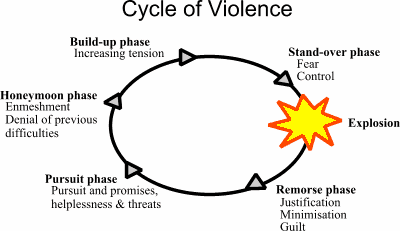
There's more info below the podcast - a couple of images we use with clients. I have also included some resources for getting help.

The Psychology of Abusive Men

An interview with Lundy Bancroft, the former co-leader of Emerge, the first batterers treatment program in the United States.  He is the Author of, Why Does He Do That: inside the Minds of Angry and Controlling Men.  Lundy debunks common myths about abusers, explaining that the man does not have an anger problem, or a problem with conflict resolution. He explains that violence happens in a larger context of control, in which the man attempts to control who she sees, what she does, what she wears, how she parents, etc.  He explains that abuse is deliberate and based on the man’s thinking that he is superior, and entitled and justified in treating her this way.  He describes the need for prevention by changing the culture which fosters the feeling of entitlement among boys.  He decries the idea that "boys will be boys," which turns a blind eye to the attitudes that foster domestic violence.  He describes some of the necessary steps in taking responsibility for abuse that a man needs to go through in order for treatment of batterers to be successful.

This show aired on March 14th, 2012.

The Domestic Violence Wheel


The Cycle of Violence


National DV Resources

Wednesday, February 15, 2012

I Met Myself for the First Time Today


Through Coach Michael Taylor's webcast (A New Conversation with Men), I have discovered an interesting new site called Men's Group, created by Brett Churnin and Mike Britton. The site provides a wealth of information on men's groups, including why we might want to join one, how they work (or can work), how to form one, and a whole lot more. It's an excellent resource. Coach Taylor will be speaking with Brett and Mike on Friday, February 17th, so check it out.

Their site also includes a blog, so I thought I'd take a look. The first post I came upon was this one below, I met myself for the first time today, which reads a little like a prose poem. Nice piece.

I met myself for the first time today 

I control and am in control because that is how I am able to protect myself.

The exploration started from that place and why my heart as a way of being is closed and protected.

And how it expresses itself in my life is that I control things and people – because that which I can control can not hurt me.

But he who controls also dominates, imposes, tells, forces, distrusts and manipulates.

All of that without even realising that I was doing it.

My earliest memories of controlling people and situations goes back to Kindergarden. I was really small and being small I was scared of the big kids.

So controlling became a way to survive. I did not have the physical size but I did have the brain. So I became the leader. I had my gang and I told them what to do. Where to play, how to treat the others – and my gang protected me.

Despite being the controller I have still been hurt many times in my life, mainly by woman.

This morning I woke up and I asked God to help me. I recounted all the people who had hurt me, let me down, betrayed me, left me, abandoned me and I forgave each and all of them.

I did it with words and I released them.

I then asked God to open me and open my heart.

Nothing happened.

I asked again, I lay prostrate, my arms open like a crucifix, vulnerable and surrendered.

Nothing happened.

I asked out loud and then my jaw locked, I could not open my mouth.

And I heard or felt a voice saying “you do not believe your word”

And then I grew silent, it grew silent. I asked myself to just be, be in silence, I said to myself – no one is coming into this room, no one knows I am here, my phone is off, no one is going to ring, there is nowhere to go so just be here.

As I lay, things came up, experiences, conversations, and I felt myself loving right into them, almost like acceptance as an active process, A person, a judgement, an experience I just loved deeply into it and it felt peaceful, powerful, liberating.

I felt cleansed, and clean and this time I asked God in silence to come in.

Nothing happened.

And so I lay there quietly for a while until needing a pee became a strong enough reason to get out of bed.

I got up and went to the bathroom. As I walked past the mirror I caught my refection so I went to the mirror and stared at myself.

I could feel that I was confronted by this person in the mirror, separate, even fearful, I could say “hi” to this person like I would a stranger. And then I stopped and looked at him and said ” hi ” again, and we stared at each other and laughed out loud but it was still the laugh of strangers.

I asked the him who was me in the mirror If it was okay for me to go and have a pee and I got the absurdity of the question. I got that I was asking this question to myself like a stranger would ask it as if he in the mirror were someone else.

I went and peed and then returned to the mirror.

This time we looked deeply into each others eyes. At first I was confronted by him, this stranger but his eyes were soft and so I stared and he stared back. We drank each other in and I said hello, lovingly, with deep respect and compassion, and with love. And he answered back in the same loving way.

And we breathed, and we drank each other in more deeply this time, and we softened and then I met myself for the very first time.

We laughed and then we cried and I was no longer afraid of the man in the mirror.

Hi we said to each other again, Hi we said back.

And tears rolled down our cheeks

Friday, July 1, 2011

Matt Morin - The Confessions of a Cage Fighter: Masculinity, Misogyny, and the Fear of Losing Control


This is an interesting first-person perspective on MMA and masculinity issues (with a foundation of faith-based life meaning). The author is a former "cage fighter," so mcuh of what he is looking at here involves embodiment and masculinity, seen through a Biblical lens, but there is also much more to his article.

This comes from a site called The Other Journal: An Intersection of Theology and Culture.

Before enrolling in divinity school, I was a cage fighter—not a full-time cage fighter, not a world-famous cage fighter, not even a person for whom cage fighting paid the bills, but a cage fighter nonetheless. Now, before I go any further, I need to be more careful with my vocabulary or else I’ll risk losing credibility. You see, real cage fighters don’t like to be referred to as such; we prefer the term mixed martial artist. And we prefer that our sport go by the name mixed martial arts or MMA instead of “cage fighting.” There is a long, sordid history behind the sport’s various name changes, and it has everything to do with public perception, influential politicians, and corporate cash (Amy Silverman, Phoenix New Times, February 12, 1998). (But then again, what doesn’t?) Given my history of participation in and love for the sport, my ears perked up last year when MMA arose as a topic of conversation in my theological ethics class.

During the course of our class discussion, one of my divinity school colleagues referred to a recent New York Times article that describes the way a number of churches throughout the United States are turning to mixed martial arts as a way to draw men into their buildings (R. M. Schneiderman, February 1, 2010). Some churches train fighters to compete, while an even greater number of churches host gatherings for men at live fights. On top of this, clothing companies such as Jesus Didn’t Tap and websites like AnointedFighter.com market themselves to a crowd of Christian fight fans—a crowd that might be called a niche if it weren’t already so big.

To some Christians, this new MMA movement represents an expression of real, natural, God-given masculinity. One captain for this team is Seattle megachurch pastor Mark Driscoll, who in the film Fighting Politics says, “I don’t think there is anything purer than two guys in a cage. [. . .] As a pastor and as a Bible teacher, I think that God made men masculine. [. . .] Men are made for combat, men are made for conflict, men are made for dominion. [. . .] That’s just the way men are made.”


And yet, not all Christians are so keen to adopt MMA as a spiritual discipline. Many people are repulsed by Driscoll’s comments yet respond to his sophomorism in kind. Take for example, the responses I heard from some fellow students during the course of our class conversation. “That’s the church of the rich,” one person stated from behind his Apple laptop. Not to be outdone in terms of ersatz answers, another student chimed in, “I’d say it’s the church of the bored.” That is the way these conversations tend to go—like two pugilists past their prime, both sides dance around one another, trading harmless jabs and failing to deliver a decisive blow.

In this essay, I hope to take a different tack altogether. I do not intend to make a case for MMA Christianity but neither do I seek to dismiss its representatives as unworthy dialogue partners. I do not think that mixed martial artists must be transformed into good Christian hipsters before they can teach us something about masculinity. Rather, I believe that MMA can make a substantial contribution to the conversation on masculinity. Therefore, in what follows I am going to consider MMA on its own terms; I am going to take its self-descriptions at face value. I am—in all charity—going to attempt a sympathetic reading of MMA.

In doing so, moreover, I will engage selections from The Confessions of Saint Augustine in order to ground my sympathetic reading of MMA theologically. By putting MMA in conversation with the Bishop of Hippo, I hope it will become clear that the sport does not shore up the particular notion of masculinity that Driscoll and others like him imagine it does.

The Fighter’s Body

According to MMA fans, masculinity is deeply connected to the body. For example, in the video clip, Driscoll makes disparaging remarks about the “fat guys” who sit on the sidelines and critique the sport. The implication, of course, is that the fit guys in the cage are the real men; true masculinity is revealed in the fighter’s body. A simple glimpse of a boxer or a wrestler—these guys are extraordinary physical specimens—reveals thick necks, tree trunk legs, v-shaped backs, even strong jaw lines. No doubt about it, so the argument goes, these are the archetypes to which all men ought to conform.

Furthermore, this emphasis on the relation between masculinity and embodiment seems to be a Christian one. After all, flesh and blood are central to our faith.

And yet, for all of MMA Christianity’s insistence on the centrality of the body for adequate conceptions of masculinity, my experience as a fighter taught me something entirely different. You see, far from acknowledging myself as a living body, success in MMA required that I ignore this fact, that I (somehow!) try to forget that I am a body.

It started in training. I had dozens of training partners who never competed. Their only job was to beat me up as I prepared for the fight. I would spar for a nonstop, ten-minute round, where every minute, a fresh, rested training partner would come in and lay a beating on me. Though exhausted, I would try to give one back. The point, of course, was that when fight night came, the real thing would actually be easier than the hell I had put myself through at practice. And after each training session, far from feeling angry with the people who had just pummeled me, I sincerely thanked them for helping me train, for making me a better fighter.

What was happening along the way, however, was nothing less than being schooled in how to ignore my body. Perhaps you’ve seen the T-shirt slogans that bark with false bravado, “Pain is just weakness leaving the body.” That was my attitude toward training: ignore the pain, redefine it, explain it away—it’s not real, it’s for my own good, it’s not a message from my body; it is just something in my “mind” (whatever that means).

A similar thing would happen on the night of the fight. The adrenaline dump that you get before a fight is incredible. Even after having fought for years, including for a number of large promotions, on fight night the same thing always happened: I got jittery, and my jaw would chatter. When that adrenaline first hit me, I found it difficult to make a tight fist or take a deep breath—both of which are somewhat important for a fighter to do. Early in my career, I came to dread this feeling before the fight. But over time, I learned how to deal with my hormones, how to talk myself out of the message they were trying to send me.

During the fight, I had to ignore not only my body but my opponent’s body as well—which is to say I had to ignore him. After taking an opponent down to the ground, I would hit him until he decided it wasn’t worth it anymore and gave up by tapping out. Some opponents were more stubborn than others and thus needed more convincing than others, but I always vowed to never hit them any more than I needed to in order to get them to tap out—witness the triumph of rational morality, or to use the language of Jus In Bello, “proportionality”!

After the fight, my whole body ached. If it were a quick fight, I would usually feel better in a few days. But if the fight lasted all five rounds, it would be a good week before I felt like getting out of bed. To cope with the pain, I would drink at night—not a lot, just enough to take some of the sting out. On the really bad days, I would pop a few pain pills—again not a ton, just enough to mute some of the pain.

In all these ways—in my training, in the moments leading up to the fight, in the fight itself, and especially in the days following the fight—the way to excel as a fighter was not by living as an integrated human body, but rather by (somehow!) detaching my “self” from my body. So I agree with the MMA Christians in their insistence that any account of masculinity must also offer an account of embodiment. And yet, I simply observe that the successful mixed martial artist must subscribe to a false account—one in which pain is not real and in which human beings are somehow outside of or apart from the body.

And now it seems appropriate to ask what account of masculinity requires a man to forget his body? The answer can only be that it is not a Christian masculinity but a Manichean masculinity. The Manichees, a sect founded in the third century by Mani and depicted by Augustine in his Confessions as a popular movement during the mid-fourth century, believed that this world was a fusion of divine spirit and evil matter. By this account, it was only through the spirit’s escape from the vile material realm that it was able to reach the transcendent world. Augustine describes his time among the Manichees like so:

I fell among a set of proud madmen, exceedingly carnal and talkative people in whose mouths were diabolical snares and a sticky mess compounded by mixing the syllables of your name, and the names of the Lord Jesus Christ and the Holy Spirit, who is our Paraclete and Consoler. These names were never far from their mouths, but amounted to no more than sound and the clacking of tongues, for their hearts were empty of the truth.”[1]

Having joined their ranks, Augustine soon subscribed to a variety of otherworldly philosophies:

I derided your holy servants and prophets. Even as I laughed at them I deserved to be laughed at by you, for gradually, little by little, I was being lured into such absurdities as the belief that a fig wept when plucked, and its mother tree too wept milky tears. Then, I was told, if one of the saints ate the fig, it would be absorbed by his digestive system and then when he belched or groaned in prayer he would spew out angels, or even particles of God [. . .] I believed, poor wretch, that it was accordingly a higher duty to show mercy to the fruits of the earth than to human beings.”[2]

Now if that didn’t make much sense to you—and it shouldn’t—Augustine’s experience as a Manichee can be described as follows: after falling in with a crowd whose hyperspirituality caused them to paradoxically become “exceedingly carnal,” Augustine developed a disregard for the human creature that was ultimately evidenced in some rather absurd practices. Or again, as a result of accepting a false description of the human body—one that mistakenly taught the separation of human spirit and flesh rather than their interwoven and mutually constitutive nature—Augustine also came to adopt a false way of being in the world. Thus, both his flesh and spirit suffered, or in his own words, he became “misshapen.” This description rings as true of some twenty-first-century hypermasculine Christianists as it did of fourth-century Manichaeism.

Any Christian account of masculinity must take our embodiment seriously. Violence will result whenever we forget that God created us as flesh and blood, that God came to earth in flesh and blood, and that the flesh and blood of Jesus is now present to the world in the church’s sacraments.

Go read the whole article.


Wednesday, August 18, 2010

Letting Go of Understanding - Adopting Beginner's Mind

http://www.geois.de/wp-content/uploads/2007/11/beginner_2.jpg

One of the ways I try to control my world is through understanding - by knowing things, looking for connections, and synthesizing information. It makes me good at my job, it makes me a good writer, and being an "expert" makes me a closed system.

Lately, I have been wondering how healthy this is for me. Intellectually, as a Buddhist, I know that control is an illusion. Seeking control is a great way to suffer.

But I learned this at a very early age. In my family knowledge was power. As a very young student, I didn't learn to read until second grade - which got me placed with the "special" kids, and it also got me teased and made fun of when I couldn't read the next sentence in class. In short, it got me shamed.

Shame is a powerful and destructive feeling - and a powerful motivator. I decided at some point (probably not even consciously) that, as far as knowledge and education are concerned, I would NEVER be the "dumb kid" again.

So now, at 43, I still consume information the way a Hummer consumes gasoline - which is to say in large volumes. Again, I ask, is this healthy?

Probably not so much. Which is why I have been trying more and more to adopt beginner's mind - I can still consume information, but it doesn't all have to make sense and fit into a perspective. I can have experiences - good and bad - that do not have to mean anything.

Because that's another thing I do - I try to find meaning in the things that happen in my life. When bad things happen, I look for a lesson or a way to make sense of it. When I good things happen, I wait for the other shoe to drop - what's up with that?

Today's Daily Om is about NOT seeking the hidden meaning in everything that happens. They recommend a ritual of letting go, but I am trying to hold beginner's mind more often - to approach life. The phrase was used in the title of Zen teacher Shunryu Suzuki's classic book, Zen Mind, Beginner's Mind, which reflects a saying of his regarding the way to approach Zen practice: In the beginner's mind there are many possibilities, in the expert's mind there are few.

I'm tired of trying to maintain expert's mind, no matter how safe it makes me feel. I want to be open to possibilities.

Sometimes we are not always meant to know the deeper meaning of certain occurrences and need only move forward.

All of us who seek to be conscious and aware regard our experiences as teachers, and we try to discern what lessons we are learning from the things that happen in our lives. Sometimes the lesson is very clear from the get-go, and other times we have to really search to understand the deeper meaning behind some event. While this search often yields results, there also comes a point in the search where what we really need to do is move forward. It is possible that we are not meant to know the deeper meaning of certain occurrences. Answers may come later in our lives, or they may come as a result of letting go, or they may never come.

We are all part of a complex system of being, and things work themselves out in the system as a whole. Sometimes we are just playing a necessary part in that process with a result larger than we can understand. It may have very little to do with us personally, and while that can be hard to understand, it can also free us from overthinking the matter. Sometimes it is best to see it in terms of karma, a past debt we have been able to repay in this way, or as the clearing of energy. We can simply thank the event for being part of our experience and let it go. This completes the process that the occurrence has made possible.

To make this letting go official, we can perform a ritual, make a final journal entry on the subject, or sit in meditation with the intention of releasing the event from our consciousness. As we do so, we summon it one last time, honoring it with our attention, thanking it, and saying good-bye. We then let it go out the door, out the window, out the top of our heads, or into the earth through the bottoms of our feet, liberating ourselves from any burden we have carried in association with it.

What do you think?

Thursday, August 20, 2009

Learning to Release Control into a Loving Embrace

http://www.artchive.com/artchive/s/schiele/embrace.jpg

If you have ever read David Deida, you likely know that he believes men do the holding and women need to be held. For most of us, that is our experience. We hold our wives or girlfriends when they are sad, or when we cuddle, but we might be never allow ourselves to be held.

I hadn't really though about this much until this last weekend when I was holding Jami (my wonderful girlfriend, who also happens to be a gifted therapist) and she commented that I rarely allow her to hold me. I reflected on her comment and realized she is right.

Since then I have been thinking about that truth. What I comes down to for me, and I think this might be true of most men, is that I am more comfortable being the emotional container for her than I am being vulnerable and surrendering control to someone else, even someone I love.

Yet I know that all of us men, even the meanest, strongest, most masculine man you might ever meet, have inner children who crave being held and to surrender to someone else who contains them. This is natural - it is NOT a sign of weakness, or being a girly-man.

Rather, it takes REAL strength - and security in our masculinity - to admit that sometimes we would like to be held, that we can be vulnerable and allow ourselves to surrender to someone else. This may not be our defining characteristic as men, but it is a part of who we are.

We NEED to not always be in control. Most of us spend our lives seeking to be in control of everything - our bodies, our jobs, our relationships, whatever - but control is really an illusion. In Buddhism, we think of this need for control as an attachment.
The most troublesome beliefs are related to our attach­ments, which are often hard to identify. Attachments are sim­ple beliefs—fantasies, in fact—that have become solidified as “truth” in our mind. They also partake of the energy of desire, which is based on the underlying belief that without some par­ticular person or thing, we can never be free from suffering.
Sure we seem to be in control, and it's often enough to keep our egos busy, but there is very little in life we can actually control, even our own minds (we discover this when we begin a meditation practice). It is our attachments, especially the attachment so many of us have to being in control, that leads to suffering.

But we do not have to live this way - and our primary relationship is a place we can learn how to release this attachment.

One way we can prepare ourselves for dropping our illusion of control in daily life is to practice doing so with our partners. We can allow her (or him) to hold us, and learn to release control into that loving embrace. And you know what? Most of us have partners who would enjoy giving us a few moments to relax into their arms and not be in control.

So this is now a part of my practice as a man and as a human being - to learn to surrender, to be vulnerable, and to relinquish control, even if it is only for a few moments each week.