Showing posts with label abuse. Show all posts

Wednesday, December 19, 2012

Empathy is Masculine: An Interview with Christian Veske - Good Men Project

This excellent article comes from the Good Men Project. Christian Veske is part of the European Institute for Gender Equality (Networking and Communications Assistant). He speaks out against domestic gender violence and calls for all men to take action, and this photo (below) comes from the EIGE project, “16 Days of Activism Against Gender Violence.”
At EIGE, we work with the topic of gender based violence mainly in terms of research, but the campaign on Facebook was a grass root initiative. This is something anyone could do. It can happen in any organization. All it takes is the courage to step forward and propose the idea.
Exactly.

He doesn't specifically address empathy in this brief interview, but it's an important part of their campaign. We must feel empathy and concern for the victims - women, children, and other men - if we are ever going to change this and reduce violence in the home. 

For what it's worth, many women/wives beat their partners/husbands, it just isn't as apparent and men tend not to report it because of the shame that comes with being beaten by a woman. We need to end domestic in general.

Empathy is Masculine: An Interview with Christian Veske

DECEMBER 12, 2012 BY GINT ARAS


Christian Veske of the European Institute for Gender Equality speaks out against domestic gender violence and calls for all men to take action.


The photograph shown above appeared in my Facebook news feed on November 28th. Christian Veske, pictured, is a Networking and Communications Assistant for The European Institute for Gender Equality (EIGE); the photo made its rounds as part of EIGE’s participation in “16 Days of Activism Against Gender Violence.” Christian included the following caption: As a child I witnessed on a regular basis how my friend’s father beat up his mother. I remember how frightened we were when his father was drunk for we knew that this meant that shouting and beating will happen too. I don’t think any child should experience seeing their mother get beaten up. Never. The key to end violence against women is in the hands of men. Men must change and we need to stand against violence against women. Together.”

I had a chance to speak to Christian this past week.

I was very moved by the photograph, and I applaud your efforts to raise awareness of domestic violence. Of course, the men who are abusing their wives and families are not necessarily those who saw your photo and were moved by it. In what way will raising an awareness among the general population about the prevalence of domestic violence help to reduce it?

I think it is very important to make the issue of domestic violence visible. Men need to stand against violence because most of the perpetrators are men. Therefore men, as a group, should take responsibility to improve the situation. If men dared to say that violence towards other human beings were unacceptable, this could hopefully lead to change in behaviour patterns of the perpetrators.

Naturally, as you pointed out, quite often it might be that the perpetrators do not see these sorts of campaigns, but I believe the more people, the more men, dare to stand against violence, the greater the effect can be. I also believe that everyone can do this. At EIGE, we work with the topic of gender based violence mainly in terms of research, but the campaign on Facebook was a grass root initiative. This is something anyone could do. It can happen in any organization. All it takes is the courage to step forward and propose the idea. From our institute’s side we can make problems of violence visible through the research we do and this is something that potential future campaigners could use. Of course, one should not stop only with campaigning, but one should also extend these principles to one’s everyday life. What I mean is that when you see or hear something that may you lead to believe that someone’s physical integrity is in danger, do not hesitate to call the police. Too often people still feel that they are intruding to other people’s personal sphere, but this is not true. One should not leave these things unnoticed.

You mentioned in the caption attached to the photo that you witnessed a friend’s father beat his mother multiple times. Do you know what prevented your friend’s mother from leaving her partner?

I do not remember much of my childhood, only some strong emotions. The thing I remember in this particular case was the fear. I think every child in the house where I lived was afraid of this man. So, I can’t speculate about her reasons; as an adult, I can only guess. Violence against women has historically been rather too commonplace in Estonia. There are numerous proverbs that show this—violence has been considered as a private matter of the family. I believe that when a woman wanted to leave husband, that had a stigmatizing effect on that woman: she had to consider the consequences and deal with gossiping.

You also mention that the father was often very drunk. To me it seems impossible to address an issue like domestic violence without also addressing alcoholism, especially in the Baltic States where rates of alcohol abuse are very high. How do you see this relationship? Isn’t alcoholism essentially a cause of domestic violence?

I don’t think that the issue of domestic violence should automatically be related to alcoholism. There are cases nowadays in my home country, Estonia, which clearly show that alcohol had nothing to do with violence. Yes, it might have a triggering effect, but the issue still is about power relations and how some men feel the need to exercise their power on the ones that are vulnerable.

I know some men believe they have to show who is the master of the house. I believe this has nothing to do with masculinity. On the contrary: when a man needs to assert his masculinity through violence, it only shows this man’s insecurity and reveals very serious self-esteem and confidence issues. In my eyes violence makes men look weak; when you resort to violence, you show you lack brains enough to solve issues in civilized manner.

That is also a bit of a circle. To break the cycle of associating this kind of brutal “power” with the masculine, we need to work with boys at an early age. We need to make them understand that what makes them best is not that they have control over others (a “boys will be boys” mentality), but teach them to understand other people, what others may feel as a result of their actions.

What else is EIGE doing to spread awareness?

We are planning to work much more on the issue of men and gender equality, as this remains an important topic. Soon we are publishing a report of a study on men for gender equality in the European Union, and we will also make public a database on organizations in Europe that work with men and gender equality. Over the next year, we are planning to have online discussions on our web platform, Eurogender. We hope these and other efforts work to continue spreading public awareness.

Photo by Christian Veske

Monday, October 1, 2012

Are You a Male Survivor of Domestic Violence?

If so, there is a research project that could use your participation. I found this at the Good Men Project - they did not look into Dr. Hines it seems, based on their disclaimer, but I took a look at her page at Clark University and she seems to be actively seeking an understanding of male survivors of domestic violence, as well as enacting policy decisions based on that knowledge. She has an extensive list of publications in this realm (see below). The link to the research study is also in the brief post from the Good Men Project.

Men Needed to Participate in Men’s Experiences with Partner Aggression Survey


One thing we come across very often when talking about male survivors of domestic violence is the lack of studies into the issue of male victims of domestic violence.

Research Assistant Professor Denise Hines, PhD at Clark University on Worcester, MA is conducting an online survey into this very subject. If you would like to participate and meet the criteria, visit the survey website here.

For the record, we do not know Professor Hines, nor can we vouch for her credibility or the study, we merely would like to facilitate men finding the survey so they can participate, should they choose.

Image of silhouette in black courtesy of Shutterstock


Selected (Relevant) Publications:
  • Hines, D. A., & Douglas, E. M. (2012). Alcohol and substance abuse in men who sustain intimate partner violence. Aggressive Behavior, 38 (1), 31-46.
  • Douglas, E. M., & Hines, D. A. (2011). The Reported Availability of U.S. Domestic Violence Services to Victims who Vary by Immigration Status, Primary Language, and Disability. Partner Abuse, 2 (4), 427-451.
  • Hines, D. A., & Douglas, E. M. (2011). Understanding the use of violence among male victims of intimate terrorism. Partner Abuse, 2(3), 259-283.
  • Douglas, E. M., & Hines, D. A. (2011). The Help-seeking Experiences of Men Who Sustain Intimate Partner Violence: An Overlooked Population and Implications for Practice. Journal of Family Violence, online first.
  • Hines, D. A., & Douglas, E. M. (2011). Symptoms of post-traumatic stress disorder in men who sustain intimate partner violence: A study of helpseeking and community samples. Psychology of Men and Masculinity, 12 (2), 112-127.
  • Hines, D. A., & Douglas, E. M. (2011). The Reported Availability of U.S. Domestic Violence Services to Victims who Vary by Age, Sexual Orientation, and Gender. Partner Abuse, 2 (1), 3-30.
  • Hines, D. A., & Douglas, E. M. (2010). A Closer Look at Men Who Sustain Intimate Terrorism from their Female Partners. Partner Abuse, 1(3), 286-313.
  • Hines, D. A., & Douglas, E. M. (2010). Intimate terrorism by women towards men: Does it exist? Journal of Aggression, Conflict, and Peace Research, 2(3), 36-56.
  • Hines, D. A., Douglas, E. M., & Mahmood, S. (2010). The effects of survey administration on disclosure rates to sensitive items among men: A comparison of an Internet panel sample with an RDD telephone sample.” Computers in Human Behavior, 26, 1327-1335.

Wednesday, July 11, 2012

Ozy Frantz and Noah Brand - What About the Men? Why Our Gender System Sucks for Men, Too

This article by Ozy Frantz and Noah Brand originally appeared at The Good Men Project and was reposted at Alternet. This article is from a book in progress by Brand and Frantz. I'll be curious to see the book when they complete it - it may be a welcome addition to men's studies.


If you are anything like us, you spent some time when you were younger playing with optical illusions: the vase that, if you looked at it differently, was two faces; the fish that were also birds; the old woman who was also a young lady.

If you were reading this in a book in a bookstore, and some malicious person had not moved it into the Local Birdwatching category, it would almost certainly be next to some other books about gender. (Yes, this is related.) Look at the other books, and you’d find they have one thing in common—they’re almost all about women. Women and work. Women and body image. Women and race. Women and sex. Women and feminism.

You’d think that only women have a gender.

For a long time, we’ve only been able to see half the illusion—we see the birds, but not the fish; the vases, but not the faces. We’ve noticed the thousands of ways, big and small, that our current gender system wounds women. Rarely, however, and often only as an afterthought does anyone remark on how the current gender system harms men.

 ♦◊♦

We live in a sexist society, one where gender programming starts at birth (though the advent of the sonogram has allowed parents to get a head start by painting the nursery pink or blue and stocking up in advance on gendered toys and clothes) and is so pervasive as to be inescapable. Feminism has done an excellent job analyzing and challenging the ways that these assigned and enforced gender roles damage and deform the lives of women. The same tools of analysis can be applied to the damage and deformation that men suffer. And that damage, sad to say, is severe.

The general term for the incredibly restrictive social codes on male behavior is hegemonic masculinity, though Paul Kivel refers to it as the “Man Box” in his work, and Charlie Glickman clarifies that to the “Act Like a Man Box” to emphasize the performative nature of the restrictions. We choose to use hegemonic masculinity as our term because it is less likely than “Man Box” to be used in a trend piece about how it’s okay for men to own steamer trunks now.

Indeed, the current cultural trend of terms like bromance, guyliner, mancession, and so on -- “bromanteaus” as we call them -- just demonstrates the power of hegemonic masculinity. Anything that might potentially be seen as outside the narrow bounds of acceptable male behavior, such as having a close relationship, wearing makeup, or being out of work, must be given a special name to assure people that it really is masculine, it’s not outside the box in any way.

So what is the box? What are the bounds of hegemonic masculinity? The essence of it is that the things we think of as “manly,” the things a “real man” does or is, are a mess of unreasonable, contradictory and impossible expectations and assumptions. A real man is supposed to be attractive to women, but not do anything for a woman’s approval or attention. A real man is supposed to be stoic and emotionless, but is permitted to show anger. A real man is supposed to be tall and have a big penis, for heaven’s sake, and if your genetic dice didn’t shake out that way, you’d better perform the rest of the list even harder to make up for your supposed deficiency.

Men who do not fit the box of hegemonic masculinity get all kinds of stigmatized. For instance, consider men who want to help raise their children. Stay-at-home dads and men on the “mommy track” often face disapproval and the belief that they “laze around all day” or “aren’t real men.” In public, men are all too often patronized as “Mr. Mom” or treated as though it’s exceptional and startling that they want to spend time with their children; it’s depressingly common for men openly interested in childcare to be called pedophiles.
 

Social pressure has astonishing effects on people’s behavior: just ask any teenager who drove home drunk from a party. Many people find it so unthinkable that men might want to have traditionally feminine jobs such as nurses or teachers that they tend to promote men out of those jobs and into more traditionally masculine positions such as administration; this sounds like an advantage, but most people become nurses to take care of patients, not to deal with paperwork, and it’s based in misandric stereotypes around what men can do. The social pressure to conform to the man box can be internalized, sometimes with tragic effects: unemployment increases a man’s risk of suicide more than it does a woman’s, partially because of the association between masculinity and success.

Even if they don’t experience social pressure, the expectations that they should act in a certain way can disadvantage men who don’t act that way. Straight men are all too often expected to approach women, ask them out, and pay for the date—which causes disproportionate pain to men who are socially awkward, shy or just broke. Male virgins are more likely than their female counterparts to feel shame because of their virginity.

Ultimately, the most important concepts in hegemonic masculinity are “strong," “tough,” and “winner.” Each of these is code for a wealth of symbolism and subconcepts, so that “tough” implies both “stoically emotionless” and “does not seek medical attention.” “Strong” covers “supports his family financially” and “bench-presses more than his bodyweight,” among other things. “Winner” is the key to a Pandora’s box of competition and inadequacy, where the twin concepts of “loser” and “failure” lurk, waiting to consume men’s sense of self at the least excuse.

Even for men who conform to these demands, these ideals of masculinity can burden them. Take toughness, for instance—it’s good to be tough, right? Chuck Norris is tough. Wolverine is tough. Toughness lets you survive in this hard world, keeps you from being weak and vulnerable. That’s a good thing to encourage people to be, right?

Turns out, not so much.

The ideal of physical toughness kills people. Especially men. Except for sex work, the most male-dominated jobs are the most dangerous, from lumberjacks to firefighters to soldiers, men are more likely to be injured on the job and suffer an astonishing 92% of fatal occupational injuries. Historically and cross-culturally, men’s life expectancy is shorter than women’s; in the United States, men tend to live four years less than women. While some of the discrepancy may be biological, much of it is due to socialization: in fact, the level of patriarchy in a society is associated with lower life expectancy for men. Men are encouraged to “tough out” pain and not go to doctors unless they absolutely need to.

Emotional toughness can also cause men pain; if you can’t open up emotionally to another person, it makes it more difficult to have friends. The social support gap is large and growing—men tend to report having fewer close friends and being less connected to their communities than women. For far too many men, romantic relationships are the only acceptable venue for them to express their feelings (and even there, the idea that men hate emotional intimacy limits them). In fact, men tend to report more distress due to a strained romantic relationship, possibly because women are far more likely to have a group of friends to help with the social support. The nervously joking societal construct of “bromance” arises from the notion that having a close male friend is something weird enough that it needs its own name.

Then there’s rape. When was the last time you heard men mentioned as rape or molestation victims in any public discussion of such issues? Despite the fact that 1 in 6 men are subject to unwanted sexual activity before the age of 18, despite the fact that 1 in 4 rape survivors in America is male, far too many people still believe a man cannot be raped, especially by a woman: the myth that an erection is consent, instead of a biological function, remains strong. The Centers for Disease Control’s own statistics draw a line between “rape” and “being forced to penetrate someone.” Not to be rude to the CDC, but we have a word for sex that someone is forced to have against their will. It’s called rape.

Even in cases of boys as young as 13 who are raped by teachers or other authority figures, many people congratulate them or call them lucky. Try to imagine anyone saying that to a 13-year-old girl who was molested by her teacher, and you begin to see how deep the gender gulf is here. In fact, some male rape survivors never acknowledge, even to themselves, that what they endured was rape. Rape of men is endemic within the prison system, which is not treated as a human rights outrage, but as an appropriate subject for jokes. Some even speak glowingly of prison rape as the real deterrent to criminal activity. It’s amazing how many people are downright enthusiastic about their government running rape camps, so long as the victims are male.

The ideal of toughness also impacts male survivors of abuse. Many people believe that men cannot be abused, because they’re “stronger,” or that if a man is abused it’s proof that he’s a wimp or a weakling; many believe that men who were raped are responsible for and enjoyed their rapes. Many of the guides to recognizing abuse are gendered with a female survivor and a male perpetrator, rendering abuse of men invisible. Many shelters do not provide services to male survivors (although some female-only shelters will put male survivors up in hotels).

Most men will never end up in prison, a majority will never be raped or abused, but the same societal expectations that allow us to laugh off the rape and abuse of men give rise to a thousand smaller micro-aggressions, all the little ways in which men are made to feel horrible in a gendered way. It sounds strange to say that the same system tells men that they are grotesque and laughable for being masculine, and simultaneously pathetic and laughable for not being masculine enough, but bizarrely, that is the case.

Of course, a few men do manage to perform hegemonic masculinity quite well and even avoid most of the negative consequences of masculinity.
Read the whole article.

Tuesday, April 3, 2012

Safe Space Radio - The Psychology of Abusive Men


This is important information - if you know a guy like this, or you are a guy like this, please seek help. And please understand that me sharing this does not negate the fact that there are just as many women abusing their male partners - I am aware of that, AND it's a different psychological system in abusive women.

There's more info below the podcast - a couple of images we use with clients. I have also included some resources for getting help.

The Psychology of Abusive Men

An interview with Lundy Bancroft, the former co-leader of Emerge, the first batterers treatment program in the United States.  He is the Author of, Why Does He Do That: inside the Minds of Angry and Controlling Men.  Lundy debunks common myths about abusers, explaining that the man does not have an anger problem, or a problem with conflict resolution. He explains that violence happens in a larger context of control, in which the man attempts to control who she sees, what she does, what she wears, how she parents, etc.  He explains that abuse is deliberate and based on the man’s thinking that he is superior, and entitled and justified in treating her this way.  He describes the need for prevention by changing the culture which fosters the feeling of entitlement among boys.  He decries the idea that "boys will be boys," which turns a blind eye to the attitudes that foster domestic violence.  He describes some of the necessary steps in taking responsibility for abuse that a man needs to go through in order for treatment of batterers to be successful.

This show aired on March 14th, 2012.

The Domestic Violence Wheel


The Cycle of Violence


National DV Resources

Monday, December 5, 2011

What's Going On . . . Courage of a Young Man

I know this video has been out since August, and it has already made the rounds on Facebook. But this is one of the saddest videos I have ever seen - if you know this kid or one like him, spend some time with him (or her, for that matter), acknowledge his pain, share your own experiences, and give him some tools to love himself.


Sunday, July 17, 2011

CBS's The Talk Rejoices in the Catherine Kieu Becker Case (she cut off her husband's penis)

Ife

I have not been following this case, because . . . well, stuff like this is simply sensationalist crap - there's often better things to get upset about. But I wasn't aware that some women in media were celebrating the fact that a woman took a knife to a man's penis and cut if off.

In case you, like me, boycott media stories about dumbass people, here's the scoop, via the L.A. Times (this story is an udpate about her mental evaluation):
A law enforcement source said told The Times that a dispute over an "inappropriate relationship" may have been the motive in the case.

The source, who spoke on condition of anonymity because the case was ongoing, said the couple had argued earlier in the day and that the wife was angry at the husband over a relationship. Police said that when they confronted the woman, she said her husband "deserved it."

Orange County prosecutors charged the wife with two felony counts for allegedly cutting off her husband's penis and throwing it in a garbage disposal after drugging him and tying him to a bed.
He may be an ass, he may have cheated on her, he may have even been emotionally abusive, but celebrating and laughing about that kind of revenge is sick . . . as sick as Catherine Becker's actions. I cannot imagine how outraged those same women would be if a man caught his wife cheating on him and cut out her clitoris. They would be demanding his head on a stake.

The following was posted at a site called No, Seriously, What About teh Menz?

CBS, We Are Not Amused


Trigger warning for violence and sexual mutilation.

This is a short and simple call to action. CBS Television recently aired an episode of The Talk about the Catherine Kieu Becker case, previously discussed here (trigger warning for the same topics). On this episode, the hosts glorified the event, mocking the victim and delighting in his torture, fantasizing about what he might have done to deserve it, and generally behaving in an incredibly repugnant and morally bankrupt manner. Sharon Osborne even went so far as to call it “quite fabulous,” and mouthed “I love it!” while dancing and making a “garbage disposal motion” with her hands.

We’re asking you to write to CBS and let them know what you think. If you need to kickstart your Sunday Social Justice, this is the perfect way to do it.

To see the segment in question, look below the fold. (This is the actual segment - the video on the site was an MRA rant.)


Saturday, April 23, 2011

Damon's Story ... Son Beaten by Dad

A couple of friends on Facebook (Ed Gamboa via Ryan Ange) posted this video - for which I am grateful. Very sad . . . very touching. The speaker is Mark Lundholm, an addictions comedian.


The killing of this child is horrible and sad. But listen to the worldview Damon holds - crying is for "faggots," touch is forbidden, emotions are off-limits. In his home, no doubt, touch = violence, crying = showing pain or defeat, emotions = opening oneself to ridicule and abuse.

As much as I would like to believe this is the exception, I don't think so. So few parents know how to be good parents, and the lower the income level, the more this is true.

It's so simple to teach young parents how to be better parents, but it also requires that the parents have some measure of affect regulation (the ability to not act out anger or frustration, for example, on their kids). Most of them don't have any skills of self-awareness.

I highly recommend two books for parents, or for those who work with low-income parents:

Parenting from the Inside Out, by Dan Siegel and Mary Hartzell.
Theraplay: Helping Parents and Children Build Better Relationships Through Attachment-Based Play (3rd Ed.) by Phyllis B. Booth and Ann M. Jernberg

Friday, July 16, 2010

GoodTherapy - Treating Male Victims of Domestic Violence

http://images.icnetwork.co.uk/upl/sundaysun/jan2009/4/5/C5EF09B6-9CBC-E2B9-F4B878473A9CBC20.jpg

Despite decades of pioneering work with female victims of domestic violence that has provided valuable information for therapists, the topic of male victimization has been systematically rejected and bypassed as politically incorrect. This has left many counselors unsure about how to effectively treat male victims and concerned they aren’t getting the best support. Yet, the UK Home Office suggests that as many males as females are victims.

We have a lot of work to do in changing our cultural perceptions about issues like this. There is some evidence that men in the US are hit/abused by female partners as much as females are hit by male partners - but they fear ridicule if they report it. This needs to change.

Interestingly, a similar article appeared in the Sunday Sun in January, 2009.
Treating Male Victims of Domestic Violence

A GoodTherapy.org News Headline

The British Psychological Society, as well as many of the therapists who work within it, is concerned that male victims of domestic violence may not be getting the support they need because of counselors’ own limitations and preconceptions. In a small study presented at the organization’s national conference, experts said trained counselors feel ill-prepared treating males who come in for domestic violence therapy. Counselors admit having preconceived notions over victimization and gender roles, and struggle to adapt female-oriented victim recovery methods to male victims. Despite efforts to raise domestic violence awareness, male victims are often stigmatized, even though some agencies suspect that nearly as many males are victims of domestic violence as are females.

Here is the article from British Psychological Society:

Counsellors struggle to treat male victims of domestic violence

Some trained counsellors feel unprepared to treat male victims of domestic violence due to their own assumptions about domestic abuse.

This is one of the findings of Kevin Hogan* and John Hegarty from the University of Keele who discussed the findings on Saturday 10th July at The British Psychological Society's Division of Counselling Psychology's annual conference at the University of Strathclyde, Glasgow.

In 2008 6.4% of men in England and Wales between the ages of 20 and 24 reported having been the victim of domestic abuse and Home Office figures suggest the problem is evenly spread between the sexes. (Ref http://rds.homeoffice.gov.uk/rds/pdfs/hors191.pdf)

Despite this and decades of pioneering work with female victims of domestic abuse that has provided clear, usable information to therapists the subject of male victimisation has been systematically rejected and bypassed as politically incorrect. This has left many counsellors unsure about how to effectively treat victims and concerned they aren't getting the best support.

Kevin explained: "Male counsellor's stereotype who can be a victim and women counsellors fare no better, since such male clients naturally fear being with women. This leaves the abused male with a tough job to do, educating his counsellor as well as helping himself."

A small-scale study was designed to understand better how counsellors respond to working with male victims of domestic violence. They interviewed six therapists (three women and three male) and found that some of them had to reassess their own view of male and female roles in society.

Kevin said: "All of the counsellors spoke about experiencing an element of surprise as a result of a lack of awareness of male victimisation and assumptions around domestic abuse. They described how they had to suppress their surprise so as not to make the client feel uncomfortable.

All counsellors said they need more awareness training so that they can offer the best support to these vulnerable men."

* The study was undertaken as part of Kevin's post-graduate dissertation.

Note - The findings have significant implications for the counselling profession as a result of recently introduced European equality laws, which now require that services do not discriminate on the grounds of gender.

Source:
British Psychological Society

Monday, July 12, 2010

Male Child Abuse and Fatalities - The Numbers

Sexual abuse of Children

I found these links at The Spearhead, a site that I read regularly and often disagree with either in part or in whole. The contributors are often very angry (perhaps some of the stats below are WHY they are angry) and extremely anti-feminist. But they do seem to care about men, their health, their rights as fathers, and some of cultural bias against men (although they focus on the biases and injustices perceived to come from women far more than others).

A recent post (linked to above) focused on the fact that boys of all ages die more frequently than girls as a result of abuse. Based on what I know of child abuse, this makes sense - but we seldom here about male children being killed (far more often by mothers than by fathers). When the media covers such a story, it is usually about a female child.
Age and Sex of Child Fatalities, 2006

This table compares the age and gender of children who died from maltreatment for only those States that reported fatalities in the Child File. The first column lists the single-year ages ranging from birth to 3 years. Then the ages are grouped together: 4–7, 8–11, and 12–17. Next the population, number of victims, and rate of fatalities per 100,000 are presented for boys and for girls. Then the boys and girls are added together for total fatality victims. A total of 1,129 children died as a result of abuse or neglect, as reported by States in the Child File only.

AGEGIRLS
POPULATION NUMBER RATE PER
100,000
<1> 1,462,500 215 14.7
1 1,457,529 61 4.2
2 1,458,173 58 4.0
3 1,437,652 30 2.1
4-7 5,647,666 43 0.8
8-11 5,603,650 25 0.4
12-17 8,983,687 22 0.2
Total 26,050,857 454 Blank Cell
Rate Blank Cell Blank Cell 1.7


AGEBOYS
POPULATIONNUMBERRATE PER
100,000
<1>1,531,44428418.5
11,525,6241087.1
21,527,348825.4
31,504,541422.8
4-75,902,038911.5
8-115,868,580290.5
12-179,430,198390.4
Total27,289,773675Blank Cell
RateBlank CellBlank Cell2.5

The numbers for who is the abuser generally do not reflect what we see in the media or in the popular culture. If it's a family member, we seem to assume it must be the father, but it's not - when it's a parent it is more often the mother.

Figure 4-2 Perpetrator Relationships of Child Fatalities, 2006

Perpetrator Relationships of Child Fatalities, 2006

This pie chart indicates that 27.4 percent of child fatalities were perpetrated by the mother acting alone. Such nonparental perpetrators as daycare providers, foster parents, or residential facility staff were responsible for 14.6 percent of fatalities.

The numbers are no better from 2008:

Figure 4-2 Report Sources, 2008

Table 4-5 Perpetrator Relationships to Child Fatalities, 2008
Child Maltreatment 2008


Relationship to Child Child Fatalities
Number Percent
PARENT

Mother 358 26.6
Mother and Other 119 8.9
Father 170 12.6
Father and Other 19 1.4
Mother and Father 289 21.5
NONPARENT

Daycare Staff 25 1.9
Foster Parent (Female Relative) 1 0.1
Foster Parent (Male Relative) 1 0.1
Foster Parent (Nonrelative) 2 0.1
Foster Parent (Unknown Relationship) 3 0.2
Friend or Neighbor 3 0.2
Legal Guardian (Female) 1 0.1
Legal Guardian (Male) Blank Cell Blank Cell
More than One Nonparental Perpetrator 28 2.1
Other Professional 1 0.1
Partner of Parent (Female) 4 0.3
Partner of Parent (Male) 36 2.7
Relative (Female) 32 2.4
Relative (Male) 18 1.3
Staff Group Home 2 0.1
Unknown or Missing 232 17.3
Total 1,344 Blank Cell
Percent Blank Cell 100.0

Based on data from 41 States.

It bothers me that we generally assume men are the perpetrators and girls are more often the victims. NO CHILD should be abused - but there is some not too subtle sexism involved here - against boys and men.

When was the last time you saw a male child on Nancy Grace or one of those other shows that make celebrities out of missing children (always white, generally blond and blue eyed)? Surprisingly, however, more missing boys are mentioned on network news than missing girls - I wouldn't have believed it before reading the study linked to.

Bu then there is this commentary that comes from Sociological Images:
Commenter eruvande pointed out that when discussing the case of an 11-year-old boy, Shawn Hornbeck, who was kidnapped, beaten, and sexually abused for 4 years, Bill O’Reilly implies that he must have liked the situation or wanted to be there, because otherwise he could have escaped:

When Van Susteren points out the case of Elizabeth Smart, who also seemed to have opportunities to escape and didn’t “choose” to take them, O’Reilly refers to her as a “little girl,” although she was 14 when she was kidnapped.

I am trying to imagine a similar response to a girl. Although we often still blame women for being raped, it seems to go the other way when it comes to childhood sexual abuse/kidnapping: girls might get to be innocent victims, but boys ought to have been tough enough to get away. If they didn’t, they must have liked it.

Unbelievable, really.

No, really, it's fucking unconscionable.


Sunday, January 3, 2010

Containing and Resisting Masculinity: Narratives of Renegotiation Among Resilient Male Survivors of Childhood Sexual Abuse

It's good to see that psychology finally is looking at how childhood sexual abuse impacts males - most of the research has generally focused on women because they have been assumed to be the primary (and only) victims. Not so. Approximately one in six male children are victims of sexual abuse (while some estimate as high as one in three for females). My guess is that the number for males is too low and the number for females might be too high.

For men who have been abused by men, there is often a great sense of ambiguity and resistance toward accepting their own masculinity. How does one embody the traits of the abuser? A big part of the recovery process according to this article, is in questioning the dominant cultural myths of masculinity.

Citation:
Kia-Keating, M., Grossman, F., Sorsoli, L., Epstein, M. Containing and Resisting Masculinity: Narratives of Renegotiation Among Resilient Male Survivors of Childhood Sexual Abuse. Psychology of Men & Masculinity. 2005, Vol. 6, No. 3, 169–185.


Maryam Kia-Keating, Frances K. Grossman, Boston University; Lynn Sorsoli, Wellesley College; Marina Epstein, University of Michigan.

Abstract: Male childhood sexual abuse survivors face the same social pressures as other men to live up to the tenets of masculinity. However, they contend with a disjuncture between cultural definitions of manhood and the discordant experience of sexual victimization. In-depth qualitative interviews were conducted with 16 resilient men varying in age, sexual orientation, socioeconomic status, and ethnicity. The authors analyzed the men’s narratives concerning male role socialization for toughness, stoicism, and aggressive sexuality, as well as the impact of childhood sexual abuse. Results indicate that in their paths toward recovery, the participants repeatedly described both containing and resisting traditional masculine roles and made conscious choices not to become perpetrators. The importance of raising awareness about masculinity myths in clinical interventions is discussed.

Keywords: childhood sexual abuse, resiliency, masculinity, masculine ideology, traumatic stress, human males

For growth to occur, men’s pain cannot remain hidden or misunderstood. (G. R. Brooks, 2001, p. 294) Historically, the issue of gender has interfered with the study of sexual abuse. Patriarchal notions about the rights of men to dominate, physically and sexually, the women and children in their households may have contributed to the difficulty of acknowledging that marital rapes and sexual abuse of girls was real, and fairly prevalent, until pressure from feminists brought legal reforms in the early 1970s. The sexual abuse of boys and men, unfortunately, has been even more difficult for society to accept or acknowledge, in part, because the experience stands in stark contrast to the notion of masculinity, damaging men’s sense of power, control, and invulnerability.

Even when gender is considered, it is most often reduced to examinations of the different types of childhood traumatic experiences boys and girls may have or explorations in adulthood of differential outcomes for men and women. Nevertheless, research about the prevalence and impact of sexual abuse on boys has begun to grow (e.g., Finkelhor, 1993; Finkelhor, Hotaling, Lewis, & Smith, 1990; Holmes & Slap, 1998), coinciding with an increasing awareness reflected in clinical reports (e.g., Gartner, 1999; Lew, 1988) and in research (e.g., Bolton, Morris, & MacEachron, 1989; Lisak, 1994, 1995) that the childhood sexual abuse of boys significantly affects the development of their masculine identities.

Although the development of a masculine identity plays a fundamental role in male health and well-being, few studies have taken the time to examine in careful detail the issues of masculinity for male survivors of sexual abuse. (Gartner, 1999, and Rasheed and Rasheed, 1999, are important exceptions, and we draw heavily on their work.) In our study of male survivors, we investigated the conflicts and interactions between gender role socialization and the experience of significant childhood sexual abuse (CSA) in men who are resilient survivors. Because so little is yet known about these issues, and almost nothing has been written about how men understand these issues themselves, we chose to use a qualitative research approach, which is best designed to explore such questions. Specifically we interviewed 16 men heterogeneous for age, race/ethnicity, socioeconomic status (SES), and specifics of their abuse history—all showing some evidence of resilient adaptation to adult life—to develop a theoretical framework explicating the ways in which these men have understood and endeavored to resolve these conflicts as part of their recovery processes.
Read the whole article. (It's long, but good.)


Saturday, November 28, 2009

Patrick Stewart: the legacy of domestic violence

Patrick Stewart, one of the best actors on the planet, speaks out about the abuse he and his mother suffered at the hands of his father. It's a moving piece of writing. No child should ever have to grow up in a home like this. EVER.

No man should EVER be left with so few tools with which to cope with life's challenges that violence feels - in that moment when the frustration or fear rises - as though it is the only option.

Patrick Stewart: the legacy of domestic violence

As a child, the actor regularly saw his father hit his mother. Here he describes how the horrors of his childhood remained with him in his adult life.

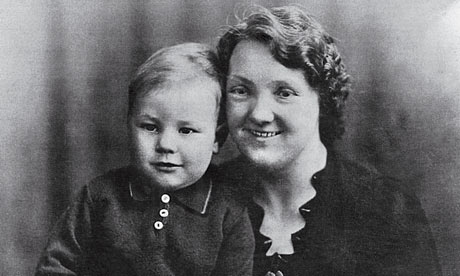
Patrick Stewart and his mother

Patrick Stewart as a baby with his mother Gladys. Photograph: Collect

My father was, in many ways, a man of discipline, organisation and charisma - a regimental sergeant major no less. One of the very last men to be evacuated from Dunkirk, his third stripe was chalked on to his uniform by an officer when no more senior NCOs were left alive. Parachuted into Crete and Italy, both times under fire, he fought at Monte Casino and was twice mentioned in dispatches. A fellow soldier once told me, "When your father marches on to the parade ground, the birds in the trees stop singing."

In civilian life it was a different story. He was an angry, unhappy and frustrated man who was not able to control his emotions or his hands. As a child I witnessed his repeated violence against my mother, and the terror and misery he caused was such that, if I felt I could have succeeded, I would have killed him. If my mother had attempted it, I would have held him down. For those who struggle to comprehend these feelings in a child, imagine living in an environment of emotional unpredictability, danger and humiliation week after week, year after year, from the age of seven. My childish instinct was to protect my mother, but the man hurting her was my father, whom I respected, admired and feared.

From Monday morning to Friday tea time he worked as a semi-skilled labourer, and was diligent and sober. Often funny and charming, he was always rich in the personal stories of warfare and adventure that thrilled me. But come Friday night, after the pubs closed, we awaited his return with trepidation. I would be in bed but not asleep. I could never sleep until he did; while he was awake we were all at risk. Instead, I would listen for his voice, singing, as he walked home. Certain songs were reassuring: I'll Take You Home Again, Kathleen; I'll Walk Beside You . . . But army songs were not a good sign. And worst of all was silence. When I could only hear footsteps it was the signal to be super-alert.

Our house was small, and when you grow up with domestic violence in a confined space you learn to gauge, very precisely, the temperature of situations. I knew exactly when the shouting was done and a hand was about to be raised – I also knew exactly when to insert a small body between the fist and her face, a skill no child should ever have to learn. Curiously, I never felt fear for myself and he never struck me, an odd moral imposition that would not allow him to strike a child. The situation was barely tolerable: I witnessed terrible things, which I knew were wrong, but there was nowhere to go for help. Worse, there were those who condoned the abuse. I heard police or ambulancemen, standing in our house, say, "She must have provoked him," or, "Mrs Stewart, it takes two to make a fight." They had no idea. The truth is my mother did nothing to deserve the violence she endured. She did not provoke my father, and even if she had, violence is an unacceptable way of dealing with conflict. Violence is a choice a man makes and he alone is responsible for it.

No one came to help. No adult stepped in and took charge. I needed someone else to take over and tell me everything was going to be all right and that it wasn't my fault. I wanted the anger to go away and, while it stayed, I felt responsible. The sense of guilt and loneliness provoked by domestic violence is tainting – and lasting. No one came, but everyone knew. Our small houses were close together. Every Monday morning I walked to school with my head down, praying that I would not encounter a neighbour or school friend who had heard the weekend's rows. I felt ashamed.

Very occasionally one person would come to our aid – Mrs Dixon, our next-door neighbour, the only person who would stand up to my father. She would throw open the door and stand before him, bosom bursting and her mighty weaver's forearm raised in his face. "Come on, Alf Stewart," she would say, "have a go at me." He never did. He calmed down and went to bed. Now I wish I could take Lizzie Dixon's big hand in mine and thank her.

Such experiences are destructive. In my adult life I have struggled to overcome the bad lessons of my father's behaviour, this corrosive example of male irresponsibility. But the most oppressive aspect of these experiences was the loneliness. Very recently, during a falling-out with my girlfriend, I felt again as though I were shut out and alone, not heard or understood. I was neither, but it was such a familiar isolation that it was almost a comfort and consolation.

I managed to find my own refuge in acting. The stage was a far safer place for me than anything I had to live through at home – it offered escape. I could be someone else, in another place, in another time. However, whenever the role called for anger, fury, or the expression of murderous impulses, I was always afraid of what I might unleash if I surrendered myself to those feelings. It was not until 1981, when the director Ronald Eyre asked me to play the psychotic Leontes in The Winter's Tale, that the breakthrough came.

He quietly told me that the play would only work if I gave myself over, completely and totally, to the delusions, madness and murderousness of this man. "If you do that," Ron said, "I will be at your side. I will be available to you 24 hours a day." From that time forward I was never again afraid of my feelings on stage.

The truth is that domestic violence touches many of us. It is very possible that someone you know – a friend, sister, daughter or colleague – is experiencing abuse. One in four women will experience domestic violence at some point in her lifetime. And every week two women are killed by a current or former partner in England and Wales, and 10 women take their own lives as the only way they know how to escape a violent partner. You are almost certainly paying for it. Domestic violence costs around £26bn a year in medical, legal and housing costs.

This violence is not a private matter. Behind closed doors it is shielded and hidden and it only intensifies. It is protected by silence – everyone's silence. Which is why, in 2007, I became patron of Refuge, the national domestic violence charity. Every day the organisation supports more than 1,000 women and children through its national network of refuges and services. At Refuge, women and children are given psychological support to help them overcome the trauma of abuse. A team of independent legal advocates are on hand to protect women at high risk of violence through the legal process.

Thanks to Refuge's tireless campaigning, attitudes have changed. Police tactics have improved and most men are no longer able to get away with beating women. Yet the statistics still make for grim reading. More than two thirds of the residents in Refuge's network of refuges are children. I cannot express how sad – and angry – it makes me to think that we still cannot ensure the safety of women and children in their own homes.

Most people find the idea of violence against women – and sometimes, though rarely, against men - abhorrent, but do nothing to challenge it. More women and children, just like my mother and me, will continue to experience domestic violence unless we all speak out against it. You can do this by supporting Refuge's latest campaign, Four Ways To Speak Out.

Let us know what you think about how domestic violence victims are supported and protected in this country. Email women@guardian.co.uk or write to Women, The Guardian, Kings Place, 90 York Way, London N1 9GU


Friday, August 15, 2008

On Abuse and Gender


I found this blog through my Google feeds, which bring me all kinds of random crap and the occasional nugget of wisdom. This is one of those nuggets.

The blogger at Beyond Mere Survival works for an organization called Middle Way House, which seems to be an advocacy organization for those who find themselves in abusive relationships. She recounts in a recent post the realization that the men involved in relationship abuse are often as in need of help as the women, and that given a better option, they would rather not be abusive men.

today, because of some oversight from the hospital, i found myself in a room with the woman that asked for assistance, and her boyfriend, whom she was calling about. i was not aware that he was her partner, i though he might have been a family member or friend. however, as i started explaining to her the services the middle way offers, he started yelling that “this country has gone to shit, and people are just reverse sexist and racist. no one give a fuck about men anymore, the only people that can get help are women and blacks”, he also yelled at the woman i was with, demanding to know why i was even there.

he proceeded to scream that the organization i was representing was sexist because it helped women, and not men. then he stormed out the door after slamming things around the room.

in moments like these there is no rational train of thoughts, i find myself usually oddly calm, and unfazed. i was worried that my presence might have triggered a worse situation than before i got there for the woman. we were able to talk a bit, and i gave her phone numbers and resources, and talked about healthy and unhealthy relationships.

after not so long he came back, and i approached him trying to explain the services the middle way has for men, and that we try to be as gender conscious as possible, and advocate for anyone that needs help.

he broke down and started to cry, and told me about how abusive his father had been to him, and saying that he just wanted to feel loved, and being in a relationship was just too painful. i ended up talking to him for a very long time.

he expressed feeling helpless, and hopeless, and that nothing or no one had ever helped him when he needed it. feeling completely hopeless at 18 is one of the saddest things i can think of.

in the end we all came together again and talked about things that they think could help their relationship, and where to find support with them.

it was strange, and i don’t think i have even quite digested the intensity of it all. what jumps out at me is that he needed help as much as she did, and that thinking of violence as a clear cut issue won’t help anything.

it makes me crazy to think that in a way he is right. what help is there for a man wanting support in learning how to be in a healthy relationship?
Go read the rest of the post.

Abuse is generally seen as a women's health issue, but if we ever want to put an end to it, we need to begin looking at it as a men's issue -- and that means that we, as men, need to step up to help other men when the situation arises. [OK, in fairness, there is an increasing number of women abusing men, but it remains a minority and the damage inflicted, most times, is minimal in comparison.]

Partner abuse really is about the lack of healthy role models for young men, especially young men who grow up with abusive fathers. We all know that abuse begets abuse, and the cycle continues until someone has the courage and the resources to end the pain.

I don't think the men who are abusive want to be that way. I think that many of them (maybe most of them) would gladly change if they knew how and had the resources and support to do so. The question is how we get them the help they need.

The system, as it is currently set up, criminalizes abusers, then puts them in jail where their anger grows and festers and they learn to be even more hateful and hurtful. This doesn't seem like a good plan to me. Healthy madculinity (either as a skill or as a model) does not exist behind bars.

Clearly, there needs to be some form of punishment for assaulting one's partner. But why can't we remove these men from the situation and put them into an environment where they are getting therapy and learning new skills that might give them options that are better than violence?

The criminal model isn't working -- it's time to try something else.