Showing posts with label feminism. Show all posts

Sunday, August 10, 2014

Omnivore - Of the Two Sexes

From Bookforum's Omnivore blog, here is a collection of links on men and women and the issues that drive gender theory.

Of the Two Sexes

Aug 8 2014
3:00PM

Tuesday, August 5, 2014

Sarah Nicholson - The Evolutionary Journey of Woman: From the Goddess to Integral Feminism

[NOTE: This post also appears at Integral Options Cafe this morning. While the main topic is integral feminism, it feels particularly useful for men to be acquainted with this book, too.]


The following is my review of Sarah Nicholson's recent book, The Evolutionary Journey of Woman: From the Goddess to Integral Feminism (Integral Publishers, 2013). Sass was kind enough to send me a PDF review copy of the book.

* * * * *

When I was 20 years old or so, I began reading the Collected Works of C.G. Jung on the recommendation of an art history professor who correctly intuited my affinity for Jung's approach to psycho-spirituality. As an adjunct, I also discovered (again) the work of Joesph Campbell, who was the editor of The Portable Jung, one of the better introductions to the writings of Jung, grouped thematically. I was previously familiar with Campbell's work from his PBS series with Bill Moyers (based on his, The Power of Myth) in the 1980s.

The parallels between Jung's model of psychological individuation and Campbell's model of the monomyth took me back to Campbell's work, especially The Hero with a Thousand Faces (Bollingen Series, No. 17), which then took me back to the work of Arnold van Gennep and Victor Turner.

In essence, the hero's myth, which Campbell called the monomyth, is a symbolic narrative of initiation, a process that can be broken down into three stages - separation (from family, community, previous identity), [crossing the threshold in answer to "the call"], initiation (physical and psychological trials, often involving a confrontation with the divine feminine and a need to find atonement with the father), [decision to take the gifts acquired back to the world or not], and return (bringing the "boon" bestowed or earned back to the world, sharing the gift with others, no longer fearing death).

Within those three larger movements, Campbell identified 17 individual stages for the whole process - stages that are common to many (if not most) of the world's best known hero's quests.

One thing you may have noticed, however, is that this model is distinctly masculine. While Campbell occasionally made reference to the monomyth applying to women as well, there is little evidence of this in his work.

The question is this: What does the evolutionary journey (individuation) of woman look like?  Can her story be framed within this same structure, or is there a unique path that women follow in their own trasnformational process?

These are the questions Nicholson addresses in her book.

* * * * *

From the Introduction:
"In the midst of a period of internal and external exploration, fueled by the desire to understand the significant disparity between my socio-cultural context and my inner calling - which insisted that life was deeper, wider and wilder than social norms and material goals suggested - I found the work of Joseph Campbell. This meeting was deeply affective. His exploration of the hero beautifully articulated the core purpose of human life as attunement to the path of awakening, and this spoke to me directly."
As she explored the areas of mythology, religion, and spirituality, she discovered the "deeply androcentric nature of these worlds." In her book, Nicholson seeks to find and follow the heroine, to discover and share her story and to "explore woman's evolving relationship with what it is to be human."

To outline the broader project of book, here is the table of contents (personally, I find the table of contents, the references, and the index to be good indicators of whether or not I want to read a given book):
ONE: HEARING THE CALL: THE HEROINE’S JOURNEY    1
Joseph Campbell and the hero’s journey
Mysticism and mythic symbol
The hero’s journey as perennial philosophy
The hero as ‘everyman’
Feminist critique of the hero
TWO: CROSSING THE THRESHOLD: CONFRONTING THE QUESTION OF WOMAN    17
Feminist approaches to the question of Woman
The First wave of feminism
The Second wave
Sex versus gender
Psychoanalytic and poststructural feminism
Woman, mythology and the religious symbolic
Feminist theology
Mary Daly: Reweaving the journey
Carol Christ: Thealogy
Goddess spirituality and the Great Mother
The God problem
Jungian archetypes
The archetype of the self for women
Towards the third wave and beyond
THREE: WHO IS WOMAN? THE THIRD WAVE AND BEYOND     43
Time and the evolution of feminist thought
The discourses of the Third wave
Subjectivities of inter-relation: corporeal feminism
Process philosophy and the Nomadic Feminist subject
Third wave religion: Buddhism’s nondual philosophy
Non-dual philosophy: Transontolog
Definition: The Name of Woman
Integral theory: New tools
Towards an Integral feminism
Woman - through the quadrants
Evolutionary consciousness
FOUR: THE ROAD OF TRIALS: EVOLUTIONARY PATHWAYS    65
The limits of evolutionary theory
Wilber’s evolutionary theory
Holonic theory
Developmental eras of consciousness
From Origin to Integral: The work of Gebser
Wilber’s Integral Theory of development
The Archaic Stage
The Magical Stage
Habermas: Social Labor and the father
Bacofen: Mother right – Father right
Pre-modern Gender: Wilber’s suppositions
Man the hunter
Foraging: woman the gatherer
Evolutionary continuity: sociobiology and sharing
Sexual dimorphism
The collective hunt
The sedentary woman
The father and the question of work
Feminist archaeology: Re-capitulating the evidence
FIVE: MEETING THE GODDESS: THE MYTHIC PLAINS   97
The Question of Venus
Symbolism of the Magical stage
The Mythic stage
Stages of consciousness: From Magic to Mythic
Gimbutas and the Great Goddess
Critique of the Goddess hypothesis
Remembering and inventing the Goddess
Re-reading the Mythic evidence
Epochal mutation: From Mythic to Mythic-Agrarian
The Metamorphosis of Myth: The Tales of Inanna
Inanna: The Great Death
Mythic-Imperial Stage
The Hero and the Warrior
Mythic-Agrarian: The Iron Age
SIX: THE RISE OF THE RATIONAL     123
The Mental Rational Stage
Formal Operational Cognition
From Monotheism to Globalism
Feminism: Emergence vs. Oppression
Gender Stratification: Coercion and Voluntarism
A rebuttal to Co-creative theory
Capacity Development
Woman and the cultural symbolic
From mythos to religion
The separative self
Pathological dominance
The rise of feminist consciousness
Integral answers
Towards the horizon
SEVEN: DIVINE HORIZONS: THE HEROINE’S PATH TO THE UNITIVE   151
Self abnegation: Women’s estrangement from the divine
Women’s divine horizons
Adult development theory
Critique of developmental theory
The first stages of development
Women in the conventional
Critique of gendered theories of development
Girls development and adolescence
The developmental journey of the hero/ine
A developmental junction: Achiever or Affliate
Differentiation and the separative self
The Post-conventional tier
Integrated vs. Construct Aware
The Post-Postconventional tier
The transcendent stage
The Unitive stage
Practising the sensible transcendental
Horizontal and vertical, terrestrial and heavenly
To be incarnated? Archi-ancient and forever future
EIGHT: CONCLUSION     175
Returning from the Journey with Gift Giving
Hands – the Discourse of Integral Feminism
Next Steps: Sacred Marriage
Her chapters (2 and 3) on the history of feminism are very instructive for readers who are not familiar with this material - and few of us outside of academic feminism read most of the authors she references. They also provide a solid foundation for her later explorations of a uniquely heroine-oriented myth and a critical framework for her deconstruction of gender in Ken Wilber's integral theory.

Inanna and the Descent to the Underworld

The myth she feels drawn toward is one of the oldest human myths, the Sumerian myth of Inanna, Queen of Heaven and goddess of lust, love, fertility, and warfare. However, it's important to note that she is not the goddess of marriage. Her domain is lust and she is associated with extramarital sex and affairs, and she can often be found in taverns seeking the adventure of new sexual partners. The Babylonian epic of Gilgamesh also makes reference to Inanna's well-known disregard for her lovers (after the act).

Nicholson understand's Inanna's narrative as a classic hero's tale, or heroine in this case. Her story was the genesis for her book, and even though she chose to expand the study beyond Inanna's myth, she felt pulled back to the myth.
For two years her story was the topic of this book, but the need to establish an Integral feminist philosophical and methodological position that could adequately contextualize her story in terms of stages of consciousness, the evolution of gender dynamics, and changing representations of the female divine, became increasingly clear to me. Thus this book is focused on the greater schema. Yet, no matter how much I put Inanna’s story aside it continued to return to the text. 
One of her best known myths is "Inanna's Descent to the Underworld." Staying true to her nature, when Inanna is rescued from the Underworld, she must choose someone to replace her there. The first few people they come upon are all mourning servants, but then they come upon her husband, Dumuzi, who is not mourning at all (far from it), and she chooses him to go with the demons and take her place in the Underworld.

Any effort to analyze the goddess figure in history requires discussing and critiquing the work of the archeologist Marija Gimbutas. Despite her popularity among lay readers (especially in New Age goddess movements), archeologists and anthropologists have offered harsh and thorough criticism of her Goddess Hypothesis. Gimbutas' main idea is that all of the world's variety of goddess figures can be traced back to a single neolithic goddess or divine feminine figure. Further, she contends that this period of "peaceful, matrilineal, agricultural and primarily sedentary culture of Mythic Old Europe" ended with the invasion of nomadic herders who brought with them domesticated horses and lethal weapons. According to Gimbutas, these invaders brought to Europe "myths of conquering warrior hero gods" (p. 105).

Aside from the vast criticism of her model in archeological and interpretive grounds (which Nicholson spends a couple of pages outlining), there is also the issue of the pre/trans fallacy (an idea developed by Ken Wilber) in assigning trans-rational capacities to a pre-rational culture. An additional issue is that many anthropologists and archeologists believe that it was agriculture that ushered in the patriarchal dominance from which modern goddess movements seek to extricate themselves [see references: 1, 2, 3], not nomadic herders.

Here is the stance Nicholson takes on Gimbutas' work:
While not absolutely explicit, it is clear that, in keeping with feminist methodology, Gimbutas’ archaeo-mythology is a liberally intuitive and creatively interpretive method. She moves her subject matter out of the realm of archaeology and into the realm of mythopoesis and in doing so blurs boundaries and distinctions, utilising but going beyond the scope of the material evidence. Yet despite these methodological problems, there is much rich material in Gimbutas’ extensive research that should not go unutilised.... (p. 107) 
* * * 

Integral Feminism

Nicholson uses Ken Wilber's model of integral theory to underpin her larger project in this book. For this reader, the time spent on Wilber is the weakest part of the book (but I suspect this is less about the book and more about the seeming need for every book using integral theory to spend a couple of chapters explaining Wilber's AQAL model, as if homage must be paid).

To be fair, Nicholson is perfectly willing to criticize the weaknesses in Wilber's theory, and when it comes to sex and gender, there is a lot of room for criticism. 
It is my intention, utilizing the philosophy and methodology of Integral feminism, to follow woman’s journey through the broad waves of human development, as Wilber presents them , to her arrival in feminist consciousness. Along the way I examine how Wilber positions woman and I make feminist incursions into this history where necessary. (p. 63)
Jean Gebser and Jurgen Habermas, primary sources for Wilber's integral model, also get their due from Nicholson. In chapter four, the author offers a thorough and cogent critique of Wilber's (via Habermas) views on the division of work and gender roles in the "Magical" stage of human evolution.

The evidence seems relatively clear that early horticultural societies were not terribly divided in work roles according to gender (as Wilber would have it). Wilber espouses somewhat of an essentialist position on gender and gender roles, and while there are essential differences in some respects, gender roles are (or were) more egalitarian and less rigidly divided.
Studies of contemporary horticultural societies show an equal distribution of productive work between men and women. Both women and men “plant, weed, harvest, and transport crops” after new areas of land have been cleared and prepared for cultivation, mostly by men (Huber 2006, 71). This is likely to have been the case in the Neolithic period also. (p. 109)
 

While moving towards the socially conventional ‘roles and rules’ of concrete operations and conventional morality, the early Mythic [13] period would not yet have the reified differentiations of gender roles and status divisions that are demonstrated in later stages. (p. 109)
 As horticulture became agriculture with the invention of metal tools, especially the hoe and later the sword, humanity moved from a early mythic worldview to a mythic-agrarian worldview. Kinship loyalties now played a lesser role in culture than did political/power loyalties. Dependence on and subservience to a king was now central in daily life.

By tracking these societal changes alongside changes in the Inanna story, the myth becomes reflective of the lives of its tellers.
The Sumerian mythologies of the goddess Inanna straddle the divide between the early Mythic and Mythic-Agrarian stages. Inanna is a particularly important case study. Encapsulated in the very first written mythic narratives, she is both a unique representation of the heroine and of the divine in female form. In this guise she represents the archetype of the Self as envisaged through the Mythic stage. The significant changes that occur in the manner of her representation as the Mythic stage transitions to Mythic-Agrarian demonstrate the shifts in consciousness that occur during this period. (p, 112)
Nicholson details some of the changes that occur in Inanna's myth over that period of time (roughly 2,000-3,000 BCE). This is how the author characterizes her subject:
 The Mythic Inanna embodied the values of adventure, curiosity, knowledge, sensuality and deeper self-knowledge through mysticism. As a spiritual hero she is both agentic and communal, transcendent and yet deeply immanent. As a goddess, Inanna fully represents the burgeoning consciousness of the Mythic Age. Fundamentally different to the mother Goddess espoused by Gimbutas [16], Inanna is a goddess of exploration and knowledge. (p. 113-114)
From here, Nicholson continues to trace the evolution of the archetypal feminine Self, the development of a heroine's myth, through Wilber's psycho-social stages of development.

Final Thoughts

This is a book I found to be educational, enlightening, thought-provoking, and with which I sometimes found myself arguing. Isn't that what good books should do? Being as familiar as I am with both Campbell and Wilber, however, it was easy to let Nicholson lead me on the "evolutionary journey of woman."

As a man who works with other men on issues around gender roles, this feels like an important book for men to read, at least as much so as it is for women. Perhaps nowhere is this so true as in the integral community, with its reliance on Warren Farrell and David Deida as essential leaders in masculinity.

The integral community, in particular, with so many of the primary authors being male and holding essentialist positions, dictated in part by Wilber, has alienated a lot of women. For example, here is a passage from the "Integral Operating System," based on the writings of Carol Gilligan:
Male logic, or a man’s voice, tends to be based on terms of autonomy, justice, and rights; whereas women’s logic or voice tends to be based on terms of relationship, care, and responsibility. Men tend toward agency; women tend toward communion. Men follow rules; women follow connections. Men look; women touch. Men tend toward individualism, women toward relationship. (Wilber, 2012)
Seriously? To define the feminine as communal, caring, and immanent and the masculine as agentic, rights-oriented, and transcendent is so painfully reductionist that both men and women should be turned off by this androcentric nonsense.

Now, we have Sarah Nicholson's book and voice to add some justice, autonomy, and individualism to the heroic journey of the integral feminine.

References:
  1. Hughes, SS & Hughes, B. (2001). "Women in Ancient Civilizations". In Adas, Michael. Agricultural and pastoral societies in ancient and classical history. Temple University Press. pp. 118–119.
  2. Eagly, AH, & Wood, W. (June 1999). "The Origins of Sex Differences in Human Behavior: Evolved Dispositions Versus Social Roles". American Psychologist; 54 (6): 408–423.
  3. Erdal, D. & Whiten, A. (1996). "Egalitarianism and Machiavellian Intelligence in Human Evolution" in Mellars, P. & Gibson, K. (eds) Modelling the Early Human Mind. Cambridge Macdonald Monograph Series.
  4. Wilber, K. (2012, Mar 11). The Integral Operating System. Part IV: What Type Are You? Retrieved on August, 4, 2014, from https://www.integrallife.com/member/ken-wilber/blog/integral-operating-system-part-iv-what-type-are-you

Monday, July 7, 2014

Various Perspectives on the First International Conference on Men’s Issues

The last weekend in June, in Detroit (fittingly), the first ever International Conference on Men’s Issues was held. Monica Hesse, who covered the conference for the Washington Post, summed up the 150-200 (mostly white) men who attended: "the binding theme was that almost everyone here had experienced a version of a 'red pill moment'." For those unfamiliar with the jargon of the men's rights activists (MRAs), think back to The Matrix:


For MRAs, a red pill moment is the moment in which a man wakes up and realizes he has become a second class citizen in this country. It's the moment he realizes that feminism has taken away his rights, his freedoms, and his privilege. The red pill crowd has a very popular Reddit site.

Unfortunately, for the majority of MRAs, taking their red pill seems to lead not only to anti-feminism, but to a lot of anti-women rhetoric as well.

Voice-for-Men-conference

As you might guess, this conference was an easy target for pro-women and pro-feminist sites to make fun of and ridicule, and Jezebel took up that task with enthusiasm.

The conference was organized by Paul Elam, who hosts the MRA site, A Voice For Men. According to Jessica Roy's article for Time Magazine, Elam wanted speakers and attendees to take a more press-friendly tone:
At Elam’s request, the majority of the speakers were noticeably less anti-woman in person than many are in their writings or speeches elsewhere.
For what it's worth, Roy did the best job of trying to provide fair and balanced coverage, but apparently Elam took issue with a couple of tweets she posted during the conference, moments when she was dismayed by the commentary she was seeing.

We Hunted the Mammoth posted about Elam's response to the tweets:
Elam, evidently incensed about a handful of sarcastic remarks that Roy tweeted during the conference, denounced her as, among other things, a “hack,” “a liar and bigot” and a practitioner of “journalistic scumtardery,” whatever that is. Commenters on A Voice for Men happily joined in the hate, denouncing her as an “airhead,” a “disgrace and a liar,” “lil’ miss hair-o’or-her-eyes,” and a “little asshole [who] will look like a right nazi in five-to-ten years time.” Amazingly, no one pulled out the c-word. Evidently AVFMers are still on their best behavior.
So much for being on their good behavior.

It's unfortunate, as Tom Hawking notes at Flavorwire, that the MRAs are so caught up in hating feminism and feeling like victims - their anger and hatred do more harm to men than they do to help men.
There are many things to dislike about r/RedPill types. Many, many things. But here’s the issue: quite apart from their hatefulness, they do their “cause” — such as it is — absolutely no good at all. As with extremists in many other areas, they hijack and polarize a discussion that is worth having.
And it IS a discussion that needs to be held, with all sides open and curious, not convinced they are right and highly cynical of other perspectives.

The blog ANIMAL New York posted the conference as well, but they took the added step of including some of the key comments from the speakers. Interestingly, many of the most cogent points have nothing to do with feminism. The realms where feminism has probably done men the most harm is in family courts, education, and related areas.

Quotes from Warren Farrell:
  • Millions of boys are getting their dopamine fixes from performing in video games, but not performing in real life.
  • With the increased amount of video porn, boys who are failures to launch, who aren’t doing well in school, notice that not many girls are interested in them. But they have an easy escape: Video porn, 250 million options… free.
  • Men questioning work full time is to this day extremely difficult especially if the man is successful.
  • Why, when girls are doing much better than boys, do we have a White House council on women and girls, but no White House council on men and boys?
None of these points can be pinned on women or feminism. Farrell has been one of the loudest and most visible voices on the plight of boys in education and as young men. However, if one looks at the issues he is most known for (some of which Elam presents below), in The Myth of Male Power, these are social structures and products of power differential.

Even Paul Elam had some good points in this area:
  • Men are 93% of all workplace fatalities. They’re currently 97% of combat deaths. They’re the majority of the homeless.
  • Men are sentenced on average to 66% more time in prison than women for the same crime, and are twice as likely to be incarcerated in the first place, again, for the first time. It is a gap even wider than that between black and white.
It's the 1%, the wealthy elite, who are the owners of all the industries in which men are most likely to be killed (mining, oil fields, etc) and these owners fight every effort to regulate safety. Furthermore, the military that sends these men to die in battle is run almost exclusively by men. As Hawking pointed out on Flavorwire:
The prison industrial complex uses male bodies as free labor for the enrichment of a privileged elite… who are pretty much entirely white men.
When Elam gets deeper into his message, however, there is a more direct attack on the feminist assault on male rights:
  • Men are subject to a family court system so corrupt and biased it represents the biggest rollback of civil right since Jim Crow. It is a system that destroys the lives of men and children by severing their bond with calculated indifference. Parental alienation is real and rampant. Sadly there is now a profit to be made in the destruction of our families.
  • Under the false banner of the best interests of the child, fathers are forced to pay child support as though it were mafia protection money.
  • Men are starting to abandon the idea of marriage in the first place. It’s a form of risk management for their lives.
  • Despite a compelling body of evidence, that men and boys are victims of domestic and sexual assault at rates far exceeding what most would think, the current gender paradigm ignores this and dedicates to resources all but exclusively to women.
The issue of the family court system is one place where I have seen good men lose to the system, even when the mother originally abandoned the child to the father. Then she decides she wants custody and wins, three years after walking away from her child. I have seen other fathers get jerked around in court by the ex-wives, forced to pay more child support because the mother "won" more direct time with custody.

The family court system claims that equal custody is the preferred norm, but it seldom plays out that way in court, especially if there are lawyers involved.

On that issue, I am all-in with the MRAs, except that I blame a patriarchal society that sees women as the care-providers and men as the bread-winners. Until that model changes the family court system is unlikely to change.

I'm also all-in on the lack of support for men who are victims of domestic violence (and men tend to be more often the victims, while women tend to be more often injured). This is a topic that will continue to be an issue until the stigma disappears on a man who says his wife or girlfriend beat him up. Part of this problem is due to law enforcement - if they are called to a DV scene and the male is the victim, they are much less likely to take it seriously unless the female is holding a knife or something and he is bleeding.

Elam gets caught in a double standard in his comments above. On the one hand, it should be easier for men to have or get custody of their children, while on the other hand, if a man doesn't want to be a father he should not have to pay child support. Sorry, man, but if you're going to play in the rain, you need to wear a jacket. Failure to do so makes you responsible for anything that grows.

Diana Thompson, one of five women who spoke at the conference, made some good points about the family court system, and she did not blame feminism to make them:
  • I’ve seen many of the grievances men and father’s face; blocked visitation and unenforced visitation orders, move-away moms who use geography to drive father’s out of their children’s lives, acceptance by the court of false accusations of domestic violence or child abuser, especially as a basis for denying custody or even contact between the father and child.
  • Our current family court system is very adversarial. The only winner being the billion dollar divorce industry paid for by our children, even though study after study shows that children without fathers are at higher risk for social pathology such as: criminality, teen pregnancy, and drug use and there’s many more.
Again, these are very valid points. The system is broken and the people who are getting rich off of this system, who are invested in keeping it broken, are the divorce lawyers.

Another of the female speakers, Suzanne Venker, made some points I have often made on this blog - the television and film industry routinely portrays men and fathers as idiots.
  • The lack of respect for men is palpable. The message coming from the media, Hollywood, and America’s universities, is that men are superfluous at best, dangerous at worst.
  • America routinely paints a portrait of the idiot husband whose wife is smarter and more capable than he. That is a war!
But then, Dr. Helen Smith has to go and say something stupid:
  • We’ve seen women with increased reproductive freedom, married men often require a note from their wives before a doctor will even perform a vasectomy.
I have never heard of this happening, and I know several men who have had this procedure. But what I have heard about, over and over, is how doctors (always male) will refuse to do a tubal ligation for a woman under 40, because she's "going to change her mind" and want kids. How disrespectful. If a woman says she does not want kids, or is through having kids, then the doctor needs to respect her wishes. She's an adult, she can make adult decisions.

One of the few speakers who genuinely seems to be an idiot was Mike Buchanan, who wants a "Men's Rights Party" in British politics. But he goes off the rails more than the rest of the speakers:
  • We had for more than 30 years across much of the developed world, unholy alliances between states and radical feminism.
  • Now radical feminism is without doubt a female supremacy ideology that’s driven by misandry; the hatred for men and boys.
  • Legislation is routinely drafted to advantage women and disadvantage men.
  • Boys are being relentlessly disadvantaged by an evermore feminized education system.
  • Apparently, we need more female engineers. I’ve never quite worked out why.
  • It’s time to end divorce as a route to financial enrichment.
  • We’re calling for compulsory paternity testing at birth, so at long last we’ll find out just what the rate is.
The only point here that has any truth to it is that boys ARE being disadvantaged by a feminized educational system. Women greatly outnumber men as teachers in the earliest school grades, and this the age at which boys are being given ADHD meds are alarming rates. Even worse, a lot of schools have done away with recess - and if you want to make it hard for boys to learn, don't let them run around and burn off energy.

There are a lot of areas in which I am in agreement with the MRAs that there are problems and we need to fix them. But I refuse to associate with them because of their penchant for rage and vitriol. That is not how change gets done.

I have aligned myself with an "equal rights for all people" agenda, a belief in equality that sees gender as only one variable among many. And because I support equal rights for women (and men), mothers take me more seriously when I speak about the need for boys to burn off energy before sitting down to do homework, or that it's okay if your son learns how to express his emotions rather than act them out.

If we move away from the truly radical feminists on one side and the truly radical MRAs on the other side, the remaining 90% of us have much more in common than we do in difference. If we start from that place of common interest, we can affect some meaningful change. 

If you want to read more about the conference from a variety of sources, here are some links.
And two from the Hatewatch blog at the Southern Poverty Law Center:

Sunday, June 22, 2014

Men Can Be Feminists . . . But It’s Actually Really Hard Work

Male feminist. To me, that is not at all unlike saying one is a male triathlete, or a male liberal. To be a feminist, and I am sure (as a male) I can't possibly grasp this entirely, is to want women and men to have equal rights and status in the society, both through cultural norms and under the legal system. That doesn't feel too hard, so I must be missing something.

Men can be feminists but it’s actually really hard work

Feminism is for everybody because sexism hurts everybody, but lots of men are comfortable with the status quo

Katie McDonough
Monday, Jun 9, 2014


Joseph Gordon-Levitt recently called himself a feminist (Credit: AP/Victoria Will)

The Betteridge law of headlines states that “any headline which ends in a question mark can be answered by the word no,” but a Monday piece in the New York Times may be the rare exception. “Is it possible to be a male feminist?” asks writer (and self-described male feminist) Jake Flanagin. The answer to this question is yes. Possibly even, “Yes of course come on seriously?”

It’s a fine enough question for a journalist to ask (think piece glass houses, etc.), but Flanagin’s decision to focus on Hugo Schwyzer — who was given several platforms to write about men and feminism while he spent his spare time attacking the personal, academic and professional lives of black feminists and other feminists of color – is an odd one. As Jamil Smith noted on Twitter, if you want to have a conversation about men and feminism, why not talk to male feminists? Smith’s point, I think, is to raise the issue of why we seem to have a lot of pieces questioning whether men can be feminists and very few that explore what happens after you answer that question in the affirmative. Aren’t we even a little bit curious?

The most compelling part of the Times piece comes in the very last paragraph, when writer Noah Berlatsky discusses the work that being a male feminist actually requires. “It’s true that sometimes male feminists, myself not excluded, imagine we’re brave allies, altruistically saving women by standing up for them,” Berlatsky observes. “But dreams about men saving women are just another version of misogyny — and, in this case in particular, totally backwards. Misogyny is a cage for everyone. When I call myself a male feminist, I’m not doing it because I think I’m going to save women. I’m doing it because I think it’s important for men to acknowledge that as long as women aren’t free, men won’t be either.”

Berlatsky gets to something important about the nature of justice — that it’s a radically intertwined project. Contrary to the tired trope about “mothers, wives and daughters” that generally gets thrown around in arguments about why men should care about women’s rights, men should be feminists because the lives of the women and girls they have never met and will never meet matter. Particularly in a culture that does not encourage men to cultivate or express empathy, this thing of giving a basic shit about people you don’t know is itself a kind of radical act. But Berlatsky’s point that “misogyny is a cage for everyone” also captures another reason that I think men can and should identify as feminists. Because of course men should be outraged at the violence experienced by women and girls and the systems that dehumanize them, but framing men’s relationship to feminism exclusively as men’s relationship to women’s status in the world erases the fact that men are also harmed by patriarchy, toxic masculinity and entrenched cultural and institutional sexism.

The scale is aways going to be different, of course. I’d never try to argue otherwise. Cultural norms that hold women as mothers and caregivers above all else mean that women get paid less than their male colleagues for the same work, and that women disproportionately put their personal and career ambitions on hold in order to care for children and others. But these same norms also leave men questioning their masculinity or doubting their self-worth if they want to stay home with their children. These things aren’t the same, but they both matter.

The same could be said about dominant narratives around sexual assault. Women and girls make up the majority of victims of sexual violence, but a culture that straight up says that teenage boys can’t be raped makes it almost impossible for male survivors to come forward. Destructive ideas about sexual male entitlement are at the heart of rape culture and the reason that so many women and girls are victimized in their lifetimes, but they also feed into this idea that men always want sex, which makes men who have been victims of rape question whether or not what happened to them even counts as a crime. It took a really, really long time for this to even become a crime. These same norms also encourage men to have really warped relationships to desire and sexual satisfaction. This stuff hurts women the most because of the violence it engenders, but it hurts men, too.

There are plenty of important questions to ask about how men can be feminists without making themselves the center of the movement. About the work of listening and boosting versus erasing and derailing. About how men get lots of applause and accolades for doing very basic things — like not violently abusing women. About how many men don’t identify as feminists because they are deeply invested in upholding the systems — like patriarchy and white supremacy — that benefit them. And Berlatsky’s point about the line between the male savior complex and being a legitimate force for positive social change is well made. But we can have all of these conversations while acknowledging that men who identify as feminists aren’t just cheerleading for women — they’re fighting systems that tell them that being a good listener makes them a pussy, or that they shouldn’t share their emotions, or that straight men can’t have intimate friendships with other men, or that rape in prison is hilarious.

Feminism’s relevance to everyone has been articulated and re-articulated throughout the history of the movement, and I was reminded of this again over the weekend when I read an interview with actress Mackenzie Davis, who said she couldn’t understand why “feminism” feels like such a scary word to some people.

“Feminism is rooted in racial rights and gender rights, and all of those things intersect, and to say that that’s not something you can stand behind — it confuses me,” she told the Times. “I think it’s a really great word.”

So do plenty of men.

Katie McDonough is an assistant editor for Salon, focusing on politics, culture and feminism. Follow her on Twitter @kmcdonovgh or email her at kmcdonough@salon.com.

Tuesday, May 20, 2014

The Gender Binary (Omnivore)

From Bookforum's Omnivore blog, a new collection of links looking at the gender binary (and Facebook's "antagonistic relationship to gender), the gender gap in pay, and variations on gender differences and gender essentialism.

The Gender Binary

May 19 2014
3:00PM


Sunday, February 16, 2014

Omnivore - Incoherent Masculinities

From Bookforum's Omnivore blog, a collection of links on masculinity - coherent, cultural, genetic, and all kinds of other topics.

Incoherent Masculinities

Feb 13 2014  
9:00AM

Thursday, January 23, 2014

Michael Kimmel - How Can We Help Women? By Helping Men

It was nice to see this article from Michael Kimmel in the Huffington Post. This is the fundamental idea that feminism is missing in its often radical views of men and masculinity.

How Can We Help Women? By Helping Men

Michael Kimmel
Posted: 01/17/2014


In her thoughtful op-ed in the New York Times, family historian Stephanie Coontz answered the question "How can we help men?" with a ringing endorsement of gender equality: "By helping women," she answered.

I'd like to suggest the converse is equally true. How can we help women? By helping men.

Women's progress towards equality is incontestable; it seems obvious that we are, today, more gender equal than we have ever been in our history (I hasten to point out that we are not "there" yet, that we have not fully achieved gender equality, just that we are closer than we have ever been.) But progress towards greater equality has slowed: Women have pushed the glass ceiling higher on the corporate ladder, but all that leaning in has not crashed through to the board room. Girls and women compose half of all students in our law, medical and business schools, and have made enormous strides in STEM courses, yet working mothers are doing more housework and child care than they did 30 years ago. Every day, we read stories of sexual assault -- in our schools, homes, at parties and in our military.

How can we further the campaign for women's equality? How can we help women get there?

By helping men. Particularly, we need to help men decouple those aspects of masculinity that hold men -- and women -- back from living the lives they say they want.

This is crucial. A 2013 survey by the Pew Research Center found that women and men rated "being a good parent" (94% of women, 91% of men) and "having a successful marriage" (84% of women, 83% of men) equally highly -- and nearly twice as important as "being successful in a high-paying career." (Interestingly, women rated career aspirations slightly higher than men did, 51% to 49%).

So women and men want the same thing: good careers, loving relationships and happy families. Women are advised to lean in or to opt out -- as if they can do it alone. But women can't have the lives they want without some support from men. Men: We need to listen up.

Let me offer a few examples. Take education. Four decades after a concerted effort to remedy dramatic gender discrimination in education, we read today about a "boy crisis" -- gender disparities in college attendance, a gender-grade gap with girls earning better grades and taking most academic honors, while boys populate the detention room, special education classes and are diagnosed with ADHD far more often. Remedies abound, from the sensible (greater attention to individual learning styles) to the illogical and possibly unconstitutional (single-sex classes with thermostats set at different temperatures, gender-specific classroom seating arrangements and course materials, all based on outdated stereotypes).

In reality, much of the cause of the "boy crisis" in education lies with the definition of masculinity held by the boys themselves -- the notion that academic disengagement is proof of masculinity. Helping boys to engage academically requires that we recognize different learning styles along an array of measures -- which in turn leads to recognizing diverse aptitudes and competencies, enabling everyone, girls and boys, to better achieve to their potential.

Or take balancing work and family. We know that women will not be able to balance work and family until -- well, until men do.

Twenty years ago, I wrote an article in the Harvard Business Review entitled "What Do Men Want?" In it, I asked men who worked for companies that offered parental leave to men why they didn't take it when they became fathers. Each one told the same story: His colleagues wondered loudly if he was really committed to his job, his supervisor gave his permission with a promise that he'd be put on the "daddy track," a stalled track that would not end in partnership. In each case, it was other men who had created a workplace climate that thwarted these fathers from taking the opportunity they wanted to take.

This has really changed. As an article in The Atlantic makes clear, men are not being policed as arduously by other men. And, as Liza Mundy writes, "the true beneficiaries of paternity leave are women." As a result, over the past two decades men have stepped up on the home front. Well, not exactly stepped up -- more like stepped out. Men are doing marginally more housework, but significantly more childcare than they did a generation ago. This separation of housework and childcare has resulted in a new phenomenon: Dad has become the fun parent. Dad takes the kids to the park to pay soccer while mom cleans the breakfast dishes, makes the bed, does the laundry and prepares lunch. The kids come home proclaiming what a great time they had and what a great parent dad is.

If we want to help women, we need to help men find all those inner joys of housework that anti-feminists have been celebrating for decades -- or at least get us to do our share.

What about health? Yes, we know that women outlive men by about 5 years, 81 for women and 76 for men. Men are more likely to die of stress-related illness and miss work due to workplace accidents. By defining masculinity as risk-taking stoicism, men are less likely to have routine screenings, less likely to comply with workplace safety in the name of proving masculinity. Our notions of masculinity deprive our spouses and partners and families of our presence for those five years because of our adherence to these ideals of masculinity.

Finally, let's get even more intimate. Decades of research have shown that the more men subscribe to what we might call "traditional" notions of masculinity -- that manhood is defined by strength, aggression, emotional toughness and sexual prowess -- the more likely they are to believe that male-female relationships are adversarial, that control of women is central to manhood and that violence is sometimes necessary to control a female partners -- beliefs that can sometimes translate into behaviors like earlier first sex, higher rates of HIV and STDs and violence.

Conforming to these traditional ideas of masculinity may be hazardous to our health, but it is also hazardous to the health of our wives, partners and children.

What's common among these is that men often feel they must prove their masculinity -- and they must prove it to other men. One wants to be a man's man, a man among men. (Who wants to be a ladies' man?)

We need to help men reduce the power of that gender policing -- the fear that other men will see us as less than manly if we listen to the voices in our own hearts about how we want to live our lives.

If the past few decades have made anything clear it's been that we are neither Martians nor Venusians. And what's good for Earthlings -- male and female -- is good for all of us. If we want to help women achieve greater equality, we have to engage men.

Wednesday, January 15, 2014

The U.S. Is Not a "Feminized Atmosphere" - Life Is Just Getting Harder If You're an Asshole

Fox News' Brit Hume is an asshat. He argued the other day that Chris Christie's bridge blocking scandal is just a man being a good old fashioned man, you know, an asshole, and that he is only in trouble because America is too feminized. Via Esquire.

We Are Not Living in a Feminized Atmosphere - We've Just Made Life Harder If You're an Asshole


By Ben Collins on January 13, 2014


Fox News’ Brit Hume knows why all you peons are lapping up this Chris Christie Bridgegate story. It’s not because Christie’s administration made his constituents’ commutes a living hell solely over a petty political grudge that no average person had anything to do with.

No, it’s because you’re all a bunch of fairies who need to do some lifting, stat.

Punch yourself in the face and listen up, sissies:


Well, I would have to say that in this sort of feminized atmosphere in which we exist today, guys who are masculine and muscular like that in their private conduct, kind of old fashion tough guys, run some risk.  
I mean that men today have learned the lesson the hard way—that if you act like a kind of an old fashioned guy’s guy, you’re in constant danger of slipping out and saying something that’s going to get you in trouble and make you look like a sexist or make you look like you seem thuggish or whatever. That’s the atmosphere in which he operates. This guy is very much an old fashioned masculine, muscular guy, and there are political risks associated with that. Maybe it shouldn’t be, but that’s how it is.
There is no grander American past where you went to the store and fought the clerk fair and square for a jug of milk. That era did not exist. Not everybody lined up red rover-style and snapped at one another to assert dominance until a fist/knifefight broke out. That was West Side Story, and West Side Story is a musical where they would only stop stabbing each other to dance, and we’re not even going to get into the gender politics of that.

Even back in the days of the venerated/since-bastardized-into-something-unrecognizable Founding Fathers, everybody wore wigs to hide their crippling insecurities brought upon largely by syphilis. Have you seen John Hancock's signature? Alexander Hamilton’s pen name in the Federalist Papers was “Glory Hole Johnson.” (Okay, that one's a joke.)

Maybe Brit Hume is thinking of the beautiful 1950s, where if your wife didn’t smell coffee before bringing it home from the supermarket, even advertisements would implore you to beat the living shit out of her until she figured it out. This was basically a cottage industry.

Just to get on the record for this one: That era was worse. Rhetorically, that was a bad time.

Not only is being an asshole an undesirable and unnecessary trait — one that's counterintuitive to getting stuff done and leading a beneficial life — it’s also not why Chris Christie is catching hell.

The media has latched onto this story — this unbelievably boring story about traffic, by the way, which is the world’s sleepiest subject — because this is the definitive role of the press in America: To out precisely this kind of corruption before somebody like this runs for president.

But while we’re at it, remember: The only thing less manly than acting like a tough guy is inquiring where all of the tough guys went, to an audience of nobody.

Sunday, January 5, 2014

‘Traditional Masculine Values’ Are Evolving, Not Dying

Home

This article originally ran in The Guardian (UK) and was picked up by Raw Story. In part this is a response to Camille Paglia's recent piece in the Wall Street Journal, wherein she decries the decline in traditional notions of masculinity (military service, physical labor) and the feminization of education. Here is a passage that begins with her experience with her own son (11-year-old Lucien):
She sees the tacit elevation of "female values"—such as sensitivity, socialization and cooperation—as the main aim of teachers, rather than fostering creative energy and teaching hard geographical and historical facts.

By her lights, things only get worse in higher education. "This PC gender politics thing—the way gender is being taught in the universities—in a very anti-male way, it's all about neutralization of maleness." The result: Upper-middle-class men who are "intimidated" and "can't say anything. . . . They understand the agenda." In other words: They avoid goring certain sacred cows by "never telling the truth to women" about sex, and by keeping "raunchy" thoughts and sexual fantasies to themselves and their laptops.

Politically correct, inadequate education, along with the decline of America's brawny industrial base, leaves many men with "no models of manhood," she says. "Masculinity is just becoming something that is imitated from the movies. There's nothing left. There's no room for anything manly right now." The only place you can hear what men really feel these days, she claims, is on sports radio. No surprise, she is an avid listener. The energy and enthusiasm "inspires me as a writer," she says, adding: "If we had to go to war," the callers "are the men that would save the nation."
On the topic of boys and education, she (and Christina Hoff-Sommers) are dead on - we have created schools and education models that are hostile to boys in particular, and we are seeing the results of the last three decades of that movement in the high percentage of boys diagnosed with ADHD, their lower academic performance, and their lower application, admission, and graduation rates at college.

However, what she sees as "how a civilization commits suicide," some of us see as how a civilization evolves into a healthier and more inclusive version of masculinity. Too much is the traditional model has excluded normal and necessary human expression - the "stiff upper lip," "boys don't cry," and "man up" approach no longer serves men or the women who love them (as friends, sisters, mothers, or partners).

Anyone who is familiar with men's work and masculinity studies knows that we are not seeing "the end of men," rather we are seeing the rough, clumsy, and often challenging transformation of men - and much like feminism it is happening at the local level in men's processing groups, in the Mankind Project's I-groups, and even in some men's spirituality groups. There is also the wider discussion happening on sites such as The Good Men Project, or this blog and many others like it.

And there are more articles being published such as the one below, articles that recognize we are in transition, not decline.


‘Traditional masculine values’ are evolving, not dying

By Ally Fogg, The Guardian
Tuesday, December 31, 2013


I thought I had heard enough febrile, hyperbolic pronouncements on modern masculinity to get me through any year, but I had not counted on Camille Paglia. In an interview with the Wall Street Journal, the maverick libertarian feminist pondered the implications of the feminisation of society and the devaluing of traditional masculine values. “What you’re seeing is how a civilisation commits suicide,” she declared.

Paglia is not a lone Cassandra. Hanna Rosin and Christina Hoff-Sommers have written on The End of Men and The War on Men and Boys respectively. This year, Diane Abbott warned of a crisis of masculinity that is seeing her young male constituents in Hackney corrupted by hardcore pornography and “a Viagra and Jack Daniels culture”. From North America to Europe to Oceania, masculinity is being prodded, pathologised, diagnosed and bemoaned by voices from across the political, cultural and social spectrum. The great irony is that the overwhelming majority of these voices are female.

Most men instinctively know why this would be. It is the first rule of fight club, after all. Men’s concerns, interests, anxieties or even pride in our own gender roles are typically sheltered by the conceits of fiction – as seen in the exquisite 62-hour thesis on modern masculinity that was Breaking Bad – or filtered through protective layers of irony and humour. Social media users recently parodied the internal travails of feminism with the hashtag #MeninistTwitter, but behind the walls of laddish banter and sexism, there were some very real anxieties and resentments on display.

The sledgehammers and stilettos of a gendered society impact upon, and are wielded by, every man, woman and child. Women – and feminists in particular – have spent centuries developing the vocabulary to discuss the myriad ways in which their lives are affected by gender constraints, and, crucially, they have carved the space in which to host those discussions. Men, too often, mutter into our pints and change the subject. This goes a long way to explaining why men vastly outnumber women in the figures for hazardous alcohol and drug abuse. It is why so many men in psychological crisis end up in a police cell rather than a GP’s surgery. At the sharpest end, it may be why men are around three times more likely to take their own lives than women.

One organisation dealing with the fallout of this is the mental health charity CALM, the Campaign Against Living Miserably. In an attempt to turn around self-destructive male habits, they have announced that 2014 will be the Year of the Male – 12 months of campaigning, debate and discussion aimed at changing both public opinion and public policy towards male gender-specific issues. There will be a state-of-nation audit of modern masculinity, and a public campaign inviting men to share their stories and experiences. CALM’s director, Jane Powell, says: “We think it’s time to ask some big questions about men and work, health, the media, education, relationships and family and ask what it really means to be ‘man enough’?”

Separately, the Southbank Centre recently announced a major festival at the end of January entitled Being a Man in which voices as diverse as Jon Snow, Baaba Maal and Grayson Perry will contribute to a weekend of performance and conversations on how men’s roles are evolving.

All this leaves hanging a central question of whether examining, debating and discussing masculinity will actually do anything to change the habits and behaviours of men themselves or society’s expectations and obligations. The supposed crisis of masculinity is largely a crisis in economics and employment, education and social policy, health and social service delivery. Those are not issues that can be solved with an introspective healing circle. Identifying and addressing those problems means changing how we behave as men, and towards men. If that means the end of civilisation as we know it, then perhaps it is a model of civilisation that needs to go.


["Close-Up Of A Man Smiling" on Shutterstock]

Friday, January 3, 2014

The Production of Patriarchy - Bookforum Omnivore

From Bookforum's Omnivore blog, here is yet another fascinating collection of links on masculinity, patriarchy, and feminism, among other things.

Among the interesting reads is Constructing Our Own Definition of Masculinity: An Intersectionality Approach by Cristobal Salinas Jr. and Cameron C. Beatty (Iowa State), a talk given at the 2013 ACPA Annual Convention  (Las Vegas, NV), entitled "Looking Forward: A Dialogue on College Men and Masculinities."

Enjoy.

The Production of Patriarchy


Dec 20 2013
9:00AM

Monday, December 30, 2013

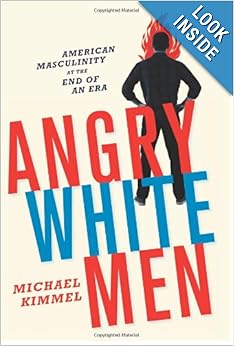
Michael Kimmel - Angry White Men: American Masculinity at the End of an Era


Michael Kimmel's new book, Angry White Men: American Masculinity at the End of an Era, has been getting a lot of attention on the interwebs. Salon posted an excerpt that focuses on the white supremacy morons as an example of the angriest of the angry white men. Over at the New York Times Sunday Book Review, Hanna Rosin (The End of Men) reviewed the book.

[As a side note, this is one of the best mainstream books of the year.]

The publisher's copy for the book is posted on the Amazon page for the book:
"[W]e can't come off as a bunch of angry white men.”
Robert Bennett, chairman of the Ohio Republican Party


One of the enduring legacies of the 2012 Presidential campaign was the demise of the white American male voter as a dominant force in the political landscape. On election night, after Obama was announced the winner, a distressed Bill O’Reilly lamented that he didn’t live in “a traditional America anymore.” He was joined by others who bellowed their grief on the talk radio airwaves, the traditional redoubt of angry white men. Why were they so angry? Sociologist Michael Kimmel, one of the leading writers on men and masculinity in the world today, has spent hundreds of hours in the company of America’s angry white men – from white supremacists to men's rights activists to young students –in pursuit of an answer. Angry White Men presents a comprehensive diagnosis of their fears, anxieties, and rage.

Kimmel locates this increase in anger in the seismic economic, social and political shifts that have so transformed the American landscape. Downward mobility, increased racial and gender equality, and a tenacious clinging to an anachronistic ideology of masculinity has left many men feeling betrayed and bewildered. Raised to expect unparalleled social and economic privilege, white men are suffering today from what Kimmel calls "aggrieved entitlement": a sense that those benefits that white men believed were their due have been snatched away from them.

Angry White Men discusses, among others, the sons of small town America, scarred by underemployment and wage stagnation. When America’s white men feel they’ve lived their lives the ‘right’ way – worked hard and stayed out of trouble – and still do not get economic rewards, then they have to blame somebody else. Even more terrifying is the phenomenon of angry young boys. School shootings in the United States are not just the work of “misguided youth” or “troubled teens”—they’re all committed by boys. These alienated young men are transformed into mass murderers by a sense that using violence against others is their right.

The future of America is more inclusive and diverse. The choice for angry white men is not whether or not they can stem the tide of history: they cannot. Their choice is whether or not they will be dragged kicking and screaming into that inevitable future, or whether they will walk openly and honorably – far happier and healthier incidentally – alongside those they’ve spent so long trying to exclude.
First up, the review from Rosin at the New York Times, a sympathetic response, although she concludes that the real issues with the men in this book are class issues more than gender or race issues. I think she's right, and many men (and women) don't get that men are just as oppressed in this country as are women, it just looks very different because many men have bought into their oppression.

Even Madder Men: ‘Angry White Men,’ by Michael Kimmel
By HANNA ROSIN
Published: November 22, 2013

The characters populating Michael Kimmel’s new book, “Angry White Men,” are familiar types: Rush Limbaugh’s ditto­heads, neo-Nazis, wife beaters, rampaging shooters and the divorced rageaholics of the men’s rights movement. Crowded together under one banner, they make for a scary and unpleasant lot: full of fury and blaming everyone but themselves for their problems. Mostly, they blame women: ex-wives, would-be girlfriends, the phantom black women who stole their jobs. The editor of a men’s rights website proclaims, “The real question here is not whether these women deserve the business end of a right hook, they obviously do, and some of them deserve one hard enough to leave them in an unconscious, innocuous pile on the ground.” 


ANGRY WHITE MEN: American Masculinity at the End of an Era
By Michael Kimmel
314 pp. Nation Books. $26.99.
Kimmel, a sociologist at Stony Brook University in New York, is unusually adventurous for an academic. As he did in his last book, “Guyland: The Perilous World Where Boys Become Men,” here, he ventures into unfamiliar territory and finds himself engaged in the kinds of conversations he is unlikely to have at department meetings. At a gun show in Shippensburg, Pa., Kimmel passes time with a guy he calls “Rick,” who mans the K.K.K. table and says what you would imagine such a person would say about the black man in the White House. At a batterer’s intervention group, Kimmel gets into the action, prodding one man who had hit his wife by asking, “Well, why didn’t you just pick up a knife and stab” her?

A longtime feminist, Kimmel maintains a delicate balance when handling his sources. He wants to be sympathetic to the people he interviews and yet loyal to his academic principles. After a series of humbling recessions and other economic shifts, men like Rick feel emasculated and humiliated, he writes, “betrayed by the country they love, discarded like trash on the side of the information superhighway.” Their sin, according to Kimmel, is a failure to adjust. These guys refuse to admit they’ve been handed privilege all these years by a world that puts white men on top. White men, he writes, “have been running with the wind at our backs all these years,” and “what we think of as ‘fairness’ to us has been built on the backs of others.”

Failing to concede this, men get stuck in a permanent dysfunction Kimmel calls “aggrieved entitlement,” in which they “refuse to even be dragged kicking and screaming into that inevitable future” of greater gender and racial equality. Instead they rage, not at the corporate overlords who have actually shipped their jobs overseas but at the amorphous feminists, or more likely “feminazis,” who have stolen American manhood.

Sometimes it’s difficult to tell how mainstream a phenomenon Kimmel is describing. In one chapter he recounts the case of George Sodini, a 48-year-old who went to his gym and shot dead five women (and then himself) because, as he wrote in an online diary, “I dress good, am clean shaven, bathe, touch of cologne — yet 30 million women rejected me.” Sodini, Kimmel writes, has “legions of fans” on men’s rights websites, people who call him a “hero” for standing up to all the “freeloading” women out there. But are these fringe lunatics or, as Kimmel labels them, an army of “everyday Sodinis” who beat and batter women with abandon? After all, rates of nonfatal violent victimization of women have dropped significantly since the 1990s, according to a 2011 White House report on women and girls. Visible rage may be increasing, but most men may feel impotent to act on it, or may be adjusting in more ways than we realize.

In one fascinating chapter Kimmel explores the changing nature of school violence. Once the scourge of urban black institutions, this phenomenon has taken on new form in suburban and rural neighborhoods. The school shooter is now pretty much always male and usually white (Seung-Hui Cho, the Virginia Tech shooter, being an exception, although Kimmel asserts that he had much in common with the Columbine killers and others). Kimmel makes a convincing case that this shift has to do with a sense of aggrieved entitlement, showing how these boys spent a lot of time fending off insults to their masculinity from the “jockocracy” that ruled their schools. But Kimmel also strains a little too hard for a tidy sociological explanation, arguing mightily (and pointlessly) against the idea that these attackers were singularly deranged or psychotic. Like the suicide bombers he compares them to, one can be both uniquely psychologically vulnerable, a total outlier, and yet tuned in to a broader cultural trend.

Kimmel’s balance of critical distance and empathy works best in his chapter on the fathers’ rights movement, a subset of the men’s rights movement. Members of this group are generally men coming out of bitter divorce proceedings who believe the courts cheated them out of the chance to be close to their children. They exhibit some of the wrath and obsessive qualities of other angry white men, routinely refer to their ex-wives in the nastiest ways and tend to overstate their involvement in family life. (As one child reported to a custody evaluator, his dad didn’t spend a lot of time with him “because he’s always busy working on his fathers’ organization.”) That said, their grievances are based on a legitimate insight. Often, Kimmel writes, family court judges act as if “they’re adjudicating Don and Betty Draper’s divorce,” back in the 1960s. They fail to recognize that fathers these days do a lot more child care than they used to, that mothers should not always be the default caretakers, and that fathers often want to remain an active presence in their child’s lives, as something beyond a steady paycheck — ​an­other sign that many men are in fact getting used to a new world order.

Outside a more elite audience, Kimmel’s diagnosis of aggrieved entitlement will be, I imagine, a tough sell. The men he’s writing about have gone through several recessions and 40 years of economic shifts. They live in a world where, as one man tells him, you’ll never find a job as a plumber but you might find one as a Walmart hostess. Beyond that, families around them are falling apart. Among men like them, without a college degree, divorce rates are high and fewer people get married; for women with only a high school degree, for example, nearly 60 percent of births occur outside marriage, rendering fatherhood a relic of the past. These men may have once run with the wind at their backs, but the air has been dead still for a long time.

Kimmel’s hope is that more men will give up their sense of entitlement and accept a gentler, fairer notion of what it means to be a man. That’s the right ­ideal, and pop culture has been helping him along, providing ever more TV shows portraying working-class men as loving fathers. Kimmel’s own book, too, offers evidence that men are making adjustments, choosing to be active parents or attending batterer support groups in an effort to change.

But in the short term, class inequalities loom larger than gender or race. You won’t easily convince Rick or the other men in the book that, due to the long arc of male privilege over the course of world history, he owes something to the likes of Barack Obama or Sheryl Sandberg, or to a sociology professor who lives in New York.
~ Hanna Rosin is the author, most recently, of “The End of Men: And the Rise of Women.”

This article has been revised to reflect the following correction:

Correction: December 29, 2013A review on Nov. 24 about “Angry White Men: American Masculinity at the End of an Era,” by Michael Kimmel, misspelled the surname of the man who shot 32 people to death at Virginia Tech in 2007. He was Seung-Hui Cho , not Choi.
* * * * *

This piece is from Salon, an excerpt from Angry White Men that focuses on the white supremacists as the angriest of the angry white men.

America’s angriest white men: Up close with racism, rage and Southern supremacy

Up close with small-town white rage, with bitter, scary men who feel left behind by economic and cultural change

Michael Kimmel


Excerpted from Angry White Men: American Masculinity at the End of an Era

Who are the white supremacists? There has been no formal survey, for obvious reasons, but there are several noticeable patterns. Geographically, they come from America’s heartland—small towns, rural cities, swelling suburban sprawl outside larger Sunbelt cities. These aren’t the prosperous towns, but the single-story working-class exurbs that stretch for what feels like forever in the corridor between Long Beach and San Diego (not the San Fernando Valley), or along the southern tier of Pennsylvania, or spread all through the Upper Peninsula of Michigan, across the vast high plains of eastern Washington and Oregon, through Idaho and Montana. There are plenty in the declining cities of the Rust Belt, in Dearborn and Flint, Buffalo and Milwaukee, in the bars that remain in the shadows of the hulking deserted factories that once were America’s manufacturing centers. And that doesn’t even touch the former states of the Confederacy, where flying the Confederate flag is a culturally approved symbol of “southern pride”—in the same way that wearing a swastika would be a symbol of German “heritage” (except it’s illegal in Germany to wear a swastika).

There’s a large rural component. Although “the spread of far-right groups over the last decade has not been limited to rural areas alone,” writes Osha Gray Davidson, “the social and economic unraveling of rural communities—especially in the midwest—has provided far-right groups with new audiences for their messages of hate. Some of these groups have enjoyed considerable success in their rural campaign.” For many farmers facing foreclosures, the Far Right promises to help them save their land have been appealing, offering farmers various schemes and legal maneuvers to help prevent foreclosures, blaming the farmers’ troubles on Jewish bankers and the one-world government. “As rural communities started to collapse,” Davidson writes, the Far Right “could be seen at farm auctions comforting families . . . confirming what rural people knew to be true: that their livelihoods, their families, their communities—their very lives—were falling apart.” In stark contrast to the government indifference encountered by rural Americans, a range of Far Right groups, most recently the militias, have seemingly provided support, community, and answers.

In that sense, the contemporary militias and other white supremacist groups are following in the footsteps of the Ku Klux Klan, the Posse Comitatus, and other Far Right patriot groups who recruited members in rural America throughout the 1980s. They tap into a long history of racial and ethnic paranoia in rural America, as well as an equally long tradition of collective local action and vigilante justice. There remains a widespread notion that “Jews, African-Americans, and other minority-group members ‘do not entirely belong,’” which may, in part, “be responsible for rural people’s easy acceptance of the far right’s agenda of hate,” writes Matthew Snipp. “The far right didn’t create bigotry in the Midwest; it didn’t need to,” Davidson concludes. “It merely had to tap into the existing undercurrent of prejudice once this had been inflamed by widespread economic failure and social discontent.”

And many have moved from their deindustrializing cities, foreclosed suburban tracts, and wasted farmlands to smaller rural areas because they seek the companionship of like-minded fellows, in relatively remote areas far from large numbers of nonwhites and Jews and where they can organize, train, and build protective fortresses. Many groups have established refuge in rural communities, where they can practice military tactics, stockpile food and weapons, hone their survivalist skills, and become self-sufficient in preparation for Armageddon, the final race war, or whatever cataclysm they envision. Think of it as the twenty-first-century version of postwar suburban “white flight”—but on steroids.

They’re certainly Christian, but not just any Christian—they’re evangelical Protestant, Pentacostalist, and members of radical sects that preach racial purity as the Word of Jesus. (Catholicism is certainly stocked with conservatives on social issues, but white supremacists tap into such a long and ignoble tradition of anti-Catholicism that they tend to have their own right-wing organizations, mostly fighting against women’s rights and gay rights.) Some belong to churches like the Christian Identity Church, which gained a foothold on the Far Right in the early 1980s. Christian Identity’s focus on racism and anti-Semitism provides the theological underpinnings to the shift from a more “traditional agrarian protest” to paramilitarism. It is from the Christian Identity movement that the Far Right gets its theological claims that Adam is the ancestor of the Caucasian race, whereas non-whites are pre-Adamic “mud people,” without souls, and Jews are the children of Satan. According to this doctrine, Jesus was not Jewish and not from the Middle East; actually, he was northern European, his Second Coming is close at hand, and followers can hasten the apocalypse. It is the birthright of Anglo-Saxons to establish God’s kingdom on earth; America’s and Britain’s “birthright is to be the wealthiest, most powerful nations on earth . . . able, by divine right, to dominate and colonize the world.”

A large proportion of the extreme right wing are military veterans. Several leaders served in Vietnam and were shocked at the national disgust that greeted them as they returned home after that debacle. “America’s failure to win that war was a truly profound blow,” writes William J. Gibson. “If Americans were no longer winners, then who were they?” Some veterans believed they were sold out by the government, caving in to effeminate cowardly protesters; they can no longer trust the government to fight for what is right. Bo Gritz, a former Green Beret in Vietnam, returned to Southeast Asia several times in clandestine missions to search for prisoners of war and was the real-life basis for the film Rambo. He uses his military heroism to increase his credibility among potential recruits; one brochure describes him as “this country’s most decorated Vietnam veteran” who “killed some 400 Communists in his illustrious military career.” In 1993 Gritz began a traveling SPIKE (Specially Prepared Individuals for Key Events) training program, a rigorous survival course in paramilitary techniques.

Many of the younger guys are veterans of the first Gulf War, a war that they came to believe was fought for no moral principles at all, but simply to make America’s oil supply safer and to protect Israel from possible Arab attack. They feel they’ve been used, pawns in a larger political game, serving their country honorably only to be spit out and stepped on when they returned home to slashed veteran benefits, bureaucratic indifference to post-traumatic stress disorder, and general social contempt for having fought in the war in the first place. They believed they were entitled to be hailed as heroes, as had earlier generations of American veterans, not to be scorned as outcasts. Now a guy like Bo Gritz symbolizes “true” warrior-style masculinity, and reclaiming their manhood is the reward for signing up with the Far Right.

THE CLASS ORIGINS OF RACIAL POLITICS

Perhaps what binds them all together, though, is class. Rural or small town, urban or suburban, the extreme Right is populated by downwardly mobile, lower-middle-class white men. All of the men I interviewed—all—fitted this class profile. When I compared with other ethnographies and other surveys, they all had the same profile as well.

In the United States, class is often a proxy for race. When politicians speak of the “urban poor,” we know it’s a code for black people. When they talk about “welfare queens,” we know the race of that woman driving the late-model Cadillac. In polite society, racism remains hidden behind a screen spelled CLASS.

On the extreme Right, by contrast, race is a proxy for class. Among the white supremacists, when they speak of race consciousness, defending white people, protesting for equal rights for white people, they actually don’t mean all white people. They don’t mean Wall Street bankers and lawyers, though they are pretty much entirely white and male. They don’t mean white male doctors, or lawyers, or architects, or even engineers. They don’t mean the legions of young white hipster guys, or computer geeks flocking to the Silicon Valley, or the legions of white preppies in their boat shoes and seersucker jackets “interning” at white-shoe law firms in major cities. Not at all. They mean middle-and working-class white people. Race consciousness is actually class consciousness without actually having to “see” class. “Race blindness” leads working-class people to turn right; if they did see class, they’d turn left and make common cause with different races in the same economic class.

That’s certainly what I found among them. Most are in their mid-thirties to early forties, educated at least through high school and often beyond. (The average age of the guys I talked with was thirty-six.) They are the sons of skilled workers in industries like textiles and tobacco, the sons of the owners of small farms, shops, and grocery stores. Buffeted by global political and economic forces, the sons have inherited little of their fathers’ legacies. The family farms have been lost to foreclosure, the small shops squeezed out by Walmarts and malls. These young men face a spiral of downward mobility and economic uncertainty. They complain that they are squeezed between the omnivorous jaws of global capital concentration and a federal bureaucracy that is at best indifferent to their plight and at worst complicit in their demise.

And they’re right. It is the lower middle class—that strata of independent farmers, small shopkeepers, craft and highly skilled workers, and small-scale entrepreneurs—that has been hit hardest by globalization. “Western industry has displaced traditional crafts—female as well as male—and large-scale multinational-controlled agriculture has downgraded the independent farmer to the status of hired hand,” writes journalist Barbara Ehrenreich. This has resulted in massive male displacement—migration, downward mobility. It has been felt the most not by the adult men who were the tradesmen, shopkeepers, and skilled workers, but by their sons, by the young men whose inheritance has been seemingly stolen from them. They feel entitled and deprived—and furious. These angry young men are the foot soldiers of the armies of rage that have sprung up around the world.

What’s important to note is that they are literally the sons. It was their fathers who closed the family store, who lost the family farm. Some are men who have worked all their adult lives, hoping to pass on the family farm to their sons and retire comfortably. They believed that if they worked hard, their legacy would be ensured, but they leave their sons little but a legacy of foreclosures, economic insecurity, and debt.

It was their status next to their father’s and grandfather’s names on the cabinetmaking storefront that said “Jones and Sons.” These were businesses that came not only with the ability to make a living, but came with dignity, with a sense of craft pride, a sense that you owned your own store or farm, owned and controlled your own labor—even employed some other people—and that this economic autonomy had been a source of great pride in the family for generations. In a near-throwaway footnote in his classic study of identity development, Childhood and Society (1950), Erik Erikson locates the origins of young men’s anger in a multigenerational story:
In psychoanalytic patients the overwhelming importance of the grandfather is often apparent. He may have been a blacksmith of the old world or a railroad builder of the new, and as yet proud Jew or an unreconstructed Southerner. What these grandfathers have in common is that fact that they were the last representatives of a more homogeneous world, masterly and cruel with good conscience, disciplined and pious without loss of self-esteem. Their world invented bigger and better machinery like gigantic playthings which were not expected to challenge the social values of the men who made them. Their mastery persists in their grandsons as a stubborn, an angry sense of superiority. Overtly inhibited, they yet can accept others only on terms of prearranged privilege.
“It wasn’t my daddy’s farm,” said Andy, “it was my granddaddy’s, and his daddy’s, and his daddy’s. Five generations of Hoosier farmers.” Generations of Hoosier men, who worked the farm, supported a family, made a living with dignity. They proved their masculinity in that most time-honored way in America: as family providers. And it was their fathers who lost it all, squandered their birthright. Instead of getting angry at their fathers, Andy and his comrades claim the mantle of the grandfathers, displace their rage outward, onto an impermeable and unfeeling government bureaucracy that didn’t offer help, onto soulless corporations that squeezed them mercilessly. By displacing their anger onto those enormous faceless entities, the sons justify their political rage and rescue their own fathers from their anger.

Some can’t do it. Some of the sons—and the fathers—turn their rage inward. We have already discussed the wave of suicides that rippled across the American heartland in the 1980s and 1990s—spawning widespread concern and a series of Farm Aid concerts to raise awareness. The number of suicides in America’s Midwest was higher in the 1990s than during the Great Depression; suicide was the leading cause of agricultural fatalities for two decades—by far. Men were five times more likely to kill themselves than die by accident. “To fail several generations of relatives (both backwards and forwards into those unborn descendants who will now not be able to farm), to see yourself as the one weak link in a strong chain that spans more than a century, is a terrible, and for some, an unbearable burden,” writes Osha Gray Davidson. “When a fellow in a steel mill loses his job, he has basically lost his paycheck,” a physician at the University of Iowa explained. “When an Iowa farmer loses his farm, he’s lost the guts of his life.”

One woman, speaking at a town meeting in Tonkawa, Oklahoma, in 1991, provided an eloquent narrative of this process:
I am a 46-year-old mother of three children. We have lost two farms since 1980, my mother in law’s farm as well as our own. We were forced to sell 160 acres of land that was very special to us. It was homesteaded by my husband’s great grandfather and for years had served as home to our cow and calf operation which we were forced to sell just a few months before we sold the land.

My husband became completely consumed by our circumstances caused by the farm crisis. He left me. Our family continued to deteriorate and our marriage ended in divorce. We had been through natural crises before—drought, flood, crop failure—these we accepted and went on.

But when the threat of losing everything comes to your doorstep because of the bad economy, low commodity prices and high interest on your base notes has left you hopelessly in debt, your faith is sometimes shaken. No one likes to consider that their life has been pointless.
Others direct this seething rage outward. “Many debt ridden farm families will become more suspicious of government, as their self-worth, their sense of belonging, their hope for the future deteriorates,” predicted Oklahoma psychologist Glen Wallace presciently in 1989. “The farms are gone,” writes Dyer, “yet the farmers remain. They’ve been transformed into a wildfire of rage, fueled by the grief of their loss and blown by the winds of conspiracy and hate-filled rhetoric.” “It is hardly surprising, then, that American men—lacking confidence in the government and the economy, troubled by the changing relations between the sexes, uncertain of their identity or their future—began to dream, to fantasize about the powers and features of another kind of man who could retake and reorder the world. And the hero of all these dreams was the paramilitary warrior.” The contemporary white supremacist movement is the embodiment of these warrior dreams.

Their plan is to get even. Unlike Joe Wesbecker, some guys don’t just get even by rampaging through their factory floor or their corporate offices, shooting at their former colleagues and coworkers. They get mad, and they get organized. They cobble together a theory that explains their plight—grafting together fringe elements of evangelical Christianity, traditional anti-Semitism and racism, and general right-wing paranoia into an amalgam that is loosely held together by a nostalgic vision of hardy, independent frontier manhood. Like the guys who go postal, they externalize their rage—their anguish is clearly the fault of someone else—but they don’t externalize it to their immediate surroundings, their boss, supervisor, or coworkers. Instead, it’s larger, more powerful, and pernicious social forces—Jews, Muslims, minorities generally, women.

These are the sons of small-town America, the Jeffersonian yeoman of the nineteenth century, disfigured by global restructuring and economic downturns. They come from the “large and growing number of US citizens disaffected from and alienated by a government that seems indifferent, if not hostile, to their interests. This predominantly white, male, and middle-and working-class sector has been buffeted by global economic restructuring with its attendant job losses, declining real wages, and social dislocations. While under economic stress, this sector has also seen its traditional privileges and status challenged by 1960s-style social movements, such as feminism, minority rights, and environmentalism.”

The sons of these farmers and shopkeepers expected to—and felt entitled to—inherit their fathers’ legacy. And when it became evident it was not going to happen, they became murderously angry—at a system that emasculated their fathers and threatens their manhood. They live in what they call a “Walmart economy” and are governed by a “nanny state” that doles out their birthright to ungrateful and undeserving immigrants. What they want, says one guy, is to “take back what is rightfully ours.”

*

So, who are they really, these hundred thousand white supremacists? They’re every white guy who believed that this land was his land, was made for you and me. They’re every down-on-his-luck guy who just wanted to live a decent life but got stepped on, every character in a Bruce Springsteen or Merle Haggard song, every cop, soldier, auto mechanic, steelworker, and construction worker in America’s small towns who can’t make ends meet and wonders why everyone else is getting a break except him. But instead of becoming Tom Joad, a left-leaning populist, they take a hard right turn, ultimately supporting the very people who have dispossessed them.

They’re America’s Everymen, whose pain at downward mobility and whose anger at what they see as an indifferent government have become twisted by a hate that tells them they are better than others, disfigured by a resentment so deep that there are no more bridges to be built, no more ladders of upward mobility to be climbed, a howl of pain mangled into the scream of a warrior. Their rage is as sad as it is frightening, as impotent as it is shrill.

WALKING THE PATRIOTIC CAPITALIST TIGHTROPE

You might think that the political ideology of the white supremacist movement is as simple as their list of enemies: put down minorities, expel immigrants, push the women out of the workplace, and round up and execute the gays and the Jews. But it’s not nearly so simple. Actually, they have to navigate some treacherous ideological waters and reconcile seemingly contradictory ideological visions with their emotions.

There are three parts to their ideological vision. For one thing, they are ferociously procapitalist. They are firm believers in the free market and free enterprise. They just don’t like what it’s brought. They like capitalism; they just hate corporations. They identify, often, as the vast middle class of office workers and white-collar employees, even though that is hardly their class background. (They’ve a fungible understanding of class warfare.) “For generations, white middle class men defined themselves by their careers, believing that loyalty to employers would be rewarded by job security and, therefore, the ability to provide for their families” is the way one issue of Racial Loyalty (a racist skinhead magazine) puts it. “But the past decade—marked by an epidemic of takeovers, mergers, downsizings and consolidations—has shattered that illusion.”

Aryans support capitalist enterprise and entrepreneurship, even those who make it rich, but especially the virtues of the small proprietor, but are vehemently antiurban, anticosmopolitan, and anticorporate. In their eyes, Wall Street is ruled by Jewish-influenced corporate plutocrats who hate “real” Americans. Theirs is the Jeffersonian vision of a nation of producers—not financiers, not bankers, and not those other “masters of the universe” whose entire careers consist of cutting the cake ever more finely and living on the crumbs. It’s Andrew Jackson’s producerist attack on the “parasitic” bankers. It is “the desire to own small property, to produce crops and foodstuffs, to control local affairs, to be served but never coerced by a representative government, and to have traditional ways of life and labor respected,” writes historian Catherine Stock.

White supremacists see themselves as squeezed between global capital and an emasculated state that supports voracious global profiteering. In the song “No Crime Being White,” Day of the Sword, a popular racist skinhead band, confronts the greedy class:
The birthplace is the death of our race.
Our brothers being laid off is a truth we have to face.
Take my job, it’s equal opportunity
The least I can do, you were so oppressed by me
I’ve only put in twenty years now.
Suddenly my country favors gooks and spicks and queers.
Fuck you, then, boy I hope you’re happy when your new employees are the reason why your business ends.
Second, the extreme Right is extremely patriotic. They love their country, their flag, and everything it stands for. These are the guys who get teary at the playing of the national anthem, who choke up when they hear the word America. They have bumper stickers on their pick ups that show the flag with the slogan “These colors don’t run.”

The problem is that the America they love doesn’t happen to be the America in which they live. They love America—but they hate its government. They believe that the government has become so un-American that it has joined in global institutions that undermine and threaten the American way of life. Many fuse critiques of international organizations such as the United Nations with protectionism and neoisolationism, arguing that all internationalisms are part of a larger Zionist conspiracy. Some embrace a grand imperial vision of American (and other Aryan) domination and the final subjugation of “inferior races.”

As he traveled through the rural West, journalist Joel Dyer constantly heard these refrains: “Environmentalists wouldn’t let me run my cows cause some damn little sparrow they said was endangered lived on my place,” “They took my farm,” “The IRS took everything I owned.” “These people believe the government is responsible for where they are, because they are finding themselves ignored, basically, by the economic system. People are losing their homes, their farms, their jobs, their sources of income. Corporations have been allowed to move wherever they want, and to take away jobs by the truckload. People are becoming economically dispossessed.”

NAFTA took away American jobs; what they see as the “Burger King” economy leaves no room at the top, so “many youngsters see themselves as being forced to compete with nonwhites for the available minimum wage, service economy jobs that have replaced their parents’ unionized industry opportunities.”

That such ardent patriots are so passionately antigovernment might strike the observer as contradictory. After all, are these not the same men who served their country in Vietnam or in the Gulf War? Are these not the same men who believe so passionately in the American Dream? Are they not the backbone of the Reagan Revolution? Indeed, they are. The extreme Right faces the difficult cognitive task of maintaining their faith in America and in capitalism and simultaneously providing an analysis of an indifferent state, at best, or an actively interventionist one, at worst, and a way to embrace capitalism, despite a cynical corporate logic that leaves them, often literally, out in the cold—homeless, jobless, hopeless.

Finally, they believe themselves to be the true heirs of the real America. They are the ones who are entitled to inherit the bounty of the American system. It’s their birthright—as native-born, white American men. As sociologist Lillian Rubin puts it, “It’s this confluence of forces—the racial and cultural diversity of our new immigrant population; the claims on the resources of the nation now being made by those minorities who, for generations, have called America their home; the failure of some of our basic institutions to serve the needs of our people; the contracting economy, which threatens the mobility aspirations of working class families—all these have come together to leave white workers feeling as if everyone else is getting a piece of the action while they get nothing.”

This persistent reversal—white men as victim, the “other” as undeservedly privileged—resounds through the rhetoric of the extreme Right. Take, for example, Pat Buchanan’s “A Brief for Whitey,” a response to candidate Barack Obama’s call for a national conversation about race in America: “It is the same old con, the same old shakedown. America has been the best country on earth for black folks. It was here that 600,000 black people, brought from Africa in slave ships, grew into a community of 40 million, were introduced to Christian salvation, and reached the greatest levels of freedom and prosperity blacks have ever known.”

And now, I suppose, Buchanan would say, we’re supposed to apologize to them? Pay them reparations? They should be kissing our feet with gratitude! But no. We live in a fun-house version of America, Buchanan argues, where minorities rule and white folks are the new oppressed minority. It was ours, but it’s not anymore. It has been taken—because we let it! And the fact that it has been stolen from us leaves white American men feeling emasculated—and furious.

It is through a decidedly gendered and sexualized rhetoric of masculinity that this contradiction between loving America and hating its government, loving capitalism and hating its corporate iterations, is resolved. Racism, nativism, anti-Semitism, antifeminism—these discourses of hate provide an explanation for the feelings of entitlement thwarted, fixing the blame squarely on “others” whom the state must now serve at the expense of white men. The unifying theme is gender.

These men feel emasculated by big money and big government. In their eyes, most white American men collude in their emasculation. They’ve grown soft, feminized, weak. White supremacist websites abound with complaints about the “whimpering collapse of the blond male,” the “legions of sissies and weaklings, of flabby, limp-wristed, non-aggressive, non-physical, indecisive, slack-jawed, fearful males who, while still heterosexual in theory and practice, have not even a vestige of the old macho spirit.”

Excerpted from Angry White Men: American Masculinity at the End of an Era by Michael Kimmel. Published by Nation Books, a member of the Perseus Books Group. Copyright © 2013 by Michael Kimmel. All rights reserved.


More Michael Kimmel.