Men can be feminists but it’s actually really hard work
Feminism is for everybody because sexism hurts everybody, but lots of men are comfortable with the status quo
Katie McDonough
Monday, Jun 9, 2014
Joseph Gordon-Levitt recently called himself a feminist (Credit: AP/Victoria Will)
The Betteridge law of headlines states that “any headline which ends in a question mark can be answered by the word no,” but a Monday piece in the New York Times may be the rare exception. “Is it possible to be a male feminist?” asks writer (and self-described male feminist) Jake Flanagin. The answer to this question is yes. Possibly even, “Yes of course come on seriously?”
It’s a fine enough question for a journalist to ask (think piece glass houses, etc.), but Flanagin’s decision to focus on Hugo Schwyzer — who was given several platforms to write about men and feminism while he spent his spare time attacking the personal, academic and professional lives of black feminists and other feminists of color – is an odd one. As Jamil Smith noted on Twitter, if you want to have a conversation about men and feminism, why not talk to male feminists? Smith’s point, I think, is to raise the issue of why we seem to have a lot of pieces questioning whether men can be feminists and very few that explore what happens after you answer that question in the affirmative. Aren’t we even a little bit curious?
The most compelling part of the Times piece comes in the very last paragraph, when writer Noah Berlatsky discusses the work that being a male feminist actually requires. “It’s true that sometimes male feminists, myself not excluded, imagine we’re brave allies, altruistically saving women by standing up for them,” Berlatsky observes. “But dreams about men saving women are just another version of misogyny — and, in this case in particular, totally backwards. Misogyny is a cage for everyone. When I call myself a male feminist, I’m not doing it because I think I’m going to save women. I’m doing it because I think it’s important for men to acknowledge that as long as women aren’t free, men won’t be either.”
Berlatsky gets to something important about the nature of justice — that it’s a radically intertwined project. Contrary to the tired trope about “mothers, wives and daughters” that generally gets thrown around in arguments about why men should care about women’s rights, men should be feminists because the lives of the women and girls they have never met and will never meet matter. Particularly in a culture that does not encourage men to cultivate or express empathy, this thing of giving a basic shit about people you don’t know is itself a kind of radical act. But Berlatsky’s point that “misogyny is a cage for everyone” also captures another reason that I think men can and should identify as feminists. Because of course men should be outraged at the violence experienced by women and girls and the systems that dehumanize them, but framing men’s relationship to feminism exclusively as men’s relationship to women’s status in the world erases the fact that men are also harmed by patriarchy, toxic masculinity and entrenched cultural and institutional sexism.
The scale is aways going to be different, of course. I’d never try to argue otherwise. Cultural norms that hold women as mothers and caregivers above all else mean that women get paid less than their male colleagues for the same work, and that women disproportionately put their personal and career ambitions on hold in order to care for children and others. But these same norms also leave men questioning their masculinity or doubting their self-worth if they want to stay home with their children. These things aren’t the same, but they both matter.
The same could be said about dominant narratives around sexual assault. Women and girls make up the majority of victims of sexual violence, but a culture that straight up says that teenage boys can’t be raped makes it almost impossible for male survivors to come forward. Destructive ideas about sexual male entitlement are at the heart of rape culture and the reason that so many women and girls are victimized in their lifetimes, but they also feed into this idea that men always want sex, which makes men who have been victims of rape question whether or not what happened to them even counts as a crime. It took a really, really long time for this to even become a crime. These same norms also encourage men to have really warped relationships to desire and sexual satisfaction. This stuff hurts women the most because of the violence it engenders, but it hurts men, too.
There are plenty of important questions to ask about how men can be feminists without making themselves the center of the movement. About the work of listening and boosting versus erasing and derailing. About how men get lots of applause and accolades for doing very basic things — like not violently abusing women. About how many men don’t identify as feminists because they are deeply invested in upholding the systems — like patriarchy and white supremacy — that benefit them. And Berlatsky’s point about the line between the male savior complex and being a legitimate force for positive social change is well made. But we can have all of these conversations while acknowledging that men who identify as feminists aren’t just cheerleading for women — they’re fighting systems that tell them that being a good listener makes them a pussy, or that they shouldn’t share their emotions, or that straight men can’t have intimate friendships with other men, or that rape in prison is hilarious.
Feminism’s relevance to everyone has been articulated and re-articulated throughout the history of the movement, and I was reminded of this again over the weekend when I read an interview with actress Mackenzie Davis, who said she couldn’t understand why “feminism” feels like such a scary word to some people.
“Feminism is rooted in racial rights and gender rights, and all of those things intersect, and to say that that’s not something you can stand behind — it confuses me,” she told the Times. “I think it’s a really great word.”
So do plenty of men.
Katie McDonough is an assistant editor for Salon, focusing on politics, culture and feminism. Follow her on Twitter @kmcdonovgh or email her at kmcdonough@salon.com.
Showing posts with label equality. Show all posts
Showing posts with label equality. Show all posts
Sunday, June 22, 2014
Men Can Be Feminists . . . But It’s Actually Really Hard Work
Male feminist. To me, that is not at all unlike saying one is a male triathlete, or a male liberal. To be a feminist, and I am sure (as a male) I can't possibly grasp this entirely, is to want women and men to have equal rights and status in the society, both through cultural norms and under the legal system. That doesn't feel too hard, so I must be missing something.


Monday, February 10, 2014
How the NFL's Plan for Its 1st Openly Gay Player Fell Apart - And How Missouri Defensive End Michael Sam Is Changing All That
Two stories from the Bleacher Report - the first details the NFL's plan to announce it's first gay player fell through, and how the very recent announcement by Missouri Defensive End Michael Sam that he is gay is likely to change all of that - for the better.
The cool thing about Sam coming out was the support he received on Twitter from players (pas and present) and other athletes, including Shannon Sharpe, DeAngelo Williams, Tiki Barber, Amy Wambach, Jonathan Martin, and Robbie Rogers, among others.
The cool thing about Sam coming out was the support he received on Twitter from players (pas and present) and other athletes, including Shannon Sharpe, DeAngelo Williams, Tiki Barber, Amy Wambach, Jonathan Martin, and Robbie Rogers, among others.
The Inside Story of How the NFL's Plan for Its 1st Openly Gay Player Fell Apart
By Mike Freeman , NFL National Lead Writer Nov 20, 2013

B/R photo illustration
The team had decided yes. The player had decided the same. It was set. It was going to happen. An NFL player was going to publicly say he was gay and then play in the NFL.
What happened before that moment showed how parts of the NFL are progressive and ready for change. Then, what happened next showed how the sport is still in some ways fearful of it.
The following account is based on interviews with approximately a dozen people, including team and league officials, current and former players, and gay-rights advocates. Some were directly involved with the discussions that nearly led to the first openly gay NFL player. Further illustrating the intense secrecy, delicacy and fear surrounding the subject, none of the principals wanted to be identified. They also refused to identify the team or the player.
It was early this past spring when a closeted gay player, who was a free agent, reached out to a small group of friends and told them about his sexual orientation. The friends, both current and former players, and others with NFL connections, then contacted a handful of teams to gauge their interest in the player and their comfort with that player talking openly about being gay if they signed him.
A number of teams contacted passed. The player was told they didn't have a need at his position. The player told a recently retired player he believed the teams declined because they feared the attention a gay NFL player would receive from the public and media.
Yet some teams were interested, and one team actually said yes. It wasn't a lukewarm yes or a conditional one. It was a definite yes.
The team expressed that it didn't care if the player was gay and had no issue with him announcing he was gay after signing. The player expected the signing, and subsequent announcement, to happen in June. This would give the team, fans and media a month to adjust to the news before training camp began.
It was during these talks with the team, occurring in late March and early April, that reports surfaced about the possibility of an openly gay player emerging. In effect, word of the impending signing was leaking. I reported a player was strongly considering coming out. My reporting was based on speaking to several NFL players. Word of an openly gay player signing was spreading among a portion of the player base.
Gay-rights advocate and former Baltimore Raven Brendon Ayanbadejo said in April that he believed several gay players might come out. He later backed away from the number of players but stood by his statement that a gay player would soon emerge onto the NFL stage.
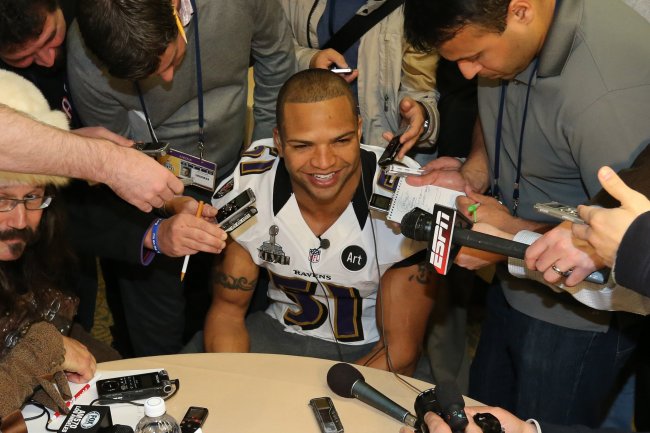
USA TODAY Sports - Outspoken gay-rights advocate Brendon Ayanbadejo is not as confident as he once was about how soon there will be an openly gay NFL player.
Some months later, it's possible Ayanbadejo may have been right. The feeling now among team officials, as well as current and former players, is that there wasn't just one gay player ready to shed his secret, but multiple ones.
"I don't know how close we are," Ayanbadejo said to Bleacher Report in regard to having an openly gay player. "I just know there are gays in the NFL but their identities remain confidential."
The sources paint a remarkable picture. At least two or three gay players, each unaware of the other, living in different parts of the country, with different sets of friends and agents, each contemplating the same thing: coming out.
That period was, as one gay-rights advocate described it, "the spring of optimism for the NFL and gay rights." There was a feeling that the NFL was on the verge of crossing this significant barrier. There was great excitement. It was going to happen.
Until it didn't.
***
The question now is: What happened?
In considering possible answers, it's important to know five things.
First: Estimates of how many gay players are in the NFL range widely, but some of them, from people intimately familiar with the league, are far higher than might be assumed by the outside public.
Players and team executives give totals ranging from several dozen to several hundred. (There are about 2,000 players in the league.) One former general manager said he believes the number of gay players is 30-40.
Second: The NFL and union know the identities of some gay players, according to many sources—a gay-rights advocate, a union official and a team official. The league and union learn who these players are from other players and coaches. They keep the identities of these players secret. In some cases, teams do so to protect the players. In many cases, teams learn the identities to avoid signing them as free agents.
Third: The league office backs the idea of an openly gay player, but one high-ranking league official believes the NFL isn't yet ready for one. League executives think football is three to five years away from accepting such a player, according to an NFL source. The league plans to carefully and deliberately make the atmosphere more tolerant and comfortable in the meantime, setting the stage for when that happens.
The NFL actually wants an openly gay player because it would be one of the last barriers broken in the sport and show professional football as a tolerant sport. And not everyone thinks the league needs to wait. Another league-office executive said the NFL is ready now. "We are prepared," he stated. "The league would give the player and his team all the support necessary."
In response to this story the NFL issued a statement saying all players are protected by the NFL's Personal Conduct Policy. A manual given to every player during training camp includes language about violent or threatening behavior between employees inside and outside of the workplace. It includes documents relating to sexual harassment and sexual orientation.
Fourth: Some individual franchises, however, are not as enthusiastic about the prospect as the league office seems to be. Several team officials say the largest obstacle to an openly gay player is the resistance of a significant number of NFL owners and a smaller number of general managers and coaches.
Fifth: Many in the league are fearful of acting or even speaking on this subject. Quite simply, teams remain terrified of signing an openly gay player.
One team official gave an example of why there is such fear. He posed a question: What if a gay player came out in a place like the Dolphins locker room, where there was allegedly severe hazing?
Some stories out of the last NFL combine indicated teams are worried. Nick Kasa, a prospective pro out of the University of Colorado, told ESPN Radio in Denver earlier this year that during interviews with team officials at the combine in Indianapolis: "(Teams) ask you, like, 'Do you have a girlfriend?' 'Are you married?' 'Do you like girls?'" Big-name players like Michigan's Denard Robinson and Michigan State's Le'Veon Bell indicated in radio interviews that they were asked similar questions. The assumption was that the questions were some form of standard operating procedure not tied to the particular interviewees.
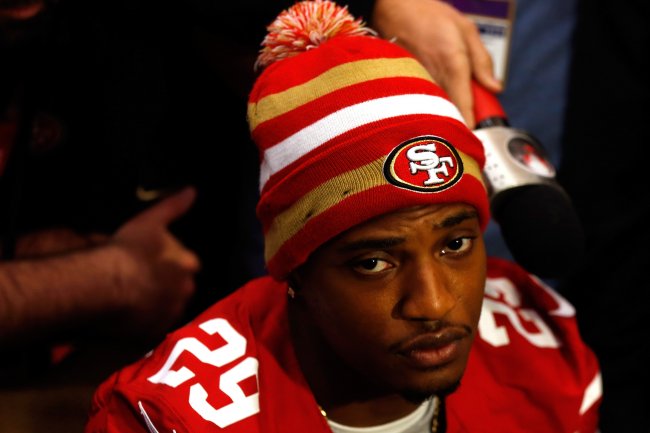
Scott Halleran/Getty Images - Chris Culliver's homophobic remarks in advance of the Super Bowl this year offered a glimpse at the reception an out player might get.
During media day before this past Super Bowl, 49ers defensive back Chris Culliver said, "I don’t do the gay guys, man. I don’t do that. Got no gay people on the team. They gotta get up outta here if they do. Can’t be with that sweet stuff…Can’t be…in the locker room, nah. You’ve gotta come out 10 years later after that."
It's this fear of gays that helps explain why many in the NFL are nervous about addressing the issue on the record. Some sources feel that talking openly about gay issues will label them as being part of the gay-player discussion and harm them in their current positions across the sport.
Still, some players strongly believe an openly gay player would be welcome in an NFL locker room.
"Players, in general, don't care what other players do in the bedroom," Arizona kicker Jay Feely, who is in his 13th season and has been a longtime union representative, told Bleacher Report. "Whether that is being celibate, having an affair, being happily married for 20 years or being gay. No one cares. The only thing they care about is winning games (and getting paid). That's the honest truth.
"This story is not about football or locker rooms but outside factors and agendas that are using football as the carrot to attract attention for their own personal gain."
To others, both in football and out of it, an openly gay NFL player would be a monumental moment, signaling that yet another barrier has fallen not just in sports, but all of society.
***
This past spring, it seemed imminent that barrier was going to collapse with not one, but two players having found teams that would sign them knowing they would come out.
Along with the initial player discussed in this article, there was a fairly well-known defensive back. He drew interest from at least one AFC team that knew he was gay. Coaches on the team were asked if they were OK with a gay player. They were. Some defensive players were casually queried, according to an official on the team. All of the players asked said it wouldn't be an issue. They were not told the name of the player.
According to the team, the potential deal collapsed when the player wanted too much money. If that was the case—and there is doubt about that among gay-rights advocates—it stands apart from everything else league insiders are saying about an NFL which they know includes many gay players and not a single one who will publicly acknowledge he's gay.
The first player, the one who expected to sign in June, heard in mid-to-late May from the interested team that it would no longer be signing him, officials from other teams told Bleacher Report. The player was told the reason why was fear of intense media coverage.
It was at the end of April that NBA player Jason Collins wrote a first-person story for Sports Illustrated in which he stated he was gay. The story became one of the most discussed in recent sports history.
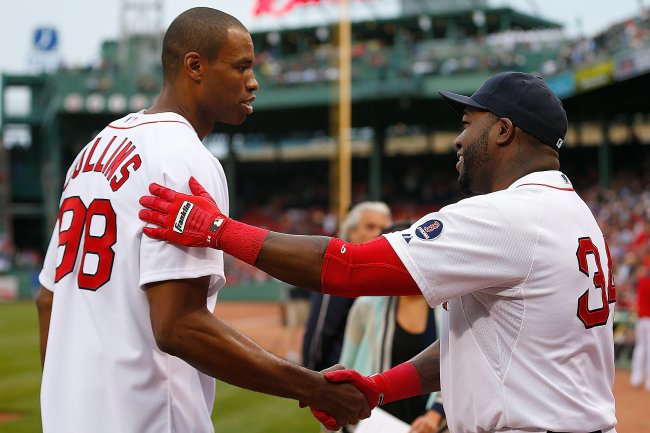
Jim Rogash/Getty Images - Did the media attention Jason Collins received scare off NFL teams thinking of signing a gay player? Collins has not been signed by an NBA team.
The NFL player told a former teammate he believes the Collins story, and others about gay athletes around that time, caused the team to withdraw its offer. It was afraid of the attention. Now, six months and countless injuries to active players later, neither he nor the other player has signed with a team.
While being afraid to sign an openly gay player smacks of cowardice—the Dodgers signed Jackie Robinson knowing there would be not only disapproval but possibly violence directed against the club—it remains a fact teams fear almost any type of controversy. And this would be one of the more talked about stories ever.
So after lots of talk of a gay NFL player coming out, the talk disappeared. Because NFL teams, in the end, got cold feet. It's that simple.
The sport still isn't quite ready for an openly gay NFL player.
***
All sources close to the players were asked one question repeatedly: Why don't the players just come out?
The answer was the same—fear. If they come out before signing, they won't get signed. While the players want to help push change, they also want to play football. Some will point to how Collins remains unemployed post-announcement.
The other problem is the league itself. It has, at times, moved extraordinarily slow on this issue. One gay-rights advocate who has had extensive dealings with the NFL said the league is trying to do the right thing but "it's like changing the course of a cruise ship."
Go back to an important fact. At least one league official believes pro football is three to five years away from a gay player coming out. Thus we're seeing the S.S. NFL turning hard to starboard toward a gay player coming out, but turning ever so slowly.
It will happen. It's just a question of when.
The two likeliest scenarios remain true. The first is what happened with the NBA's Collins could happen in the NFL. A player toward the end of his career comes out while a free agent or just after signing with a team.
The other possibility is a high-profile player in college is openly gay and has discussed this in media interviews for years. By the time he's picked high in the NFL draft, his sexuality has been so discussed and analyzed that no one cares.
And that is the goal. Reach a day when no one will care.
* * * * *
NFL Prospect Michael Sam Comes Out as Gay — Big Tests Loom for Him, League
By Mike Freeman , NFL National Lead Writer Feb 9, 2014
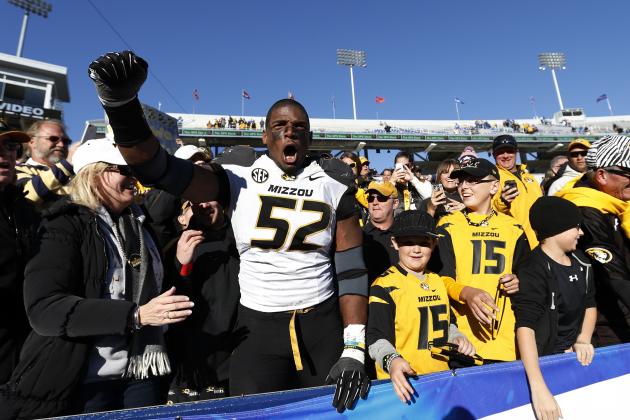
Joe Robbins/Getty Images
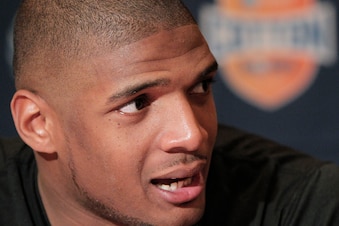
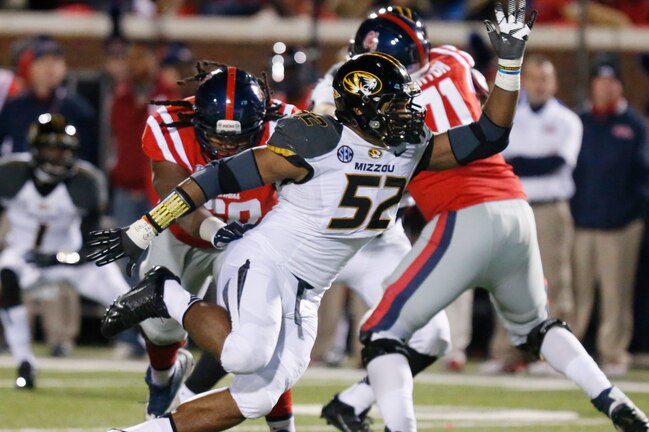
One of the last barriers of bigotry in all of professional sports will soon fall: Former Missouri star defensive end Michael Sam, an All-American and the SEC Defensive Player of the Year, has come out as gay.
Sam is expected to be a high-round draft pick in May, which would set a series of historic firsts in motion. He would be the first openly gay player drafted. Since most high-round picks make NFL rosters, he'd also likely be the first openly gay player in NFL history.
"I came to tell the world that I'm an openly, proud gay man," he told Chris Connelly of ESPN's Outside The Lines Sunday night.
“Michael has shown great courage in taking this step and not only do we support him, we are incredibly grateful. His decision to welcome us all into his world as he embarks upon a professional NFL career is an honorable one. This moment will resonate in a unique and important way for countless people, particularly LGBT youth,” said human rights activist Brendon Ayanbadejo, the former Baltimore Ravens player who has been advising Sam. Ayanbadejo is a member of the Athlete Ally Board of Directors, a group that fights homophobia in sports.
The announcement sets up a number of tests for the league, for Sam and for his fellow players.
For one, there will be a dizzying scouting combine that starts Feb. 19 in Indianapolis, which Sam is expected to attend. No draft prospect in the history of the combine has been dissected or discussed like he will be.
Brandon Wade/Associated Press
If Sam does attend, the combine will become one of the most heavily covered sports events in recent years because it would no longer be a sports-centric story. It will be talked about across the media spectrum.
One general manager told Bleacher Report that Sam will be a true test of whether the NFL is actually open to all kinds of players. He believes that if Sam falls past the third round, then "something stinks. Because this guy is easily a high-rounder."
Bleacher Report NFL Draft Lead Writer Matt Miller agrees that Sam's talents should result in his getting picked in an early round.
"As a player, Michael Sam was one of the most impactful defenders in college football last season," Miller said. "Playing left defensive end, he was able to produce All-American numbers by using his quickness off the ball and high-level instincts. The tape shows a smaller pass-rusher with good agility, but (at 6'2", 255 pounds) he might struggle to find a true position in the NFL...The production and burst are easy to fall in love with, though. Teams needing an outside pass-rusher will like the tools he brings and his developmental potential as a player."
The NFL released a statement to Bleacher Report saying: "We admire Michael Sam's honesty and courage. Michael is a football player. Any player with ability and determination can succeed in the NFL. We look forward to welcoming and supporting Michael Sam in 2014."
Sam will have to withstand being the center of attention outside and inside the locker room. And many believe his teammates may have a hard time accepting him.
The NFL reiterated it has a workplace conduct policy that prohibits discrimination of any kind. A portion of the collective bargaining agreement also states: "There will be no discrimination in any form against any player by the NFL, the Management Council, any Club or by the NFLPA because of race, religion, national origin, sexual orientation, or activity or lack of activity on behalf of the NFLPA."
The historic nature of this cannot be overstated. An openly gay player in America's most popular sport has the potential to change a great deal all across the sports world. Gay NFL players—as well as players in other sports—have come out after they retired but never during their career, or, as Sam is doing, as their NFL career is beginning.
Sam's declaration has the potential to open other fronts on this issue as well. It can make current closeted NFL athletes less fearful. It could provide support to younger athletes, in high school or younger, that they don't have to deny their sexuality.
Sam told ESPN that he knew from a young age that he was gay.
"It shouldn't be a big problem" to people, Sam said.
"I want to be a football player in the NFL," he added.
When asked how he thought his future NFL teammates would feel, Sam said, "It shouldn't matter."
"I'm not afraid of who I am."
Sam told his team some time ago he was gay. The team in turn not only had no problem with Sam's sexuality, they protected him. One Missouri player told Miller: "98 percent of the NFL could care less about someone being gay. It's the two percent that make us look bad."
The player added, "I got his back."
The reaction from NFL players, team executives and league officials queried by Bleacher Report was mostly positive but also cautious. Some of the players did not want to be identified out of fear of repercussions from the league.
What all agreed on was that Sam would face immense pressure. While Sam won't be the first openly gay player to try to make an NFL team, he will undoubtedly be the first to earn a roster spot, and most assuredly be the highest-profile player to do so.
In many ways, this is a huge test of the NFL's belief that an openly gay player would suffer no discrimination in the sport. This is a belief that has been privately stated by some NFL officials for years. Yet other officials believed the league is still some three to five years away from being able to handle an openly gay player.
One player called Sam the "gay Jackie Robinson." Yes, that is pressure. (Though the better comparison might not be Robinson, but instead, Charles Follis, one of the NFL's first black players.)
The disagreement begins with the question of how Sam will be treated. One veteran player said Sam will be welcome in most locker rooms and will have few problems. Another player said that "half of the NFL's locker rooms will accept him and half won't. It's a roll of the dice whether he would be accepted or not."
A third player explicitly said that he felt the player would face bigotry no matter what team he played for because homophobia still is common in the NFL despite the league's best attempts to eliminate it. The player said Sam "would be targeted by players on the field and fans off of it."
"Just look at the Dolphins and (Richie) Incognito," said the player. Text messages between Incognito and Jonathan Martin featured repeated use of gay slurs. The player also pointed out what happened in Minnesota to former Vikings punter Chris Kluwe. Kluwe alleged he was released because of his outspokenness on gay issues and that his position coach repeatedly used gay slurs. The Vikings deny this.
Players also point to interviews done by the NFL Network's Andrea Kremer in which players state pessimism about how the first openly gay player would be treated.
Rogelio V. Solis/Associated Press
"There's such a stigma with gay and homosexuals within male sports," said Washington linebacker London Fletcher to Kremer. "It would be very difficult for that first person to come out."
New Orleans linebacker Jonathan Vilma told Kremer, "I think that he would not be accepted as much as we think he would be accepted, I don't want people to just naturally assume, like, 'Oh, we're all homophobic.' That's really not the case. Imagine if he's the guy next to me and, you know, I get dressed, naked, taking a shower, the whole nine, and it just so happens he looks at me. How am I supposed to respond?"
"That attitude is more prevalent in NFL locker rooms than you think," one of the players interviewed by Bleacher Report said.
The comments to the NFL Network follow the strong anti-gay remarks made by San Francisco 49er Chris Culliver at last year's Super Bowl. Also, at last year's combine, at least one team asked several players were asked if they liked women.
Team and league officials interviewed vehemently disagree that the NFL is homophobic. One team executive said Sam would be "the most protected player in NFL history" because neither the team he goes to nor the league itself would want anything to happen to Sam.
"Imagine how humiliated the league would be if the first openly gay player to be in the NFL suffered from extreme bigotry?," the team official said.
A league official said the NFL is ready for a gay player and that teams and players would treat Sam like any other player.
When Sam this past season was named the conference Defensive Player of the Year, he was the first player from the Missouri program to earn the honor since tackle Jeff Gaylord was Big Eight defensive player of the year in 1981. Sam doing the same about 35 years later was considered a great piece of history.
But that pales to what Sam has done now.
Thursday, January 23, 2014
Michael Kimmel - How Can We Help Women? By Helping Men
It was nice to see this article from Michael Kimmel in the Huffington Post. This is the fundamental idea that feminism is missing in its often radical views of men and masculinity.
How Can We Help Women? By Helping Men
Michael Kimmel
Posted: 01/17/2014
In her thoughtful op-ed in the New York Times, family historian Stephanie Coontz answered the question "How can we help men?" with a ringing endorsement of gender equality: "By helping women," she answered.
I'd like to suggest the converse is equally true. How can we help women? By helping men.
Women's progress towards equality is incontestable; it seems obvious that we are, today, more gender equal than we have ever been in our history (I hasten to point out that we are not "there" yet, that we have not fully achieved gender equality, just that we are closer than we have ever been.) But progress towards greater equality has slowed: Women have pushed the glass ceiling higher on the corporate ladder, but all that leaning in has not crashed through to the board room. Girls and women compose half of all students in our law, medical and business schools, and have made enormous strides in STEM courses, yet working mothers are doing more housework and child care than they did 30 years ago. Every day, we read stories of sexual assault -- in our schools, homes, at parties and in our military.
How can we further the campaign for women's equality? How can we help women get there?
By helping men. Particularly, we need to help men decouple those aspects of masculinity that hold men -- and women -- back from living the lives they say they want.
This is crucial. A 2013 survey by the Pew Research Center found that women and men rated "being a good parent" (94% of women, 91% of men) and "having a successful marriage" (84% of women, 83% of men) equally highly -- and nearly twice as important as "being successful in a high-paying career." (Interestingly, women rated career aspirations slightly higher than men did, 51% to 49%).
So women and men want the same thing: good careers, loving relationships and happy families. Women are advised to lean in or to opt out -- as if they can do it alone. But women can't have the lives they want without some support from men. Men: We need to listen up.
Let me offer a few examples. Take education. Four decades after a concerted effort to remedy dramatic gender discrimination in education, we read today about a "boy crisis" -- gender disparities in college attendance, a gender-grade gap with girls earning better grades and taking most academic honors, while boys populate the detention room, special education classes and are diagnosed with ADHD far more often. Remedies abound, from the sensible (greater attention to individual learning styles) to the illogical and possibly unconstitutional (single-sex classes with thermostats set at different temperatures, gender-specific classroom seating arrangements and course materials, all based on outdated stereotypes).
In reality, much of the cause of the "boy crisis" in education lies with the definition of masculinity held by the boys themselves -- the notion that academic disengagement is proof of masculinity. Helping boys to engage academically requires that we recognize different learning styles along an array of measures -- which in turn leads to recognizing diverse aptitudes and competencies, enabling everyone, girls and boys, to better achieve to their potential.
Or take balancing work and family. We know that women will not be able to balance work and family until -- well, until men do.
Twenty years ago, I wrote an article in the Harvard Business Review entitled "What Do Men Want?" In it, I asked men who worked for companies that offered parental leave to men why they didn't take it when they became fathers. Each one told the same story: His colleagues wondered loudly if he was really committed to his job, his supervisor gave his permission with a promise that he'd be put on the "daddy track," a stalled track that would not end in partnership. In each case, it was other men who had created a workplace climate that thwarted these fathers from taking the opportunity they wanted to take.
This has really changed. As an article in The Atlantic makes clear, men are not being policed as arduously by other men. And, as Liza Mundy writes, "the true beneficiaries of paternity leave are women." As a result, over the past two decades men have stepped up on the home front. Well, not exactly stepped up -- more like stepped out. Men are doing marginally more housework, but significantly more childcare than they did a generation ago. This separation of housework and childcare has resulted in a new phenomenon: Dad has become the fun parent. Dad takes the kids to the park to pay soccer while mom cleans the breakfast dishes, makes the bed, does the laundry and prepares lunch. The kids come home proclaiming what a great time they had and what a great parent dad is.
If we want to help women, we need to help men find all those inner joys of housework that anti-feminists have been celebrating for decades -- or at least get us to do our share.
What about health? Yes, we know that women outlive men by about 5 years, 81 for women and 76 for men. Men are more likely to die of stress-related illness and miss work due to workplace accidents. By defining masculinity as risk-taking stoicism, men are less likely to have routine screenings, less likely to comply with workplace safety in the name of proving masculinity. Our notions of masculinity deprive our spouses and partners and families of our presence for those five years because of our adherence to these ideals of masculinity.
Finally, let's get even more intimate. Decades of research have shown that the more men subscribe to what we might call "traditional" notions of masculinity -- that manhood is defined by strength, aggression, emotional toughness and sexual prowess -- the more likely they are to believe that male-female relationships are adversarial, that control of women is central to manhood and that violence is sometimes necessary to control a female partners -- beliefs that can sometimes translate into behaviors like earlier first sex, higher rates of HIV and STDs and violence.
Conforming to these traditional ideas of masculinity may be hazardous to our health, but it is also hazardous to the health of our wives, partners and children.
What's common among these is that men often feel they must prove their masculinity -- and they must prove it to other men. One wants to be a man's man, a man among men. (Who wants to be a ladies' man?)
We need to help men reduce the power of that gender policing -- the fear that other men will see us as less than manly if we listen to the voices in our own hearts about how we want to live our lives.
If the past few decades have made anything clear it's been that we are neither Martians nor Venusians. And what's good for Earthlings -- male and female -- is good for all of us. If we want to help women achieve greater equality, we have to engage men.
Sunday, November 3, 2013
Nike Uses #BeTrue Campaign To Make $200,000 Donation To LGBT Sports Coalition

Awesome - it's nice to see a company that makes billions (Nike owner Phil Knight is worth about $16 billion all by himself) donate a couple of hundred thousand dollars to a worthy cause. If Knight would personally donate once to this cause in the same manner he does for University of Oregon athletics (he's given them $300 million over the years), he could reach the whole country and not just people who wear Nike shoes or are sports fans.
Nike Uses #BeTrue Campaign To Make $200,000 Donation To LGBT Sports Coalition
By Travis Waldron on November 1, 2013

CREDIT: Nike
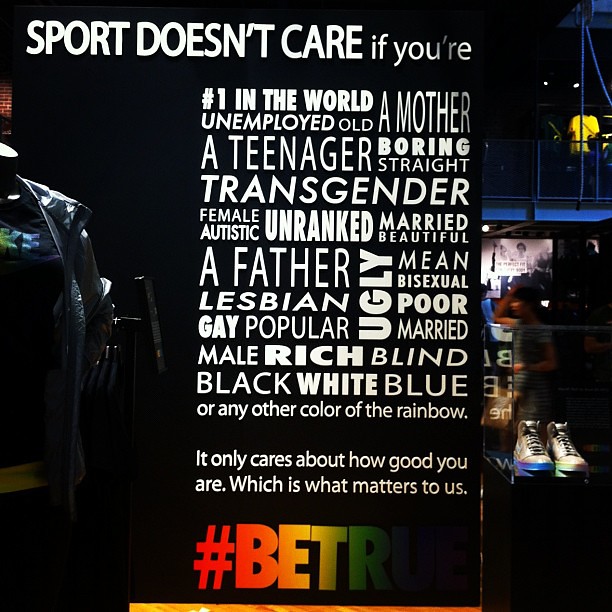
Earlier this year, Nike, the world’s largest sporting apparel company and an absolute icon in sports, launched a line of shoes and other products meant to promote LGBT equality in sports. The #BeTrue line wasn’t just a marketing ploy from Nike, since it also pledged to donate all proceeds from the shoes and clothing line to the LGBT Sports Coalition, which is fighting to end homophobia in sports by 2016.
In October, that promise came to fruition when Nike donated $200,000 to the coalition. The donation, according to Campus Pride, one of the groups affiliated with the coalition, is the first-ever made to the LGBT Sports Coalition and the largest Nike’s employee network has ever made to an LGBT cause. The funds will go to support all of the projects the coalition has worked on since Nike sponsored the first-ever LGBT Sports Summit at its headquarters in June 2012, the same year it launched the #BeTrue apparel line.
“Today we need more corporations to speak up and take a stand against anti-LGBT bias and bullying in sports,” said Shane Windmeyer, executive director of Campus Pride, said in the release. And I think that’s a key point that Nike’s partnership here is going to drive home.
That a huge company like Nike jumped to the front of efforts to fight homophobia in sports might seem radical, the actual strategy isn’t. The shoes and clothes Nike produced to market the cause fit squarely into a trend in sports fashion that was already pushing the boundaries of acceptability and comfort for the stereotypical straight male athlete. That trend — Grantland’s Wesley Morris has called it “the quiet queering of professional sports” — has blurred lines between men and women and what might be perceived as unacceptable or gay or simply weird.
What Nike has done is take that trend and run with it. Inclusivity has always been a staple of Nike’s advertising, and now it’s expanding that to an LGBT audience that has often been left out of the sports world. It’s promoting its #BeTrue line and endorsing athletes like Brittney Griner and letting her market men’s clothes for the company, all the while telling sports fans and apparel buyers that it’s cool to be who they are, no matter whether they’re part of the LGBT audience, sympathizing with the LGBT audience, or someone who just likes the shoes. At the same time, they’re going one step farther, not just preaching that message but putting considerable weight behind the causes that matter to that audience too.
That obviously gives Nike ample business opportunities. But a more equal sports world is in and of itself a better business opportunity for everyone involved. That’s what Nike’s involvement here is saying, and judging by the actions of other companies, including Nike’s competitors — Adidas endorsed Oregon’s marriage equality amendment two weeks ago — that message is starting to sink in to the corporations Campus Pride and the LGBT Sports Coalition are asking to step up.
Friday, March 29, 2013
Omnivore - Gendering Everything
From Bookforum's Omnivore blog, a great collection of links on gender studies, masculinity, tough guys, and how being attractive makes men funnier (and here I thought being funny might be make me more attractive).
Gendering everything
MAR 28 2013
Gendering everything
MAR 28 2013
9:00AM

- Katharine K. Baker (IIT): Sex and Equality.
- Emma Poulton (Durham): “If You Had Balls, You'd Be One of Us!” Doing Gendered Research: Methodological Reflections on Being a Female Academic Researcher in the Hyper-Masculine Subculture of “Football Hooliganism”.
- Christian Williams on the trouble with tough guys.
- Erika Bachiochi on why U.N. feminists should want to partner with the Holy See.
- It’s well-established being funny makes men more attractive — now a new paper reports that being attractive makes men funnier.
- Sympathy for the stay-at-home mom: Judith Shulevitz on an argument about work, life, and the modern calendar.
- The final feminist frontier: Why men still don't do their share of the dirty work.
- The retro wife: Lisa Miller on feminists who say they’re having it all — by choosing to stay home.
- Donald N.S. Unger on how men can't have it all either.
- Yes, we’re still gendering everything.
Monday, March 11, 2013
The Two Sexes - Bookforum Omnivore
From Bookforum's Omnivore blog, a new collection of links on men, women, gender equality, boys, differences in how men and women process visual stimuli, and high heels.
The Two Sexes
MAR 1 2013
2:00PM

- Marie Sarlet, Muriel Dumont, Nathalie Delacollette, and Benoit Dardenne (Liege): Prescription of Protective Paternalism for Men in Romantic and Work Contexts.
- Patricia A. Seith (Stanford): Congressional Power to Effect Sex Equality.
- Vera Trappmann (Magdeburg): Being Unemployed: Masculinity, Change Competence and Identity.
- Anca Gheaus (Sheffield): Three Cheers for the Token Woman.
- From Contexts, Niobe Way, C.J. Pascoe, Mark McCormack, Amy Schalet and Freeden Oeur on the hearts of boys.
- Where men see white, women see ecru: Neuroscientists prove what we always suspected — the two sexes see the world differently.
- Why do women wear high heels? Because men did.
- Is fourth-wave feminism all about boobs and beauty? Hadley Freeman reviews Sexy Feminism by Jennifer Keishin Armstrong and Heather Wood Rudulph.
Friday, December 7, 2012
Congratulations to Dan Savage and Terry Miller, Finally Legally Married

I would like to extend a heart-felt congratulations to author, advice columnist, and co-founder of the It Gets Better Project, Dan Savage and his fellow co-founder and long-time partner Terry Miller on their marriage, which is finally recognized by law. Now their son DJ can proudly say, "My daddies are married!"
I've been reading Savage Love for more than 15 years, and have not always agreed with Savage, especially on open relationships (although he always points out the incredible difficulty of doing those well and on-goingly), but I have always admired his honesty and bluntness - as evidenced in "Dump the motherfucker already," better known to his readers as DMFA.
I have enjoyed his political consciousness and advocacy for basic human freedoms around harm-free sexuality with which government often seems to have a problem. More importantly, to me,he is open to new information and perspectives; for example, he initially supported Bush's invasion of Iraq, but eventually felt that Bush had not made a legitimate case for invasion (nor has convinced the UN and our allies). Eventually (2005) he felt the whole thing had been a disaster.
Anyway - offering blessings to Dan and Terry for a long and happy life together.
By the way, the Good Men Project also posted a nice note of congratulations:
Dan Savage and Terry Miller Legally Married At Last
December 6, 2012 By
The famed sex columnist and his husband were among the first to take advantage of Washington state’s new law recognizing their union.
We at the Good Men Project congratulate Dan Savage and Terry Miller on the legal recognition of their marriage in Washington state, as reported by the San Francisco Chronicle, which also has a slideshow of images of the happy couple receiving their official marriage license. Mr. Savage has been a longtime advocate for greater sexual and gender freedom for all people, and has worked to break down stereotypes and end oppression and bullying based on sexuality or gender. These are goals we at the Good Men Project share, and we hope that these ideals will continue to spread until they’re considered self-evident, painfully obvious, and frankly a little old-fashioned. We wish Mr. Savage and Mr. Miller continued happiness in their union.

Wednesday, November 7, 2012
Why Did 16 Eagle Scouts Return Their Pins?
This is via BuzzFeed, and it was posted a couple of weeks ago. One might easily assume these letters are in response to the recent release of documents showing the Boy Scouts had known about and not reported child molesters in their ranks (they did however ban them from any involvement and kept a list of names so that they could not go to another town and perpetrate). But they aren't - they are in protest of the decision by the National Executive Board of the Boy Scouts recently to reaffirm its ban on gay scouts and scoutmasters.
As one of the young men below states:
As one of the young men below states:
Being “mentally awake and morally straight” means thinking for yourself and standing up for others in times of inequality. Every boy in this country deserves to have the opportunity to take part in scouting regardless of sexual orientation.The young and not-so-young men represent the values I would hope our sons be taught - discrimination of any kind is wrong and should not be tolerated.
16 Eagle Scouts Returning Their Pins
These Scouts penned open letters to the Boy Scouts of America to explain why they can no longer be affiliated with an organization they dedicated years of their childhood to be a part of.
Reported by Stacy Lambe
1. James S. Kleven, Troop 18
 Via: eaglebadgesI left the Boy Scouts when I was sixteen, grappling with the conflict between my sexuality and the BSA’s ban on openly gay members. Though I regret that I was not brave enough then to be honest about my reasons for leaving, I realize now that no young man should be forced to make that awful decision.Via: eaglebadges[T]he day I obtained the Eagle rank was a very proud moment, but not only for the same reason it is for most. For nearly a decade now, I have felt a great sense of accomplishment at having earned the Eagle rank as such an unlikely candidate. But this pride doesn’t outweigh the burden on my conscience.Via: eaglebadgesI looked at the Boy Scout Handbook in relation to someone who is gay and only saw disappointment on numerous occasions. I took a promise as a Boy Scout to live by the Scout Oath and Law and as my values are no longer aligned with those of the BSA through defending those who are gay. I am being reverent and faithful in my religious beliefs and that is why I am returning my Eagle Scout Badge and certificates received from many including the President of the United States, New York Governor and Senator, my high school, Boy Scout Troop and others.Via: eaglebadges


Being a leader of men does not come with a ‘straight’ prerequisite. That the National Executive Board recently reaffirmed a ban on gay scouts and scoutmasters is deeply troubling. In the course of my career as an entertainer, I have met and worked with numerous members of the LGBT community – many of whom have told me it wasn’t so much a choice that they made as it was an affirmation of who they were. After all, no rational adult would choose a life of constant ridicule, harassment and rejection.Via: eaglebadges
Friday, July 6, 2012
Alex Taylor - Making Men Partners in the Mission for Gender Equality in Lebanon
It's great to see an article like this from a paper in Lebanon - it would be equally great to see more thinking like this in the mainstream of the U.S., rather than going for the shock stories like "The End of Men" and other similar fertilizer.
Too often efforts to align men with anti-violence campaigns ignore the socialization that men have received, treat the men as though they are or will be perpetrators, and simply fail to meet men where they are in their lives. I have long believed that the best way to reduce male violence against women is to help men better understand themselves.
According to the article, a primary purpose of the men’s center is to assist me in understanding "their own gender roles and how it has worked against them.”
From Lebanon's The Daily Star.
Too often efforts to align men with anti-violence campaigns ignore the socialization that men have received, treat the men as though they are or will be perpetrators, and simply fail to meet men where they are in their lives. I have long believed that the best way to reduce male violence against women is to help men better understand themselves.
According to the article, a primary purpose of the men’s center is to assist me in understanding "their own gender roles and how it has worked against them.”
From Lebanon's The Daily Star.
Making men partners in the mission for gender equality
July 06, 2012
By Alex Taylor
Abaad’s publicity campaign shows the stresses men encounter in many occupations.
BEIRUT: A real man is strong – he can recognize and express his emotions, and, yes, he may even cry. By establishing a men’s center to examine masculinity in Lebanese society and provide men with a place to talk about their stresses and needs, the Abaad Resource Center for Gender Equality hopes to help men become partners in addressing issues such as domestic violence and achieving a more equal society.
Too often, discussions about domestic abuse or women’s empowerment sideline or even demonize men, says Anthony Keedi, manager of the center.
“One reason there has been such resistance from men toward women’s human rights initiatives is because of a lack of targeting men as a demographic and understanding the gender roles that have also been dictated upon men as well as women,” he adds.
Keedi explains that commonly in the field of gender rights activists “seem to not address men at all or address men as the aggressors, or as having a negative or evil intent.”
A central goal of the men’s center, he says, is to “allow men to begin to see their own gender roles and how it has worked against them.”
“One very crucial part of the masculine gender role is about emotional expression or lack thereof. Men are not expected to seek help. In fact, they are a population where help-seeking behavior is seen as a weakness ... A man should have the solutions, a man should fight, a man should be strong and not let these things affect him. Speaking from a psychological point of view, that’s not characteristic of human nature – it’s human to be able to mourn or be able to cry or communicate,” Keedi insists.
In addition to workshops on stress and anger management, the center, located in Furn al-Shubbak, offers individual psychological counseling to help men reconsider the way they address problems in the home or daily stresses. The service is free, completely private and confidential.
One common stress cited by those who have already come to the center is financial pressure, says Keedi. While financial and work problems will be ever-present, the center’s work is to show ways to cope, rather than taking their frustrations home with them and further compounding their problems by creating discordance in their family.
“One problem can lead to problems at home, which will lead to feeling even more isolated, even more stressed, even more anxious,” Keedi says, which can, in some cases, “lead to violence or a psychological state where the man is unhappy and others around him are unhappy.”
Unfortunately, the reactions to stress that are considered “understandable masculine responses” are not very healthy, Keedi highlights.
“It might not be looked upon well, but it’s understood if they act violently or if they act out in anger in response to stress ... as opposed to saying we should sit down and talk about it.”
Through individual counseling, the center helps beneficiaries look at the ways they process stress and how it affects them and those around them.
“When you hurt someone you’re living with, you’re hurting the one who is supposed to help you through difficulties and is supposed to listen and be your partner in everything – whether the spouse or the children. So it’s not just affecting others around him, it’s affecting the man’s own life,” says Dr. Ghassan Assaf, the center’s psychologist.
Assaf says that many of the men who have sought counseling at the center begin to realize that their angry or explosive behavior is actually a weakness rather than a sign of strength or masculinity. They come to see that “to be strong is to handle all the family stress, all the life stress or economical stress ... not to explode all the time. This means they were weaker before.”
Despite the breakthroughs of some of the center’s clients, reaching out to men in Lebanon and encouraging them to seek help is not the easiest task, both Assaf and Keedi acknowledge. While Abaad has offered the counseling service to men since September of last year, the men’s center only launched fully in June with a nationwide publicity campaign.
Through billboards and TV spots showing men experiencing stress in their professions – whether as a doctor, electrician, taxi driver or vegetable seller – the campaign allows men to see that stress is common and men from all different backgrounds can experience problems that they can’t solve alone.
The response to the campaign has been overwhelming, says Keedi, with over 150 calls to the men’s center in the last few weeks alone. Other organizations are also becoming aware of the service and referring people to counseling at the center. As a result, Abaad is already looking to expand counseling hours and add another psychologist.
While not every inquiry to the center ends with that person scheduling or showing up for their appointment, Keedi believes the response is encouraging and an important first step.
“Men have been raised in a certain way their entire lives. Their entire lives they’ve been told, ‘don’t talk, don’t cry,’ and then all of a sudden they’re getting another message, which inherently feels true, because it’s a natural, human need to speak and relieve stress. But it’s not going to be easy ... because their whole lives they’ve heard the opposite.”
Abaad is also in the process of conducting a nationwide study on perceptions of masculinity in Lebanon and will use the results to design more programming in the coming months.
Ultimately, Keedi hopes men will realize that they have nothing to lose, but everything to gain by calling the center and taking the time to invest in their own well-being, for themselves and the sake of their families.
“What they can pick up in the center is a greater understanding of themselves and perhaps ways they can keep stresses in one aspect of their life from negatively affecting other aspects or their life. Hopefully they will actually be able to enjoy those other aspects of their life a little more – such as their interactions at home with their loved ones and their family and friends.”
For more information contact the Abaad center 24-hour phone line at 71-283-820.

Thursday, June 28, 2012
Men and Feminism: A Good Men Project Roundtable
A disturbing number of men tend toward the opinion that if we are devoted to helping men, then we must, by default, oppose feminism. There seems to be a tendency toward defining all feminism (and feminists) by the rantings of the most extreme voices in the feminist cause - the radical feminists.
Clearly not all men's movement guys are SNAGs (sensitive New Age guys) or misogynists, so it is equally true that not all feminists are man-haters. Why is that so hard to accept?
The Good Men Project has convened a roundtable on men and feminism - some views I understand, some I do not. I'll let you decide which ones are worthwhile.
Clearly not all men's movement guys are SNAGs (sensitive New Age guys) or misogynists, so it is equally true that not all feminists are man-haters. Why is that so hard to accept?
The Good Men Project has convened a roundtable on men and feminism - some views I understand, some I do not. I'll let you decide which ones are worthwhile.
Men and Feminism: A Good Men Project Roundtable
June 28, 2012 ByIf there’s one thing we’re all about here at the Good Men Project, it’s discussion. So when our erstwhile founder Tom Matlack wrote a controversial post about how he sees the role of feminism in discussions of men’s issues, we figured this was something worth talking about. Below you’ll find Tom’s original post, as well as a collection of response pieces from a number of our favorite contributors, representing many different points of view on this important issue.Why Being a Good Man is NOT a Feminist Issue
Tom Matlack envisions a place where men can share stories of their struggle for goodness man-to-man apart from what women or feminists might say about that story.♦◊♦Why Being a Good Man is Definitely a Feminist Issue
Noah Brand makes the case that gender theory applies to both genders.♦◊♦These Are The Stories that Change Everything
Lisa Hickey responds to an article in The Atlantic about ‘having it all’ and debates feminism and Tom Matlack along the way.
♦◊♦Is Men vs. Feminism Even a Relevant Discussion?
Jesse Kornbluth asks why, with women’s rights under attack in America and around the world, we should argue about who gets to be in the club against these abuses.

Wednesday, May 16, 2012
Barack Obama - ESPN Man or First Gay President?

It's been an interesting week for President Barack Obama's masculinity. Depending on who you read, he is either the ESPN man ("postfeminist in his values, but also thoroughly traditional in style — hypercompetitive, restrained, not given to self-doubt, rarely self-indulgent") or the first gay president ("he intuitively understands gays and our predicament—because it so mirrors his own").
There is something chameleon-like in his ability to be so many things to so many people. For the conservative David Brooks of the New York Times, "he is self-disciplined, traditional and a bit formal. He is willing, with drones and other mechanisms, to use lethal force." In other words, he embodies traditional codes of masculinity. Meanwhile, the liberal Andrew Sullivan of Newsweek/The Daily Beast, was "utterly unprepared for how psychologically transformative the moment would be. To have the president of the United States affirm my humanity—and the humanity of all gay Americans—was, unexpectedly, a watershed."
There is probably no place in American culture (excluding the military) where being gay is accepted and supported less than it is in professional sports, the world that ESPN covers and glorifies. And yet, in one week, Obama is both the ESPN man and the first president who invites gays and lesbians back into the culture that has denied them recognition and equality.
If the election were held based on the characters of the two men involved, it's no contest - Obama is a transforming figure and Romney beat up gay kids in high school. Obama has fought, in however a misguided way, to make healthcare available to everyone, and especially the poor, while Romney is "not concerned about the very poor."
I highly recommend both of these columns for their differing views on Obama. The reality is not either/or in this case, it's both/and. Obama can be both very traditionally masculine in his behaviors and personality and still be post-feminist and supportive of the rights of all citizens, without discrimination.
David Brooks - The ESPN Man
Andrew Sullivan - Barack Obama: The First Gay President
Tuesday, May 15, 2012

Thursday, July 14, 2011
Former Dallas Cowboys Receiver Michael Irvin Favors Gay Rights and Equality
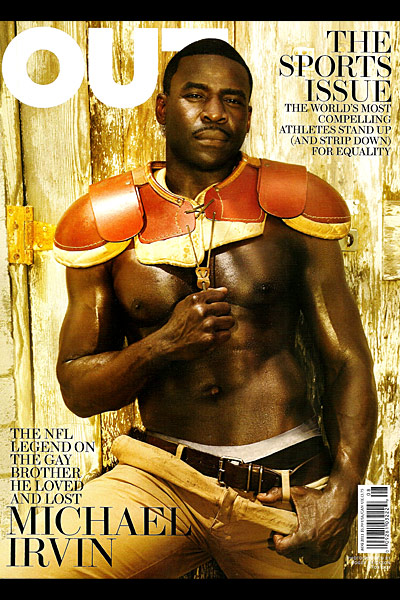
Dallas Cowboys great, and NFL Hall of Fame receiver, Michael Irvin is in (and on the cover of) the current issue of Out, championing equality for LGBT folks - very cool to see more males athletes taking a stand for LGBT equality.
It's great to see this from an NFL player - as I have mentioned before, sports - and even more so professional sports - tend to be incredibly homophobic. When an icon like Irvin (and to be clear, I've never really liked him much as a person) takes a stand in support of equality, it has a ripple effect.
Michael Irvin champions equalityFormer Dallas Cowboys great Michael Irvin appears shirtless on the cover of this month's gay men's magazine Out and discusses his passion for equality issues.
Irvin publicly acknowledges that the impetus for taking a stand comes from his relationship with his gay brother, Vaughn, who died of stomach cancer at age 49 in 2006. Irvin had not spoken publicly about his brother previously, according to the magazine.
In the article, Irvin describes how his brother's sexual orientation contributed to his own issues.
He says that he found out his brother was gay in the late 1970s, when he found Vaughn wearing women's clothing. Michael Irvin was rattled by the experience and has figured out since that it contributed to his own womanizing behavior. Working with a Dallas area bishop, T.D. Jakes, Irvin looked at the past.
"And through it all we realized maybe some of the issues I've had with so many women, just bringing women around so everybody can see, maybe that's the residual of the fear I had that if my brother is wearing ladies' clothes, am I going to be doing that? Is it genetic?" Irvin said to Out. "I'm certainly not making excuses for my bad decisions. But I had to dive inside of me to find out why am I making these decisions, and that came up."
Irvin says that his father, Walter, helped him learn a tolerant form of Christianity because the elder Irvin accepted his gay son and encouraged him to love his brother unconditionally.
He remained close to his brother, one of 16 siblings, until his death.
"He was the smartest, most charismatic man I'd ever seen in my life," Irvin said.
Irvin now believes the African-American community should support marriage equality.
"I don't see how any African-American, with any inkling of history, can say that you don't have the right to live your life how you want to live your life," he said, according to the magazine. "No one should be telling you who you should love, no one should be telling you who you should be spending the rest of your life with. When we start talking about equality, and everybody being treated equally, I don't want to know an African-American who will say everybody doesn't deserve equality."
The Hall of Fame wide receiver believes that this work matters more than his football career.Graziano on Irvin's Stand
You might not approve of Michael Irvin's views. But his comments in support of gay marriage equality were the right thing to do, writes Dan Graziano. Blog
"The last thing I want is to go to God and have him ask, 'What did you do?' And I talk about winning Super Bowls and national titles," Irvin said, according to Out. "I didn't do anything to make it a better world before I left? All I got is Super Bowls? That would be scary."
Irvin would support any athlete who wants to come out.
"If anyone comes out in those top four major sports, I will absolutely support him. ... When a guy steps up and says, 'This is who I am,' I guarantee you I'll give him 100 percent support," Irvin said.
And if the player produced on the field, he would have supported a gay teammate as well. Winning was paramount.
"I believe, if a teammate had said he's gay, we would have integrated him and kept moving because of the closeness," Irvin said, according to the magazine.
He believes the team that won three Super Bowls could have integrated an openly gay teammate as well as any team.
"We had a bunch of different characters on that team," Irvin said. "Deion [Sanders] and Emmitt [Smith]. I believe that team would have handled it well."

Tags:
Subscribe to:
Posts (Atom)