Showing posts with label gay marriage. Show all posts

Tuesday, December 24, 2013

The Great American Gender Debates of 2013 (The Atlantic)

I almost missed this article from The Atlantic on the top gender stories in 2013, but then I saw my high school classmate, Ty Burrell in the picture. I wish I could say, "I knew him when . . ." but I really didn't. And not having television, I didn't even know he was actor (even though we were at Southern Oregon University during the same years) until he won an Emmy. Then I saw him in one of my favorite indie films from the past few years (set in Tucson), Goats.

Anyway, this is an interesting recap of the year's top gender stories.

The Great American Gender Debates of 2013

From Supreme Court cases to blockbuster films, these are the narratives on sex and gender that dominated the news this year.

Heather Horn and Svati Kirsten Narula | Dec 17 2013  


Some of the biggest stories and debates in the media in 2013 had to do with gender relations—LGBT rights, women in the workplace, parenting styles, and more. Same-sex marriage gained more approval and legitimacy than ever this year, both in public opinion polling and as a matter of federal law. Sheryl Sandberg told women to "lean in" at the office, while the military told women they were now permitted to "lean in" on the battlefield. Bradley Manning became Chelsea Manning. And researchers offered up interesting new studies for individuals seeking a happy home life.

Here are our picks for the most interesting narratives about sex and gender in 2013.

Gay Marriage Starts to Influence Straight Marriage 


On June 26, the Supreme Court struck down the Defense of Marriage Act, which had denied federal benefits to gay couples legally married in their states. In The Atlantic’s June cover story, Liza Mundy argued that gay marriage has the potential to change straight marriage—for the better. Mundy pointed to research showing higher rates of satisfaction in same-sex unions. Same-sex partnerships, researchers quoted in the piece suggested, may finally shed light on an old question: How much of the conflict we’ve come to see as inherent in heterosexual marriage is about marriage, and how much of it is about gender roles? Same-sex couples often have different approaches to handling chores, childcare, and intimacy, Mundy noted. Maybe straight couples have something to learn.

Intriguingly, however, it appears there’s one area where gay marriage is reinforcing traditional norms: name-changing.

Marissa Mayer Shakes Up the Work-Life Debate 


"Marissa Mayer is a CEO first and a woman second," wrote Anne-Marie Slaughter in February. (Henny Ray Abrams/Associated Press file photo)
Marissa Mayer was already a divisive figure and potential feminist icon when the year opened, having become CEO of Yahoo in July 2012 and taken only two weeks of maternity leave that October before returning to work. In February of 2013, she made headlines again with a controversial ban on telecommuting. Some called Mayer hypocritical for having made life more difficult for Yahoo’s working parents while she, herself, could afford to have a private nursery built next to her office. In April, though, Mayer doubled paid maternity leave for mothers and instituted a new eight-week paid paternity leave to fathers. Critics hailed the move as a first step towards gender-parity in parenting.

Marriage Is Good for Your Career—If You’re a Man


In January, the American Historical Association revealed the results of its 2010 Career Paths Survey. As Alexis Coe reported for The Atlantic, the study showed not only that men progressed quicker from associate to full professor than women did, but also that marriage hastened a man’s promotion, while slowing a woman’s promotion. The difference was attributed, in part, to the support married men get from their female partners, who are more likely to take a leave of absence from their own jobs to aid a husband’s career. Another study Coe covered that same month suggested this isn’t just true in academia: It pays to be a married dad whose wife doesn’t work full-time.

Sheryl Sandberg Tells Women to Lean In 


March saw the release of Facebook COO Sheryl Sandberg’s book Lean In, an extension of her viral TED talk, “Why We Have Too Few Women Leaders.” Sandberg’s key contribution to the debate was not just to focus on sexism in the workplace: She also challenged women to speak up in the office, and not to check their ambitions out of a premature consideration for the pressures of motherhood.

Was the book too focused on upper-class women? Did it ignore gender differences and patronize “lean back” moms? Some critics thought so. But the book was also well timed. Recent studies had found women less likely than men to behave aggressively in the workplace, particularly when it came to asking for raises. And a study in January revealed that women were less likely even to talk about their salaries. The Atlantic’s Garance Franke-Ruta, among others, praised Sandberg for getting the conversation going. Rebecca Rosen pointed to the book’s message for men: Making workplaces and homes more equal not only requires their help, but could also benefit them, as well.

Women Will Fill Combat Roles, and Get Better Procedures for Reporting Sexual Assaults 


In January, Defense Secretary Leon Panetta announced, with hearty and unequivocal support from General Martin Dempsey, that the Pentagon would lift its controversial ban on women in combat. "I went back to teach at West Point in 1984 and found the place far better than it was when I had been a cadet,” said Dempsey when a reporter pressed him on how women would affect combat readiness. “I attributed a good amount of that to the fact that we opened up the academy to women." Dempsey also thought greater moves to include women would reduce the military’s pernicious sexual assault problem: "The more we can treat people equally, the more likely they are to treat each other equally.”

Politicians weren’t prepared to wait on that front. Debate over reforms in the military’s sexual assault reporting and prosecution process raged in Congress over the summer. On December 12, the House of Representatives voted by an overwhelming majority to pass the resulting defense policy bill.

Dempsey’s confidence that women could meet the standards required for combat roles got some support this fall: For the first time in history, women are set to graduate from the infantry training course of the U.S. Marine Corps. No allowances or adjustments were made to the physical fitness requirements. Remember those 17 percent of Marines who said in February they’d quit if women were allowed in combat roles? Time to find out whether they were serious.

Angelina Jolie Attempts to De-Stigmatize Mastectomies 


In May, actress Angelina Jolie revealed in a New York Times op-ed that she had undergone a preventative double mastectomy. She chose to remove her breasts, she wrote, after learning she carried the infamous BRCA1 gene. Her mother died of breast cancer. The message? “A woman is still sexy, even after she has her breasts removed and reconstructed,” argued The Atlantic’s Eleanor Barkhorn. “It’s hard to imagine a person who can say that with more authority than Jolie.”

Jolie’s revelation prompted an outpouring of anecdotes from other women. In November, television reporter Amy Robach underwent a double mastectomy following an on-air screening mammogram, prompting some to wonder whether American women were getting the wrong message about breast cancer options.

Sex and the College Girl 


The American media remain fascinated with the way young men and women flirt, hook up, and form relationships at college. The biggest stories this year revolved around sexual assault on campus: how to prevent incidents from occurring in the first place (should we just tell female students to stop drinking so much?), and how to make it easier for victims to speak up and seek justice. Whether the need to report assaults, in the interest of campus-wide safety and awareness, outweighs a victim’s desire to move on is also up for debate. Meanwhile, the NCAA was accused of turning a blind eye to Division I programs who set their high school recruits up with “hostesses” on official visits – another sign, according to author Jessica Luther, “that the culture of men’s Division I sports can be harmful to women.

Transgender Issues Gain Unprecedented Mainstream Coverage 


It’s an encouraging time for queer identities in America—or, at least, in the American media. The story of Chelsea-née-Bradley Manning—and the ensuing discussion of how and when federal prisoners get access to hormone therapy and sex re-assignment surgery—was one of several highlighting society’s shifting attitudes on defining gender. In The Atlantic, a few weeks after Matt Duron explained why he’s okay with raising a “gender-creative” son who wears dresses, Noah Berlatsky interviewed author Julia Serano about gender expression and biology. On Halloween, Duron’s wife Lori wrote about letting their son choose “girl costumes” instead of “boy costumes.”

Meanwhile, Harvard Business School's first openly trans student has been speaking up about why Harvard's progress is a good sign for society at large.

The Great Princess Debate Rages On 


In January, Saraswati Nagpal argued that princesses can be heroic role models for young girls, even if they’re not wielding weapons and conquering bad guys. Nagpal pointed to epic mythological tales from India for examples of princesses who display strength in domestic ways. Merida, the spunky red-headed princess from Pixar’s 2012 movie Brave, got a “sexy makeover” this May, which fans of her original personality—“a cross between Annie Oakley and Katniss Everdeen,” a tomboy who might even be lesbian—were not too happy about. The backlash against Merida’s enhanced femininity was maybe too reductive, argued Noah Berlatsky: There ought to be a middle ground between tomboys and girly-girls in princess-dom. Meanwhile, Andy Hinds tried to keep his twin daughters away from Disney’s Cinderella stories, thinking that a video of Sonia Sotomayor saying “being a princess is not a career” would help keep them away from what he called “the Princess Industrial Complex.” To his dismay, one daughter eventually just said: “I don’t want to have a real career.”

Women Who ‘Opt Out’ 


Ten years after Lisa Belkin wrote about “The Opt-Out Revolution” for the New York Times, Lisa Miller penned a cover story for New York magazine about the exact same thing: “Feminists who say they’re having it all – by choosing to stay home.” Is there anything wrong with highly educated professional women who are more interested in raising their kids than running the world? If the trend is less a reflection of women's preferences and more about inflexible, family-unfriendly workplaces, then maybe so. Relatedly, however, Emily Matchar pointed out what she calls the “new domesticity”: Mothers from all walks of life are making environmentalist, anti-consumerist political statements by staying home.

In August, The New York Times issued a controversial update on the original Belkin piece: “The Opt-Out Generation Wants Back In.” Apparently women who left the workforce for their families are now, whether due to divorce, restlessness, or economic necessity, rethinking the move—and having a hard time getting back into the market. The piece prompted The Atlantic’s daddy panel to protest that there’s no such thing as opting out. “Why did these women think they could get away with this?” Another writer offered the obvious but necessary reminder that “Keeping a Family Together Is Hard, Whether You ‘Opt Out’ or Not.”

The Year in Marriage Advice 


Is marriage changing? Earlier this year Conor Friedersdorf said he’s not sure that his own marriage is very different from his grandparents’ marriage. Two things that have shifted, though, according to public opinion polls, are attitudes about cheating and divorce. While divorce is becoming more and more acceptable, along with pre-marital sex and having children out of wedlock, public disapproval for cheating has skyrocketed. The new message, Hugo Schwyzer summarized, is “I’d rather be left than lied to”; that the reverse would have been true forty years ago says a lot about how our views have changed.

How can one avoid an unhappy marriage, divorce, or infidelity to begin with? Researchers have looked to gay and lesbian couples for insights on what strains and strengthens partnerships (as mentioned above). The Dean of the National Cathedral offered his list of twelve things he urges couples to discuss before tying the knot. Eleanor Barkhorn took Vladimir Putin’s divorce as an opportunity to consider the importance of “mutual independence” in marriages. Karen Swallow Prior told readers not to shy away from getting married young, as marriage may make a better “cornerstone” of adulthood than a “capstone.” No matter when you get married, though, one piece of advice surfaces over and over again—the key to living happily ever after is dividing the housework. Even if one spouse ends up doing only 35 percent of the chores, the less ambiguity there is about whose job it is to empty the dishwasher, the better.

Friday, December 7, 2012

Congratulations to Dan Savage and Terry Miller, Finally Legally Married


I would like to extend a heart-felt congratulations to author, advice columnist, and co-founder of the It Gets Better Project, Dan Savage and his fellow co-founder and long-time partner Terry Miller on their marriage, which is finally recognized by law. Now their son DJ can proudly say, "My daddies are married!"

I've been reading Savage Love for more than 15 years, and have not always agreed with Savage, especially on open relationships (although he always points out the incredible difficulty of doing those well and on-goingly), but I have always admired his honesty and bluntness - as evidenced in "Dump the motherfucker already," better known to his readers as DMFA.

I have enjoyed his political consciousness and advocacy for basic human freedoms around harm-free sexuality with which government often seems to have a problem. More importantly, to me,he is open to new information and perspectives; for example, he initially supported Bush's invasion of Iraq, but eventually felt that Bush had not made a legitimate case for invasion (nor has convinced the UN and our allies). Eventually (2005) he felt the whole thing had been a disaster.

Anyway - offering blessings to Dan and Terry for a long and happy life together.

By the way, the Good Men Project also posted a nice note of congratulations:

Dan Savage and Terry Miller Legally Married At Last

The famed sex columnist and his husband were among the first to take advantage of Washington state’s new law recognizing their union.

We at the Good Men Project congratulate Dan Savage and Terry Miller on the legal recognition of their marriage in Washington state, as reported by the San Francisco Chronicle, which also has a slideshow of images of the happy couple receiving their official marriage license. Mr. Savage has been a longtime advocate for greater sexual and gender freedom for all people, and has worked to break down stereotypes and end oppression and bullying based on sexuality or gender. These are goals we at the Good Men Project share, and we hope that these ideals will continue to spread until they’re considered self-evident, painfully obvious, and frankly a little old-fashioned. We wish Mr. Savage and Mr. Miller continued happiness in their union.

Saturday, September 8, 2012

All-Pro NFL Linebacker Brendon Ayanbadejo Supports Same-Sex Marriage . . . .


. . . but Baltimore politician (Ayanbadejo plays for the Baltimore Ravens), Emmert C. Burns Jr., a democrat in the Maryland House of Delegates, sent a letter to the Baltimore Ravens asking them to silence their player's support for same-sex marriage (as reported by WBALTV, Yahoo! Sports and other sources). As reported by the Huffington Post:
In a letter dated August 29, 2012 and addressed to Ravens owner Steve Biscotti, Burns writes "I find it inconceivable that one of your players, Mr. Brendon Ayanbadejo, would publicly endorse Same-Sex marriage, specifically as a Ravens football player."

"Many of my constituents and your football supporters are appalled and aghast that a member of the Ravens Football Team would step into this controversial divide," wrote Burns, "and try to sway public opinion one way or another."

According to WBALTV, Burns became upset when he learned that Ayanbadejo had contributed a pair of Ravens tickets to a fundraiser for Marylanders for Marriage Equality. After expressing his dismay at Ayanbadejo's actions in his letter, Burns then asked the Ravens to silence the 36-year-old veteran.

"I am requesting that you take the necessary action, as a National Football League Owner, to inhibit such expressions from your employees and that he be ordered to cease and desist such injurious actions. I know of no other NFL player who has done what Mr. Ayanbadejo is doing."

CLICK HERE to see Burns' letter (H/T WBALTV)  
That's right, Mr. Burns (wow, that is somehow fitting), the NFL has been one of the most homophobic leagues in professional sports, so imagine how much strength and courage it takes for a player to support gay rights and same-sex marriage. By the way, dude, you are supposed to be a Democrat. What's up with that?

This is not a new stance for Brendon Ayanbadejo, he began speaking out in support of same-sex marriage in a 2009 article for Huffington Post (he also filmed a public service announcement for Marylanders for Marriage Equality in 2011) - Burns seems to have missed this much higher profile actions.
Maybe I am a man ahead of my time. However, looking at the former restrictions on human rights in our country starting with slavery, women not being able to vote, blacks being counted as two thirds of a human, segregation, no gays in the military (to list a few) all have gone by the wayside. But now here in 2009 same sex marriages are prohibited. I think we will look back in 10, 20, 30 years and be amazed that gays and lesbians did not have the same rights as every one else. How did this ever happen in the land of the free and the home of the brave? Are we really free?

Ayanbadejo should be applauded, not condemned (you can follow him on Twitter, where he had some thoughts for Burns). It is men like him who paved the way for changing attitudes about LGBT rights in the NFL, which includes the San Francisco 49ers being the first NFL team to create a public service video for Dan Savage's "It Gets Better" program, a program intended to "inspire and comfort" LGBT adolescents and offer hope for the future.

It's important that NFL players get involved in these efforts. At the high school level, where life is gets most difficult for LGBT youth, it is often the jocks (read: football players) who tease, bully, and beat up the LGBT students.

As noted by Huffington Post, Minnesota Vikings punter Chris Kluwe also is a supporter of Minnesotans For Equality and also speaks out (on his Twitter feed and on his "Out Of Bounds" blog) with exactly the type of equal rights message that Mr. Burns finds so detestable and believes is limited to Ayanbadejo.

Mr. Burns aside, this whole thing represents progress - and when things change, we get to see some people's true colors. Burns might want to consider changing political parties.

Wednesday, May 16, 2012

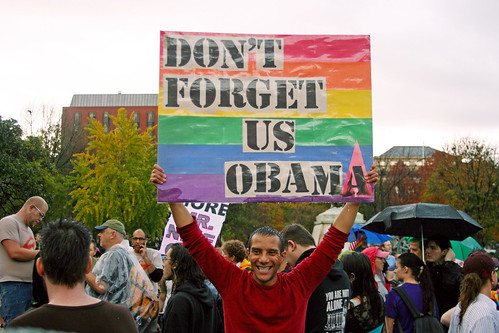
Barack Obama - ESPN Man or First Gay President?

 
It's been an interesting week for President Barack Obama's masculinity. Depending on who you read, he is either the ESPN man ("postfeminist in his values, but also thoroughly traditional in style — hypercompetitive, restrained, not given to self-doubt, rarely self-indulgent") or the first gay president ("he intuitively understands gays and our predicament—because it so mirrors his own").

There is something chameleon-like in his ability to be so many things to so many people. For the conservative David Brooks of the New York Times, "he is self-disciplined, traditional and a bit formal. He is willing, with drones and other mechanisms, to use lethal force." In other words, he embodies traditional codes of masculinity. Meanwhile, the liberal Andrew Sullivan of Newsweek/The Daily Beast, was "utterly unprepared for how psychologically transformative the moment would be. To have the president of the United States affirm my humanity—and the humanity of all gay Americans—was, unexpectedly, a watershed."

There is probably no place in American culture (excluding the military) where being gay is accepted and supported less than it is in professional sports, the world that ESPN covers and glorifies. And yet, in one week, Obama is both the ESPN man and the first president who invites gays and lesbians back into the culture that has denied them recognition and equality.

If the election were held based on the characters of the two men involved, it's no contest - Obama is a transforming figure and Romney beat up gay kids in high school. Obama has fought, in however a misguided way, to make healthcare available to everyone, and especially the poor, while Romney is "not concerned about the very poor."

I highly recommend both of these columns for their differing views on Obama. The reality is not either/or in this case, it's both/and. Obama can be both very traditionally masculine in his behaviors and personality and still be post-feminist and supportive of the rights of all citizens, without discrimination.

David Brooks - The ESPN Man
Andrew Sullivan - Barack Obama: The First Gay President

Wednesday, August 3, 2011

The Secret Lives of Men - Unhitched: Love, Marriage, and Family Values


This is an interesting episode of The Secret Lives of Men - it focuses on the recent book by Judith Stacey, Unhitched: Love, Marriage, and Family Values from West Hollywood to Western China (Nyu Series in Social and Cultural Analysis).

Listen to internet radio with Secret Lives of Men on Blog Talk Radio

Unhitched: Love, Marriage, and Family Values

Unhitched: Love, Marriage, and Family Values from West Hollywood to Western China. Stacey (In the Name of the Family), a professor of social and cultural analysis at New York University, spent over a decade interviewing and observing families in California, South Africa, and China for this scrupulously researched and moving portrait of family diversity across three continents and cultures. The first section is devoted to gay men living, loving, and parenting in tony West Hollywood. Stacey uses the experiences of her 50 subjects to examine both sides of the gay-marriage debate. The theory that legalizing gay marriage will lead to the legalization of polygamy takes Stacey to South Africa, where both same-sex and plural marriages are legal. She examines the history and modern interpretation of polygamy and asks if the practice might not offer some potential benefits to women and their children. Finally, Stacey turns her keen analysis on the Mosuo people of southwest China, who have rejected marriage for multigenerational households in which children are raised by their mothers and maternal family. Throughout her travels and exhaustive research, Stacey pokes and prods, and eagerly calls into question everything we think we know about love, marriage, and the baby in the baby carriage.

Sunday, June 5, 2011

President Obama Decrees June 2011 as Lesbian, Gay, Bisexual, and Transgender Pride Month

http://farm4.static.flickr.com/3069/3036317118_005a8890b8.jpg

In what represents a much smaller step forward than it might seem, President Obama has decreed that beginning in 2011, June will be LGBT Pride Month. In one way it's a monumental recognition - but until the laws change allow same-sex marriage, until a trans man is not questioned about having a penis as proof he is a man, and even until we include intersex in the acronym (LGBTI), then no proclamation will change the fact that LGBTIQA (Q = questioning; A = allies) are not accorded full citizenship in this country.

The White House
Office of the Press Secretary
For Immediate Release
May 31, 2011

Presidential Proclamation - Lesbian, Gay, Bisexual, and Transgender Pride Month

BY THE PRESIDENT OF THE UNITED STATES OF AMERICA

A PROCLAMATION

The story of America's Lesbian, Gay, Bisexual, and Transgender (LGBT) community is the story of our fathers and sons, our mothers and daughters, and our friends and neighbors who continue the task of making our country a more perfect Union. It is a story about the struggle to realize the great American promise that all people can live with dignity and fairness under the law. Each June, we commemorate the courageous individuals who have fought to achieve this promise for LGBT Americans, and we rededicate ourselves to the pursuit of equal rights for all, regardless of sexual orientation or gender identity.

Since taking office, my Administration has made significant progress towards achieving equality for LGBT Americans. Last December, I was proud to sign the repeal of the discriminatory "Don't Ask, Don't Tell" policy. With this repeal, gay and lesbian Americans will be able to serve openly in our Armed Forces for the first time in our Nation's history. Our national security will be strengthened and the heroic contributions these Americans make to our military, and have made throughout our history, will be fully recognized.

My Administration has also taken steps to eliminate discrimination against LGBT Americans in Federal housing programs and to give LGBT Americans the right to visit their loved ones in the hospital. We have made clear through executive branch nondiscrimination policies that discrimination on the basis of gender identity in the Federal workplace will not be tolerated. I have continued to nominate and appoint highly qualified, openly LGBT individuals to executive branch and judicial positions. Because we recognize that LGBT rights are human rights, my Administration stands with advocates of equality around the world in leading the fight against pernicious laws targeting LGBT persons and malicious attempts to exclude LGBT organizations from full participation in the international system. We led a global campaign to ensure "sexual orientation" was included in the United Nations resolution on extrajudicial execution -- the only United Nations resolution that specifically mentions LGBT people -- to send the unequivocal message that no matter where it occurs, state-sanctioned killing of gays and lesbians is indefensible. No one should be harmed because of who they are or who they love, and my Administration has mobilized unprecedented public commitments from countries around the world to join in the fight against hate and homophobia.

At home, we are working to address and eliminate violence against LGBT individuals through our enforcement and implementation of the Matthew Shepard and James Byrd, Jr. Hate Crimes Prevention Act. We are also working to reduce the threat of bullying against young people, including LGBT youth. My Administration is actively engaged with educators and community leaders across America to reduce violence and discrimination in schools. To help dispel the myth that bullying is a harmless or inevitable part of growing up, the First Lady and I hosted the first White House Conference on Bullying Prevention in March. Many senior Administration officials have also joined me in reaching out to LGBT youth who have been bullied by recording "It Gets Better" video messages to assure them they are not alone.

This month also marks the 30th anniversary of the emergence of the HIV/AIDS epidemic, which has had a profound impact on the LGBT community. Though we have made strides in combating this devastating disease, more work remains to be done, and I am committed to expanding access to HIV/AIDS prevention and care. Last year, I announced the first comprehensive National HIV/AIDS Strategy for the United States. This strategy focuses on combinations of evidence-based approaches to decrease new HIV infections in high risk communities, improve care for people living with HIV/AIDS, and reduce health disparities. My Administration also increased domestic HIV/AIDS funding to support the Ryan White HIV/AIDS Program and HIV prevention, and to invest in HIV/AIDS-related research. However, government cannot take on this disease alone. This landmark anniversary is an opportunity for the LGBT community and allies to recommit to raising awareness about HIV/AIDS and continuing the fight against this deadly pandemic.

Every generation of Americans has brought our Nation closer to fulfilling its promise of equality. While progress has taken time, our achievements in advancing the rights of LGBT Americans remind us that history is on our side, and that the American people will never stop striving toward liberty and justice for all.

NOW, THEREFORE, I, BARACK OBAMA, President of the United States of America, by virtue of the authority vested in me by the Constitution and the laws of the United States, do hereby proclaim June 2011 as Lesbian, Gay, Bisexual, and Transgender Pride Month. I call upon the people of the United States to eliminate prejudice everywhere it exists, and to celebrate the great diversity of the American people.

IN WITNESS WHEREOF, I have hereunto set my hand this thirty-first day of May, in the year of our Lord two thousand eleven, and of the Independence of the United States of America the two hundred and thirty-fifth.

BARACK OBAMA


Wednesday, April 13, 2011

Gay Couple Denied Birth Certificate for Their Adopted Child

http://lgbtweekly.com/webzinexpress/gfx/articles/11/11_126_145.jpg

This is seriously effed up - these men would be married if the law allowed, and by preventing them from legally being married, these redneck states prevent them from providing a loving home for an adopted child.

at Beyond (Straight and Gay) Marriage has the story - she has been working on gay and lesbian family law issues for more than 30 years. She has published several law review articles and book chapters - Beyond (Straight and Gay) Marriage: Valuing All Families under the Law is her first book.

Fifth Circuit en banc ruling in Adar v. Smith denies birth certificate to child adopted by two men

Late today, the Fifth Circuit Court of Appeals issued an en banc ruling in Adar v. Smith. As I noted in several earlier posts about this case, Oren Adar and Mickey Smith jointly adopted a child in New York. The child was born in Louisiana, and the couple sought an amended birth certificate listing both of them as parents. Louisiana refused to issue the birth certificate, citing its own law prohibiting an unmarried couple from jointly adopting a child. The couple is represented by Lambda Legal, whose senior staff attorney Ken Upton argued the case in January. The couple won in the trial court and in a Fifth Circuit panel opinion. This loss comes after rehearing by the entire Fifth Circuit.

Tomorrow I will write more about the court's ruling that the couple could not sue the state for violating the Full Faith and Credit Clause. Tonight I will just note that the court ruled against the argument that the state is denying the child equal protection of the law by refusing to issue a birth certificate based on the marital status of his parents.

Citing the despicable 11th Circuit Lofton ruling upholding Florida's ban on adoption by gay men and lesbians, the majority said that Louisiana has "a legitimate interest in encouraging a stable and nurturing environment for the education and socialization of its adopted children." It then cited one 2002 report for the principle that marriage is associated with better child outcomes than cohabitation because it is more likely to provide stability. Because this provides a rational basis for denying unmarried couples the opportunity to adopt, it therefore is sufficient support for denying a child adopted by an unmarried couple a birth certificate with two names. Both the logic and the sentiment here are appalling. This reasoning (or lack thereof) stands in sharp contrast to that of the Arkansas Supreme Court, which just last week ruled that the state's ban on adoption by anyone living with an unmarried partner was unconstitutional. The Adar v. Smith Fifth Circuit ruling also dismissed almost out of hand the argument that the state is violating the constitutional prohibition on discrimination against nonmarital children by denying a child with unmarried parents a birth certificate reflecting his legal parentage -- something granted routinely to children with married parents.

There's a strong dissent. And there is a contrary case from the 10th circuit five years ago, also argued by Lambda Legal. I hope Lambda asks for review by the US Supreme Court. The "circuit split" raises the odds that the Court would hear the case.
If this goes to the Supreme Court, I don't see it it going well based on the 5-4 majority of "traditional values" justices, who are very activist in their agenda to enforce conservative values.


Sunday, October 17, 2010

Linda C. McClain - What's so Hard About Sex Equality?: Nature, Culture, and Social Engineering

Interesting stuff - I think she's wrong, especially on the brain science (see Cordelia Fine's book that I keep suggesting: Delusions of Gender: How Our Minds, Society, and Neurosexism Create Difference) but she is on solid ground regarding the tenaciousness of cultural gender norms.

Citation:
McClain, Linda C., What's so Hard About Sex Equality?: Nature, Culture, and Social Engineering (September 21, 2010). Boston Univ. School of Law Working Paper No. 10-30. Available at SSRN: http://ssrn.com/abstract=1680496


Linda C. McClain
Boston University - School of Law


September 21, 2010

Boston Univ. School of Law Working Paper No. 10-30

TRANSCENDING THE BOUNDARIES OF LAW: GENERATIONS OF FEMINISM AND LEGAL THEORY, Martha Albertson Fineman, ed., Routledge, Chapter 5, pp. 66-82, 2010


Abstract:
Why is sex equality so hard to achieve? Social cooperation between women and men in various domains of life is assumed to be a fundamental and necessary building block of society, but proves hard to secure on terms of equality. One answer is that feminist quests for equality in private and public life are a form of misguided social engineering that ignores natural sex difference. This chapter examines arguments that nature and culture constrain feminist law reform. Appeals to nature argue that brain science and evolutionary psychology find salient differences between women and men, limiting what social engineering can achieve in fostering sex equality or reforming family law. Appeals to culture argue that constructions of masculinity and femininity are tenacious; challenging them threatens women’s and men’s sense of identity and causes resistance to equality. Contemporary society may espouse a commitment to a “gender neutral society,” but men’s and women’s “unofficial desire” (as Harvey Mansfield puts it) stands in the way. ” I discuss three examples of cultural resistance: the debate about egalitarian marriage, work/life conflict, and popular novels and films about heterosexual romance. Often at work in discussions about sex inequality is the notion of a proper equilibrium between the sexes that is upset when sex roles change or differences are minimized. However, even as critiques of feminist social engineering invoke nature and culture, problems posed by nature feature as a reason to embrace social engineering in the form of the social institution of marriage: Marriage is fundamental, yet fragile. I illustrate this by examining arguments (in case law and the marriage movement) against allowing same-sex couples to marry. The chapter then considers how feminist or female-centered work in evolutionary science challenges the presentation of nature and evolution in popularizing accounts and in public policy arguments. This work cautions about the politics of prehistory, or how certain gender biases or stereotypes may shape the study of human origins and impose a “paleolithic glass ceiling.”
As far as I am concerned, this article is a fine example of why lawyers should not be involved in psychology, brain science or anything else that does not involve actual case law.

As proof of this, here is her perspective in the paper on the neuropsychological differences between men and women - quoting false statistics.

Male and female brains and evolutionary psychology
The appeal to nature as a constraint on equality enlists brain science and evolutionary psychology, which reportedly find salient differences between women and men, linked to different reproductive biology and reproductive strategies. These differences limit what social engineering can achieve.

In the 1990s, a flurry of books, including Robert Wright’s The Moral Animal (1995) and David Buss’s The Evolution of Desire (1994) introduced basic concepts of evolutionary psychology and sociobiology, proposing that science shed light on sex difference, why men and women had different views about the harm of rape and sexual harassment, and why they made different choices about work–family balance (Wright 1994). Wright criticized feminist legal theorists for avoiding science. He argued that:
[M]any of the differences between men and women are more stubborn than most feminists would like, and complicate the quest for—even the definition of—social equality between the sexes. (Wright 1994: 34)
In the early twenty‐first century, brain science rivets popular attention. Once again, evolution presents limits to social engineering and affirms sex difference. Enthusing about neuropsychiatrist Louann Brizendine’s work in popular science, The Female Brain (2006), journalist David Brooks opines, “Once radicals dreamed of new ways of living, but now happiness seems to consist of living in harmony with the patterns that nature and evolution laid down long, long ago” (2006: 14).

What are these differences and what patterns do they prescribe? Brizendine (2006: 1) declares, “more than 99 percent of male and female genetic coding is exactly the same,” but the one percent difference “influences every single cell in our bodies.” The inside flap of the book cover promises neurological explanations for such sex differences as:
  • “A woman uses about 20,000 words per day, while a man uses about 7,000.”
  • “A woman knows what people are feeling, while a man can’t spot an emotion unless somebodycries or threatens bodily harm.”
  • “Thoughts about sex enter a woman’s brain once every couple of days but enter a man’s brain about once every minute.”
Brizendine turns to evolutionary theory to explain the roots of brain differences. However she is not quietist about human nature. Biology need not be destiny if we understand how evolutionary, biological, and cultural forces shape us (2006). Social engineering informed by biology holds promise:
Biology powerfully affects us but does not lock in our reality. We can alter that reality and use our intelligence and determination both to celebrate and, when necessary, to change the effects of sex hormones on brain structure, behavior, reality, creativity—and destiny. (Brizendine 2006: 6)
What does this interplay of biology and human will suggest about social cooperation on terms of equality? I focus on Brizendine’s use of evolutionary theory to interpret brain difference and its implications for intimate and family life. I do not assess whether Brizendine gets the science of brain difference right, though some scientists argue she does not (Liberman 2006; Rivers and Barnett 2007). Scientists caution against letting “dubious science” give credibility to stereotypes and ignore “decades of legitimate findings” about male and female similarity (Rivers and Barnett 2007). “Inflated claims of gender differences,” they warn, have costs to children, adults, and society, as they “reify stereotypes,” limit opportunity, and ignore that “males and females are similar on most, but not all, psychological variables” (Hyde 2005: 581–89). These concerns echo questions about sameness, difference, and stereotypes long posed by feminist legal theory (Mississippi University for Women v. Hogan 1982; Littleton 1987).

“STONE AGE” BRAINS
Contemporary females, Brizendine (2006: 42) asserts, inherit the “ancient circuitry” of “our most successful foremothers.” Teenage girls’ drive for social connection with each other has biological and hormonal reasons. Intimacy “activates the pleasure centers in a girl’s brain,” triggering a near‐orgasmic “major dopamine and oxytocin rush” (37). Girls are motivated “on a molecular and a neurological level” to “ease and even prevent social conflict” and to “maintaining the relationship at all costs” (40). These findings sound similar to those made by Carol Gilligan and her colleagues (1990) on how girls work to maintain connection.

Connection among females has evolutionary roots as a strategy of protection against aggressive males, evident in studies of female mammals that develop stress responses to “tend and befriend” and to form social groups “that promote safety and reduce distress for the self and offspring” (Brizendine 2006: 42). “These female networks” also share infant care, “information about where to find food,” and model “maternal behavior for younger females” (42–43). Social connectedness, thus, contributes to reproductive success (43). Today’s teen females, as they “reach” optimal fertility, undertake similar strategies (43).

Competition is as hardwired as cooperation. Brizendine (2006: 54) attributes the “biology of mean girls”—the harsh tactics of teen‐girl cliques—to a “survival” strategy of “sexual competition” for the best male mates, a “biological imperative to compete for sexual attractiveness.” Success, for both sexes, requires “some aggression,” and relevant hormone levels rise during puberty (55).

Our “Stone Age brain” also shapes mate selection, sex, and motherhood (60). Brizendine repeats evolutionary psychology’s familiar story of the male who chases and the female who chooses, claiming that it is “not sex stereotyping,” but “the brain architecture of love, engineered by the reproductive winners in evolution” (59–60). Contemporary couples proceed “down an ancient pair‐bonding path,” over which they have “little control” (60).

Brizendine draws on David Buss’s influential work (1994) on the different qualities women and men seek in mates. Women are “less concerned with a potential husband’s visual appeal and more interested in his material resources and social status” and prefer a slightly older partner (Brizendine 2006: 61). “Scientists conclude” that these “universal” mate preferences are part of the “inherited architecture of the female brain’s mate‐choice system” and are “presumed to serve a purpose” (62).

What purpose? Brizendine turns to evolutionary biology scholar Robert Trivers, who explains female mate selection as a sound investment strategy stemming from their limited number of eggs and greater investment than men in bearing and raising children. A man “can impregnate a woman with one act of intercourse and walk away;” a woman is “left with nine months of pregnancy, the perils of childbirth, months of breast feeding,” and “trying to ensure that child’s survival” (Brizendine 2006: 62). Ancient necessities led females to seek long‐term male partners to ensure reproductive success; those who “faced these challenges alone were less likely to have been successful in propagating their genes” (62). Brizendine is skeptical about whether contemporary “single motherhood...will succeed,” noting that, even today, “in some primitive cultures,” a father’s presence enhances a child’s survival rates, making a female’s “safest bet” a long‐term male partner to offer protection and improved access to “food, shelter and other resources” (62). In effect, women’s need for protection and provision explains the so‐called sex contract posited by evolutionary theorists.

Men’s ancient brain circuitry, according to Buss, leads them to seek wives who are “physically attractive, between ages twenty and forty,” and with “clear skin, bright eyes, full lips, shiny hair, and curvy, hourglass figures” (Brizendine 2008: 63). These traits are “strong visual markers of [female] fertility,” which offers men “the biggest reproductive payoff for their investment” (63, emphasis in original). But “the most reproductively successful males also need to pick women who will mate only with them,” ensuring their paternity (64).

Men’s concern with paternity supposedly explains their concern with women’s social reputation. Brizendine explains that if a woman had sex with a man on a first date or “showed off” about former bed partners, “his Stone Age brain might have judged that she would be unfaithful or had a bad reputation” (64). But male “seduction and abandonment” is an old problem (64–65). Thus, male and female reproductive strategies put them at odds. Evolution, in effect, explains the sexual double standard. High paternal investment requires men’s certainty of paternity.

However, this model suggests that men have little to lose in random and casual sexual encounters. Why wouldn’t they care about any potential offspring they father, if their strategy is to maximize their reproductive success? The premise implies that if men spread around enough genes, even if they do not personally invest in parental care for all offspring, some may survive due to the mother’s efforts.

Male sexual jealousy, thus, has evolutionary roots and “adaptive functions”—preventing infidelity and ensuring paternity (Buss 1994: 125–29; Posner 1992: 97; Wright 2005: 66–72); it also has enormous costs, evident in domestic violence (Buss 1994). Drawing on evolutionary science, Judge Richard Posner (1992: 97, 112) argues the “biology of sex” explains men’s mate‐guarding behaviors such as “physical sequestration of wives, disparagement of female sexuality,” and female genital mutilation. The sexes are in conflict rather than in cooperation; these male behaviors subvert female choice (Batten 1994).
The problem with using Brizendine as her primary source is that she is often wrong - at least according to Dr. Fine, who dismantles most of her arguments with convincing studies. And we have long known that the statistics she cites at the beginning of this section are false (particularly the differences in word usage and thoughts about sex).

We need to basing law decisions on more accurate and integral science - a perspective that recognizes stages of development, lines of development, and perspectives, including typologies. What she presents here is from the often dismissed and frequently over-reaching field of evolutionary psychology.

Later in the article, she makes some points about culture and its impact on marriage:
Egalitarian or “peer” marriage is a more just form of marriage, from a feminist or liberal perspective, than traditional marriage and more likely to be happy and stable (Schwartz 1994). Marriage equality is a factor contributing to marriage quality, particularly for women (McClain 2006). However, other scholars point out that marriages with a traditional gendered division of labor may also be quite stable so long as spouses’ expectations do not change (Hetherington and Kelly 2002). Spouses may also accept an unequal division of labor even if they think it is unfair (Brinig and Nock 2002). Thus, considerable disagreement exists about whether social cooperation best takes place on terms of equality or inequality.
I don't necessarily disagree with her positions and citations here - what bothers me is that there is a clear lack of developmental clarity. Egalitarian marriages work best when couples are equally matched at that stage, while traditional power structures work best in couples who are equally matched at that stage. Trouble arises when two people at different stages are involved - if she is egalitarian and he is traditional, eventually there will be issues.

It seems as though few people ever consider these issues - especially not lawyers it appears.

Where this paper totally derails in my opinion is when she begins citing Laura Schlesinger (I refuse to call her "doctor" since her degree is in literature, not religious studies, gender studies, or psychology), who is a complete and total moron on her best days. An example:
Stunning her host on the Today show, Schlesinger laid the problem of men’s cheating at the door of any wife who failed to make her husband feel “like a man...like a success...like her hero,” so that he was “very susceptible to the charm of some other woman.” Schlessinger holds women “accountable” for not giving “perfectly good men” the love, kindness, respect, and attention they need, charging that “these days, women don’t spend a lot of time thinking about how they can give their men what they need...” (Armstrong 2008).
Even after quoting something as partial and patriarchal as that, McClain goes on to site more from Schlesinger (the women’s movement is a “core destructive influence” - wives should treat their husbands with respect, reinforce them as head of the household, and celebrate difference). I can only assume that McClain must also hold a very traditional (and limited) view of gender roles.

You can read the whole article yourself (download the PDF from the link above) - but I want to offer one more section related to same sex marriage.
In Kerrigan v. Commissioner of Public Health (2008), the Supreme Court of Connecticut concluded that civil unions did not afford same‐sex couples equal protection and that their exclusion from civil marriage lacked constitutional justification. The court determined that same‐sex couples “share the same interest in a committed and loving relationship” and “in having a family and raising their children in a loving and supportive environment” as opposite‐sex couples (Kerrigan 2008: 424). The legislature recognized these “overriding similarities” when it enacted the civil union law (424), and even though same‐sex couples “cannot engage in procreative sexual conduct,” the method of conceiving children is an insufficient difference to negate “fundamental and overriding similarities” (424, note 19). Notably, the state did not appeal to procreation or optimal childrearing as rationales. However, the court noted that the procreation rationale raised by several amici did not satisfy an “exceedingly persuasive justification requirement”: allowing same sex couples to marry “in no way undermines any interest that the state may have in regulating procreative conduct between opposite sex couples” (477, note 79). The court also argued that expanding marriage will not “diminish the validity or dignity of opposite‐sex marriage,” but instead reinforce “the importance of marriage to individuals and communities” (474). Citing to these amici’s procreative purpose argument, dissenting Justice Zarella disagrees: “The ancient definition of marriage as the union of one man and one woman has its basis in biology, not bigotry” (Kerrigan 2008: 515–16).

This examination of case law and of marriage movement writings illustrates how biology, sex difference, and evolution are used to argue against expanding the definition of marriage. Because marriage is a form of social engineering that addresses problems posed by nature, it is a fundamental and fragile institution.
Connecticut got it right in their ruling - and it makes perfect legal and cultural sense, so then why suggest that rulings such as this make marriage a "fragile institution"?

Anyway - we need to get lawyers out of these issues. We need real science and clear thinking - and a little higher order perspective would be useful.