Man Violently Attacked for Standing Up for Women Being Catcalled
Rebecca Rose | August 12, 2014
A man is in the hospital after he was attacked for defending a group of women who were being harassed on the street, according to police.
The 39-year-old Texas man (whose name has not been released) was visiting Philadelphia's Rittenhouse Square on Saturday night. Police said the man observed a car of men pull up to a group of women. Via NBC Philadelphia:
The men inside the Nissan began taunting and catcalling the women, according to investigators, prompting the victim to get involved.The man is in stable condition at a local hospital. "This is a tragic, tragic story," Captain Fuchs said. "Here's a guy trying to stick up for these girls and he gets victimized."
"The male victim took offense to something that the guys were saying to the girls and said 'hey, watch what you're saying,'" said Philadelphia Police Captain George Fuchs.
Police say one of the men inside the Nissan then got out of the car and punched the victim once in the head. The man was knocked unconscious after he fell and struck his head on the concrete.
[...]
Police say the suspect's Nissan had Delaware tags. They are currently looking through surveillance video to see if they can find the license plate number.
Good to know that their are men who are so irrationally fixated on their need to publicly demean and shame women they are willing to beat the shit out of anyone who gets in their way or dares call it into question. Great. Add another layer of fear to all the reasons why I hate catcalling.
Screencap via NBC Philadelphia.
Showing posts with label misogyny. Show all posts
Showing posts with label misogyny. Show all posts
Wednesday, August 13, 2014
Man Violently Attacked for Standing Up for Women Being Catcalled (via Jezebel)
It's great that this guy stood up to the a-holes, and it sucks that he got so badly hurt.



Monday, July 7, 2014
Various Perspectives on the First International Conference on Men’s Issues
The last weekend in June, in Detroit (fittingly), the first ever International Conference on Men’s Issues was held. Monica Hesse, who covered the conference for the Washington Post, summed up the 150-200 (mostly white) men who attended: "the binding theme was that almost everyone here had experienced a version of a 'red pill moment'." For those unfamiliar with the jargon of the men's rights activists (MRAs), think back to The Matrix:
For MRAs, a red pill moment is the moment in which a man wakes up and realizes he has become a second class citizen in this country. It's the moment he realizes that feminism has taken away his rights, his freedoms, and his privilege. The red pill crowd has a very popular Reddit site.
Unfortunately, for the majority of MRAs, taking their red pill seems to lead not only to anti-feminism, but to a lot of anti-women rhetoric as well.

As you might guess, this conference was an easy target for pro-women and pro-feminist sites to make fun of and ridicule, and Jezebel took up that task with enthusiasm.
The conference was organized by Paul Elam, who hosts the MRA site, A Voice For Men. According to Jessica Roy's article for Time Magazine, Elam wanted speakers and attendees to take a more press-friendly tone:
We Hunted the Mammoth posted about Elam's response to the tweets:
It's unfortunate, as Tom Hawking notes at Flavorwire, that the MRAs are so caught up in hating feminism and feeling like victims - their anger and hatred do more harm to men than they do to help men.
The blog ANIMAL New York posted the conference as well, but they took the added step of including some of the key comments from the speakers. Interestingly, many of the most cogent points have nothing to do with feminism. The realms where feminism has probably done men the most harm is in family courts, education, and related areas.
Quotes from Warren Farrell:
Even Paul Elam had some good points in this area:
The family court system claims that equal custody is the preferred norm, but it seldom plays out that way in court, especially if there are lawyers involved.
On that issue, I am all-in with the MRAs, except that I blame a patriarchal society that sees women as the care-providers and men as the bread-winners. Until that model changes the family court system is unlikely to change.
I'm also all-in on the lack of support for men who are victims of domestic violence (and men tend to be more often the victims, while women tend to be more often injured). This is a topic that will continue to be an issue until the stigma disappears on a man who says his wife or girlfriend beat him up. Part of this problem is due to law enforcement - if they are called to a DV scene and the male is the victim, they are much less likely to take it seriously unless the female is holding a knife or something and he is bleeding.
Elam gets caught in a double standard in his comments above. On the one hand, it should be easier for men to have or get custody of their children, while on the other hand, if a man doesn't want to be a father he should not have to pay child support. Sorry, man, but if you're going to play in the rain, you need to wear a jacket. Failure to do so makes you responsible for anything that grows.
Diana Thompson, one of five women who spoke at the conference, made some good points about the family court system, and she did not blame feminism to make them:
Another of the female speakers, Suzanne Venker, made some points I have often made on this blog - the television and film industry routinely portrays men and fathers as idiots.
One of the few speakers who genuinely seems to be an idiot was Mike Buchanan, who wants a "Men's Rights Party" in British politics. But he goes off the rails more than the rest of the speakers:
There are a lot of areas in which I am in agreement with the MRAs that there are problems and we need to fix them. But I refuse to associate with them because of their penchant for rage and vitriol. That is not how change gets done.
I have aligned myself with an "equal rights for all people" agenda, a belief in equality that sees gender as only one variable among many. And because I support equal rights for women (and men), mothers take me more seriously when I speak about the need for boys to burn off energy before sitting down to do homework, or that it's okay if your son learns how to express his emotions rather than act them out.
If we move away from the truly radical feminists on one side and the truly radical MRAs on the other side, the remaining 90% of us have much more in common than we do in difference. If we start from that place of common interest, we can affect some meaningful change.
If you want to read more about the conference from a variety of sources, here are some links.
For MRAs, a red pill moment is the moment in which a man wakes up and realizes he has become a second class citizen in this country. It's the moment he realizes that feminism has taken away his rights, his freedoms, and his privilege. The red pill crowd has a very popular Reddit site.
Unfortunately, for the majority of MRAs, taking their red pill seems to lead not only to anti-feminism, but to a lot of anti-women rhetoric as well.
As you might guess, this conference was an easy target for pro-women and pro-feminist sites to make fun of and ridicule, and Jezebel took up that task with enthusiasm.
The conference was organized by Paul Elam, who hosts the MRA site, A Voice For Men. According to Jessica Roy's article for Time Magazine, Elam wanted speakers and attendees to take a more press-friendly tone:
At Elam’s request, the majority of the speakers were noticeably less anti-woman in person than many are in their writings or speeches elsewhere.For what it's worth, Roy did the best job of trying to provide fair and balanced coverage, but apparently Elam took issue with a couple of tweets she posted during the conference, moments when she was dismayed by the commentary she was seeing.
We Hunted the Mammoth posted about Elam's response to the tweets:
Elam, evidently incensed about a handful of sarcastic remarks that Roy tweeted during the conference, denounced her as, among other things, a “hack,” “a liar and bigot” and a practitioner of “journalistic scumtardery,” whatever that is. Commenters on A Voice for Men happily joined in the hate, denouncing her as an “airhead,” a “disgrace and a liar,” “lil’ miss hair-o’or-her-eyes,” and a “little asshole [who] will look like a right nazi in five-to-ten years time.” Amazingly, no one pulled out the c-word. Evidently AVFMers are still on their best behavior.So much for being on their good behavior.
It's unfortunate, as Tom Hawking notes at Flavorwire, that the MRAs are so caught up in hating feminism and feeling like victims - their anger and hatred do more harm to men than they do to help men.
There are many things to dislike about r/RedPill types. Many, many things. But here’s the issue: quite apart from their hatefulness, they do their “cause” — such as it is — absolutely no good at all. As with extremists in many other areas, they hijack and polarize a discussion that is worth having.And it IS a discussion that needs to be held, with all sides open and curious, not convinced they are right and highly cynical of other perspectives.
The blog ANIMAL New York posted the conference as well, but they took the added step of including some of the key comments from the speakers. Interestingly, many of the most cogent points have nothing to do with feminism. The realms where feminism has probably done men the most harm is in family courts, education, and related areas.
Quotes from Warren Farrell:
- Millions of boys are getting their dopamine fixes from performing in video games, but not performing in real life.
- With the increased amount of video porn, boys who are failures to launch, who aren’t doing well in school, notice that not many girls are interested in them. But they have an easy escape: Video porn, 250 million options… free.
- Men questioning work full time is to this day extremely difficult especially if the man is successful.
- Why, when girls are doing much better than boys, do we have a White House council on women and girls, but no White House council on men and boys?
Even Paul Elam had some good points in this area:
- Men are 93% of all workplace fatalities. They’re currently 97% of combat deaths. They’re the majority of the homeless.
- Men are sentenced on average to 66% more time in prison than women for the same crime, and are twice as likely to be incarcerated in the first place, again, for the first time. It is a gap even wider than that between black and white.
The prison industrial complex uses male bodies as free labor for the enrichment of a privileged elite… who are pretty much entirely white men.When Elam gets deeper into his message, however, there is a more direct attack on the feminist assault on male rights:
- Men are subject to a family court system so corrupt and biased it represents the biggest rollback of civil right since Jim Crow. It is a system that destroys the lives of men and children by severing their bond with calculated indifference. Parental alienation is real and rampant. Sadly there is now a profit to be made in the destruction of our families.
- Under the false banner of the best interests of the child, fathers are forced to pay child support as though it were mafia protection money.
- Men are starting to abandon the idea of marriage in the first place. It’s a form of risk management for their lives.
- Despite a compelling body of evidence, that men and boys are victims of domestic and sexual assault at rates far exceeding what most would think, the current gender paradigm ignores this and dedicates to resources all but exclusively to women.
The family court system claims that equal custody is the preferred norm, but it seldom plays out that way in court, especially if there are lawyers involved.
On that issue, I am all-in with the MRAs, except that I blame a patriarchal society that sees women as the care-providers and men as the bread-winners. Until that model changes the family court system is unlikely to change.
I'm also all-in on the lack of support for men who are victims of domestic violence (and men tend to be more often the victims, while women tend to be more often injured). This is a topic that will continue to be an issue until the stigma disappears on a man who says his wife or girlfriend beat him up. Part of this problem is due to law enforcement - if they are called to a DV scene and the male is the victim, they are much less likely to take it seriously unless the female is holding a knife or something and he is bleeding.
Elam gets caught in a double standard in his comments above. On the one hand, it should be easier for men to have or get custody of their children, while on the other hand, if a man doesn't want to be a father he should not have to pay child support. Sorry, man, but if you're going to play in the rain, you need to wear a jacket. Failure to do so makes you responsible for anything that grows.
Diana Thompson, one of five women who spoke at the conference, made some good points about the family court system, and she did not blame feminism to make them:
- I’ve seen many of the grievances men and father’s face; blocked visitation and unenforced visitation orders, move-away moms who use geography to drive father’s out of their children’s lives, acceptance by the court of false accusations of domestic violence or child abuser, especially as a basis for denying custody or even contact between the father and child.
- Our current family court system is very adversarial. The only winner being the billion dollar divorce industry paid for by our children, even though study after study shows that children without fathers are at higher risk for social pathology such as: criminality, teen pregnancy, and drug use and there’s many more.
Another of the female speakers, Suzanne Venker, made some points I have often made on this blog - the television and film industry routinely portrays men and fathers as idiots.
- The lack of respect for men is palpable. The message coming from the media, Hollywood, and America’s universities, is that men are superfluous at best, dangerous at worst.
- America routinely paints a portrait of the idiot husband whose wife is smarter and more capable than he. That is a war!
- We’ve seen women with increased reproductive freedom, married men often require a note from their wives before a doctor will even perform a vasectomy.
One of the few speakers who genuinely seems to be an idiot was Mike Buchanan, who wants a "Men's Rights Party" in British politics. But he goes off the rails more than the rest of the speakers:
- We had for more than 30 years across much of the developed world, unholy alliances between states and radical feminism.
- Now radical feminism is without doubt a female supremacy ideology that’s driven by misandry; the hatred for men and boys.
- Legislation is routinely drafted to advantage women and disadvantage men.
- Boys are being relentlessly disadvantaged by an evermore feminized education system.
- Apparently, we need more female engineers. I’ve never quite worked out why.
- It’s time to end divorce as a route to financial enrichment.
- We’re calling for compulsory paternity testing at birth, so at long last we’ll find out just what the rate is.
There are a lot of areas in which I am in agreement with the MRAs that there are problems and we need to fix them. But I refuse to associate with them because of their penchant for rage and vitriol. That is not how change gets done.
I have aligned myself with an "equal rights for all people" agenda, a belief in equality that sees gender as only one variable among many. And because I support equal rights for women (and men), mothers take me more seriously when I speak about the need for boys to burn off energy before sitting down to do homework, or that it's okay if your son learns how to express his emotions rather than act them out.
If we move away from the truly radical feminists on one side and the truly radical MRAs on the other side, the remaining 90% of us have much more in common than we do in difference. If we start from that place of common interest, we can affect some meaningful change.
If you want to read more about the conference from a variety of sources, here are some links.
- What I Learned as a Woman at a Men’s-Rights Conference, Time, by Jessica Roy
- Men’s rights activists, gathering to discuss all the ways society has done them wrong, The Washington Post, by
- The First "Men's Issues" Conference Makes a Good Point. And a Lot of Bad Ones, Salon, by Laura Smith
- The Most Inane Moments from Last Weekend's Men's Rights Conference, Jezebel, by
- MRAs Aren’t Just Terrorizing Women — They’re Hurting Men, Too, Flavorwire, by Tom Hawking
- Inside The First International Conference on Men’s Issues, ANIMAL New York, by Bucky Turco
- Defenders of A Voice for Men tell Time magazine reporter “we have to SCARE you into listening,” you “stinky … human monkey”, We Hunted the Mammoth, by David Futrelle
- The First International Conference on Men’s Issues: Day 1, by Arthur Goldwag
- First International Conference on Men’s Issues: Day 2, by Arthur Goldwag
Tuesday, June 10, 2014
Your Daily Dose of Dumb - Washington Post's George Will Thinks Being a Sexual Assault Victim Is Now A "Coveted Status"
Wow, and the GOP wonders why they get so few female voters, or voters with working brain matter, as far as that goes. This is just utterly absurd - George Will is now the poster boy for Stupid Rich White Men Who Don't Get It (or SRWHWDGI).
If you think, as I do, that George Will should apologize to the nation's female sexual assault survivors, send him an email and let him know what think: georgewill@washpost.com
Via Media Matters for America:
If you think, as I do, that George Will should apologize to the nation's female sexual assault survivors, send him an email and let him know what think: georgewill@washpost.com
Via Media Matters for America:
Wash. Post's George Will: Sexual Assault Victim Is Now A "Coveted Status"
June 8, 2014 ››› SOPHIA TESFAYE
Fox News contributor and Washington Post columnist George Will derided efforts on college campuses to combat the sexual assault epidemic as a ploy to "make victimhood a coveted status that confers privilege."
In a June 7 syndicated op-ed which appeared in The Washington Post and the New York Post, Will dismissed "the supposed campus epidemic of rape, aka 'sexual assault,'" arguing that the definition of sexual assault was too broad because it could include "nonconsensual touching" and disputing the evidence that shows 1 in 5 women experience sexual assault on campuses in the U.S., implying that individuals were pretending to be victims because colleges have made victimhood a "coveted status" (emphasis added):
Colleges and universities are being educated by Washington and are finding the experience excruciating.Will also criticized colleges and universities for attempting "to create victim-free campuses -- by making everyone hypersensitive, even delusional, about victimization."
They are learning that when they say campus victimizations are ubiquitous ("micro-aggressions," often not discernible to the untutored eye, are everywhere), and that when they make victimhood a coveted status that confers privileges, victims proliferate.
[...]
Now the Obama administration is riding to the rescue of "sexual assault" victims. It vows to excavate equities from the ambiguities of the hookup culture, this cocktail of hormones, alcohol and the faux sophistication of today's prolonged adolescence of especially privileged young adults.
The administration's crucial and contradictory statistics are validated the usual way, by official repetition; Joe Biden has been heard from. The statistics are: One in five women is sexually assaulted while in college, and only 12% of assaults are reported. Simple arithmetic demonstrates that if the 12% reporting rate is correct, the 20% assault rate is preposterous.
[...]
Education Department lawyers disregard pesky arithmetic and elementary due process. Threatening to withdraw federal funding, the department mandates adoption of a minimal "preponderance of the evidence" standard when adjudicating sexual assault charges between males and the female "survivors" -- note the language of prejudgment.Combine this with capacious definitions of sexual assault that can include not only forcible sexual penetration but also nonconsensual touching. Then add the doctrine that the consent of a female who has been drinking might not protect a male from being found guilty of rape. Then comes costly litigation against institutions that have denied due process to males they accuse of what society considers serious felonies.
Despite Will's dismissal of the statistics, a report on sexual violence by the Center for Disease Control (CDC) confirmed that "in a study of undergraduate women, 19% experienced attempted or completed sexual assault since entering college." Moreover, the dangerous stigmatization of sexual assault victims has kept many from reporting these crimes -- particularly because victims who do report can become the targets of vicious attacks. According to the FBI, people falsely report sexual assault only 3 percent of the time.

Wednesday, May 28, 2014
Masculinity, Misogyny And Murder: Unpacking A Killing In California (On Point w/ Tom Ashbrook)
I have already commented on this tragedy in two different posts (here and here), as well as sharing a collection of links devoted to this topic (here). I don't really have too much to add, other than to reiterate that these killings cannot be simplified into a single cause or target of blame.
In Elliott Rodger's actions there are a whole collection of factors, most prominent (as if often true and overlooked) is the delusional and grandiose thinking that justified these actions in his broken mind. It's easy to blame guns (he owned all of his weapons legally), or misogynistic, toxic masculinity (he followed men's rights activists [MRAs] and pick up artists [PUAs] on You Tube), but they are only part of the story - they are shadow elements of our culture that rarely get examined in the light of day unless we are forced to do so by some atrocity like this one.
In Elliott Rodger's actions there are a whole collection of factors, most prominent (as if often true and overlooked) is the delusional and grandiose thinking that justified these actions in his broken mind. It's easy to blame guns (he owned all of his weapons legally), or misogynistic, toxic masculinity (he followed men's rights activists [MRAs] and pick up artists [PUAs] on You Tube), but they are only part of the story - they are shadow elements of our culture that rarely get examined in the light of day unless we are forced to do so by some atrocity like this one.
Masculinity, Misogyny And Murder: Unpacking A Killing In California
A vicious, deadly rampage spurs a new look at misogyny and why it matters.
May 28, 2014 | Tom Ashbrook
People gather at a park for a candlelight vigil to honor the victims of Friday night’s mass shooting on Saturday, May 24, 2014, in Isla Vista, Calif. Sheriff’s officials said Elliot Rodger, 22, went on a rampage near the University of California, Santa Barbara, stabbing three people to death at his apartment before shooting and killing three more in a crime spree through a nearby neighborhood. (AP)

What’s in a killer’s heart? We know in the case of last Friday’s Santa Barbara massacre. Because the killer wrote about it at length. He despised women. His unrequited desire turned into a furious hatred. And a plan to kill. A plan he carried out. An overwhelming response followed. A Twitter flood – the #yesallwomen hashtag – women sharing their own stories. Concerns that hatred, entitlement, towards women is woven widely into our culture. Not creating killers necessarily, but haters. Is this true? Where’s the line? And what’s to be done? This hour, On Point: Misogyny. Assessing the damage.
– John Donvan
Guests
Soraya Chemaly, activist and writer. Her work has appeared in the Huffington Post, Salon, the Guardian, CNN and in other publications. (@schemaly)
David Futrelle, freelance writer who blogs at “We Hunted the Mammoth,” a site that tracks the “Men’s Rights” movement online. (@DavidFutrelle)
Dr. Robert Heasley, professor of sociology at the Indiana University of Pennsylvania. Former president of the American Men’s Studies Association.From The Reading List
Slate: The Pick-Up Artist Community’s Predictable, Horrible Response to a Mass Murder – “I do not blame the Pick-Up Artist community (or its somehow even more deeply tortured counterpart, the Anti-Pick-Up-Artist community) for the deaths of seven people. The man who committed this horrific crime is responsible for this heinous act. But I was interested to see how these groups are reacting to the news. It is disturbing, if not surprising, that they are using these murders to reinforce their hatred of women and “Beta” men, and to cement their own status at the top of the pyramid.”
The Guardian: Elliot Rodger’s California shooting spree: further proof that misogyny kills — “Rodger was reportedly involved with the online men’s rights movement: allegedly active on one forum and said to have been following several men’s rights channels on YouTube. The language Rodger used in his videos against women – like referring to himself as an “alpha male” – is common rhetoric in such circles. These communities are so virulently misogynist that the Southern Poverty Law Center, an organization that tracks hate groups, has been watching their movements for years.”
Washington Post: In covering Elliot Rodger, writers aren’t shy about blaming misogyny and the groups that perpetuate it — “people have embraced the term ‘misogyny’ to describe Rodger’s online screeds against women, and they've been more receptive to treating Friday’s killings as a hate crime, the way McDevitt suggests. Sunday night, Gawker’s Jordan Sargeantnoticed that Rap Genius co-founder Mahbod Moghadam posted incendiary annotations to Rodger’s 141-page manifesto. The manifesto had been uploaded to News Genius, Rap Genius’s sister site which aims to annotate and explain the news. Moghadam said Rodger’s manifesto was ‘beautifully written.’”
Tuesday, May 27, 2014
The Tantrum of Masculinity - Omnivore
From Bookforum's Omnivore blog, here is a new collection of links themed on masculinity.The topics include patriarchy, male competition, academic masculinities, education, military masculinities, and pick up artists (PUAs).
And speaking of PUAs, there are also the mandatory links to articles blaming men, masculinity, patriarchy, and guns for the shooting rampage in Isla Vista. If only it were that simple.

And speaking of PUAs, there are also the mandatory links to articles blaming men, masculinity, patriarchy, and guns for the shooting rampage in Isla Vista. If only it were that simple.
The tantrum of masculinity
May 26 2014
9:00AM

- From Evolutionary Behavioral Sciences, Daniel J. Kruger (Michigan), Maryanne L. Fisher (St. Mary’s), and Paula Wright (Newcastle): Patriarchy, Male Competition, and Excess Male Mortality; and Dario Maestripieri, Amanda Klimczuk, Daniel Traficonte, and M. Claire Wilson (Chicago): Ethnicity-Related Variation in Sexual Promiscuity, Relationship Status, and Testosterone Levels in Men.
- Christopher R. Matthews (Brighton): Biology Ideology and Pastiche Hegemony.
- Lawrence D. Berg , Levi Gahman, and Neil J. Nunn (UBC): Neoliberalism, Masculinities and Academic Knowledge Production: Towards a Theory of “Academic Masculinities”.
- A link between fidgety boys and a sputtering economy: A gender difference in behavioral skills, seen as early as kindergarten, is hurting boys’ academic prospects and their earning potential.
- Discharged under the rainbow: Ariel M. Martinez on military masculinities and Don't Ask, Don't Tell.
- The tantrum of masculinity: Elisabeth Donnelly interviews Rebecca Solnit on mansplaining, power, and her book Men Explain Things to Me.
- 10 years later, The Game has changed for pick-up artist Neil Strauss: “To hear Strauss tell it, PUA is about using male sexuality as a force for good in the world”.
- Amanda Hess on the Pick-Up Artist community’s predictable, horrible response to a mass murder.
- It denies reality to pretend that Rodger’s sense of masculine entitlement and views about women didn’t matter or somehow existed in a vacuum.
- Laurie Penny on calling the Isla Vista killings what they were: misogynist extremism (and more and more).
- Here are some of the most powerful #YesAllWomen tweets (and more and more and more and more and more).
- Rightbloggers say Santa Barbara killer Elliot Rodger's sexist rants have nothing to do with sexism (or guns).
- In the deadly aftermath of Elliot Rodger’s psychotic and suicidal shooting spree that left six others dead, the muted echoes of David Attias — who killed four people in Isla Vista 12 years ago — will be bouncing off Isla Vista’s blood-stained streets for some time to come.
Thursday, May 22, 2014
Jared Keller - The Tortured Rise of the All-American Bro (Pacific Standard)
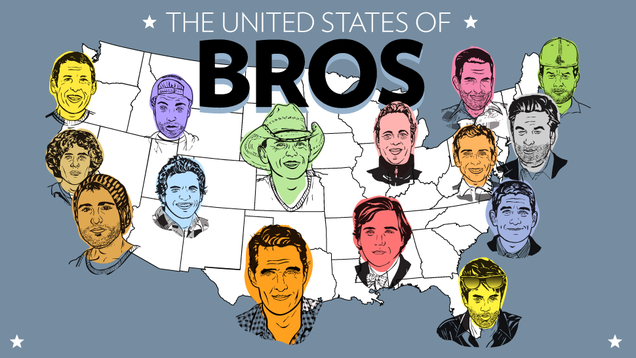
This article by Jared Keller comes from Pacific Standard - it offers a first-person account of a man who identifies himself as a "bro."
For all intents and purposes, I am a bro. I identify as a bro in the sense that, as Jezebel so aptly put it, I am “an adult male whose social life revolves around collegiate homosocial bonding and who also presents himself in a way that assimilates to the prevailing aesthetic of men with similar socialization patterns.”From a much more critical, dismissive perspective, John Saward says of "bros," writing in Vice, “This is his dream. This is his life. He is the worst person alive, and he has no idea.”
He is a walking scorched-earth policy. He takes what he wants to satisfy some hedonistic impulse, and then he leaves her sobbing in a hallway with her friend on the other line. He wrings every moment of every drop of novelty. He is doing shots and never with a chaser, because moderation and restraint are for women and faggots and children. The only way to be a real man is to be a real man as ferociously as humanly possible. He goes all-in; he gets shredded and ripped and defines his life by aggression and competitions. He buys the hamburger that comes with two other hamburgers and a chicken cutlet on top of it. Why? Because it’s three hamburgers with a chicken cutlet on top of it.Keller asks, and tried to answer in this article, some very challenging questions:
Where did this strange American Bro come from, this alien, fist-pumping, Jager-bombing avatar of modern sexism, racism, and nihilism? And why does he loom over every male friendship, every moment “with the boys”? Am I doomed, by our culture, to live as a jerk, a social parasite made fat on the sweet lard of privilege, with my male friends and colleagues? At what point did all strong homosocial relationships between men become conflated with the most vile and socially abhorrent behavior and egregious sartorial choices?I'm fortunate, I guess, to have long, long ago left the "bro" stage of my life, sometime in 20s. When I get together with male friends, it's usually over coffee or lunch, not Jager-bombs. Our conversations do involve our work, but also our hobbies, or home repairs (do bros own homes?), or interesting books or articles we have read.
This is longish, but it is certainly deserving of a good read.
The Tortured Rise of the All-American Bro
Pacific Standard
By Jared Keller • May 06, 2014
A fraternity building at Cornell University (Photo: Pete Spiro/Shutterstock)
The misogynist portrait of modern American masculinity may be a historical accident. Here’s how to fix it.
•In April, my college buddies and I drove up to Maine to spend the weekend getting drunk and bouncing around downtown Portland for a former roommate’s bachelor party. Of all the people I’ve met and friends I’ve made—through high school and internships and college and jobs—these random goofballs are my closest friends. We headed north to celebrate impending nuptials, but at its core this weekend was about, as my girlfriend says, “just hanging out with the bros.”
For all intents and purposes, I am a bro. I identify as a bro in the sense that, as Jezebel so aptly put it, I am “an adult male whose social life revolves around collegiate homosocial bonding and who also presents himself in a way that assimilates to the prevailing aesthetic of men with similar socialization patterns.”
But according to Vice, my friends and I are the worst thing to happen to Portland since the great 1866 fire that leveled churches, destroyed the city’s commercial center, and left nearly 10,000 homeless. On an off day, I should be on Boston’s Orange Line, stinking of bourbon and slurring, and “cackling at the ceiling, electrified by the degree to which he does not give a fuck,” John Saward writes. “This is his dream. This is his life. He is the worst person alive, and he has no idea.”
He is a walking scorched-earth policy. He takes what he wants to satisfy some hedonistic impulse, and then he leaves her sobbing in a hallway with her friend on the other line. He wrings every moment of every drop of novelty. He is doing shots and never with a chaser, because moderation and restraint are for women and faggots and children. The only way to be a real man is to be a real man as ferociously as humanly possible. He goes all-in; he gets shredded and ripped and defines his life by aggression and competitions. He buys the hamburger that comes with two other hamburgers and a chicken cutlet on top of it. Why? Because it’s three hamburgers with a chicken cutlet on top of it.I’ve been a member of male-centric institutions my entire life—sports teams, a summer camp staff, a fraternity—and still, somehow, my friends and I don’t seem to quite match this portrait of the American Bro. My weekend habits, though boisterous and uncouth, don’t sync with the totally terrifying acid trip of masculinity captured by Vice. Though I have spent time in the presence (or wake) of the horrific men described by Saward, I have never done 75 push-ups because NO REGRETS. I don’t know anyone named Rachael who wants it, she so wants it, bro. None of my fashion choices match Jezebel’s amazing geographical exhibition of the Great North American Bro. Even BuzzFeed’s “How ‘Bro’ Are You?” quiz considers me vaguely well-adjusted, despite the fact that I make duckface in way too many photos and have been known to say “duuude.” “Congratulations on having exquisite taste,” the BuzzFeed results page says, “and feel free to procreate as much as you like!”
Where did this strange American Bro come from, this alien, fist-pumping, Jager-bombing avatar of modern sexism, racism, and nihilism? And why does he loom over every male friendship, every moment “with the boys”? Am I doomed, by our culture, to live as a jerk, a social parasite made fat on the sweet lard of privilege, with my male friends and colleagues? At what point did all strong homosocial relationships between men become conflated with the most vile and socially abhorrent behavior and egregious sartorial choices?
Ironically, the history of homosexuality in America may hold the secret to the modern hyper-masculine bro. Prior to the 1970s, the majority of psychological literature on homosexuality was based on the presumption that the practice was a mental disorder, a view that coincided with advances in medicine at the end of the 18th century and the rise of psychoanalysis in the U.S. and Continental Europe. Homosexuality was eventually declassified as a mental illness in 1973, and all references to homosexuality as a psychiatric disorder were removed from the American Psychiatric Association’s Diagnostic and Statistical Manual of Mental Disorders (DSM). Despite this, gays and lesbians were still met with apprehension and hostility by the American public: In 1988, only 11 percent approved of same-sex marriage, and while that number increased to 46 percent by 2010, 40 percent of Americans remain opposed to it.The repressive, hypermasculine bro that stalks your local watering hole and pisses in the street is a modern, anxious manifestation of homosexual panic, an allergic reaction to the mainstreaming of gay culture.
But decades of classifying homosexuality as a “dysfunction” in America left a lasting mark on all homosocial relationships. In modern Anglo-American society, writes gender theorist Eve Kosofsky (who coined the term “homosocial”) in her classic study “Between Men,” there’s a significantly greater disconnect between male homosexual and homosocial bonds, whereas there’s a much more psychosocially continuous relationship between female homosexual and homosocial bonds. The discontinuity between male homosociality and homosexuality results in male homosocial relationships taking on the form of “male bonding,” which is characterized by homosocial desire and intimacy (say it with me now: “broing out”) but marked, most notably, by homosexual panic, the fear of this attention gliding over into something a little more taboo, a little more risqué. In an attempt to emphasize heterosexuality, fear or hatred of homosexuals and misogynist language developed. The bro, in short, is a culture-wide defense mechanism against the gay.
This social split between male homosexual and homosocial relationships is why the sort of homosocial bonding on display in black-and-white photographs of men throughout American history all but went extinct by the middle of the 20th century: homosexuality had become a pathologized identity, one that carried connotations of psychological dysfunction and perversion. “The shift meant sitting for a portrait in your best bro’s lap was verboten; more important, though, some have argued that it has led to a wide-scale deprivation in boys and men of intimate touch that is important to their development and mental health,” Kat Stoeffel explains at The Cut, discussing the rise of touch isolation. “Men who hold hands, sling an arm around each other, and say ‘I love you’ risk being labeled gay at best and violent homophobic backlash (either from observers or their beloved bro) at worst.”

Male physical affection may be making a comeback: According to a recent study in British journal Men and Masculinities, 98 percent of the heterosexual men interviewed had shared a bed with another man, while 93 percent had cuddled or spooned with one, evidence of, as the authors write, “expansion of changing conceptions of masculinity in contemporary culture.”
The repressive, hypermasculine bro that stalks your local watering hole and pisses in the street is a modern, anxious manifestation of homosexual panic, an allergic reaction to the mainstreaming of gay culture (and, by extension, a loss of cultural power and sexual stability). The modern definition of manhood came about in strict domination over the feminine, both sexually and behaviorally. “Male-male relations organize and give meaning to the social and sexual involvements of young heterosexual men in a powerful way,” writes researcher Michael Flood in a 2008 issue of Men and Masculinities, an exploration of how male homosocial bonding affects men’s relationships with women. “Homosocial bonds are policed against the feminizing and homosexualizing influences of excessive heterosociality, achieving sex with women is a means to status among men, sex with women is a direct medium of male bonding, and men’s narratives of their sexual and gender relations are offered to male audiences in storytelling cultures generated in part by homosociality.”
If modern misogyny is a virus, a symptom of psychosexual anxiety and irrational fear of homosexuality, then institutions like fraternities make for an excellent petri dish. Alcohol consumption is the primary way in which men “negotiate masculinities in leisure activities,” writes Lois West in the Journal of Men’s Studies in a 2001 examination of two American drinking cultures, fraternities and the U.S. Navy. Collective boozing—at frat houses, on shore leave, at sporting events—can facilitate the creation of masculine homosociality by “developing a sense of community and trust” around perpetuating certain kinds of American masculine traditions, West writes. But alcohol-driven social interactions are also used to inhibit negotiations over other hierarchies of identity and social boundaries relating to class, religion, race, ethnicity, and sexuality. “Status hierarchies get negotiated through competitive drinking games, humor, and heterosexual significations.”
One of the more troubling features of the modern bro isn’t the sad, relatively recent dose of anxiety that fuels his behavior, but the cultural power he maintains. Male-heavy organizations like the armed forces and college fraternities have the institutional power to safeguard the more violent, despicable, and misogynistic behaviors of young men. The prevalence of sexual assault on college campuses, the site of social and professional development for America’s workforce, is especially troubling. Nearly 20 to 25 percent of female college students will experience rape or attempted rape during their time on campus, according to the Department of Justice; and according to research by the Center for Public Integrity, abusive students rarely receive more than a slap on the wrist. Some universities even rebrand rape as “non-consensual sex.” College sexual assault has become such a frightening epidemic in America that the White House has pressured universities to do more to combat it.
Fraternities, once social organizations focused on personal development and scholastic achievement, have devolved into engines for misogyny and assault. And they can breed future horrors. “Future fraternity brothers are often coddled by yes-men athletic coaches and administrators in high school, where they learn that they can argue their way out of class and — as nationally publicized cases like Steubenville and Maryville show us — rape accusations,” Katie Baker writes. “‘[A]n astonishing number of CEOs of Fortune 500 companies, congressmen and male senators, and American presidents have belonged to fraternities.’ Once they’re entrenched in the high-paying jobs they expected to easily obtain, these former fraternity brothers … continue to act the same way behind barely closed doors. If you feel so secure about your past, present and future that you feel invincible, why stop the fun?”
And in that permanent aura of cultural invincibility, born from the anxiety of homosocial bonding, is where we find the American bro, freed from the ivied walls and storied halls of his fraternity house and let loose on the sidewalks near you. A visceral portrait of the dark strains of brodom can be found in Cord Jefferson’s demand that the white community take responsibility for a “culture of lawlessness” after a group of surfers rioted in Huntington Beach, California—a satirical inversion of the “culture of black violence” segments favored by cable’s talking heads. “Whites in America have been out from under their European ancestors’ boot heels for centuries; California specifically outlawed preferences for nonwhites in state hiring and education nearly two decades ago, so being ‘oppressed’ is no longer an excuse for behavior like this,” Jefferson writes. “How long must we wait for the white community to get its act together?”One of the more troubling features of the modern bro isn’t the sad, relatively recent dose of anxiety that fuels his behavior, but the cultural power he maintains.
Racism, sexism, and misogyny are alive and well in the minds of some men with too much time, money, and anger on their hands. In this respect, the chest-thumping, booze-guzzling mess of a man you encounter clad in stunner shades and blasting EDM in the early hours of the morning isn’t the norm, but some accidental avatar of the worst impulses of modern man. The bro is a historical accident, a hostile social virus—incubated in the safety of homosocial bonding and bred in communal organizations—that has infected the bloodstream of the United States.
Changing demographics and attitudes may be a vaccine against the social and political dominance of bros: Millennials, fast transitioning into adulthood, are the most racially diverse generation in American history, a trend driven by the large wave of Hispanic and Asian immigrants who have been coming to the U.S. for the past half century, and whose U.S.-born children are now aging. Millennials are essentially a transitional generation: Some 43 percent of Millennial adults are non-white, the highest share of any generation, and the Census Bureau projects that the full U.S. population will be majority non-white sometime around 2043. With the changing racial make-up of today’s young adults comes a burst of political liberalism, an acceptance of homosexuality, and an emphasis on social and political justice along gender and racial lines.
But the bro is a persistent creature, and some male-centric organizations can remain safe spaces for misogyny, frustration, anxiety, and cultural narcissism despite shifts in American society. The emphasis on terrible style choices—the cheapest, most juvenile form of identity politics—only distracts attention from other forms of sexism that permeate American culture beneath the veneer of irony and sophistication (hello, hipster sexism). And casting homosocial relationships between men into something cartoonish and clownish, either as insufferably haphazard and childish (like the bromances that dot Judd Apatow’s filmography) or mortifyingly aggressive and secretly homosexual (Jersey Shore), can end up conflating positive friendships with the caricature of a man that is the American Bro.
Male friendships are camouflage to the worst impulses of the bro, at the cost of a relatively decent, courteous, and moral class of American men. For them—us—being good isn’t enough. We can’t just point to this scourge of American social life and say “not all men.” I was lucky enough to belong to male-centric institutions—like my childhood summer camp—that emphasized understanding, empathy, and loyalty. But as a straight, white man, I benefit from brodom in American culture, and I’ve been socialized to navigate it. This is what it means to actually “check your privilege”: If the American Bro is “the worst person alive, and he has no idea,” as Vice’s Saward writes, then a real man lives keenly aware of the historical and institutional powers which he has inherited, regardless of good, humble, and sensitive he thinks he is.
This, really, is my challenge: To recast “bro”—now, rightfully, a slur—as the rallying cry of honest, thoughtful, and productive male friendship.
~ Jared Keller is a journalist and social media specialist living in New York. His writing has appeared in The Atlantic, Bloomberg Businessweek, National Journal, Outside, Al Jazeera America, and The Verge.
Sunday, May 18, 2014
BBC - Blurred Lines: The New Battle of the Sexes

From the BBC, this is an interesting look at the new culture of misogyny, "whether there's a new culture abroad in which it's acceptable to write about, talk about, and feature women in a sexually offensive, even abusive way. Or whether the female of the species just needs to 'man up', learn to enjoy a gag, and get used to the 21st century world." This is not only a British issue, as it seems maybe worse in the U.S.
Kirsty Wark also participated in a Twitter question and answer session, the product of which is presented below.Blurred Lines: The New Battle of the Sexes
Published on May 9, 2014
Blurred Lines: The New Battle of the Sexes - BBC Documentary, 2014
From bomb threats sent to campaigners for more females on banknotes to sexually explicit pop videos. From extreme laddism at universities to rape jokes in the school yard... Kirsty Wark explores whether there's a new culture abroad in which it's acceptable to write about, talk about, and feature women in a sexually offensive, even abusive way. Or whether the female of the species just needs to 'man up', learn to enjoy a gag, and get used to the 21st century world.
Your questions to Kirsty Wark
 Kirsty Wark held a Twitter Q&A on sexism and misogyny
How have men's attitudes towards women changed? Is the internet a naturally hostile place for women?The BBC's Kirsty Wark answered your questions in a live Twitter Q&A on Friday 9 May.
This is an edited version of the session.
Question from @NUS_Vonnie: Where did the idea come from that "Freedom of Speech" means freedom to say things with no consequences?
Kirsty answers: Civil society evolved over centuries-the internet just decades. Need a web conduct code that's not censorious but courteous
Will Blaik emails: Is the increased misogyny that we see a reaction to misandry?
Kirsty answers: I'm not sure that misandry is as entrenched and overt as misogyny. I think it's more complicated than a simple reaction
Question from @dotluckhurst: Is it possible to change attitudes? Parents & schools must act more urgently.
Kirsty answers: Action in schools is the great hope because it's this generation who are growing up online. Schools must talk about it.
Chris emails: Can we encourage teenagers and young people to know, care and understand others around them?
Kirsty answers: I think many young people do care for those around them. But the pressures on them, eg from porn, are phenomenal
Question from @AliceBand1: I am so shocked by Grand Theft Auto. Shocked to the core. How is this allowed to exist?
Kirsty answers: It's perfectly legal. We asked Rockstar to take part but they declined. Why don't you write to them and ask?!
Question from @_raymatthew: Why do parents allow their children to "play" computer games that show rape?
Kirsty answers: Many parents just don't know what's in these games.They need to talk to kids; the activity needs to come out the bedroom
Question from @thegreenelk: It's a mistake to tie increase in misogyny with growth of internet - think it started with rap lyrics
Kirsty answers: Misogyny has been around probably as long as men and women! But certainly rap music language should be part of the debate
Andrew Soule emails: Women say they prefer male bosses & are derogatory towards females. Do women hold themselves back?
Kirsty answers: Sexism and misogyny is a mind-set not a gender. Sometimes women don't realise that they've internalised prejudice.
Question from @thinkingmuslim: Did you toy with the idea that the internet has its own culture & its misogyny doesn't enter real world?
Kirsty answers: The internet does have its own culture, but it's one that spill[s] into the real world. For young people it is the real world
Question from @Charlesknight: Why was the show entirely white?
Kirsty answers: Noted - misogyny affects women of all colours and creeds. Women of colour can experience an additional layer of prejudice
Question from @Jillaclogs: Do you think children's access to smartphones should be regulated? So many beartraps!
Kirsty answers: Certainly could be parental controls for pre-teens, but parents need to learn to use smartphones better than their kids!
Question from @louisegrant21: Has making #blurredlines made you more worried about misogyny or more hopeful it will die out?
Kirsty answers: The young women we spoke to who are standing up to sexism and misogyny makes me hopeful. They have real energy and purpose
Question from @julieohara79: Was excellent, any chance of a series?
Kirsty answers: Glad you enjoyed the documentary. The decision on a series is above our pay-grade!
Kirsty ends: Thanks for all your questions and comments. Sorry I couldn't answer all of them. Great to have the discussion. Newsnight calls!
For more tweets from Kirsty Wark you can follow her Twitter account.
Kirsty examined these issues in the BBC2 programme Blurred Lines: The New Battle of the Sexes. Twitter Q&A produced by Andree Massiah
Saturday, April 26, 2014
Bros, This Is How Your Slut-Shaming Is Backfiring: A Sex Researcher Explains
This article is from Playboy SFW - an interesting place to find an article on how "slut shaming" is backfiring on "bros."
Slut shaming defined: "the act of making a person, especially a woman, feel guilty or inferior for certain sexual behaviors or desires that deviate from traditional or orthodox gender expectations, or that which may be considered to be contrary to natural or religious law."
This whole thing of rape culture and slut shaming is what we get for not teaching our boys about respect and kindness toward women. Additionally, there is a systematic failure in these guys to grasp and tolerate that different people have different values, and that women have the same rights as men.
Slut shaming defined: "the act of making a person, especially a woman, feel guilty or inferior for certain sexual behaviors or desires that deviate from traditional or orthodox gender expectations, or that which may be considered to be contrary to natural or religious law."
This whole thing of rape culture and slut shaming is what we get for not teaching our boys about respect and kindness toward women. Additionally, there is a systematic failure in these guys to grasp and tolerate that different people have different values, and that women have the same rights as men.
Bros, This Is How Your Slut-Shaming Is Backfiring. A Sex Researcher Explains
Zhana Vrangalova | 4/16/14
When a Duke frat boy recognized a classmate in the porn clip he was watching, the gossip was just too good. He spread the news among some other bros on campus, and the rumor soon traveled from Duke's campus to the blogosphere (including Playboy SFW). Belle Knox, as the student revealed her porn identity to be, was promptly called a slut and brutally harassed online. Many people encouraged her to drop out of Duke—"a huge fucking whore" like her didn't belong among smart, educated elites.
Somehow, however, the frat boy's decision to violate Knox's privacy by outing her went mostly unquestioned. (There wasn't much coverage of him beyond this Gawker post.) The takeaway message was loud and clear: It's okay for men to enjoy porn, but the women who make it are nothing but sluts.
Unfortunately, that reaction isn't surprising. It's simply a more extreme version of a common double standard that echoes throughout the misogynistic corners of college campuses (and their corresponding blogs). "Women are sluts if they sleep around, but men are not," the bro-site Return of Kings decrees. "This fact is due to the biological differences between men and women."
Of course, the pseudo-scientific myth that all women are naturally predisposed toward sexual restraint and all men toward promiscuity isn't only inaccurate but dangerous, leading directly to the notion that women who differ from that norm are unacceptable, need to be corrected or deserve to be mistreated. What's more, it creates a culture in which men who seek out many partners aren't just celebrated, but given permission to devalue women with a similar sexual appetite.
Ironically, it's this negative attitude toward women who have casual sex that makes many women less likely to seek it out, which means less casual sex for the men who want it most. Based on what psychologists know, I'd argue that if we can work toward a culture where the stigma surrounding women's casual sex is diminished, the result could be more guilt-free hookups for all those who want them.
* * * * *
At first glance, some of my field's work on casual sex might appear to prove the bros right. In 1989, when undergraduates at the University of Hawaii were spontaneously asked by researchers of the opposite sex if they would join them in bed that evening, 75 percent of men—but not a single woman—agreed. Similar studies across Europe have confirmed that compared to men, women really are less likely to agree to casual sex and disapprove of it more. In fact, such a difference in desire for casual sex is one of the largest gender differences in sexuality—behind only differences in masturbation and pornography use—as two review studies from 1993 and 2010 showed.
This is where a lot of the analyses end, jumping to the conclusion that men are from Mars, women from Venus. But two important conditions make the findings less black-and-white. First, differences in the affinity for casual sex aren't absolute; they're averages. The desire for casual sex in both sexes is distributed in similar bell-shaped curves that overlap by about 50 percent. That means about one-third of women like hookups more than the average guy and about one-third of men want to hookup less than the average woman does. So even if all of the gender difference in the desire for casual sex was due to some immutable biology (as The Return of Kings and other bro sites would have you believe), a substantial minority of women would still be biologically inclined toward promiscuity and a substantial minority of men would still be biologically inclined toward monogamy.
What's more, these gender differences aren't only biological. Few scientists would deny that nature—namely, the challenges of reproduction (women's high cost of creating offspring versus men's low cost)—has played a role in gender differences toward casual sex over humankind's long evolutionary history. But nurture—namely, socializing women to be chaste and the widespread stigma against those who violate that norm—cannot be ruled out either.
Consider the results from a 2013 study of more than 24,000 students from 22 different American colleges. When asked if they'd lose respect for a man or a woman who "hooked up a lot," 28 percent of men said "yes" for a woman but "no" for a man. (Only 4 percent of women said the same thing.) Another 2013 study of almost 8,000 students at a Midwestern university arrived at a similar conclusion: Both men and women disapproved more of a woman who had casual sex (defined as sex with someone whom they've known for less than one month) than of a man.
Even more interestingly, these studies reveal that guys who seek out casual sex are the ones who are more likely to disrespect females with the same interest. For example, in one study referenced, each additional hookup reported was associated with a 4 percent increase in the odds of men holding the double standard (while the opposite was true of women). To put it another way, "sluttier" men are more likely to slut-shame women—or at least, hold negative views toward women whose promiscuity approximates their own.
This not only exposes a serious hypocrisy, but it seems counterproductive: Disrespecting women on whom your casual sex depends can only lower your chances of finding willing partners in the future, right? So why would slutty guys feel this way?
* * * * *
Perhaps the most obvious explanation is nurture. When misogynist environments teach men that their sexuality is fundamentally different from women (that casual sex is something for them to pursue and for women to avoid) they tend to buy in. Such views are part of a more general traditional gender ideology, explaining why studies have found that men with more traditional gender role attitudes also tend to want more casual sex. Or why in the study of students from 22 colleges mentioned above, fraternity affiliation or varsity athletic participation resulted in a 31 percent and 46 percent increase, respectively, in the odds of holding the traditional double standard. Indeed, while the desire for casual sex might be partly due to nature, genetic analyses of twins show that the tendency to support gender inequality is almost entirely due to nurture. In other words, if your environment promotes sexism, it's likely you'll hold sexist views.
That said, some men might be naturally more predisposed to end up in sexist environments. Over the years, studies consistently found that men who are more into casual sex are also more dominant, aggressive, narcissistic, arrogant, manipulative and lacking empathy. (The evidence is less clear about whether this is true for women who are more into casual sex.) Scholars have argued that these personality traits and a high interest in casual sex often cluster together as part of an exploitative short-term mating strategy where men attempt to seduce many different women—using deception (what bros would call "game") or coercion (what law enforcement would call "rape") if necessary—without feeling remorse. While such an approach might be hostile to their female partners, it allows the men to spread their seed far and wide. As such, these traits have survived (and often times, thrived) throughout our evolutionary history.
Given that these traits are largely heritable, it isn't a coincidence that many narcissistic, manipulative and coercive men find themselves in misogynistic environments: They actively seek out communities that reinforce the sexist attitudes that fit their personality. And so, a vicious cycle is created, resulting in disregard for women, particularly those they deem unworthy of respect. "It's often hard to seduce scores of women if you genuinely respect them," explains Andrew Irwin-Smiler, a psychologist whose book Challenging Casanova examines teenage masculinity and sexuality. "Respect would prevent any kind of meaningful deception—like taking advantage of drunk women. But if you think most women are 'bitches' or 'sluts,' then you can treat them like crap in order to sleep with them."
These men might also feel like the women they consider sluts not only deserve to be treated badly, but they want to be treated badly. After all, part of the repertoire of sexist attitudes is rape-myth acceptance—the belief that women "really wanted it" even when they say no, or that they "asked for it" simply by wearing provocative clothing.
Yet another explanation for the slutty-men-shaming-slutty-women phenomenon lies in the fear of unbridled female sexuality. Since an inherent part of the traditional masculinity ideology is the belief that men are the sexual initiators and predators, the existence of a highly promiscuous woman who unapologetically goes after what she wants threatens men's sense of self. As one nonsexist male blogger, My Dissolute Life, explains when writing about women who like gangbangs (perhaps the sluttiest of slutty acts), "I want, I need, to believe that I'm at the absolute center of a woman's sexual universe. ... A gangbang presents the possibility of a woman whose desire swamps that of the men, who cannot be overwhelmed by the desires of one measly guy."
And that is "more than a little terrifying." That poses a direct affront to men with fragile or "precarious masculinities," a term coined by Joseph Vandello to describe men who perceive manhood as an impermanent state that's easily lost if they fail to conform to gender norms. We know that some men respond with violence when their manhood is threatened. Slut-shaming could be just another aggressive response to this deeply felt threat to their identities.
None of this is to say that all men who are into casual sex are sexist and exploitative. (Nor that all men who aren't into casual sex are respectful and sweet.) It's certainly possible to be a highly sexual man who goes about acquiring sexual partners in an ethical way. The swinger lifestyle, for example, elaborately described in Terry Gould's The Lifestyle, is replete with examples of men who actively pursue casual sex while fully respecting the women (their own wives included) who do the same. It's just that, statistically speaking, there are more "jerks" among fans of casual sex.
* * * * *
Luckily, such "jerks" are a minority in the Western world. The online sexist manosphere has a vocal anti-sexist counterpart, from ManBoobz to the Good Men Project. Better yet, as sophomoric teenagers mature into young men and get exposed to the world outside of their fraternity bubbles, their double standards lessen. Even Tucker Max, the one-time king of the bros, recently gave up his "game". And since Belle Knox came out publicly about her porn career, she has been flooded with support and encouragement that has negated the insults.
More good news is that women's lesser interest in casual sex isn't immutable. For millennia, women have lived in environments that have made them dependent on men for survival and taught them to be sexually conservative. But when social and economic circumstances change to allow for greater female independence and freedom of sexual expression, gender differences in the desire for casual sex become less pronounced.
For instance, this gender difference is smaller among today's youth than it was among their parents. It's smaller in countries where political and economic power is distributed more evenly between men and women (e.g., Sweden, USA, and Saudi Arabia). It's smaller when the stigma that women anticipate for accepting a casual sex offer is statistically controlled for in analyses—i.e., take that stigma away and a lot more women would consent to casual sex. And it can disappear altogether when women believe that the man offering them casual sex is a competent lover who's going to provide sexual pleasure or when that lover is famous and attractive —or famous and unattractive .
In short, put women in the right environment with the right partners, and it's likely they will desire casual sex much more than they do today, perhaps even as much as men do. Overall, the science seems to indicate that the more we talk about the tremendous individual variability in the desire for casual sex, the more the misogynistic minority will get further pushed to the fringe. Which, of course, has an added benefit: When the slut-shaming stops, everyone is likely to get laid more.
*****
Zhana Vrangalova, PhD, is a NYC-based sex researcher who studies casual sex and nonmonogamy, teaches Human Sexuality at New York University, blogs about the science of hookups for Psychology Today, tweets daily about new sex research, and runs the Casual Sex Project, a place for people to share their true hookup stories.
Photo courtesy of MBI/Alamy


Monday, October 28, 2013
Matt Forney Is a Douche

This is Matt Forney, he is a douche. He recently posted an article entitled The Case Against Female Self-Esteem that has set the internet ablaze with commentary, most of it suggesting that Forney is a douche, or much more explicit things I am choosing not to repeat (despite full agreement).
Forney represents what the men's rights activists, or MRAs (i.e., all feminists are evil) call a red pill/anti-feminist (men who are feminists have apparently swallowed the blue pill, or are white knights [used as a derogatory term], or are manginas).
The red pill/blue pill thing is taken from The Matrix, where it represented the choice between embracing the sometimes painful truth of reality (red) and the blissful ignorance of illusion (blue). In the MRA and PUA worlds (PUA = pick-up artists) being a male feminist (i.e., believing that biological sex and gender should be invisible before the law) is to have taken the blue pill.
Men like Forney (really just a sniveling little boy) are why we have something as ugly as rape culture in this era. For him, women should not get college degrees, should not have jobs, should not do anything other than submit to him sexually. Fortunately for the rest of us, those of us who are adult men, little boys like Forney are decreasing in number with each successive generation.
On the downside, they will never be fully extinct.
His article is frustrating, infuriating, and deeply flawed (at best). Rather than try to summarize his nonsense myself - it makes my brain hurt just reading the stupid flowing from this guy's keyboard - here is a post called 60 sexist incoherent things matt forney believes.
60 sexist incoherent things matt forney believesPosted on October 7, 2013 by Clara
In the event that you’re confused, check out this glorious masterpiece: The Case Against Female Self-Esteem. It has made me so angry that I have literally spent an hour (which I could and should have spent at the GCB) writing this blog post. Basically, he writes that women should stop having self-esteem because it’s killing his boner. Enjoy.
- Women have “natural biological social functions.” Somewhere in our DNA, femininity is encoded as a series of ACGT sequences that spell out sugar and spice and everything nice.
- America is not currently waging a war against female self-esteem. No, America is way too woman-friendly as far as media goes.
- America ought to be waging a war against female self-esteem.
- Girls (only girls, definitely not boys, not at all) are bombarded with pro-self-esteem propaganda from childhood.
- We live in “a man’s world.” For some reason.
- “Girls should be discouraged from being confident.”
- “Most girls have done nothing to deserve self-esteem.”
- Men get respect (and self-esteem) by accomplishing things, but women expect it to just be handed to them like a free cookie.
- Men deserve to have self-esteem because they do important things
- Women don’t deserve to have self-esteem because they do unimportant things.
- Women’s achievements are “complete jokes.”
- “Having a college degree is a strike against a girl,” because it demonstrates that she thinks education is like, important or something.
- Women all do silly things like teach elementary school.
- Men do the really important things, not because of any glass ceiling, but because men are better.
- We are “girls,” and we want to “play” in the man’s world.
- We (girls) have to obey their (men’s) rules.
- We are “girls” or “females,” but members of the other gender are only known as “men.”
- A couple of guitarists on Matt Forney’s street corner provide a more useful service to society than a career-driven woman.
- “Insecurity is integral to femininity.”
- Emotional vulnerability is the same thing as fragility. This is so wrong. Vulnerability is absolutely an integral part of any real relationship between two human beings. You need to be able to be open with your partner, trusting that they won’t hurt you, even though they can. Basically, Matt Forney thinks vulnerability is the opposite of confidence.
- “Insecurity is the natural state of woman.” Yes, womanhood has a natural state, and that state is insecure.
- “Given their lack of physical strength, a woman on her own should be frightened as hell without men to protect her.” That is a direct quote. I didn’t have to embellish that one bit.
- There is a predetermined relationship between men and women, and any deviation from that script is backwards and wrong and leads to misery for everyone forever.
- Part of the male identity requires women to need them, either emotionally or materialistically.
- “Female insecurity is a crucial ingredient for unlocking our inner masculine instincts.” Again, I wish I’d made that up.
- Women should be concerned with unlocking Matt Forney’s “inner masculine instincts.”
- If only women looked weaker, men would look super strong! And that would give Matt Forney a boner!
- “Confidence doesn’t give men erections; vulnerability does.”
- All men get erections from the same things. (That’s why there are only three or four porn videos out there. Once they figured out what turns on the all-encompassing male hive mind, they quickly realized there was no need for any more porn, ever.)
- My purpose is to give Matt Forney an erection.
- Vulnerability and confidence are opposites.
- Women need to be more vulnerable than men, in relationships, because women like confident men, and men like insecure women.
- That’s just how it is, for everyone, forever. If you disagree, then you’re either a feminist or a manboob.
- Girls get mental illnesses because they deny their feminine instincts.
- Women have “inborn insecurity.”
- “The modern woman has become an emotional cripple.”
- Considering yourself an “equal” in the dating world is the same as viewing your partner as “a life support system for a penis.” Because I consider myself a life support system for my vagina. Hooray for equality!
- “Confident women are incapable of viewing men as human beings.” This is the most insane jump Forney makes. He describes a vulnerable, fragile, needy girl, and then describes a totally heartless and frankly horrible-sounding alternative. None of these people are emotionally healthy! A confident woman is not a sociopath!
- If women are confident and empowered, “men are nothing more than fashion items to help women show how cool or sophisticated they are.” Because a confident woman couldn’t possibly see a man as a human being.
- “If I’m not the center of a girl’s world, I’m not going to be in her world period.” Matt Forney literally demands to be the center of a girl’s world. Nothing else will do, because Matt Forney is so fucking special that he deserves it, as a man.
- “So-called confident women are as threatening as a pile of dog turds.” Matt has just described all of the horrible things a confident woman can do to a man (e.g. throwing him in the trash, exchanging him for cash and prizes, etc), but now he’s saying they’re all totally harmless, for reasons that are unclear.
- “Women don’t want to have high self-esteem.”
- Women with depression are only depressed because their lives are a total lie. Also, women with depression are “confident.” Because if there’s one quality I’d say I associate with depression, it’s confidence.
- Their lives are a lie because they’re being confident, and it would be better if they were weak and submissive.
- Women “despise their strong, independent lives.” You can tell because they take all that Prozac. You can also tell because they’re so notoriously unhappy.
- Women “want nothing more than for a man to throw them over his knee, shatter the Berlin Wall around their hearts, and expose the lovestruck, bashful little girl within.” I cannot even begin to comprehend this.
- Pick-up artists are only successful because women need insane displays of dominance to overpower their artificially confident psyches.
- Lana Del Rey is popular because women all want to pretend we’re all sixteen years old.
- Women write songs about men, because we are all totally nuts for men. Men don’t write songs about women, ever, because men are smart and women are stupid.
- Women need men “far more” than men need women.
- “Girls will all but die without masculine attention.”
- Rape culture is just a made-up thing that lets women feel vulnerable, because we just love feeling vulnerable. This is the part in the article where Matt Forney’s argument goes from insane to sickening. It’s not even a little bit funny.
- Feminists lie about rape all the time, for fun. Lying about rape is super fun.
- “At the end of the day, there are no Strong, Independent Women™. There are only shrews pleading for a taming.” Women are like pets. Disobedient pets.
- Girls don’t want a six-figure job.
- Girls don’t want an apartment.
- Girls don’t want a master’s degree.
- Girls don’t want sexual liberation.
- Girls want to be led back to the kitchen.
- Girls want to make Matt Forney a sandwich.
Subscribe to:
Posts (Atom)