Showing posts with label bro code. Show all posts

Thursday, August 14, 2014

The End of Bro Culture?


Slate has posted an interesting article of the history of the word, bro, and the reasons why it may be on its way out of common usage. One of the best arguments is from the Russian linguist Bakhtin, who once pointed out that every genre ends in parody of itself in literary form. This was before films became the cultural standard and literature became a fringe medium. If Bakhtin is right, the recent trend of bro movies (I Love You, Man, The Expendables, Harold And Kumar Go To White Castle, The Hangover, and so on) might be the best indicator the word is doomed.

Here is the video referenced in the first paragraph of the article from Slate.


Funny. It's only fitting that men should know what it feels like to be seen as little more than decoration. The only difference is that here it is done as satire, when male rocker videos do it there is no self-awareness that they are dehumanizing the women.

Here is the more serious full article from Slate on the potential demise of Bro culture. Couldn't happen too soon for me.

The End of Bro

The term’s ubiquity may signal its demise.

By Matthew J.X. Malady

Bro in the news. Image by Slate.

A few weeks ago, the country music duo Maddie & Tae released their debut single “Girl in a Country Song” to impressive airplay numbers and broad media coverage. Why all the attention? The song is catchy, but it also appealed to people as the latest in a series of highly public junk punches that have been pounding away at bro culture as we’ve come to know it. “Girl in a Country Song” takes aim at a musical genre known as Bro Country, a term coined by former Slate music critic Jody Rosen. In the video, which has been viewed more than 4 million times on YouTube, three bros are made to parade around in cutoff jeans and too-tight tank tops before eating strawberries in slo-mo.

As nearly everyone has noticed, since at least the early aughts, men—especially straight, white men between the ages of 15 and 35 who happen to wear their baseball caps backward and enjoy the occasional brewski or bro-hug with other similarly situated men—have been referring to one another as bro with increasing regularity. As a result, we’ve all suffered through far too many bro-related SNL sketches and that ridiculous Bros Icing Bros thing, our ears accosted by annoying portmanbros like “bromance” and “Broseph Stalin.” “U Mad Bro?” became an Internet and T-shirt sensation. “Don’t tase me, bro!” went viral within hours of being uttered. And bro on, and bro on.

During the past 12 months there has been a marked uptick in news stories and magazine articles portraying the bro lifestyle as one based on privilege, self-centeredness, and sexism. (Among the more prominent examples: a widely read New York Times piece that examined “a sexist, alpha-male culture” in the tech industry.) But when it comes to how we talk to one another, a similar level of backlash isn’t immediately evident. The proliferation of “Don’t Bro Me If You Don’t Know Me!” T-shirts may seem to signal the early stages of a rebellion against the bro-ification of our language—but they also appear to claim a truer, more intimate meaning of the term that should not be sullied. (Once we do know the T-shirt wearer, we can, it seems, bro them at will.) And spend 10 minutes at almost any sporting event, concert, gym, or mall, and you’ll quickly realize that bro’s place in casual conversation remains rock solid.

Still, amid this very ubiquity, there are signs that suggest the word may not last. To understand why, it helps to know where the word comes from, and why it’s taken off over the past decade or so.

University of Pittsburgh linguistics professor Scott Kiesling argues that bro has thrived during the recent past at least partly because it offers up a few things that other seemingly similar words like dude, man, and buddy do not. “One difference that bro presents is that it is used much more than the others as a referring term to refer to a particular type of person,” he says. Kiesling notes that dude was at one point associated with a laidback, counterculture vibe, but even then it wasn’t limited to such a precise subset of men. “Dude and the other terms never really picked out a specific type of man [the way] bro does. Dudes are just dudes, men are just men, and even buddies are simply close friends. They do have slightly different connotations, but not to the specificity that bro does.”

In that way, Kiesling adds, bro has become more productive than words such as man or buddy. And when most people use it, they are doing so with specific intent. “In general, I suspect that anyone using bro knows what they are doing and why, and, moreover, taking a stance toward the terms and the culture,” he says. “They may be borrowing some aspect of ‘bro culture’ momentarily, embracing it, criticizing it, etc. But there is no ‘dude culture’ or ‘buddy culture’ to align with or against, so that’s very different.”

Even with this relatively specific set of connotations, though, the word has gradually become more widely applicable. The bro label is no longer being used solely in reference to fratty white men. It has expanded beyond the hetero universe. And, as Ann Friedman noted on the Cut last September—by paraphrasing Jay Z—the term is not even always reserved for men. In some instances, “ladies is bros, too.” (Just in case there are any doubters, Amanda Hess has developed a running list of ladybros.)

So bro is, at least for the moment, a fairly handy word with quite a bit of range. That may not seem like great news for those hoping that it goes the way of yuppie. Are we stuck with bro forever?

This is where a longer view of the word’s history is worth examining. Though usage of bro as an abbreviation of “brother” can be traced back to at least 1660, conversational uses more similar to what we hear today begin cropping up in the mid- to late 18th century, according to lexicographer and Indiana University English professor Michael Adams. He points to the text of a 1762 burlesque play titled Homer Travestie, which includes the word bro several times. “That suggests maybe it’s low or underworld speech—a type of slang of the period,” Adams says. “Brother would often be shortened to bro in this period, in the same way that many names were radically shortened, so that William would be shortened to Wm. You just skip all the letters you didn’t really need to identify the person. So in casual correspondence, that was the way people referred to each other, and it may have migrated into speech.”

Bro’s use as a simple abbreviation appears to have remained fairly consistent during subsequent centuries. But its slang usage really took off during the past 100 years or so as it gained popularity in the black community as a replacement for brother in conversation. (Use of the term brother in the black church, Adams says, can be definitively dated back to at least the early 20th century, though “that’s partly just the emergence of African-American culture into print, so it’s quite likely that brother associated with the church has a longer history. It just ends up not being recorded anywhere.”)

While the heavy use of brother by those participating in social movements during the 1960s helped propel bro into the realm of casual conversation among activists, its more broad ascendance into the pop cultural pantheon after that was mostly due to lots of white kids trying to seem cool by emulating black slang. As the 20th century advanced, first brother and then bro became progressively more common in back speech says Geoffrey Nunberg, a linguistics expert who teaches at Berkeley’s School of Information. “Then,” he adds, “like everything else in black English, it’s appropriated and reinterpreted both deliberately and unwittingly by other speakers.”

This is an old, familiar story with respect to slang progression, Adams notes. “In so many ways, from the jazz age, right up through hip-hop,” he says, “African-Americans have been doing hip things, and white people have been trading on that cultural production, if you want to call it that, in order to prove that they are also hip.”

Of course, that sort of appropriation by no means guarantees that the resulting use, or any contemporary reinterpretation of the word, is destined to live on forever. And, according to both Nunberg and Adams, bro haters may have some reason to be encouraged by how the word has veered off in different directions as usage increased.

Adams contends that the mocking and parodying that has begun to attach to bro’s usage may not bode well for the term’s longevity. “The great Russian formalist critic Bakhtin once pointed out that every genre ends in parody of itself in literary form, and there are ways in which slang also moves toward that parody status,” he says. “So that when something is about ready to explode or die out, when it will be finally used up, is when people have gotten it to the stage of parody.”

Adams also believes the future of bro may to a large extent depend on the persistence of what are considered to be the foremost breeding grounds for bros: fraternities and other all-male organizations. “How residential are our universities going to be 30 years from now?” Adams asks. “Or how many people will be at home taking courses via computer and having other social associations that don’t have to do with getting together only with men.” While admitting that gaming bros and other online bro groupings could still thrive in such a scenario, he says a future wherein people—foremost young people—congregate in person less often could help speed the decline of bro. “The future of the term is going to depend on whether there are social phenomena that require use of the term, or make use of the term somehow evidently useful to some people.”

But even if nothing changes on that front, and men still convene in person with regularity down the line, bro still may not be safe.

“My first instinct would be to say that this word is going [away],” Nunberg says. “It’s too self-conscious. It’s too marked. It’s too easily ridiculed to be around for long. And because bro is associated with all these portmanteaus and derivatives, that’s a good sign it’s not going to be around. Those things never are. Every once in a while something like infotainment sticks around. But these sorts of words tend to climb up on the beach, and then get pulled down with the next tide.”

Both Adams and Nunberg declined to speculate as to whether such a tide might arrive next year, in a few decades, or even centuries from now. And rightly so. Asking for a precise prediction about something as fluid and unpredictable as language progression is a silly endeavor. It is, as one might say, for now at least, a clown question, bro.

~ Matthew J.X. Malady is Slate’s Good Word columnist. Follow him on Twitter @matthewjxmalady.

Thursday, May 22, 2014

Jared Keller - The Tortured Rise of the All-American Bro (Pacific Standard)

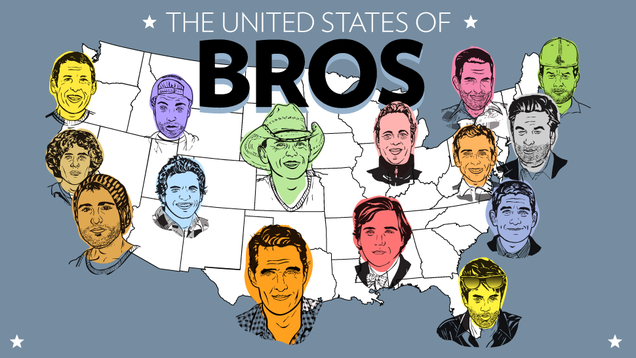
The United States of Bros: A Map and Field Guide

This article by Jared Keller comes from Pacific Standard - it offers a first-person account of a man who identifies himself as a "bro."
For all intents and purposes, I am a bro. I identify as a bro in the sense that, as Jezebel so aptly put it, I am “an adult male whose social life revolves around collegiate homosocial bonding and who also presents himself in a way that assimilates to the prevailing aesthetic of men with similar socialization patterns.”
From a much more critical, dismissive perspective, John Saward says of "bros," writing in Vice, “This is his dream. This is his life. He is the worst person alive, and he has no idea.
 He is a walking scorched-earth policy. He takes what he wants to satisfy some hedonistic impulse, and then he leaves her sobbing in a hallway with her friend on the other line. He wrings every moment of every drop of novelty. He is doing shots and never with a chaser, because moderation and restraint are for women and faggots and children. The only way to be a real man is to be a real man as ferociously as humanly possible. He goes all-in; he gets shredded and ripped and defines his life by aggression and competitions. He buys the hamburger that comes with two other hamburgers and a chicken cutlet on top of it. Why? Because it’s three hamburgers with a chicken cutlet on top of it.
Keller asks, and tried to answer in this article, some very challenging questions:
Where did this strange American Bro come from, this alien, fist-pumping, Jager-bombing avatar of modern sexism, racism, and nihilism? And why does he loom over every male friendship, every moment “with the boys”? Am I doomed, by our culture, to live as a jerk, a social parasite made fat on the sweet lard of privilege, with my male friends and colleagues? At what point did all strong homosocial relationships between men become conflated with the most vile and socially abhorrent behavior and egregious sartorial choices?
I'm fortunate, I guess, to have long, long ago left the "bro" stage of my life, sometime in 20s. When I get together with male friends, it's usually over coffee or lunch, not Jager-bombs. Our conversations do involve our work, but also our hobbies, or home repairs (do bros own homes?), or interesting books or articles we have read.

This is longish, but it is certainly deserving of a good read.

The Tortured Rise of the All-American Bro

Pacific Standard
By Jared Keller • May 06, 2014


cornell-fraternity
A fraternity building at Cornell University (Photo: Pete Spiro/Shutterstock)


The misogynist portrait of modern American masculinity may be a historical accident. Here’s how to fix it.

In April, my college buddies and I drove up to Maine to spend the weekend getting drunk and bouncing around downtown Portland for a former roommate’s bachelor party. Of all the people I’ve met and friends I’ve made—through high school and internships and college and jobs—these random goofballs are my closest friends. We headed north to celebrate impending nuptials, but at its core this weekend was about, as my girlfriend says, “just hanging out with the bros.”

For all intents and purposes, I am a bro. I identify as a bro in the sense that, as Jezebel so aptly put it, I am “an adult male whose social life revolves around collegiate homosocial bonding and who also presents himself in a way that assimilates to the prevailing aesthetic of men with similar socialization patterns.”

But according to Vice, my friends and I are the worst thing to happen to Portland since the great 1866 fire that leveled churches, destroyed the city’s commercial center, and left nearly 10,000 homeless. On an off day, I should be on Boston’s Orange Line, stinking of bourbon and slurring, and “cackling at the ceiling, electrified by the degree to which he does not give a fuck,” John Saward writes. “This is his dream. This is his life. He is the worst person alive, and he has no idea.”
He is a walking scorched-earth policy. He takes what he wants to satisfy some hedonistic impulse, and then he leaves her sobbing in a hallway with her friend on the other line. He wrings every moment of every drop of novelty. He is doing shots and never with a chaser, because moderation and restraint are for women and faggots and children. The only way to be a real man is to be a real man as ferociously as humanly possible. He goes all-in; he gets shredded and ripped and defines his life by aggression and competitions. He buys the hamburger that comes with two other hamburgers and a chicken cutlet on top of it. Why? Because it’s three hamburgers with a chicken cutlet on top of it.
I’ve been a member of male-centric institutions my entire life—sports teams, a summer camp staff, a fraternity—and still, somehow, my friends and I don’t seem to quite match this portrait of the American Bro. My weekend habits, though boisterous and uncouth, don’t sync with the totally terrifying acid trip of masculinity captured by Vice. Though I have spent time in the presence (or wake) of the horrific men described by Saward, I have never done 75 push-ups because NO REGRETS. I don’t know anyone named Rachael who wants it, she so wants it, bro. None of my fashion choices match Jezebel’s amazing geographical exhibition of the Great North American Bro. Even BuzzFeed’s “How ‘Bro’ Are You?” quiz considers me vaguely well-adjusted, despite the fact that I make duckface in way too many photos and have been known to say “duuude.” “Congratulations on having exquisite taste,” the BuzzFeed results page says, “and feel free to procreate as much as you like!”

Where did this strange American Bro come from, this alien, fist-pumping, Jager-bombing avatar of modern sexism, racism, and nihilism? And why does he loom over every male friendship, every moment “with the boys”? Am I doomed, by our culture, to live as a jerk, a social parasite made fat on the sweet lard of privilege, with my male friends and colleagues? At what point did all strong homosocial relationships between men become conflated with the most vile and socially abhorrent behavior and egregious sartorial choices?

The repressive, hypermasculine bro that stalks your local watering hole and pisses in the street is a modern, anxious manifestation of homosexual panic, an allergic reaction to the mainstreaming of gay culture.

Ironically, the history of homosexuality in America may hold the secret to the modern hyper-masculine bro. Prior to the 1970s, the majority of psychological literature on homosexuality was based on the presumption that the practice was a mental disorder, a view that coincided with advances in medicine at the end of the 18th century and the rise of psychoanalysis in the U.S. and Continental Europe. Homosexuality was eventually declassified as a mental illness in 1973, and all references to homosexuality as a psychiatric disorder were removed from the American Psychiatric Association’s Diagnostic and Statistical Manual of Mental Disorders (DSM). Despite this, gays and lesbians were still met with apprehension and hostility by the American public: In 1988, only 11 percent approved of same-sex marriage, and while that number increased to 46 percent by 2010, 40 percent of Americans remain opposed to it.

But decades of classifying homosexuality as a “dysfunction” in America left a lasting mark on all homosocial relationships. In modern Anglo-American society, writes gender theorist Eve Kosofsky (who coined the term “homosocial”) in her classic study “Between Men,” there’s a significantly greater disconnect between male homosexual and homosocial bonds, whereas there’s a much more psychosocially continuous relationship between female homosexual and homosocial bonds. The discontinuity between male homosociality and homosexuality results in male homosocial relationships taking on the form of “male bonding,” which is characterized by homosocial desire and intimacy (say it with me now: “broing out”) but marked, most notably, by homosexual panic, the fear of this attention gliding over into something a little more taboo, a little more risqué. In an attempt to emphasize heterosexuality, fear or hatred of homosexuals and misogynist language developed. The bro, in short, is a culture-wide defense mechanism against the gay.

This social split between male homosexual and homosocial relationships is why the sort of homosocial bonding on display in black-and-white photographs of men throughout American history all but went extinct by the middle of the 20th century: homosexuality had become a pathologized identity, one that carried connotations of psychological dysfunction and perversion. “The shift meant sitting for a portrait in your best bro’s lap was verboten; more important, though, some have argued that it has led to a wide-scale deprivation in boys and men of intimate touch that is important to their development and mental health,” Kat Stoeffel explains at The Cut, discussing the rise of touch isolation. “Men who hold hands, sling an arm around each other, and say ‘I love you’ risk being labeled gay at best and violent homophobic backlash (either from observers or their beloved bro) at worst.”
Male physical affection may be making a comeback: According to a recent study in British journal Men and Masculinities, 98 percent of the heterosexual men interviewed had shared a bed with another man, while 93 percent had cuddled or spooned with one, evidence of, as the authors write, “expansion of changing conceptions of masculinity in contemporary culture.”

The repressive, hypermasculine bro that stalks your local watering hole and pisses in the street is a modern, anxious manifestation of homosexual panic, an allergic reaction to the mainstreaming of gay culture (and, by extension, a loss of cultural power and sexual stability). The modern definition of manhood came about in strict domination over the feminine, both sexually and behaviorally. “Male-male relations organize and give meaning to the social and sexual involvements of young heterosexual men in a powerful way,” writes researcher Michael Flood in a 2008 issue of Men and Masculinities, an exploration of how male homosocial bonding affects men’s relationships with women. “Homosocial bonds are policed against the feminizing and homosexualizing influences of excessive heterosociality, achieving sex with women is a means to status among men, sex with women is a direct medium of male bonding, and men’s narratives of their sexual and gender relations are offered to male audiences in storytelling cultures generated in part by homosociality.”

If modern misogyny is a virus, a symptom of psychosexual anxiety and irrational fear of homosexuality, then institutions like fraternities make for an excellent petri dish. Alcohol consumption is the primary way in which men “negotiate masculinities in leisure activities,” writes Lois West in the Journal of Men’s Studies in a 2001 examination of two American drinking cultures, fraternities and the U.S. Navy. Collective boozing—at frat houses, on shore leave, at sporting events—can facilitate the creation of masculine homosociality by “developing a sense of community and trust” around perpetuating certain kinds of American masculine traditions, West writes. But alcohol-driven social interactions are also used to inhibit negotiations over other hierarchies of identity and social boundaries relating to class, religion, race, ethnicity, and sexuality. “Status hierarchies get negotiated through competitive drinking games, humor, and heterosexual significations.”

One of the more troubling features of the modern bro isn’t the sad, relatively recent dose of anxiety that fuels his behavior, but the cultural power he maintains. Male-heavy organizations like the armed forces and college fraternities have the institutional power to safeguard the more violent, despicable, and misogynistic behaviors of young men. The prevalence of sexual assault on college campuses, the site of social and professional development for America’s workforce, is especially troubling. Nearly 20 to 25 percent of female college students will experience rape or attempted rape during their time on campus, according to the Department of Justice; and according to research by the Center for Public Integrity, abusive students rarely receive more than a slap on the wrist. Some universities even rebrand rape as “non-consensual sex.” College sexual assault has become such a frightening epidemic in America that the White House has pressured universities to do more to combat it.

Fraternities, once social organizations focused on personal development and scholastic achievement, have devolved into engines for misogyny and assault. And they can breed future horrors. “Future fraternity brothers are often coddled by yes-men athletic coaches and administrators in high school, where they learn that they can argue their way out of class and — as nationally publicized cases like Steubenville and Maryville show us — rape accusations,” Katie Baker writes. “‘[A]n astonishing number of CEOs of Fortune 500 companies, congressmen and male senators, and American presidents have belonged to fraternities.’ Once they’re entrenched in the high-paying jobs they expected to easily obtain, these former fraternity brothers … continue to act the same way behind barely closed doors. If you feel so secure about your past, present and future that you feel invincible, why stop the fun?”

One of the more troubling features of the modern bro isn’t the sad, relatively recent dose of anxiety that fuels his behavior, but the cultural power he maintains.

And in that permanent aura of cultural invincibility, born from the anxiety of homosocial bonding, is where we find the American bro, freed from the ivied walls and storied halls of his fraternity house and let loose on the sidewalks near you. A visceral portrait of the dark strains of brodom can be found in Cord Jefferson’s demand that the white community take responsibility for a “culture of lawlessness” after a group of surfers rioted in Huntington Beach, California—a satirical inversion of the “culture of black violence” segments favored by cable’s talking heads. “Whites in America have been out from under their European ancestors’ boot heels for centuries; California specifically outlawed preferences for nonwhites in state hiring and education nearly two decades ago, so being ‘oppressed’ is no longer an excuse for behavior like this,” Jefferson writes. “How long must we wait for the white community to get its act together?”

Racism, sexism, and misogyny are alive and well in the minds of some men with too much time, money, and anger on their hands. In this respect, the chest-thumping, booze-guzzling mess of a man you encounter clad in stunner shades and blasting EDM in the early hours of the morning isn’t the norm, but some accidental avatar of the worst impulses of modern man. The bro is a historical accident, a hostile social virus—incubated in the safety of homosocial bonding and bred in communal organizations—that has infected the bloodstream of the United States.

Changing demographics and attitudes may be a vaccine against the social and political dominance of bros: Millennials, fast transitioning into adulthood, are the most racially diverse generation in American history, a trend driven by the large wave of Hispanic and Asian immigrants who have been coming to the U.S. for the past half century, and whose U.S.-born children are now aging. Millennials are essentially a transitional generation: Some 43 percent of Millennial adults are non-white, the highest share of any generation, and the Census Bureau projects that the full U.S. population will be majority non-white sometime around 2043. With the changing racial make-up of today’s young adults comes a burst of political liberalism, an acceptance of homosexuality, and an emphasis on social and political justice along gender and racial lines.

But the bro is a persistent creature, and some male-centric organizations can remain safe spaces for misogyny, frustration, anxiety, and cultural narcissism despite shifts in American society. The emphasis on terrible style choices—the cheapest, most juvenile form of identity politics—only distracts attention from other forms of sexism that permeate American culture beneath the veneer of irony and sophistication (hello, hipster sexism). And casting homosocial relationships between men into something cartoonish and clownish, either as insufferably haphazard and childish (like the bromances that dot Judd Apatow’s filmography) or mortifyingly aggressive and secretly homosexual (Jersey Shore), can end up conflating positive friendships with the caricature of a man that is the American Bro.

Male friendships are camouflage to the worst impulses of the bro, at the cost of a relatively decent, courteous, and moral class of American men. For them—us—being good isn’t enough. We can’t just point to this scourge of American social life and say “not all men.” I was lucky enough to belong to male-centric institutions—like my childhood summer camp—that emphasized understanding, empathy, and loyalty. But as a straight, white man, I benefit from brodom in American culture, and I’ve been socialized to navigate it. This is what it means to actually “check your privilege”: If the American Bro is “the worst person alive, and he has no idea,” as Vice’s Saward writes, then a real man lives keenly aware of the historical and institutional powers which he has inherited, regardless of good, humble, and sensitive he thinks he is.

This, really, is my challenge: To recast “bro”—now, rightfully, a slur—as the rallying cry of honest, thoughtful, and productive male friendship.
Jared Keller
~ Jared Keller is a journalist and social media specialist living in New York. His writing has appeared in The Atlantic, Bloomberg Businessweek, National Journal, Outside, Al Jazeera America, and The Verge.

More From Jared Keller

Friday, March 7, 2014

The BroApp - Saving Relationships One Bro at a Time


Hilarious . . . except that it's real. WTF guys? Are men really becoming THAT pathetic?

This comes from Tucson Weekly's The Range blog.

BroApp Saving Relationships One Bro at a Time

Posted by David McGlothlin on Mon, Mar 3, 2014


For some bros it can be extremely tasking to adequately balance their time between their girlfriends and bro activities like lifting, video games, broing out, and chilling with the bros. This is a common bro-blem. Bros genuinely cares about their partner but for some reason sometimes accidentally forget to talk to her all day.

Luckily fellow bros share your pain and created the BroApp to bring an end to this bro-lemma.

With BroApp, you can spend as much time with the bros as you want while pre-selected thoughtful, sweet, and heart-felt text messages are sent through the app to your girlfriend during times of your choice that remind her you're always thinking about her.

Texts include:
  • Hey babe, how was your day?
  • :x
  • Hey babe, what are you up to tonight?
  • Miss you :)
  • Hey babe, i'm leaving work now
If the bros who created the BroApp didn't properly capture the way you communicate with your girlfriend (or lack there of), you have the option of customizing and adding your own messages.

Every bro surely knows the importance of not getting caught in the act, which is why the app also has certain safeguards preventing your girlfriend from ever knowing.

You can choose which Wi-Fi networks are not bro-friendly so the app doesn't send her an automatic text when your both on the couch at her house. Also the bros claim they have a way to disguise the BroApp on your phone so she can never detect it.

As always bros prevail for their fellow bros and the BroApp is here to help any member of the bro community who need bro-sisstance.

Saturday, August 31, 2013

Documentary - The Bro Code: How Contemporary Culture Creates Sexist Men


This is an educational documentary meant, I assume, for university campuses. Sounds pretty similar to Jackson Katz's Tough Guise. Here some of the main points of the film, according to the supplemental materials.
Key Points
• The filmmaker admits that he grew up in “bro culture,” pointing to his background in sports and music.
• He then suggests that boys today are being raised in the same sexist ways he was raised.
• But he underlines a key difference between then and now: he claims that the sexism inherent in today’s “bro” culture is far more dangerous than in the past.
• The primary aim of the film, he says, is to understand the variety of ways that this increasingly dangerous strain of sexism continues to be lauded and defined as cool by mainstream media and mainstream male culture.

You can also read a transcript of the film (here)and a study guide for the film (here). Below is a low-resolution full-length preview of the film.

The Bro Code: How Contemporary Culture Creates Sexist Men


Filmmaker Thomas Keith, a professor of philosophy at California State University, Long Beach, provides an engrossing look at the forces in male culture that condition boys and men to dehumanize and disrespect women. Breaking down a range of contemporary media forms targeted explicitly at young men, Keith teases out the main maxims of "bro culture" and "the bro code," and examines how this seemingly ironic mentality reinforces misogyny and gender violence in the real world. Whether he's looking at movies and music videos that glamorize womanizing, pornography that trades in the brutalization of women, comedians who make fun of sexual assault, or the recent groundswell in men's magazines and cable TV shows that revel in reactionary myths of American manhood, the message Keith uncovers in virtually every corner of our "entertainment" culture is clear: that it's not only normal -- but cool -- for boys and men to control and humiliate women. Along the way, The Bro Code makes a powerful case that there's nothing normal, natural, or inevitable about this toxic ideal of American manhood, and challenges young people to fight back against the resurgent idea that being a "bro" -- and a man -- means glorifying sexism, bullying, and abuse.

Featuring interviews with Michael Kimmel, Robert Jensen, Shira Tarrant, J.W. Wiley, Douglas Rushkoff, Eric Anderson, and Neal King.

Sections:
Intro (2:15)
Step 1: Train Men to Womanize (18:03)
Step 2: Immerse Men in Porn (13:25)
Step 3: Make Rape Jokes (11:33)
Step 4: Obey the Masculinity Cops (12:22)

Viewer discretion advised : Contains violent & sexual imagery and profanity.


Filmmaker Info

Written and produced by Thomas Keith
Director of Photography: Michael Enriquez
Additional Photography: Mitch Lemos
Editing: Thomas Keith


Filmmaker's Bio

DR. THOMAS KEITH | Director, Writer, Producer
Dr. Thomas Keith teaches philosophy at California State University, Long Beach and California Polytechnic University. He specializes in American philosophy and pragmatism with an emphasis on issues of race, class, and gender. In 2008, Dr. Keith directed and produced the bestselling film, Generation M: Misogyny in Media and Culture, which is used in classrooms around the world.