Showing posts with label poverty. Show all posts

Wednesday, March 20, 2013

Brené Brown - Shame Corrodes Our Ability to Believe We Are Capable of Change


New York City, under Mayor Bloomberg's direction, recently unveiled its new anti-teen pregnancy campaign, with a series of posters similar to the one above (which is part of the series). A lot of people who are frequently liberal allies of Bloomberg have denounced the ad campaign, including Planned Parenthod:
Planned Parenthood issued a statement denouncing the poster campaign, saying that it ignored the racial, economic and social factors that contribute to teenage pregnancy and instead stigmatized teenage parents and their children.
Brené Brown - author of Daring Greatly: How the Courage to Be Vulnerable Transforms the Way We Live, Love, Parent, and Lead, The Gifts of Imperfection: Let Go of Who You Think You're Supposed to Be and Embrace Who You Are, and I Thought It Was Just Me (but it isn't): Making the Journey from "What Will People Think?" to "I Am Enough", among other works - also weighs in on the issue, and she suggests (rightfully so) that shaming these young mothers is pouring salt in an open wound. Most of them probably did not plan to be mothers, but it happened, and shaming them for it will just create even more shame as they shame themselves.

She should know - Brown is one of the leading researchers and writers on shame in the U.S., and her TED Talks (The Power of Vulnerability, 2010, and Listening to Shame, 2012) have been HUGE successes.

This is from Brown's blog.

Public Shaming is a Better Example of "If it feels good - do it" than Teen Pregnancy


March 20, 2013


Richard Reeves’ New York Times Op/Ed arguing that shame is an essential ingredient of a healthy society is not only wrong, but also potentially more dangerous to parents, children, and society than teen pregnancy – the example he uses in his argument.

Last week New York City unveiled its public education campaign targeting teenage pregnancy. Taking a page from the Georgia obesity campaign and Nathaniel Hawthorne’s The Scarlet Letter, the campaign features pictures of tear-stained toddlers admonishing their teen mothers for ruining their lives.

The ads are painful, and in a moment of sheer frustration and anger, I thought about ditching this article and just sending both Reeves and Mayor Bloomberg pictures of tear-stained pregnant teenagers staring out and declaring: “Please don’t attack my self-worth. I’m already struggling and desperate for love and belonging.”

Having spent the past decade studying shame, courage, and vulnerability, I know that ploy is cheap, easy, and ineffective. I’m going old school – with facts.

To be effective, all shame- and stigma-based campaigns rely on the intended audience’s feeling empathy and guilt when they see the images. In New York the goal is for teenagers to see the forlorn toddlers and think, “I don’t want to do that to a child.” In anti-obesity ads, the goal is for parents to see a desperate child saying, “Please help me. I don’t want to be fat,” and think, “I’ve got to start making better choices for my family.”

Here’s the rub:

Shame diminishes our capacity for empathy.

Shame corrodes the very part of us that believes we are capable of change.


You can’t depend on empathetic connection to make a campaign effective, then crush the needed empathy with shame.

Researchers June Tangney and Ronda Dearing, authors of Shame and Guilt, explain that feelings of shame are so painful that it pulls the focus to our own survival, not the experiences of others.

Example: A man shakes a bottle of pills in his wife’s face, “Look around you! Your pill-popping is destroying our family. Our son is failing out of school and our daughter is literally starving herself for attention. What's wrong with you?”

Does the shame of what she’s doing to her family lead her to get help, or does it lead her to slink away and get high? After-school specials tell us she gets help. Data say she gets high. In fact, new research shows that some addiction may be born of shame and that shame leads to relapse rather than relapse prevention.

A man is convicted of domestic abuse and the judge sentences him to stand downtown during rush hour holding a sign that says, “I am a wife beater.” Would you like to be the woman he comes home to that night? Are you safer when he’s in shame or repairing shame?

Reeves basically makes the good shame/bad shame argument, explaining that shame should be used in some ways but not others.

I don’t see any evidence of “good shame.” Not in my research and not in the research being done by other affect researchers.

I define shame as “the intensely painful feeling or experience of believing we are flawed and therefore unworthy of love and belonging.” Along with many other shame researchers, I’ve come to the conclusion that shame is much more likely to be the source of dangerous, destructive, and hurtful behaviors than it is to be the solution.

It is human nature, not just the nature of liberals (as Reeves argues), to want to feel affirmed and valued. When we experience shame, we feel disconnected and desperate for belonging and recognition. It’s when we feel shame or the fear of shame that we are more likely to engage in self-destructive behaviors, to attack or humiliate others, or to stay quiet when we see someone who needs our help.

Making the distinction between good and bad shame, and promoting so-called good shame is like saying there’s “good starvation” and “bad starvation” and that we need to address the obesity epidemic with “good starvation.” Just like there’s no such thing as “good starvation,” there’s no such thing as “good shame.”

The “good shame” that Reeves describes is actually a combination of guilt and empathy. And, interestingly, there is actually significant research on the important roles both guilt and empathy play in pro-social, positive behavior.

Is this just a case of semantics? No. We don’t refer to balanced, healthy eating as “good starvation” because it’s confusing, inaccurate, and misleading. It also obscures and confuses what we really need to do to move toward positive social outcomes.

The majority of shame researchers agree that the difference between shame and guilt is best understood as the difference between “I am bad” and “I did something bad.” Shame is about who we are, and guilt is about our behaviors.

When we apologize for something we’ve done, make amends to others, or change a behavior that we don’t feel good about, guilt is most often the motivator. Of course, you can shame someone into saying, “I’m sorry,” but it’s rarely authentic. Guilt is as powerful as shame; it just doesn’t have the paralyzing and debilitating impact that prevents shame from being an effective agent of meaningful change.

Empathy is the ability to put ourselves in someone else’s place in order to understand what they are feeling. When we are empathetic, we can listen and respond authentically to others, and we have the skills to consider how our actions will impact others.

Again, why don’t we just refer to guilt and empathy as “good shame”? Because it’s inaccurate. It clouds the fact that being empathetic and communicating with others (colleagues, children, partners, friends) without using shame requires most of us to develop new skills. Labeling these skills “good shame” moves us away from the hard work of understanding, identifying, and acquiring the knowledge we need to change.

Based on my own experiences with shame (we all have it) and what I’ve learned about it as a researcher, I know the intense pain, isolation, and fear it causes. I’m not proud to say this, but even with this knowledge, if I thought shaming people would, in the long run, keep them safer and make the world a better place, I might do it. As a parent and an observer of human behavior, I can get extremely fearful, and that fear might allow me to overlook the pain caused by shame if I thought it would ensure a better outcome.

Fortunately, I don’t have to wrestle with that moral dilemma because we know that shame never works as a catalyst for healthy, lasting change.

Shame is at the core of violence, addiction, disengagement, and fear. Shame is about anger and blame, not accountability and change. Meaningful change means understanding the realities of these girls’ lives (and the boys who get them pregnant) and working with them to cultivate educational opportunities, hope, and support.

Reeves writes, “We need a sense of shame to live well together. For those with liberal instincts, this is necessarily hard. But it is also necessary.” I’m not sure what he means by “liberal instincts,” but what I do know is that using shame as a tool when we are frustrated, angry, or desperate to see behavior change in people is a much better example of the “it feels good – do it” ethos than the teen pregnancy problem. We might feel justified in belittling and humiliating people, but it makes the world a more dangerous place.

I'd love to know what you think. Respectful debate and discussion is always welcome! ​

Tuesday, July 10, 2012

Chris Hedges - War Is Betrayal: Persistent Myths of Combat


As far as I know, there has not been a formal declaration of war in my lifetime (since 1967). Still, various presidents have sent our military around the planet in a variety of combat missions, most recently to Afghanistan and Iraq. There also has not been a mandatory draft in my lifetime, which has resulted in a military composed of the patriotic (an act of service to the nation) and the poor (those who join to learn a skill or earn money for college, or simply to escape a life of flipping hamburgers).

According to Chris Hedges, in a new article for the Boston Review, the reality is even more harsh:
We condition the poor and the working class to go to war. We promise them honor, status, glory, and adventure. We promise boys they will become men. We hold these promises up against the dead-end jobs of small-town life, the financial dislocations, credit card debt, bad marriages, lack of health insurance, and dread of unemployment. The military is the call of the Sirens, the enticement that has for generations seduced young Americans working in fast food restaurants or behind the counters of Walmarts to fight and die for war profiteers and elites. 
I doubt that Hedges identifies himself with the term, but I'm willing to bet he has been named a Marxist by the rich, mostly-white "ruling class" he so often targets in his articles and books. For him, this is a nation of social class built on wealth and power - the rich (the proverbial 1%) vs. the rest of us.

The poor are those who do the hardest most dangerous work, and that includes military service - of the 25 most dangerous jobs, 99% of those doing them are men, and of those men, my guess is that a fair percentage are from low-income families and from minority families. And now, even women are beginning to enter these fields (especially military service).

Here is some more from Hedge's article, War Is Betrayal: Persistent Myths of Combat:
At the age of ten I was given a scholarship to a top New England boarding school. I spent my adolescence in the schizophrenic embrace of the wealthy, on the playing fields and in the dorms and classrooms that condition boys and girls for privilege, and came back to my working-class relations in the depressed former mill towns in Maine. I traveled between two universes: one where everyone got chance after chance after chance, where connections and money and influence almost guaranteed that you would not fail; the other where no one ever got a second try. I learned at an early age that when the poor fall no one picks them up, while the rich stumble and trip their way to the top.

Those I knew in prep school did not seek out the military and were not sought by it. But in the impoverished enclaves of central Maine, where I had relatives living in trailers, nearly everyone was a veteran. My grandfather. My uncles. My cousins. My second cousins. They were all in the military. Some of them—including my Uncle Morris, who fought in the infantry in the South Pacific during World War II—were destroyed by the war. Uncle Morris drank himself to death in his trailer. He sold the hunting rifle my grandfather had given to me to buy booze.

He was not alone. After World War II, thousands of families struggled with broken men who, because they could never read the approved lines from the patriotic script, had been discarded. They were not trotted out for red-white-and-blue love fests on the Fourth of July or Veterans Day.

The myth of war held fast, despite the deep bitterness of my grandmother—who acidly denounced what war had done to her only son—and of others like her. The myth held because it was all the soldiers and their families had. Even those who knew it to be a lie—and I think most did—were loath to give up the fleeting moments of recognition, the only times in their lives they were told they were worth something.

“For it’s Tommy this, an’ Tommy that, an’ ‘Chuck him out, the brute!’” Rudyard Kipling wrote. “But it’s ‘Saviour of ’is country’ when the guns begin to shoot.”

Any story of war is a story of elites preying on the weak, the gullible, the marginal, the poor. I do not know of a single member of my graduating prep school class who went into the military. You could not say this about the high school class that graduated the same year in Mechanic Falls, Maine.
This was true, in its own way, in my own high school.

Only none of us were wealthy. The only true wealth in rural Southern Oregon was intelligence and hard work, our ticket to college. For others, especially the young men, it was a life in the timber mills (a life that dried up not long after we graduated) or spend a few years in the military to earn money for college or learn a trade.


Hedges can be prone to more than a little hyperbole, but this article is pretty spot on. Read the whole thing.

But before you go read the article (and I hope you do), here is one last passage that gets the point across in case you choose not to click through:
War comes wrapped in patriotic slogans; calls for sacrifice, honor, and heroism; and promises of glory. It comes wrapped in the claims of divine providence. It is what a grateful nation asks of its children. It is what is right and just. It is waged to make the nation and the world a better place, to cleanse evil. War is touted as the ultimate test of manhood, where the young can find out what they are made of. From a distance it seems noble. It gives us comrades and power and a chance to play a bit part in the great drama of history. It promises to give us identities as warriors, patriots, as long as we go along with the myth, the one the war-makers need to wage wars and the defense contractors need to increase their profits.

But up close war is a soulless void. War is about barbarity, perversion, and pain. Human decency and tenderness are crushed, and people become objects to use or kill. The noise, the stench, the fear, the scenes of eviscerated bodies and bloated corpses, the cries of the wounded all combine to spin those in combat into another universe. In this moral void, naïvely blessed by secular and religious institutions at home, the hypocrisy of our social conventions, our strict adherence to moral precepts, becomes stark. War, for all its horror, has the power to strip away the trivial and the banal, the empty chatter and foolish obsessions that fill our days. It might let us see, although the cost is tremendous.

Monday, May 21, 2012

TEDxXavierUniversity - Sherman Bradley - Relational Justice

Sherman Bradley brings his own family experience to introduce the topic of relational justice - a shift of perspective around crime and poverty as relational (between people) and not institutional (between the person and the state). Here is a definition of relational justice from Nicola Baker and Jonathan Burnside:
Relational justice is a fresh vision of what doing justice means in a society where relationships are being undermined and undervalued. It turns the spotlight on one of the goals of justice which is to restore and repair human relationships damaged by crime.
 Bradley brings these ideas to healing poverty and helping men without hope through his organization, Consider the Poor, a project of the City Gospel Mission. Consider the Poor educates the public about the dynamics of poverty and homelessness and encourages dialogue about these critical issues. By bringing people together for training and discussion, Consider the Poor inspires men and women to advocate for the poor and create grassroots change in their communities.

Sherman Bradley's Understanding Poverty Workshop 

Take Action


TEDxXavierUniversity - Sherman Bradley - Relational Justice
This former US air force sargent, has made it is his life's mission to empower formerly incarcerated, addicted, disenfranchised and homeless men. What he discovered is a new way of looking at... one another.

Sherman Bradley is innovating the way we serve with an entirely new approach.

Saturday, October 18, 2008

How Manly Men Can Fight Poverty

The Art of Manliness posted this on Blog Action Day, which was dedicated to fighting poverty -- I think it is a good post and deserves a little more attention.

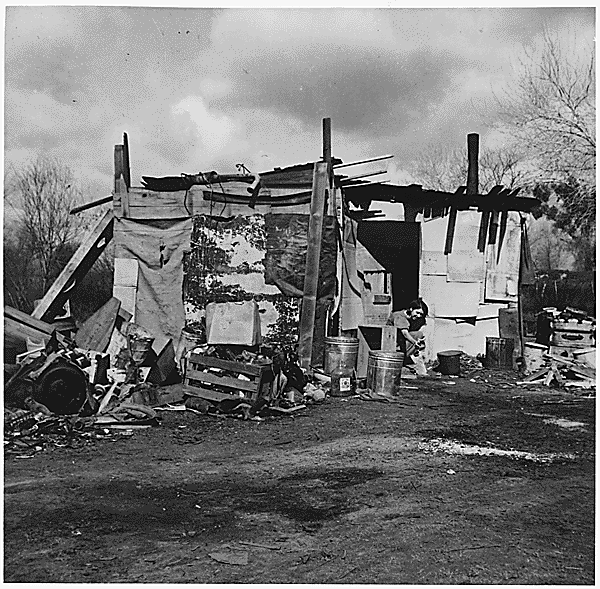
Personally, although I grew up reasonably "poor" by American standards, I had no idea what poverty looked like until I traveled to Mexico City in 1986 for the World Cup. Until then, I had never seen people living in cardboard boxes or "shacks" made from aluminum siding nailed to trees. I was devastated.

There is so much we each can do, and even though I missed Blog Action Day, every day can be a day devoted to fighting poverty. The more the economy collapses, the more those of us still working will need to help others.

It's our moral obligation as men, as human beings.

How Manly Men Can Fight Poverty

shack How Manly Men Can Fight Poverty

Editor’s Note: Today is Blog Action Day and AoM is taking part. Blog Action Day is an annual nonprofit event that aims to unite the world’s bloggers, podcasters and videocasters, in posting about the same issue on the same day. The goal is to raise awareness and trigger a global discussion about that issue. This year’s issue is poverty.

The first time I was really confronted with poverty on a consistent basis was when I lived in Tijuana, Mexico for two years as a missionary for my church. For a white kid (well, a tan white kid) who grew up in an affluent American town, the experience was an eye opener. For the first time, I saw all the ugly effects of poverty first hand: drug and alcohol abuse, prostitution, child neglect, sickness, and crime.

While I was in Tijuana, I saw several church groups from California cross the border with the goal of alleviating poverty. They’d come with bags of used clothes, toys, and handouts of free food. Heck, they’d even build people new homes for free! While their intentions were noble, their efforts did little to help the people. In a day or two the food was gone and in a week or two the free toys were lying untouched on the dirt street. But the people still didn’t have enough money to buy clean water or food for their families. And those people who got new homes? As soon as the church groups left, some of these new homeowners dismantled their houses and sold the materials for money. Others, who kept their homes, failed to take care of them properly and they quickly deteriorated. Within a matter of months, those brand new houses were indistinguishable from the other run down shacks.

But during my time in TJ, I met several families who were able to beat the poverty cycle. As I look back at these people, they all had two things in common that helped them get out of poverty: self-determination and responsible help from others. I never saw one without the other.

One family stands out to me. The husband was basically a bum. He drank his days away and worked odd jobs that paid a pittance. He couldn’t provide for his family and they often went hungry. This bum happened to attend the same church as a man who owned several taxies that ran in Tijuana. The taxi owner knew the bum husband and the problems he had. The taxi owner took the guy under his wing and worked with him on getting his life in order. With a bit of tough love, this guy turned his life around completely. It took a lot of hard work and a lot of setbacks, but he had the determination to make a better life for his family The taxi owner soon offered the newly transformed man a job as a taxi driver in Tijuana. For the first time in this man’s life he had steady work that allowed him to provide comfortably for his family. He was able to escape poverty.

Grit and determination will only get you so far when you’re battling poverty. I saw men in Tijuana who worked their asses off at two jobs, but their situation never improved. It wasn’t until someone stepped in and provided better resources and opportunities that these men’s situations got better.

Likewise, all the help in the world won’t do any good unless the person has the desire to accept the help and do something constructive with it. As they say, you can lead a horse to water, but you can’t make it drink. So just providing handouts won’t cut it, like the misguided church groups did above. At some point the impoverished person must make the decision to get out of poverty. And they might need some help to see that they even have a choice. Some people have been so beaten down by poverty that they don’t have confidence or self determination to rise up from it.

Don’t get me wrong. I’m not naïve enough to think that self determination and help from others will beat poverty every time. Some places in the world have such corrupt governments and extreme environments that Herculean efforts and all of Warren Buffet’s money can’t possibly eradicate all of the poverty there. But individuals don’t have much influence over those factors. I think it’s much more constructive to focus on things we can have a direct and immediate influence on.

And a final thing I learned while I was in Mexico is that it isn’t the big Herculean efforts that beats poverty. Big government programs, huge benefit concerts, or even Blog Action Days don’t do much to help people get out of poverty. It’s done one person at a time.

Go read the rest of the post for some ideas on how to "kick poverty's ass."