Showing posts with label justice. Show all posts

Thursday, August 22, 2013

Robin Rosenberg, "What is a Superhero" | Talks At Google


In What Is a Superhero?, psychologist Robin S. Rosenberg and comics scholar Peter Coogan (Co-Editors) explore this idea and mainstream of American comic and film history from a variety of perspectives. Here is the publisher's ad copy for the book:
It's easy to name a superhero--Superman, Batman, Thor, Spiderman, the Green Lantern, Buffy the Vampire Slayer, Rorschach, Wolverine--but it's not so easy to define what a superhero is. Buffy has superpowers, but she doesn't have a costume. Batman has a costume, but doesn't have superpowers. What is the role of power and superpower? And what are supervillains and why do we need them?

In What is a Superhero?, psychologist Robin Rosenberg and comics scholar Peter Coogan explore this question from a variety of viewpoints, bringing together contributions from nineteen comic book experts--including both scholars in such fields as cultural studies, art, and psychology as well as leading comic book writers and editors. What emerges is a kaleidoscopic portrait of this most popular of pop-culture figures. Writer Jeph Loeb, for instance, sees the desire to make the world a better place as the driving force of the superhero. Jennifer K. Stuller argues that the female superhero inspires women to stand up, be strong, support others, and most important, to believe in themselves. More darkly, A. David Lewis sees the indestructible superhero as the ultimate embodiment of the American "denial of death," while writer Danny Fingeroth sees superheroes as embodying the best aspects of humankind, acting with a nobility of purpose that inspires us. Interestingly, Fingeroth also expands the definition of superhero so that it would include characters like John McClane of the Die Hard movies: "Once they dodge ridiculous quantities of machine gun bullets they're superheroes, cape or no cape." 
From summer blockbusters to best-selling graphic novels, the superhero is an integral part of our culture. What is a Superhero? not only illuminates this pop-culture figure, but also sheds much light on the fantasies and beliefs of the American people.
Interesting stuff. I think most boys who grew up in the 1970s were comic book fans and most of read superhero comics, either Stan Lee's Marvel Universe (Spider Man, The Hulk, Captain America, Thor, Fantastic Four, and so on) or the DC Comics Universe (Batman, Superman, Wonder Woman, Green Arrow, The Flash, Aquaman, and the Justice League).

I knew I could never be Superman, being from Earth and all, but Batman was just smart and had really cool toys - I could do that. Boys often saw these characters (almost certainly unconsciously) as role models.

In the end, a Superhero, for me, was someone who sacrificed their own safety and sometimes happiness to keep the world safe from villains. Gender, planet, or species, super powers or not - none of that matters. Superheroes are those who serve good and resist evil.

Rosenberg recently stopped in at Google to talk about her new book and our ideas about superheroes.

Top 25 superheroes on screen

* * * * *


Robin Rosenberg, "What is a Superhero" | Talks At Google


Published on Aug 22, 2013

Robin Rosenberg, Geoff Klock, Tom DeFalco, and Danny Fingeroth, "What is a Superhero"
What is a superhero? Everyone knows, right? And yet everyone seems to have a different answer. If asked, most people will say that a superhero is a fictional character with "superhuman" abilities or powers — and one who uses those abilities for the common good. Some might add that superheroes wear costumes. But this is only part of the story. 
In this innovative collection of essays, renowned psychologist Robin Rosenberg and comics scholar Peter Coogan explore the question "What is a superhero?" from a variety of viewpoints. What is the role of power and superpower? Heroism? The environment? How is the superhero a metaphor? Perhaps most intriguing, what are super villains and why do we need them? These and many other fascinating topics are taken up in this exciting new book. With essays from scholars and commentary by the writers and creators themselves, including exclusive material from Stan Lee, Danny Fingeroth, and their peers, What is a Superhero? is the first volume to provide a true synthesis and reflection of the state of superheroes in our culture today.

Wednesday, October 10, 2012

Sandusky Must Serve at Least 30 Years for Sexual Molestation Conviction


I meant to post this yesterday, after the sentencing hearing was completed, but I did not have any time last night to get it done. In my opinion, even though this is essentially a life-term for the 68-year-old Sandusky, I think it is too little for the crimes he committed and the lives he derailed (the maximum sentence possible was 442 years).

Perhaps this makes me a bad person, and it certainly makes me a bad Buddhist, but it feels that the "justice" he will receive in prison is much more appropriate than the sentence he received from the judicial system. From USA Today:
At trial, Pennsylvania prosecutor Joseph McGettigan referred to Sandusky as "the predator." In prison, says inmate safety consultant Larry Levine based in Los Angeles, the former coach will become "the prey."

The potential risk for sex offenders in general is very real, Levine says.

Four inmates have been killed in Pennsylvania prisons since 2010, including one sex offender. It is not known whether the slain inmate's rape conviction was the reason for the killing, Department of Corrections spokeswoman Susan McNaughton says.

In California, six sex offenders have been slain in state prison this year. The number includes the murders in May of at least three prisoners convicted of sex offenses involving children. California Department of Corrections spokeswoman Terry Thornton says it was not known whether all the inmate victims were targeted because of their offenses.

"But those inmates who have offended against children are targeted more often than not," she says.
In one of the highest profile killings involving a child sex offender, John Geoghan — a main figure in the Boston priest sex scandal — was killed in prison in 2003 by a fellow inmate who specifically targeted the priest.

Levine, who served a 10-year federal prison sentence for narcotics trafficking, weapons possession, obstruction of justice and securities fraud before he began teaching prospective inmates survival techniques, says child sex offenders are often more despised in prison than even informants.
The likelihood is that if Sandusky is not kept in protective custody, or killed pretty quickly, there will be some very scary men who will want to play "tickle monster" with him in the showers - so he will probably get what he gave. Prison rape is very common, but child molesters are nearly always targeted for this form of retribution.

It bothers me that I am not at all bothered that Sandusky will be assaulted in prison . . . . .

This article contains a lot of responses from the victims or their families, but see this piece, too - Victims angrily confront Sandusky at sentencing - for additional insight into how this horrific situation impacted the boys and young men Sandusky victimized.

Sandusky gets at least 30 years for child sex abuse

By Josh Levs and Laura Dolan, CNN
updated 6:17 PM EDT, Tue October 9, 2012
 
Bellefonte, Pennsylvania (CNN) -- After spending years of his life sexually abusing boys entrusted into his care and recent years denying it, Jerry Sandusky is likely to spend the rest of his life in jail. A judge sentenced the 68-year-old former Penn State assistant football coach Tuesday to at least 30 years in prison.

He had faced a maximum of 400 years for dozens of charges stemming from his sexual abuse of 10 boys over a 15-year period. Sandusky was convicted in June.

After an emotional hearing in which victims detailed the horrors they endured -- and Sandusky still maintained his innocence, portraying himself as a victim -- Judge John Cleland ruled that the "dangerous" Sandusky will not be eligible for parole for 30 years. His maximum sentence is 60 years.
The once-beloved coach, whose abuse triggered a scandal for one of the nation's most storied college football teams, was given credit for 112 days served.

He will also have to cover costs of the prosecution, Cleland said. The amount was not immediately known.

"All the qualities that make you successful concealed your vices," Cleland said. "This, in my view, makes you dangerous."

He noted the long-term damage Sandusky inflicted on victims: "This crime is not only what you did to their bodies but their psyche and souls."

Despite the mountain of testimony that convicted him and a plea from a victim Tuesday that Sandusky finally admit his guilt, Sandusky remained stalwart. "I did not do these disgusting acts," he said repeatedly.

His attorneys have 10 days to appeal the judge's decision. They have already vowed to appeal his conviction. After the sentencing, defense attorney Joe Amendola insisted that if the team had had more time to prepare for the trial, Sandusky would have been acquitted.

Cleland designated Sandusky as a sexually violent offender, which will partially determine where he will be housed in prison and which programs he will be required to participate in, according to Jean Casarez of HLN's "InSession." Sandusky told the judge he did not oppose the status but maintained his innocence.

One of his attorneys said before the hearing that Sandusky's legal team would not contest the classification but would stipulate that they disagree with it.

Across the country, victims of sexual abuse and organizations that represent them hailed the downfall of the notorious abuser.

"Now that Sandusky will be locked up and unable to harm more children, our hope is that even more survivors will take their first steps towards recovery -- with the confidence that their family, friends and community will believe them and support them," said Scott Berkowitz, president of the Rape, Abuse & Incest National Network.

But the most emotional words of the day came from Sandusky's victims. Some spoke at the hearing, pushing for a harsh sentence, while one and the mother of another offered written impact statements read by the prosecution.

"The pain is real, and it will be inside me forever," said a man identified as Victim No. 5.
He added that he will never forget the image of Sandusky "forcing himself on me and forcing my hand on him."

"He took away my childhood the day he assaulted me, and he should be sentenced accordingly."
Another victim, No. 6, described the "deep wounds" that left him praying for help.

"As I put the 1998 incident in the shower into focus, I think about how you manipulated me," he said, adding that Sandusky "called yourself the tickle monster so you could touch me."

Victim No. 4 assailed Sandusky's refusal to acknowledge what he had done. "Rather than take responsibility for your actions, you attacked us," he said.

"My only regret is that I didn't come forward earlier."

In her written statement, the mother of Victim No. 9 said, "Words cannot describe the pain and impact on my son and family."

"Because of you, we had to move four times," she said.

"I had to endure two attempts from my son trying to take his life. ... You caused him a lifetime of sorrow and suffering.

"I question every decision I made as a parent," she added.

"Shame on you, Mr. Sandusky, for your narcissistic and selfish acts.

"Whatever comes to you I hope it is tenfold for what you did to my son and others."

Victim No. 1, in his statement, said of Sandusky, "There is no remorse ... just evil."

Lead prosecutor Joseph McGettigan said Sandusky is among "the most insidious and depraved of criminals."

Sandusky founded his charity for young people, Second Mile, to help children but used it to identify victims, McGettigan said.

"He inserted himself into the lives of children, deceiving their mothers."

A touch became a grope and "too often a penetration," McGettigan said.

"No deceit was too shameful for him," the prosecutor added. "He relied on shame to silence his victims. ... He treated his victims like sexual property, which he used as he saw fit."

McGettigan also slammed Sandusky for whining about "his own pain" in an audio statement Monday night.

Sandusky, speaking for about 13 minutes at the hearing, called his situation "the worst loss of my life."

"I will cherish the opportunity to be a candle for others," he said, adding that "somehow, some way, something good will come out of this."

His wife, Dottie, had tears in her eyes.

Cleland addressed the victims: "The fact that you were assaulted is no cause for shame. ... It is for your courage that you will be remembered." And, he said, they will heal.

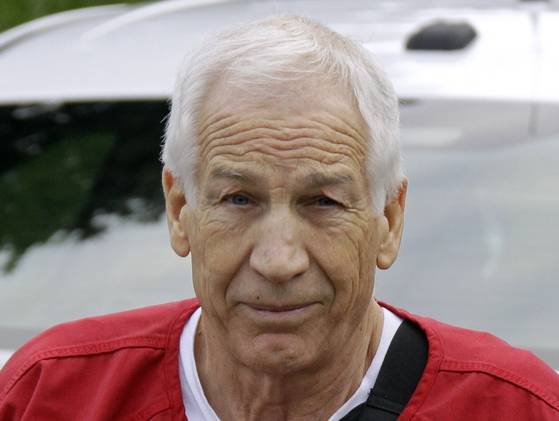
Sandusky entered the courthouse Tuesday wearing a red jumpsuit with a bullet-resistant vest underneath. Though he was handcuffed, he clutched a manila envelope and smiled briefly as he got out of a police vehicle. His wife arrived in the parking lot moments earlier.

In his audio statement Monday, Sandusky said, "They could take away my life, they could make me out as a monster, they could treat me as a monster, but they can't take away my heart."

He accused the judge of bringing the case to trial too quickly, the victims of conspiring together and the attorneys of trying to make money in future civil suits -- which an attorney for Victim No. 5 called "preposterous."

It has been nearly a year since the Penn State scandal erupted, leading to the firing of iconic head football coach Joe Paterno and the ouster of the university's longtime president, Graham Spanier.

Jurors determined in June that Sandusky, who retired from Penn State in 1999, used his access to university facilities and his foundation for underprivileged youth to sexually abuse the boys.

On June 22, Sandusky was convicted on 45 counts of child sex abuse, ranging from corruption of minors to involuntary deviate sexual intercourse, which were laid out in graphic testimony by his accusers over the course of the less-than-two-week trial.

During the trial, which garnered national attention and cast a shadow on Penn State's heralded football program, the 23-year-old Victim No. 4 testified that he was only 13 when Sandusky sexually abused him in a university shower.

That account is separate from a 2001 incident that Mike McQueary, a former Penn State assistant football coach, testified about, saying he saw the former coach pressed up against the back of a boy in the shower room of the Lasch Football Building.

McQueary filed a whistle-blower lawsuit last week against the university, according to a court document from Centre County, Pennsylvania.

Less than a month after Sandusky's conviction, former FBI Director Louis Freeh released his university-funded report that blamed Paterno, Spanier, suspended Athletic Director Tim Curley and ex-Vice President Gary Schultz for taking part in a cover-up to avoid bad publicity.

Freeh also said Paterno could have stopped the attacks had he done more, though neither McQueary, Sandusky nor Paterno -- who died in January -- were interviewed by his investigators.

Attorneys for Spanier blasted the review, calling it a "blundering, indefensible indictment" and "a flat-out distortion of facts" that was "infused with bias and innuendo."

In July, the NCAA imposed sanctions against Penn State, including a $60 million fine, scholarship reductions, the vacating of 112 wins of the football team, five years' probation and a bowl ban for four years.

After the sentencing decision was announced, the university's president released a statement.
"Our thoughts today, as they have been for the last year, go out to the victims of Jerry Sandusky's abuse," Penn State President Rodney Erickson said. "While today's sentence cannot erase what has happened, hopefully it will provide comfort to those affected by these horrible events and help them continue down the road to recovery."

CNN's Laura Dolan reported from Bellefonte; Josh Levs reported from Atlanta. CNN's Susan Candiotti, Jason Carroll, Ross Levitt and Ed Payne contributed to this report
 

Monday, May 21, 2012

TEDxXavierUniversity - Sherman Bradley - Relational Justice

Sherman Bradley brings his own family experience to introduce the topic of relational justice - a shift of perspective around crime and poverty as relational (between people) and not institutional (between the person and the state). Here is a definition of relational justice from Nicola Baker and Jonathan Burnside:
Relational justice is a fresh vision of what doing justice means in a society where relationships are being undermined and undervalued. It turns the spotlight on one of the goals of justice which is to restore and repair human relationships damaged by crime.
 Bradley brings these ideas to healing poverty and helping men without hope through his organization, Consider the Poor, a project of the City Gospel Mission. Consider the Poor educates the public about the dynamics of poverty and homelessness and encourages dialogue about these critical issues. By bringing people together for training and discussion, Consider the Poor inspires men and women to advocate for the poor and create grassroots change in their communities.

Sherman Bradley's Understanding Poverty Workshop 

Take Action


TEDxXavierUniversity - Sherman Bradley - Relational Justice
This former US air force sargent, has made it is his life's mission to empower formerly incarcerated, addicted, disenfranchised and homeless men. What he discovered is a new way of looking at... one another.

Sherman Bradley is innovating the way we serve with an entirely new approach.