Who's The Man? Hollywood Heroes Defined Masculinity For Millions
by Bob Mondello
All Things Considered
July 30, 2014
Movies have always offered a window through which audiences, sitting in the dark, can observe human nature without being observed. A movie theater is where many a boy learned how to make things right, the way John Wayne did in so many pictures, with fists or a gun. Movies taught about sacrificing for the greater good, as Humphrey Bogart did when he sent Ingrid Bergman off with a "here's lookin' at you, kid" in Casablanca. They're a place to learn about standing firm against injustice (with Spencer Tracy in Inherit the Wind), and about standing up for yourself (with Sidney Poitier in A Raisin in the Sun).
All of which was useful for a nation that thought of itself as a melting pot. For generations, newly arrived immigrants had emerged slowly from their ethnic enclaves in big cities, where things were comfortingly just like the old country. Assimilating was hard.
But film — even back when it was silent — was like an instruction manual for the American experience. For a nickel at the nickelodeon, a foreign fellow fresh off the boat could see exactly how American men dressed, how they greeted each other (with a handshake, not with European kisses on each cheek), and, more generally, how people in his newly adopted country behaved. Admittedly, silent films used a kind of shorthand for American behavior — stereotypes, to allow directors to brush in characters quickly without dialogue: women were almost always domestic, delicate and passive, while men were outgoing, strong and active.
Film's power of suggestion quickly became so influential — so overwhelming in fact — that some argued it should be curbed. In the 1930s, the film industry created a production code that laid out a set of strict rules for filmmakers, banning drunkenness, sex, revenge plots, all forms of immorality and stating explicitly that no movie should throw audience sympathy to the side of wrongdoing.
You couldn't do most of Shakespeare under those rules, but you could have strong, manly, family-friendly heroes. Which meant, as the bluenoses intended, that Hollywood, having been told what it could show, was in effect telling audiences what they should be — portraying human behavior (especially male behavior) in idealized, heroic terms that mere mortals might have trouble living up to.
After World War II, the code started fraying around the edges as competition from television cut into Hollywood's bottom line. What could film offer that TV couldn't? Well, foreign films had nudity; indie films offered rebellion. The studios wanted a piece of that action, so they stopped restricting filmmakers with the Production Code and started alerting audiences through the ratings we know today.
And as soon as the restrictions were gone, leading men in movies became more like men in real life — not always strong or good or forceful. Dustin Hoffman became a huge star, playing a total slacker in The Graduate. Peter Fonda easy-rode his way across America; Paul Newman and Steve McQueen played antiheroes and got labeled the "Kings of Cool." John Travolta was that era's Fred Astaire — all of them recognizable as people, not icons.
All were nuanced, and vulnerable and incapable of being like the men of old Hollywood, because the world had changed too much. Woody Allen demonstrated the change in comically literal terms by conjuring up Bogie to help him man up in Play It Again, Sam.
In a world of modern, nuanced, flawed screen men, superheroes like Robert Downey Jr.'s Iron Man have taken up the mantle of traditional movie masculinity, says critic Bob Mondello. Industrial Light & MagicTestosterone was in full retreat by the 1980s. Movies made for teenagers had teen heroes, not adult males. James Bond started poking fun at the kind of "suave" his predecessors had played straight, and romance devolved from Cary Grant to Hugh Grant — stammering, hesitant, charming in a manner that was utterly without eloquence or confidence.
This led over time to the adult male as overgrown child in Judd Apatow comedies, to dads who turned themselves into Mrs. Doubtfires to rule the roost, to sensitive bad guys, earnest good guys, gay guys who wished they could quit each other, and action heroes like Jason Bourne who literally don't know who they are. Men, in short, became varied, and human, and unambiguously authentic on-screen.
But audiences still want heroes — and more important, audiences are eager to pay to see heroes. Which means Hollywood needed to find a way for males to be heroic again.
The solution, which turned out to be a multibillion-dollar solution: Make them superheroic. Men of Steel, Men of Iron, men with the webslinging power of spiders and with the claws of wolverines — but more important, each and every one a man who cares.
From John Wayne to Iron Man ... not such a stretch, really. They're icons both, standing tall, fighting for the greater good. And yes, they're manly in a way that may not be entirely human, or even something most people would want to live up to. But it sure looks great in Cinemascope.
Showing posts with label heroes. Show all posts
Showing posts with label heroes. Show all posts
Wednesday, August 6, 2014
Who's The Man? Hollywood Heroes Defined Masculinity For Millions
This brief story from NPR details the shift in Hollywood from leading men who embody traditional forms of masculinity (tough, sure, quiet) to men who are more real and more reflective of the varied masculinities men can embody. Even our superheroes are flawed men (Iron Man, The Dark Knight [Batman], Superman) who have doubts about themselves and who many not always act like heroes.


Sunday, September 29, 2013
Walter White and White Male Priviledge
Walter White has been the (anti-)hero of Breaking Bad for much of its five seasons. But his son, Walter, Jr. (who changes his name to Flynn early on in the show, then changes it back to Walter, Jr. when his father and mother split up [taking his dad's side and even wanting to live with him], then finally changing it back to Flynn in the final season) is the real hero of the show according to Anna Mae Duane at Salon.
Flynn is by birth a flawed human being (he has cerebral palsy), and he has learned in his brief life that nothing is perfect - a lesson Walt surely needs to learn and never did.
Yes. In Walt we see a traditional model of masculinity - the only real values are strength, power, courage, and family, not necessarily in that order. In Flynn, we see a more complete human being, a young man who has strong feelings about the chaos he lives with and who stands up for what he believes is true.
Flynn is by birth a flawed human being (he has cerebral palsy), and he has learned in his brief life that nothing is perfect - a lesson Walt surely needs to learn and never did.
If Walter White, the great manipulator both of chemicals and of people, could have learned from the son he likely deemed a burden, he would have learned that living with brokenness is the only hope any of us have of beating back chaos and the dark.
Yes. In Walt we see a traditional model of masculinity - the only real values are strength, power, courage, and family, not necessarily in that order. In Flynn, we see a more complete human being, a young man who has strong feelings about the chaos he lives with and who stands up for what he believes is true.
Why Flynn is the real hero of “Breaking Bad”
Unlike Walt, Flynn understands that neither his life nor his body will ever be "perfect"
By Anna Mae Duane
Sunday, Sep 29, 2013
RJ Mitte as Walter White, Jr. in "Breaking Bad" (Credit: AMC/Frank Ockenfels 3)
As Walter White squares off against Todd and his crew of white supremacists in the final season of “Breaking Bad,” much has been made of Walt’s hubris as a symptom of white male privilege — his sense that he is owed a certain degree of power and adulation, and his anger that he has somehow been denied his due. Thus Walt’s showdown with neo-Nazis — who are really invested in the idea of superior bodies — offers a certain sort of poetic closure. I’ll take your white male privilege and raise you a reich.
There’s an even deeper sense of entitlement that shapes Walt’s world — and likely the world of the viewers. It’s the deeply entrenched, and deeply American sense that we are entitled to bodies that function perfectly. Walter may well have been seething with resentment for most of his life, but it’s not until his cancer diagnosis that he makes his long descent into crime. Because it fades into the background for so much of the series, it’s easy to forget that it is illness, with its attendant specters of disability and death, that flips the switch that breaks Walter White bad.
Cancer, we tell ourselves with irrepressible American optimism, is what you make of it. As Skyler’s nightstand full of self-help books attest, cancer comes with its own to-do list, its own requirement that you take control of your endangered asset and regain a healthy body. Medical practitioners rightly applaud this sort of take-charge attitude. Self-efficacy, as it’s called, is a prime indicator of a how well a patient will do. If patients can imagine useful steps, envision themselves taking them and then follow through, the odds of recovery are substantially higher. In the face of the uncontrollable chaos that cancer threatens, a plan and a cool head can, doctors often tell us, prevail.
Walt is far from the model patient. He is, however, a model of self-efficacy. He has a plan. Hoo boy, does he ever. The cancer, like all the other forces in “Breaking Bad,” is brought to heel by Walt’s formidable will and intellect. Just a matter of showing that cancer who’s boss, it seems. And while Walter’s haughty dismissal of the killer disease might be a satisfying narrative (particularly for Walt), disability studies scholars have pointed out the flaws in the mind-over-matter model that Walter’s story seems to tell.
While being empowered is certainly important, insisting that we can apply a can-do attitude to all the body’s vagaries and ailments implies that living with less than perfection is just not an option. The implication is that if something is broken, it absolutely must be fixed. If you can’t fix it, then you just must not be trying hard enough. Walt’s decisions stem from a fundamental desire to be the one doing the breaking, rather than the one who has to live with the uncertainty of being perceived as broken. Until his family pressures him to get medical help, he seems to prefer death to the dependency that he associates with chronic illness and disability.
Walter’s disdain for the weakness he associates with illness seems to insulate him as everyone around him deals with bodies that don’t do what they are told. Skyler’s surprise pregnancy, Flynn’s cerebral palsy, Hank’s life-altering injury, and Jane’s misbehaving gag reflex all render them vulnerable to the man whose control over his environment is so complete that stage 3 non-operable lung cancer is no match for his badassery.
In the face of such superhuman control, Flynn’s disability in particular has likely always felt to Walt like one of the unfair strikes against the perfection he seems to think he’s due. Indeed one of Walt’s first transformative moments — often considered the birth of his alter ego Heisenberg — comes as he strikes out in rage against bullies who had been mocking Flynn’s need for assistance in a clothes store.
It is an undeniably satisfying moment when the nebbishy Walter White takes down the biggest of the bullies. With his newfound power, he can master his son’s disability, or at the very least the painful social responses to it. “What’s the matter, chief,” he asks the bully as he grinds his heel into his leg, “having trouble walking?” The scene brings with it a sense of vigilante empathy. By impairing the bully’s leg, Walter gives him a taste of his son’s disability: He might as well be asking, “Do you want to feel what’s it’s like, punk?”
But Walter White’s flat-out run into the arms of Heisenberg is powerful testimony to just how badly he doesn’t want to feel what it’s like. His successful “battle” against cancer, his canny entrepreneurship, his ruthless empire-building, all reinforce the idea that a real man, a real American, makes it all himself, his body just one more tool in the arsenal he controls. Like the meth addicts his empire creates and destroys, he cannot tolerate the discomfort of living in an often-painful reality. Like an addict chasing that high that won’t crash, he convinces himself that after just one more scheme, one more death, he will have fixed everything perfectly.
I can’t help feeling that Walter White’s story — or at least the one he likes to tell himself — owes as much to the transcendentalists as to Tarantino. While Walter’s cabin in the woods evokes Thoreau’s Walden, and his initials disastrously evoke those of Walt Whitman, Heisenberg’s philosophy is perhaps best summed up by yet another of the transcendentalists, Ralph Waldo Emerson. His famous essay “Self Reliance” explicitly divides the realms of self-made men from both children and the disabled:
And we are now men, and must accept in the highest mind the same transcendent destiny; and not minors and invalids in a protected corner, not cowards fleeing before a revolution, but guides, redeemers, and benefactors, obeying the Almighty effort, and advancing on Chaos and the Dark.For Walter White, manhood means not just being a redeemer and benefactor (after all, he’s doing it for his family, right?) but a conqueror of the chaos and darkness that comes with being embodied, with being human. Walter’s sense of entitlement, which undeniably finds its purchase in having a white male body, also resides in the belief that only an able body is worth having. He, unlike those trapped within the realm of “minors and invalids,” will accept only a body that doesn’t require thinking about at all.
So it is particularly fitting that Heisenberg is taken down by a crew of invalids and minors. Hank, still recovering from profound injury, undoes the meth kingpin by finding a book by the “other W.W.,” Walter Whitman. Within Whitman’s “Leaves of Grass” — the title itself a reference to the reality that we’re all going to wind up pushing up daisies someday — is the famous poem “Song of Myself,” a title that would likely appeal to a character who has had narco corridos sung in his honor, and who demands that even business associates sing his praises, or at least say his name. But anyone who knows Walt Whitman, and in particular his “Song of Myself,” knows that Heisenberg couldn’t find a less complementary counterpoint. As a white man in the 19th century, Whitman revels in finding connection with those whose bodies render them subjects of disdain, of powerlessness, and exclusion:
Through me many long dumb voices;
Voices of the interminable generations of slaves;
Voices of prostitutes, of deform’d persons;
Voices of the diseas’d and despairing, and of thieves and dwarfs;
Voices of cycles of preparation and accretion,
And of the threads that connect the stars--and of wombs, and of the father stuff,
And of the rights of them the others are down upon;
Of the trivial flat, foolish, despised
Fog, in the air, beetles rolling balls of dung.
Walt, rolling his barrel full of dumb, useless cash through the desert, would have done well to listen to the other “W.W.” He is undone by the relics of man who wrote that the only “song of myself” that’s worth telling, the only one that has a hope of lasting, is the one that is about something other than yourself.
If Walt Whitman’s giddy embrace of the body’s imperfections set the scene for Heisenberg’s discovery, it is Walt Jr. who brings his career to a definitive end. In Emerson’s terms, both a minor and an invalid, Flynn is the only character who never gets sucked into Heisenberg’s justifications, never becomes complicit in Heisenberg’s assurance that he can work it all out, never decides to keep the secret to himself to come out looking better in the end. In one of the show’s most wrenching moments, Flynn ends the mad chase begun with Hank’s discovery of Walt Whitman’s poems by doing what Walter White was never able to do — he calls for help.
Flynn’s choice to ask for help is what dismantles Heisenberg’s plan to beat both death and the law. And it’s Flynn, whose disability has taught him that neither his life nor his body will ever be perfect, who squashes his father’s last-ditch scheme to send some money home. “Why aren’t you dead already?” he screams at his sick and desperate would-be benefactor. Flynn’s brutal question asks out loud what he suspects strangers, bullies and likely his father have silently asked themselves about him. In a world that demands perfection, it’s better to be a criminal than to be a supplicant, and for Heisenberg, it’s better to be dead than disabled. If Walter White, the great manipulator both of chemicals and of people, could have learned from the son he likely deemed a burden, he would have learned that living with brokenness is the only hope any of us have of beating back chaos and the dark.

Wednesday, September 11, 2013
Medal of Honor Recipient, in New Act of Valor, Thanks His Therapist
It's an act of bravery for a soldier to thank his therapist when accepting a Congressional Medal of Honor, but in an era where more men die of their own hand than die in battle, it is a necessary and laudable act. He is strong enough to admit that war and seeing friends die has had an incredible impact on his mental health, that he is emotionally scarred by what he has witnessed.
Wonderful to see the wall of silence being taken down by a man recognized as a hero.
This nice story comes from Pacific Standard.
Wonderful to see the wall of silence being taken down by a man recognized as a hero.
This nice story comes from Pacific Standard.
Medal of Honor Recipient, in New Act of Valor, Thanks His Shrink
As wave of military suicides continues
Staff Sgt. Ty Carter speaking at a ceremony awarding him the Congressional Medal of Honor. (PHOTO: YOUTUBE)
August 27, 2013 • By Marc Herman
The video below, from Stars and Stripes, shows Staff Sgt. Ty Carter’s speech at a ceremony awarding him the Congressional Medal of Honor yesterday. Carter, one of only five living recipients of the medal who fought in post 9/11 conflicts, was cited for his actions during a battle in Afghanistan in which he attempted to rescue a fellow soldier, Spc Stephan Mace. Carter pulled Mace to safety and treated him amid a 12-hour-long battle. Mace, wounded grievously, eventually died.*
Carter’s speech is notably different from the popular image of a war hero receiving a medal. In lieu of crisp salutes and talk of duty, Carter spends much of his time speaking about loss, and frankly discussing his own mental health after the ordeal. To be clear, Staff Sgt. Carter appears to be a person of extraordinary mettle. In his presentation, however, he does not mind projecting another image, of a young man who has seen too many terrible things. Speaking in what can only be called a tone of vulnerability, he tells the White House audience, including President Obama:
Only those closest to me can see the scars that come from seeing good men take their last breath. During the battle, I lost some of the hearing in my left ear. But I will always hear the voice of Specialist Stephan Mace. I will hear his plea for help for the rest of my life.He goes on to talk about how he recovered from the experience.
However, thanks to the professionalism of my platoon Sgt, Sgt Hill, and my behavioral health provider, Capt. Cobb, and my friends and family, I will heal.“Behavioral health” is a synonym for mental health. A “behavioral health provider” is a therapist. In a ceremony traditionally designed to showcase bravery in battle, Carter is taking the extraordinary step of focusing on how he, the classic American war hero, came home from Afghanistan with his head in a bad place. He goes on to speak of anguished families of the soldiers lost in the same violent battle for which he received the medal. President Obama also remarks on the mental health issue.
Certainly what the video below displays is a cultural shift, from the 1940s image of the hard-bitten GI, to the modern, human hero like Carter. It’s also tempting to read the focus of this week’s ceremony as a tacit pushback against an emerging skepticism about war’s role in a wave of military suicides over the past half-decade-plus. Coincidentally, two weeks ago a study published in the Journal of the American Medical Association claimed that military deployments were not to blame for the widely-reported rise in suicides among service members since 2005.
The study, which has sparked intense debate, found ”suicide risk was independently associated with male sex and mental disorders but not with military-specific variables.” It cited a rise in alcohol and drug abuse among the soldiers studied as likely causes for the increase in suicides, but did not consider those influences “military-specific.”
*UPDATE 08/28/2013: This post originally stated that Staff Sgt. Ty Carter was one of only five living recipients of the Congressional Medal of Honor. In fact, he is one of five who have received the MOH in the post 9/11 conflicts in Afghanistan and Iraq.

Thursday, August 22, 2013
Robin Rosenberg, "What is a Superhero" | Talks At Google

In What Is a Superhero?, psychologist Robin S. Rosenberg and comics scholar Peter Coogan (Co-Editors) explore this idea and mainstream of American comic and film history from a variety of perspectives. Here is the publisher's ad copy for the book:
It's easy to name a superhero--Superman, Batman, Thor, Spiderman, the Green Lantern, Buffy the Vampire Slayer, Rorschach, Wolverine--but it's not so easy to define what a superhero is. Buffy has superpowers, but she doesn't have a costume. Batman has a costume, but doesn't have superpowers. What is the role of power and superpower? And what are supervillains and why do we need them?
In What is a Superhero?, psychologist Robin Rosenberg and comics scholar Peter Coogan explore this question from a variety of viewpoints, bringing together contributions from nineteen comic book experts--including both scholars in such fields as cultural studies, art, and psychology as well as leading comic book writers and editors. What emerges is a kaleidoscopic portrait of this most popular of pop-culture figures. Writer Jeph Loeb, for instance, sees the desire to make the world a better place as the driving force of the superhero. Jennifer K. Stuller argues that the female superhero inspires women to stand up, be strong, support others, and most important, to believe in themselves. More darkly, A. David Lewis sees the indestructible superhero as the ultimate embodiment of the American "denial of death," while writer Danny Fingeroth sees superheroes as embodying the best aspects of humankind, acting with a nobility of purpose that inspires us. Interestingly, Fingeroth also expands the definition of superhero so that it would include characters like John McClane of the Die Hard movies: "Once they dodge ridiculous quantities of machine gun bullets they're superheroes, cape or no cape."
From summer blockbusters to best-selling graphic novels, the superhero is an integral part of our culture. What is a Superhero? not only illuminates this pop-culture figure, but also sheds much light on the fantasies and beliefs of the American people.Interesting stuff. I think most boys who grew up in the 1970s were comic book fans and most of read superhero comics, either Stan Lee's Marvel Universe (Spider Man, The Hulk, Captain America, Thor, Fantastic Four, and so on) or the DC Comics Universe (Batman, Superman, Wonder Woman, Green Arrow, The Flash, Aquaman, and the Justice League).
I knew I could never be Superman, being from Earth and all, but Batman was just smart and had really cool toys - I could do that. Boys often saw these characters (almost certainly unconsciously) as role models.
In the end, a Superhero, for me, was someone who sacrificed their own safety and sometimes happiness to keep the world safe from villains. Gender, planet, or species, super powers or not - none of that matters. Superheroes are those who serve good and resist evil.
Rosenberg recently stopped in at Google to talk about her new book and our ideas about superheroes.

* * * * *
Robin Rosenberg, "What is a Superhero" | Talks At Google
Published on Aug 22, 2013
Robin Rosenberg, Geoff Klock, Tom DeFalco, and Danny Fingeroth, "What is a Superhero"
What is a superhero? Everyone knows, right? And yet everyone seems to have a different answer. If asked, most people will say that a superhero is a fictional character with "superhuman" abilities or powers — and one who uses those abilities for the common good. Some might add that superheroes wear costumes. But this is only part of the story.
In this innovative collection of essays, renowned psychologist Robin Rosenberg and comics scholar Peter Coogan explore the question "What is a superhero?" from a variety of viewpoints. What is the role of power and superpower? Heroism? The environment? How is the superhero a metaphor? Perhaps most intriguing, what are super villains and why do we need them? These and many other fascinating topics are taken up in this exciting new book. With essays from scholars and commentary by the writers and creators themselves, including exclusive material from Stan Lee, Danny Fingeroth, and their peers, What is a Superhero? is the first volume to provide a true synthesis and reflection of the state of superheroes in our culture today.
Monday, October 22, 2012
Lance Armstrong - The Fall of an American Hero
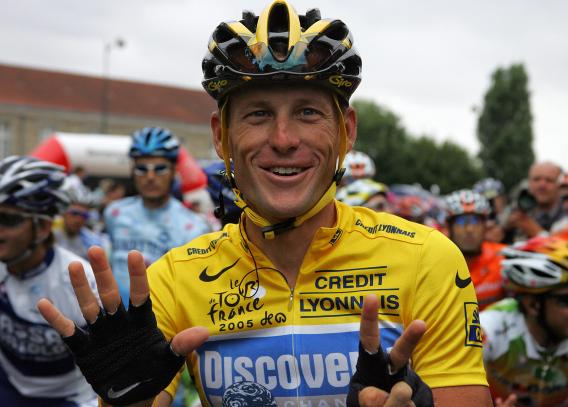
It's now official - Lance Armstrong has been stripped of all of his cycling results from August 1st 1998 forward, including the record seven Tours de France that he had won. He is also permanently banned from cycling and any World Anti-Doping Agency sanctioned events, including his new hobby of triathlons.
I have some thoughts about all of this that may counter to a lot of what is in the press and posted online. First, however, here is the case against Armstrong as revealed so far, with a lot of links so you can read the material yourself and form your own opinion - after that, I will explain my perspective.
“The UCI will not appeal to the court of Arbitration for Sport, and it will recognise USADA’s sanction against Lance Armstrong,” said UCI President Pat McQuaid, who spoke forcefully about the fight against doping. “The UCI will ban Lance Armstrong from cycling and the UCI will strip him of his seven Tour de France titles. Lance Armstrong has no place in cycling.”
McQuaid said that it will also recognised the USADA’s sanctions on the riders who testified, and thanked them to for that. He said that the UCI will set up a structure to examine the doping situation which had happened, and will take measures to safeguard the sport from experiencing the same sort of problems as before.
On August 23rd, Armstrong was handed a lifetime ban from sport by USADA plus had all of his results since August 1998 taken away. The sanction was handed down after he decided not to fight the doping charges made against him by the agency.
The reasoned decision included over one thousand pages of evidence, including sworn testimony from 26 individuals. Of that number, eleven were former team-mates of Armstrong, namely Frankie Andreu, Michael Barry, Tom Danielson, Tyler Hamilton, George Hincapie, Floyd Landis, Levi Leiphimer, Stephen Swart, Christian Vande Velde, Jonathan Vaughters and David Zabriskie.
Other details contained included what USADA described as ‘direct documentary evidence including financial payments, emails, scientific data and laboratory test results that further prove the use, possession and distribution of performance enhancing drugs by Lance Armstrong.’
Its CEO Travis Tygart said that the management of the US Postal Service team ‘ran the most sophisticated, professionalized and successful doping program that sport has ever seen.’
“The USPS Team doping conspiracy was professionally designed to groom and pressure athletes to use dangerous drugs, to evade detection, to ensure its secrecy and ultimately gain an unfair competitive advantage through superior doping practices,” he elaborated. “A program organized by individuals who thought they were above the rules and who still play a major and active role in sport today.”
Last week, many of Armstrong’s sponsors including Trek, Giro and Nike have announced that they were ending their relationship with him. He also resigned as chairman of the Livestrong foundation.
Christian Prudhomme, the director of the Tour de France, has confirmed that he does not want Lance Armstrong’s seven Tour de France victories reassigned after the UCI ratified the USADA verdict to ban the Texan and disqualify him from results going back to August 1998.
Prudhomme also said that he expects Armstrong to pay back his estimated three million dollars he won in the race.
“There won’t be a winner. The formal decision will be taken by the UCI on Friday but for us, it’s very clear; we want to leave the palmares blank,” Prudhomme told the Reuters news agency after hearing Pat McQuaid speaking during his Geneva press conference.
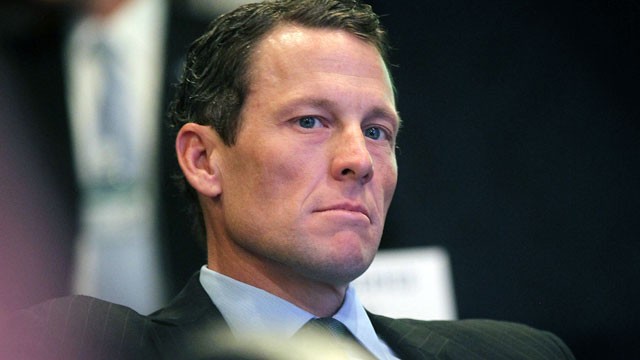
This is from Armstrong in one of his Nike commercials:
This is my body, and I can do whatever I want to it. I can push it. Study it. Tweak it. Listen to it. Everybody wants to know what I'm on. What am I on? I'm on my bike busting my ass six hours a day. What are you on?
* * * * * * *
This quote offers the key, in my opinion, to understanding who Armstrong is and why he did the things he has done. It reflects both his incredible desire to win, by manipulating his body in any way he can, and the fact that he seriously worked his ass off to be the best cyclist in a peloton filled with other cyclists who were using banned substances as well.
I have no problem with Armstrong having used performance enhancing drugs - every other top rider in that era was also using chemical assistance, and as far as I am concerned, all of it should be legal and monitored by doctors to ensure the safety of the riders (or other athletes).
If you have done a 100 mile ride (like the El Tour de Tucson, which is 109 miles for the top riders), you know how grueling that can be and how hard on the body it is, even if you are in shape and adequately trained. Now imagine doing that for 19 out 21 days, including time trials and some of the steepest mountain climbs in the world. You might be tempted to use drugs, too, to get through those three weeks, especially if you wanted to be competitive in cycling's most prestigious event.
Here is where I have a problem, as revealed in the testimony of several former Armstrong teammates:
Christian Vande Velde testified to being pressured to stick to the program given to him by Dr. Michele Ferrari in 2001, one that "involved regular use of EPO and testosterone", he stated.Vande Velde, Zabriske, and other rides have described an atmosphere where they were pressured and coerced to use drugs and banned methods (blood transfusions) - and Armstrong was instrumental in leveling that pressure on his teammates.
But his fears of needles and of being caught meant he was reluctant to follow the program. He was not selected for the 2002 Tour de France and was told by Armstrong, "if I wanted to continue to ride for the Postal Service team I would have to use what Dr. Ferrari had been telling me to use and would have to follow Dr. Ferrari's program to the letter.
"Johan Bruyneel confirmed this a few days later ... and said he expected to see improvement."
Vande Velde left the team in 2003 for the Liberty Seguros team, which he stated "had an organised doping program as well". After moving to CSC in 2005, and in the absence of "the pressure of an organised doping program, I decided I would only continue in the sport if I could ride clean." He stated he stopped doping in April, 2006.
Zabriskie describes coming into the sport at the time of the Festina affair in 1998, and testified, "I knew I did not want to use drugs". He was reassured by current USA Cycling president Steve Johnson (then with a performance lab), who said the sport was cleaning up.
By 2000, he caught the attention of Bruyneel with a win in the U23 GP des Nations. He was hired on at $40,000, but refused to participate in "recovery injections". In 2001, he was begging to keep his job, accepting a drop in salary to $15,000 just to stay. In 2002, he began using the injections, because "I came to believe it was just vitamins".
Although he joked about EPO on the team bus earlier, Zabriskie testified that he was reluctant to succumb to its use until finally, when his teammate Barry decided to give in, Zabriskie did as well in 2003.
After leaving US Postal in 2004, Zabriskie moved to CSC, during which time he used doping products growth hormone and testosterone several times, but then in June, 2006 he stated he quit doping for good,
Danielson testified to using EPO and blood transfusions on the Discovery Channel team (after taking a pay cut from $200,000 as a neo-pro with Fassa Bortolo to $125k to join Armstrong's team) in 2005, only beginning to get scared of doping in 2007 when the program shifted to blood doping.
"I began to worry that my blood would be mistaken for someone else's," Danielson testified. "The more I thought about it, the more worried I became.
"I found the whole process to be almost emotionally paralyzing," he said, admitting that he got so paranoid that he began to have panic attacks and was given a sedative on the last night of the 2007 Vuelta a España.
"I continued to experience anxiety attacks and have trouble finishing well in races. As a result, I stopped doping in 2007. He then left to join Vaughters' team "where I knew I would be more comfortable competing clean."
Again, I have no problem with Armstrong choosing to do drugs, as many other riders have done (including Levi Leipheimer and George Hincapie), but when he and Bruyneel pressure and coerce other riders to do the same, then I have a real problem.
The decision to cheat, and even more the decision to risk one's health with performance enhancing drugs, has to be a personal choice and a freely made decision. When you cut a rider's salary from $40K a year to $15K because that rider (Zabriske) does not want to use the drugs, that is wrong on many levels.
And then there is the ferocity with which Armstrong went after anyone who dared to expose his drug use and tactics. He was infamous for suing anyone who spoke out, or intimidating, threatening, and even (in the case of Tyler Hamilton) physically intimidating (assaulted?) those people.
From the New York Daily News:
Doping might sometimes be a victimless crime, but not in the case of Lance Armstrong, whose drug abuse and illicit blood transfusions created a phony empire of wealth, adulation and power that had to be protected at all costs.
The Armstrong myth was so lucrative that suppressing the truth came to require an endless behind-the-scenes campaign to bully and intimidate people into silence. Some of it bordered on gangsterism. Some of it was dressed up in the respectable wardrobe of elite law firms. But mostly it was just hot air - a fact that by 2010 had become clear enough to Floyd Landis that he stepped up and burst the bubble, blowing the whistle on the whole big fraud.
Armstrong is undoubtedly the most talented and exceptional cyclist of his generation - yes, he was doped, but he was doped in a peloton of doped cyclists. He was just better at it than all the others.
It's too bad he resorted to doping and intimidation to make himself the best. He was naturally gifted enough to compete even with athletes using drugs, he just wanted a short-cut to the top. Rather than become more innovative in his training, he sought the chemical cocktail to the front of the peloton.
The greatest loss in all this, however, is for the cancer patients - current and in the future - who no longer have a role model to look up to for inspiration. Further, there is no way this will not impact the ability of the Livestrong Foundation to raise money for cancer research. Armstrong has helped raise more than $500 million over the years since he founded Livestrong, and for this alone he should be an American hero - no single person can claim anything near that in helping to cure a disease. But even this achievement will be tarnished by Armstrong's association with cheating.
He may have cheated death in surviving cancer, but he could cheat pro cycling without eventually falling victim to his own hubris and ego.
Wednesday, September 19, 2012
Why Do We Hate Athletes Who Cheat?

Armstrong gives Jan Ullrich "The Look" as he passed him on the final climb of L'Alpe d'Huez after feigning fatigue (2001 Tour de France)
Lance Armstrong may be one of the few "guilty as sin" athletes not to be totally rejected by his fan base. In baseball, people like Mark McGuire, Sammy Sosa, Barry Bonds, Alex Rodriguez, and Roger Clemons, to name only a few, lost a lot of their fans and likely any chance at being elected to the Hall of Fame because of performance enhancing drugs (PED).
Interestingly, this is less true in the NFL, where I have little doubt that the athletes are at least using testosterone injections. The "random" test is on the day of or day after the game, so you piss in a cup and go get your shot. Testosterone levels will be back to normal by the next week's game, and you will have healed quicker and better than you could have without the drug.
We seem to get - consciously or not - that modern professional football might be a sport that demands drug use. On the other hand, it's a sport set up to facilitate PEDs, and when someone does get caught, it is generally not a top-tier player.
So why do we get bent out of shape about athletes using PEDs? Why does it warrant hearings in Congress (which is a complete and total farce and waste of tax dollars)? Why will Barry Bonds, who was probably the best hitter the game has seen and holder of the career home run record, never make it into the hall of fame?
Here is one possibility:
Athletes must work "near the edges of endurance and the outer fringes of metabolic stability. Conditioning and diet allow the athlete to engage at the highest levels of human body performance, incredibly close to the breakdown points of cardiovascular, respiratory, and digestive systems. With the body close to its limits, the pressures, and the years of effort and expense for training all on the line, it is no wonder that some of our heroes suppress these intense feelings by succumbing to performance-enhancing and pain-relieving drugs. The surprise is that we are disappointed in them when they are found out, not because we are doing any better in holding it all together without prescribed or recreational pharmaceutical support, but because the weakness of the hero exposes our own insufficiencies and guilty sedations."Maybe Fogel is correct, maybe if we see our heroes falter, see them as human beings like ourselves, it reminds us that we too are flawed. It seems most people in this country would do anything to avoid those feelings.
~ Alan Fogel, The Psychophysiology of Self-Awareness: Rediscovering the Lost Art of Body Sense
I think part of the reason I support drug use in sports, however, is because I can identify with them. I have been an athlete. I know how hard it can be to stay in peak condition for months at a time, fighting off injuries, fatigue, and other stress. I've played four or five full 90-minute, tournament-level soccer games in a single 3-day weekend, and if there was drug I could have taken back then to perform better, I might have done it.
When I watch the three major cycling races (Giro d'Italia, Tour de France, Vuelta a Espana), I have no idea how they could ride for three weeks at the speeds they do without PEDs. It's no wonder there are more cyclists suspended for PEDs than in any other sport on the planet.
We held up Lance Armstrong as an almost super human hero - until we found out that he too is mortal. Then we judge him and take away his victories, in itself a silly decision since all the other contenders in those races were also using PEDs.
We, as a nation, cannot understand the pain he endured to win those races because we cannot bear the pain of our daily lives.
We are a nation drugged on sugar, tobacco, alcohol, marijuana, methamphetamine, antidepressants, tranquilizers, sedatives, narcotics, and on and on, what right do we have judge athletes who use PEDs to be the best in their particular sport?
The athletes at least have a goal - we are just numbing ourselves to avoid life.
Thursday, August 25, 2011
Superman Finally Stops Wearing His Underwear on the Outside
And people are not pleased.
But seriously, we are supposed to respect an adult man who wears his underwear on the outside of his clothes? It always looked silly to me. When I was kid buying cheap Halloween costumes, I preferred Batman because he at least knew what order in which to put on his clothes.
More seriously, a lot of people freaked out about the new metrosexual Superman who has, hold on now . . . feelings. Yep, the Man of Steel is also a man with feelings. Well, that's the rumor that had people upset that Henry Cavill was selected to play the role.
Sounds like a step forward to me.


But seriously, we are supposed to respect an adult man who wears his underwear on the outside of his clothes? It always looked silly to me. When I was kid buying cheap Halloween costumes, I preferred Batman because he at least knew what order in which to put on his clothes.
More seriously, a lot of people freaked out about the new metrosexual Superman who has, hold on now . . . feelings. Yep, the Man of Steel is also a man with feelings. Well, that's the rumor that had people upset that Henry Cavill was selected to play the role.
Sounds like a step forward to me.
Henry Cavill’s Superman goes without underpants, internet freaks outGo read the whole article. Here are a few more images - the top one is the new rebooted series from DC Comics, the bottom one is an enlargement of a still from the new film.
Where have Superman's famous red trunks gone? Henry Cavill was pictured on the set of Zack Snyder's Man of Steel without the traditional red bottoms of the Superman costume. The internet saw Commando Superman, and was not pleased.
Naturally a few folks were displeased by the disappearing trunks...

Subscribe to:
Posts (Atom)