Showing posts with label courage. Show all posts

Thursday, July 17, 2014

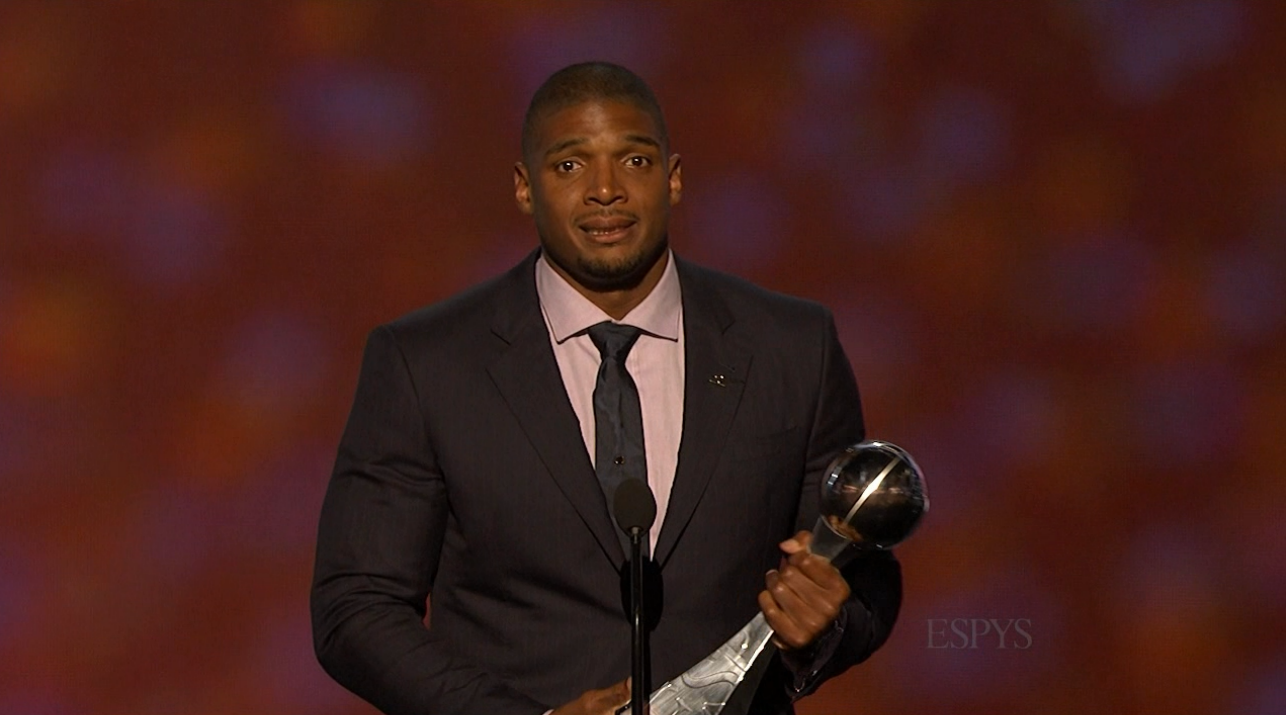
Michael Sam's Powerful, Show-Stopping Speech at the ESPYs


Michael Sam was given the Arthur Ashe Courage Award at the 2014 ESPYs on Wednesday night. His acceptance speech was incredibly powerful. Enjoy!

Michael Sam's Powerful, Show-Stopping Speech at the ESPYs

By Scott Gleeson

LOS ANGELES — Michael Sam delivered an incredibly powerful speech after accepting the Arthur Ashe Courage Award at the 2014 ESPYs on Wednesday night.

There weren’t many dry eyes in the room following the words of Sam, who was honored for his decision to publicly come out and become the first openly gay player drafted into the NFL.

Sam emotionally quoted Ashe’s words of wisdom, that included: Start Where You Are, Use What You Have and Do What You Can.

“Those were words to live by,” Sam said. “Whether you’re white or black. Young or old. Straight or gay.”

Sam fought back tears on stage, and he ended his speech by telling the story of a gay woman who told him she never again consider committing suicide after he came out as gay.

Sam’s powerful message: “To anyone out there, especially young people feeling like you don’t fit in, or are not accepted, great things can happen when you have the courage to be yourself.”

Sam brought boyfriend Vito Cammisano on the red carpet and specifically thanked him.

Dwayne “The Rock” Johnson presented the award. Jason Collins, the first openly gay athlete in the NBA, was shown cheering in the audience.

Saturday, October 5, 2013

Omnivore - Gender Gap

Here is another cool collection of links from Bookforum's Omnivore blog - this one centered on all things gender-related. I highly recommend the Buzzfeed piece on the resignation of Tom Matlock from the Good Men Project (he remains the primary investor and shareholder, but nothing else), an event that somehow slipped beneath my radar when it happened.

Gender gap


Oct 4 2013
3:00PM 

Sunday, September 15, 2013

Chris Kyle - The Three Hidden Powers of Vulnerability

Over at the Good Men Project, Chris Kyle shared an excellent post on masculinity and vulnerability - two great things that go great together, but that we (as men growing up) are not simply discouraged from embodying, but essentially threatened with the loss our status as men if we do embody vulnerability.

This is wrong in more ways than I can count. Vulnerability is essential for psychological health, for mature masculine presence, and for ensuring authentic relationships.

Chris concludes his article with three observations around the benefits of being vulnerable: (1) increased capacity for courage, (2) greater compassion for ourselves and others, and (3) deeper, more authentic connections with others.


About Chris Kyle

Chris is a speaker, teacher, success coach and champion of your purpose. He’s an eLearning expert and recently created two new virtual programs called the Power of Purpose Summit and the Man on Purpose online course. Chris is also passionate about building global learning communities that unite people across cultures.
Enjoy the article - he even mentions the current guru on vulnerability, Brene Brown.

The Hidden Powers of Vulnerability

September 13, 2013 | by Chris Kyle


Chris Kyle learned early on that he better man up and sure as hell ‘Don’t cry!’ He learned later that vulnerability makes him stronger.

When I was a kid, I can’t tell you how many times I heard phrases like these: “just suck it up, Kyle.”
“Don’t cry.” “What are you, a pussy?; ”Don’t get too excited.” “Tone it down.” “I don’t want to hear how you feel about it, just do it.” “Don’t get angry with me young man.”

These came from my friends, my teachers, my coaches, and my family too.

I know many men who can relate to these words and far worse including a lot more swearing— “f*cking” this and “goddamn” that.

As a boy and then a young man I was told constantly to stay in a zone of feeling and behavior that essentially felt like I was a block of granite—solid, unmoving, rational, toned-down, and generally unfeeling. Sharing my feelings, my deep fears, expressing sadness, crying were all seen as weakness for a young, maturing man.

I came to believe vulnerability = weakness.

I recall one key event in my early teens when some friends at school were instigating a fight between me and a kid named Evan. I didn’t want to fight him, but it somehow became a matter of honor, or an issue of shame, if I didn’t fight him.

I remember facing Evan, with a small crowd circled around us, and thinking “Why am I here?” I literally couldn’t remember what we fought about or what was the issue that had us squaring off against each other with fists raised. We finally dove into it, trading a few punches, and then found ourselves wrestling on the ground. He got me in a headlock and all I could do was say ‘uncle’—to tap out. I’d lost the fight.

As I stood up, facing the others gathered around, I could feel the shame welling up in me, and the tears started to come. And, of course, one of the boys says: “F*ck Kyle, are you crying?” It was said with such disdain and disbelief. I dropped into a deeper level of shame for having these feelings and showing the tears. This moment shut me down and locked me out from my tears, and slammed the door on my vulnerability.

Our culture continues to indoctrinate boys and men in this way—through old socializing patterns that are deeply ingrained in our cultural DNA. Be tough, don’t cry, don’t share your fear, win at all costs, prove you’re a man.

And yet, now what I’m seeing are adult men who are willing to work on themselves and take a deep look at these beliefs and patterns. They are consciously unwinding this shame and belief of ‘vulnerability is weakness,’ and bringing a new understanding and self-compassion to their childhood wounds and traumas.

This truth-telling about myself and the willingness to be more open, transparent, revealing… to be more vulnerable, is freeing and empowering.

Now, vulnerability looks and feels different. It has become a hidden source of power for me.

At its core, vulnerability allows us to really be seen, warts and all, so we can feel more connected. Researcher and author Brene Brown says that it’s this vulnerability that helps heal our shame and opens us up to deeper connection and a greater sense of worthiness.

So as I investigated deeper into masculine vulnerability, I became aware of what I call the Three Hidden Powers of Vulnerability.

1. Vulnerability opens us to an increased capacity for courage.
 Being vulnerable, sharing more of myself, taking the risk to say with needs to be said, to speak the truth in my heart—all of it takes courage. As we practice being more vulnerable (open, transparent, being seen) then we foster a new level of courage that we can apply in many areas of our lives. This courage building also garners respect and appreciation from others. And it builds resilience in us to face the many challenges that life will bring.

2. Being vulnerable brings forth greater compassion for ourselves and others.
 When we are vulnerable, when we truly open ourselves to be seen by others, we are sharing more parts of ourselves with the world. And in that awareness of the hurt, raw or broken parts of ourselves we are able to see our own humanity and have greater compassion for ourselves. As this capacity builds inside us we have more empathy and compassion for others. This growing power of compassion provides us with a greater ability to accept and let go of beliefs and judgments that don’t serve us. More presence and peace is found in this compassion.

3. Vulnerability creates deeper, more authentic connections.
 What I see as the greatest gift of vulnerability is the ability to actively cultivate deeper, more real connections with everyone in my life. When we practice being more open and vulnerable we are able to pierce the veil of shame and fear and experience deeper connection and relatedness. More honest dialog emerges, more healing between friends and loved ones occur. And this is counter-intuitive to our minds—where we equate vulnerability with fear, hurt and weakness. When in fact it creates more support, more freedom, more joy, more release and more appreciation. These authentic connections serve our success and happiness in every area of life—relationships, work, parenting, community and well-being.

So, I invite you to choose more opportunities to share yourself, to express your fears, to let your tears be seen. Cultivate this openness, this vulnerability and watch these hidden powers blossom and grow so that they infuse your life with more meaning, passion and care for yourself and others.

Read More from Men’s Work

Image Credit: Rochelle Hartman/Flickr

Wednesday, September 11, 2013

Medal of Honor Recipient, in New Act of Valor, Thanks His Therapist

It's an act of bravery for a soldier to thank his therapist when accepting a Congressional Medal of Honor, but in an era where more men die of their own hand than die in battle, it is a necessary and laudable act. He is strong enough to admit that war and seeing friends die has had an incredible impact on his mental health, that he is emotionally scarred by what he has witnessed.

Wonderful to see the wall of silence being taken down by a man recognized as a hero.

This nice story comes from Pacific Standard.

Medal of Honor Recipient, in New Act of Valor, Thanks His Shrink

As wave of military suicides continues

Staff Sgt. Ty Carter speaking at a ceremony awarding him the Congressional Medal of Honor. (PHOTO: YOUTUBE) 

August 27, 2013 • By Marc Herman

The video below, from Stars and Stripes, shows Staff Sgt. Ty Carter’s speech at a ceremony awarding him the Congressional Medal of Honor yesterday. Carter, one of only five living recipients of the medal who fought in post 9/11 conflicts, was cited for his actions during a battle in Afghanistan in which he attempted to rescue a fellow soldier, Spc Stephan Mace. Carter pulled Mace to safety and treated him amid a 12-hour-long battle. Mace, wounded grievously, eventually died.*

Carter’s speech is notably different from the popular image of a war hero receiving a medal. In lieu of crisp salutes and talk of duty, Carter spends much of his time speaking about loss, and frankly discussing his own mental health after the ordeal. To be clear, Staff Sgt. Carter appears to be a person of extraordinary mettle. In his presentation, however, he does not mind projecting another image, of a young man who has seen too many terrible things. Speaking in what can only be called a tone of vulnerability, he tells the White House audience, including President Obama:
Only those closest to me can see the scars that come from seeing good men take their last breath. During the battle, I lost some of the hearing in my left ear. But I will always hear the voice of Specialist Stephan Mace. I will hear his plea for help for the rest of my life.
He goes on to talk about how he recovered from the experience.
However, thanks to the professionalism of my platoon Sgt, Sgt Hill, and my behavioral health provider, Capt. Cobb, and my friends and family, I will heal.
“Behavioral health” is a synonym for mental health. A “behavioral health provider” is a therapist. In a ceremony traditionally designed to showcase bravery in battle, Carter is taking the extraordinary step of focusing on how he, the classic American war hero, came home from Afghanistan with his head in a bad place. He goes on to speak of anguished families of the soldiers lost in the same violent battle for which he received the medal. President Obama also remarks on the mental health issue.

Certainly what the video below displays is a cultural shift, from the 1940s image of the hard-bitten GI, to the modern, human hero like Carter. It’s also tempting to read the focus of this week’s ceremony as a tacit pushback against an emerging skepticism about war’s role in a wave of military suicides over the past half-decade-plus. Coincidentally, two weeks ago a study published in the Journal of the American Medical Association claimed that military deployments were not to blame for the widely-reported rise in suicides among service members since 2005.

The study, which has sparked intense debate, found ”suicide risk was independently associated with male sex and mental disorders but not with military-specific variables.” It cited a rise in alcohol and drug abuse among the soldiers studied as likely causes for the increase in suicides, but did not consider those influences “military-specific.”


*UPDATE 08/28/2013: This post originally stated that Staff Sgt. Ty Carter was one of only five living recipients of the Congressional Medal of Honor. In fact, he is one of five who have received the MOH in the post 9/11 conflicts in Afghanistan and Iraq.

Thursday, August 15, 2013

Dr Brené Brown - The Power of Vulnerability (at The RSA)


On July 4th, Dr. BrenĂ© Brown spoke at The RSA about her research into vulnerability, courage, worthiness, and shame. The original talk of over an hour is no longer available in video format, but The RSA has just released a 20+ minute "highlights" video (why!??), which is below. There is also a link to the full audio of the event below the video.

Brown's books include I Thought It Was Just Me (but it isn't): Making the Journey from "What Will People Think?" to "I Am Enough" (2007), The Gifts of Imperfection: Let Go of Who You Think You're Supposed to Be and Embrace Who You Are (2010), and Daring Greatly: How the Courage to Be Vulnerable Transforms the Way We Live, Love, Parent, and Lead (2012).

As usual, this talk is informational and entertaining. I have posted her talks many times over at Integral Options Cafe, but it occurred to me this morning that we, as men, need this as much or more than do women. 


We are raised to believe vulnerability = weakness, and that to be vulnerable makes us less than ______ (fill in the blank, with some choices being masculine, manly, strong). When we feel vulnerable, and ALL human beings do at some point, then we feel ashamed and weak. 

The truth, however, is that it takes much more strength and courage to be vulnerable than it does to pretend that nothing gets to us, that we do not have a tender open heart. We do. We simply must learn how to be okay with that, and add vulnerability to the list of masculine traits.

Dr Brené Brown - The Power of Vulnerability


Published on Aug 15, 2013

Influential author and speaker Dr Brené Brown tackles the myth that vulnerability is a weakness. Instead, she argues, it is the clearest path to courage and meaningful connection, and has the power to transform the way we engage and educate.

Listen to the podcast of the full event including audience Q&A.

Follow the RSA on Twitter: http://www.twitter.com/thersaorg
Like the RSA on Facebook: http://www.facebook.com/thersaorg

Our events are made possible with the support of our Fellowship. Support us by donating or applying to become a Fellow.

Donate: http://www.thersa.org/support-the-rsa
Become a Fellow: http://www.thersa.org/fellowship/apply

Friday, July 12, 2013

The New Man 138: Stutz and Michels – The Tools That Stop Negative Thoughts

Phil Stutz and Barry Michels are "Hollywood psychologists," with a new book out, The Tools: 5 Tools to Help You Find Courage, Creativity, and Willpower--and Inspire You to Live Life in Forward Motion. Tripp Lanier spoke with them on the New Man Podcast a couple of weeks ago - here is that conversation.


TNM 138: Stutz and Michels – The Tools That Stop Negative Thoughts


25 JUNE 2013


Podcast: Download


Do you ever get negative thoughts that you just can’t seem to shake?

Do you get all fired up to make a change but then eventually end up quitting?

And are you hoping that one day you’ll have all this crap figured out and you won’t have to worry about it anymore?

Phil Stutz and Barry Michels are here to discuss The Tools that’ll pull your butt out of a rut and share how these tools have helped other guys do some amazing things. Is it too good to be true? Let’s find out.

In this interview:
  • A tool to beat procrastination
  • How to let go of a grudge
  • What to do if you’ve lost your temper
  • How to stop freezing up in social situations
  • Making peace with the parts you want to hide from the world

Also:
  • How to get out of the worry and negative thinking spiral
  • What to do when you quit and feel like crap
  • The hidden expectation that is driving us nuts
  • How to stop being a personal development jackass
  • The two demons that kill your motivation
  • When thinking screws things up

And:
  • A story about a guy who “had it all” and then hit the wall
  • How did he bounce back?

Click here to learn more about The Tools by Phil Stutz and Barry Michels.


About Phil Stutz and Barry Michels

From Studio360.org:

Phil Stutz and Barry Michels are Hollywood psychologists with a roster of A-list clients. “Especially among the actors, you have people where no one’s told them the truth ever for the last eight years, 12 years — literally never,” Stutz tells Kurt Andersen. “We tell them the truth about who they are, both the strong points and the weaknesses,” Michels explains. “And we’re pretty brutal about the weaknesses, because we want people to change.” Stutz and Michels have shared what they’ve learned with the stars in a book geared to the rest of us: The Tools.


Their tactics combine Jungian analysis with cognitive behavioral therapy. One chapter deals with what Jung called the Shadow. “Everybody has a piece of them that’s insecure — everybody,” Stutz tells Kurt. “It’s not particularly rational and you can’t get rid of it.” When, for example, a screenwriter sabotages his pitch at an important meeting, it may be because he or she is trying to hide the Shadow. Instead, Stutz and Michels say, the screenwriter needs to visualize this “shameful” persona, make friends with it, and enlist its aid in judgmental situations. “Although most people think of their Shadows as the source of their insecurity, if you can change your relationship with your Shadow, it becomes the source of your confidence,” Michels says.

The pair started their careers about as far from celebrity as you can get: Michels as a lawyer with political ambitions, Stutz as a prison psychiatrist at New York’s Rikers Island. In prison, Stutz explains, what you say is nowhere near as important as what you do and how you communicate non-verbally. “There’s a whole level of communication that, within psychotherapy, is not usually dealt with.”

Click here to learn more about The Tools by Phil Stutz and Barry Michels.

Thursday, March 14, 2013

A Tale of a Son and His Father


It's rare that a cyclist makes the news in this country for anything other than a spectacular win. American pro and future cycling star Taylor Phinney made the news this week for finishing last on Monday's penultimate stage of Italy's Tirreno-Adriatico stage race.

I'm a pretty serious cycling fan, but I don't think I have ever seen a stage like this one. Three circuits, 209 kilometers of punishment, including a 27% climb so steep that at least one rider had to stay in the saddle in order not to spin the rear wheel on the wet, steep incline.

It was a cold and wet day, and the small group at the back of the race, the grupetto, decided to abandon the race. But Phinney wanted to ride the final stage, his specialty, a time trial. So he kept riding, by himself, and that is where the story resides.

This Is Not a Story About Last Place

JASON GAY
Updated March 13, 2013


Taylor Phinney - photo by Stefano Sirotti

Taylor Phinney's solo ride during the Tirreno-Adriatico on Monday.

This is a story about a guy who finished last. Which is technically true. You can look up the results of the race, and you'll see his name, right there, lonely at the bottom. Taylor Phinney. USA. Finishing time of six hours, twenty-two minutes, fifty-four seconds. One hundred-and-ninth place. Last.

But this story is better than that.

First, about Taylor Phinney. Remember that name. You might already know it. Bike racer from Boulder, Colo., 22 years old. The son of two cycling legends, Davis Phinney and Connie Carpenter. A big dude on the bike, at 6 feet 5 inches, 180 pounds, Taylor Phinney is one of the most promising young cyclists in the world. He's already been to the Olympics twice. Won a stage of the prestigious Giro d'Italia last year. He is expected to have many great days in the sport.

Monday didn't begin like one of those days. Phinney was competing in Italy's Tirreno-Adriatico stage race, and this penultimate stage was a doozy. Up and down, down and up, 209 kilometers of punishment, including a 27% climb so comically steep that some riders got off their bikes and pushed them uphill. Many riders quit. Later the race organizer would admit that the stage was too difficult, even for elite pros.

Phinney didn't expect to win this stage. He just wanted to hang around, because the next day brought a time trial against the clock, and Phinney had a chance for a good result in that event. But the day soon unraveled. His legs weren't feeling great, and then his bike busted its chain. He had to get a replacement and chase his way back to the pack.

"I just was dangling," Phinney said on the phone, from his home in Tuscany. "We kept going over these really difficult climbs. I'd get back to the group and I would get dropped. I'd get back again, then get dropped."

Bike racing is a sport that fetishizes suffering. Anyone who's done it talks almost mystically about painful days on the bike, about the serenity achieved by pedaling through the agony. But even the best can only take so much. Soon Phinney found himself in a small group of 30 or so riders who had fallen off the main field, with about 130 kilometers, or 80 miles, left. The riders in the group began talking. Phinney said became clear that nobody wanted to finish. Drop out now, get out of the cold. This is no shame. It happens all the time. Fight another day.

But Phinney wanted to fight now. He had to complete the race under the time limit to do the time trial Tuesday. "If I wanted to finish the race, I was going to have to do it by myself," he said.

So that's what he did. As the rest of the group abandoned the race, Phinney put his head down and pedaled. He was suddenly alone. The weather was miserable. It began to rain. And Phinney kept thinking of one thing.

"I would just think of my dad," he said.

Davis Phinney has lived with Parkinson's disease for more than half of Taylor Phinney's life. One of the great American racers of all time, a Tour de France stage winner and Olympian, Davis's day is often met by frustrating physical challenges. Tasks that were once simple take so much longer. Ordinary life requires patience.

That's what kept his son pedaling in the cold Italian rain.

"I knew that if my dad could be in my shoes for one day—if all he had to do was struggle on a bike for six hours, but be healthy and fully functional—he would be me on that day in a heartbeat," Taylor Phinney said. "Every time I wanted to quit, every time I wanted to cry, I just thought about that."

He had so many miles to ride. "It's kind of embarrassing," he said. "The race has gone by, and people aren't really expecting one rider slogging along by himself." Fans on the side of the road offered to push him up hills. But Phinney remembered a story his Dad had told him about one of his old Tour de France teams, making a pact to decline pushes.

Taylor would do the same. No pushes.

"He never lost his motivation," said Fabio Baldato, an assistant director for Phinney's team, BMC Racing, who was driving a car behind Phinney the entire route. "It was unbelievable."

"He wanted so badly to finish the race," said Phinney's teammate, Thor Hushovd, a former world champion.

Hours later, Phinney crossed the line, exhausted. He finished almost 15 minutes after the second-to-last rider, thirty-seven minutes behind the winner. He didn't make the time cut for the day, which meant he couldn't compete in Tuesday's time trial. It was a bummer, but Phinney was too zonked to be devastated. During his post-race massage, he cried like crazy. On Twitter, Phinney wrote about riding for his Dad and called it "probably the most trying day I've had on a bike." When Phinney's saga was reported on the website Velonews, cycling fans went crazy. These have been bleak times for the sport, ripped apart by doping scandals. Phinney's solo effort—and his emotions post-racel—had stirred something soulful. "Emotion is powerful and undeniably human," Phinney's mother, Connie Carpenter, said in an email from Italy.

Back home in Colorado, Davis Phinney was marveling at the whole story. You can still find Davis on his bike, usually on the fancy carbon-fiber city commuter he got from his son. Cycling remains a sanctuary—"easier than walking, in a sense," he said. But the daily routine remains full of hassles. Davis Phinney keeps a sense of humor about it, jokingly referring to himself as "Turtleboy." He began a foundation to give people living with Parkinson's tools for living well—for achieving little victories.

Davis Phinney said he didn't learn about Taylor's ride until after it was over. Friends told him how inspired they were by his son. When he heard that Taylor had been thinking about him the whole time, he was floored.

"I have almost no words for how amazing it makes me feel," Davis Phinney said. He wrote in an email to his son:

You make me so happy and beyond proud—and that is better than any medicine and can defeat any disease.

The results are wrong. This is not a story about a guy who finished last. Taylor Phinney won that race.

Friday, February 15, 2013

Soccer Player Robbie Rogers Reveals He Is Gay . . . and Walks Away from the Sport at 25


I'm glad Robbie Rogers felt safe enough to come out and live his own life, but I am saddened that he felt the need to walk away from the sport that was his "escape, my purpose, my identity." Maybe one day he return to soccer, after all he is only 25 years old.

On the bright side, some of his fellow players applauded his courage and wished him well:
"Brave men like you will make it so that one day there's no need for an announcement. That day can't arrive soon enough," tweeted Eddie Pope, a U.S. veteran of three World Cups and an executive with the MLS players' union. 
"Much love and respect for you," tweeted U.S. teammate Herculez Gomez, a sentiment echoed byD.C. United's Chris Pontius, the Galaxy's Omar Gonzalez and women's national team star Abby Wambach.
I hope Rogers is not the last to live his life openly - and I hope the next man to do so will not feel the need to leave his sport.

Soccer player Robbie Rogers reveals he is gay

Robbie Rogers, 25, a Mater Dei High graduate who has played in MLS and for U.S. national team, says in blog post that he is gay and is 'stepping away' from soccer.

Mater Dei High graduate and professional soccer player Robbie Rogers announced he's gay and will be stepping away from the sport. (Drew Hallowell / Getty Images / August 10, 2011)

By Kevin Baxter | Los Angeles Times
February 15, 2013

Robbie Rogers said he had to choose between being a soccer player or being himself.

He ultimately choose to be himself, stepping away from his sport Friday in a powerful blog post in which he revealed he is gay.

"I always thought I could hide this secret," wrote Rogers, 25, a former Mater Dei High standout who played five seasons in Major League Soccer and had 18 appearances with the U.S. national team.

"Football was my escape, my purpose, my identity. Football hid my secret, gave me more joy than I could ever have imagined."

But, he concluded, "I realized I could only truly enjoy my life once I was honest. . . . My secret is gone, I am a free man, I can move on and live my life as my creator intended."

Rogers did not use the word "retirement" in his seven-paragraph announcement, instead saying, "Now is my time to step away. It's time to discover myself away from football."

Rogers' career has been in free-fall since he left MLS'Columbus Crew in 2011, the year he earned his last cap with the national team.

Troubled by nagging injuries, he was most recently playing for Stevenage of League One, the third tier of English soccer. And in his blog Rogers suggested his decline on the field was influenced by the emotional toll of trying to hide his homosexuality — although in Columbus, at least, that was said to be something of an open secret.

"You hear from athletes all the time that performance suffers from living in the closet," said journalist Cyd Zeigler, co-founder of the gay sports website Outsports.com. "I'd love to see him try again. It might be a mistake for him to stop now.

"There's a great chance that he will . . . have a clear head and be able to focus on the sport in a way he hasn't been able to in his adult life."

No active athlete in a major professional U.S. team sport has come out as gay. But Rogers was being lauded for his courage on social media Friday.

"Brave men like you will make it so that one day there's no need for an announcement. That day can't arrive soon enough," tweeted Eddie Pope, a U.S. veteran of three World Cups and an executive with the MLS players' union.

"Much love and respect for you," tweeted U.S. teammate Herculez Gomez, a sentiment echoed byD.C. United's Chris Pontius, the Galaxy's Omar Gonzalez and women's national team star Abby Wambach.

kevin.baxter@latimes.com

Sunday, January 27, 2013

Brené Brown: Vulnerability as a Measure of Courage


This is a kind of follow-up to yesterday's post from Graham Phoenix on vulnerability and shame. In this short (a minute or so) video from Sounds True, BrenĂ© Brown talks about our misunderstanding of vulnerability as something weak as one of the most serious problems she sees in her work.

I see a lot of women who have bought into the idea that vulnerability is weakness, but this is true of nearly all the men I work with in coaching or in therapy. As I mentioned in the post from yesterday, this needs to change at the foundations - in how mothers, fathers, teachers, coaches, and so on help our children their sense of self.

BrenĂ© Brown is the author of Daring Greatly: How the Courage to Be Vulnerable Transforms the Way We Live, Love, Parent, and Lead and The Gifts of Imperfection: Let Go of Who You Think You're Supposed to Be and Embrace Who You Are, as well as other books. She has also recorded several audio teachings with Sounds True, including Men, Women, and Worthiness: The Experience of Shame and the Power of Being Enough and The Power of Vulnerability: Teachings on Authenticity, Connection, and Courage.

Thanks to Sounds True for making this clip available.

Brené Brown: Vulnerability as a Measure of Courage

 
When Dr. BrenĂ© Brown began researching the subjects of shame and vulnerability, she was told by many people to give it up, and “nobody wants to hear about that stuff.” Twelve years later, after several top-selling books and millions of online views of her TED talks, BrenĂ© Brown has proven that many of us do want to hear about this stuff as we try to enrich our lives with authenticity and purpose. In this video clip, BrenĂ© tackles the pervasive myth that equates vulnerability with weakness, and reveals how the truth is just the opposite. 
more from Brené Brown


Friday, May 25, 2012

Television - Louis CK on Masculinity

I haven't seen this show, but after reading this column I am inclined to see if it is on Netflix or some other streaming service (we are a cable-free home). This is a good post on the issues of masculinity the show raises, and it comes from Mike Doyle's blog. Some comments below.

Louis CK on Masculinity


When I started watching comedian Louis C.K.’s show LouisI expected to spend those 25-minute episodes laughing as Louis poked crude fun at the world around him Ă  la his stand-up shows. And while the show does have some legitimately funny moments, I was surprised to discover that Louis’ show actually presents a more realistic comedic depiction of his life (sounds like an oxymoron, I know) that makes viewers feel equal parts awkward and uncomfortable. It’s quite brilliant, actually.
* * * * * * *
The teenager saunters over to the couple’s table and menaces them with a feigned civility that is dripping with the potential for violence. After a long minute of this charade, the kid proceeds to threaten to kick Louis’ ass, showing him his cut up knuckles that he claims are the result of a recent beat down he bestowed upon some other lucky victim. Louis is forced to beg the kid not to beat him while his date watches in stunned silence. It’s humiliating for Louis.

And it gets worse.

After the kids leave, Louis tells his date he can’t go around fighting because he has to think of his daughters, but as his date asserts that she thinks he did the right thing, it’s clear she’s being insincere. Louis calls her on it, and she admits the whole situation was a turn off. She says she would’ve been upset if things had turned violent … but it was still a turn off. She says,”It’s like a primitive thing or something. I mean, you see this guy totally debase himself just to be safe. It’s a turn off.”

Louis is floored. He tells her, “I gotta criticize you a little bit for that. That’s why there’s wars and stuff — women like you that choose stupid strong people over the weak and the gentle.”

I almost wish his date had tried to argue with him, but instead she says, “I’m a grown woman, and my mind is telling me that you are a great guy … but my chemistry is telling me that you’re a loser. I’m surprised by my own reaction, and I have no defense.”

At this Louis tells her it’s time to get her a cab, angrily batting away her attempts to pay for their meal and making a point to open and hold the door for her as they leave the cafe. I found my breath caught in my throat as the scene came to a close, a touch of shame for my gender creeping its way into my psyche.
There is more to the article - Doyle offers some explication and good questions for consideration. 

This is a very realistic version of how this would play out if people were honest about how they feel, but few if any women would admit that it had been a turn-off and few if any men would have called her on it as did Louis.

Men live with a double standard - be strong, powerful, and show no fear, but do not be violent or overly aggressive. These qualities can all co-exist in the same man, but few men are capable of holding the paradox of power and non-violence in a way that honors both qualities.

What would you do? What would have been the "correct" way to handle the confrontation? Watch the video and decide for yourself - then come back here to share your thoughts.

Louis is bigger, maybe even stronger, but the kid has youth and the bravado that comes with a group of buddies to back him up. Do you confront the punk, stand up and call his bluff?

Do you take Louis's approach and just try to make it go away, seeing no good outcome from a confrontation, but then face the emasculation and humiliation and being made to beg by a high school punk?

I'm a different situation than Louis - I'm bigger and more menacing, despite not needing to hit anyone in more than 20 years. A kid like that would not pick me as a target. I could easily just stand up, dwarf the punk kid (who is not that big), and he'd back down. I can look intimidating.

I would not - personally - have taken the route Louis did, although I do not blame him at all for doing so - I have no children, and I am sure my mind would work differently if I did.

So what would I do?

I would stand up, and I'd ask the kid who hurt him so badly that he needs to pick on other people to feel like a man? I would tell him I can see the frightened child looking out through those angry eyes. I would reach out a hand and ask him how I can help? What does he need to feel safe? Whose love and approval does he crave and is not getting? I would tell him he is exactly okay right now, as he is, and beating me up will not make him feel any more safe or any more loved.

Maybe he would swing at me anyway, which I would deflect. Or maybe he would feel ashamed that someone exposed his secrets in front of his peers and be even more belligerent. And if it were a Steven Spielberg move he would start crying and give me a hug.

Whatever - my response in that situation would be to look past the bluster and bravado and to see the wounded child inside. In my experience, this is surest way to defuse a situation like the one on the show.
Saturday, April 14, 2012

Ze Frank - An Invocation for Beginnings

Somehow I have not been a fan of this Ze Frank's work. Possibly it's the ever-present smirk just below the surface when he speaks that I found annoying and so I tuned him out. But this video is cool - and now I suspect I may need to go back and look at more of Ze Frank's stuff to see what I have been missing . . . .

Ze Frank - An Invocation for Beginnings


Tuesday, February 28, 2012

Big Think - Henry Rollins' Letters to a Young American


I don't really have heroes, but if I did, Henry Rollins would certainly be one of them. He's intelligent and self-educated, talented as a musician and an author, healthy and muscular (he's been "straight edge," I believe, throughout his career), and he cares about and is passionate about the world in which he lives.

He was not handed success - he found it, took it, or made it. And along the way he finally learned to find humor and perspective in all the tragedy he has witnessed in the punk scene, in politics, and in the world. 

Here is the bio statement for him at Big Think.

About Henry Rollins

Henry  Rollins
Henry Rollins is an American singer-songwriter, spoken word artist, writer, comedian,publisher, actor, and radio DJ.After performing for the short-lived Washington D.C.-based band State of Alert in 1980, Rollins fronted the California hardcore punk band Black Flag from August 1981 until mid-1986. Following the band's breakup, Rollins soon established the record label and publishing company 2.13.61 to release his spoken word albums, as well as forming the Rollins Band, which toured with a number of lineups from 1987 until 2003, and during 2006. Since Black Flag, Rollins has embarked on projects covering a variety of media. He has hosted numerous radio shows, such as Harmony in My Head on Indie 103, and television shows such as The Henry Rollins Show, MTV's 120 Minutes, and Jackass. He had a recurring dramatic role in the second season of Sons of Anarchy and has also had roles in several films. Rollins has also campaigned for various political causes in the United States, including promoting LGBT rights, World Hunger Relief, and an end to war in particular, and tours overseas with the United Service Organizations to entertain American troops.
Big Think has posted two clips called "Letters to a Young American" - good stuff.

Henry Rollins' Letters to a Young American: Do it Yourself

Jason Gots on February 28, 2012, 12:00 AM

Henry%20rollins%20-%20letter

Thought exercise: Open "stickies" or "notepad" or grab a real piece of paper. Write the words "Dear ___ year old self," filling the blank with an age at least 10 years younger than you are now. Now, for five full minutes, write whatever comes to mind.

What's the Big Idea? 

Chances are whatever you wrote contains some variation on the phrase "don't worry about..." with the ellipses representing some preoccupation that time has revealed to be meaningless, unproductive, even harmful. It's likely, too, that your advice to yourself contains something of more general value - the kind of sage advice that almost never comes to mind when you're explicitly trying to advise someone else. 

We asked Henry Rollins - a guy who at the age of 20 left his responsible job as manager of a Haagen Dazs to tour the country as the frontman of the hardcore band Black Flag, and has gone on to build one of the most diverse and unprecedented arts careers ever, as a musician, author, spoken-word artist, television actor, and world-traveling photojournalist – to improvise a “letter to a young American,” coming of age in a time of, at best, “cautious optimism.” The result, as we’d hoped, was a letter to a young Henry Rollins, full of invaluable advice for just about anyone on trusting in your own ability to learn and become whatever you want to, no matter what obstacles you face.


What's the Significance? 

Nobody’s perfect, but Henry Rollins has done a better job than most of approaching life courageously. Like his hero, Abraham Lincoln, he’s a voracious reader and autodidact in multiple fields. Too busy working his way through high school to take acting lessons, he invented his own form of performance art – a mix of motivational speaking, and strident sociopsychopolitical comedy – developing his unique voice onstage as he went along. Never formally taught what not to do, he has dared to make his mistakes publicly and had the humility to learn from them. 

In a recent article, Why Are Harvard Graduates in the Mailroom? Adam Davidson of NPR’s Planet Money points out that many of America’s comfortable middle-management jobs have disappeared. As a result, he says, many ambitious young professionals without “something to fall back on” are diving into the jungle of Hollywood or other creative professions in which legions of drudges vie for promotion to a few top spots. 

An Ivy League education still looks good on a resume, but if “the best” formal education is no longer a guarantee of (at least monetary) success, then what do you tell a bright kid who wants to get ahead in the world? “Work hard, be honest, and trust in yourself,” the sage advice Henry Rollins stole from Abraham Lincoln and wants to pass on to the next generation, seems like a pretty good place to start.
* * * * * * *

Henry Rollins' Letters to a Young American: Live Heroically

Wednesday, February 22, 2012

Frank Deford - When There's More To Winning Than Winning

This story conveys the heart of sports - the compassion and the courage of fighting challenges and honoring that fight, even when the person is from the other team. Beautiful.
Senior Cory Weissman (center) of Gettysburg College, takes his second free-throw shot in a Division III Centennial Conference game against Washington College.
February 22, 2012

When last we left the NCAA, it was February madness, colleges were jumping conferences, suing each other, coaches were claiming rivals had cheated in recruiting — the usual nobility of college sports.

And then, in the midst of all this, the men's basketball team at Washington College of Chestertown, Md., journeyed to Pennsylvania to play Gettysburg College in a Division III Centennial Conference game.

It was senior night, and the loudest cheers went to Cory Weissman, No. 3, 5 feet 11 inches, a team captain — especially when he walked out onto the court as one of Gettysburg's starting five.

Yes, he was a captain, but it was, you see, the first start of his college career. Cory had played a few minutes on the varsity as a freshman, never even scoring. But then, after that season, although he was only 18 years old, he suffered a major stroke. He was unable to walk for two weeks. His whole left side was paralyzed. He lost his memory, had seizures.

But by strenuously devoting himself to his rehabilitation, Cory slowly began to improve. He was able to return to college, and by this year, he could walk without a limp and even participated in the pre-game lay-up drills.

So for senior night, against Washington, his coach, George Petrie, made the decision to start Cory. Yes, he would only play a token few seconds, but it meant a great deal to Cory and to Gettysburg. All the more touching, the Washington players stood and cheered him.

That was supposed to be the end of it, but with Gettysburg ahead by a large margin and less than a minute left in the game, Coach Petrie sent Cory back in.

Nobody could understand, though, what happened next, why the Washington coach, Rob Nugent, bothered to call time out. The fans didn't know what he told his players there in the huddle: that as quickly as they could, foul No. 3. And one of them did. And with 17 seconds left, Cory Weissman strode to the free-throw line. He had two shots.

Suddenly, the crowd understood what Coach Nugent had sought to do. There was not a sound in the gym. Cory took the ball and shot. It drifted to the left, missing disastrously. The crowd stirred. The referee gave Cory the ball back. He eyed the rim. He dipped and shot. The ball left his hand and flew true. Swish. All net.

The crowd cried as much as it cheered.

The assistant vice president for athletics at Gettysburg, David Wright, wrote to Washington College: "Your coach, Rob Nugent, along with his ... staff and student-athletes, displayed a measure of compassion that I have never witnessed in over 30 years of involvement in intercollegiate athletics."

Cory Weissman had made a point.

Washington College had made an even larger one.

Sunday, February 12, 2012

Mark Walsh - What Is Strength? Life, Death & Resilience

When my friend Mark sent this video my way, I didn't watch it first. For whatever reason I did not make the seven minutes needed to sit down and watch (or mostly listen). I hope you won't make the same mistake I did - this is an honest, courageous, wise, and vulnerable statement from Mark about his life and his work - and how they are connected in deep ways.

Mark Walsh - What Is Strength? Life, Death, and Resilience
How can love make you stronger? Full version - with Mark Walsh of Integration Training. There is also a Shorter version.


Friday, January 20, 2012

TEDxCambridge - Nate Ball: What Moves You?


 This is a cool TEDx Talk on letting go of the self-imposed limitations that keep us from pushing ourselves deeper into the experiences that move us, that make our body, mind, and soul resonate with joy and freedom.

TEDxCambridge - Nate Ball wants to know what moves you
Beatboxer Nate Ball is on a constant quest to push the limits of his body to create new sounds. It's all about letting go of embarrassment and doubt. He wants to know what moves you and what you need to let go of to keep moving.


Tuesday, December 6, 2011

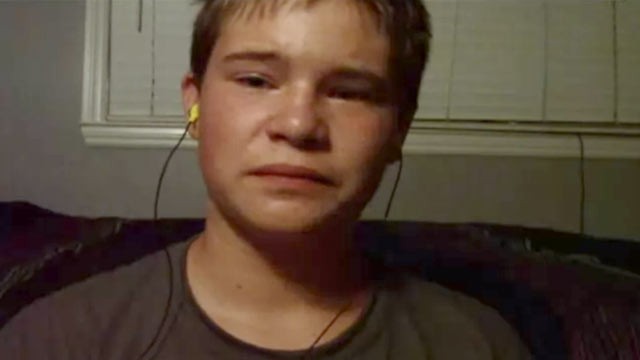
Jonah Mowry - It Does Get Better (Sometimes)


Yesterday I posted a moving video of a young man talking about the pain and suffering he has endured and inflicted on himself (cutting) as a result of bullying. I did not know anything more than what I saw in the video, which had gone viral on Facebook in the last few days.

Now he is the most famous bullied gay teen in the country. His name is Jonah Mowry - he is 14 years old, and despite some people's claims that the video was a hoax, his mom says otherwise.

He has recently posted a follow up video, but he deleted it from his own page. However, it has been reposted by many people and linked to by ABC News. In this video, he is with a friend and seems much happier.


ABC's 20/20 website ran a story on him and his situation.

Jonah Mowry's Mom Says Gay Son Inspired by Support

Sunday, November 27, 2011

Dylan Baker – The Story Behind Manhood (Parkour)


For those who have never encountered parkour - free running - it has become one of the fastest growing training and fitness models in recent years, partly because it requires no equipment, just an environment in which to practice. According to Wikipedia:
Parkour (sometimes abbreviated PK) is a method of movement focused on moving around obstacles with speed and efficiency. Originally developed in France, the main purpose of the discipline is to teach participants how to move through their environment by vaulting, rolling, running, climbing and jumping. Traceurs (parkour practitioners) train to be able to identify and utilize alternate or the more efficient paths. Parkour can be practiced anywhere, but areas dense with obstacles offer many different training opportunities.
Dylan Baker is one of the legends of the sport. I think the title of the post comes from his refusal to be defeated by a skill or trick - even though it nearly killed him. He overcame his fear and a year later landed the trick.

Filmed and Interviewed by Frosti
Edited by Knox
Dylan Baker – The Story Behind Manhood (Parkour)
Thursday, November 24th, 2011

This week’s article is not going to be covering any movements, but will be covering an inspirational video that I think everyone who practices parkour, or does anything that requires motivation and dedication for should see.
“Dylan Baker – The Story Behind Manhood” presented by American Parkour


The video is an interview of Dylan Baker, who almost died doing a movement while training one day, but he did not and got out of the situation safely. However, the fear of the movement kept him away from doing the same movement in the same place for over a year; however, a year later, he conquered his fear and did the move smoothly. He, also, expresses that no matter how much you do train on certain moves (and overall); there is always a chance of something happening that could cause you harm, which should always be considered while training or doing something new.

Other than that, the interview is inspirational to a lot of people (I think), because it goes on to express the love of parkour (or anything really), and it shows that you should not allow yourself to be held back from something you love by something like fear (or any other obstacle; mental or physical). Even if you do take a break from something you love, only allow that to be a break, not an end; come back to it when you are able to or feel comfortable enough to go back and continue doing it.
Music:
Get Down by Nas
Angel by Massive Attack
Luchini Instrumental by Camp Lo