Showing posts with label self compassion. Show all posts

Thursday, July 24, 2014

Feeling Overwhelmed? Remember "RAIN"

Some days we can feel completely buried by the responsibilities and obligations we carry. For some of us, when we get in this place, rather than acknowledging the magnitude of our burdens we can become self-critical and beat ourselves up for our perceived failure to "man up" (a phrase I hate, by the way).

The acronym RAIN is shorthand for a simple method to deal with overwhelm and self-criticism.
Recognize what is going on;
Allow the experience to be there, just as it is;
Investigate with kindness;
Natural awareness, which comes from not identifying with the experience.
Tara Brach is a well-known spiritual teacher and the author of several books and audio teachings, including True Refuge: Finding Peace and Freedom in Your Own Awakened Heart (2013) and Radical Acceptance: Embracing Your Life With the Heart of a Buddha (2004).


Feeling Overwhelmed? Remember "RAIN"

Four steps to stop being so hard on ourselves.

By Tara Brach | Mindful Magazine


Illustrations by Michael Woloschinow

When I was in college, I went off to the mountains for a weekend of hiking with an older, wiser friend of twenty-two. After setting up our tent, we sat by a stream, watching the water swirl around rocks, talking about our lives. At one point she described how she was learning to be “her own best friend.” A wave of sadness came over me, and I broke down sobbing. I was the furthest thing from my own best friend. I was continually harassed by an inner judge who was merciless, nit-picking, demanding, always on the job. My guiding assumption was, “Something is fundamentally wrong with me,” as I struggled to control and fix what felt like a basically flawed self.

Over the last several decades, through my work with tens of thousands of clients and meditation students, I’ve come to see the pain of perceived deficiency as epidemic. It’s like we’re in a trance that causes us to see ourselves as unworthy. Yet, I have seen in my own life, and with countless others, that we can awaken from this trance through practicing mindfulness and self-compassion. We can come to trust the goodness and purity of our hearts.

In order to flower, self-compassion depends on honest, direct contact with our own vulnerability. Compassion fully blossoms when we actively offer care to ourselves. To help people address feelings of insecurity and unworthiness, I often introduce mindfulness and compassion through a meditation I call the RAIN of Self-Compassion. The acronym RAIN, first coined about 20 years ago by Michele McDonald, is an easy-to-remember tool for practicing mindfulness. It has four steps:
Recognize what is going on;
Allow the experience to be there, just as it is;
Investigate with kindness;
Natural awareness, which comes from not identifying with the experience.
You can take your time and explore RAIN as a stand-alone meditation or move through the steps in a more abbreviated way whenever challenging feelings arise.


R—Recognize What's Going On
Recognizing means consciously acknowledging, in any given moment, the thoughts, feelings, and behaviors that are affecting us. Like awakening from a dream, the first step out of the trance of unworthiness is simply to recognize that we are stuck, subject to painfully constricting beliefs, emotions, and physical sensations. Common signs of the trance include a critical inner voice, feelings of shame or fear, the squeeze of anxiety or the weight of depression in the body.
In order to flower, self-compassion depends on honest, direct contact with our own vulnerability. Compassion fully blossoms when we actively offer care to ourselves.

Different people respond to the sense of unworthiness in different ways. Some might stay busy, trying to prove themselves valuable; others, fearful of failure, may become discouraged or even paralyzed. Still others may resort to addictive behaviors to avoid facing their shame and fear. Any of these strategies can lead to either defensive or aggressive behavior with others, or unhealthy attachment.

Some of us are at war with ourselves for decades, never realizing how our self-judgment and self-aversion keep us from finding genuine intimacy with others or enjoying our lives. One palliative caregiver reports that a key regret of the dying is not having been true to themselves. Rather than listening to and trusting our inner life, most of us try to live according to the expectations of others, which we internalize. When we inevitably fall short of the mark, we condemn ourselves.

Though it may sound depressing or overwhelming, learning to recognize that we are at war with ourselves is quite empowering. One meditation student described the trance of unworthiness as “…the invisible and toxic gas I am always breathing.” As he became increasingly mindful of his incessant self-judgment and feelings of inadequacy, his aspiration to free himself from his painful inner prison grew.

A—Allowing: Taking a Life-Giving Pause

Allowing means letting the thoughts, emotions, feelings, or sensations we have recognized simply be there. Typically when we have an unpleasant experience, we react in one of three ways: by piling on the judgment; by numbing ourselves to our feelings; or by focusing our attention elsewhere. For example, we might have the sinking, shameful feeling of having been too harsh in correcting our child. But rather than allowing that feeling, we might blame our partner for not doing his or her part, worry about something completely different, or decide it’s time for a nap. We’re resisting the rawness and unpleasantness of the feeling by withdrawing from the present moment.

We allow by simply pausing with the intention to relax our resistance and let the experience be just as it is. Allowing our thoughts, emotions, or bodily sensations simply to be doesn’t mean we agree with our conviction that we’re unworthy. Rather, we honestly acknowledge the presence of our judgment, as well as the painful feelings underneath. Many students I work with support their resolve to let it be by silently offering an encouraging word or phrase to themselves. For instance, you might feel the grip of fear and mentally whisper yes in order to acknowledge and accept the reality of your experience in this moment.

Victor Frankel writes, “Between the stimulus and the response there is a space, and in this space lies our power and our freedom.” Allowing creates a space that enables us to see more deeply into our own being, which, in turn, awakens our caring and helps us make wiser choices in life. For one student, the space of allowing gave her more freedom in the face of urges to binge eat. In the past, whenever she felt restless or anxious at night, she’d start thinking of her favorite food—trail mix—then mindlessly consume a half pound of it before going to bed, disgusted with herself. Learning to recognize the cues and taking a pause interrupted the pattern. While pausing, she would allow herself to feel the tension in her body, her racing heart, the craving. Soon, she began to contact a poignant sense of loneliness buried beneath her anxiety. She found that if she could stay with the loneliness and be gentle with herself, the craving passed.

I—Investigating with Kindness

Investigating means calling on our natural curiosity—the desire to know truth—and directing a more focused attention to our present experience. Simply pausing to ask, what is happening inside me?, can initiate recognition, but investigation adds a more active and pointed kind of inquiry. You might ask yourself: What most wants attention? How am I experiencing this in my body? Or What am I believing? What does this feeling want from me? You might notice hollowness or shakiness, then discover a sense of unworthiness and shame masked by those feelings. Unless you bring them into awareness, your unconscious beliefs and emotions will control your experience and perpetuate your identification with a limited, deficient self.

Poet Dorothy Hunt says that we need a “...heartspace where everything that is, is welcome.” Without such an attitude of unconditional care, there isn’t enough safety and openness for real investigation to take place. About ten years ago I entered a period of chronic illness. During one particularly challenging period of pain and fatigue, I became discouraged and unhappy. In my view I was terrible to be around—impatient, self-absorbed, irritable, gloomy. I began working with RAIN to recognize these feelings and judgments and to consciously allow the unpleasantness in my body and emotions to just be there. As I began to investigate, I heard an embittered voice: “I hate living like this.” And then a moment later, “I hate myself!” The full toxicity of self-aversion filled me.

Not only was I struggling with illness, I was at war with the self-centered, irritable person I believed I had become. Unknowingly, I had turned on myself and was held captive by the trance of unworthiness. But in that moment of recognizing and allowing the suffering of self-hatred, my heart began to soften with compassion.

Here’s a story that helps to describe the process I went through. Imagine while walking in the woods you see a small dog sitting by a tree. You bend down to pet it and it suddenly lunges at you, teeth bared. Initially you might be frightened and angry. But then you notice one of its legs is caught in a trap, buried under some leaves. Immediately your mood shifts from anger to concern. You see that the dog’s aggression sprang from vulnerability and pain.

This applies to all of us. When we behave in hurtful, reactive ways, it’s because we’re caught in some kind of painful trap. The more we investigate the source of our suffering, the more we cultivate a compassionate heart toward ourselves and others.

When I recognized how my leg was in a trap—sickness compounded with self aversion— my heart filled with sorrow and genuine self-care. The investigating deepened as I gently put my hand over my heart—a gesture of kindness— and invited whatever other feelings were there to surface. A swell of fear (uncertainty for my future) spread through my chest, followed by an upwelling of grief at losing my health. The sense of self-compassion unfurled fully as I mentally whispered, It’s all right, sweetheart, and consciously offered care to the depths of my vulnerability, just as I would to a dear friend.

Compassion arises naturally when we mindfully contact our suffering and respond with care. As you practice the RAIN of Self-Compassion, experiment and see which intentional gesture of kindness most helps to soften or open your heart. Many people find healing by gently placing a hand on the heart or cheek; others, in a whispered message of care, or by envisioning being bathed in warm, radiant light. What matters is that once you have investigated and connected with your suffering, respond by offering care to your own heart. When the intention to awaken self love and compassion is sincere, the smallest gesture—even if, initially, it feels awkward— will serve you well.

N—Natural Loving Awareness

Natural loving awareness occurs when identification with the small self is loosened. This practice of non-identification means that our sense of who we are is not fused with any limiting emotions, sensations, or stories. We begin to intuit and live from the openness and love that express our natural awareness.

Though the first three steps of RAIN require some intentional activity, the N is the treasure: A liberating homecoming to our true nature. There’s nothing to do for this last part of RAIN; we simply rest in natural awareness.

The RAIN of Self-Compassion is not a one-shot meditation, nor is the realization of our natural awareness necessarily full, stable, or enduring. Rather, as you practice you may experience a sense of warmth and openness, a shift in perspective. You can trust this! RAIN is a practice for life—meeting our doubts and fears with a healing presence. Each time you are willing to slow down and recognize, oh, this is the trance of unworthiness… this is fear… this is hurt…this is judgment…, you are poised to de-condition the old habits and limiting self-beliefs that imprison your heart. Gradually, you’ll experience natural loving awareness as the truth of who you are, more than any story you ever told yourself about being “not good enough” or “basically flawed.”

A friend of mine was sitting with her dying mother while she was in a coma. At one point the mother opened her eyes, looked at her daughter with great lucidity, and said “You know, all my life I thought something was wrong with me.” She closed her eyes, sank back into a coma and died shortly thereafter. For my friend, her mother’s words were a parting gift. They inspired her to dedicate herself to the mindfulness and self-compassion that frees us.

We each have the conditioning to live for long stretches of time imprisoned by a sense of deficiency, cut off from realizing our intrinsic intelligence, aliveness, and love. The greatest blessing we can give ourselves is to recognize the pain of this trance, and regularly offer a cleansing rain of self-compassion to our awakening hearts.

* * *

~ Clinical psychologist Tara Brach is the author of True Refuge: Finding Peace & Freedom in Your Own Awakened Heart. For guided meditations and talks, visit Tara Brach's website.

Sunday, June 23, 2013

Real Change Takes Time

Lest we forget, in our desire to be better men, better human beings, real change takes real time. We do not ever arrive at healed (it's a journey not a destination), and progress visible to our own eyes takes considerable time.

Real Change Takes Time

By Deborah Fike
The Change Blog


As a young adult, I had a nasty habit that I detested with all my being. I had a quick temper. I could easily lose my cool at the slightest insult and would snap at the people I loved. It didn’t matter if my behavior was justified or not, hurtful words just flew out of my mouth. Perhaps worse, over time I became cold and distant to many people without explaining why. This baffled many family and friends, and I lost genuine relationships over my behavior.

When I finally owned up to my anger problem during my senior year of college, I found it hard to change. I saw counselors that gave me relaxation techniques, but I did not use them consistently. I read books and articles about ways to cool my temper, but only followed that advice sporadically. I would be okay for a week or two, and then something would set me off, and I’d feel guilty for not being able to control my feelings. I felt trapped by my own personality, and I began to hate who I had become.

We all have things about ourselves that we wish we could change. It’s easy to read stories about people who make radical changes in their lives – losing 100 pounds, overcoming alcoholism, starting a new business. These media snippets make it sound so easy: a person just woke up one day and decided to take charge and boom! They led newer, happier lives.

If you read between the lines of all these stories, though, you’ll find that the “easy change” actually wasn’t so easy, nor did it happen in an instant. It took someone 2 years to shed 100 pounds. The person overcoming alcoholism tried 5 different programs before finding one that worked. The guy starting the new business lost money on 6 different products before getting it right. These changes took real time and effort.

Yet, why do we continue to think we can change overnight?

What I didn’t realize back in college was despite appearances, I actually was improving. Sure, I would feel my ugly anger rear its head now and again, but I would use those techniques that the counselors taught me and succeed in squashing my anger 80% of the time. Even after a bad blowout, I would sit down and analyze what went wrong. I visually pictured myself being provoked and not losing my cool. I also started avoiding situations that would make me angry, and thus, found myself happier overall.

Today, I’m proud to say I’m a much less angry person. Taming my temper didn’t happen overnight. It took several years of trial and error with many setbacks to learn how to calm myself. There wasn’t just one “a-ha” moment when I realized that I had “conquered” my temper. In fact, I still lose it now and again, but now it happens so infrequently that it’s become the exception and not the rule. I can now even walk away in the middle of a flare-up, something I never dreamed possible before.

So if you can learn anything from me, realize that real change doesn’t happen overnight. It will take time for you to make progress, especially if you have a big problem or are working toward a big goal. If you understand this, hopefully you’ll feel less guilty than I did trying to make great personal change.

And if you think you’ll never get to where you want to be, give yourself a break. Don’t give up. Just count all the small victories you’ve made instead of always blaming yourself for the small losses. You might be amazed at what you can accomplish if you give yourself some time.


About: Deborah Fike is a full-time mom and founder of Avalon Labs, which provides consultations and writing services for start-ups and online businesses. She believes in the power of self-reflection and positive change.

Friday, February 1, 2013

Anthony Carter - Young Boys Need Self-Esteem to Survive


Over at the Good Men Project this morning, Anthony Carter has an article entitled, "Young Boys Need Self-Esteem to Survive," an idea that seems pretty obvious and useful on the surface. However, I have long agreed with Kristin Neff, PhD (University of Texas) and clinical psychologist Christopher Germer, PhD, who both argue that self-compassion is more important than self-esteem. After the article from Carter, I will offer some information on why self-compassion is not only better, but more important than self-esteem.

Young Boys Need Self-Esteem to Survive

FEBRUARY 1, 2013 BY ANTHONY CARTER


Anthony Carter knows how hard it is to survive a childhood that was critical of who he was. He wants that to change for the boys of today.


To all the boys who may or may not be queer. The boys picked last in sports but first for the latest in fashion, entertaining, and tasteful decorating. The boys who couldn’t catch a football but instead could clean a bathroom until it sparkles and offer serious, heartfelt care to a sick sibling.

I salute you.

I salute us. In this culture, our gifts go unrecognized or at worse, get criticized and mocked. I salute all the boys like me who were different. Yes, we are here to stay and more importantly will be leading the revolution when the time comes.

Did I mention the time is now?

We are through waiting patiently for the all powerful “they,” whoever the they happens to be this week, to allow us the privilege to “be.” We have been quietly watching from the sidelines learning to survive a very hostile world that is not ready for us.

However, no one is ever fully ready for change. It pretty much sneaks up on you.


♦◊♦

As a young boy and now older adult, I have spent my life seeking kindness. I witness so much cruelty, domination, and coercion in the world.

What are boys and men like me to do if there is no urge to dominate or be dominated? What to do when we would rather a great conversation and a cup of coffee than an opportunity to one up a friend or colleague?

In this world, the thinking man is a problem man. As a person seeking kindness, it becomes difficult to hold out for this seemingly unattainable entity. It seems almost an impossibility trying to survive amidst a world that seems so set on destroying everything that you are.

Almost impossible is not the same as impossible.

Those of us who have survived childhood and didn’t give into the self-hatred that is so seductive when you don’t toe the line, know a thing or two about not only surviving but thriving. Within the harshest of circumstances, human beings hunger for and create beauty.

As a man/boy learns to thrive beyond a prescribed masculinity, we totally thrive by repeatedly creating beauty.

Our refusal to stop being, doing, and developing the things that sustain us is the most important step in revolutionizing our thinking, our relationships and our planet.

Hurray for the assholes that bullied us and bravo to all the young males who survived it, didn’t recreate it, and learned how to not stop simply because a wall of shit fell on their heads.

One key line above is important in my opinion: "Our refusal to stop being, doing, and developing the things that sustain us is the most important step in revolutionizing our thinking, our relationships and our planet." Being who we are and doing the things that sustain us has little to do with self-esteem and everything to do with self-compassion.

Here is a short video from Dr. Neff on the important differences between self-esteem and self-compassion:


And this brief section, from Kristin Neff's article, Self-Compassion: An Alternative Conceptualization of a Healthy Attitude Toward Oneself (Self and Identity, 2: 85–101, 2003), offers an useful working definition of self-esteem:

Self-esteem, which stems from evaluations of self-worth, is constituted by judgments and comparisons (Coopersmith, 1967; Harter, 1999). As William James (1890) proposed over a century ago, self-esteem involves evaluating personal performances (how good am I?) in comparison to set standards (what counts as good enough?) in domains of perceived importance (it’s important to be good at this). Self-esteem also involves looking to others’ evaluations of the self (how much do others like me, approve of me?), in order to determine how much one likes the self (Cooley, 1902; Mead, 1934). Social comparison is an additional determinant of self-esteem (Aspinwall & Taylor, 1993; Beach & Tesser, 1995; Buunk, 1998; Deci & Ryan, 1995; Suls & Wills, 1991), so that the self is evaluated in relation to the performances of others.

There are also sub-types of self-esteem, such as domain specific self-esteem, contingent self-esteem, and stable self-esteem, among others.

In opposition to the self-esteem model, which can result in less than desirable behaviors in order to maintain social approval, to measure up to others, or an "over-emphasis on evaluating and liking the self may lead to narcissism, self-absorption, self-centeredness, and a lack of concern for others" (Neff, 2003), Neff (2009) has proposed an alternate model based in self-compassion, one that does not involve evaluations of self-worth:

Drawing upon ideas discussed in the Insight tradition of Buddhism (e.g., Brach, 2003; Kornfield, 1993; Salzberg, 1997), self-compassion is defined in terms of three main components: self-kindness, a sense of common humanity, and mindfulness when considering personal weakness or hardships (see Neff, 2003a, 2003b, for a more complete discussion of the theoretical underpinnings of self-compassion). Research on self-compassion is part of a larger movement by Western psychologists to investigate the validity of Buddhist ideas concerning the causes and amelioration of suffering and to examine the usefulness of techniques such as mindfulness for adaptive functioning (see Wallace & Shapiro, 2006, for review).

Although people typically value being kind and compassionate to others, they are often harsh and uncaring toward themselves. The intense self-focus that occurs when people confront their own limitations can sometimes lead to a type of tunnel vision in which people become over-identified with and carried away by negative thoughts and feelings about themselves. Feelings of isolation can also occur when people temporarily forget that failure and imperfection are part of the shared human experience, serving to amplify and exacerbate suffering. Self-compassion, on the other hand, involves being kind toward oneself when considering weaknesses, remembering that being human means being flawed and imperfect, and learning from one’s mistakes. Self-compassion also involves taking a mindful approach to negative thoughts and emotions that acknowledges the reality of personal failings while keeping them in balanced perspective. Mindfulness shifts one’s attention away from elaborative cognitive processing—especially those thoughts creating stories about the self (Martin, 1997)—toward the nonjudgmental acceptance of present-moment experience (Bishop et al., 2004). Thus, self-compassion tends to soften rather than reinforce egoprotective boundaries between self and others. (For an alternative conceptualization of self-compassion, see Gilbert & Irons, 2005 or Gilbert & Procter, 2006.)

In this same article, Neff argues that people who rate higher in self-compassion likely are not as defensive of their egos (compared to people who are working to maintain their self-esteem) because their feelings of inadequacy are experienced with acceptance rather than evaluation and judgment.

One of the huge criticisms of the "self-esteem movement" in this country is the need for everyone to feel special (to the point that score is not kept in games or everyone gets a trophy for showing up). After all, who wants to be average? Few people describe themselves as average and many would consider it an insult.
In contrast, self-compassion is predicated on the acknowledgment of shared and universal aspects of life experience and therefore tends to highlight similarities rather than differences with others. Also, whereas self-esteem is often contingent on the successful attainment of goals, self-compassion is felt precisely when life is not going so well, allowing for greater resilience and stability regardless of particular outcomes. (Neff, 2009)
So, rather than arguing that young boys need self-esteem to survive, I would argue that our boys (and teens and men) need self-compassion to survive . . . or even better, to thrive.

For more information on the psychological benefits of self-compassion, see Self-compassion and adaptive psychological functioning (Neff, Kirkpatrick, and Rude; Journal of Research in Personality 41: 139–154, 2007).

Wednesday, January 2, 2013

Pema Chödrön - Humor and Openness


Some wisdom from Pema Chödrön to begin the new year. Make this a year in which you learn from mistakes, improve on strengths, and develop compassion and kindness for those wounded places inside of us that still need to be healed.

HUMOR AND OPENNESS 
Learning how to be kind to ourselves is important. When we look into our own hearts and begin to discover what is confused and what is brilliant, what is bitter and what is sweet, it isn't just ourselves that we’re discovering. We’re discovering the universe. When we discover the buddha that we are, we realize that everything and everyone is Buddha. We discover that everything is awake, and everyone is awake. Everything and everyone is precious and whole and good. When we regard thoughts and emotions with humor and openness, that’s how we perceive the universe.

Sunday, June 3, 2012

Self-Compassion with Dr. Kristin Neff on The Secret Lives of Men


Kristin Neff is one of my favorite people - she has helped bring the idea of self-compassion, rather than self-esteem, into the forefront of research and praxis. Dr. Neff is an Associate Professor in Human Development and Culture at the University of Texas at Austin - she has been featured at TED and has spoken at a variety of other conferences and venues - there are several video clips at her site (linked at her name above).

Through her work, I have changed my approach to doing therapy, and I have spread ideas to my co-workers as well. Her website has some cool self-compassion meditations, free assessment tools for counselors and researchers, exercises to increase self-compassion, and lots of other very useful material - all open access. Many of the materials offered are co-created with Dr. Christopher K. Germer, author of The Mindful Path to Self-Compassion: Freeing Yourself from Destructive Thoughts and Emotions (another book I HIGHLY recommend).

For those of you who have seen the film, she is the mother who took her family to Mongolia in search of a shaman to work with her autistic son - the film about her journey is called The Horse Boy. This is a very touching film - and since I love Mongolia (the people and the landscape are beautiful) that part was an extra bonus.

On a recent episode of The Secret Lives of Men, Dr. Chris Blazina spoke with Dr. Kristin Neff about her research and hr recent book, Self-Compassion: Stop Beating Yourself Up and Leave Insecurity Behind. Here is the publishers ad-copy for the book:
The relentless pursuit of high self-esteem has become a virtual religion—and a tyrannical one at that. Our ultra-competitive culture tells us we need to be constantly above average to feel good about ourselves, but there is always someone more attractive, successful, or intelligent than we are. And even when we do manage to grab hold of high self-esteem for a brief moment, we can't seem to keep it. Our sense of self-worth goes up and down like a ping-pong ball, rising and falling in lockstep with our latest success or failure. 

Fortunately, there is an alternative to self-esteem that many experts believe is a better and more effective path to happiness: self-compassion. The research of Dr. Kristin Neff and other leading psychologists indicates that people who are compassionate toward their failings and imperfections experience greater well-being than those who repeatedly judge themselves. The feelings of security and self-worth provided by self-compassion are also highly stable, kicking in precisely when self-esteem falls down. This book powerfully demonstrates why it's so important to be self-compassionate and give yourself the same caring support you'd give to a good friend.

This groundbreaking work will show you how to let go of debilitating self-criticism and finally learn to be kind to yourself. Using solid empirical research, personal stories, practical exercises, and humor, Dr. Neff—the world's foremost expert on self-compassion—explains how to heal destructive emotional patterns so that you can be healthier, happier, and more effective. Engaging, highly readable, and eminently accessible, this book has the power to change your life.
I think this topic is especially relevant for men. We are raised to be competitive, to be self-critical and aim for perfection, and to be intolerant of anything less than greatness. No wonder so many men secretly feel like failures or frauds.


Listen to internet radio with Secret Lives of Men on Blog Talk Radio

Self-Compassion: Kristin Neff

by Secret Lives of Men

May 22, 2012

Self-Compassion: Stop Beating Yourself Up and Leave Insecurity Behind. Kristin Neff 

From leading psychologist Dr. Kristin Neff comes a step-by-step guide explaining how to be more self-compassionate and achieve your dreams in life.
Dr. Kristin Neff (and other leading psychologists) indicates that people who are compassionate toward their failings and imperfections experience greater well-being than those who repeatedly judge themselves. The feelings of security and self-worth provided by self-compassion are also highly stable, kicking in precisely when self-esteem falls down. This book powerfully demonstrates why it's so important to be self-compassionate and give yourself the same caring support you'd give to a good friend. This groundbreaking work will show you how to let go of debilitating self-criticism and finally learn to be kind to yourself.

Saturday, April 14, 2012

Ze Frank - An Invocation for Beginnings

Somehow I have not been a fan of this Ze Frank's work. Possibly it's the ever-present smirk just below the surface when he speaks that I found annoying and so I tuned him out. But this video is cool - and now I suspect I may need to go back and look at more of Ze Frank's stuff to see what I have been missing . . . .

Ze Frank - An Invocation for Beginnings


Saturday, April 7, 2012

Rick Hanson - Taking in the Good: A Personal Reflection


Rick Hanson, author of Buddha's Brain: The Practical Neuroscience of Happiness, Love, and Wisdom and Just One Thing: Developing A Buddha Brain One Simple Practice at a Time, is working on a new book. He sent out an email today asking for personal experiences on a specific topic. Interestingly enough, it was something that has been "up" for me the last couple of months.

First the email.

Hello,

I have a favor to ask. I'm heading into writing my next book, which is about the practice of taking in the good, and related themes of defeating the negativity bias, taking charge of building structure in your brain, and coming home to your natural resting state of happiness, love, and peace. It would help me a lot to get examples of how the method of taking in the good has helped people such as yourself. I need these as soon as possible, ideally over this weekend and by Tuesday at the latest. 

A sentence or brief paragraph would be great. Maybe with an example. I may use what you write in the book, though never with your name, and it's fine to leave out or alter identifying details. 

As you probably know, the three basic steps of taking in the good are:
1.  Let a good fact become a good experience.
2.  Open to and savor this experience for 10-30 seconds in a row.
3.  Intend and sense that the experience is sinking into you, becoming a part of you.
You can use this method for the good facts around you each day - most of which are relatively small, such as coffee smells good, you finished a batch of emails, flowers are blooming, someone was warm to you, etc. Most positive experiences are fairly mild, and that's fine. But mild or intense, they normally flow through the brain like water through a sieve while negative experiences get caught every time (which helped our ancestors survive). That's why it's so important, several times a day or more, to turn toward a positive experience and take it into you. And since "neurons that fire together, wire together," you'll be weaving positive feelings, sensations, and thoughts into the fabric of your brain and your self.  

Then there is the 4th, optional step, in which you're aware of a strong positive experience connecting with some negative material - such as a longing for love, feelings of anxiety, or some pain from childhood - that is dim and in the background of your mind. You don't let yourself get sucked into the negative material but keep the positive material relatively intense and in the forefront of awareness. With repetition, the positive material will gradually associate to, infuse, soothe, and even gradually replace the negative material. For more on all four steps, see chapters 2 and 50 in my book, Just One Thing.

So I'd really appreciate it if you could send me a few words about your own experience of taking in the good, especially how this method has helped you in some way. Informal and relaxed is fine; you don't have to worry about your writing. I really appreciate any help you can offer me with this.

Warmly,
Rick    

I assume this went out to the people who subscribe to Just One Thing, his newsletter, so it's not a personal email. But I did send him a response . . . although it was more than just a sentence or a paragraph. As usual, I was a bit verbose.

Here is my response, which I think offers some insight into the process Dr. Hanson is talking about, and also suggests that it's an ongoing process.

Hi Rick,

This is timely - I have been working with these ideas with my therapy clients (sexual trauma survivors) - but the fact that I am working with clients at all is where my experience of this comes in.

I have been self-employed as a fitness coach/trainer for several years, but I had not really "let it in" that my clients all seem to "love" me, for lack of a better word (or maybe that is the correct word). I initially became a personal trainer because I did not feel "good enough" to be a psychotherapist. Three years ago, however, I went back to school, partly as a result of personal work to build more self-efficacy and acceptance.

As I have transitioned into counseling (recently completing a 9-month internship), I received a good deal of feedback from clients (as they completed therapy) and supervisors that I was effective and that my clients were deeply appreciative.

I work to take their experience as fact, and also have worked over the last couple of months to take that in as my experience: I am effective and appreciated. It's always been challenging for me to accept praise or compliments of any kind, so I tried to sit with the emotions of feeling valued and effective in what I do (I have never let that in as a trainer, either, so this impacted my whole work life).

Over the past several weeks, I have continually tried to embody this sense of being valued and to integrate that into my self-concept at the intellectual, emotional, and somatic levels. Being valued is something I have never really felt, which has produced both a "pleaser" self and a "hyper-critical" self that I have worked with therapy and in meditation practice over the years.

Doing this process has brought up the old wounds of having never been acknowledged or appreciated by my family of origin. I did not value myself very highly, so I did not seek work that reflected my skills and abilities  (despite already having one post-graduate degree), and consequently I was always dissatisfied and bored in my work life. With time in therapy, I left some bad jobs and moved into being self-employed, but I still failed to see myself as valuable in the same ways as did my clients.

Now, having tried to use some of the techniques I have learned from your work, as well as from Richard Davidson, Pema Chodron, Kristin Neff, Dan Siegel, and many other sources, I am beginning to embody and live within a much different sense of self, with far less need to please others and much less self-criticism. It feels like I am only at the beginning stages of transformation, but the more room I make for self-worth and self-compassion, the more I know that I am reparenting myself (a la Dan Siegel's Mindsight model) and changing the way my brain is wired.

Thanks for offering space to share this!

I look forward to the new book.

All best,
Bill 

Wednesday, July 13, 2011

Pema Chodron - Meditation Is about Accepting Ourselves as We Are

http://www.snowlionpub.com/data/img2/councd.jpg

I have a client who meditates when she is struggling, then she wonders why it doesn't make her feel better. Instead, troubling feelings and thoughts, memories and fears arise and leave her feeling worse. She thinks meditation does not work, and I keep telling her it's working exactly as it should.

The difference in our perceptions comes in what we expect meditation to do for us and what we hope to get from meditation.

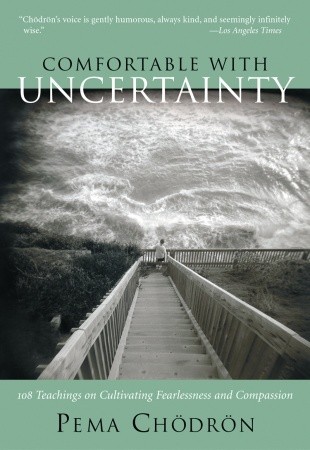
This brief bit of wisdom comes from Pema Chodron - it was posted at Tricycle Insights. This is quoted from Comfortable with Uncertainty: 108 Teachings on Cultivating Fearlessness and Compassion.

We Can Still Be Crazy

We may think meditation will improve us, but it’s really about accepting ourselves as we are right now.

Pema Chodron

When we start to meditate or to work with any kind of spiritual discipline, we often think that somehow we’re going to improve, which is a subtle aggression against who we really are. It’s a bit like saying, “If I jog, I’ll be a much better person.” “If I had a nicer house, I’d be a better person.” “If I could meditate and calm down, I’d be a better person.” Or the scenario may be that we find fault with others. We might say, “If it weren’t for my husband, I’d have a perfect marriage.” “If it weren’t for the fact that my boss and I can’t get on, my job would be just great.” And, “If it weren’t for my mind, my meditation would be excellent.”

But lovingkindness—maitri—toward ourselves doesn’t mean getting rid of anything. Maitri means that we can still be crazy, we can still be angry. We can still be timid or jealous or full of feelings of unworthiness. Meditation practice isn’t about trying to throw ourselves away and become something better. It’s about befriending who we are already. The ground of practice is you or me or whoever we are right now, just as we are. That’s what we come to know with tremendous curiosity and interest.

Curiosity involves being gentle, precise, and open—actually being able to let go and open. Gentleness is a sense of goodheartedness toward ourselves. Precision is being able to see clearly, not being afraid to see what’s really there. Openness is being able to let go and to open. When you come to have this kind of honesty, gentleness, and goodheartedness, combined with clarity about yourself, there’s no obstacle to feeling lovingkindness for others as well. ▼

From Comfortable with Uncertainty: 108 Teachings on Cultivating Fearlessness and Compassion by Pema Chodron. © 2002 by Pema Chodron and Emily Hilburn. Reprinted with permission of Shambhala Publications, Inc., www.shambhala.com