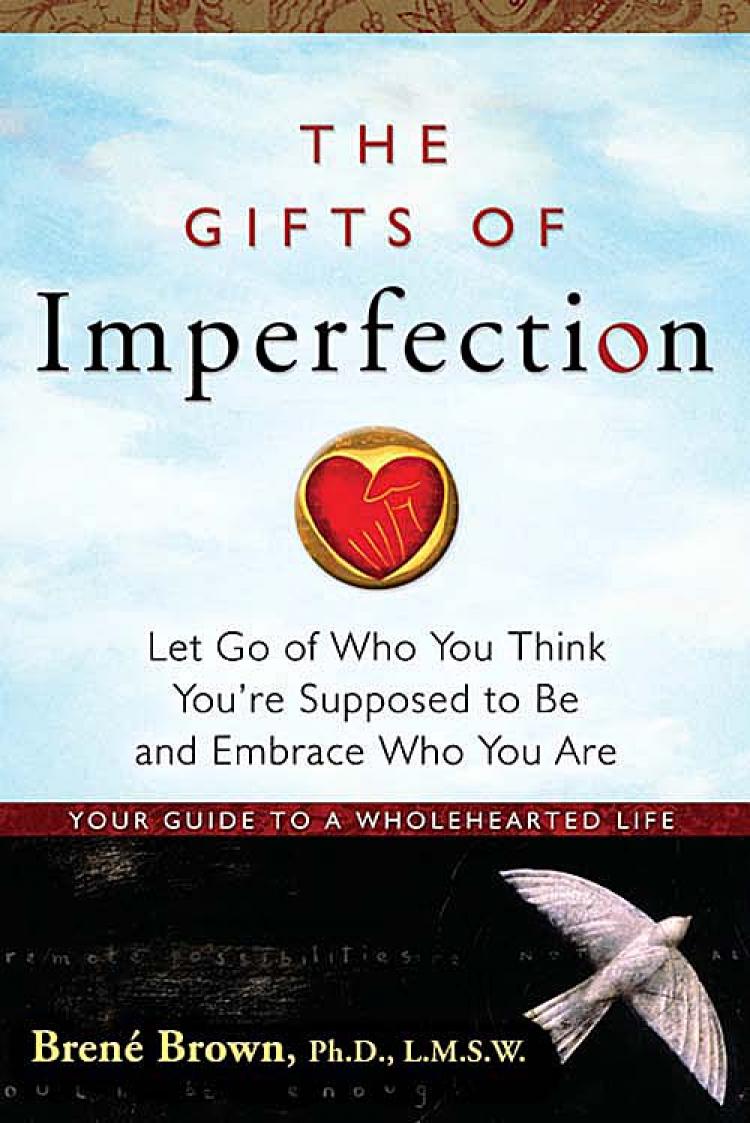
In the spirit of Brené Brown's The Gifts of Imperfection: Let Go of Who You Think You're Supposed to Be and Embrace Who You Are, my personal growth challenge for 2014 is to fail more often and to embrace imperfections.
I have always feared failure, which is fitting because one of my coping strategies to deal with a hyper-critical parent was to become a perfectionist. It worked great in school - I got good grades and the teachers loved me. Then that parent died, and I still had this perfectionist inside me.
The downside is that I have missed out on a lot of opportunities to do things because I was afraid I would not be good something new. That fear of being laughed at and being obviously not good at something was a powerful deterrent.
I have changed this quite a bit over the years - to the point that I am fine with falling on my ass trying something new. But that perfectionist is still in there, and when he fears he failed at something, he and the inner critic get together and have a shame party at my expense.
No more.
Here are two of Brown's TED Talks on vulnerability, which is what we must embrace if we embrace imperfection. The illusion of perfection offers an invulnerability cloak (a protection from shame), but failure is raw, vulnerable, and human.
Brené Brown: Listening to Shame: TED Talk
Brené Brown: The Power of Vulnerability: TED Talk
This last video is from the Behance U99 Conference in 2013.
Brené Brown: Why Your Critics Aren't The Ones Who Count
And for one other bit of inspiration, it appears that
Hey Man, Let’s Practice Imperfection in 2014
January 1, 2014 by Joe Rutland
Every New Year’s Day is a chance for men to either start something new or stop actions and behaviors that may not be healthy to their lives. Those infamous “New Year’s resolutions” can sometimes, without intention, become a horrendous “to-do” list that feels like a 45-pound weight swinging around a man’s neck. What if this Jan. 1 was different? What if men chose a few different actions beside the usual list of “eating healthier, exercising more, stressing out less, getting finances in order, etc.”? Let me suggest three possibilities: Choose imperfection. Choose messiness. Choose authenticity.
Joe Rutland in defense of messiness, authenticity and imperfection.
Being imperfect is actually a healthy emotional behavior as the stress to be perfect is lessened. Messiness shakes the reins of obsessive-compulsive behaviors and thoughts, turning them upside down. Authenticity, when practiced, can become a blessing instead of a fear-based, soul-wrenching curse.
Now when it comes to perfection and being a perfectionist, then you’ll find my name at the top of the list. Oh no, you think your name is No. 1. Nope. I’m the chief of perfectionists, meaning that I have to do every single thing in my life just right. I have to say the right words, act the right way, stuff my thoughts and feelings deep within myself and not let them out, even when sitting among what I consider safe environments and safe people. Fighting against perfectionism hasn’t been a healthy battle in my life. I have lost more times than I have won, and I’ve lost so much time and emotional energy to it.
What I can say is that I’ve learned a lot about letting go, trusting the process (whatever that looks like), and believing in myself in recent years. Reading others’ stories and hearing other men talk about how they deal with perfection has helped me greatly. Perfectionism could almost be put into a mental health category alongside shame.
One of the more enlightening pieces of literature I’ve read recently around this subject is The Gifts of Imperfection, written by Dr. Brene’ Brown, a member of the research faculty at the University of Houston Graduate School of Social Work. Dr. Brown’s work has focused around the topics of shame and fear and the subject of Wholeheartedness, about which Dr. Brown poses this question: “How do we cultivate the courage, compassion, and connection that we need to embrace our imperfections and to recognize that we are enough—that we are worthy of love, belonging, and joy?”
A lot of men are more apt to wrap their self-worth around the trophy system. You know: the trophy job, the trophy wife, the trophy car, the trophy sexual conquests, the trophy fill-in-the-blank. Then one day, a man wakes up, looks within, goes into his bathroom and stares at the mirror. “It’s all bullshit,” he mutters to his reflection. Now this could be called a rude awakening. It also could be called a spiritual awakening. Not one of blazing chariots of fire coming down from the heavens and lifting the veil from his eyes, per se. But this moment is powerful if and when it happens.
Imperfection allows breathing room for mistakes, missteps and foibles. Remember the opening scene from “The Dick Van Dyke Show” where Rob Petrie (Van Dyke) walks through his front door, leans in to kiss his wife Laura (Mary Tyler Moore), turns and starts heading toward his “Alan Brady Show” co-writers Sally Rogers and Buddy Sorrell (Rose Marie and Morey Amsterdam, respectively), and doesn’t see the ottoman in front of him and flips over it? That’s imperfection. It’s also a good sense of acrobatic timing on Van Dyke’s part. To get that scene right, he probably had to practice it a few times; therefore, getting the “imperfect” scene perfect.
Yet the image is of imperfection. Now do I put up an “image of imperfection” so that I can hold on like a drunken sailor to my perfections? God knows I’ve done my best to dump that image and trade it for reality. Oh, but my perfections protect me from you…and you…and you, too. I don’t want you to see that I make mistakes. It pisses me off when I don’t get something perfect. Even today, after years of soul work, I still catch myself starting that negative self-talk chatter when I make a mistake. It is brutal.
Living in imperfection is definitely easier. Accepting myself as I am—a man who is worthy of love, compassion, empathy, healthy sexuality, nurturing and support—sure helps my mental and emotional well-being. Come to think of it, my physical health improves, too. Imperfection, messiness and authenticity do take time and practice so they can become a part of a man’s life. For too long, men (and women, too) have been bombarding themselves with negative self-talk. It is a disease, or dis-ease, of the mind, body and spirit.
So what if someone doesn’t like what I think or write? OK.
So what if someone doesn’t believe what I believe? OK.
Is it really “OK” or, again, am I fooling myself and you with my physical responses to not pleasing you?
A very wise friend told me one time four words about physical responses that people give off to other people’s statements or words: “The body don’t lie.” Think about it. When your wife, girlfriend, employer, best friend or co-worker starts giving you a hard time about something, are you aware of your physical responses? You know, like folding your arms across your chest, making a loud sighing noise (which is really telling the person to shut up without saying “shut up”), or pressing your lips so tightly together that water flowing from Niagara Falls couldn’t get inside your mouth.
Well, I’d say it is time for me and you to give ourselves a break. Let’s do our best to drop perfectionism this year. Embrace your mistakes, foibles and faults. Know that it is OK to screw up and it’s also OK to protect yourself from others’ perfectionism.
Be imperfect. Give it a shot in 2014 and see what happens. Who knows? Your life, and mine, might change for the better.
- modified photo Plat / Flickr Creative Commons


