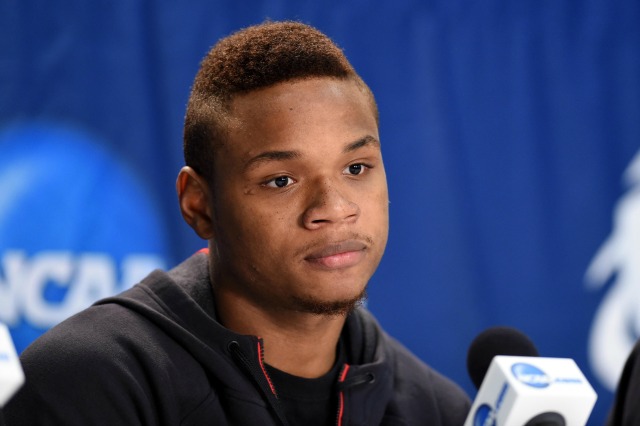
Jason Collins was the first active NBA player to come out; Michael Sam was the first Division I NCAA football player to come out; and now Derrick Gordon is the first Division I NCAA men's basketball player to come up.
Some people seem to think it's no big deal, and it shouldn't be - no one should give a rat's ass about anyone else's sexuality if the other person is not being evangelical. But that's not the world we live in, and that is certainly not the world of male sports. So, kudos to Mr. Gordon for showing other young men it is okay to be yourself - gay, straight, or somewhere in between.
Why Derrick Gordon Coming Out is Important, and a Story
April 9, 2014
Derrick Gordon first realized he was gay in middle school but never told anybody until earlier this month. He's now 22 years old. So the UMass guard has been hiding things from his family and friends for nearly a decade, and, by Gordon's own admission, he didn't figure he'd publicly disclose his sexual orientation for at least another three or four years.
But then NBA veteran Jason Collins came out last year.
And ...
"When he came out I wanted to come out the next day," Gordon said in an interview conducted by Kate Fagan that was broadcast nationally on Wednesday. "It was a relief."
And that, quite simply, is why Gordon's story is a huge and important story.
Because his story might help somebody else the way Collins' story helped him.
"[Collins] was getting subbed into [an NBA] game [as an openly gay man], and everybody stood up and started clapping," Gordon said. "And I was visualizing ... that being me. ... I just kept replaying it over and over again. ... And that definitely put a huge smile on my face."
Over the past year we've now had three examples of prominent male athletes publicly acknowledging that they're gay, and each time somebody on Twitter or a message board has been compelled to ask why this is a story. It happened when Collins came out. It happened again when Missouri football player Michael Sam came out. It happened again early Wednesday, when Gordon, a starter on the UMass team that made this season's NCAA Tournament, came out, and I get so frustrated every time somebody asks this question.
Are you one of those people?
Are you somebody who asks why this is a story?UMass guard Derrick Gordon's decision to come out is important beyond college basketball. (USATSI)
If so, take eight minutes, watch this interview, and then, presumably, you'll never ask that question again because what you'll realize is that Gordon wouldn't be able to live honestly if not for Collins' story first being a story. There had never been an openly gay man in the NBA until Collins just like there had never been an openly gay man in Division I football until Sam just like there had never been an openly gay man in Division I basketball until Gordon, and it's naive to think one very public announcement didn't help trigger the next. In fact, Gordon was quite clear in stating that without Collins' story he'd almost certainly still be in the closet, and he was quite clear in stating that being in the closet was an awful way to live.
"I want to be myself," Gordon said. "I don't want to be somebody that I'm not."
Now, Gordon can be himself.
He doesn't have to hide anything anymore.
And the only reason Gordon ever felt comfortable enough to take this step is because he saw the way Collins and Sam have been treated by teammates and fans in recent months, and the only reason he saw that is because their stories were stories. This is still all so new, you know? So it doesn't matter whether you care or do not care if a player is gay. What matters is that there's another young gay athlete somewhere who will feel empowered to come out because of Gordon's story the same way Gordon was empowered by Collins' story.
And I'll take it a step farther.
Is it foolish to think that Gordon's teammates at UMass are more accepting of the news than they might've otherwise been because of the way they saw the Brooklyn Nets accept Collins? Is it farfetched to suggest that the way future Hall of Famers Kevin Garnett and Paul Pierce publicly handled that situation helped the UMass players better handle this situation?
I don't think it is.
I think all of these stories are connected.
And that's why anybody suggesting these stories aren't stories is wildly missing the point. Again, Collins' story helped pave the way for Sam's story, and those stories helped pave the way for Gordon's story. Across the board, those three men now say they're happier than they've ever been, and watching them be accepted will undoubtedly help somebody else, which is why these important stories deserve every headline they can possibly get.
~ Gary Parrish is a senior college basketball columnist for CBSSports.com and frequent contributor to the CBS Sports Network. The Mississippi native also hosts the highest-rated sports talk radio show -- The Gary Parrish Show -- in the history of Memphis. He lives in that area with his wife, two children and a dog.


