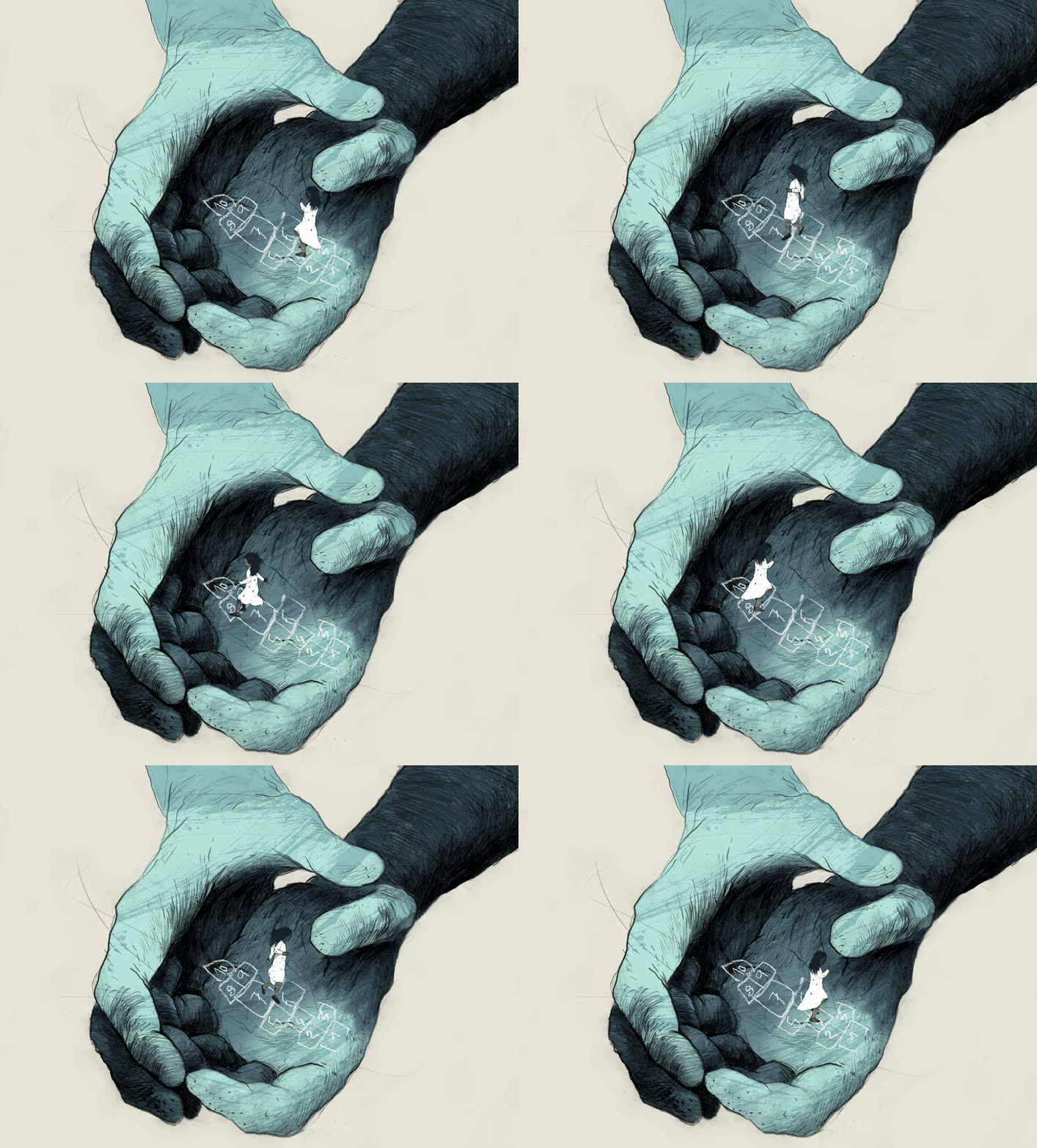
This is a long but highly interesting article on the efforts of young men who have identified in themselves a desire for sex with children but who do not want to become perpetrators. There are very few resources around the country for these guys, which is sad because without help they are likely to become offenders.
This article comes from Medium, and I found as a selection on last week's Longreads.
You’re 16. You’re a Pedophile. You Don’t Want to Hurt Anyone. What Do You Do Now?
There’s no helpline for pedophiles who want treatment before they act. So a teen with a terrible secret had to find his own way to save himself and others like him.
By Luke Malone | Illustrations by Simon Prades
Adam was at his desk in the second-story bedroom of his family’s suburban home when he came across it. He had recently switched file-sharing programs to one that offered more content and faster browsing, and his downloading habit had increased in kind. There was now a constant stream of files whose names included acronyms such as PTHC, or pre-teen hardcore.
The boy in this video was fair-haired and looked to be about one and a half, his small, naked body tied up to restrict movement. A man’s torso entered the frame and the child began to scream. As he watched the scene unfold, Adam was transfixed, and then quickly revolted; he reached over and stopped the video. It wasn’t like anything he’d witnessed in the two years he’d been viewing child pornography. Until now everything he’d seen seemed to suggest that the kids liked it, but this toddler was clearly in pain.
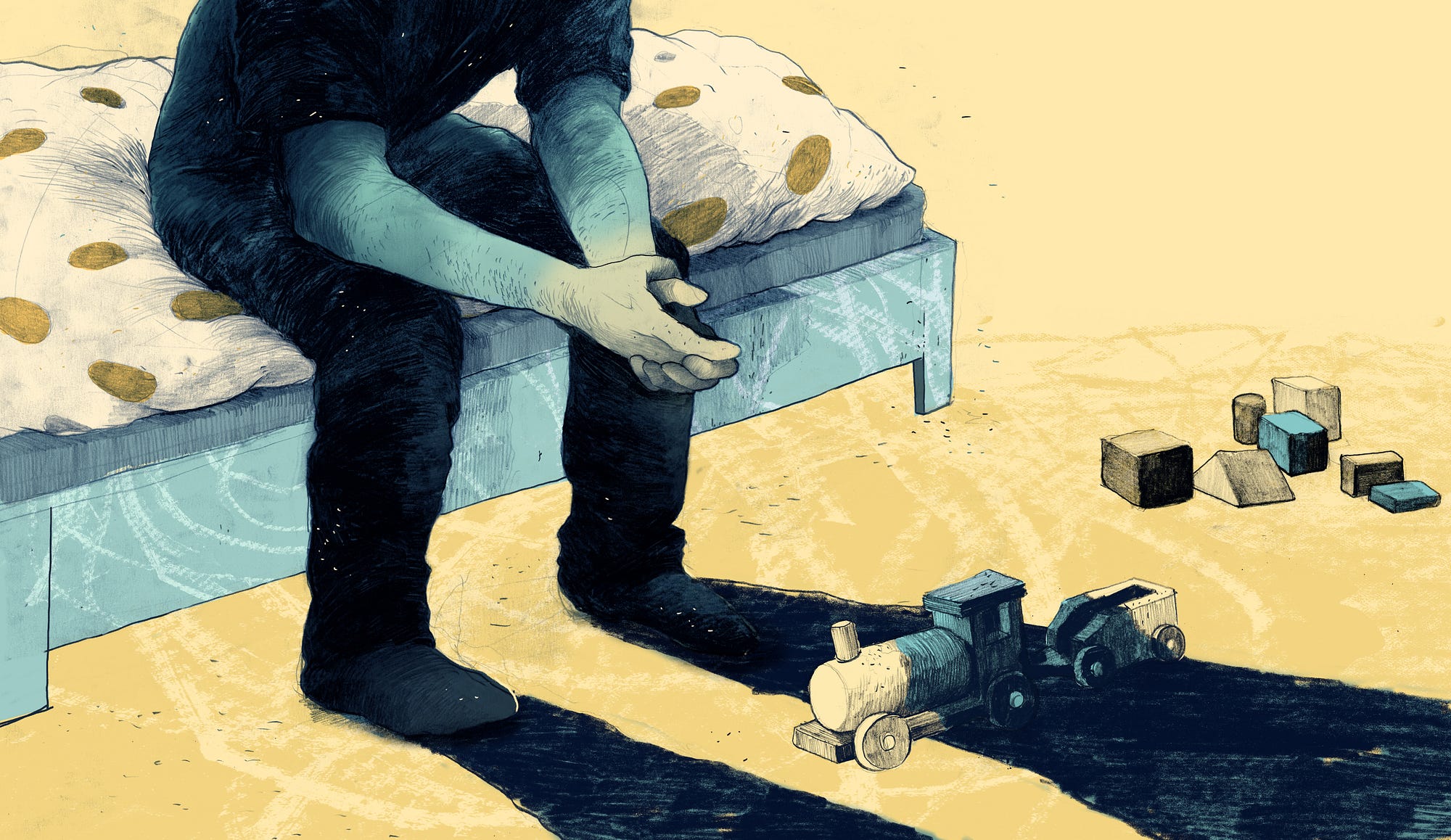
He moved over to his bed, a twin with a sturdy, wooden frame, and lay down on the crumpled blue and white cloud-print sheet. Band posters clung to the surrounding walls. Directly across from the foot of the bed was a bookshelf housing an impressive collection of horror novels. Atop the shelf sat several chess and baseball trophies whose silver sheen had been dulled by dust, and he stared up at them as he tried to process what he had just seen. He felt, he told me later, a combination of anger, sadness, and confusion.
Seeing that toddler trussed up and in pain confirmed something he’d long suspected but now had to acknowledge. The man in the video was one of those guys they sometimes talked about on the news. Though Adam didn’t want to hurt anyone, he knew that, on some level, he was just like him. He was 16 years old, he was a pedophile, and he had to do something about it.
WE HAVE A FEW go-to archetypes when it comes to pedophilia: There is the playground lurker, the chat-room predator, and the monstrous (often religious) authority figure. These men are usually middle-aged, unrepentant serial abusers who are caught only after remaining undetected for years. But what about the preceding decades? When do these urges first begin to manifest?
The Diagnostic and Statistical Manual of Mental Disorders defines a pedophile as an individual who “over a period of at least six months” has “recurrent, intense sexually arousing fantasies, sexual urges, or behaviors involving sexual activity with a prepubescent child or children.” This person also has to have “acted on these sexual urges, or the sexual urges or fantasies cause marked distress or interpersonal difficulty,” and be “at least age 16 years and at least five years older than the child or children” involved.
Anecdotal evidence suggests that most pedophiles first notice an attraction toward children when they themselves are between 11 and 16, mirroring that of any other sexual awakening. It can be a confusing time for any of us, but imagine realizing that you’re attracted to little kids. How do these young men and women negotiate that with no viable role models or support network? There is no It Gets Better for pedophiles. Are they all fated to end up as child molesters? Or is it possible for them to live a life without hurting children at all?
I spoke with experts and asked around online. I came across a site for self-described pedophiles who acknowledged their attraction and wanted help dealing with it. But the men I met were in their 50s and 60s, and I’d hoped to speak with someone younger, someone still coming to terms with what he was learning about himself. I asked them if they knew anyone like that, and a few weeks later I received an email.
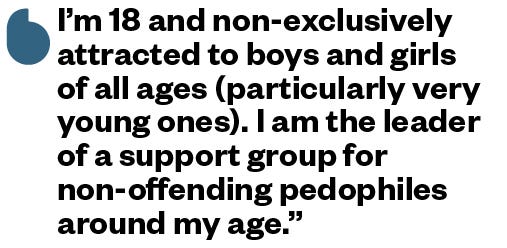
“My name is Adam,” it read. “I’m 18 and non-exclusively attracted to boys and girls of all ages (particularly very young ones). I am the leader of a support group for non-offending pedophiles around my age… I would be very happy to talk with you.”

ADAM IS NOW 20 (his name, like those of other young men in this article, has been changed). He has a slightly chubby build and messy, medium-brown hair. The first time we spoke at length about his attractions, we were sitting in his old, beat-up car, in the lot of a park near the house he shares with his parents and two older brothers. It had become our regular meeting place. Outside the car, locals chatted among themselves while herding frisky Labradors and Weimaraners into the backs of jeeps; two kids roughhoused in the dirt next to us until their father asked them to stop.
Talking about his pedophilic urges, Adam refused to look me in the eye, though he often stole glances when he thought I wasn’t looking. He first noticed his attraction toward young children when he was 11. He’d developed a crush on a kindergartener at school, a boy, his desire fueled by brief, furtive glimpses of him in the halls. By the time he reached 16, his sexual interest in kids had become more defined. He found himself attracted primarily to boys between three and seven and girls aged five to eight.
When I pressed him about what he finds most attractive in a child, he shifted in the car seat from side to side, and eventually managed to say: “Small body, hairless legs, you know, things like that… like small genitalia.” But there is a strong emotional pull, a potent idea of innocence that, he explained, is far more intoxicating than anatomy. “A lot of us tend to have, I think, unrealistic views of kids,” he said. “To the point that they’re kind of angelic.” This purity, he told me, is what keeps in check his urge to act on his desires. “I see an innocence in children that would be violated,” he said.

It is why the video of the toddler, out of everything he’d seen, rattled him. There was no denying that the boy was being debased. The bound child was wailing as the man defecated on him, though his cries were soon replaced with choking splutters as his abuser began urinating in his mouth. “I wanted to reach through the computer screen and kill the person,” Adam said. “I was just so horrified at what I saw.”
I asked him what happened in the days and weeks after he’d watched the video, and he admitted he didn’t stop downloading child porn straight away. He tried his best to abstain, often going weeks, but would end up back in front of the computer. He scoured the internet looking for a way to help him break his porn “addiction” and deal with his attraction to children, and ended up at a general mental health forum. This site stated that new visitors must offer an introductory message. “I know that pedophiles don’t choose to be pedophiles,” he wrote. “I didn’t want my attraction. I don’t want my attraction. But the attraction is there, and all I can do is try to curb it.”
Instead of posting it right away, he went to bed and masturbated to child porn. “I actually felt okay about that because I reasoned that I was taking the first step toward getting help,” he said. “I guess like a drug addict enlisting in rehab and then using one last time before it starts.” He published it the following morning.
The response to his post was mixed. Some commentators were working through their own abuse history, and couldn’t stomach the idea of helping a self-confessed pedophile. But two female sexual-abuse survivors eventually came forward, convinced that he was of an age where a change could still be made. One of them, Adam believes, had suffered particularly brutal abuse, abuse that was filmed, and their conversations about the evils of child pornography would often trigger her past traumas. “She cared about me,” he said. “But she made it known that she felt I deserved whatever the law decided to do with me if I were caught for the CP [child porn].”
More than once she kept him distracted from watching porn until the early hours of the morning, when he was tired enough to go to sleep.
HIS PORNOGRAPHY habit, of course, was merely symptomatic of a larger issue. It took him a long time, he told me, to accept that his desire for young boys wasn’t simply going to evaporate just because he’d stopped downloading and watching videos, and he grew increasingly despondent trying to suppress these feelings. “I was passively suicidal for a long time. I went six months without seeking actual help aside from online,” he said.
One night, while his father was out, Adam walked into his parents’ room and handed a note to his mother as she was lying in bed. “Read this,” he said. Paula (whose name has also been changed) looked up at him and opened her mouth to speak but changed her mind when she saw the expression on his face. He slipped back out of the room and she considered the letter for a moment, turning it over in her hands. She got up and walked down the hall to Adam’s bedroom, and found him curled up in bed with his back to the door. She called out to him, but he pretended he was already asleep.
Not knowing what else to do, she walked back to her room and unfolded the note. When Adam sent me a copy of it years later, he told me he couldn’t read past the first few lines, the memory of this time still so raw for him.
Dear Mommy, I am writing this letter to you as I cannot bring myself to say what I need to say to you to your face. It would simply be too painful for me, and I don’t want you to see me cry and struggle, nor do I want you to be pained by seeing me do so… I find that I am seldom happy, and very rarely go through days when I am entirely happy… I am always overshadowed with feelings of depression, guilt and shame. I’m really sick and tired of covering these feelings up… I want you to let me see a psychologist, and for both your and my own privacy, I don’t want you to be in any way acquainted with him/her… I understand that you probably have a lot to ask me, but I need some time to get my head wrapped around things. I thank you in advance for my privacy. Love, Adam.
He didn’t explain the source of his depression and his mother decided not to ask. The next morning, she pulled him aside and told him she would find him a local therapist who took their insurance.
It was a Friday morning when Adam went to see her. As he sat with his mother in the waiting room, the reality of what was about to happen washed over him. He was overwhelmed. He was about to vocalize a secret he’d only ever previously admitted to strangers on the internet.
He was called into her office, his heart racing as he stepped toward the door. She closed it behind them, offered him a seat, and began the session with questions familiar to anyone who has been in therapy, “family history, how many siblings I have,” that kind of thing. She scribbled his answers down in a notepad, and then asked why he had come to see her. Adam had never in his life felt such dread. His body began to shake as he explained that he suffered from anxiety. She asked what was making him anxious, and he just blurted it out: “I’m a pedophile and I’m addicted to child pornography.”
She blinked at him for a moment and then asked him to repeat himself. When he did, her mood changed. “She just became extremely cold and harsh,” he said. “She even, a few times, almost got to the level of shouting.” She suggested that he was simply nervous around kids his own age — a reaction I’ve learned is common among therapists with limited experience in this area. She told him she wasn’t trained to deal with the situation, but she would ask around for information on how to help him and scheduled a second session for a couple of weeks later.
I asked Adam why he agreed to see her again, and he said he felt he had no choice: “I didn’t have anything else, you know?” He soon found himself back in the waiting room with his mother. “I walk in, she asks how I’m doing, and she seems a little bit more sympathetic,” he said. “But she told me pretty much right away, ‘I can’t do this. I have to tell your mom.’”
THERE IS CURRENTLY no mechanism for treating someone who has pedophilic urges and hasn’t acted on them. A major roadblock is the existence of mandatory reporting laws, which dictate that people in certain professions must report suspicion of child abuse and neglect to Child Protective Services. (The individuals required to make a report varies from state to state; it can include all citizens but is usually restricted to those whose work puts them in regular contact with children, such as teachers, police, and psychologists.)
Mandated reporting revolutionized the way child abuse is handled in the U.S. and has brought many incidents to light, but it can be problematic for young men like Adam who haven’t abused children. The civil and criminal liabilities facing those who fail to report someone who goes on to molest a kid, combined with the fact that it need only be based on suspicion and not probable cause, means a report could be triggered when well-intentioned individuals reach out for help. The overwhelming number of minor-attracted men I spoke with said this was too much of a deterrent. Which also makes it harder to learn more about them.
There is a lot we still don’t know about pedophilia—one researcher described our scientific understanding of it as a series of “pretty big black holes.” We don’t know, for example, how someone comes by an attraction for prepubescent children in the first place. The research we do have, and this is derived from very small sample sizes, suggests that those attracted to kids tend to be shorter, left-handed, and have a lower IQ than the broader population. Another study found that being knocked unconscious before the age of 13 might be a factor. This may sound like quackery, but it points toward biological causation. In other words, it’s likely that pedophiles are born this way.
Things are a little clearer when it comes to the numbers. Studies suggest that up to 9 percent of men have fantasized about having sex with a prepubescent child, and 3 percent of all men have gone on to sexually offend. (Not all of them would meet the diagnostic criteria for pedophilia. The latter figure includes situational offenders, men who abuse children if the opportunity arises but who otherwise have no pre-existing attraction to kids.) Michael Seto, director of the University of Ottawa’s Forensic Research Unit and associate editor of Sexual Abuse: A Journal of Research and Treatment, believes that the prevalence of male pedophiles sits closer to 1 percent of the population, which would equate to at least 1.2 million in the U.S. alone. (Female pedophiles exist, but in smaller numbers.)
The distinction between fantasies and behavior is an important one to make. Our failure to acknowledge the existence of pedophiles who choose not to act on their desires not only prevents them from coming forward to seek help but is also an obstacle when it comes to gaining support for therapeutic intervention. Seto told me there is evidence to suggest that there are a significant number of men who are sexually attracted to children and struggling, often alone, to keep their urges in check. “If you did a survey of the general public,” Seto said, “I think a large majority would assume that anyone who is sexually attracted to prepubescent children has acted on it.”
“THE FIRST THING that I recall the therapist saying is ‘We’ve got a problem,’” said Adam’s mom, Paula. She knew something was up when she first entered the room. She saw her son staring at the floor, “not speaking… practically not breathing, he wasn’t moving a muscle, other than he was shaking.” And then the therapist told her why she was there.
“I was really, really shocked. I thought we were going to be talking about depression. That wasn’t even on my radar of what I thought could even come up as part of the problem,” she said. “It immediately entered my mind that perhaps somebody had abused him. How else could this have happened? How else could he have even thought to do that if he wasn’t abused?”
But while victimization is a risk factor for perpetration, it’s not a given, and the majority of abused children do not go on to offend. Paula believes her son when he says it’s not the case. “If it had already come out that he was engaged in looking at child pornography, why would he then hold back on the other component?” she said. “It would have been easier, I think, from his position to say that something had happened to him and then he is considered a victim.”
Paula hasn’t told anyone about what she learned about her son — not a friend, not a therapist of her own, not her husband. Our conversations were the first she’s had about it since finding out. “Nobody,” she said, with a melancholic laugh, when I asked who she turns to for support. “I can be certain that his dad would not have, I don’t think could have, handled it in a similar way as myself. He’s just much more emotionally reactive.”

But it doesn’t mean she hasn’t been thinking about it. I was surprised by how eager she was to talk about Adam, and so directly. In fact, discussing her son’s attraction to children seemed to come as a relief. “It is something I’m aware of when I lay down to sleep and I’m aware of it when I get up,” she said. “It’s always on my mind.”
Paula copes by being pragmatic. She helped her son find a new therapist, one better equipped to help him deal with his attractions. And when that new therapist suggested he remove all information on the two computers he used to access child porn, so as to reduce temptation and possible legal ramifications, she led the charge. “Adam told me that the only way to do that would be to actually replace the hard drives, because writing over them or just deleting information does not actually get rid of it—it’s still embedded, it’s still there,” she said, adding that they destroyed the originals. “I didn’t want him to be at any risk whatsoever, and I felt the thing to do was to immediately get rid of it.”
Her concern was hardly disproportionate to the potential repercussions. Possession of child pornography carries statutory penalties under federal and state law. These penalties can be so severe that those caught with child porn can receive longer sentences than those convicted of child abuse. Because the videos he downloaded included children under 12 years old, a first-time offender like Adam might have been fined $100,000 and sentenced up to 20 years in prison; the maximum term can be increased to 40 years for those with prior convictions.
Paula said her greatest fear is that he might one day go back to viewing child porn, but, after a little pressing, she acknowledged a larger concern. “I know that he has had thoughts, I know that he’s had urges… I know that when people have urges and thoughts that they can progress to actions, and of course I worry that could happen,” she said. “I don’t want there to be any victims. I mean, every child is very important. My son is important to me, and I would feel horrible if he was abused and I would feel horrible if he abused, so there’s no winners there.”
She and her son hadn’t spoken directly about that day at the therapist’s office, much less the underlying issue, in the intervening three years. They only recently resumed the discussion when I persuaded Adam to ask if she’d be willing to speak with me. This has forced Paula to come to terms with things she was able to avoid before. He told her he identifies as a pedophile and “it is his expectation that this is going to be a very long, lifetime struggle.” It was painful to hear, though, important. But she remains hopeful for his future.
“Best-case scenario is that this never happened and this never could happen to my son or anybody’s son, but that bubble has already popped because bad things do happen to good people and good sons and good mothers,” she said. “The next best-case scenario would be to be able to live with this burden and live a normal and happy and productive life… I want him to be happy, to not feel depressed about this, and to be able to fulfill all of his dreams that were there before and that should continue to be available to him even living with this.”
ADAM’S NEW THERAPIST put him on Zoloft and taught him to resist the urge to identify with the child molesters he encountered in the media. “A lot of it was, ‘I’m a monster’ for having viewed that stuff but also just for having these attractions,” he said. “What you hear in the media and online and how people talk, it sinks in, you know? You don’t even question it. It’s just kind of a fact.”
But his sense of social isolation wasn’t so easily remedied, and his thoughts about young children were as strong as ever. He had maintained an active presence on the mental health message boards, but said most of the members he knew were abuse survivors, depressives, or alcoholics — no one who could truly understand what he was struggling with on a daily basis.
One day he typed the words “young pedophile” into Google, and his original thread on the mental health board was the first entry to come up. But when he started to scroll down he saw similar entries on other boards, ones with headlines like “I’m a young pedophile and I need some help” and “How can I get free counseling? I’m a teenage pedophile.” Desperate for someone to relate to, he started reaching out. “I’d say, ‘I’m a pedophile. I used to have a child porn addiction. I know what you’re going through,’” he said. “‘You obviously need help, and I know someone else around our age who’s like that. I think we could be a good support for you and vice versa.’”

This is how he began communicating with other young pedophiles around the world. In turn, they introduced him to those they had managed to find. Distinct from the idea of a malevolent pedophile ring, these young men — and occasionally young women — said they didn’t want to hurt children and were trying find a way to make sure they never would. Some messaged back and forth before dropping off (“They probably got scared that it was a sting operation,” said Adam), but one by one a cluster of regulars formed. Before long Adam had inadvertently established an informal online support group for pedophiles in their teens and early 20s who want help battling their attraction toward children.
Speaking with members of the group, it’s apparent their concern about detection sits close to the surface — each citing a fear of rejection by family and friends, and the unwanted attention of law enforcement. Yet, Adam explained that many are willing to risk it rather than continue to battle their demons alone. “For a pedophile, there is almost no place to go and get information or any sort of help,” he said. “I’m sure that there are pedophiles who kill themselves who never come out as that. Who never admit to it, even in a suicide letter. I think there’s probably a lot more than people would realize.”
There are currently nine members, ranging in age from 16 to 22, eight men and one woman, though Adam said others have come and gone over the years. Some members hail from as far abroad as the Philippines, but language barriers confine most participants to the U.S. and the U.K. His group has two rules. The first is that you can’t have offended or harbor any intention to do so; those who question the concept are banished if they can’t be convinced otherwise. The second is a commitment to stopping the use of child pornography. Adam told me it’s okay if you come into the group as a user, but you must be devoted to quitting.
Adam’s mom recently found out about the group. Realizing that support is elusive to those in his situation, she accepts it. But she also harbors reservations about them operating without the oversight of professionals. “We need to understand the problem so that we can find appropriate ways to fix it. The way to help is to identify anyone that wants help,” Paula said. “We have to make connections. Just as they have things like hotlines for people to come forward and get help with problems they’re having, there has to be something available and advertised for young people that may be having these thoughts and these urges.”
“ANYONE THAT'S DONE treatment with people who have sexually offended know that many of them are horrified by their behaviors,” Elizabeth Letourneau, founding director of the Moore Center for the Prevention of Child Sexual Abuse at Johns Hopkins University, told me. “A lot of these guys don’t want to be sexually abusing children.”
We first met at her office one dreary afternoon last February. Out the window, whose sill was flanked by framed photos of her two sons, you could see rain gently blanketing downtown Baltimore. The center’s core mission is “to try to change the way the nation views child sexual abuse, as something that is preventable.” From a desk piled high with books and manila folders full of journal articles, she continued: “We say we’re really concerned about sex offending and we really don’t want children to be sexually offended and we don’t want adults to be raped, but we don’t do anything to prevent it. We put most of our energy into criminal justice, which means that the offense has already happened and often many offenses have already happened.”
Letourneau is the only U.S. researcher developing science and policy in the field of primary prevention. She wants to implement a program, separate to her work at the center, that provides preventive therapy for non-offenders and offenders alike. Her focus will be on adolescents, at least initially. She believes that early intervention is more effective and that teenagers pose less of a threat to potential funders and review boards. She would also like to get parents involved, though this would present its own challenges. “The risk that you face when you have to pull in a parent and a kid is that you’re going to lose some kids who are not able to talk about this to their parent, out of fear or shame or embarrassment,” she said. “We will miss some important subgroups.”
Adam told me that, when it comes to pedophilia, there are other distinctions beyond age and gender preference — most notably, primary and exclusive attraction. A primary interest means a person is sexually focused on children but can also be aroused by those who are more age-appropriate. Exclusive attraction is when someone feels no sexual desire for anyone but prepubescent kids. Letourneau is curious if young pedophiles who show even a slight interest in their peers might respond to treatment that attempts to redirect their attention into that corner. For most people, our age of attraction increases as we mature, suggesting that it is variable. She wonders if pedophilic adolescents can be encouraged to develop acceptable sexual desires, but acknowledges that it wouldn’t be effective for those with exclusive attraction.

Historically, attempts to change sexual impulses have included arousal reconditioning, which involves, essentially, getting men to masturbate to fantasies of their preferred target and then switching to something more socially acceptable right before climax. But there is also the opposite, like satiation training, where patients masturbate to fantasies over and over again until they are drained of desire.
I suggested to Letourneau that talk of sexual reconditioning strongly echoes the tactics of gay conversion therapy, a harmful and wholly unsuccessful pseudoscience, and she was quick to distance herself. “It’s a horrible legacy of psychology and psychiatry,” she agreed. “It seems kind of archaic, actually. And, frankly, ethically challenging to do with kids. So coming up with a viable way that is respectful of the person, the child and the parent, but also effective… I don’t know what that’s going to look like. I have no idea. I don’t want it to look like arousal reconditioning, I can tell you that.”
Dr. Klaus Beier doesn’t believe in sexual reconditioning. He leads the team behind Prevention Project Dunkelfeld, a therapeutic program based in Germany that targets potential offenders. He believes that minor attraction is a fixed part of someone’s makeup, that it’s “fate and not choice.” His program is considered the global gold standard of preventive treatment, and its practitioners help adults manage their attraction to children rather than try to change it. “In my view, it’s not the inclination that’s a problem,” he said. “And I wouldn’t condemn the inclination, I’d condemn the behavior.” The program consists of weekly therapy sessions for up to 12 months. They favor cognitive behavioral therapy, but also offer libido-reducing medication, otherwise known as chemical castration, if a patient needs to reduce his sexual drive in order to benefit from treatment.

The cornerstone of the program, according to Beier, is confidentiality. Germany doesn’t have mandated reporting, and that, he said, makes it easier for men to seek treatment. The project’s aim is to bring as many undetected men forward as possible, which is more easily achieved when you remove the threat of punitive action. This includes men who have already molested a child in addition to non-offending pedophiles. In English, Dunkelfeld translates to “dark field.” Beier said most cases of child sexual abuse go unreported, and though it can be ethically challenging to suggest that sex offenders evade immediate prosecution, he and his colleagues believe that it’s better to bring them into the light for the sake of preventing further instances of abuse.
“Telling the police would not be the first step we would choose,” said Dunkelfeld’s research coordinator, Gerold Scherner. “If we know about this, we will talk about it frankly and openly: What happened? What can you do? How safe is the child?”
In the United States, researchers can apply for a Certificate of Confidentiality. These federal certificates, if granted, protect the privacy of research study participants and can offer temporary exemptions from mandatory reporting laws. But there has been only one certificate granted in the area of pedophilia research. Between 1977 and 1985, Dr. Gene Abel interviewed 561 unidentified sex offenders in order to better understand this under-researched population. No one has been given one since.
It’s a hard ask, but Letourneau is considering applying for a certificate when she launches her new program. She doesn’t know if she’ll have much luck. “I’d like to be able to include youth who have offended but who are undetected, and the reason for that is that if they’re undetected they’re gonna stay undetected,” she said. “Do you want them to get help or not? For my money, you really want to be working with the kids who have already started offending, because those are the ones most likely to offend again.”
“IT'S NOT THAT I don’t want to see a therapist,” said Mike, a 21-year-old on the West Coast. “It’s just that I don’t feel that I can see a therapist.”
I had been speaking with Mike online for two months before he agreed to let me fly out and meet in person. We met in the parking lot of a local supermarket and wound up talking in front of a Starbucks. He is pale and slight, and has a long face dominated by high cheekbones, wide brown eyes and dark, curly hair. Unlike Adam, he is outwardly confident and unguarded; he talks fast, casually jumping from one topic to the next, and has no reservations about discussing his attraction to children. He explained that he maintains a clear distinction between those he feels sexually attracted to and those with whom he feels a close paternal bond. He told me he only feels an erotic pull to girls aged seven to 12, and that for two-to-six-year-olds it’s more of a protective, almost brotherly instinct. He said this is what makes him such a good preschool teacher.
He is currently studying child development, and substitute teaches part-time for a pre-kindergarten program. He plans to continue working with kids up to six when he graduates from college, and said his connection to children helps him relate to them better. “I’ve had people say, ‘If you don’t go into teaching you’re doing the world a disservice. Like, you’re brilliant, why would you not?’” he said. “I never felt like I shouldn’t be here, this is dangerous… Long-term maybe this is a bad idea, but in the moment, right now where I’m at, I’m fine.”
Mike first noticed his sexual interest in children at 13, when he developed a crush on a girl he used to babysit. She was around three at the time and would strip naked and run around the house. “I was aware of it but it was like, well, it will go away,” he said. “I’m 13, so I’m transitioning from girls without boobs to girls with boobs.” He said he never acted on it, but that doesn’t mean he wasn’t tempted, admitting that he would find himself overcome with curiosity when he changed her diaper. “I’d want to touch her and that’s kind of as far as anything went,” he said.
When he started his teaching placement, he created a strict set of rules: staying away from the bathroom area where possible and avoiding any physical contact with the children. He said he would tense up when the more playful kids approached him for a hug. This wasn’t so much to keep the children safe, he told me, as to ensure people wouldn’t become wary of him. Which was something his dad warned him about when he first started. “He’s like, ‘People are going to be suspicious of you simply because you’re a guy. Don’t do anything stupid,’” he said. “And, honestly, I wonder if that had anything to do with it, because that kind of freaked me out.”
Adam asked Mike to be the first one to join the group in mid-2011, and they’ve communicated almost daily since. He said he’s not worried that Mike will abuse the children in his care, but he does wonder why he would leave himself open to temptation. “As much as I support Mike, and I’m definitely very close with him, his becoming a teacher is never something I’ve supported,” he said. “And not because I think he’d slip up, because I honestly believe very firmly that he wouldn’t, but I think he’s going to torture himself a lot in that position. I think that’s not going to make him very happy.”
Like Adam, Mike grew increasingly depressed while grappling with his desires. He never made active plans to commit suicide, but told me that he thought about it and knew what to do if the time came. “If I had a sawn-off shotgun, that would be it,” he said. “I don’t want to take pills because I could come back from that.” Ultimately, he felt he couldn’t kill himself and leave his family with no context for what he had done, and instead hoped that God would take care of matters for him. “But at the same time, I was still… It would be nice if I got hit by a car or I got really sick,” he said.
More than anyone else I spoke with, Mike seems like he could benefit from having a professional to talk to, and not just because of his proximity to children. I was taken by his urgent need to disclose information others might have a hard time expressing. Late one afternoon we were sitting in his car in the parking lot of a different shopping mall. After hours of conversation, I suggested that we wrap for the day and he flat-out refused, telling me in an uncharacteristically abrupt tone that he had to get it out. We continued speaking until the encroaching shadows finally met and turned to darkness, stopping only when the center’s cleaning staff began arriving for their night’s work.
IN PLACE of therapy, Mike leans on Adam and the group. They talk via email, text, telephone, and Skype, but their primary tool of communication is Gchat, where they can speak in groups or have multiple conversations at the same time. If arguments break out among members they look to Adam, their default leader, for advice.
In the beginning they were all pretty fragile, wrestling with this dark secret and what it meant for their futures. But once they’d exhausted talk of their attraction to children and the unique set of issues that come with it, they turned to far more routine topics: chatting about computer games or The Walking Dead, or sharing random YouTube clips.
Adam told me that sometimes they’d tease each other about peer-aged crushes, offering relationship advice and egging each other on to ask people out. “I talked to Mike a fair bit about dating. Partly about the guy I dated for a little while and partly about this girl in his class who he wanted to ask out. He’d find every excuse in the world not to do so, and I’d be supportive by trying to push him to take the leap,” he said. “We did talk about everyday things that most everyone else in the world has to deal with.”

James, 22, is another member of the group, and the only registered sex offender. In May 2011 he was convicted of indecent liberty with a minor and sent to prison. Adam was reluctant to break the group’s most fundamental rule by letting him join, but eventually became convinced of his commitment not to reoffend. Since then, they’ve grown close. “We talk about the obvious subject of being a pedophile, you can’t get around that,” James said, adding that it’s lost some of its urgency over the years. “We just think about it as if we’re both fans of this sports team. We sit there and talk about it in that same direction, but we can immediately turn around and talk about something else. To other people it’s a huge deal, but to us it’s just life. Life as it is. We’ve been living with it our whole lives.”
When I asked Adam to show me examples of their chats, he said they no longer keep records for security reasons. But, after some digging, he eventually found a handful of logs from the early days. The conversations in the documents he sent me veered from mundane to earnest, among them a discussion of whether shotacon or lolicon — manga and anime depictions of intergenerational sex — are morally acceptable alternatives to child porn. On several occasions it seemed like they were testing the waters with each other, admitting suspect behavior and then waiting for the other one to respond.
1:46 PM Mike: so you’re right
i do have a problem
i’ve started googling pictures of girls in their underwear and such on a regular basis
so fucking awful
1:47 PM Adam: …you need to stop this before it’s too late
if I can, so can you
Mike: yeah
ive even seen some CP show up in the results
Adam: :o
Mike: that was really disturbing
it wasn’t serious
Adam: did you look at it?
Mike: no
admittedly I kinda wanted to though1:48 PM Adam: you need to stopAdam’s group of young pedophiles isn’t the only such self-help resource on the internet. There is B4U-ACT, a Maryland-based outfit with around 100 subscribers, which offers peer support services to pedophiles and guidelines for accessing mental health providers who might be willing to help. However, the moderators of B4U-ACT claim that because they’re not a research organization they can’t say whether all instances of adult-child sex are intrinsically harmful. “But we do support and would advocate for minor-attracted people to live law-abiding lives,” said Matthew Hutton, the group’s spokesperson, who uses a pseudonym to protect his identity. “Even though we acknowledge the existence of research in the past that might say that some sort of contact between teenagers and older people might not be so harmful.”
This ambiguity made Adam and some others uncomfortable, and it’s why he didn’t stick around for long after signing up. A splinter group was formed, named Virtuous Pedophiles. Now the largest pedophile support group in the U.S., its 318 active members are clear in their belief that sex with children is wrong. The founders, Ethan Edwards and Nick Devin (also pseudonyms), both family men with children, enact this policy with tight moderation. If someone is seen to be voicing the opinion that minor sex is acceptable, he gets a warning. Repeat offenders are ousted from the group. The membership list is also restricted to those aged 18 and over, lest they be accused of wrongdoing.
While Adam contributes to discussions there from time to time, his focus remains on the young men who come to his own group for help. James, for one, speaks with a clear reverence for Adam. Though his status as a sex offender means he must attend court-mandated therapy, it is Adam and the others that he credits with helping keep him on the right path. It’s also not lost on him that, for everyone else, it is the only lifeline they have. “If they want help, if they want to be better, to try and fix their behavior and be a better person, he’s never given up on them,” he said. “He didn’t give up on me, he didn’t give up on Mike, he never gave up on any of us.
WHEN I TOLD Professor Letourneau that I was in contact with a group of young, non-offending pedophiles, she seemed taken aback. In her 25 years in the field she’s had plenty of experience with juveniles who have abused children, but she had never met a pedophile who hasn’t. It seemed strange to me considering her line of work, but she explained that, because such pedophiles rarely come forward, researchers have no way of accessing this particular segment of the population. “I don’t know anyone else who has made it a goal to talk to young people who have an attraction to younger people,” she said.
I asked her if she’d like to be put in touch with the group, and she jumped at the chance. After speaking with four of them over the phone, which she described as “kind of a life-altering experience,” she flew out and met Adam face-to-face, and has been speaking with him regularly ever since. She said they have taught her things about pedophilia that she didn’t know before, and it’s giving her a clearer understanding of how these attractions develop. She’s now using this information to modify her proposed treatment plan and has brought Adam on as an official advisor.
“I’m not a teenage boy attracted to children, and so I don’t know what that experience is like,” she said. “They all describe years of just agonizing self-hatred, agonizing fear of being detected as having sexual interest in children, viewing themselves as monsters, being afraid to look for help… If they could have just turned to someone to talk about this, a professional who’s going to treat this subjectively and see them as a person of worth, who’s going to know that they’re not bad kids, that they’re good kids but they have this aspect of them that they really need help controlling. That’s what they’re looking for and that’s what I hope we can provide.”
Adam’s input has helped expedite the pilot program she’s putting together, aimed at pedophiles aged 17 and under. If successful, it will provide the foundation for a comprehensive preventive model, which she hopes to eventually expand to include pedophiles of all ages, that will be rolled out online and to therapists across the country. Though it’s in the early planning stages, Letourneau imagines it will involve disabusing them of the notion that sex with children is ever appropriate, improving self-esteem in light of a situation that might not change, and strengthening social interaction with their peers. In many ways, it’s an extension of what Adam has been doing with his group for the past three years.
The last time I saw Adam in person we found ourselves sitting, once again, in his car. We had been talking for a few hours and were about to finish up when I asked him what it feels like to be not only a pedophile, but something of a pioneer. He paused for a moment before answering. “It’s one part of what defines me. You know, a small part of the puzzle,” he said. “Part of me is a pedophile but that’s not all I am. I’m also, I think, a very decent person in a lot of other ways. I’m definitely a very caring person… I have hobbies, I have interests, I have studies, and things like that all put together define who I am.”

This story was written by Luke Malone. It was edited by Mark Lotto, fact-checked by Hilary Elkins, and copy-edited by Lawrence Levi. Illustrations by Simon Prades. A version of this story first appeared on This American Life.
Read more: Editor Mark Lotto discusses the graphic nature of this story, and art director Erich Nagler talks about how to illustrate the most horrifying piece in the world.


 by
by