Showing posts with label lesbians. Show all posts

Sunday, September 21, 2014

Domestic Violence Appears More Likely for Same-Sex Couples

http://www.washingtonblade.com/content/files/2014/03/domestic_violence_insert_by_Bigstock.jpg

I've seen research suggesting that this is true in the past - but this adds to the evidence. It would be useful, too, to get a more comprehensive assessment of male same-sex domestic violence. As the article below notes, most of the research has been conducted on lesbians, not gay men or bisexuals.

We need to increase prevention eduction to the LGBT community, not just professional athletes and other high profile people.

Domestic Violence More Likely for Same-Sex Couples

By Janice Wood Associate News Editor
Reviewed by John M. Grohol, Psy.D. on September 21, 2014


Domestic violence occurs at least as frequently — and likely more so — between same-sex couples, according to a review of literature conducted by researchers at Northwestern Medicine.

“Evidence suggests that the minority stress model may explain these high prevalence rates,” said senior author Richard Carroll, associate professor in psychiatry and behavioral sciences at Northwestern University Feinberg School of Medicine and a psychologist at Northwestern Memorial Hospital.

“Domestic violence is exacerbated because same-sex couples are dealing with the additional stress of being a sexual minority. This leads to reluctance to address domestic violence issues.”

Previous studies have shown that domestic violence affects 25 percent to 75 percent of lesbian, gay, and bisexual individuals. However, researchers believe that a lack of representative data and underreporting of abuse suggests even higher rates.

An estimated 25 percent of heterosexual women experience domestic abuse, according to researchers, who note that that percentage is “significantly lower” for heterosexual men.

“There has been a lot of research on domestic violence, but it hasn’t looked as carefully at the subgroup of same-sex couples,” Carroll said. “Another obstacle is getting the appropriate samples because of the stigma that has been attached to sexual orientation. In the past, individuals were reluctant to talk about it.”

The research that has examined same-sex domestic violence has concentrated on lesbians rather than gay men and bisexuals, according to the Northwestern scientists.

“Men may not want to see themselves as the victim, to present themselves as un-masculine and unable to defend themselves,” Carroll said.

He suggests that homosexual men and women may not report domestic violence for fear of discrimination and being blamed for abuse from a partner. They also may worry about their sexual orientation being revealed before they are comfortable with it.

“We need to educate health care providers about the presence of this problem and remind them to assess for it in homosexual relationships, just as they would for heterosexual patients,” Carroll said.

“The hope is that with increasingly deeper acceptance, the stress and stigma will disappear for these individuals so they can get the help they need.”

The review was published in the Journal of Sex & Marital Therapy.

Source: Northwestern University

Wednesday, November 2, 2011

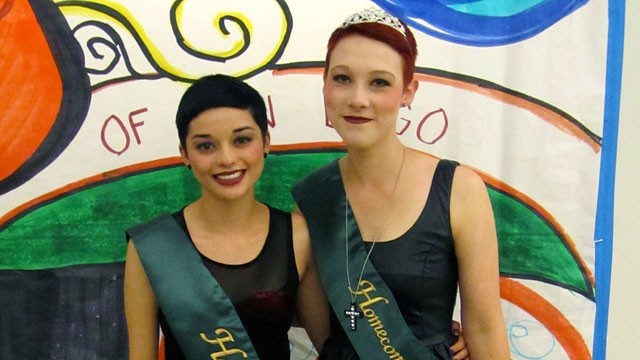
Lesbian Couple Crowned Homecoming King and Queen

From ABC News - I'm sure a lot of conservatives will get their anger on over this, but it was bound to happen eventually, so I'm cool with it. Surprising, to me anyway, there has already been a gay couple named Prom King and Queen. There is far less tolerance in this culture for gay men than there is for lesbian women.

Lesbian Couple Crowned Homecoming King and Queen

PHOTO: High School Students Crowned America's First Lesbian Homecoming Couple

Two California high school students became one of the first lesbian couples crowned homecoming king and queen in the nation this weekend.

Rebeca Arellano, a senior at Patrick Henry High School, was made the school's first female homecoming king when her name was announced Friday at a pep rally.

"They were chanting my name and it was one of the most amazing experiences I've ever had," said Arellano.

Arellano's girlfriend, Haileigh Adams, who also attends Patrick Henry High School, was made homecoming queen at Saturday night's dance.

"I was happier than when I won, my little Haileigh has just been announced Homecoming queen and I couldn't feel happier! Thanks to every single one of you! You guys made this happen and we are all part of something huge. I can't fully express how grateful I am. I am in completely shocked that this happen. My girl looks absolutely flawless," wrote Arellano on Facebook Saturday night.

Lesbian H.S. Student Crowned Homecoming King Watch Video
Teens Hail Gay Prom King, Queen Watch Video
Lesbian Couple Banned From Prom Watch Video
 
The two girls told ABC News that they're thankful for the abundance of support they've received from family, friends, and students and staff at the school.

Arellano said one of her teachers told her, "Today school is a bit better because of you girls."

Arellano's Facebook wall is covered with congratulatory notes from her friends.

"Thank you all for allowing this change to happen," Arellano posted on Facebook.
Adams said they have received negative feedback as well.

"We have a lot of support, but there are also a lot of people who are angry about it," she said. "Anonymous Patrick Henry students are saying they're embarrassed and that it's wrong for a girl to take the spot of king. But there's no other way for us to run as a couple. It's not really fair for us not to have the right to run as a couple."

Arellano posted a statement to those who opposed her on her Facebook wall that read: "For all the girls who think tradition should be continued, go back to the kitchen, stop having sex before you're married, get out of school and job system, don't have an opinion, don't own any property, give up the right to marry who you love, don't vote, and allow your husband to do whatever he pleases to you. Think about the meaning of tradition when you use it in your argument against us."

Adams and Arellano both came out their freshman year of high school, and they began dating in February of their sophomore year. They say their parents were supportive both when they came out and when they started dating.

Friday, December 24, 2010

Bullying, Part 2 - Targeting LGBT Youth

http://cci.sfsu.edu/files/images/FAP_logo.preview.JPG

In part one of this two-part post, I offered an article from the Boston Globe on the horrible and lasting effects bullying can have on the child's brain. LGBT youth are easy targets for harassment and bullying by their fellow students, and even by school authorities (LGBT youth are 40 percent more likely than other teens to be punished by school authorities, police and the courts).

On the bright side, support and acceptance by parents can help mitigate the impact of that harassment - when that support and existence exists, that is. There is also, now, the It Gets Better Project, initiated by Dan Savage.

For a variety of reasons, gay youth are the most common targets. Lesbian youth are not as ostracized and transgender youth are far less common (though they may be more troubled if they are identified by peers). This comes from the It Gets Better Project website.

Growing up isn’t easy. Many young people face daily tormenting and bullying, leading them to feel like they have nowhere to turn. This is especially true for LGBT kids and teens, who often hide their sexuality for fear of bullying. Without other openly gay adults and mentors in their lives, they can't imagine what their future may hold. In many instances, gay and lesbian adolescents are taunted — even tortured — simply for being themselves.

Justin Aaberg. Billy Lucas. Cody Barker. Asher Brown. Seth Walsh. Raymond Chase. Tyler Clementi. They were tragic examples of youth who could not believe that it does actually get better.

While many of these teens couldn’t see a positive future for themselves, we can. The It Gets Better Project was created to show young LGBT people the levels of happiness, potential, and positivity their lives will reach – if they can just get through their teen years. The It Gets Better Project wants to remind teenagers in the LGBT community that they are not alone — and it WILL get better.

Fortunately, mental health services can also help - and may be a necessity when parents are not accepting and supportive. This comes from the Center for American Progress.

Idea of the Day: Mental Health Services Can Help LGBT Youth Cope with Harassment

Lesbian, gay, bisexual, and transgender teenagers are some of the most vulnerable of people in the United States today. They face discrimination and harassment from a variety of different sources: bullying and harassment in schools, rejection at home, and condemnation from media and religious organizations. A fear of persecution encourages many LGBT teens to keep their real identities hidden.

Living with the stress of a marginalized identity has clear and negative effects on the mental health of LGBT youth. They are consistently reported as having higher rates of depression and anxiety than their non-LGBT peers. Even more troubling, studies have demonstrated that these young adults are more likely than non-LGBT teenagers to engage in self-harm, have suicidal thoughts, and attempt suicide.

Providing LGBT adolescents with access to mental health services is essential to helping them cope with the extreme pressures that have led many of them to consider suicide. Numerous studies have already demonstrated the benefits of mental health treatment for people suffering from depression and other mood disorders. Mental health counseling and therapy have a high probability of improving the mental health and wellbeing of teens, even when unaccompanied by medication.

For more on this topic please see:

I find it especially disturbing that adults - school officials, law enforcement, and the courts are more likely to punish LGBT youth that other young people. Apparently, lesbian youth are twice as likely to be stopped by police than their peers. My question on that would be: Is this about their sexual preference or is a form of sexual harassment?

Lesbian, gay and bisexual teens singled out for punishment

Posted On: December 6, 2010

Lesbian, gay and bisexual (LGB) adolescents are about 40 percent more likely than other teens to be punished by school authorities, police and the courts, according to a study by Yale University researchers. Published in the January 2011 issue of the journal Pediatrics, the study is the first to document excessive punishment of LGB youth nationwide.

"We found that virtually all types of punishment—including school expulsions, arrests, juvenile convictions, adult convictions and especially police stops—were more frequently meted out to LGB youth," said lead author Kathryn Himmelstein, who initiated the study while she was a Yale undergraduate. The research was supervised by Hannah Brueckner, professor of sociology and co-director of the Center for Research on Inequalities and the Life Course at Yale.

The study was based on the National Longitudinal Study of Adolescent Health (Add Health) and included about 15,000 middle and high school students who were followed for seven years into early adulthood. The study collected details on participants' sexuality, including feelings of sexual attraction, sexual relationships and self-labeling as LGB. Add Health also surveyed participants about how frequently they engaged in a variety of misbehaviors, ranging in severity from lying to parents, to using a weapon.

Add Health included detailed questions about school expulsions and contacts with the criminal justice system.

Himmelstein, who now teaches math at a public high school in New York City, said that adolescents who identified themselves as LGB were about 50 percent more likely to be stopped by police than other teenagers. Teens who reported feelings of attraction to members of the same sex, regardless of their self-identification, were more likely than other teens to be expelled from school or convicted of crimes as adults.

"Girls who labeled themselves as lesbian or bisexual were especially at risk for unequal treatment," said Himmelstein. "They reported experiencing twice as many police stops, arrests and convictions as other girls who had engaged in similar behavior. Although we did not explore the experiences of transgender youth, anecdotal reports suggest that they are similarly at risk for excessive punishment."

The study showed that these disparities in punishments are not explained by differences in the rates of misbehavior. In fact, the study showed that adolescents who identified themselves as LGB actually engaged in less violence than their peers.

"The painful, even lethal bullying that LGB youth suffer at the hands of their peers has been highlighted by recent tragic events," Himmelstein notes. "Our numbers suggest that school officials, police and judges, who should be protecting LGB youth, are instead singling them out for punishment based on their sexual orientation. LGB teens can't thrive if adults single them out for punishment because of their sexual orientation."

Brueckner added, "The study provides the first and only national estimates for over-representation of LGB youth in the criminal justice system. We simply did not have any good numbers on this before. We need more research on the processes that lead to this to help us identify ways to make our institutions more equitable with respect to policing all youth, regardless of race, gender, or sexual orientation."

~ Source: Yale University
Finally, there is this piece that shows how important it is for parents to be supportive. Many parents want to be supportive, but they were raised with values that reject LGBT people as sinful, or a mental illness, or whatever. They struggle to overcome their internalized beliefs - to accept and love their children - but they often do not know how. The Family Acceptance Project can help parents develop the skills they need.

Study finds family acceptance of LGBT youth protects against depression, substance abuse, suicide

Posted On: December 6, 2010

For the first time, researchers have established a clear link between accepting family attitudes and behaviors towards their lesbian, gay, bisexual and transgender (LGBT) children and significantly decreased risk and better overall health in adulthood. The study shows that specific parental and caregiver behaviors -- such as advocating for their children when they are mistreated because of their LGBT identity or supporting their gender expression -- protect against depression, substance abuse, suicidal thoughts and suicide attempts in early adulthood.

In addition, LGBT youth with highly accepting families have significantly higher levels of self-esteem and social support in young adulthood. The study is published in the Journal of Child and Adolescent Psychiatric Nursing, a journal of the International Society of Psychiatric-Mental Health Nurses, in a peer-reviewed article titled "Family Acceptance in Adolescence and the Health of LGBT Young Adults."

Despite all the recent attention to health risks and disparities for lesbian, gay and bisexual youth, prior to this study, little was known about how families express acceptance and support for their LGBT children. Moreover, no prior research had examined the relationship between family acceptance of LGBT adolescents and health and mental health concerns in emerging adulthood.

"At a time when the media and families are becoming acutely aware of the risk that many LGBT youth experience, our findings that family acceptance protects against suicidal thoughts and behaviors, depression and substance abuse offer a gateway to hope for LGBT youth and families that struggle with how to balance deeply held religious and personal values with love for their LGBT children," said Dr. Caitlin Ryan, PhD, Director of the Family Acceptance Project at San Francisco State University. "I have worked on LGBT health and mental health for 35 years and putting our research into practice by developing a new model to help diverse families support their LGBT children is the most hopeful work I've ever done."

Ann P. Haas, Ph.D., Director of Prevention Projects for the American Foundation for Suicide Prevention, noted, "With this new groundbreaking study, Ryan and her colleagues have provided the strongest evidence to date that acceptance and support from parents and caregivers promote well-being among LGBT youth and help protect them from depression and suicidal behavior. These findings open the door to a whole new focus on how families can be helped to more fully engage in the kind of behaviors that reduce suicide risk in LGBT adolescents and young adults."

"Times have changed," said Stephen Russell, PhD, President Elect of the Society for Research on Adolescence and a consultant to the Family Acceptance Project. "More and more families want to be accepting of their children. Yet, many families still struggle when a child comes out as LGBT. It's essential to have research like this to deeply understand the ways that families show their acceptance, so that we can identify how to support families."

The study, authored by Dr. Caitlin Ryan and her team from the Family Acceptance Project, which shows that accepting behaviors of parents and caregivers towards their LGBT children are protective against mental health risks – including suicidal behaviors -- has critical implications for changing how families relate to their LGBT children and how LGBT youth are served by a wide range of providers across disciplines and systems of care, including custodial care systems such as foster care. The study was funded by The California Endowment, a health foundation dedicated to expanding access to affordable, quality health care for underserved individuals and communities.

Major Research Findings:

  • Family accepting behaviors towards LGBT youth during adolescence protect against suicide, depression and substance abuse.
  • LGBT young adults who reported high levels of family acceptance during adolescence had significantly higher levels of self-esteem, social support and general health, compared to peers with low levels of family acceptance.
  • LGBT young adults who reported low levels of family rejection during adolescence were over three times more likely to have suicidal thoughts and to report suicide attempts, compared to those with high levels of family acceptance.
  • High religious involvement in families was strongly associated with low acceptance of LGBT children.

Dr. Ryan and her team at the Family Acceptance Project are currently developing a new evidence-based family model of wellness, prevention and care for LGBT adolescents, with funding from the Robert Wood Johnson Foundation. This model uses a behavioral approach to help ethnically and religiously diverse families decrease rejection and increase support for their LGBT children to reduce risk for suicide, depression, substance abuse, and HIV, to promote well-being and to prevent homelessness and placement in custodial care. This systems-level approach helps communities and providers to engage diverse families as allies in decreasing their LGBT children's risk and increasing their well-being while respecting the family's deeply held values. This work is being conducted in English, Spanish and Chinese with families from all ethnic backgrounds, including immigrant and very low income families, and those whose children are out-of-home in foster care and juvenile justice facilities.

The existing approach to serving LGBT adolescents by pediatricians, nurses, social workers, school counselors and others has focused almost exclusively on serving LGBT youth alone and through peer support, rather than in the context of their families, and does not consider the impact of family reactions on the adolescent's health and well-being.

In addition to providing direct services for families with LGBT children and working with communities in the U.S., the Family Acceptance Project is collaborating with organizations, providers, advocates and families to develop an international movement of family acceptance to promote wellness and healthy futures for LGBT children, youth and young adults.

"Family Acceptance in Adolescence and the Health of LGBT Young Adults" is the third in a series of research papers on outcomes related to family acceptance and rejection of LGBT adolescents, supporting positive LGBT youth development, school experiences and providing family-related care to be released by the Family Acceptance Project.

These studies will be published in peer-reviewed journals designed for providers, caregivers and practitioners from a wide range of disciplines and practice settings.

~ Source: San Francisco State University

Here are a few resources for LGBT youth and their families - if you need some support, these people can help, and connect you with someone who can.

National Sexuality Resource Center

2017 Mission Street, Suite 300
San Francisco, CA 94110
415-437-5121 begin_of_the_skype_highlighting 415-437-5121 end_of_the_skype_highlighting
nsrcinfo@sfsu.edu
nsrc.sfsu.edu

The National Sexuality Resource Center is a sexuality information center affiliated with the Human Sexuality Studies Program at San Francisco State University (SFSU). The Center collects and disseminates the latest information and research on sexual health, education, and rights to advocates, academics, researchers, policy makers, and diverse communities throughout the U.S.

LGBT Family-Related Organizations

PFLAG

(National Federation of Parents and Friends of Lesbian and Gays)
1726 M Street, N.W., Suite 400
Washington, DC, 20036
202-467-8180 begin_of_the_skype_highlighting 202-467-8180 end_of_the_skype_highlighting
www.pflag.org

National organization for education, advocacy and support for families and friends of LGBT persons. Chapters are available in all states – check website for local chapters and educational materials for families.

HRC FamilyNet

Human Rights Campaign
1640 Rhode Island Avenue
Washington, DC 20036
202-628-4160 begin_of_the_skype_highlighting 202-628-4160 end_of_the_skype_highlighting
www.hrc.org

A resource and online information base for LGBT families sponsored by the Human Rights Campaign.

Children of Lesbian and Gays Everywhere (COLAGE)

2300 Market Street, Box 165
San Francisco, CA 94114
415-861-5437 begin_of_the_skype_highlighting 415-861-5437 end_of_the_skype_highlighting
www.colage.org

National organization for children of LGBT parents.

Family Pride Coalition

PO Box 65327
Washington, DC 20035-5327
202-331-5015 begin_of_the_skype_highlighting 202-331-5015 end_of_the_skype_highlighting
www.familypride.org

National organization to provide advocacy and support for LGBT parents and their families.

LGBT Youth Organizations

National Youth Advocacy Coalition

1638 R Street NW, Suite 300
Washington, DC 20009
202.319.7596 begin_of_the_skype_highlighting 202.319.7596 end_of_the_skype_highlighting
Toll-free: 800-541-6922 begin_of_the_skype_highlighting 800-541-6922 end_of_the_skype_highlighting
www.nyacyouth.org

National advocacy organization for LGBT youth. Youth conferences and education.


Monday, May 10, 2010

Sinclair Sexsmith - A Manifesto for Radical Masculinity


Sometimes it takes an outsider to get to the heart of an issue. In this article from Carnal Nation, a feminist, butch lesbian offers her insights into how she came to appreciate the box in which many evolving men find themselves stuck.

Favorite quote:
Radical masculinity is strong enough to be vulnerable and receptive enough to put his foot down. Radical masculinity is trans men and fairy fags and butches who do girly drag. Radical masculinity is straight women with cropped hair and tool belts marrying men, not apologizing, refusing to take the lesbian jokes personally. Radical masculinity is a new form of fatherhood, of manhood, of adulthood, of humanhood. Radical masculinity is feminist men doing real work for equality and liberation for everyone. Radical masculinity is football games with your daughter's ballet class and ice cream sundaes with your high school son's best friends. Radical masculinity is big cuddly bears and vicious hardcore dharma punx, urban cowboys and the sexiest MMA fighters, yogis and your brother with his new baby and yes even sometimes your dad, showing everyone that you can teach an old dog new tricks.
There is a very limited range of acceptable male behaviors - and there are two essential tools the dominant traditional model uses to keep transgressive men in line: calling them gay or calling them little girls.

So I find it very cool to read this manifesto on masculinity from a woman, a woman who "gets it" in ways most men don't even get it. And certainly, few feminists understand this point of view - for all the reasons she presents in her own process of coming to this reality with which men must deal.

A Manifesto for Radical Masculinity

Remember back in the Spring of 2009 when two young boys committed suicide within a week of each other, both eleven years old? Carl Joseph Walker-Hoover of Massachusetts and Jaheem Herrera of Georgia were both being subjected to unbearable anti-gay bullying at school. Whether or not these boys were actually gay, using homophobia to police masculinity is practically the oldest trick in the book. In the aftermath of these suicides, and in the discussions that ensued on the Web and in print, there was extensive lip service given to gender and the inevitable complaint that boys have it so hard, that feminism has stripped men of their manliness, that men don't know how to be men anymore, that we've got a Crisis In Masculinity.

That might seem like anti-feminist rhetoric, but I agree with it—at least in part. I agree that masculinity is changing, for some in dramatic, drastic ways. I have witnessed and observed cultural changes around the masculine and male gender roles which are shifting, yes, as a direct result of the recent feminist and other gendered social change movements.

This bipolar—I mean polarized binary—gender system is built for the masculine and feminine to be in sync with each other, built to be in friction, built to be in an elaborate dance of give and take. The ideal of the "American Dream" suburbia that we think of from the 1950s and early 1960s laid out precisely just how the masculine and the feminine are supposed to be dependent upon each other and interact. The problem is, that system is completely prescriptive, with exactly one option for everyone. We are used to hearing the oh-woe-is-my-gender tales from women and the feminist movements in the recent past, but it is rather new to begin to untangle the ways in which this system damages men and prescribes certain traits within masculine expression, too.

I know; my inner feminist starts rolling her eyes. Oh yeah, sure, men have it so hard. Running the world and being 485 of the top 500 CEOs (and hey, that's more than last year! that means women are on the rise! Women are now taking men's jobs!) and never having to worry whether their work shirt is cut too low to be 'appropriate.' I spent too many years examining the plights of women and the plights of queers and the plights of people of color and the plights of all sorts of other socio-economically degraded and marginalized groups—I was raised by feminist parents and majored in Women Studies, after all—it takes some work for me to be convinced that men have the short end of the stick in this system that has set up masculinity to be superior.

But I know there's something wrong with masculinity, and I know it's hard to express one's self as masculine without falling into the many, many harmful trappings of the limitations of a masculine gender, because I'm butch.

I did not grow up that girly, mostly more due to the rural mountainous landscape of my upbringing than a lack of interest. I climbed trees in my dresses, snuck my makeup to high school, studied femininity and feared myself a failure at it. Femininity was never encouraged by my parents—they still have trouble separating gender expression, celebration, or presentation from prescribed gender roles, therefore taking on an attitude that all gender is oppressive. When I came out easily into lesbian communities that value androgyny, it was easy and comfortable to don "fuck your fascist beauty standards" tee shirts and chop off my hair. It is a rite of lesbian passage, you know.

But coming into my own masculinity was harder and took much longer. I wanted to go further than androgyny; I knew I was drawn to and wanted to be butch, but I wasn't sure what that meant. Hell, I'm still not entirely sure what that means (but I do love trying to figure it out).

Not knowing what it meant to "be masculine" held up my adopting a butch identity for many years. As a feminist, as a lesbian, I was constantly asking myself, and my boi-ish friends: what is masculinity, if not misogyny? What is masculinity without misogyny? How can I be a feminist and be masculine? Does feminism devalue masculinity? Isn't that the same problem as devaluing femininity? And more personally, what does masculinity look like on me? I could recognize it on other people, but I couldn't quite figure out how it translated, or how to break it down into its individual components so I could play with presenting it myself.

As I began making a serious study out of learning masculinity, I started seeing more and more parallels in the oppressive gender roles, regardless of where individuals fall in the hierarchy. The prescriptive roles are limiting and restricting, and predetermine too much which I would now separate out and call personality. I don't believe hobbies and interests should ever be determined by your particular gender identity—if you're into fashion or ballet or football or baking or knitting or home repair or cars or video games, why should it matter what your gender is? Your hobbies might interact with your gender—they might tickle your gender in just the right ways, which may or may not align with the prescribed gender role, but they should never restrict or determine what you do or do not like.

I tried to turn to my heavy background in feminist theory and gender theory to try to understand this limiting devaluing of masculinity, but found a gap. Feminism hasn't dug down deep into masculinity the same way it has dug down deep into femininity, and those who are digging down deep into masculinity are often reproducing some sort of essentialist tripe that clashes with feminism and feels completely removed from explaining my own experience. I want a masculinist theory that grows out of feminism, that works with women instead of against, that understands that all the so-called "man-hating" issues of feminism have much more to do with backlash than with fundamental philosophies of the work.

So I have studied butch. I was not born with swagger: I learned it. I earned it. I was not born knowing how to use a cock or tie a tie or match my belt to my shoes or court a girl or refrain from chivalry when it's not welcome or to contain something big and chaotic. I have read everything I can, gone to the performances, asked my friends or perfect strangers for their definitions and understandings and hardships. I've found that most of the misunderstandings come from simple, basic sexism—simple, basic policings of masculinity—like when I ordered a vanilla vodka and cranberry from the bartender at my regular bar and she leaned over the counter, confidentially, and said, "Really? Are you sure? Because that's awfully ... sweet."

Implying, of course, that sweet drinks are for girls and wasn't I a guy? A guy's guy? A butch's butch? Come on, order something that'll put hair on your chest, like whiskey or beer!

Why the fuck can't I just order what I want to order?

It isn't just me, either. As I've been more confident and explorative in my presentation and understanding of my masculinity, I've been observing over and over the limitations of masculinity in others, and the effect these limitations have on all kinds of people with masculine presentations—gay boys, trans men, straight men, women who date men, female masculinity, men who are unemployed in this recession, non-traditional men like my yogi straight cis male roommate, anybody who loves or cares for or is related to or interacts with men or masculine people.

The restrictions and prescriptions for masculinity affect everybody.

There are so many rules of masculinity which are really fucking painful, to ourselves and to others. The competition, the fighting, the physical violence, the anger, the rage, the lack of emotional expression, the policing of each other's weaknesses, the presumption that someone masculine is always sexually available and is probably sexually promiscuous, the issues of commitment, the expectations of "bringing home the bacon."

Of course, it is not all bad. There are beautiful traits, too, care-taking and problem solving and the use of tools and innovative thinking and observation and leading others in passion and entering and embiggening and guiding energy in just the right way. There are many people doing all sorts of Radical Masculinity work already—butches, genderqueers, gender-non-conformist folks, masculine trans women, effeminate trans men, gay men, men who are professional pastry chefs, metrosexuals, guy yogis, feminist men, the "new" stay-at-home-dads, and all sorts of other aspects of masculinity that are still desperate to be explored.

So many questions about masculinity still remain: what are male traits? What makes a 'good man'? What is a positive presentation of masculinity? What are masculine traits? Sure, I can describe physical presentation and some sort of energy movement, but what about emotional traits, what about interpersonal traits? Is there any truth to the broad-sweeping concepts about men from one planet and women from another? Can we really make any emotional, psychological, or interpersonal conclusions by dividing people by gender? I remain unconvinced that those conclusions are much more than stereotypes.

But I do know that we need to continue struggling and stumbling into a new masculinity, a radical masculinity, a masculinity that is not painful for those who wear it or those who fall in love with it or for those who interact with it. Radical masculinity does not hurt. Radical masculinity is strong enough to be vulnerable and receptive enough to put his foot down. Radical masculinity is trans men and fairy fags and butches who do girly drag. Radical masculinity is straight women with cropped hair and tool belts marrying men, not apologizing, refusing to take the lesbian jokes personally. Radical masculinity is a new form of fatherhood, of manhood, of adulthood, of humanhood. Radical masculinity is feminist men doing real work for equality and liberation for everyone. Radical masculinity is football games with your daughter's ballet class and ice cream sundaes with your high school son's best friends. Radical masculinity is big cuddly bears and vicious hardcore dharma punx, urban cowboys and the sexiest MMA fighters, yogis and your brother with his new baby and yes even sometimes your dad, showing everyone that you can teach an old dog new tricks.

Radical masculinity is a way to present, perform, play with, celebrate, and liberate masculinity, in thousands of multi-dimensional expressions. It is still being created, recreated, formed, and reformed, and I want to be a part of its ongoing evolution.